Category Archives: proprietors & careers

Find of the day: Hancock Tavern menu

hancocktaverndoublemenu

When I found this menu from Boston’s Hancock Tavern [shown front & back] at a flea market my first question was how old it was. As soon as I began researching I learned that proprietor Wadsworth & Co. had taken over in 1897 and that the building pictured was torn down in the spring of 1903. That narrowed things down.

At that point I thought I knew enough to consider the question of the tavern’s history, starting with “Built 1634″ as noted on the menu.

Then, everything began to unravel, including the menu’s date.

hancocktavern1867corncourtI discovered that Edward & Lucina Wadsworth had reopened the Hancock Tavern in 1904 at “the identical site of the original historic structure.” Which had been razed. It took a while to figure that one out but I eventually determined that the reborn Hancock Tavern was located in the rear, Corn Court side, of a new office building facing on State Street. [sketch of map fragment shows Corn Court and Hancock Tavern in 1867]

Then I found a story about a menu like mine found in a collection of items related to the Hancock Tavern — similar except that it said “Visit the Historic Tea Room Up Stairs. In this room the ‘Boston Tea Party’ made their plans, and dressed as Mohawk Indians to destroy the tea in Boston harbor, Dec. 16, 1773.” Since mine simply says “Private Supper Rooms Up Stairs for Ladies and Gentlemen,” I decided that it probably dates from the reincarnated Hancock Tavern, which would put it between 1904 and approximately 1910.

Much bigger mysteries surrounded the history of Hancock Tavern. By the late 19th century legends about the tavern abounded, beginning with the notion that it dated from 1634 as the continuation of a tavern begun by Samuel Coles. It was also said to have hosted John Hancock, exiled French king Louis Philippe, George Washington, Benjamin Franklin, and French foreign minister Talleyrand. But the grandest legend concerned the conspirators in the “Boston tea party.” Beginning in the 1880s, the various proprietors of the Hancock Tavern spun historic tales about this.
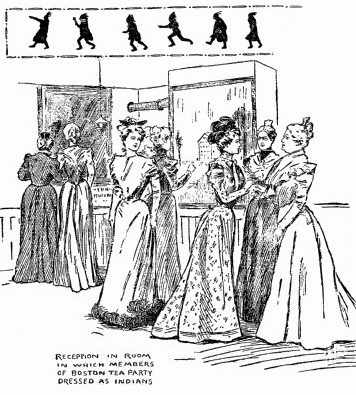
hancocktaverndec1898In December of 1898, the Daughters of the American Revolution, dressed as Colonial maids, met at the Hancock Tavern to celebrate the 125th anniversary of the tea party. On the wall was a somewhat more detailed inscription, likely put there by the Wadsworths: “In this room the Boston tea party made their plans and dressed as Mohawk Indians, and went to Griffin’s (now Liverpool) wharf, where the ships Beaver and Eleanor and Dartmouth lay, and threw overboard 342 chests of tea, Dec. 16, 1773.” Later, the Wadsworths produced a souvenir booklet of historic lore.

But the link between the tavern and the Revolution, as well as its ancient status, were thrown into doubt in 1903 when City Registrar Edward W. McGlenen announced that the just-razed building that had housed the Hancock Tavern had been erected between 1807 and 1812. Furthermore, he said, its predecessor on the same site, a two-story house, had not been granted a tavern license until 1790, ruling out any associations with the Revolution. He also showed that Samuel Coles’ Inn, reputedly built in 1634, was an entirely separate property, thereby demolishing the Hancock Tavern’s claim to be Boston’s oldest tavern. The legends, he said, had developed from a number of fanciful books and articles from the 19th century that were in conflict with town records.

And so my menu, though still more than 100 years old, lost some of its charm.

On the bright side, though, I learned a few things about the operation of 19th-century taverns. I learned that Mary Duggan, widow of the first licensee, ran the tavern for a number of years after her second husband died. In addition to supplying the finest liquors, she advertised in 1825 that she had engaged a “professed COOK” who would have soup ready from 10 to 12 o’clock (then the standard time to eat soup), and would prepare supper parties “at the shortest notice.”

I also realized how much turnover there was in the tavern business. During most of the 19th century the Hancock Tavern was leased out to a succession of proprietors who either handled its alcohol and food service or the entire operation, which included lodging.

It fell on hard days sometime before the Wadsworths took over in 1897. Their energetic attempts to raise its historic value may have sprung in part from the fact that it had spent some years as a gambling den. In a city with many old buildings, most Bostonians did not care about it.

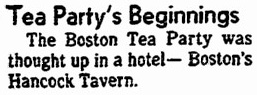
Having the bad luck to be located in what was fast becoming Boston’s financial district, the building was doomed, but the legend of Hancock Tavern’s link to the tea party lived on. The Arkansas Gazette reported in 1976:
hancocktavern1976© Jan Whitaker, 2016

6 Comments

Filed under atmosphere, history, menus, odd buildings, Offbeat places, proprietors & careers

Anatomy of a corporate restaurant executive

corpexecJPG1966Jan14localrestaurateurnowRAvpIt strikes me that much more has been written about and by chefs than those restaurant personnel who mostly work behind a desk. Business people lack the glamour of knife wielding chefs. They are not surrounded by flames. They have no dishes named after them.

But Frederick Rufe’s career in restaurants was as interesting as many chefs’ and he was undoubtedly more influential in shaping the dining experiences of countless restaurant patrons over his career of nearly 40 years. His entire working life had a single focus. In a 1974 interview he stressed, “Everything I’ve ever done has been with food.” As a management executive he was closer to the soul (or soullessness, depending how you see it) of both the upscale and the midscale American corporate-owned restaurant of the 1960s and 1970s.

Born in New Jersey in 1922 he came from a humble background, growing up in a one-parent household with his mother, who was a factory worker, and a brother. While a student at a teachers’ college, he spent one summer as a waiter for a Pennsylvania resort, leading him to detour from a teaching career to one in food service. Following WWII army duty (working in food supply), he obtained a degree from Cornell’s School of Hotel Administration, which excelled in turning out top hospitality industry executives.

He then went to work in Miami Beach as food and beverage manager at large hotels there, among them the Monte Carlo, Algiers, and Deauville. He was not shy about promoting himself. Aiming for a catering manager job in a hotel without such a position, he “invented” it for himself. He took over a vacant room, bought a desk, put up draperies, and hung out a “Catering Manager” sign. When challenged by his boss, he successfully convinced him that the hotel needed someone – him – in that position.

corpexecFourSeasonsAlbertStockli1960He joined Restaurant Associates in New York in the mid-1950s as the company was entering its most creative phase. RA was going from managing coffee shops and cafeterias to developing theme restaurants, some in the luxury class. In 1956 Rufe was made general manager of RA’s Newark Airport restaurants which included the famed Newarker, its kitchen headed by the inventive Swiss chef Albert Stöckli who would go on to the Four Seasons [pictured here]. Rufe helped develop the Four Seasons, the Forum of the Twelve Caesars, and La Fonda del Sol. At a time when out-of-season fruits and vegetables equalled the height of luxury, he obtained shipments of melons and new asparagus from the West for the Four Seasons, as well as miniature vegetables that allowed power-lunching VIPs to minimize awkward bites. With James Beard’s help he brought the blind cook Elena Zelayeta from California to plan Mexican and Spanish dishes for La Fonda del Sol.

corpexecJPG1960LaFondaDelSolMenuAmiable and worldly, Rufe could be mistaken for a European sophisticate. He was on James Beard’s holiday dinner guest list, and had easy access to the food columns at major newspapers where he promoted RA’s restaurants with recipes and interviews. While manager of the Latin-themed La Fonda del Sol, he explained to a reporter that a “broiling wall” of revolving stuffed flank steaks was based on a setup he had observed at an inn in Peru on a menu-collecting tour of South America with La Fonda’s chef John Santi. He was known for focusing on detail, so much so that his travel notes were said to look like research for a doctoral dissertation.

In 1964 he took on the task of rescuing the Top of the Fair, a failing de luxe restaurant atop the Port Authority’s heliport building adjoining the World’s Fair grounds. He was made a RA vice-president in 1967 and two years later put in charge of food operations at LaGuardia and Kennedy air terminals, as well as other airports in the Northeast. “Our places are genuine restaurants,” he insisted, “not just places to grab a quick meal and dash to your plane.”

corpexecJPG1978MayADVAfter a shift in RA’s direction, Rufe left for the Marriott Corporation where he was soon made VP of its dinner house division of moderate-priced theme restaurants in the DC area. The recession of the 1970s was on and Rufe explained in the press that Americans wouldn’t pay for $25 French dinners any more. Marriott’s new dinner houses were geared to more modest lifestyles. Phineas Prime Rib, Joshua Tree, Franklin Stove, Port O’Georgetown, and Garibaldi’s were management-driven eating places where every detail was arrived at through consumer research and economic calculation. Lunch was not profitable, so dinner only. No reservations because that resulted in less than 100% occupancy. Short menus with only America’s favorites, beef and seafood. All-you-can-eat salad bars. Fireplaces and ceiling beams evoking old-time hospitality. Friendly college student servers speaking from scripts. Cooking by step-by-step recipe cards. No chefs.

corpexecJPGADV1971At first the formula was wildly popular with modal guests – suburbanites with $15,000 annual incomes who ordered $6.95 meals and cleared out in 1.5 hours. “Seventeen million dollars and no chefs,” Rufe boasted in January of 1975. However, by 1978 competition was up and profits were down. Marriott decided to sell off its dinner house division and some of the restaurants closed under the new owner.

After a few years as director of food and beverage planning and development for Hilton International, Rufe retired, returning to Stroudsburg PA where he continued as a consultant.

Needless to say, the chain dinner house formula he helped develop prevails today, demonstrating that there is a sizable market for restaurants with pleasant decor, parking, clean bathrooms, and palatable fare that is affordable.

© Jan Whitaker, 2016
12 Comments

Filed under chain restaurants, food, proprietors & careers, theme restaurants

Restaurant-ing with Mildred Pierce

mildredpierceaswaitress

Many Americans are familiar with the story of the fictional Mildred Pierce, the mid-century wife and mother who kicks out her unemployed, philandering husband and becomes the family’s breadwinner so she can support her two daughters, especially her musically talented older daughter Veda.

Mildred Pierce was the main character in James M. Cain’s novel of the same name, the star of a melodramatic 1945 black & white film-noir with Joan Crawford, and the protagonist in a color HBO miniseries with Kate Winslet.

Lacking experience other than housewifery, Mildred turns to restaurants for work. Starting as a waitress, she builds a home-based business as purveyor of pies to restaurants, then opens a restaurant of her own, building it into a small chain in greater Los Angeles.

Although the three renditions of the story differ, they all feature Mildred’s restaurant career. Why did Cain choose this line of work for Mildred? I suspect he wanted something that readers would believe a woman could succeed in. Though I have no direct evidence, I feel sure he based Mildred’s career on that of the much-publicized Alice Foote MacDougall of 1920s fame whose success story was told repeatedly in magazines and syndicated newspaper columns. In the 1927 column “Girls Who Did,” MacDougall, then pushing 60, was headlined as “A Girl Who Never Expected to Enter Business and Who Has Become a Dealer in Wholesale Roasted Coffee and Owner of Four Restaurants.”

But – oh dear – MacDougall’s empire went into receivership in the early Depression, shortly after Mildred Pierce launched her restaurant chain. Of course most movies demand suspension of disbelief on the part of viewers, but let’s just admit that 1931 was not a favorable time to go into business. The 1935 National Handbook of Restaurant Data dismally reported that “75% of the women who open restaurants fail within the year.” Mainly, it said, due to lack of capital and knowledge of business management.

mildredpierceherrestaurarantMaybeCain, who stuffs his novel with copious details about running restaurants, must have been aware of this problem because he had Mildred, er, entertain her husband’s former business partner Wally to insure a favorable start-up. In the book she builds up to a total of three restaurants. The first, located in a house and specializing in chicken and waffles, actually conforms to the path many women of the 1920s and 1930s took starting small restaurants and tea rooms that served home-like dishes in domestic settings. Her second, a luncheonette in Beverly Hills, is somewhat believable despite being in a high rent area. Her third, on the other hand, a swanky beachside resort, is a reach.

Advancing farther on the unlikelyhood scale, the 1945 movie threw caution aside and had Mildred with five restaurants in only four years. Even the fantabulous Alice took 10 years to get to four! What’s more, all but one of Mildred’s had drive-in curb service, even though women rarely owned drive-ins. Plus, many drive-ins closed during the war because of gasoline rationing that limited driving.

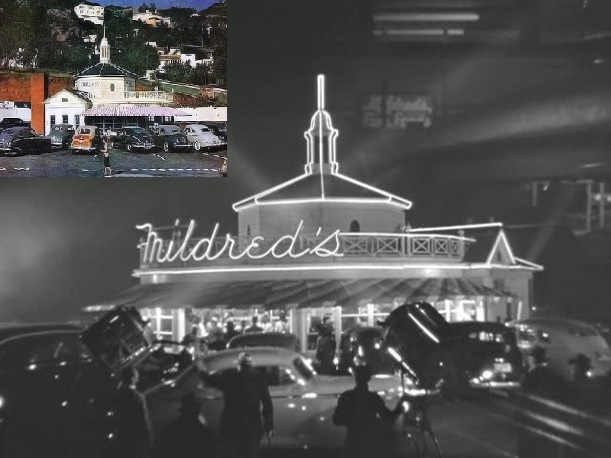
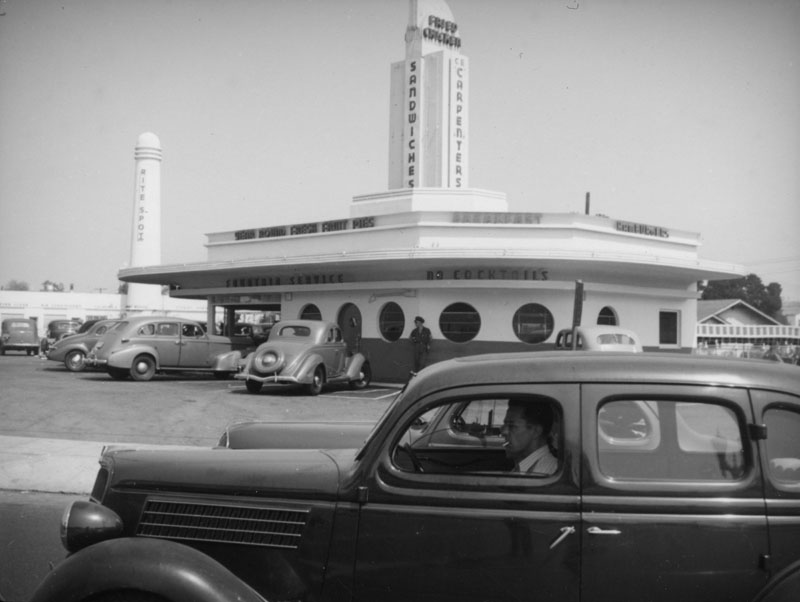
Of the five restaurants depicted in the 1945 film, three are identifiable as actual restaurant locations, while the identity of the other two is unclear.

MildredpierceDoloresdrive-inInset#1 – the new Dolores drive-in on Sunset Blvd. & Horn (inset top left; movie still in b&w)
MildredPierceexteriorofRestaurant4#2 – supposed to be Beverly Hills, but location unknown and possibly not an actual restaurant at all (movie still)

mildredpierceExteriorofRestaurant3 – unidentified but appears to be a real drive-in (movie still)

MildredPierceexteriorofrestaurant5#4 – exterior shot filmed at Carl’s Sea Air on the Pacific Coast Highway (movie still on left; Carl’s postcard on right)

mildredpiercecarpenter'sGlendale1938E.Colorado#5 – Carpenter’s restaurant on Glendale & Colorado shown fleetingly (not a movie still)

The slow-moving HBO series follows Cain’s book more closely than the 1945 movie. (As in the book, there is no murder.) There are only three restaurants, all movie creations: 1) the model house from the Pierce Homes development once owned by Mildred’s ex-husband; 2) the Beverly Hills luncheonette; and, 3) a seaside estate which doesn’t look a bit like it’s in California.

In the book and at several points in the 1945 movie Mildred, who we are told comes from the lower-middle class, runs up against the upper class, always getting bruised in the encounters. As a restaurant historian, one of the most interesting lines to me occurs when she meets the snobby mother of her daughter’s boyfriend. Mildred recognizes her but forgets that she had once interviewed to be her housekeeper and was humiliated by the woman. She tries to place her, asking if she has ever been to her restaurant and the woman replies haughtily, “But I don’t go to restaurants, Mrs. Pierce.” It would have been more believable in the East, around 1900, but still an interesting comment on the unexalted status of restaurant-ing.

Cain, who was also a gourmet, an amateur cook, and a magazine food writer on topics such as “Midnight Spaghetti,” “Crepes Suzette,” and “Carving Game Duck,” befriended Alexander Perino when he was headwaiter at The Town House and suggested Perino open his own restaurant which he famously did in 1932. Restaurants also figured in Cain’s books The Postman Always Rings Twice and Galatea, both of which involve the betrayal and murder of husbands.

In Cain’s Mildred Pierce, Mildred ends up broke, restaurantless, alienated from Veda, and living with her ex-husband, both of them ready to pursue a life of heavy drinking.

© Jan Whitaker, 2016
12 Comments

Filed under drive-ins, proprietors & careers, roadside restaurants, women

Image gallery: insulting waitresses

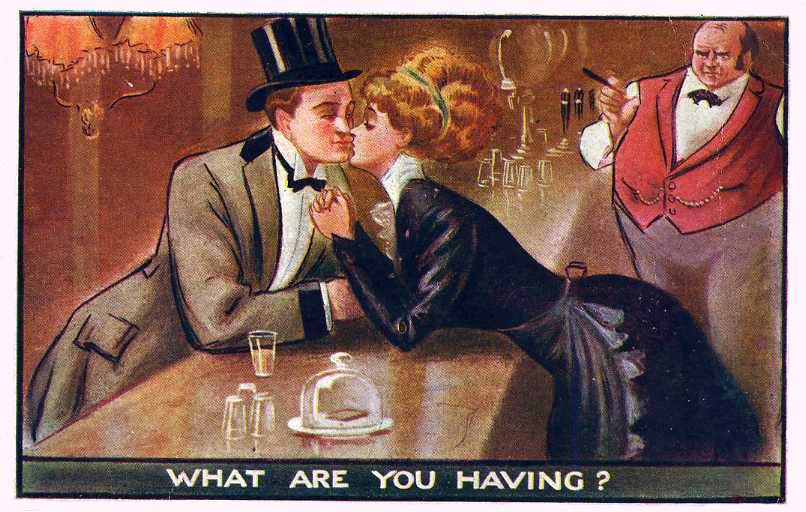
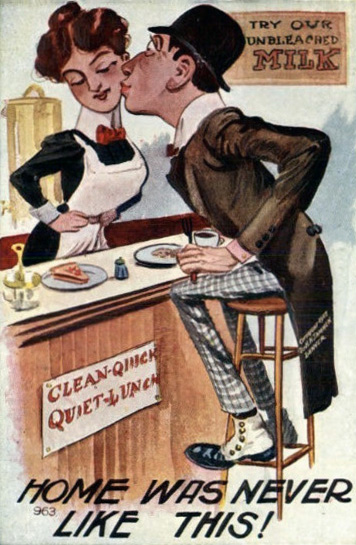
waitressinsultJudging from postcards and cartoons, the early 20th century was not a fun time to be a waitress. However hard working, competent, or skilled in dealing with demanding situations they may have been [see recent op-ed on how much skill serving takes], there was no recognition of that in popular images.

Quite the contrary. The images were of two basic types. Either female servers were shown as incompetent or as objects of fantasy who were open to the sexual advances of their customers.

waitressflirting

All but two of these images in this post are from 1906 to about 1915. The gum chewer is from the 1920s.

waitressspillingwaitressbeingkissedwaitress&Lecher

waitress1908BeaneryButeThe reasons for these degrading images could be many. Joke-style postcards were designed to get men to send postcards, an activity that they were less inclined to do than were women. Almost all joke postcards derived humor from insulting others, whether women, Blacks, immigrants, or the poor. On several of the cards in the post, the women illustrated are Irish immigrants, a status that was generally portrayed as both stupid and ugly. Women who were in the public eye, such as actresses, department store clerks, or restaurant workers, were evidently considered fair game, possibly out of resentment that they strayed outside the realm of church and home or because they appeared in public without male protection.

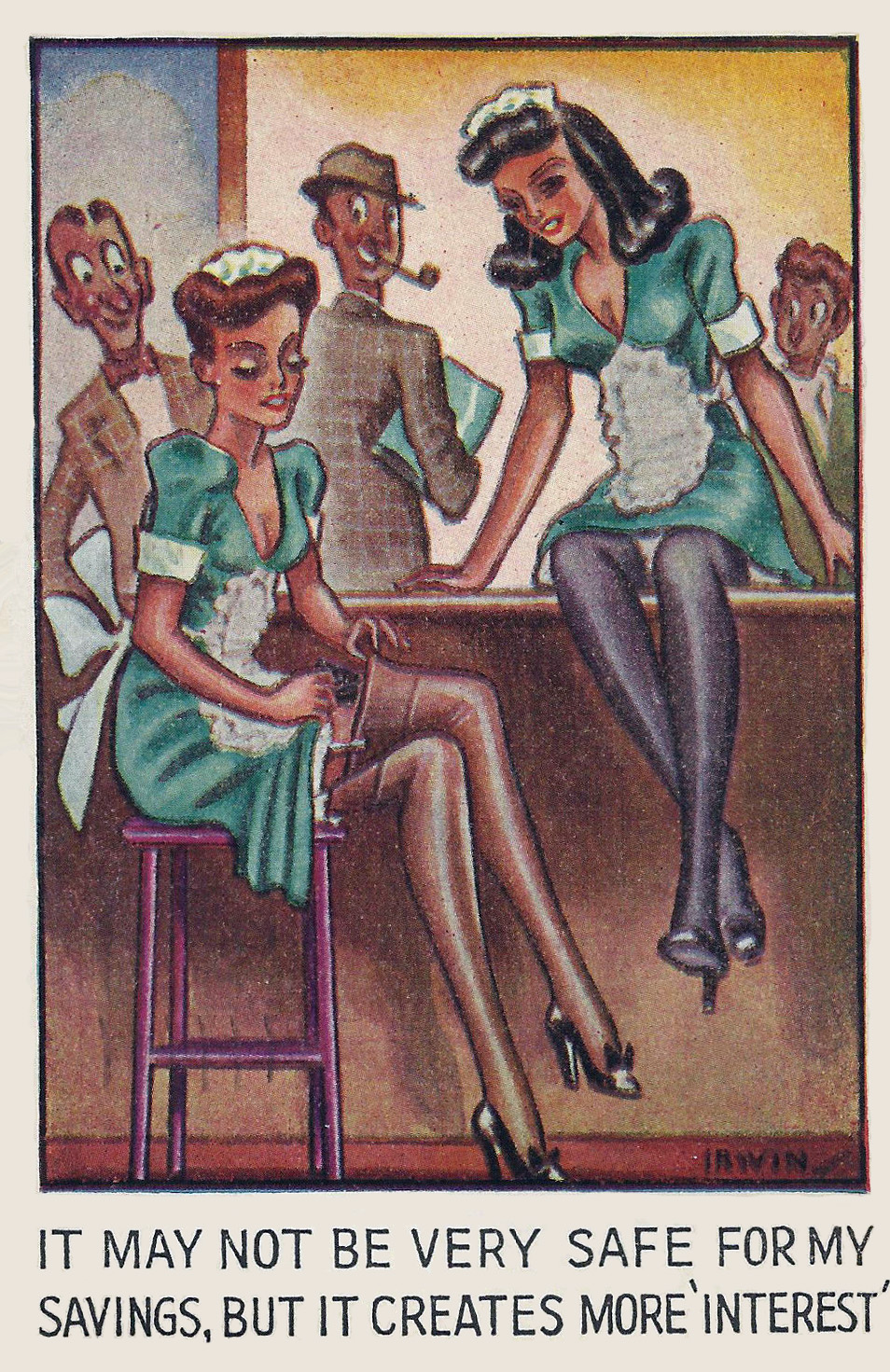
waitressstockings1946Later postcards mostly dropped the theme of incompetence but images of sexy bimbo waitresses persisted for decades, as for example on this postcard mailed in 1946.

© Jan Whitaker, 2015

6 Comments

Filed under proprietors & careers, women

Find of the day: Mrs. K’s Toll House Tavern

MrsKs943

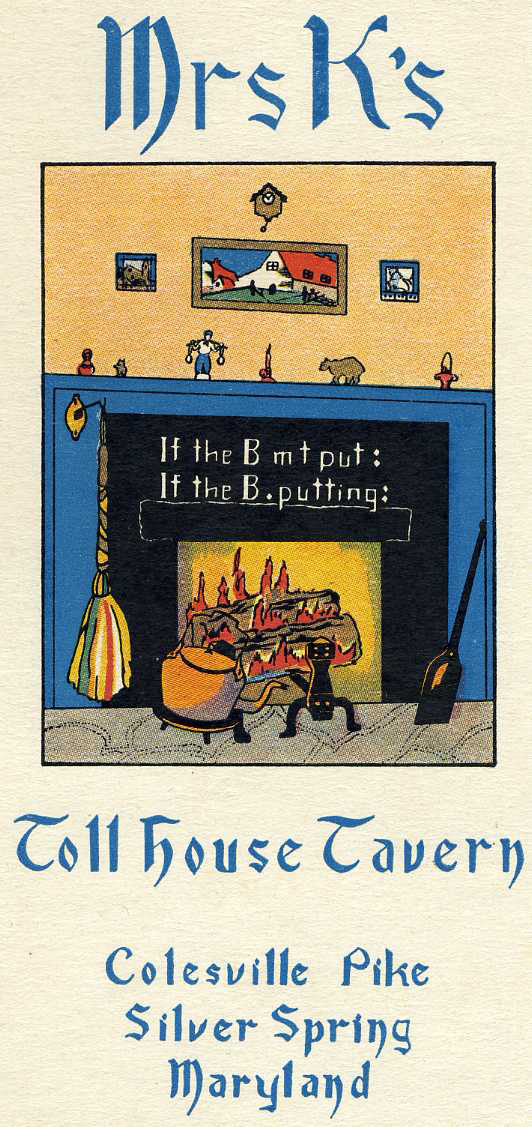
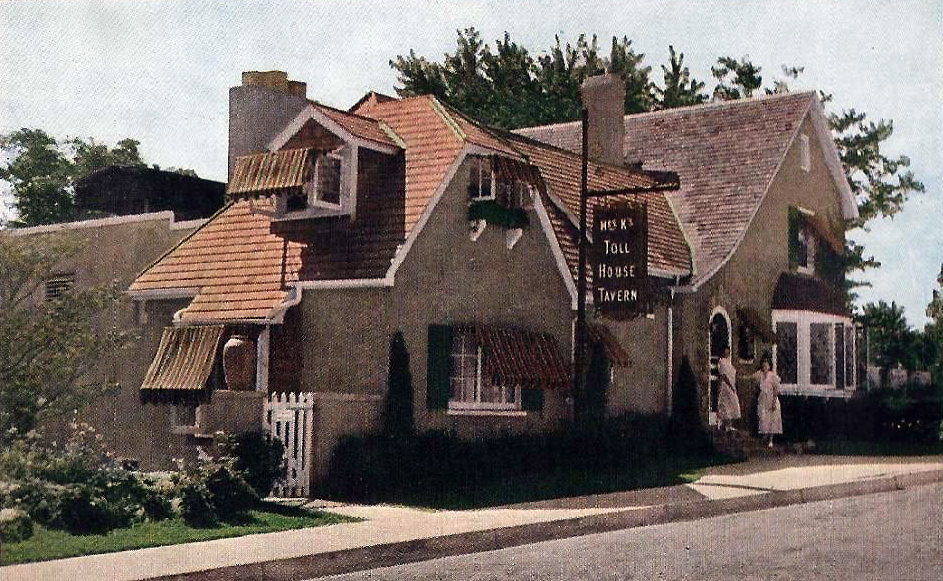
Over the weekend, at a vintage paper and postcard show in Boxborough MA, I found a charming diecut menu from a restaurant in Silver Spring MD. Established in 1930 by Olive and Harvey Kreuzburg, the landmark restaurant is still in operation today though no longer owned by the founding family.

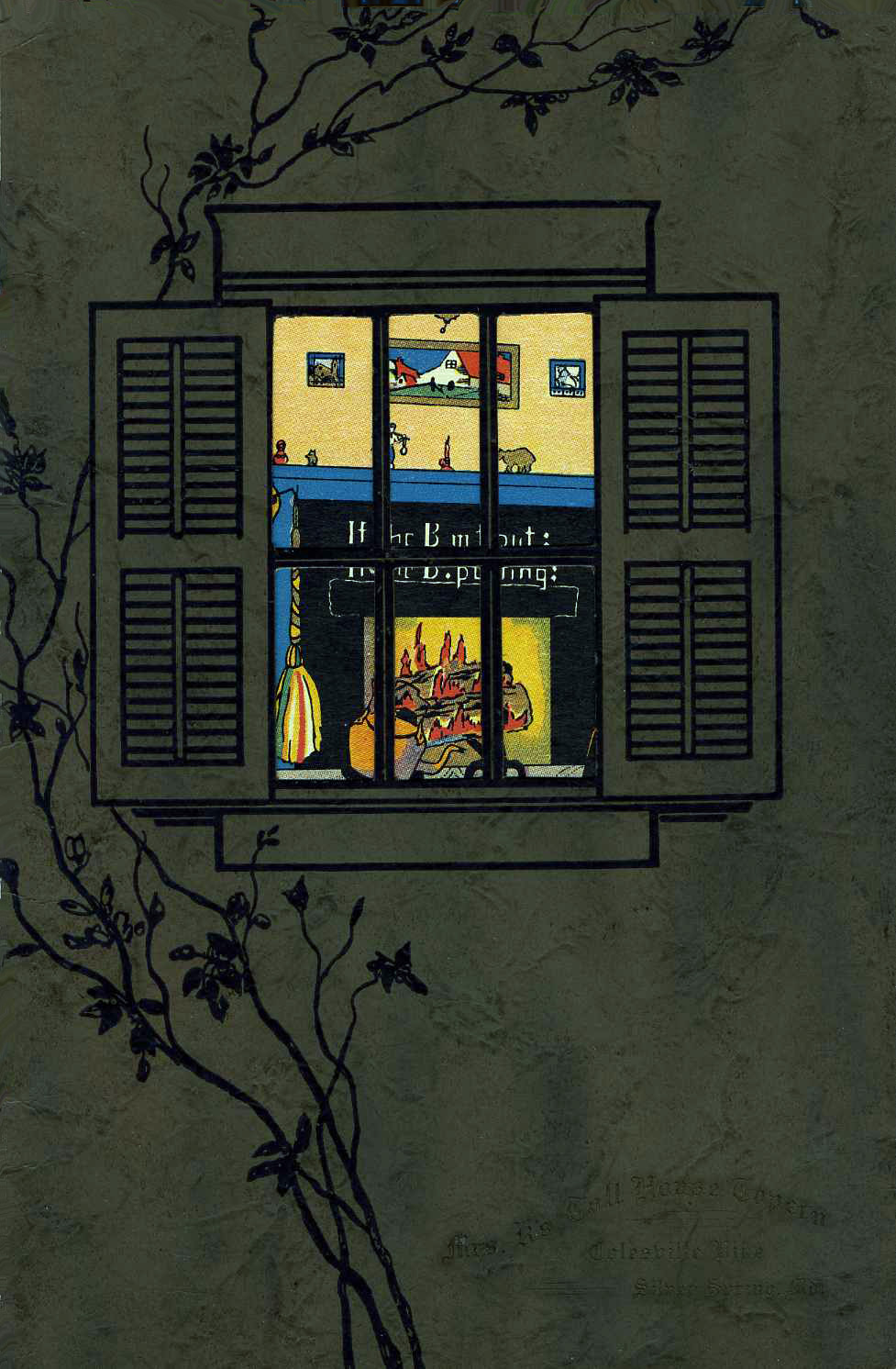
Shown through the window is page 2 of the menu illustrated with a fireplace inscribed with a cryptogram. Can you figure it out? Hint: the riddle is said to have originated in England. (Click to enlarge. Answer below.)

MrsKs941Judging by the prices, this menu is from around 1950. A Tenderloin Steak dinner accompanied by French Fried Onions or Fresh Mushrooms, cost $2.25. It was served with soup, fruit relish, salad, three vegetables, a sherbet course, hot bread, dessert, beverage, and after dinner mints. By 1962, when the Kreuzburg’s son Richard ran the restaurant, that dinner had gone up to $6.00. Burgundy, Sauterne, Claret, and Blue Ribbon beer were available. All meals were served family style with bowls filled with enough for the entire table. Mrs. K assured guests that everything was prepared from scratch on the premises and under her supervision.

Olive Kreuzburg was not new to the restaurant business when she and her husband took over the old toll house that had previously been the home of two other failed tea rooms. In 1923 it operated as the Seven Oaks Tavern where sky high prices must have contributed to its demise. Olive’s prior experience included running the dining room of the Hotel Wellesley in Clayton NY, a tea room in Miami FL called Mrs. K’s, and two tea rooms in Washington DC, one named Mrs. K’s, and the other Mrs. K’s Brick Wall Inn. Clearly using her abbreviated name served her well.

At its opening in 1930 the Silver Spring Toll House was listed in a DC newspaper under “Where to Motor and Dine.” At that time development had not sprung up around Mrs. K’s; although only “a 30-minute drive from the White House,” it was in the country. The early advertisement read: “This old Toll House with its charming furnishings and Terraced Gardens marks a delightfully smart Country Dinner Place.”

mrs.K'sTollHouseILL

Getting through the Depression was no doubt aided by Duncan Hines’ recommendation of Mrs. K’s in his very first list of his favorite restaurants that he sent out to friends in a 1935 Christmas card. Later he expanded the list and published it as a book. In the 1937 edition, he said of Mrs. K’s, “You dine in the past here – so far as furnishings are concerned. Nothing is changed apparently from the Revolutionary days when it was built. Even the pretty girls who wait on you in Colonial dress seem to have been miraculously preserved from a more leisurely age when dining was a rite not to be passed over casually.”

Whether or not the building dated from the Revolution, the quaint restaurant was filled with antiques collected by the Kreuzburg’s.

The cryptogram explained:
If the grate be [great B] empty (m t), put coal on [colon].
If the grate be full, stop [ . ] putting coal on.

© Jan Whitaker, 2015

6 Comments

Filed under family restaurants, proprietors & careers, roadside restaurants, women

High-volume restaurants: Crook & Duff (etc.)

crook&nashADV1875Luxury restaurants are more likely to become memorialized by time, but often ordinary restaurants have a history that is equally rich and played a more significant role in the everyday functioning of society.

That was certainly true of a restaurant that opened in New York City’s “Newspaper Row” in 1858 under the name of its two proprietors, Crook & Duff. The popular restaurant persisted until at least 1906 under nine different names and with four different addresses. It was considered not only a fine place to eat — “a marvel of gastronomic entertainment” – but also a depot where ideas were exchanged.

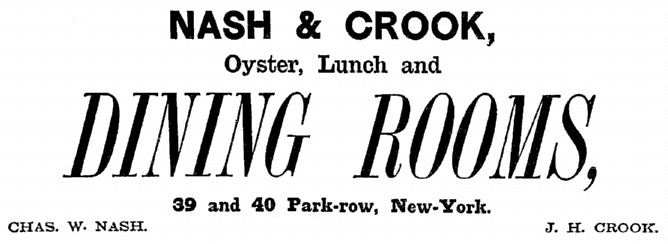
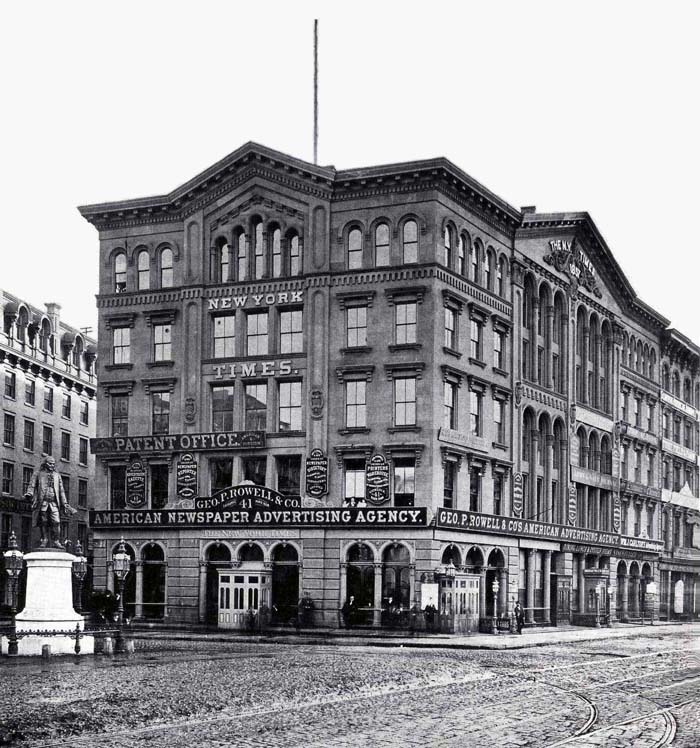
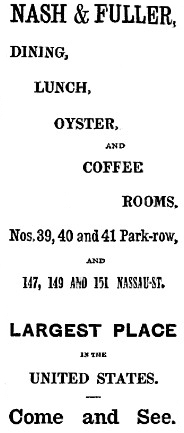
crookNYT1874Proprietor John Crook was already an old hand in the restaurant business by 1858, having learned the business from his uncle who ran an eating stand in Fulton Market. Crook then went into business with a brother, and next ran several places on his own before he and theatrical manager John Duff opened a restaurant in the newly constructed New York Times building on Park Row. [Unfortunately no signs for the restaurant are visible in the 1874 photograph shown above.] It was an excellent location since City Hall, the main Post Office, a new court building, and many newspaper and periodical offices were located close by. Journalists and printers especially, with their odd hours and relative freedom to roam the city, were frequent patrons of eating and drinking places such as Crook & Duff, aka Crook, Fox & Duff; Crook, Fox & Nash; Nash & Fuller; Nash & Crook; Nash & Brush; George S. Brush; Brush & Foy; and Foy & Crook.

The people of prominence who ate at Crook & Duff and its successors were numerous, many of them lawyers, journalists, business men, and political figures. Feminist publishers of Woodhull & Claflin’s Weekly, Victoria Woodhull and Tennessee “Tennie” Claflin, were frequent patrons in the 1870s – probably eating in a room reserved for ladies (assuming they found  that acceptable). The restaurant was popular with women clerical workers in the 1880s when their numbers were on the increase.

The restaurant remained in the Times building, occupying the basement and much of the first floor for thirty years, while doing business under five different names, the best known and longest lasting being Nash & Crook. In 1888 it moved a short distance to 16 Park Place.
Nash & Crook (etc.) was known for good food, reasonable prices, and fast, expert service. Broiled oysters and corned beef hash were specialties. Fruits and vegetables came from the Oneida Community, a religious commune in upstate New York. The bar did a brisk business in gin slings and brandy smashes, especially during election season.

crook&NashSept51870Serving food from early morning until late at night, the restaurant was a high-volume business, dishing out up to 2,000 mid-day meals daily. In 1870 it claimed to have the largest dining room in the U.S. The lunch counter was 60 feet long. Even so, from noon to 3 p.m. it would often become so crowded that customers would stand and eat from plates in their hands. Many customers were regulars, including men who took all their meals there – and only there – for decades.

Reputedly it was the second restaurant in New York City to hire African-American waiters. During the Civil War draft riots of July 1863 when white mobs attacked Black men, the restaurant sheltered its staff in the basement. Many of the staff from both races were long-term employees. A Black waiter, John Thomas Cooper, worked at the restaurant from 1859 until his death in 1893, becoming a favorite for his sense of humor.

As late as 1927 a letter to the editor of the New York Times mourned the loss of Nash & Crook’s corned-beef hash.

© Jan Whitaker, 2015

2 Comments

Filed under popular restaurants, proprietors & careers

Famous in its day: Fera’s

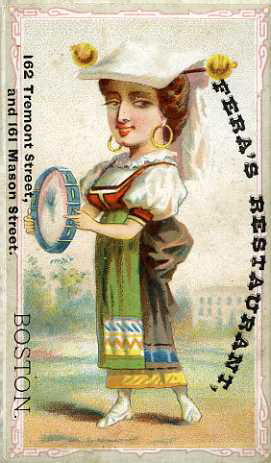
fera'sfrontIn the second half of the 19th century wealthy families patronized Fera’s Confectionery and Restaurant in Boston, which had earned a reputation for high quality pastries and candies throughout the East. The business was established ca. 1855 in the basement of the Temple Club on West Street, and after 1876 was located on Tremont across from the Common and near the Boston Theatre. [The trade card shown front and back in this post is probably from the 1880s.]

At Fera’s, patrons could enjoy dainty luncheons or after-theater suppers or could arrange to have the firm cater their next dinner party, complete with table ornaments. Women shoppers might stop there for lunch or bon bons after a visit to the shopping district where, in 1866 for instance, they could consult a clairvoyant or pick up such things as freckle lotion, a new perfume from Mexico called Opoponax, potted meat, or library slippers. Fera’s was especially popular with female patrons, as was always the case with confectioneries in the days when many other kinds of restaurants were considered off-limits to respectable women. [see 1866 advertisement below]

fera's1866

Respectability in eating places was not easily achieved then and it’s surprising that Fera’s was able to rescue its reputation from a scandal it was caught up in not long after opening. It was constantly in the newspapers in 1857 because of a sensational divorce case in which a husband alleged that his wife had committed an “adulterous act” in Fera’s. Although the defendant’s lawyer argued that no such occurrence took place since the restaurant was “a wide hall” that was “open all the way through” (i.e., not divided into small private rooms or boxes), the divorce was granted, branding the defendant as an adulteress and leaving in doubt what had occurred where.

Somehow Fera’s survived the scandal, as well as George Fera’s own marital breakup, fires, robberies, changes of address, and a couple of bankruptcies.

At the Tremont address Fera’s was divided into two sections with the restaurant occupying space behind the confectionery and separated by an arched doorway. After redecorating in 1887, the restaurant was painted in cream and gold, with lower walls in marble and upper walls hung with large mirrors. Electric lights were installed, producing a  bright and glittering style that emulated a Paris café.

fera'sback

Like many Europeans in the culinary trades who came to this country, George Fera had traveled a prestigious career path before arriving on U.S. soil in his early 20s. Born in Lübeck, Germany, he compressed a lifetime into a few years. Starting out at a young age he had trained in confectionery in Paris, succeeding so well that he was appointed confectioner to the Czar of Russia in St. Petersburg, where he remained for a number of years. Upon his arrival in the United States, he went to work at a New Orleans hotel, moving from there to New York City where he was employed by the famed confectioner Henry Maillard. He was said to have made for Maillard’s the first caramels produced in this country.

George Fera retired around 1890 and his two sons, who had been working with him for years, took over. In 1892 Fera’s closed and the furnishings and equipment were auctioned, including in part: “30 marble-top saloon tables, 75 bentwood chairs, 5 nickel plated show cases, one show case with deck, one square [show case] with fancy chocolates, two large mirrors, candy jars, 50 doz. wine, cordial and hot water glasses, decanters, Eper[g]nes punch bowl, triple plated spoons, knives and forks, plated castors, water pitchers and cold water urn, 600 decorated French china plates, platters, compotes, pitchers, cups and saucers, &c., Jap. plates, fine lot candies, French wedding cake ornaments, fruits and marmalades in jars, costume crackers, candy machines, bon bons, ice cream apparatus, &c.”

© Jan Whitaker, 2008, revised 2015

Leave a comment

Filed under confectionery restaurants, food, history, proprietors & careers

“Every luxury the markets afford”

alhambra1847In the 1840s and 1850s, when Russell W. Allen ran restaurants in Richmond VA, newspaper advertising for eating places employed pat phrases such as the one that serves as this post’s title. Allen advertised frequently in the papers and, judging from descriptive blurbs, he attracted affluent men looking for fine liquors and cigars, as well as top quality duck, seafood, oysters, and game.

In 1843 he opened The Alhambra which, like most eating places then also served as a hotel. His aim was to have the foremost eating place in Richmond.

The son of a Providence RI cabinet maker, Russell was 24 years old in 1835 when he married. He and Agatha moved to Richmond a few years later. In 1840 he was employed as a decorative painter whose business included hand painting custom window shades. Agatha ran a boarding house for Virginia legislators.

AlhambraHouse1844

Although it was open to the public, it would seem as though Russell’s eating saloon developed as an extension of the boarding house. His first advertisements make a direct appeal to legislators whom he offered three meals a day, promising to have on hand fine oysters from nearby rivers and bays “fresh three times a week.” He also imported live lobsters from the North, a practice which he said was highly unusual since most lobsters in Richmond were brought there pre-cooked. [bill of fare, 1844]

The Alhambra was located on the main thoroughfare, 14th street, near the bridge that crossed the James River. Outside was a sign of a deer visible in the day but eclipsed after dark by the standard candlelit red balloon that identified oyster houses. In 1846 the establishment moved two doors closer to the bridge and installed private dining rooms. A new and sensational feature was a fountain with a statue of a Greek goddess bearing a flowing cup, surrounded by swans. The spouting water held aloft a golden ball.

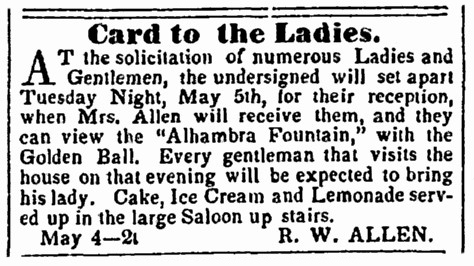
AlhambraCardtoLadies1846After a Richmond newspaper advised that “those who wish to see a pretty fountain should pay one visit at least,” the normally all-male sanctum was besieged by women wanting a peek inside. The result was a ladies’ night advertised in May of 1846 with Agatha Allen on hand to reassure visitors that the goings on would remain cake & lemonade respectable.

alhambraarbourSept1852

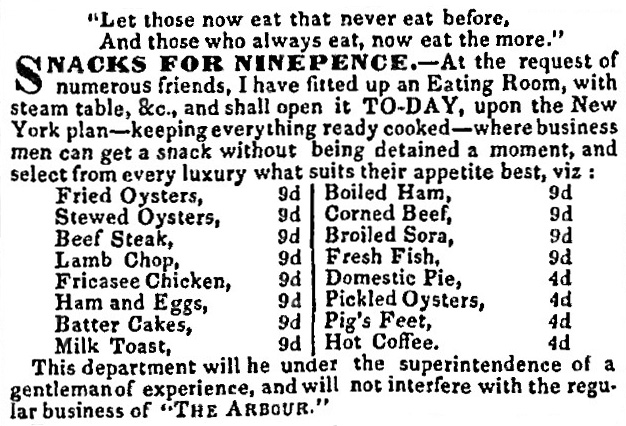
Perhaps due to the death of his father in 1848, Russell sold his business in 1849 and the family moved to New York City, where he also ran an eating place. In 1852 he returned to Richmond, bought out the Rough and Ready on the corner of 12th and Main, renamed it The Arbour, and kept it going until 1858. He tried to equal The Alhambra’s reputation as an epicurean eating place, though I can’t tell how well he succeeded. In 1852 he ran an advertisement for quick eats at reduced prices as shown above. It contains something I’ve never seen before, “domestic pie,” which I’m guessing is another way of saying homemade. Also, sora, a marsh bird.

After he gave up the restaurant and hotel business, Russell Allen returned to his earlier career as a painter and earned the rank of Captain in the Civil War.

© Jan Whitaker, 2014

4 Comments

Filed under proprietors & careers

Tea at the Mary Louise

MaryLouiseTR1928BestFoodsADV2200W7th

In 1914 the J. W. Robinson department store arrived on West Seventh and Grand, launching a shift in Los Angeles’ shopping district from Broadway. The following year the Brack Shops began leasing specialty shops in an empty loft building nearby. Construction activity boomed as Seventh Street turned into a shopping mecca.

Will and Dolla Harris staked the future of the Mary Louise Tea Room on the prosperity of West Seventh. In 1918 they opened their first tea room on the 12th floor of the Brack Shops. With wide hallways allowing shops to open their doors and let goods spill outside, it resembled a modern-day shopping mall. Shoppers could easily spend the day having their hair done, browsing the latest styles, or enjoying lunch, tea, or a Thursday night chicken dinner at the Mary Louise.

MaryLouiseBarkerBros790Through the 1920s the Mary Louise expanded, opening additional tea rooms on West Seventh — on the mezzanine of the fashionable New York Cloak & Suit House, and on the top floor of the gigantic Barker Brothers home furnishings store [shown here]. In 1922 construction began on what would be the largest of the Mary Louise tea rooms [shown below], a two-story building across from Westlake Park (renamed MacArthur Park in 1942). It opened in 1923 and was soon followed by a Mary Louise in Fullerton, next door to the new Alician Court movie theater owned by Dolla’s brother Charles S. Chapman. The last Mary Louise, whose servers were young Asian-American women dressed in Chinese costumes, opened in 1931 on North Cahuenga in Hollywood.

MaryLouiseEXT792

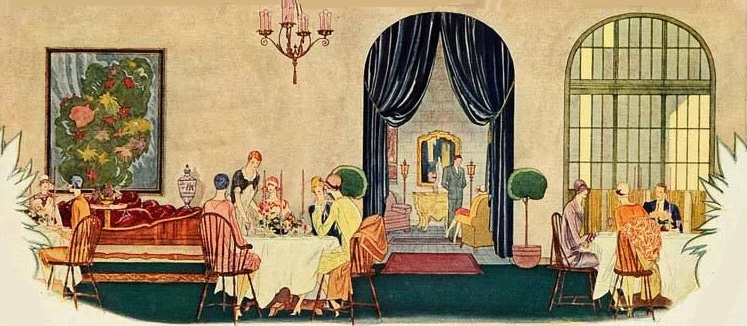
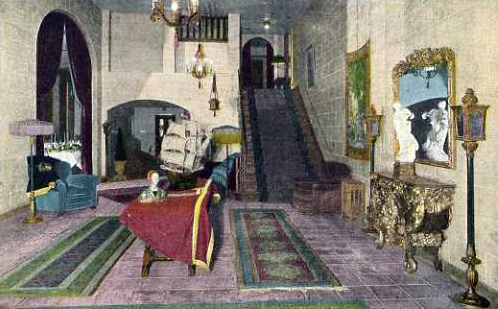
Shortly after its debut, the park-side Mary Louise advertised it was “the Center of the City’s Social Life.” Wedding parties and meetings of professional groups were booked regularly. Elaborately decorated on a lavish budget equal to more than half the cost of construction, the capacious building held a large entry hall [shown below] and dining room [shown at top] on the first floor plus an afternoon tea room, a banquet hall, and four smaller dining rooms for private parties on the second. In sync with the fashion of the day, the rooms had themes such as Mah Jong and Italian tea garden.

MaryLouiselobby789As can be seen on postcards from the Mary Louises in Barker Brothers and opposite Westlake Park, the tea rooms were decorated in glamourous movie-set style markedly different than minimalist Eastern tea rooms. Gilded pieces, Oriental rugs, wall tapestries, heavy draperies, and paired ornamental trees abounded.

MaryLouisebizcardINT791

The Mary Louise mini-empire was dealt a severe blow just a few months after the Hollywood location opened when Will Harris died suddenly. Three of the tea rooms, including the main one opposite Westlake Park, were quickly sold to the Elite Catering Company owned by the expanding Pig’n Whistle chain. When I acquired the business card shown here opened up, it had Xs penciled over all but the section reading “2 Smart Downtown Tea Rooms,” evidently reflecting the changeover.

Dolla Harris continued to operate the two downtown tea rooms: in Barker Brothers and in the Security Bank Building opposite the Robinson’s store. In 1932, in the depths of the Depression, she was forced to reduce prices for lunch and to attract customers with palmists and numerologists. How long she stayed in business is uncertain but I’ve found evidence that there was still a Mary Louise tea room in Barker Brothers in 1952.

© Jan Whitaker, 2014

9 Comments

Filed under proprietors & careers, restaurant decor, tea shops

For the record

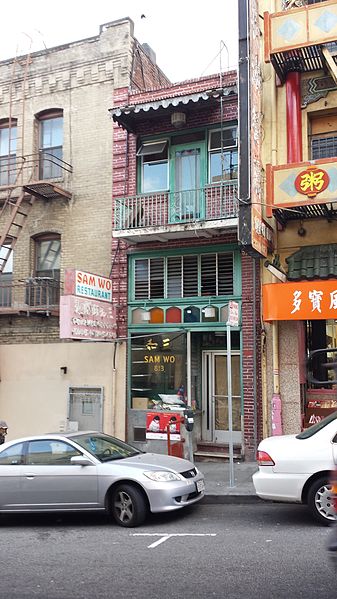
SamWoRestaurantRecently I read an amusing story about “Edsel Ford Fong,” a legendary waiter at Sam Wo (aka Sam Woh), a former restaurant in San Francisco’s Chinatown, who yelled at guests, ordered them around, and often refused their requests. For this outrageous behavior he earned lasting fame and is still remembered fondly long after his premature death in 1984.

As is usually true of  legends there are a few errors. In this case they encourage a somewhat distorted view of Americans of Chinese descent.

His name was not Edsel Ford Fong. It was Edsel Fung. His army, marriage, and divorce records give his middle initial as Y. The insertion of “Ford” – reproducing the name of Henry Ford’s son — must have been either an irresistible bit of showmanship on his part or someone else’s joke. How Fung became Fong I’m not sure.

According to R. B. Read’s The San Francisco Underground Gourmet, published in 1969, Edsel was commonly known as Eddie in the 1960s, his name not yet ossified into Edsel Ford Fong. Read wrote that the restaurant’s dining room on the second floor “is the province of Eddie, the archetypal Chinese waiter, so famous for his rudeness that he cultivates it. For Eddie, every Caucasian diner is a challenge and he moves in, barking, before you’ve sat down. If you don’t order within two minutes, you get a relentless verbal prodding which reduces many customers to the jellied state Eddie prefers, where they allow him to order for them. He shouts all orders down a dumbwaiter in a voice of heroic size. If Eddie doesn’t like you (he doesn’t like anybody, at least until the fifth visit), you have to ask for tea while awaiting your food.”

As the photograph shown above reveals, the restaurant was quite small despite its three stories. It readily comes to mind that Eddie’s performance tended to speed up diner turnover in this tourist-attraction spot which often had guests waiting to be seated.

Although it’s true that Edsel was a waiter in a Chinese restaurant, he was not a “Chinese waiter” as he is often described. His parents were born in China but he and most of his siblings were born in California. He served in the U.S. Army in World War II.

Often the legends quote his quips and remarks in broken English. Given that he was an American I have no doubt he spoke English like the native he was, not like a 1930s Hollywood character. He was no Charlie Chan, but he may have used broken English as part of his act. He was an actor. In fact, he had a role in the 1981 Chuck Norris movie An Eye for an Eye. It’s quite possible he was one of the legion of Californians who wait tables while trying to make it as an actor.

He may not have gone far in Hollywood but he was a smash hit at Sam Wo’s.

© Jan Whitaker, 2014

1 Comment

Filed under proprietors & careers