Tag Archives: 1960s

California coffee shops

With the end of World War II, the United States became the undisputed world power as well as the leading economy, producing the largest share of the world’s goods.

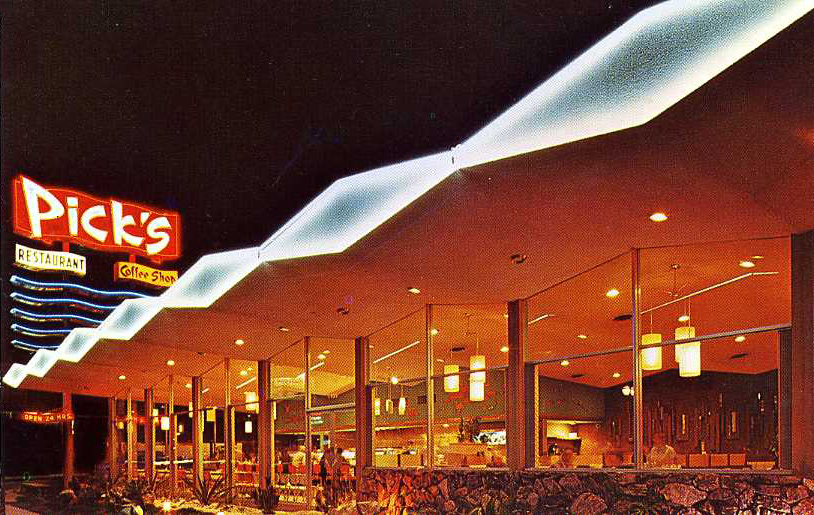
Many changes took place in American society as the soldiers returned. Suburbs sprang up with housing for growing families, shopping centers appeared, and many workers enjoyed prosperity. And a new type of eating place came into being, known as the “California coffee shop.” There had been coffee shops before that, but Southern California introduced new features, particularly in terms of design.

Triumph at the war’s end was celebrated with ticker-tape parades, but also in the design of cars and buildings, including the exuberant design of coffee shops in Southern California. The style of restaurant buildings that has also come to be known as “Googie” was modern, but without the severity of International Style. It used a wide range of materials developed in wartime, and forms inspired by the angles of fighter planes, the energy of the atom, and the bursts of bombs.

The inspiration for the striking designs of California coffee shops – known as Coffee Shop Modern – is frequently attributed to the space age, but over time the realization has grown that it was equally inspired by U.S. world ascendancy rooted in warfare. It may seem strange to attribute inspiration for a sprightly and bright type of architecture and interior design to something as ominous and deadly as the bomb, but a number of writers have made this connection.

In the words of Michael Sorkin’s essay “War is Swell” [in World War II and The American Dream, 1995]:
“That the atom so readily became a chipper symbol of American modernity in the immediate aftermath of its use as the greatest instrument of mass death in human history speaks volumes about the relationship of the accomplishments of war to the formal culture of peace. The decor of the fifties is all bursts and orbits, nuclei and energetic spheres. The atom was fully relegated to the class of things, isolated from life.”
[See also Elizabeth Yuko’s “Why Atomic Age Design Still Looks Futuristic 75 Years Later”]

Elements of coffee shop design can be seen in the look of automobiles of the same time. Some of the striking elements of California coffee shop design were echoed in the fins of Cadillacs inspired by the P-38 fighter plane. In Googie Redux, author Alan Hess, who has been largely responsible for recognition and appreciation of the creativity of Coffee Shop Modern, notes that Time Magazine called the 1959 Cadillac design the “ICBM [Intercontinental Ballistic Missile] look,” and also that “The Olds Rocket, the Olds Cutlass, and the Buick LeSabre were all names borrowed from aeronautics.”
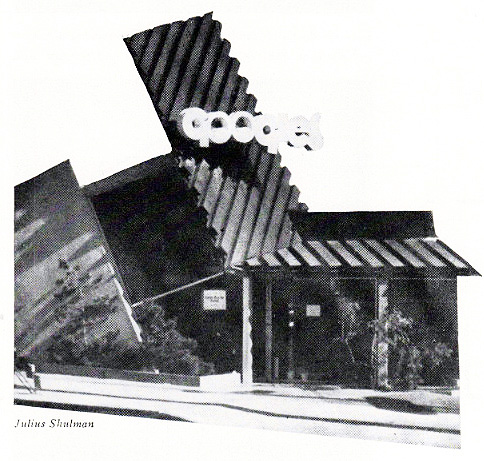
The design of coffee shops was nicknamed “Googie” after architect John Lautner’s 1949 unique Los Angeles creation bearing that name. It featured expansive glass window walls, unusual angles and roof lines, prominent signs, and bright colors. [partial view shown above — it extended farther to the right]

The vocabulary of Coffee Shop Modern signals its inventiveness. Terms in a glossary by Alan Hess in his book Googie Redux include: amoeboid, boomerang, cantilevered canopy, diagonals, dingbat, flagcrete, folded plate roof, free form, hyperbolic paraboloid, starburst, steel web lightener, structural truss, and tapering pylon.

California coffee shops, often bearing nicknames of their owners (Norm’s, Biff’s, Ship’s, Hody’s, Sherm’s, etc.), were casual, unpretentious, comfortable, moderately priced, and open 24 hours. Compared to the inexpensive eating places of the Depression, they offered a cheerful example of luxury for the masses, or what has been termed “populuxe” (See Thomas Hines’ book of the same name). Contrary to the usual negative public reaction to modern architecture, the upstart designs of the coffee shops were well accepted.
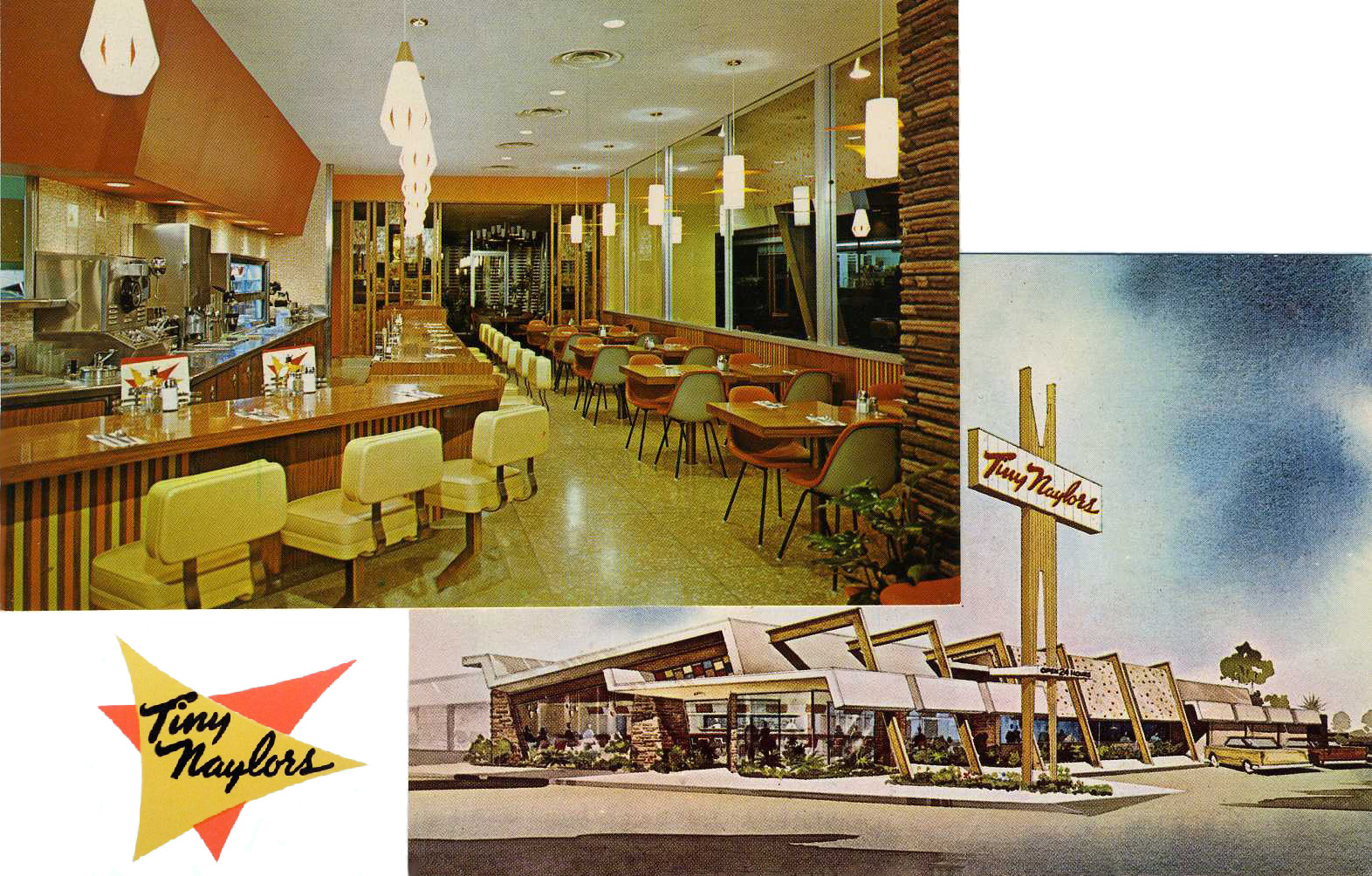
Counter seats were usually spaced generously and built with cantilevered supports allowing for unobstructed floor cleaning. [see above] Many had walls of decorative stone. A 1955 news story about the newly built Carolina Pines Jr. at LaBrea and Sunset noted its imported Italian mosaic tile columns, Palos Verde stone walls, and custom-designed wall plaques, among other features. It also had a carpeted dining room and an outdoor patio eating area in a garden protected from road noise and dirt with decorative fencing. [see below]

The coffee shops also introduced exhibition cooking. Although Eastern diner-style eateries had long done their cooking in sight of patrons, coffee shops introduced stylish designs and materials to the cooking areas and kept them sparkingly clean.

And, oddly enough, considering that the coffee shops were open all night, many of them had cocktail lounges.

Coffee shops designed along the lines of Southern California’s soon spread across the country. In St. Louis there was the Parkmoor, Cleveland had Manners, and Denny’s, with its beginnings in California, flourished everywhere.

Of course, as was true with neon signs, there were critics, notably Peter Blake in his 1964 book God’s Own Junkyard. He lumped Googie-style designs with neon, billboards, subdivisions, and a general decline in the built environment.
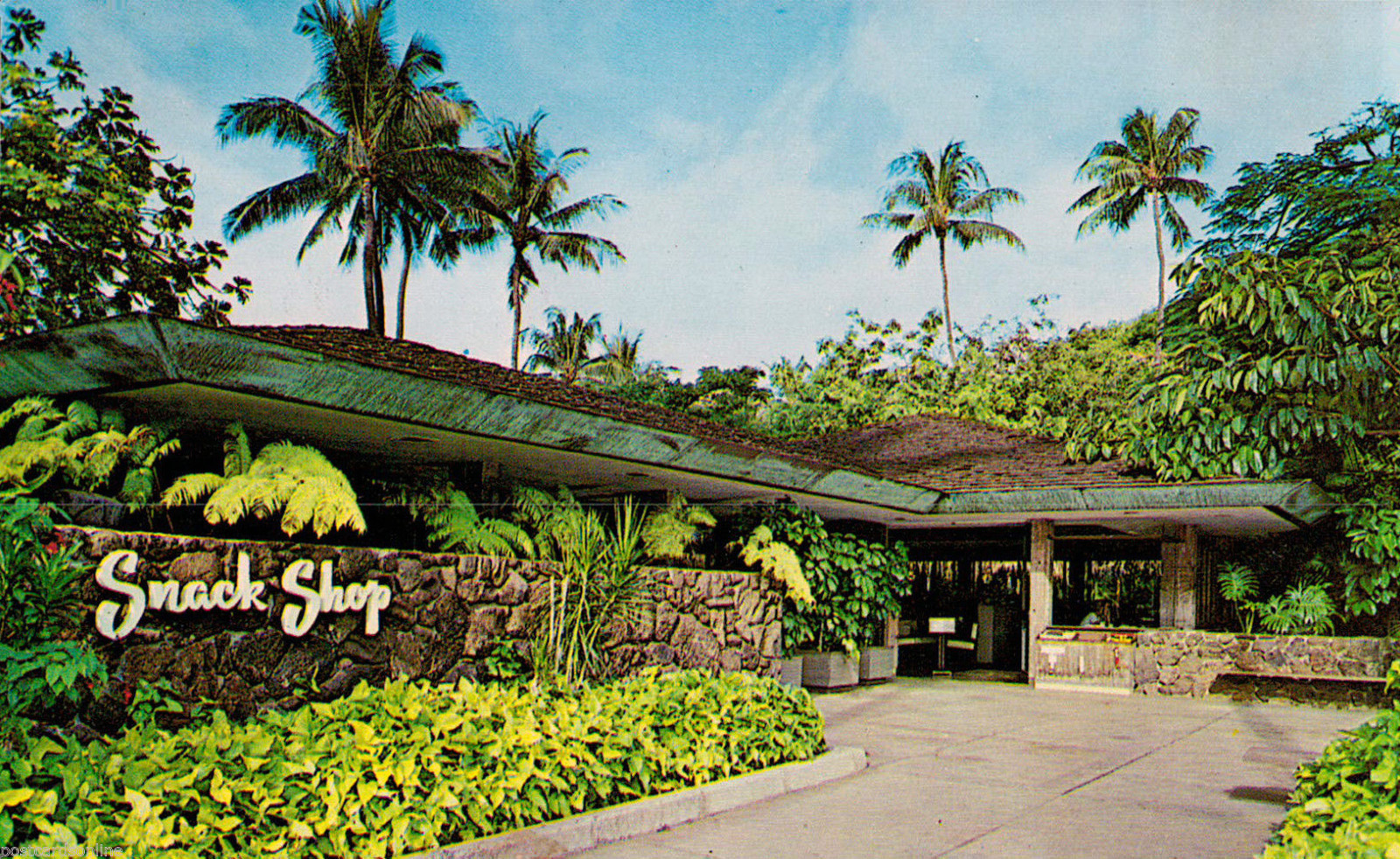
Starting in the mid 1960s but gaining in the 1970s Googie style was rejected, and what has been dubbed the “browning of America” by Philip Langdon had begun. Now chain restaurants of the coffee shop type began featuring earth tones, mansard roofs, exposed wooden beams, hanging plants, and subdued lighting. The coffee shop type of suburban restaurant continued in chains such as Denny’s despite competition by fast food establishments. McDonald’s, which had itself begun with Googie styling, toned down its buildings.

The change was due in part to the Vietnam War, but I can’t help but wonder if Americans hadn’t already become disenchanted with power and wealth based on military might.

© Jan Whitaker, 2024
22 Comments

Filed under chain restaurants, decor, family restaurants, popular restaurants, restaurant decor, restaurants

Spectacular failures: Laugh-In

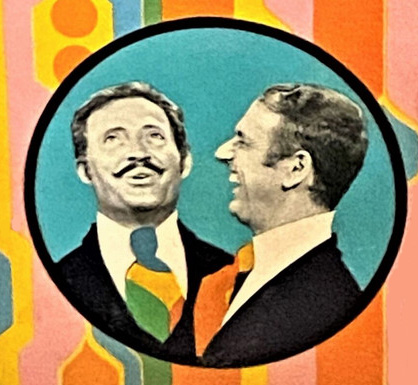
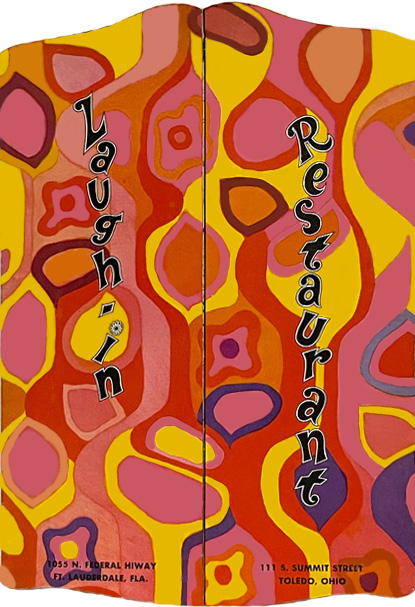
The restaurants called “Laugh-In,” based on the hit Dan Rowan and Dick Martin TV show, formed a teensy blip in an enterprise that culminated with big-time gambling casinos. [1969 menu cover]

Perhaps because the TV show was such an instant hit, it inspired the idea that the same enthusiasm would transfer over to the restaurant. It didn’t.

The chain was created in 1969, under the Lum’s restaurants umbrella, by brothers Clifford and Stuart Perlman who had built the successful Lum’s chain from a small Florida hot dog stand thirteen years earlier. The brothers adopted the Laugh-In concept and franchise system not long after they had begun another chain called Abners Beef House in 1968.

At that time the parent company, Lum’s Inc., had 300 locations. The brothers decided to list it on the New York Stock Exchange. In addition to the three restaurant chains, they also owned a chain of Army-Navy stores, meat packing plants, honeymoon resorts in the Poconos, and a large country club in Miami, the city where the corporation was located.

Selling stock in Lum’s, Inc. was a way to amass money to fulfill the brothers’ ambition of buying Caesar’s Palace, the Las Vegas hotel and casino that had opened in 1966.

When they created Laugh-In, financial analysts warned investors that counting on the continuing popularity of a TV show was risky. What if it went off the air? Perhaps that did worry buyers. Forty franchises were expected to be sold in 1969, but the actual total for that year was probably lower and the overall total number of units ever opened is unknown. [above left, Rowan, right, Martin]

Laugh-In relied heavily on the goofiness of its namesake TV show for the design of its units, fronting its flat-roofed concrete-block-style buildings with wild patterns and colors. Table tops were manufactured with imitation graffiti reflecting phrases from the show. [Below, table-top graffiti as shown on the back of menu above]

Everything was meant to appeal to youthful customers. According to an early advertisement for franchisees, Laugh-In was “a fun restaurant, designed for today’s vast young-minded, leisure-rich market.”

Additionally it advertised that it used a “proven food format” as employed by Lum’s. Lum’s had a signature dish, hot dogs cooked in beer, and it also sold beer. Laugh-In did not. But judging from their menus, neither Abners nor Laugh-In offered anything special in the way of food. Despite the “funny” names, Laugh-In selections were the same as those found in many other casual restaurants. Then there’s the fundamental question of whether customers choose what to order according to how funny the name is.

Judging from a 1969 advertisement for Abner’s franchisees, the Lum’s corporation was not especially good at presenting desirable-sounding food. The ad exclaimed over its menu’s “hunks of steak in a long fun bun” and “good things to drink, too, a malt, milk, a soda, coffee and tea.” As for Laugh-In, despite the funny names (Bippy Burgers, Fickle Fingers, Here Comes The Judge), its menu boiled down to the usual assortment of sandwiches, deep fried fish, onion rings, and a few oddities such as “tomato and egg slices” and “cheese on a bed of lettuce.”

The first Laugh-In restaurant opened in Hollywood FL in December, 1969. A few months later 25 more franchises were said to have been sold around the country. But #1 did not do at all well. It closed just short of a year later, replaced with an “Adult Art Theatre.” [above, partial advertisement for the grand opening]

Overall, the brothers fared better with another big venture, Caesar’s Palace, acquired a couple of months before the first Laugh-In opened. Caesar’s Palace had a rough time at the beginning of their ownership, and the stock of Lum’s, Inc., its corporate owner, fell sharply. The brothers raised $4 million by selling off most of their restaurants, including Laugh-Ins, in 1971. But they ran into trouble attempting to open another casino in Atlantic City. New Jersey’s Casino Control Commission insisted that because the Perlmans had had financial dealings with reputed organized crime figures, they had to resign if a permanent permit was to be issued. Stockholders voted to buy them out, paying almost $100 million for their stock.

A few Laugh-In restaurants probably continued on for a while, though it had to be a blow when the show went off the air in 1973. The longest survivor may have been Jeff’s Laugh-In in Chicago, lasting until 1988.

© Jan Whitaker, 2023

7 Comments

Filed under chain restaurants, food, menus, odd buildings, restaurant names, theme restaurants

Underground dining

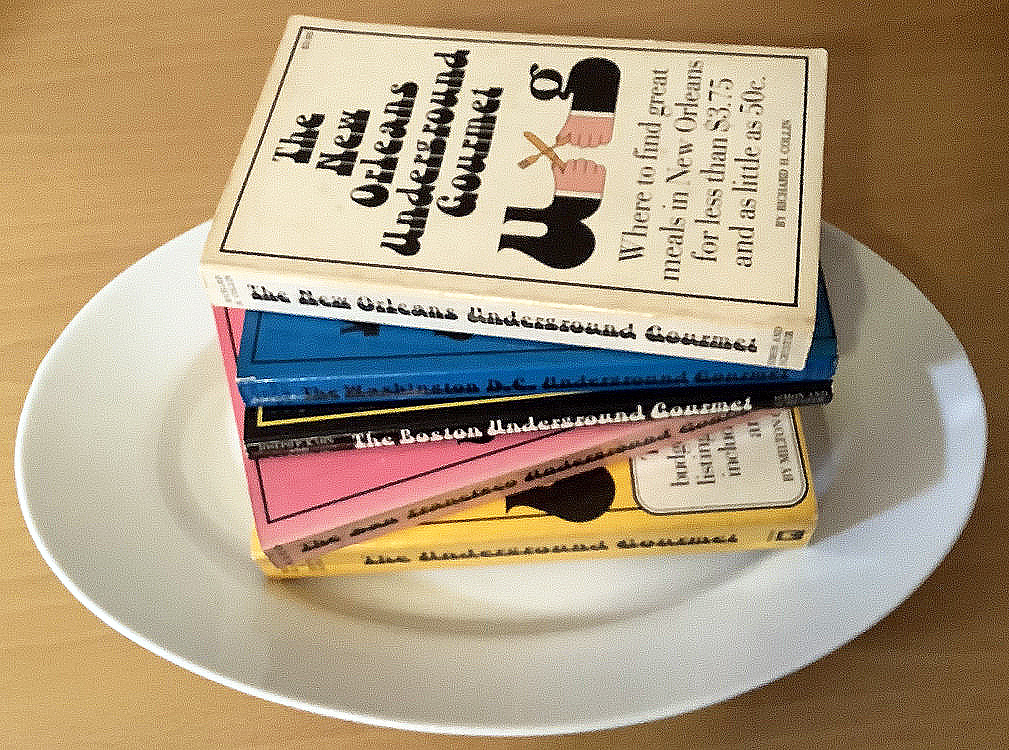
In the 1960s, with the rumble of social change came a flood of interest in low-priced eating places with character and good food. In this spirit, New Yorkers Milton Glaser and Jerome Snyder began a newspaper and magazine column titled The Underground Gourmet, followed by a guide book in 1966 with the same name.

Their book led to a series. It’s been a little difficult to nail down how many different UGs there were, but here is my list, with initial publication dates: New York (1966), San Francisco (1969), Los Angeles (1970), Washington D.C. (1970), New Orleans (1971), Boston (1972), Honolulu (1972), and Long Island (1973).

Several factors probably contributed to the new mood regarding restaurants. The economy was bad and the public was looking for bargains. Youth culture was blossoming as the baby boomers grew older, many becoming college students. And increased travel abroad was widening the public’s interest in unfamiliar foods and ways of cooking.

The public’s attraction to low-priced independent restaurants could also be seen as a reaction against the growth of fast food chains taking place, the greater use of frozen food in restaurants, and a rebellion against the blandness of much American food.

What was considered a low price for a meal during these years? The first New York edition specified in 1966, “Great meals . . . for less than $2 and as little as 50¢.” But the third edition (1977) explained that “unending inflation . . . has changed our perception of an inexpensive meal from one that cost $2.00 to one that costs $5.00 or $6.00.” For the New Orleans’ second edition in 1973, author Richard Collin promised meals “for less than $3.75 and as little as 50c.” This was still a lower price than featured by the others, which ran from $1.00 to $3.75 in San Francisco in 1969; $1.00 to $4.00 in D.C. in 1970; and “under $4.00″ in Boston in 1972. Dining in Honolulu remained a bargain, with the 1972 UG promising meals as inexpensive as in the first New York edition (50¢ to $2).

Low price was not really what set the best of the recommended restaurants apart from others. Rather it was the quality of the food for the price. Although Mr. Steak in 1970 offered its most expensive meal – Steak & Lobster with salad, toast and potatoes – for $3.99, it didn’t make the cut, though strangely enough a few other chain restaurants did win recommendations including a McDonald’s in D.C. and a Burger King in New Orleans.

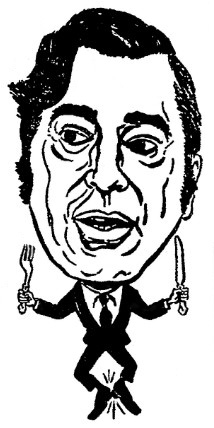
What were some of the most remarkable finds in these books? Richard Collin [above cartoon] discovered a number of dishes that he gave his highest praise, naming them “platonic dishes,” as perfect as that dish could possibly be. His New Orleans list of platonic dishes included Oysters Bienville and Fried Chicken at Chez Helene’s soul food restaurant — which he rated one of the city’s finest restaurants; Creole Gumbo at Dooky Chase; and Fried Potato Poor Boys at the dirt-cheap Martin’s Poor Boy.

The number of restaurants that met the criteria varied from city to city. Boston and D.C. are notably slim books. New York is the fattest volume. San Francisco and New Orleans have about 2/3 the heft of New York. However, with his shorter entries, Richard Collin packed over 250 restaurants into the 1973 revised New Orleans edition, rating everywhere he ate, including some very bad places. Needless to say, this makes for interesting reading.

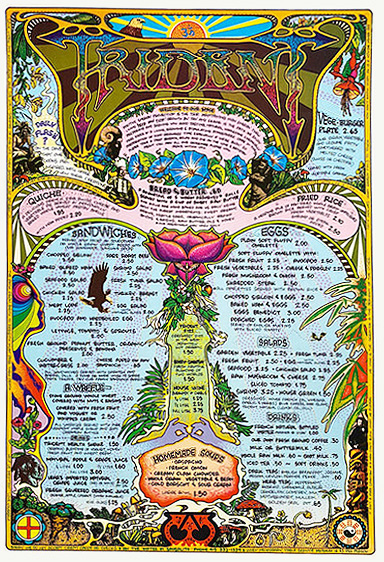
In his 1969 UG, R. B. Read made a case that the San Francisco area had a unique set of restaurants from all over the world, such as at The Tortola, which preserved “hacienda cookery” from the days before gringos settled in the state. He also heaped praise on restaurants that were rare in the U.S. then — from Korea, the West Indies, and Afghanistan. The latter instance, Khyber Pass, offered a “fabled” ashak, which he described as “aboriginal ravioli.” In a different category of unusual was The Trident in Sausalito, with jazz and a “debonairly eclectic” menu with a psychedelic design.

Because my copy is the third edition of the New York UG (The All New Underground Gourmet, 1977), I did not get the flavor of the earlier versions, which is a shame. Sadly, Jerome Snyder died during the publication of the book. That and rising prices may have cast a pall over this edition, which strikes me as less interesting than the New Orleans and San Francisco UGs. The original NYC book contained 101 of the best low-cost eating places (out of 16,000!). The third edition has about 130. The three given the highest ratings for “excellent food” were the Italian Caffe da Alfredo, and two Greek restaurants, Alexander the Great and Syntagma Square. Mamma Leone’s showed up in the book even though it met the price criterion only for its Buffet Italiano Luncheon where for $4.25 it spread out 25 feet of salami, mortadella, meatballs, celery, olives, green bean salad, and more.

The UG authors for Boston were Joseph P. and E. J. Kahn, Jr.; Washington D.C.’s were Judith and Milton Viorst. Both books show a lower level of enthusiasm. The Viorsts admitted that Washington “has not been known for its restaurants” and that of the 100 restaurants they visited, “a substantial proportion were so awful that we were unable to include them.” Father and son Kahn began by telling of a long-time resident of Boston and Cambridge who couldn’t imagine that anyone could recommend inexpensive restaurants since the area’s expensive restaurants were “bad enough.” The Kahns then admitted, “It is probably true that the Boston area does not loom large in the world of cuisine.”

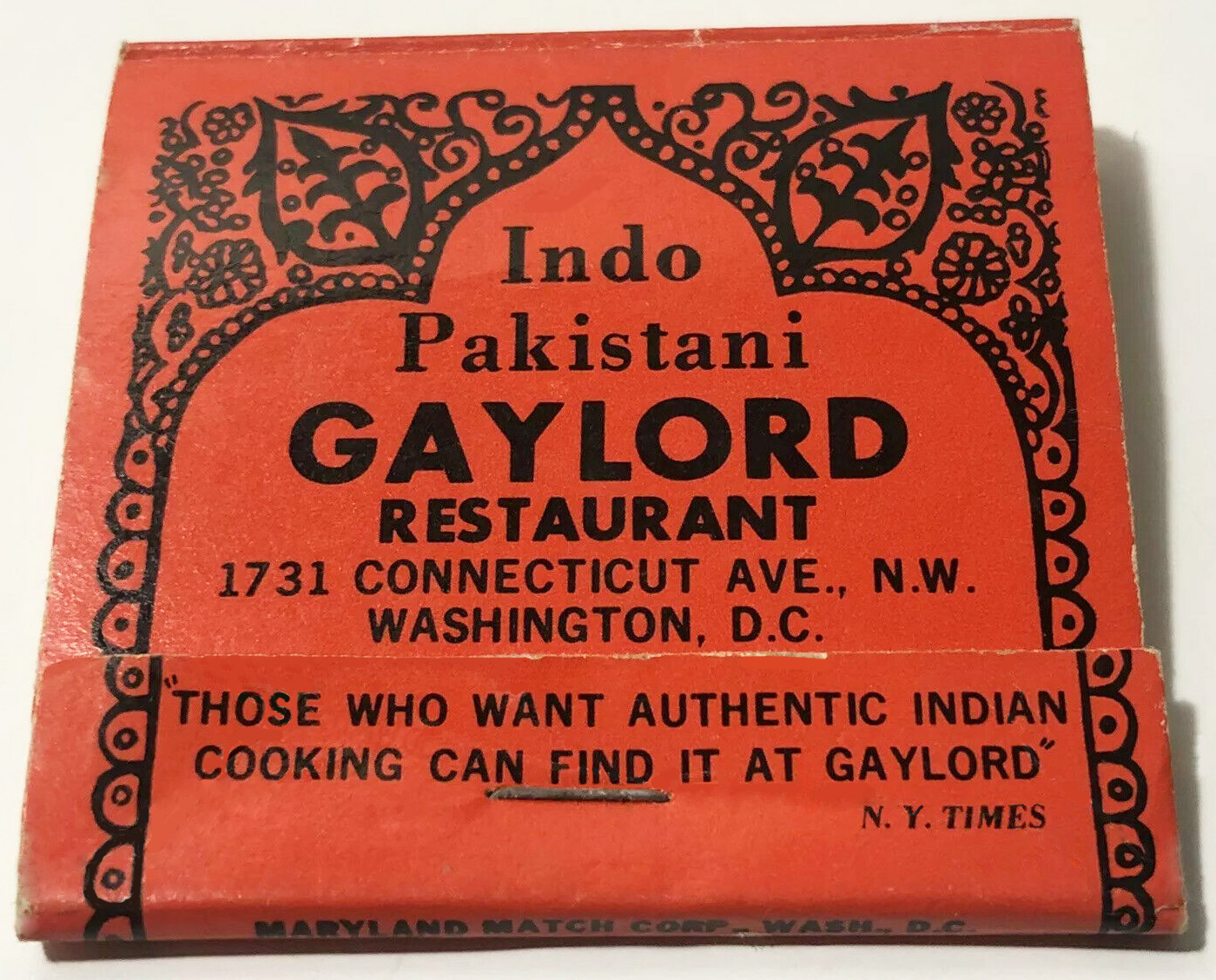
Despite their reservations, the authors of both books managed to find some places they liked. The Viorsts singled out five D.C. restaurants as “great finds.” They were: the Calvert Café, an Arabic place “worthy of shahs and empresses”; Don Pedro, Mexican, with a marvelous mushroom appetizer called hongos; the Cuban El Caribe, featuring raw Peruvian-style fish cubes in lemon-onion sauce (95¢); Gaylord, an Indo Pakistani restaurant with “delicious samosas”; and Warababa, a West-African place run by a Ghanaian couple with “exquisite” dishes such as peanut butter soup and Joloff rice flavored with bits of beef and vegetables.

The Kahns didn’t exactly rave about finds in Boston or Cambridge. But, after encountering “enough blandness while making our rounds to put us to sleep,” they enjoyed spicy lamb stew at Peasant Stock in Cambridge. They included the No Name restaurant on Fish Pier – no name, no sign, no lights, no decor — where a seafood chowder (50¢) served as the house special and was “so incredibly rich and so brimming with hunks of fresh fish that a cupful could be a meal in itself.” But the popular Jack and Marion’s in Brookline, known for its giant menu and huge portions, ranked merely as one of the area’s “better delicatessens.”

Alas, I couldn’t find the books from Honolulu, Los Angeles, or Long Island, but I saw a magazine piece that criticized the Los Angeles UG for its surprising inclusion of 25 restaurants in Palm Springs.

© Jan Whitaker, 2022

8 Comments

Filed under alternative restaurants, ethnic restaurants, restaurant prices

The Mister chains

Sometimes I feel the need to focus on ridiculousness in restaurants, maybe because I run across so many instances of it when I’m meandering through old sources. Lately I’ve been exploring franchising and have encountered numerous silly concepts expressed in the names of chains. Many businesses across the country adopted “Mister” or “Mr.” as part of their names, and this seems to have been particularly true of restaurant chains. [For now, I’m calling all of them Mister.]

There are also scores of restaurants with names such as Mister Mike’s or Mister T’s, but those are usually not part of franchise chains and the letter or nickname refers to an actual person, usually the owner, who may be known by that name in real life. I’m not including those here.

I’m more interested in the Misters that are not named for actual humans. At least I’m hoping that there is no real-life Mister Beef, Bun, Burger, Chicken, Drumstick, Fifteen, Hambone, Hamwich, Hofbrau, Pancake, Quick, Sandwich, Sirloin, Softee, Steak, Swiss, or Taco.

There were also Sir chains, such as Sir Beef, plus Kings and Senors. Were they in their own way an expression of multiculturalism? Being “continental,” Sir Beef was classier than most of the Misters.

For quite a while I believed there could be no Mister Chicken. That seemed obvious to me – who wants to be called a chicken? But then it occurred to me that I should do a little more research. I was proven wrong. Maybe I shouldn’t be surprised. Surrounding the logo shown here were the words: Home of America’s Best Barbecue Chicken Since 1966!” Although there were restaurants by the same name in Rockford IL and Atlanta GA, I don’t know if they were related.

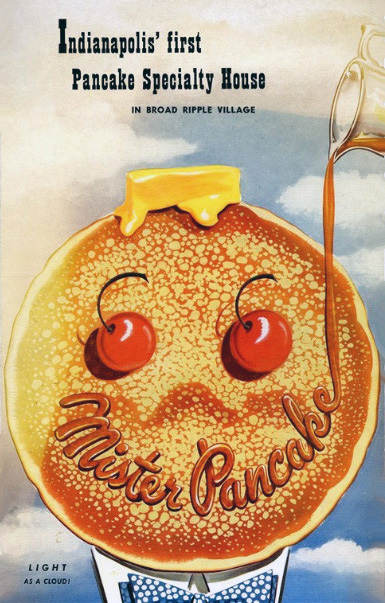
I find Mister Pancake’s face somehow threatening, but never mind that – he was a hit in his hometown of Indianapolis. He came into the world there in 1959, but I don’t know if he appeared anywhere else.

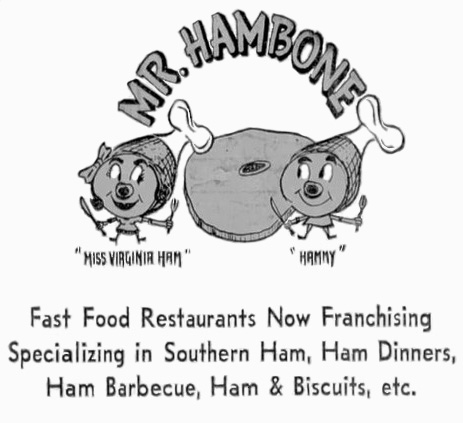
I especially like the logos that attempt to humanize food, particularly unlikely items such as hambones. Sadly for him and his girlfriend, Mister Hambone International – aka Hammy — really didn’t catch on. Starting out in Virginia in 1969, he opened at least one place in North Carolina, but nothing, I think, internationally.

Mister Softee with his natty bow tie, born in New Jersey, was mainly peddled out of ice cream trucks, but there were also restaurants of the same name that served hamburgers, steaks, hot dogs, fish, etc., along with the creamy guy. In 1967 a mobile franchise cost $2,500 while a restaurant was ten times that, which may account for why there were then 1,600 trucks — even as far off as the French West Indies — but only 5 restaurants. Overall, Mister Softee, like Mister Steak, had a more successful life than most of the Misters.

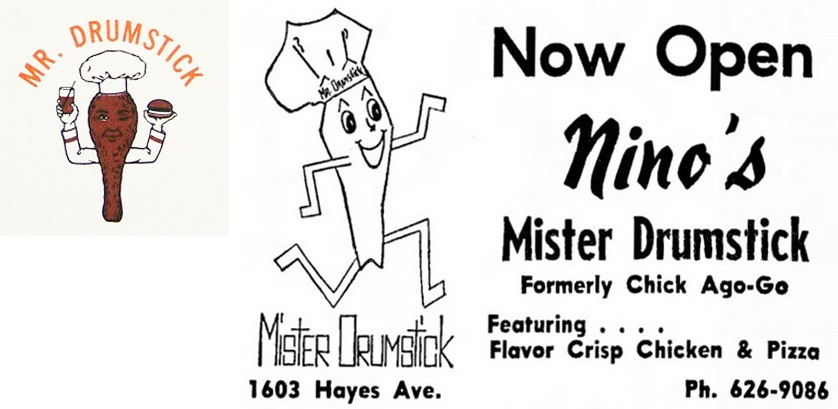
Mister Drumstick, born in Atlanta, offered the World’s Best Fried Chicken. I can’t help but wonder why he is holding a hamburger rather than a chicken leg. Maybe it was because his franchise was sold in connection with Mister Sirloin, a roast beefery, as well as Mister Hamwich, a ham sandwich purveyor. So far I’ve found four Mister Drumsticks in Atlanta and a few in Illinois, Ohio, and Missouri. Nino’s Mister Drumstick in Sandusky OH looks more athletic than Atlanta’s, but of course he has the advantage of legs. Was he a go-go dancer in an earlier phase of his career?

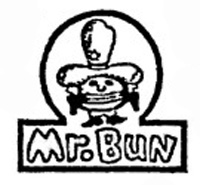
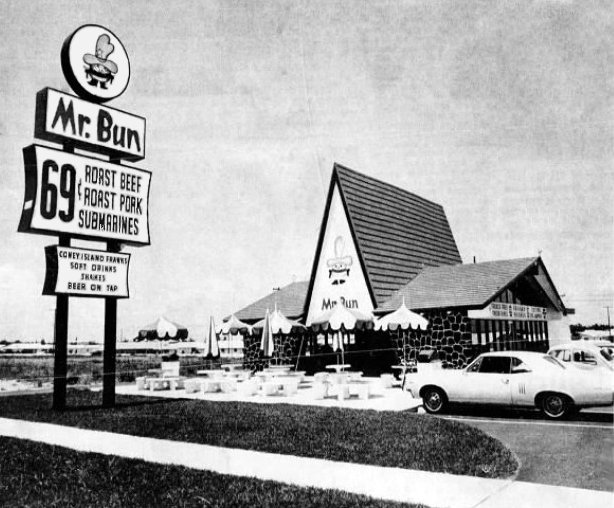
I like the Drumsticks, but my favorites are Mister Bun and Mister Sandwich (of New York City!). They are so versatile. They can handle anything that goes between two slices of bread. I don’t know what Mister Sandwich looked like but Mister Bun was a strange one, with his extremely short legs, his six-guns, and his 10-gallon hat. I can’t really figure him out. Is he trying to compensate for being nothing but bread?

The three Florida creators of Mister Bun had high hopes in 1968 when they opened their first location in Palm Beach, with plans to add more outlets in Florida as well as a number of other states where investors were interested. They advertised for franchisees by telling them that Mister Bun featured “the eight most popular food items in this nation.” It was true that Mister Bun could hold almost anything, so they settled on roast beef, cold cuts, roast pork, frankfurters and fish, accompanied by french fries and onion rings, and washed down with a range of beverages, including beer. Alas, Mister Bun had a rather unhappy life, experiencing little growth, abandonment by his primary creator, and time in court.

Females seemed to stay out of the game, so there are no Mrs. Buns, Mrs. Beefs, Mrs. Tacos . . . or Miss Steaks. Maybe theirs was the wiser course.

© Jan Whitaker, 2022

14 Comments

Filed under chain restaurants, food, restaurant fads, restaurant names, signs

Famous in its day: Le Pavillon

Alternative headings for this post could be Former Busboy Becomes Famous Restaurateur, Best Mid-Century French Restaurant in the U.S., or The Restaurant that Set the Standard for Fine Dining.

In other words, everyone who has known or researched Le Pavillon agrees that it produced this country’s finest French cuisine for most of its 22 years under Henri Soulé. It’s also significant that throughout that time numerous employees of the restaurant left to found some of New York’s other top French restaurants.

Not that the city was devoid of fine French restaurants when Le Pavillon arrived on the scene. French restaurants were well established and plentiful, both as independents and in hotels. Among those competing for the most discriminating and well-heeled diners were Voisin, Café Chambord, and La Belle Meunière. But they were soon outdone.

Because its story has been written about so often and so well, it is challenging to approach Le Pavillon as a topic. For a thorough history that gives a good appreciation of its cuisine, I recommend Ten Restaurants That Changed America by Paul Freedman.

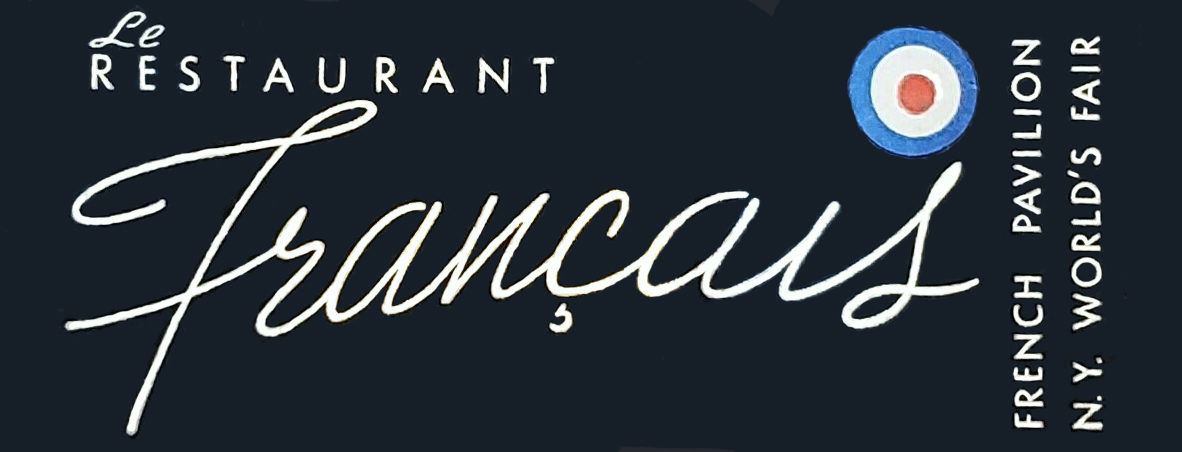
Le Pavillon opened in New York City in 1941, after a spectacular two-year run at the 1939-1940 New York World’s Fair. Located near the top of the Fair’s French Pavilion, it had a dramatic spot overlooking the Lagoon of Nations where a light and fireworks show took place each night at 9 p.m. Despite being the Fair’s most expensive eating place, it was wildly popular and booked for weeks in advance. Because the Fair was difficult to get to by car, New Yorkers had to want to go there badly enough to take public transportation. Yet many returned again and again to dine at the Restaurant Français.

The French Pavilion’s restaurant was provisioned with food and wines brought from France and was staffed by French cooks, maitre d’s, and waiters. It was backed by the French Line and a number of prominent Paris restaurants owned by the Drouant family. Jean Drouant ran the show, hiring Soulé [pictured here], a maitre d’ at one of his Paris restaurants, to manage the dining room.

During the Fair’s tenure, Germany advanced on France, occupying Paris. When the Fair ended, Soulé decided to stay in New York. It has been said that he did not want to return to France under enemy occupation, but it’s likely he was also swayed by the stunning success of the Restaurant Français.

Since many of the restaurant’s French waiters had decided to return to France, Soulé had to hire a good number of French waiters already living in New York. He would soon become known for disputes with his staff, some resulting in resignations of chefs and temporary closure of the restaurant. His authoritarian attitudes may have been shaped by his history with Drouant, who occupied a powerful position in the French restaurant industry. He was president of the Syndicate of French Restaurants as well as the General Owners Union and was not sympathetic to waiters’ rights. He had fully supported military force used to stop a 1938 workers’ strike in response to elimination of the 40-hour week in France. He was critical of French waiters working in America, describing them as “contaminated.”

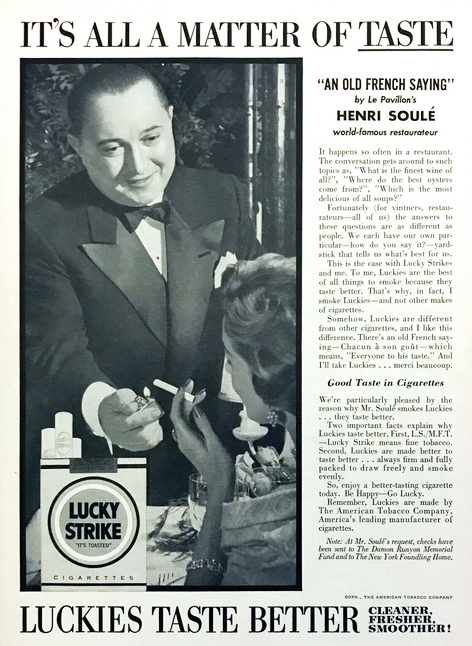
Soulé’s negative attitudes also included dislike of smoking at the table, women drinking, and the widespread American habit of eating quickly rather than slowly savoring the meal. Perhaps because of his general air of disapproval, regular patrons sought signs of his favor, which he gave sparingly. His was a notable ability to confer status on people who were as hungry for that as they were for Chateaubriand with sauce Béarnaise. One of his ways of winning the loyalty of valued patrons was to offer them special dishes not on the menu. [Note that his dislike of smoking in his restaurant did not keep him from appearing in a Luckies’ advertisement in 1954.]

In a 1962 review of a book about Le Pavillon, a clever journalist summed up how to become approved by Soulé. She wrote: “When you go to Le Pavillon you should be famous, if you can manage it, if not, you should at least be rich, elegant, chic and witty. Beautiful, if a woman, dintingué, if a man. If you can’t manage that, then maintain a balance between hauteur and quiet rapture and for heaven’s sake be careful of your manners and careless of your money.”

Yes, the restaurant was exceedingly expensive, beginning at the Fair. According to Craig Claiborne, in 1960 it was possible to spend as little as $6 there for a meal without drinks, equivalent to about $52 today. But with drinks it could cost ten times that. However, in the era of expense accounts, it was standard that a power lunch would be written off as a business expense.

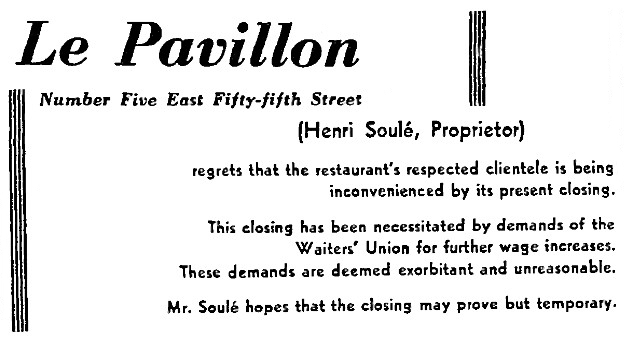
1960 was the year that a dispute between chef Pierre Franey and Soulé over working hours resulted in Franey’s resignation, followed by that of seven of the kitchen staff and leading to a temporary closure of the restaurant. It was not the first time the restaurant closed in response to a dispute. [1955 notice above]

Soulé died in 1966, at age 62. I find it interesting that he willed his watch to frequent patron and “dear friend” J. Edgar Hoover, director of the FBI, whose favorite dishes included Filet of Beef Periogourdine accompanied by a bottle of vintage Romanée Conti.

After Soulé’s death, attempts were made to keep Le Pavillon going but it closed for good in 1971.

© Jan Whitaker, 2022

6 Comments

Filed under elite restaurants, patrons, proprietors & careers, restaurant issues

Lunch in a bus station, maybe

In November, 1961, new Interstate Commerce Commission (ICC) rules took effect requiring all interstate bus terminals to integrate their lunch and waiting rooms. The new regulations went against Jim Crow laws in the South that required separate “white” and “colored” facilities.

Although travel on interstate buses had been integrated by the ICC in 1955, the regulations had not covered restaurants or restrooms in the terminals.

The new rules were issued just months after the Congress of Racial Equality organized “Freedom Rides” with groups of Black and white members who rode buses to Southern states — Alabama and Mississippi in particular — with the intention of challenging segregated bus station facilities. In May, 1961, the Freedom Riders were attacked by violent white mobs who beat them and firebombed one of their buses while it was stopped with a flat tire outside Anniston AL. [photo above]

Twelve days after the ICC rules took effect a Black journalist, Bettye Rice Hughes, set out on a bus trip through the South to observe firsthand what had changed – and what hadn’t. She was a graduate of Lincoln University in Jefferson City MO where she majored in journalism. She and her husband, Albert Hughes, a photographer for the Associated Negro Press [ANP], lived in Los Angeles. She was a reporter for the ANP, but it is unclear if that was her job at the time of her tour. In 1964 she was editor of the women’s page of the San Francisco Sun-Reporter. That year she took part in a panel at a conference on Black writers sponsored by the University of California, Berkeley. In 1966 she left the Sun-Reporter and may have moved to New York City. I was not able to trace her any further than that. [photo: Bettye Jean Hughes at 1964 conference, talking with LeRoi Jones (Amiri Baraka)]

Her six-week tour took her through Oklahoma, Arkansas, Tennessee, the Carolinas, Florida, Georgia, Alabama, and part of Mississippi. Her story, “A Negro Tourist in Dixie,” was published in April, 1962, and continues to be read today.

The bus she took avoided going through all but a corner of Mississippi – where it made no stops – and her tour did not include Louisiana, the birthplace of segregated railroad travel.

In her report of the bus tour it’s clear that she is a close observer, paying attention not only to the reaction of white people to her, but also to the reaction of other Black people, on the bus and in the stations, including kitchen workers. Clearly she is an object of curiosity, but also hostility. “I felt that the threat of violence was always there – particularly in South Carolina, Georgia, and Alabama – but somehow it never erupted,” she writes. She is served in the lunch rooms, though often grudgingly. On a couple of occasions she has to insist on her right to eat in what were still considered by many to be “white” lunch rooms.

The first direct challenge to her presence in a lunch room came at a Greyhound station in Florence, South Carolina. There, the white cashier as well as a white counterman yelled at her to go to the station’s other lunch room, “the one for you.” She stood her ground, despite her growing fear, and succeeded in getting served, but the episode filled her with dread about the next stops. During the encounter, white patrons, she noted, were silent and “pointedly staring at their food.” In Tallahassee FL, the “problem” of serving her was solved by having a Black cook do it.

Throughout her experiences in lunch rooms she felt the eyes of Black travelers on her as much as those of whites, though evidently few dared to order food. She concluded her essay expressing hope that Black passengers would assert their rights in the future and that white Southerners would become accustomed to eating in lunch rooms with them.

I was curious about how lunch room integration proceeded in other parts of the South that she did not visit, and how things developed after her tour. I found that in quite a few cities officials refused to integrate, insisting that local Jim Crow laws took precedence over ICC rulings. The major of Shreveport LA put it bluntly: “We don’t care about the ICC.”

In Birmingham, the manager of the Greyhound cafeteria was fined and given a suspended sentence for allowing Black and white people to be served together. The manager of the lunch counter in the McComb MS bus station took down the signs indicating separate lunch rooms but refused to serve five Black customers in what had been the white room. When they began banging on the counter for service, a gang of white males ran in and attacked them as well as chasing off a TV cameraman.

In some cities and towns local authorities closed their bus stations’ eating facilities rather than integrate. Federal authorities stepped in and prevented Birmingham from closing its Greyhound restaurant. But in Crossett AR a lunch room closure left a Black woman traveling with a 2-year old stuck on a Continental Trailways bus with little food for two days in a snow storm. White passengers had found rooms in a local hotel, but the hotel told the Black woman they were full. After a radio station ran a story about their plight, Black families offered a room and neighbors brought “enough food for a banquet.”

By the time Bettye Hughes’ essay came out, it was generally possible for Black travelers to get a meal in a Southern bus station, though resistance continued in some places. An Associated Press story declared that Virginia and the Carolinas had accepted bus station integration, but Birmingham had integrated “in name but not in practice.” It also reported that Black people were staying away from bus station restaurants generally. They knew they still were not welcome.

© Jan Whitaker, 2020

14 Comments

Filed under atmosphere, lunch rooms, racism, restaurant issues, waiters/waitresses/servers

Image gallery: breaded things

In the 1960s restaurants became seriously interested in portion-controlled entrees. Suddenly any restaurant that aspired to be regarded as sophisticated could have Chicken Cordon Bleu on their menu. Even in the middle of the Arizona desert a teenage employee in a Polynesian restaurant could pop a frozen Cordon Bleu into the microwave, add a slice of orange and some parsley, and – voila! – there you were, dining continentally.

Breaded products that could be dropped into a vat of cooking oil or microwaved were particularly popular with restaurant operators. They were advertised in full color in trade magazines, shown plated just as they might be served to guests. The images that follow were all from 1960s ads.

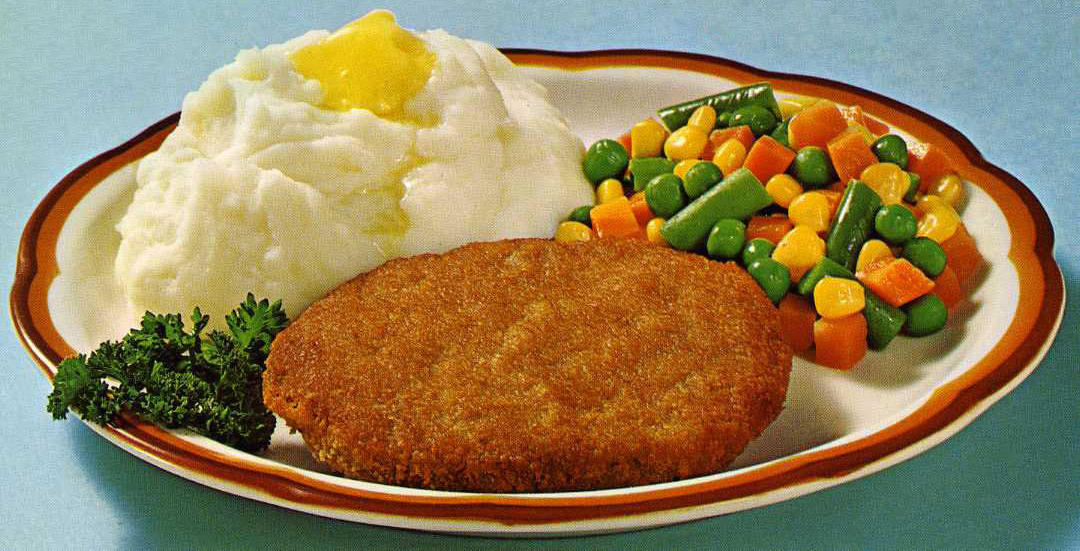
Steak seems to me an odd choice for breading since its appeal is usually based on representation in a more natural state, often with grill marks on the outside and juicily red insides. Breading turns it into mystery meat. But for the money-conscious entrepreneur it made a kind of sense. A 1968 advertisement for Durkee Food Service Group showed a 4 oz. “polarized” Chuck Wagon Steak which cost only 24c. Add a #10 scoop of mashed potatoes (1½ cents), 4 oz. of mixed vegs (6½ cents) and ½ cent worth of parsley and the meal came to 33½ cents. The advertisement suggested charging the customer $1.25.

As much as I’ve searched I’ve failed to discover what “polarized” meant, but I suspect it may have been a disinfecting method or some kind of process that made cheap reheated breaded meat more acceptable to diners.

Swift & Co.’s hotel and restaurant division also offered a breaded Chuck Wagon steak, shown here with corn sticks, baked beans with chopped onions, and banana peppers. Not only did Swift give its steak the same name as Durkee, it looked equally unappetizing. I suppose there was a degree of honesty in the name Chuck Wagon in that both were probably constructed out of inexpensive chuck steak.

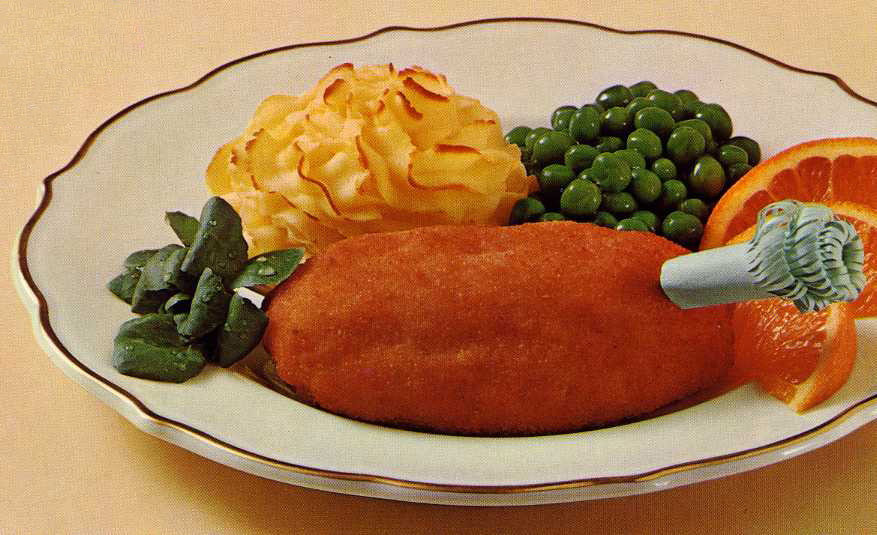
Chicken a la Kiev evidently wasn’t sufficiently elegant sounding to Durkee which renamed their product Empire Chicken Kiev. Its selling point, according to the 1968 advertisement in Food Service Magazine, was that it offered “year-round banquet quality chicken without seasonal price fluctuation.” The dish, whose sadly wilted watercress garnish cost ½ cent, had a total cost of 82 and 1/4 cents. The paper frill is hilarious. I have to keep reminding myself that professionals were paid to design dishes like this.

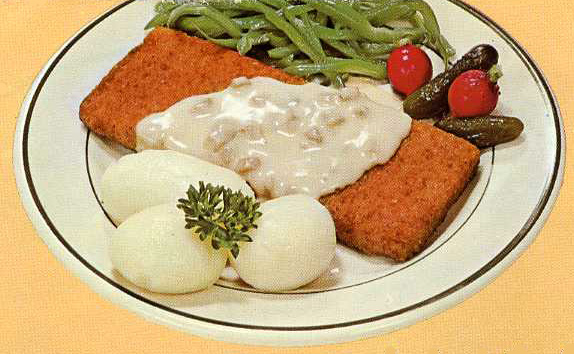
And now to fish processed by Blue Water Seafoods. Here we see their “standard fish portion,” a severely rectangular industrial looking product. In the advertisement it is fancied up and given the name “Fish du Monde.” The serving suggestion is to “cap it with hot mushroom sauce – straight from a can of mushroom soup” (4 cents). Eleven cents for the fish, 4 cents for the boiled potatoes, and 7 cents worth of vegetables and it’s a full-scale dinner. Suggested menu price in 1961: $1.00.

Blue Water also offered “proportioned seafood,” such as the Custom Cut Fillet shown here. “Looks like a fillet, fries like a fillet,” proclaims the copy. A half-hearted try at looking natural.

But what if a restaurant operator really wanted their processed fish to look more realistic? Moore’s Seafood Products, Inc. offered a Cut Haddock Portion, assuring buyers that “even the most discerning gourmet would have a difficult time” distinguishing it from a natural haddock fillet. Called the Aberdeen Cut, it was a patented shape whose “thin, beveled portions . . . develop[ed] the crisp, flaky edge characteristic of the natural fillet.” And, assured Moore’s, an added bonus of the new 1968 shape was that “on a platter or plate, it looks larger than ordinary portions of the same weight.” Are the tiny bits of parsley also meant to make the fish look larger?

© Jan Whitaker, 2020

16 Comments

Filed under food, restaurant industry, technology

Green Book restaurants

Interest in historical Green Book guides for Black travelers has been growing in the past decade and the new movie of this title will surely increase it.

The Green Books’ slogan, “Covering the United States like a blanket,” nicely sums up its goal of making travel more comfortable (maybe even enjoyable) for Black travelers living in a country that typically greeted them with hostility whenever they moved outside their restricted neighborhoods and social roles.

Prior to the arrival of the Green Book, Black Americans relied on the kindness of strangers – also Black – when traveling. Until the 1960s, Jim Crow laws in Southern states barred them from access to white hotels, resorts, and restaurants. Outside the South conditions were not much better, despite civil rights laws barring discrimination in many states. To deal with this, middle-class Black travelers relied on other Blacks who invited them into their homes, even providing meals despite not usually knowing them personally. According to Willis Duke Weatherford’s Race Relations (1934), “The institution of ‘dining out’ is not established among careful [Black] families – it is a reflection on the home to eat in a restaurant; it simply is not done.”

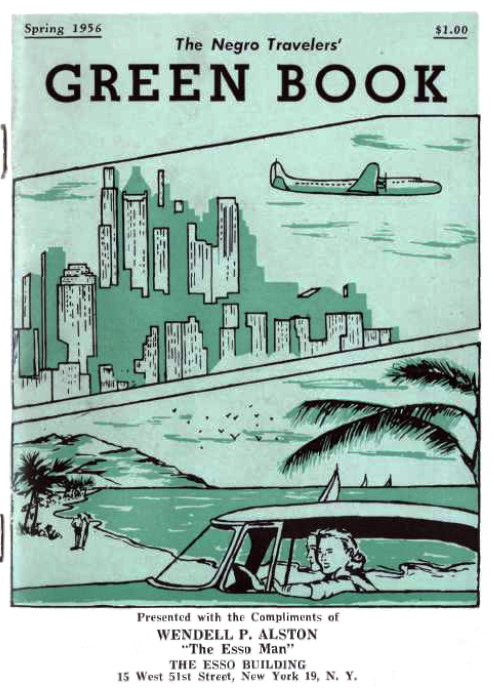
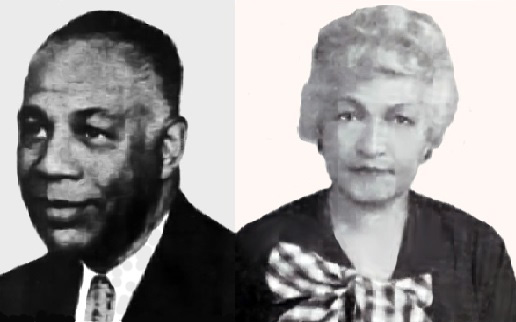
As travel increased among Black business people, entertainers, and tourists, accommodations in private homes were no longer adequate, especially for longer trips. A number of guides were published, among them the annual Negro Motorist Green Book published by Victor Hugo Green, a mail carrier in New Jersey. The guide was renamed the Negro Travelers Green Book in 1952. At some point in the 1950s, Victor became ill and his wife Alma took over as editor and publisher. The last two editions were by new owners.

The Green Books were first published in 1937, then every year after that except for four WWII years, ending with a 1966-1967 edition. With the exception of 1946 and 1958, all of the editions are available digitally in the New York Public Library. A 1946 edition sold for over $4,500 on eBay in 2016 and a copy is owned by Virginia Union University Library. As far as I can tell the 1958 edition is not publicly available. Several editions have been republished.

Green Books were sold directly to consumers and also distributed by Esso after Standard Oil of New Jersey hired a prominent Black businessman to promote Esso to Black motorists. Thirty-eight percent of Esso gas stations were operated by Black proprietors, according to a 1939 essay. Conoco also ran a Negro Travel Service which prepared custom “Touraides” free on request. Quite a few issues of guides devoted pages to new model cars of the major, and a few minor, automobile manufacturers. In the Black community cars were regarded as liberators, as well as providers of good jobs in the manufacturing and service sectors. An essay to this effect, “The Automobile and What It Has Done for the Negro,” appeared in the 1938 edition.

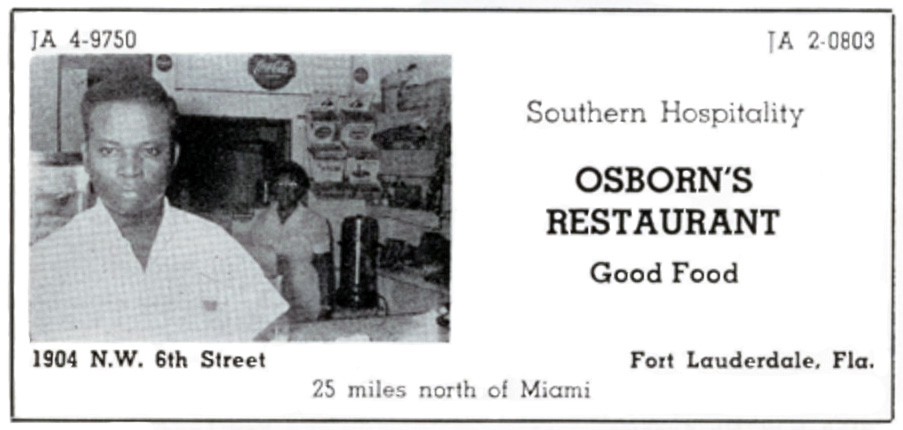
The books provided lists of hotels and tourist homes that were welcoming, most of them located in Black business areas of cities and towns. It also listed restaurants, roadhouses, taverns, nightclubs, beauty and barber shops, service stations, and other businesses. In later years it tended to focus primarily on places to stay. [Osborn’s, 1962]

I’ve looked at all the Green Books in the NYPL collection, paying special attention to restaurants in them. Overall there are not a huge number of restaurants. In 1939, for instance, only two restaurants are listed for the entire state of California.

Most of the restaurants seem to be in Black sections of towns, or are Chinese. Their numbers seem to have been dependent on Victor Green’s informants, who were said to be mail carriers like himself. Coverage was also spotty. Green lived in New Jersey and then New York City, and it’s noticeable that both states are more thoroughly covered than most others.

What seems to be lacking are restaurants in predominately white areas that welcomed Black customers. If Black tourists or business people were visiting Los Angeles, for instance, how would they know which restaurants in the main shopping or business districts would serve them without problems?

Comparing the Duncan Hines’ popular Adventures in Good Eating guide book of the late 1940s with a Green Book of roughly the same time reveals that there is no overlap whatsoever in their listings of Los Angeles restaurants. Not one of the 37 LA restaurants recommended by Hines is to be found in the Green Book or vice versa.

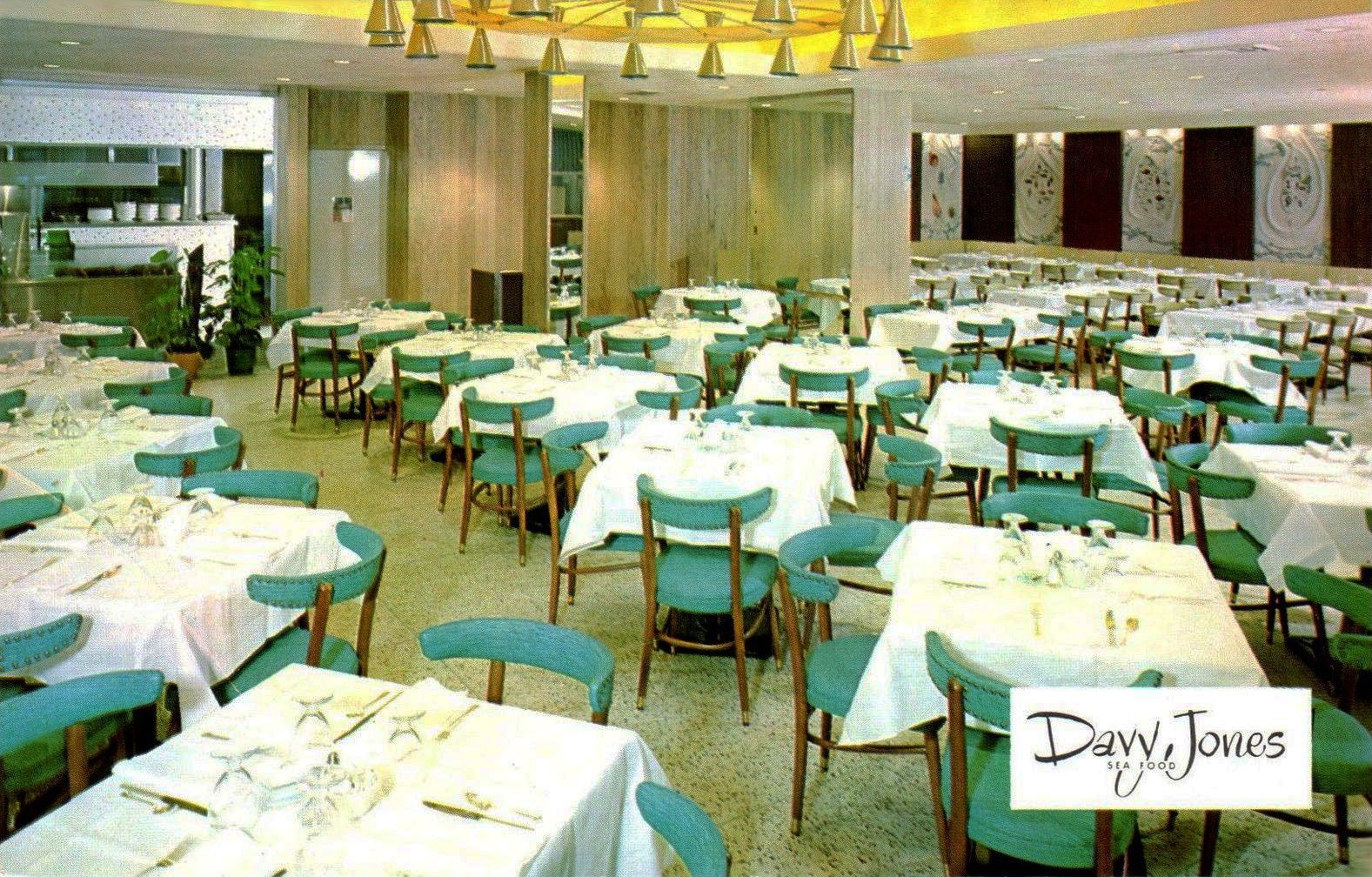
Things had changed somewhat by the 1962 edition. It is striking how many more white-owned and patronized restaurants are listed for New York City that year. Previously the only New York restaurants in the guides were located in Harlem, but now they are all over town. Among them are the Brass Rail chain, Davy Jones Seafood House, and Jack Dempsey’s. It’s hard to know whether the change was due to the policy of the restaurants or the Green Book.

Trying to learn more about restaurants listed in Green Books is difficult. Many I’ve looked for do not show up in city directories, nor in newspaper archives. Judging from feature advertisements for restaurants in later issues, many of the restaurants listed were small neighborhood places that served unpretentious home-cooked meals, quite similar to the majority of white-owned restaurants in the 1930s, 1940s, and 1950s.

I recognized a few names of well-known Black restaurants such as Paschal’s in Atlanta (est. 1947 as a small sandwich shop), Little Gray Shops #2 and #3 (considered Harlem’s better eating places in the 1930s), and Dooky Chase in New Orleans (like Paschal’s, still going strong today).

There was also a listing for Bagley’s, operated by Black socialite Caroline Bagley in Sheepshead Bay NY, as a kind of tea room with garden dining. A number of other tea rooms are listed, among them the Black Beauty Tea Room in Mount Olive NC, which had the distinction of being raided in 1950 for serving bootleg whiskey.

Probably quite a few restaurants in the Green Book were community institutions in their time, such as Hammond Café in Abilene TX, specializing in spicy chili. Certainly that was true of Harlem’s Aunt Dinah’s Kitchen, run by Broadway actor Richard Huey. Aunt Dinah’s hosted one-act plays and discussion forums in the 1930s and 1940s, and served as an informal support center for actors who needed a place to gather and have a free meal now and then.

Researching restaurants, hotels, etc. listed in the Green Books would be an interesting way to construct a picture of 20th-century Black life before the Civil Rights Act. It would make a good group project.

© Jan Whitaker, 2018

17 Comments

Filed under guides & reviews, patrons, racism

Clown themes

Have you ever felt that clown themes, characters, and motifs in restaurants were a mistake? A good number of Americans – estimated as many as 12% of children and adults — experience fear that clowns are deranged maniacs in disguise.

But that wasn’t always true. The 1950s and 1960s were the era of jolly clowns. Several clowns, particularly Bozo, won a children’s audience on TV, redeeming a character that had a sometimes dark history in past centuries. In 1963 Ronald McDonald got his start on television, played by Willard Scott who became better known in subsequent years as a weather forecaster.

Scott’s Ronald, a character he claims to have created, was costumed differently than later and more familiar Ronalds. Ronald has, in fact, gone through numerous costume changes over the years — as have many corporate mascots.

Whether because of clowns’ popularity on TV or some other source of inspiration, quite a few drive-in restaurants (and some drive-in movies) of the 1950s and 1960s adopted clown names, signs, and motifs. Taking on a clown theme suggests a wish to attract children in hopes they might bring the whole family along. The drive-ins’ menus of hamburgers and ice cream were certainly in tune with children’s tastes.

As was true of drive-ins generally, clown-themed drive-ins got their start in the warmer climates of California and Texas. The original Jack In The Box, previously called Oscar’s, was one of the first, opening in 1951 in San Diego, California, with the Jack figure looming over a low roof.

Another early California drive-in of the 1950s was the Big Clown Drive-In, again describing itself as a “hamburger operation.” The Clown Burger, in Fort Worth TX, opened in 1959 serving what are now regarded as surprisingly small, thin burgers and fries.

The innocent appeal of clowns began to wane in the 1970s.

It was a blow to the clown image when juvenile and teen-age murder victims of John Wayne Gacy began to be discovered in 1978. Gacy sometimes wore a Bozo the Clown costume to aid in luring his victims. After his conviction he sold crude paintings of himself dressed as Bozo that he painted in prison.

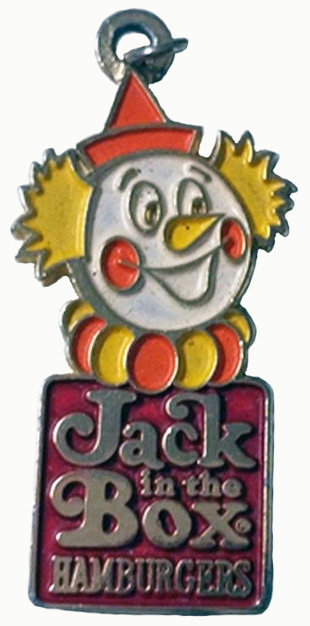
The disclosure of Gacy’s crimes didn’t put a total end to the clown theme, but it may have accelerated its decline. A year earlier Jack In the Box had already simplified and stylized its clown logo which had been in use for nearly a decade (shown here as a charm).

Somehow, though, Ronald McDonald survived. In 2011 the chain’s mascot was criticized for peddling an unhealthy diet to children, but the company decided to keep him nonetheless.

In the 2000s, around two dozen movies with scary clowns were released. Then, in 2016 clown fears increased due to a number of incidents where knife wielding men wearing clown masks marauded in public. After that Ronald became less visible.

© Jan Whitaker, 2018

9 Comments

Filed under atmosphere, chain restaurants, drive-ins, family restaurants, restaurant fads

Delicatessing at the Delirama

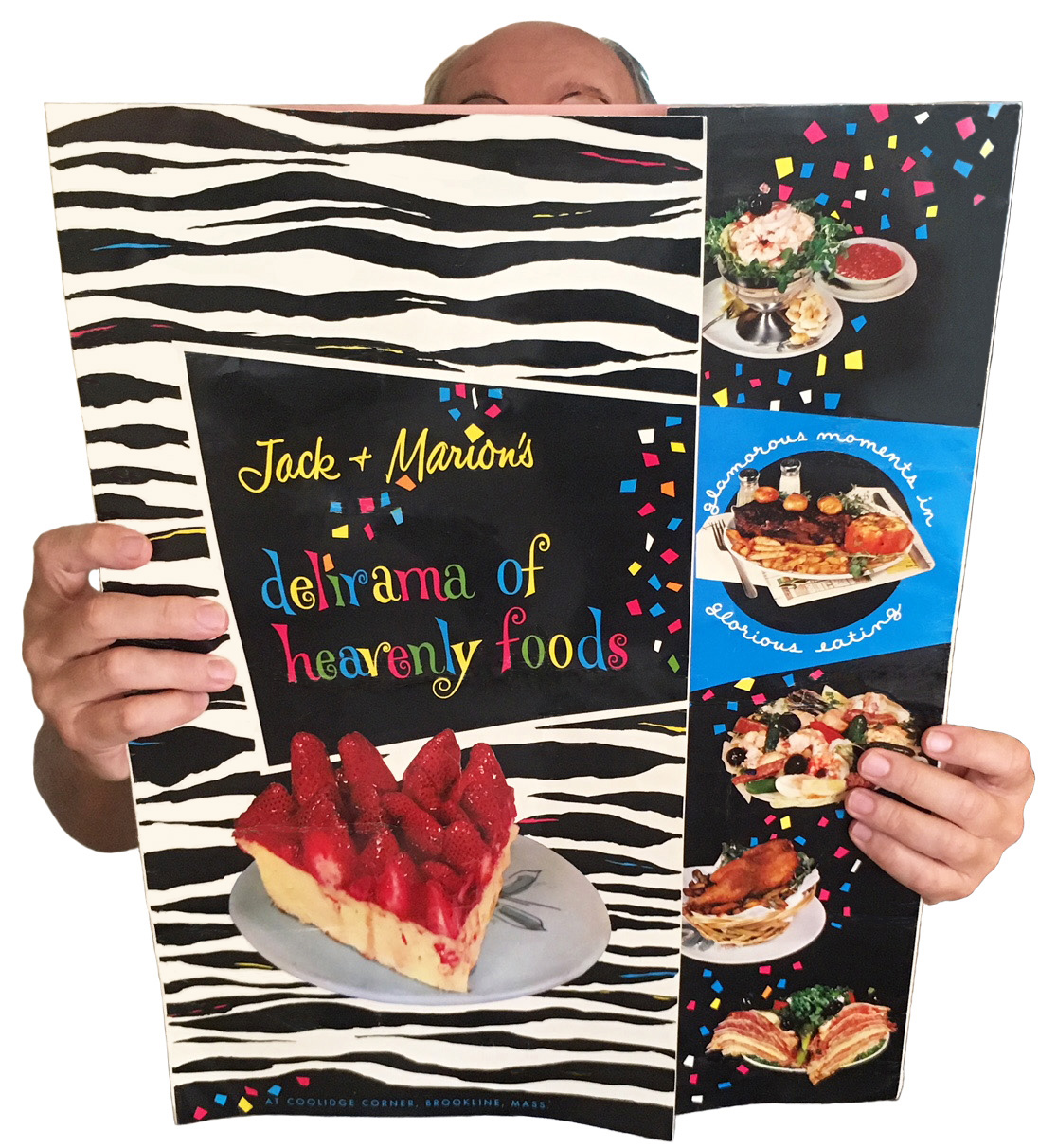
The gigantically oversized menu shown here from Jack & Marion’s Delirama in Brookline MA is 21.5 inches tall, 34 inches wide fully opened, and contains over 230 items not counting drinks, desserts, or carry-out Delicacy Platters.

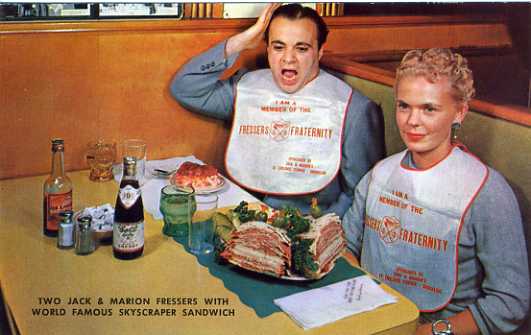
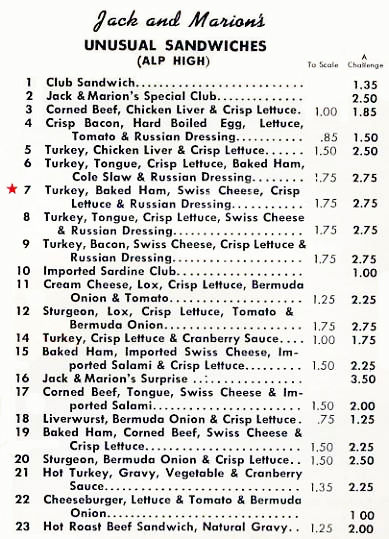
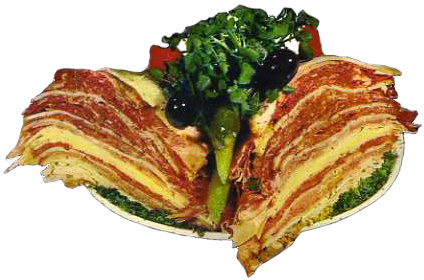
Digesting its pink and white interior is a dizzying, yet entertaining, exercise. Some items, such as the Hot Roumanian Pastromi Sandwich, are marked with a red star indicating “good profit item for Jack and Marion’s (Please order).” The Empire State Skyscraper Sandwich comes with a warning “Sissies, Please Don’t Order!” There is a “Jewish Dictionary” that explains that a “Zedeh” is “a grandchild’s press agent” while “Mein Bubbe’s Tahm” means “chopped herring at Jack’s and Marion’s.”

Patrons might join the “Fressers Fraternity” if they cared to admit that they had gluttonous appetites.

Hungry patrons could feast on bowls of sour cream with banana, fresh vegetables, or cottage cheese. Or on “Forshpies (before getting serious . . . a treat!”), in other words appetizers ranging from a dish of Sweet Gherkins (.35) to Chopped Herring (.65) or a Jumbo Shrimp Cocktail (.95). Along with shrimp, the deli also served non-kosher dishes such as Canadian Bacon Steak and Lobster Surprise, one of the most expensive choices at $5.95. Parties of six could feast on a $25 “Sandwich Supreme, served on a sterling silver platter (which remains our property.)” Like delis generally, sandwiches formed the bulk of menu offerings.

The deli on Harvard Street in Brookline’s Coolidge Corner was owned by Jack and Marion Solomon who opened it in 1950, advertising themselves as “designers and builders of the famous Skyscraper Sandwiches.” Jack, who had previously operated a deli in Brighton, explained that he modeled the Delirama on the famous Raymond’s on Boston’s Washington Street. Raymond’s was a bargain store that used corny advertising by a fictitious Unkle Eph who coined the store’s slogan “Where U Bot the Hat.” Jack Solomon said he, much like Raymond’s, had “done everything to make this the most talked-about restaurant.”

For a number of years the deli kept late hours, staying open until 3 a.m. It drew celebrities doing shows in Boston, such as players from the musical revue Bagels and Yox, who performed songs in Yiddish and other languages. In the 1950s it was often mentioned in entertainment columns in Boston newspapers. It was also a popular place for college students and couples on dates.

Despite suffering two bad fires and having the safe stolen, the Delirama persisted. It did, however, eventually withdraw from the entertainment scene and begin to keep earlier hours. The business did not survive long after the death of Jack Solomon in 1971. Despite attempts by his second wife, Valda, to keep it going, it went bankrupt and closed around the mid-1970s.

© Jan Whitaker, 2018

9 Comments

Filed under food, menus, Offbeat places, popular restaurants, proprietors & careers