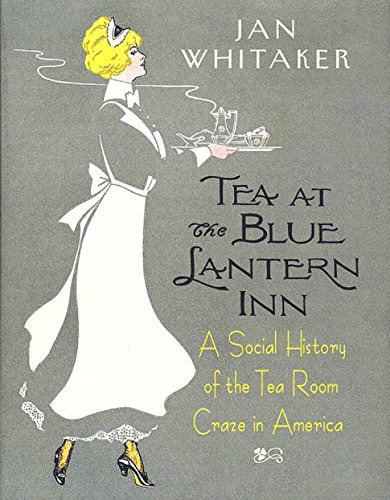
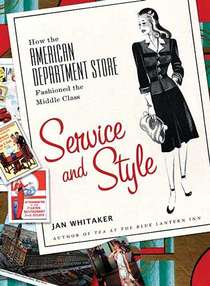
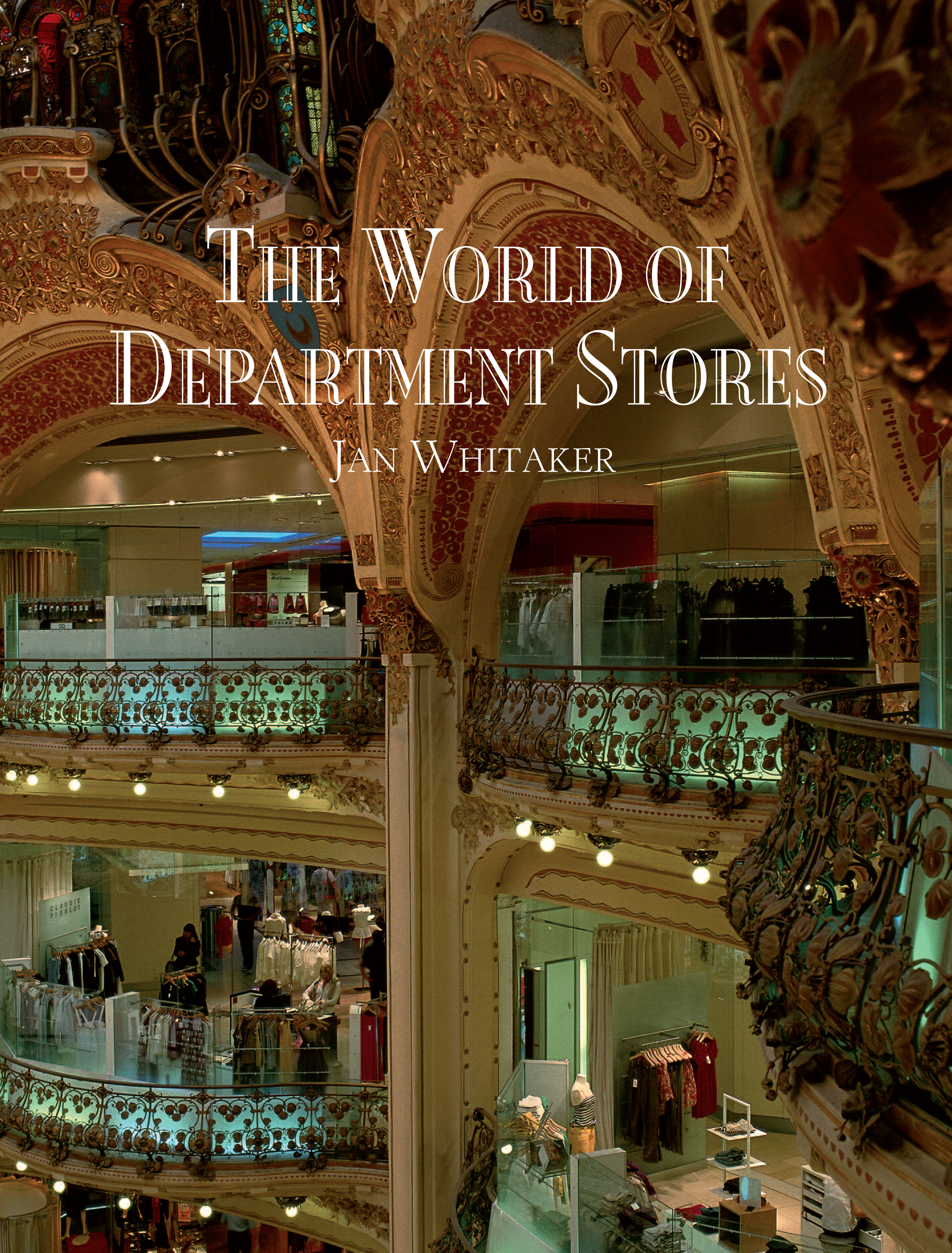
Category Archives: restaurants

The mystery restaurant critic

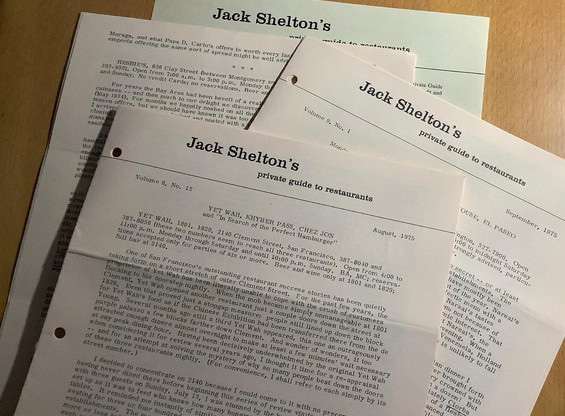
I recently bought the three newsletters by San Francisco restaurant reviewer Jack Shelton shown above. At least I thought they were written by Jack Shelton.

But I was wrong.

He began producing the newsletters in 1967, eleven years after he came to Sausalito, near San Francisco. His main occupation was producing direct mail advertising and fundraising appeals. But in 1959, before beginning his “private guide,” he had published a 94-page booklet called Jack Shelton’s Gracious Dining Guide to Outstanding Restaurants in San Francisco. Another venture was a popular book that he and his partner updated every few years called How to Enjoy 1 to 10 Perfect Days in San Francisco, which also included restaurants [shown above]. Both the guide book and the newsletter were co-authored by Jack Juhasz, but Shelton’s name was featured. Juhasz lived with Shelton and it’s likely they were life partners as well as business partners.

It did not take long for his newsletter to catch on with San Franciscans. Almost immediately he had 3,000 subscribers and the number continued to grow. Soon he was also being interviewed on radio programs and frequently mentioned in newspaper columns.

He had strong opinions about restaurants. An early citing of his newsletters noted that he was a tough critic who “finds the quenelles lacking in flavor, their sauce containing too much brandy, the escalope du veau in too thick a covering, and the salad dressing too sweet. The souffle ‘proved to be pudding-like in texture and a disappointing finale . . .’ The check, including an $8 bottle of Chateau Magdelaine (served in too small glasses), was $27.95 for two.”

He was also quite critical of waiters. On a radio show in 1968 he boldly declared, “Waiters are like dogs – they know when you’re afraid of them. Otherwise they lick your hand.”

He measured a restaurant’s quality by what customers got for their money. So he might give a more favorable review to a casual, inexpensive place such as Tommy’s Joynt or a Haight-Ashbury restaurant with a $3 wiener schnitzel.

As is almost certain to happen to any reviewer, he made some restaurant people angry. The chef of the Palace Hotel reacted badly when Shelton criticized his filets of sole in champagne sauce, saying they were “tasteless” with a “curdled” sauce. The furious chef declared that the sauce was impossible to curdle and that he disliked critics who wouldn’t identify themselves.

Shelton said he ate in restaurants six times a week, visiting those he was reviewing three times, and paying his own bill. And he tried to keep his identity secret. He sometimes wore a mask and wouldn’t allow his picture to appear in papers or magazines.

For instance, he appeared wearing a mask in 1974 when he testified in favor of then President of the Board of Supervisors Dianne Feinstein’s truth-in-menu law. It would have banned frozen dishes that were represented as fresh and other deceptions. In reply to an official’s comment that waiters might notify diners which dishes were frozen, he responded, “All waiters lie.” [Above: maskless Shelton in 1958]

Do reviewers lie too? In Shelton’s case the deception was that as of 1972 he was no longer the author of the restaurant newsletter.” He had sold his private guide to restaurants to wine critic Robert Finigan yet the name remained “Jack Shelton’s private guide to restaurants” as before.

When this became public news some reporters and columnists may have felt a little bit foolish. In May, 1976, columnist Stan Delaplane had referred to Shelton’s restaurant newsletter, calling him “the biggest hitter in San Francisco’s area.” He also reported that a restaurateur was worried that Shelton had been in his restaurant the night before. (Actually, he may have simply been there as a customer.)

It wasn’t until August, 1977, that the San Francisco Chonicle’s Herb Caen revealed that “a plug in Jack Shelton’s Private Guide to Restaurants is not a plug from Jack Shelton, since he no longer writes it” and “hasn’t . . . since 1972,” when he sold it to Finigan. Then he commented, “I thought all you people who say ‘I can’t STAND the way Jack Shelton writes!’ would want to know this.”

It isn’t clear exactly what Finigan renamed it, or exactly when, though it was during or after 1978. In 1982 I saw a mention of “Finigan’s Private Guides to Wine and Restaurants.” In 1981 Finigan had published a book about restaurants called “Robert Finigan’s Guide to Discriminating Dining in San Francisco.”

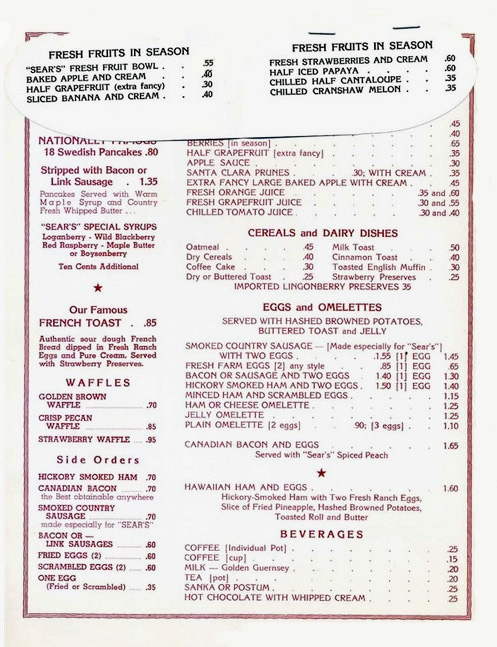
Despite not owning a true Shelton guide, I got a glimpse of a few pages from one in 1968 — when he truly did author it. In it he reviewed Rue Lepic, which he noted was a well-liked restaurant that all his readers wanted him to review, and Sear’s, which was famous for its breakfasts. [Note: the page from the Sear’s menu shown above is earlier than his review.]

Shelton remained a restaurant critic, with a radio show in 1981, but his direct mail business came first. Among the people and causes that he wrote newsletters for were Jesse Jackson and Common Cause.

© Jan Whitaker, 2025

4 Comments

Filed under restaurants

Dining Chinese in the 1800s

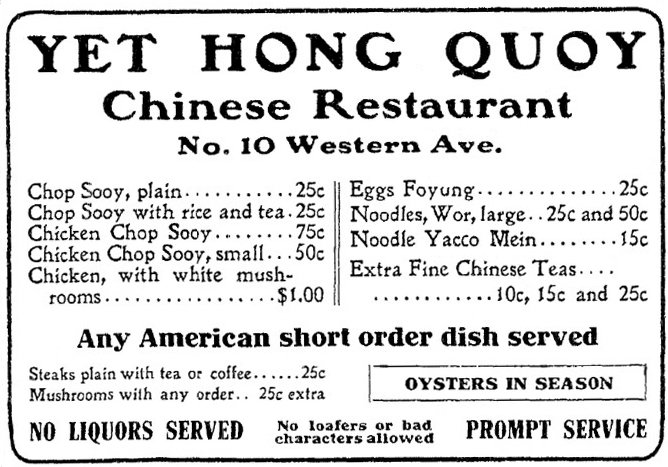
Almost as soon as the Chinese began arriving in San Francisco in the 1850s their restaurant dishes became news of interest. A story appeared in major dailies in 1849 which observed that there were “two restaurants in the town, kept by Kong-sung and Whang-tong, where very palatable chow-chow, curry and tarts are served up by the Celestials.” [Above: early 20th century, San Francisco, when the dining area was usually on an upper floor; Below: elaborate interior of a San Francisco restaurant]

From the start, as this quotation reveals, there was a lot of guesswork in the identification of many of the unfamiliar dishes prepared by the newcomers. The same often applied to proper names.

But the level of interest was high, despite the fact that the Chinese themselves did not experience widespread acceptance, quite the opposite in fact. So the above 1849 report by poet, diplomat, and world traveler Bayard Taylor, which showed appreciative curiosity, stood in stark contrast to the many ugly slurs against the Chinese that would appear through the decades.

Despite the mixed attitudes toward Chinese immigration, their restaurants were popular with a wide range of patrons in early San Francisco. The most elaborate of them sometimes furnished formal banquets for visiting American dignitaries that featured exotic delicacies such as bird’s nest soup.

Although many Chinese kept their traditional grooming and clothing, they proved to be very adaptable in catering to America’s tastes and needs. Gradually moving from San Francisco to the western territory, they opened small eating places, sometimes in the back room of a saloon.

They quickly learned what their customers liked. A man named S. Ling Ning, who ran a restaurant in a mining area of Arizona, demonstrated adaptability in producing baked products, according to his 1873 advertisement.

Hateful sentiment toward Chinese had grown intense in the 1860s and 1870s, as is evidenced in a memoir by a woman who had moved to the silver mining boomtown of Virginia City, Nevada. She denounced the Chinese in the ugliest terms, calling them a “thieving, murderous, licentious, filthy, pestilential race of heathens” who should be banished from the land.

There is something ironic, if that is the right word, about ‘white’ Americans eating meals cooked by people they despised.

In 1882 the Chinese Exclusion Act prohibited the Chinese from immigrating or becoming citizens. The act was not reversed until 1943. Many left the U.S. because of the act, while others began to migrate in an eastern direction due to the level of hostility in the West where “No Chinese” was becoming common in want ads for restaurant help.

Despite the eastward migration, by 1885 there were said to be only six Chinese restaurants in New York City’s Chinese settlement area, according to a report by journalist Wong Chin Foo. Most New Yorkers were leery of patronizing them, he wrote. One of the six he described as grand, attracting “Hong Kong merchants, Mongolian visitors from ‘Frisco, and flush gamblers and wealthy laundrymen.” In other words, most customers were then limited to the Chinese. But it did not take long for the non-Chinese population of the city to “discover” Chinese restaurants. [Above: early 20th century, NYC]

Chinese cooks who came to America in the 19th and early 20th century were highly adaptable in giving Americans food they liked.

Chinese cooks continued to be highly adaptable to American tastes. Along with learning to turn out favorite American dishes such as stew, steak, and potatoes. [Above, Muskegon MI, 1906]

And there were some Chinese chefs who mastered cooking French dishes after training by French chefs. In his 1906 book A Requiem of Old San Francisco, Will Irwin notes that “most of the French chefs at the biggest restaurants were born in Canton, China.”

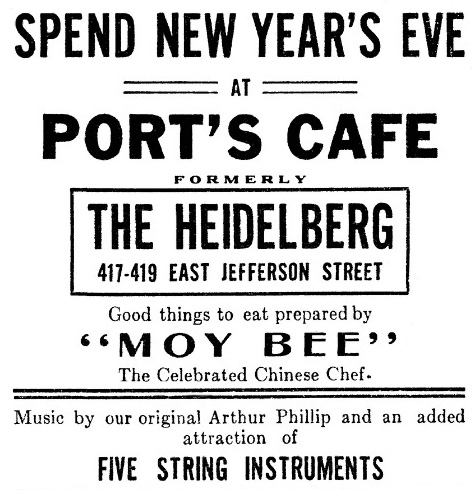
Chinese chefs also learned to prepare German dishes. James Beard and his mother were patrons of two Portland OR German restaurants, House’s and Huber’s, both of which were staffed by Chinese cooks. The venerable Huber’s was known for its turkey and cole slaw. Beard’s family meals were also prepared by a Chinese cook. [Above, Springfield IL, 1915]

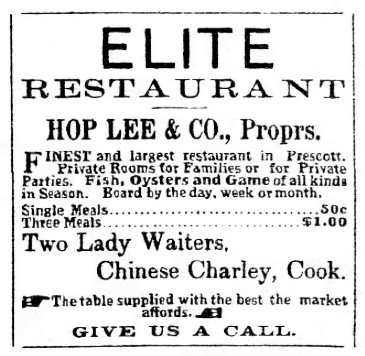
Chinese food, even when adapted to American tastes, did not qualify as a basic American “square meal” but it caught on with Americans anyway. In New York City, according to reports, among the non-Chinese population it was free-wheeling bohemians who were first to discover and enjoy Chinese restaurants. According to one observer, they were said to like the low prices that allowed them to escape from “the insipidity of cheap chop houses and the sameness of the dairy lunch counters.” [Elite Restaurant, Prescott AZ. 1892]

By 1903, according to the New York Times, there were “an estimated 100 chop suey places between 45th street and 14th and between the Bowery to 8th Ave.” However, the story continued, they were mainly patronized by Western visitors since many New Yorkers did not like Chinese servers. Chinese restaurants outside New York’s Chinatown were reportedly popular with Black Americans who hesitated to go into Chinatown but felt comfortable when many of those restaurants began to relocate.

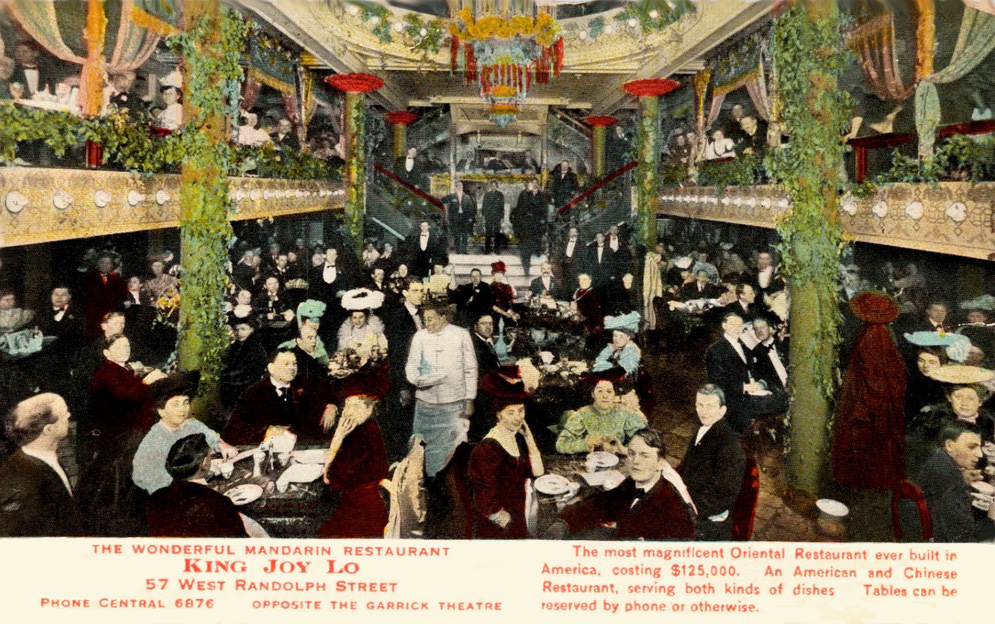
As is well known, the number of Chinese restaurants increased throughout the 20th century, eventually outnumbering McDonald’s. [Above, Chicago, 1913]

© Jan Whitaker, 2025

2 Comments

Filed under restaurants

California coffee shops

With the end of World War II, the United States became the undisputed world power as well as the leading economy, producing the largest share of the world’s goods.

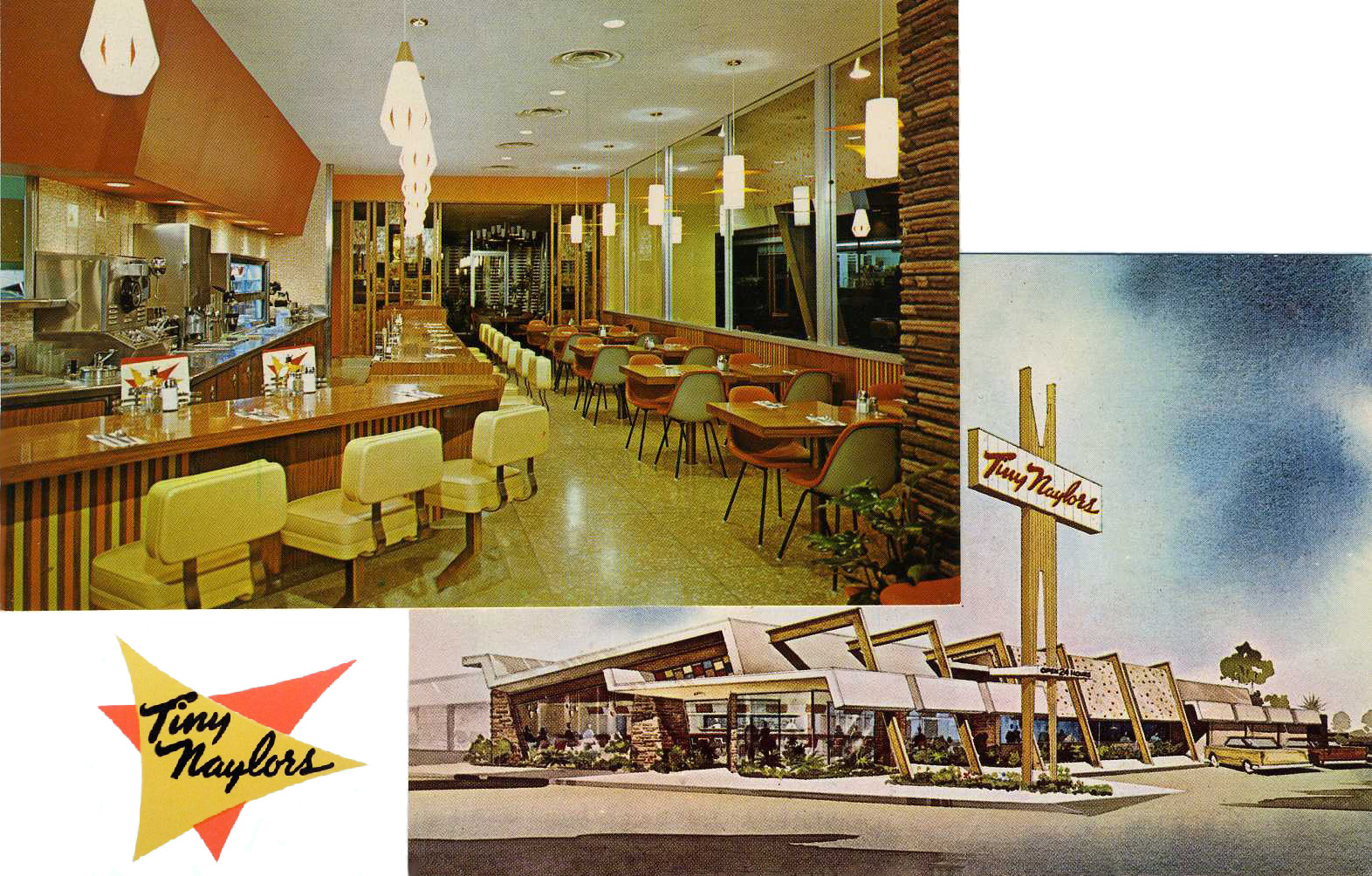
Many changes took place in American society as the soldiers returned. Suburbs sprang up with housing for growing families, shopping centers appeared, and many workers enjoyed prosperity. And a new type of eating place came into being, known as the “California coffee shop.” There had been coffee shops before that, but Southern California introduced new features, particularly in terms of design.

Triumph at the war’s end was celebrated with ticker-tape parades, but also in the design of cars and buildings, including the exuberant design of coffee shops in Southern California. The style of restaurant buildings that has also come to be known as “Googie” was modern, but without the severity of International Style. It used a wide range of materials developed in wartime, and forms inspired by the angles of fighter planes, the energy of the atom, and the bursts of bombs.

The inspiration for the striking designs of California coffee shops – known as Coffee Shop Modern – is frequently attributed to the space age, but over time the realization has grown that it was equally inspired by U.S. world ascendancy rooted in warfare. It may seem strange to attribute inspiration for a sprightly and bright type of architecture and interior design to something as ominous and deadly as the bomb, but a number of writers have made this connection.

In the words of Michael Sorkin’s essay “War is Swell” [in World War II and The American Dream, 1995]:
“That the atom so readily became a chipper symbol of American modernity in the immediate aftermath of its use as the greatest instrument of mass death in human history speaks volumes about the relationship of the accomplishments of war to the formal culture of peace. The decor of the fifties is all bursts and orbits, nuclei and energetic spheres. The atom was fully relegated to the class of things, isolated from life.”
[See also Elizabeth Yuko’s “Why Atomic Age Design Still Looks Futuristic 75 Years Later”]

Elements of coffee shop design can be seen in the look of automobiles of the same time. Some of the striking elements of California coffee shop design were echoed in the fins of Cadillacs inspired by the P-38 fighter plane. In Googie Redux, author Alan Hess, who has been largely responsible for recognition and appreciation of the creativity of Coffee Shop Modern, notes that Time Magazine called the 1959 Cadillac design the “ICBM [Intercontinental Ballistic Missile] look,” and also that “The Olds Rocket, the Olds Cutlass, and the Buick LeSabre were all names borrowed from aeronautics.”

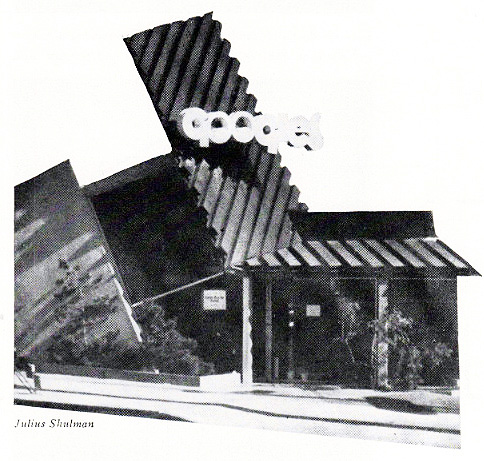
The design of coffee shops was nicknamed “Googie” after architect John Lautner’s 1949 unique Los Angeles creation bearing that name. It featured expansive glass window walls, unusual angles and roof lines, prominent signs, and bright colors. [partial view shown above — it extended farther to the right]

The vocabulary of Coffee Shop Modern signals its inventiveness. Terms in a glossary by Alan Hess in his book Googie Redux include: amoeboid, boomerang, cantilevered canopy, diagonals, dingbat, flagcrete, folded plate roof, free form, hyperbolic paraboloid, starburst, steel web lightener, structural truss, and tapering pylon.

California coffee shops, often bearing nicknames of their owners (Norm’s, Biff’s, Ship’s, Hody’s, Sherm’s, etc.), were casual, unpretentious, comfortable, moderately priced, and open 24 hours. Compared to the inexpensive eating places of the Depression, they offered a cheerful example of luxury for the masses, or what has been termed “populuxe” (See Thomas Hines’ book of the same name). Contrary to the usual negative public reaction to modern architecture, the upstart designs of the coffee shops were well accepted.

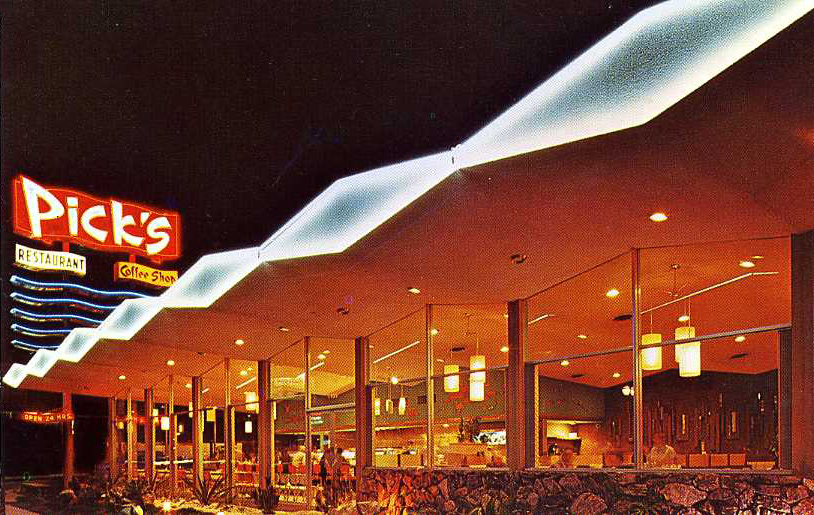
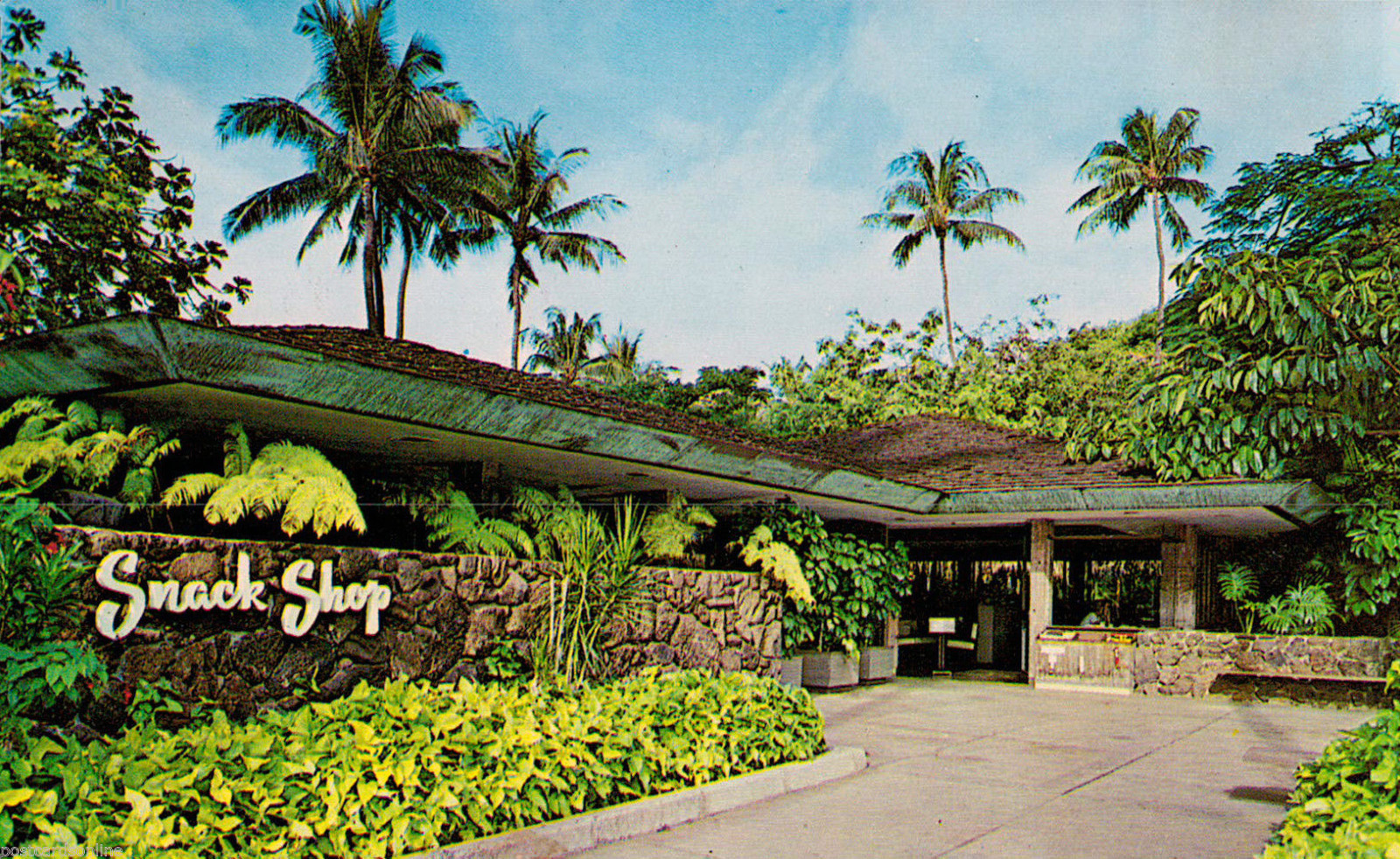
Counter seats were usually spaced generously and built with cantilevered supports allowing for unobstructed floor cleaning. [see above] Many had walls of decorative stone. A 1955 news story about the newly built Carolina Pines Jr. at LaBrea and Sunset noted its imported Italian mosaic tile columns, Palos Verde stone walls, and custom-designed wall plaques, among other features. It also had a carpeted dining room and an outdoor patio eating area in a garden protected from road noise and dirt with decorative fencing. [see below]

The coffee shops also introduced exhibition cooking. Although Eastern diner-style eateries had long done their cooking in sight of patrons, coffee shops introduced stylish designs and materials to the cooking areas and kept them sparkingly clean.

And, oddly enough, considering that the coffee shops were open all night, many of them had cocktail lounges.

Coffee shops designed along the lines of Southern California’s soon spread across the country. In St. Louis there was the Parkmoor, Cleveland had Manners, and Denny’s, with its beginnings in California, flourished everywhere.

Of course, as was true with neon signs, there were critics, notably Peter Blake in his 1964 book God’s Own Junkyard. He lumped Googie-style designs with neon, billboards, subdivisions, and a general decline in the built environment.

Starting in the mid 1960s but gaining in the 1970s Googie style was rejected, and what has been dubbed the “browning of America” by Philip Langdon had begun. Now chain restaurants of the coffee shop type began featuring earth tones, mansard roofs, exposed wooden beams, hanging plants, and subdued lighting. The coffee shop type of suburban restaurant continued in chains such as Denny’s despite competition by fast food establishments. McDonald’s, which had itself begun with Googie styling, toned down its buildings.

The change was due in part to the Vietnam War, but I can’t help but wonder if Americans hadn’t already become disenchanted with power and wealth based on military might.

© Jan Whitaker, 2024

22 Comments

Filed under chain restaurants, decor, family restaurants, popular restaurants, restaurant decor, restaurants

Anatomy of a restaurateur: Clifford Clinton

Rarely is the word fantastical used to modify the word cafeteria. Nor are restaurant proprietors usually thought of as powerful vice crusaders. [cover, 1940s booklet; below Pacific Seas]

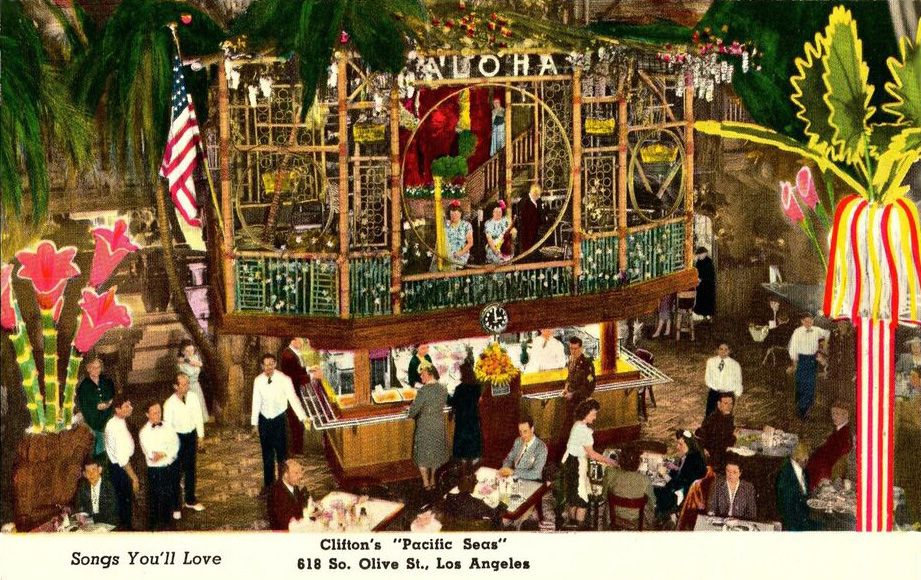
A major exception of the latter was Clifford Clinton, creator of two of Los Angeles’ most memorable cafeterias. Both Clifton’s Pacific Seas and Clifton’s Brookdale were indeed fantastical, exotic, and composed of an odd blend of entertainment and salvation. In appearance they anticipated elements of Disneyland as well as Polynesian restaurant decor.

One of their strangest aspects was that they represented Clinton’s missionary work. After a few years of operating his father’s Puritan restaurant chain in San Francisco – previously owned by moralist Alfred W. Dennett — he came to Los Angeles in 1931 and re-opened a former Boos Brothers cafeteria at 618 S. Olive.

By the following year he was running that “Clifton’s” cafeteria plus another one on W. Third, one on Hollywood Blvd, a hotel probably housing his employees, “A miniature Cafeteria of the Tropics” in Whittier, and a “Penny Caveteria” in a basement on S. Hill street that offered dishes for 1 cent each.

In October 1932, perhaps the worst year of the Depression, a newspaper featured a smiling woman in the Caveteria with her 5¢ meal of soup, veal loaf, macaroni, sliced tomatoes, and buttered bread. According to another story, she was but one of an average of 4,500 customers fed each day (except Sundays, when all Clifton’s closed). Lines typically stretched down the street. For Christmas that year 7,000 guests enjoyed a Christmas turkey dinner priced at 1¢.

In 1939 Clinton remodeled the redwood-forest-themed Clifton’s Brookdale that had opened in 1935 as well as the original place on S. Olive, Clifton’s Pacific Seas, with a dazzling Polynesian look, neon palm trees, and many, many waterfalls. [Brookdale interior shown above; below more waterfalls, Pacific Seas exterior]

Along with meals, the restaurants acted as social centers and spiritual retreats for the thousands of uprooted mid-westerners who had relocated to Los Angeles. And they served as a kind of political base for Clinton’s reform campaigns. His cafeterias and his political activities were entirely consistent with the tenor of Los Angeles culture of the time. As George Creel summarized it in a 1939 Colliers article, the city throbbed with “two thousand religious cults . . ., each claiming daily and direct communication with Jehovah, and an equal number of social, economic and political movements: Epic, Social Credit, Utopia, the Townsend Plan and Thirty Dollars Every Thursday, etc., all guaranteed to promote the immediate salvation of mankind.”

Religiosity permeated the Clifton’s Cafeterias, as it had Dennett’s and would in a number of restaurants later in the century. If guests left the main dining room of Pacific Seas and entered the basement they would find a life-sized figure of Jesus praying in The Garden of Meditation [shown above]. Brookdale featured a Little Chapel set amidst the redwoods.

During World War II, Pacific Seas diners could also post their “feelings and wants” on a bulletin board or consult with a “Mrs. Von” in her bamboo hut for advice on personal problems.

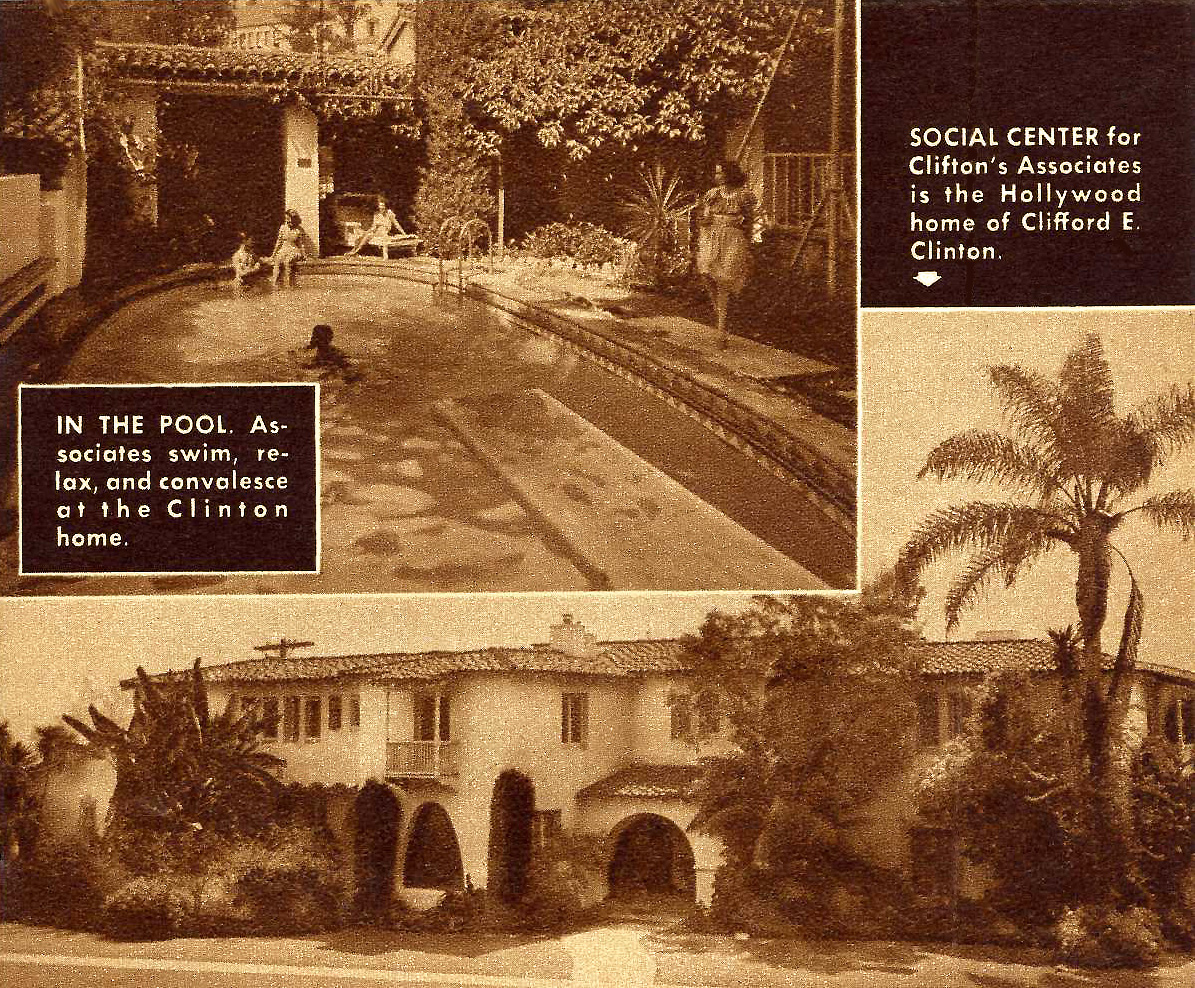
Clifford Clinton’s mission to offer affordable meals continued throughout his career. The policy was that no one would be turned away because of a lack of funds. Although the practice undoubtedly ate into revenue, and was probably taken advantage of by some, Clinton managed to amass enough profits to live in a sprawling mansion on Los Feliz Blvd. and Western Ave in which he hosted convalescing employees [shown above]. (The house sold last year for close to $5M.)

Clifford Clinton was as colorful as his restaurants, despite his appearance as a conventional religious and civic-minded family man. He had spent much of his childhood in China with his missionary parents, an experience that he said made him ultra-sensitive to human hunger. That is unusual but it was just a prelude to his role as one of Los Angeles’ prominent crusaders of the 1930s dedicated to cleaning up the city’s vice and political corruption.

He succeeded in getting Mayor Frank Shaw recalled and replaced by the candidate of his choice, who he promoted on his radio show. In addition, the city’s police chief was indicted and found guilty of plotting the car bombing that severely injured the private detective working for Clinton’s lawyer.

Clinton’s success as a crusader has been partly attributed to his alliances. He worked with Protestant ministers under the banner of an organization he created known as C.I.V.I.C (Citizens’ Independent Vice Investigating Committee). And he also allied with the Communist Party during its popular front phase. As a result of these efforts, gambling, prostitution — and the city’s anti-Communist Red Squad — were eliminated, or at least removed from sight.

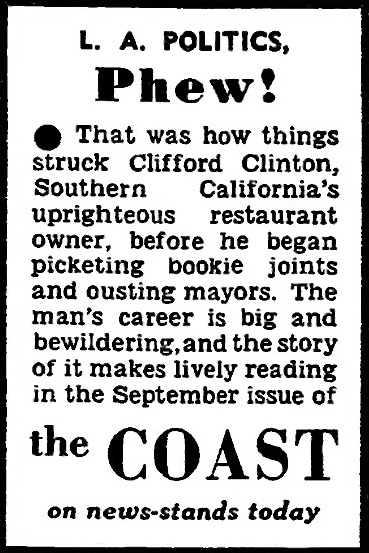
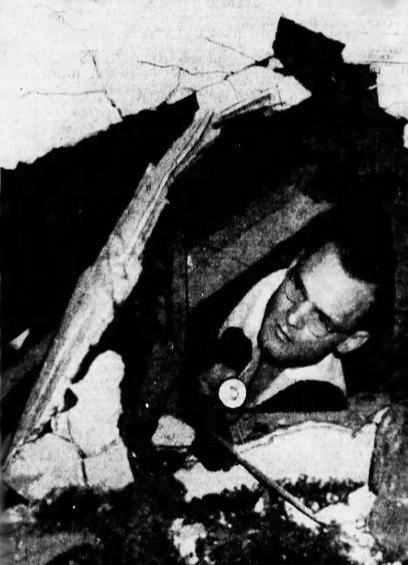
Through these years Clinton experienced endless phone threats, a bombing at his home, false reports of food poisoning at his restaurants, and an endless array of dirty tricks such as an invasion of one of his public forums by 300 hungry people who had been given tickets for a (non-existent) free meal of chicken and beer. [above: 1939 advertisement for magazine article; below: Clinton examines bomb damage]

Having turned the cafeterias over to his children in 1946, Clinton and his business partner, Ransom Callicott, focused on world hunger. They found a scientist who developed what would be known as Meals for Millions, a soy-based one-dish meal that could be prepared as soup or, with a little flour or corn meal added, bread.

Clinton died in 1969 but his restaurants, including a number of conventional ones in shopping centers, endured well into the 2000s.

© Jan Whitaker, 2024

11 Comments

Filed under cafeterias, Offbeat places, popular restaurants, proprietors & careers, restaurant decor, restaurants, theme restaurants

Restaurant food revisited

Over time I’ve written a number of posts about specific dishes and types of food highly associated with restaurants, some of them rarely prepared in home kitchens. Other items listed below are not restaurant dishes, but items that restaurants need to provide on the table or use in the kitchen – and that have played special roles — such as butter, cheese, bread, sugar, parsley, water, and cooking oil.

Beans – Beans were a basic dish in cheap eateries in the 19rh and early 20th centuries and furnished a meal for any time of day or night. Writers were attracted to beaneries for their symbolic association with rock-bottom reality. Beaneries disappeared when the increasing wealth of post-WWII America led restaurants to shun beans except in chili.

Bread – Clearly the filler-upper in America’s early eating places, it accompanied even the cheapest meals. In more modern times, it has served as a consolation to hungry diners waiting for their orders to arrive at the table. Today as many restaurants “monetize” their bread baskets, it is no longer “free.”

Butter – It has appeared on restaurant tables in various guises — whipped, as rosettes, curls, or pats. It was a bit of headache for restaurants but they had to serve it as long as they served bread. Restaurants continued to serve it during WWII when the federal government backed down on reducing the amount they were allowed.

Cheese – Although the custom of finishing a meal with a cheese course never really caught on in American restaurants, their use of cheese in a variety of menu items continued to rise throughout the last century. Its ever-increasing popularity was boosted by Italian dishes, saloon “free lunches,” cheeseburgers, and of course the rise of pizza and Mexican fast food chains. [pictured: chili cheese fries]

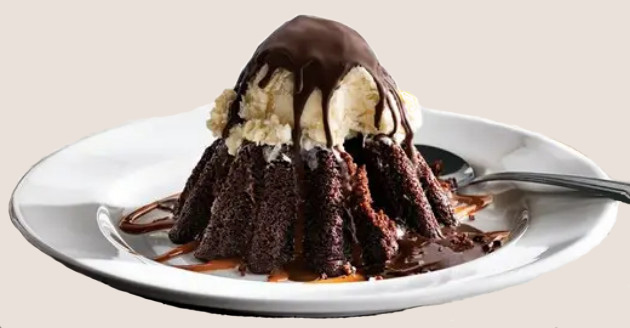
Chocolate desserts – Not much chocolate on the menus of hotels and eateries in the 19th century, but that was going to change. No doubt the entry of women into the dining-out public in the 20th century had a lot to do with its rising popularity, especially in the form of baked goods. By the 1970s a huge number of Americans began to declare themselves “chocoholics.”

Club sandwiches – Perhaps they originated in clubs, but that mere suggestion gave them a cachet and no doubt helped spread their popularity. That and how neatly they were layered and cut into four dainty triangular pieces recommended them to diners who were upwardly mobile – or wished they were. Perfect for restaurants because, really, who wanted to go to all the extra trouble to construct one at home.

Coffee – Coffee, the beverage of sobriety and business, was basic to restaurants for most of the 19th and much of the 20th century. And, surprisingly, its price per cup stayed at 5 cents in many restaurants until the 1940s. By the 1970s it was up to 25 cents but it was increasingly losing out to soft drinks. Eventually it lost its major place as an accompaniment to meals, except maybe with desserts.

Cooking oil – If anything shouts restaurant fare, it is the long history of deep-fried food served in public eating places. Early fryers relied on lard, later replaced with cheaper cottonseed oil. The number of items that are fried has only increased over the decades, to include meats, fish, potatoes, a wide assortment of vegetables, even cheese.

Crepes – Restaurants specializing in crepes became popular in the 1960s and 1970s, fueled by increased travel abroad and interest in wider food horizons. Yet, unlike other foods regarded as rather exotic, crepes were affordable. The Magic Pan chain became popular and was acquired by a major food corporation. But by the mid 1980s the trend had expired and the delicate food was declared out of fashion.

Eggs Benedict – A truly “legendary” menu item in the sense that its origin story was concocted to give it enough glamour that a higher price could be charged. Maybe not quite that deliberate, but close. A legend appears to have been invented, or perhaps embroidered, in the 1940s. Eventually the dish, a brunch favorite, became popular enough that it could stand on its own.

Fortune cookies – The cookies probably made their initial appearance in the 1910s at Golden Gate Park’s Japanese Tea Garden in San Francisco. It didn’t take long before they were regarded as an invariable component of a Chinese restaurant meal. In the 1960s the paper on which fortunes are printed was sterilized and the message was printed with non-toxic vegetable dyes.

French fries – In cooking terms, frenched does not refer to France but to cutting food into strips. In France our “French fries” are their “frites.” The cost of cooking oil hampered their adoption in restaurants here for a time, but they began to appear on more menus in the early 20th century, especially after demand rose as WWI veterans who had been introduced to them in France returned home.

Fried chicken – Fried chicken could not become popular, inexpensive – and profitable — restaurant fare throughout the country until chickens went into mass production, mainly after the second World War. Before that fried chicken lovers had to travel into rural areas, often to tea rooms, to find it on a menu.

Hamburgers – Perhaps because in the 1890s hamburger sandwiches were strongly associated with “smelly” night lunch wagons whose customers ate them standing on the street, hamburgers were disdained by those of higher means. It didn’t help that in some cases the ground meat was questionable in quality and had been dosed with preservatives. It may have been young people who changed the equation, boosting hamburgers’ popularity in the 1920s.

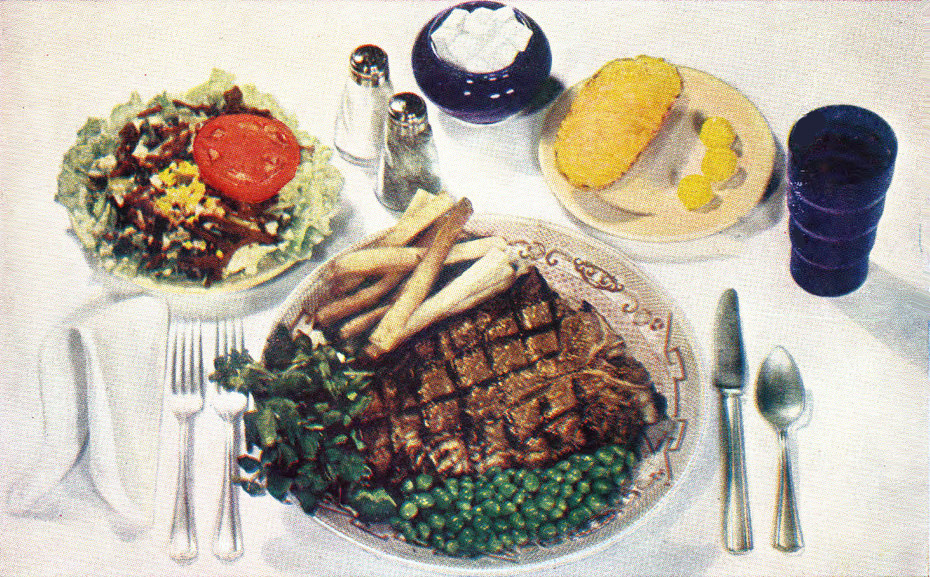
Meat and potatoes – The popularity of restaurant meals containing both components was intense in the 19th and 20th centuries. The mutton of the 19th century vanished but the love of beef seemed eternal. This was the bedrock American diet, especially popular with men who patronized steak houses. It was not challenged until the 1970s, mostly for health reasons, and yet did not disappear.

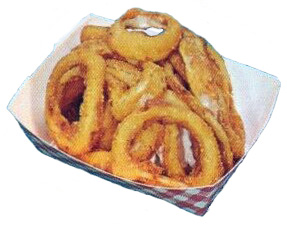
Onion rings – Once Americans got over their aversion to onions — mostly in the 1970s when fast food outlets began to offer them — they decided they really loved those deep fried treats! It helped a lot that they had become available frozen and breaded, relieving kitchen workers from having to handle the smelly vegetables.

Pancakes and waffles – Pancakes had long been short order staples, growing in popularity in the Depression as an inexpensive, yet filling, menu choice. Later, the proliferation of chains specializing in pancakes made them popular for all meals, not just breakfast, and attracted the family trade. Waffles have probably been less popular than pancakes overall, but in some ways they proved more versatile since they could serve as a base for other foods, especially fried chicken.

Parsley – Some people eat it, but its main role in restaurants has been decorative. Better yet, it has filled in empty spaces on plates. Its use as a garnish departed from the European practice of matching garnishes with foods whose taste and texture they enhanced. In this country, parsley could appear on any plate regardless of what was being served. Nevertheless, its mere presence signals to the diner that s/he is eating away from home.

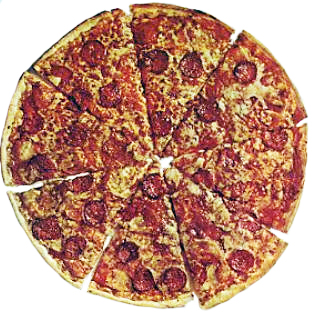
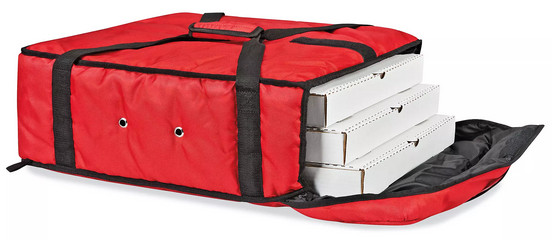
Pizza – In its early years it was known mainly to Italian-Americans, but it came into the mainstream in the 1950s, though still relatively unknown in some areas of the country such as the South. For a time it was regarded as a snack more than as a meal. Partly due to the growth of nationwide chains, it would eventually surpass hamburgers in popularity. Cities vie for pizza fame, among them New Haven CT, home of apizza.

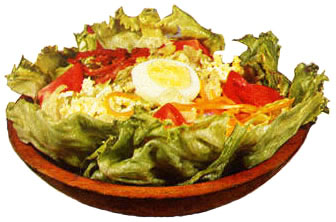
Salad – Salads tended to be reserved for elites in the 19th century, but in the 1910s they reached a wider slice of Americans in small French and Italian cafes. As the century progressed salad moved into the mainstream, popularized by salad bars. Meanwhile Caesar salads migrated northward from Mexico into California, while some other parts of the country enjoyed the unfortunately named “wop” salads.

Shrimp – Although hotels included shrimp salad on their menus in the later 19th century, the little crustaceans didn’t achieve notable attention until the rise of shrimp cocktails in the 20th century. Next came breaded deep-fried shrimp, their use boosted by frozen products marketed to restaurants.

Spaghetti – The early non-Italian fans of Italian restaurants featuring spaghetti dinners were drawn by their semi-forbidden attractions, namely red wine and garlic, plus the fun of wrangling spaghetti. In other words, precisely those things that made upright Americans uncomfortable. Artists and musicians, considered “bohemians,” boosted its popularity.

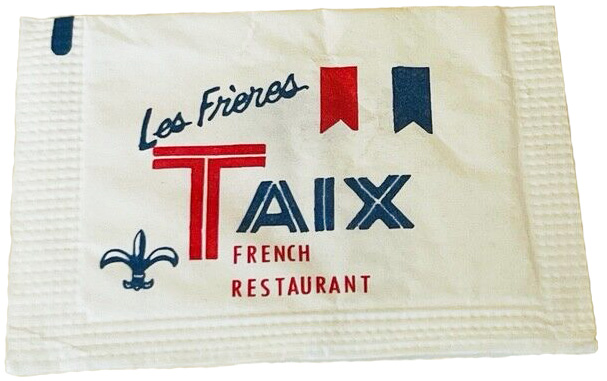
Sugar – Largely absent on restaurant tables today, sugar was once demanded by restaurant customers. Over time the unsanitary sugar bowl, often shared with strangers, was replaced with shakers and then individual paper packets. Wartime restrictions posed a vexing issue for proprietors, as did the behavior of some customers who employed ingenious methods to make off with the scarce commodity.

Surf ‘n’ turf – Brought to this country via airplane in the 1930s, South African “rock lobster” introduced a new menu selection that was destined to achieve fame. The inexpensive lobster tails paired with steak became popular in the 1960s, remaining a favorite into the 1970s. Price increases by the late 1970s were no doubt responsible for the once-inexpensive combo’s decline.

Tomato juice – Introduced to restaurants in the 20th century, tomato juice was once a trendy drink that could serve as an appetizer. Unsurprisingly, its menu appellation, Tomato Juice Cocktail, reflected its popularity during Prohibition. It was sometimes presented in special concoctions – with cottage cheese stirred in, or perhaps orange or clam juice.

Water – It seems that diners were first served a glass of water with their meal in the 1840s when some large cities, including Boston and New York, acquired reservoirs. The new custom pleased temperance advocates, but some newcomers, Italians for instance, preferred wine with their meals. Though many Americans don’t drink the water provided in restaurants, they tend to want it poured for them anyway.
8 Comments

Filed under food, restaurant customs, restaurants

A tough business in a tough town

Most people realize that the expense and hassle of opening a restaurant in New York City is daunting, but a 1980 New York Magazine story by Paul Tharp laid it out in excruciating detail.

Generally new restaurants have a short run, but the piece underscored this observation by noting that the city’s Restaurant Association claimed that three of every four places shut down or had new owners within five years. Tharp added that a real estate broker said that one out of ten operating restaurants was for sale “at any given time.”

New York was a particularly tough city for restaurant operators. Higher food costs there meant that the consumer was going to pay four times the cost of a meal’s raw materials rather than three times, then the national norm.

Expenses involved in opening a new restaurant were staggering. Although the total estimate for a 40-seat restaurant of $162,018 given in the article seems quite low by today’s standards, it wasn’t then. The biggest chunks of money were for payroll, kitchen equipment, rent, and remodeling costs.

But that was just the monetary total. Tharp also outlined a time factor, noting that the amount of time spent getting set up was often not anticipated by those lacking previous experience.

The article observed that few new owners expected to be putting in 14-hour days the first year working in the kitchen or waiting on tables, virtually abandoning their personal life. Nor did they realize how much time and patience would be required to obtain licenses and satisfy city regulations, such as taking and passing a 15-hour Health Department course in sanitation and food handling.

And then there were the exasperating bureaucratic hurdles. For some it was a surprise that stove vents were required to extend to the top of buildings. If the Buildings Department found that the restaurant had not obtained a permit and met city standards for remodeling, an owner might need to tear out all the work that had already been done and start over.

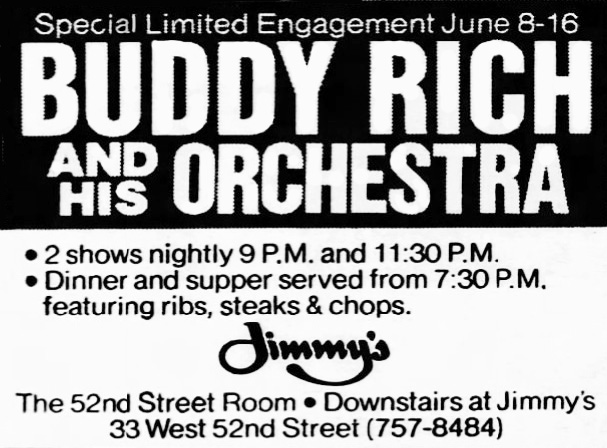
Taking over an existing restaurant may have avoided the hassles of remodeling, but its costs were likely much higher and brought their own hazards. Tharp relates a horror story involving two inexperienced men, elsewhere termed “babes in the gastronomic woods,” who wanted to take over a former Toots Shor restaurant for a bargain price if the new owners also assumed the restaurant’s debt. They teamed with major investors who pulled out and left them at sea. They renamed it Jimmy’s after soon-to-vanish partner Jimmy Breslin. Although at first it was quite popular, business then fell off with the recession and they realized they couldn’t handle the large staff or deal with unexpected costs such as credit card service charges, electricity rate hikes, and a temporary loss of their liquor license. Even adding an upstairs cabaret and a downstairs jazz club and hiring Jack Lemmon as Monday night bartender failed to attract the disappearing crowds. After about 34 months capped by a flooded basement, Jimmy’s shut down.

If Tharp’s report didn’t contain enough warnings, a published letter from a Manhattan realtor added another note of caution. He pointed out that owners of “quality buildings,” fearful of restaurant failure rates, tacked on security deposits equal to as much as five months rent, plus additional payments to make up for premiums required by insurers who assessed a higher fire risk for a restaurant tenant. Altogether, he estimated the operating budget should be 30% to 40% higher than Tharp’s.

Perhaps to offset all the bad news, the story included five thumbnail sketches of restaurateurs who overcame obstacles. I took a closer look at their subsequent careers, which raised some questions about just how well they all did. Three seemed to be well-connected pros who, despite disappointments with some ventures, did well overall. One of those briefly profiled was Peter Aschkenasy who had a number of successes including Charley O’s and U.S. Steakhouse, but who hit a snag trying to revive the classic New York restaurant Lüchow’s [pictured at top].

One restaurateur had a place I could find absolutely no trace of anywhere, and another had a single tiny restaurant with a short life. It was operated by the only woman mentioned in the story, chef Leslie Revsin, whose professional biographies unfailingly cited that she was the first woman chef to be hired by the Waldorf-Astoria. She opened Restaurant Leslie in Greenwich Village in 1979. With only nine tables and no liquor or wine license, it lasted only a few years despite critical praise. Following that she cycled through about nine New York restaurant kitchens including Argenteuil, One Fifth Avenue, and The Inn at Pound Ridge, often as executive chef. Eventually she turned to writing cook books.

© Jan Whitaker, 2024

Leave a comment

Filed under proprietors & careers, restaurant issues, restaurants

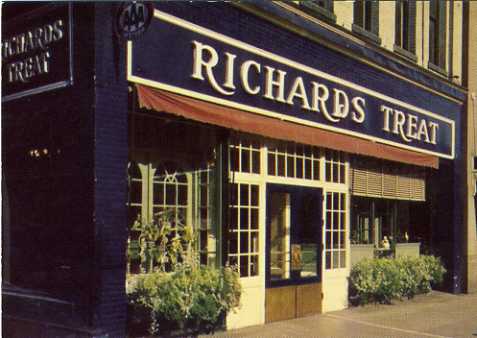
Famous in its day: Richards Treat Cafeteria

With its ham loaf and chicken pot pie, the Richards Treat Cafeteria on South Sixth Street in downtown Minneapolis was akin to other cafeterias and restaurants run by women, such as The Maramor in Columbus, Miss Hulling’s in St. Louis, and the Anna-Maude in Oklahoma City. Like its sisters, the Richards Treat was not known for culinary innovation but for preparing home-like dishes from scratch using fresh ingredients cooked in small batches.
The Richards Treat was opened in 1924 by two home economics professors at the University of Minnesota, Lenore Richards and Nola Treat, who ran the successful enterprise until 1957. The two met in 1915 when they both taught at Kansas State Agricultural College in Manhattan KS. They became close and decided to arrange their lives so they could work and live together from then on. “I am not and never have been married,” each wrote in 1923 when applying for passports prior to a European tour.

Nola Treat [pictured, 1923] had some experience in running cafeterias before 1924. She had set up a high school cafeteria in Decatur IL in 1911 when many schools provided no meal service. Following that she inaugurated student cafeterias and institutional management programs at several Midwestern state colleges and universities. Apparently she was well aware that many people disliked cafeterias, publishing an article titled “Why Cafeterias Fail” just months before opening her own. In it she said that it was unusual to find the sort of cafeteria which was “so attractive in appearance, and which serves such good food, that the most fastidious people will go to it.”

Perhaps that was why Richards and Treat always paid such close attention to their restaurant’s decor, which had little in common with the typical cafeteria’s institutional appearance. Theirs more nearly resembled a tea room with its antique cupboard of curly maple, pewter objects from the couple’s collection, and other decorative pieces brought back from their travels. Each table in the main dining room, including the one where they ate their own dinner nightly, held glowing candles in candlestick holders or candelabra.

In their cafeteria they attempted to provide a home substitute for patrons who might be unable to get home for meals or who lived in efficiency apartments. “The atmosphere of the dining room – its quiet, order, cleanliness – contribute to a feeling of well-being and satisfaction in the food,” observed Lenore [pictured, 1923] in a 1941 address to the Home Economics Association.

Their menus featured American cooking as understood by the middle-class American-born mainstream in the mid-20th century. An April 1933 menu offered a special 50-cent dinner of Veal Loaf with Mushroom Sauce, Buttered New Asparagus and Carrots, and desserts such as Fresh Strawberry Shortcake or Devils Food Cake, accompanied by Coffee, Milk, or Buttermilk.

For 15 or more years the cafeteria supplied cakes for dining cars of the Great Northern Railroad. When they learned, quite by accident, that the cakes’ top layers had a habit of sliding off when trains went over mountains en route to Seattle, they substituted sheet cakes. Cakes, cookies, bread, and house-made candy were popular sellers at the cafeteria’s bake counter where, in the 1940s, they also sold Laguna Pottery from California.

The cafeteria became a place where lawyers, judges, professional men and women, and newspaper reporters gathered, leading restaurant guidebook publisher Duncan Hines to characterize it as “Educated Food for Educated People.” The slogan was adopted by the Richards Treat.

They expanded several times, seating 300 by 1944, and winning loyal patrons despite stiff competition from other cafeterias such as The Forum and Miller’s Cafeteria. They also ran a coffee shop in the Northwestern Bank Building. Throughout their career they received many accolades, served on the editorial board of Restaurant Management magazine, and held top positions in the National Restaurant Association. Their book Quantity Cooking, published in 1922, with three subsequent editions, became a basic text used by the US military in World War II and restaurants throughout the country into at least the 1970s.

© Jan Whitaker, 2012

3 Comments

Filed under cafeterias, proprietors & careers, restaurants, women