Category Archives: patrons

Restaurants in the family: Doris Day

I’ve often been struck by how many American families have some relationship to restaurants other than as patrons. It’s not at all unusual to have a family member who has worked for a restaurant or has owned one.

Reading the lengthy obituary for Doris Day in the NY Times this week I discovered this was true for her also. Both her father and one of her husbands worked in or owned restaurants and related businesses.

For most of his life her father, William J. Kappelhoff, had a career in music, whether as a church organist, piano teacher, or choral director in Cincinnati where Doris and her family lived. But by the late 1950s he was operating a place in Cincinnati called the Mound Café, and in 1960 he owned the Melburn Bar. Exactly what was served in either place is unclear but, like many taverns, their menus may have included light food along with drinks.

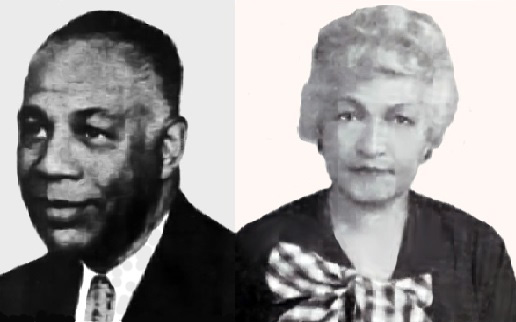
Kappelhoff divorced Doris’ mother in 1935 and then married the woman he had been having an affair with when Doris was growing up. After his second wife died he married his tavern manager, Luvenia Bennett, in 1961. Because he was Doris Day’s father, and was white, the fact that his new wife was a Black woman was considered unusual and newsworthy and reported widely across the USA.

In 1976 Day married her fourth husband, Barry Comden, who had worked in various aspects of the restaurant business. In the 1960s he was involved with a restaurant dining club which sold coupon books enabling buyers to get two dinners for the price of one at member restaurants. Called Invitation Dinners, in 1965 it operated in nineteen cities around the U.S. including Los Angeles, San Francisco, New Orleans, and Boston.

In the 1970s Comden was hired to open the Old World Restaurant in the Westwood neighborhood of Los Angeles. He also supervised the building of Tony Roma’s, a rib place in Palm Springs CA.

He was also maître d’ or manager (or both) of the Old World Restaurant in Beverly Hills, which was dedicated to serving fresh natural foods without preservatives. Day met him at the restaurant, after she went there on a recommendation from her dentist who was part owner. The Beverly Hills location was the second in the Old World chain which at one time had locations on Los Angeles’ Sunset Strip, as well as in Beverly Hills, Westwood Village, Newport Beach, and Palm Springs.

In a 1976 interview Comden said that Day disliked sauces of any kind. “She likes plain hamburgers, vegetables, plain fish!” he said. It is true that Day was often described as a down-to-earth, no frills woman who rejected glamour, for instance wearing no makeup in public. She said in the interview that one of her favorite dishes at the Old World was the round-the-clock Belgian waffle special, a popular selection that included a whole wheat waffle with sausage, bacon, Canadian ham, or vegetables, plus cottage cheese, two eggs, and a Mimosa cocktail – all for $4.50.

As Day said in her 1976 as-told-to autobiography (Doris Day, Her Own Story, by A. E. Hotchner), when she visited the Old World, Comden would give her scraps to take home for her dogs. The two tried to create a pet food brand that would raise money for an animal foundation she wanted to create, but that project failed as did the marriage. Day and Comden were divorced in 1981.

An interesting footnote: The original Old World, on Sunset Strip, was begun by Jim Baker, creator (with his wife) of a natural-foods restaurant, The Aware Inn, and later The Source, a vegetarian restaurant. Known as Father Yod, he became leader of a commune that eventually moved to Hawaii. Coincidentally, like Day, Baker was born in Cincinnati in 1922.

© Jan Whitaker, 2019

5 Comments

Filed under food, patrons, proprietors & careers

Soul food restaurants

Before the 1960s, the term “soul food” wasn’t used in reference to food. Until then the words had religious connotations for Protestants.

What became known as edible soul food, such as chitterlings, pigs’ feet, greens, black-eyed peas, cornbread, and cobbler (to name just a few), had been popular in the South long before the words soul food were applied. But the diet gained a charged meaning in the 1960s when proponents of Black Power affirmed eating soul food as a political statement.

By any name, soul food was not often found in restaurants outside the South until African-Americans began migrating northward before, during, and after World Wars I and II. Walker’s Café in Wichita KS advertised chitterlings and catfish in 1910. That same year the Gopher Grill in St. Paul MN claimed to be “headquarters for chitterlings and corn bread.” Similar menus were often found at dinners at Black churches and homes. Women belonging to the Social and Literary society of a Baptist church in St. Paul MN dressed in Colonial costumes and hosted a chicken and chitterlings dinner in 1916 to celebrate Lincoln’s birthday, an event where the identity politics were quite different than what would develop in the Black Power movement.

There were also numerous restaurants owned and patronized by Blacks in the North that did not serve soul food, or at least didn’t specialize in it. It’s difficult to find menus from restaurants of the migration periods, but when their advertisements mentioned specialties, they were often similar to dishes in white restaurants. A Chester PA restaurant specialized in oysters in 1910. In Black’s Blue Book for 1923-1924 — which listed Chicago’s prominent African-American citizens, along with recommended businesses — there were only four restaurants that advertised what kinds of dishes they served. Those dishes were Barbecued Chicken, Duck, and Squab; Chicken Salad; Club Sandwiches; Sea Foods; and Chili Con Carne (at two restaurants).

The spectrum of eating places found in New York’s Harlem, Chicago’s Black Belt, and Black urban neighborhoods across the North ranged from down-home, all-night eateries serving factory shift workers to elegant tea rooms lodged in old mansions that hosted patrons with more money and leisure. In Chicago, leaders of the N.A.A.C.P., the Urban League, and visiting foreign dignitaries were inevitably entertained with dinners at top Black tea rooms such as The Ideal, the Bird Cage [pictured, 2018], and the University tea rooms. In Spring 1923, the University Tea Room (“The Most Beautiful Spot in Chicago”) advertised the following menu:

65c – Special Table de Hote Dinner – 65c
Cream of Tomato Soup
Roast Chicken with Dressing
Spring Lamb with Peas
Snowflake Potatoes
June Peas in Cases
Salad
Head Lettuce and Tomatoes
French Dressing
Dessert
Apple Pie with Cheese
Rice Pudding
Coffee
Strawberry Shortcake, 25c
Ice Cream, 10c

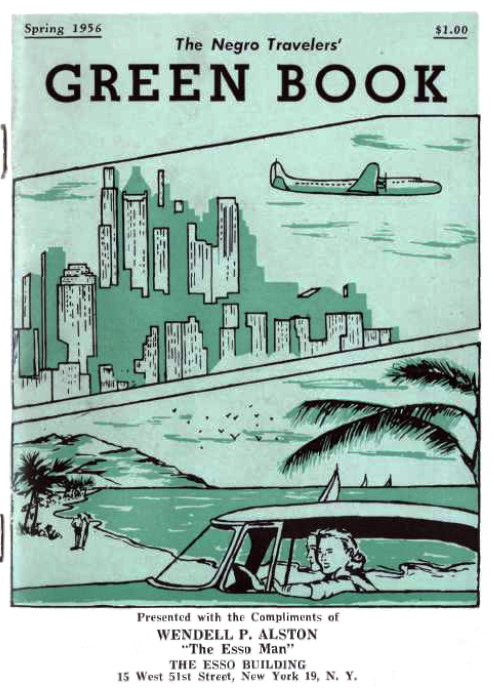
Strangely enough, the 1966-1967 version of the Green Book failed to list some prominent Black restaurants with barbecue such as Arthur Bryant and Gates in Kansas City, and soul food places such as Soul Queen and H & H in Chicago. For New York City, it broke restaurant listings into the categories Steaks, American Specialties, Seafood, and Chinese – but not Soul Food.

While some Northern Blacks slowly accepted soul food, others were more resistant. This seemed to hold especially true for those higher in social status. Some of Chicago’s Bronzeville residents who held themselves superior to migrants expressed criticism of newcomers’ food customs, such as eating chitterlings. A journalist writing in the New York Amsterdam News in 1931 claimed that Harlemites rejected the “Fried Chicken, Pork Chop, Hog Maw and Chitterlings Theories” that assumed all Blacks liked rural Southern food. He also disavowed any special attraction to watermelon.

In 1945 another reporter from the Amsterdam News set out to find chitterlings in Harlem restaurants. He found only one restaurant serving them (Rosalie’s and Frances’ Clam House and Restaurant). He reported that Harlemites were just as likely to eat Chock Full O’ Nuts’ nutted cream sandwiches, Chicken Fricassee, Weiner Schnitzel, or Oysters Casino. At the same time, he observed that whites visiting Harlem enjoyed spare ribs with red beans, concluding, “there are no fundamental points of difference between eating habits of Harlemites and those of the lighter-skinned folk downtown.”

Most soul food histories note that some prominent Black leaders have rejected soul food, pointing to Eldridge Cleaver of the Black Panthers and Nation of Islam leader Elijah Muhammad. In his book Soul Food, Adrian Miller observed that Cleaver wrote in Soul on Ice (1968), “The emphasis on Soul Food is counter-revolutionary black bourgeois ideology.” Instead, wrote Cleaver, “The people in the ghetto want steaks. Beef Steaks.” Elijah Muhammad denounced soul food as a legacy of slavery that should be decisively rejected.

Miller laments the decline of restaurants that serve soul food, marked by the closure of landmarks such as Army and Lou’s and Soul Queen in Chicago. “Across the country, legendary soul food restaurants are disappearing at an alarming pace,” he writes, attributing it to health concerns and reduced business prospects due to the scattering of African-American communities and the popularity of fast food.

With a few exceptions, I don’t think the views of critics such as Cleaver are seen as valid now. And there seems to be a renaissance of interest in soul food among Black chefs and restaurateurs who celebrate it as part of a heritage of resilience and creativity under slavery. Somewhat surprisingly, even vegan soul food restaurants can be found now.

© Jan Whitaker, 2019

9 Comments

Filed under food, menus, patrons, restaurant controversies, tea shops

Effects of war on restaurant-ing

This is such a big subject that I’m focusing only on the two world wars of the 20th century. Both wars made restaurants more central to modern life. The restaurant industry emerged larger and with a more diverse patronage. It was more organized, more independent from the hotel industry, more consolidated, more streamlined in its practices, and less European in its values and orientation.

World War I

● The effects of World War I were felt before the US declared war against Germany in spring of 1917. Americans living abroad, such as artists in Paris, returned to the U.S. Some of them returned to Greenwich Village to develop and nurture something quite foreign here, namely café culture.

● In Washington DC, wartime bureaucracy required more office workers, increasing the ranks of working women, a new and lasting restaurant clientele. As the female workforce grew nationwide, women’s restaurant patronage from 1917 to 1927 went from 20% of all customers to 60%, and became foundational to the future growth of modern restaurants. Around the country low-priced restaurants accustomed to male patronage were forced to add women’s restrooms.

● Many foreign nationals who had worked as cooks, kitchen help, and waitstaff in restaurants left to join armies of their native lands. The restaurant labor shortage worsened when the draft began in 1917 and foreign immigration ceased. Immigrants were replaced by Afro-American and white women who migrated to cities. Serving in restaurants became female dominated.
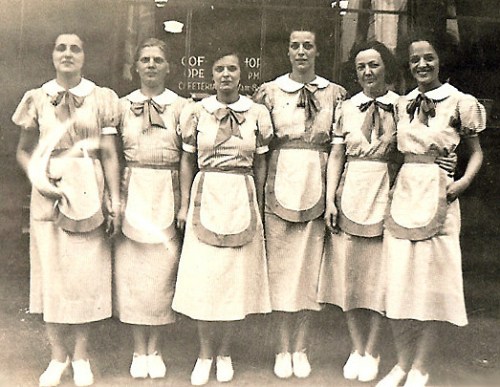
● The war brought women to the forefront of food service. Home economists rallied to the cause by opening restaurants. In Washington DC, a graduate of Cornell’s home economics program began a cafeteria for war workers nicknamed the “Dom Econ Lunchroom.”

● Wartime prohibition followed by national prohibition in 1919 dealt a blow to fine dining. The culinary arts of European-trained chefs fell into disuse as many elite restaurants closed after a few lean years.

● Immigrant tastes were reworked by WWI. Those who served in the US military became accustomed to the American diet of beef and potatoes, white bread, and milk, as did Southerners used to “hogs and hominy.” Meanwhile on the homefront, certain “foreign” foods, such as pasta and tomato sauce, were admitted into the mainstream middle-class diet, in this case because Italy was an ally.

● Wartime also stimulated a more business-like attitude on the part of restaurants which now had to work smarter to produce profits. They adopted principles of scientific management — for example, they began keeping books! And they standardized recipes to turn out consistent food despite changes in personnel.
● The decade after World War I saw the rise of sandwiches, salads, milk, and soft drinks replacing the heavy restaurant meals served before the war.

● During the Depression WWI veterans demonstrated and lobbied for their long-overdue soldiers’ bonuses. Many used the bonuses to open hamburger stands and other roadside businesses such as the Kum Inn on Long Island.

World War II

● Many of the same kinds of effects were felt after the Second World War, sometimes more strongly because of the increased duration of the conflict. Immigration came to a halt, furthering the “Americanization” of restaurants. Women trained in institutional management and home economics continued to enjoy expanded opportunities and prestige. Two home economists in Minnesota saw their quantity cooking manual adopted by the military.
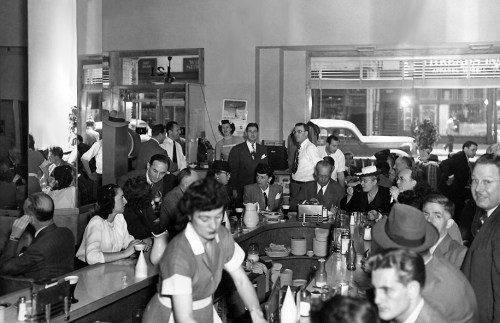
● During the war, the average American patronized restaurants as never before. Southern California restaurants were overwhelmed as an estimated 250,000 workers in war plants who lacked housekeeping facilities turned to public eating places for their meals.
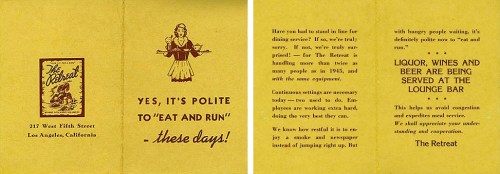
● Food rationing dramatically increased restaurant patronage. In January 1943 the Office of Price Administration announced that the public would not need ration coupons in restaurants. Within weeks after rationing began restaurants were mobbed. In Chicago, Loop restaurants experienced a 25% increase in business. By October of that year patronage in NYC restaurants had doubled.

● Also stimulating the eating-out boom were generous business expense accounts which, said the NYT, “grew into a fat-cat fringe during World War II.” These benefits were meant to compensate workers who could not be granted raises because of government-imposed wage and salary freezes and employers’ wish to avoid paying excess-profits taxes. To retain valued employees they instead gave pensions, medical care plans, stock options, and generous expense accounts. Expense accounts led to the creation of the first nation-wide credit card, sponsored by The Diner’s Club.

● Already in 1944 the National Restaurant Association was looking forward to augmenting short staffs with some of the estimated 300,000-500,000 military cooks and bakers to be demobilized at war’s end. Tuition under the GI bill lured thousands into further training as restaurant cooks, managers, and proprietors.

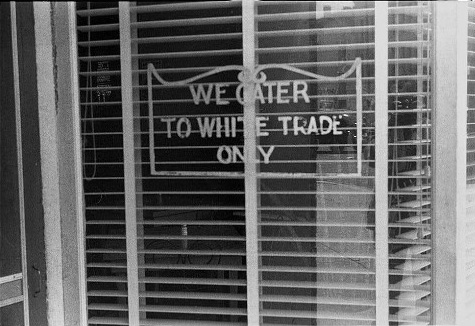
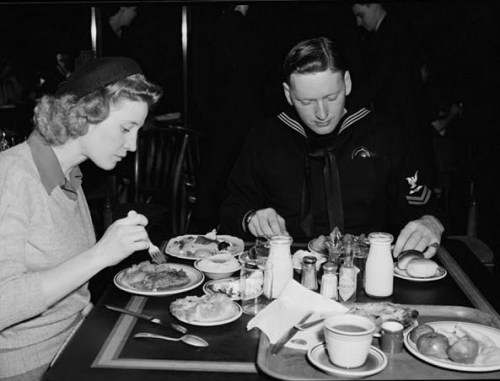
● After fighting a war against a “master race” ideology, returning black GIs strongly resisted racial discrimination in American restaurants. In Seattle the NAACP filed complaints when “white only” signs appeared or blacks experienced deliberately poor service. The signs were meant for Japanese returning from internment camps as well. [Ben Shahn photo, FSA]

● Unlike before the war, eating in restaurants was no longer an unfamiliar experience for most Americans. A manual issued by the New York State Restaurant Association in 1948 proclaimed that restaurants were serving more than 15.5B meals annually. A sociologist attributed the emergence of the sassy waitress to wartime’s broadening clientele which included a “new class of customers, who were considered particularly difficult to deal with.”

● Family patronage, encouraged by a wartime increase in employment of married women, continued to grow after the war. A trade journal counseled operators of suburban restaurants to “be especially nice to children.” In Denver, the average family was said to eat out three or four times a month, a rate unheard of before the war.

● Another lasting effect of wartime eating-out habits was increased restaurant patronage in the South, a region where there had been few restaurants and little restaurant culture. Northern industries were already moving south in 1941, but also, as the restaurant industry noted in May of that year, “most of the Army activity is in the Southern States,” a fact they believed made it the area with the “greatest opportunity for restaurant expansion.”
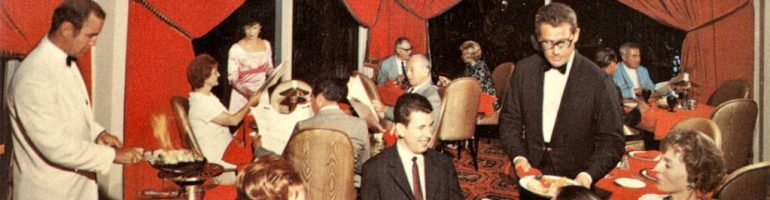
● A number of common menu items can be attributed to World War II. Restaurant patrons learned how to eat lobsters, which were plentiful because they were not rationed. Pizza parlors proliferated because pizza was also simple to serve. Conscripted country dwellers were introduced to sea foods in military service. Veterans who had served in the South Pacific discovered a liking for Polynesian food.

● War spurred the use of new food products by the military, including frozen food. In a remarkably short time, the restaurant industry, which had previously preferred fresh to processed food, adopted frozen foods and by 1955 they accounted for 20 to 40% of their supplies. With the rise of frozen food and other war-facilitated convenience foods came restaurant stalwarts of the 1960s: French fries, breading mixes, and cheese cake.

● Along with frozen foods came new technologies for their preparation, in particular microwave ovens and quick-recovery griddles, both military spinoffs. The RadarRange, presented at the National Hotel Exposition in 1947, was developed by Raytheon using principles of infrared technology developed during the war. It not only permitted food to be cooked lightening fast but also made reheating pre-cooked frozen entrees possible. Another marvel was the Rocket Griddle which featured fast heat recovery that enabled frozen food to be cooked without defrosting.

● The development of the air freight industry following WWII, stimulated by the availability of trained pilots and surplus airplanes, permitted restaurants to obtain foods from locations around the world. A restaurant called Imperial House in Chicago was approached by two former Air Force fliers who proposed to fly in king crabs from Alaska by freezer plane. By 1952 the restaurant was bringing strawberries from Florida and California, bibb lettuce from Kentucky, salmon from Nova Scotia, pheasant and venison from South Dakota, grouse from England, and paté from France.

● Last but not least, the ideal of organizational efficiency was stimulated by both wars. The World War II postwar period saw the rise of a much larger food service industry.

And, of course, this brief survey is far from complete.

© Jan Whitaker, 2019
10 Comments

Filed under family restaurants, food, patrons, Polynesian restaurants, proprietors & careers, restaurant industry, roadside restaurants, waiters/waitresses/servers, women

Behind the scenes at the Splendide

Ludwig Bemelmans, well known author and illustrator of the Madeline books for children, began his life in the United States in hotel food service. In the book Life Class (1938), he reveals how perceptive an observer he was of the workings of a deluxe hotel’s dining operations in the early decades of the 20th century.

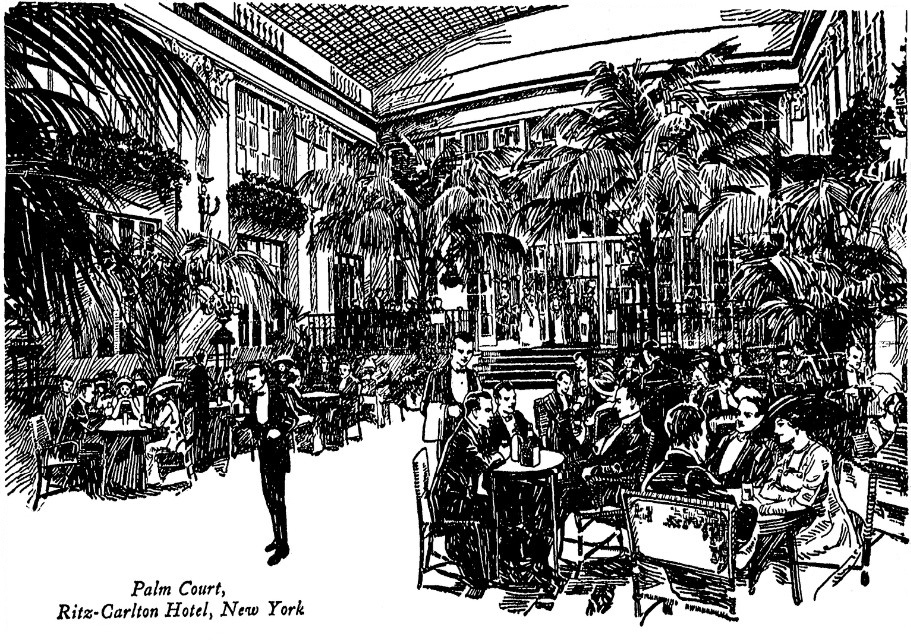
With a few strokes, he paints a vivid portrait of the “Hotel Splendide,” otherwise known as the Ritz-Carlton on Madison Avenue between 46th & 47th streets in New York. The hotel was part of a worldwide chain of luxury hotels that defined “ritziness” by providing fine food and service that attracted people of wealth and social status, some with aristocratic titles that dazzled wealthy Americans. [shown above, Palm Court, 1914]

Bemelmans arrived in this country from Rotterdam in December, 1914, with letters of introduction from his European hotelier uncle. He was only 16 years old, but with a troubled past. Had he been from a family of lesser stature he might well have been classed as a juvenile delinquent. He had a rocky start in New York, too; he was fired by the first two hotels that hired him in New York, the Astor and the McAlpin. But, despite some perilous incidents at the Ritz, he managed to hang on there for years, working in the restaurant, the café, and the banquet department before leaving for a career as an artist and author around the late 1920s.

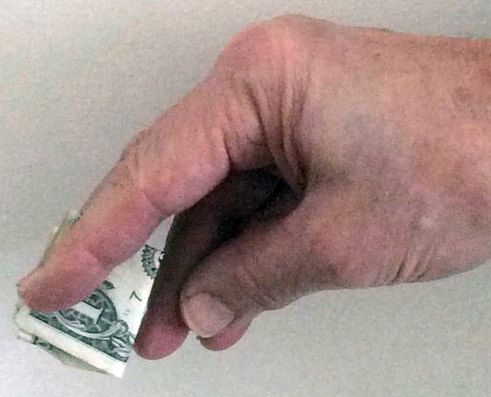
In Life Class he frequently observes how the hotel’s gatekeepers sorted out patrons by social class. The hotel’s restaurant manager, Monsieur Victor, “knew who was in Society, who was almost in Society, and, what is most important, who was not” and treated them accordingly. Those with the highest status gave him no tips or honor, but at the other end of the social spectrum he collected handsome tolls from those who wanted a decent table. Bemelmans judged that Victor took in a fabulous sum for that time, about $40,000 a year.

However, those who slipped Victor a too-small bill found themselves among the “untouchables” seated at an awkward table near a service station or in a drafty corner. Although Bemelmans can be warmly egalitarian about the hotel’s staff, he can be as dismissive as Victor when describing guests. Among the untouchables are “Westchester housewives in gray squirrel coats and galoshes on rainy days. They order an oeuf Bénédict and a glass of milk before going to a matinee.” A woman who he imagines is “the wife of some street-car magnate,” he writes, is “dressed with costly despair.”

Faring worse than the untouchables were “innocents” who didn’t understand how things worked at all, such as those who “just walked in off the street, thinking that this was a restaurant.” They were soundly humiliated and turned away with great haughtiness by Monsieur Victor who then watched them depart “with the detachment of a bullfighter who has done his routine work and waits until the horses have dragged the animal out, ready to start on the next.”

Since I have always thought that hotels were among the most likely businesses to follow Prohibition laws, I was surprised how much trade the Ritz did with bootleggers in the 1920s. Bemelmans explains that banquets were furnished with high quality alcohol from the “most reputable bootleggers” who delivered cases clearly marked Champagne and Whisky during the daytime while the police blandly looked on. More surprising, the police did not demand a payoff, settling instead for a few late-night drinks and leftover food after banquets ended, along with maybe a couple of bottles at Christmas.

The serving staff was expert at squirreling away food and drinks in their own private icebox for later use. In some cases they cleverly “rescued” cases of booze during parties, yet still received lavish tips from satisfied guests who had paid for far more wine than they consumed. As the manager remarked, the banquet business at the Ritz was a “goldmine.”

Even while in the midst of serving, waiters managed to enjoy delectable snacks. They snatched “little fried things” such as scallops, frogs’ legs, and fried potatoes from serving platters and ate them in the middle of the dining room without anyone noticing. According to Bemelmans, they had “learned to eat so that their cheeks and jaws do not move.”

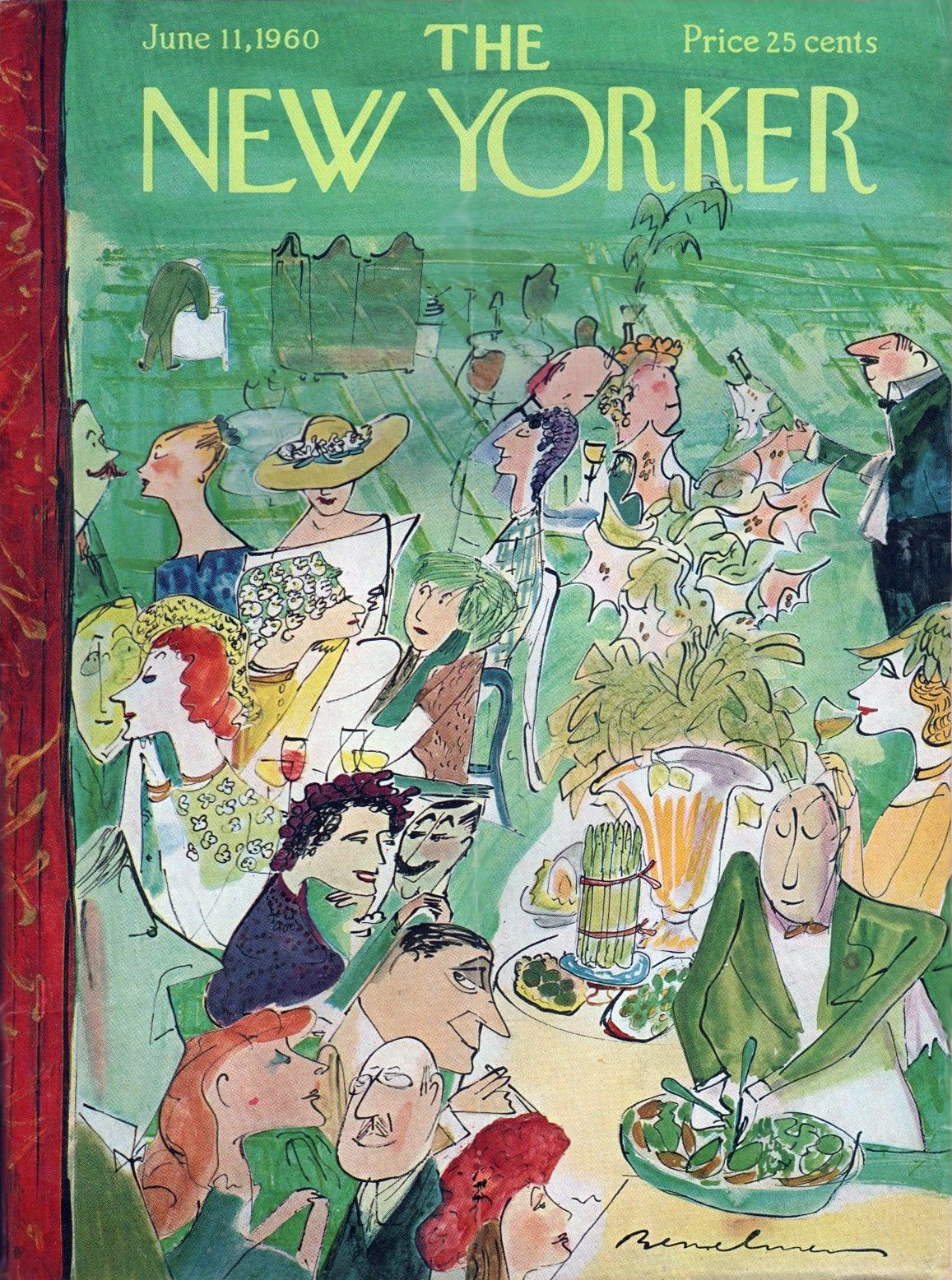
After he left the Ritz-Carlton, the epicurean Bemelmans stayed closely connected to fine food and restaurants. He painted murals for several restaurants, illustrated menus and wine cards, depicted them in advertisements and on New Yorker covers, and owned or was closely associated with four places (all of which may be the subject of a future post).

© Jan Whitaker, 2019

14 Comments

Filed under elite restaurants, food, patrons, restaurant customs, waiters/waitresses/servers

Tea rooms for students

College and high school students of the 20th century led many eating-out trends and customs. Not only did they help make certain foods popular, they also influenced meal habits and adopted frequent restaurant-going as part of their social lives.

Drive-ins, coffee houses, and vegetarian restaurants were some of the types of eating places heavily shaped by student patrons in the middle and later decades of the last century. But a bit earlier, in the early 20th century, the eating places of choice for many college students were tea rooms that attracted women students. Not that men students didn’t also like tea rooms. An example was The Cactus Tea Room, built in 1917 with weird carvings of university types adorning its eaves, and serving both male and female students at the University of Texas in Austin.

Although tea rooms were more likely to be found near residential colleges, high school students also enjoyed them for after-school stops. In the 1920s students at Decatur High School in Decatur GA hung out at the Elite Tea Room, while Haverling High School students in Bath NY gravitated to the Chat-A-Wile Tea Room.

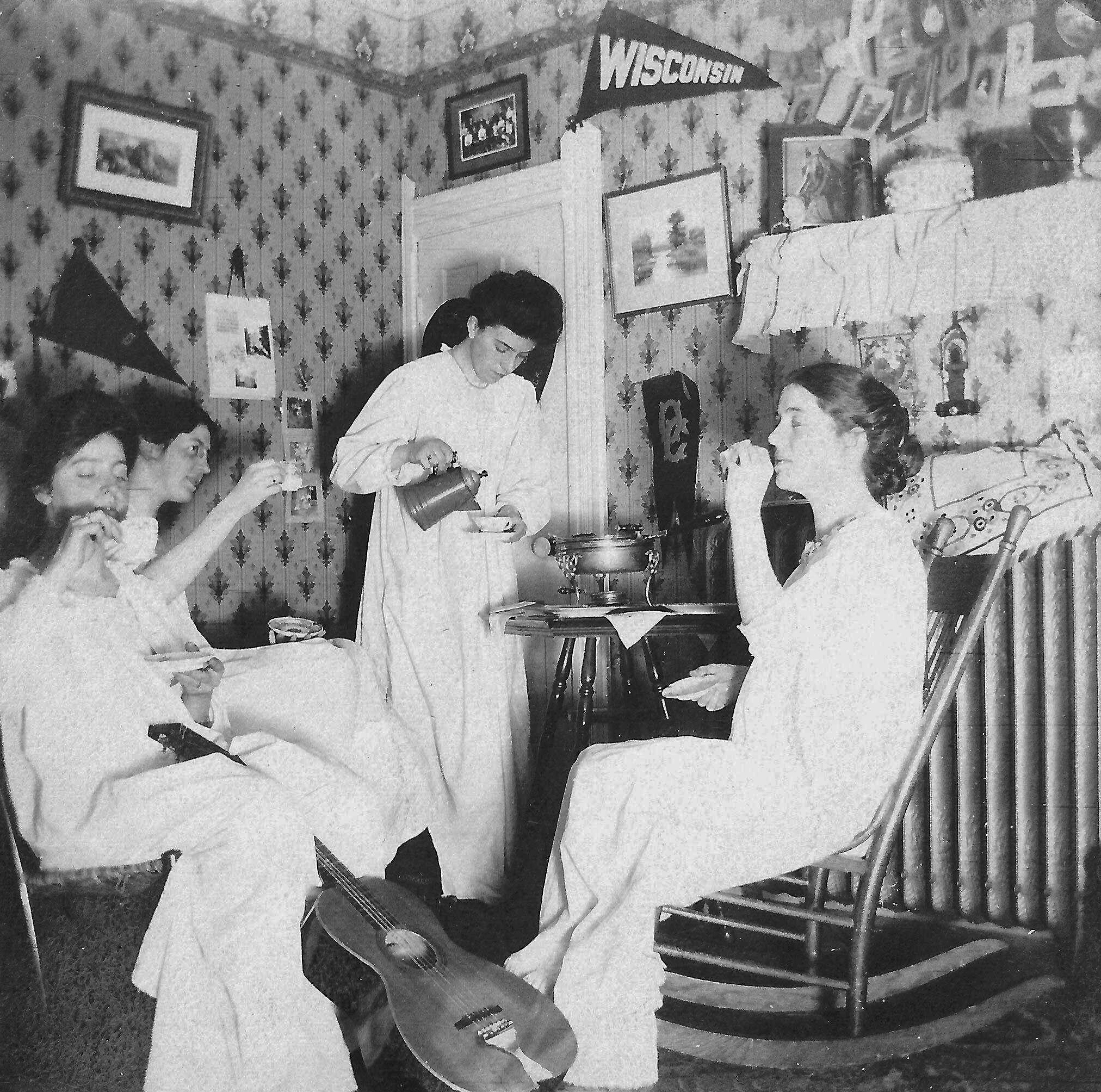
Rather than being stuffy and proper, many tea rooms that catered to students were relaxed and informal. They carried on college traditions such as midnight “spreads,” at which foods pilfered from the school’s dining halls were remade into chafing dish repasts. The feasts were occasions for casual attire, sprawling on the floor, and high spirits at the thought of evading detection while breaking college rules. [shown here is an Oberlin College dorm room spread, 1905]

Tea rooms also carried on the tradition of college dining clubs, which involved groups of friends joining together to hire a local woman to prepare their meals. The clubs adopted humorous names such as Vassar College’s Nine Nimble Nibblers, Grubbers, and Gobbling Goops of the late 19th century.

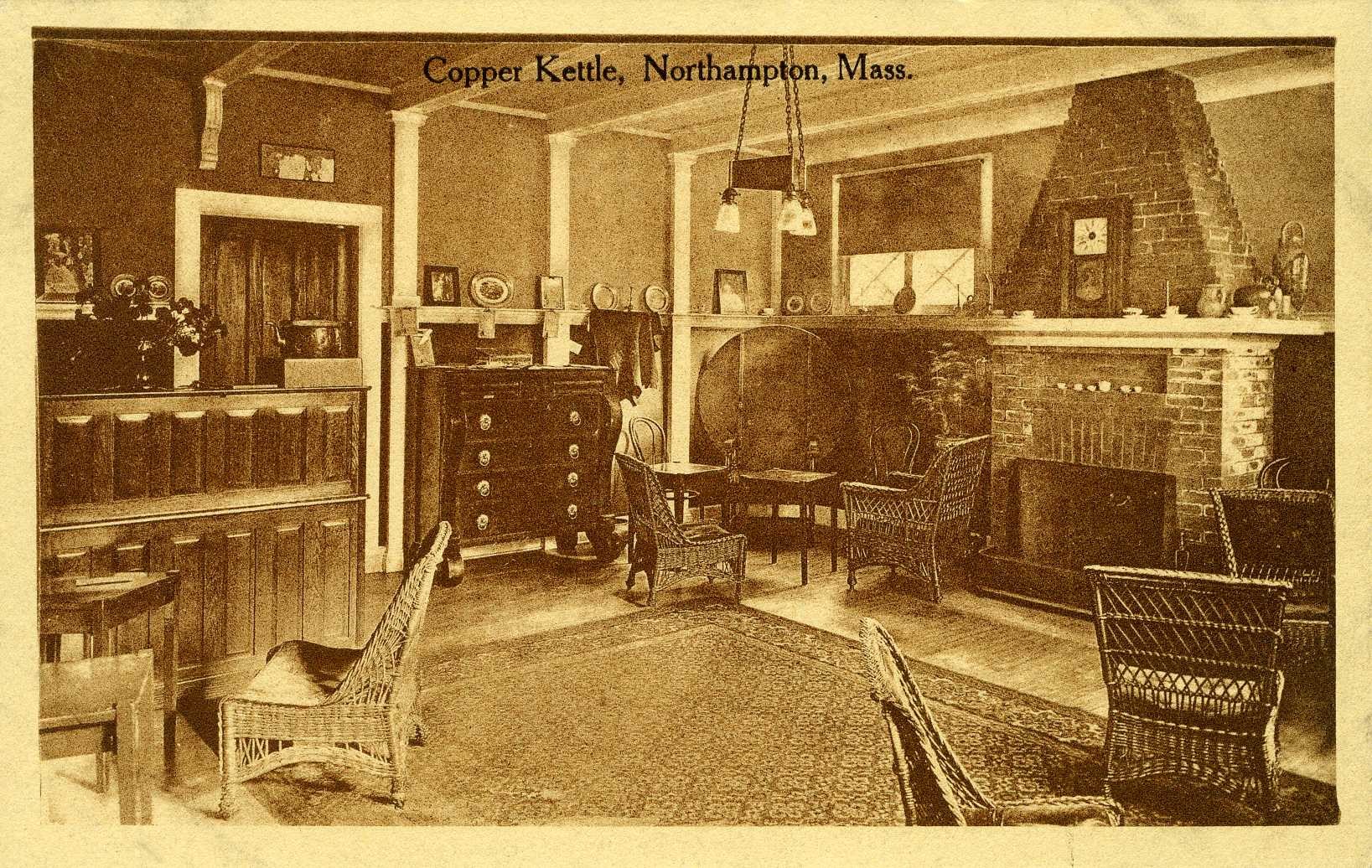
For example, a popular spot for students from Smith College was the Copper Kettle, which played a role much like the coffee shops of today. Students hung out there, read, chatted, and snacked on popcorn, ice cream, and tea. Its decor was cosy, shabby-chic style with mismatched furniture, wicker lounge chairs, posters, and window seats. Smith students were also enamored of the Rose Tree Inn, where full meals were served in a Bohemian atmosphere created by the intriguing Madame Anna de Naucaze.

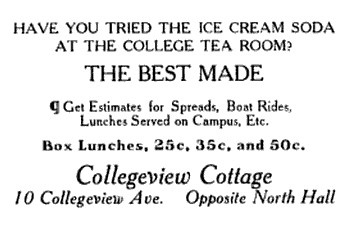
Some colleges were almost surrounded by tea rooms. That was true in Western Massachusetts where both Smith College and Mount Holyoke College are located. Northampton, home of Smith College, was described in 1922 as having “more tea-houses than churches.” Not so far away, Mount Holyoke College was also well supplied with tea rooms, among them The Croysdale Inn, The Mary-Elin Tea Shop, and The Art Nook. I find it interesting that the Mary-Elin advertised in 1921 that it would stay open until 10 p.m., which was quite late for a tea room.

Parents did not always approve of their free-wheeling daughters’ behavior. In 1912, a mother wrote a critical article titled “One Disintegrant of Our Home Life,” about the typical college girl who socialized constantly, ignored rules of proper dress, and loved going to “the Green Coffee Pot or the Carnation Tea Urn.” “I tell my husband that college doesn’t breed home-building girls,” she wrote.

Among the most notable changes that tea rooms brought was simply that of providing a welcoming and friendly place for unescorted women to gather. This, of course, encouraged women and girls to spend more time eating away from home.

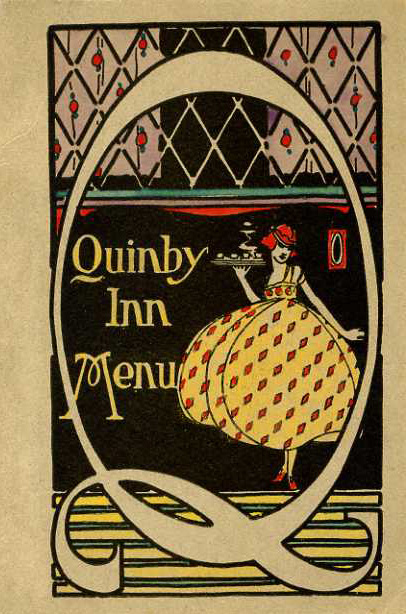
As for food, apart from popularizing eating cake and ice cream at any time of day or night, tea room food was a departure from typical lunch rooms and restaurants of the early 20th century that served fairly heavy meals based around meat. Although meat was certainly served in tea rooms, patrons also had many other choices. A 1920s menu from The Quinby Inn (shown above) — popular with students at Goucher College near Baltimore — offers Tenderloin Steak and Roast Pork, but also many other choices, with quite a few of them revealing the popularity of sweet food. Among them are 12 desserts, 22 salads, many of which involved mixed fruits and whipped cream, and 22 sandwiches, including Olive & Egg and Sliced Pineapple (no, not together!).

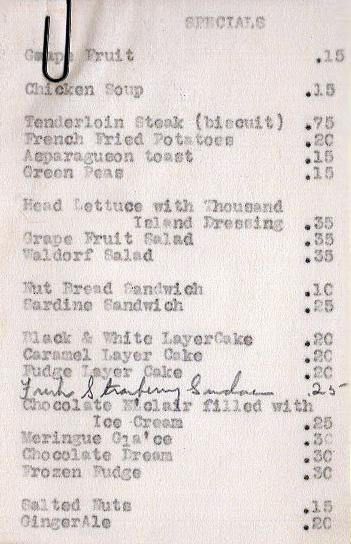
The list of specials clipped onto a 1920s menu from The Mary-Elin Tea Shop near Mount Holyoke College also shows its patrons’ fondness for sweets [thanks to Donna Albino for scans of the menu from her Mount Holyoke College collection].

A number of college women opened tea rooms of their own either as a summer project or after graduation. But that will be another post.

© Jan Whitaker, 2019

4 Comments

Filed under alternative restaurants, food, menus, patrons, restaurant customs, restaurant fads, tea shops, women

Green Book restaurants

Interest in historical Green Book guides for Black travelers has been growing in the past decade and the new movie of this title will surely increase it.

The Green Books’ slogan, “Covering the United States like a blanket,” nicely sums up its goal of making travel more comfortable (maybe even enjoyable) for Black travelers living in a country that typically greeted them with hostility whenever they moved outside their restricted neighborhoods and social roles.

Prior to the arrival of the Green Book, Black Americans relied on the kindness of strangers – also Black – when traveling. Until the 1960s, Jim Crow laws in Southern states barred them from access to white hotels, resorts, and restaurants. Outside the South conditions were not much better, despite civil rights laws barring discrimination in many states. To deal with this, middle-class Black travelers relied on other Blacks who invited them into their homes, even providing meals despite not usually knowing them personally. According to Willis Duke Weatherford’s Race Relations (1934), “The institution of ‘dining out’ is not established among careful [Black] families – it is a reflection on the home to eat in a restaurant; it simply is not done.”

As travel increased among Black business people, entertainers, and tourists, accommodations in private homes were no longer adequate, especially for longer trips. A number of guides were published, among them the annual Negro Motorist Green Book published by Victor Hugo Green, a mail carrier in New Jersey. The guide was renamed the Negro Travelers Green Book in 1952. At some point in the 1950s, Victor became ill and his wife Alma took over as editor and publisher. The last two editions were by new owners.

The Green Books were first published in 1937, then every year after that except for four WWII years, ending with a 1966-1967 edition. With the exception of 1946 and 1958, all of the editions are available digitally in the New York Public Library. A 1946 edition sold for over $4,500 on eBay in 2016 and a copy is owned by Virginia Union University Library. As far as I can tell the 1958 edition is not publicly available. Several editions have been republished.

Green Books were sold directly to consumers and also distributed by Esso after Standard Oil of New Jersey hired a prominent Black businessman to promote Esso to Black motorists. Thirty-eight percent of Esso gas stations were operated by Black proprietors, according to a 1939 essay. Conoco also ran a Negro Travel Service which prepared custom “Touraides” free on request. Quite a few issues of guides devoted pages to new model cars of the major, and a few minor, automobile manufacturers. In the Black community cars were regarded as liberators, as well as providers of good jobs in the manufacturing and service sectors. An essay to this effect, “The Automobile and What It Has Done for the Negro,” appeared in the 1938 edition.

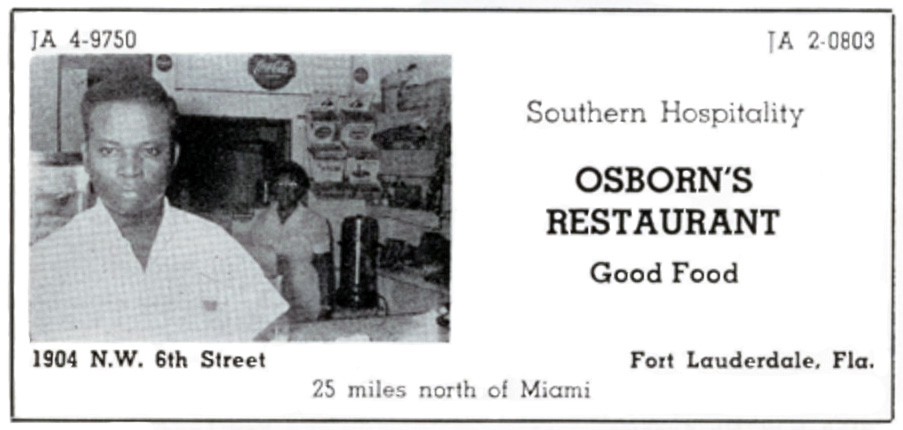
The books provided lists of hotels and tourist homes that were welcoming, most of them located in Black business areas of cities and towns. It also listed restaurants, roadhouses, taverns, nightclubs, beauty and barber shops, service stations, and other businesses. In later years it tended to focus primarily on places to stay. [Osborn’s, 1962]

I’ve looked at all the Green Books in the NYPL collection, paying special attention to restaurants in them. Overall there are not a huge number of restaurants. In 1939, for instance, only two restaurants are listed for the entire state of California.

Most of the restaurants seem to be in Black sections of towns, or are Chinese. Their numbers seem to have been dependent on Victor Green’s informants, who were said to be mail carriers like himself. Coverage was also spotty. Green lived in New Jersey and then New York City, and it’s noticeable that both states are more thoroughly covered than most others.

What seems to be lacking are restaurants in predominately white areas that welcomed Black customers. If Black tourists or business people were visiting Los Angeles, for instance, how would they know which restaurants in the main shopping or business districts would serve them without problems?

Comparing the Duncan Hines’ popular Adventures in Good Eating guide book of the late 1940s with a Green Book of roughly the same time reveals that there is no overlap whatsoever in their listings of Los Angeles restaurants. Not one of the 37 LA restaurants recommended by Hines is to be found in the Green Book or vice versa.

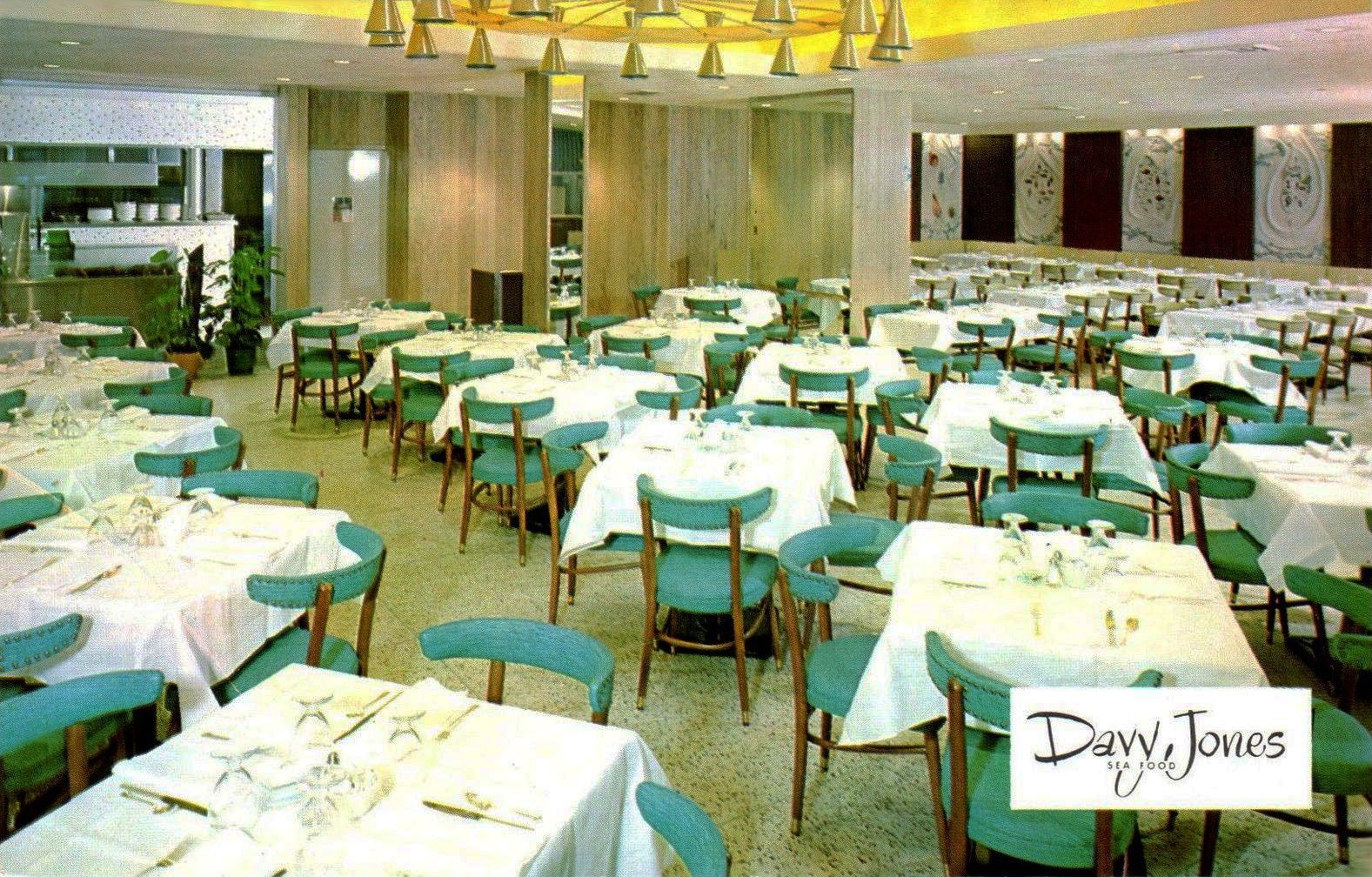
Things had changed somewhat by the 1962 edition. It is striking how many more white-owned and patronized restaurants are listed for New York City that year. Previously the only New York restaurants in the guides were located in Harlem, but now they are all over town. Among them are the Brass Rail chain, Davy Jones Seafood House, and Jack Dempsey’s. It’s hard to know whether the change was due to the policy of the restaurants or the Green Book.

Trying to learn more about restaurants listed in Green Books is difficult. Many I’ve looked for do not show up in city directories, nor in newspaper archives. Judging from feature advertisements for restaurants in later issues, many of the restaurants listed were small neighborhood places that served unpretentious home-cooked meals, quite similar to the majority of white-owned restaurants in the 1930s, 1940s, and 1950s.

I recognized a few names of well-known Black restaurants such as Paschal’s in Atlanta (est. 1947 as a small sandwich shop), Little Gray Shops #2 and #3 (considered Harlem’s better eating places in the 1930s), and Dooky Chase in New Orleans (like Paschal’s, still going strong today).

There was also a listing for Bagley’s, operated by Black socialite Caroline Bagley in Sheepshead Bay NY, as a kind of tea room with garden dining. A number of other tea rooms are listed, among them the Black Beauty Tea Room in Mount Olive NC, which had the distinction of being raided in 1950 for serving bootleg whiskey.

Probably quite a few restaurants in the Green Book were community institutions in their time, such as Hammond Café in Abilene TX, specializing in spicy chili. Certainly that was true of Harlem’s Aunt Dinah’s Kitchen, run by Broadway actor Richard Huey. Aunt Dinah’s hosted one-act plays and discussion forums in the 1930s and 1940s, and served as an informal support center for actors who needed a place to gather and have a free meal now and then.

Researching restaurants, hotels, etc. listed in the Green Books would be an interesting way to construct a picture of 20th-century Black life before the Civil Rights Act. It would make a good group project.

© Jan Whitaker, 2018

17 Comments

Filed under guides & reviews, patrons, racism

Basic fare: meat & potatoes

Meat and potatoes were so characteristic of eating places in the 19th century we could call it the Meat and Potatoes Century. But of course that title could apply to most of the 20th century as well.

In 1829, the Plate House, a cheap New York City eating hall, offered steaks with potatoes by the dish and half dish, 4 cents for the latter.

Chop houses of the 19th century were also based on meat and potatoes. They could be considered forerunners of today’s steakhouses, with their dark interiors, male patrons, and baked potatoes as accompaniments to meat. One difference, though, was that in the 1800s patrons were as likely to order mutton as beef.

The chop house was regarded as an antiquated type of eating place in 1873 when a journalist wrote that Farrish’s and others were “sought out by Britishers who like places off the beaten track and humble, dark and without glitter.” Old fashioned or not, it was still loved for its “mealy” baked potatoes, probably even in the 1930s when this postcard was produced.

Little surprise that “meat and potatoes” became a metaphor for no-frills reliability. To call someone a meat-and-potatoes “man” – always a man — was more than a commentary on his diet; it also meant he was a regular guy. Similarly for a meat-and-potatoes town. As Chicago columnist Bob Greene would put it in 1983, as the world capital of meat and potatoes, his hometown was “tough, brawling, no-nonsense, rugged.”

The metaphor – that came into use after World War II — could extend to almost anything. Business success relied upon sure-thing “meat and potatoes” products and services. For Gloucester MA, odd as it sounds, the town’s meat-and-potatoes industry was ground fish. For a symphony orchestra their meat and potatoes might be a popular Beethoven sonata.

Nineteenth-century restaurants featured potatoes either mashed, boiled, baked, stewed, fried, Lyonnaise, scalloped, mousseline, or au gratin. In the 20th century the choices tended to narrow down to mashed, baked, and French fried. Meat meant mostly beef in the 19th, but extended to chicken in the 20th.

In 1885 it was standard for potatoes to come free with a meat order. As noted then, “An unordered boiled potato, with the skin on, is the second grand characteristic of an American dining saloon. It matters not what meal it is, the boiled potato will always appear, if the establishment is truly legitimate.”

But this “legitimate” entitlement was about to end. Where would fast food restaurants be today if they didn’t charge extra for French fries? As far back as the early 20th century, restaurant operators realized there was additional profit to be made by charging separately for potatoes.

In the 1950s and 1960s, fast food burger chains, hotel rib rooms, and chain and independent steakhouses began to proliferate. Steakhouses proved popular with lunching business men while families chose economy cuts at Bonanza or Ponderosa. “Advances” took place, such as foil wrappings that allowed the potatoes to remain under infra-red lamps longer without drying out. By the early 1960s sour cream and chives were considered essential additions to baked potatoes. By that time, the favorite All-American meal was shrimp cocktail, followed by steak, baked potato with sour cream, an iceberg lettuce salad thickly coated with Thousand Island dressing, and cheesecake for dessert.

In 1971 a Gallup survey measuring the popularity of “international cuisine” confirmed the timidity of most American palates. The strangest aspect of the survey were the dishes Gallup offered up as international. Among them were Beef Stroganoff (ranked highest), Swedish Meat Balls, Lasagne, Veal Parmigiana, Chili Con Carne, and Hungarian Goulash. A full 10% of respondents found nothing among the 22 selections that they liked.

Nevertheless . . . around the late 1970s the whole meat-and-potatoes dining complex began to be questioned. Increasingly it ran against new notions of health and fitness. The cholesterol, the heaviness! Also, it was such a limited diet. Did its fans have no interest in other cuisines? Meat-and-potato towns – Chicago, Cleveland, Kansas City, St. Louis, Denver, Fort Worth – were shamed and ridiculed even though, occasionally, someone admitted there were plenty of steakhouses on the coasts too — New York, San Francisco, even New Orleans.

In the next phase, not surprisingly, many meat-and-potatoes towns struggled to refurbish their reputations by boasting of restaurants of all kinds. Omaha touted its seafood, Japanese, Korean, and French restaurants. Minneapolis was still conservative, wrote Jeremy Iggers and Karin Winegar in John Mariani’s 1986 Coast to Coast Dining Guide, yet they identified seventeen Vietnamese restaurants, three Thai, two Ethiopian and many other nationalities represented as well, along with examples of “yuppies” taking fresh approaches to American cuisine.

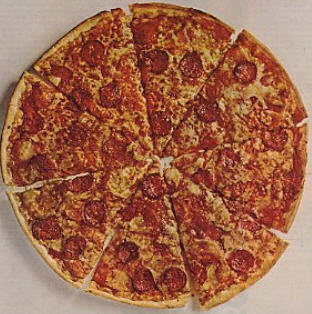
Plus, pizza had actually become the new meat and potatoes.

How are steakhouses doing today? Although there are still many around and some Americans nurture a wish to return to the 1950s, I’m guessing that it’s unlikely the golden years of the steakhouse will return. Burgers and fries, too, may have seen their better days.

© Jan Whitaker, 2018

10 Comments

Filed under chain restaurants, food, patrons, popular restaurants

Dining with Chiang Yee in Boston

Chiang Yee was a travel writer, born in China but a resident of London since 1933. In 1953 he came to the U. S. to research his book The Silent Traveller in Boston (1959). In 1955 he immigrated to the U.S. and taught at Columbia University for 16 years.

While in London he had published 21 books, many of them which he illustrated with paintings and drawings. Some were about travel but all of them interpreted aspects of Chinese culture for non-Chinese readers, reflecting upon similarities and differences with Western culture. In the travel books, for which he adopted the persona of Silent Traveller, he avoided political criticism and controversy while presenting himself as a serene, meditative man who walked slowly, looked closely, and enjoyed the simple pleasures of life.

Of course his visit to Boston involved quite a few restaurants, including a number of well-known places. He made influential friends — intellectuals and cultural elites — who took him to clubs and fine restaurants such as the Parker House, Locke-Ober, and the hidden-away 9 Knox Street, then run by two men in their antique-filled home at that address.

He went to popular spots such as Durgin-Park, Purcell’s, Jimmy’s Harborside, and Union Oyster House where he made a drawing of himself with a lobster and bib [shown above]. He was eager to sample local dishes such as cod, baked beans, and clam chowder. He never criticized the restaurants he patronized, though he admitted he was not fond of raw seafood.

A darker and far less serene Chiang Yee was revealed in 2010 with the publication of Chiang Yee: The Silent Traveller from the East – A Cultural Biography. Its author, Da Zheng, examined Chiang’s correspondence and interviewed friends and family, painting a complex portrait of his subject. In the Foreword, Arthur Danto reminded readers that “the Silent Traveller itself is a mask he wore that enabled him to survive under skies very different from those under which he was born.” Danto related that after visiting China in 1975, Chiang proclaimed to a group of friends, “Nobody knows who I am!! Nobody! I am a REVOLUTIONARY!!!!.”

Chiang had left his wife and four children behind when he went to London at age 30, confessing to his closest associates that his marriage was unhappy. Born into a wealthy family, he was trained in the classical arts as well as science which he studied in college. He had been a magistrate in China but in the West he built his career around Chinese art and high culture.

According to Da Zheng, when one of his sons immigrated to the U.S. in 1960, Chiang advised him to expect hardships and to be forbearing. His son observed that his father’s New York apartment was filled with signs saying “Forbearance,” suggesting that his father had much need of his own advice.

Chiang Yee told his son to stay away from Chinatown or he might end up running a restaurant there, advice he had earlier given his older son in London. Given the prejudice against Chinese in the U.S. and England – of which he was strongly critical — Chiang told them it was wise to cultivate relationships with non-Chinese.

In the light of revelations in his biography of Chiang’s strong feelings about politics, society, and the vicissitudes of his own life, I interpreted some of his words in a different light than on my first reading of The Silent Traveller in Boston. It is interesting how suggestive his stories of restaurants are in particular.

Although he admired Chinatown residents’ determination and drive, he did not share their language or cultural background. He showed some irritation that his non-Chinese friends and acquaintances in Boston expected him to be an expert on American Chinese restaurants. He wrote that a Frenchman would not “be asked to suggest which French restaurant in Boston is the best as I was asked to do in the case of Chinese restaurants almost as soon as I had arrived in the city.”

He also told of experiencing his first clam chowder in San Francisco but being greeted with silence when he told his Boston friends about this. At first he did not realize why, but later, when they asked if he thought food in Chinatown restaurants was genuine, he reminded them of their reaction to his story of eating Boston clam chowder in San Francisco. I now see this as a kind of mild dig at them, a subtle reminder that the food of American Chinatowns was as foreign to him as it was to them.

I also find it interesting that he tells of a dinner with the family of Harvard professor Yang Lien-sheng at the Old Wright Tavern. He was pleased that the waitress complimented the good behavior of the Yangs’ 5-year old son, but also wrote, “Neither the manageress nor the waitress bothered to tell us the history of the inn . . . Perhaps the people of the Wright Tavern had no time to spare from catering. Or they took for granted our knowledge of Concord history.” I suspect that he felt they had been slighted.

He must have experienced numerous “microaggressions.” Surely experiences such as the one he related about Durgin Park accounted for at least some of his Forbearance signs. Given a huge plate of food that he could not finish, a waitress addressing him as “young man” (he was 53), loudly commented, “Can’t you finish your plateful? If you can’t you should not have come here to waste your money; if you don’t like the food, we want to know why. We don’t like people who don’t like our food.” He said that when she laughed he realized she was joking, but admitted to feeling embarrassed. I’m certain that he knew that the “joke” contained a jibe about his being a foreigner.

It is a shame he had to travel silently and could not be as frank about his estimations of American culture as the Soviet authors of Little Golden America.

© Jan Whitaker, 2018

5 Comments

Filed under food, patrons, popular restaurants

Slumming

The word slumming had several meanings when it came into use in the 1880s. Basically it meant visiting the slums. But the purpose for elite and middle-class white Americans might vary, from charity to data collection, curiosity, a sexual escapade, or general entertainment.

Apart from ministers, reformers, and city officials, those who went on slumming tours (with guides) in the late nineteenth century usually were motivated by curiosity or a wish for entertainment.

In 1884, the New York Times ran a story about British actress Lillie Langtry and her party visiting the city’s slums, noting, “So far the mania here has assumed the single form of sight-seeing – the more noble ambition of alleviating the condition of the desperately poor visited has not animated the adventurous parties.”

Following the vogue begun in London, slumming became a mark of worldly sophistication among some Americans in the late 19th century.

Although most newspaper accounts of slumming focused on New York’s Bowery and Tenderloin or San Francisco’s Barbary Coast, there were in fact areas of interest to slumming parties in many parts of the U.S. For example, a group of conventioneers from Omaha visiting Dakota Territory in 1889 took an excursion to Deadwood’s Chinese settlement. They were disappointed it was so tame.

Tours often involved stopping at a restaurant or café, particularly if a group was visiting a Chinese area, as was often the case especially as Chinese populations increased in the Eastern U.S. beginning in the later 1880s. Many of the first white, middle-class customers of Chinese restaurants were “slummers.” Such excursions increased around the turn of the century. A 1900 account described how Chinese restaurant keepers had learned that it paid to accommodate slumming parties who “would spend more money in their places in an hour than their regular customers would spend all day.”

But Chinese restaurants weren’t the only ones “discovered” by slummers. King’s Handbook of New York listed slumming restaurants under the category of “Novelty in Restaurants” in 1892. In addition to Chinese (“dirty, foul-smelling and cheaply furnished”), the handbook mentioned Hebrew restaurants of the East Side, a Japanese restaurant, Russian restaurants, Polish restaurants, a place with Spanish cooking, and “Italian restaurants of a low order” on Mulberry Street. Of a higher order, according to King’s, were Austrian, Swiss, Hungarian, and German eating places.

In addition to Chinese, Italian and Hungarian restaurants were top choices of slummers. Coppa’s, particularly before San Francisco’s great fire of 1906, drew many who were curious about “bohemian” lifestyles.

Postcards from New York’s Little Hungary around 1906-1908 illustrate customers’ thrilled reactions. Anna & Will mailed their card to Arlington NJ, while Marge, who apparently left out a word, sent hers to a woman in Syracuse.

A common interpretation of the appeal of immigrant restaurants was the aridity of mainstream American culture, with its emphasis on the strict rules of proper behavior. Italian and Hungarian restaurants, by contrast, were enjoyed as places where patrons might sing along with the band or talk to their neighbors without being introduced. James Harvey wrote in his 1905 book In Bohemia, “By the time you get to the roast, it is eight o’clock and the evening is in its prime. Everybody seems to love everybody else, thanks to the heavy Hungarian wines.”

In some cases nostalgia played a role. According to a 1997 article by Beth S. Wenger subtitled “The Invention of the Lower East Side,” that part of New York became a destination for Jews who had moved uptown. She quoted a 1926 Jewish Daily Forward story that said “the crowds come nightly to Delancy and Rivington Streets to drink selzer, eat Roumanian Broils and listen to sentimental ballads.” Wenger saw visits to the East Side as symbolizing “the uneasy social adjustment of second-generation Jewish Americans” who were not satisfied with “the ‘strained and sterile’ dining spots in their new neighborhoods.”

Though it was regarded as daring to venture into immigrant restaurants in the 19th century and the early years of the 20th, it became less so as the restaurants responded by exaggerating their “foreignness” to attract suburbanites and tourists. In 1905, according to Town & Country, “to eat spaghetti in the backyard is a pet fad,” especially for wealthy conservatives in search of “thrills at the strangeness of it all.” The proprietor played up to them by dressing as a ferocious bandit, “his head bound up in a gay bandanna with large rings in his ears.”

In a 1914 Sinclair Lewis novel, Our Mr. Wrenn, the protagonist takes a woman to a restaurant run by “Papa Gouroff” who wears a fez in hopes that “the place would degenerate into a Bohemian restaurant where liberal clergymen would think they were slumming . . .”

Menus, too, were tailored to the tastebuds of outsiders, producing dishes such as chop suey and chili con carne.

Slumming really hit the mainstream before and after World War I, probably due to a number of movies and novels whose plots included exciting scenes of people on tours. In the 1913 “New York’s Society Life and Underworld,” a group is set to visit the Port Arthur restaurant in Chinatown [pictured] just as they hear a woman’s scream. Norma Talmadge and Mary Pickford both starred in 1918 films with slumming scenes; Pickford’s included slumming in San Francisco’s red light district, the Barbary Coast.

At this time just about anyone might venture into the slums, whether a group of clayworkers visiting New Orleans in 1914, or soldiers from Seattle on leave in New York. One soldier admitted, “I was never so disappointed in my life as I was in the Bowery. I expected to see several murders and gun fights but all I could see was foreign merchants with hair all over their faces.” Their big thrill, as it turned out, was going to the Automat.

In fact the Bowery wasn’t what it used to be, having been sanitized in the war period. According to the book Slumming (Chad Heap, Univ. Chicago Press, 2008), counterculture tea rooms in places such as NY’s Greenwich Village and Towertown in Chicago became the bohemian “thrillage” sites of the 1920s. [verse from The Quill, 1919]

© Jan Whitaker, 2018

4 Comments

Filed under alternative restaurants, atmosphere, ethnic restaurants, Offbeat places, patrons

Catering

The catering business is closely related to restaurants, though many caterers work from a rented or home-based kitchen. Frequently caterers have been – and are — cooks or waiters; many later enter the restaurant business as proprietors. Then as now catering provides an important financial supplement to restaurants.

In the 18th and 19th centuries many coffee houses, taverns, eating houses, refectories, etc., not only catered to groups in their own banquet rooms or off-site, but also delivered food to homes and workplaces. Monsieur Lenzi, recently arrived in New York from London advertised in 1773 that he could provide jams, preserved fruits, pâtés, and “sugar plumbs” and could handle balls and masquerades as he had done in “most of the principal cities of Europe.” The early Delmonico café of the 1830s supplied meals to residents of a small hotel located next door on Broad street in New York.

Confectioners, who often ran eating places too, were especially likely to be in the catering business because, unlike many restaurant proprietors, they were skilled in turning out elegant cakes and ice cream. For most of the 19th century ice cream could only be obtained from a confectioner.

African-Americans were quite prominent in the catering business until the latter part of the 19th century. They could be found in Boston, Salem, New York, Washington, Baltimore, Charleston, and other cities along the East Coast, but especially in Philadelphia. Quite a few earned prestige catering to elite white patrons, often being referred to as “princes.” They were often rumored to have become quite wealthy.

According to W. E. B. DuBois in The Philadephia Negro (1899), “the triumvirate [Henry] Jones, [Thomas] Dorsey and [Henry] Minton ruled the fashionable world from 1845-1875.” Dorsey had been a slave, as had the celebrated caterer Joshua B. Smith, who was Boston’s top man in the field. At the opening of Smith’s new restaurant in 1867, the entire city government was present and former mayor Josiah Quincy gave a speech.

But despite the prominence and success of Black caterers, the fact that they served clients in high society, and the praise heaped upon them for their astute management and taste, they were still regarded as second-class citizens banned from public transportation in Philadelphia as well as theaters and cemeteries there and elsewhere.

According to the 1870 U.S. federal census, there were then about 154 caterers (undoubtedly an undercount), 129 of whom were born in the U.S. The majority of those born in this country whose race was identified were Black (56) or Mulatto (29). But by the end of the 19th century, Black caterers had become less numerous, with much catering having been taken over by the big hotels that by then were dominant in the field, particularly for large banquets.

Only two caterers identified in the 1870 census were women, both white. I feel certain, however, that many more women were caterers in the 19th century. Catering was common among women tea room proprietors of the early 20th century whose clients included civic organizations, women’s clubs, and wedding parties. Harriet Moody was a very successful caterer in Chicago of the 1890s, with a remarkable career that included opening a notable restaurant, Le Petit Gourmet, decades later when she was at an advanced age.

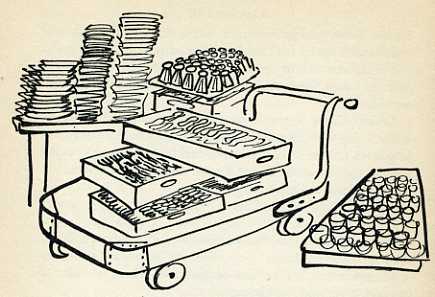
In addition to food, caterers usually supplied linens, china, and silver, as well as decorations, even when the dinner was held in a client’s home. In his book Catering for Private Parties, Jessup Whitehead explained that caterers obtained most of their linens and table ware at auctions, being careful not to acquire monogrammed pieces. A prized item was a large epergne which made a grand appearance on a table. Trenton NJ caterer Edmund Hill spent a good deal of time traveling to other cities to keep up with the latest trends in his field. He recorded in his diary on September 26, 1883: “Went to Wilmington, Del. to see about a Vienna Bread baker. Did not get him. Stopped in Phila on way home. Bought a silver epergne $20.00.”

Hotel catering, with its backstage mishaps, staffs of curious characters, and endless haggling over costs and contracts was described with humor by Ludwig Bemelmans who worked as a busboy at the fictitiously named New York “Hotel Splendide” before World War I. In the book Life Class (1938) he described how a group of well-bred but penniless blue bloods bargained for reduced rates based on their status and decrepitude, while accepting a simple supper menu of nothing but consommé and scrambled eggs.

After World War II catering continued on as before, distributed among hotels, restaurants, and independent caterers, the main change being the incorporation of frozen convenience canapes and better equipped kitchens to simplify and speed up the work. Some restaurants, and especially deli restaurants, such as Wolfie’s in St. Pete FL, offered party platters. By then large hotel banquets tended to lose their appeal for many people who had experienced too much Chicken a la King. Thanks to glittering parties thrown by Hollywood stars, it become clear that status accrued to the host or hostess who hired a famed restaurant’s celebrity chef to present novelties that piqued guests’ interest.

© Jan Whitaker, 2018

9 Comments

Filed under food, patrons, proprietors & careers, restaurant customs