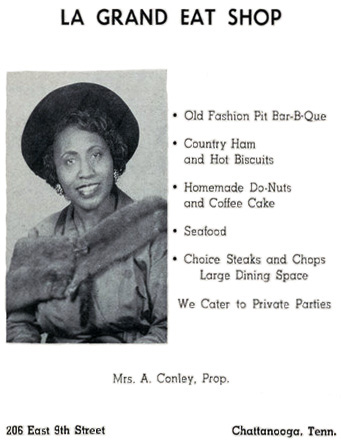
Green Book restaurants

Interest in historical Green Book guides for Black travelers has been growing in the past decade and the new movie of this title will surely increase it.

The Green Books’ slogan, “Covering the United States like a blanket,” nicely sums up its goal of making travel more comfortable (maybe even enjoyable) for Black travelers living in a country that typically greeted them with hostility whenever they moved outside their restricted neighborhoods and social roles.

Prior to the arrival of the Green Book, Black Americans relied on the kindness of strangers – also Black – when traveling. Until the 1960s, Jim Crow laws in Southern states barred them from access to white hotels, resorts, and restaurants. Outside the South conditions were not much better, despite civil rights laws barring discrimination in many states. To deal with this, middle-class Black travelers relied on other Blacks who invited them into their homes, even providing meals despite not usually knowing them personally. According to Willis Duke Weatherford’s Race Relations (1934), “The institution of ‘dining out’ is not established among careful [Black] families – it is a reflection on the home to eat in a restaurant; it simply is not done.”

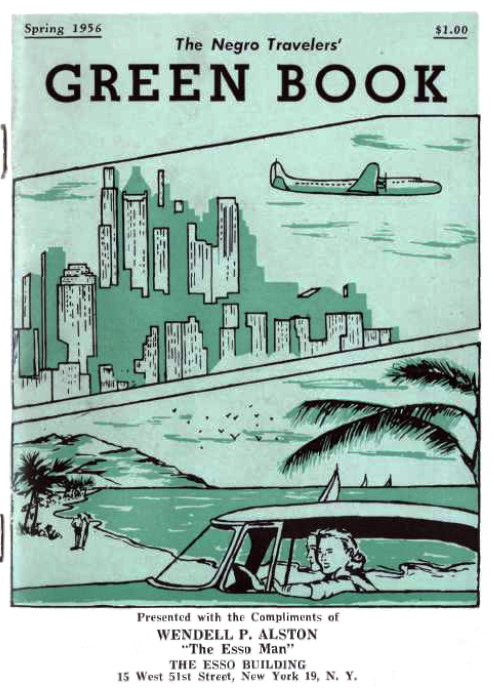
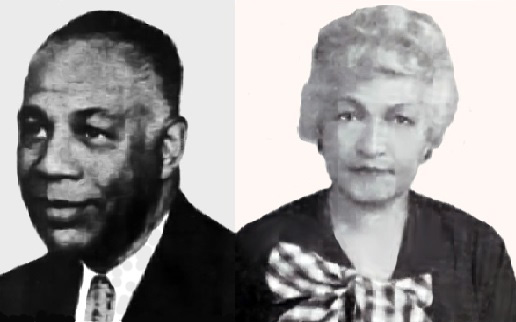
As travel increased among Black business people, entertainers, and tourists, accommodations in private homes were no longer adequate, especially for longer trips. A number of guides were published, among them the annual Negro Motorist Green Book published by Victor Hugo Green, a mail carrier in New Jersey. The guide was renamed the Negro Travelers Green Book in 1952. At some point in the 1950s, Victor became ill and his wife Alma took over as editor and publisher. The last two editions were by new owners.

The Green Books were first published in 1937, then every year after that except for four WWII years, ending with a 1966-1967 edition. With the exception of 1946 and 1958, all of the editions are available digitally in the New York Public Library. A 1946 edition sold for over $4,500 on eBay in 2016 and a copy is owned by Virginia Union University Library. As far as I can tell the 1958 edition is not publicly available. Several editions have been republished.

Green Books were sold directly to consumers and also distributed by Esso after Standard Oil of New Jersey hired a prominent Black businessman to promote Esso to Black motorists. Thirty-eight percent of Esso gas stations were operated by Black proprietors, according to a 1939 essay. Conoco also ran a Negro Travel Service which prepared custom “Touraides” free on request. Quite a few issues of guides devoted pages to new model cars of the major, and a few minor, automobile manufacturers. In the Black community cars were regarded as liberators, as well as providers of good jobs in the manufacturing and service sectors. An essay to this effect, “The Automobile and What It Has Done for the Negro,” appeared in the 1938 edition.

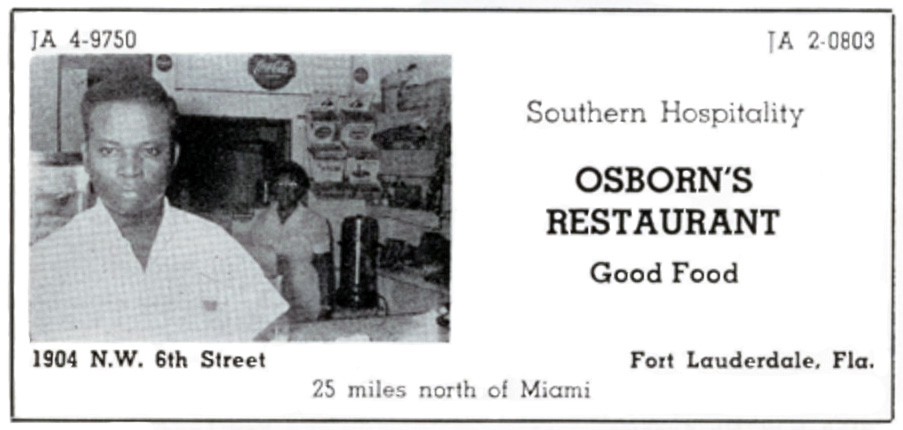
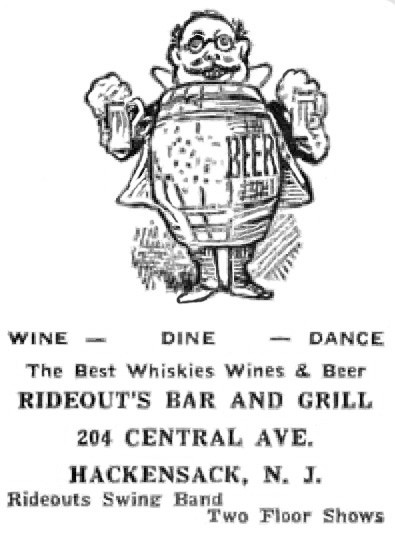
The books provided lists of hotels and tourist homes that were welcoming, most of them located in Black business areas of cities and towns. It also listed restaurants, roadhouses, taverns, nightclubs, beauty and barber shops, service stations, and other businesses. In later years it tended to focus primarily on places to stay. [Osborn’s, 1962]

I’ve looked at all the Green Books in the NYPL collection, paying special attention to restaurants in them. Overall there are not a huge number of restaurants. In 1939, for instance, only two restaurants are listed for the entire state of California.

Most of the restaurants seem to be in Black sections of towns, or are Chinese. Their numbers seem to have been dependent on Victor Green’s informants, who were said to be mail carriers like himself. Coverage was also spotty. Green lived in New Jersey and then New York City, and it’s noticeable that both states are more thoroughly covered than most others.

What seems to be lacking are restaurants in predominately white areas that welcomed Black customers. If Black tourists or business people were visiting Los Angeles, for instance, how would they know which restaurants in the main shopping or business districts would serve them without problems?

Comparing the Duncan Hines’ popular Adventures in Good Eating guide book of the late 1940s with a Green Book of roughly the same time reveals that there is no overlap whatsoever in their listings of Los Angeles restaurants. Not one of the 37 LA restaurants recommended by Hines is to be found in the Green Book or vice versa.

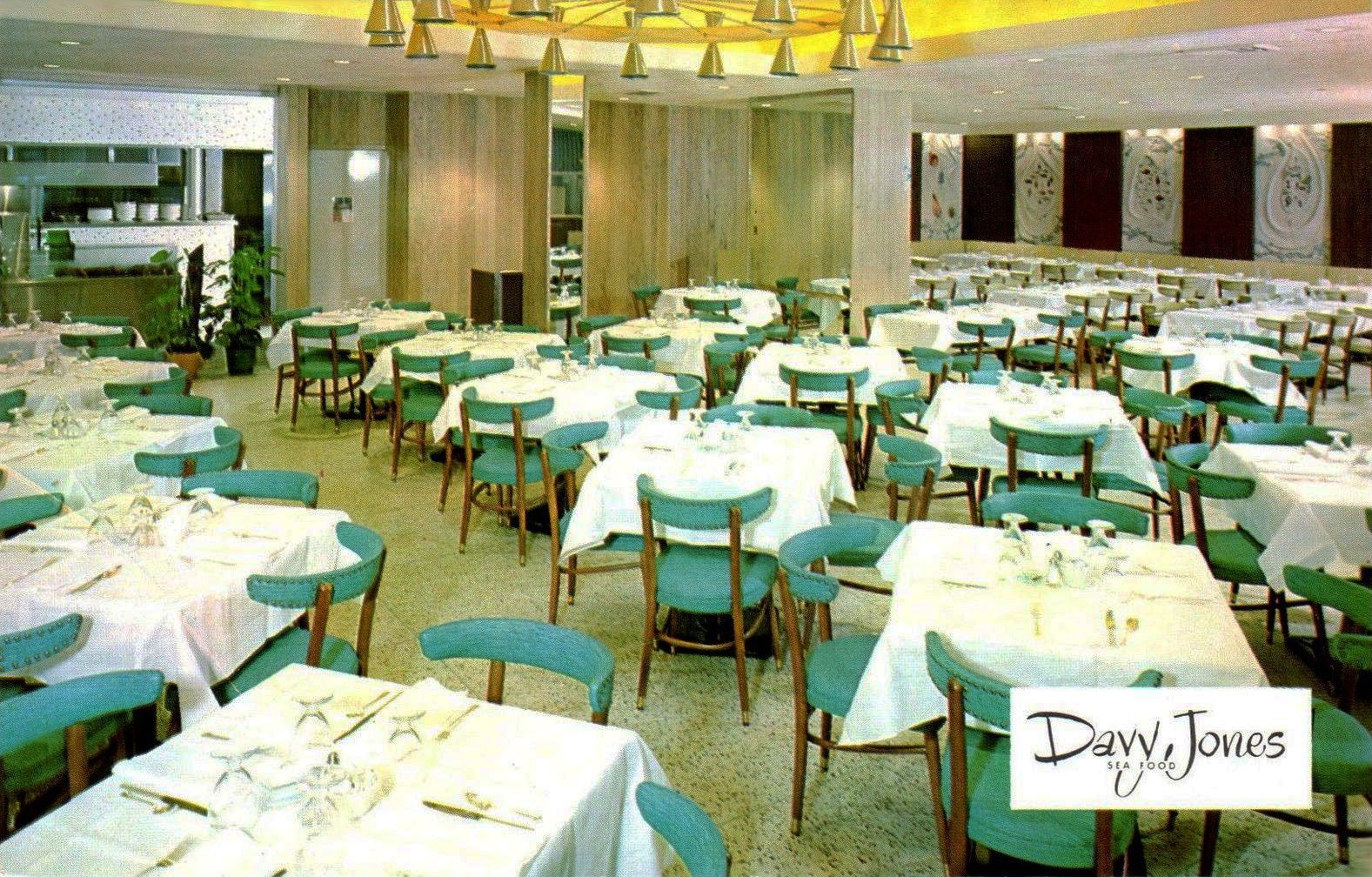
Things had changed somewhat by the 1962 edition. It is striking how many more white-owned and patronized restaurants are listed for New York City that year. Previously the only New York restaurants in the guides were located in Harlem, but now they are all over town. Among them are the Brass Rail chain, Davy Jones Seafood House, and Jack Dempsey’s. It’s hard to know whether the change was due to the policy of the restaurants or the Green Book.

Trying to learn more about restaurants listed in Green Books is difficult. Many I’ve looked for do not show up in city directories, nor in newspaper archives. Judging from feature advertisements for restaurants in later issues, many of the restaurants listed were small neighborhood places that served unpretentious home-cooked meals, quite similar to the majority of white-owned restaurants in the 1930s, 1940s, and 1950s.

I recognized a few names of well-known Black restaurants such as Paschal’s in Atlanta (est. 1947 as a small sandwich shop), Little Gray Shops #2 and #3 (considered Harlem’s better eating places in the 1930s), and Dooky Chase in New Orleans (like Paschal’s, still going strong today).

There was also a listing for Bagley’s, operated by Black socialite Caroline Bagley in Sheepshead Bay NY, as a kind of tea room with garden dining. A number of other tea rooms are listed, among them the Black Beauty Tea Room in Mount Olive NC, which had the distinction of being raided in 1950 for serving bootleg whiskey.

Probably quite a few restaurants in the Green Book were community institutions in their time, such as Hammond Café in Abilene TX, specializing in spicy chili. Certainly that was true of Harlem’s Aunt Dinah’s Kitchen, run by Broadway actor Richard Huey. Aunt Dinah’s hosted one-act plays and discussion forums in the 1930s and 1940s, and served as an informal support center for actors who needed a place to gather and have a free meal now and then.

Researching restaurants, hotels, etc. listed in the Green Books would be an interesting way to construct a picture of 20th-century Black life before the Civil Rights Act. It would make a good group project.

© Jan Whitaker, 2018

17 Comments

Filed under guides & reviews, patrons, racism

Dirty by design

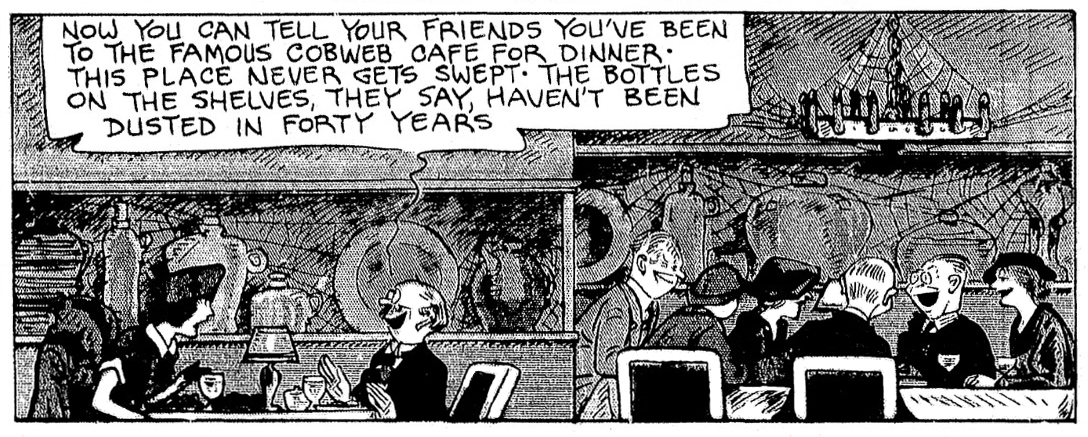
Given the general fear of unclean restaurants, it’s hard to understand the fascination with cobwebs and dirt in eating and drinking places of the 19th century and early 20th. File this under “the past is a foreign country.”

One of the famous places known for its decades’ worth of dust and grime was Old Tom’s in New York City. In the judgment of its fond patrons, it only got better with time.

According to witnesses, the shabby building that housed Old Tom’s on Thames Street a block west of Broadway was dark and dingy and its windows had never been washed. In the corners were stacks of boxes and barrels. Its walls were adorned with dusty letters from old patrons, ancient notices for boxing matches, and somewhat repulsive relics such as a mummified bat and “a pair of shoes taken off a little forlorn waif found wandering in the streets.”

Although customers liked Old Tom’s chops, Welsh rarebits, and ale well enough, the fame of the place rested on its cobwebs (barely visible in this 1872 illustration). By the 1870s they had been allowed to grow quite luxurious for at least 30 years. One visitor compared them to an “air-plant” which absorbed fibers and floating dust along with ale fumes and the aroma of cooking. The webs hanging from the ceiling were so long that the owner trimmed them “like a garden hedge” so they didn’t catch on men’s hats. If the restaurant had wanted to move to a new location, it would have failed. Without Old Tom’s cobwebs “the soul of his business would vanish,” said a newspaper story in 1877.

Old Tom’s went out of business in 1880 but the name was so famous that another Old Tom’s popped up nearby. It was dowdy, but sadly lacking in cobwebs.
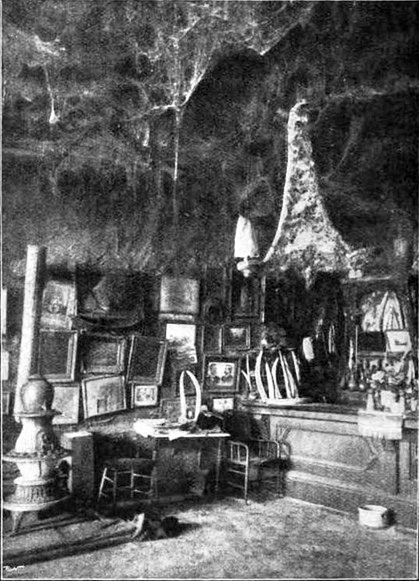
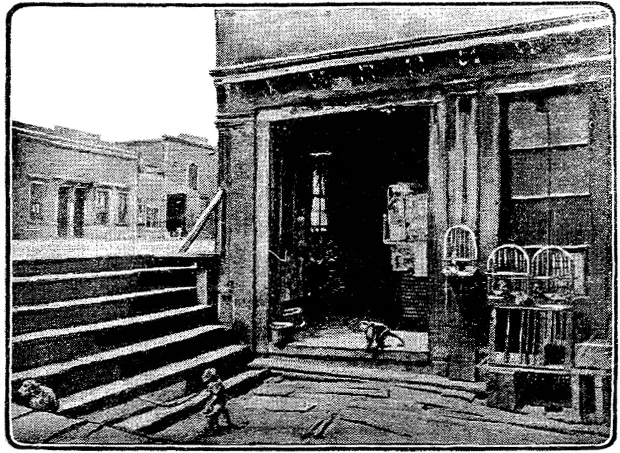
Old Tom’s had its match in San Francisco, at a dive known as the Cobweb Palace, established in 1855. Such places were as much saloon as eating place, yet the Cobweb Palace, located on Meigg’s Wharf (now the site of Fisherman’s Wharf), was known in its better days for its clam chowder, cracked crab, and mussels. By the time it was demolished in 1893, it was a near-total wreck.

The Cobweb Palace was decorated with spider webs, South Sea island clubs and masks, and a totem pole, among many other curios both valuable and worthless. Though it was hardly a family spot, children liked to stop by and see the parrots, magpies, and parakeets flying around. Roaming monkeys greeted patrons while outside the door was a caged bear.

Old Tom’s and the Cobweb Palace lived in lore long after they were gone, but many other cobwebbed saloon-style eateries disappeared into the mist and little is known but their names.

There had been a place called Cobweb Hall in New York and another in Detroit, both operated by men from Scotland. The owner of the New York saloon/chophouse on Duane Street died in 1868, putting an end to his menagerie of spiders, Siberian wolfhounds, and canaries. In Detroit, Tom Swan’s Cobweb Hall began in 1869, lasting into the 20th century. He attracted business men and actors to his web-filled restaurant whose walls were also adorned with old playbills.

The West had quite a few Cobweb Saloons, some serving food or adjoining a restaurant whose cook often was a Chinese immigrant. Some were in mining towns such as Prescott AZ, where Ben Butler’s Chop House, run by Fong, Murphy & Co., “the Finest Restaurant in Prescott,” was next to, or connected to the Cobweb Saloon.

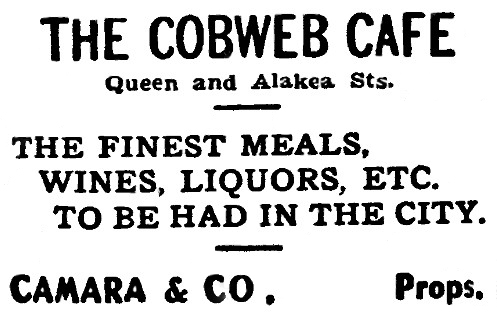
I’ve also found Cobweb Saloons in Las Vegas NM, Lincoln NE, Spokane and Tacoma WA, San Antonio and Beaumont TX, Albany OR, New Orleans LA, and Honolulu HI [advertisement, 1905].

Alas, I don’t know whether these saloons and cafes were draped with cobwebs. Seems like those in the West would not have had enough decades to grow them. I’m guessing it was more of a declaration of manly, no-frills comforts.

The patrons of cobweb cafes, saloons, and chop houses were regarded as victims of the devil by Christian preachers and their flocks who thought the name Cobweb Saloon was just about perfect for a place that entrapped heavy-drinking men. In 1903 a Sunday School group in Roswell NM planned a temperance discussion to include topics such as “Do men drink whiskey for the taste or effect?” and “‘Cobweb Saloon’ – Why is this an appropriate name?”

© Jan Whitaker, 2018

9 Comments

Filed under alternative restaurants, atmosphere, decor, odd buildings, Offbeat places, sanitation

Clown themes

Have you ever felt that clown themes, characters, and motifs in restaurants were a mistake? A good number of Americans – estimated as many as 12% of children and adults — experience fear that clowns are deranged maniacs in disguise.

But that wasn’t always true. The 1950s and 1960s were the era of jolly clowns. Several clowns, particularly Bozo, won a children’s audience on TV, redeeming a character that had a sometimes dark history in past centuries. In 1963 Ronald McDonald got his start on television, played by Willard Scott who became better known in subsequent years as a weather forecaster.

Scott’s Ronald, a character he claims to have created, was costumed differently than later and more familiar Ronalds. Ronald has, in fact, gone through numerous costume changes over the years — as have many corporate mascots.

Whether because of clowns’ popularity on TV or some other source of inspiration, quite a few drive-in restaurants (and some drive-in movies) of the 1950s and 1960s adopted clown names, signs, and motifs. Taking on a clown theme suggests a wish to attract children in hopes they might bring the whole family along. The drive-ins’ menus of hamburgers and ice cream were certainly in tune with children’s tastes.

As was true of drive-ins generally, clown-themed drive-ins got their start in the warmer climates of California and Texas. The original Jack In The Box, previously called Oscar’s, was one of the first, opening in 1951 in San Diego, California, with the Jack figure looming over a low roof.

Another early California drive-in of the 1950s was the Big Clown Drive-In, again describing itself as a “hamburger operation.” The Clown Burger, in Fort Worth TX, opened in 1959 serving what are now regarded as surprisingly small, thin burgers and fries.

The innocent appeal of clowns began to wane in the 1970s.

It was a blow to the clown image when juvenile and teen-age murder victims of John Wayne Gacy began to be discovered in 1978. Gacy sometimes wore a Bozo the Clown costume to aid in luring his victims. After his conviction he sold crude paintings of himself dressed as Bozo that he painted in prison.

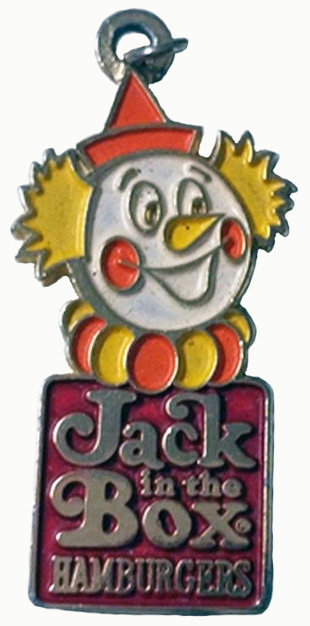
The disclosure of Gacy’s crimes didn’t put a total end to the clown theme, but it may have accelerated its decline. A year earlier Jack In the Box had already simplified and stylized its clown logo which had been in use for nearly a decade (shown here as a charm).

Somehow, though, Ronald McDonald survived. In 2011 the chain’s mascot was criticized for peddling an unhealthy diet to children, but the company decided to keep him nonetheless.

In the 2000s, around two dozen movies with scary clowns were released. Then, in 2016 clown fears increased due to a number of incidents where knife wielding men wearing clown masks marauded in public. After that Ronald became less visible.

© Jan Whitaker, 2018

9 Comments

Filed under atmosphere, chain restaurants, drive-ins, family restaurants, restaurant fads

Basic fare: meat & potatoes

Meat and potatoes were so characteristic of eating places in the 19th century we could call it the Meat and Potatoes Century. But of course that title could apply to most of the 20th century as well.

In 1829, the Plate House, a cheap New York City eating hall, offered steaks with potatoes by the dish and half dish, 4 cents for the latter.

Chop houses of the 19th century were also based on meat and potatoes. They could be considered forerunners of today’s steakhouses, with their dark interiors, male patrons, and baked potatoes as accompaniments to meat. One difference, though, was that in the 1800s patrons were as likely to order mutton as beef.

The chop house was regarded as an antiquated type of eating place in 1873 when a journalist wrote that Farrish’s and others were “sought out by Britishers who like places off the beaten track and humble, dark and without glitter.” Old fashioned or not, it was still loved for its “mealy” baked potatoes, probably even in the 1930s when this postcard was produced.

Little surprise that “meat and potatoes” became a metaphor for no-frills reliability. To call someone a meat-and-potatoes “man” – always a man — was more than a commentary on his diet; it also meant he was a regular guy. Similarly for a meat-and-potatoes town. As Chicago columnist Bob Greene would put it in 1983, as the world capital of meat and potatoes, his hometown was “tough, brawling, no-nonsense, rugged.”

The metaphor – that came into use after World War II — could extend to almost anything. Business success relied upon sure-thing “meat and potatoes” products and services. For Gloucester MA, odd as it sounds, the town’s meat-and-potatoes industry was ground fish. For a symphony orchestra their meat and potatoes might be a popular Beethoven sonata.

Nineteenth-century restaurants featured potatoes either mashed, boiled, baked, stewed, fried, Lyonnaise, scalloped, mousseline, or au gratin. In the 20th century the choices tended to narrow down to mashed, baked, and French fried. Meat meant mostly beef in the 19th, but extended to chicken in the 20th.

In 1885 it was standard for potatoes to come free with a meat order. As noted then, “An unordered boiled potato, with the skin on, is the second grand characteristic of an American dining saloon. It matters not what meal it is, the boiled potato will always appear, if the establishment is truly legitimate.”

But this “legitimate” entitlement was about to end. Where would fast food restaurants be today if they didn’t charge extra for French fries? As far back as the early 20th century, restaurant operators realized there was additional profit to be made by charging separately for potatoes.

In the 1950s and 1960s, fast food burger chains, hotel rib rooms, and chain and independent steakhouses began to proliferate. Steakhouses proved popular with lunching business men while families chose economy cuts at Bonanza or Ponderosa. “Advances” took place, such as foil wrappings that allowed the potatoes to remain under infra-red lamps longer without drying out. By the early 1960s sour cream and chives were considered essential additions to baked potatoes. By that time, the favorite All-American meal was shrimp cocktail, followed by steak, baked potato with sour cream, an iceberg lettuce salad thickly coated with Thousand Island dressing, and cheesecake for dessert.

In 1971 a Gallup survey measuring the popularity of “international cuisine” confirmed the timidity of most American palates. The strangest aspect of the survey were the dishes Gallup offered up as international. Among them were Beef Stroganoff (ranked highest), Swedish Meat Balls, Lasagne, Veal Parmigiana, Chili Con Carne, and Hungarian Goulash. A full 10% of respondents found nothing among the 22 selections that they liked.

Nevertheless . . . around the late 1970s the whole meat-and-potatoes dining complex began to be questioned. Increasingly it ran against new notions of health and fitness. The cholesterol, the heaviness! Also, it was such a limited diet. Did its fans have no interest in other cuisines? Meat-and-potato towns – Chicago, Cleveland, Kansas City, St. Louis, Denver, Fort Worth – were shamed and ridiculed even though, occasionally, someone admitted there were plenty of steakhouses on the coasts too — New York, San Francisco, even New Orleans.

In the next phase, not surprisingly, many meat-and-potatoes towns struggled to refurbish their reputations by boasting of restaurants of all kinds. Omaha touted its seafood, Japanese, Korean, and French restaurants. Minneapolis was still conservative, wrote Jeremy Iggers and Karin Winegar in John Mariani’s 1986 Coast to Coast Dining Guide, yet they identified seventeen Vietnamese restaurants, three Thai, two Ethiopian and many other nationalities represented as well, along with examples of “yuppies” taking fresh approaches to American cuisine.

Plus, pizza had actually become the new meat and potatoes.

How are steakhouses doing today? Although there are still many around and some Americans nurture a wish to return to the 1950s, I’m guessing that it’s unlikely the golden years of the steakhouse will return. Burgers and fries, too, may have seen their better days.

© Jan Whitaker, 2018

10 Comments

Filed under chain restaurants, food, patrons, popular restaurants

Dining with Chiang Yee in Boston

Chiang Yee was a travel writer, born in China but a resident of London since 1933. In 1953 he came to the U. S. to research his book The Silent Traveller in Boston (1959). In 1955 he immigrated to the U.S. and taught at Columbia University for 16 years.

While in London he had published 21 books, many of them which he illustrated with paintings and drawings. Some were about travel but all of them interpreted aspects of Chinese culture for non-Chinese readers, reflecting upon similarities and differences with Western culture. In the travel books, for which he adopted the persona of Silent Traveller, he avoided political criticism and controversy while presenting himself as a serene, meditative man who walked slowly, looked closely, and enjoyed the simple pleasures of life.

Of course his visit to Boston involved quite a few restaurants, including a number of well-known places. He made influential friends — intellectuals and cultural elites — who took him to clubs and fine restaurants such as the Parker House, Locke-Ober, and the hidden-away 9 Knox Street, then run by two men in their antique-filled home at that address.

He went to popular spots such as Durgin-Park, Purcell’s, Jimmy’s Harborside, and Union Oyster House where he made a drawing of himself with a lobster and bib [shown above]. He was eager to sample local dishes such as cod, baked beans, and clam chowder. He never criticized the restaurants he patronized, though he admitted he was not fond of raw seafood.

A darker and far less serene Chiang Yee was revealed in 2010 with the publication of Chiang Yee: The Silent Traveller from the East – A Cultural Biography. Its author, Da Zheng, examined Chiang’s correspondence and interviewed friends and family, painting a complex portrait of his subject. In the Foreword, Arthur Danto reminded readers that “the Silent Traveller itself is a mask he wore that enabled him to survive under skies very different from those under which he was born.” Danto related that after visiting China in 1975, Chiang proclaimed to a group of friends, “Nobody knows who I am!! Nobody! I am a REVOLUTIONARY!!!!.”

Chiang had left his wife and four children behind when he went to London at age 30, confessing to his closest associates that his marriage was unhappy. Born into a wealthy family, he was trained in the classical arts as well as science which he studied in college. He had been a magistrate in China but in the West he built his career around Chinese art and high culture.

According to Da Zheng, when one of his sons immigrated to the U.S. in 1960, Chiang advised him to expect hardships and to be forbearing. His son observed that his father’s New York apartment was filled with signs saying “Forbearance,” suggesting that his father had much need of his own advice.

Chiang Yee told his son to stay away from Chinatown or he might end up running a restaurant there, advice he had earlier given his older son in London. Given the prejudice against Chinese in the U.S. and England – of which he was strongly critical — Chiang told them it was wise to cultivate relationships with non-Chinese.

In the light of revelations in his biography of Chiang’s strong feelings about politics, society, and the vicissitudes of his own life, I interpreted some of his words in a different light than on my first reading of The Silent Traveller in Boston. It is interesting how suggestive his stories of restaurants are in particular.

Although he admired Chinatown residents’ determination and drive, he did not share their language or cultural background. He showed some irritation that his non-Chinese friends and acquaintances in Boston expected him to be an expert on American Chinese restaurants. He wrote that a Frenchman would not “be asked to suggest which French restaurant in Boston is the best as I was asked to do in the case of Chinese restaurants almost as soon as I had arrived in the city.”

He also told of experiencing his first clam chowder in San Francisco but being greeted with silence when he told his Boston friends about this. At first he did not realize why, but later, when they asked if he thought food in Chinatown restaurants was genuine, he reminded them of their reaction to his story of eating Boston clam chowder in San Francisco. I now see this as a kind of mild dig at them, a subtle reminder that the food of American Chinatowns was as foreign to him as it was to them.

I also find it interesting that he tells of a dinner with the family of Harvard professor Yang Lien-sheng at the Old Wright Tavern. He was pleased that the waitress complimented the good behavior of the Yangs’ 5-year old son, but also wrote, “Neither the manageress nor the waitress bothered to tell us the history of the inn . . . Perhaps the people of the Wright Tavern had no time to spare from catering. Or they took for granted our knowledge of Concord history.” I suspect that he felt they had been slighted.

He must have experienced numerous “microaggressions.” Surely experiences such as the one he related about Durgin Park accounted for at least some of his Forbearance signs. Given a huge plate of food that he could not finish, a waitress addressing him as “young man” (he was 53), loudly commented, “Can’t you finish your plateful? If you can’t you should not have come here to waste your money; if you don’t like the food, we want to know why. We don’t like people who don’t like our food.” He said that when she laughed he realized she was joking, but admitted to feeling embarrassed. I’m certain that he knew that the “joke” contained a jibe about his being a foreigner.

It is a shame he had to travel silently and could not be as frank about his estimations of American culture as the Soviet authors of Little Golden America.

© Jan Whitaker, 2018

5 Comments

Filed under food, patrons, popular restaurants

Slumming

The word slumming had several meanings when it came into use in the 1880s. Basically it meant visiting the slums. But the purpose for elite and middle-class white Americans might vary, from charity to data collection, curiosity, a sexual escapade, or general entertainment.

Apart from ministers, reformers, and city officials, those who went on slumming tours (with guides) in the late nineteenth century usually were motivated by curiosity or a wish for entertainment.

In 1884, the New York Times ran a story about British actress Lillie Langtry and her party visiting the city’s slums, noting, “So far the mania here has assumed the single form of sight-seeing – the more noble ambition of alleviating the condition of the desperately poor visited has not animated the adventurous parties.”

Following the vogue begun in London, slumming became a mark of worldly sophistication among some Americans in the late 19th century.

Although most newspaper accounts of slumming focused on New York’s Bowery and Tenderloin or San Francisco’s Barbary Coast, there were in fact areas of interest to slumming parties in many parts of the U.S. For example, a group of conventioneers from Omaha visiting Dakota Territory in 1889 took an excursion to Deadwood’s Chinese settlement. They were disappointed it was so tame.

Tours often involved stopping at a restaurant or café, particularly if a group was visiting a Chinese area, as was often the case especially as Chinese populations increased in the Eastern U.S. beginning in the later 1880s. Many of the first white, middle-class customers of Chinese restaurants were “slummers.” Such excursions increased around the turn of the century. A 1900 account described how Chinese restaurant keepers had learned that it paid to accommodate slumming parties who “would spend more money in their places in an hour than their regular customers would spend all day.”

But Chinese restaurants weren’t the only ones “discovered” by slummers. King’s Handbook of New York listed slumming restaurants under the category of “Novelty in Restaurants” in 1892. In addition to Chinese (“dirty, foul-smelling and cheaply furnished”), the handbook mentioned Hebrew restaurants of the East Side, a Japanese restaurant, Russian restaurants, Polish restaurants, a place with Spanish cooking, and “Italian restaurants of a low order” on Mulberry Street. Of a higher order, according to King’s, were Austrian, Swiss, Hungarian, and German eating places.

In addition to Chinese, Italian and Hungarian restaurants were top choices of slummers. Coppa’s, particularly before San Francisco’s great fire of 1906, drew many who were curious about “bohemian” lifestyles.

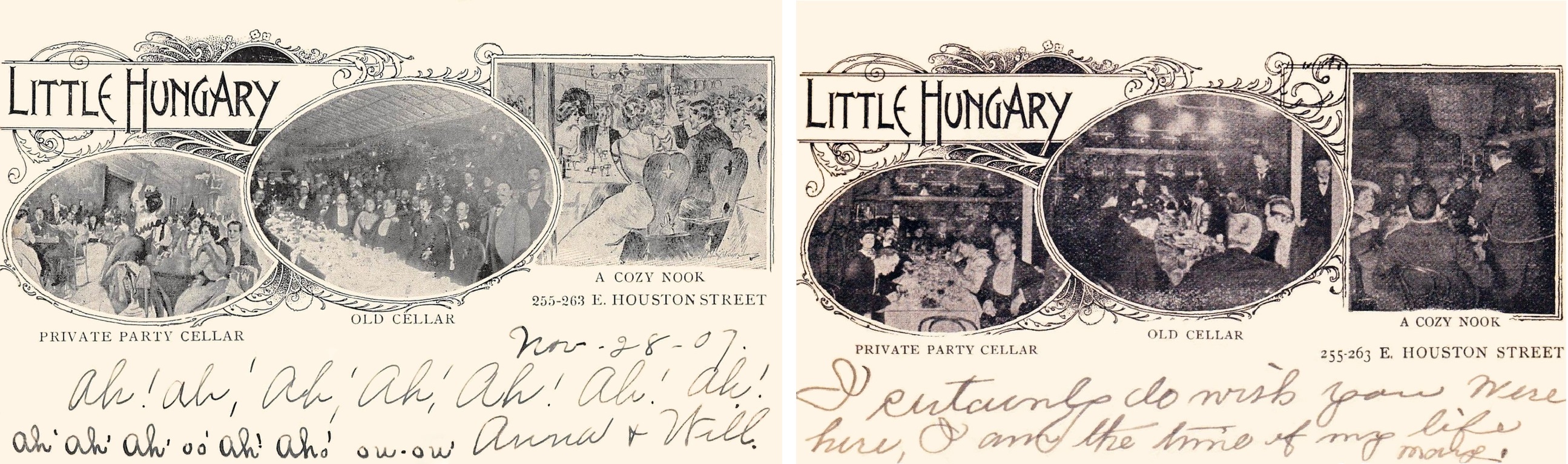
Postcards from New York’s Little Hungary around 1906-1908 illustrate customers’ thrilled reactions. Anna & Will mailed their card to Arlington NJ, while Marge, who apparently left out a word, sent hers to a woman in Syracuse.

A common interpretation of the appeal of immigrant restaurants was the aridity of mainstream American culture, with its emphasis on the strict rules of proper behavior. Italian and Hungarian restaurants, by contrast, were enjoyed as places where patrons might sing along with the band or talk to their neighbors without being introduced. James Harvey wrote in his 1905 book In Bohemia, “By the time you get to the roast, it is eight o’clock and the evening is in its prime. Everybody seems to love everybody else, thanks to the heavy Hungarian wines.”

In some cases nostalgia played a role. According to a 1997 article by Beth S. Wenger subtitled “The Invention of the Lower East Side,” that part of New York became a destination for Jews who had moved uptown. She quoted a 1926 Jewish Daily Forward story that said “the crowds come nightly to Delancy and Rivington Streets to drink selzer, eat Roumanian Broils and listen to sentimental ballads.” Wenger saw visits to the East Side as symbolizing “the uneasy social adjustment of second-generation Jewish Americans” who were not satisfied with “the ‘strained and sterile’ dining spots in their new neighborhoods.”

Though it was regarded as daring to venture into immigrant restaurants in the 19th century and the early years of the 20th, it became less so as the restaurants responded by exaggerating their “foreignness” to attract suburbanites and tourists. In 1905, according to Town & Country, “to eat spaghetti in the backyard is a pet fad,” especially for wealthy conservatives in search of “thrills at the strangeness of it all.” The proprietor played up to them by dressing as a ferocious bandit, “his head bound up in a gay bandanna with large rings in his ears.”

In a 1914 Sinclair Lewis novel, Our Mr. Wrenn, the protagonist takes a woman to a restaurant run by “Papa Gouroff” who wears a fez in hopes that “the place would degenerate into a Bohemian restaurant where liberal clergymen would think they were slumming . . .”

Menus, too, were tailored to the tastebuds of outsiders, producing dishes such as chop suey and chili con carne.

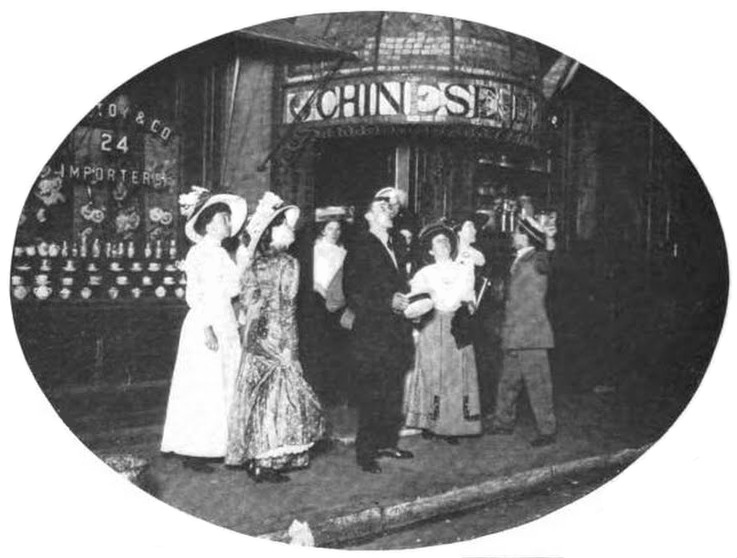
Slumming really hit the mainstream before and after World War I, probably due to a number of movies and novels whose plots included exciting scenes of people on tours. In the 1913 “New York’s Society Life and Underworld,” a group is set to visit the Port Arthur restaurant in Chinatown [pictured] just as they hear a woman’s scream. Norma Talmadge and Mary Pickford both starred in 1918 films with slumming scenes; Pickford’s included slumming in San Francisco’s red light district, the Barbary Coast.

At this time just about anyone might venture into the slums, whether a group of clayworkers visiting New Orleans in 1914, or soldiers from Seattle on leave in New York. One soldier admitted, “I was never so disappointed in my life as I was in the Bowery. I expected to see several murders and gun fights but all I could see was foreign merchants with hair all over their faces.” Their big thrill, as it turned out, was going to the Automat.

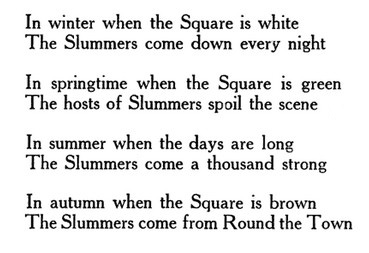
In fact the Bowery wasn’t what it used to be, having been sanitized in the war period. According to the book Slumming (Chad Heap, Univ. Chicago Press, 2008), counterculture tea rooms in places such as NY’s Greenwich Village and Towertown in Chicago became the bohemian “thrillage” sites of the 1920s. [verse from The Quill, 1919]

© Jan Whitaker, 2018

4 Comments

Filed under alternative restaurants, atmosphere, ethnic restaurants, Offbeat places, patrons

Picturing restaurant food

Restaurants have long tempted the public with displays of food, but in the 20th century it became possible to replace actual food with images of desirable dishes on colored postcards and illustrated menus.

Color photochrome postcards became standard after WWII, yet it wasn’t until the 1970s and 1980s that menus illustrated with full-color photographic images of food came into common usage.

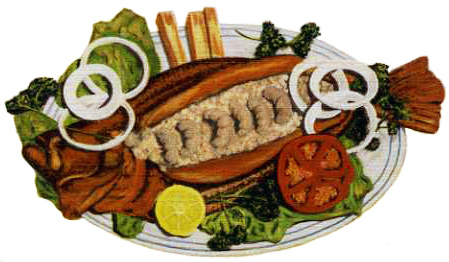
In the 1930s and early 1940s, before photochrome postcards came into widespread production, linen-finish postcards were the norm. Their cartoonish coloring often lacked realism. For example, the grayish shrimp topping stuffed flounder at Manuel’s in Galveston TX look distressingly like worms.

Even as quality photography and printing became more available in the 1950s, restaurants weren’t always successful in portraying food attractively. Professional food stylists had yet to arrive on the scene to solve problems such as poor plating, monochromatic food combinations, and runny gravies.

Regarding poor plating, a large portion is all very fine but should an order of meat or fried fish be bigger than the plate?

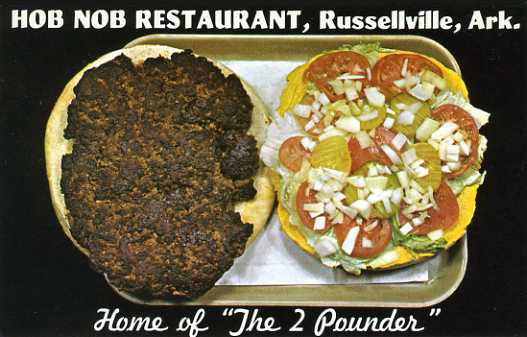
Gargantuan food itself can be questionable, not only to consume but also to look at. How attractive are french fries almost as big as baked potatoes? Is a two-pound burger eight times better looking than a quarter pounder?

On menus, photos of food play multiple roles, providing information about “exotic” dishes, invoking desire, and steering choices. In the case of restaurants whose dishes – or drinks in the case of Polynesian theme restaurants — might be unfamiliar to some patrons, pictures serve as visual description.

As far back as the 1930s, some restaurants used illustrated menus but with images that appeared to be hand drawn and colored and almost comical compared to the realistic photographs that dominated chain restaurant menus by the 1980s. Full-color, laminated menus are most often found in 24-hour coffee-shop restaurants and present all the meals and dishes that are available; breakfast, lunch, and dinner often have no clear demarcation.

Laminated menus cost more to produce than others yet are relatively long-lasting because they can be wiped off — though, as often noted, rarely are. Their lifespan is about 3 to 6 months, after which prices and dishes need updating.

Unlike Indian, Chinese, or Mexican restaurants (especially in the years when they were new to many diners), dishes found on illustrated menus of chain restaurants – such as bacon and eggs, pancakes, or burgers — are not the least bit unfamiliar. Quite the opposite.

Which seems to raise the question of why such ordinary food needs to be illustrated at all.

Not too surprisingly the main role of photos is to encourage customers to order the restaurant’s more profitable dishes. It’s always possible to order a single pancake or fried egg, but it is certain that what will be pictured is instead a stack of three pancakes or two eggs with sausage or bacon.

Featured dishes are positioned to follow the paths typically taken by customers’ eyes. Prized locations include the menu’s center and top right. Another tactic, one that turns the whole menu into an eye-catching circus, is to place featured dishes inside brightly colored boxes.

As for dishes that don’t get top billing, a Denny’s advertising director observed that a hopelessly slow seller like a grilled cheese sandwich would be line-listed, no photograph. On a 1970 Tops Big Boy menu [shown here], beef and shrimp achieved center feature status but ham and fish dinners failed to make the cut, languishing in a line-list.

I am still left wondering why many dishes on illustrated menus look so unattractive, especially considering that the menus are often produced after extensive research and consultation with experts. On a three-panel 1985 Friendly’s menu a “100% Sirloin Steak Burger” looms over the center column at a scale larger than other features such as a Clamboat Platter and a Seafood Salad Plate, yet it utterly fails to project charisma.

Contrary to wished-for results, many diners view laminated, illustrated menus as a signal that a restaurant’s offerings are going to be bland and uninteresting. An Orlando FL restaurant reviewer complained in 1988 that many restaurants there used laminated menus: “It seems that no matter what type of restaurant I go to, or how much is charged for the average meal, the menu is plastic coated. It reminds me of the people who buy really nice furniture and then cover it in plastic.”

Illustrated menus have become so strongly associated with mediocre food that it is a huge mistake for an establishment aiming for the fine-dining category to use such a menu, even temporarily. But, believe it or not, such a restaurant existed in Phoenix AZ in 1983, with expensive entrees pictured in shiny plastic while the wine list was calligraphied and covered in velvet.

© Jan Whitaker, 2018

8 Comments

Filed under chain restaurants, food, menus, restaurant customs

Find of the day: the Double R Coffee House

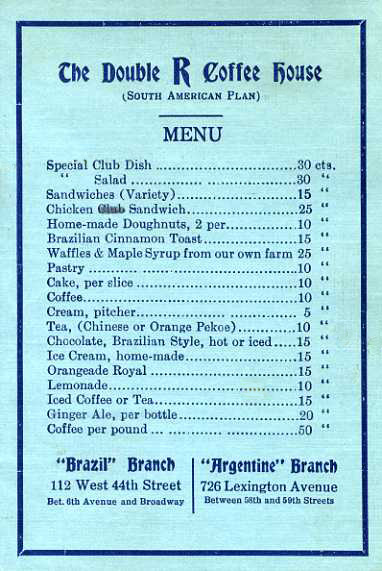
It gets harder and harder to turn up anything interesting at flea markets – even on the sprawling fields of Brimfield. But luck was with me this past week when I found the little menu from The Double R Coffee House.

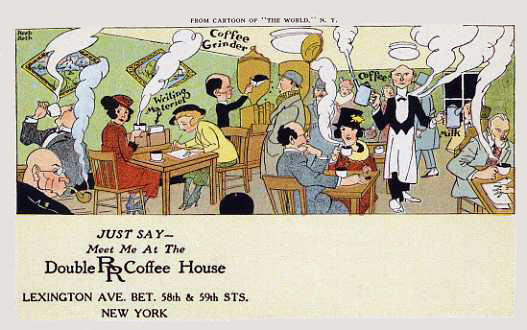
It didn’t look terribly interesting in itself until I remembered that my restaurant collection contained a cartoon-style postcard with the same name that I especially liked.

Turns out that the two Double R Coffee Houses had an interesting history. They were established and funded by sons, daughters, cousins, and others related by blood or marriage to Theodore Roosevelt. The impetus for the coffee houses came from Theodore’s son Kermit, who had spent time in South America and Arab countries. He mentions coffee repeatedly in his book War in the Garden of Eden. The book describes his experiences while serving with the British forces in Iraq and other countries involved in the Mesopotamian Campaign of World War I.

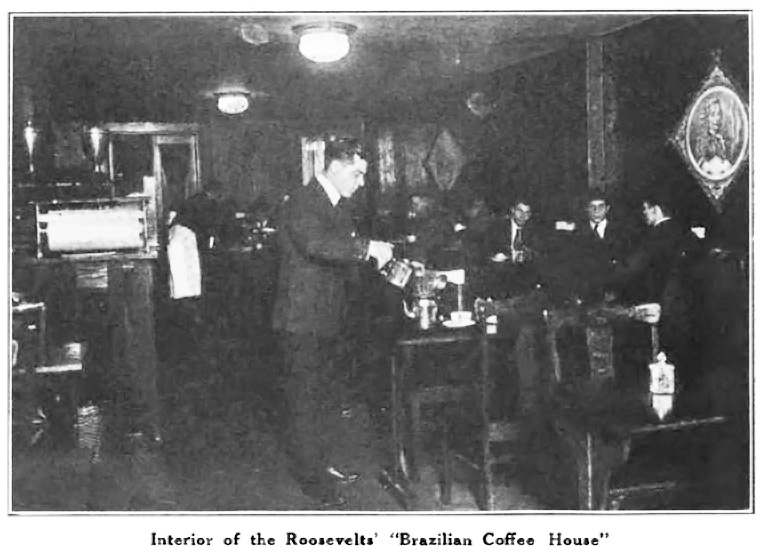
The initial business incorporation in 1919 was called Café Paulista after a café in Buenos Aires that Kermit had frequented years before. The corporation launched the first coffee house, then located at 108 West 44th Street, calling it The Brazilian Coffee House as inscribed above the door in this 1919 photo.
The coffee house got a fair amount of press due to the Roosevelt connection, but the family did not involve themselves in running it, nor were they known to frequent it. However, in one instance President Roosevelt’s widow did visit the 44th street location. A widely publicized news story in 1923 told of how she had saved two oil paintings of her late husband when a minor fire broke out in the kitchen.

What was truly unusual about the coffee house was not so much its owners or its decor, but how serious it was about coffee. The manager, Brazilian Alfredo Salazar [shown above], declared it was not a restaurant. Although it served light food including empenadas, he insisted the focus was on serving “real” coffee. He declared that Americans, New Yorkers included, did not know how to roast, grind, brew, or for that matter, drink coffee. Coffee that was boiled or percolated and left to sit around for over 30 minutes was equivalent to “tannic acid soup” in his estimation. He advised drinking it black, but allowed that the coffee house would provide cream, milk, and sugar since it was not a “propaganda establishment.”

The coffee house roasted coffee beans on the site and everyone commented on the wonderful aroma this produced.

Shortly after opening, the 44th Street coffee house moved to larger quarters nearby at #112. It was popular from the start, particularly with Brazilians, American business men – and business women — as well as surrounding theater-district performers.

Another characteristic of the coffee house that was appreciated was that patrons could linger as long as they liked, even if they ordered very little. Imprinted stationery was provided along with some reading materials – including an abridged version of the U.S. Constitution — and the place soon extended its hours to 1 a.m.

In February of 1921 the name was changed to Double R Coffee House due to a conflict with another business claiming that name and also because a cousin named Robinson was the corporation’s new president. In May a second coffee house on Lexington was opened with an exhibit of paintings by members of the Art Students League curated by realist painter John Sloan. Because of the art connection, it seems as though this coffee house had a more bohemian aspect. In a letter to Chicago poet and editor of Poetry Magazine Harriet Monroe, poet Wallace Stevens wrote that he had visited the new coffee house in August and “had a dash of maté.”

In 1923 there was talk of opening another Double R on 45th street in Times Square, but I could find no trace of it. Vague ideas about expanding to Boston, Philadelphia, and Chicago, talked about in 1919, never materialized and in 1928 one or both of the coffee houses were sold to new owners. What happened after that is unknown.

© Jan Whitaker, 2018

10 Comments

Filed under alternative restaurants, menus, Offbeat places, proprietors & careers

Delicatessing at the Delirama

The gigantically oversized menu shown here from Jack & Marion’s Delirama in Brookline MA is 21.5 inches tall, 34 inches wide fully opened, and contains over 230 items not counting drinks, desserts, or carry-out Delicacy Platters.

Digesting its pink and white interior is a dizzying, yet entertaining, exercise. Some items, such as the Hot Roumanian Pastromi Sandwich, are marked with a red star indicating “good profit item for Jack and Marion’s (Please order).” The Empire State Skyscraper Sandwich comes with a warning “Sissies, Please Don’t Order!” There is a “Jewish Dictionary” that explains that a “Zedeh” is “a grandchild’s press agent” while “Mein Bubbe’s Tahm” means “chopped herring at Jack’s and Marion’s.”

Patrons might join the “Fressers Fraternity” if they cared to admit that they had gluttonous appetites.

Hungry patrons could feast on bowls of sour cream with banana, fresh vegetables, or cottage cheese. Or on “Forshpies (before getting serious . . . a treat!”), in other words appetizers ranging from a dish of Sweet Gherkins (.35) to Chopped Herring (.65) or a Jumbo Shrimp Cocktail (.95). Along with shrimp, the deli also served non-kosher dishes such as Canadian Bacon Steak and Lobster Surprise, one of the most expensive choices at $5.95. Parties of six could feast on a $25 “Sandwich Supreme, served on a sterling silver platter (which remains our property.)” Like delis generally, sandwiches formed the bulk of menu offerings.

The deli on Harvard Street in Brookline’s Coolidge Corner was owned by Jack and Marion Solomon who opened it in 1950, advertising themselves as “designers and builders of the famous Skyscraper Sandwiches.” Jack, who had previously operated a deli in Brighton, explained that he modeled the Delirama on the famous Raymond’s on Boston’s Washington Street. Raymond’s was a bargain store that used corny advertising by a fictitious Unkle Eph who coined the store’s slogan “Where U Bot the Hat.” Jack Solomon said he, much like Raymond’s, had “done everything to make this the most talked-about restaurant.”

For a number of years the deli kept late hours, staying open until 3 a.m. It drew celebrities doing shows in Boston, such as players from the musical revue Bagels and Yox, who performed songs in Yiddish and other languages. In the 1950s it was often mentioned in entertainment columns in Boston newspapers. It was also a popular place for college students and couples on dates.

Despite suffering two bad fires and having the safe stolen, the Delirama persisted. It did, however, eventually withdraw from the entertainment scene and begin to keep earlier hours. The business did not survive long after the death of Jack Solomon in 1971. Despite attempts by his second wife, Valda, to keep it going, it went bankrupt and closed around the mid-1970s.

© Jan Whitaker, 2018

9 Comments

Filed under food, menus, Offbeat places, popular restaurants, proprietors & careers

Restaurant design and decoration

In the second half of 19th century restaurant decoration – in restaurants that had any — was mainly the work of painters who created baroque fantasies on walls and ceilings. Rooms reserved for female diners seemed to be more likely to be well decorated. An example was a ladies’ Refreshment Saloon on Broadway in New York in 1853 painted by someone simply referred to as Delamano. It’s likely he was the same Signor Delamano who painted scenery for a minstrel production with tableaux featuring Uncle Tom and Little Eva five years later.

Unfortunately I don’t know what the women’s decor of 1853 looked like. But for men, a standard decorative focal point was a painting over the bar of a reclining nude woman. Presumably men enjoyed these paintings, though one dissenter in 1884 declared barroom artwork a tasteless and degraded “decorative nightmare” aimed at “gamblers and the swell-mob.” To little effect – such paintings survived well into the 20th century, continuing to define spaces as male turf.

Along with friezes and murals, a full-service painting and decorating firm was likely to be able to handle plaster ceiling decorations and room moldings. In the case of the excessively ornate, carved and gilded Tosetti Restaurant opened in Chicago in 1895, decorators were aided by metal grillwork attached to the ceiling which was then covered with elaborate plaster work and lunettes painted to depict historic scenes.

Magnificence had become more attainable in the 1880s with the availability of Lincrusta-Walton, a thin version of linoleum that was embossed and paintable. It was waterproof and altogether superior to papier maché reliefs that had been used earlier. An era of exuberant gorgeousness was about to begin.

Theatrical decor reached a peak in the work of Henry Erkins, who designed the short-lived, Babylonian-styled Café de l’Opera and the opulently ridiculous Murray’s Roman Gardens in New York, shown here in 1908.

Decorative materials such as Lincrusta [shown here] were especially popular in the decades when restaurants were designed as empty boxes, ready for a decorator. As explained in Interiors Book of Restaurants (1960), architects from earlier eras had “designed buildings from the outside in, often giving no more thought to the appearance of the interior than the use of appropriately designed moldings, paneling, stairways, and other architectural details which would relate the style of the interior to that of the exterior.” The rest was left to a decorator who would finish the interior in the period style selected.

Later, particularly around the mid-20th century, the process was reversed, with architects working from the inside out, often in collaboration with an integrated design team that might include lighting and kitchen consultants along with interior designers. The integrated inside-out process was manifested in the California coffee shop of the late 1940s and 1950s.

Of course hiring a professional design team presumes a well-capitalized restaurant. Many restaurants, of course, had no architect, designer, or decorator unless it was the owner or an associate, and this remains the case today. In stark contrast to restaurants designed by prominent designers and decorators such as Raymond Loewy Associates or Dorothy Draper [see top, coffee shop at The Greenbrier], were the everyday 20th-century cafes and lunchrooms that had no decor whatsoever other than advertising calendars and soft drink posters.

For a long time, only luxury restaurants enjoyed the services of professionals, but that had begun to change with the emergence of chain lunchrooms in the late 19th and early 20th centuries. They adopted functional designs meant to make the most of a storefront location from a business standpoint. Rather than beauty or faux-luxury, they built their reputations on cleanliness, efficiency, and brisk, moderately priced food service.

Although there have been some well-known restaurant designers, they tend to remain behind the scenes, largely unknown to the dining public. Certainly the designers of lunchroom and cafeteria chains were not celebrated. It’s likely that some of them were employees of restaurant supply companies, such as Vulcan Equipment and Supply Co. of Birmingham AL, which claimed in the 1950s to be “One of the South’s Finest Restaurant Designers,” specializing in “beautiful and serviceable” restaurants.

After World War II restaurant design came into its own, with firms that specialized in just that, handling not only dining room decor, but kitchen layouts, lighting, furnishings, and even the design of distinctive uniforms, tableware, and menus. In the case of restaurants owned by New York’s Restaurant Associates – such as the Forum of the Twelve Caesars, Leone’s, the Four Seasons [see below], La Fonda del Sol, and others, each restaurant had its own logo appearing on menus, matchbooks, ashtrays, and in advertisements.

Although New York City had many restaurants by top designers, California proved a strong rival in the 1960s when restaurant patronage soared there. A new restaurant type had evolved, the “California coffee shop,” combining elements of drive-ins, coffee shops, cocktail lounges, and dinner houses. They occupied specially designed structures that used novel angles and signage, with modern interiors that were said to reduce labor costs and speed up service. Among the leading designers were IRS, Inc., responsible for designing and developing more than 2,200 California coffee shops by the mid-1960s, and Armet & Davis, hailed by Alan Hess (Googie, Googie Redux) as responsible for making “Coffee Shop Modern . . . a major popular modern style.” Hess identifies a specialized architectural vocabulary applicable to these styles, one that includes terms such as boomerangs, dingbats, folded eaves and plates, and hyperbolic paraboloids. [Biffs, Los Angeles, Dougles Honnold architect]

The Four Seasons, opened in 1959 in NY’s Seagram Building, represented the height of luxury restaurant design, not only because it employed a top flight of designers but also because everything in it was custom designed to the tune of $5.5 million. The decor changed with the seasons, from the interior trees and plants right down to the color of waiter uniforms and matchbooks. The recreated Four Seasons, about to open at a new address, reportedly cost $30 million, which works out to $6.2 million less than the present-day value of the 1959 project [measuringworth.com].

In the 1970s and 1980s, the growing popularity of theme restaurants brought about new kinds of decorating services, as well as a growing industry of collectors who amassed warehouses full of objects of all sorts, ranging from antiques to wagon wheels and dentists’ chairs. One such business, originating in the late 1950s, was Oceanic Arts in suburban Los Angeles which grew to be a major supplier and manufacturer of Tiki decor.

By the later 20th century anyone opening a first-class restaurant faced a host of requirements beyond heightened customer expectations of decor. They ranged from managing utility demands, fire and health regulations, accessibility issues, and, in California, earthquake proofing. By 1990 costs began in the hundreds of thousands, easily escalating into the millions, even when dealing with a location in pre-existing building.

Restaurant design has come a long way from Lincrusta and potted palms.

© Jan Whitaker, 2018

8 Comments

Filed under chain restaurants, elite restaurants, lunch rooms, restaurant decor, uniforms & costumes