Tag Archives: 1920s

A grandiose failure?

It’s difficult to assign a definite cause to the short life of Raphael’s, a Chicago restaurant that opened in October 1928 and seemed to have closed by the following July. It would make perfect sense if it had failed after the Wall Street crash at the end of October 1929, but it seems to have closed while the boom was still in progress. [Above: Detail of a platter from Raphael’s shown below, with a fanciful depiction of the building.]

Then again, Prohibition was in effect and that almost undoubtedly contributed to failure. But whatever the cause, Raphael’s on Chicago’s south side didn’t even make it to its first birthday as far as I can tell.

Judging from its exotic design, the restaurant clearly had grand aspirations. Its financial backing totaling $300,000 amounted to a small fortune at that time, equal to nearly $5,700,000 today. At least two thirds of the capital came from a major Chicago investment banker. The remaining $100,000 presumably was furnished by the restaurant’s nominal owner, Edwin Raphael.

In June of 1928, as construction began, the Chicago Tribune ran a snarky story that managed to insult the design as well as Chicagoans’ taste in general. It said that the building “should make one think he’s in Persia, provided he doesn’t know too much about Persian Architecture,” and that it was aimed at “Chicago’s epicureans – if we have any.” [Above: Raphael’s main dining room in 1929]

The layout of the building accommodated a small tea garden inside the front door that was outfitted with trees and fountains. Next came a two-story dining room accommodating hundreds, with a ceiling imitating a blue sky with twinkling stars and surrounded on all sides by a balcony that also held tables for guests. Two ends of the building provided people entering from the street access to two interior lunch counters with soda fountains. [Above: one of the lunch counters, but looking strangely like a bar.]

With its minaret, the building reached 60 feet in height and was visible for miles along all three major streets that crossed there. The minaret was used for advertising with neon lighting and a crescent on top. The illustrations used for this building, whether on the restaurant’s dinnerware [shown above] or in advertising, took great liberty in portraying it. [Below: April 1929 advertisement that imagines the building with two domes, four minarets, and palm trees!]

The main dining room featured a band named Raphael’s Persians. Their performances could be heard on the radio at night.

The March 1929 issue of The American Restaurant Magazine hailed Raphael’s for its ability to merchandise meals by “stealing the thunder” of night clubs and offering them stiff competition while putting food “foremost.” When the radio audience listened to the Raphael’s orchestra, the story said, they would feel that the restaurant had “an air of mystery about it” and want to visit “Chicago’s most exclusive restaurant.” But did they?

The combination of three types of eating places in one business was an odd one, something that would be more understandable in a hotel than a restaurant. It would seem as though the tea room and the snack bars would keep earlier and shorter hours than the restaurant/nightclub which stayed open until 3 a.m. and that this would cause staffing problems. By June of 1929 Raphael’s had figured out more ways of making money, as is shown on the advertisement below, such as afternoon dancing, an additional cover charge, and higher cover charges on weekends, but it’s likely that it wasn’t enough.

The trade journal also hailed Raphael’s for its modern kitchen facilities that were filled with the latest mixing machines, ranges, refrigerators, warmers, etc., proving “that the kitchen methods of this modern restaurant are a far cry from the methods employed when the members of Persian tribes would prepare feasts for their shahs.”

A reader of The American Restaurant would be left with the idea that Raphael’s was an elegant place catering to a clientele with sophisticated tastes. But that idea was dashed in a story written by a young reporter who spent a night there playing the part of a “shy cigaret girl.” Over the course of the evening male patrons hit on her nine times. She also observed people drinking alcoholic drinks, probably enhanced by their own whisky flasks. The crowd included teenagers. By June of 1929, the restaurant was reduced to featuring a “crystal gazer” on the balcony named Allah Mahalla. So much for elegance!

Despite serious searching I could find no advertising, nor any mention of the Raphael restaurant at all after July, 1929. In 1940 the address was mentioned as the location of a bunco party (a dice game) hosted by a political group. In 1947 the building, then occupied by a beauty supply warehouse, was auctioned for taxes. It sold for a mere $14,027 plus payment of back taxes of $11,259. The second floor was offered for rent in 1948, and it may have been then that the American Legion moved in. [Above: Could the Hippodrome have occupied the building when this advertisement ran in 1938?]

However, according to a recent Chicago Sun Times story by architectural critic Lee Bey, Raphael’s continued in business until WWII, and “later converted into the American Legion South Shore Post 388.” I haven’t been able to find out why he thought Raphael’s stayed in business that long.

Another eating place that might have once occupied the building (in addition to the Hippodrome) was the Kickapooo Inn. Its address was given as 7901 Stony Island in a 1957 obituary notice for its owner.

The building was acquired by The Haven of Rest Missionary Baptist Church in 1966 and used for church services until 1977 when they built a new church. Now the church is seeking a grant to restore the building, hoping it can be reopened in a few years as a community center. [Above: the building as it appeared recently.]

If any reader has information about this building and its uses over time, I’d love to hear from you. It could assist the church in applying for grants.

© Jan Whitaker, 2025

4 Comments

Filed under atmosphere, night clubs, odd buildings, Offbeat places, restaurant decor

Restaurant-ing in movieland

In 1916 a newly arrived New Yorker named Adolph “Eddie” Brandstatter and a partner opened a café in Los Angeles. Modeling it on an unnamed New York City restaurant, they named it Victor Hugo and designed it to introduce fine French cuisine and continental service to the cafeteria-loving city.

Four years after opening the Victor Hugo, Brandstatter turned his attention to a Santa Monica project, the Sunset Inn, buying it with a new partner and selling his share in the Victor Hugo. His short tenure at the Victor Hugo was an early sign of his seeming “love it and leave it” relationship to most of the restaurants he created. Despite that, he rapidly became a well-known and well-liked public figure.

Trying to track all his restaurant ventures is a dizzying job.

By June of 1920 the Sunset Inn, which had served as a Red Cross center during WWI, had been remodeled and outfitted with a jazz band. Wednesdays were devoted to performances by Hollywood actors. But in 1922, less than two years after its opening, and despite the Inn’s apparent success, Eddie sold his share and moved on.

That same year, only a few months after departing from the Sunset Inn, he bought a new restaurant, the Maison Marcell, remodeling and reopening it. A little more than a year later he remodeled it again, renaming it the Crillon Café. Meanwhile, shortly after opening the Marcell, he had advertised the sale of his home’s furnishings, including suites from the living room, dining room, and two bedrooms, along with curtains, draperies, oriental rugs, flatware, and tableware.

Presumably the sale was meant to raise funds for his next project, the Café Montmartre which he opened in January of 1923 on Hollywood Boulevard, with a coffee shop below it on street level. At the luxurious Café Montmartre he continued the method of luring customers that had been adopted at the Sunset Inn: linking the café to the movies, attracting stars and a gaping public. Reputedly this often involved subsidizing meals for actors short on funds. [photo: Los Angeles Public Library]

The Montmartre would become the restaurant most closely identified with him, and the longest lasting of his cafes, staying in business for nine years. He took an active role in it, greeting and mingling with guests from the film industry, as well as overall management. Yet that workload barely slowed him down. In May of 1923, the Los Angeles Examiner announced that Eddie, “Little Napoleon of the Cafes,” was planning to open “the exclusive Piccadilly Coffee House on West Seventh street between Hill and Broadway.”

1925 was a busy year of ups and downs. The Crillon closed, as did his newly opened cafeteria called Dreamland, not even open for a full year. It was the only cafeteria I’ve ever come across that had dancing!
He also began a catering company that furnished food to movie casts and crews. In the next few years, the catering company took on some big projects. In one case it provided meals for 2,500 in Yuma AZ when the Famous Players-Lasky studio was filming Beau Geste. [above photo] To do that it was necessary to build a plank road atop the sand and to drill wells. The company also catered to studios when they filmed in Hollywood at night, as was the custom. That could mean serving as many as 25 studios on some nights.
The Depression – and probably the end of silent film — took a toll. When Montmartre began to sag, he opened a swanky club next door for film people called the Embassy. It opened in 1929, closing three years later when his decision to open to the public failed to rescue it. [above: the public waits to get in] Also, in 1932 he was caught removing art objects and furnishings from the then-closed Montmartre, planning to use them in his next venture. At his trial it came out that the actual owner of the Montmartre was the realtor who had built the Montmartre and backed him by putting up capital, loaning him personal funds, and paying him a salary of $100 a week. He was found guilty and put on probation for two years.

In 1933 he opened a restaurant he called Sardi’s but in no way connected to New York’s Sardi’s. With booths, tables, and fountain service, and featuring his popular set-price buffet luncheon, it quickly became a success. Its success did not stop him, however, from launching another restaurant, a chop house called Lindy’s that he seemed to have no further link to. In 1936 Sardi’s was destroyed by fire. When it was rebuilt two years later he sold his share to a partner. [rebuilt Sardi’s shown above]

In 1939 he opened his final eating place, the Bohemia Grill, with prices as low as 35c for Pot Roast and Potato Pancakes. The following year he took his own life, apparently troubled by money worries. Among the honorary pall bearers at his funeral were Charlie Chaplin, Tom Mix, Bing Crosby, and studio head Jack Warner.

© Jan Whitaker, 2024

8 Comments

Filed under patrons, popular restaurants, proprietors & careers, restaurant catering

Neon restaurant signs

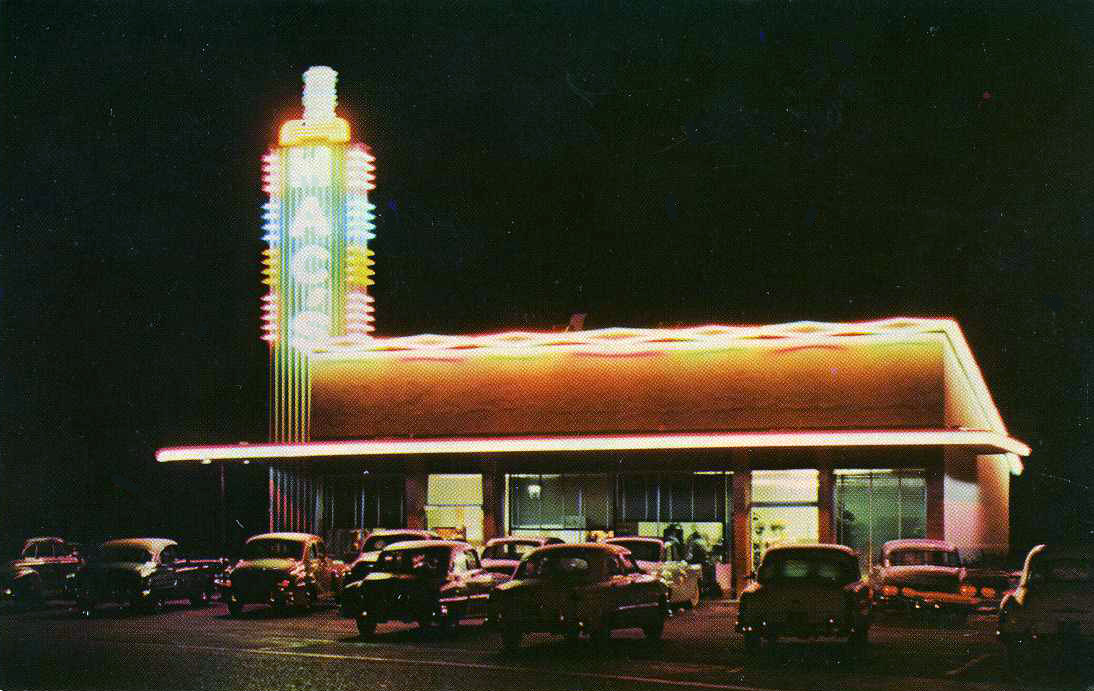
The four gases used initially by neon signs – neon, argon, krypton, xenon – were discovered by English scientists in the 1890s and adapted for use in signs by Frenchman Georges Claude a short time later. Though not the first, an early neon sign was used in Paris in 1913 to advertise Cinzano vermouth. [shown above: Mac’s, Corpus Christi TX]

But it wasn’t until the late 1920s that the signs became popular with restaurants in America. Particularly in the West where car culture was developing, the eye-catching signs helped attract the attention of drivers.

In the early days neon signs in a town’s business district could also be taken as a sign of progressiveness. A 1929 advertisement for an electrical display company in Great Falls MT advised businesses that their adoption of a neon sign would impress people, encourage progress, and “beautify Great Falls.”

Their use became well established in the 1930s. In the 1934 book Curious California Customs, the author commented, “To the casual visitor, Wilshire Boulevard, after dark, is a flashing cavern of Neon signs, most of which are calling attention to eating places.” A later postcard of Hollywood Boulevard at night in the 1950s demonstrates the effect of a street full of neon signs [shown above].

In the late 1920s the signs began moving across the country. Among early adopters were eight Benish Restaurants in St. Louis, four White Way Hamburger outlets in Colorado, the Horn & Hardart Automats in Philadelphia, and four Janssen’s Hofbraus in New York City. Salt Lake City outfitted multiple New York Coney Island Sandwich Shops with the signs.

Bright neon signs and images remained quite popular throughout the country into the 1940s. But if they were meant to make a business stand out from the crowd, that became more and more difficult as the numbers grew.

Neon signs were undoubtedly most effective for roadside restaurants on dark roads that stayed open at night [above: [Bratten’s Grotto, Salt Lake City, 1956]. Or for eating places in somewhat obscure locations that required signs that could be seen from afar. Unfortunately, they didn’t look as impressive during the daylight hours [below: Bratten’s Grotto, daytime].

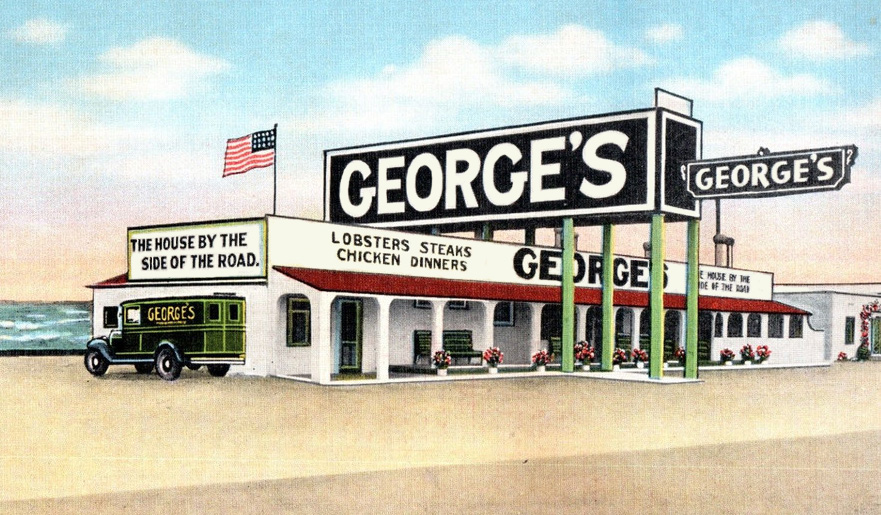
Before neon, efforts to craft signs that could attract distant or speeding traffic were undoubtedly less successful, less visible in the dark. George’s grotesquely large sign shown below, for example, was neither attractive nor sufficiently visible at night. As a slightly later version of this postcard revealed, the restaurant soon found it necessary to add spotlights atop the sign.

Neon wasn’t for every eating place. To critics it lacked artistic pedigree and dignity. Elite restaurants wanted nothing to do with it. It might announce the presence of the Green Frog or the Zig Zag Sandwich Shop, but certainly not New York’s La Chaumiere.

A 1960 book on restaurant decor pronounced neon in bad taste, saying, “Incandescent lighting is more expensive but has a kindlier glow and, thanks to the bad association arising from the tasteless use of neon, is generally considered ‘classier.’” As cities declined with the growth of suburbs, such attitudes toward neon grew more negative.

Nor was neon welcome in classy towns and communities such as Palm Springs, Carmel-by-the-Sea, and Sonoma in California; Santa Fe, New Mexico; the Hamptons on Long Island; and Cohasset, Massachusetts, to name but a few that banned it.

Rejection of neon grew in the 1960s and 1970s. In 1965, food critic and editor Craig Claiborne was uneasy about eating in the one (barely) acceptable restaurant he could find in Roswell NM, which he said had “the air of something once removed from Las Vegas or Miami Beach with its neon-silhouetted champagne glass and flashing neon bubbles.” His unease increased upon stepping inside and seeing a lighted goldfish tank, male customers not wearing coats, and bartenders with “narrow, abbreviated ties.”

Antipathy to neon in the 1970s, as before, was associated with urban decay and seedy neighborhoods characterized by run-down buildings and businesses such as bars and strip clubs. More cities and towns banned it.

Soon there were few “tube benders” left who could create or repair neon signs, which were increasingly being replaced with lighted plastic signs that were easier and cheaper to make and less prone to damage outdoors. Yesterday’s real neon signs that had survived soon showed up as quaint wall decor in warehouse-style theme restaurants.

A few commentators, such as a reporter for the Fort Wayne News-Sentinel, began to wonder about the return of neon. She speculated in 1975 that “that much-maligned symbol of everything that’s bad about American commercial districts” might “someday be recognized as art.”

Sure enough, in 1976 the Smithsonian put on an exhibit that included neon signs, among them examples from a Kosher restaurant, a foot-long hotdog place in Cleveland, and from a Spanish-American restaurant in Greenwich Village, a many-colored creation that combined a lobster, pig, fish, chicken, crab, and a steaming coffee cup.

Nowadays, vaguely quaint-looking plastic “neon” signs might show up as interior wall decor in the sort of restaurants that want to suggest they are fun places.

© Jan Whitaker, 2024

12 Comments

Filed under restaurant issues, roadside restaurants

Nan’s Kitchens

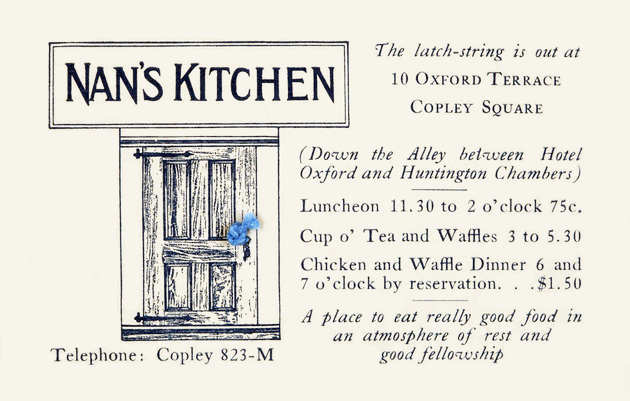
In 1919 two women opened a small tea room in Boston with just four tables. It was something of a lark. They had virtually no money to outfit it so they bought used furnishings. The location was a candlelit basement on Oxford Terrace in Boston, a romantic name for what would generally be known as an alley.

Anyone reading about their opening might have predicted they would fail spectacularly – especially after noting their rather boastful claims: “Such a place as we are about to open to the public is rare in New England. We are just trying out an idea and are seeking an answer to it by actual experiment rather than to obtain profits. If this is a success we will open others in large cities of the country.”

Despite being in an unpretentious building in a lowly area it turned out to be a very favorable location, in walking distance of the central Boston Public Library and Copley Square with all its hotels and nearby shops.

They named it Nan’s Kitchen after Nan Gurney, one of the founders. The two had met while in the Navy during World War I. Before that Nan had been married, but left her husband behind to join the service. Claiming desertion, he divorced her. Nan’s partner Thellma McClellan had worked as an astrologer before joining the Navy. Both enjoyed performing and were involved with vaudeville and amateur theatrics.

Nan’s Kitchen was an instant success, popular with members of the Professional Women’s Club to which they belonged. It also attracted fellow vaudeville performers. Publicity helped, particularly newspaper stories that made the tea room sound like a haven for romantic trysts at lunch and afternoon tea. They added more tables, but continued to specialize in one dish, chicken and waffles.

They must not have made much in the way of profits initially because they continued their side jobs as freelance teachers of music and elocution for several years. They were generous with the servers (who wore smocks, Oriental pantaloons, and artists’ caps), giving them a share of profits and paying them over the summer when the tea room closed.

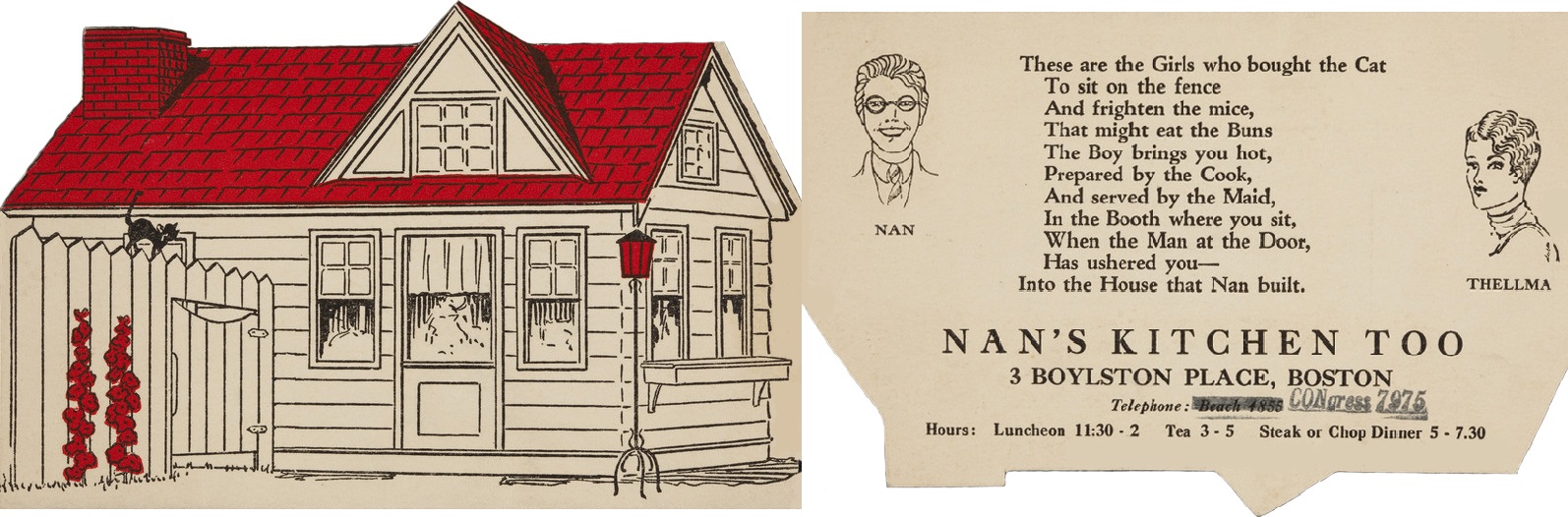
In 1925 the pair seemed to become more serious about the restaurant business, opening a second tea room called Nan’s Kitchen Too at 3 Boylston Place. The next year the original Nan’s remained open all summer for the first time. The following year it was remodeled to resemble an outdoor garden containing a small cabin where a Black woman prepared the waffles, an arrangement also in use at the Boylston Place Nan’s. (Shades of Georgia’s Aunt Fanny’s Cabin? I would hope that Nan’s Black cooks were not costumed as Mammys!)

Although Nan and Thellma lived together in the 1920s, in 1930 they no longer did. In 1931 Nan went to New York where she worked as steward in an “exclusive Manhattan club,” according to an advertisement for Birds-Eye frozen foods. From 1934 to 1936 she ran Nan Gurney’s Inn, in her home town of Patchogue, Long Island, where she had grown up as Lettie L. Smith. After that, in 1937, she opened Nan Gurney’s Restaurant on Northern Blvd. in Flushing NY, specializing in “Long Island food.” [Flushing restaurant shown below later when it was Villa Bianca]

In 1932 Thellma, who had managed Nan’s Kitchen Too, was living in Connecticut. A version of Nan’s moved to the Motor Mart Building on Park Square and remained in business until 1935, but whether Thellma or Nan had any connection with it then is unknown.

© Jan Whitaker, 2021

5 Comments

Filed under alternative restaurants, atmosphere, Offbeat places, proprietors & careers, tea shops, women

The golden age of sandwiches

In their restaurant career sandwiches came from humble beginnings. They could sometimes be found in eating places as far back as the early 1800s, such as at the Ring of Bells, a porter and oyster house in New York. But they became more popular when they teamed up with beer joints after the Civil War. They also flourished in Boston’s “sandwich depots” of the 1880s — bean sandwiches included. And they were among the edibles offered by lunch wagons, saloons, and stand-up buffets in the late 19th century.

But it was the trend toward lighter mid-day meals in the early decades of the 20th century, spurred by the growth of cities, that gave sandwiches their big boost. Then, as light meals replaced hot dinners at noon, they found their niche, furnishing a quickly prepared menu item available in a variety of styles and combinations. Sandwiches of all kinds – named after celebrities, toasted, clubs, St. Paul’s — continued to flourish until after WWII when hamburgers began to take center stage.

While some eating places stuck with hot meals at noon in the early 20th century, others were quick to embrace sandwiches, particularly lunch rooms, tea rooms, drug stores, and delis. The sandwich shop was declared the winner among fast food restaurants. To critics the proliferation of this slapped-together fare was a sign of cultural decline. “The postwar decade might be known as the era of the sandwich,” declared cultural observer Eunice Fuller Barnard in a New York Times article of 1929 with the mournful headline, “We Eat Still, But No Longer Do We Dine.”

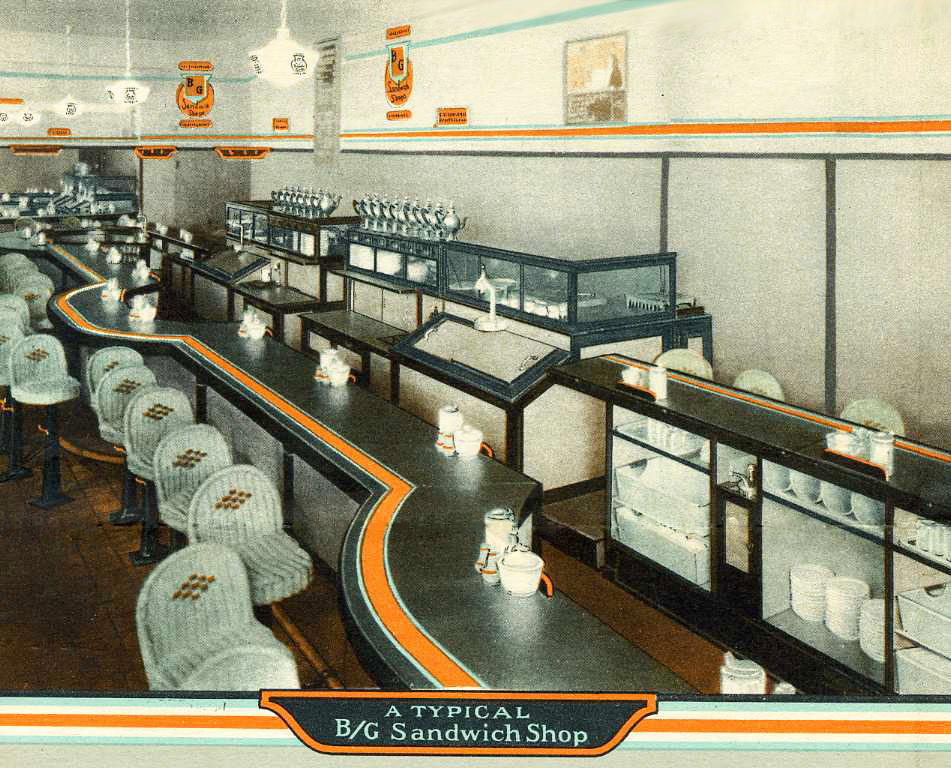
Among new developments was the formation of sandwich chains such as the Tasty Toasty and the Hasty Tasty. The B/G System was one of many in that category, which also included R&C, C&L, S&S, and no doubt other alphabetical combos across the USA. In 1924, the “Purely American, Meal in a Minute, No Tipping” B/G chain claimed to pay wages allowing their workers to “live according to American standards.” It had outlets in 16 large cities and was about to spread further. Was St. Louis the champion host of sandwich shops? Included among the city’s 52 sandwich shops in 1938, there were at least 6 “sandwich systems,” the Continental, Hollywood, Nickel Plate, Night Hawk, Ure-Way, and Yankee.

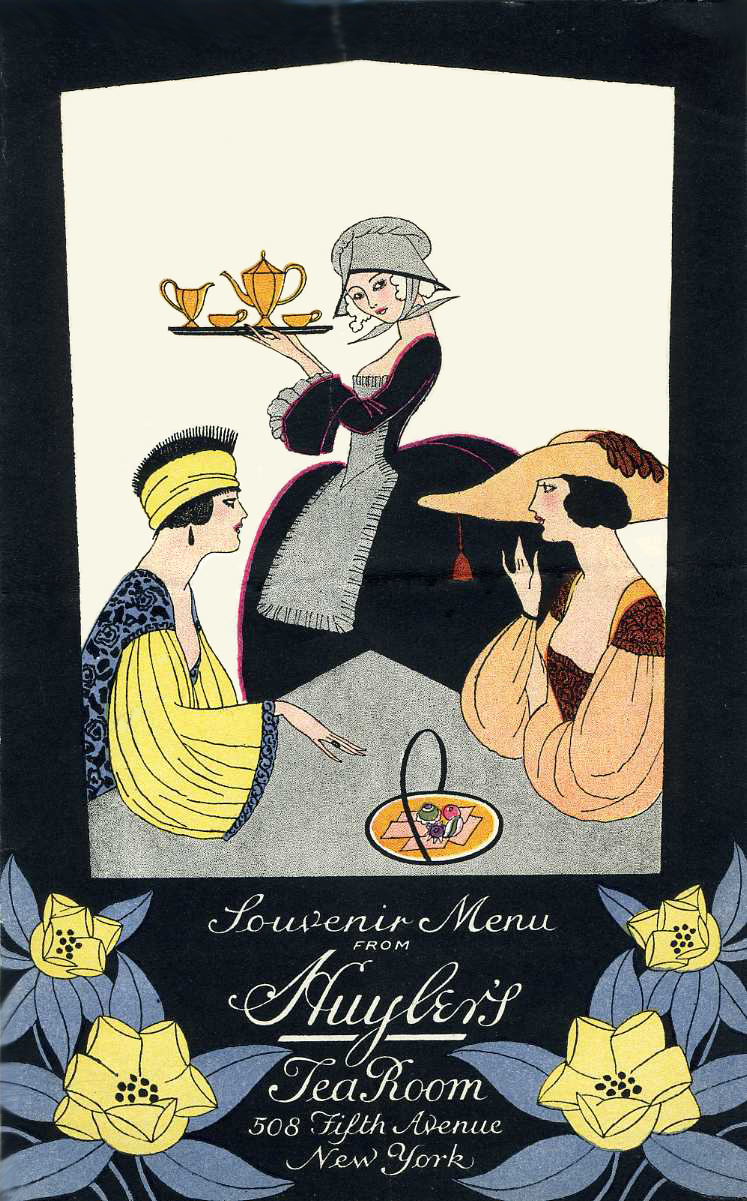
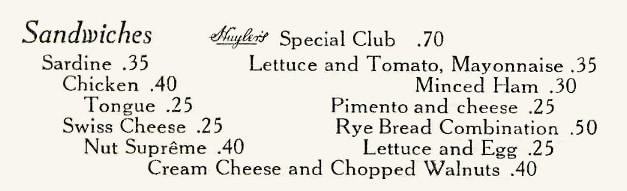
The sandwich selections on the menu shown here are from the Huyler’s confectionery-based chain. Tongue and Cream Cheese sandwiches, rarely (ever?) seen today, were quite popular in those early years (1921 menu above).

Polly’s Cheerio Tea Room’s Ham and Jam on French Toast would seem to be unusual, though perhaps Los Angelenos would have disagreed (1932 menu above).

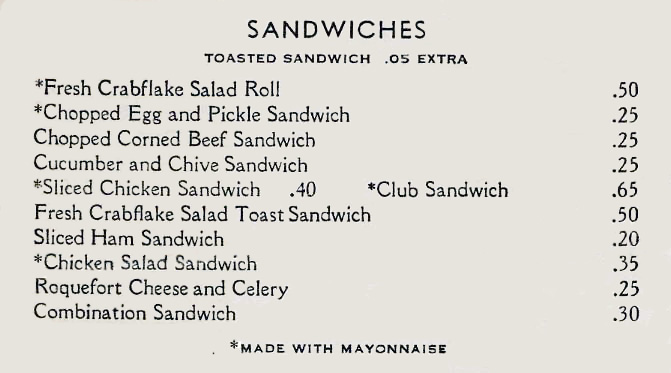
I can’t account for why Schrafft’s in New York City felt the need to indicate which sandwiches were made with mayonnaise (1938 menu above). I’ve found one other tea room, located in St. Joseph MO, that included the same annotations.

Among the other interesting sandwich combinations I’ve found are Cucumber & Radish (25c at The Cortile in NYC in 1928); Egg and Green Pepper with Mayonnaise on Whole Wheat Gluten Bread (25c at Schrafft’s in 1929); “Chef’s Pride,” Smoked Tongue, Sliced Chicken, and Deviled Eggs double decker (50c at Townsends, San Francisco in1933); Peanut Salad (10c at The Candy Box in Winona MN in 1935); Peanut Butter, Sliced Tomato, Bacon, and Lettuce triple decker on toast (25c at The Little White House in NYC in 1936); and Marshmallow and Peanut Butter (15c at The Bookshop Tearoom in Springfield MA in 1946).

I prefer my BLTs without peanut butter. Hold the marshmallows, please.

© Jan Whitaker, 2021

17 Comments

Filed under food, menus, restaurant customs, tea shops

Black Tulsa’s restaurants

(This post is a footnote to Robin Caldwell’s fine essay on Black grocers in the Greenwood community – my attempt to give some sense of the community by sketching a little about the area’s many restaurants.)

Before the Greenwood district’s destruction in 1921 – evaluated at $536M in property damage in today’s dollars — the area had become home to a prosperous Black business district filled with brick buildings, many of them housing eating places. Its leading citizens had done very well and a Black newspaper, the Tulsa Star, had begun publishing in 1913, with its office located near the heart of the business district at N. Greenwood and E. Archer avenues.

Nonetheless, like all of Tulsa, the area had its share of problems, no doubt due in large part to its rapid growth and the city’s attractiveness to transients and people on the make in both a good and a bad sense. Though generally striking a positive note, The Star complained of inadequate city services reflected in a failure of police to shut down gambling, prostitution, and bootlegging, and the lack of sewers in some parts of the community. Shortly before the massacre area residents petitioned the city, urging annexation of that part of the Black community outside the city limits and lacking modern improvements such as water, street lights, railroad crossings, fire stations, sidewalks, and paved streets. [Shown above: ca. 1915 photo of flooding in the 300 block of N. Frankfort street; Russell & Co. was a black-owned business.]

One of the most successful Black restaurant proprietors was Texas-born Joe Lockard who moved to Tulsa from his farm in Muskogee Indian Territory (Oklahoma). In 1914 he opened The People’s Café near Tulsa’s Frisco train depot. In 1920 he became president of the board of directors of a newly created investment company. That same year a white customer got into an argument with Lockard’s cook, shooting and killing the cook in the cafe’s dining room. Lockard’s café was destroyed by white rioters in 1921, but he continued in the café business into the 1930s, possibly later.

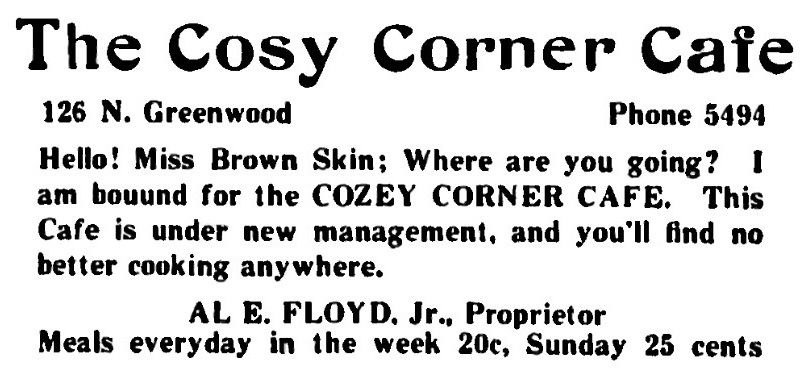
In contrast to Lockard, another Texan, Al Floyd, operator of the Cosy Corner [shown at top, 1915 advertisement from The Tulsa Star], was in business for at most a few years before relocating to Oklahoma City where he managed a railroad café.

The Busy Bee Café was run by Texas-born Savannah Elliott, also known as ‘Mother Elliott” despite only being in her 30s. In 1918 the newspaper mentioned that she entertained groups, such as teachers, and birthday dinners with as many as 17 guests. She sold the 112 N. Greenwood location at the end of that year, and moved to a new place that she operated briefly before again moving to Kansas City MO. In KC she and her husband ran a café called the Blue Goose. [1917 advertisement]

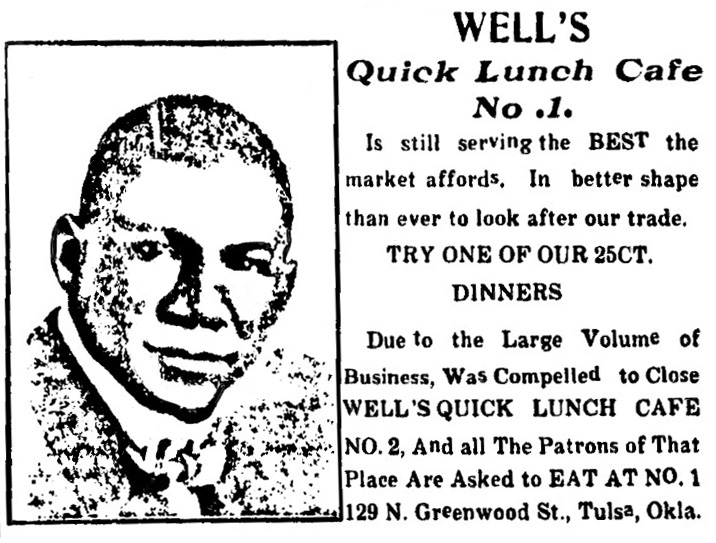
L. W. Wells ran a café in Okmulgee OK in 1914. The following year he moved to Tulsa, working in a white-owned restaurant called the Ever Eat Café. By 1918 he was running two quick-lunch cafes of his own in the Greenwood area where he provided “classy lunches” according to advertisements. It was wartime and business was booming, possibly because soldiers were passing through on the railroad. As the above advertisement indicates he was unable to keep his second location open because of the business crunch which probably meant increased patronage and a simultaneous shortage of help. In 1918 he had a dangerous brush with a drunken customer, engaging in a fist fight with him and pulling a gun. Like Lockard, he owned a farm in Oklahoma and was considered well off. The Star paper noted that for Christmas 1918 he presented his wife and daughter with a piano costing $475. His restaurant on Greenwood Avenue was destroyed in the 1921 attacks. [1918 advertisement]

Most of the cafes in the Greenwood district were basic, pricing meals reasonably, often charging 25 cents for a plated hot dinner. Many were open day and night. Their advertising stressed cleanliness. Most went by their owners’ names but there were also plenty of colorful names such as Busy Bee, Cosy Corner, Crystal, Ideal, Liberty, Little Pullman, Lone Star, Minute, Olympia, Palace, People’s, Red Rose, Square Deal, Star, and Sunny Side. (Because Tulsa was a Jim Crow city, it’s easy to identify which were Black restaurants – they were marked (c) in the city’s business directories.)

The greatest number of restaurants over the years 1913 through 1920 were on North Greenwood avenue. It intersected with East Archer to form the heart of the area’s business district, as well as bearing the brunt of destruction in 1921. East Archer had the second largest number of restaurants. I counted about 30 on North Greenwood during the 8-year period and 15 on East Archer, with another couple dozen on other streets.

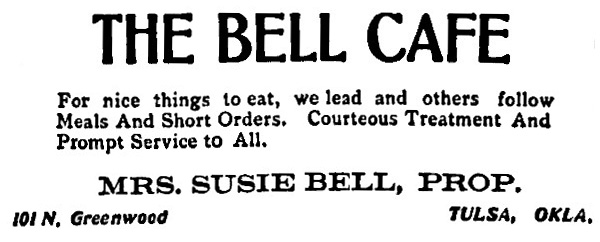
Overall, the cafes went through a great deal of turnover and geographical churn – as was common throughout the US. They changed hands or moved to new addresses with some frequency. For example, Susie Bell’s cafe suffered fire damage when the Waffle House next door caught on fire in 1920. Although she had already moved several times, she was not defeated. She went out scouting for a new location early the next morning, confident she would be back in business by evening. In all likelihood she had “regulars” who counted on her to provide their daily meals. Her cafe was destroyed in the massacre. [1913 advertisement]

I had hoped to get an idea of what foods restaurants served, but that turned out to be difficult. Many advertised “home cooking” but almost never mentioned specific dishes. Usually when applied to basic cafes, home cooking referred to plain meat-and-potatoes dinners of the sort preferred by people who relied on restaurants for most of their meals. It’s likely that a fair number of residents of the Greenwood area lived in rooming houses and residential hotels with no cooking facilities. According to the 1920 federal census, about a tenth of Tulsa’s Black population were lodgers.

Though advertising did not offer much idea of what was served in the cafés, two foods were mentioned fairly frequently: Barbecue and Chili. Aside from the Black population born in Oklahoma, the next largest percentage were transplants from Texas, so it isn’t at all surprising that these two foods would be staples. There was also frequent mention of confectionery, pies, and cakes.

The one and only menu I discovered was for a 1918 Christmas dinner, billed as home cooking, at the Sunny Side Café. An advertisement also referred to it as a “Conservation” dinner, reflecting wartime rationing. In addition to a “Christmas Oyster Loaf,” the dinner included: Baked Turkey with Roquefort Dressing; Baked Chicken with Corn Dressing; Roast Goose with Sage Dressing; Smothered Duck with Brown Gravy; Cream Potatoes; Cream Peas; Griddle Corn; Macaroni; Stuffed Tomatoes; Stewed Prunes; String Beans; Cream Cabbage; Cranberry Sauce; Cherry Cobbler and Whip Cream; and the following pies: Pumpkin, Potato Custard, Mince Meat, Lemon Custard, Apple, and Cocoanut Custard.

Despite the enormity of the disaster in which possibly more than 300 Black lives were lost and there was extensive property destruction, survivors went to work almost immediately. Cafes that had been turned into rubble were rebuilt and reopened, and new locations were found. The area rebounded.

© Jan Whitaker, 2021

12 Comments

Filed under food, proprietors & careers, racism, women

Good eaters: Josephine Hull

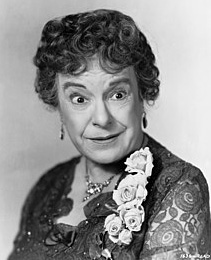
A while back I reviewed several years of a diary kept by New York City resident Josephine Sherwood Hull. Over a five-year period, 1920 until 1925, she recorded about 320 restaurant meals. This works out to a little more than one a week, which was considerable at that time. [publicity photo, ca. 1950, from movie Harvey]

I suspect her attraction to restaurants was largely explained by the fact that she was in the theater. After years of research into the history of restaurants, I’ve noticed that opera singers and theater people lived more of their lives in public than did the average American, and that included eating in restaurants frequently. Also, the 1920s was the decade that saw the number of women eating outside the home increase dramatically.

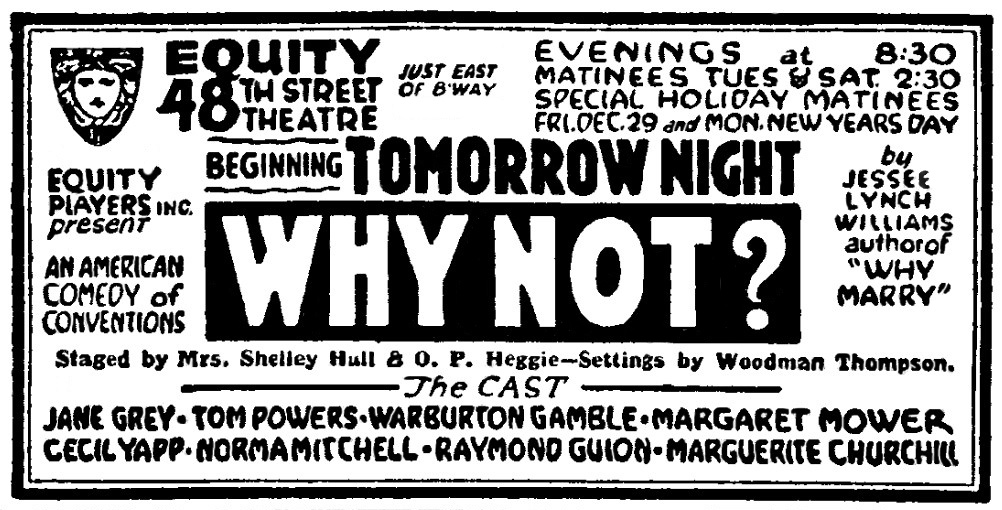
Then unmarried, Josephine Sherwood began her theater career not long after her 1899 graduation from Radcliffe College, where she had participated in amateur theatrics. In 1909 she married actor Shelley Hull and retired from legitimate theater. But after he died in 1919 – a sudden victim of the “Spanish” flu raging through the U.S. – she resumed her theater career as an actor and a director.

In 1922, 1923, and 1924 alone she directed four or more plays, and appeared in at least two others. Later she would appear in movies, often playing an older woman, frequently an aunt. She appeared in Arsenic and Old Lace, and in Harvey for which she won an Oscar in 1951 for a supporting role.

In the years of her diary that I looked at, Prohibition was in effect, and that along with greater employment of urban women during and after the war led to the flourishing of tea rooms, a type of restaurant that she favored. She went to the White Swan for dinner 24 times over the five-year period, the English Tea Room 20 times, mainly for lunch, and the Yellow Aster near her apartment on West 57th Street 12 times, again mainly for lunch. Other tea rooms she liked included the Virginia, the Thistle, the Hawaiian, and the Mirror. But despite her liking for tea rooms she rarely had afternoon tea, and when she did it was usually at hotels rather than independent tea rooms.

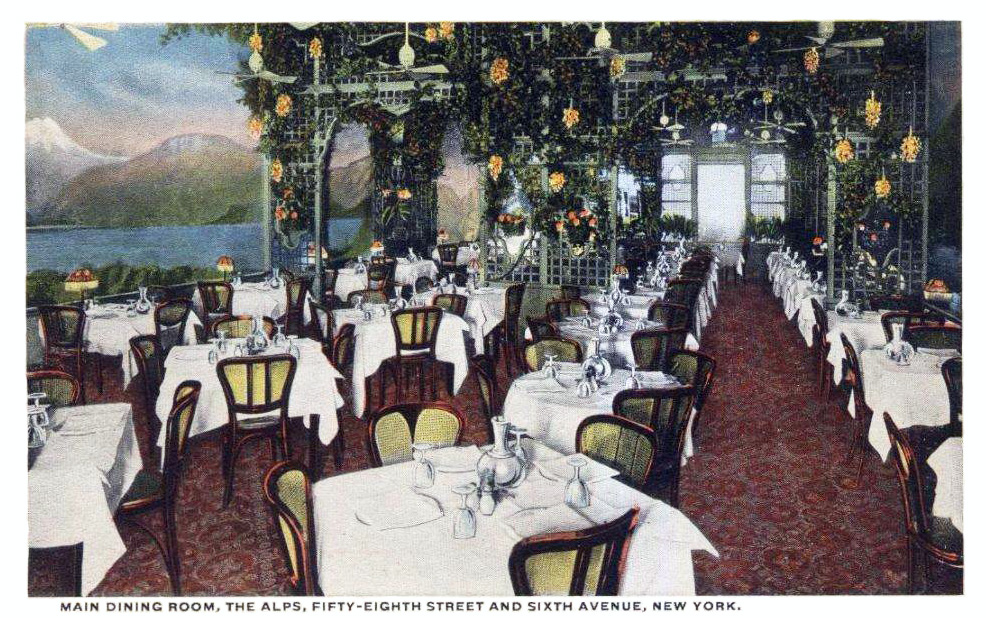
By far her most frequent meal out was dinner. She recorded eating it in restaurants 219 times. Her favorite dinner spot was a popular restaurant on 6th Avenue established in 1907 called The Alps. She also enjoyed The Hotel McAlpin, visiting their rooftop restaurant six times in warm weather. Henri’s was another favorite, as was The Tavern.

She had “supper” in restaurants 13 times, mostly in hotels. As a late night meal, supper was a favorite of theater people and others in the entertainment world. She visited a number of clubs, some of them related to theater, others emphasizing civic volunteerism.

Judging from the restaurants she patronized, except for tea rooms, she preferred places that might be described as continental, either Italian or French. For whatever reasons – perhaps reflecting her rather conservative middle-class background — there were some popular restaurants and areas of the city that she did not patronize in these years. The Automat was one. Nor did she record a single visit to a Chinese restaurant. She apparently was not attracted to Greenwich Village, a part of the city filled with tea rooms.

© Jan Whitaker, 2020

5 Comments

Filed under patrons, Polynesian restaurants, tea shops, women

Chinese for Christmas

Readers may be familiar with the custom among many Jews of going to a Chinese restaurant on Christmas Day. Hard as I tried I could not determine when this custom began, although based on advertisements I did get the sense that the tradition of going to the movies on Christmas Day may have begun in the 1920s.

That is the same decade for which I found the earliest advertisements by Chinese restaurants in Jewish newspapers. [Wong Yie, American Israelite, 1922, Cincinnati] I didn’t find any Chinese restaurant ads that invited readers to visit on Christmas Day, though I saw some that reminded them to make reservations for New Year’s Eve. Some also mentioned that they were near movie theaters. In the 1930s some wished readers of Jewish papers happy new year at Rosh Hashanah.

So, even though I don’t know when Jews began going to Chinese restaurants on Christmas Day, I suspect that the affinity between Jews and Chinese restaurants became notable in the 1920s.

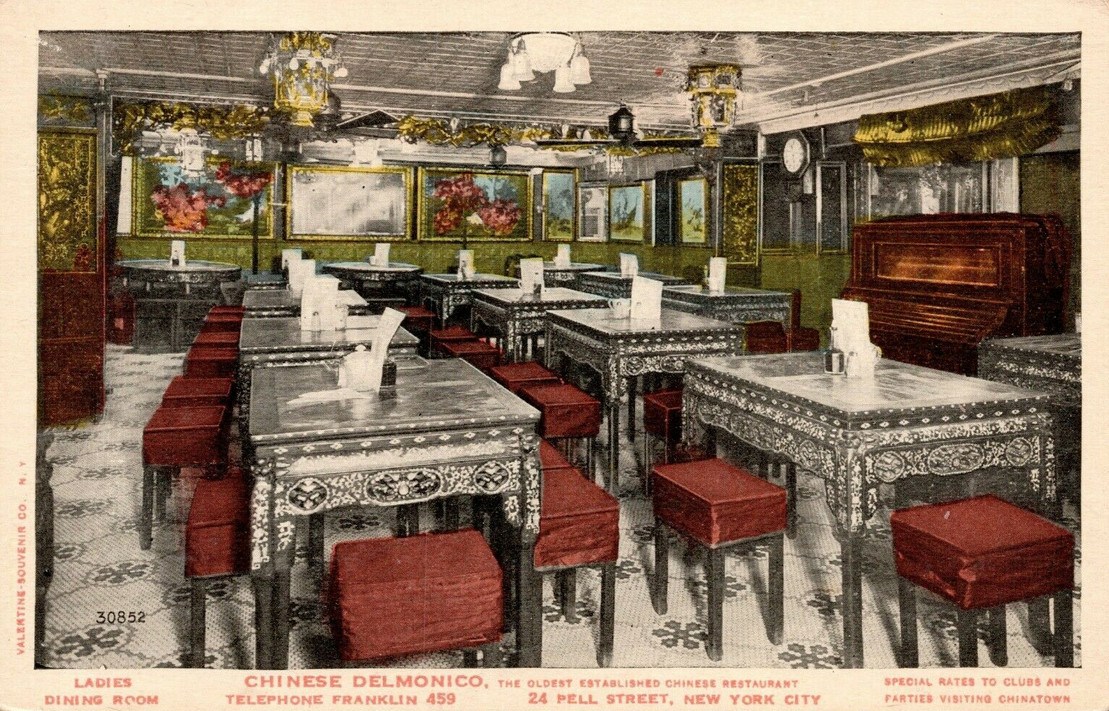
While the 1920s may have marked the blossoming of Jewish patronage of Chinese restaurants, I did find one earlier example of a Chinese restaurant said to be patronized by Jewish businessmen. According to a New York Tribune story of 1907, Chinese Delmonico’s on Pell Street near the wholesale center was kosher. At “Kosher Delmonico’s,” as it was called in the story, a French chef prepared mushroom delicacies, lotus lily seed soups, and other dishes for lunch using no dairy products or “game of the kind that is shot.”

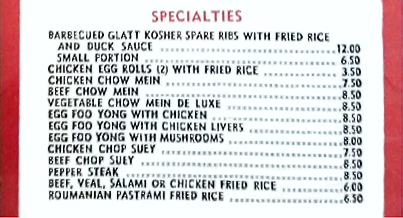
Bernstein-on-Essex, a deli that opened in the 1920s on New York’s lower East Side, is often credited with being the first restaurant serving kosher Chinese food – a 1959 addition to the menu [above menu fragment from a later date]. But it may not have actually been the first: Aside from Chinese Delmonico’s, there was said to be a kosher Chinese restaurant on Temple Street in the Jewish section of Los Angeles in 1929.

What Bernstein’s might have been an early example of, though, was a Jewish restaurant that served kosher Chinese food – in contrast to a Chinese restaurant that was kosher, which was rarer. Although Chinese restaurants generally did not feature dairy dishes, typically they would serve pork, as well as shellfish, meat that wasn’t from kosher butchers, and noodles cooked in lard.

For the most part Jews had to be willing to make whatever adjustments they found necessary in order to enjoy Chinese restaurants. This could mean not ordering pork, shrimp, or lobster dishes, or, as many writers have pointed out, accepting dishes with pork that had been minced and “hidden” in wontons. Nonetheless, not everyone was so careful. According to Haiming Leu, author of A History of Chinese Food in the United States, one of the most popular dishes with American Jews was moo shu pork. Such behavior brought an angry comment from a rabbi writing in Newark’s Jewish Chronicle in 1929: “The writer has seen families leaving an orthodox synagogue on Sabbath noon and taking the new Bar Mitzvah, who has just pledged his allegiances to Jewish tradition, into a Chinese restaurant for a salt-pork chop suey meal.”

While the topic of Jews and Chinese restaurants has been a popular one with scholars and journalists, it’s worth noting that historically Jews were not the only non-Chinese cultural group that heavily patronized Chinese restaurants. Even though in the early 1930s Jews were estimated to make up 60% of the white clientele of Chinese restaurants in Philadelphia and New York, the estimate was that white customers totaled a minority of patrons. The rest of non-Chinese customers were Black.

After WWII Jews began moving from the inner cities and into the suburbs. Meanwhile, most African-Americans stayed behind. Many Chinese proprietors courted their Jewish customers, often opening suburban restaurants with pleasant interiors. In Black neighborhoods often the facilities tended to be poorer, many for carry-out only, and some even outfitted with protective bars and orders taken and delivered through small hatches.

Another change in the postwar years was the increase in the number of kosher Chinese restaurants, some, such as Sabra and the popular Moshe Peking, with Jewish owners. The 1970s and 1980s saw a rise of kosher Chinese restaurants adhering to what appeared to be a stricter standard in how food was obtained and prepared and also in hours of operation, being closed on the Jewish Sabbath as well as holidays. Additionally, they had a rabbi on hand to inspect food preparation.

Happy Holidays to readers, whatever you may be eating on December 25!

© Jan Whitaker, 2019

12 Comments

Filed under alternative restaurants, food, kosher, patrons, restaurant customs

Find of the day: the Double R Coffee House

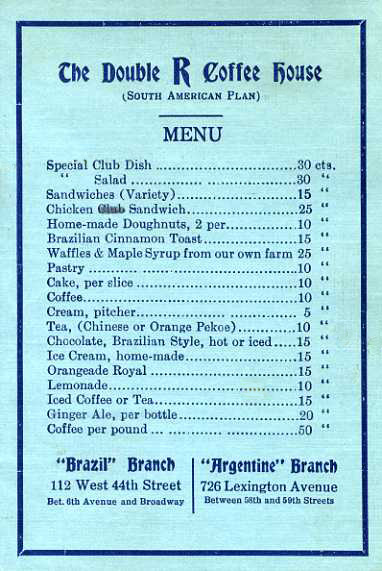
It gets harder and harder to turn up anything interesting at flea markets – even on the sprawling fields of Brimfield. But luck was with me this past week when I found the little menu from The Double R Coffee House.

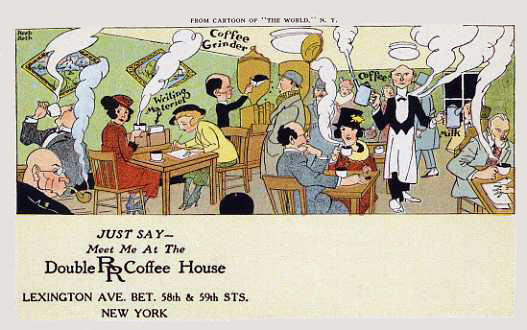
It didn’t look terribly interesting in itself until I remembered that my restaurant collection contained a cartoon-style postcard with the same name that I especially liked.

Turns out that the two Double R Coffee Houses had an interesting history. They were established and funded by sons, daughters, cousins, and others related by blood or marriage to Theodore Roosevelt. The impetus for the coffee houses came from Theodore’s son Kermit, who had spent time in South America and Arab countries. He mentions coffee repeatedly in his book War in the Garden of Eden. The book describes his experiences while serving with the British forces in Iraq and other countries involved in the Mesopotamian Campaign of World War I.

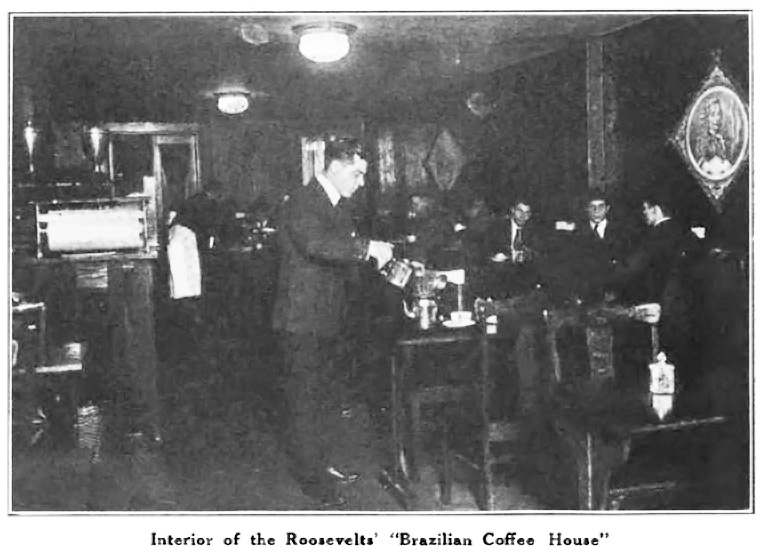
The initial business incorporation in 1919 was called Café Paulista after a café in Buenos Aires that Kermit had frequented years before. The corporation launched the first coffee house, then located at 108 West 44th Street, calling it The Brazilian Coffee House as inscribed above the door in this 1919 photo.

The coffee house got a fair amount of press due to the Roosevelt connection, but the family did not involve themselves in running it, nor were they known to frequent it. However, in one instance President Roosevelt’s widow did visit the 44th street location. A widely publicized news story in 1923 told of how she had saved two oil paintings of her late husband when a minor fire broke out in the kitchen.

What was truly unusual about the coffee house was not so much its owners or its decor, but how serious it was about coffee. The manager, Brazilian Alfredo Salazar [shown above], declared it was not a restaurant. Although it served light food including empenadas, he insisted the focus was on serving “real” coffee. He declared that Americans, New Yorkers included, did not know how to roast, grind, brew, or for that matter, drink coffee. Coffee that was boiled or percolated and left to sit around for over 30 minutes was equivalent to “tannic acid soup” in his estimation. He advised drinking it black, but allowed that the coffee house would provide cream, milk, and sugar since it was not a “propaganda establishment.”

The coffee house roasted coffee beans on the site and everyone commented on the wonderful aroma this produced.

Shortly after opening, the 44th Street coffee house moved to larger quarters nearby at #112. It was popular from the start, particularly with Brazilians, American business men – and business women — as well as surrounding theater-district performers.

Another characteristic of the coffee house that was appreciated was that patrons could linger as long as they liked, even if they ordered very little. Imprinted stationery was provided along with some reading materials – including an abridged version of the U.S. Constitution — and the place soon extended its hours to 1 a.m.

In February of 1921 the name was changed to Double R Coffee House due to a conflict with another business claiming that name and also because a cousin named Robinson was the corporation’s new president. In May a second coffee house on Lexington was opened with an exhibit of paintings by members of the Art Students League curated by realist painter John Sloan. Because of the art connection, it seems as though this coffee house had a more bohemian aspect. In a letter to Chicago poet and editor of Poetry Magazine Harriet Monroe, poet Wallace Stevens wrote that he had visited the new coffee house in August and “had a dash of maté.”

In 1923 there was talk of opening another Double R on 45th street in Times Square, but I could find no trace of it. Vague ideas about expanding to Boston, Philadelphia, and Chicago, talked about in 1919, never materialized and in 1928 one or both of the coffee houses were sold to new owners. What happened after that is unknown.

© Jan Whitaker, 2018

10 Comments

Filed under alternative restaurants, menus, Offbeat places, proprietors & careers

Famous in its day: the Blue Parrot Tea Room

blueparrot1920sjpg“Hoity toity” was how a resident of Gettysburg PA in the 1980s remembered The Blue Parrot Tea Room in its heyday.

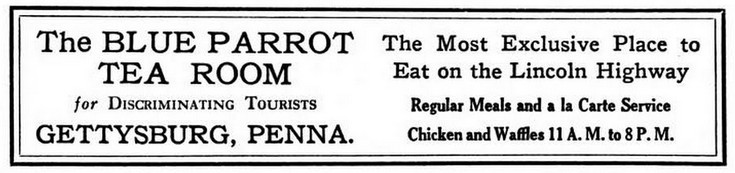
The tea room opened in 1920 on the Lincoln Highway (aka Chambersburg street) through Gettysburg [pictured above, before 1928]. Known initially as the Blue Parrot Tea Garden (rendered on its large lighted sign in pseudo-“Oriental” lettering), it was a soda fountain, candy store, and lunch spot at first. It quickly earned a reputation as an eating place for “discriminating” diners, according to its advertisement in the 1922 Automobile Blue Book [shown below]. Later advertising described the restaurant as modern, sanitary, and perfect for people who ran an “efficient table” at home.

blueparrotautobluebook1922

Its creator was Charles T. Ziegler, who spent years on the road as a salesman for a Chicago firm, returning to his hometown to open a gift shop in 1916 with the then-trendy name of Gifts Unusual. His shop featured imported articles such as Japanese household items and kimonos. In 1917 he bought the building his shop was in, turning it into a tea room a few years later.

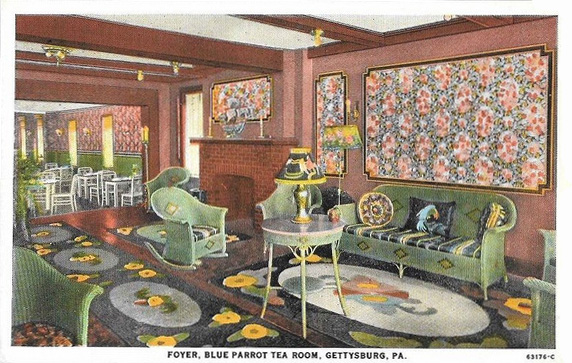
blueparrotfoyer

blueparrotdiningroom

The tea room’s artistic decor, elements of which had reportedly come from England and Belgium, was of great interest to Gettysburgers. The sign on the front of the building was illuminated with 275 small lights (this was before neon). Thirty feet in length and topped with a blue parrot, the Gettysburg Times declared it “one of the most pretentious between Philadelphia and Pittsburgh.”

In 1927 a visitor noted fine aspects of the Blue Parrot that he observed, many vouched for by their brand names, such as Shenango China and Community Silver. He was pleased to note that the kitchen was shiny and spotless and even the potato peeler was “cleaned to perfection.” He was also gratified by the back yard area where “every fowl is killed, cleaned and dressed by the kitchen staff.”

blueparrotadvjuly1921The Blue Parrot remained the place to go for decades. Local colleges held dinners there, as did fraternal organizations and women’s clubs. Guests included bishops, Washington dignitaries, Harrisburg business men, and traveling celebrities. A high point came in 1926 when Douglas Fairbanks, Mary Pickford, and Gloria Swanson and her husband, the Marquis de la Falause, stopped for dinner on a chauffeured road trip following the New York funeral of Rudolph Valentino.

The Blue Parrot could be counted on to furnish special holiday meals for Thanksgiving, New Year’s Day, and Easter. In 1924 it published the following menu for Thanksgiving Dinner, served from 11 am to 9 pm.

Grape Fruit
Oyster Cocktail
Bisque of Tomato
Celery              Olives
Salted Nuts
Roast Vermont Turkey English Filling
Giblet Gravy            Cranberry Jelly
Orange Sherbert [sic]
Mashed Potatoes             Green Spinach au Egg
Waldorf Salad
Hot Mince Pie                            Lemon Meringue
Pineapple Parfait                   Chocolate Ice Cream
Mixed Fruit Ice Cream
Mints
Café Noir

Dinners at the Blue Parrot in the 1920s ran from $1.25 to $1.50, while lunches were often 75 cents. The tea room advertised its prices as moderate, yet probably they would have been out of reach for many of Gettysburg’s working class residents. In the 1930s Depression the Blue Parrot, like so many other restaurants, was forced to lower its prices considerably. In the mid-1930s it offered lunch platters at 30 cents and New Year’s and Thanksgiving dinners for as little as 50 cents.

No doubt the end of Prohibition was a life saver for the Blue Parrot. As soon as beer became legal in 1933, Ziegler opened a Blue Parrot Tap Room and Grill on the second floor, with extended hours, Pabst Blue Ribbon on tap, and 10-cent crab cakes and sandwiches. He was at the head of the line for a full liquor license when they became available a few months later. The bar and grill had a western slant with rustic log cabin decor, knotty pine paneling, and a wagon wheel light fixture, all likely meant to appeal to a wide range of male customers.

blueparrotnowIn 1944 Ziegler sold the business to Gettysburg’s fire chief, James Aumen, who ran it for the next ten years, after which it had a succession of owners. Even in recent times, the original name has continued as the Blue Parrot Bistro, and now the Parrot.

© Jan Whitaker, 2016

4 Comments

Filed under food, menus, proprietors & careers, restaurant decor, signs, tea shops