Odd restaurant buildings: Big Tree Inn

bigtreeinn

Was there ever a building or structure so strange, so awkward, so ugly that no one yearned to turn it into a restaurant?

Chicken coop, stable, giant tree stump. Why not? Especially if it was likely to catch the eye of speeding motorists and get them to stop out of sheer curiosity if nothing else.

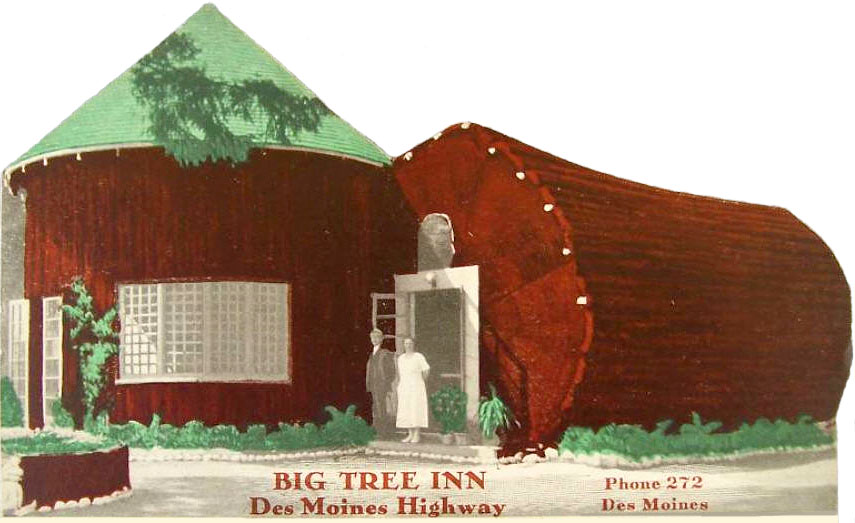
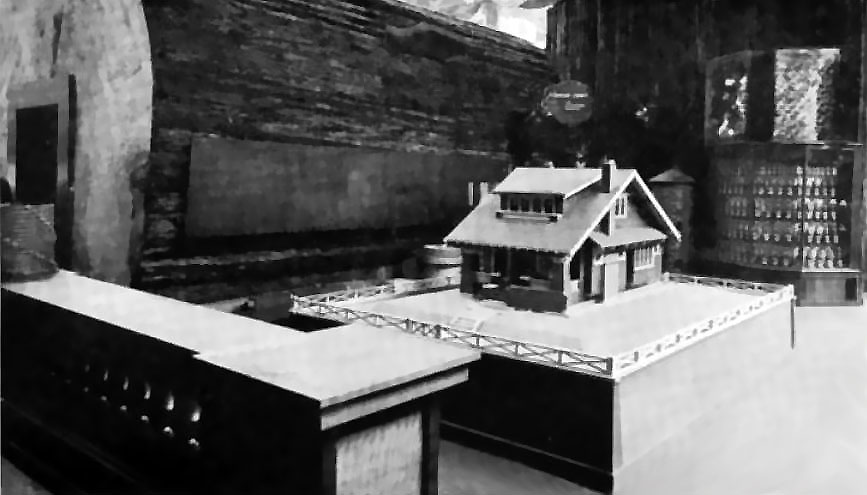
BigTreeInnHumboldtCountyexhibit1915That’s not to say that the Big Tree Inn, for instance, had nothing to recommend it but its oddness, but it certainly had plenty of that. Built from two sections of a redwood log it was designed to exhibit Humboldt County CA’s wood products at the 1915 Panama-Pacific International Exposition.

The stump house, 20 ft in diameter, plus its associated log structure, was contrived by the Rodney Burns Redwood Novelty Co. and shipped by rail in sections to San Francisco where it was reassembled.

Following the exposition, a realtor in Washington state bought the log structure, transporting it to Des Moines WA at great cost. Then he added a kitchen and dining room. The odd building quickly proved a great attraction to gawkers.

The realtor’s intentions in buying the two-part building are unclear – if he had hoped to make money from the redwood structure he was evidently disappointed. For several years the property languished among the real estate listings even though it was described as “very desirable for a chicken dinner place.”

Finally, in 1923 a couple from Seattle, middle-aged and recently married Andrew and Katherine Swanson, bought the Big Tree Inn. Andrew was a bookbinder, an occupation with no seeming suitability for operating a restaurant. Katherine, however, had worked as a cook.

BigTreeInnca1930

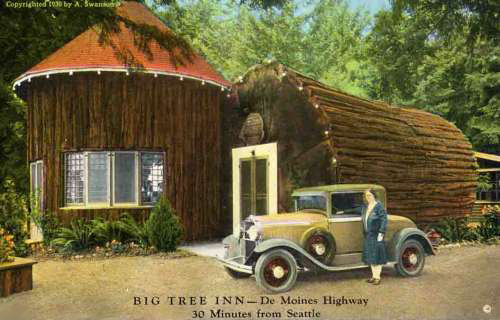
The two managed to make a success of the venture, running it as a seasonal business for 20 years. A 1930 postcard shows Katherine standing in front of the Big Tree with her new Oldsmobile.

It was a popular destination for parties of city dwellers wanting chicken or steak dinners – or other dishes listed on the menu shown above such as Minced Ham and Pickle Sandwiches. In 1925 a Seattle newspaper advertised the Big Tree as “The Most Unique and Attractive Summer Resort in Washington” – On Des Moines Highway – Family Chicken Dinner, $2.00 – Special ½ Fried Chicken, on Toast, 50c. Not necessary to phone. We are always ready to serve.”

The Big Tree Inn’s location on a heavily traveled highway between Seattle and Tacoma was essential to its success, so when the highway was rerouted in 1938 the Big Tree Inn followed. The Swansons sold it in 1944. The building survived a bad fire in 1946 and was back on the market five years later, described as a “summer gold mine on main hiway” that was “ideal [for] couple management.” What happened to it after that I don’t know.

© Jan Whitaker, 2013

5 Comments

Filed under odd buildings, roadside restaurants

Restaurant-ing in Metropolis

Metropolis544

In the depths of the Depression, in 1934, Harper & Bros. published a book of 304 photographs called Metropolis. Most of the photos were by Edward M. Weyer, Jr., an anthropologist who wanted to show how people in greater NYC lived. Captions were supplied by the popular writer Frederick Lewis Allen.

In a 2010 NY Times story the book was described as a “romantic masterpiece of street photography” composed of “moody black-and-white coverage of day-to-day life in New York in the ’30s. Beggars, snow-shoveling squads, schooner crews, railroad commuters, subway crowds, tenement life, tugboats, a sidewalk craps game. . .”

I find it particularly interesting that a major focus of the book was to contrast how different social classes lived, illustrated in part by where they ate lunch.

The central narrative follows employees of a company headed by a Mr. Roberts. He lives in a house on a 4-acre plot in Connecticut, commutes to New York, and employs a house maid whose duties include fixing his wife’s lunch each day. On the day he is being profiled Mr. Roberts eats a $1.00 table d’hôte lunch at his club (equal to $17 today). So frugal, Mr. R.

Metropolis540

Mr. Roberts is visited by a Mr. Smith from out of town (shown above looking out hotel window). Mr. Smith “stands for all those who come to the city from a distance,” whether Los Angeles, Boston, or elsewhere. He is “reasonably well off.” Mr. Smith eats a $1.25 table d’hôte lunch – er, luncheon — in a dining room on a hotel roof (pictured). Prices are high there, making his meal a relative bargain. Had he wanted to splurge he could have ordered a Cocktail (.40), Lobster Thermidor ($1.25), and Cucumber Salad (.45) – total $2.10. I would guess that many visitors to New York tend to spend more on restaurants than natives.

Metropolis539

Mr. Roberts’ secretary, Miss Jordan, lives with her mother and brother in an apartment just off Riverside Drive. With a combined family income of less than $4,000 the three can barely afford their $125/month rent. She goes to lunch at a café (pictured) and orders To-Day’s Luncheon Special which consists of Tomato Juice, Corned Beef Hash with Poached Egg, Ice Cream, and Coffee, all for 40 cents. Frankly, I don’t see how she can afford to do this every day.

Metropolis538

Miss O’Hara and Miss Kalisch transcribe dictation from other executives in the firm and each makes about $22.50 a week. Miss Kalisch lives in Astoria, Queens, and is married. Evidently she is pretending to be single in order to hold her job (her name is really Mrs. Rosenbloom). Miss O’Hara lives with her father in a somewhat decrepit apartment costing almost half her wages. Her father has been out of work for three years. The two women eat lunch at a drugstore counter (pictured) where they order Ham on Rye Sandwiches, Chocolate Cake, and Coffee (.30). I fear Miss O’Hara is living beyond her means if she does this often.

Miss Heilman, a young clerk, makes about $16.50 a week and is subject to occasional layoffs. She lives with her brother, his wife, and their two children in a 3-room apartment in Hoboken NJ, for which they pay $15/month. Like the other “girls” at the bottom of the totem pole she brings a sandwich and eats it in the office.

Metropolis542

Mr. Smith, being on his own, must go out for dinner. Once again he chooses a hotel roof garden (pictured), where about half the guests are also out-of-towners. With a live orchestra and dancing, it is undoubtedly expensive. I’m guessing he went for the Cocktail and Lobster Thermidor this time.

© Jan Whitaker, 2013

8 Comments

Filed under patrons

Image gallery: dinner “on board”

ShipTacomaTopoftheOceanest1946burned1977

There are numerous historical links between restaurants on land and vessels that navigate seas, lakes, and rivers. Ocean going sailors arriving in port, for instance, made up a notable fraction of early restaurant customers. Their ranks also provided stewards, cooks, and chefs, bringing new skills and cuisines wherever they took up their profession on land. San Francisco in the 1850s provides a striking example. In the United States steamboats that traveled the rivers and Great Lakes contained dining salons that were among the 19th century’s most luxurious and among the few places where ornamental French cuisine flourished.

But . . . this post isn’t about that. Instead it illustrates how far restaurants featuring ship and boat themes have strayed from a connection with their watery history. Ship restaurants are for the most part little more than a novelty – but a novelty that can be traced back at least to the 1850s. Despite quite a lot of ship restaurants running aground or sinking, literally and figuratively, there is some kind of primal appeal that keeps them going.

Frank Bazzuro may have been first. He arrived in San Francisco from Italy in 1852 and installed a restaurant in one of the hundreds of ships abandoned in the Bay, introducing his customers to a Genoese fish stew, cioppina. In the 1880s Capt. Paul Boyton, a world-famous swimming champion who popularized rubber wet suits, opened a restaurant on West 29th in NYC called “The Ship” which resembled a ship’s cabin. On Venice Pier in CA, a developer constructed a replica of a Spanish Galleon in 1904, after which it rode the waves of good and bad luck until its demolition in 1946. After an underworld shooting in 1928, it went through a couple of name changes, from Show Boat Café to Volga Boat.

Most ship restaurants that float on water – which not all do – have had checkered pasts as more utilitarian vessels or ones that have spent some time under water. Before it became a floating restaurant in Wilmington NC in 1951, the Ark had transported troops, hosted gamblers, and housed the coast guard. The SS Catala was one of about ten ships that appeared in Elliott Bay during the 1962 World’s Fair in Seattle. Previously it had served as a coastal passenger steamship, then fish transporter. When the fair ended it was towed to Los Angeles where it failed as a nightclub restaurant, then appeared in an Perry Mason TV episode before returning to restaurant-ing in Washington where a storm ran it aground.

Dining on a floating restaurant can be hazardous. A storm tore St. Louis’s Becky Thatcher Riverboat from its moorings, sending it downstream where it ran onto the opposite side of the Mississippi in 1969. Bar business was said to be brisk in the interlude before its 100 diners were rescued.

Ships moored on land are safer but rarely very convincing in their roles, particularly if they are in Dallas or Phoenix (below, respectively), smack on a roadway or surrounded by an asphalt parking lot where the water consists of a few puddles.

ShipRestaurantBountyDallas1971ShipCopperBelleRiverboatPhoenix

A parking lot might seem like a strange place for a ship but, a little reflection tells you that Noah’s Ark could have ended up almost anywhere. And that may be the reason enterprises with that name have done business not only on the beach in Leucadia CA, but near the interstate in St. Charles MO (pictured) and in Grovetown GA and Des Moines IA.

ShipNoah'sArk

Some sites present a real challenge. How do you make your restaurant resemble a ship when it’s in the middle of a block? Boyton’s ship cabin restaurant where only the interior resembles a ship gives an answer, but so do a number of storefronts that have been adorned with protruding ship’s prows, such as Bernstein’s in San Francisco (pictured).

shipBernstein'sFishGrotto

Babette'sYachtBarThere were oh so many bars shaped like boats and yachts, of which Babette’s was one (above).

Many restaurants with ship themes specialize in fish and seafood, but not all. Why not Chinese and American cuisine as in the 1940s Ship Ahoy chain with restaurants in  Atlanta and Augusta GA, Charlotte NC, Columbia SC, and Houston TX? Or hamburgers (McDonald’s, St. Louis riverfront, shown below)?

ShipSTLRiverfrontMcDonald's

In researching this topic I learned that almost every city or town will sooner or later have a ship restaurant. And many of them will sink, be scrapped, or get towed to another location. The fate of the Showboat Restaurant in Beaverton OR was ironic. In 1981 it became Showboat Liquidators where “Selling Your Boat Is Our Only Business!”

© Jan Whitaker, 2013

2 Comments

Filed under theme restaurants

The case of the mysterious chili parlor

Historical research sometimes goes nowhere. I saw the following advertisement in a 1903 Denver newspaper and was intrigued. Chinese noodle and chili parlor? Another strike at the idea of ethnic authenticity in cuisine. I wondered, was the owner Chinese or Mexican or neither? What did “no opposition” mean? I hoped I could find out more.

8MysteryJan281903
The ad says “old established trade.” I was unable to verify that. I discovered that in 1890 a man named Reuben Newhart ran a restaurant at 909 18th street, but I could find nothing about him. In the early part of 1902 a restaurant at that address was under the management of Mrs. Lizzie Albin. She also proved to be a cipher. Otherwise Denver city directories for the intervening years showed no restaurants at #909.

I searched for additional advertisements. What I found made everything more confusing.

Can you, dear reader, create a scenario which explains the following series of advertisements?

The earliest I found was September 15, 1902, when the business is described as a chile parlor. (Note: chile was often used instead of chili.)

1MysterySept151902

In October it is put up for sale. Clearing $100 a month, about $6,000 today – not too bad for a chili parlor.

2MysteryOct191902

October 24, it is no longer described as a chile parlor but as an “all new” Short Order and Oyster House.

3MysteryOct241902
It is on November 19, 1902, that the restaurant is first described as a “chile and noodle parlor.”

4MysteryNov91902
But on December 13 it is doing business as “The Orient” and serving Chinese Noodles and Chop Suey. Western Chinese restaurants were often located in the rear of saloons but, the advertisement announces, this is not true of The Orient. Now we discover the asking price: $160.

5MysteryDec131902
Eight days later, December 21, and the Chile, Noodle and Lunch Parlor is clearing $125 a month. But is that true? The owner must be pretty desperate to sell if s/he is willing to raffle it at 1 cent a chance.

6MysteryDec211902
Well, it’s January 25, 1903, and evidently the raffle was not successful. The owner must sell in the next few days. The profit picture seems to have dimmed a little – but maybe the new owner could collect on those invoices, which I’m guessing had been figured into previous profit estimates. Price dropped to $125.

7MysteryJan251903
The advertisement that got me interested in the first place, January 28, 1903. Why is no one buying it if it’s doing big business and has a fine location and low rent? The owner isn’t around much.

8MysteryJan281903
Six days later, the price drops to $100, but now the place is clearing only $90 a month.

9MysteryJan291903
March 11, 1903. Makes no sense at all.

10MysteryMar111903
Chile parlor gone! Looks like selling faucet filters is a better deal.

11MysteryJune71903
© Jan Whitaker, 2013
7 Comments

Filed under miscellaneous

Taste of a decade: 1970s restaurants

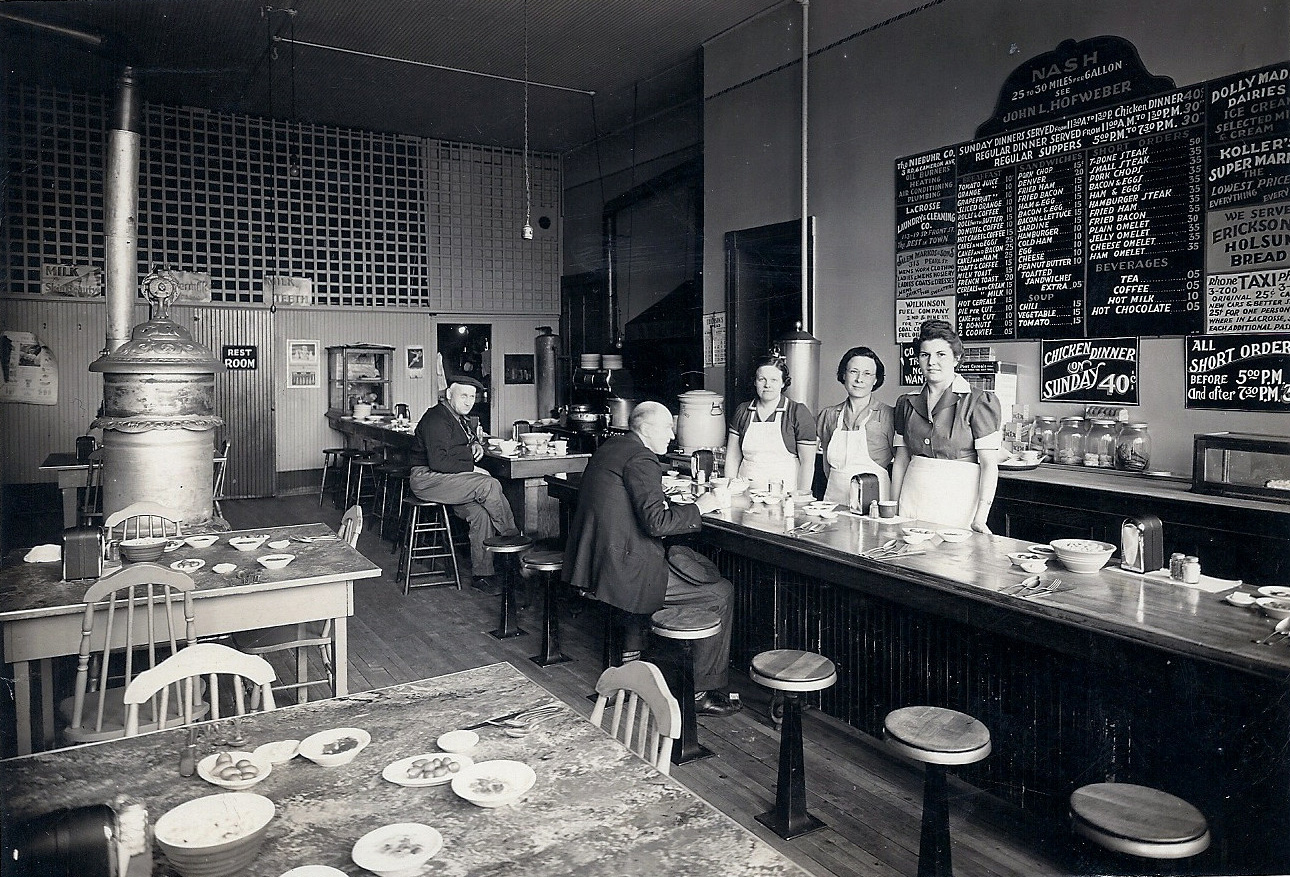
1979restaurantIn the 1970s the restaurant industry and the custom of eating in restaurants grew rapidly. The decade was the gateway to the present in many ways. Despite economic woes (recession and inflation), the energy crisis, urban decline, crime, and escalating restaurant prices, restaurant-going continued to rise.

The president of the National Restaurant Association proclaimed “Dining out is a significant part of the lifestyle of this great country,” noting in 1976 that one out of three meals was being consumed outside the home.

Restaurant patronage was encouraged by all kinds of things, including relaxed liquor laws in formerly dry states and counties, which brought more restaurants into the suburbs, the spread of credit cards, more working wives and mothers, youth culture, and a me-generation quest for diversion.

New York exemplified the problems faced by restaurants in troubled inner cities. Fear of crime kept people from going out to dinner. Restaurants closed, few new ones opened, and cash-strapped survivors began to trade vouchers for heavily discounted meals for advertising. But as New York struggled, California experienced a culinary renaissance as did other parts of the country. Still, much of the U.S. wanted only steak and potatoes, and hamburger was the most often ordered menu item nationwide.

A number of restaurant formats and concepts faced senescence, but new ones came on the scene at a rapid pace. Going, going, or gone were automats, coffee shops, continental cuisine, diners, drive-ins, formal dining, Jewish dairy restaurants, and Polynesian restaurants, not to mention the rule of elite French cuisine.

Fast-food chains continued to grow, with the number of companies increasing by about two-thirds. Growth was especially strong in the Midwest which was targeted as a region susceptible to their appeal. Toledo was bestowed with Hardee’s, Perkins Pancakes, a Mexican chain, and, in 1972, the arrival of two Bob Evans eateries. Another Ohio city, Columbus, was christened a test market for new fast-fooderies while Junction City KS, bordering Fort Riley, looked like a franchiser’s fast food heaven. By contrast, greater Boston had only one Burger King and one McDonald’s in 1970.

HamburgerFactoryAlong with the chains and a shortage of (cheap) kitchen help, came an upsurge in restaurants’ use of convenience foods and microwaves. In response, municipalities across the country enacted ordinances to protect consumers against false claims on menus, many of them centering on misuse of the words “fresh” and “home-made.”

Yet as the country was swamped with fast food, it experienced the flowering of restaurants specializing in ethnic, artisanal, and natural foods. Hippie and feminist restaurants stressed honest, peasant-style meals. Burgeoning interest in nutrition made salad bars popular. Bean sprouts, zucchini, and more fish showed up on menus. Diners learned that Chinese food was not limited to Cantonese, but might also be Mandarin, Szechuan, or Hunan. Once languishing behind luxurious decor, impeccable service, and famous patrons, food took center stage in deluxe restaurants as they purged Beef Wellington from their repertoire and took up the call for culinary creativity and authenticity.

Though not unknown in earlier decades, the restaurant-as-entertainment-venue came into full flourish with the proliferation of theme restaurants with unbearably cute names such as Orville Bean’s Flying Machine & Fixit Shop. To supplement a shrinking supply of old stained glass windows, telephone booths, and barber chairs, restaurant fixture companies began to manufacture reproduction antiques.

However crazy and mixed up the foodscape, America had become the land of restaurants for every taste and pocketbook.

Highlights

ChezPanissecookbook1971 – In Berkeley CA Alice Waters and friends found Chez Panisse, marking the movement of college and graduate students into the restaurant field, a career choice which is beginning to have cachet.

1972 – NYC’s Le Pavillon, considered the finest French restaurant in the U.S., closes. In Kansas City MO the first Houlihan’s Old Place, adorned with nostalgia-inducing decorative touches, opens, as does Mollie Katzen’s natural-food Moosewood Restaurant in Ithaca NY.

1972 –Dry since 1855, Evanston IL, home of the Women’s Christian Temperance Union, grants liquor licenses to two hotels and six restaurants. Their business doubles in a few months.

1973 – Los Angeles County becomes the first jurisdiction in the country to enact a “truth in menu” ordinance. During the pilot program, the scenic Sea Lion Restaurant in Malibu is caught selling the same fish under five different names with five different prices.

1974 – A Chicago food writer throws cold water on arguments about which restaurant has the best lasagne, asserting that the debaters “might have found that same lasagne in restaurants all over the country” courtesy of Invisible Chef, Armour, or Campbell’s.

1974 – Restaurateur Vincent Sardi spearheads a campaign to get New Yorkers to eat out, claiming that the city’s major restaurants have lost up to 20% of their business in the past two years, thus precipitating the closure of 20 leading restaurants.

1976 – The CEO of restaurant supplier Rykoff says whereas his company once supplied whole tomatoes it now provides diced tomatoes “because the operator just can’t afford to pay someone to cut them up.”

RjGrunts1970s1976 – Richard Melman’s Chicago restaurant company, Lettuce Entertain You Enterprises, operator of RJ Grunts, Great Gritzbe’s Flying Food Show, and Jonathan Livingston Seafood, opens Lawrence of Oregano and prepares to take over the flamboyant Pump Room.

1977 –Industry journal Restaurant Business publishes survey results showing that, on average, husband & wife pairs eat out twice a month, spend $14.75 plus tip, prefer casual restaurants, and tend to order before-dinner cocktails and dishes they don’t get at home. Measured by sales, Lincoln NE is one of the country’s leading cities for eating out.

1977 – Once characterized by blandness, San Diego now has restaurants specializing in cuisines from around the globe, an improvement one observer attributes in part to the new aerospace industry there.

1978 – A reviewer in Columbia MO complains, “A brick floor and pillars, old photos, Tiffany lamps, stained-glass windows and trim on the tops of the booths as well as revolving single-bladed, old-fashioned fans [is] a familiar type of decoration these days and I’m getting a little weary of the sameness of so many restaurants.”

1979 – As the year ends restaurant reviewer Phyllis Richman observes that more people are eating out than ever before, transforming once-lackluster Washington D.C. into “what is known as a Restaurant Town.”

Read about other decades: 1800 to 1810; 1810 to 1820; 1820 to 1830; 1860 to 1870; 1890 to 1900; 1900 to 1910; 1920 to 1930; 1930 to 1940; 1940 to 1950; 1950 to 1960; 1960 to 1970; 1980 to 1990

© Jan Whitaker, 2013
29 Comments

Filed under alternative restaurants, chain restaurants, food, patrons

Picky eaters: Helen and Warren

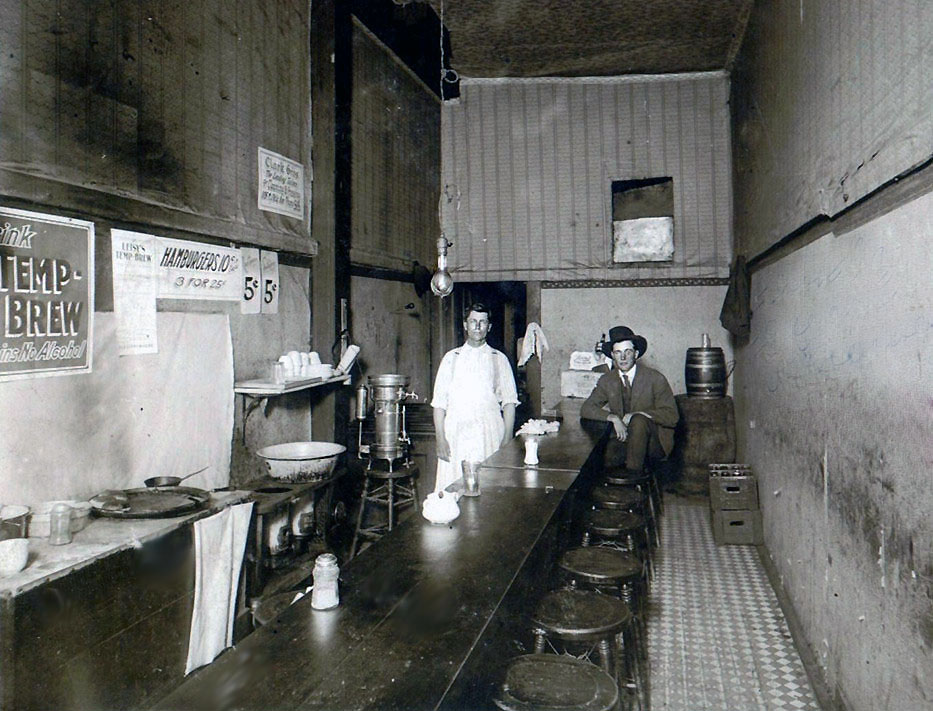
helenwarren1928

Helen and Warren liked eating in restaurants in the early 20th century when it was a rare experience for most Americans. They kept up with the trends and they tried restaurants of every format. They were affluent New Yorkers, somewhat jaded and always seeking the new thing.

Helen wanted to avoid expense and ostentation but was uncomfortable in offbeat places. Warren was cynical and alternately a cheapskate or big-spender. Both were distrustful. They feared they’d be taken advantage of, and sometimes were.

In the 1920s Helen and Warren were the best known couple in the U.S.A.

But they were fictional. They were the creation of Mabel Herbert Urner who wrote a column about the pair for over thirty years, from 1910 until the early 1940s.  The column was widely syndicated in newspapers from Boston to Los Angeles as well as in Canada and England. Though fiction, the column presents a fascinating subjective view of dining out, particularly in the 1910s and 1920s.

HelenandWarrenLathropandMabelHelen’s and Warren’s experiences likely had some resemblance to Mabel’s own life, particularly when the couple visited restaurants in Paris, London, and other European capitals. After marrying rare book dealer and collector Lathrop Colgate Harper in 1912, Mabel traveled with him around the world. In New York they lived in an apartment at 1 Lexington Avenue across from Gramercy Park from which they surely forayed into restaurants regularly.

Did Mabel and Lathrop, like her famous pair, have a preference for out-of-the-way restaurants such as the French and Italian tables d’hôtes in NYC? One starlit summer night in 1913 Helen dragged Warren to a backyard café run by three sisters. Helen exclaimed “Why, it’s a bit of Paris!” when she stepped into the garden. They were surrounded by writers, artists, and illustrators, including a “queerly dressed” literary woman. (Mabel’s inside joke?) Warren, a successful businessman, scoffed at the artists but even he had to admit afterward, “That [was] the best dinner in New York for the money.” They paid 65 cents each for soup, beef tongue with piquant sauce, squab, and salad, finished with fresh pears, Camembert, and coffee – wine included. The café was clearly modeled on that run by the Petitpas sisters on W. 29th in conjunction with a boarding house where artist John Butler Yeats lived. A dinner with Yeats and friends about this time was memorialized in a painting by John Sloan.

pepperpot

The Petitpas dinner was one of the couple’s few positive experiences. As much as Helen was drawn to offbeat restaurants, she was often squeamish about unsanitary conditions. She refused to eat ground meat. Usually she wiped her silverware with her napkin. She had problems in a Chinese restaurant, an Italian place, an “anarchist restaurant,” probably Maria’s, as well as at the Pink Parrot in Greenwich Village (probably the Pepper Pot, shown here). When she pushed away her plate there, Warren reprimanded her, saying, “You’re a bum bohemian.”

Helen and Warren visited cafeterias, tea rooms, pre-war cabarets, hotel dining rooms, roadhouses, and shoreline resorts in the NYC metro area. Helen was often embarrassed by Warren’s behavior when he showed off or spent too much money. They bickered. He declared a tea room she liked “a sucker joint.” She was critical of the decor and pomp of expensive restaurants, but her attempts to put a brake on Warren’s spending often backfired.

In 1913 they went to a restaurant in the throes of a waiters’ strike. Somewhat surprisingly, considering the bourgeois lifestyles of both Mabel and Helen, the story presents a case for the strikers. Helen questions their server about the goals of the strike, and he says, “They want decent food, m’am; clean food and a clean place to eat it. They want to be treated like men – not dogs! And they want a living wage.” Warren asks about tips and the waiter replies, “Why does he have to depend on tips thrown at him?”

In many ways Helen’s and Warren’s restaurant adventures and complaints seem relevant today. Has it happened to you that a server tries to remove your meal in progress? Have you been charged extra for bread? Welcome to the 1910s.

© Jan Whitaker, 2013
10 Comments

Filed under miscellaneous, patrons

Hot chocolate at Barr’s

e.c.Barrtearoomca1906

Even in a good-sized, prosperous city as Springfield MA was in the late 19th century, a chance to sit down and be served a cup of hot chocolate or other light, non-alcoholic refreshments was hard to come by. Other than hotel dining rooms, usually open only during mealtimes, there was just about nothing.

Except for the city’s leading confectioner. As was true in other cities, a confectionery restaurant assumed a prominent role in feeding and entertaining the public.

E. C. Barr & Co. was Springfield’s leading restaurant, caterer, candy and ice cream maker, and baker of fine pastries and wedding cakes. In an advertisement in December 1889 it advised, “Ladies while on your Holiday shopping tour try a cup of that hot Chocolate, Cocoa or Bouillon at BARR’S Restaurant.” For most of its long existence it did business on Main Street, for 20 years occupying a corner just across from the city’s foremost retailer, the Forbes & Wallace department store.

e.c.barr1884Barr’s reach went beyond Springfield. With a branch in Northampton, its fame was known throughout Western Massachusetts. The restaurant ran advertisements in Amherst to lure students from the Massachusetts Agricultural College to come out for a “spread” or a class dinner. This 1884 example ran in the M.A.C.’s yearbook.

Barr’s stayed in the public eye as a prime banquet venue and with elaborate show window displays of confectionery. In 1909 the company commemorated the exploration of the North Pole with representations of Cook and Peary and their exploring party, all made of sugar fashioned by owner Edwin Barr’s son Walter.

Recently I was lucky to find the postcard image of the Japanese Tea Room in the Barr restaurant shown above. It dates from about 1906, when a dessert called the Priscilla College Ice, an ice cream soda with a “totally different flavor,” was a popular order. Edwin Barr’s second wife, Minerva, worked with him and it’s likely she supervised the tea room and may have chosen the Japanese theme which was in vogue then.

Barr’s was begun in 1865 or 1866 when founder Edwin Barr finally decided to give up prospecting for gold in California and Montana and returned to Springfield to settle down. It wasn’t until around 1891 that Edwin acquired the Main and Vernon corner (384 Main), one of the most valuable corners in the city’s shopping district. (It’s likely that the 884 Main address on the trade card shown here is misprinted.)e.c.barrtradecard

In 1870 an article in the Springfield Republican claimed that Barr’s decor was more “tasteful” than that of Delmonico’s in New York. Keep in mind that the New England taste of that time leaned toward plainness. The story also praised the appearance of the restaurant’s menu which was printed on cream paper with a thin magenta border – “neat, but not gaudy.”

Sadly the Barr family’s lives were not so neat. In 1891 Edwin’s eldest son, George, who managed the family’s Hotel Warwick in Springfield, shot and killed his wife and himself in a fit of jealousy. Edwin’s third son, Jesse, manager of the Northampton restaurant, died of syphilis in 1900.

Fortunately Edwin’s son Edgar lived a long life and carried on his father’s business for a time after Edwin’s death in 1911. In 1912 the restaurant moved to East Bridge Street and later was recreated on State Street. I have not been able to discover how long it remained in business.

Clearly Barr’s glory days were at Main and Vernon. That site underwent many demolitions, the latest being construction of the Monarch Place hotel and office complex.

© Jan Whitaker, 2013

12 Comments

Filed under confectionery restaurants, restaurant decor, tea shops

Name trouble: Sambo’s

SambosGoletaCA

You might imagine that chain restaurants would spend vast amounts of time and money researching potential names in order to pick one that would convey exactly the desired associations and nuances. Certainly one that would not insult a portion of its intended customers.

I’m sure most do. Sambo’s was not among them.

Wouldn’t the founders of Sambo’s, in the late 1950s, dimly perceive that the name Sambo was not beloved by everyone, especially African-Americans?

Why would they decorate with images from the book “Little Black Sambo,” the American editions of which were filled with racist caricatures?

sambocollage

Evidently they had no idea that Sambo had been – and still was – a derogatory word for black males for over 100 years; that the name and ridiculous images of Sambo were used on many consumer products in the early 20th century; and that after WWII school libraries had complied with requests by African-Americans to remove the book from shelves.

Even if they didn’t know any of this, when protests erupted they might have realized they had made a terrible mistake. Regardless of whether “Sam-bo” originated from the first name of one of them combined with the nickname of the other.

Nope, nope, nope, and double nope.

Instead the founders, their successor, and the corporation that finally took over the chain all insisted right up to the bitter end that no harm was intended or implied. Even as they renamed some units in the East where there had been boycotts, the company insisted the change was purely in order to market their new menus.

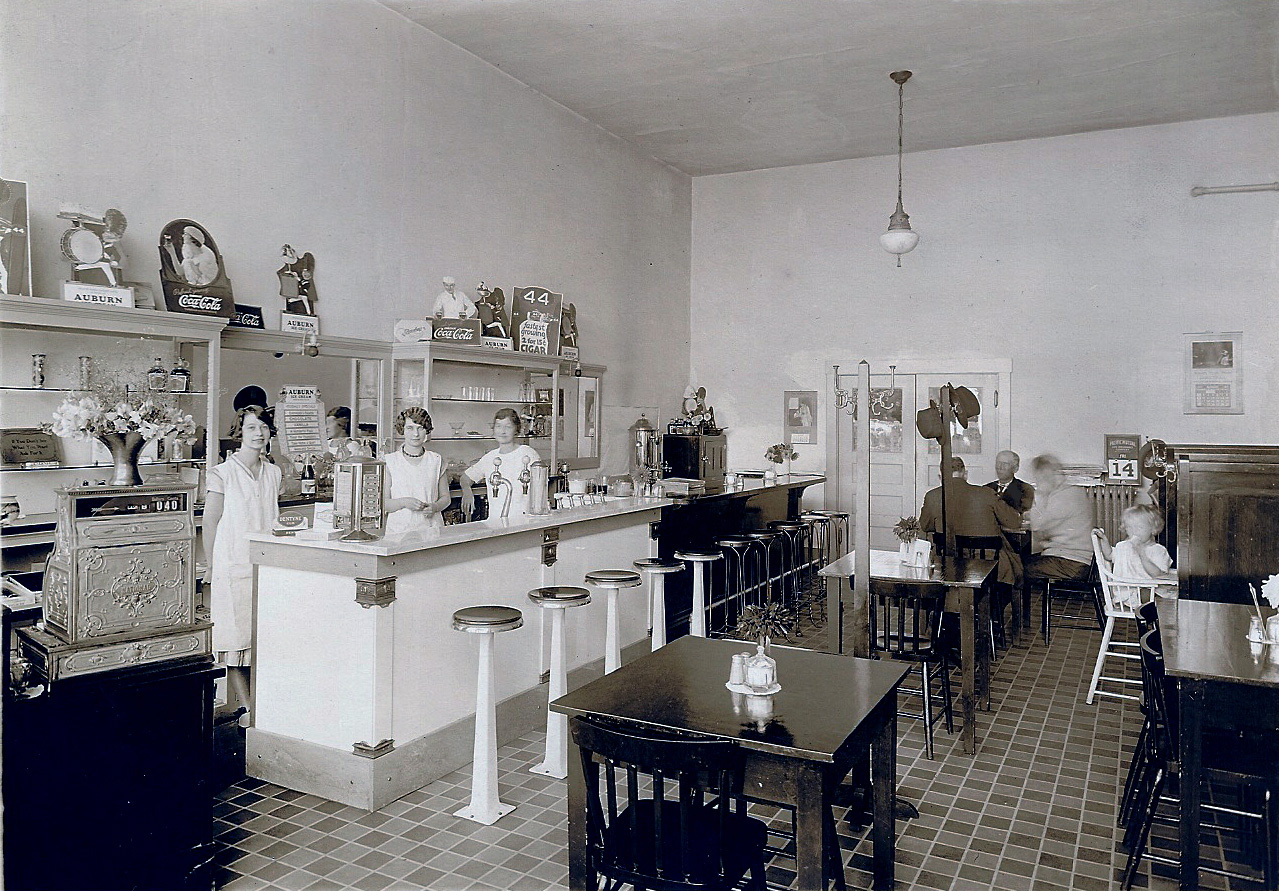
sambo's216CabrilloHwy1960The first Sambo’s was opened in Santa Barbara in 1957. [pictured] By 1977, when the son of one of the founders was heading the company, the chain was the country’s largest full-service restaurant chain, with 1,117 units.

But trouble was looming. Protests during the West Coast chain’s expansion into the Northeast had already resulted in renaming units in the Albany NY area “Jolly Tiger.” Eventually there were 13 Jolly Tigers in various towns. Protest would spread to Reston VA, New York, and New England including at least 9 towns in Massachusetts. In 1981 the Rhode Island Commission on Human Rights ordered the company to change its name in that state because indirectly the name violated the 1964 Civil Rights Act by denying public accommodations to black persons.

SambosNoPlaceLikeSam'sLogo1981The company responded that it would rename 18 of its Northeastern units “No Place Like Sam’s”; in fact according to an advertisement a few months later they actually renamed 41 units.

Soon thereafter the company began to collapse. In November 1981 it filed for Chapter 11 bankruptcy protection, closing more than a third of its units. In Leominster and Stoughton MA, early morning customers had to pick up and get out immediately so the restaurants could be padlocked.

In 1982 all, or most, remaining Sambo’s were renamed Seasons. By 1984 most of the Seasons restaurants had been sold to Godfather’s Pizza and other buyers.

The successive name switches undoubtedly hurt business, but a more serious problem was that Sambo’s, like other chains using a coffee shop format with table service and extensive menus, had been steadily losing out to fast food chains. Unsurprisingly, it did not survive.

© Jan Whitaker, 2013
67 Comments

Filed under chain restaurants, racism

“Eat and get gas”

EatandGetGasMO

When I first encountered that jokey phrase as a child I thought it was amazingly clever and funny. So did many adults, evidently, because over the decades numbers of roadside eateries adopted it as a catchphrase. Even as late as 1976 Stuckey’s was using it on a billboard near Dallas. A roadside gas station/café outside Omaha bore the equally cornball name Tank and Tummy.

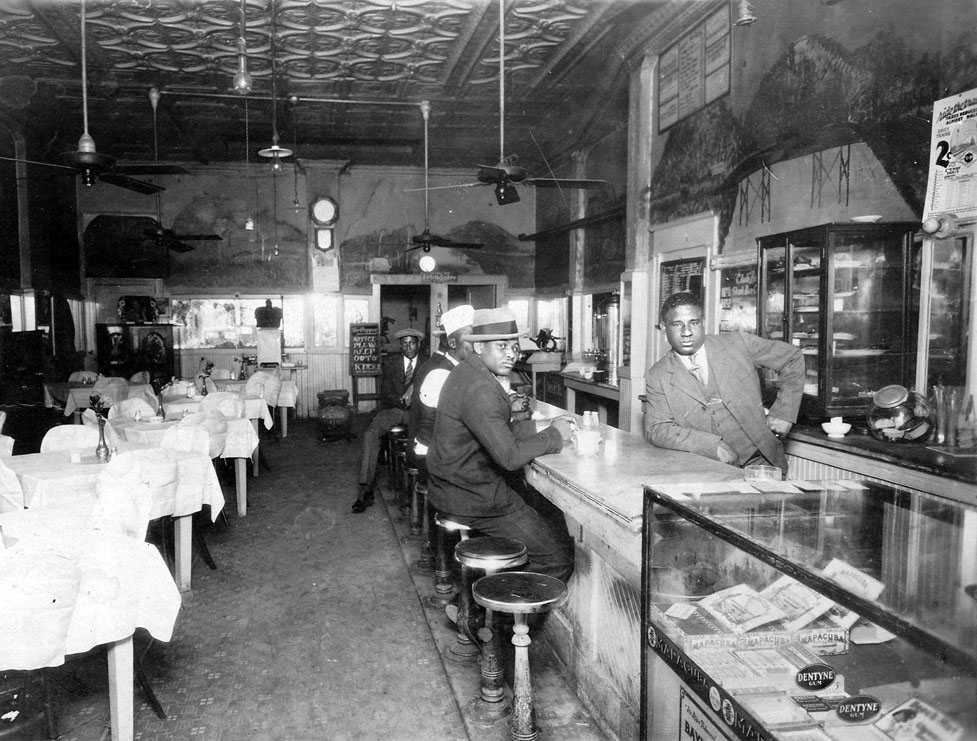
AncestryChildressTXcafe

It wasn’t long after thousands of Americans acquired cars and took to the roads in the 1920s that all kinds of roadside businesses popped up to serve them. They ranged from campgrounds in farm fields to tourist homes and cabins, gas stations, tea rooms, and cafés. The Depression failed to stifle the urge to travel by car while inspiring thousands to try to make a living from passing traffic. Among the ideas included in a dispiriting little 1937 pamphlet called The Roadman’s Guide (“A Valuable Book of Money Making Formulas, Recipes, Ways, Plans and Schemes”) were carnival games, refreshment stands, and “eating joints.”

AncestryOzarkTavernWestphaliaMO

The gas station/restaurant combination was a popular one, often further combined with a gift shop or rooms for overnight guests. The logic is the same one-stop-shopping idea used by department stores: get customers to stop in for essentials and they may buy other things they didn’t even know they wanted. In Taunton MA in the 1920s, the Marvel Lunch and Filling Station not only had chicken and duck sandwiches on offer but also advertised “Stop and See the Trained Bears.”

Although it did tend to render them less refined, some tea rooms were linked to gas stations. Yet Duncan Hines’ 1937 edition of Adventures in Good Eating for the Discriminating Motorist gave a slightly grudging nod to The Old Elm Tree near Fremont OH, indicating “Just a wayside place with filling station adjacent but they serve a mighty good steak and chicken dinner, as well as all kinds of sandwiches and salads.”

Among those who tried combining gas and eating in the Depression – and succeeded – were Harlan Sanders and Gus Belt, respectively founders of Kentucky Fried Chicken and Steak ’n’ Shake.

AncestryTrouttCafeWoodlawnIL

Which came first in these combined ventures — the gas station or the restaurant? I’ve decided that in most cases it was – and still is – the gas station. And that might account for why so few roadside dining spots earn a reputation for fine food. Consider chains such as Stuckey’s, Nickerson Farms, and Dutch Pantry.

With superhighway construction in the 1950s and 1960s, highway stops institutionalized paired restaurants and gas stations, though by this time they were housed in separate buildings. In 1961 the Stouffer Corporation teamed up with Standard Oil of Ohio to test automat-style restaurants. They were not a success, but generally highway self-service food courts have proved acceptable to the motoring public.

Like many of the eat-and-get-gas highway oases before them, interstate service plazas also do duty as truck stops. But that is the subject of a future post.

© Jan Whitaker, 2013
10 Comments

Filed under roadside restaurants