We burn steaks

ptomainetommyMB

While most restaurant advertising tends to exaggerate the subject’s merits, some takes the opposite tack, declaring that the restaurant’s food and service are horrid. The reason is simple, a wish to stand out from the crowd.

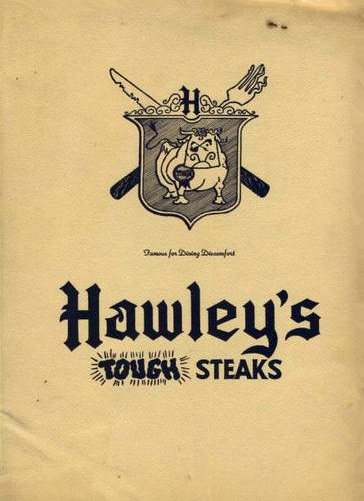
ToughSteaksShermanOaks1950How well this works is questionable. If a restaurant has nothing going for it in food quality or service, a gimmicky promotional attitude isn’t going to make it successful. For instance, the humor of Hawley’s Tough Steaks, Sherman Oaks Ca, displayed in the slogan “Famous for Dining Discomfort” wears thin almost instantly. After you have read through the menu once, and maybe smiled wanly at its jokiness – Tired T-Bone, 25 cents, With Meat, 2.25 – you might not ever want to see it again. I haven’t been able to determine how long Hawley’s stayed in business.
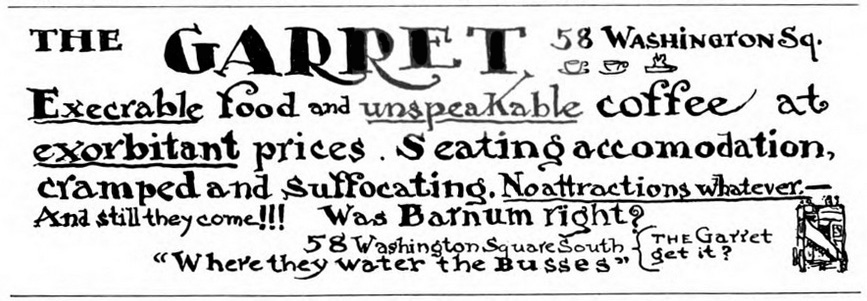
I sense a degree of desperation in the advertisement for The Garret in Greenwich Village. In 1922 when this ad appeared, The Garret’s proprietor was Grace Godwin, single mother of four who ran it to support her family. It was located near the spot in the Village where all the tour buses parked, which should have given it an edge despite the fact that it was housed on the second floor of a dumpy old building. The ad played off the Village’s reputation for zaniness that was so attractive to tourists. Grace gave up the business not much later.

TheGarretGVQuillApril1922

But sometimes it seems to work.

Ptomaine Tommy’s in Los Angeles fared quite well and was around at least from 1913 to 1940 if not longer. It multiplied, “dotting California roadsides,” according to newspaper columnist O. O. McIntyre who mentioned the restaurant’s name often enough even if he wasn’t terribly flattering. He called them “hastily constructed” and comparing them to the Shanties, Shacks, and Food Hutches that sprang up in the Depression serving bean soup and hash.

Perhaps partly because McIntyre made the name known, it became a popular one. Ptomaine Tommy’s appeared in San Francisco, Portland OR, Reno NV, and even Eau Claire WI. I wouldn’t be a bit surprised if restaurants with that name are in business today.

I think that the self-denigrating approach appeals to a sense of humor among those, historically men, who aren’t especially fond of eating out unless they can be reassured that they won’t be expected to pay much, dress up, or display refined manners.

Restaurants that make fun of themselves give off a message that they aren’t pretentious. Patrons can be sure they won’t meet up with haughty servers. Or, as Newman’s in Amarillo and Dalhart, TX, put it, “Terrible Service, But We’re Friendly.”

© Jan Whitaker, 2014

9 Comments

Filed under miscellaneous

Girls’ night out

GirlsNightOut

This is one of my favorite photographs, the kind I tend to hoard until the perfect moment. I put it in the same league with the wonderfully evocative photograph in That night at Maxim’s. It seems just right for the first post of a new year.

Once again, I invite readers to imagine what is going on. I know little other than that they are in a restaurant in New York City. Because they are seated  at a banquette, and because the photo was almost certainly taken by a professional photographer, I would guess it is a nightclub restaurant, or certainly a special occasion type of place. Judging from their outfits and the style of the mural behind them, I think it is the late 1940s or early 1950s.

I love how directly they look at the photographer and how contented they are. I think the woman in the middle is the mother of the woman on the left. Perhaps it is her birthday. Could the other be a cousin? She seems to have been interrupted just as she is about to present what looks like a check to the older woman.

They are drinking manhattans or martinis, not paying too much attention to their salads, and totally ignoring the mound of dinner rolls piled so unceremoniously on a too-small plate. The awkward way the rolls are served and the ordinary serviceable restaurant ware (water tumblers, dishes, and salt and pepper shakers) makes me think it is not an elite restaurant. Still, love those butter pats on the tiny plates!

The only objects in the photograph that I cannot identify are two small squares of paper on the table, one in the foreground right and the other just beyond the salad of the woman on the right. Forms to fill out for the photographer?

Thoughts?

© Jan Whitaker, 2014

10 Comments

Filed under patrons

2013, a recap

recapWolfie'sMBI think of the past twelve months as the year of Wolfie’s.

Although it was two years ago that I wrote Famous in its day: Wolfie’s, about a former Florida coffee shop, 2013 was the year when the post broke records, becoming my top post devoted to an individual restaurant. It also became the all-time most popular post on a single restaurant since I began blogging in 2008. I’d love to think it was my sparkling writing that made Wolfie’s so hot, but I suspect it was due to interest stirred up by two seasons of the TV show Magic City about mobsters in 1960s Miami.

As for other single-restaurant posts, Miss Hulling’s, published in January 2012, came in second. It was followed by Schrafft’s, John R. Thompson, and Pig ’n’ Whistle.

My Recipes page actually topped Wolfie’s by a thousand or so, demonstrating that day and night there are legions of recipe hunters searching for their favorite bygone restaurant dishes. I fear they are usually disappointed. Through the generosity of a friend I just obtained Miss Hulling’s cook book. No split layer cakes, but I can do Country Gravy or Miss Ethel’s Scalloped Potatoes.

The Prices page was another click magnet. Yes, it’s true that in 1964 Howard Johnson’s ran a special on one-plate turkey dinners for $1.49.

Other notables

Evergreen posts: The Decades stayed strong, in this order: 1920s, 1960s, 1950s.

recap1970sRuth'sHickoryMtnRestaurantMy biggest achievement: Finally completing the decade of the 1970s, which takes the 20th century right up to 1980. I expect it will eventually move into second place among the Decades.

“Fastest out of the gate”: B.McD, which was the fastest to accumulate page views, maybe because of great images.

recapWoolworth67cheeseburgerPerennially most popular post not about an individual restaurant: You want cheese with that? Alas, it is sadly lacking in “likes” maybe because that feature didn’t exist when it came out in 2009. Once no likes, always no likes?

recapShambarger'sDMy personal favorites of 2013: Writers’ favorites never quite seem to mesh with readers’ favorites. Mine were Greek-American restaurants and Restaurant as fun house: Shambarger’s.

Most deserving 2013 post that didn’t click with readers: Charge it! Boo hoo. Was it because it has no color pictures, or because it came out in summer?

Coming up: There are many posts on the drawing board and quite a few already moving down the production line for 2014. I’m determined to tackle fearsomely big topics such as oysters, and Chinese and Mexican restaurants. And then there are lunch wagons, smorgasbords, celebrity restaurants, tableside preparation, restaurants at world’s fairs, and . . . (fill in the blank). Any requests?

Thanks for reading and best wishes for happy restaurant-ing through 2014,signature168

10 Comments

Filed under miscellaneous

Holiday greetings from Vesuvio Café

XmasVesuvio1956

I wish I could explain the Vesuvio’s holiday cards, but I can’t. Maybe it’s enough to know that the Café was a beatnik gathering spot in San Francisco.

The café was founded in 1949 by Henry Lenoir, who wore a beret and undoubtedly preferred to spell his first name as Henri. I’m guessing he’s the aging cherub on the left on the 1956 postcard above. I couldn’t find much about him other than that he was born in Massachusetts around 1904. The son of a Swiss university professor, he was a college graduate at a time when that was fairly unusual. In 1940, before he opened the café, he worked as a salesman in a San Francisco department store that I like to think was the Emporium. He was an art lover who enjoyed the company of beats and hipsters.

I don’t know if the Vesuvio served much food. It seemed to be more of a drinking than an eating place back in the days when Henry presided behind the bar. A sign in the window advertised “booths for psychiatrists” and a “Gay ‘90s Color Television” flashed old photos of women clad in bloomers. In the late 1950s it was on the North Beach circuit for beatniks who made the rounds from the Vesuvio to the Coexistence Bagel Shop and a nameless bar called “the place.” No doubt they stopped in at the City Lights bookstore too; Henry lived upstairs.

XmasVesuvio1964It was the day of the Hungry I, the Purple Onion, and the Anxious Asp (where the restroom was papered with pages from the Kinsey Report). “The place” and the Coexistence, considered the birthplaces and headquarters of the San Francisco beats, were both gone by early 1961. But, although Henry sold the Vesuvio in 1970, it continues even today. Of course it isn’t the same. Given that Beatnik dens became tourist sites almost overnight, it already wasn’t the same in 1964 when the card with the 5 nude mannequins and one real woman modestly dressed in a long-sleeve leotard was produced.

© Jan Whitaker, 2013

16 Comments

Filed under Offbeat places

The Shircliffe menu collection

Arnold ShircliffeAlmostTremontHouseBillofFareArnold Shircliffe spent his life in the catering trade, working in almost every branch of it. He held jobs in railroad dining cars, the Army, hotels, clubs, and restaurants. He began as supervisor of a dining car in 1902, remaining in that occupation for a couple of decades before becoming catering manager of the Edgewater Beach Hotel in Chicago. While there he published the Edgewater Beach Hotel Salad Book in 1926. Around 1936 he became manager of the restaurant in Chicago’s Wrigley Building, then known as Grayling’s, a position he held until his death in 1952.

By 1928 he had amassed an impressive collection of cook books that included a first edition of Hannah Glasse’s The Art of Cookery Made Plain and Easy published in London in 1747. Somewhat later he began to collect menus.

In 1954 Arnold’s son Harold auctioned his father’s collection which by then was vast and focused mainly on antique cook books. It also included what was described in the auction catalog of the Parke-Bernet Galleries in NYC as “the Pride and Joy of His Life,” about 14,000 menus. The catalog has been digitized as part of the Hathi Trust and can be viewed in its entirety.

I have been able to find only two auction records from the sale of the 697 lots in the Shircliffe auction. Mrs. Glasse’s folio-edition book went for $300. The sum is equivalent to several thousand dollars today but it strikes me as very low. Another rarity, William Turner’s A New Boke of the Natures and Properties of All Wines That Are Commonly Used Here in England, published in 1568, brought $500.

GlasseArtofCookery

The menus were grouped in lots numbered 354, 420-422, and 470-473. I find #354 quite fascinating. It is described as a Horn Book Menu made of wood, almost 8 inches tall and 3 inches wide, with a handle and a manuscript menu labeled “The Carte of the Palais Royal Dinner,” presumed to be English from the 19th century. In a 1943 note, Arnold wrote about a horn book he displayed at a culinary exhibit put on by the Societe Culinaire Philanthropique de New York at the Hotel Commodore. He said that horn books were originally worn around children’s waists and used for studying the ABCs, prayers, etc. Then, he wrote, “The model of the horn book or paddle was taken up by the restaurateurs and they used same as a menu – when it was issued to the waiter, his name was placed upon it; this hung from the waiter’s side in many restaurants and the menu was read to the guest. The menu or horn book was charged to the waiter, and when he left the service or was discharged, his name was scratched off and the name of the new waiter placed on same.”

ArnoldShircliffeTheRainbowNYC1838The largest auction lot of menus was #470 which held an estimated 10,000 items, many from 19th-century American hotels. In it was a tavern broadside from 1790 showing the set price for “the best dinner,” but the oldest true bill of fare, from The Rainbow in NYC, was dated 1838.

In another annotation for the exhibition of the Societe Culinaire Philanthropique Arnold explained that the Tremont House in Boston was one of the first to issue written menus. He added, “The earliest hotel menu that I have is dated 1825.” No menu from a date this early appeared in the list of highlighted items in lot #470, however there was a menu from the Tremont House dated August 25, 1844, that was similar to that of May 1844 shown above.

In 1955 Arnold’s son donated 10,000 menus to the New York Historical Society. A short time later the Historical Society put them on display with the bill of fare from The Rainbow included. This leads me to believe that it was lot #470 that Harold Shircliffe donated. The Historical Society’s notes on the Shircliffe Menu Collection say only that “The core of the collection was assembled by Arnold Shircliffe but has been added to since its donation.” I can’t help but wonder if lot #470 had failed to receive any acceptable bids — or any bids at all – and that was the reason for the donation.

The NYHS menu collection is viewable at the Historical Society’s Patricia D. Klingenstein Library on a walk-in basis (registration with a photo ID required). An electronic database of what is contained in the collection is available at the library.

© Jan Whitaker, 2013

9 Comments

Filed under menus

Books, etc., for restaurant history enthusiasts

TURNING THE TABLES: RESTAURANTS AND THE RISE OF THE AMERICAN MIDDLE CLASS, 1880-1920, by Andrew P. Haley, University of North Carolina Press, 2011.

turningthetables666In the time that has elapsed since my reading this fine book — and getting to meet Andrew in person — and now, he has gathered numerous glowing reviews plus a 2012 James Beard Award. Proving he didn’t need any help from me to get the attention he deserved for this well-researched and highly readable book. Still, I’d like to see him get even more.

Turning the Tables is an investigation of the role of the American middle class in the creation of restaurants that suited their tastes, values, and habits: in other words, in creating the kinds of restaurants we patronize today, where the menu is streamlined and written in plain English, where women and children are welcome, and where food of many ethnicities is enjoyed. The book investigates in detail what it was about elite restaurants of the late Victorian age that average Americans disliked. And I must say it is refreshing to read an account of the making of our culture that portrays average people “turning the tables” and spreading access to the good things of life rather than aspiring to become privileged exclusivists.

HISTORIC RESTAURANTS OF WASHINGTON D.C., by John DeFerrari, The History Press/American Palate, 2013.

HistoricRestsDC664John is a preservationist and an authority on Washington. He is the author of Lost Washington and of the well-illustrated blog Streets of Washington. His book on the city’s restaurants is carefully researched and beautifully illustrated with postcards from his collection and photographs from the Library of Congress. There are eight pages of color illustrations, the remainder in black and white. Reading the book makes clear that even if Washington’s restaurants – like those of many cities across the nation – were long considered of little culinary interest, that doesn’t mean that their histories are any less significant. John has ferreted out plenty of evidence of the important role they played in the life of the city.

I particularly liked his chapters “Black Washington’s Restaurants” and “Power Lunches and Dinners.” And, of course, I appreciated that he included a chapter on tea rooms. I know I will be dipping back into his book many times as I write my own posts.

REPAST: DINING OUT AT THE DAWN OF A NEW AMERICAN CENTURY, 1900-1910, by Michael Lesy and Lisa Stoffer, W. W. Norton & Company, 2013

repast665Michael Lesy is of course the author of the newly reissued, haunting classic Wisconsin Death Trip, as well as numerous other books. In Repast he has teamed up with his wife Lisa Stoller to write about turn-of-the-century dining, high and low, American, French, and other ethnicities. Splitting the task between them almost 50-50, Michael authored the Introduction and the chapters Pure Food, Quick Food, and Other People’s Food while Lisa wrote Her Food, Splendid Food, and the Afterword. Together the chapters create a vivid portrait of how people lived as reflected through their eating habits.

The book makes great use of the New York Public Library’s Buttolph menu collection which is particularly strong in the first decade of the 20th century. Many of the photographs shown in the book are from the incomparable Byron Company collection at the Museum of the City of New York. As a consequence, the book tends to favor New York particularly in the illustrations, which are printed beautifully in this handsome, full-color book.

Note cards by Cool Culinaria

coolculinaria670The sprightly image of a menu from McDonnell’s Drive-In shown here, in 1940s Los Angeles, is from CC’s mixed set of ten cards, the American Collection. Other note card sets in their lineup include those of the Old West and the cities of Chicago, Los Angeles, New Orleans, New York, and San Francisco. I like how the inside left side of each card gives a glimpse of the  menu’s interior.

And, in case you were wondering what that brown bottle is that the female carhop carries on the tray, it is indeed beer. In addition to colas, ice cream sodas, and “churned buttermilk,” McDonnell’s served bottled beer and beer by the glass (10 cents), with a higher charge for Eastern beers than those brewed in the West! So let’s drink a toast to California’s unique concept of the drive-in and to Cool Culinaria’s mission of “Rescuing Vintage Menu Art from Obscurity.”

3 Comments

Filed under miscellaneous

Roast beef frenzy

neba

According to Mike Davis, creator of the NEBA chain, the arrival of fast-food roast beef sandwiches in the early 1960s was a sign of an upward-bound middle class able to afford its beef sliced rather than ground to bits. His sandwiches cost 69 cents as against the 15 or 20 cents for a chain burger.

Indeed, sliced beef was big. Despite being first into the beef sandwich market, by 1967 NEBA faced competition from Arby’s, Beef Corral, RoBee’s (soon to become Roy Rogers), Heap Big Beef (with its odd Indian theme), and others. Burger King and McDonald’s were testing roast beef in some of their units and Minnie Pearl’s was poised to add roast beef to its chicken menu.

NEBAADVDavis began his fast food career with submarine sandwiches, branching into roast beef in 1960 because it was easier to produce in quantity and not commonly found in chain restaurants. There are various ideas about where the odd name NEBA came from. Almost certainly it was not an abbreviation for “Never eat burgers again.” As strange as it sounds, it’s likely that NEBA was chosen because it was the name of a dog once owned by Davis, as he said in a 1969 interview. Another possible explanation is that it was named after the New England Beef Association. “Nicest Eating Beef Around,” sometimes used as an advertising slogan, may have been a back formation.

The first sandwich shops in the NEBA chain were in the Albany NY area, the company’s headquarters before moving to Hollywood FL. In 1965 a Mike’s Submarine and NEBA Roast Beef unit opened in Pittsfield, the first in Davis’s home state of Massachusetts. Franchised units eventually opened in Florida and southern states but the chain never made it to the West.

NebadavisphotoDavis described himself as driven to make money ever since his miserable childhood in which he earned up to $100 a week by organizing a crew of boys to deliver newspapers. Reportedly he used the money to pay rent and buy food for his brothers and sisters in an attempt to make up for parental neglect. Dropping out of school after 8th grade, he was apprehended for breaking into houses and stealing money in his teens and spent time in a reformatory. Described as “tight-lipped” and “compulsive,” he confessed he felt inhuman and never laughed.

The NEBA chain reached its peak in 1969 when there were 70 units in the U.S. Having sold the Canadian branch, Davis, 35, was said to be worth $15 or 20 million at that time. In 1970 he resigned as chairman a month before the corporation declared bankruptcy. With 400 units by then, Arby’s had become the competition-busting roast beef leader.

As late as the mid-1980s a few of the original NEBA sandwich shops, in upstate New York and Miami FL, remained in business under new owners.

I don’t know what happened to Davis after he left the company. I’d like to think he found some degree of happiness.

© Jan Whitaker, 2013

64 Comments

Filed under chain restaurants, food, proprietors & careers

B.McD. (Before McDonald’s)

ArmstrongMOcafe

In most towns and cities across the USA the landscape is filled with fast food eateries that belong to chains, McDonald’s obviously being only one. Chain restaurants make up close to half of all restaurants today, and many of them can be classed as fast food places. A large proportion of the meals people eat away from home come from this type of eating place.

Where did people grab a quick bite before the fast food chains came along? What was the ordinary, inexpensive eating place like for so much of the last century, B.McD.?

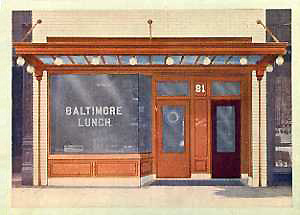
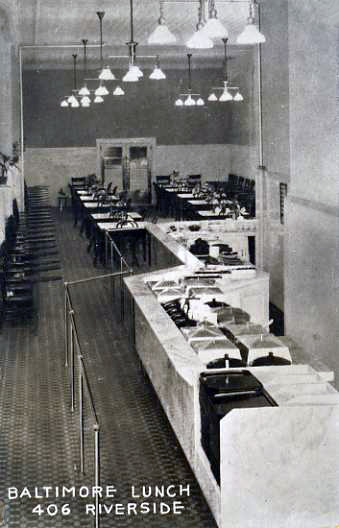
Let’s peer back into the first half of the 20th century. There were some “quick lunch” chains in existence, but they were the exception rather than the rule. Although high-traffic locations in larger cities were quickly grabbed up by chains such as Baltimore Lunch or John R. Thompson, less desirable sites in cities and on Main Streets in smaller towns were populated with small independent eateries.

ConeyIslandCafecropped

Many, perhaps most, lunch rooms and cafes – not likely to be called restaurants then – occupied storefronts or freestanding one-story buildings of very basic construction. Often they were “mom & pop” operations with one of the pair handling the cooking, the other running the food service side of things. Very likely the proprietors knew most of their customers on at least a first name basis.

LaCrosseWI2

Most lunch rooms shared a basic floor plan in a standard storefront space 18 to 25 feet wide and 75 to 100 feet deep. About 2/3 to 3/4 of the space was devoted to the dining room, the rest making up the kitchen which was hidden behind a wall, partition, or just a curtain.

MagnumOK2

Usually seating would include both a counter and some tables or booths along the side or arranged toward the back. Very narrow storefronts had counter seating only. Shelves behind the counter or glass display cases might hold baked goods, packaged groceries, cigars, or candy. A cash register was often a prominent feature.

BaltimoreCafeoysterHouseAberdeenWA1921

In many cases during Prohibition, a café’s or lunch room’s previous status as a barroom was plainly evident.

AuburnWAcoffeeshop

Decor, such as it was, was frequently provided by posters and stand-up signs advertising national brands, particularly soft drinks.

GreenLeafCafeTX

What was gained and what was lost when the old lunch rooms disappeared? It’s a mixed picture. I doubt that their food was much to brag about. Some were clean, some were dirty. Often their menus were limited — but rarely as limited as the fast food chains. Food was served on dishes, not in paper wrappings. They provided service and often friendliness and a sense of community, though it was sometimes circumscribed by race, gender, and familiarity.

I recall walking into a local café in Hannibal MO about ten years ago. The few customers at the counter all turned to stare openly as we came though the door. The proprietor screeched, “Where are YOU from?” We were horrified when the chili came with a big scoop of sour cream on top. She seemed offended when we failed to order pie. I hate to admit it but, all in all, I would have preferred the anonymity of a chain for lunch that day. On the other hand, if we had gone to a chain I wouldn’t remember being in Hannibal at all.

© Jan Whitaker, 2013

13 Comments

Filed under lunch rooms

Road trip restaurant-ing

PostluggageFor New Yorkers even today a lengthy car trip can raise concerns about letdowns at the dinner table, but all the more so in 1915.

That was the year that two writers, Theodore Dreiser and Emily Post, separately set out across country [Post pictured above, about ready to embark]. Although novelist Theodore Dreiser is often credited with writing the “first road trip” book, the publication of his Hoosier Holiday in 1916 was in fact matched by Post’s By Motor to the Golden Gate that same year.

Dreiser’s trip took him back to his boyhood state of Indiana, while Post daringly continued westward to the Panama-Pacific Exposition in San Diego and San Francisco. Both were in their 40s, lived in New York, and had failed marriages behind them. Both traveled with a companion and a chauffeur, in Post’s case her son.

Each made interesting observations about places where they ate. Dreiser, on a sentimental journey into his past, tended to see most restaurants as symptomatic of the identity-less mediocrity of American culture. Post experienced the journey with a liberating sense of adventure and was less judgmental than Dreiser, but only to a point.

As much as possible the Post party stuck to respectable hotels for their meals, for which they spent a fair amount of money for that time. An appendix in Post’s book provides a rundown of expenses. The joint dinner check for all three travelers usually came to between $4 and $5 plus a 10% tip even though Post reports they were light eaters.

poststatlercleveland

Though she encountered some very bad meals in dingy lunch rooms, including a barroom in New Mexico where no plates were provided, Post was most critical of the dining room of Chicago’s much-ballyhooed Blackstone Hotel. She compared it unfavorably to Cleveland’s Statler Hotel [pictured] where she found the food and service “extraordinary.” Dreiser saved his greatest praise for a quick lunch eatery in Princeton IN and another restaurant in Vermilion OH where he enjoyed cherry pie provided by a Japanese-born proprietor (misidentified in his book, but almost certainly named Mamoru Okagi). He aimed his criticism at more pretentious places.

It’s safe to say that Dreiser, from a much humbler background than Post, disliked the hotel dining rooms of the sort Post preferred. He ridiculed their fake European elegance which aped the “Palace of Vairsigh,” as he mockingly put it.

dreiserGrill654

Despite, or because of, her higher social standing, Post had to juggle gender issues. She avoided hotels of the “saloon-front-and-ladies’-entrance-in-the-back variety.” Whereas Dreiser sneered at then-trendy grills and rathskellers [grill in Scranton PA pictured], Post could not even get into them. Dreiser found these types, which were so popular with men, dull and silly – “made to look exactly like a western architect’s dream of a Burgundian baronial hall”. But Post was disappointed when she was turned away from the men-only grill room of the Fontenelle Hotel in Omaha.

Dreiser’s discomfort was induced by stuffy dining rooms where haughty head waiters fauned over rich men — and by country lunch rooms where local “wits” hung out. The following photograph illustrates what I imagine he saw walking into some of the places he encountered on his trip.

DreiserKearnyNJ1913cafe

Both cast a cold eye on the attire of other guests in upscale dining rooms. Post shuddered at the casual, wrinkled outfits worn by the wealthy, as well as at how freely California women combined colors such as “an emerald-colored fan with a sage-green frock!” But, although Dreiser was horrified by “the upstanding middle class American with his vivid suit, yellow shoes, flaring tie and conspicuous money roll,” the socialist-leaning author nevertheless said he wanted to “compose an ode” to this sort of common man of democratic society.

Summing up her travel experiences, Post reflected, “It is your troubles on the road, your bad meals in queer places, . . . , in short, your misadventures that afterwards become your most treasured memories.” Dreiser wondered, “how long will it be before we will have just a few good [restaurants] in our cities?”

© Jan Whitaker, 2013

2 Comments

Filed under roadside restaurants, women

Menu vs. bill of fare

billoffare1876ClevelandThe short version is that Bill of Fare is English and Menu is French, and up until the 1920s the use of Bill of Fare was standard, but by the 1930s it had been almost universally supplanted by Menu. In a way it seems surprising that Menu won out and I wonder, was it because it’s shorter?

Commercially printed Bills of Fare were unknown before the late 1830s. But did that mean that previously diners had no idea what was being served until they sat down and saw what was being set out on the table? No.

As early as the American revolution, and no doubt much before that, public eating places (whether taverns, inns, coffee houses, or eating houses) provided a written list of what they were serving that day. For instance a New York paper advertised in 1777 that at Mrs. Treville’s “the bill of fare is to be seen in the coffee room every forenoon.” In other places, too, around 10 or 11 a.m. a list of what was to be served that day would appear.

How the Bill of Fare was presented is never described, alas. Since paper was rare and expensive then, I would guess that it was usually chalked on a board.

It is also interesting that more than a few eating places in the early Republic followed the (supposedly French) innovation of letting guests choose their dishes and pay accordingly rather than charging them a set fee for pre-chosen dishes. Baltimore’s Freemason’s Tavern and Coffee House in 1796 advertised that “A bill of fare, with the price of each article, will be fixed up in the public room, so that gentlemen may chuse [sic] their own dinners, at any price, from a quarter of a dollar upwards.”

In the cheapest eating places the day’s offerings were recited verbally at the door, presumably because most patrons could not read.

In the 1860s the word Menu came into use – often referred to in italics to indicate a foreign word. Special dinners and banquets at first-class eating places, such as Delmonico’s and a few hotels in the Northeast, were accompanied by souvenir Menu cards giving the dishes chosen for that event. Such a Menu, sometimes called a Carte du Diner, was often decorated with gold lettering, ribbons, and hand-colored illustrations.

By the late 1800s it was commonplace for the better hotels and restaurants to print a Menu, not Bill of Fare, for their special dinners, including those for holidays. Often some or all of the dishes were listed in French but this was not essential. As a manual published in 1896 called The Practical Hotel Steward explained, in American usage the word menu was popularly understood to indicate a “limited, choicely selected meal, as for a table d’hote dinner, a banquet, etc.”

BillofFare636

Bill of Fare remained in use up until roughly World War I, especially among everyday lunchrooms, such as Clerk’s (shown). It was so common, in fact, that it came as a surprise to me to discover an ordinary eating place that had no association with anything French using the term Menu in the first decade of the 20th century. What led Mann Fang Lowe on Pell Street, or Van Liew’s quick lunch, both in NYC, to head their list of dishes with the word Menu?

At that time Menu still carried an association with French terms and dishes – and with a degree of snobbishness that brought forth “just folks” humor such as the following from 1914:billoffare1914joke

But change continued nonetheless. In the 1920s, many restaurants switched from Bill of Fare to Menu, yet it was still enough of a transition period to produce some strange combinations such as an American, Italian & Chinese restaurant in St. Louis that termed its list an A La Carte Bill of Fare, or the Berkeley CA restaurant that printed Menu on the outside but Bill of Fare on the inside.

By the 1930s Menu had become the norm, with no suggestion whatsoever of any French connection, so much so that it didn’t seem a bit strange that drug store lunch counters used that term. If a restaurant wanted to put on French airs they would have to resort to Carte du Jour.

© Jan Whitaker, 2013

6 Comments

Filed under menus