Tag Archives: New York City

Behind the scenes at Gonfarone’s

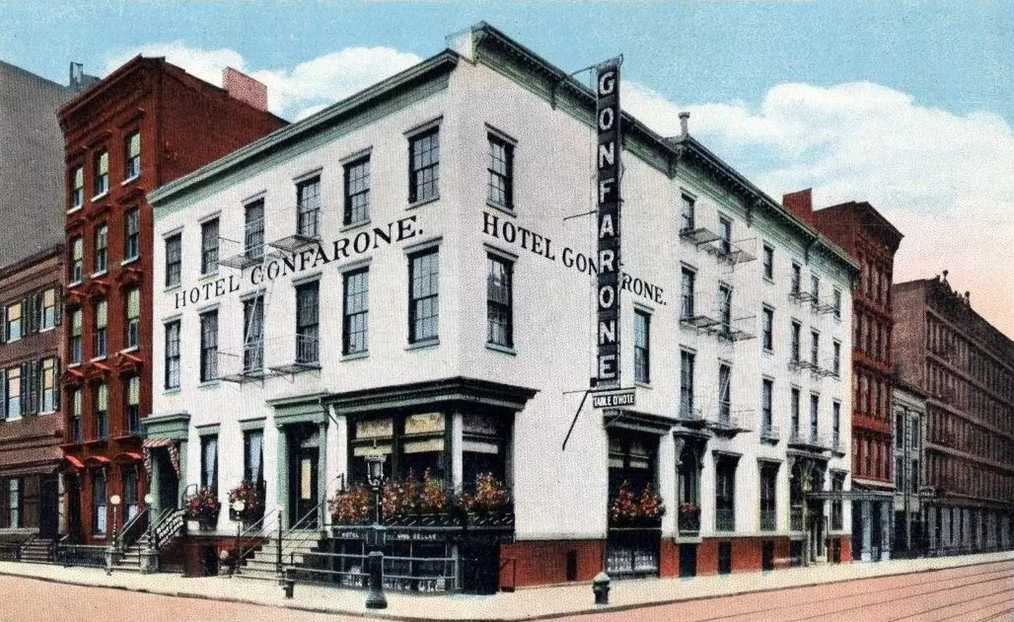
There is nothing as interesting (to me) as a memoir about a restaurant from an insider who reveals its workings not usually known to customers. Papa’s Table d’Hôte by Maria Sermolino is such a memoir, published in 1952, decades after her father’s ownership of the New York City restaurant, Gonfarone’s.
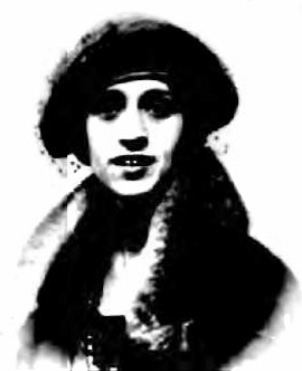
Maria’s career as an editor and writer was extensive. After graduating from the Columbia School of Journalism and spending a couple of years writing about post-WWI conditions in France, she interviewed Italian Fascist leader Benito Mussolini. Later she worked for Time, was the editor of The Delineator and for 11 years an associate editor for Life magazine. She attributed her lifelong unmarried status to overhearing conversations about women among waiters and from male guests invited by her father to join him at his table. [above, Maria at age 25, in 1920, the year she interviewed Mussolini]
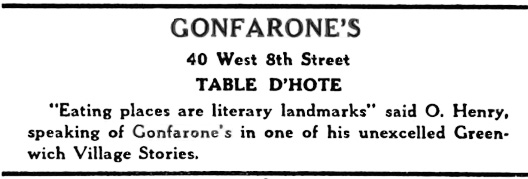
Gonfarone’s began in business around the turn of the last century as an Italian pension-type eating place, transitioning into a bohemian resort for Greenwich Villagers. It was run initially by Caterina Gonfarone who operated it in a basement on the corner of Eighth and McDougall streets. She soon partnered with Maria Sermolino’s father, Anacleto, who saw to it that the dining room was moved upstairs. Then, as neighboring residences were acquired by the partners, the popular Latin Quarter table d’hôte expanded to eventually accommodate 500 diners at a time. Sermolino soon acquired the restaurant from Madama Gonfarone, but kept her name.

After the Sermolino family moved into the complex of buildings (which also included a small hotel), Maria spent much of her childhood in the restaurant. Chapter 6 of her book is entitled “The Barroom Was My Playground.” She assisted her mother, the restaurant’s cashier, by spotting waiters who failed to pay her mother for drinks they ordered for customers at the bar. (They would have been reimbursed later, but without paying first they were able to keep the customers’ payments for themselves.)

But that is not the only way in which the staff tried to make extra money on the side. Dishwashers sold food scraps and fat to a company that made soap, with higher prices paid for barrels with more fat. On occasion Madama Gonfarone would catch a dishwasher pouring a large tin of unused lard into a barrel for a higher payoff. It was also common for the staff to smuggle out bottles of wine, chickens, lobsters, and other choice food items when they left at night. Her father refused to institute routine searches because he thought it would be bad for morale.

Because the restaurant was connected to a hotel, the bartender also acted as the room clerk. He took advantage of his position by renting rooms to prostitutes, even on occasion — when she was away — renting Madama’s room for more than double his usual charge.

Not all the restaurant’s customers were treated equally. Waiters would see to it that their favored regulars got larger portions, choicer cuts of meat, and less melted ice in their drinks. A standard menu, 50 cents on weeknights and 10 cents more on Saturdays and Sundays, featured Antipasto, Minestrone, Spaghetti, Salmon with Caper Sauce, a Sweetbread, Broiled Chicken or Roast Beef, Vegetables, Potatoes, Green Salad, Biscuit Tortoni or Spumoni, Fresh Fruit, Assorted Cheeses, and a Demi-tasse. In all likelihood the portions would have usually been on the small size.
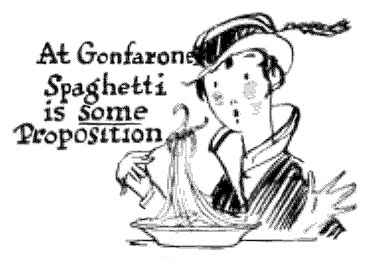
“By the simple act of ordering spaghetti an American was plunged into a foreign experience,” observes Sermolino. [above, 1916 advertisement from The Greenwich Village Quill; below, 1919 Quill]
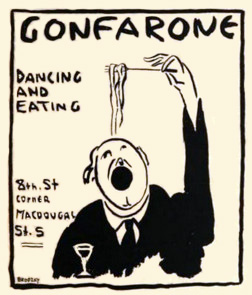
All meals came with a glass of California claret, which the restaurant bought 40 or 50 barrels at a time, reducing their cost to ten cents a gallon. Apart from that free glass, which impressed many American patrons who were unfamiliar with wine and considered it exotic, the bar was a money maker. Maria called it “a gold mine.” A Manhattan cocktail — with cherry — cost 3 cents but sold for 15 cents, she explained.
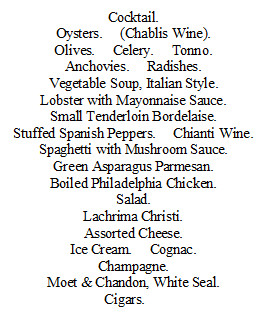
Banquet menus were grander and supplied more alcoholic beverages, as is shown in a 1904 menu above for a dinner given to honor a supporter of Democrats in the Tammany-controlled area occupied by the restaurant.

The restaurant’s best years were before World War I, when it was not unusual to serve four to five thousand dinners on an average weekday and double that on a good Saturday or Sunday, with waiting patrons spilling down the hall and into Macdougal Street. When food ran low the cooks would water the soup and waiters would offer patrons omelets.

With the onset of Prohibition, Maria’s father decided to get out of the business and concentrate on his other interest, real estate. Under new ownership, Gonfarone’s remained open for another 10 years, until 1930. The buildings were razed in 1937.

© Jan Whitaker, 2024

8 Comments

Filed under atmosphere, ethnic restaurants, menus, popular restaurants, proprietors & careers, restaurant customs, restaurant prices, waiters/waitresses/servers

Playboy on the town, 1850s style

Quite by accident I discovered a book called Fresh Leaves from the Diary of a Broadway Dandy, a moral tract that conceals its true purpose by enticing the reader with details from the wild life of a roguish playboy in New York city. It was published in 1852. [Except for one Thompson’s advertisement, also from 1852, the images in this blog are from the book.]

The book was promoted with the headline “Rich and Racy.” Author John D. Vose, who had earlier been the editor of a humor publication called The New York Picayune, wrote a few other short “diaries,” one titled Seven Nights in Gotham, another called Yale College Scrapes, and a third, Ten Years on the Town. Alas, I could not find those.

The Diary of a Broadway Dandy describes the doings of one particular young man named Harry for whom money flows endlessly. At one point he enumerates some of the 30 bills he just received from fashionable eating and drinking spots around town, all of which amount to a considerable sum which he dismisses as insignificant.

In an average week, he and his pals spend most of their time drinking uncountable bottles of booze of every kind, destroying property by breaking furniture, mirrors, and other things, and arriving back at their abodes extremely late in a drunken state. The dandies also pursue women, but just how far that goes is not detailed.

When Harry’s parents try to get him to go straight, attend church, and get a job on Wall Street, he balks and moves into a hotel. Clearly he belongs to a set of men identified in an advertisement for Charley Abel’s place on Broadway in 1852 as “the wits, fast men, and bloods of the town.”

His favorite eating and drinking places were plentiful, and included many on Broadway, among them The Arbour, Shelley’s Restaurant and Oyster Saloon, Taylor’s, and Thompson’s. (Note that at that time “saloon” meant a large roomy space, not necessarily a barroom.)

Of course, being a member of the “bon ton,” he also patronized Delmonico’s, taking his pals there for dinner one evening. He clearly liked to play the generous host not concerned about cost, but things didn’t go just as he planned this time. The day before he had ordered a dinner costing precisely $50 (about $2,000 today). When the bill came it was only for $42 and that made him quite angry. Next, he ordered a slice of white bread. Then, to make the point that he expected his exact demands to be met, he buttered the bread, placed a $50 bill on it, and ate it all.

At other places he and his friends visited, they drank vast amounts of booze and left behind a trail of destruction. On one occasion, on which nine bottles of champagne were consumed, then some brandy to settle their stomachs, he described the following:

“By some unknown way, a large mirror got cracked; but, as the landlord was a clever man, and I didn’t want to have no fuss, it being Sunday, I at once settled the loss with seven ten dollar bills, as I was not confident whether I did throw a champagne bottle against it or not. It has rather run in my mind since, that I did, but I won’t be certain. Yes, several chairs got broken, and were minus of legs and backs, yet that was laid to unknownity.”

Other casualties of drinking bouts at various times included damage to himself such as losing the heel of his patent leather shoes, staining his white pants, breaking his gold watch chain and his watch crystal, and breaking a bottle of champagne. He dismissed them, and he didn’t sound terribly contrite about an accident that happened on a Sunday either:

“Sloped from home, and took a drive with a particular friend out to the ‘Abbey.’ Found a great number out there. Our team being very dashy, attracted attention from every quarter – especially of the ladies. We drank twice, order a waiter to brush our attire three different times – made five new acquaintances, and then returned home. On our return we run the tire off of one hind wheel, causing four spokes to fall to the ground. So much for not being at church!”

By the end of the book, after the reader has enjoyed delving into the seamy exploits of the rich, the author issues stern criticisms. He concludes that it isn’t enough for a young man in New York who wants to be seen as an elite to have “the rocks,” go to the right places, or dress fashionably. Along with the rules of being a gentleman, “He must know how to be the part of a knave, a rascal,” . . . cultivating deceit “between the two gateways of virtue and vice, by sun-light and by gas-light.” Why? Because “This is a very wicked city.”

© Jan Whitaker, 2024

1 Comment

Filed under elite restaurants, patrons

The ‘bohemian’ restaurant in fiction

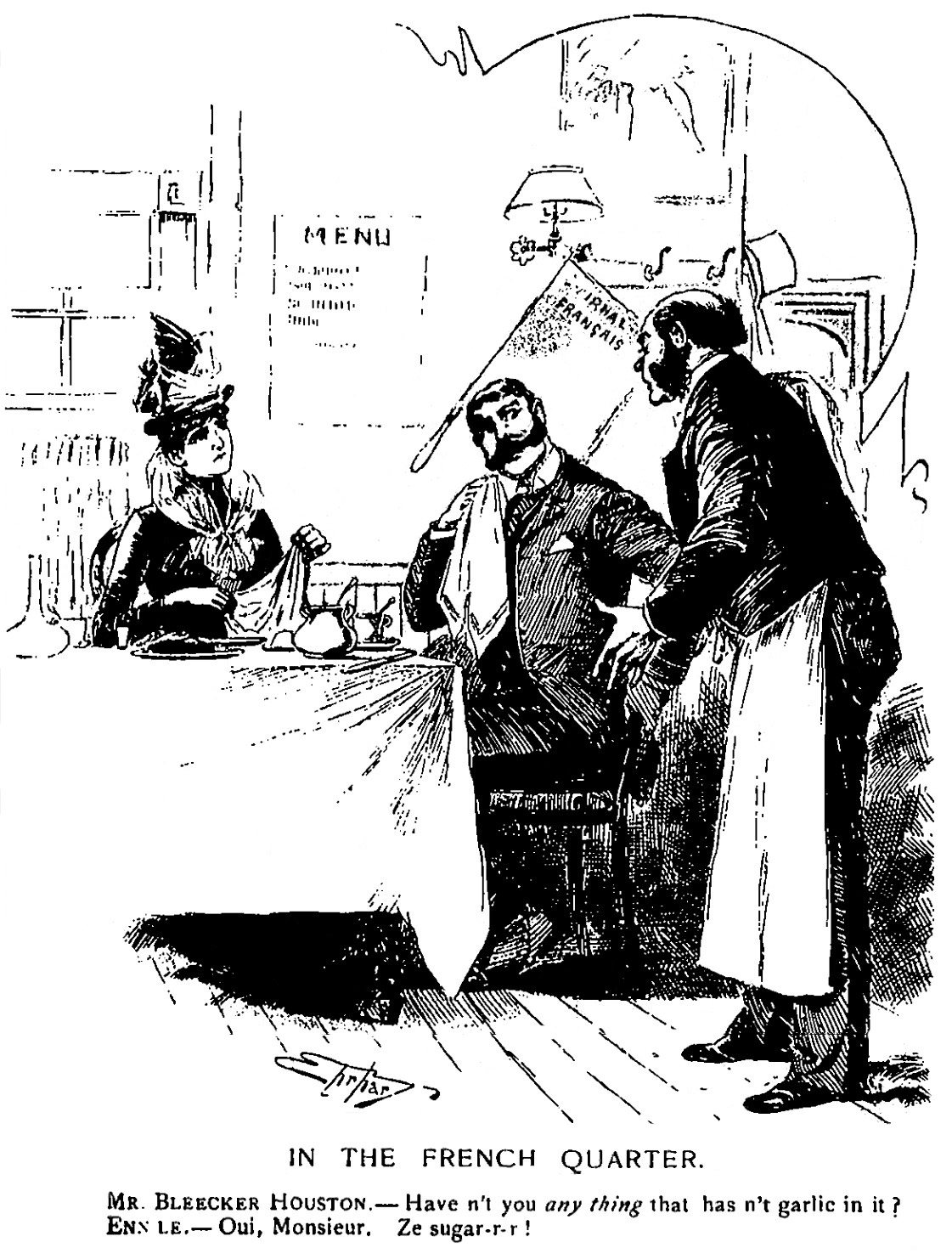
There was a time when many Americans considered inexpensive French or Italian restaurants naturally bohemian – wild and crazy, not too clean, filled with oddball characters, and offering menus of unfamiliar and dubious dishes. But nonetheless fascinating. Novelists liked to use them as settings, so they turned up in fiction of the late 19th and early 20th centuries as the excerpts below illustrate.

In the final sample presented here we meet up with a restaurant keeper who wishes his place was more bohemian because that would make it a better draw.

1886 The Midge, Henry C. Bunner – To celebrate the Midge’s 16th birthday, her guardian, a doctor, takes her out to dinner at a table d’hote in New York City’s French quarter.

It was a modest feast, only a plain table-d’hôte dinner, eaten in the heart of the quarter, at a cost of half-a-dollar apiece. They had tried more elaborate dinners, at the great hotels up-town; but they preferred the simpler joys of Charlemagne’s restaurant. They both possessed that element of Bohemianism which belongs to all good fellows; the Midge was a good fellow, as well as the Doctor.

Charlemagne’s is a thing of the past; but he was a jolly king of cheap eating-house keepers while he lasted. He gave a grand and wholesome dinner for fifty cents. The first items were the pot-au-feu and bouilli. If the pot-au-feu was thin, the bouilli was so much the richer. And if the bouilli was something woodeny, why, you had had all the better pot-au-feu before it. Then came an entrée, calves’ brains, perhaps, or the like; a rôti, a vegetable or so coming with it; a good salad, chicory or lettuce or plantain, a dessert of timely fruits, a choice of excellent cheese, and a cup of honest black coffee. And with all this you got bread ad libitum and a half bottle of drinkable wine, that had never paid duty, for it came from California, though it called itself Bordeaux.

1896 Some Modern Heretics: A Novel, Cora Maynard – About two women who adventurously move to Boston to live in a flat and do their own housework. But they don’t know how to cook.

And the alternative of tramping out to restaurants at all hours was a Bohemianism which, in spite of her late advancement, she could not contemplate serenely. It appeared positively disreputable. If her father knew of the actual circumstances of her situation a prompt withdrawal of his original consent would have cut short Vida’s visit on the spot; but she left him in tranquil ignorance . . .

By seven o’clock the girls realized that it was time to have dinner, and then came Vida’s great trial. It was too late to think of cooking anything themselves, so there was nothing to do but face the restaurant.
“Isn’t it a very – a very queer thing to do?” Vida ventured feebly. She would much rather have bought some crackers and eaten them at home in their unpalatable dryness.

“Why, no. It’s a little quiet place we’re going to. I’ve often been. You know we girls don’t believe in being restricted by senseless prejudices. Good gracious, one can’t be so dreadfully hampered in these days of rationality!”

Before long Vida got used to the restaurant, and even enjoyed it when they felt too tired or too lazy to struggle with the cookbook. She enjoyed the whole queer situation and got a taste of such freedom as she had never before dreamed of.

1910 Predestined, Stephen French Whitman – Featuring Benedetto’s, a favorite with artists in New York City.

On the north side of Eighth Street, close to Washington Square, an old, white dwelling-house had been converted into an Italian restaurant, called “Benedetto’s,” where a table d’hôte dinner was served for sixty cents. Some brown-stone steps, flanked by a pair of iron lanterns, gave entrance to a narrow corridor. There, to the right, immediately appeared the dining-room, extending through the house — linoleum underfoot, hat-racks and buffets of oak aligned against the brownish walls, and, everywhere, little tables, each covered with a scanty cloth, set close together.

Felix, at the most inconspicuous table, consumed a soup redeemed from tastelessness by grated parmesan, a sliver of fish and four slices of cucumber, spaghetti, a chicken leg, two cubic inches of ice cream, a fragment of roquefort cheese, and coffee in a small, evidently indestructible cup. Then, through tobacco smoke, he watched the patrons round him, their feet twisted behind chair-legs, their elbows on the table, all arguing with gesticulations. Sometimes, there floated to him such phrases as: “bad color scheme!” “sophomoric treatment!” “miserable drawing!” “no atmosphere!” Benedetto’s was a Bohemian resort.

1912 The Soul of a Tenor, W. J. Henderson – According to a review, “The reader is taken behind the scenes at performances and rehearsals and into the dressing rooms and boudoirs of the artistes; into the café, where foreign singers congregate.”

As for those women who figure in all animated chronicles of the present kind, some of them may have had husbands, but they have tried to forget them, and usually with success. Little Italian restaurants, with hot and opaque atmospheres, are in accord with their temperaments, for their part of the opera world is hot and opaque at all seasons of the year.

It was not a pretty place, that particular Italian restaurant. All the men in it seemed to require cigarette smoke as a condiment for food, and they chewed and puffed alternately. The room was filled with a wreathing blue fog, through which strange head-dresses and still stranger gowns could be seen, for the denizens of this world always garb themselves in streamers of splendor and look not unlike perambulating lamp shades.

They were not only singers. Some were impecunious painters and some were patrons of the arts, who were wont to shout “bravo” from the highest seats in the temple. It gave them a fine satisfaction to eat within reach of real singers. And they were not all Italians, for one feast of spaghetti makes the whole world of Bohemia kin.

1914 Our Mr. Wrenn; The Romantic Adventures of a Gentle Man, Sinclair Lewis – Mr. Wrenn is a lonely lodger who timidly invites a neighbor, Theresa Zapp, to dinner at a restaurant run by Papa Gouroff. She is described as “forward” and “gold-digging.” Although she is not interested in Mr. Wrenn, she accepts his invitation, but fails to be impressed by the restaurant.

The Armenian restaurant is peculiar, for it has foreign food at low prices, and is below Thirtieth Street, yet it has not become Bohemian. Consequently it has no bad music and no crowd of persons from Missouri whose women risk salvation for an evening by smoking cigarettes. Here prosperous Oriental merchants, of mild natures and bandit faces, drink semi-liquid Turkish coffee and discuss rugs and revolutions.

In fact, the place seemed so unartificial that Theresa . . . was bored. And the menu was foreign without being Society viands. It suggested rats’ tails and birds’ nests, she was quite sure. She would gladly have experimented with pate de foie gras or alligator-pears, but what social prestige was there to be gained at the factory by remarking that she “always did like pahklava”?

Papa Gouroff was a Russian Jew who had been a police spy in Poland and a hotel proprietor in Mogador, where he called himself Turkish and married a renegade Armenian. . . . He hoped that the place would degenerate into a Bohemian restaurant where liberal clergymen would think they were slumming, and barbers would think they were entering society, so he always wore a fez and talked bad Arabic. He was local color, atmosphere, Bohemian flavor.

© Jan Whitaker, 2024
6 Comments

Filed under alternative restaurants, ethnic restaurants, food, Offbeat places, patrons

Advice to diners, 1815

What follows are “Useful Directions to Epicures,” published in the (New York) Weekly Museum. The publication’s motto was: “Here Justice with her balance sits, and weighs impartially the deeds of men.” (The word “Museum” was sometimes used to mean a publication. Another example was the Farmers’ Museum, a New Hampshire newspaper of the early 1800s.)

At the time of publication New York city had a population of about 100,000. The war of 1812 had just ended. Most residents of the city were merchants, grocers, or tradesmen such as shoemakers, cabinetmakers, or carpenters. Eating places included boarding houses, small hotels, victualling houses, and taverns.

– Make it a rule to be early in your attendance: every epicure will allow that it is better to wait a little for dinner, than to have the dinner spoiled waiting for him.

– Carefully inspect the bill of fare that you may know what is coming, and be able to place yourself accordingly.

– Seat yourself directly opposite your favourite dish; in that case you will be able to help yourself to the nice cuts.

– Help yourself plentifully at first, as it is a thousand to one whether you have a chance of a second plateful, and there may be some present who understand the joint as well as yourself.

– Watch the eye of him who wishes to hob or nob, and ask him to drink a glass of wine with you. You may get drunk otherwise, but not so expeditiously and politely.

– If you wish to be very witty at the expence of any of the company, attack him after the second bottle, ten to one but he forgets it all before morning, or if not, you can plead that you had too much wine in your head.

My interpretation

The advice, clearly critical of common practices, is addressed to men, some of whom may have been renting bedrooms in the same building. This explains why the writer might see a dinner companion again the next morning.

The word “epicure” is probably meant to be humorous.

The “bill of fare” was likely a single sheet of paper on which the day’s or week’s meals were hand written.

At this time in history, everyone sat at communal tables for meals and helped themselves from shared platters and bowls. They would heap their plates high and the last person might not get the best pieces, or much at all.

It’s clear that meat dishes, referred to as “nice cuts” and “the joint,” were the most highly prized foods. The narrator – along with the others — would almost certainly try to sit as close to them as possible, even if that meant arriving early and waiting for the food to arrive.

The reference to the difficulty of getting a second helping reflects the customary greediness of patrons — and that would include the advice giver.

There was quite a drinking problem in early America, and getting drunk was a frequent occurrence.

© Jan Whitaker, 2024

2 Comments

Filed under restaurant customs

A tough business in a tough town

Most people realize that the expense and hassle of opening a restaurant in New York City is daunting, but a 1980 New York Magazine story by Paul Tharp laid it out in excruciating detail.

Generally new restaurants have a short run, but the piece underscored this observation by noting that the city’s Restaurant Association claimed that three of every four places shut down or had new owners within five years. Tharp added that a real estate broker said that one out of ten operating restaurants was for sale “at any given time.”

New York was a particularly tough city for restaurant operators. Higher food costs there meant that the consumer was going to pay four times the cost of a meal’s raw materials rather than three times, then the national norm.

Expenses involved in opening a new restaurant were staggering. Although the total estimate for a 40-seat restaurant of $162,018 given in the article seems quite low by today’s standards, it wasn’t then. The biggest chunks of money were for payroll, kitchen equipment, rent, and remodeling costs.

But that was just the monetary total. Tharp also outlined a time factor, noting that the amount of time spent getting set up was often not anticipated by those lacking previous experience.

The article observed that few new owners expected to be putting in 14-hour days the first year working in the kitchen or waiting on tables, virtually abandoning their personal life. Nor did they realize how much time and patience would be required to obtain licenses and satisfy city regulations, such as taking and passing a 15-hour Health Department course in sanitation and food handling.

And then there were the exasperating bureaucratic hurdles. For some it was a surprise that stove vents were required to extend to the top of buildings. If the Buildings Department found that the restaurant had not obtained a permit and met city standards for remodeling, an owner might need to tear out all the work that had already been done and start over.

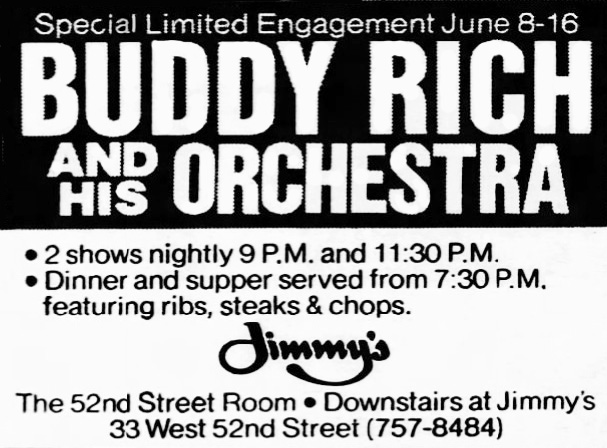
Taking over an existing restaurant may have avoided the hassles of remodeling, but its costs were likely much higher and brought their own hazards. Tharp relates a horror story involving two inexperienced men, elsewhere termed “babes in the gastronomic woods,” who wanted to take over a former Toots Shor restaurant for a bargain price if the new owners also assumed the restaurant’s debt. They teamed with major investors who pulled out and left them at sea. They renamed it Jimmy’s after soon-to-vanish partner Jimmy Breslin. Although at first it was quite popular, business then fell off with the recession and they realized they couldn’t handle the large staff or deal with unexpected costs such as credit card service charges, electricity rate hikes, and a temporary loss of their liquor license. Even adding an upstairs cabaret and a downstairs jazz club and hiring Jack Lemmon as Monday night bartender failed to attract the disappearing crowds. After about 34 months capped by a flooded basement, Jimmy’s shut down.

If Tharp’s report didn’t contain enough warnings, a published letter from a Manhattan realtor added another note of caution. He pointed out that owners of “quality buildings,” fearful of restaurant failure rates, tacked on security deposits equal to as much as five months rent, plus additional payments to make up for premiums required by insurers who assessed a higher fire risk for a restaurant tenant. Altogether, he estimated the operating budget should be 30% to 40% higher than Tharp’s.

Perhaps to offset all the bad news, the story included five thumbnail sketches of restaurateurs who overcame obstacles. I took a closer look at their subsequent careers, which raised some questions about just how well they all did. Three seemed to be well-connected pros who, despite disappointments with some ventures, did well overall. One of those briefly profiled was Peter Aschkenasy who had a number of successes including Charley O’s and U.S. Steakhouse, but who hit a snag trying to revive the classic New York restaurant Lüchow’s [pictured at top].

One restaurateur had a place I could find absolutely no trace of anywhere, and another had a single tiny restaurant with a short life. It was operated by the only woman mentioned in the story, chef Leslie Revsin, whose professional biographies unfailingly cited that she was the first woman chef to be hired by the Waldorf-Astoria. She opened Restaurant Leslie in Greenwich Village in 1979. With only nine tables and no liquor or wine license, it lasted only a few years despite critical praise. Following that she cycled through about nine New York restaurant kitchens including Argenteuil, One Fifth Avenue, and The Inn at Pound Ridge, often as executive chef. Eventually she turned to writing cook books.

© Jan Whitaker, 2024

Leave a comment

Filed under proprietors & careers, restaurant issues, restaurants

Good eaters: Josephine Hull

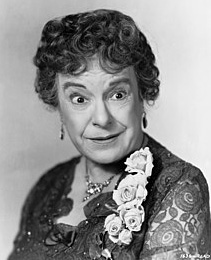
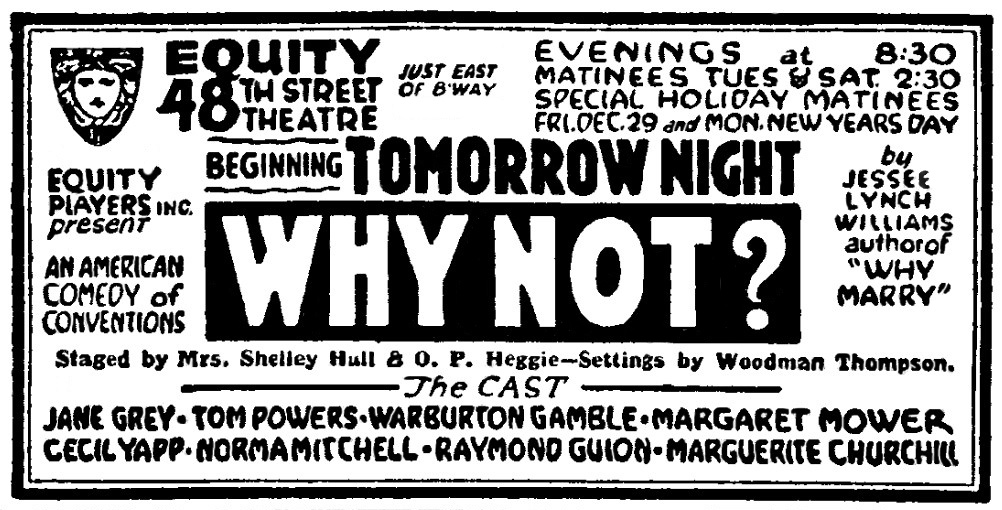
A while back I reviewed several years of a diary kept by New York City resident Josephine Sherwood Hull. Over a five-year period, 1920 until 1925, she recorded about 320 restaurant meals. This works out to a little more than one a week, which was considerable at that time. [publicity photo, ca. 1950, from movie Harvey]

I suspect her attraction to restaurants was largely explained by the fact that she was in the theater. After years of research into the history of restaurants, I’ve noticed that opera singers and theater people lived more of their lives in public than did the average American, and that included eating in restaurants frequently. Also, the 1920s was the decade that saw the number of women eating outside the home increase dramatically.

Then unmarried, Josephine Sherwood began her theater career not long after her 1899 graduation from Radcliffe College, where she had participated in amateur theatrics. In 1909 she married actor Shelley Hull and retired from legitimate theater. But after he died in 1919 – a sudden victim of the “Spanish” flu raging through the U.S. – she resumed her theater career as an actor and a director.

In 1922, 1923, and 1924 alone she directed four or more plays, and appeared in at least two others. Later she would appear in movies, often playing an older woman, frequently an aunt. She appeared in Arsenic and Old Lace, and in Harvey for which she won an Oscar in 1951 for a supporting role.

In the years of her diary that I looked at, Prohibition was in effect, and that along with greater employment of urban women during and after the war led to the flourishing of tea rooms, a type of restaurant that she favored. She went to the White Swan for dinner 24 times over the five-year period, the English Tea Room 20 times, mainly for lunch, and the Yellow Aster near her apartment on West 57th Street 12 times, again mainly for lunch. Other tea rooms she liked included the Virginia, the Thistle, the Hawaiian, and the Mirror. But despite her liking for tea rooms she rarely had afternoon tea, and when she did it was usually at hotels rather than independent tea rooms.

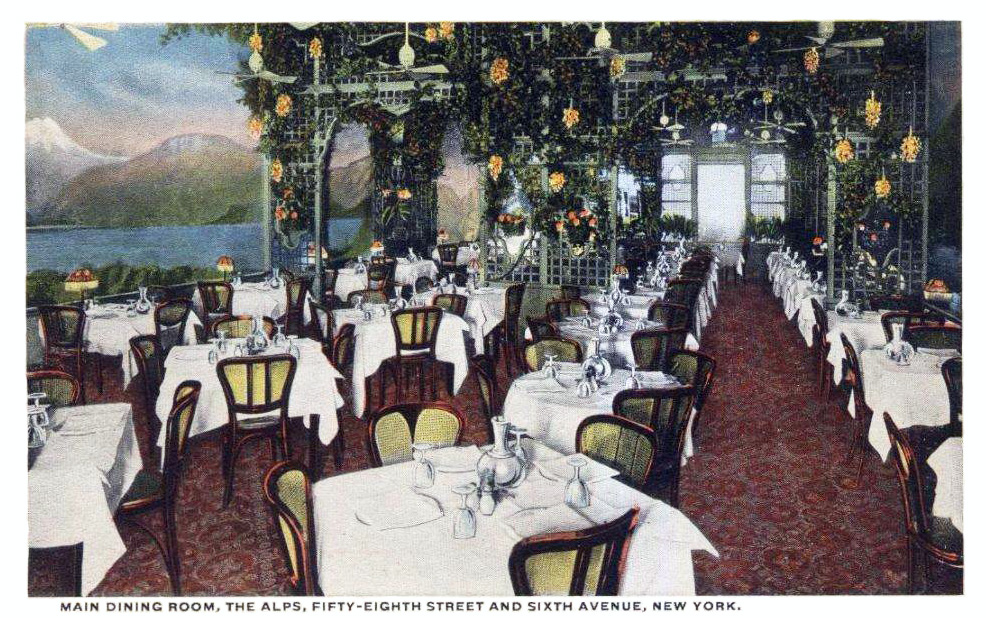
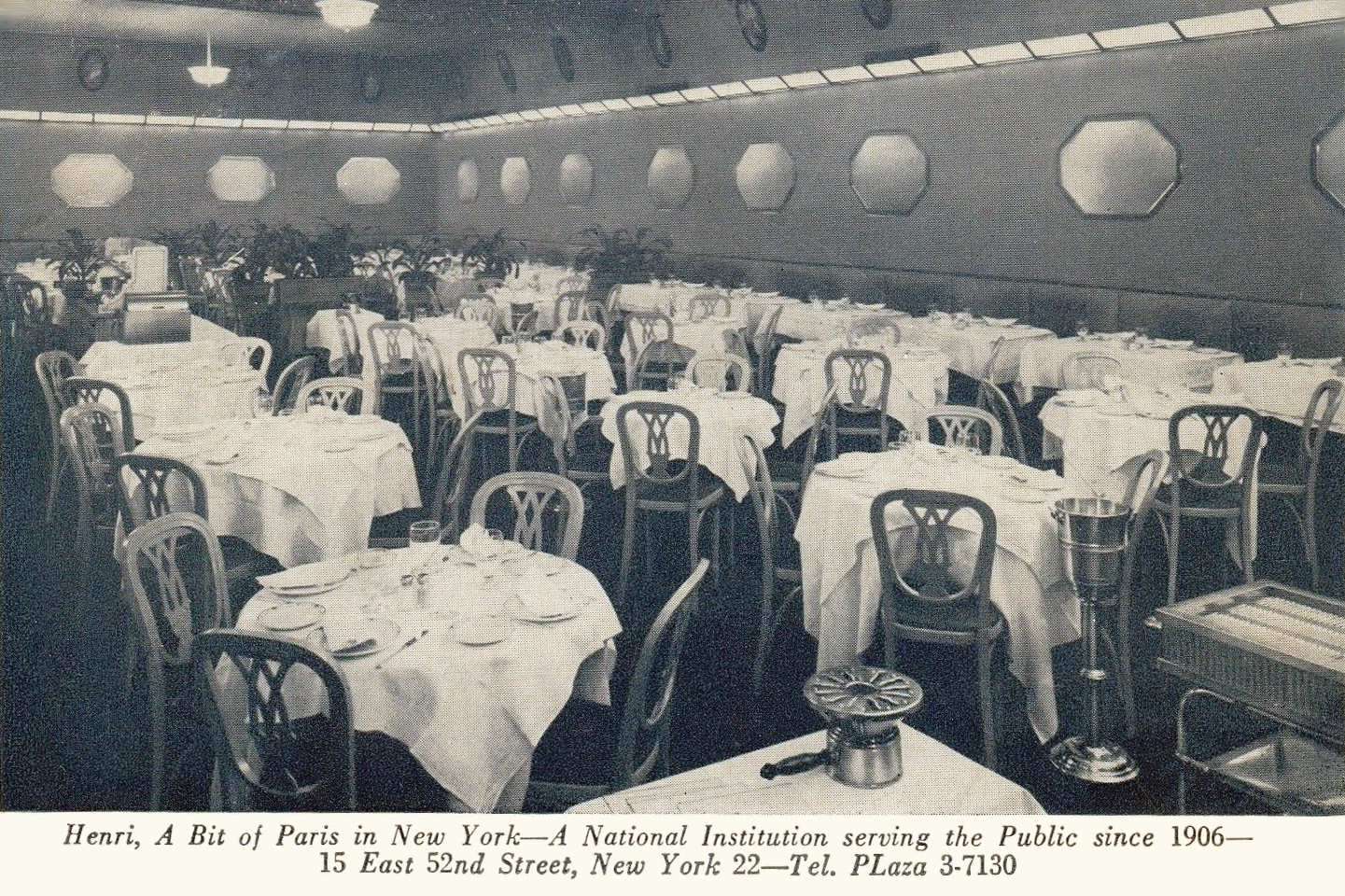
By far her most frequent meal out was dinner. She recorded eating it in restaurants 219 times. Her favorite dinner spot was a popular restaurant on 6th Avenue established in 1907 called The Alps. She also enjoyed The Hotel McAlpin, visiting their rooftop restaurant six times in warm weather. Henri’s was another favorite, as was The Tavern.

She had “supper” in restaurants 13 times, mostly in hotels. As a late night meal, supper was a favorite of theater people and others in the entertainment world. She visited a number of clubs, some of them related to theater, others emphasizing civic volunteerism.

Judging from the restaurants she patronized, except for tea rooms, she preferred places that might be described as continental, either Italian or French. For whatever reasons – perhaps reflecting her rather conservative middle-class background — there were some popular restaurants and areas of the city that she did not patronize in these years. The Automat was one. Nor did she record a single visit to a Chinese restaurant. She apparently was not attracted to Greenwich Village, a part of the city filled with tea rooms.

© Jan Whitaker, 2020

5 Comments

Filed under patrons, Polynesian restaurants, tea shops, women

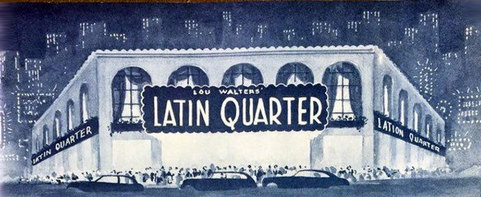
New Year’s Eve at the Latin Quarter

Anyone who wanted to celebrate New Year’s Eve at New York City’s nightclub The Latin Quarter in the 1940s and 1950s had to plan ahead. Way ahead, as in July or August.

The club – its name suggestive of Paris — seated 600 patrons. It took a lot of effort to fill it Like New York’s other nightclubs of that era, it was highly dependent upon out-of-towners.

Packing the house for two or three shows nightly meant that every travel agency in America had the LQ on its list, as did every convention planner. In 1956 it was said that there was scarcely an insurance company anywhere that didn’t include a night at the Latin Quarter among its prizes for top-selling agents.

The most ordered dinners were favorites of the time. Nightclubs weren’t known for the best food in town. Obviously, patrons were not there for the food, but for the show with lightly clad women. In the mid-1950s roast beef was tops. Then, somewhat surprisingly, came turkey, then steak.

The Latin Quarter opened in 1942, with Lou Walters as manager-owner and E. M. Loew’s of Boston’s Loew’s theaters as a financial backer. Walters (father of Barbara Walters) also had interests in LQ clubs in Boston, Miami, and Detroit, along with other nightclubs in New York and Florida.

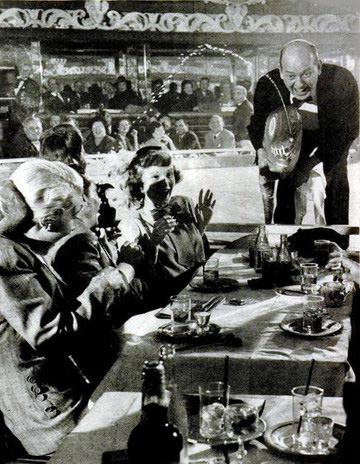
In addition to the nearly nude performers and big name bands and comedy acts, the LQ threw in some trick performances such as a waiter who unexpectedly squirted guests with water and a drunk photographer who would stumble onto the stage taking pictures of performers and creating a noisy ruckus. He was so convincing that guests (and sometimes even waiters) would try to shush him or have him arrested.

The Latin Quarter closed just before New Year’s Eve in 1968, marking the end of New York’s nightclub era. The building went through various identities after that, as a porn theater, a disco, and a hip-hop club.

Best wishes to everyone for happiness in 2020. Have fun, plan ahead, and don’t be fooled!

Leave a comment

Filed under alternative restaurants, night clubs, patrons

Dining in a garden

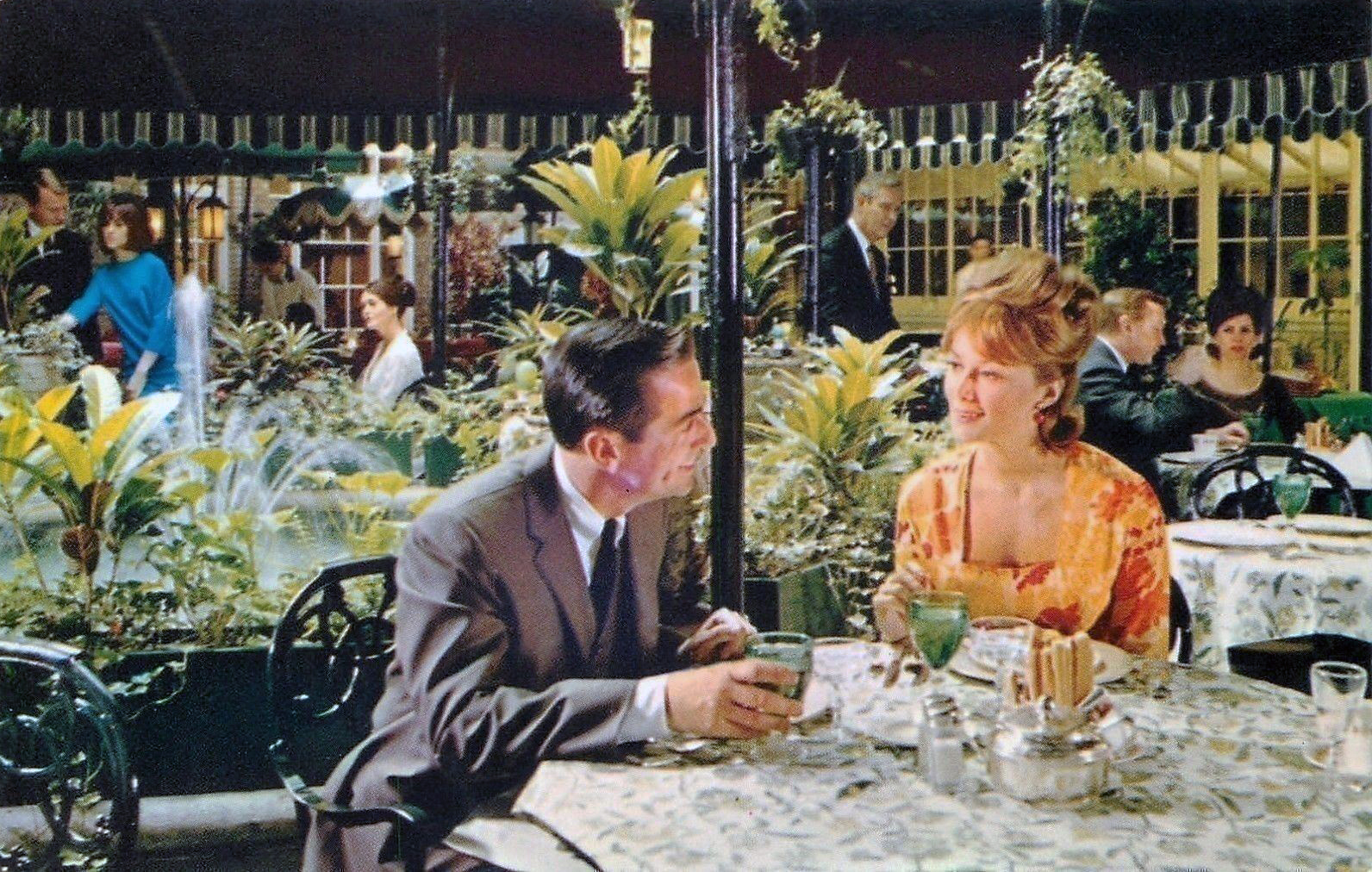
Pleasure gardens of the 18th and early 19th centuries, sometimes called tea or mead gardens, typically opened on May 1 and offered relief from summer heat. Garden dining could be as simple as a tent in the back yard of an eating place or as elaborate as a larger garden with walkways, fruit trees, and arbors. A Philadelphia tea garden of 1798 furnished “tables, benches, boxes, bowers, etc.” The “etc.” might have included colored lights, or even small rustic cabins.

Garden guests ranged from families and young couples to “gentlemen farming parties.” In many of the gardens, menus were limited to delicacies such as ice cream, confectionery, lemonade, iced drinks, teas and coffees, and of course wines and liquors.

But others served more substantial food that fell under the heading “relishes.” Today relishes are condiments but then the word referred to a wide range of hot or cold edibles, including steaks and chops, oysters, rarebits, poached eggs, omelets, kidneys, sardines, anchovies, sandwiches, savory patties, tripe, pigs’ feet, and soup. Relishes tended to be salty, no doubt to encourage drinking, and were usually “available any time.”

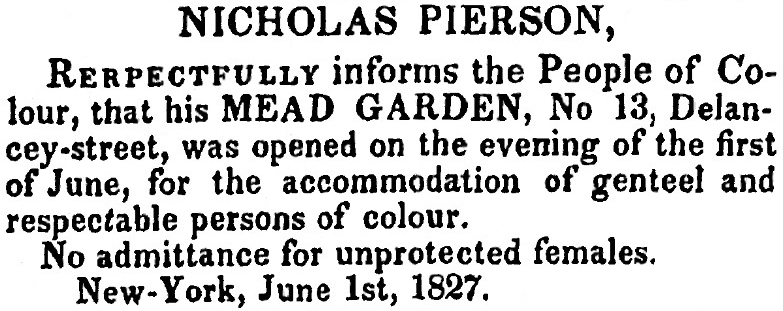
The early 19th-century gardens were meant to attract genteel folks, though I’ve run across a couple of advertisements suggesting it wasn’t so easy to discourage problem guests. The owner of a garden in Wilmington DE advertised in 1803 that he was opening his “elegant Mead and Flower Garden” for those who would “observe the strictest order and decorum” and not “injure his garden or molest his flowers.” Nicholas Pierson, in 1827, was evidently concerned that unaccompanied women (understood to be prostitutes) would want to enter his mead garden.

Unlike other drinking places, gardens were acceptable for women (if escorted). According to one report, mead — a sweet concoction of fermented honey and spices — was one of their favorite drinks. Mead gardens were more popular before the temperance movement took hold in the 1830s.

Tea and mead gardens were fading when German beer gardens appeared on the scene in the 1850s and 1860s, usually consisting of rows of tables in an open air setting amidst groves of trees, but not really a garden — and not usually providing food.

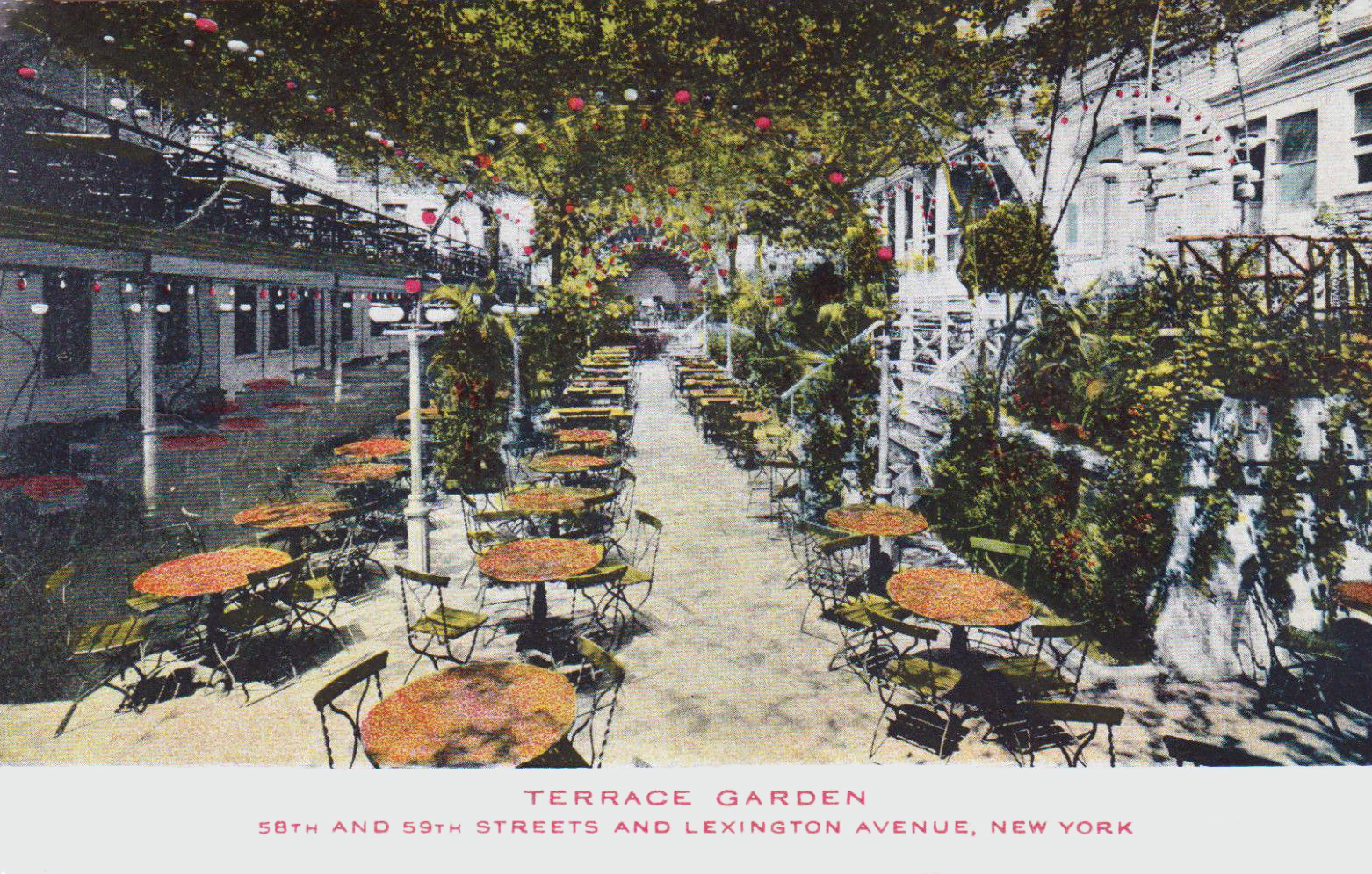
Dining in a garden once again became popular in the early 1900s, only now, in addition to outdoor gardens such as New York’s Terrace Garden and others on the roofs of tall buildings, there were many indoors, making them available year round. Natural touches included pendulous boughs draped from ceiling lattices, burbling fountains, potted palm fronds that threatened to tickle guests’ necks, and sometimes blue-painted ceilings twinkling with tiny stars.

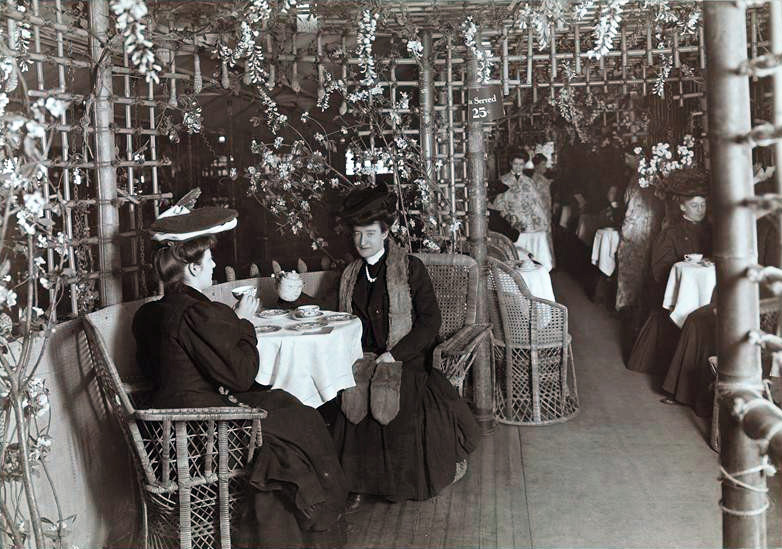
Department stores adopted garden motifs as did tea rooms where one could dine in an actual garden or, in rural New England, on the front lawn of the proprietor’s home. Tea rooms that chose a garden theme for indoors leaned heavily toward a Japanese style invoked rather simply with flower-strewn trellises and a bit of wicker or paper lanterns, as did Schrafft’s in Syracuse NY and the tea room at the Vantine store in NYC [above photo, 1906]. Actual Asian restaurants, on the other hand, were likely to include the word garden in their name, but that did not necessarily imply they had an actual garden.

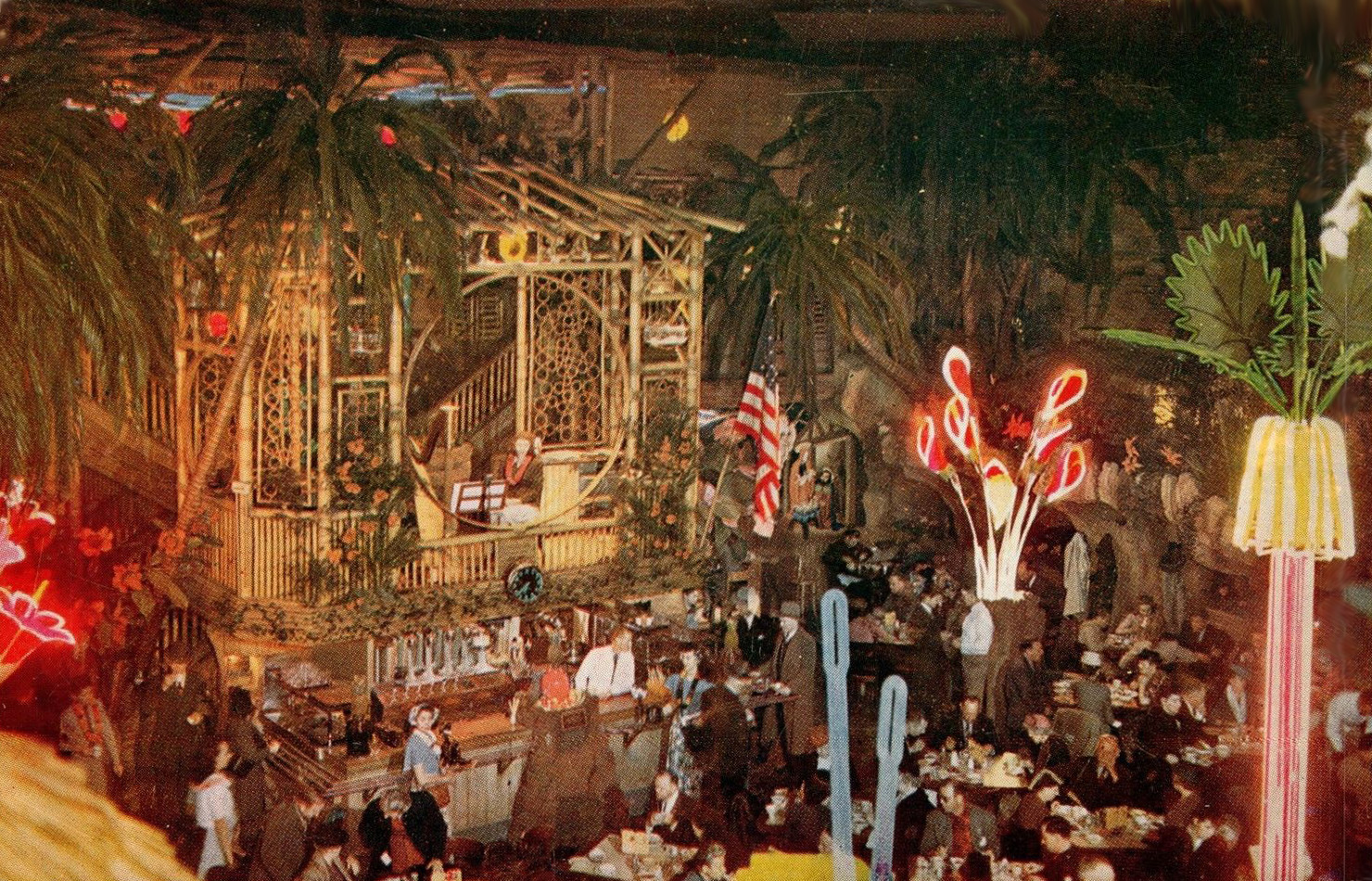
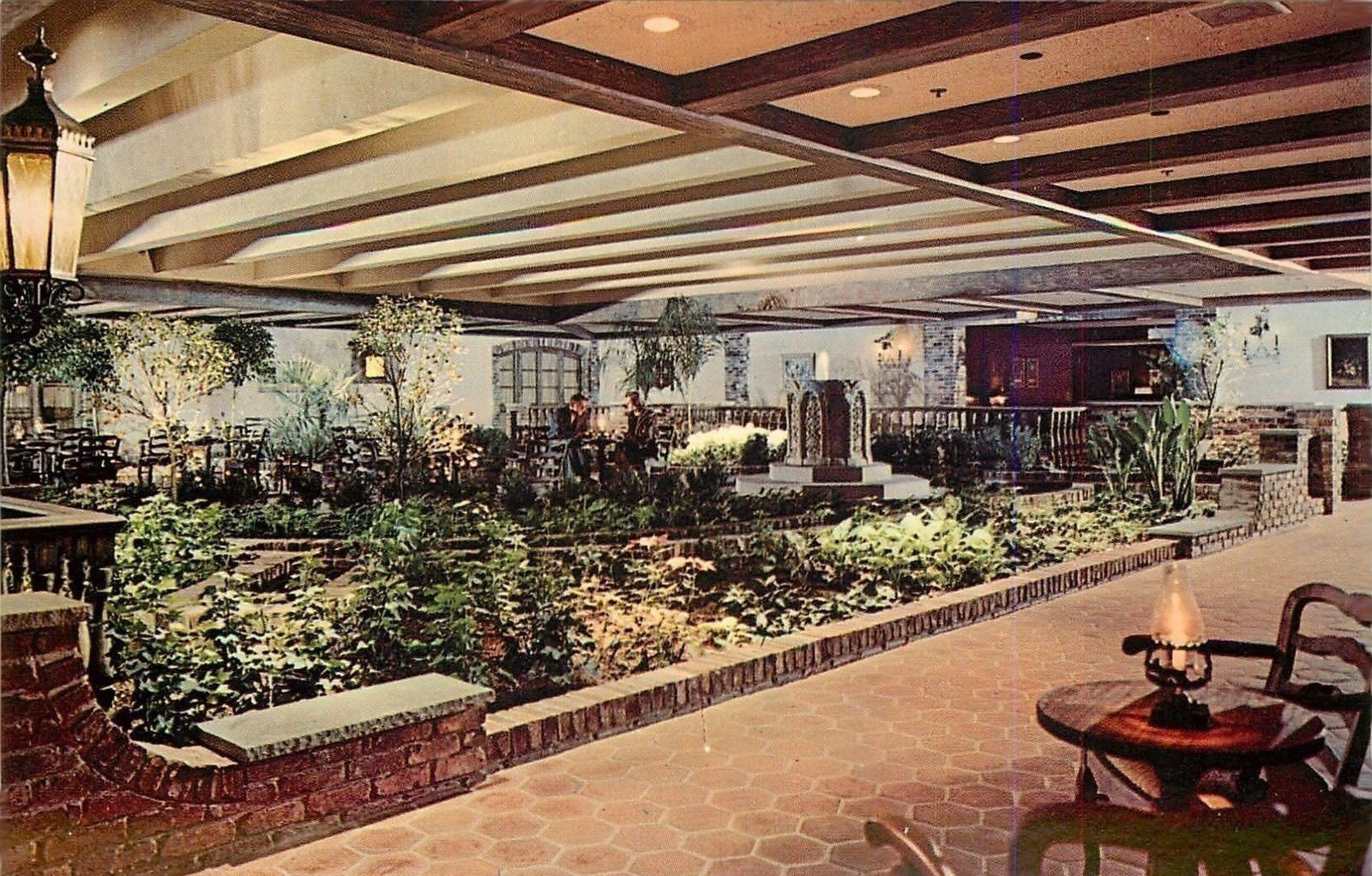
Undoubtedly, one of the most flamboyant indoor garden restaurants was Clifton’s “Pacific Seas” Cafeteria in Los Angeles [pictured]. Indoor palm trees are always impressive, as are neon flowers, multiple waterfalls (12), and volcanic rock. Clifton’s was but one of the many restaurants with indoor gardens that proved eye-catching yet less than totally convincing in terms of their relation to nature. [below, Stouffer’s Top of the Mart, Atlanta]

Today a restaurant garden, while in many cases still a popular place to eat in nice weather, is as likely to be a place where vegetables or herbs are grown and harvested.

© Jan Whitaker, 2018

5 Comments

Filed under atmosphere, decor, department stores, food, outdoor restaurants, restaurant customs, tea shops

Finds of the day: two taverns

Steuben Taverns

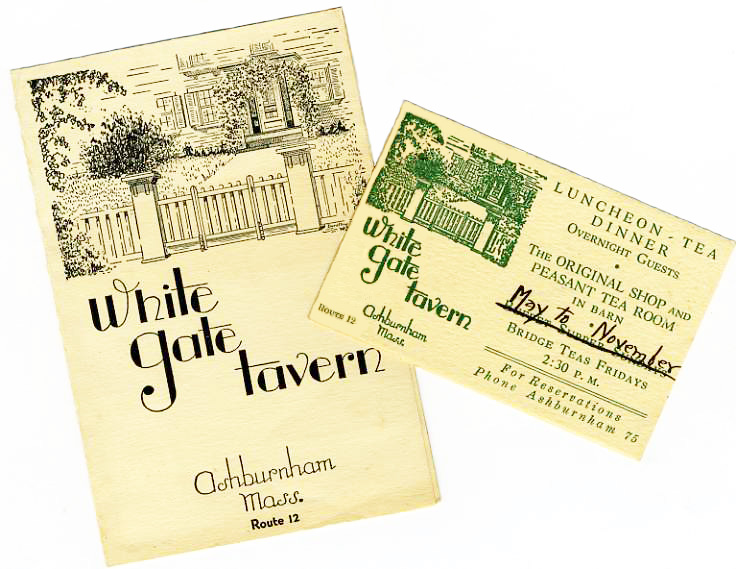
Two small finds on a cold, rainy day at the Brimfield flea market. Both are from the 1930s, both are taverns, and both conjure up bygone days. But beyond that, the two – one representing a chain of German-themed restaurants and the other a small-town tea room – have little in common.

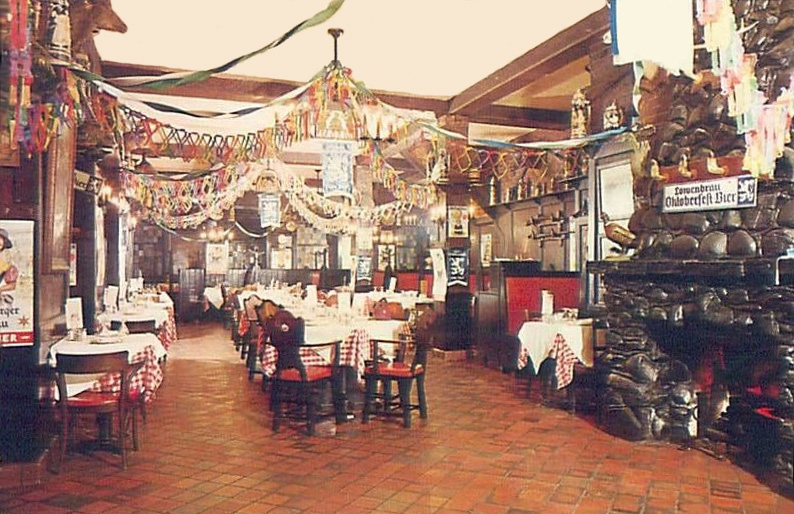
Steuben Taverns was a chain of pseudo-Bavarian restaurants located in big cities. The first, on 47th Street, was opened in New York City in 1930 and was the longest survivor of the moderate-priced chain, staying in business until 1971 [the postcard of the interior below is probably of the 47th Street place]. At its peak the chain had about a dozen restaurants, mainly in NYC but also in Newark, Baltimore, and Philadelphia.

The business encountered a few bumps along the road. Opening a huge, block-long unit in Times Square in 1934 proved difficult, dragging out to 14 months, because the restaurant was located over the Times Square subway station, which had to be redesigned. Despite selling a lot of beer (Prohibition had just ended) and seating 800 customers, the Times Square Steuben Tavern failed just five years later.

Meanwhile the chain suffered more grief in 1936 during a mobster shakedown that affected a number of high-profile NYC restaurants. As a chain the Taverns allegedly paid a particularly high sum – $17,000 – to ensure that the racket leaders did not carry out their threats to send “union” picketers or set off stench bombs.

Strangely, given its German theme, the Steuben Tavern in Newark evidently entertained many Jewish patrons in the 1930s. On September 14, 1934, with the Nazis in power in Germany, the restaurant took out an advertisement in Newark’s Jewish Chronicle wishing its patrons the best for the Jewish holidays.

White Gate Tavern

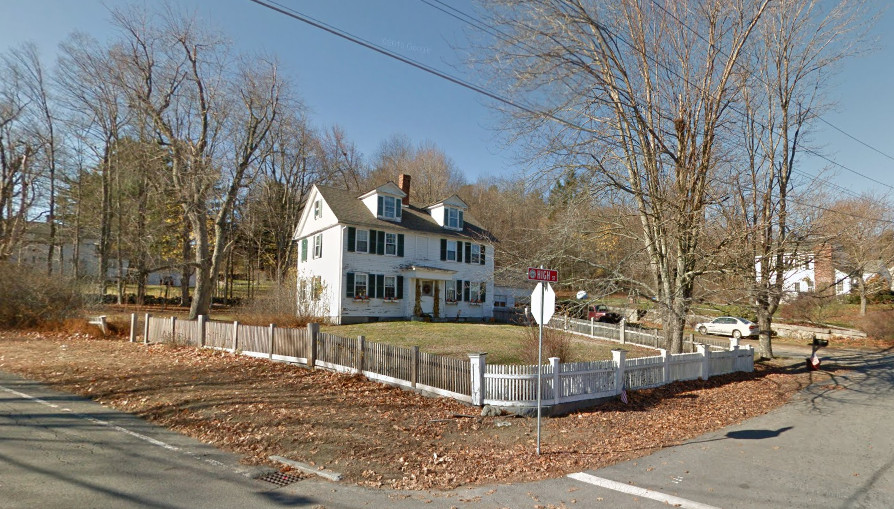
It was almost as though the White Gate Tavern was in another country altogether, one without beer, racketeers, or subway stations. It began in business in August of 1932 in the town of Ashburnham, Massachusetts, in a 100-year-old house formerly occupied by a Latin teacher at the town’s private school, Cushing Academy.

Its proprietors were two unmarried middle-aged women, both of whom had worked for the Y.W.C.A. at one point. Ida J. Lyon was from Connecticut and, as a member of the Daughters of the American Revolution, a bona-fide Yankee. Her partner, Helen G. Cowell, was the daughter of the late but long-time principal of Cushing Academy.

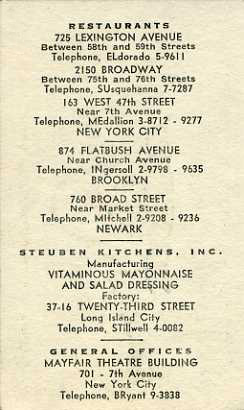
The two women set about having the house remodeled for use as a guest house and tea room. They installed a modern kitchen with electric refrigeration, a convenience undoubtedly not enjoyed by many of the townspeople at that time. They emphasized the house’s old-fashioned Colonial features as they were considered “homey” by their prospective patrons. The dining rooms were decorated in a green and yellow color scheme that was carried over to the dishes and glassware. In 1932 – in the depths of the Depression – they offered special Sunday dinners for $1.00 and $1.50. (By comparison the Steuben Taverns advertised their “famous” 55-cent dinners on the business card from about the same time.)

In the next few years, further improvements were made to the White Gate Tavern. A yarn shop where knitting lessons were given was opened in a finished room in a barn adjoining the house. In 1935 the interior of the house was renovated and the kitchen was enlarged. A so-called Peasant Tea Room was opened in the barn, along with a “Sunbeam Shop,” a gift shop with crafts made by villagers.

The White Gate Tavern probably closed in the late 1930s. I could find no trace of it after 1937 — the local newspaper carried no further notices of its annual opening for the season or the usual lists of guests who stayed there.

The house is still standing and from the outside likely looks much like it did in the 1930s.

© Jan Whitaker, 2017

2 Comments

Filed under chain restaurants, proprietors & careers, tea shops, women

Girls’ night out

GirlsNightOut

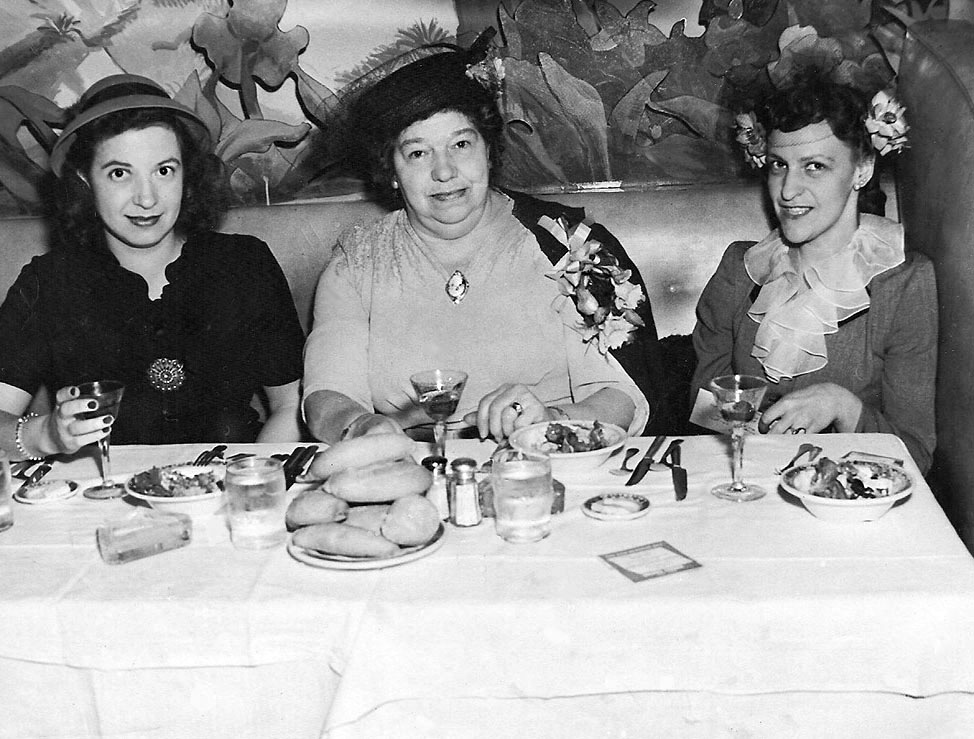
This is one of my favorite photographs, the kind I tend to hoard until the perfect moment. I put it in the same league with the wonderfully evocative photograph in That night at Maxim’s. It seems just right for the first post of a new year.

Once again, I invite readers to imagine what is going on. I know little other than that they are in a restaurant in New York City. Because they are seated  at a banquette, and because the photo was almost certainly taken by a professional photographer, I would guess it is a nightclub restaurant, or certainly a special occasion type of place. Judging from their outfits and the style of the mural behind them, I think it is the late 1940s or early 1950s.

I love how directly they look at the photographer and how contented they are. I think the woman in the middle is the mother of the woman on the left. Perhaps it is her birthday. Could the other be a cousin? She seems to have been interrupted just as she is about to present what looks like a check to the older woman.

They are drinking manhattans or martinis, not paying too much attention to their salads, and totally ignoring the mound of dinner rolls piled so unceremoniously on a too-small plate. The awkward way the rolls are served and the ordinary serviceable restaurant ware (water tumblers, dishes, and salt and pepper shakers) makes me think it is not an elite restaurant. Still, love those butter pats on the tiny plates!

The only objects in the photograph that I cannot identify are two small squares of paper on the table, one in the foreground right and the other just beyond the salad of the woman on the right. Forms to fill out for the photographer?

Thoughts?

© Jan Whitaker, 2014

10 Comments

Filed under patrons