Tag Archives: Chicago restaurants

A grandiose failure?

It’s difficult to assign a definite cause to the short life of Raphael’s, a Chicago restaurant that opened in October 1928 and seemed to have closed by the following July. It would make perfect sense if it had failed after the Wall Street crash at the end of October 1929, but it seems to have closed while the boom was still in progress. [Above: Detail of a platter from Raphael’s shown below, with a fanciful depiction of the building.]

Then again, Prohibition was in effect and that almost undoubtedly contributed to failure. But whatever the cause, Raphael’s on Chicago’s south side didn’t even make it to its first birthday as far as I can tell.

Judging from its exotic design, the restaurant clearly had grand aspirations. Its financial backing totaling $300,000 amounted to a small fortune at that time, equal to nearly $5,700,000 today. At least two thirds of the capital came from a major Chicago investment banker. The remaining $100,000 presumably was furnished by the restaurant’s nominal owner, Edwin Raphael.

In June of 1928, as construction began, the Chicago Tribune ran a snarky story that managed to insult the design as well as Chicagoans’ taste in general. It said that the building “should make one think he’s in Persia, provided he doesn’t know too much about Persian Architecture,” and that it was aimed at “Chicago’s epicureans – if we have any.” [Above: Raphael’s main dining room in 1929]

The layout of the building accommodated a small tea garden inside the front door that was outfitted with trees and fountains. Next came a two-story dining room accommodating hundreds, with a ceiling imitating a blue sky with twinkling stars and surrounded on all sides by a balcony that also held tables for guests. Two ends of the building provided people entering from the street access to two interior lunch counters with soda fountains. [Above: one of the lunch counters, but looking strangely like a bar.]

With its minaret, the building reached 60 feet in height and was visible for miles along all three major streets that crossed there. The minaret was used for advertising with neon lighting and a crescent on top. The illustrations used for this building, whether on the restaurant’s dinnerware [shown above] or in advertising, took great liberty in portraying it. [Below: April 1929 advertisement that imagines the building with two domes, four minarets, and palm trees!]

The main dining room featured a band named Raphael’s Persians. Their performances could be heard on the radio at night.

The March 1929 issue of The American Restaurant Magazine hailed Raphael’s for its ability to merchandise meals by “stealing the thunder” of night clubs and offering them stiff competition while putting food “foremost.” When the radio audience listened to the Raphael’s orchestra, the story said, they would feel that the restaurant had “an air of mystery about it” and want to visit “Chicago’s most exclusive restaurant.” But did they?

The combination of three types of eating places in one business was an odd one, something that would be more understandable in a hotel than a restaurant. It would seem as though the tea room and the snack bars would keep earlier and shorter hours than the restaurant/nightclub which stayed open until 3 a.m. and that this would cause staffing problems. By June of 1929 Raphael’s had figured out more ways of making money, as is shown on the advertisement below, such as afternoon dancing, an additional cover charge, and higher cover charges on weekends, but it’s likely that it wasn’t enough.

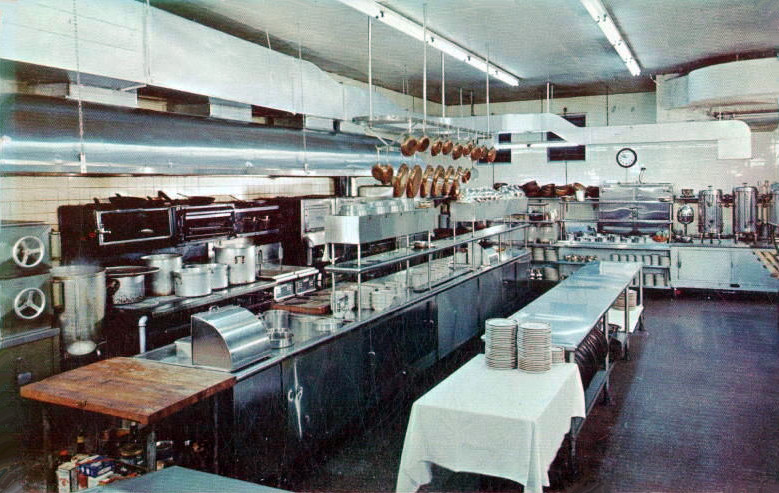
The trade journal also hailed Raphael’s for its modern kitchen facilities that were filled with the latest mixing machines, ranges, refrigerators, warmers, etc., proving “that the kitchen methods of this modern restaurant are a far cry from the methods employed when the members of Persian tribes would prepare feasts for their shahs.”

A reader of The American Restaurant would be left with the idea that Raphael’s was an elegant place catering to a clientele with sophisticated tastes. But that idea was dashed in a story written by a young reporter who spent a night there playing the part of a “shy cigaret girl.” Over the course of the evening male patrons hit on her nine times. She also observed people drinking alcoholic drinks, probably enhanced by their own whisky flasks. The crowd included teenagers. By June of 1929, the restaurant was reduced to featuring a “crystal gazer” on the balcony named Allah Mahalla. So much for elegance!

Despite serious searching I could find no advertising, nor any mention of the Raphael restaurant at all after July, 1929. In 1940 the address was mentioned as the location of a bunco party (a dice game) hosted by a political group. In 1947 the building, then occupied by a beauty supply warehouse, was auctioned for taxes. It sold for a mere $14,027 plus payment of back taxes of $11,259. The second floor was offered for rent in 1948, and it may have been then that the American Legion moved in. [Above: Could the Hippodrome have occupied the building when this advertisement ran in 1938?]

However, according to a recent Chicago Sun Times story by architectural critic Lee Bey, Raphael’s continued in business until WWII, and “later converted into the American Legion South Shore Post 388.” I haven’t been able to find out why he thought Raphael’s stayed in business that long.

Another eating place that might have once occupied the building (in addition to the Hippodrome) was the Kickapooo Inn. Its address was given as 7901 Stony Island in a 1957 obituary notice for its owner.

The building was acquired by The Haven of Rest Missionary Baptist Church in 1966 and used for church services until 1977 when they built a new church. Now the church is seeking a grant to restore the building, hoping it can be reopened in a few years as a community center. [Above: the building as it appeared recently.]

If any reader has information about this building and its uses over time, I’d love to hear from you. It could assist the church in applying for grants.

© Jan Whitaker, 2025

4 Comments

Filed under atmosphere, night clubs, odd buildings, Offbeat places, restaurant decor

Mobsters & racketeering

This post was inspired by a 1959 Life Magazine feature story on the Chicago underworld. The magazine created a fictitious café to show the goods and services that actual mobsters forcibly provided to restaurants. The illustration above indicates those areas of mob involvement commonly found in restaurants then – and probably now to some extent.

In the magazine, a brief description of some of the real life gangsters who had invaded restaurants was linked to the illustration, complete with headshots of them (not shown here).

Here is a summary of who furnished what:
1 Former Capone lieutenant operates in laundry (and produce) unions. (See my earlier post about gangsters in the restaurant laundry business.)
2 Hit man handles steam cleaning of beer tap coils.
3 Slot machine operator also gets a cut of juke box revenues.
4 Former Capone gunman is boss of bartenders.
5 & 8 Two gangsters push Fox Head beer and get a cut.
6 Another juke box boss also handles vending machine merchandise.
7 A third juke box boss runs 15 Teamster locals and handles delivery drivers.
9 Meat supplies are furnished by the syndicate nightclub controller.
10 Man who handles syndicate bookkeeping also sells glass-washing machines through a front.
11 Former Prohibition-era bootlegger handles liquor distribution.
12 Glassware and glass-washing boss handles machines that happen to break glassware, stimulating his business.

The movement of mobsters into these fields began at the end of Prohibition, when bootlegging became obsolete. The mob had infiltrated the Teamsters Union in Chicago, and used it to their own advantage, doing little if anything for the workers, who saw little benefit and in many cases did not even know they were members.

Strangely enough, Life seems to have left out mobsters in the trash removal business.

As the story explains, if the restaurant owner “balks, the syndicate can harass him by ordering pickets to scare off customers. If this fails, the mob, which controls waiters and bartender union locals, can call members out. Since the mobsters also control Teamster locals who deliver, they can put the owner out of business by cutting of his supply of beer or by stopping his garbage pick-up.”

The next step would be violence such as burning down the restaurant, dramatically so in the case of suburban Chicago’s Allgauer’s Fireside Restaurant in 1958, whose owner was being punished for testifying at a Senate hearing on organized crime. The “workers’ union” at Allgauer’s was under the control of a local underworld leader. The crime was never solved. I would say “curiously unsolved” except that was always the case.

© Jan Whitaker, 2025

4 Comments

Filed under restaurant issues

Famous in its day: Well of the Sea

A short time ago I had a chance to visit the fascinating second floor of the Fishs Eddy store in New York. It is piled high with not-for-sale dishware of all kinds, collected by the store’s owner Julie Gaines. The collection includes restaurant ware from the golden past when this country still produced such things. (Tours of the collection, hosted by Julie, are given periodically and booked by the New York Adventure Club.)

The Fishs Eddy collection also includes records from china producers that show pattern designs. A page from Shenango China in Newcastle PA — closed in the 1970s — depicted the design for a plate made for use at the Well of the Sea restaurant in the former Hotel Sherman in Chicago. (A ca. 1950 painting of the restaurant by Cal Dunn is shown at the top of this page. Below is a plate using the above Shenango design.)

The restaurant opened late in 1948 in the hotel’s basement, which no doubt suggested an underwater theme to the hotel’s owner, the colorful and theatrical Ernie Byfield. He had also originated the over-the-top glamour restaurant, the Pump Room in the Ambassador Hotel.

A number of abstract murals of underwater scenes by Richard Koppe, Chicago painter and student of the German Bauhaus, decorated the walls of the restaurant. One of them was used for the menu’s cover shown below. The room was further enhanced by darkness and other-worldly ultraviolet lighting.

In addition to the murals, Koppe also contributed wire fish and light sculptures somewhat visible in the black and white advertisement of unknown date. The color menu depicted one of the murals.

Needless to say, the restaurant specialized in fish, with frequent shipments coming in by air. It was especially known for what was called Black Clam Chowder made with Madeira wine, clams, and many herbs and spices. A portion of a menu is shown above.

Another unusual feature of the Well of the Sea was the attached art gallery in which the work of Koppe and other Chicago artists was displayed. The exhibit of Richard Koppe’s work took place in December, 1949, one year after the restaurant’s opening.

In 1968 the Sherman’s general manager explained that the ultraviolet light used in Well of the Sea was glamorous when it illuminated jewelry and white shirts but not when it lighted false teeth. But the customers liked it anyway despite the room being so dark that waiters had to assist them with flashlights in order to read menus. In 1968 a glow-in-the-dark menu was introduced to make reading easier.

Exactly when the dishware inspired by Koppe’s murals and designed by Shenango Potteries’ Paul Cook came into use in the restaurant is not known with certainty. According to Margaret Carney, whose International Museum of Dinnerware Design in Kingston NY features many pieces of dinnerware from the Well of the Sea, the design shown on the Shenango file page above was probably not used until 1954. What preceded it is unknown.

The Well of the Sea was popular from the start and stayed in business until 1972, a year before the Sherman itself closed.

© Jan Whitaker, 2024

5 Comments
Filed under atmosphere, decor, menus, Offbeat places

Status in a restaurant kitchen

The status hierarchy in a restaurant kitchen depends on a variety of factors. Skill is clearly one of them, but, historically — if not currently — there have been others, some of them surprising.

In 1944 and 1945 sociologist William Foote Whyte spent time observing kitchens in a number of Chicago restaurants. To one of them he gave the fictional name “The Mammoth” because of the size of its kitchen which employed 45 persons excluding dishwashers.

Whyte noted in his book Human Relations in the Restaurant Industry that by that time in this country, the French chef had lost influence and “this system has steadily degenerated,” eliminating some of the hallmarks of status.

But there were still distinctions of rank, fainter and sometimes subtle yet real.

In step with that time, gender was still a major factor contributing to status. It was linked to skill and experience as well as the difficulty of tasks. It was also reflected in the use of knives and heat, and the sorts of food handled. Although because it was wartime, more women were assuming these positions, at The Mammoth it was men who did the cooking, and men who both portioned and cooked red meat.

Women handled the lower-status food: chicken, fish, and vegetables. The Mammoth’s food suppliers at that time had not yet taken over much of the food preparation as they have in more recent decades, leaving many tedious tasks to the staff that sliced, chopped, and otherwise prepared fresh food for the cooks and sandwich makers.

Among vegetables, he explained, decorative items such as parsley, chives, and celery ranked highest. (Their elevated status reverberates today in the many photographs of elite chefs bending almost double as they carefully tweeze small decorative touches into place.)

One notch down came green beans, followed by spinach and carrots. Undoubtedly the status of these vegetables derived in part from their popularity with customers. But also, he explained, on the women workers’ opinion of them, based on “lack of odor, crispness, and cleanness of handling.”

Lowest in status were potatoes, then at the bottom onions. Whyte states that the “low standing of potato peeling is too well-known to require comment.” I’m not quite sure what it derived from, although it is well known that military recruits strongly disliked kitchen duties that involved peeling potatoes.

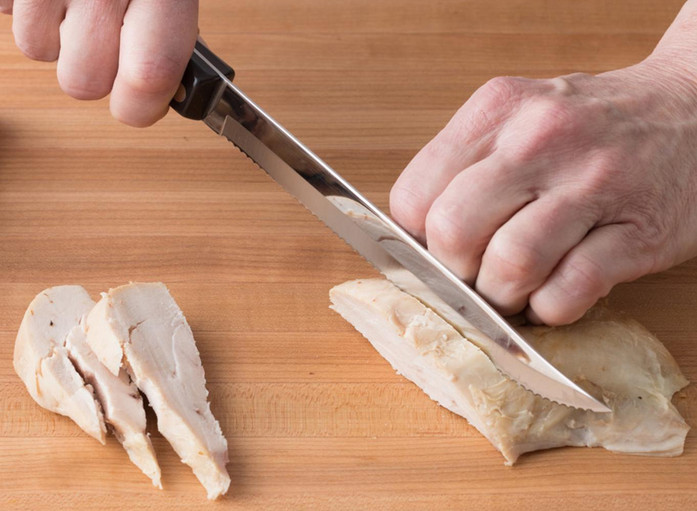
Seven women handled cooked chicken. Those who sliced the chicken were at the head of the line. Slicing white meat was higher in status than dark meat. Next came two women who portioned and wrapped slices for sandwiches. On the bottom rung were three women who picked the remaining meat off carcases, with the one who picked white meat ranking higher. The worst job, that of the seventh woman in line, was picking bits from chicken neckbones. When the worker assigned to that task complained about always getting the necks, she was assigned to another job.

Deep disdain for the chicken picking job was highlighted in the response of one of the workers on the line whose job was wrapping slices. She commented to Whyte that it was tedious. When he asked her if she would prefer picking, she frowned and said emphatically, “Oh, no, I wouldn’t want to do that.”

The woman who handled the fish station, “Gertrude,” was highly regarded by management but not by employees because they held a low opinion of fish, considering it smelly. According to Whyte, this put her station “at the bottom of the status hierarchy,” even though with the wartime meat shortage, fish was assuming a much more important role in restaurants. He attributed the workers’ attitude to ignorance, particularly because The Mammoth had a high standard regarding fish and bought only the freshest. Gertrude strongly disliked being referred to as “the fish lady,” and asked that in the book Whyte refer to her station the “sea-food station.”

© Jan Whitaker, 2023

2 Comments

Filed under food, women

Fish & chips & alligator steaks

The menu shown here caught my eye as I was browsing the internet. Of course, I wanted to know more about it. The first thing I discovered was that it is available as a reproduction.

Evidently the Trebor Dinner was a specialty menu for complete dinners of multiple courses. Three dollars was a steep price for the Depression when this menu was introduced, at least double what a comparable meal would have cost in a moderately-priced good restaurant then.

The illustrated menu shows 14 entrees. But the restaurant almost certainly did not have all the exotic items available at all times. Another fish & chips, inc. menu from 1937, for example, offered one appetizer, one soup, and only four entrees.

The menu could date any time from the opening of the restaurant in 1936 into the 1940s. Its clever design may have been due to owner Bob Winter’s background in advertising. Why the menu is named “Trebor Dinner” is a mystery. It’s possible that Trebor is a play on the owner’s name Robert.

Fish & chips, inc. was conveniently located in the Loop, across the street from the central Chicago library, now the Chicago Cultural Center. It was a handy location for a 1943 dinner of the literary members of the Boswell club, admirers of Doctor Samuel Johnson. In their honor the restaurant posted one of Johnson’s quotations over their table in which he criticized French menus, requesting “thy knaves to bring me a dish of hog’s pudding, a slice or two from the upper cut of a well roasted sirloin, and two apple dumplings.”

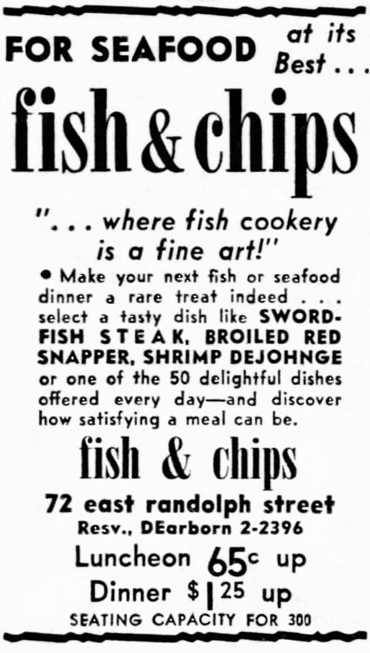
It was a popular restaurant, said to be especially well liked by male patrons. In 1944, during World War II, lines formed at the door. The following year it was enlarged to seat 300. [1949 advertisement shown]

With no meat on the menu, the restaurant would have had the advantage of escaping wartime food restrictions and shortages.

Advertising that it had 50 varieties of fish on hand daily, a lunch or dinner could include sunfish, crappies, smelts, cod, brook trout, sea bass, shrimp, and lobster among many others. The restaurant advertised heavily during the Lenten season.

Bob Winter died in 1953 and the entire contents of the restaurant were auctioned, including groceries.

© Jan Whitaker, 2021

16 Comments

Filed under alternative restaurants, food, menus, Offbeat places, patrons, popular restaurants

Holiday greetings from 11th Heaven

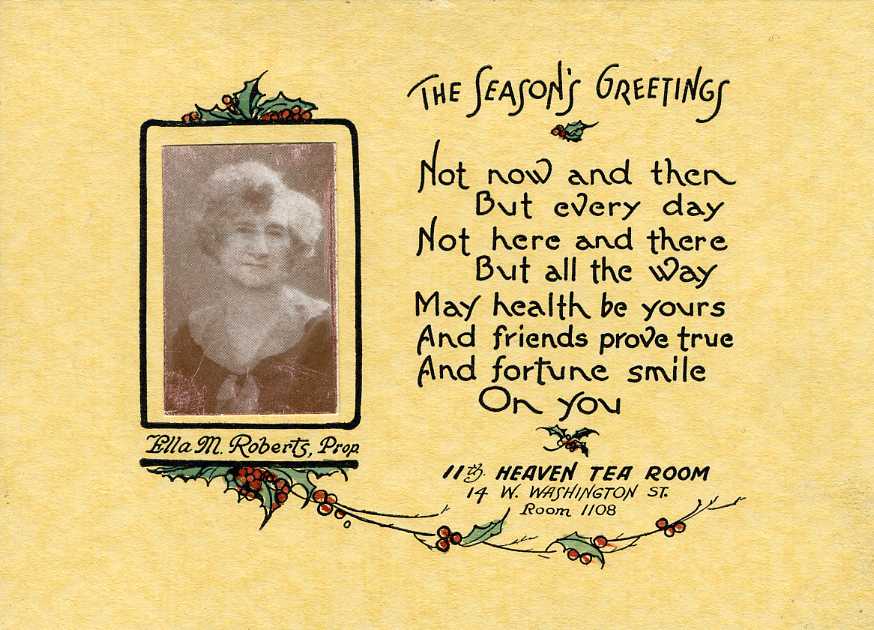
A while back I found two small Christmas cards from the 11th Heaven Tea Room, run by Ella Roberts.

The name was evidently inspired by the tea room’s location on the 11th floor of the Browning Building, an oddly narrow building for its height, located in the Chicago Loop. The building, designed in “Moorish Gothic” style by architect Harry S. Wheelock, was constructed in 1899 and razed in 1990.

I have been able to find out almost nothing about the tea room or its owner, who had an unfortunately (for me) common name. In April of 1931 she ran three brief newspaper advertisements in the classified section saying, “Home cooked dinner, 50c; hours 10 to 4. Phone Dearborn 2673.”.

How long did she stay in business? Was her tea room a victim of the Depression? Was the 11th floor a curse, despite the building’s four elevators?

Regardless, I echo Ella’s messages: may the world treat you right, have a gorgeous appetite, and call again.

Addendum:

Thanks to Gary Allen, author, food blogger, and researcher extraordinaire, I now know more about the proprietor of Chicago’s 11th Heaven Tea Room.

Ella M. Roberts was a hard-working, seasoned businesswoman who had owned her own grocery store as far back as 1910. Her first husband had been a confectioner and it’s possible she had worked with him. By 1910 she was divorced; she remarried and in later censuses she was described as widowed. In 1920 she was still running the delicatessen, i.e., grocery. By 1930, at age 71, her occupation was listed as tea room proprietor, but no longer in the 1940 census. She lived to be 96.

Following on Gary’s research I learned that Ella’s three children were stage actors in the early century. In 1912 her daughter Maude Le Page created quite a stir and became a minor celebrity when she stood up in the balcony of a Chicago theater and loudly proclaimed that she would sell herself to a man for $1,000 so that she could escape working in a deli (!) and publish her poetry. She then enjoyed a whirl as a newspaper columnist writing on the hard life of working girls, explaining why they liked cheap thrills and frills, why they should be paid better, and why they were tempted to trade sex for money. In 1930 she lived with her mother and worked as a hand letterer for a card company. I have to wonder if she designed her mother’s Christmas cards.

9 Comments

Filed under Uncategorized

Soul food restaurants

Before the 1960s, the term “soul food” wasn’t used in reference to food. Until then the words had religious connotations for Protestants.

What became known as edible soul food, such as chitterlings, pigs’ feet, greens, black-eyed peas, cornbread, and cobbler (to name just a few), had been popular in the South long before the words soul food were applied. But the diet gained a charged meaning in the 1960s when proponents of Black Power affirmed eating soul food as a political statement.

By any name, soul food was not often found in restaurants outside the South until African-Americans began migrating northward before, during, and after World Wars I and II. Walker’s Café in Wichita KS advertised chitterlings and catfish in 1910. That same year the Gopher Grill in St. Paul MN claimed to be “headquarters for chitterlings and corn bread.” Similar menus were often found at dinners at Black churches and homes. Women belonging to the Social and Literary society of a Baptist church in St. Paul MN dressed in Colonial costumes and hosted a chicken and chitterlings dinner in 1916 to celebrate Lincoln’s birthday, an event where the identity politics were quite different than what would develop in the Black Power movement.

There were also numerous restaurants owned and patronized by Blacks in the North that did not serve soul food, or at least didn’t specialize in it. It’s difficult to find menus from restaurants of the migration periods, but when their advertisements mentioned specialties, they were often similar to dishes in white restaurants. A Chester PA restaurant specialized in oysters in 1910. In Black’s Blue Book for 1923-1924 — which listed Chicago’s prominent African-American citizens, along with recommended businesses — there were only four restaurants that advertised what kinds of dishes they served. Those dishes were Barbecued Chicken, Duck, and Squab; Chicken Salad; Club Sandwiches; Sea Foods; and Chili Con Carne (at two restaurants).

The spectrum of eating places found in New York’s Harlem, Chicago’s Black Belt, and Black urban neighborhoods across the North ranged from down-home, all-night eateries serving factory shift workers to elegant tea rooms lodged in old mansions that hosted patrons with more money and leisure. In Chicago, leaders of the N.A.A.C.P., the Urban League, and visiting foreign dignitaries were inevitably entertained with dinners at top Black tea rooms such as The Ideal, the Bird Cage [pictured, 2018], and the University tea rooms. In Spring 1923, the University Tea Room (“The Most Beautiful Spot in Chicago”) advertised the following menu:

65c – Special Table de Hote Dinner – 65c
Cream of Tomato Soup
Roast Chicken with Dressing
Spring Lamb with Peas
Snowflake Potatoes
June Peas in Cases
Salad
Head Lettuce and Tomatoes
French Dressing
Dessert
Apple Pie with Cheese
Rice Pudding
Coffee
Strawberry Shortcake, 25c
Ice Cream, 10c

Strangely enough, the 1966-1967 version of the Green Book failed to list some prominent Black restaurants with barbecue such as Arthur Bryant and Gates in Kansas City, and soul food places such as Soul Queen and H & H in Chicago. For New York City, it broke restaurant listings into the categories Steaks, American Specialties, Seafood, and Chinese – but not Soul Food.

While some Northern Blacks slowly accepted soul food, others were more resistant. This seemed to hold especially true for those higher in social status. Some of Chicago’s Bronzeville residents who held themselves superior to migrants expressed criticism of newcomers’ food customs, such as eating chitterlings. A journalist writing in the New York Amsterdam News in 1931 claimed that Harlemites rejected the “Fried Chicken, Pork Chop, Hog Maw and Chitterlings Theories” that assumed all Blacks liked rural Southern food. He also disavowed any special attraction to watermelon.

In 1945 another reporter from the Amsterdam News set out to find chitterlings in Harlem restaurants. He found only one restaurant serving them (Rosalie’s and Frances’ Clam House and Restaurant). He reported that Harlemites were just as likely to eat Chock Full O’ Nuts’ nutted cream sandwiches, Chicken Fricassee, Weiner Schnitzel, or Oysters Casino. At the same time, he observed that whites visiting Harlem enjoyed spare ribs with red beans, concluding, “there are no fundamental points of difference between eating habits of Harlemites and those of the lighter-skinned folk downtown.”

Most soul food histories note that some prominent Black leaders have rejected soul food, pointing to Eldridge Cleaver of the Black Panthers and Nation of Islam leader Elijah Muhammad. In his book Soul Food, Adrian Miller observed that Cleaver wrote in Soul on Ice (1968), “The emphasis on Soul Food is counter-revolutionary black bourgeois ideology.” Instead, wrote Cleaver, “The people in the ghetto want steaks. Beef Steaks.” Elijah Muhammad denounced soul food as a legacy of slavery that should be decisively rejected.

Miller laments the decline of restaurants that serve soul food, marked by the closure of landmarks such as Army and Lou’s and Soul Queen in Chicago. “Across the country, legendary soul food restaurants are disappearing at an alarming pace,” he writes, attributing it to health concerns and reduced business prospects due to the scattering of African-American communities and the popularity of fast food.

With a few exceptions, I don’t think the views of critics such as Cleaver are seen as valid now. And there seems to be a renaissance of interest in soul food among Black chefs and restaurateurs who celebrate it as part of a heritage of resilience and creativity under slavery. Somewhat surprisingly, even vegan soul food restaurants can be found now.

© Jan Whitaker, 2019

9 Comments

Filed under food, menus, patrons, restaurant controversies, tea shops

Famous in its day: The Bakery

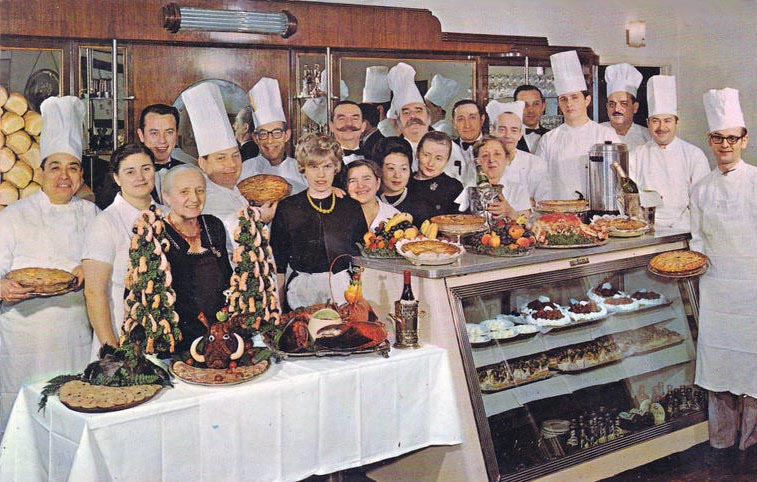
Louis Szathmary’s restaurant, The Bakery, opened in Chicago at a time when restaurant going in that city was not a very exciting proposition. Amidst the steak and potatoes of 1963, its pâté, bouillabaisse, Wiener schnitzel, and Viennese tortes stood out as exotic. Despite its storefront location in a run-down neighborhood – and no decor to speak of — the 25-seat neighborhood restaurant became an instant success. A little more than a year after it opened it was given a distinguished dining award by Holiday magazine. Reservations became hard to get.

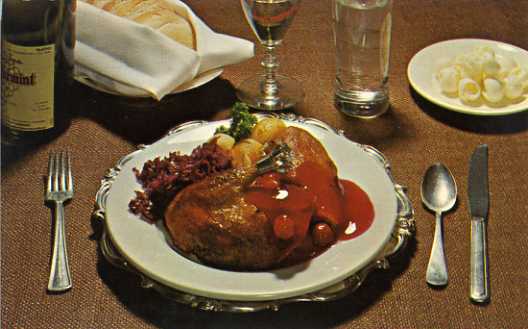
The first review of The Bakery described it as a table d’hôte offering a set dinner that began with pâté, possibly followed by celery soup, shredded celery root salad with handmade mayonnaise, and Filet of Pike with Sauce Louis. By 1975 the number of entree choices for the then-$12 five-course dinner had extended to ten, with Beef Wellington and Roast Duckling with Cherry Glaze [pictured] among the most popular. Even as Beef Wellington lost its fashionability in the 1970s and 1980s, it continued as a Bakery mainstay. In 1989, as the restaurant was about to close, Szathmary said that although current food writers made fun of it, “they all raved about it once, and I know 50 percent of our sales after 26 years is still beef Wellington.”

Szathmary, who claimed a Ph.D. in psychology from the University of Budapest, had learned to cook in Hungary during WWII when he was conscripted into the Hungarian army. He arrived in the US in 1951, working as a chef in several institutional settings in the Northeast before moving to Chicago in 1960 to join Armour & Co. in product development. As executive chef at Armour he helped launch the company’s Continental Cuisine line of frozen entrees for the home and commercial market that came in polybags that could be immersed in boiling water and served.

Among the first eating places to serve entrees from Armour’s Continental Cuisine and American Fare lines were Holiday Inn motels and the Seagram Tower at Niagara Falls. Dishes available in the two lines included beef burgundy, chuck wagon beef stew, turkey and crabmeat tetrazzini, chow mein, shrimp creole, and barbecued pork fried rice. Only months before opening The Bakery, Chef Louis (as he was popularly known) had been training the staff of a Michigan gas-station-restaurant complex aptly named The American Way how to heat and serve Armour’s bagged entrees.

After he left Armour to concentrate on The Bakery, Chef Louis continued to praise the use of convenience foods in restaurants. He published a column titled “Use Psychology on Your Customers” in a trade magazine in 1965 in which he urged restaurant managers to be honest about the food they served. He conceded that because he knew many of his guests were suspicious of frozen foods, he did not apologize when he took them on a tour of his storage areas. Although he sometimes used frozen foods, he said he always revealed that on his menus. In a July 1968 column for the trade magazine Food Service, he insisted that the restaurant industry should welcome factory-produced food because of the shortage of help at a time when restaurant patronage was on the rise.

That column brought forth a protest from fellow Hungarian-born restaurateur George Lang of the elegant Four Seasons in NYC. Lang wrote, “I would very much like to preserve the level of cooking and the niveau [peak] of gastronomy that we practice at the Four Seasons.” To this Chef Louis replied that he was simply trying to be provocative. Not much later he boasted that he had the distinction of being fired as a consultant to Restaurant Associates (owner of the Four Seasons) – as well as caterer to Playboy founder Hugh Hefner.

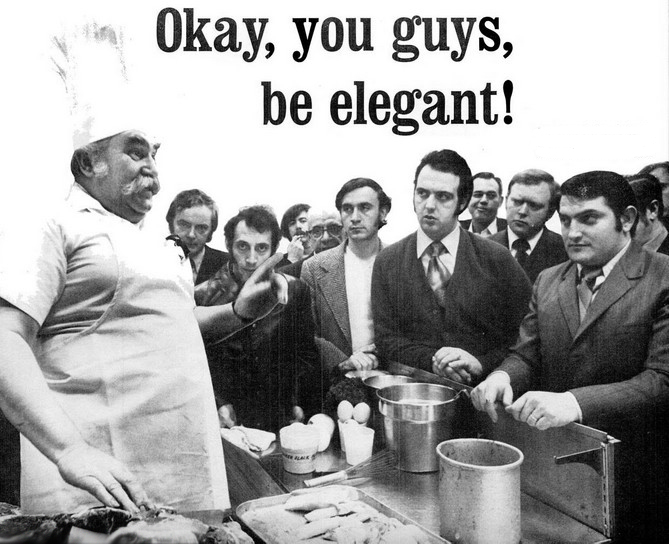
With his fingers in many pies, Chef Louis was assisted by his wife Sada and a contingent of relatives, not to mention quite of few of his compatriots from Hungary who served in The Bakery’s kitchen and dining room (one going so far as to grow his own handlebar mustache). No doubt it was his loyal staff who made it possible for him to run a restaurant while producing books and copious newspaper and magazine articles, appearing frequently on TV and radio, teaching and lecturing at colleges, and conducting sideline restaurant consulting and cooking school businesses [shown above training waiters]. Always a showman, the flamboyant Chef Louis gave talks with titles such as “The Naked Ape and the Frying Pan,” and another in which he compared his ex-wives unfavorably to a bottle of Angostura bitters that had lasted longer and never got spoiled.

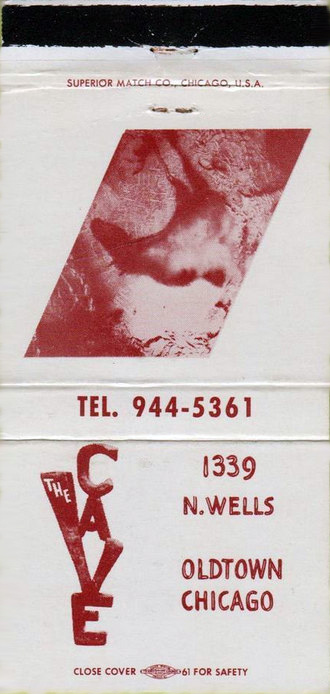
In addition to The Bakery, he owned or co-owned two other restaurants managed by his wife’s sister and brother-in-law, the Kobatas. The Cave, in Old Town, opened shortly after The Bakery. Its interior of papier mache simulated the walls of a cave covered with prehistoric drawings as researched by Chef Louis. In 1970 he opened Bowl & Roll, another family-wide venture drawing in not only the Kobatas but also the mothers of both Louis and Sada, plus Louis’ brother and sister-in-law. In an opening advertisement Bowl & Roll promised a range of unusual soups such as Hungarian sour cherry soup, Scandinavian fruit soup, and kohlrabi soup.

In the mid-1970s The Bakery’s reputation began to sag somewhat along with “continental cuisine” generally. Critic John Hess, in 1974, questioned the high regard that Holiday magazine bestowed on The Bakery and declared its Beef Wellington “the quintessence of the pretentious gourmet plague.” Patrons sent letters to Chicago newspapers saying the Roast Duckling was as “tough as an auto tire,” and charging that the restaurant’s acclaim was based on “mass hysteria” whipped up by Chef Louis himself. Chicagoans were sharply divided into lovers and haters. For two years in the 1970s readers polled by Chicago Magazine voted The Bakery as one of both the city’s 10 favorite and 10 least favorite restaurants. Still, in 1977 Cornell University named it one of the country’s six great restaurants, and, despite its loudly banging front door, too-brisk service, lack of decor, and awkward layout, its loyal patrons stuck by it and it remained profitable to the end.

At the 1989 closing Chef Louis said that the restaurant business had changed so much he could not have successfully created a restaurant such as The Bakery then, partly because of the public’s growing preference for lighter food. He declared he was proud that he “never served one kiwi fruit.”

Chef Louis stayed busy in retirement and donated his vast cookbook and culinary arts collection to libraries at the University of Iowa and Johnson & Wales University.

© Jan Whitaker, 2017

62 Comments

Filed under food, guides & reviews, Offbeat places, popular restaurants, proprietors & careers

Famous in its day: Tip Top Inn

tiptopinnColonialRm

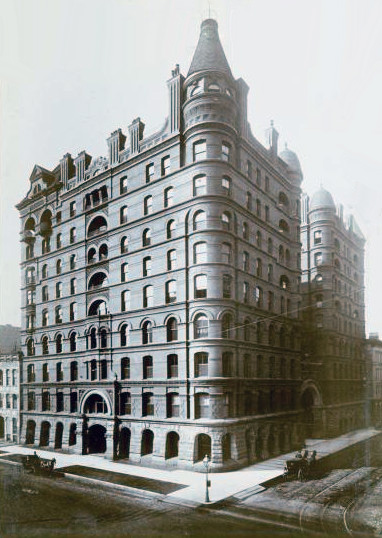
As the massively solid Pullman Building was under construction on Michigan Avenue in Chicago in 1884, a young Adolph Hieronymus was traveling to Chicago from his native Germany. Within a few years he would run a restaurant of renown on the building’s top floor.

tiptopinnpullmanbldgThe building was to be the new headquarters of the Pullman Palace Car Company which manufactured sleeping and dining cars used by major railways. When the imposing building was completed, the company occupied two and a half of its nine floors while the rest of the space was rented for offices and what were known then as “bachelor apartments,” probably lacking anything but the most rudimentary cooking facilities.

For the first few years the Pullman company ran its own restaurant, The Albion, on the 9th floor. It was considered advanced at the time to locate restaurants on top floors so that cooking odors would not drift throughout the building. In addition, diners at The Albion, and later the Tip Top Inn, had excellent views of Lake Michigan.

tiptopinnFrenchRoomDuring the Columbian Exhibition in 1893 Adolph Hieronymus left his job as chef at the Palmer House and took over the Pullman building restaurant, renaming it the Tip Top Inn. Under his management, it became one of Chicago’s best restaurants, hosting society figures and professional organizations. Until the Pullman company expanded its offices onto all eight floors below the restaurant, men living in the 75 or so apartments on the upper floors were also steady customers of the Inn, often having meals sent down to them.

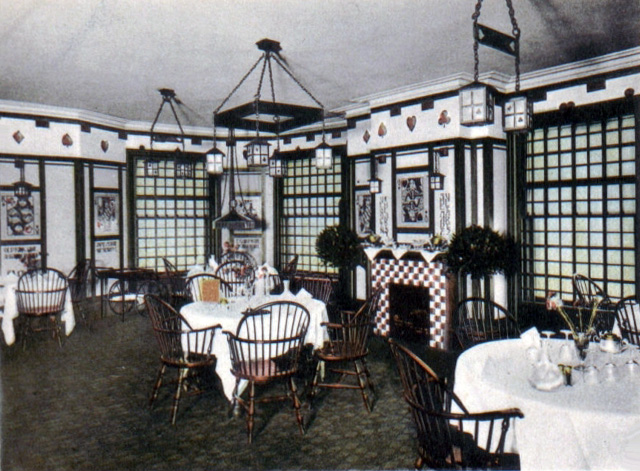
The space occupied by the Tip Top Inn was divided into a bewildering number of rooms, at least five and maybe more. Each had its own decorating scheme. Over the years – but surely not simultaneously — there were the Colonial Room [pictured at top ca. 1906], the Nursery, the Whist Room [pictured below], the Charles Dickens Corner, the Flemish Room, the French Room [pictured above], the Italian Room, the Garden Room, and the Grill Room. The Whist Room was decorated with enlarged playing cards and lanterns with spades, hearts, diamonds, and clubs. The lantern and suits also decorated the Inn’s china and menus.

tiptopInnmenu1920The outlawing of alcoholic beverages proved challenging to the Tip Top Inn, as it did to other leading Chicago restaurants of the pre-Prohibition era such as Rector’s, the Edelweiss, and the Hofbrau, all of which would go under before the ban on selling alcohol ended. Perhaps to attract new customers, Hieronymus created an associated restaurant on the 9th floor called The Black Cat Inn, with somewhat lower prices than the Tip Top Inn and a menu featuring prix fixe meals.

tiptopinnWhistRoom

The Black Cat was unusual at the time for having a staff of Black waitresses – who served in restaurants far less often than Black men. The Tip Top Inn, just like the Albion and the Pullman dining cars, had always been staffed with Black waiters, some of whom worked there for decades. It was said that anyone who worked at the Tip Top could find employment in any restaurant across the country. “Black Bolshevik” Harry Haywood wrote in his autobiography that he quickly worked his way up from Tip Top Inn busboy to waiter and then landed jobs on the ultra-modern Twentieth-Century Limited train and with Chicago’s Sherman Hotel and Palmer House.

By 1931 when the Tip Top Inn restaurant closed, it was regarded as an old-fashioned holdover from a previous era. Its extensive menu of specialties such as Stuffed Whitefish with Crabmeat and Suzettes Tip Top, some of the more than 100 dishes created by Hieronymus, was no longer in vogue. Aside from Prohibition, Hieronymus attributed the restaurant’s demise to the death of gourmet dining. Hieronymus died in1932 but he and his restaurant were remembered by Chicagoans for decades. The Pullman Building was demolished in 1956.

© Jan Whitaker, 2014

10 Comments

Filed under proprietors & careers, restaurant decor

Mob restaurants

mobstersGalante&CoppolakilledGangster stories run like a red thread through the 20th-century history of American restaurants, from the speakeasies of the 1920s, to the shakedowns and union infiltration of the 1930s, the rackets of the 1940s and 1950s, and the later years of money laundering and loudly proclaimed legitimate business.

But what seems to interest Americans the most are restaurants mobsters are alleged to patronize, and all the more so if there has been a legendary shootout there.

As portrayed in the film Dinner Rush, even rumors that a restaurant is a gangland favorite can boost its popularity immensely. The film was made by Bob Giraldi who’s been inside the restaurant business.

mobsterscolosimo'sOn July 28 a series called Inside the American Mob will begin on the National Geographic channel. My friend and neighbor John Marks, supervising producer, inspired this post when he mentioned the popularity of restaurants where mobsters have been gunned down.

Violence is abundant in restaurant history. Two of the worst mass murders in the United States took place in restaurants, the killing of 23 people at Luby’s Cafeteria in Killeen TX in 1991 and 21 at a McDonald’s in San Ysidro CA in 1984. Those tragic events did not bring about an influx of patrons wanting to soak up evil ambiance. Quite the contrary. Luby’s remodeled and reopened but never regained the business it once had, closing the Killeen site for good in 2000. McDonald’s razed the blighted unit in San Ysidro, rebuilding nearby.

MobsterVillaVeniceGlenviewIL1932

On the other hand, when gangsters are shooting victims people are unmoved, evidently figuring they got what was coming to them. The absence of bullet holes and bloodstains disappoints.

Restaurants that are linked to mobsters, such as NYC’s Sparks Steak House, where Paul Castellano was killed as he stepped out of his car, do not always appreciate being included in guide books such as A Goodfellas Guide to New York just because a mobster sometimes ate there. I can’t blame them. Who would want tourists dressed in shorts and tee shirts turning up at your high priced restaurant? The mob is not what it used to be. Yet I have to wonder, is there an American restaurant that can be absolutely certain it has never hosted mobsters?

I’ll also point out that not all mob-connected restaurants are or have been Italian. Also, probably every ethnic group has had its own version of the Mafia at some point.

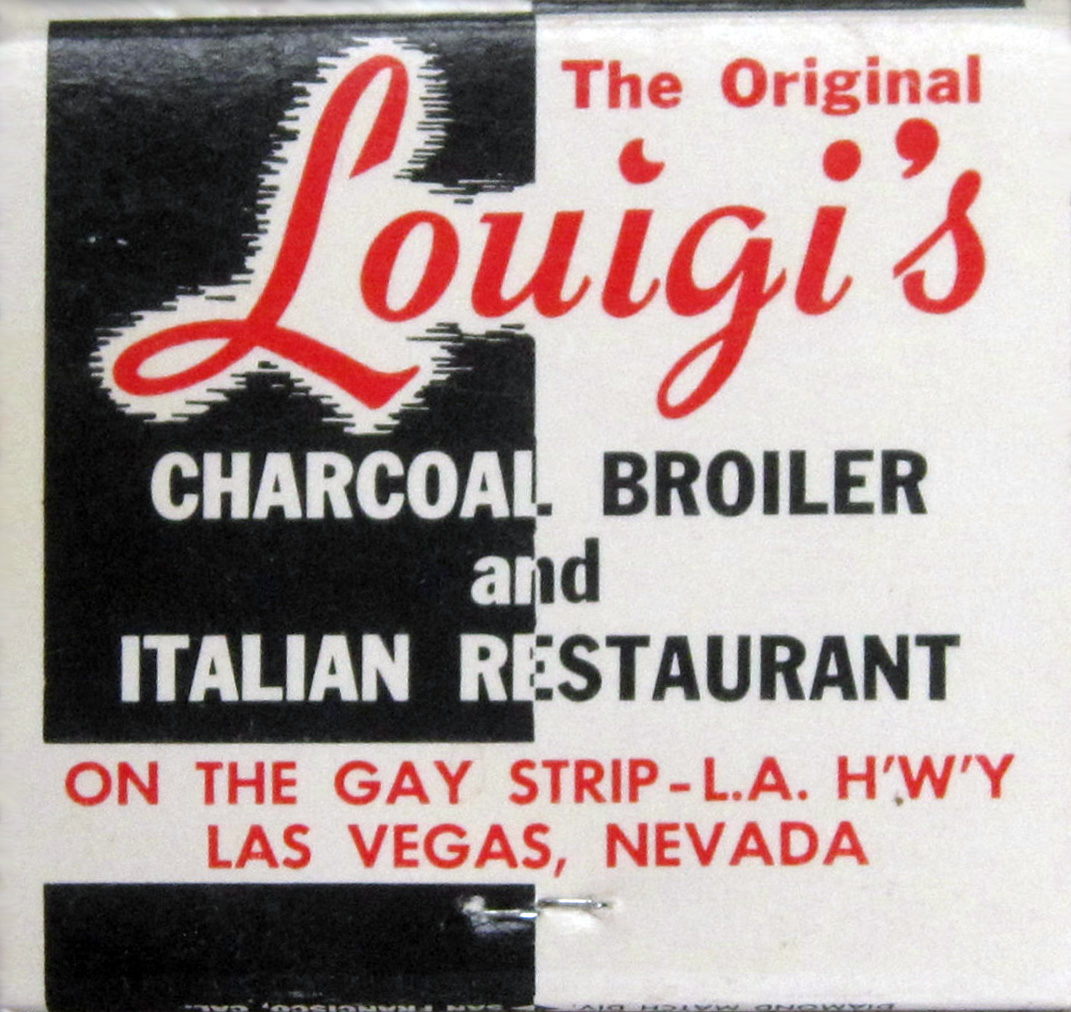
MobstersCaponeTorioheadquartersCiceroca1939Most major cities in the U.S. have had restaurants that served as gangster hangouts. [pictured: the Cicero IL headquarters of Al Capone, ca. 1939] Chicago’s Colosimo’s was already in the books by 1930, ten years after its owner “Big Jim” Colosimo became one of the first victims of a gangland shooting in a restaurant. As late as 1958 when a new owner of the property announced he would raze the building, the site was overrun with an estimated 1,000 souvenir hunters. In the 1920s and 1930s even “nice” St. Paul MN could boast of four or five nightclub eateries with underworld associations, according to the authors of Minnesota Eats Out. Other mob-connected eating places illustrated in this post are Louigi’s in Las Vegas and Villa Venice outside Wheeling IL.

MobstersLouigi'sNew York City and environs takes the prize for gangland restaurants, among which are restaurants where mobsters, their henchmen, and associates have met a messy end. Few still exist or remain in their original locations. To name some, both present and past: Nuova Villa Tammaro, Coney Island (Giuseppe “Joe the Boss” Masseria,1931); Palace Chop House, Newark (Dutch Schultz, 1935); Umberto’s Clam House, Little Italy (Joey Gallo, 1972); Joe & Mary, Brooklyn (pictured at top, Carmine Galante, 1979); Broadway Pub, Manhattan; La Stella, Queens; King Wah, Chinatown; Villa Capri, Long Island; Sparks, Manhattan (Paul Castellano, 1985); Bravo Sergio, Manhattan (Irwin Schiff, 1987).

© Jan Whitaker, 2013

10 Comments

Filed under patrons