Image gallery: eating in a hat

In an earlier post I wrote about buildings shaped like what they sell – known as “ducks.” Usually they sold simple foods rather than entire meals. They were often located on busy roads where it wasn’t easy to get cars to stop. But proprietors realized that even the most humble shed, if masquerading as a giant dog or coffee pot, just might get speeding motorists to stop for closer examination.

Ducks, which became popular in the 1930s, could be found all over the country but their birthplace is usually cited as Southern California, the land of fantasy and car culture.

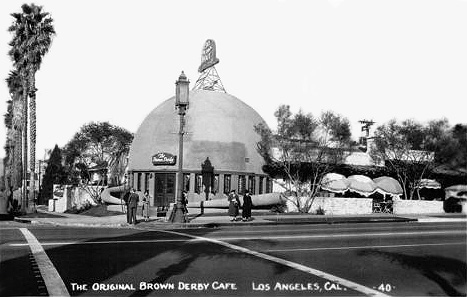
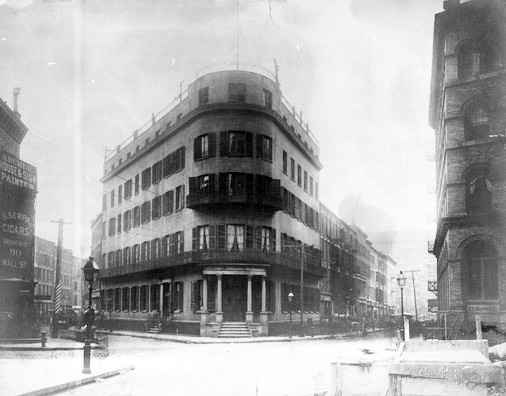
The slogan “eat in the hat” was, in fact, created in Los Angeles for the Brown Derby restaurant that opened in 1926 on Wilshire Blvd, shown above a few years later after it enlarged and added a patio.

To be considered a genuine duck, the Brown Derby should have been selling hats, but it was a restaurant, and one with a standard menu rather than just grab-and-go food. Its fame derived from its successful courtship of gossip columnists and film stars.

Copying, I am convinced, is one of the most common business tactics. Eating places love to borrow a little bit of the glamour of far-off restaurants that have achieved fame. As Los Angeles’ Brown Derby became famous, taverns and eateries across the land adopted Brown Derby, Green Derby, and related names. As shown in the images that follow, some also created a variety of hat-shaped buildings, signs, and menus.

Brown Derby Drive-in, Southern CA – Something went terribly wrong with the shape of this derby.

Brown Derby, Tyler TX – Ditto.

Brown Derby, Evansville IN – The Hat had loomed impressively larger atop an earlier, one-story building. As humorist S. J. Perelman wrote in 1936, “. . . the flood waters of the Ohio River weren’t far away, but the Brown Derby went unscathed. Such is the irony of nature.”

Brown Derby, Olympia WA – Menu on which a waffle with “wild blackberry syrup” was 40 cents.

Miner’s Hat, Kellogg ID – Why stick to derbies? This Hat had odd hours, from 10:00 A.M. to 1:00 A.M., possibly to mesh with work shifts of area miners.

Hat-O-Mat, between Warren and Youngstown OH – Maybe it was too hard to build a derby shaped drive-in? A 1950 advertisement in the Cleveland Plain Dealer sought franchisees for the Hat-O-Mat’s unnamed “new idea in feeding the public.”

El Sombrero Drive-In, Albuquerque NM – A sombrero on top just in case people didn’t realize this was a restaurant serving Mexican food. A sombrero is without doubt one of the most hackneyed of restaurant symbols.

© Jan Whitaker, 2018

9 Comments

Filed under drive-ins, odd buildings, roadside restaurants

The up-and-down life of a restaurant owner

The model tea room proprietor has generally been portrayed as a woman of taste and refinement who has a heightened aesthetic sense, is congenial, and knows good food. In short, she closely resembled the ideal of the early 20th-century wife. So it comes as something of a shock to discover a tea room proprietor whose life did not neatly conform to that ideal.

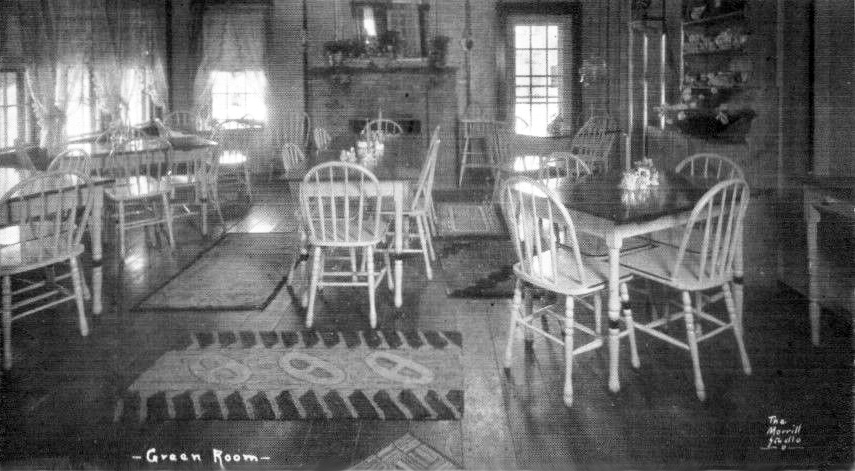
An interesting example of someone who only partially conformed to the ideal was Charleen Baker, proprietor of the Buttercup Hill Tea Room near Fitchburg MA from 1928 to 1943.

She had taste, she was a successful hostess, and she knew good food. Her menu, filled with dishes such as Duck a la King, Sauteed Sweetbreads, and Lobster Newberg, bears that out. Her tea room was recommended by Duncan Hines in the 1937 edition of Adventures in Good Eating.

But how successfully did she personify refinement?

On the one hand, she portrayed herself as a product of a patrician background. In her 1935 cookbook she subtly painted a picture of her life and world that began with childhood cooking lessons from her southern Mammy, Aunt Maria. She explained that her mother had taught her that thin biscuits revealed a family’s “fine lineage,” as was true in her family. Presenting herself as a dutiful young wife, she described how hard she had worked to please her husband, on one occasion baking three different “lemon sponge pies” before she produced one “good enough to set before the king.” And she included a chapter on “Sunday Night Suppers” which assumed that, even in the Depression, the lady of the house had a maid who cooked — and took Sundays off.

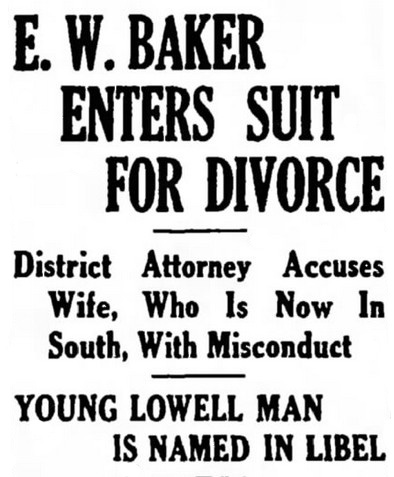
Yet – big surprise – I discovered that her “king” had tried to divorce her in 1923, resulting in a sensational headline in the Fitchburg Sentinel as well as the Boston Herald. Her husband also accused her of abandoning their hospitalized son while she vacationed in Florida.

She then filed a reply, producing another zinger headline, “District Attorney Charged With Unfaithfulness In Answer By Wife.” Each charged the other with having multiple partners.

Upon further research I learned that in 1900, far from enjoying a life of leisure and refinement in the South, the 13-year-old Charleen had lived in a miner’s boarding house in Tortilla Flat, Arizona Territory, with her mother and her stepfather (#2 of her mother’s four husbands) who ran the place. Upon her stepfather’s death in 1903, she and her mother moved to Fort Worth TX where they resided in a lodging house run by her mother.

How she made her way from a Texas boarding house to studying voice at the New England Conservatory of Music in Boston I don’t know. While in Boston she met her future husband, Emerson, then a Harvard law student. They married in 1907 and settled in the Fitchburg area where Emerson joined his father’s law firm and later the district attorney’s office.

Remarkably, Charleen and Emerson reconciled later in 1923 and he assisted her in enlarging her tea room, which by 1931, when the Early American Room was added, seated nearly 160. The couple’s marriage continued until his premature death in 1934.

Two years before that Charleen had taken over the Green Parrot Tea Room in Winter Park, Florida, redecorating it in blue and orchid and calling it Charleen’s Tea House. Buttercup Hill stayed open from May through October, while Charleen’s in Florida was open the other months.

Due to wartime gasoline rationing that caused a fall off in customers, and to difficulties getting staff, Charleen closed the Buttercup in early 1943. She auctioned off furnishings that included old cradles, antique clocks, hooked rugs, and Currier & Ives prints.

From everything I’ve read about her, Charleen was successful in winning status as an admired figure in Fitchburg society.

After she sold the Buttercup several other owners operated the complex of buildings as a tea room while continuing the practice of serving cocktails that Charleen had begun in 1938. After the WWII the name was changed to Buttercup Hill Steakhouse and Club and it continued into the 1970s.

© Jan Whitaker, 2018

10 Comments

Filed under food, proprietors & careers, roadside restaurants, tea shops, women

Dressing the female server

Clearly restaurant uniforms and costumes serve a variety of practical purposes, especially if they are comfortable, easy to move in, and well supplied with pockets. They mark their wearers as restaurant staff rather than patrons. Some go a step further by carrying out a restaurant’s decor or theme. Still others promise to bring male customers in the door.

Even though they share common characteristics, three types can be distinguished as described above: the functional, the decorative, and the alluring. Each has its own separate history.

Surprisingly, the oldest are alluring costumes that bring customers in the door.

Most restaurant and hotel dining room servers in the 19th century were male. Female servers usually worked in the lower types of eating and drinking places. They were often viewed as women of loose morals if not downright criminals; enticing male patrons as well as taking abuse from them were part of the job.

As early as the 1860s, music halls, also known as concert saloons, began heavily advertising the presence of “pretty waiter girls” whose job was to deliver beer and cocktails to male patrons. Their outfits were referred to as “fantastic,” “with short petticoats,” “microscopic,” or resembling “extremely reduced ballet dress.”

Reformers eventually succeeded in eliminating pretty waiter girls by banning the sale of alcohol in music halls. But the realization that female servers dressed in scanty costumes could attract customers did not disappear. In the mid-1890s, some cafes introduced women dressed in knee-length bloomers that showed off their legs. Although bloomers also had some practical advantages, that was not what attracted crowds of gawking male customers.

Dressing servers as pretty waiter girls continued in the 20th century and right into the present. In the 1930s, drive-ins dressed carhops in drum majorette costumes with shorts and bare midriffs; Playboy bunnies came along in the 1960s, as did topless waitresses and bordello-themed restaurants with servers in red and black corsets; in the 1980s came “breastaurant” chains such as Hooters, with Twin Peaks and Tilted Kilts arriving in the 2000s, all with servers wearing regulation big smiles and low cut tops and short shorts or micro-kilts.

The ability to attract large tips clearly plays a significant role in women’s willingness to perform an almost vaudevillian sexy server role. It was said that the 1860s pretty waiter girls, who enticed patrons to drink heavily, received a portion of the check rather than regular wages. Some 1930s drive-ins paid no wages either, figuring the carhops received generous tips.

About the same time as pretty waiter girls arrived in music halls, “good girls” wearing modest decorative costumes took up their serving trays at fairs to raise money for civil war soldiers. At New York’s fair, for instance, they dressed as Normandy peasants with picturesque caps. It soon became fashionable to dress female servers in costumes such as Martha Washington at a “Boston tea party” or Swiss peasants at an 1876 Centennial Exhibition restaurant named The Dairy.

The popularity of decorative novelty costumes carried over to commercial restaurants such as the tea rooms of the early 20th century where Asian and Colonial motifs were popular. Next it spread to theme restaurants of all kinds and servers could be found wearing togas, grass skirts, kilts, Bavarian dirndls, sarongs, etc., some of these — such as steakhouse wench costumes — revealing as well as decorative.

As far as I can tell, Asian-American women were never hired as servers unless they agreed to work in their “native costumes.” Black women rarely worked as servers in white restaurants, but when they did they often wore Mammy costumes. I can’t decide if it was a step forward or backward when Alice Foote MacDougall hired light-skinned Black women to dress like Italian peasants at Firenze in NYC in the 1920s.

As is true of alluring waitress costumes, decorative costumes never fell completely out of favor and continue in use today.

Fred Harvey, who ran lunch rooms and restaurants for the Santa Fe railroad, introduced functional, standardized uniforms as early as 1883 and a Denver restaurant claimed in 1895 that its unionized “lady waiters” were “dressed in complete uniform, something never before introduced in this country.” But in most eating places women simply wore street clothes such as shirtwaists and long skirts, possibly with a long apron or pinafore, when they served meals. This began to change in the early 20th century, primarily in the better-capitalized, modern restaurant chains.

The spread of standardized uniforms in the teens and twenties represented a significant change. Although the status of waitresses did not rise dramatically, wearing a uniform did add a professional dimension to the job, putting wearers on a par approaching nurses, police, soldiers, and others with authority. A newspaper columnist in 1928 named Mary Marshall observed that wearing uniforms had recently become “a privilege rather than a disgrace” as they were adopted by dentists and doctors, telephone operators, bank tellers, hairdressers, department store saleswomen, and waitresses.

Part of the explanation for standardized waitress uniforms arose from concerns with restaurant cleanliness in the years before WWI. But their adoption was also a sign of a growing restaurant industry looking for legitimacy. The development of functional uniforms occurred as restaurants were run more systematically. Specialized manufacturers and suppliers emerged to furnish restaurants — separate from hotels — with kitchen equipment, furniture, china, linens, uniforms, and food products.

Another significant change in how female servers were dressed began to take place in the 1970s, influenced by the women’s movement. A growing number of Americans expressed dislike of revealing costumes. A restaurant critic focusing on Monterey Jack’s at Rancho Bernardo in California in 1978, for instance, cited the restaurant’s corny decor, “near total disregard for food,” and “exaggerated and tasteless attire” that debased the waitresses.

The tide was definitely turning in the 1980s. In a 1993 article in Gender and Society, author Elaine J. Hall’s research showed that the more “prestigious and trendy” a restaurant was, the more likely all its serving staff, both male and female, would be referred to as waiters and would wear “generic male uniforms.” A unisex uniform is usually composed of dark pants and shirt worn with a vest or a long bistro-type apron. Women servers in restaurants that have adopted unisex uniforms, she noted, see them as “an important aspect of gender equality.”

© Jan Whitaker, 2018

13 Comments

Filed under restaurant industry, uniforms & costumes, women

The Lunch Box, a memoir

There is little glamour surrounding the operation of most restaurants. They demand hard work, long hours, and relentless determination. Few stay in business long or bring their owners great riches.

All of these observations apply to the Lunch Box. Except one. The Lunch Box stayed in business for 35 years, becoming a well-loved stopping place along the road in the small Western Massachusetts town of Williamsburg.

But, glamour? As its owner, Anthony “Tommy” Thomas, writes in his recently published book, “the happiest day of owning the Lunch Box was the day that we hooked up to the sewer line.”

After that, he no longer had to worry about overuse of the restrooms.

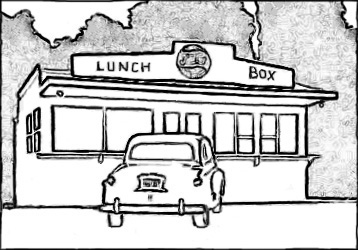
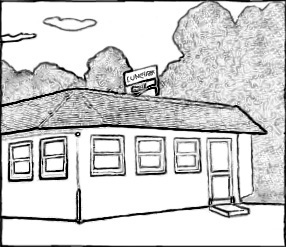
In 1968 Thomas bought the small roadside restaurant that had begun in 1949 as a hot dog stand. Since then it had been enlarged [see below], never quite meeting the building standards he would have liked.

Thomas, like the owners of so many modest eating places, had been disappointed working for others and was strongly attracted to the risky idea of having his own business. Given the woeful condition of the restaurant, along with considerable misery in the lives of previous owners, the Lunch Box seemed overrun with risk and negative vibes. But that didn’t stop him.

In addition to hooking up to a sewer line, he also discovered in the early years that he needed to install a grease trap. For 35 years he cleaned it himself, an arduous task since it was located in a crawlspace under the building. “I had to crawl under and take the trap apart, take the pieces that needed to be cleaned and drag them outside, clean them and then crawl back under to put the trap back together,” he explained. He also spent many an hour defrosting frozen water pipes.

The small kitchen, with a ceiling “so low that a person six feet tall would have to bend over to use the stove,” was equipped with an “apartment size gas stove.” The original cash register could not ring up an order over $5, and had to be supplemented with an adding machine to total checks. Shortage of capital meant that major improvement projects had to be deferred, particularly when it came to solving the building’s heating and cooling problems. “We were always cold on really cold days and hot on the very hot days,” he wrote.

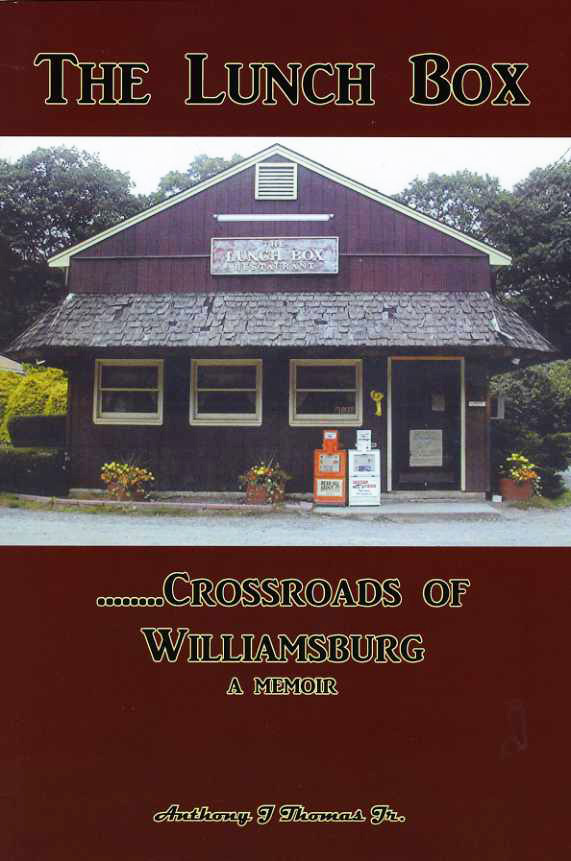
Eventually he was able to rebuild the Box, adding a second story and a peaked roof [see book cover above]. And, he and his wife were able to raise four children, though it must have been tough at times. As he says, “There were years when my tax returns showed hardly any income and I was fortunate that I was in the food business so I could feed my family.”

Thomas took great pride in his other roles, admitting – rather surprisingly — that “The most rewarding in my judgment and the most important aspect of my life outside of my family was my time serving as a firefighter/EMT.” I was surprised that he did not cite the restaurant. He worked as a firefighter and EMT in both Williamsburg, where the Lunch Box was located, and in neighboring Goshen, where he lived. And he served as a Goshen Selectman for years.

He inherited the cafe’s reputation as a “woodchopper’s diner,” but he improved the quality of its comfort food menu by using fresh local produce whenever possible. He took great care in testing brands of coffee before selecting one. He saw to it that soups and pies, previously purchased, were made in house. The Box’s comfort foods, such as shepherd’s pie, macaroni and cheese, and meat loaf, drew locals, public officials, police, truck drivers, woodsmen, and a wide range of others including a few who traveled some distance to eat there regularly.

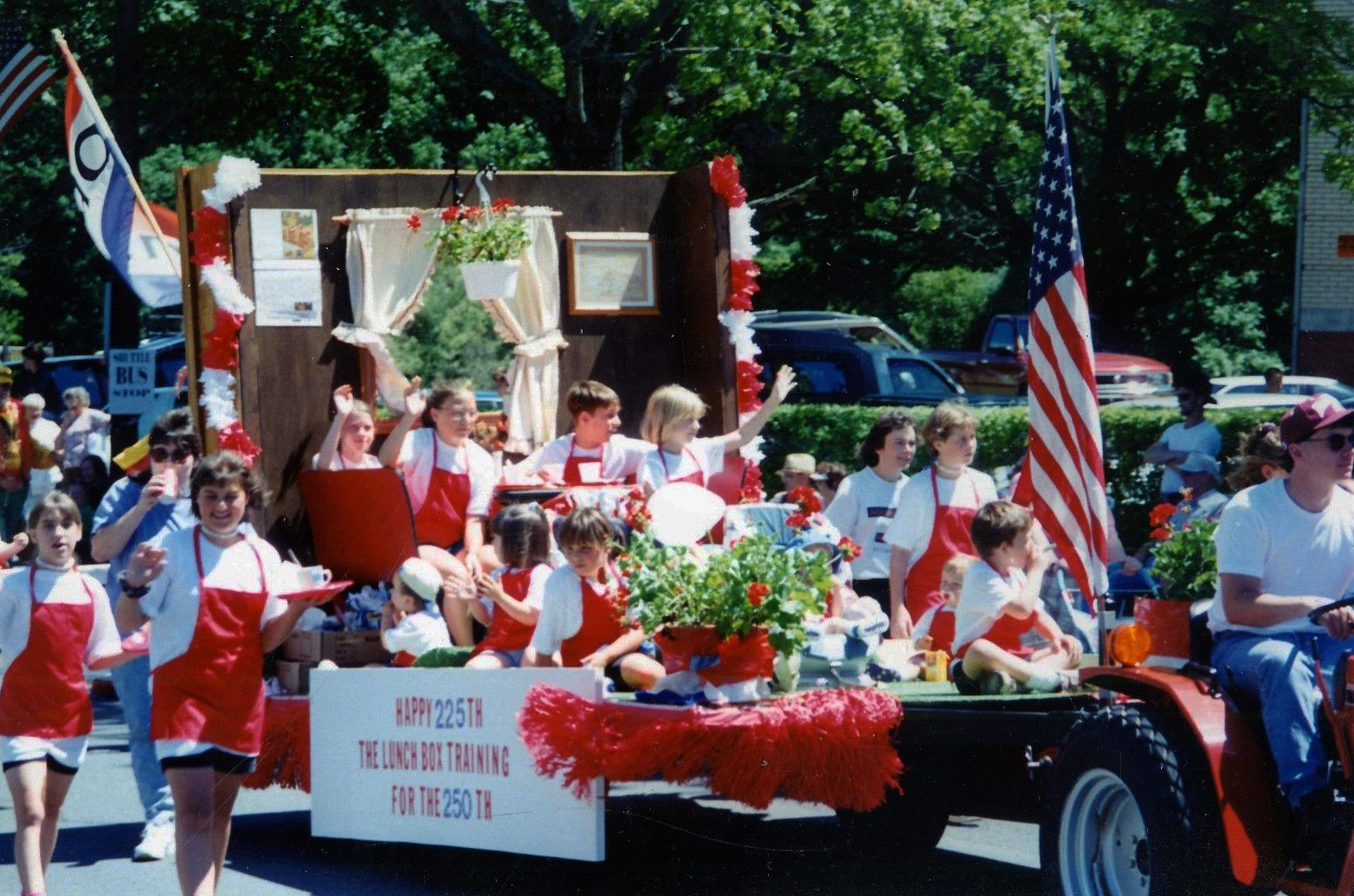
As is often the case with roadside diners, over the years the Lunch Box became a community hub where business was conducted, friends met up, and local news was exchanged. In a book with plenty of anecdotes, it becomes clear that each day promised new adventures with the Lunch Box right in the middle of it all. [photo: The Lunch Box float in Williamsburg’s 225th anniversary parade]

© Jan Whitaker, 2018

5 Comments

Filed under lunch rooms, patrons, popular restaurants, proprietors & careers, roadside restaurants, technology

Crazy for crepes

The crepes craze, which began in the 1960s, became intense in the 1970s. By the late 1980s it had all but disappeared.

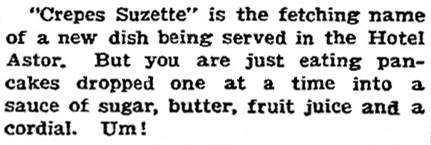
But before crepes achieved popularity, they were almost unknown in the U.S. The exception was Crepes Suzette, thin, delicate pancakes with an orange-butter sauce and liqueurs that were often dramatically lit aflame at the diners’ table. Like Cherries Jubilee, Crepes Suzette usually only appeared on high-priced menus, such as the Hotel Astor [1908 quotation].

Before 1960 even fewer restaurants served savory crepes, and those that did would also seem to have been expensive restaurants. In 1948 the Colony in New York City served Crepes Colony with a seafood filling. And in the late 1950s New York’s Quo Vadis offered Crepes Quo Vadis, filled with curried seafood and glazed with a white sauce, as hors d’oeuvres.

Although few Americans had ever eaten Crepes Suzette, it’s likely that the fame of this prized dish helped pave the way for the creperie craze, with restaurants primarily featuring crepes. Crepes were regarded as an exotic luxury dish that, by some miracle, was affordable to the average consumer, sometimes costing as little as 60 or 75 cents apiece around 1970.

Crepes enjoyed a mystique, offering a link to European culture and a break from the meat and potatoes that dominated most restaurant menus in the late 1960s and early 1970s.

At a time when America was seen as the world leader in modern ways of living – including industrially efficient food production — Europe was imagined as a romantically quaint Old World where traditional ways were preserved and many things were still handmade.

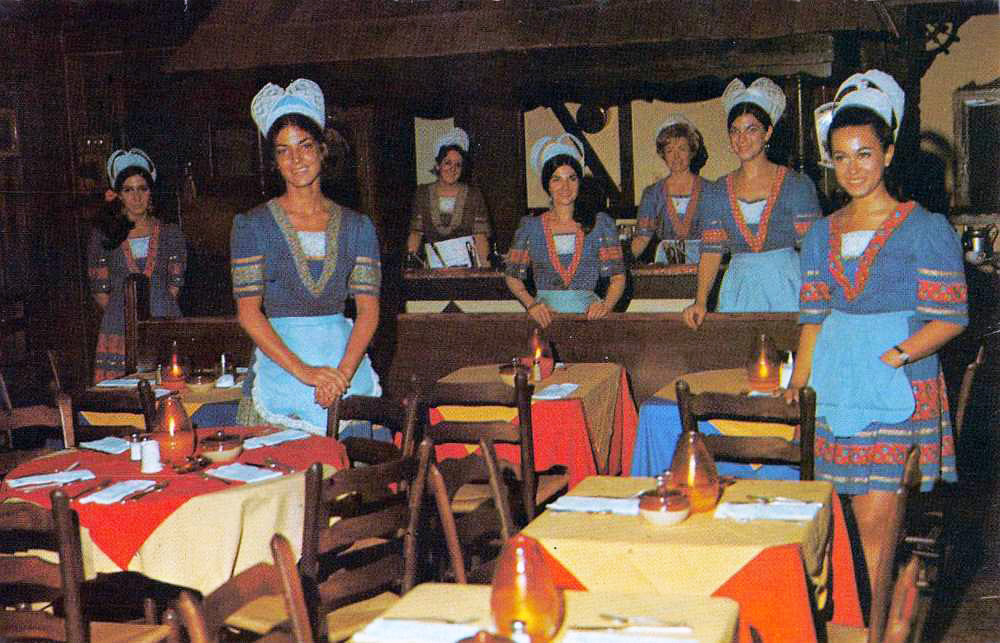
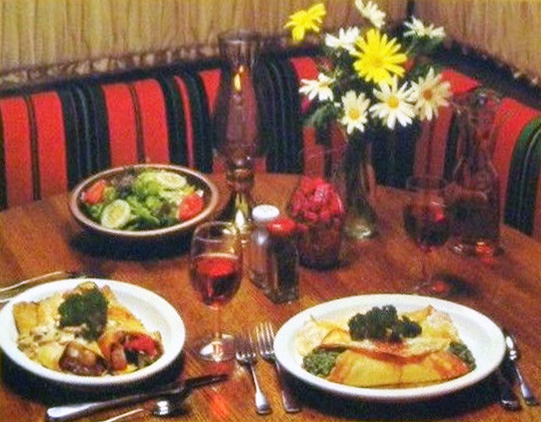
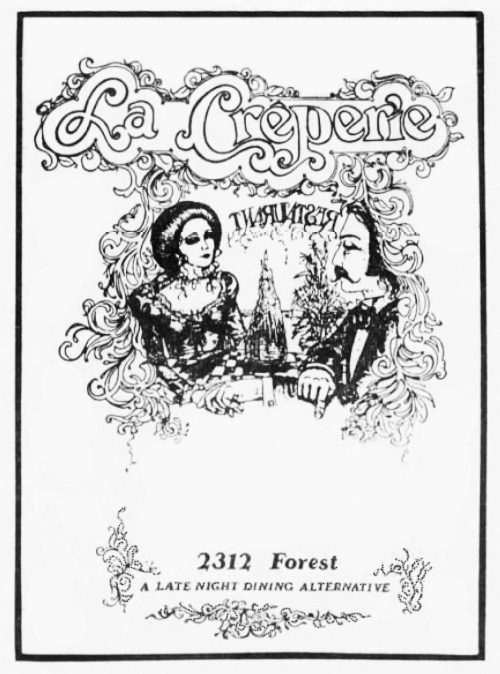
American creperies catered to their customers’ wish for a taste of Europe. With country French decor, servers in folk costumes, and names such as Old Brittany French Creperie and Maison des Crepes [pictured at top, Georgetown], diners were imaginatively transported to a delightfully foreign environment quite unlike the brand new shopping malls in which many creperies were located. Another exotic touch employed by quite a few creperies was to use the French circumflex mark in crêpes (which I have not done in this blogpost).

Filled with creamed chicken, ratatouille, or strawberries and whipped cream (etc.), crepes soon became a favorite lunch, dinner, and late-night supper for college students, dating couples, shoppers, and anyone seeking “something different.” Along with crepes, menus typically included a few soups, most likely including French onion soup, a spinach-y salad, and perhaps a carafe of wine.

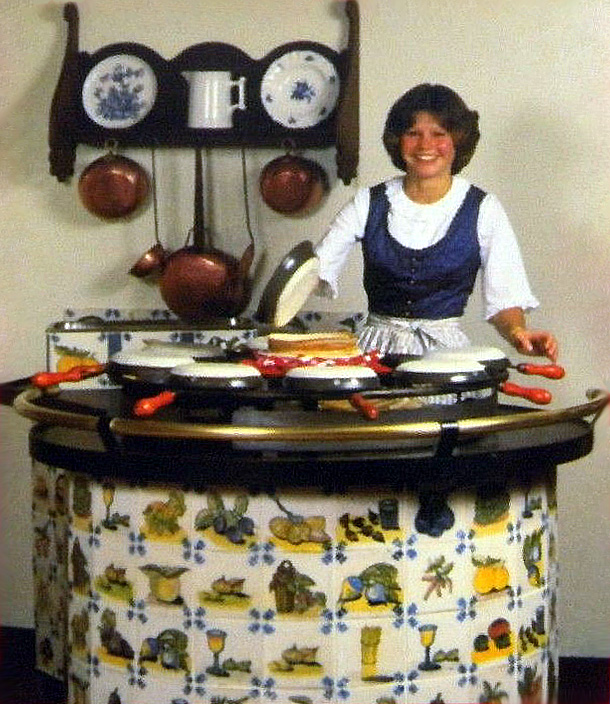
San Francisco’s Magic Pan Creperie led the trend and, after being acquired by Quaker Oats in 1969, spread to cities across the country, with the chain eventually totaling about 112. The first Magic Pan, a tiny place on Fillmore Street, was opened in 1965 by Paulette and Laszlo Fono, who came to this country in 1956 after the failed anti-Communist uprising in their native Hungary. A few years later they opened another Magic Pan in Ghirardelli Square and Laszlo patented a 10-pan crepe-maker capable of turning out 600 perfectly cooked crepes per hour [pictured here].

As Quaker opened Magic Pans, they invariably received a warm welcome in newspaper food pages. It was as though each chosen city had been “awarded” one of the creperies, usually situated in upscale suburban shopping malls such as St. Louis’s Frontenac Plaza or Hartford’s West Farms Mall. When a Magic Pan opened in Dallas’ North Park shopping center in 1974, it was called “as delightful a restaurant as one is likely to find in Dallas.”

Among Magic Pan amenities (beyond moderate prices), reviewers were pleased by fresh flowers on each table, good service, delicious food, pleasant decor, and late hours. Many of the Magic Pans stayed open as late as midnight – as did many independent crepe restaurants. [Des Moines, 1974]

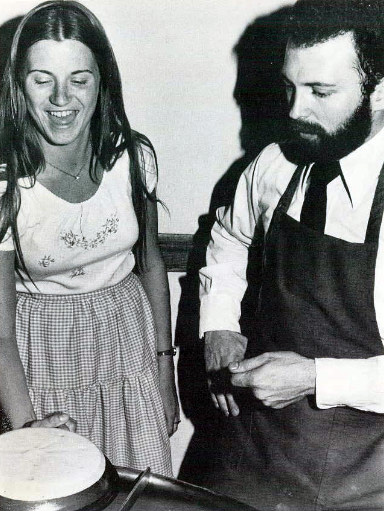
In hindsight it’s apparent that creperies responded to Americans’ aspirations to broaden their experiences and enjoy what a wider world had to offer. It was a grand adventure for a high school or college French class or club to visit a creperie, watch crepe-making demonstrations, and have lunch. [below: student at the Magic Pan, Tulsa, 1979] But what one Arizona creperie owner called the “highbrow taco” did not appeal to everyone. The operator of a booth selling crepes at Illinois county fairs reported that hardly anyone bought them and that some fairgoers referred to them as creeps or craps.

I would judge that crepes and creperies reached the pinnacle of popularity in 1976, the year that Oster came out with an electric crepe maker for the home. Soon the downward slide began.

Quaker sold the Magic Pans in 1982 after years of declining profits. The new owner declared he would rid the chain of its “old-lady” image, i.e., attract more male customers. Menus were expanded to include heartier meat and pasta dishes.

Even though new creperies continued to open here and there – Baton Rouge got its first one in 1983 – there were signs as early as 1980 that the crepe craze was fading. A visitor to a National Restaurant Association convention that year reported that crepes were “passé” and restaurants were looking instead for new low-cost dishes using minimal amounts of meat or fish. A restaurant reviewer in 1986 dismissed crepes as “forgotten food” served only in conservative restaurant markets. Magic Pans were closing all over, and by the time the 20-year old Magic Pan on Boston’s Newbury Street folded in 1993, very few, if any, remained.

© Jan Whitaker, 2018
15 Comments

Filed under alternative restaurants, atmosphere, chain restaurants, food, popular restaurants, proprietors & careers, restaurant fads

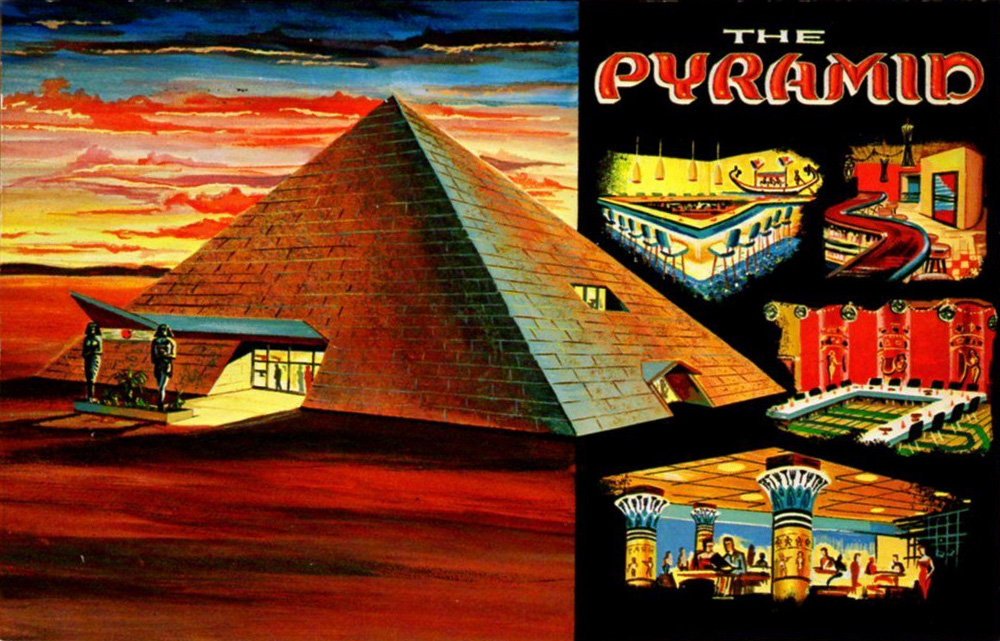
Famous in its day: The Pyramid

I was initially attracted to The Pyramid Supper Club because of its kooky architecture and its surprising location on a rural Wisconsin road next to a cornfield. I admit I thought it was a joke.

As a 1991 advertorial noted, “The Pyramid Supper Club on Highway 33 east of Beaver Dam is surrounded by a bare, flat-land setting much like the original pyramids depicted in the interior wall paintings.”

Flat it is, I thought, but Wisconsin is a long way from ancient Egypt. Like Wild West-theme restaurants in New England and Polynesian restaurants in Arizona, it struck me as absurd.

Not only its location, but dining in a replica of a tomb? With murals depicting slaves at work? “Dine amidst the splendors of The Pharaohs – Have Cocktails in fabulous Egyptian lounges,” read the copy on the back of a postcard. I pictured the wives of Lutheran pastors, 4-H officials, fertilizer dealers, and goose hunters – all of whom gathered there at various times – clinking glasses of Yummy Mummies.

Why did the owners, who helped design the building, want their restaurant to resemble a pyramid? It opened in 1961 as the Tutankhamun Treasures exhibition toured the United States, so that’s one obvious source of inspiration. But I was surprised by the explanation that owners Gini and Dick Beth gave to a reporter, that in addition to “visual appeal” the building style had “no association with any particular food.”

Doesn’t that apply to most buildings that house restaurants? It takes no special architecture to lure lovers of steak and prime rib, the all-American cuisine the restaurant was based on.

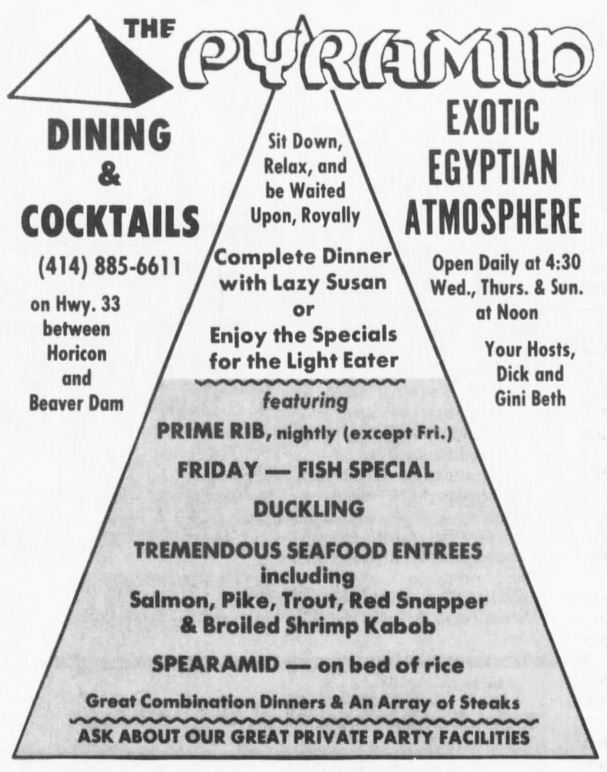
I counted at least 27 main dishes on a 1984 Pyramid menu, suggesting that the restaurant must have had a mighty big freezer. Along with beef, chicken, and seafood specials was the puzzler, “Spearamid – on bed of rice.” Slowly it dawned on me that the word rhymed with pyramid, and was their coining. I then discovered it was beef, onion, peppers, and tomatoes grilled on a skewer.

To be fair, not all the Pyramid’s meat was frozen. The restaurant bought locally raised animals that won prizes at fairs. In 1991, for instance, they bought a lamb that won grand champion honors, paying $1,050 for it.

The Pyramid was a popular place, with a staff that was renowned for their friendliness and long tenure. It was heavily patronized by surrounding townspeople and community organizations of all sorts. Counting party rooms, the restaurant seated 500. On Sundays they served up to 300 meals, a number that jumped up as high as 800 during goose hunting season.

As I continued to learn about the Pyramid I realized a restaurant that at first I took as a joke wasn’t that at all. It was a true community institution.

Its originators, the Beths, sold it in 1994, and it subsequently had a couple of owners who ran it under different names. It closed in 2009, looking rather forlorn as shown here on Google Earth.

© Jan Whitaker, 2018
15 Comments

Filed under food, odd buildings, popular restaurants, restaurant decor, theme restaurants

Dining & wining on New Year’s Eve

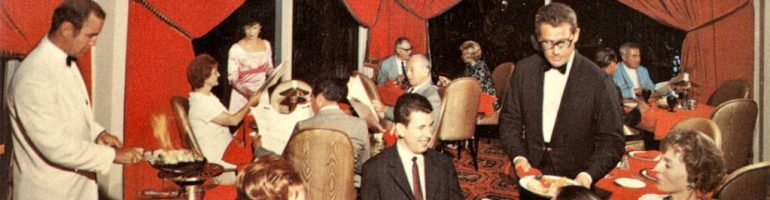
I haven’t found evidence that people celebrated New Year’s Eve in restaurants or hotels much in the 19th century. But in the early 20th century it became a more popular thing to do. Having a reservation at a swanky place conferred status, as the 1912 drawing above is meant to illustrate.

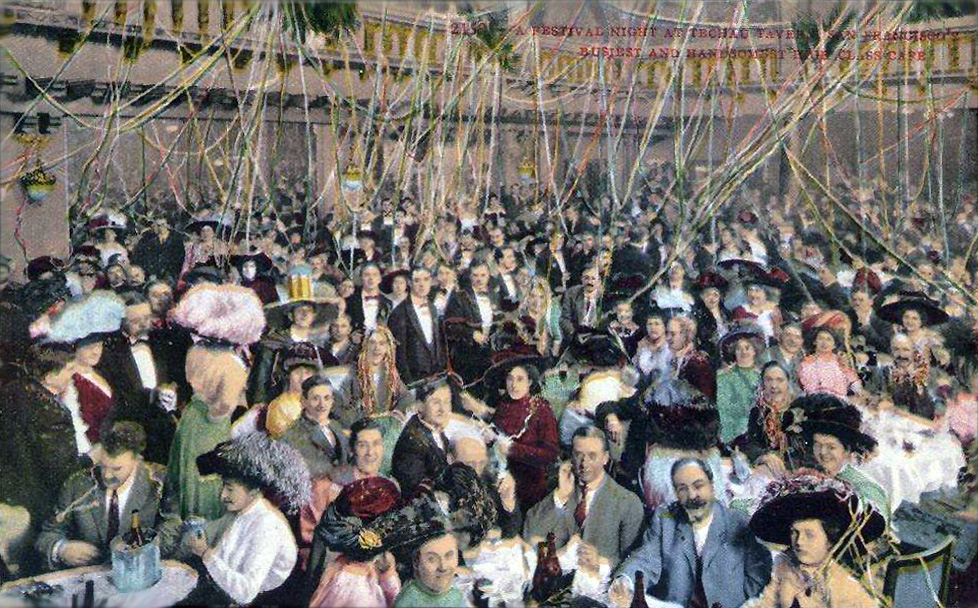
If one dish ruled New Year’s Eve menus in the early 20th century it was roast turkey. It was the main dish at the Techau Tavern, “San Francisco’s Busiest and Handsomest High-Class Café,” shown here in 1909. Turkey with Cranberry Dressing and Chestnut Stuffing was preceded by Toke Point Oysters from Washington, Cream of Chicken Soup, Striped Bass, and Sweetbreads.

Turkey also dominated the 1912 New Year’s Eve menu at The Fern in Scranton PA, “An Eating Place of Refinement and Respectability.” The Fern featured a $1 dinner that was similar but even heftier than the Techau Tavern’s, with Blue Point Oysters, Cream of Chicken Soup, Baked Bluefish, Croustade of Lobster, Tenderloins of Beef, Roast Turkey, Sweetbreads, Banana Fritters, as well as all kinds of vegetables, salad, and pie. The Alt Heidelberg Café in Fort Wayne IN, and Tait’s in San Francisco provided similar menus.

Through the 1920s, it was not hard to find a place where one dollar or a little more would buy an elaborate dinner with an orchestra and dancing. In Seattle WA, New Year’s Eve entertainment at the Hotel Washington Annex included dinner plus a “lady vocalist” and the Whangdoodle Quartet, all for $1.25. The absence of (legal) alcohol in the 1920s did not dim festivities in Chicago nightspots in the Loop or on the South Side, where “handling a flask has never been considered flagrant.”

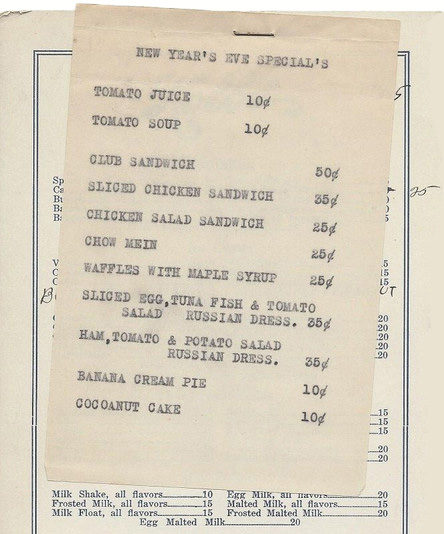
Despite tight economic times in the 1930s and war in the 1940s – or maybe because of these conditions — Americans showed continuing enthusiasm for celebrating the new year in restaurants and clubs. The repeal of Prohibition at the end of 1933 brought about heightened levels of good cheer. Not even higher prices at the end of 1934 discouraged revelers who paid from $7.50 to $15 per plate in NYC. Yet there were still bargains to be had as the accompanying 1935 menu from Kolb’s in New Orleans shows. Low prices also prevailed in Canton OH where sauerkraut and wieners were traditional.

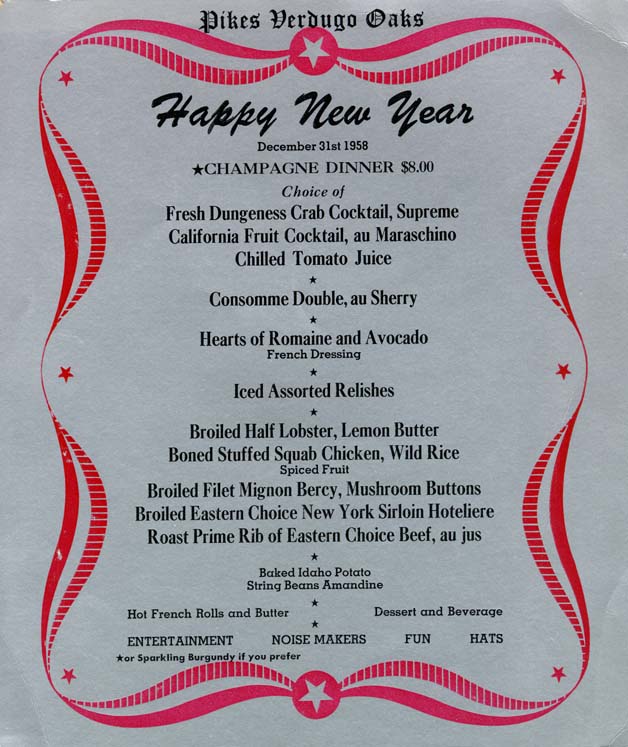
After the war, menus reflected the growing importance of beef on New Year’s Eve – and throughout the year. The 1958 menu at Pike’s Verdugo Oaks in Glendale CA is representative, and not terribly different than menus found throughout the U.S. in later decades. The Raintree Room at the Continental Regency in Peoria IL in 1978, for example, offered beef or lobster, with salad, baked potato or french fries, and the ubiquitous cheesecake for dessert, a standard menu for a restaurant dinner in the last decades of the 20th century.
Whether you have steak or hot dogs this New Year’s Eve, have a good time and best wishes for 2018!

© Jan Whitaker, 2017

8 Comments

Filed under food, menus, night clubs, restaurant customs

High-volume restaurants: Hilltop Steak House

Until I moved to Boston in the 1980s and took a whale watch tour I hadn’t heard the boastful term “biggest grossing” thrown around. In pointing out the highlights of the Boston Harbor, the tour operator singled out several booming enterprises including Anthony’s restaurant. Had we been on a tour of Route 1 north of Boston, I’m sure he would have shouted the praises of the Hilltop Steak House, another mega-volume eatery, where a team of in-house butchers carved up millions of steaks a year, the parking lot held 1,000 cars, and customers waited in long lines outside the door.

I never went there. I was not one of the 2,350,000 or so customers who patronized the Hilltop in 1985, for example, one of a number of years when it ranked as the #1 independent restaurant in the USA from a high-grossing perspective, with over $24 million in annual sales.

Established in 1961 with seating for 125, the Western-themed restaurant continued to grow in subsequent years, with more dining rooms brightened with the standard steakhouse blood red color scheme, seating 1,100 by 1970, with an enlarged parking lot, and a huge 68-foot high lighted cactus sign out front.

Dining rooms were adorned with totem poles, reproductions of Remington and Russell paintings, and life-size Indian figures. The rooms had names meant to conjure up the Wild West such as Sioux City and Kansas City. No doubt the names rang true to diners from New Hampshire and Massachusetts but would have amused residents of those Iowa and Missouri cities which are conspicuously lacking in Western symbology.

Guests appreciated big steaks, low prices, and free parking. Prices were premised on sales volume, rapid table turns, cash-only payment, no reservations, and limited menu choices. Steaks could vary in grade, customers could not send back too-well-done steaks, orders could not be split, and there were no tablecloths. There was only one salad dressing and appetizers and desserts were uninspired – Jello was one of the three desserts on a 1981 menu. “I have nothing against lobster thermidor,” owner Frank Giuffrida told a reporter in 1984, “but don’t come to the Hilltop Steak House and expect to find it.”

The restaurant was prominently visible on Route 1’s tacky, wacky restaurant row where other high-grossing restaurants were also located, making the roadway a New England phenomenon in its own right. The Hilltop’s location was conveniently near the Mystic Bridge, the Callahan and Sumner Tunnels, Logan Airport, the Southeast Expressway, and Routes. 128, 28, 3, and 93. Busses were welcome!

The Hilltop’s founder, Frank Giuffrida, owned the restaurant until 1988, retiring as a rich man despite never having attended high school. In 1940, when Frank was 23, he was a butcher in the family meat market. His parents were born in Italy and had once toiled in a Lawrence MA woolen mill. In the 1950s he owned a tavern-style eatery called the Hilltop Lounge not far from where the steakhouse would be located.

Frank sold the Hilltop corporation in 1988 though he held onto the building and the large plot of land it occupied. The sale came with an agreement that the Giuffrida family would eat at the restaurant for free for the rest of their lives and that they would never have to wait in line for a table.

By the late 1990s restaurant competition on Route 1 had grown fierce. Weylu’s, another Route 1 top-grosser serving as many as 5,000 meals a day at its peak, went into bankruptcy in 1999 and closed. The Hilltop shrank its seating capacity to a mere 850 guests, but carried on until 2013. Both Weylu’s and the Hilltop have been demolished.

© Jan Whitaker, 2017

11 Comments

Filed under decor, family restaurants, food, menus, popular restaurants, proprietors & careers, signs

Famous in its day: the Public Natatorium

Sometimes a brilliant idea hits you, but then you wake up the next day and see why it won’t work. But other times you don’t see why it won’t work until much, much later – after you’ve lost a lot of money.

That’s what seems to have happened with John and Margaret Garlic’s plan to turn a 19th-century public bathhouse in Milwaukee into a restaurant with dolphin shows. The future looked bright when they bought the building from the city for a mere $4,000, but then things became more complicated.

They hoped to open the restaurant one year after their January 1978 purchase, but the actual opening date was delayed by a year by city regulations, trade unions, and late equipment deliveries. Gutting the building and reconstructing the interior purportedly cost upwards of $800,000. And then there were unexpectedly high costs of leasing dolphins and providing for their care and feeding, as well as for federal inspections and trainers’ salaries.

It was not the Garlic’s first foray into the food and restaurant business. Around 1976 they had opened J. J. Garlic’s, a casual restaurant that soon gained popularity in Milwaukee for its cheese fondue, soups, burgers, and jumbo shrimp. Around 1973 the Garlics had pioneered the industrial production of the now-ubiquitous gyro cone, beef and lamb scraps blended and pressed into a Spam-like substance supplied to concessionaires, roadside carts, and restaurant operators.

But then in 1978 J. J. Garlic’s received a devastating review by none other than the celebrated writer Herbert Kubly who wrote restaurant reviews for The Milwaukee Journal from 1970 to 1984. According to G&G Enterprises, Ltd., the official owner of Garlic’s, the review caused a 25% drop in business, amounting to a loss of half a million dollars.

As it happened, the menu at the Public Natatorium – as the new 1979 restaurant was named — borrowed heavily from J. J. Garlic’s. This was especially the case on the Natatorium’s “gourmet” second level where prices ran considerably higher than on the lower level.

While the lower-level menu had sandwiches in the $4 to $5 range, the upper level was meant to provide an elegant dining experience, with chilled golden salad forks, marble-topped tables, and a parchment-like menu. Yet even the lower level was deemed too expensive by some Milwaukeeans. A review that appeared shortly after the opening pointed to skimpy servings such as the Peel & Dip Shrimp at $7.50 which a reviewer described as “five small shrimp . . . with cocktail sauce, a slice of lemon and a lot of ice.” The writer also grumbled about a $1 entrance fee assessed on all customers.

Nonetheless, the Public Natatorium became a must for tourists attracted by the dolphin shows and as far as I can tell did reasonably well overall. At some point after its opening, G&G Enterprises opened a third place with the characteristically jocular 1970s name Fried Eggs & Tootsies, aka F.E.A.T.S. Located near the Milwaukee campus of the state university, F.E.A.T.S. was mostly a drinking spot with bands.

Still, the fine dining concept at the Public Natatorium showed signs of consumer resistance. A 1980 review in a Racine WI paper titled “Taking a bath at the Natatorium” was extremely negative. It described in great detail how, despite high prices, the wine glasses were dirty as were some raw appetizer mushrooms, while several main dishes were submerged in thick, tasteless sauces. The reviewer also cited a shrimp dish that “reeked of the freezer.” He found a small loaf of warm bread the best food served to his table. A 1982 Los Angeles Times story about places to visit in Milwaukee advised visitors to take the children there for the dolphin show but “certainly don’t go for the food, which is mediocre.”

It’s likely that the Natatorium was not doing too well by 1983, the year in which G&G Enterprises filed a $1.1 million lawsuit against The Milwaukee Journal for the 1978 Kubly review of J. J. Garlic’s and to forestall a forthcoming review of the Natatorium by Kubly which they believed would be negative. The suit, which went nowhere, claimed that the paper, an editor, and Kubly were “engaged in a conspiracy to put plaintiff out of business with yet another defamatory article.”

Kubly’s review came out anyway and was indeed negative, detailing slow service, cold food, and a high degree of inept pretentiousness. He included inauspicious quotations from the menu such as “Wild Boar Chasseur, cousin of the domestic sow” and “Hippopotamus Bordelaise, chewier than beef.” What was appealing about Lion le Blanc, Buffalo Navajo, or Veal Chop Andrea Doria (“once served on the famous ship that had the unfortunate collision”)? Kubly must have recognized some of the same dishes he had been served at J. J. Garlic’s, namely the cold fondue (“incorrigible, starch-laden, over salted”), cold consomme (“contained tough bits of meat, a few peas and carrot lumps”), and baked potatoes (“cold and had an unappetizing scorched taste”). A lengthy two and a half hours after arriving, he and his companions made their way out of the then-empty restaurant as the staff brought out a cake – which they took home in its Pepperidge Farm box supplied by the waitress.

The following year John Garlic announced he would sell J. J. Garlic’s and F.E.A.T.S. and move to Florida, while The Public Natatorium would remain open under a manager. But that didn’t last long. By January 1985 the remaining dolphin, Soda, was in peril due to a heating breakdown. A bankruptcy judge ordered that he and two sea lions be sold immediately as part of the restaurant’s liquidation proceedings.

© Jan Whitaker, 2017

23 Comments

Filed under atmosphere, food, guides & reviews, menus, odd buildings, Offbeat places

Turkey on the menu

In previous years I’ve written about restaurants serving Thanksgiving dinners and about the special meaning of Thanksgiving to Chinese restaurant workers. Obviously Thanksgiving is about much more than turkey, but I found myself wondering how turkey has figured on restaurant menus the rest of the year. My first thought was that it is rarely seen in restaurants but I discovered that isn’t entirely true.

Turkey by the slice was seasonally available in taverns of the colonial and early-American eras. In 1800 NYC eating places put up pots of preserved turkey wings for sea voyages. Roast turkey was among the delectable dishes at Julien’s in Boston about this time.

Whole roast turkeys were part of the English tradition which prized big chunks of meat and fowl ready to carve up. Before the Civil War they were a staple of American plan hotels where copious meals were included with the room charge.

Although turkeys fell in the culinary category that one critic would later call “great vulgar joints,” they could be gussied up if boned and covered in aspic. Boned turkeys occasionally appeared on the menu of fine hotel dining rooms, such as Boston’s Tremont House. In 1843 the hotel menu offered “L’Aspic de dindon sur un socle, garni d’atelettes,” i.e., a pedestal on which rested a turkey in aspic decorated with little ornamental spears stuck into it.

The boning operation, performed from the uncooked turkey’s neck, wing tips, and drumsticks by loosening the flesh from the bones with a long knife, required great skill. According to directions published in 1860, after all the loosening was done, the person was to “take the turkey by the neck, give it a pull and the whole skeleton will come out entire … as easily as you draw your hand out of a glove.” The result resembled a deflated football which was then restored to turkey shape with stuffing and roasted.

Boning turkeys was a specialty of confectioners and caterers, including Afro-American Thomas Downing who prepared them during the holidays.

But generally turkey did not find favor with luxury restaurants that featured French cuisine in the later 19th century. Game birds were more highly prized. It remained plentiful on menus of everyday eating places and was popular enough that a 1902 restaurant run by Seventh Day Adventists offered a meatless turkey substitute. I wonder if it resembled “tofurkey”?

In ordinary lunchrooms turkey usually cost a little bit more than other dishes served around the turn of the last century. At the Electric Restaurant at the Chicago World’s Fair in 1893 a diner could have Roast Beef with Potatoes for 45 cents, while Stuffed Turkey and Apple Sauce was 50 cents. Cheap turkey could be hazardous. As a waiter revealed in 1908, “When you get young turkey with cranberry sauce, mashed potatoes, celery, bread, butter, coffee, and mince pie for the sum of 25 cents, you can figure that something was wrong with the turkeys.”

Turkey burgers might seem like recent inventions but in fact they were found in California restaurants as early as 1938. Storing, roasting, and slicing turkey, as well as dealing with the carcass was a nuisance to restaurants, so turkey sandwiches were something of a rarity before WWII. In the 1950s boneless turkey rolls became available. They made it convenient for any restaurant to offer triple deckers with turkey (instead of chicken as previously) or turkey dinner specials with sliced white meat and gravy that undoubtedly came from a can.

A few restaurants, mainly those connected with turkey farms, have specialized in turkey, among them the 620 Club in mid-century Minneapolis: its owner grabbed publicity in 1944 by paying $6.20 a pound for a prize-winning turkey. Still, if you search for turkey recipes in books compiling the “great recipes of great restaurants” you may be disappointed by the absence of turkey dishes. I include a recipe for my favorite turkey dish, the famous open-face “hot brown” sandwich of toast and turkey covered with cheese sauce and bacon strips developed at Louisville’s Brown Hotel.

© Jan Whitaker, 2012/2017

8 Comments

Filed under food