Chinese for Christmas

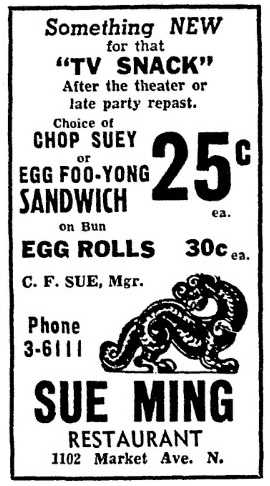
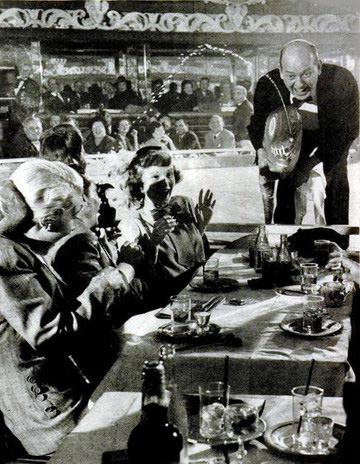
Readers may be familiar with the custom among many Jews of going to a Chinese restaurant on Christmas Day. Hard as I tried I could not determine when this custom began, although based on advertisements I did get the sense that the tradition of going to the movies on Christmas Day may have begun in the 1920s.

That is the same decade for which I found the earliest advertisements by Chinese restaurants in Jewish newspapers. [Wong Yie, American Israelite, 1922, Cincinnati] I didn’t find any Chinese restaurant ads that invited readers to visit on Christmas Day, though I saw some that reminded them to make reservations for New Year’s Eve. Some also mentioned that they were near movie theaters. In the 1930s some wished readers of Jewish papers happy new year at Rosh Hashanah.

So, even though I don’t know when Jews began going to Chinese restaurants on Christmas Day, I suspect that the affinity between Jews and Chinese restaurants became notable in the 1920s.

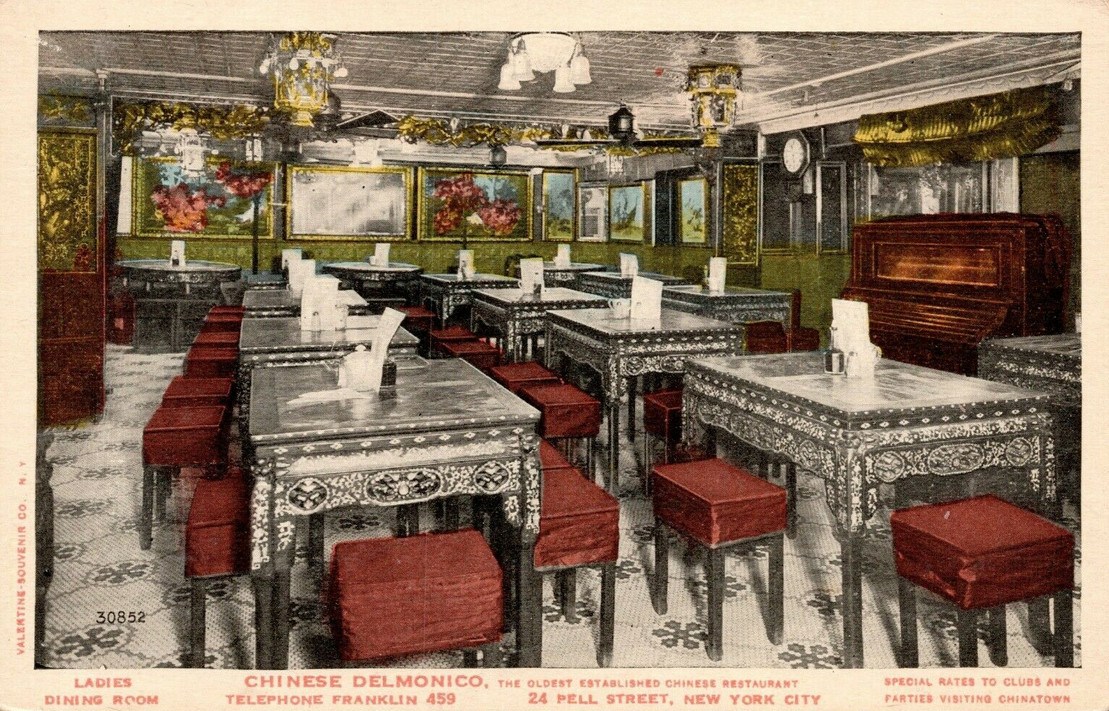
While the 1920s may have marked the blossoming of Jewish patronage of Chinese restaurants, I did find one earlier example of a Chinese restaurant said to be patronized by Jewish businessmen. According to a New York Tribune story of 1907, Chinese Delmonico’s on Pell Street near the wholesale center was kosher. At “Kosher Delmonico’s,” as it was called in the story, a French chef prepared mushroom delicacies, lotus lily seed soups, and other dishes for lunch using no dairy products or “game of the kind that is shot.”

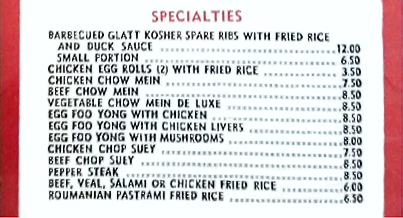
Bernstein-on-Essex, a deli that opened in the 1920s on New York’s lower East Side, is often credited with being the first restaurant serving kosher Chinese food – a 1959 addition to the menu [above menu fragment from a later date]. But it may not have actually been the first: Aside from Chinese Delmonico’s, there was said to be a kosher Chinese restaurant on Temple Street in the Jewish section of Los Angeles in 1929.

What Bernstein’s might have been an early example of, though, was a Jewish restaurant that served kosher Chinese food – in contrast to a Chinese restaurant that was kosher, which was rarer. Although Chinese restaurants generally did not feature dairy dishes, typically they would serve pork, as well as shellfish, meat that wasn’t from kosher butchers, and noodles cooked in lard.

For the most part Jews had to be willing to make whatever adjustments they found necessary in order to enjoy Chinese restaurants. This could mean not ordering pork, shrimp, or lobster dishes, or, as many writers have pointed out, accepting dishes with pork that had been minced and “hidden” in wontons. Nonetheless, not everyone was so careful. According to Haiming Leu, author of A History of Chinese Food in the United States, one of the most popular dishes with American Jews was moo shu pork. Such behavior brought an angry comment from a rabbi writing in Newark’s Jewish Chronicle in 1929: “The writer has seen families leaving an orthodox synagogue on Sabbath noon and taking the new Bar Mitzvah, who has just pledged his allegiances to Jewish tradition, into a Chinese restaurant for a salt-pork chop suey meal.”

While the topic of Jews and Chinese restaurants has been a popular one with scholars and journalists, it’s worth noting that historically Jews were not the only non-Chinese cultural group that heavily patronized Chinese restaurants. Even though in the early 1930s Jews were estimated to make up 60% of the white clientele of Chinese restaurants in Philadelphia and New York, the estimate was that white customers totaled a minority of patrons. The rest of non-Chinese customers were Black.

After WWII Jews began moving from the inner cities and into the suburbs. Meanwhile, most African-Americans stayed behind. Many Chinese proprietors courted their Jewish customers, often opening suburban restaurants with pleasant interiors. In Black neighborhoods often the facilities tended to be poorer, many for carry-out only, and some even outfitted with protective bars and orders taken and delivered through small hatches.

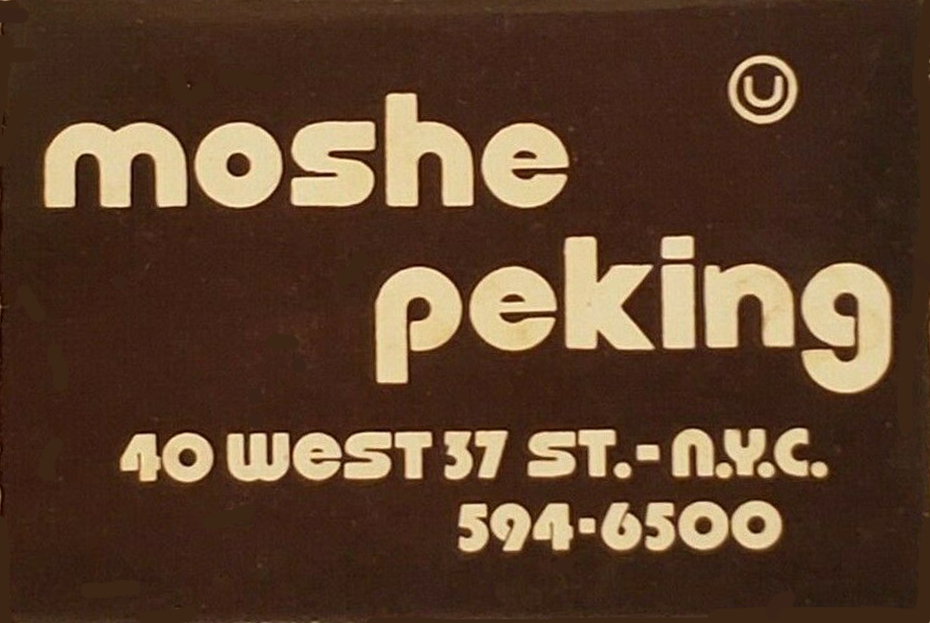
Another change in the postwar years was the increase in the number of kosher Chinese restaurants, some, such as Sabra and the popular Moshe Peking, with Jewish owners. The 1970s and 1980s saw a rise of kosher Chinese restaurants adhering to what appeared to be a stricter standard in how food was obtained and prepared and also in hours of operation, being closed on the Jewish Sabbath as well as holidays. Additionally, they had a rabbi on hand to inspect food preparation.

Happy Holidays to readers, whatever you may be eating on December 25!

© Jan Whitaker, 2019

12 Comments

Filed under alternative restaurants, food, kosher, patrons, restaurant customs

Turkeyburgers

If the turkey growing industry had one marketing mission in the early 20th century it was to get consumers to eat more turkey, and to eat it year-round.

So, during the Depression turkeyburgers arrived upon the dining scene.

In the mid-1930s humorists found rich material in California cuisine, notably in the range of burgers found at weird and fanciful roadside eateries. Among them chickenburgers, nutburgers, onionburgers, lobsterburgers, even mysterious huskyburgers. And on Los Feliz Boulevard in Los Angeles a commentator spotted a neon sign advertising “The Snack with a Smack – Our Toasted Turkeyburger.”

The stories that appeared in the press attributed turkeyburgers to California’s bizarre culture. But what they didn’t say was that in the 1930s California was becoming a major turkey producer. Production had moved westward from its East Coast home of origin. In California, dry weather conditions were more favorable for turkey raising. But in 1936 overproduction resulted in a serious drop in prices. This was bad for producers but good for Depression-era drive-ins and roadside stands. And now producers were more interested in increasing turkey consumption than ever before.

Gonzales, Texas, was another important turkey-raising area. A local newspaperman there had a product placement idea about how to stimulate turkey sales. He suggested that since the comic strip character Wimpy was known for his love of hamburgers, it would make sense to introduce turkeyburgers into the strip. Wimpy started eating them in December of 1939.

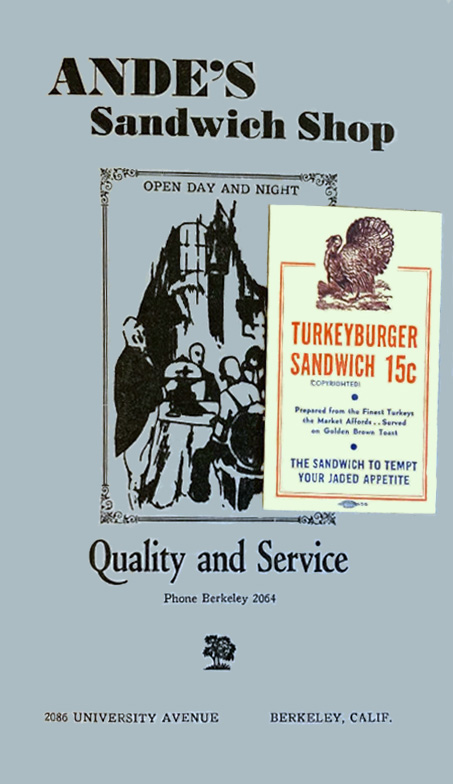
Meanwhile, in Corpus Christi, Texas, a drug store was offering a December holiday lunch of sorts, “Something New”: a Turkey-Burger with waffle potatoes and cranberry sherbet, for 19 cents. Also in 1939, someone in Phoenix registered the trade name Turkey-Burger with the Arizona Secretary of State. It’s interesting, too, that the Berkeley, California, menu shown below, possibly from the 1930s, says “copyrighted!” following “Turkeyburger Sandwich.” (Thanks to the reader who sent me a scan of this menu and inspired this post.)

With rationing of beef, pork, veal, and lamb in World War II more restaurants added turkeyburgers and other turkey dishes to their menus. In 1941 the magazine Chain Store Age tested recipes for turkeyburgers and turkey salads on behalf of in-store soda fountains and luncheonettes. It showed that turkeyburgers had high profit potential: if a turkeyburger on a bun was served with cranberry sauce, sliced tomato, and potato salad, the magazine reported, it could be priced at 25 cents while costing only 6.55 cents. A few years later Payless stores in Albany, Oregon, cashed in on the idea, boldly charging 40 cents for their sandwich.

In the 1950s drive-ins served turkeyburgers. In 1950 they were up to 65 cents at Vogel’s Drive-In in Ogden, Oregon, though only 30c a few years later at Moeby’s Hamburger Palace in Eureka, California. A Texas drive-in revived the idea of burger variety, offering sandwiches made of chicken, turkey, rabbit, shrimp, or pork, all for 40 cents. Somewhat surprisingly, in 1969 Ferdinand’s in Honolulu’s Coral Reef Hotel, which specialized in 16 kinds of burgers, offered a Turkey Burger Deluxe on Thanksgiving Day.

Starting in the 1970s and especially in the 1980s – and continuing today — turkeyburgers came to represent a healthier substitute for a hamburger, one with less fat and fewer calories.

Have a delicious Thanksgiving!

© Jan Whitaker, 2019

8 Comments

Filed under drive-ins, food, restaurant customs, roadside restaurants

Themes: bordellos

In the 1960s turn-of-the-century brothels inspired restaurant decor, even in some places pitching to the family trade.

Isn’t it strange that some restaurants with this type of decoration were meant to represent family good times? Mom and dad and the kids, for instance, eating burgers and fries while enjoying the songs of Lusty Lil and company at The Red Garter Saloon in a Shakopee MN amusement park. All in good fun of course, as if business in that venerable trade had been suspended long ago.

In the 19th century and the early 20th, the connection between certain restaurants and “the oldest profession” was a well-known fact and provided at least one reason why women who valued their reputations tended to be fearfully shy of night life. As late as 1923, guardian of manners Emily Post wrote, “It is not good form for an engaged couple to dine together in a restaurant, but it is all right for them to lunch, or have afternoon tea.” If they drove to the countryside for a meal, she recommended they be accompanied by a chaperone.

In 1881 The National Police Gazette, a sensational men’s tabloid, warned of Italian restaurants. “Ostensibly kept for the purposes of dealing out the culinary requirements of the inner man, they depend upon the sporting element for patronage, and in the lowest den in the vilest neighborhood, to the first-class restaurant in the heart of the business section of the city, the bawd and her ‘man’ may be seen.”

In 1907 a number of popular restaurants in San Francisco were named as participants in a scheme in which politicians, for a fee, made sure the police did not interrupt the non-food side of their business. Among these restaurants were both the Old Poodle Dog and the grandiose New Poodle Dog.

But by the early 1960s, the ambience of a brothel was considered not only proper but elegant, particularly for steakhouses. The hallmark of this decor had become red or red and black flocked wallpaper and lamps that looked like gas lights. There were various degrees of formality attaching to this theme, depending on whether it was interpreted as a “Wild West” dance hall or a “Gay 90s” Victorian parlor-style brothel. Another hallmark sneeringly remarked upon by critics was the overlarge pepper grinder, shown above standing erectly on a tray. Rather surprisingly, some respected restaurants such as Ernie’s in San Francisco adopted red-flocked decor [shown below].

Guess what happened when an actual “professional” of the trade opened a restaurant? Sally Stanford, as she was known professionally, had run a famed house of ill repute in San Francisco. When she retired in 1950 she opened a restaurant named Valhalla in Sausalito CA. From the start she was hassled by officials. First the police painted the street red in front of her restaurant, claiming it was to indicate a no-parking zone. Then, for several years the California Department of Alcoholic Beverage Control tried to take away her liquor license because she was a person of bad character. She fought back and eventually won and was declared rehabilitated. After many tries she was elected to the Sausalito city council in 1972, becoming mayor in 1976.

In 1977 it was revealed that the CIA had created a brothel in San Francisco to test “truth serums” on unwary men they recruited in bars. They gave them $100 and took them to the brothel where the prostitutes working there (perhaps unknowingly) supplied them with drinks that had been laced with psychoactive drugs, possibly LSD. The brothel was decorated with stereotyped red and black decor. When interviewed about the CIA’s decorating scheme by a reporter, Sally criticized their taste, saying, “That’s about the scope of their minds. . . . I’m surprised the tricks weren’t suspicious once they walked into a place that looked like that.”

Sally died in 1982 and Valhalla closed a couple of years later, but hackneyed brothel decor can still be found in restaurants today. It has become an American classic.

© Jan Whitaker, 2019

7 Comments

Filed under atmosphere, family restaurants, proprietors & careers, restaurant decor, theme restaurants

Finds of the day

Today I discovered two wonderful small cards at an antique book and ephemera show held just a few blocks from where I live.

This may not sound like a big deal – unless you are a collector. These were very special cards.

One was old and rare, the other more recent but by a favorite designer.

The older one, shown above, was for club called Sans Souci which held a dinner at Delmonico’s on 5th Avenue and 14th Street. The date of a dinner was just a few years after the Delmonico brothers opened at that location, which was destined to become their most fashionable one.

About the Sans Souci Club, I know nothing. But I did find out that there were many, many clubs with that name all over the United States in the 19th century. It’s possible that it might have been the one in Brooklyn about the time of this dinner. It was an amateur drama club which fits with the theme of the card.

As rare as the Sans Souci card may be, my favorite find was the newer card, probably from about 1986, designed for the Restaurant Florent by Tibor Kalman. He cleverly used simple, familiar symbols found in the Yellow Pages (except maybe for the gun?). It is printed on what has been described as shirt cardboard with flecks in it. He used similar cardboard for the restaurant’s matches.

Kalman’s card was designed while he was working with M&Co. which he founded along with others. It is in the collection of the Cooper Hewitt museum with other work of his done at M&Co., including quite a number of items for Restaurant Florent.

9 Comments

Filed under miscellaneous

Early bird specials

Recently I read a story that originated on Eater.com about the decline of early bird specials in parts of Florida populated by retirees. It said that fewer and fewer restaurants were offering these deals. Partly this was because the retirees who had once patronized early bird dinners were passing away, but also because baby boomer retirees rejected the custom which they associated with an antiquated idea of old age.

Early bird restaurant-going is popularly associated with Florida, but by no means has been confined to that state. A 1973 story about restaurants in Palm Springs CA commented that “early dining is almost a city ordinance in Palm Springs,” with 6:00 p.m. being the popular dinner hour and restaurants deserted by 9:30.

Jaya Saxena, who wrote the Eater story, talked with historian Andrew Haley, author of the book Turning the Tables. He said he knew of restaurants that had offered early bird specials as early as the 1920s and 1930s, but that the custom had really become popular in the 1970s.

I found scarcely any trace of early bird restaurant specials before the 1950s, but agree that the 1970s was when the custom became popular. It increased in the 1980s but may have declined somewhat after that, possibly because of the ever-growing competition of cheap meals in chain eateries.

The term early bird special itself was in use in the early 1900s if not before, almost always referring to morning clothing sales in stores. Of course the concept could be – and was – extended to almost anything including sparkplugs at Western Auto or family portraits at discounted prices if made before the Christmas rush.

Stores, especially drug chains, were probably the first to offer early bird meals, usually breakfasts or pre-noon lunches. This was clearly a tactic to draw customers into the store at times when it was least busy. The Owl Drug store in Riverside CA offered Early Bird Breakfast Specials at its soda fountain in 1951. About the same time Walgreen’s in Lexington KY had a similar before-11:00 a.m. deal on two pancakes and an egg for 29 cents.

Nightclubs were some of the first to use early bird specials to attract patrons for dinner. Their business seemed to need a lot of boosting, especially in the 1960s and 1970s when night clubs were not doing well. Often part of the bargain was that early diners who came before showtime were allowed to stay on for the night’s entertainment without paying an additional charge. In the case of San Diego’s Shalimar Club, the time for early diners is not specified but evidently was before 8:00. [shown below]


Discounting meals for early customers might seem mainly to be a way for restaurants to spread out dinner business rather than turning away customers at rush times. In 1967 Wolferman’s Biftec Room in Kansas City found that daylight savings time inclined customers to eat later, when it became dark, but that by offering discounts for earlier dinners, they could correct this tendency. Although it makes good sense to try to spread the arrival of customers, it is notable that it is rarely, if ever, fashionable restaurants that offer early bird specials. There is at least a hint that some restaurants adopting this tactic were simply trying to improve a generally lagging business.

It’s interesting to note what times have been considered early for dinner. Usually it meant before 6:00 or 7:00 p.m. The understanding was/is that fashionable dining began at 8:00, an hour generally considered late by older diners – as well as by families, who have also made up a portion of the early bird flock. Early bird dining often began as early as 4:00 p.m. and I’ve found one restaurant chain, JB’s Big Boy restaurants in Nebraska, where it started at 2:00 p.m.

I can’t help but reflect on 19th-century dining hours, when dinner was a midday meal. Then 2:00 p.m. was when dinner time in restaurants and eating houses typically ended. The fashionable hour for dining out for the few who had the luxury of arising late in the morning was 5:00 or 6:00 p.m., though they might have a lighter repast, supper, later in the evening.

© Jan Whitaker, 2019

6 Comments

Filed under night clubs, patrons, restaurant customs

Franchising: Heap Big Beef

The 1960s was the decade when franchising frenzy began. Franchising was hailed as a chance to be your own boss and make a comfortable income with a moderate investment.

Fast food drive-ins and other low-priced eateries with limited menus were in the forefront of the franchised businesses springing up everywhere. As is typical with franchised restaurants, owners needed no particular experience, or even interest, in food or food preparation. Because, in a sense, someone might just as well choose a franchise in wigs or roto-rooters as chicken or hamburgers.

One of the interesting franchising business careers was that of the originator of Bonanza and Heap Big Beef. The principal creator of both was an ambitious man named Don Pruess. He was a true believer in a franchising formula that paired a celebrity name with a chain of small businesses run by people who put up the capital. In 1956 he signed up Esther Williams to lend her fame as a movie star and champion swimmer to the sale of backyard in-ground, vinyl-lined pools. However, as has often been true of businesses with celebrity figureheads, the company was soon in bankruptcy.

A few years later, in 1963, Pruess began licensing local distributors to sell franchises for Bonanza Sirloin Pit Steak Houses. An advertisement for franchise applicants proclaimed, “It’s America’s hottest food franchise,” saying net profits ranged from $2,500 up to $7,000 a month with a $20,000 cash investment. The following year the first restaurant in the chain opened in Westport CT with Dan Blocker, who played ‘Hoss’ Cartwright on the TV show Bonanza, enlisted as the chain’s celebrity mascot.

As it developed, Preuss’ business was more than simply a franchisor of restaurants. As a 1973 law brief put it, his corporation, Franchises International (F. I.), “was the ultimate in franchising” because it “franchised the right to sell franchises.”

Serious expansion of the Bonanza chain actually did not happen until its acquisition by a Texas company in 1965. The following year F. I. began seeking franchisors and franchisees for Heap Big Beef. The first units in the HBB chain opened in 1967, with a menu of “giant” beef sandwiches for 59 and 99 cents.

In addition to franchising for Heap Big Beef, F. I. did the same for a beauty salon chain named Edie Adams’ Cut & Curl and Mary’s Drive-Thru Dairies. At one point F. I. revealed plans to move into franchising for more than 50 other types of businesses including nursing homes and diet centers.

At the same time, F. I. was seeking capital from a large investing company called City Investing Co. Starting in 1967, Heap Big Beef franchising advertisements identified F. I. as a subsidiary of City Investing. But the relationship was fraught from day one. The president of City Investing did not approve of F. I.’s sales tactics, including misrepresenting how many units had been opened. For example, City Investing objected to the false implications of F. I.’s claim that Heap Big Beef #32 had opened, suggesting that the number was not in fact a tally of how many had been opened. City’s subsequent failure to supply F. I. with enough capital led to the resignation of Pruess and the other officers of his corporation.

Beginning in 1969 there was a die-off of Heap Big Beef outlets. Though it had been advertised as the hottest thing going, it turned out the chain had never exceeded 60 units nationwide. The latest date I could find one in operation was 1971.

Maybe there are fans out there that still sorely miss Heap Big Beef, but I doubt it. Given its theme, it was a chain that could not exist today. The American Indian theme had no relevance, having been adopted solely because of the popularity of western TV shows at the time. The A-frame buildings were meant to suggest tepees, although they were used by other chains, including Der Wienerschnitzel. There was little about the menu that differed from 19th-century lunchroom fare except for the paucity of items and the offensive “Hollywood Injun English” used. Consider: “You’ll let out a war whoop” when you eat a Heap Big Beef (or Ham, Fish, or Corned Beef) sandwich. How about a Warrior Burger, a Shawnee Shake, or a Pawnee Pie?

File Heap Big Beef under failed restaurant chains.

© Jan Whitaker, 2019

10 Comments

Filed under chain restaurants, menus, proprietors & careers, roadside restaurants

Boston’s automats

I have written quite a lot about automats, their origins in Germany, and where they have appeared around the country and the world. The automats run by the Horn & Hardart Company in New York, which began in Philadelphia in 1902, were undoubtedly the most successful and best known.

But automats did not do so well in other places. In Boston, The Automat Company of New England is pretty much completely unknown and I could not find a single illustration. (Boston’s automats were not part of Horn & Hardart Co.)

In 1916 the Automat Co. of New England’s first automat opened in a renovated building at 255-257 Washington, occupying the first floor and basement.

It’s difficult to say exactly who was behind this business, but evidently there were numerous investors, including a NYC bond merchant, a New England hotelier, Harvard College, a Philadelphia trust company, and a Boston realty company.

The company began advertising in Boston papers for help, running hundreds of advertisement for chefs, cooks, buss boys, dishwashers, porters, bakers, pie men, and mechanics. Applicants were directed to 40 Winchester Street, which was the central office and commissary where food was to be prepared for the branches that would soon open.

Next, the company hired a general manager and began running advertisements for leases on new locations containing “not less than 4,300 square feet floor space with basement preferred.” Soon it had five: 2 High st., 40 Court st., 234 Huntington ave., 255 Washington, and 32 Franklin, as well as its headquarters on Winchester. As might be expected, the cost of installing automat equipment in the five locations was high.

By early 1919, the company was insolvent and operating only three locations. Receivers were appointed by the court. A story in March revealed that the company owed a serious amount of money to its creditors: $103,789. In August, the commissary and the remaining four locations were auctioned, including all equipment, furniture, stock, and patent rights.

The Waldorf Lunch System, which ran about 24 lunchrooms in the Boston area, acquired the assets of the Automat Company. They continued to run at least one of the locations as an automat, 234 Huntington, until they auctioned the restaurant in June 1924.

Waldorf ran a second automat in the 12-story Little Building on Boylston Street. Since this had not been a location of the Automat Company, Waldorf must have moved automat equipment they acquired in the auction to this address. But, in 1924 they converted this automat into a “modern cafeteria,” saying that they would now be able to handle an additional 50 customers at a time, as well as to expand the menu to include steaks, chops, roasts, and even oysters, cooked by “special chefs” who would provide “regular first-class hotel cooking.” The change was seen as a substantial upgrade.

It sounded as though Bostonians weren’t shedding tears over the disappearance of automats in their city.

It seems to beg the question of why NYC’s automats were celebrated and became objects of nostalgia.

Automat is a word still in use in Germany, meaning a vending machine. And if you think about it, weren’t the old H&H automats simply large vending machines with people working inside of them?

© Jan Whitaker, 2019

21 Comments

Filed under chain restaurants, lunch rooms

Coffee and cake saloons

When it came to cheap ready-to-eat food that was available around the clock, butter cakes sold in coffee and cake saloons were king. By the mid-19th century they had become food of urban lore. They were said to be favorites of people of the night such as newsboys, newspaper printers, policemen, volunteer firemen, and prostitutes.

Until the 1880s when they widened their menus, coffee and cake saloons served nothing but those two items. Although called saloons, they were not drinking places. Saloon then simply meant a room.

There was no hint of elegance in these places. Many were run by Irish proprietors, at a time when the Irish were pretty much at the bottom of the class order. Usually they were in basements, but those were the more established coffee and cake saloons. Other sellers occupied market stands or peddled butter cakes on the streets with trays strapped over their shoulders.

The lack of niceties in coffee and cake saloons was celebrated in a joke that described a waiter’s shock when asked for a napkin in one of these places. He had a quick comeback, inquiring whether the patron wanted his napkin fringed or unfringed. (Surely there were no tablecloths as in this 1889 illustration.)

Among the well-known proprietors of New York City were George Parker, who opened a place on John street in 1832 and “Butter-cake Dick,” whose full name was Dick Marshall. Oliver Hitchcock took over from Dick, who turned to a life of crime. Pat Dolan, starting business in the 1860s, reputedly invested in real estate and had amassed a quarter of a million by his death in 1889, while a couple of the Meschutt brothers later opened hotels.

Lore surrounding these establishments grew as they became rarer in the late 19th century. By the early 1900s the memory of coffee and cake saloons was tinted with nostalgia. It was often said that proprietors retired with fortunes — an unlikely story in the majority of cases. Another notion was that they were “peculiar to New York.” This, too, is inaccurate. I have found them in St. Louis, Sacramento, New Orleans, San Antonio, and San Francisco. Undoubtedly they could be found in most large cities.

Just what was a butter cake? That isn’t totally clear. They are described differently, to the point where it’s anyone’s guess what they really were. Sometimes they sound like doughnuts, sometimes griddle cakes, sometimes like carnival-style fried dough – but without sugar. In St. Louis waiters referred to them as a “stack of whites.” Often they are referred to as biscuits. Sometimes they are called short cakes, as in the 1850s recipe shown here. I believe that initially they were made of little more than dough and were nearly indigestible, leading to the nickname “sinkers.” After bakers started adding yeast, they became lighter.

An 1890 story in the New York Sun explains that butter cakes could be either “wet” or “dry.” It said that the wet ones “were saturated with lard or grease of some sort, called butter for the purposes of trade.” But possibly some places really did use butter. A San Francisco restaurant advertised in 1856 that they used “none other than California Butter, fresh from the best Petaluma Ranches.” Their menu called them “New York Butter Cakes,” selling for the high price of 12 cents. In New York an order cost 3 cents. Butter-cake Dick was said to make his sinkers on the griddle and to store them in a kettle of melted butter until orders came in. The three Meschutt brothers sampled Dick’s but found a way to lighten them by adding yeast, splitting the cakes (biscuits?), and letting customers add the butter.

Although coffee and cake saloons were just about extinct by the 20th century, Lewis Hine managed to capture a view of newsboys exiting one in 1908. [shown at top]

© Jan Whitaker, 2019

5 Comments

Filed under alternative restaurants, food, Offbeat places, patrons, popular restaurants, proprietors & careers

Women chefs not wanted

Unless, maybe, they wear swimsuits to work?

Until the later 20th century when women began to break the stronghold of the male chef, it was said women simply could not handle the job of running a restaurant kitchen. What follows are the reasons given by people associated with restaurants of the 20th century.

Most of the opinions recorded here were expressed by men, but a few were by women (sigh).

1906 – Women lack accuracy using flavorings and condiments – Women do not have the right temperament, they lose their heads. – Women could not stand the strain of hard work. – They are not managers. – They do not practice economy. – They lack patience and delicacy. – They are not as orderly as men in the kitchen. – They cannot rise to the occasion in a crisis. – They cannot organize the work of a kitchen.

1908 – The work of a chef is unsuited to her physique.

1912 – Women are not particular enough to make a perfect dish.

1913 – They would become rattled and go to pieces if they had to handle the responsibilities of chef. – They go off on a tangent when things are not as they should be.

1931 – The duties are too strenuous for them. – They could not handle an elaborate menu. – They cut meat the wrong way. – They don’t make gravies and sauces properly.

1932 – Their taste is inferior to men’s.

1942 – The great chefs have always been men . . . [so there must be a good reason why] – There are scarcely any women gourmets.

1952 – Women can only do about 15% or 20% of the jobs in a restaurant kitchen as well as men.

1957 – Women can’t handle work in a restaurant kitchen either physically or mentally. – They lack discipline. – They make changes based on their own likes and dislikes.

1965 – Men have more of an inner potential for good cooking then women. – If cooking for a very large number of people a woman would probably break down crying and run away.

1968 – Heat in restaurant kitchens makes women nervous.

1975 – Women lack the instinct for great cooking.

1981 – Men seem to have more derring-do in the kitchen.

© Jan Whitaker, 2019

17 Comments

Filed under chefs, restaurant controversies, restaurant issues, women

Entree — from side dish to main dish

Menus from the 19th century, often called bills of fare, can be very confusing. One of the more puzzling aspects is the word “entree” (a French word whose accent is usually omitted in the U.S.).

In more recent times the word has been interchangeable with “main dish,” but that is not what it used to mean. To a large extent it was mainly a way to bring a bit of French culture to a cuisine that was rather plain and unsophisticated.

The way the term was used on old menus varies quite a lot and reveals some confusion on the part of menu makers.

Two menus from New York’s fashionable hotel, Astor House, are revealing. One is from the men’s dining room in 1841 and the other from the women’s dining room in 1845. The menu used in the men’s dining room has the following headings: Soup, Fish, Boiled, Entrees, Roast, Pastry, and Dessert. Under Entrees are 17 dishes, all in French, while the rest of the menu is in English.

The 1845 menu for the women’s dining room is entirely in English, with almost the same headings, and many of the same dishes under each heading. But instead of Entrees, the women’s menu says “Side Dishes” of which there are 10. They include Eels, cold sauce; Small oyster pies; Small birds, Port wine sauce; Wild Ducks, Game sauce; and also Beans and Pork and Baked Macaroni.

A variation is found at Brown’s Hotel, in Washington, D.C. in 1847. On Brown’s Bill of Fare for the men’s dining room, everything is in English. The heading Entrees is used, but the order of the various listings is quite different, with Entrees coming after Roasts but before Game and Boiled. The same ordering is found on the Bill of Fare of a San Francisco hotel in 1849 which, again, is entirely in English other than the world Entree itself.

Other dining rooms, such as that of Boston’s Revere House in 1851 preferred “Side Dishes” to Entree, as did many other hotels. It isn’t perfectly clear to me what they were side dishes for, although I’ve seen explanations saying they were to go with the first course. In most cases this was Fish, so that can’t be right.

Shown at the top is a portion of an 1853 menu from Boston’s Swiss Republic which uses a two-column format with English on the left and French on the right. On it, Entree is equated with Baked!

On the strange little 1889 menu for Sunday dinner at Kilburn’s, in Rockford IL, Entrees come last as though an afterthought.

Entrees, and presumably Side Dishes too, were supposed to be more delicate than Boiled or Roast items. Entrees were things such as Fricassees, Croquettes, Meat Pies, or Stews, while Boiled and Roasts were such as Leg of Mutton, or Ham, or Veal, the latter two presumably presented as large chunks. Entrees usually had sauces. In some places a French chef would be hired to prepare the Entrees. It is odd, though, to imagine a French chef making pork and beans. It occurs to me that in some cases Entrees might have been made of leftover roasts. For instance, it would be a short trip from Roast Mutton to a Mutton Omelet.

An article in Harper’s Bazaar in 1898 explained the appeal of “savory entrees and made dishes as a variation upon the eternal roast and boiled.” The author, Christine Terhune Herrick, considered the preference for entrees, salads, and delicate desserts as evidence of a much-needed evolution of American cookery. Herrick referred to entrees and made dishes as two different things, but other cooking experts claimed they were the same.

In the 7th edition of his Hotel Meat Cooking, in 1901, Chef Jessup Whitehead recommended the term made dishes be used since it was clearer. He noted that making entrees called upon a cook’s creativity, and was a good way to use up scraps. He also explained that entree in France historically referred to the first dishes to enter a dining room and that for a small dinner party entrees might replace roasts altogether.

Entree as a separate course largely went out of use in the 1920s, during Prohibition when fine dining and French influence on cooking were scaled back. It came to mean “main course” and included fish, duck, and roast meat as well as made dishes. Still, it is interesting that the earlier meaning did not totally vanish. In 1966 restaurant consultant George Wenzel’s Menu Maker advised that “A balanced menu has: One roast, One solid (chop, cutlet, etc.), One fish, One prepared dish [i.e., entree], One meatless dish.” History lives on!

Nevertheless, most people now think of the entree simply as the main dish. Although it is still a familiar term, I find it interesting how many menus have eliminated the word entirely.

© Jan Whitaker, 2019

9 Comments

Filed under menus, restaurant customs