Category Archives: women

Find of the day: Mrs. K’s Toll House Tavern

MrsKs943

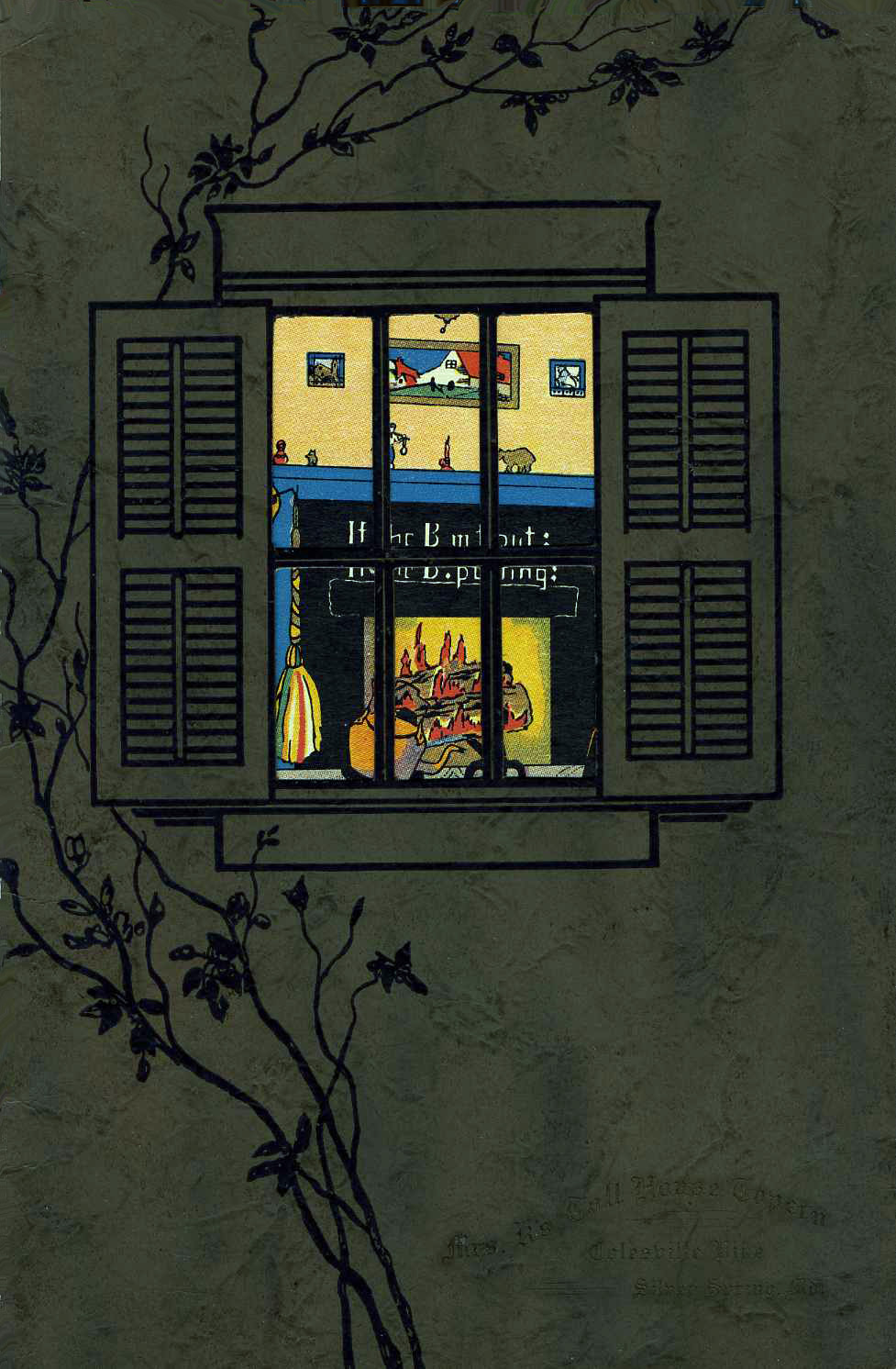
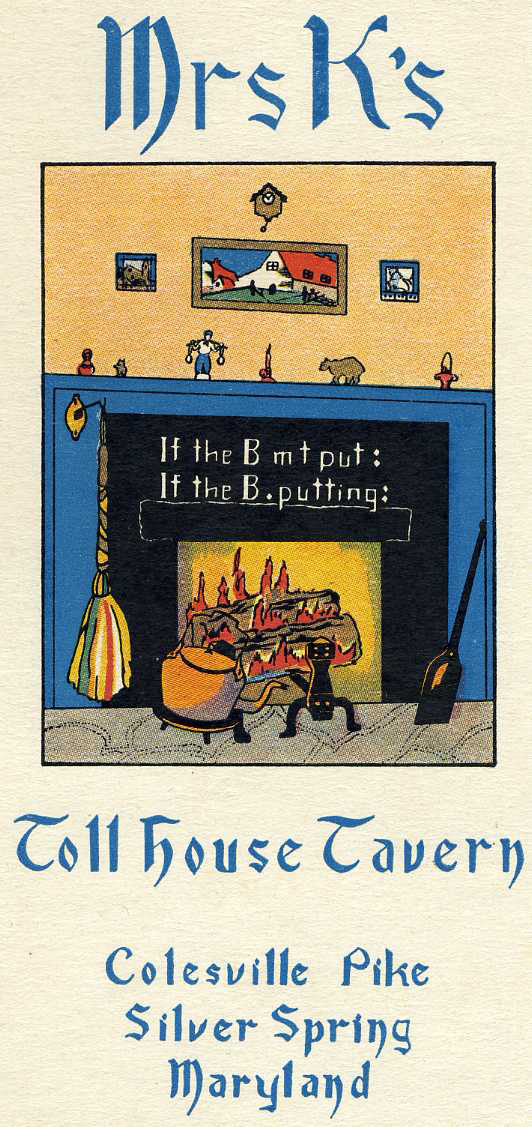
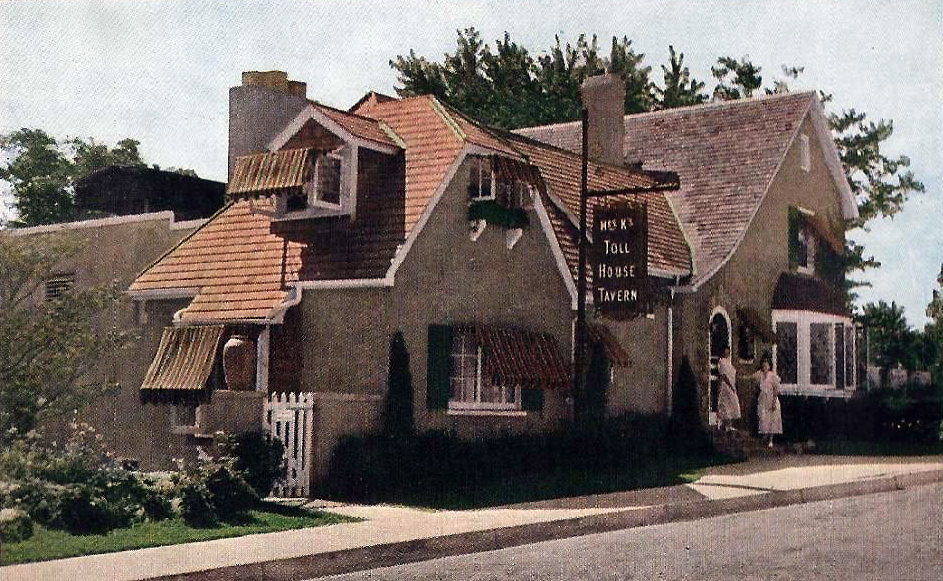
Over the weekend, at a vintage paper and postcard show in Boxborough MA, I found a charming diecut menu from a restaurant in Silver Spring MD. Established in 1930 by Olive and Harvey Kreuzburg, the landmark restaurant is still in operation today though no longer owned by the founding family.

Shown through the window is page 2 of the menu illustrated with a fireplace inscribed with a cryptogram. Can you figure it out? Hint: the riddle is said to have originated in England. (Click to enlarge. Answer below.)

MrsKs941Judging by the prices, this menu is from around 1950. A Tenderloin Steak dinner accompanied by French Fried Onions or Fresh Mushrooms, cost $2.25. It was served with soup, fruit relish, salad, three vegetables, a sherbet course, hot bread, dessert, beverage, and after dinner mints. By 1962, when the Kreuzburg’s son Richard ran the restaurant, that dinner had gone up to $6.00. Burgundy, Sauterne, Claret, and Blue Ribbon beer were available. All meals were served family style with bowls filled with enough for the entire table. Mrs. K assured guests that everything was prepared from scratch on the premises and under her supervision.

Olive Kreuzburg was not new to the restaurant business when she and her husband took over the old toll house that had previously been the home of two other failed tea rooms. In 1923 it operated as the Seven Oaks Tavern where sky high prices must have contributed to its demise. Olive’s prior experience included running the dining room of the Hotel Wellesley in Clayton NY, a tea room in Miami FL called Mrs. K’s, and two tea rooms in Washington DC, one named Mrs. K’s, and the other Mrs. K’s Brick Wall Inn. Clearly using her abbreviated name served her well.

At its opening in 1930 the Silver Spring Toll House was listed in a DC newspaper under “Where to Motor and Dine.” At that time development had not sprung up around Mrs. K’s; although only “a 30-minute drive from the White House,” it was in the country. The early advertisement read: “This old Toll House with its charming furnishings and Terraced Gardens marks a delightfully smart Country Dinner Place.”

mrs.K'sTollHouseILL

Getting through the Depression was no doubt aided by Duncan Hines’ recommendation of Mrs. K’s in his very first list of his favorite restaurants that he sent out to friends in a 1935 Christmas card. Later he expanded the list and published it as a book. In the 1937 edition, he said of Mrs. K’s, “You dine in the past here – so far as furnishings are concerned. Nothing is changed apparently from the Revolutionary days when it was built. Even the pretty girls who wait on you in Colonial dress seem to have been miraculously preserved from a more leisurely age when dining was a rite not to be passed over casually.”

Whether or not the building dated from the Revolution, the quaint restaurant was filled with antiques collected by the Kreuzburg’s.

The cryptogram explained:
If the grate be [great B] empty (m t), put coal on [colon].
If the grate be full, stop [ . ] putting coal on.

© Jan Whitaker, 2015

6 Comments

Filed under family restaurants, proprietors & careers, roadside restaurants, women

Caper sauce at Taylor’s

FannyFernWhen journalist Fanny Fern took up her pen, readers knew wicked pronouncements would flow. Her fans loved it. Of course she also had many detractors who disapproved of her bold opinions and her feminism.

For twenty years starting in 1851 Fanny Fern wrote about her favorite subjects, “Men, Women, and Things.” Her essays appeared in newspapers and were later collected in books. The first collection, Fern Leaves from Fanny’s Portfolio (1853), sold 80,000 copies in a matter of weeks. She was said to be the second highest paid woman writer in America after Harriet Beecher Stowe.

Fanny Fern was the pen name of Sara Willis, born in 1811 in Maine and raised in Boston. After her first husband died, she accepted an offer of marriage to a man who became abusive. Her literary career was launched by the need to earn a living for herself and her three children after she left him in 1851.

Food and dining out at dinner parties and restaurants were topics that occasionally appeared in her columns. Two of her collections were named for food – Ginger-Snaps and Caper-Sauce. She prefaced Ginger-Snaps with the following:

FannyFernGingerSnaps
Despite her acerbic style, even those who were its targets treasured her and over the course of her life she sold hundreds of thousands of books in the U.S. and England. An entry about her in American Women (1897), noting hers was “the most widely known and popular pen-name of the last forty years,” praised her for “wit, humor and pathos.”

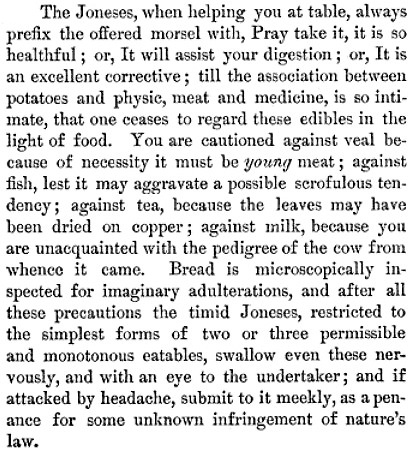
Her style is captured in a short piece called “The Amenities of the Table” in which she described attitudes toward food as represented by three very different couples. Her depiction of the Joneses strikes a note today.

fannyFernJonesesp111AmenitiesoftheTable

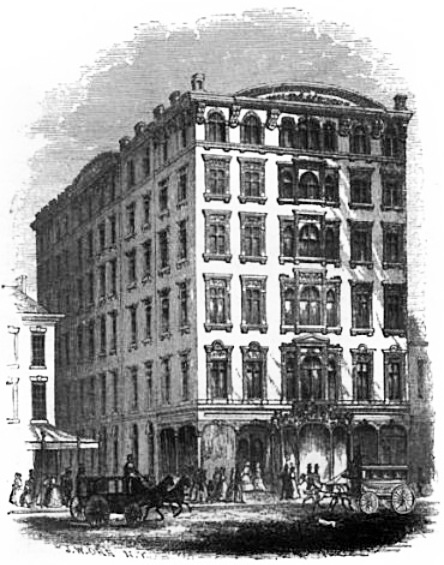
In 1854 she moved from Boston to New York City where she wrote for the New York Ledger (and married author James Parton). No doubt she became familiar with Taylor’s, the glitzy, mirrored, pseudo-posh Broadway restaurant [pictured below] she featured in an essay called “Feminine Waiters at Hotels.” Always protective of women workers, she advised miserable seamstresses to throw their thimbles at their employers and rush to Taylor’s, which had just begun hiring women as servers. But she suggested that they take good care of themselves: “Stipulate with your employers, for leave to carry in the pocket of your French apron, a pistol loaded with cranberry sauce, to plaster up the mouth of the first coxcomb [“dude,” “masher”] who considers it necessary to preface his request for an omelette, with ‘My dear.’”

fannyfernTaylor's1853

The servers, she observed, would surely encounter all kinds of overdressed patrons trying to impress others and would “get sick of so much pretension and humbug,” But, she added, “Never mind, it is better than to be stitching yourselves into a consumption over six-penny shirts; you’ll have your fun out of it. This would be a horribly stupid world, if everybody were sensible.”

Sara Willis Parton died in 1872. Her life story is told in Fanny Fern: An Independent Woman by Joyce W. Warren (Rutgers University Press, 1992).

© Jan Whitaker, 2015

4 Comments

Filed under miscellaneous, women

“Atmosphere”

atmosphereschaber1941I put the word in quotation marks to acknowledge that what atmosphere in restaurants means is as elusive as air itself — which the word also refers to. It was often used to describe eating places in the 19th century, but not in a flattering way. A typical usage is that from 1868 where someone remarked that in a certain restaurant “the atmosphere is heavy with cooking vapors.”

The term atmosphere (or ambience, which came into use in the 1970s) became used in a more general way to describe the character of a restaurant – that intangible spirit of a place. The broader meaning could encompass an air that was sophisticated or homey, rowdy or relaxing, masculine or feminine, formal or casual, etc. I discovered a 1950s restaurant that claimed to have “Christian atmosphere” with home cooking by a Mrs. and “No Beer, Liquor or Smoking.”

In the 1890s the more general meaning almost always referred to the kinds of people associated with a restaurant, both owners and patrons. For example sawdust on the floor, pictures of athletes on the wall and the presence of prostitutes signaled a thoroughly masculine atmosphere while the presence of artists and writers in French, German, or Italian table d’hotes shouted “bohemian!”. A jolly host could also impart atmosphere, which might be altogether missing if he weren’t on hand, or if his most colorful patrons failed to show.

AtmosphereRomanyMarieSummer1921It didn’t take long before restaurant owners realized they could appeal to new patrons by bragging about their “atmosphere,” especially if it was bohemian. A San Francisco restaurant announced that it attracted “artists, writers, musicians, poets, painters, singers, draftsmen, balladists, literati and newspaper writers.” In 1903 NYC’s Elite Rathskeller Restaurant ran an advertisement claiming to have “Refined Bohemian atmosphere,” which sounds like a contradiction in terms since bohemians were supposed to be carefree souls who violated everyday norms of propriety.

The next step for restaurateurs was to merchandise atmosphere by generating it themselves. Since it seemed that so many people wanted to gawk at bohemians, why wait for them to show up if you could entice them with free dinners? Allegedly some restaurants did just that.

atmosphereVentureTeaRoomPhila

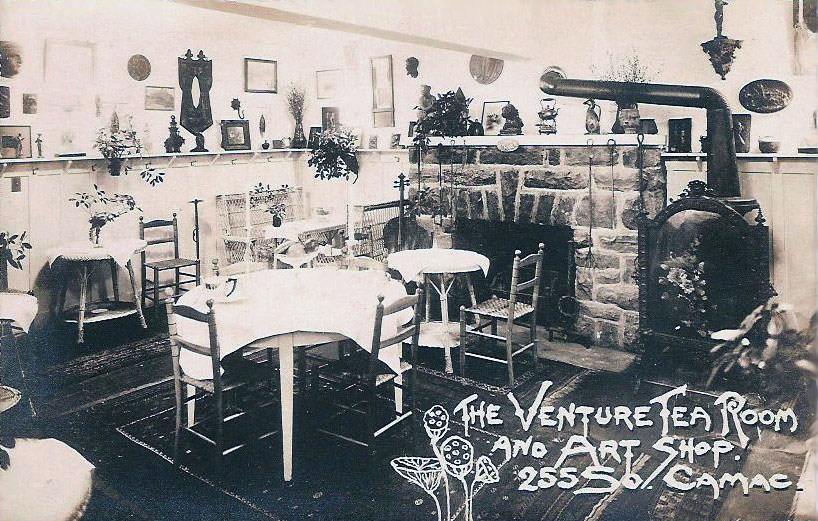
After World War I, following the reign of bohemian restaurants, came a new type of atmospheric eating place, the tea room of the 1920s. The tea room’s special atmosphere was  quaint and homey with artistic touches. In 1922 the Journal of Home Economics pronounced that “The very name of Tea Room has grown to mean a place with ‘atmosphere’ and with furnishings that are unique.” Ranging from the fashionable to the playful, tea rooms proved that women – their primary patrons – were in love with atmosphere.

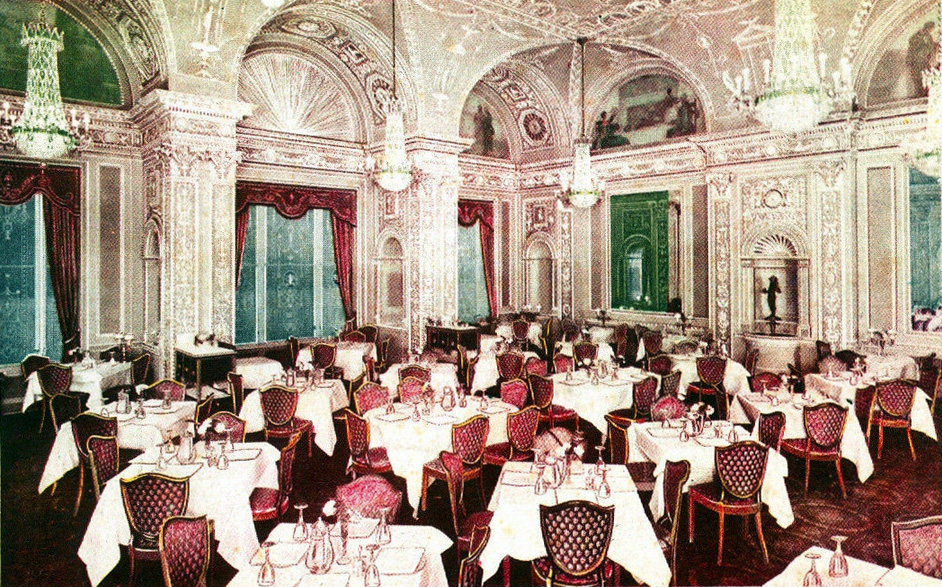
atmosphere1918FlintMIBucking the trend toward atmospheric decor were a handful of holdouts. Anything like a “restaurant atmosphere” was anathema to a Y.M.C.A. cafeteria in Flint Michigan (1918). The Old Colony Coffee House in Richmond VA renounced “ordinary restaurant atmosphere” in 1924 and vowed it would have instead “simplicity in decorations” and “plainness in food.” Patrons of traditionally masculine restaurants feared that when Chicago’s J. R. Thompson’s tore out its white tiles for a more feminine look it had destroyed its no-nonsense atmosphere and gone “girly girly.” Likewise, design critic Lewis Mumford shuddered when the Childs’ chain replaced the “antiseptic elegance” of its “hospital ward atmosphere” for “fake fifteenth century English,” betraying the honest utilitarianism of the Machine Age. No doubt Mumford chuckled when Alice Foote MacDougall, queen of scenographic Spanish villas and French chateaux in NYC, went bankrupt in 1932. [see The Cortile below]

atmosphereCortile

In the 1950s there was still a tendency in the restaurant industry to see women as the constituency for atmosphere while men supposedly judged a restaurant first by its food quality. But by the 1960s this was no longer true, as indisputably demonstrated by the success of Polynesian restaurants. An executive of the National Restaurant Association (NRA) said that Americans’ demand for atmosphere had raised the cost of opening a restaurant to $4,000 a seat in 1962.

One of the early chains built around atmospheric theme restaurants was David Tallichet’s Specialty Restaurant Corporation in California. In 1965 the firm opened Gate of Spain, capturing the “atmosphere of old Castile” atop a tall building in Santa Monica. Restaurant industry consultant George Wenzel recommended the following year that restaurateurs “give your guests something to do or something to see, or something to make conversations about.” He suggested creating a Gay Nineties or a river boat atmosphere.

In the 1970s theme restaurants came into their own, classified by the NRA as one of three of the basic types of restaurant in 1976, and the one that drew the most affluent guests.

© Jan Whitaker, 2015

5 Comments

Filed under atmosphere, restaurant decor, theme restaurants, women

Road trip restaurant-ing

PostluggageFor New Yorkers even today a lengthy car trip can raise concerns about letdowns at the dinner table, but all the more so in 1915.

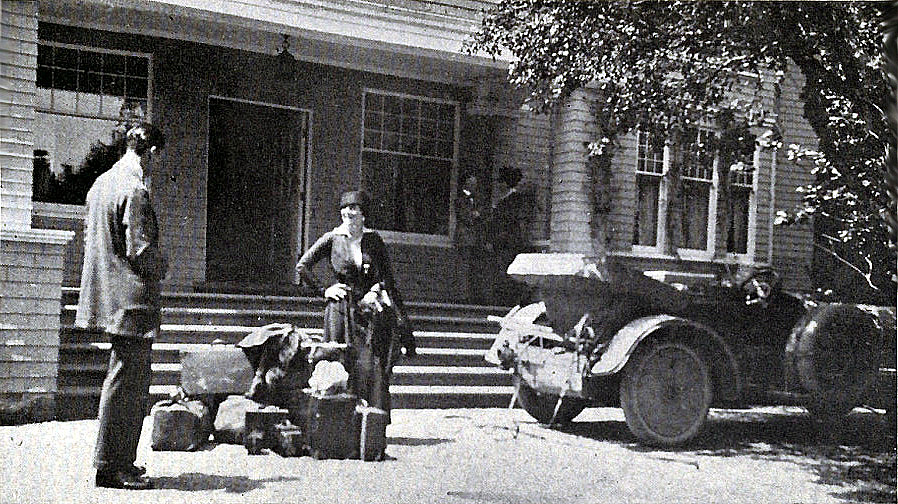
That was the year that two writers, Theodore Dreiser and Emily Post, separately set out across country [Post pictured above, about ready to embark]. Although novelist Theodore Dreiser is often credited with writing the “first road trip” book, the publication of his Hoosier Holiday in 1916 was in fact matched by Post’s By Motor to the Golden Gate that same year.

Dreiser’s trip took him back to his boyhood state of Indiana, while Post daringly continued westward to the Panama-Pacific Exposition in San Diego and San Francisco. Both were in their 40s, lived in New York, and had failed marriages behind them. Both traveled with a companion and a chauffeur, in Post’s case her son.

Each made interesting observations about places where they ate. Dreiser, on a sentimental journey into his past, tended to see most restaurants as symptomatic of the identity-less mediocrity of American culture. Post experienced the journey with a liberating sense of adventure and was less judgmental than Dreiser, but only to a point.

As much as possible the Post party stuck to respectable hotels for their meals, for which they spent a fair amount of money for that time. An appendix in Post’s book provides a rundown of expenses. The joint dinner check for all three travelers usually came to between $4 and $5 plus a 10% tip even though Post reports they were light eaters.

poststatlercleveland

Though she encountered some very bad meals in dingy lunch rooms, including a barroom in New Mexico where no plates were provided, Post was most critical of the dining room of Chicago’s much-ballyhooed Blackstone Hotel. She compared it unfavorably to Cleveland’s Statler Hotel [pictured] where she found the food and service “extraordinary.” Dreiser saved his greatest praise for a quick lunch eatery in Princeton IN and another restaurant in Vermilion OH where he enjoyed cherry pie provided by a Japanese-born proprietor (misidentified in his book, but almost certainly named Mamoru Okagi). He aimed his criticism at more pretentious places.

It’s safe to say that Dreiser, from a much humbler background than Post, disliked the hotel dining rooms of the sort Post preferred. He ridiculed their fake European elegance which aped the “Palace of Vairsigh,” as he mockingly put it.

dreiserGrill654

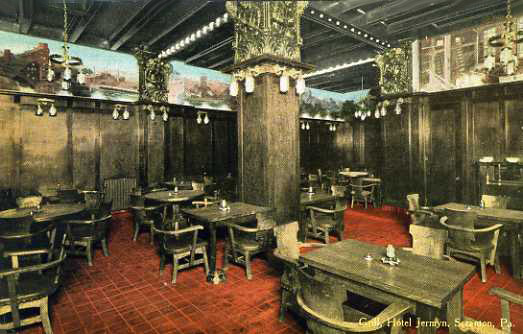
Despite, or because of, her higher social standing, Post had to juggle gender issues. She avoided hotels of the “saloon-front-and-ladies’-entrance-in-the-back variety.” Whereas Dreiser sneered at then-trendy grills and rathskellers [grill in Scranton PA pictured], Post could not even get into them. Dreiser found these types, which were so popular with men, dull and silly – “made to look exactly like a western architect’s dream of a Burgundian baronial hall”. But Post was disappointed when she was turned away from the men-only grill room of the Fontenelle Hotel in Omaha.

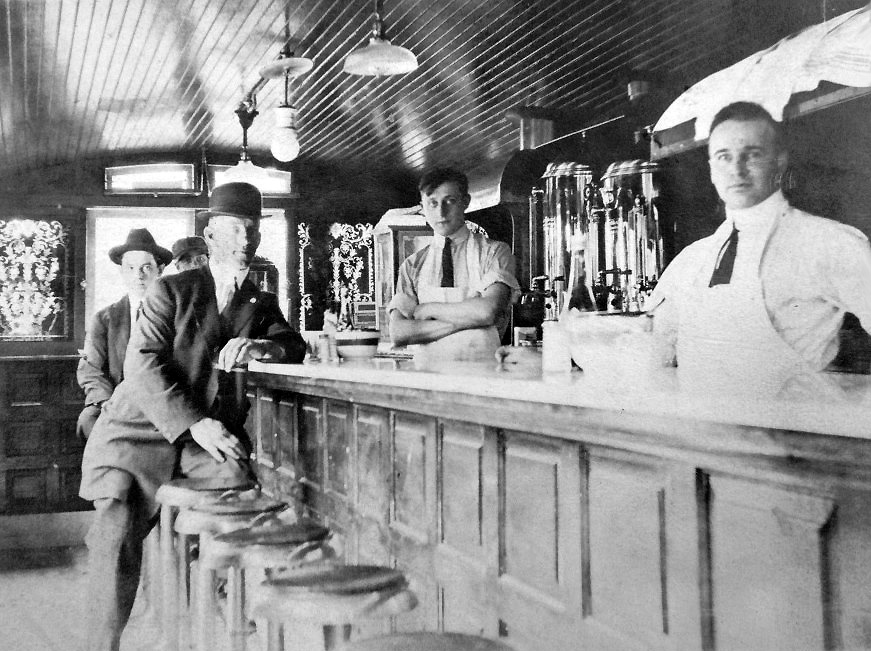
Dreiser’s discomfort was induced by stuffy dining rooms where haughty head waiters fauned over rich men — and by country lunch rooms where local “wits” hung out. The following photograph illustrates what I imagine he saw walking into some of the places he encountered on his trip.

DreiserKearnyNJ1913cafe

Both cast a cold eye on the attire of other guests in upscale dining rooms. Post shuddered at the casual, wrinkled outfits worn by the wealthy, as well as at how freely California women combined colors such as “an emerald-colored fan with a sage-green frock!” But, although Dreiser was horrified by “the upstanding middle class American with his vivid suit, yellow shoes, flaring tie and conspicuous money roll,” the socialist-leaning author nevertheless said he wanted to “compose an ode” to this sort of common man of democratic society.

Summing up her travel experiences, Post reflected, “It is your troubles on the road, your bad meals in queer places, . . . , in short, your misadventures that afterwards become your most treasured memories.” Dreiser wondered, “how long will it be before we will have just a few good [restaurants] in our cities?”

© Jan Whitaker, 2013

2 Comments

Filed under roadside restaurants, women

Women’s restaurants

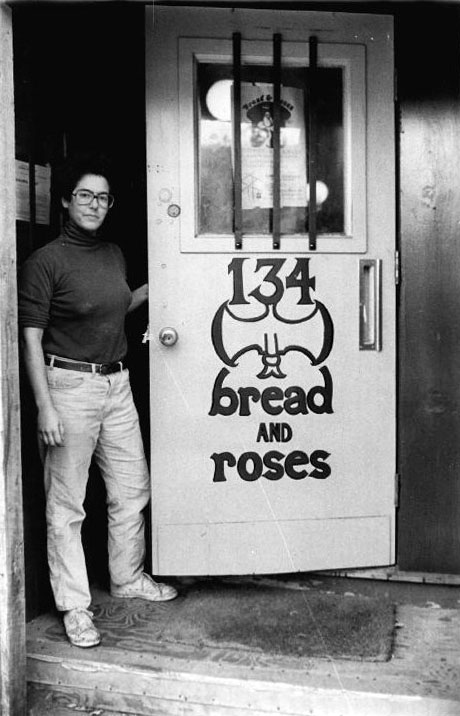
feministBreadandRosesBarbaraFried1976

Not all restaurants have been purely, or even mainly, commercial ventures. This was particularly true of women’s suffrage eating places and those of the 1970s feminist movement.

Although the women’s restaurants of these two periods were quite different in some ways, they shared a dedication to furthering women’s causes and giving women spaces of their own in which to eat meals, hold meetings, and in the 1970s, to enjoy music and poetry by women.
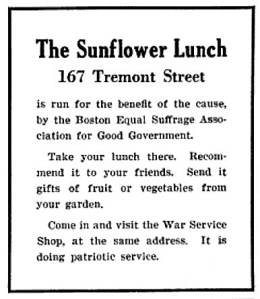
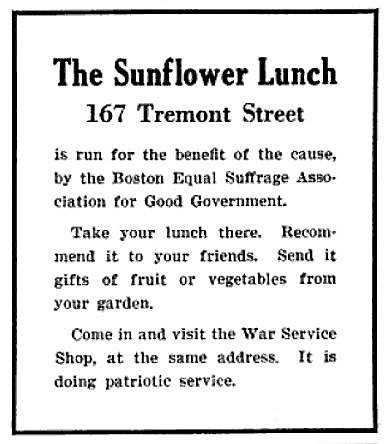
SuffrageLunchBoston1918In the 1910s most major U.S. cities had at least one suffrage restaurant, tea room, or lunch room sponsored by an organization such as the National American Woman Suffrage Association (NAWSA).

As was true of later feminist restaurants, those of the suffrage era tended to be small and undercapitalized. An exception was the suffrage restaurant financed by the wealthy socialite Alva Belmont in NYC. In terms of patronage, it was almost certainly the most successful women’s restaurant of either era. It reportedly served 900 meals per day from a low-priced menu on which most items were 5 or 10 cents and consisted of soup, fish cakes, baked beans, and home-made pie.

Suffrage restaurants admitted men and welcomed the opportunity to ply them with leaflets and home-made soups, salads, and fritters that would incline them to support the cause. An aged Philadelphia activist recalled in 1988, “I worked at a suffrage tea room. We lured men in, for a good, cheap business lunch. Then you could hand them literature and talk.” In the NYC restaurant operated by NAWSA in 1911, it was impossible to ignore the suffrage issue since every dish, glass, and napkin bore script saying Votes for Women.
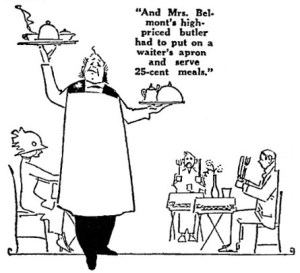
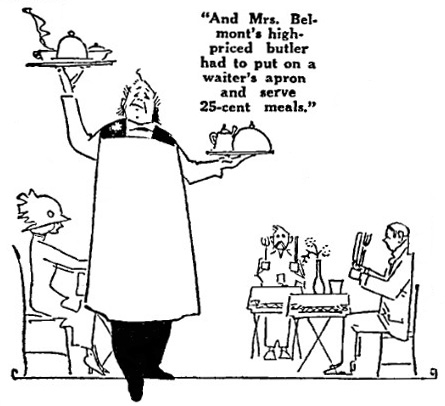
suffrageRestaurant1912Though dedicated to women’s causes, women’s restaurants were not free of conflict. Many suffragists objected to how Alva Belmont ruled with an iron fist, brusquely ordering servers around until they walked out on strike, followed by the dishwashers. Belmont was ridiculed when she brought in her butler and footman to fill the gap. Her footman quit too. Some feminist restaurants experienced discord over cooperative management and, especially, whether or not to serve men.

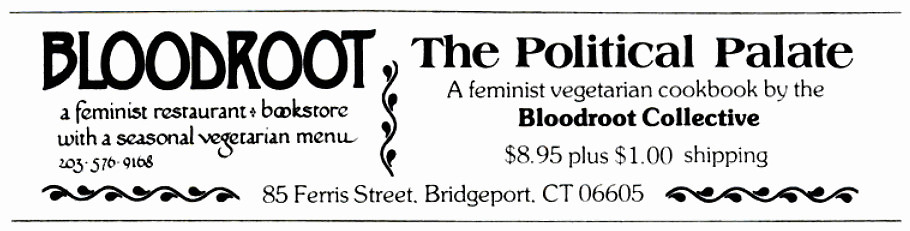
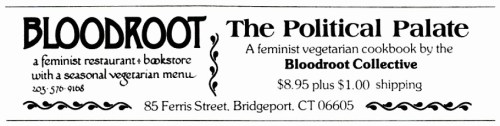
The first feminist restaurant, NYC’s Mother Courage, was founded in April of 1972. (Its co-founder Dolores Alexander discussed it in 2004-2005 interviews.) Others established in the 1970s included Susan B. Restaurant, Chicago; Bread & Roses, Cambridge MA; The Brick Hut, Berkeley CA; Los Angeles Women’s Saloon and Parlor, Hollywood CA; and Bloodroot, Bridgeport CT). Undoubtedly there were more, especially in college towns like Eugene OR and Iowa City IA. In the 1980s a number of women’s coffeehouses appeared, but they were performance spaces more than eating places.
FeministBloodroot1981

As part of the counterculture, 1970s feminist restaurants typically aimed at a broad set of goals. Women’s equal position in society was paramount but it was embedded in a project of establishing a more peaceful and egalitarian world. Feminist restaurants rotated jobs and paid everyone the same wages. They raised capital by small donations from friends. Staffs were entirely female and women also did most of the renovating. Their decor was spare, with exposed brick walls, mismatched furniture, and chalkboard menus. They served simple peasant-style food, usually prepared from scratch. Some served wine and beer. More often than not menus were vegetarian, or at least beef-less. The L. A. Women’s Saloon and Parlor supported farm workers and would not serve grapes or lettuce. The Brick Hut boycotted Florida orange juice during the anti-gay campaign of spokesperson Anita Bryant. The Women’s Saloon avoided diet plates and sodas, deeming them insulting to large-sized women.

Many proponents of feminist restaurants felt that women were often treated poorly in restaurants, many of which regarded men as their prime customers. Feminist restaurants made a point of  presenting women dining with men with the check and wine to sample. But for many women patrons, perhaps especially lesbians, the enjoyment of a non-hostile space was more significant.

At some point each feminist restaurant confronted the touchy question of whether they would serve men. Considerable acrimony erupted around this question at the Susan B. Restaurant in Chicago and Bread & Roses in Cambridge, resulting in the former restaurant’s closure after only a few months. At Bread & Roses a co-founder exercised non-consensus managerial power and fired a server who made men and some heterosexual women feel unwelcome, setting off rounds of group meetings. The restaurant, opened in 1974, was put up for sale and in 1978 became the short-lived “women only” Amaranth restaurant and performance space.

Today Bloodroot may be the sole survivor of the feminist restaurant era.

© Jan Whitaker, 2013
8 Comments

Filed under alternative restaurants, patrons, women

Anatomy of a restaurateur: Kate Munra

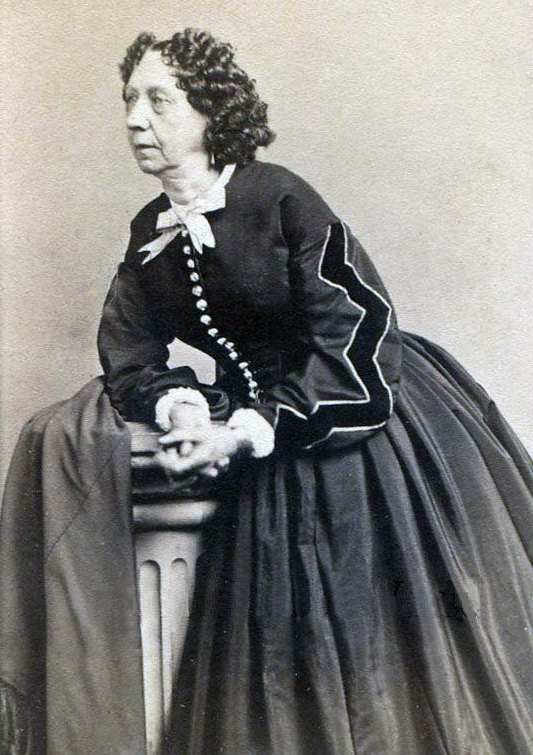
With her Early-American-style ringlets and silk gowns, already outdated by 1900 when this portrait was taken, white-haired Katherine Sterrett Munra scarcely looks like a highly skilled hospitality professional. And yet she was.

She was a pinch hitter for the Oregon Rail & Navigation Company whose trains ran across Oregon through the rugged Blue Mountains. She worked at many of their establishments, plus oversaw food facilities at Oregon’s hotels and resorts as well as at a university and a department store.

In the 1870s, at the then-advanced age of 44, she moved to southern California from her hometown of Erie PA where she ran a boarding house and raised three children single-handedly. Her marriage had ended, probably through desertion or divorce. In the seven years she lived in California she married twice and ran two boarding houses. After her second husband’s death she married an accountant, Selkirk Munra, and they took a steamer to Oregon, assuming management of a hotel in Eugene.

Next they managed the O. R. & N.’s dining facility at Bonneville. When the railroad closed it down, they returned to Eugene as managers of another hotel there. We then find Kate running the student dining halls at the University of Oregon, Eugene. Next, in December of 1894 she went back to work for the railroad, choosing furnishings for the new log hotel and restaurant in Meacham. She managed it from its inauguration in January 1895 until it was destroyed by fire in 1902.

A publicity agent for the O. R. & N. may have been responsible for dubbing Kate “Grandma,” a dubious title commonly bestowed on women past 60. He heaped praise upon the Log Cabin, calling it a “frontier Delmonico’s” and a “mountain-gulch Waldorf ” where the rugged West melded with the “refined luxury of the metropolis.” “Cabin, tables, linen, china, silver, glass and waiter-girls are all the perfection of neatness and cleanliness, and the cookery is as dainty as that of the daintiest old-time private family,” he wrote. Although Kate learned to cook as a child and could have prepared the meals, her role was to supervise the kitchen and dining room staffs.

After the Log Cabin burned Kate managed the railroad’s hotel at Huntington OR, and then a private resort at Hood River called the Country Club Inn. In the winter of 1904, when the inn was closed for the season, she presided over the opening of a tea room at Portland’s Olds-Wortman department store. She might well have retired at this point, but in 1905 came an announcement that she would act as housekeeper for the Hotel Sommer in La Grande OR. She was 75.

Eventually she did retire, joining her daughter’s household in Portland and living until age 92. She was a suffragist and friend of Oregon suffrage leader Agnes Lane. In recognition of her pioneering role in Oregon’s development a peak in the Blue Mountains was named for her in 1915.

© Jan Whitaker, 2012

Other posts on restaurant women:
Richards Treat cafeteria
Miss Hulling’s cafeteria
Anna de Naucaze
Harriet Moody
Romany Marie
Mary Alletta Crump
Afro-American women
The Maramor
Mary Elizabeth’s
Women culinary professionals
Alice Foote MacDougall

2 Comments

Filed under proprietors & careers, women

“Adult” restaurants

Anyone who knows American culture realizes immediately that the term “adult restaurant” would not even remotely imply an eating place that caters to mature or developed culinary tastes. Instead it would mean one deemed inappropriate for children because of some kind of sexually tinged goings on.

Historically the attractions in adult restaurants have not been what’s on the plate but are part of the female servers’ anatomy.

An unfamiliar restaurant concept to me is the “adult fast food restaurant.” This is how a Florida drive-in owner referred to his business in 1976. It didn’t serve adult fast food – what would that be? Crêpes? It served hot dogs, hamburgers, beer, and, oddly, wine. The manager called it “our answer to MacDonald’s,” reflecting the fierce competition drive-ins faced from big chains in the 1970s.

The “adult” aspect: servers at the “Jugs ‘n’ Suds” drive-in were costumed only in hot pants and tassles.

However, Jugs ‘n’ Suds waitresses got very little chance to “wear” their intended costume. The drive-in met with vehement disapproval from citizens and officials of New Port Richey who insisted that the waitresses cover up. One of the restaurant’s promoters admitted that business fell off once apron-like halter tops were adopted, saying “People aren’t as interested in seeing a topless waitress with fringe on.” [pictured] In very short order the drive-in closed. A second one – without carhops — then opened in an old A&W. I don’t think it lasted long. A fantasized  nationwide chain never materialized.

Jugs ‘n’ Suds was unusual in that it was a drive-in. Most topless restaurants have been positioned at the “nightclub” end of the restaurant spectrum. Typically they’ve been dark, bar-like spaces where business men congregate at noon and after work.

California was the birthplace of the topless restaurant with the pioneers opening in 1965 not long after the creation of Rudi Gernrich’s topless bathing suit. Many offered a business man’s lunch special accompanied by models strolling from table to table. In California, at Long Beach’s Kozy Kitten, kittens ambled while patrons downed 98c luncheons of Turkey, Ham, or Beef served with Potato Salad and Beans. (I didn’t say topless restaurants were glamorous.)

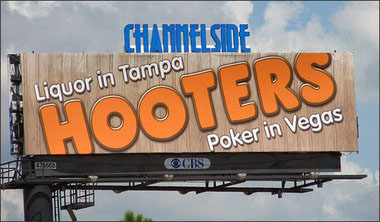
The topless restaurant fad, which combined gawking, drinking, AND eating, died out, but using women’s anatomy to attract restaurant patrons did not. Maybe it’s eternal. Even as the last Playboy bunny club closed in the 1988, a new crop of “breastaurants” (as they are mockingly known by critics) appeared, most of them flaunting scantily dressed servers. Following the success of Hooters, a slew of knock-offs opened in Florida, among them the so preciously named Melons, Knockers, and Mugs & Jugs.

Controversy is also eternal. Hooters’ aggressively suggestive advertising campaign has offended many and the chain was forced to remove billboards that hinted servers were prostitutes, an idea that, depressingly, has plagued female servers since the 19th century.

Legal challenges to topless restaurants and breastaurants have mostly not held up. But communities protest them anyway, occasionally successfully. Recently the Quincy MA Licensing Board denied permission to a unit of the Tilted Kilt chain because it was too close to a church that objected.

© Jan Whitaker, 2012

7 Comments

Filed under drive-ins, food, women

Frank E. Buttolph, menu collector extraordinaire

It was Monday, January 1, the start of a brand new week, year, and century. A patron at the Columbia Restaurant on 14th Street in NYC’s Union Square experienced a jolt when she looked at the menu. “The first time I saw the new date 1900 on a menu it thrilled me as if I had been suddenly transplanted to the planet Mars,” Miss Frank E. Buttolph would later say.

It occurred to her to save that menu. She gathered more and soon realized she had the makings of a collection. She donated 900 menus to the New York Public Library, with an offer of 1,000 more. By 1917 she claimed to have amassed about 28,000 menus for the NYPL, and had spent countless volunteer hours cataloging them and stamping them with the now-notorious blue stamp.

Although I suspect she actually started collecting menus in the 1890s, Miss Buttolph would repeat the engaging origin myth for years, using it in press releases and interviews to inspire menu donations from near and far, even from European royalty. Menu collecting was not unheard of, but had not yet become the fad it would be a few years later. It was said that when she began to collect menus, “no one thought of it as anything better than a rather tiresome freak, on which a vast amount of energy was being wasted that might have been better expended.” Poster and cookbook collecting were likewise viewed as trivial pursuits.

Born Frances Editha Buttles in Mansfield PA, Frank’s father was a wagonmaker and undertaker who filed at least a dozen patents for common tools. Frank became a teacher and taught in Rahway NJ, Minneapolis MN, Scranton PA (where she briefly ran her own girls’ school), Bolivar TN, and Saratoga Springs NY. I haven’t discovered exactly when she moved to NYC, but by 1900 Frank was a single 56-year-old whose family was deceased and who knew several languages and had traveled abroad at least three times. Her source of income in NY is unclear. She taught Sunday school and did some tutoring. She declared she was a magazine author but I’ve never found any of her publications. Perhaps she inherited money.

Evidently she had enough free time to spend long hours in her library office, first located in the old Astor Library and then, after the new Fifth Avenue public library building was completed in 1911, overlooking Bryant Park.

Her name “Frank” has caused much perplexity. Did it imply gender ambiguity? Although I can’t prove it didn’t, Frank was not a totally uncommon nickname for Frances which gained popularity in the 1870s and 1880s. She was known as Frank as early as 1866 when she finished teacher training [pictured]. It seems she was not especially fond of either Frances or Buttles. She researched her family’s genealogy and in 1900 changed her last name to the more dignified-sounding Buttolph, of which Buttles was a corruption.

Frank collected all sorts of menus, from restaurants, hotels, steamships, and trains. She insisted that they be clean and rejected those from businesses she sensed were simply trying to get publicity. Many she preserved were from club banquets or dinners celebrating famous individuals. Most were American, but she also collected menus commemorating the opening of the Suez Canal, menus from royal courts, and from other exotic occasions worldwide. It seems as though the public was most appreciative of rarity, but I am grateful that she saved menus from everyday restaurants such as the Columbia, all the more so since it went bankrupt about two years after her fateful visit.

More on Frank Buttolph and her collection.

© Jan Whitaker, 2012

3 Comments

Filed under menus, women

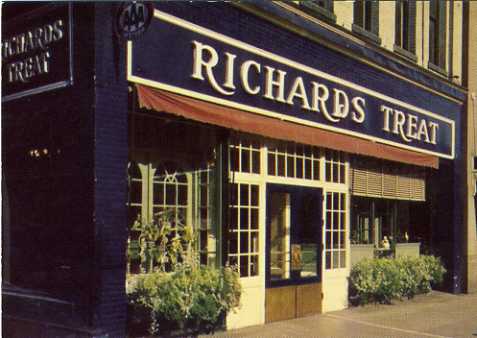
Famous in its day: Richards Treat Cafeteria

With its ham loaf and chicken pot pie, the Richards Treat Cafeteria on South Sixth Street in downtown Minneapolis was akin to other cafeterias and restaurants run by women, such as The Maramor in Columbus, Miss Hulling’s in St. Louis, and the Anna-Maude in Oklahoma City. Like its sisters, the Richards Treat was not known for culinary innovation but for preparing home-like dishes from scratch using fresh ingredients cooked in small batches.

The Richards Treat was opened in 1924 by two home economics professors at the University of Minnesota, Lenore Richards and Nola Treat, who ran the successful enterprise until 1957. The two met in 1915 when they both taught at Kansas State Agricultural College in Manhattan KS. They became close and decided to arrange their lives so they could work and live together from then on. “I am not and never have been married,” each wrote in 1923 when applying for passports prior to a European tour.

Nola Treat [pictured, 1923] had some experience in running cafeterias before 1924. She had set up a high school cafeteria in Decatur IL in 1911 when many schools provided no meal service. Following that she inaugurated student cafeterias and institutional management programs at several Midwestern state colleges and universities. Apparently she was well aware that many people disliked cafeterias, publishing an article titled “Why Cafeterias Fail” just months before opening her own. In it she said that it was unusual to find the sort of cafeteria which was “so attractive in appearance, and which serves such good food, that the most fastidious people will go to it.”

Perhaps that was why Richards and Treat always paid such close attention to their restaurant’s decor, which had little in common with the typical cafeteria’s institutional appearance. Theirs more nearly resembled a tea room with its antique cupboard of curly maple, pewter objects from the couple’s collection, and other decorative pieces brought back from their travels. Each table in the main dining room, including the one where they ate their own dinner nightly, held glowing candles in candlestick holders or candelabra.

In their cafeteria they attempted to provide a home substitute for patrons who might be unable to get home for meals or who lived in efficiency apartments. “The atmosphere of the dining room – its quiet, order, cleanliness – contribute to a feeling of well-being and satisfaction in the food,” observed Lenore [pictured, 1923] in a 1941 address to the Home Economics Association.

Their menus featured American cooking as understood by the middle-class American-born mainstream in the mid-20th century. An April 1933 menu offered a special 50-cent dinner of Veal Loaf with Mushroom Sauce, Buttered New Asparagus and Carrots, and desserts such as Fresh Strawberry Shortcake or Devils Food Cake, accompanied by Coffee, Milk, or Buttermilk.

For 15 or more years the cafeteria supplied cakes for dining cars of the Great Northern Railroad. When they learned, quite by accident, that the cakes’ top layers had a habit of sliding off when trains went over mountains en route to Seattle, they substituted sheet cakes. Cakes, cookies, bread, and house-made candy were popular sellers at the cafeteria’s bake counter where, in the 1940s, they also sold Laguna Pottery from California.

The cafeteria became a place where lawyers, judges, professional men and women, and newspaper reporters gathered, leading restaurant guidebook publisher Duncan Hines to characterize it as “Educated Food for Educated People.” The slogan was adopted by the Richards Treat.

They expanded several times, seating 300 by 1944, and winning loyal patrons despite stiff competition from other cafeterias such as The Forum and Miller’s Cafeteria. They also ran a coffee shop in the Northwestern Bank Building. Throughout their career they received many accolades, served on the editorial board of Restaurant Management magazine, and held top positions in the National Restaurant Association. Their book Quantity Cooking, published in 1922, with three subsequent editions, became a basic text used by the US military in World War II and restaurants throughout the country into at least the 1970s.

© Jan Whitaker, 2012

3 Comments

Filed under cafeterias, proprietors & careers, restaurants, women

Celebrity restaurants: Evelyn Nesbit’s tea room

Hundreds, maybe thousands, of celebrities have gone into the restaurant business when their careers waned. Their level of direct involvement may be high or low but all these ventures bank on the idea that a famous name will attract customers.

When Evelyn Nesbit opened her NYC tea room in May of 1921 she made sure that her name was prominently displayed. Located on West 52nd street just off Broadway, the sign saying “Evelyn Nesbit’s Specialty Shop” was visible from the theater district’s Great White Way.

She was then in her mid-30s, years away from her peak as a teenage artist’s model [above, age 16], “Gibson Girl,” Floradora showgirl, and millionaire’s wife. Her fame derived not only from her former good looks – from the years her image was displayed everywhere – but also from her involvement in a romantic triangle with prominent architect Stanford White and her insanely jealous husband Harry Thaw. After Thaw shot and killed White in 1906, she became notorious as a witness during the sensational “trial of the century.”

By 1921 she had divorced Thaw, had a son, returned sporadically to the stage, taken up sculpture, published a memoir, and married a second husband from whom she was estranged. Characteristically, she was in debt, owing the equivalent of a year’s income to a dress shop.

Her tea room enjoyed such a short, unsuccessful run that it is hard to learn much about it. Presumably she raised funds from friends to furnish it and pay the $300 monthly rent. She lived in two rooms upstairs. One account described the 100-seat tea room as “super-beautiful” and furnished with rich carpets, Oriental tapestries, and exotic plants, a description at odds with the homey scene in a 1922 photograph shown here.

In several interviews Evelyn made what sound like preposterous claims that she served food available nowhere else. “I am revolutionizing the restaurant business in New York,” she boasted. Her specialties included deep dish apple pie and ice cream which she said she made herself. “I amazed the chef, let me tell you, with what I know about cooking,” she said.

I found it surprising that she claimed to be a good cook; however I did discover that when she left the US for Paris in 1910, surely pregnant with her son, she told friends that she planned to rent a modest apartment on the outskirts of Paris, study sculpture, and do her own cooking.  Although she evidently hired someone else to cook for the tea room she said she furnished the recipes and did all the buying.

Things went wrong fast. During the first six months she (barely) survived three robberies, one kidnap attempt, one suicide attempt, and eviction for nonpayment of rent. On a second try in January of 1922 she was successfully evicted, after which she returned to cabaret dancing. In 1926, while performing at Chicago’s Moulin Rouge, she tried to kill herself again by swallowing Lysol. Her troubled brother took his own life two years later.

But Evelyn achieved happiness in later life and lived on to age 81. She moved to Southern California near her three grandchildren and their father, a pilot for Douglas Aircraft. She returned to her lifelong interest in art, teaching sculpture and ceramics at a community center. Easing her constant need for money, she received a $10,000 bequest when Thaw died in 1947 and was paid more than $50,000 for use of her life story in the 1955 movie “The Girl in the Red Velvet Swing.”

After many years away, she visited New York in 1955, reflecting on the great meals she had eaten during her heyday. Passing the former location of Sherry’s, she recalled “the wonderful terrapin they served.” She expressed surprise that she had managed to stay slim in her youth. “I ate so much in the old days I still wonder why I didn’t get fat,” she said referring to another performer’s, Lillian Russell’s, “upholstered” appearance. Heading off to a restaurant dinner, the ever-unsentimental Evelyn confessed, “You know what I really want to see most in New York? A nice big broiled Maine lobster.”

© Jan Whitaker, 2012

10 Comments

Filed under proprietors & careers, tea shops, women