Category Archives: theme restaurants

Spooky restaurants

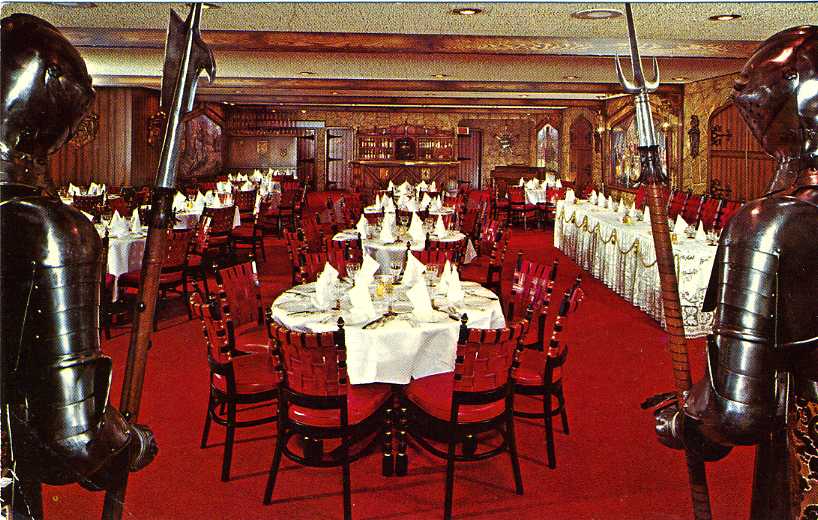
spookycolumbusohnightclub

Montmartre in Paris was the birthplace of what would come to be known in the U.S. as the theme restaurant. In the late 19th and early 20th centuries, Parisian entrepreneurs conjured up fantasy atmosphere in strange and unsettling forms. Themes included assassination, imprisonment, death, hell, and that harbinger of bad luck, the black cat.

As much devoted to drinking and entertainment as food, Montmartre’s ghoulish restaurants, cafes, and cabarets inspired Americans to duplicate them. Needless to say, both in France and in America such places were heavily geared to tourists and considerably short of good taste.

One Paris establishment, the Cabaret du Néant, deliberately transgressed the boundaries of decency serving wine in skulls (thankfully artificial), using coffins for tables and x-rays to turn patrons into skeletons, and – worst of all, in 1915 – digging trenches in the backyard so patrons could experience World War I warfare conditions while dining by candlelight.
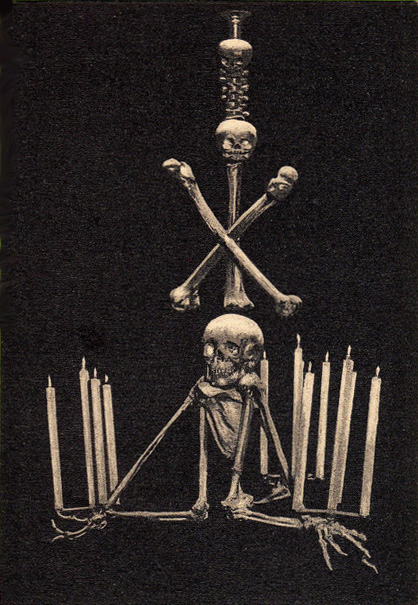
spookycabaretduneantIn 1896 the Cabaret du Néant, renamed the Restaurant of Death, had been recreated in the Casino in New York’s Central Park, right down to a candelabra made of “skulls and bones.”
spookymoulinrougecavequillsept1921


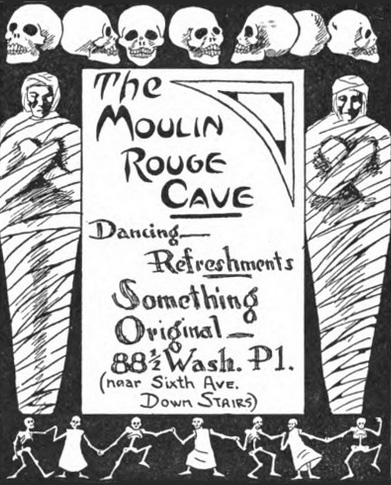
Greenwich Village’s Moulin Rouge used coffins and skulls in its advertising, though whether it carried the theme over to its interior is unknown. It was padlocked in 1924 for serving liquor illegally. Columbus OH had a nightclub known as The Catacombs in the Chittenden Hotel [at top of page] but I was not able to learn anything about it other than that it was doing business in 1941.
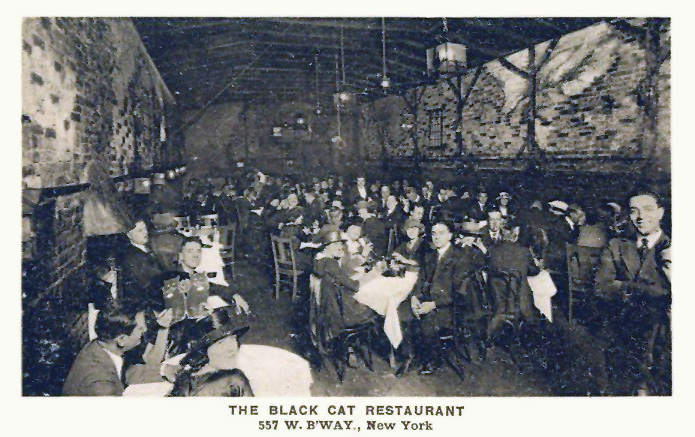
spookyblackcatgreenwichvillageOn the whole, black cats and jails gained greater popularity in the U. S., both themes inspired by Montmartre. New York City’s Black Cat had many lives [shown above], being declared dead with regularity and then reappearing. San Francisco also had a Black Cat, opened in 1911, but it sounds as though it was quite tame, filled with ferns and potted palms and an orchestra hidden behind a screen. Perhaps another Black Cat Café in San Francisco, or maybe this one transformed, operated from the 1930s into the 1960s as a center for bohemians and beats as well as a gay clientele.

As sinister animals go, rats and bats were also celebrated. Greenwich Village’s café, The Bat, was said to have a “macabre interior” similar to Paris’s famed Le Rat Mort (The Dead Rat). It’s likely that the advertising of both made them out to be far more sinister than they were.
spookysfjailrestaurant1921

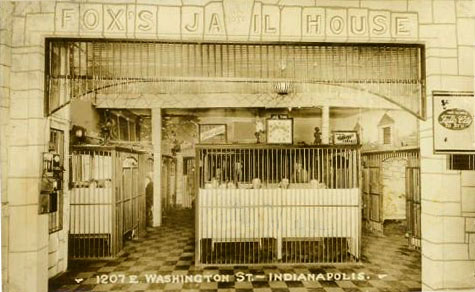
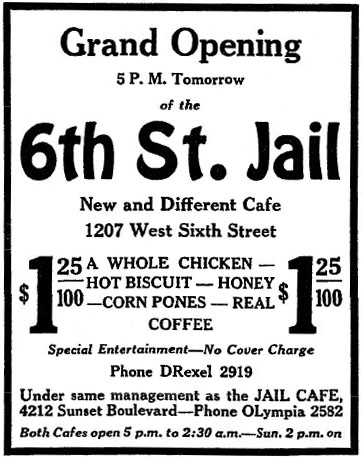
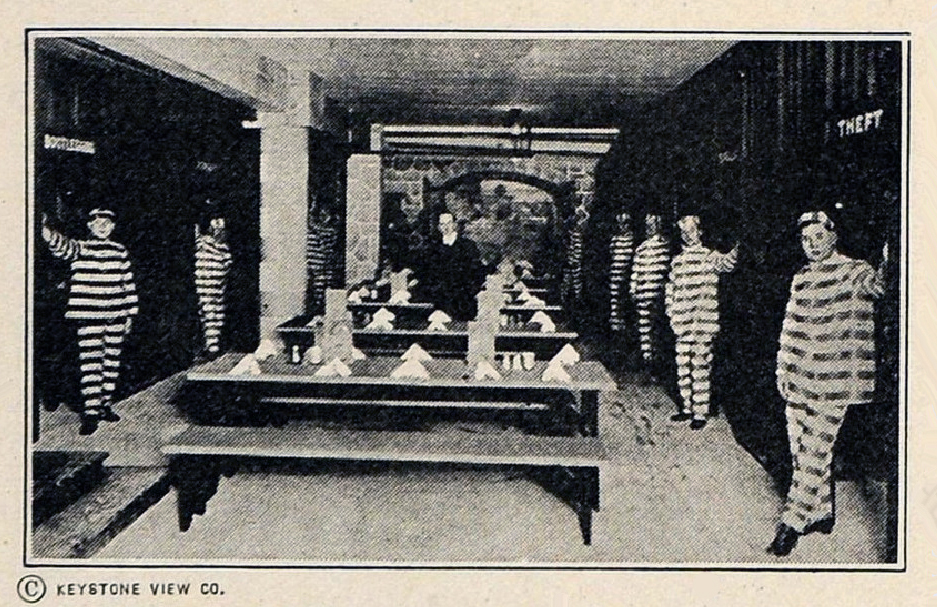
As for jail restaurants and cafés, they were fairly numerous in this country. The first, labeled dungeons, opened in New York City and were places where patrons sat on crude boxes in cellars and ate steaks with their hands. They were particularly popular with men’s groups and conventioneers. In the 1920s and 1930s, restaurants and drinking places with jail themes, often with servers dressed as jailers or prisoners, appeared in Los Angeles, Indianapolis, and even a small town in Iowa. Strangely, San Francisco’s Dungeon restaurant of the 1920s, complete with cells and wardens, etc., served waffles rather than steak. But then sometimes it’s hard to keep themes on track.

I’ve been working on a future post on truly scary restaurants, ones where outbreaks of food poisoning have occurred.

Meanwhile, whether or not you find a spooky restaurant to hang out in for Halloween, have a good holiday!

© Jan Whitaker, 2016

5 Comments

Filed under alternative restaurants, atmosphere, night clubs, Offbeat places, restaurant decor, theme restaurants

Anatomy of a corporate restaurant executive

corpexecJPG1966Jan14localrestaurateurnowRAvpIt strikes me that much more has been written about and by chefs than those restaurant personnel who mostly work behind a desk. Business people lack the glamour of knife wielding chefs. They are not surrounded by flames. They have no dishes named after them.

But Frederick Rufe’s career in restaurants was as interesting as many chefs’ and he was undoubtedly more influential in shaping the dining experiences of countless restaurant patrons over his career of nearly 40 years. His entire working life had a single focus. In a 1974 interview he stressed, “Everything I’ve ever done has been with food.” As a management executive he was closer to the soul (or soullessness, depending how you see it) of both the upscale and the midscale American corporate-owned restaurant of the 1960s and 1970s.

Born in New Jersey in 1922 he came from a humble background, growing up in a one-parent household with his mother, who was a factory worker, and a brother. While a student at a teachers’ college, he spent one summer as a waiter for a Pennsylvania resort, leading him to detour from a teaching career to one in food service. Following WWII army duty (working in food supply), he obtained a degree from Cornell’s School of Hotel Administration, which excelled in turning out top hospitality industry executives.

He then went to work in Miami Beach as food and beverage manager at large hotels there, among them the Monte Carlo, Algiers, and Deauville. He was not shy about promoting himself. Aiming for a catering manager job in a hotel without such a position, he “invented” it for himself. He took over a vacant room, bought a desk, put up draperies, and hung out a “Catering Manager” sign. When challenged by his boss, he successfully convinced him that the hotel needed someone – him – in that position.

corpexecFourSeasonsAlbertStockli1960He joined Restaurant Associates in New York in the mid-1950s as the company was entering its most creative phase. RA was going from managing coffee shops and cafeterias to developing theme restaurants, some in the luxury class. In 1956 Rufe was made general manager of RA’s Newark Airport restaurants which included the famed Newarker, its kitchen headed by the inventive Swiss chef Albert Stöckli who would go on to the Four Seasons [pictured here]. Rufe helped develop the Four Seasons, the Forum of the Twelve Caesars, and La Fonda del Sol. At a time when out-of-season fruits and vegetables equalled the height of luxury, he obtained shipments of melons and new asparagus from the West for the Four Seasons, as well as miniature vegetables that allowed power-lunching VIPs to minimize awkward bites. With James Beard’s help he brought the blind cook Elena Zelayeta from California to plan Mexican and Spanish dishes for La Fonda del Sol.

corpexecJPG1960LaFondaDelSolMenuAmiable and worldly, Rufe could be mistaken for a European sophisticate. He was on James Beard’s holiday dinner guest list, and had easy access to the food columns at major newspapers where he promoted RA’s restaurants with recipes and interviews. While manager of the Latin-themed La Fonda del Sol, he explained to a reporter that a “broiling wall” of revolving stuffed flank steaks was based on a setup he had observed at an inn in Peru on a menu-collecting tour of South America with La Fonda’s chef John Santi. He was known for focusing on detail, so much so that his travel notes were said to look like research for a doctoral dissertation.

In 1964 he took on the task of rescuing the Top of the Fair, a failing de luxe restaurant atop the Port Authority’s heliport building adjoining the World’s Fair grounds. He was made a RA vice-president in 1967 and two years later put in charge of food operations at LaGuardia and Kennedy air terminals, as well as other airports in the Northeast. “Our places are genuine restaurants,” he insisted, “not just places to grab a quick meal and dash to your plane.”

corpexecJPG1978MayADVAfter a shift in RA’s direction, Rufe left for the Marriott Corporation where he was soon made VP of its dinner house division of moderate-priced theme restaurants in the DC area. The recession of the 1970s was on and Rufe explained in the press that Americans wouldn’t pay for $25 French dinners any more. Marriott’s new dinner houses were geared to more modest lifestyles. Phineas Prime Rib, Joshua Tree, Franklin Stove, Port O’Georgetown, and Garibaldi’s were management-driven eating places where every detail was arrived at through consumer research and economic calculation. Lunch was not profitable, so dinner only. No reservations because that resulted in less than 100% occupancy. Short menus with only America’s favorites, beef and seafood. All-you-can-eat salad bars. Fireplaces and ceiling beams evoking old-time hospitality. Friendly college student servers speaking from scripts. Cooking by step-by-step recipe cards. No chefs.

corpexecJPGADV1971At first the formula was wildly popular with modal guests – suburbanites with $15,000 annual incomes who ordered $6.95 meals and cleared out in 1.5 hours. “Seventeen million dollars and no chefs,” Rufe boasted in January of 1975. However, by 1978 competition was up and profits were down. Marriott decided to sell off its dinner house division and some of the restaurants closed under the new owner.

After a few years as director of food and beverage planning and development for Hilton International, Rufe retired, returning to Stroudsburg PA where he continued as a consultant.

Needless to say, the chain dinner house formula he helped develop prevails today, demonstrating that there is a sizable market for restaurants with pleasant decor, parking, clean bathrooms, and palatable fare that is affordable.

© Jan Whitaker, 2016

12 Comments

Filed under chain restaurants, food, proprietors & careers, theme restaurants

“Atmosphere”

atmosphereschaber1941I put the word in quotation marks to acknowledge that what atmosphere in restaurants means is as elusive as air itself — which the word also refers to. It was often used to describe eating places in the 19th century, but not in a flattering way. A typical usage is that from 1868 where someone remarked that in a certain restaurant “the atmosphere is heavy with cooking vapors.”

The term atmosphere (or ambience, which came into use in the 1970s) became used in a more general way to describe the character of a restaurant – that intangible spirit of a place. The broader meaning could encompass an air that was sophisticated or homey, rowdy or relaxing, masculine or feminine, formal or casual, etc. I discovered a 1950s restaurant that claimed to have “Christian atmosphere” with home cooking by a Mrs. and “No Beer, Liquor or Smoking.”

In the 1890s the more general meaning almost always referred to the kinds of people associated with a restaurant, both owners and patrons. For example sawdust on the floor, pictures of athletes on the wall and the presence of prostitutes signaled a thoroughly masculine atmosphere while the presence of artists and writers in French, German, or Italian table d’hotes shouted “bohemian!”. A jolly host could also impart atmosphere, which might be altogether missing if he weren’t on hand, or if his most colorful patrons failed to show.

AtmosphereRomanyMarieSummer1921It didn’t take long before restaurant owners realized they could appeal to new patrons by bragging about their “atmosphere,” especially if it was bohemian. A San Francisco restaurant announced that it attracted “artists, writers, musicians, poets, painters, singers, draftsmen, balladists, literati and newspaper writers.” In 1903 NYC’s Elite Rathskeller Restaurant ran an advertisement claiming to have “Refined Bohemian atmosphere,” which sounds like a contradiction in terms since bohemians were supposed to be carefree souls who violated everyday norms of propriety.

The next step for restaurateurs was to merchandise atmosphere by generating it themselves. Since it seemed that so many people wanted to gawk at bohemians, why wait for them to show up if you could entice them with free dinners? Allegedly some restaurants did just that.

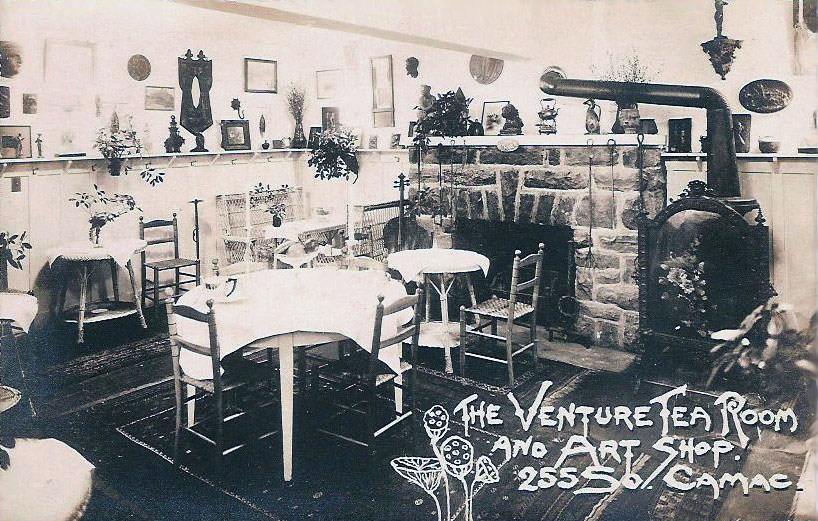
atmosphereVentureTeaRoomPhila

After World War I, following the reign of bohemian restaurants, came a new type of atmospheric eating place, the tea room of the 1920s. The tea room’s special atmosphere was  quaint and homey with artistic touches. In 1922 the Journal of Home Economics pronounced that “The very name of Tea Room has grown to mean a place with ‘atmosphere’ and with furnishings that are unique.” Ranging from the fashionable to the playful, tea rooms proved that women – their primary patrons – were in love with atmosphere.

atmosphere1918FlintMIBucking the trend toward atmospheric decor were a handful of holdouts. Anything like a “restaurant atmosphere” was anathema to a Y.M.C.A. cafeteria in Flint Michigan (1918). The Old Colony Coffee House in Richmond VA renounced “ordinary restaurant atmosphere” in 1924 and vowed it would have instead “simplicity in decorations” and “plainness in food.” Patrons of traditionally masculine restaurants feared that when Chicago’s J. R. Thompson’s tore out its white tiles for a more feminine look it had destroyed its no-nonsense atmosphere and gone “girly girly.” Likewise, design critic Lewis Mumford shuddered when the Childs’ chain replaced the “antiseptic elegance” of its “hospital ward atmosphere” for “fake fifteenth century English,” betraying the honest utilitarianism of the Machine Age. No doubt Mumford chuckled when Alice Foote MacDougall, queen of scenographic Spanish villas and French chateaux in NYC, went bankrupt in 1932. [see The Cortile below]

atmosphereCortile

In the 1950s there was still a tendency in the restaurant industry to see women as the constituency for atmosphere while men supposedly judged a restaurant first by its food quality. But by the 1960s this was no longer true, as indisputably demonstrated by the success of Polynesian restaurants. An executive of the National Restaurant Association (NRA) said that Americans’ demand for atmosphere had raised the cost of opening a restaurant to $4,000 a seat in 1962.

One of the early chains built around atmospheric theme restaurants was David Tallichet’s Specialty Restaurant Corporation in California. In 1965 the firm opened Gate of Spain, capturing the “atmosphere of old Castile” atop a tall building in Santa Monica. Restaurant industry consultant George Wenzel recommended the following year that restaurateurs “give your guests something to do or something to see, or something to make conversations about.” He suggested creating a Gay Nineties or a river boat atmosphere.

In the 1970s theme restaurants came into their own, classified by the NRA as one of three of the basic types of restaurant in 1976, and the one that drew the most affluent guests.

© Jan Whitaker, 2015

5 Comments

Filed under atmosphere, restaurant decor, theme restaurants, women

Eating, dining, and snacking at the fair

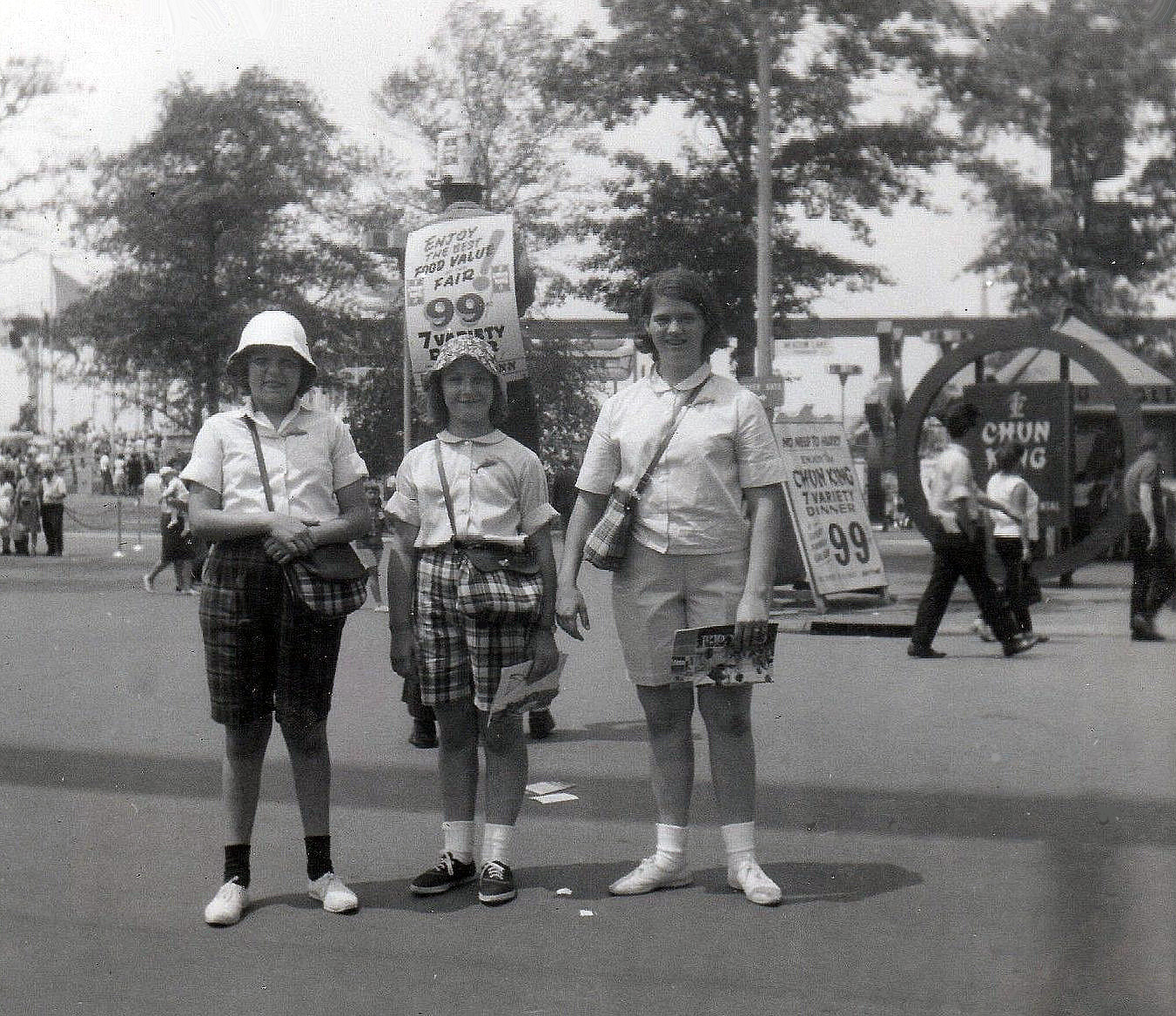
1964World'sFairChunKingphoto

Fifty years ago the 1964-65 New York World’s Fair was underway, with thousands going through the turnstiles. Sooner or later they had to eat. Some brought a picnic but others patronized the roughly 110 restaurants in operation the first season, up to nearly 200 in 1965.

The Fair was not officially sanctioned by the Bureau of International Expositions nor supported by governments (for the most part); it was a commercial enterprise filled with corporate pavilions such as Johnson’s Wax, General Motors, and Travelers Insurance. Most of the restaurants were run by private entrepreneurs who were not necessarily from the country represented by the pavilion. Restaurant Associates, which operated Mamma Leone’s, The Four Seasons, and others in NYC, ran the restaurant in the Indonesian Pavilion and five others. New York’s Sun Luck chain ran the Cathay Chinese Restaurant in the Hong Kong Pavilion.

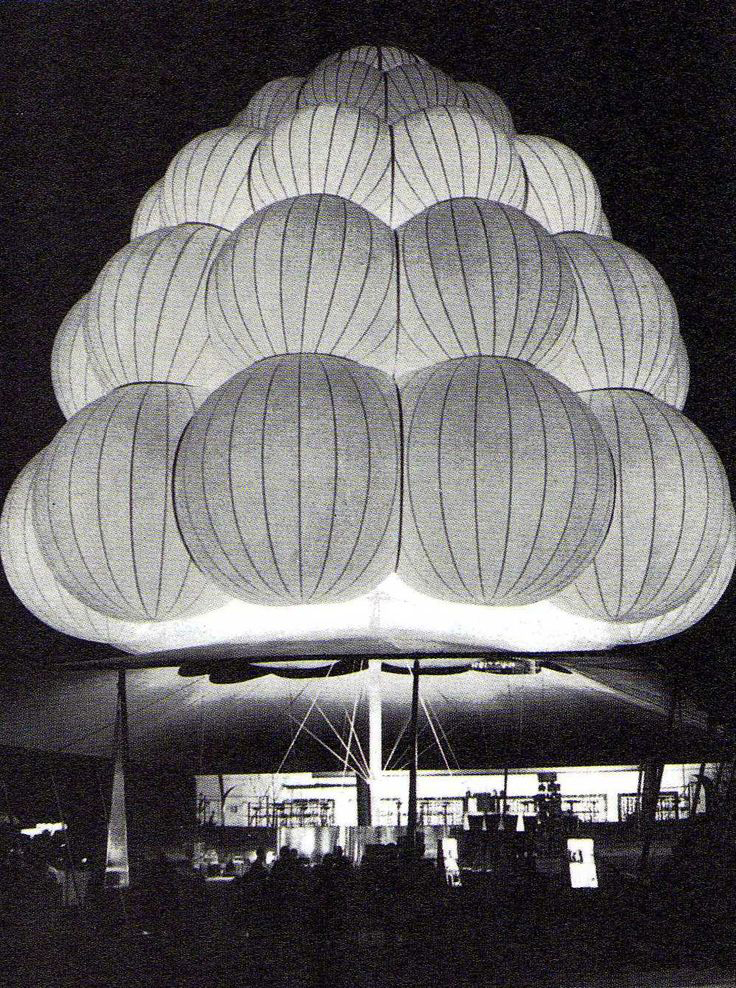
1964NYWorld'sFairBrassRailsnackbarBiggest of all, the Brass Rail operated six moderate-priced restaurants, each offering a single complete meal for $3. In the International Plaza they ran both a cold Danish buffet and the Garden restaurant offering Southern fried chicken dinners. The company, a subsidiary of Interstate Vending Co. in Chicago, also had 25 freestanding snack bars with balloon-shaped roofs that looked as though they could lift off and float away.

Most of the eating places at the Fair supplied casual food and snacks, whether strawberry and whipped cream filled Bel-gem waffles (the hit of the Fair), Wienerwald hot dogs, or Chicken Delight(s). Providing plentiful fast food was based on the belief that non-New Yorker Americans would accept nothing else. Keep in mind too that it was the mid-1960s before the culinary revolution came along with its hopes of replacing industrially produced convenience food.

There was also no shortage of exotic cocktails served at tiki bars and lounges, and American and imported beers flowing in beer gardens. During groundbreaking for the Schaefer Brewing Company Center, which contained Schaefer’s Restaurant of Tomorrow and a beer garden, Fair president Robert Moses advanced a surprising perspective on the Fair’s theme, Peace through Understanding, by declaring that beer was probably “the thing that holds the world together.”

International edibles ranged from the passably authentic to the thoroughly Americanized. Yet however tame the Fair’s version of world cuisine often was, those fairgoers daring enough to go beyond burgers and dogs found a wide selection of food unknown to most Americans then. Among the many unfamiliar dishes were smoked reindeer at the Swedish Pavilion, spicy Korean spareribs, and stewed meat with peanuts and couscous at the Tree House restaurant in the African Pavilion.

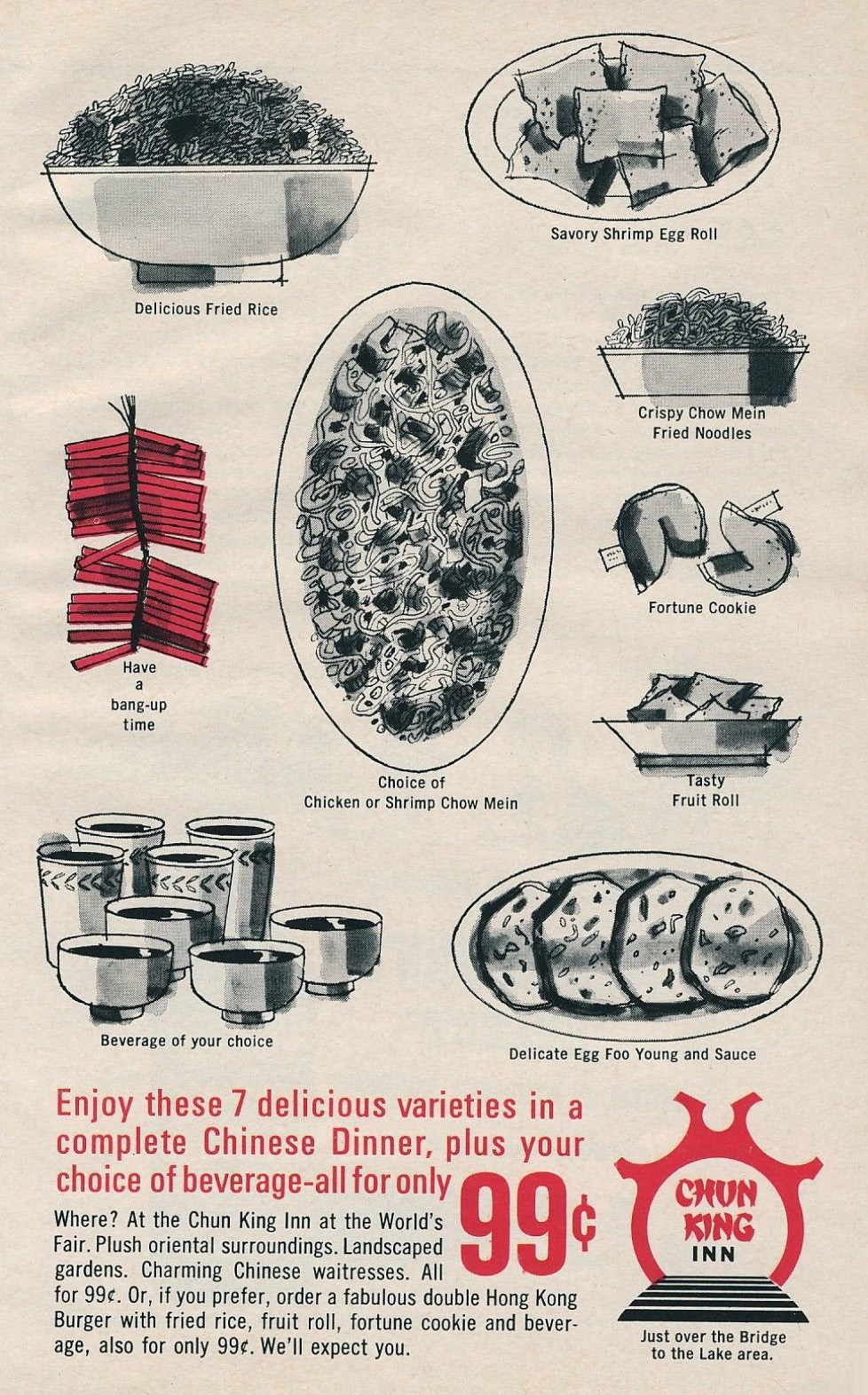
1964NYWorld'sFairChunKingRepresenting American-style Chinese food was the Chun King Inn, whose mission was not so much to run a profitable restaurant as to familarize people with Chun King products sold in supermarkets. It won over the public — who often complained about high restaurant prices at the Fair — by serving full meals consisting of seven items for only 99 cents. The Inn also featured a double-patty Hong Kong Burger with cheese, lettuce, special sauce – and bean sprouts for an Asian touch. Many restaurants did poorly at the Fair, but Chun King’s president reported that the Inn served 5 million customers the first year.

Probably the most successful restaurants were those directed by veterans of earlier Fairs, particularly Seattle’s in 1962 and New York’s in 1939. Repeaters from 1939 included the operator of the Century Grill who had run the Aviation Grill in 1939 and Schaefer Brewing Co.  Seattle businessmen subleased a restaurant in the Fine Arts Pavilion named the Bargreen Buffet to Roy Peterson, proprietor of Seattle restaurants including the Norselander. Another restaurateur from Seattle, William Moultray, did so well with his Polynesian restaurant in 1964 that Fair officials asked him to set up a restaurant complex in another pavilion.

1965World'sFairBelgianVillage

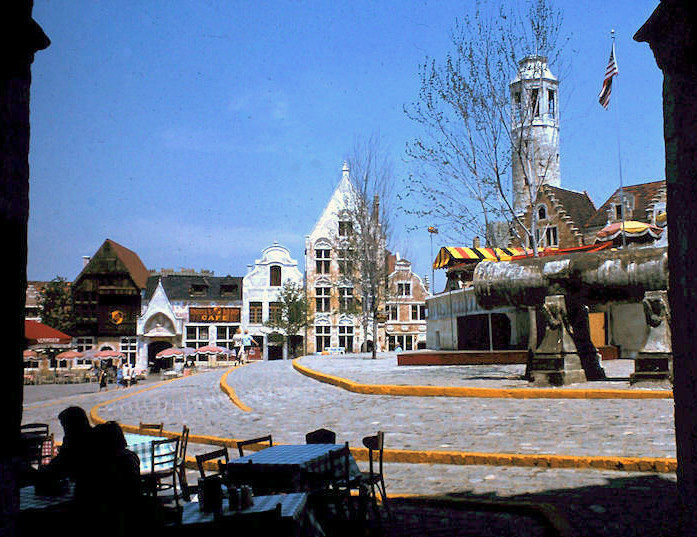
The Belgian Village [shown above in part] consisted of 100 buildings and 20 eating places, some of them outdoor cafes, but was not completed until the end of 1964. A similar village with some of the same buildings had been at Chicago’s Century of Progress Exposition in 1933.

Although critics were disappointed that there was nothing to equal Henri Soulé’s 1939 French restaurant (origin of NYC’s Le Pavillon), everyone agreed that the restaurants in the Spanish Pavilion came closest. Unlike most, it was officially supported by Spain’s government, headed at that time by dictator Francisco Franco. Two restaurants in the pavilion, the moderately priced Granada and the expensive Toledo, were under the management of Madrid’s Jockey Club which imported its chef and 40 of his assistants. So popular was the pavilion’s outdoor seafood bar, the Marisqueria, that it was enlarged in 1965. It was under the direction of Alberto Heras who opened a Spanish Pavilion restaurant on Park Avenue in NYC in 1966.

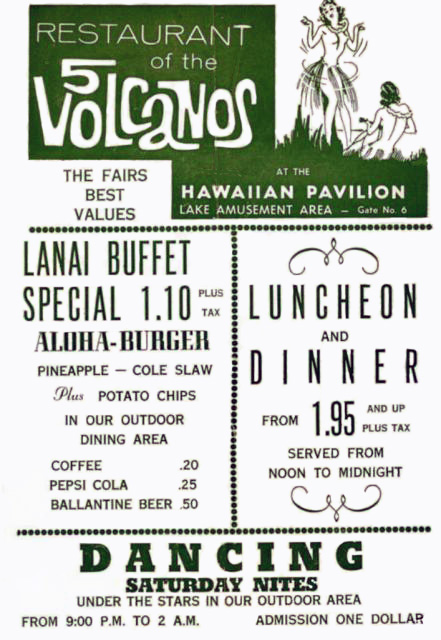
1964World'sFairFiveVolcanoesRestHeras was one of several restaurateurs who tried to extend their success beyond the Fair. The Spanish Pavilion building was removed to St. Louis by then-mayor Alfonso Cervantes, where it housed three restaurants that met a rapid demise. The maestro of Wienerwald, Friedrich Jahn, extended the Europe-based chain into this country. It had grown to 880 units by the early 1980s when it failed. The Petersons of the Bargreen Buffet took over management of New York’s venerable Janssen’s restaurant. The Wisconsin Pavilion’s Tad’s Steaks, with its popular $1.19 sirloin steak dinners, became a fixture with bargain-meal hunters in NYC.

Although the Fair fell short of meeting its attendance goal of 70 million, drawing only 52 million fairgoers, it’s likely that millions of them carried away lasting food memories.

© Jan Whitaker, 2014

16 Comments
Filed under chain restaurants, family restaurants, miscellaneous, odd buildings, outdoor restaurants, theme restaurants

Image gallery: dinner “on board”

ShipTacomaTopoftheOceanest1946burned1977

There are numerous historical links between restaurants on land and vessels that navigate seas, lakes, and rivers. Ocean going sailors arriving in port, for instance, made up a notable fraction of early restaurant customers. Their ranks also provided stewards, cooks, and chefs, bringing new skills and cuisines wherever they took up their profession on land. San Francisco in the 1850s provides a striking example. In the United States steamboats that traveled the rivers and Great Lakes contained dining salons that were among the 19th century’s most luxurious and among the few places where ornamental French cuisine flourished.

But . . . this post isn’t about that. Instead it illustrates how far restaurants featuring ship and boat themes have strayed from a connection with their watery history. Ship restaurants are for the most part little more than a novelty – but a novelty that can be traced back at least to the 1850s. Despite quite a lot of ship restaurants running aground or sinking, literally and figuratively, there is some kind of primal appeal that keeps them going.

Frank Bazzuro may have been first. He arrived in San Francisco from Italy in 1852 and installed a restaurant in one of the hundreds of ships abandoned in the Bay, introducing his customers to a Genoese fish stew, cioppina. In the 1880s Capt. Paul Boyton, a world-famous swimming champion who popularized rubber wet suits, opened a restaurant on West 29th in NYC called “The Ship” which resembled a ship’s cabin. On Venice Pier in CA, a developer constructed a replica of a Spanish Galleon in 1904, after which it rode the waves of good and bad luck until its demolition in 1946. After an underworld shooting in 1928, it went through a couple of name changes, from Show Boat Café to Volga Boat.

Most ship restaurants that float on water – which not all do – have had checkered pasts as more utilitarian vessels or ones that have spent some time under water. Before it became a floating restaurant in Wilmington NC in 1951, the Ark had transported troops, hosted gamblers, and housed the coast guard. The SS Catala was one of about ten ships that appeared in Elliott Bay during the 1962 World’s Fair in Seattle. Previously it had served as a coastal passenger steamship, then fish transporter. When the fair ended it was towed to Los Angeles where it failed as a nightclub restaurant, then appeared in an Perry Mason TV episode before returning to restaurant-ing in Washington where a storm ran it aground.

Dining on a floating restaurant can be hazardous. A storm tore St. Louis’s Becky Thatcher Riverboat from its moorings, sending it downstream where it ran onto the opposite side of the Mississippi in 1969. Bar business was said to be brisk in the interlude before its 100 diners were rescued.

Ships moored on land are safer but rarely very convincing in their roles, particularly if they are in Dallas or Phoenix (below, respectively), smack on a roadway or surrounded by an asphalt parking lot where the water consists of a few puddles.

ShipRestaurantBountyDallas1971ShipCopperBelleRiverboatPhoenix

A parking lot might seem like a strange place for a ship but, a little reflection tells you that Noah’s Ark could have ended up almost anywhere. And that may be the reason enterprises with that name have done business not only on the beach in Leucadia CA, but near the interstate in St. Charles MO (pictured) and in Grovetown GA and Des Moines IA.

ShipNoah'sArk

Some sites present a real challenge. How do you make your restaurant resemble a ship when it’s in the middle of a block? Boyton’s ship cabin restaurant where only the interior resembles a ship gives an answer, but so do a number of storefronts that have been adorned with protruding ship’s prows, such as Bernstein’s in San Francisco (pictured).

shipBernstein'sFishGrotto

Babette'sYachtBarThere were oh so many bars shaped like boats and yachts, of which Babette’s was one (above).

Many restaurants with ship themes specialize in fish and seafood, but not all. Why not Chinese and American cuisine as in the 1940s Ship Ahoy chain with restaurants in  Atlanta and Augusta GA, Charlotte NC, Columbia SC, and Houston TX? Or hamburgers (McDonald’s, St. Louis riverfront, shown below)?

ShipSTLRiverfrontMcDonald's

In researching this topic I learned that almost every city or town will sooner or later have a ship restaurant. And many of them will sink, be scrapped, or get towed to another location. The fate of the Showboat Restaurant in Beaverton OR was ironic. In 1981 it became Showboat Liquidators where “Selling Your Boat Is Our Only Business!”

© Jan Whitaker, 2013

2 Comments

Filed under theme restaurants

Image gallery: shacks, huts, and shanties

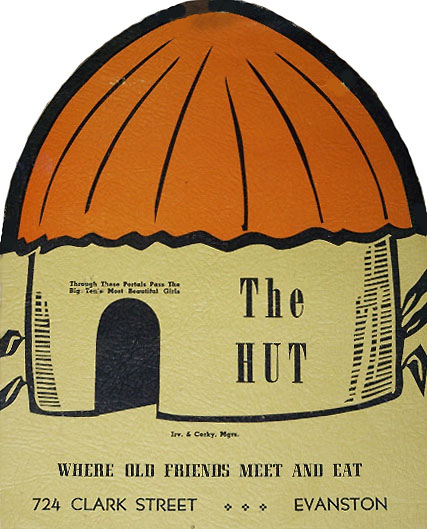
TheHutEvanstonLike stands, shacks most certainly represent a type of eating places whose origins stretch back into antiquity. Their simple structures can be erected hastily for fairs or to capture the pennies of hungry travelers. In an automobile culture they suggest open spaces and open roads.

They convey honest rusticity with uncomplicated, inexpensive fare for ordinary folks rather than elaborate cuisine accompanied by the pomp and ceremony of the palace as enshrined in posh restaurants. The kinds of food sold in shacks, huts, and shanties is likely to be lobster, fried chicken, barbecue, or other casual fare that is eaten with the hands, and quickly.

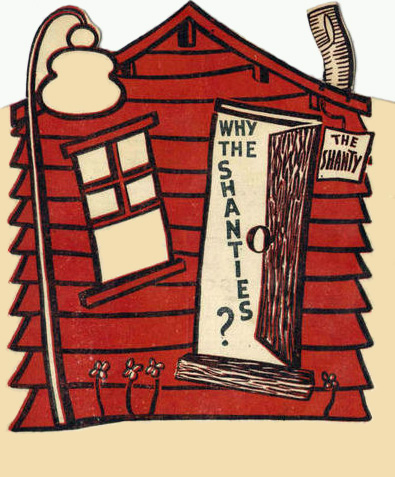
Shanties1930sFrontLow prices are implied in huts and shacks. The slogan of the Shack in Upper Darby PA was “Where Dining is an Event not an Extravagance,” while New York City’s eighteen Shanties of the 1930s promised “The Country’s Finest Products at the City’s Lowest Prices.” For 15 cents the menu offered orange or tomato juice, buttered toast, and coffee.

AncestryUNKnownlunchcounter

On the other hand, low prices or not, how many people would want to patronize a true shack? The crude Depression-era lunchroom shown above has a tarpaper roof and scanty stock on its display shelves.

Jerry'sShackSLCToday, because such places are harder to find, they project a strong contrast with the manufactured food and decor of chain restaurants. In contrast with artless roadside shanties, McDonald’s and other fast-food outlets are carefully designed, highly managed food selling environments.

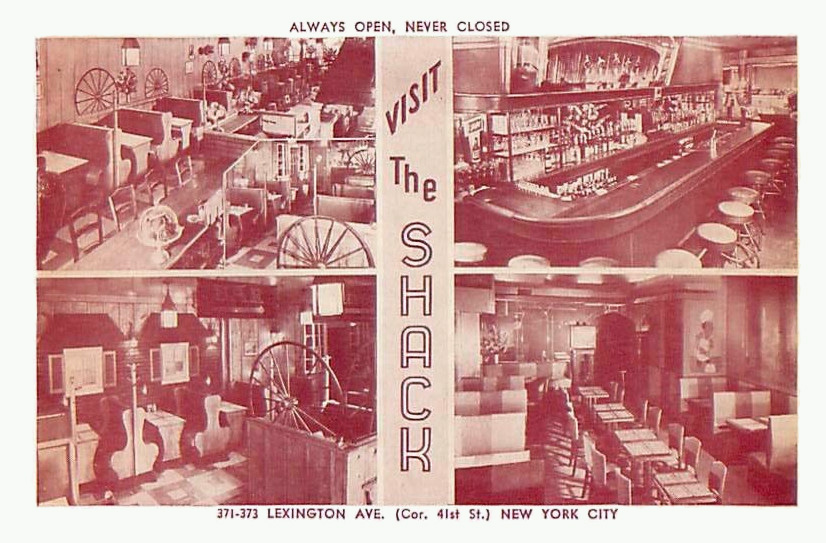
ShackNYCAt the same time, restaurants tend to look to the past rather than the future for themes that will attract customers. Shacks and huts are entirely capable of filling that role too, even in New York City, a most unlikely setting. The Shack, in Manhattan, is scarcely convincing. One of Chicago’s leading restaurants of the 1930s was the Chicken Shack, which was furnished with not-a-bit-rustic modernistic chrome tables and chairs. Its proprietor, Ernie Henderson, was invited to demonstrate his chicken frying methods at the 1939 convention of the National Restaurant Association, marking the first time an African-American was given such an opportunity.

© Jan Whitaker, 2013

5 Comments

Filed under odd buildings, theme restaurants

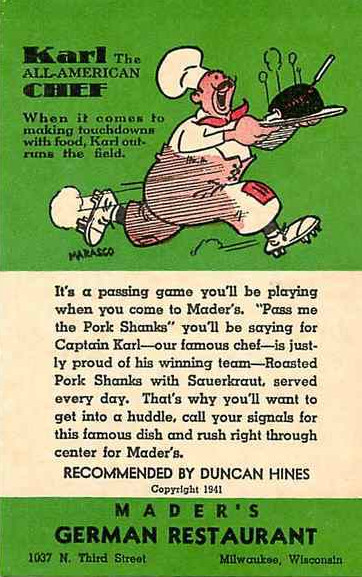
The power of publicity: Mader’s

Compared to cities of comparable size in 1910 — such as Los Angeles, Minneapolis, or New Orleans — Milwaukee at first appears to be a town where people rarely ate outside the home. But statistics can be deceiving. In the city made famous by its breweries, most eating places were primarily saloons before Prohibition, usually set up in business by one or another brewery.

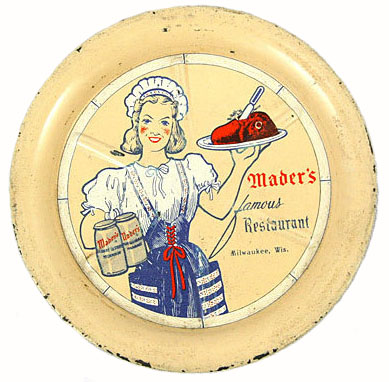
This is how Charles Mader got his start, as a saloonkeeper who also served meals of the homely sort. Although 1902 is commonly given as the year in which he began, I suspect it was a few years later that he opened his own place. Throughout most of his early career he worked with a partner. He and Gustav Trimmel joined up in 1915, the year the saloon moved to the present-day restaurant’s address. In 1921 Mader had a new partner, Charles Ruge, with whom he remained in business until 1928. Thereafter his partners were his sons George and Gus who assumed ownership when Charles died in 1937. [pictured above, 1950s]

Although many restaurants get a good share of patronage from out-of-towners, relatively few located in America’s midsection make a determined bid for nation-wide recognition. Mader’s was one of those that did so successfully. A late 1920s photograph in the historic photo collection of the Milwaukee Public Library shows the restaurant with a prominent “Tourists’ Headquarters” sign in its front window. In 1929, a newspaper item suspiciously resembling an advertorial (publications didn’t identify them as such then) claimed that Mader’s had won a reputation for hospitality extending “the length and breadth of this land and to distant lands as well.”

Charles Mader was known for his belief in advertising, often remarking, “If your business is not worth advertising, advertise it for sale.” Beginning afer Prohibition, Mader’s would intensify its advertising program and accentuate its Germanness, following a kind of reverse assimilation common to other German-themed restaurants in the US. Very likely this reflected a proportionate shift in patronage from German-American Milwaukeans to a wider clientele of conventioneers, traveling businessmen, and tourists of all stripes looking for an identifiably ethnic experience. The trend would continue: a 1968 newspaper story reported that at Mader’s and Karl Ratzsch’s, mostly patronized by tourists, German dishes were popular, while at restaurants patronized exclusively by Milwaukeans such as the Fox and Hounds, filet mignon and lobster tail were favorites.

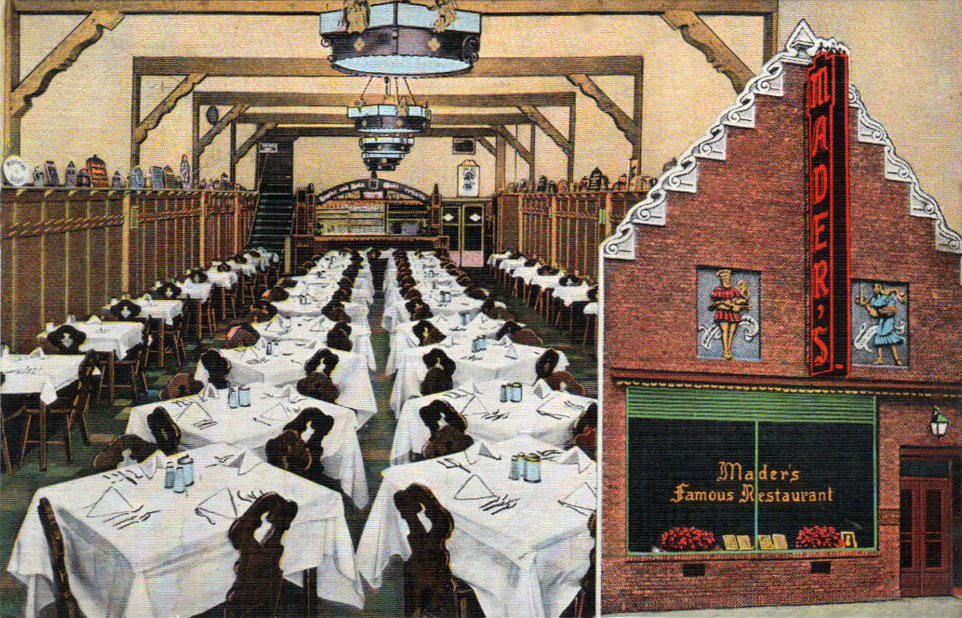
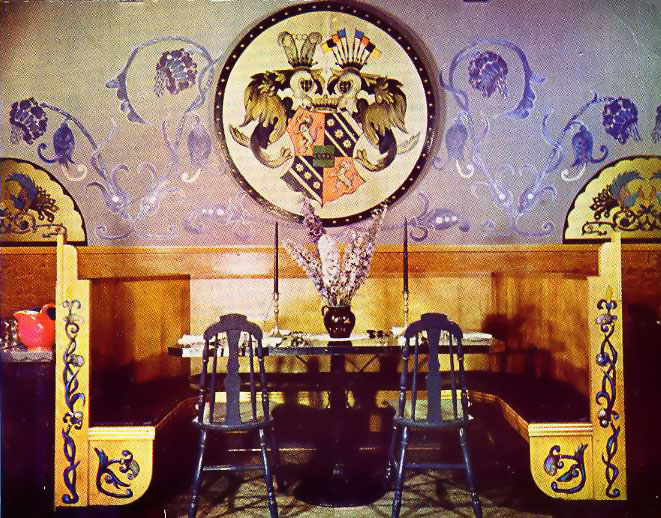
In 1935 the Maders remodeled the 3rd Street building to look more typically German in a style suggestive of medieval architecture with a high stepped gable and two bas relief panels depicting quaintly costumed servers. By contrast, only a couple years earlier Mader’s had a typical plate glass storefront with a centered, recessed entryway and a moderne sign with its name spelled out in bold aluminum lettering. In subsequent decades, the Mader’s compound has been further extended and embellished, given a vaulted ceiling and decorated with heraldic swords and shields. It has taken on a castle-like appearance.

Along with arch competitor Karl Ratzsch’s, a Viennese-inflected restaurant pursuing much the same strategy, Mader’s began to win awards and listings in national magazines and restaurant guides, such as Duncan Hine’s Adventures in Good Eating and those of the Automobile Club of America and Ford Motor Company. It began attracting visiting Hollywood stars in the 1930s, hanging their autographed photos on its walls. In 1937 and again in 1949 and 1952 a poll of traveling business men voted it America’s favorite German restaurant and one of their ten favorite restaurants overall. Accolades continued coming in up to the present day.

Mader’s is a survivor, having outlasted most of Milwaukee’s venerable German restaurants, some of which, Forst-Keller and the Old Heidelberg for example, were associated with the city’s breweries. Cafes originating with Fritz Gust, Joe Deutsch, and John Ernst have all passed from the scene, the last as recently as 2001.

Long considered “heavy” eating, German cuisine has perhaps sunk in popularity somewhat from the middle of the 20th century, although Pork Shanks – ever popular at Mader’s – remain on the restaurant’s menu to this day. Notably, though, this once-humble dish has become an expensive entree.

© Jan Whitaker, 2012

1 Comment

Filed under theme restaurants

Theme restaurants: Russian!

Restaurants and coffee houses run by Russian immigrants appeared in the late 19th century. Their proprietors were Jews living on NYC’s lower East Side as well as others in California and Chicago who were pro-revolution enemies of the Czar. But not until after World War I (and the Russian Revolution), when a very different wave of anti-revolution, pro-Czar Russian immigrants arrived, did explicitly and self-consciously Russian-themed restaurants come into being. They flourished in the 1920s and 1930s.

For many readers New York’s Russian Tea Room will immediately spring to mind. It was established on West 57th Street in 1927 by Jakob Zysman, a Polish immigrant who operated a chocolate factory at the little tea room where ballerinas hung out. The business soon moved across the street where it changed hands and was expanded into a full-fledged restaurant. Over its long history it had many owners, notably including Faith Stewart-Gordon who ran it from 1967 until the end of 1995. After extensive renovations by restaurant impresario Warner LeRoy, it reopened in the fall of 1999. LeRoy died in 2001 and the RTR closed the following year.

But it should be noted that, unlike other Russian restaurants of the interwar period, the RTR was not started by a White Russian nor did it have a specifically Russian emigré clientele for most of its tenure. Reportedly, at one point the Russians who haunted the barroom were discouraged from patronizing the place because of their propensity to linger while they eulogized the olden days. The RTR was mainly famous as a flamboyant celebrity restaurant.

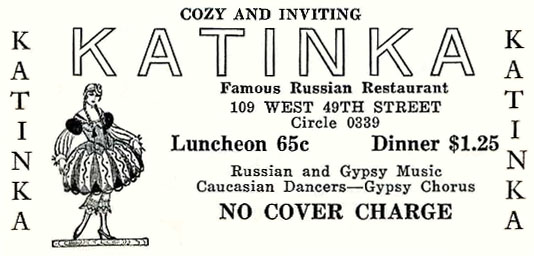
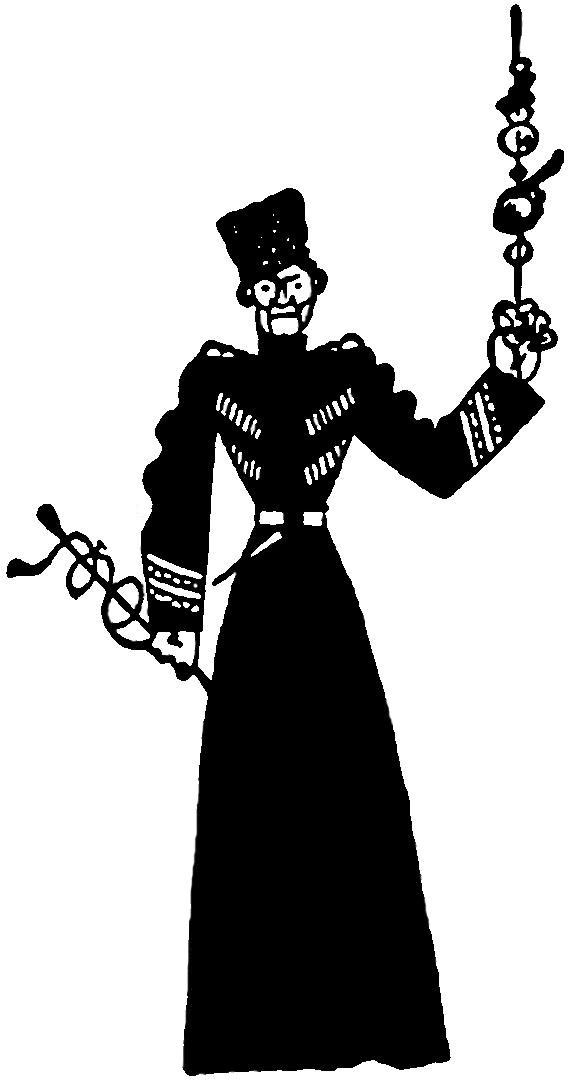
In the 1920s NYC gained a population of White Russians numbering about 6,000, most of them well-educated former members of the intelligentsia or the Imperial Russian Army. Numerous Russian eating places soon cropped up, with names such as The Russian Inn, The Eagle (E 57th), Katinka (W 49th), The Russian Swan, Kavkaz (Bdwy & 53rd), Casino Russe (W 56th), The Russian Sadko (W 57th), The Maisonette Russe (W 52nd), and The Russian Bear (W 57th). On the lower East Side were The Russian Kretchma and the (original) Russian Bear. Striking modernistic wall murals by emigré artists such as Boris Artzybashev, balalaika music, and entertainment by Cossack performers often contributed to the atmosphere of these eating places. As far as I can tell they served both as gathering spots for Russians and as tourist attractions.

Los Angeles also had a White Russian settlement of up to 2,000, with an Orthodox church, art shops, tea rooms, and restaurants. Lured by Hollywood, some Russians from this period acted as extras in movies and a few became studio consultants with expertise on the former glories of the fallen Russian aristocracy. When Theodore Lodijensky, proprietor of NYC’s Russian Eagle, moved westward he consulted on Sternberg’s “Last Command” (1928) — and he opened a West Coast version of The Eagle.

When the RTR began there were also other Russian tea rooms in NYC and around the US, some going by that exact name, some with names such as The Samovar. An importer of artistic wares named Polakoff, a Czarist who used a royal crest in his advertising, ran a Russian Tea Room filled with Russian arts and crafts on Chicago’s South Michigan Blvd. A specialty there was the Petrograd Supreme, a tall sandwich which the eater approached from the appetizer layer on top, working down to the dessert layer at bottom. In the 1930s Valentina Alekseevna Vernon ran a Russian Tea Room in San Francisco. A woman of strong opinions, she found Americans as resistant to some Russian dishes as she was to theirs.“I wouldn’t touch either an ice cream soda or a fruit salad,” she proudly proclaimed. Also in San Francisco was the Moscow Café which opened in 1932 and featured flaming Beef Stroganoff and Cossacks balancing flaming swords. A few Russian restaurants could also be found in Philadelphia, Boston, New Haven CT, and Miami in the 1930s.

The dishes introduced by White Russian restaurants included not only Beef Stroganoff, but also Blini with Caviar and Nesselrode Pudding. Although their menus might list Borscht, Darra Goldstein points out in The Oxford Companion to American Food and Drink that this humble Ukrainian beet soup was brought by Russian Jews who had immigrated earlier.

© Jan Whitaker, 2011

4 Comments

Filed under proprietors & careers, theme restaurants

Theme restaurants: castles

So often restaurant reviewers seem to struggle to say something positive about a restaurant. Is it my imagination or did they try twice as hard when reviewing restaurants with medieval castles and King-Arthur-and-his-knights themes? No doubt there were a handful of restaurants of this sort that really cared about food but, mainly, I think not. Of course most were actually steak houses in disguise — but what wasn’t a steak house around 1967, the year that the movie Camelot came out, almost certainly boosting this restaurant-ing trend?

In America Eats Out, John Mariani comments that during the 1960s many “strained and mawkish” restaurant themes prevailed. For example, he writes, “‘Old English pubs’ proliferated in places with names like Ye Olde Bull & Bush in Atlanta, The Golden Bee in Denver, and His Lordship’s in St. Louis. At Atlanta’s Abbey restaurant, waiters came to the table dressed as monks (a sartorial gimmick also featured at New York’s Monk’s Inn).”

The popular movie Camelot explains some but not all instances of medieval English resorts in this country. There were none in the 19th century that I’ve discovered, but a few can be found before the 1960s. I do not include White Castle hamburger stands. Despite their name and laughably minimal crenellated exteriors, they were so clearly not castles that they may be excused from consideration. They didn’t print menus on parchment scrolls, didn’t decorate with suits of armor, and didn’t dress countermen in monks’ robes or velveteen rompers with tights. As others have commented, White Castle interiors looked more like morgues than baronial halls. And while White Castles were sited near bus stops and factory gates, only a novelist like Vladimir Nabokov could have created the existential contexts for English castles: The Coat of Arms on Oracle Blvd. in the Casa Adobes Plaza; the Camelot Castle, a smorgasbord in Azusa CA; King Arthur steaks in Long Beach.

knightCrownRoomSheratonMotorHotelNYC

Back in the 1920s entrepreneurs in Los Angeles were knocking together roadside castles – and windmills, Irish shanties, French Bastilles, giant igloos, anything that would catch the eye of a speeding motorist. It may have been a similar motive that led to the ca. 1920s erection of a castle in Westhampton, Long Island, once the home of the Gray Lion Tea House (another medieval castle would spring up in a Valley Stream shopping center in the mid 1960s housing a unit of the Steak Pub chain). The 1939 Chicago World’s Fair occasioned many theme restaurants including The Hunting Lodge, an English castle whose guests were attended by young women dressed as Robin Hoods.

Quite unlike White Castles’s tiny beef patties, Olde English castles encouraged “royal” self-indulgence, designed principally for male guests. Stiff drinks in front of the roaring fire, the color red, chunky chairs, cheese crocks, T-bone steaks, jumbo shrimp, and oversize desserts were typical of these castles.

The proliferation of restaurants of this type in the 1960s makes me think that it took a lot of coaxing to get men to go out to dinner in that decade.

© Jan Whitaker, 2011

2 Comments

Filed under restaurant decor, theme restaurants

Theme restaurants: prisons

I’ll admit that I’m not fond of theme restaurants. So often they seem designed for tourists who will never return and, therefore, don’t get very good treatment. Food is often a secondary consideration, mediocre at best, while the entertainment is hokey.

Yet obviously many people enjoy places that allow them to escape their everyday lives for a few hours. What kind of escape does a prison concept provide? Appreciation of freedom? The opportunity to tell friends “I was in jail last night”?

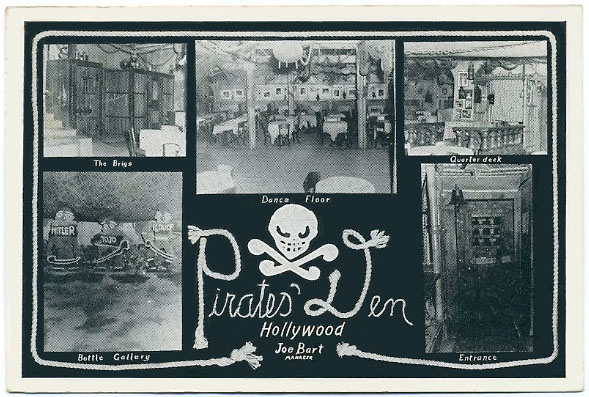
Whatever it may be, it’s never been a common restaurant motif, yet it endures today. The theme can be traced back to 19th-century Montmartre’s Café of the Penitentiary (Café du Bagne). The beat was picked up in the US by “beefsteak dungeons” that sprang up around 1900. In another variant, Don Dickerman led patrons down into a dark cellar, the brig, in his Pirates’ Den in the Greenwich Village of the 1920s, which he recreated in Miami, Washington, and Hollywood CA (shown) in the 1930s and 1940s.

Los Angeles was host to several jail theme eating/entertainment venues, the first in the early 1920s when LA entrepreneurs were eager to cash in on the popularity of Greenwich Village by creating outlandish eating places that resembled the Village’s. One LA attraction was a coffee shop largely patronized by sailors where the walls were painted to resemble the stone walls of a prison on which patrons scrawled their names. Then, in 1925, The Jail opened on Sunset Boulevard. Each table occupied its own barred cell. Just like in Montmartre of the late 1800s, waiters dressed as convicts — the bitterly ironic yet unconscious American twist being that they were black men.

Within a year the proprietors of The Jail opened a second place. This location, or perhaps the first, became the set for two movies which have subsequently fallen into obscurity: Sweet Daddies (silent, 1926) and Ragtime (1927).

The Jails featured chicken dinners. Diners were furnished with no knives or forks, thus carrying on the beefsteak dungeon’s “caveman” tradition of eating with the hands. In 1930 a newspaper columnist named The Jail as one of the “seven wonders of Hollywood,” along with the Hollywood Bowl and the residence of Harold Lloyd. That honor may have marked its swan song as it seemed to disappear around then.

There were also jail-themed restaurants in other parts of the country. Depression-era Indianapolis had Fox’s Jail House Restaurant (shown above) where the “inmates” ate behind bars, while Fairfield, Iowa, enjoyed Turner’s Jail Café where, in 1939, Mr. and Mrs. Turner invited guests to Eat (plate lunches) at the Jail!

Believe it or not, the macabre subject of execution has also served as a theme for some eating places, such as The Noose Coffee Shop located across from Chicago’s Criminal Courts building in the 1920s. It supplied condemned prisoners with their last meals and they reciprocated with autographed photos. In the 50s, 60s, and 70s, Tarzana CA had a jokey place called The Hangman’s Tree Café, whose menu cover featured a noose dangling from a tree and the slogan “Jail Fare.” Although it was presumably meant to invoke the Wild West I feel reasonably certain not many black guests chose to accept the invitation to “hang out” there. I almost hate to mention the Taipei, Taiwan, restaurant called The Jail which in 2000 was grotesquely (but briefly, following public outcry) decorated with photo murals of emaciated prisoners of German concentration camps and a sign for the rest rooms that read “gas chamber.”

© Jan Whitaker, 2010

7 Comments

Filed under theme restaurants