Category Archives: restaurant customs

Picturing restaurant food

Restaurants have long tempted the public with displays of food, but in the 20th century it became possible to replace actual food with images of desirable dishes on colored postcards and illustrated menus.

Color photochrome postcards became standard after WWII, yet it wasn’t until the 1970s and 1980s that menus illustrated with full-color photographic images of food came into common usage.

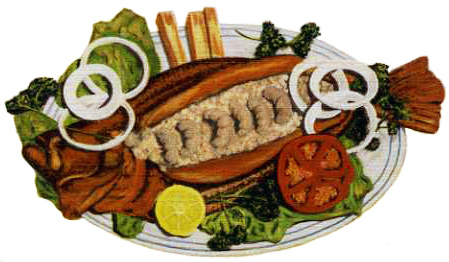
In the 1930s and early 1940s, before photochrome postcards came into widespread production, linen-finish postcards were the norm. Their cartoonish coloring often lacked realism. For example, the grayish shrimp topping stuffed flounder at Manuel’s in Galveston TX look distressingly like worms.

Even as quality photography and printing became more available in the 1950s, restaurants weren’t always successful in portraying food attractively. Professional food stylists had yet to arrive on the scene to solve problems such as poor plating, monochromatic food combinations, and runny gravies.

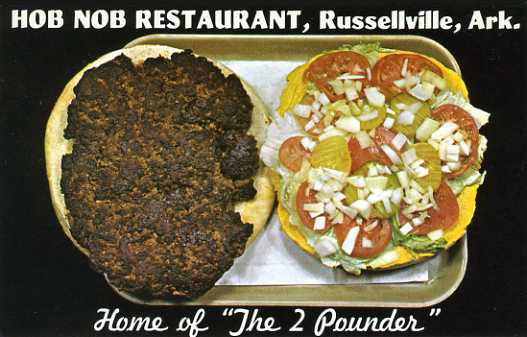
Regarding poor plating, a large portion is all very fine but should an order of meat or fried fish be bigger than the plate?

Gargantuan food itself can be questionable, not only to consume but also to look at. How attractive are french fries almost as big as baked potatoes? Is a two-pound burger eight times better looking than a quarter pounder?

On menus, photos of food play multiple roles, providing information about “exotic” dishes, invoking desire, and steering choices. In the case of restaurants whose dishes – or drinks in the case of Polynesian theme restaurants — might be unfamiliar to some patrons, pictures serve as visual description.

As far back as the 1930s, some restaurants used illustrated menus but with images that appeared to be hand drawn and colored and almost comical compared to the realistic photographs that dominated chain restaurant menus by the 1980s. Full-color, laminated menus are most often found in 24-hour coffee-shop restaurants and present all the meals and dishes that are available; breakfast, lunch, and dinner often have no clear demarcation.

Laminated menus cost more to produce than others yet are relatively long-lasting because they can be wiped off — though, as often noted, rarely are. Their lifespan is about 3 to 6 months, after which prices and dishes need updating.

Unlike Indian, Chinese, or Mexican restaurants (especially in the years when they were new to many diners), dishes found on illustrated menus of chain restaurants – such as bacon and eggs, pancakes, or burgers — are not the least bit unfamiliar. Quite the opposite.

Which seems to raise the question of why such ordinary food needs to be illustrated at all.

Not too surprisingly the main role of photos is to encourage customers to order the restaurant’s more profitable dishes. It’s always possible to order a single pancake or fried egg, but it is certain that what will be pictured is instead a stack of three pancakes or two eggs with sausage or bacon.

Featured dishes are positioned to follow the paths typically taken by customers’ eyes. Prized locations include the menu’s center and top right. Another tactic, one that turns the whole menu into an eye-catching circus, is to place featured dishes inside brightly colored boxes.

As for dishes that don’t get top billing, a Denny’s advertising director observed that a hopelessly slow seller like a grilled cheese sandwich would be line-listed, no photograph. On a 1970 Tops Big Boy menu [shown here], beef and shrimp achieved center feature status but ham and fish dinners failed to make the cut, languishing in a line-list.

I am still left wondering why many dishes on illustrated menus look so unattractive, especially considering that the menus are often produced after extensive research and consultation with experts. On a three-panel 1985 Friendly’s menu a “100% Sirloin Steak Burger” looms over the center column at a scale larger than other features such as a Clamboat Platter and a Seafood Salad Plate, yet it utterly fails to project charisma.

Contrary to wished-for results, many diners view laminated, illustrated menus as a signal that a restaurant’s offerings are going to be bland and uninteresting. An Orlando FL restaurant reviewer complained in 1988 that many restaurants there used laminated menus: “It seems that no matter what type of restaurant I go to, or how much is charged for the average meal, the menu is plastic coated. It reminds me of the people who buy really nice furniture and then cover it in plastic.”

Illustrated menus have become so strongly associated with mediocre food that it is a huge mistake for an establishment aiming for the fine-dining category to use such a menu, even temporarily. But, believe it or not, such a restaurant existed in Phoenix AZ in 1983, with expensive entrees pictured in shiny plastic while the wine list was calligraphied and covered in velvet.

© Jan Whitaker, 2018

8 Comments

Filed under chain restaurants, food, menus, restaurant customs

Catering

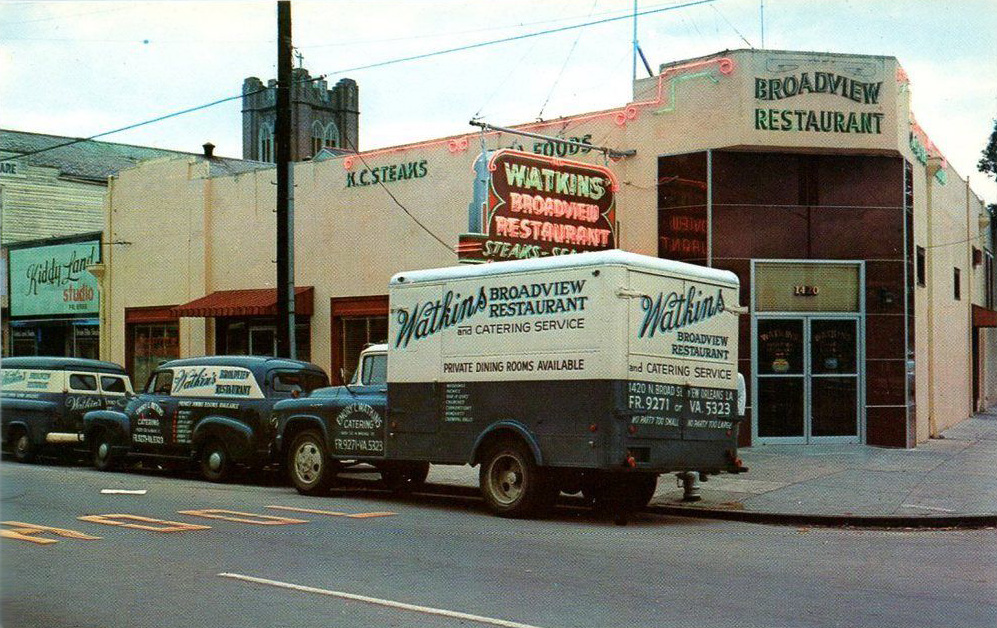
The catering business is closely related to restaurants, though many caterers work from a rented or home-based kitchen. Frequently caterers have been – and are — cooks or waiters; many later enter the restaurant business as proprietors. Then as now catering provides an important financial supplement to restaurants.

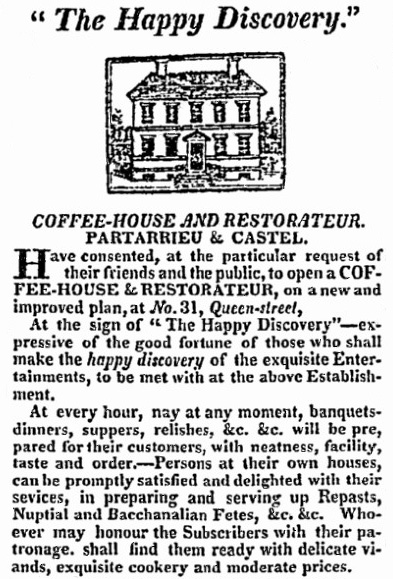
In the 18th and 19th centuries many coffee houses, taverns, eating houses, refectories, etc., not only catered to groups in their own banquet rooms or off-site, but also delivered food to homes and workplaces. Monsieur Lenzi, recently arrived in New York from London advertised in 1773 that he could provide jams, preserved fruits, pâtés, and “sugar plumbs” and could handle balls and masquerades as he had done in “most of the principal cities of Europe.” The early Delmonico café of the 1830s supplied meals to residents of a small hotel located next door on Broad street in New York.

Confectioners, who often ran eating places too, were especially likely to be in the catering business because, unlike many restaurant proprietors, they were skilled in turning out elegant cakes and ice cream. For most of the 19th century ice cream could only be obtained from a confectioner.

African-Americans were quite prominent in the catering business until the latter part of the 19th century. They could be found in Boston, Salem, New York, Washington, Baltimore, Charleston, and other cities along the East Coast, but especially in Philadelphia. Quite a few earned prestige catering to elite white patrons, often being referred to as “princes.” They were often rumored to have become quite wealthy.

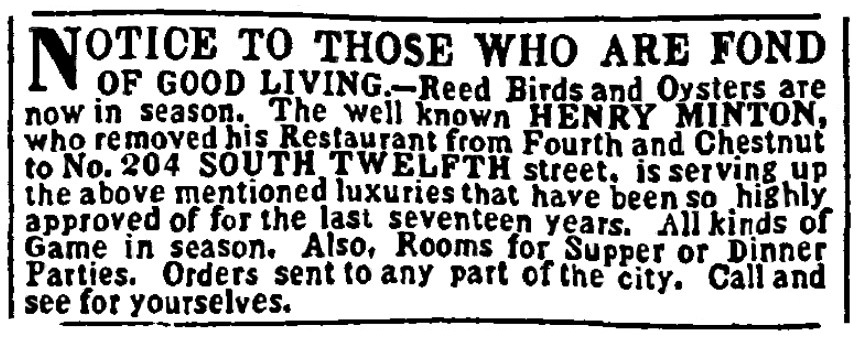
According to W. E. B. DuBois in The Philadephia Negro (1899), “the triumvirate [Henry] Jones, [Thomas] Dorsey and [Henry] Minton ruled the fashionable world from 1845-1875.” Dorsey had been a slave, as had the celebrated caterer Joshua B. Smith, who was Boston’s top man in the field. At the opening of Smith’s new restaurant in 1867, the entire city government was present and former mayor Josiah Quincy gave a speech.

But despite the prominence and success of Black caterers, the fact that they served clients in high society, and the praise heaped upon them for their astute management and taste, they were still regarded as second-class citizens banned from public transportation in Philadelphia as well as theaters and cemeteries there and elsewhere.

According to the 1870 U.S. federal census, there were then about 154 caterers (undoubtedly an undercount), 129 of whom were born in the U.S. The majority of those born in this country whose race was identified were Black (56) or Mulatto (29). But by the end of the 19th century, Black caterers had become less numerous, with much catering having been taken over by the big hotels that by then were dominant in the field, particularly for large banquets.
Only two caterers identified in the 1870 census were women, both white. I feel certain, however, that many more women were caterers in the 19th century. Catering was common among women tea room proprietors of the early 20th century whose clients included civic organizations, women’s clubs, and wedding parties. Harriet Moody was a very successful caterer in Chicago of the 1890s, with a remarkable career that included opening a notable restaurant, Le Petit Gourmet, decades later when she was at an advanced age.

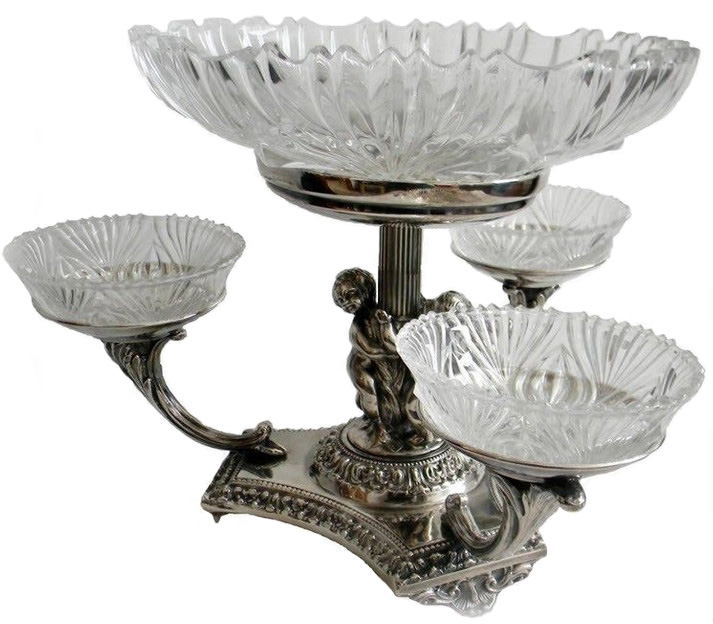
In addition to food, caterers usually supplied linens, china, and silver, as well as decorations, even when the dinner was held in a client’s home. In his book Catering for Private Parties, Jessup Whitehead explained that caterers obtained most of their linens and table ware at auctions, being careful not to acquire monogrammed pieces. A prized item was a large epergne which made a grand appearance on a table. Trenton NJ caterer Edmund Hill spent a good deal of time traveling to other cities to keep up with the latest trends in his field. He recorded in his diary on September 26, 1883: “Went to Wilmington, Del. to see about a Vienna Bread baker. Did not get him. Stopped in Phila on way home. Bought a silver epergne $20.00.”

Hotel catering, with its backstage mishaps, staffs of curious characters, and endless haggling over costs and contracts was described with humor by Ludwig Bemelmans who worked as a busboy at the fictitiously named New York “Hotel Splendide” before World War I. In the book Life Class (1938) he described how a group of well-bred but penniless blue bloods bargained for reduced rates based on their status and decrepitude, while accepting a simple supper menu of nothing but consommé and scrambled eggs.

After World War II catering continued on as before, distributed among hotels, restaurants, and independent caterers, the main change being the incorporation of frozen convenience canapes and better equipped kitchens to simplify and speed up the work. Some restaurants, and especially deli restaurants, such as Wolfie’s in St. Pete FL, offered party platters. By then large hotel banquets tended to lose their appeal for many people who had experienced too much Chicken a la King. Thanks to glittering parties thrown by Hollywood stars, it become clear that status accrued to the host or hostess who hired a famed restaurant’s celebrity chef to present novelties that piqued guests’ interest.

© Jan Whitaker, 2018

9 Comments

Filed under food, patrons, proprietors & careers, restaurant customs

Dining in a garden

Pleasure gardens of the 18th and early 19th centuries, sometimes called tea or mead gardens, typically opened on May 1 and offered relief from summer heat. Garden dining could be as simple as a tent in the back yard of an eating place or as elaborate as a larger garden with walkways, fruit trees, and arbors. A Philadelphia tea garden of 1798 furnished “tables, benches, boxes, bowers, etc.” The “etc.” might have included colored lights, or even small rustic cabins.

Garden guests ranged from families and young couples to “gentlemen farming parties.” In many of the gardens, menus were limited to delicacies such as ice cream, confectionery, lemonade, iced drinks, teas and coffees, and of course wines and liquors.

But others served more substantial food that fell under the heading “relishes.” Today relishes are condiments but then the word referred to a wide range of hot or cold edibles, including steaks and chops, oysters, rarebits, poached eggs, omelets, kidneys, sardines, anchovies, sandwiches, savory patties, tripe, pigs’ feet, and soup. Relishes tended to be salty, no doubt to encourage drinking, and were usually “available any time.”

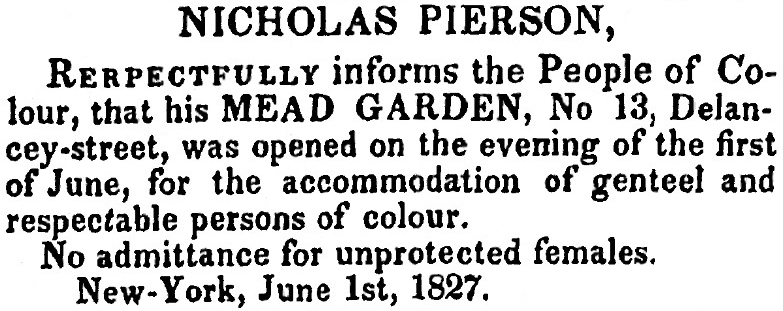
The early 19th-century gardens were meant to attract genteel folks, though I’ve run across a couple of advertisements suggesting it wasn’t so easy to discourage problem guests. The owner of a garden in Wilmington DE advertised in 1803 that he was opening his “elegant Mead and Flower Garden” for those who would “observe the strictest order and decorum” and not “injure his garden or molest his flowers.” Nicholas Pierson, in 1827, was evidently concerned that unaccompanied women (understood to be prostitutes) would want to enter his mead garden.

Unlike other drinking places, gardens were acceptable for women (if escorted). According to one report, mead — a sweet concoction of fermented honey and spices — was one of their favorite drinks. Mead gardens were more popular before the temperance movement took hold in the 1830s.

Tea and mead gardens were fading when German beer gardens appeared on the scene in the 1850s and 1860s, usually consisting of rows of tables in an open air setting amidst groves of trees, but not really a garden — and not usually providing food.

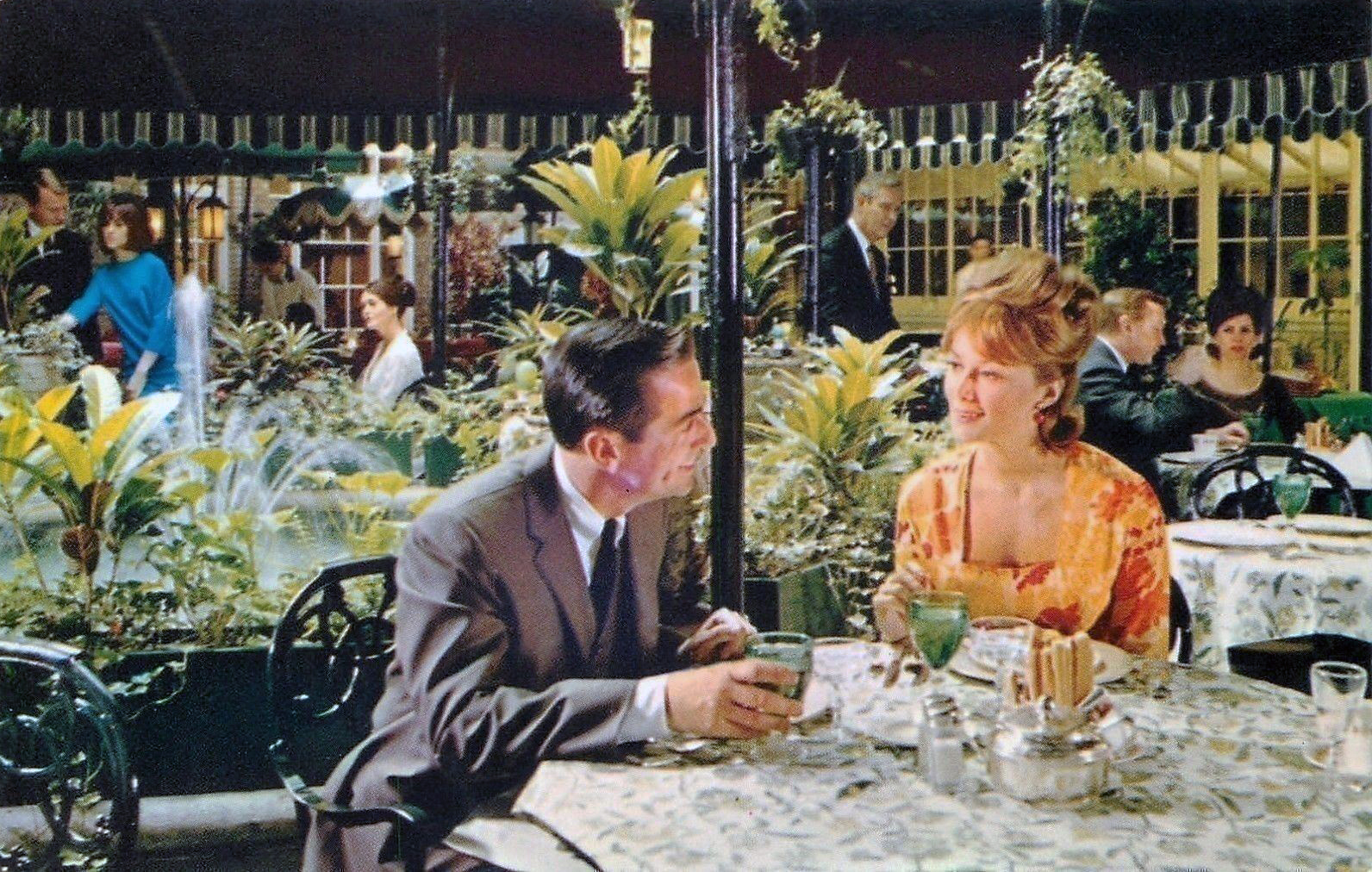
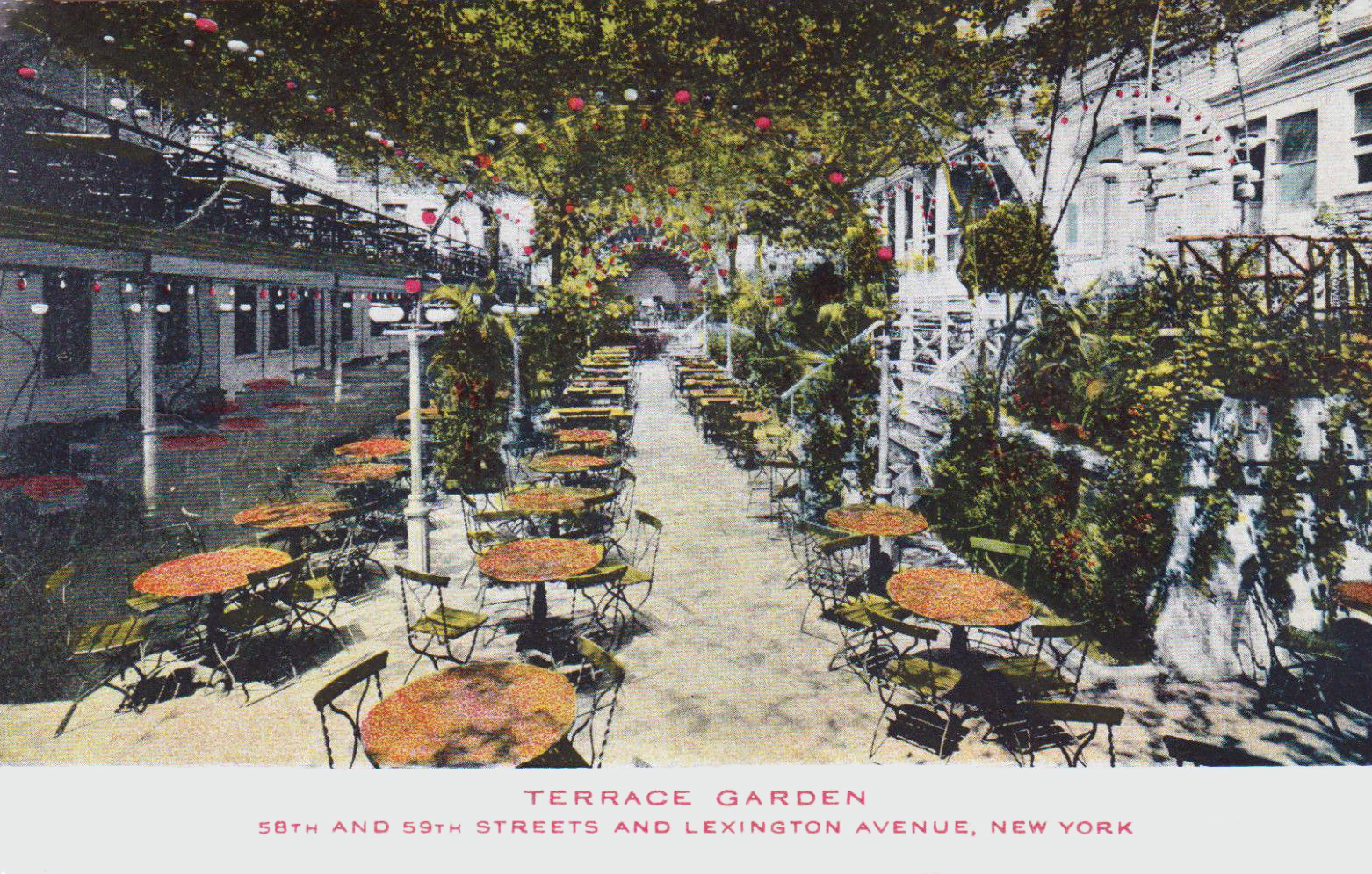
Dining in a garden once again became popular in the early 1900s, only now, in addition to outdoor gardens such as New York’s Terrace Garden and others on the roofs of tall buildings, there were many indoors, making them available year round. Natural touches included pendulous boughs draped from ceiling lattices, burbling fountains, potted palm fronds that threatened to tickle guests’ necks, and sometimes blue-painted ceilings twinkling with tiny stars.

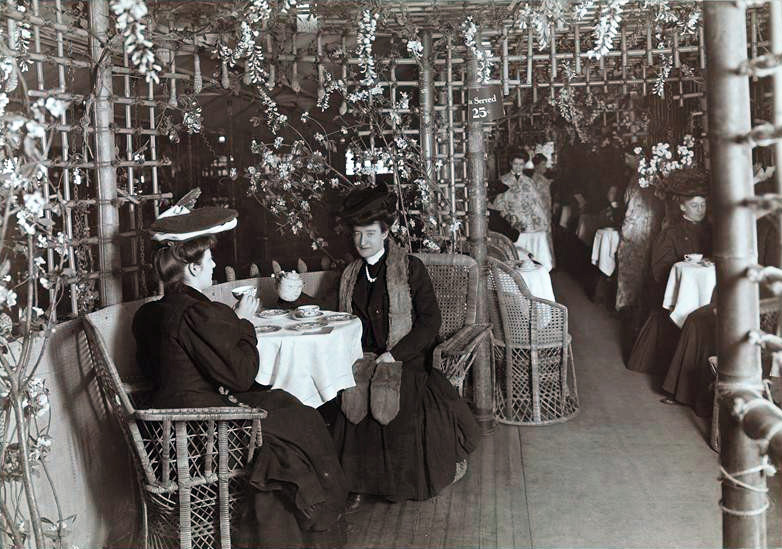
Department stores adopted garden motifs as did tea rooms where one could dine in an actual garden or, in rural New England, on the front lawn of the proprietor’s home. Tea rooms that chose a garden theme for indoors leaned heavily toward a Japanese style invoked rather simply with flower-strewn trellises and a bit of wicker or paper lanterns, as did Schrafft’s in Syracuse NY and the tea room at the Vantine store in NYC [above photo, 1906]. Actual Asian restaurants, on the other hand, were likely to include the word garden in their name, but that did not necessarily imply they had an actual garden.

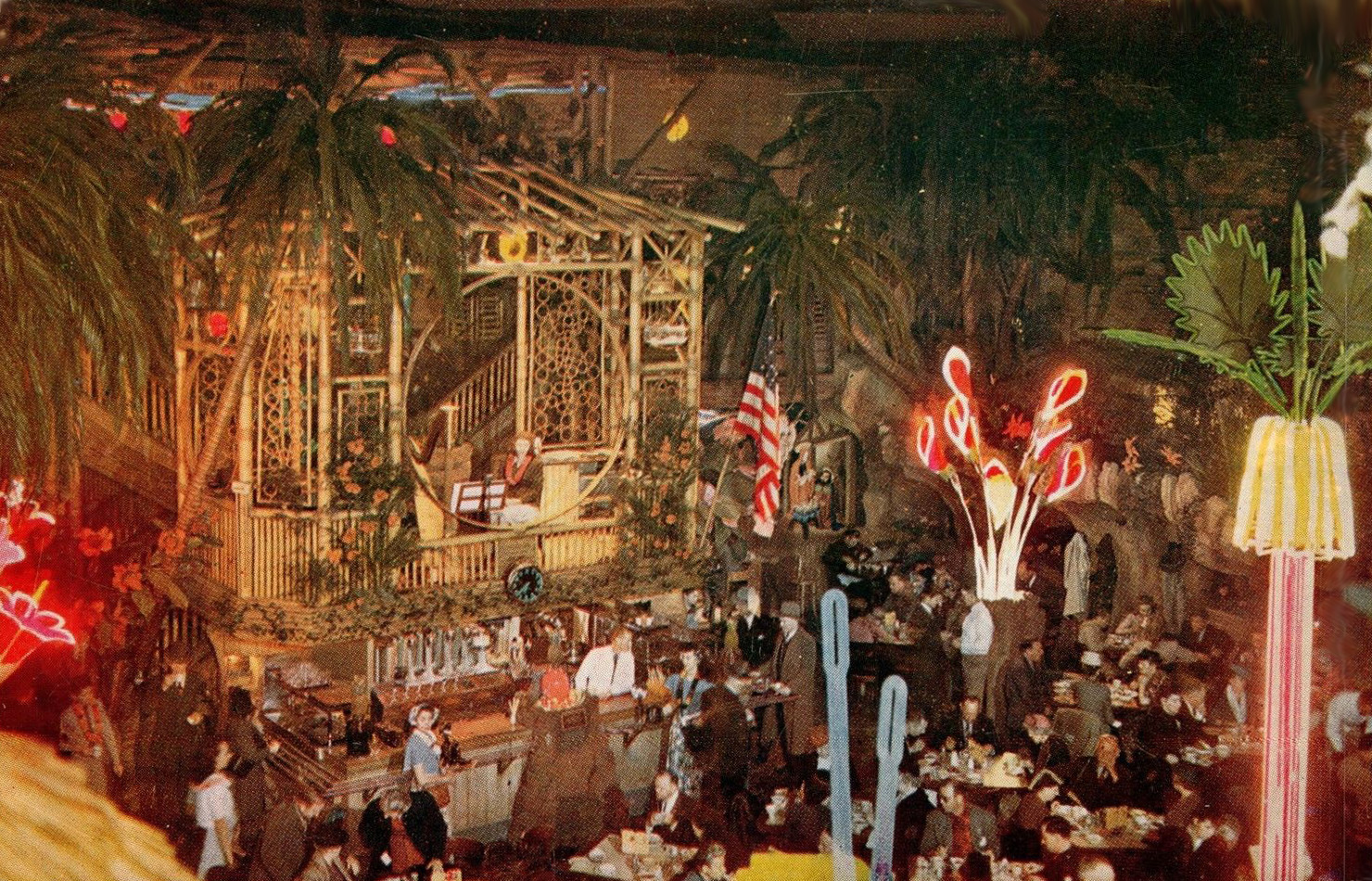
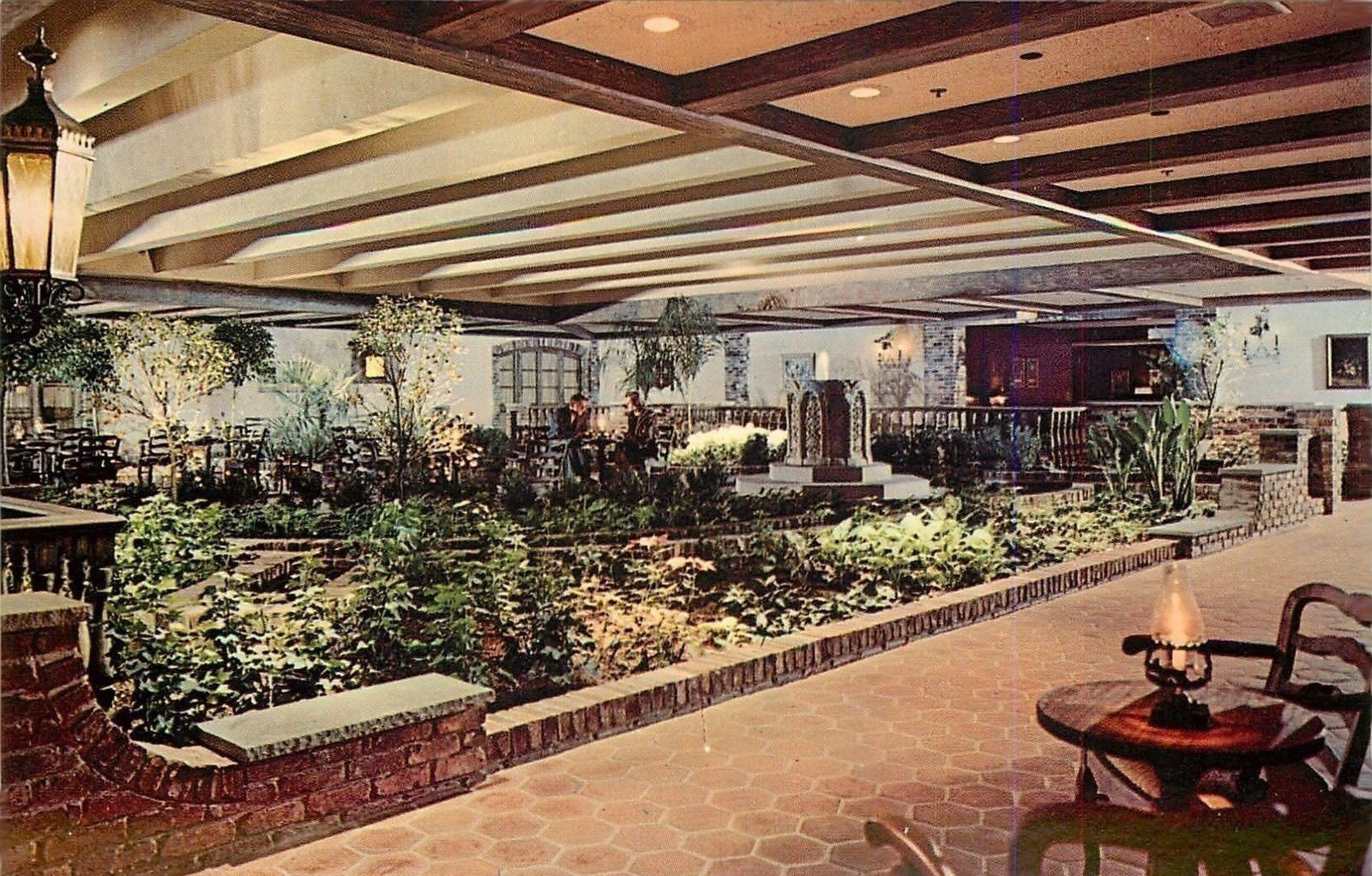
Undoubtedly, one of the most flamboyant indoor garden restaurants was Clifton’s “Pacific Seas” Cafeteria in Los Angeles [pictured]. Indoor palm trees are always impressive, as are neon flowers, multiple waterfalls (12), and volcanic rock. Clifton’s was but one of the many restaurants with indoor gardens that proved eye-catching yet less than totally convincing in terms of their relation to nature. [below, Stouffer’s Top of the Mart, Atlanta]

Today a restaurant garden, while in many cases still a popular place to eat in nice weather, is as likely to be a place where vegetables or herbs are grown and harvested.

© Jan Whitaker, 2018

5 Comments

Filed under atmosphere, decor, department stores, food, outdoor restaurants, restaurant customs, tea shops

Learning to eat (in restaurants)

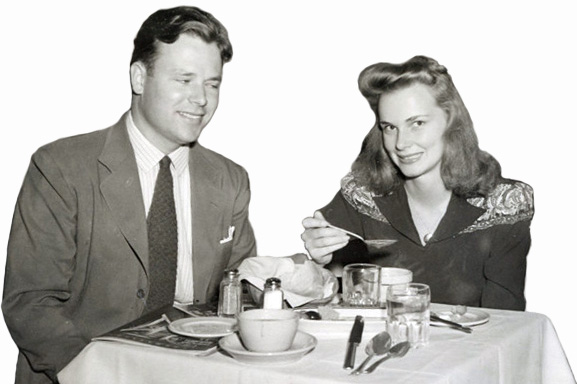
Eating in restaurants is so common today that it is hard to imagine that it in the past many people found it confusing and embarrassing, especially in more formal restaurants.

They had trouble figuring out menus, felt nervous and self-conscious, worried about their manners, and generally didn’t know how to act.

One solution was to avoid public eating places. That way no one would witness your poor manners, no haughty waiter would sneer at you, other patrons would not stare and examine your clothes as you walked in.

Restaurants were primarily men’s turf in the 19th century. Until the 1890s when affluent women began entertaining their friends at restaurant luncheons, restaurants were often seen as undesirable locations for women. High society was very private. Dinner parties were held in the home, outside public view. In a culture that was completely the opposite of today’s celebrity whirlpool, being seen in public was demeaning, especially for women. Additionally, many women of the 19th century disliked eating in a room with strangers.

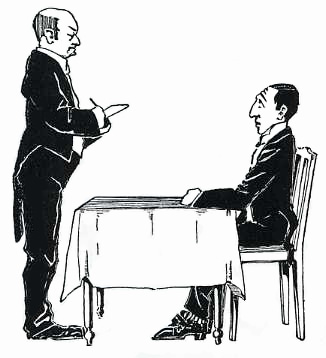
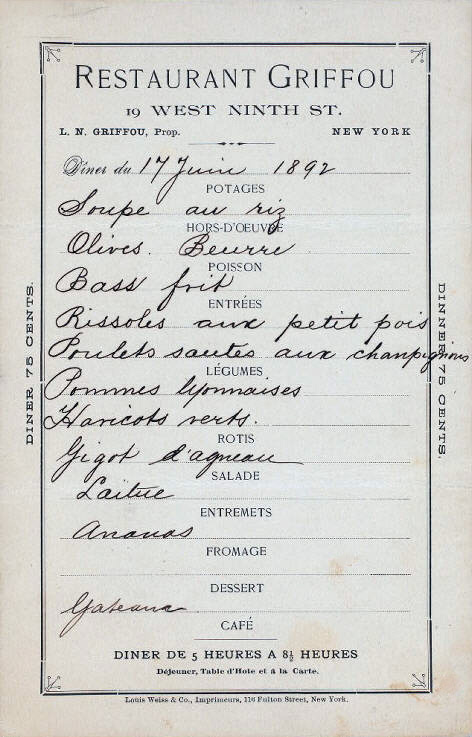
Even men and women who enjoyed restaurants found ordering from a menu entirely in French difficult. When menus were in English, they were still daunting to unworldly Americans who had never experienced many of the dishes served. Books and articles offered advice but many diners gave up the struggle and instead let the waiter select their meal.

An observer commented in 1899 that “it is a severe trial for many women, and some men, to enter a hotel dining room and particularly hard if it must be done without a companion. Some that march in with boldest front and utmost nonchalance are but actors, trembling within while brave to outward seeming.” Actors aside, other people unfamiliar with restaurants could be identified by their behavior. Some rushed in, going straight to a table without being escorted there by the head waiter. Others might give themselves away by accidentally ordering a ridiculous set of dishes such as fruit and pickles or by being overly chummy with the waiter. According to an 1890 account, going to a high class New York restaurant solo led waiters to conclude that the patron “is a countryman or unused to restaurant life.”

For the poor or the newly arrived immigrant, a restaurant could be a terrifying challenge. Two period novels illustrate this beautifully. In A Daughter of the Tenements (1895), the son of a tenement janitor goes to a restaurant for the first time:

Tom had never, for an instance, had a table napkin in his hand; had never seen more than one knife and fork placed beside a plate; had actually never been served at table by any person other than one who was eating with him; had never seen wine drunk at meals.

In The Rise of David Levinsky (1917), the main character experiences his first visit to a “high-class restaurant”:

The immense restaurant, with its rows and rows of table-cloths, the crowd of well-dressed customers, the glint and rattle of knives and forks, the subdued tones of the orchestra, and the imposing black-and-white figures of the waiters struck terror into my . . . heart. The bill of fare was, of course, Chinese to me, though I made a pretense of reading it. The words swam before me. . . . The worst part of it all was that I had not the least idea what I was to say or do. The occasion seemed to call for a sort of table manners which were beyond the resources . . . of a poor novice like myself.

African-Americans rarely experienced embarrassment in restaurants for the simple reason that they were not welcome in most of them before the 1960s Civil Rights era. Even those who attained success in the restaurant business reported an unfamiliarity with restaurants in their early lives. Sylvia Woods, founder of Sylvia’s in New York City, disclosed that when she moved to New York from South Carolina at age 28 she had never been in a restaurant. Renowned chef and cookbook author Leah Chase, of Dooky Chase in New Orleans, said she had never set foot in a restaurant until she got a job waiting on tables. “Black people didn’t go to restaurants,” she said. “That’s the way it was.”

By the 1920s it was considered acceptable for young (white) women to go to a restaurant on a date. But this could be hazardous, as “C. S.” confessed to a Boston newspaper in 1927. “Having never eaten in a restaurant before,” she wrote, “imagine my surprise when I picked up the square of butter from the butter dish, thinking it was cheese! That was my first and last date with him.”

In 1970 an etiquette expert reported that she frequently encountered young middle-class women who had never eaten in a restaurant other than a hamburger stand and said they were unsure how to order or to use silverware.

Has discomfort with restaurants disappeared? While writing this post I’ve started to wonder if my opening sentence is wrong. Maybe achieving a feeling of assurance in restaurants is actually an ongoing project.

© Jan Whitaker, 2018

4 Comments

Filed under elite restaurants, menus, patrons, racism, restaurant customs, restaurant etiquette, women

Children’s menus

Children have always been present to some extent as guests in public eating places, but not until the 20th century did they have special menus and dishes designed just for them.

Department stores and tea rooms, where unlike most restaurants the principal patrons were women, were the first to focus on children as guests. New York’s Mother Goose on 35th Street off Fifth Avenue was popular with children in 1911 because of its storybook theme and servers dressed in costumes. From these early days, tea rooms were also places available for children’s parties. The Brown Owl Tea Room in Marblehead MA made lunches for children whose mothers were away.

In 1918 the Rike-Kummler department store in Dayton OH advertised a “Special Lunch for Children” for 20 cents that demonstrated the belief of that time that children should be fed a bland diet. It consisted of Rice Baked in Cream, Peanut Butter Sandwich, Milk, and Ice Cream.

Printed children’s menus, based on the idea that children liked to choose their own meal, arrived in the 1920s, often at department stores and other restaurants patronized by women of comfortable means who were out shopping. In Boston, Filene’s and the Shepard Store offered children’s menus. In 1927 Shepard’s offered a children’s menu in its 6th floor Colonial Room with specials such as a 50-cent meal of Poached Egg with Creamed Spinach, Baked Potato, Bread & Butter, and Milk.

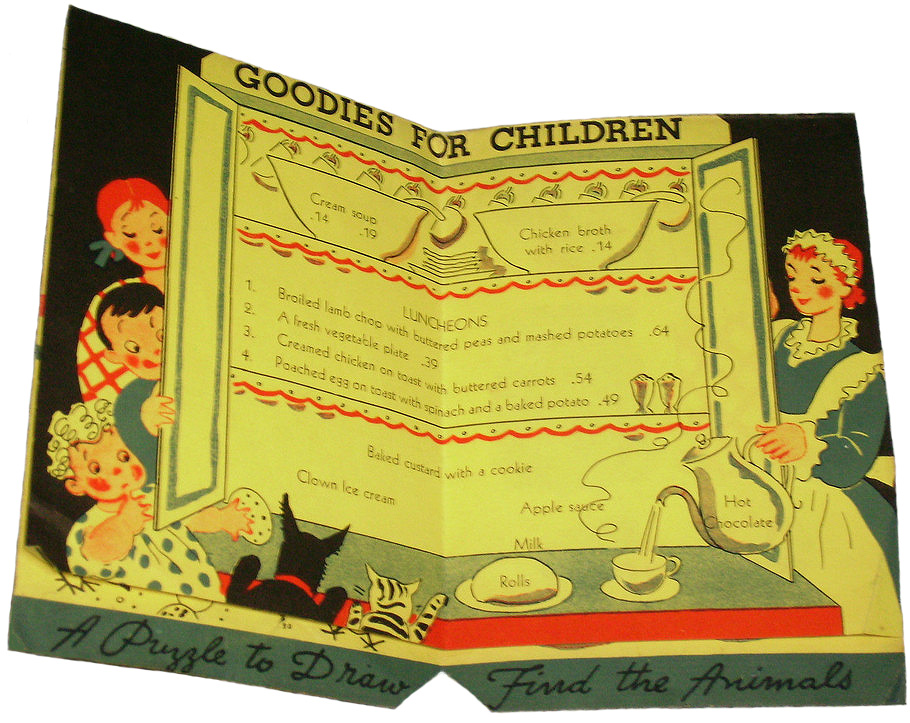
Vegetable plates were common on children’s menus from the 1920s through the 1940s, as shown on both a menu from St. Clairs’ in the 1920s and one from Macy’s [shown below] in 1936. Creamed chicken was also typical of children’s menus before the 1950s, as both the Macy’s and the 1947 Pig n’ Whistle [shown below Macy’s menu] menus illustrate. Hamburgers weren’t found much until after WWII.

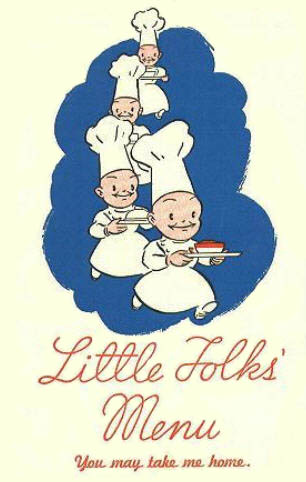
Children’s menus went beyond food listings to include games, puzzles, and pictures to color. Some came in the form of masks or paper toys to be assembled. The Howard Johnson’s chain put its children’s menu in the centerfold of a comic book in which an adventure concluded with a hefty HoJo’s meal of fried clams and a “large charcoal-broiled steak.” Odd, since steak was not on the children’s menu.

The number of restaurants offering children’s menus continued to increase throughout the 20th century, intensifying in the 1970s and 80s. Reporting on a Gallup survey in 1975, Food Service Magazine observed that more working mothers, increased family income, and smaller families suggested “a more profitable family market than ever before.” And many more children’s menus.

The new era of child-centered restaurant patronage was kicked off by the 1977 opening in California of the first Chuck E. Cheese pizza and video game restaurant for children. It was chain restaurants in particular, both of the fast food and coffee shop types such as Sambo’s and Denny’s, that were perceived as the most family-friendly and also the ones that children preferred.

Blandness continued according to Consumer Reports, whose testers in 1984 attributed the lack of seasonings in fast food to child patrons, who are often the ones who choose where the family eats.

But it wasn’t just the increase in restaurants that catered to families with children that marked a change.

Unlike the 19th century and the early decades of the 20th, it was no longer somewhat upscale restaurants that attracted families. This was not only because of prices too high for mass patronage but also because they did not engage in family-friendly practices. Usually they did not furnish high chairs, did not advertise widely or offer coupons or specials, and failed to celebrate birthdays and family holidays such as Mothers’ Day, Fathers’ Day, and Thanksgiving. Nor did upscale restaurant menus feature dishes preferred by children. They typically lacked post-WWII children’s favorites such as hamburgers, french fries, and pizza. They had no children’s menus.

© Jan Whitaker, 2018

16 Comments

Filed under chain restaurants, department stores, family restaurants, food, menus, patrons, restaurant customs, tea shops, women

Check your hat

The topic of hat checking in restaurants, nightclubs, and hotels, a popular subject in early 20th-century journalism, is so full of lore that it’s hard to know what to believe. Here’s what seems to be the story as best I can determine.

Hat checking in restaurants started as an independent money-making enterprise around 1900, beginning in New York City and gradually spreading westward. Before that, men took their hats into dining rooms, placing them under their chairs. (In cheap restaurants they kept them on while eating.)

It was considered perfectly fine for women to wear their hats at the table.

But hat checking for men wasn’t really new. It was common at fancy-dress balls in the 1800s. Many regarded it as a scam. An organization or group would throw a ball in a large venue such as Madison Square Garden. Tickets were advertised at the high price of $5. However, hardly anyone bought a ticket, getting them free instead from saloon keepers. When guests arrived at the ball they were required to check their hats, for which they were charged $2, the true price of admission. Those in the know referred to these balls as “hat check affairs.”

Around 1900 restaurants began granting concessions to entrepreneurs who offered to pay them substantial sums to run a hat checking service. At first many were staffed with immigrant boys who were rudely persistent in demanding that male guests surrender their hats before entering the dining area. Gradually, the boys were replaced with attractive young women who used honey rather than vinegar to induce men to give up their hats. Upon exiting the restaurant patrons were expected to leave a tip of at least 10 cents, up to 25 cents by the 1930s.

Concession owners paid thousands of dollars a year for the privilege of running a hat check service and, often, of supplying washroom attendants as well. In nightclubs they provided women to sell cigarettes and flowers. In the early years the amounts paid for these concessions allegedly figured as important contributors to nightclub profits.

All the tips collected by hat checkers went to concession owners, while the attendants received a low hourly wage. Newspaper stories revealing this set-up were perennials from 1910 into the 1950s, suggesting that there were always plenty of people for whom it was news that hat check “girls” didn’t keep the tips.

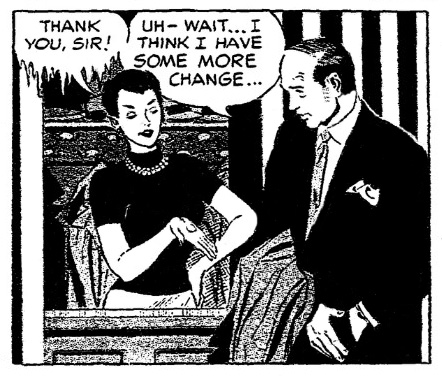
The menial job of hat checker was infused with glamour by gossip columnists and a number of Hollywood movies [top photo: Hat Check Girl, 1932]. This no doubt helped attract fresh recruits – including aspiring actresses who hoped to be “discovered” — in what was a high turnover, dead-end occupation. Want ads sought “attractive girls with pleasing personalities.” Meeting daily tip quotas through appearance and demeanor was a key to survival in what today is recognized as a “pink collar” job, i.e., one supposedly requiring no special abilities but demanding strenuous emotional labor. Acting talent came in handy. Occupants of the job became quite adept in shading the meaning of “Sir!” and “Thank you.”

Among the stresses of the job was the necessity to be gracious with patrons who flirted, pinched, left poor tips, and sometimes grew angry and slung insults. Hearing over and over how men had paid more in tips than their hats were worth became tiresome. So did laughing at jokes. Cartoonist W. E. Hill perfectly captured the facial expression of a woman preparing to respond hilariously to a bad joke.

Some hat checkers went to court to claim tips as theirs, but did they ever win? I doubt it. Many hotels and restaurants avoided the stigma associated with hat checking by running their own services while making it clear that tips were unnecessary. The Exchange Buffet chain advertised in 1914, “No hat-boy to hold you up.” Schraffts’ deposited tips in an employee sick benefit fund. Legislation was offered in some cities and states requiring that hat check stations either post a notice stating that tips went to a concession owner or turn them over to the attendants.

Overall, hat checking thrived best in big-city nightclubs visited mainly by tourists.

One of the rare hat checkers who beat the system was Renee Carroll, who ran her own concession at Sardi’s. The daughter of a New York City rabbi, she changed her name from Rebecca Shapiro and became part of the entertainment world, a Broadway personality known for witty quips. She appeared in movies, published a book about her experiences with celebrity customers, authored a gossip column, and backed theatrical productions.

By the mid-1920s, with many people going to restaurants and nightclubs by car, hat checking declined as hats were left in the car. By the mid-1930s fewer men wore hats, especially the young. Hat checking in restaurants can still be found but no one is forced to use it and the glamourous hat check girl is no longer a figure of popular culture.

© Jan Whitaker, 2018

9 Comments

Filed under night clubs, patrons, restaurant controversies, restaurant customs, restaurant etiquette, women

How Americans learned to tip

Tipping began in the U.S. in the 1840s, probably imported from Europe by Americans who began traveling abroad on the new trans-Atlantic steamships. By the end of the 19th century all the aspects of tipping we know today were widely practiced – and widely criticized..

Before that, people believed, Americans considered themselves social equals no matter what their economic circumstances and wouldn’t demean another person by treating them as an inferior (excepting, of course, slaves, Indians, and indentured servants), nor would any self-respecting person accept a gift of money for a helpful act.

Tipping wasn’t so much linked to restaurants as to hotels, applying to porters and doormen as much as to dining room waiters. There were few restaurants outside hotels then, especially when it came to places patronized by the rich.

Affluent Americans initiated tipping, beginning at summer resorts. The custom was to tip hotel staff upon arrival at a “crack watering hole” such as Saratoga or Newport, guaranteeing good treatment for the stay — and an expectation of more before the guest’s departure.

The word tip was British English and many critics blamed England for the custom, but it wasn’t purely English. It had many names, such as fee, gratuity, honorarium, and the French douceur and pourboire – plus the loaded terms bribe and baksheesh. But, overall, fee was used more often than tip in the 19th century, inspiring a popular quip in the 1870s, “When you have feed the waiter of the summer resort, then he will feed you.”

Tipping had many critics. But who to blame? At first public opinion singled out the rich for unfairly using their wealth to get special favors from waiters, leaving everyone else to suffer neglect – or even abuse. Failure to tip in the dining room could mean pointed rudeness, slow service, small portions, or even having food spilled on you.

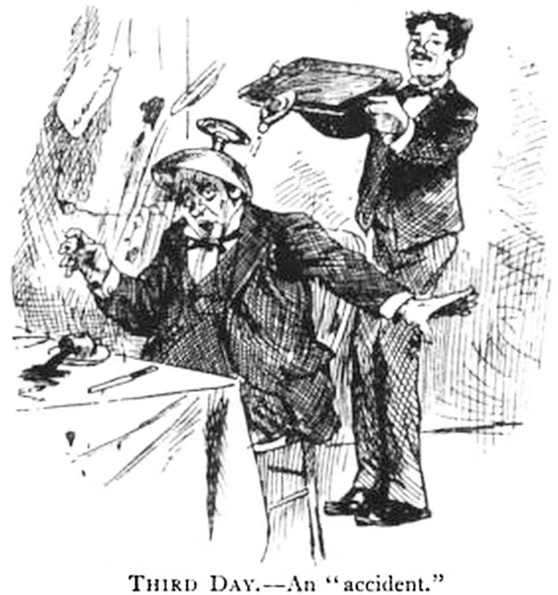
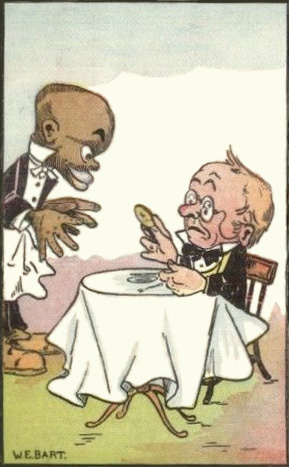
Waiters came in for plenty of blame, with criticism often devolving into bigotry. According to an 1873 editorial, Black and Irish waiters comprised “two classes of imported persons in this country whose insolence and absolute indifference to the wants of those whom they are well paid to serve is sufficient to make this country stink in the nostrils of any tourist.” Another opinion piece stated that, if not tipped, insolent “ebony” waiters would “spill soup down the back of [a customer’s] neck, and ‘swipe’ his beefsteak over a dish which has recently held a broiled mackerel.”

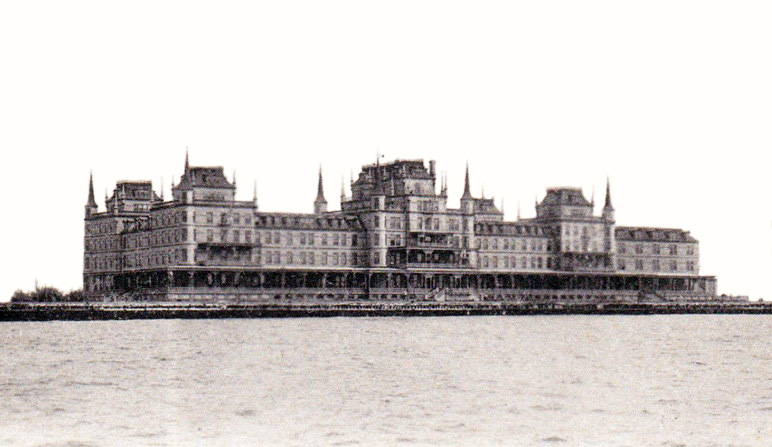
Coney Island, where waiters were said to regard tips as “the sole absorbing object of existence,” was also singled out, particularly its fancier eating spots such as at The Oriental Hotel with its turrets and 480 rooms. In the 1880s as many as 3,000 waiters worked at Coney Island, some making as much as $25 a week in tips, about double the weekly wages of male office clerks at that time.

As waiters began to expect to be tipped – or else! – more customers began leaving tips. Some employers refused to permit tipping saying it eroded their control over the standard of service. But, according to critics, a more typical reaction was for restaurant owners to take advantage of the situation by reducing waiters’ pay. An 1883 reader’s letter to a Cleveland paper voiced a quite modern view of waiters’ pay: “Until the hotels pay living prices the waiters must look to well-disposed guests who have the means, to give them extra money, for which they will receive extra attention.”

It was also alleged that some restaurant owners stopped paying waiters any wages at all, sometimes even charging them a fee to work at places where tips were large. This is quite believable considering that some drive-ins of the mid-20th century did the same.

Tipping first became common in the Northeast, New York City especially. In 1883 Charles Delmonico, then head of NY’s Delmonico restaurants, told the NY Tribune that tipping had become so well established throughout the U.S. that it could not be stopped.

But that wasn’t quite true – yet. It was not often found across the country until the end of the century, particularly not in the West where the “spirit of independence” reportedly caused hotel, restaurant, and railroad employees to refuse tips. A Portland OR paper reported in 1886 that tipping had not “obtained any very strong foothold on this coast.”

How much to tip changed over the century. An early consideration was how big the dining group was. Since it was more trouble to serve a table of four than a table of two, the latter was supposed to leave proportionately more. By the end of the century it was based mainly on check size, 10% generally viewed as the right amount.

A writer in 1877 asked plaintively, “How many centuries do you suppose it will require to eradicate the custom of ‘tipping’ waiters?” By now we can answer “definitely more than one, going on two.” Attempts to eradicate tipping failed, including those by waiters’ unions in the 1890s. Instead, some clever individuals experimented with mechanical contraptions that eliminated the need for waiters.

Self-service restaurants offered another alternative. Near the end of the century many people cheered the emergence of waiterless eating places such as Chicago’s cafeteria-style lunch clubs and European automats. These and “quick lunch” eateries would become popular after the turn of the century – and still are.

© Jan Whitaker, 2018

8 Comments

Filed under patrons, restaurant controversies, restaurant customs, waiters/waitresses/servers

Dining & wining on New Year’s Eve

I haven’t found evidence that people celebrated New Year’s Eve in restaurants or hotels much in the 19th century. But in the early 20th century it became a more popular thing to do. Having a reservation at a swanky place conferred status, as the 1912 drawing above is meant to illustrate.

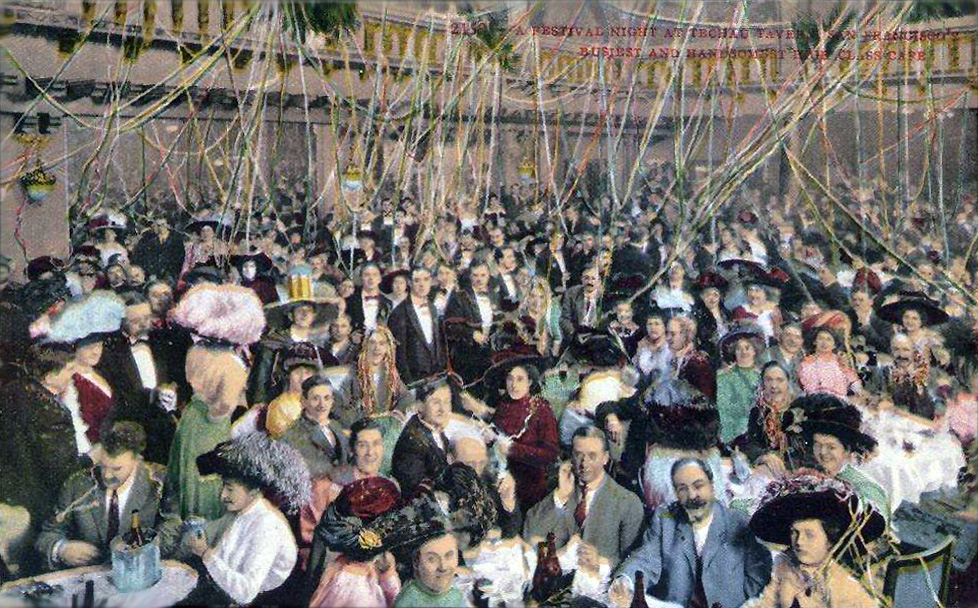
If one dish ruled New Year’s Eve menus in the early 20th century it was roast turkey. It was the main dish at the Techau Tavern, “San Francisco’s Busiest and Handsomest High-Class Café,” shown here in 1909. Turkey with Cranberry Dressing and Chestnut Stuffing was preceded by Toke Point Oysters from Washington, Cream of Chicken Soup, Striped Bass, and Sweetbreads.

Turkey also dominated the 1912 New Year’s Eve menu at The Fern in Scranton PA, “An Eating Place of Refinement and Respectability.” The Fern featured a $1 dinner that was similar but even heftier than the Techau Tavern’s, with Blue Point Oysters, Cream of Chicken Soup, Baked Bluefish, Croustade of Lobster, Tenderloins of Beef, Roast Turkey, Sweetbreads, Banana Fritters, as well as all kinds of vegetables, salad, and pie. The Alt Heidelberg Café in Fort Wayne IN, and Tait’s in San Francisco provided similar menus.

Through the 1920s, it was not hard to find a place where one dollar or a little more would buy an elaborate dinner with an orchestra and dancing. In Seattle WA, New Year’s Eve entertainment at the Hotel Washington Annex included dinner plus a “lady vocalist” and the Whangdoodle Quartet, all for $1.25. The absence of (legal) alcohol in the 1920s did not dim festivities in Chicago nightspots in the Loop or on the South Side, where “handling a flask has never been considered flagrant.”

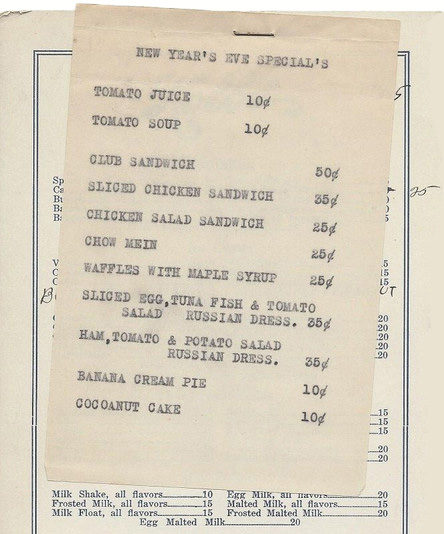
Despite tight economic times in the 1930s and war in the 1940s – or maybe because of these conditions — Americans showed continuing enthusiasm for celebrating the new year in restaurants and clubs. The repeal of Prohibition at the end of 1933 brought about heightened levels of good cheer. Not even higher prices at the end of 1934 discouraged revelers who paid from $7.50 to $15 per plate in NYC. Yet there were still bargains to be had as the accompanying 1935 menu from Kolb’s in New Orleans shows. Low prices also prevailed in Canton OH where sauerkraut and wieners were traditional.

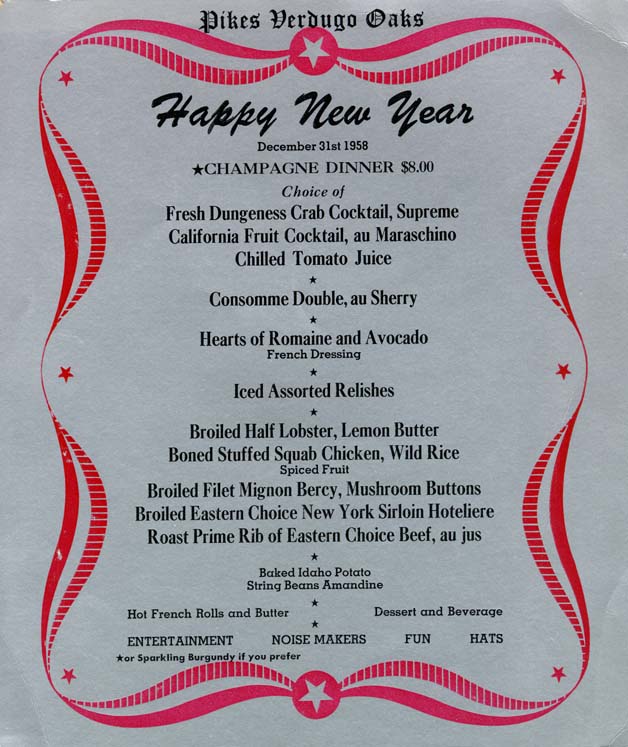
After the war, menus reflected the growing importance of beef on New Year’s Eve – and throughout the year. The 1958 menu at Pike’s Verdugo Oaks in Glendale CA is representative, and not terribly different than menus found throughout the U.S. in later decades. The Raintree Room at the Continental Regency in Peoria IL in 1978, for example, offered beef or lobster, with salad, baked potato or french fries, and the ubiquitous cheesecake for dessert, a standard menu for a restaurant dinner in the last decades of the 20th century.

Whether you have steak or hot dogs this New Year’s Eve, have a good time and best wishes for 2018!

© Jan Whitaker, 2017

8 Comments

Filed under food, menus, night clubs, restaurant customs

Getting closer to your food

How intimate do Americans want to get with their food? I’d say that restaurant-goers do not want to get too close to their food’s origins, nor to its preparation – and certainly not to kitchen cleanup. After all, getting away from it all is a big part of the attraction of eating out.

And yet . . . there are striking exceptions. Not only today when customers are able to harvest their own lettuce or vegetables that are growing on restaurant walls, but far back into the 19th century. Getting close to your food can range from assembling or selecting semi-prepared raw ingredients to choosing ones that are still alive. Allegedly, a Brooklyn NY restaurant around the end of the 19th century used to invite customers to go to their back yard where the chickens were kept, select the one they wanted, and watch it be killed.

The more common example of the latter, however, is lobster, which were – and are — often presented live to restaurant guests prior to their delivery to the table. Especially in the 19th century, live turtles played a similar role, being displayed in a restaurant’s window before their descent into the kettle. Not everyone was comfortable with these practices. In 1870 a Cape Ann MA newspaper expressed a hope that the Humane Society would look into the practice of boiling lobsters alive. And in 1881 a Boston paper commended a Chinese man in San Francisco who rescued a turtle on display in front of a restaurant by buying it and having it released into the ocean.

But “fresh” lobster and turtle remained highly valued. Some restaurants would even deceive customers with a living display turtle or lobster that was never cooked. The customers believed it had been served on their plates, while in reality the creature would return to the display later. A St. Louis restaurant man admitted he had used the same lobster for three months, returning it to a tank in back after it was shown to a customer. “Sometimes I put him in the window,’ said the restaurateur, adding, “He regards the window as his stage and dances about for the public. Whenever he sees a hungry-looking man coming down the street he begins squirming to attract his attention.” Supposedly the customer left the restaurant happily unaware he had eaten canned lobster. This was 1900, and Truth in Menu legislation had not been introduced.

Fish swimming in tanks have had fewer rescuers. The custom of choosing or netting a fish in a tank may have originated in eating places set up in city markets such as New York’s old Fulton Market. By the 1930s if not earlier the setup had migrated to restaurants.

To a great extent the selection of living creatures by hungry diners arose from a distrust of restaurants as well as poor food preservation measures in the 19th and early 20th centuries. Diners, particularly those who were epicures, felt they needed to see with their own eyes that their food was fresh. There were good reasons for their skepticism. Meat, fish, and poultry served in restaurants could be canned, spoiled, or stale from many months spent in cold storage warehouses.

Setting up lobster tanks in which fresh lobsters could be held was not such an easy task for restaurants far from the oceans, and did not occur in many inland cities until the 1950s, about the same time lobster tanks showed up in supermarkets. A news story in a Milwaukee paper gives the idea that dining on fresh lobster flown in from Maine was a fairly new activity there in 1953. Not only did the story detail how the new glass tank at the Cape Cod Inn worked, as well as its measurements and how water was aerated and filtered, it furnished readers with drawings that showed how to eat whole lobsters. In 1956 Pittari’s in New Orleans claimed to have the only live lobster tank in the South.

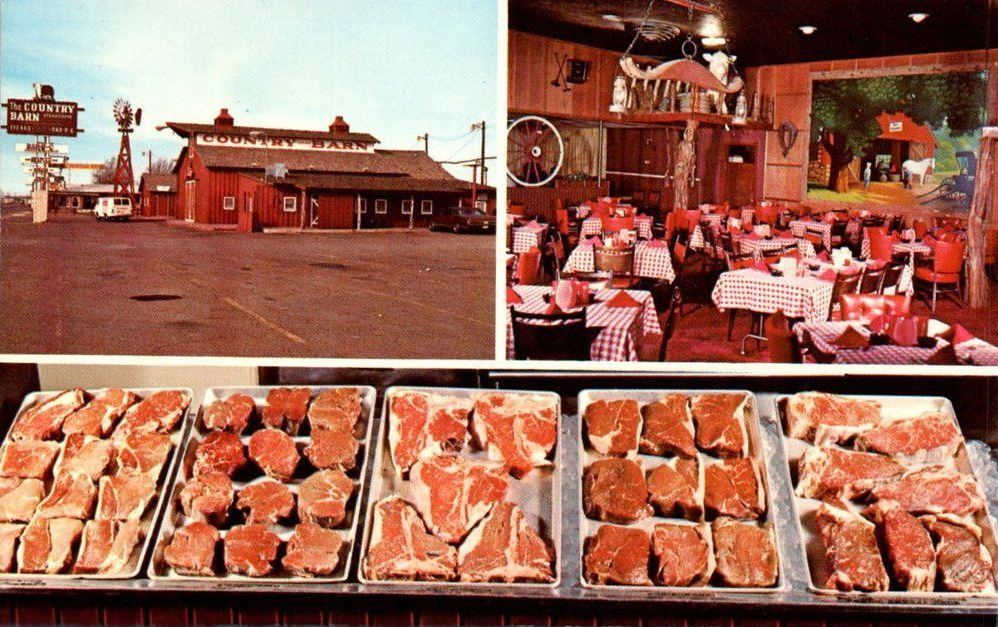
A later iteration of the pick-your-raw food angle concerned raw beef. It doesn’t appeal to me to select a steak from a cooler or a rotating display, much less to broil it myself, but the idea gained popularity in the 1950s and has continued to some extent. In the 1980s, at the Meat Market in Peoria IL, whose motto was “Dedicated to the Illinois Farmer,” patrons took their steak, potato, and Texas toast to “do yourself over the massive grill.” Reportedly patrons enjoyed a tribal feeling as they gathered around the glowing fire.

In 1974 the president of the National Restaurant Association predicted that do-it-yourself activities in restaurants would become quite popular in the future, leading patrons not only to cook steaks, but make their own pizza and mix their own drinks. “What is involved,” he said, is that people are placing greater emphasis on the total sensory experience – touching, feeling and smelling.”

Mixing your own drinks . . . hmmm.

© Jan Whitaker, 2017

3 Comments

Filed under food, restaurant customs, restaurant issues

Is “ethnic food” a slur?

This question has come up over the past few years among those who write about food and restaurants. The gist of the complaint is that the term “ethnic food” implies it is inferior to European-based cuisines, and sometimes even to pseudo-ethnic fast food. The issue is entwined with the question of whether patronizing restaurants run by immigrant or other non-white proprietors demonstrates or promotes multicultural understanding.

The terms “ethnic food” and “ethnic restaurant” did not really show up to any significant extent until the 1960s. Before that references would have been to foreign restaurants or to “food of the world.” Until the 1860s, French restaurateurs were the main departure from the English-influenced norm.

After the Revolution of 1776, there were a number of French eating places in this country. For example, Michael Marinot advertised in 1789 that he ran a Traiteur Francois in Philadelphia. And of course, there was Julien in Boston, and as of 1823 the Swiss-Italian confectionery of Delmonico in New York. From the start French restaurateurs were appreciated for producing delicate cuisine and following a higher standard than other eating places.

Much more common were the eating houses that served food similar to what would be found in England, consisting mainly of meat and game, simply prepared, with little in the way of sauces or seasonings. [see NYC Bowery restaurant, 1887] Oyster cellars provided the fast food of the day.

Things began to change in the 1850s. When gold was discovered near San Francisco, men (mostly) from all over the world converged there. An account published in 1855 notes, “There were American dining-rooms, the English lunch-houses, the French cabarets, the Spanish fondas, the German wirtschafts, the Italian osterie, the Chinese chow-chows, and so on . . . There were cooks, too, from every country; American, English, French, German, Dutch, Chinese, Chileno, Kanaka, Italian, Peruvian, Mexican, Negro, and what not.” In 1854 New York City boasted of having restaurants representing the food of America, England, Scotland, France, Germany, Italy, Holland, Hungary, Denmark, Spain, and Cuba.

In the last quarter of the 19th century, people living in cities who had refined tastes but little money sought out small restaurants run by European immigrants known as “table d’hotes.” They offered a complete meal for a low fixed price, wine included. In these places, it was said, patrons could avoid the clatter, sloppiness, bad food, and complete lack of aesthetics associated with cheap American eating places. Europeans understood “the art of living,” according to a story in the Boston Globe in 1877. Only “foreigners” ran good restaurants in San Francisco, wrote the city’s chronicler Hubert Howe Bancroft. “American restaurants are invariably second, third, or fourth rate,” he pronounced.

With the large number of immigrants arriving in the late 19th and early 20th century, it is hardly surprising that many of them took up restaurant keeping. But this did not necessarily mean that they offered anything other than standard American fare. World War I revealed an undercurrent of prejudice against foreign eating places that had earlier been aimed at Asian restaurants on the West Coast. The negative attitudes may have driven some non-natives to “Americanize” their names and menus. Other restaurant owners, probably of American birth, played to nativist prejudice. [See 1918 ADV; Turner’s chef was born in France but naturalized shortly before the advertisement appeared.]

The 1920s through the 1950s saw the proliferation of restaurant types that were definitely non-ethnic such as tea rooms, cafeterias, steak houses, hamburger and hot dog stands, fried chicken places, lunch counters, diners, drive-ins, and chain restaurants. Many Greek-American proprietors avoided putting any remotely Greek dishes on their menus until the 1960s. Other restaurants serving “foreign” food added sections with American dishes to their menus [menu above, Chicago, 1941], while others dished up a stereotyped version of ethnicity [see Milwaukee’s Schwaben-Hoff shown above].

During the all-American era, a few “foreign” dishes were naturalized, among them chili, tamales (in the West), spaghetti, and pizza. [re Simon’s Sweet Shop, Salt Lake City, 1917] Even chop suey could sometimes be found on drug store menus. Some cities had especially few foreign restaurants. In 1940s Atlanta restaurant goers wanted fried chicken, while in Omaha they demanded steaks, according to the National Restaurant Association. In fact chicken, steak, and chops dominated dinner menus throughout the U.S.

It is scarcely surprising there would be a reaction to the blandness and lack of variety in restaurants. In 1961, even Chicago — where prime rib was No. 1 — presented alternatives, among them European, Middle Eastern, Oriental, Polynesian, and South and Central American restaurants. Still, a Chicago restaurant reviewer revealed in 1971 that she got letters complaining she was “preoccupied” with ethnic restaurants and ignored the steak and potato fans.

Nonetheless the ethnic restaurant trend continued to grow. Neil Simon’s 1963 play (and 1967 movie) Barefoot in the Park featured a newlywed wife who wanted to break free of convention. One scene showed her jumping up to join a belly dance at an Albanian restaurant hidden away on Staten Island. Her character prefigured the hippies to come — young people eager for new experiences. In the 1890s or 1910s she would have been called a bohemian and would have dined in the backyard of a French table d’hote. Another sign of change was the 1966 publication of The Underground Gourmet that listed inexpensive restaurants in NYC, most of them representing a cuisine from afar.

For those critics of the term ethnic restaurant who object to it only being applied to non-European restaurants of dark-skinned people: that has not always been true. The Underground Gourmet noted nationality restaurants that were Belgian, Dutch, Hungarian, Norwegian, and Ukrainian. San Diego, a city not known for its ethnic restaurants earlier, in 1979 counted among them ones that were Swedish, Hungarian, Russian, Serbian, Basque, Portugese, Irish – and British! And cultural geographer Wilbur Zelinsky classified Jewish, New England, Pennsylvania German, and Southern U.S. restaurants as ethnic in 1985.

The trend intensified in the 1970s. By the 1980s, a major city lacking diversity in its restaurants was considered culturally deficient and of lesser interest to gourmets and tourists. The counterculture, too, was an important factor in the rising popularity of ethnic restaurants. As Warren Belasco explained in a 1987 issue of Food and Foodways, the counterculture preferred “peasant or ‘folk’ cuisines to the ‘junk food’ found in . . . fast food restaurants. . . . The countercuisine’s infatuation with ethnic foods linked the personal and political . . . eating un-American dishes could be interpreted as a protest against American cultural imperialism.”

It could also be taken as a status marker – which has become more evident over time. It can be proof of extensive foreign travel, a spirit of adventurousness, a discerning palate, esoteric knowledge possessed by the few – and sometimes a degree of haughtiness about mainstream American tastes.

Nonetheless, a fondness for non-American cuisines is not usually linked with xenophobia and nativism. On the other hand, it by no means guarantees respect for other cultures nor does it overcome prejudices of various kinds. A 2008 article, “‘Going for an Indian’: South Asian Restaurants and the Limits of Multiculturalism in Britain,” made this clear. But I think I’ll save that argument for another time.

© Jan Whitaker, 2017

9 Comments

Filed under alternative restaurants, ethnic restaurants, food, proprietors & careers, restaurant controversies, restaurant customs