Tag Archives: 1940s

Neon restaurant signs

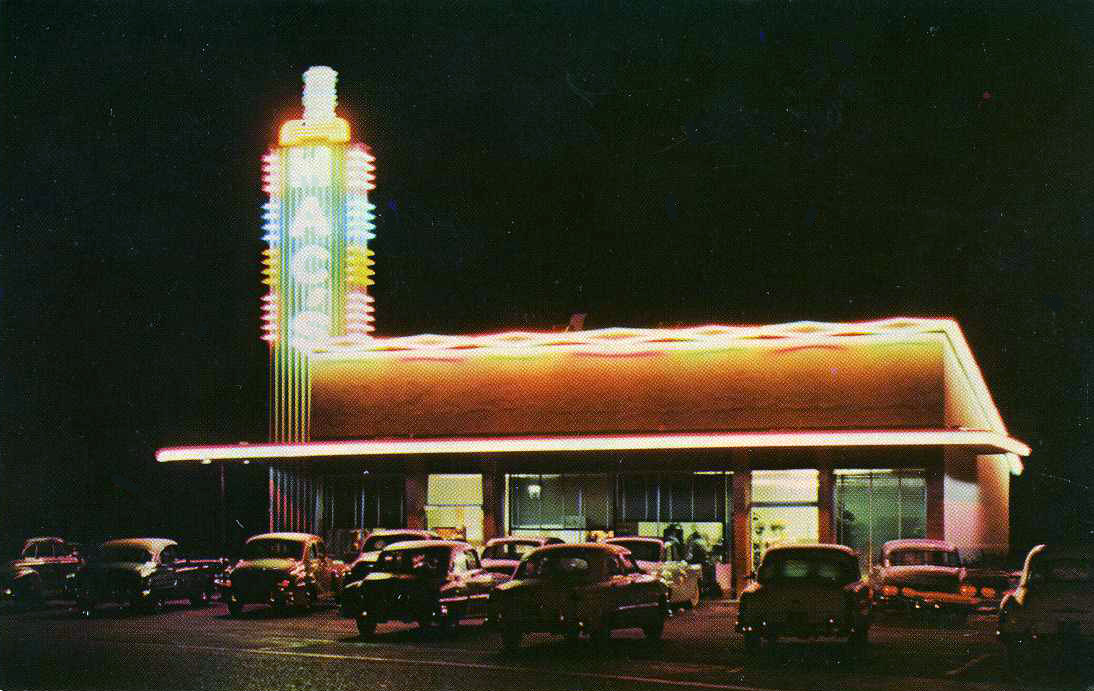
The four gases used initially by neon signs – neon, argon, krypton, xenon – were discovered by English scientists in the 1890s and adapted for use in signs by Frenchman Georges Claude a short time later. Though not the first, an early neon sign was used in Paris in 1913 to advertise Cinzano vermouth. [shown above: Mac’s, Corpus Christi TX]

But it wasn’t until the late 1920s that the signs became popular with restaurants in America. Particularly in the West where car culture was developing, the eye-catching signs helped attract the attention of drivers.

In the early days neon signs in a town’s business district could also be taken as a sign of progressiveness. A 1929 advertisement for an electrical display company in Great Falls MT advised businesses that their adoption of a neon sign would impress people, encourage progress, and “beautify Great Falls.”

Their use became well established in the 1930s. In the 1934 book Curious California Customs, the author commented, “To the casual visitor, Wilshire Boulevard, after dark, is a flashing cavern of Neon signs, most of which are calling attention to eating places.” A later postcard of Hollywood Boulevard at night in the 1950s demonstrates the effect of a street full of neon signs [shown above].

In the late 1920s the signs began moving across the country. Among early adopters were eight Benish Restaurants in St. Louis, four White Way Hamburger outlets in Colorado, the Horn & Hardart Automats in Philadelphia, and four Janssen’s Hofbraus in New York City. Salt Lake City outfitted multiple New York Coney Island Sandwich Shops with the signs.

Bright neon signs and images remained quite popular throughout the country into the 1940s. But if they were meant to make a business stand out from the crowd, that became more and more difficult as the numbers grew.

Neon signs were undoubtedly most effective for roadside restaurants on dark roads that stayed open at night [above: [Bratten’s Grotto, Salt Lake City, 1956]. Or for eating places in somewhat obscure locations that required signs that could be seen from afar. Unfortunately, they didn’t look as impressive during the daylight hours [below: Bratten’s Grotto, daytime].

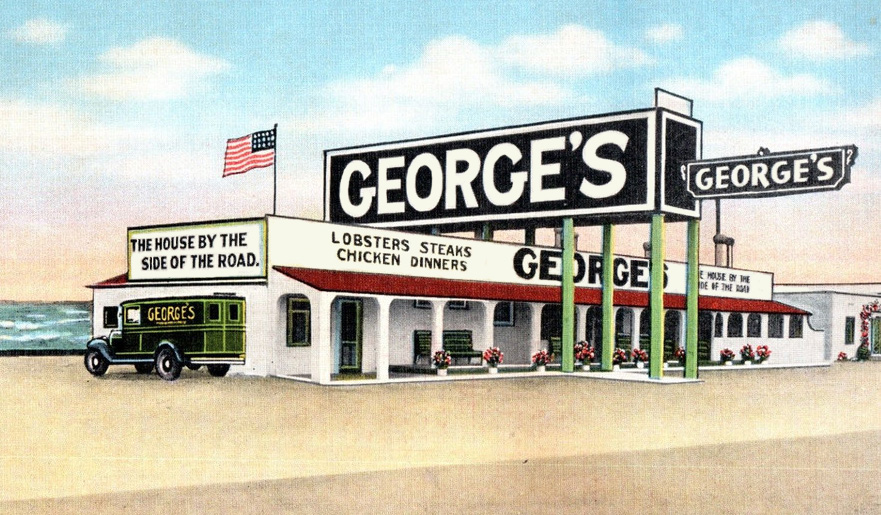
Before neon, efforts to craft signs that could attract distant or speeding traffic were undoubtedly less successful, less visible in the dark. George’s grotesquely large sign shown below, for example, was neither attractive nor sufficiently visible at night. As a slightly later version of this postcard revealed, the restaurant soon found it necessary to add spotlights atop the sign.
Neon wasn’t for every eating place. To critics it lacked artistic pedigree and dignity. Elite restaurants wanted nothing to do with it. It might announce the presence of the Green Frog or the Zig Zag Sandwich Shop, but certainly not New York’s La Chaumiere.

A 1960 book on restaurant decor pronounced neon in bad taste, saying, “Incandescent lighting is more expensive but has a kindlier glow and, thanks to the bad association arising from the tasteless use of neon, is generally considered ‘classier.’” As cities declined with the growth of suburbs, such attitudes toward neon grew more negative.

Nor was neon welcome in classy towns and communities such as Palm Springs, Carmel-by-the-Sea, and Sonoma in California; Santa Fe, New Mexico; the Hamptons on Long Island; and Cohasset, Massachusetts, to name but a few that banned it.

Rejection of neon grew in the 1960s and 1970s. In 1965, food critic and editor Craig Claiborne was uneasy about eating in the one (barely) acceptable restaurant he could find in Roswell NM, which he said had “the air of something once removed from Las Vegas or Miami Beach with its neon-silhouetted champagne glass and flashing neon bubbles.” His unease increased upon stepping inside and seeing a lighted goldfish tank, male customers not wearing coats, and bartenders with “narrow, abbreviated ties.”

Antipathy to neon in the 1970s, as before, was associated with urban decay and seedy neighborhoods characterized by run-down buildings and businesses such as bars and strip clubs. More cities and towns banned it.

Soon there were few “tube benders” left who could create or repair neon signs, which were increasingly being replaced with lighted plastic signs that were easier and cheaper to make and less prone to damage outdoors. Yesterday’s real neon signs that had survived soon showed up as quaint wall decor in warehouse-style theme restaurants.

A few commentators, such as a reporter for the Fort Wayne News-Sentinel, began to wonder about the return of neon. She speculated in 1975 that “that much-maligned symbol of everything that’s bad about American commercial districts” might “someday be recognized as art.”

Sure enough, in 1976 the Smithsonian put on an exhibit that included neon signs, among them examples from a Kosher restaurant, a foot-long hotdog place in Cleveland, and from a Spanish-American restaurant in Greenwich Village, a many-colored creation that combined a lobster, pig, fish, chicken, crab, and a steaming coffee cup.

Nowadays, vaguely quaint-looking plastic “neon” signs might show up as interior wall decor in the sort of restaurants that want to suggest they are fun places.

© Jan Whitaker, 2024

12 Comments

Filed under restaurant issues, roadside restaurants

Anatomy of a restaurateur: Clifford Clinton

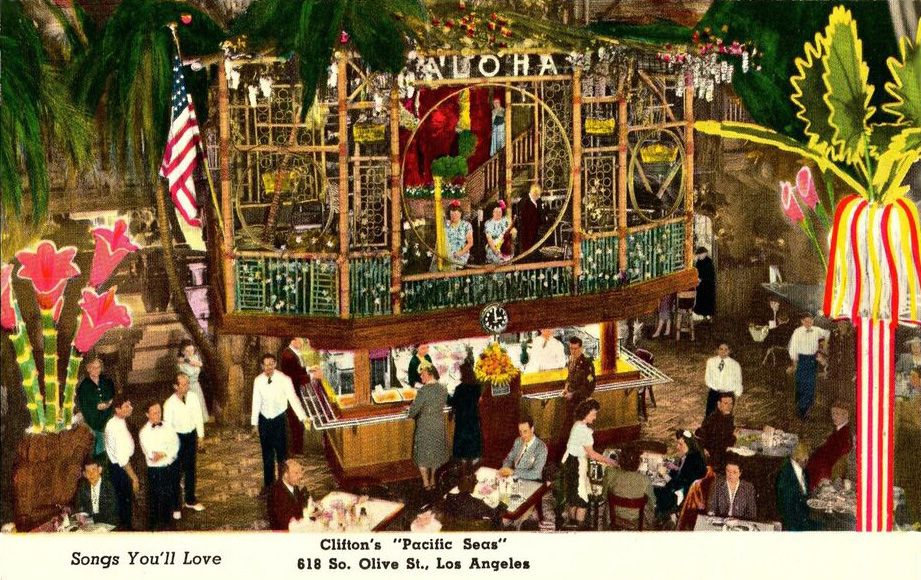
Rarely is the word fantastical used to modify the word cafeteria. Nor are restaurant proprietors usually thought of as powerful vice crusaders. [cover, 1940s booklet; below Pacific Seas]

A major exception of the latter was Clifford Clinton, creator of two of Los Angeles’ most memorable cafeterias. Both Clifton’s Pacific Seas and Clifton’s Brookdale were indeed fantastical, exotic, and composed of an odd blend of entertainment and salvation. In appearance they anticipated elements of Disneyland as well as Polynesian restaurant decor.

One of their strangest aspects was that they represented Clinton’s missionary work. After a few years of operating his father’s Puritan restaurant chain in San Francisco – previously owned by moralist Alfred W. Dennett — he came to Los Angeles in 1931 and re-opened a former Boos Brothers cafeteria at 618 S. Olive.

By the following year he was running that “Clifton’s” cafeteria plus another one on W. Third, one on Hollywood Blvd, a hotel probably housing his employees, “A miniature Cafeteria of the Tropics” in Whittier, and a “Penny Caveteria” in a basement on S. Hill street that offered dishes for 1 cent each.

In October 1932, perhaps the worst year of the Depression, a newspaper featured a smiling woman in the Caveteria with her 5¢ meal of soup, veal loaf, macaroni, sliced tomatoes, and buttered bread. According to another story, she was but one of an average of 4,500 customers fed each day (except Sundays, when all Clifton’s closed). Lines typically stretched down the street. For Christmas that year 7,000 guests enjoyed a Christmas turkey dinner priced at 1¢.

In 1939 Clinton remodeled the redwood-forest-themed Clifton’s Brookdale that had opened in 1935 as well as the original place on S. Olive, Clifton’s Pacific Seas, with a dazzling Polynesian look, neon palm trees, and many, many waterfalls. [Brookdale interior shown above; below more waterfalls, Pacific Seas exterior]

Along with meals, the restaurants acted as social centers and spiritual retreats for the thousands of uprooted mid-westerners who had relocated to Los Angeles. And they served as a kind of political base for Clinton’s reform campaigns. His cafeterias and his political activities were entirely consistent with the tenor of Los Angeles culture of the time. As George Creel summarized it in a 1939 Colliers article, the city throbbed with “two thousand religious cults . . ., each claiming daily and direct communication with Jehovah, and an equal number of social, economic and political movements: Epic, Social Credit, Utopia, the Townsend Plan and Thirty Dollars Every Thursday, etc., all guaranteed to promote the immediate salvation of mankind.”

Religiosity permeated the Clifton’s Cafeterias, as it had Dennett’s and would in a number of restaurants later in the century. If guests left the main dining room of Pacific Seas and entered the basement they would find a life-sized figure of Jesus praying in The Garden of Meditation [shown above]. Brookdale featured a Little Chapel set amidst the redwoods.

During World War II, Pacific Seas diners could also post their “feelings and wants” on a bulletin board or consult with a “Mrs. Von” in her bamboo hut for advice on personal problems.

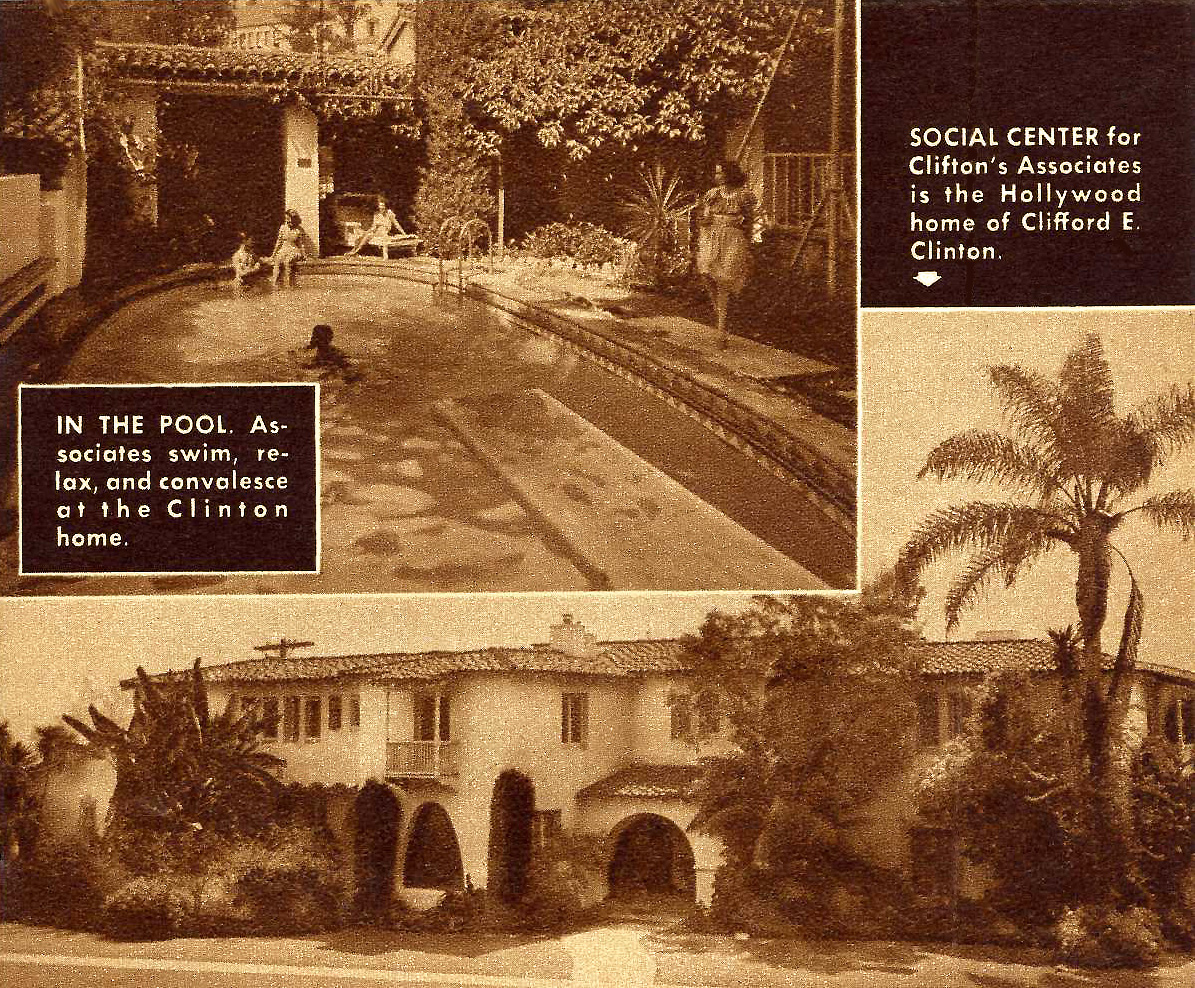
Clifford Clinton’s mission to offer affordable meals continued throughout his career. The policy was that no one would be turned away because of a lack of funds. Although the practice undoubtedly ate into revenue, and was probably taken advantage of by some, Clinton managed to amass enough profits to live in a sprawling mansion on Los Feliz Blvd. and Western Ave in which he hosted convalescing employees [shown above]. (The house sold last year for close to $5M.)

Clifford Clinton was as colorful as his restaurants, despite his appearance as a conventional religious and civic-minded family man. He had spent much of his childhood in China with his missionary parents, an experience that he said made him ultra-sensitive to human hunger. That is unusual but it was just a prelude to his role as one of Los Angeles’ prominent crusaders of the 1930s dedicated to cleaning up the city’s vice and political corruption.

He succeeded in getting Mayor Frank Shaw recalled and replaced by the candidate of his choice, who he promoted on his radio show. In addition, the city’s police chief was indicted and found guilty of plotting the car bombing that severely injured the private detective working for Clinton’s lawyer.

Clinton’s success as a crusader has been partly attributed to his alliances. He worked with Protestant ministers under the banner of an organization he created known as C.I.V.I.C (Citizens’ Independent Vice Investigating Committee). And he also allied with the Communist Party during its popular front phase. As a result of these efforts, gambling, prostitution — and the city’s anti-Communist Red Squad — were eliminated, or at least removed from sight.

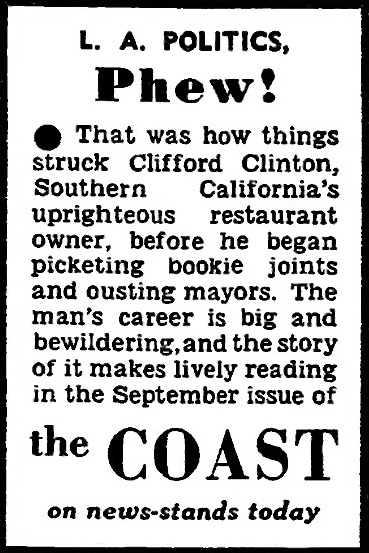
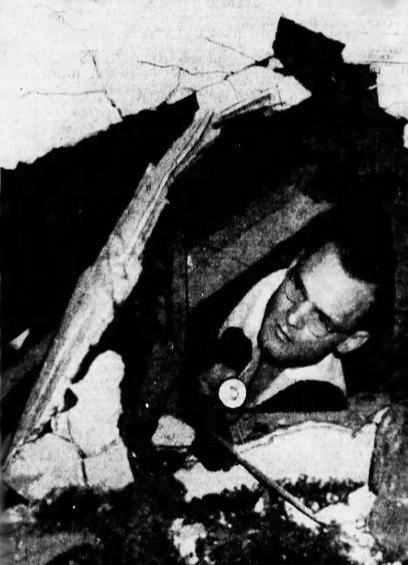
Through these years Clinton experienced endless phone threats, a bombing at his home, false reports of food poisoning at his restaurants, and an endless array of dirty tricks such as an invasion of one of his public forums by 300 hungry people who had been given tickets for a (non-existent) free meal of chicken and beer. [above: 1939 advertisement for magazine article; below: Clinton examines bomb damage]

Having turned the cafeterias over to his children in 1946, Clinton and his business partner, Ransom Callicott, focused on world hunger. They found a scientist who developed what would be known as Meals for Millions, a soy-based one-dish meal that could be prepared as soup or, with a little flour or corn meal added, bread.

Clinton died in 1969 but his restaurants, including a number of conventional ones in shopping centers, endured well into the 2000s.

© Jan Whitaker, 2024
11 Comments

Filed under cafeterias, Offbeat places, popular restaurants, proprietors & careers, restaurant decor, restaurants, theme restaurants

Status in a restaurant kitchen

The status hierarchy in a restaurant kitchen depends on a variety of factors. Skill is clearly one of them, but, historically — if not currently — there have been others, some of them surprising.

In 1944 and 1945 sociologist William Foote Whyte spent time observing kitchens in a number of Chicago restaurants. To one of them he gave the fictional name “The Mammoth” because of the size of its kitchen which employed 45 persons excluding dishwashers.

Whyte noted in his book Human Relations in the Restaurant Industry that by that time in this country, the French chef had lost influence and “this system has steadily degenerated,” eliminating some of the hallmarks of status.

But there were still distinctions of rank, fainter and sometimes subtle yet real.

In step with that time, gender was still a major factor contributing to status. It was linked to skill and experience as well as the difficulty of tasks. It was also reflected in the use of knives and heat, and the sorts of food handled. Although because it was wartime, more women were assuming these positions, at The Mammoth it was men who did the cooking, and men who both portioned and cooked red meat.

Women handled the lower-status food: chicken, fish, and vegetables. The Mammoth’s food suppliers at that time had not yet taken over much of the food preparation as they have in more recent decades, leaving many tedious tasks to the staff that sliced, chopped, and otherwise prepared fresh food for the cooks and sandwich makers.

Among vegetables, he explained, decorative items such as parsley, chives, and celery ranked highest. (Their elevated status reverberates today in the many photographs of elite chefs bending almost double as they carefully tweeze small decorative touches into place.)

One notch down came green beans, followed by spinach and carrots. Undoubtedly the status of these vegetables derived in part from their popularity with customers. But also, he explained, on the women workers’ opinion of them, based on “lack of odor, crispness, and cleanness of handling.”

Lowest in status were potatoes, then at the bottom onions. Whyte states that the “low standing of potato peeling is too well-known to require comment.” I’m not quite sure what it derived from, although it is well known that military recruits strongly disliked kitchen duties that involved peeling potatoes.

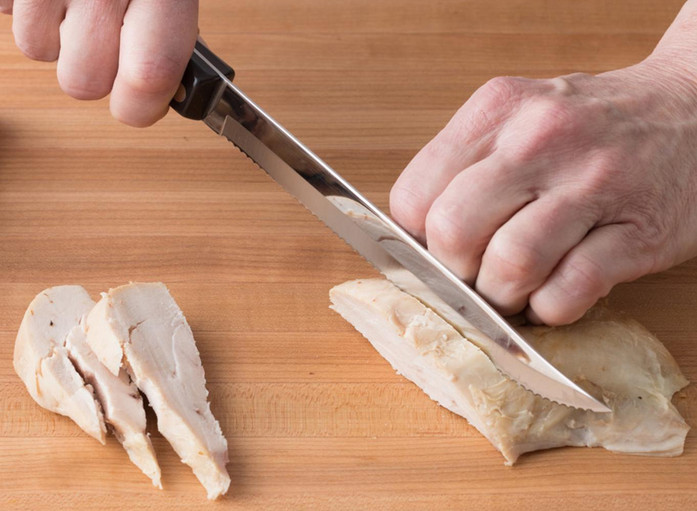
Seven women handled cooked chicken. Those who sliced the chicken were at the head of the line. Slicing white meat was higher in status than dark meat. Next came two women who portioned and wrapped slices for sandwiches. On the bottom rung were three women who picked the remaining meat off carcases, with the one who picked white meat ranking higher. The worst job, that of the seventh woman in line, was picking bits from chicken neckbones. When the worker assigned to that task complained about always getting the necks, she was assigned to another job.

Deep disdain for the chicken picking job was highlighted in the response of one of the workers on the line whose job was wrapping slices. She commented to Whyte that it was tedious. When he asked her if she would prefer picking, she frowned and said emphatically, “Oh, no, I wouldn’t want to do that.”

The woman who handled the fish station, “Gertrude,” was highly regarded by management but not by employees because they held a low opinion of fish, considering it smelly. According to Whyte, this put her station “at the bottom of the status hierarchy,” even though with the wartime meat shortage, fish was assuming a much more important role in restaurants. He attributed the workers’ attitude to ignorance, particularly because The Mammoth had a high standard regarding fish and bought only the freshest. Gertrude strongly disliked being referred to as “the fish lady,” and asked that in the book Whyte refer to her station the “sea-food station.”

© Jan Whitaker, 2023

2 Comments

Filed under food, women

Famous in its day: Le Pavillon

Alternative headings for this post could be Former Busboy Becomes Famous Restaurateur, Best Mid-Century French Restaurant in the U.S., or The Restaurant that Set the Standard for Fine Dining.

In other words, everyone who has known or researched Le Pavillon agrees that it produced this country’s finest French cuisine for most of its 22 years under Henri Soulé. It’s also significant that throughout that time numerous employees of the restaurant left to found some of New York’s other top French restaurants.

Not that the city was devoid of fine French restaurants when Le Pavillon arrived on the scene. French restaurants were well established and plentiful, both as independents and in hotels. Among those competing for the most discriminating and well-heeled diners were Voisin, Café Chambord, and La Belle Meunière. But they were soon outdone.

Because its story has been written about so often and so well, it is challenging to approach Le Pavillon as a topic. For a thorough history that gives a good appreciation of its cuisine, I recommend Ten Restaurants That Changed America by Paul Freedman.

Le Pavillon opened in New York City in 1941, after a spectacular two-year run at the 1939-1940 New York World’s Fair. Located near the top of the Fair’s French Pavilion, it had a dramatic spot overlooking the Lagoon of Nations where a light and fireworks show took place each night at 9 p.m. Despite being the Fair’s most expensive eating place, it was wildly popular and booked for weeks in advance. Because the Fair was difficult to get to by car, New Yorkers had to want to go there badly enough to take public transportation. Yet many returned again and again to dine at the Restaurant Français.

The French Pavilion’s restaurant was provisioned with food and wines brought from France and was staffed by French cooks, maitre d’s, and waiters. It was backed by the French Line and a number of prominent Paris restaurants owned by the Drouant family. Jean Drouant ran the show, hiring Soulé [pictured here], a maitre d’ at one of his Paris restaurants, to manage the dining room.

During the Fair’s tenure, Germany advanced on France, occupying Paris. When the Fair ended, Soulé decided to stay in New York. It has been said that he did not want to return to France under enemy occupation, but it’s likely he was also swayed by the stunning success of the Restaurant Français.

Since many of the restaurant’s French waiters had decided to return to France, Soulé had to hire a good number of French waiters already living in New York. He would soon become known for disputes with his staff, some resulting in resignations of chefs and temporary closure of the restaurant. His authoritarian attitudes may have been shaped by his history with Drouant, who occupied a powerful position in the French restaurant industry. He was president of the Syndicate of French Restaurants as well as the General Owners Union and was not sympathetic to waiters’ rights. He had fully supported military force used to stop a 1938 workers’ strike in response to elimination of the 40-hour week in France. He was critical of French waiters working in America, describing them as “contaminated.”

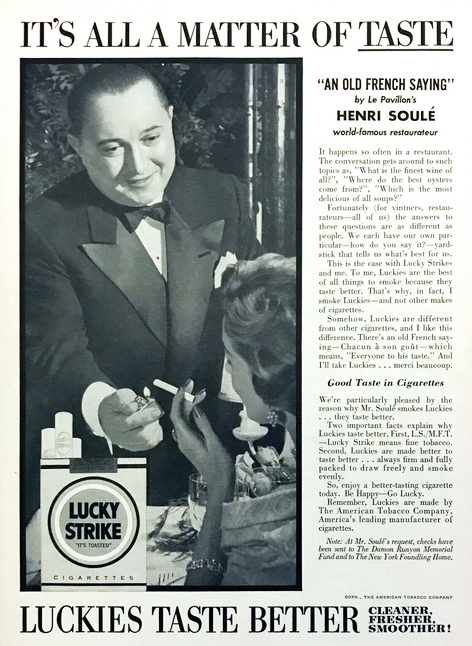
Soulé’s negative attitudes also included dislike of smoking at the table, women drinking, and the widespread American habit of eating quickly rather than slowly savoring the meal. Perhaps because of his general air of disapproval, regular patrons sought signs of his favor, which he gave sparingly. His was a notable ability to confer status on people who were as hungry for that as they were for Chateaubriand with sauce Béarnaise. One of his ways of winning the loyalty of valued patrons was to offer them special dishes not on the menu. [Note that his dislike of smoking in his restaurant did not keep him from appearing in a Luckies’ advertisement in 1954.]

In a 1962 review of a book about Le Pavillon, a clever journalist summed up how to become approved by Soulé. She wrote: “When you go to Le Pavillon you should be famous, if you can manage it, if not, you should at least be rich, elegant, chic and witty. Beautiful, if a woman, dintingué, if a man. If you can’t manage that, then maintain a balance between hauteur and quiet rapture and for heaven’s sake be careful of your manners and careless of your money.”

Yes, the restaurant was exceedingly expensive, beginning at the Fair. According to Craig Claiborne, in 1960 it was possible to spend as little as $6 there for a meal without drinks, equivalent to about $52 today. But with drinks it could cost ten times that. However, in the era of expense accounts, it was standard that a power lunch would be written off as a business expense.

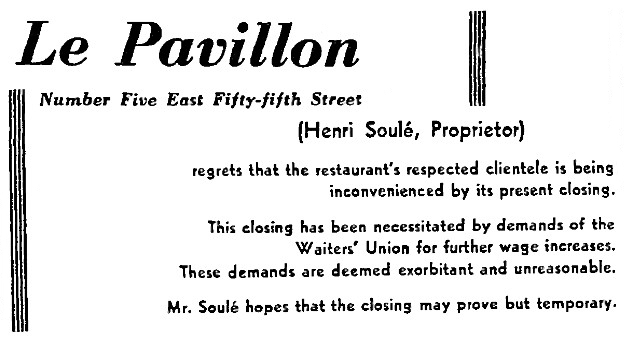
1960 was the year that a dispute between chef Pierre Franey and Soulé over working hours resulted in Franey’s resignation, followed by that of seven of the kitchen staff and leading to a temporary closure of the restaurant. It was not the first time the restaurant closed in response to a dispute. [1955 notice above]

Soulé died in 1966, at age 62. I find it interesting that he willed his watch to frequent patron and “dear friend” J. Edgar Hoover, director of the FBI, whose favorite dishes included Filet of Beef Periogourdine accompanied by a bottle of vintage Romanée Conti.

After Soulé’s death, attempts were made to keep Le Pavillon going but it closed for good in 1971.

© Jan Whitaker, 2022

6 Comments

Filed under elite restaurants, patrons, proprietors & careers, restaurant issues

Fish & chips & alligator steaks

The menu shown here caught my eye as I was browsing the internet. Of course, I wanted to know more about it. The first thing I discovered was that it is available as a reproduction.

Evidently the Trebor Dinner was a specialty menu for complete dinners of multiple courses. Three dollars was a steep price for the Depression when this menu was introduced, at least double what a comparable meal would have cost in a moderately-priced good restaurant then.

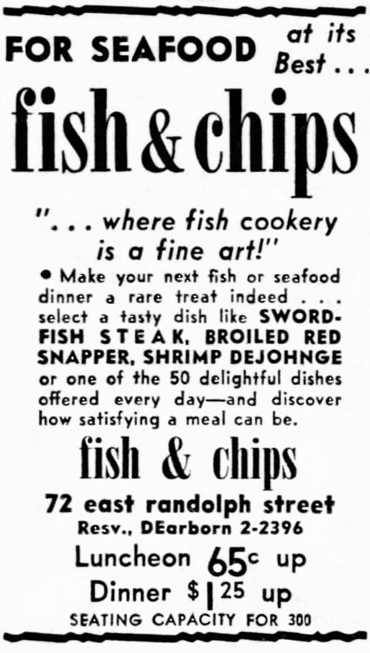
The illustrated menu shows 14 entrees. But the restaurant almost certainly did not have all the exotic items available at all times. Another fish & chips, inc. menu from 1937, for example, offered one appetizer, one soup, and only four entrees.

The menu could date any time from the opening of the restaurant in 1936 into the 1940s. Its clever design may have been due to owner Bob Winter’s background in advertising. Why the menu is named “Trebor Dinner” is a mystery. It’s possible that Trebor is a play on the owner’s name Robert.

Fish & chips, inc. was conveniently located in the Loop, across the street from the central Chicago library, now the Chicago Cultural Center. It was a handy location for a 1943 dinner of the literary members of the Boswell club, admirers of Doctor Samuel Johnson. In their honor the restaurant posted one of Johnson’s quotations over their table in which he criticized French menus, requesting “thy knaves to bring me a dish of hog’s pudding, a slice or two from the upper cut of a well roasted sirloin, and two apple dumplings.”

It was a popular restaurant, said to be especially well liked by male patrons. In 1944, during World War II, lines formed at the door. The following year it was enlarged to seat 300. [1949 advertisement shown]

With no meat on the menu, the restaurant would have had the advantage of escaping wartime food restrictions and shortages.

Advertising that it had 50 varieties of fish on hand daily, a lunch or dinner could include sunfish, crappies, smelts, cod, brook trout, sea bass, shrimp, and lobster among many others. The restaurant advertised heavily during the Lenten season.

Bob Winter died in 1953 and the entire contents of the restaurant were auctioned, including groceries.

© Jan Whitaker, 2021

16 Comments

Filed under alternative restaurants, food, menus, Offbeat places, patrons, popular restaurants

New Year’s Eve at the Latin Quarter

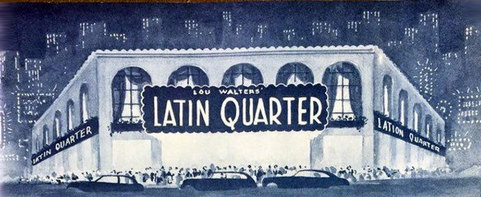
Anyone who wanted to celebrate New Year’s Eve at New York City’s nightclub The Latin Quarter in the 1940s and 1950s had to plan ahead. Way ahead, as in July or August.

The club – its name suggestive of Paris — seated 600 patrons. It took a lot of effort to fill it Like New York’s other nightclubs of that era, it was highly dependent upon out-of-towners.

Packing the house for two or three shows nightly meant that every travel agency in America had the LQ on its list, as did every convention planner. In 1956 it was said that there was scarcely an insurance company anywhere that didn’t include a night at the Latin Quarter among its prizes for top-selling agents.

The most ordered dinners were favorites of the time. Nightclubs weren’t known for the best food in town. Obviously, patrons were not there for the food, but for the show with lightly clad women. In the mid-1950s roast beef was tops. Then, somewhat surprisingly, came turkey, then steak.

The Latin Quarter opened in 1942, with Lou Walters as manager-owner and E. M. Loew’s of Boston’s Loew’s theaters as a financial backer. Walters (father of Barbara Walters) also had interests in LQ clubs in Boston, Miami, and Detroit, along with other nightclubs in New York and Florida.

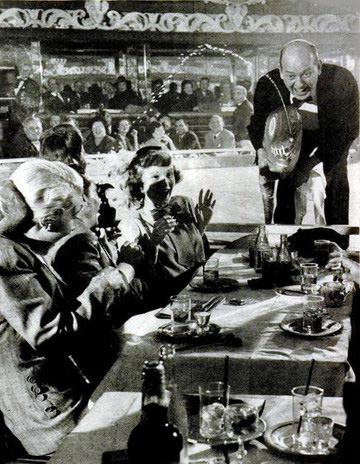
In addition to the nearly nude performers and big name bands and comedy acts, the LQ threw in some trick performances such as a waiter who unexpectedly squirted guests with water and a drunk photographer who would stumble onto the stage taking pictures of performers and creating a noisy ruckus. He was so convincing that guests (and sometimes even waiters) would try to shush him or have him arrested.

The Latin Quarter closed just before New Year’s Eve in 1968, marking the end of New York’s nightclub era. The building went through various identities after that, as a porn theater, a disco, and a hip-hop club.

Best wishes to everyone for happiness in 2020. Have fun, plan ahead, and don’t be fooled!

Leave a comment

Filed under alternative restaurants, night clubs, patrons

Lobster stew at the White Rabbit

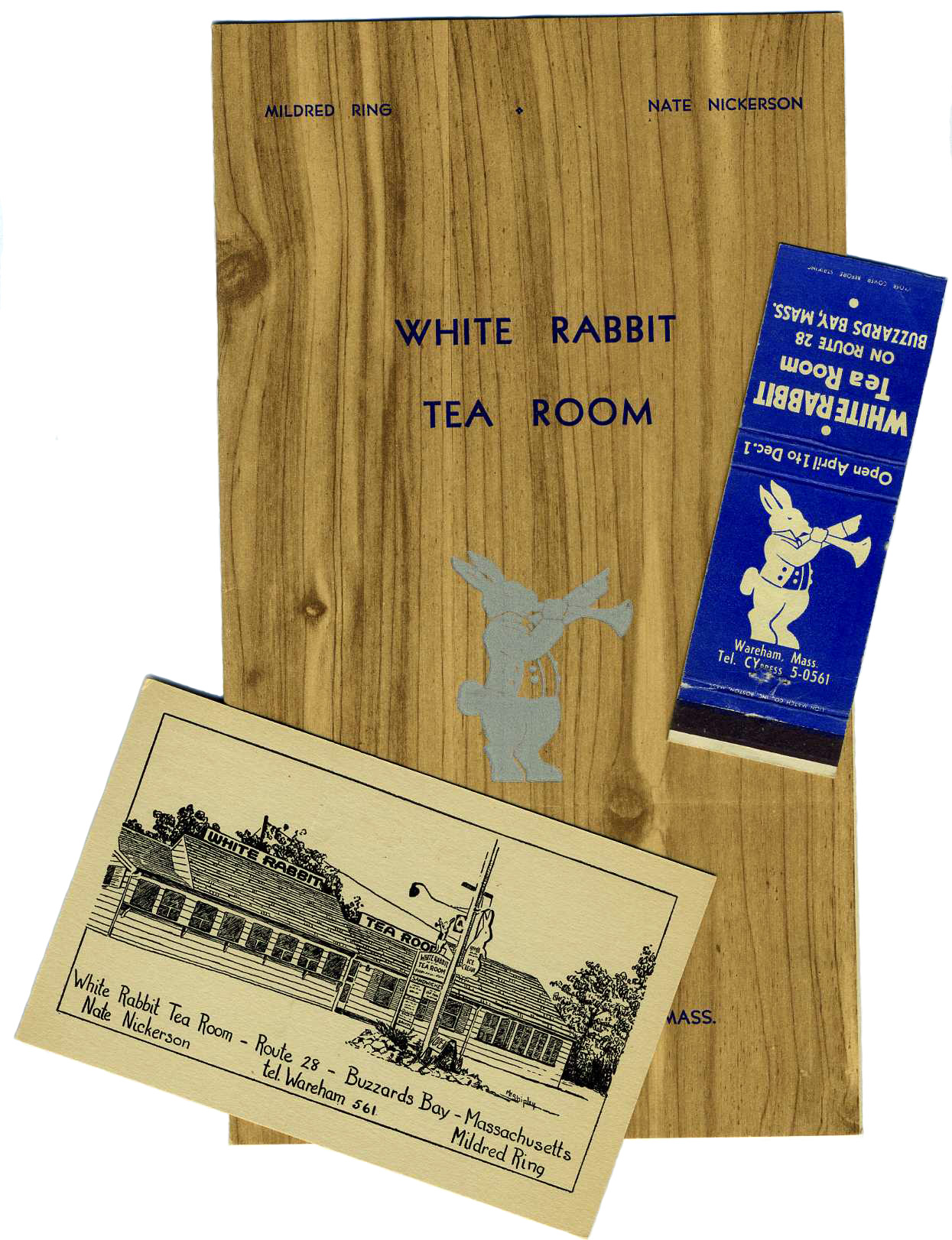
On the menu shown here a bowl of lobster stew cost 70 cents and came with crackers, pickles, and chips. Oyster stew was 50 cents, while fried clams with french fries, cole slaw, and coffee cost 60 cents.

The menu is undated but is probably from the 1940s. Fried lobster was one of the White Rabbit’s most popular dishes, according to Duncan Hines’ 1947 guide book, Adventures in Good Eating. With a fruit cup, tomato, pineapple, french fries, rolls, dessert, and tea or coffee, it came to $1.35. And, of course, they threw in pickles and chips.

In addition to lobster fried, sautéed, or stewed, it was also available as a salad.

Admiring patrons quoted in the 1948 edition of Gourmet’s Guide to Good Eating explained that the reason the Rabbit was always mobbed with people on their way to and from Cape Cod was due to its high standards, excellent food, and, specifically, “plates of hot buttered rolls.”

On Saturday nights the White Rabbit offered a traditional Massachusetts dinner of baked beans for 50 cents. Other interesting dishes on the menu include a vegetable salad sandwich (35¢), a sardine and horseradish sandwich (25¢), and a side order of tomato and cucumbers (15¢).

The tea room got its start in 1931, in West Chatham on the Cape, about 37 miles from the Buzzards Bay location which became its long-term home. Prior to its beginning, owner Nate Nickerson was a taxi driver in Brockton MA, where co-owner Mildred Ring may have worked as a waitress.

Nickerson’s two sons were waiters at the restaurant which was open only from April through November.

In 1966, the final year in which I found advertisements for it, the White Rabbit had evidently abandoned the tea room theme. It then featured liquor and steaks. Nickerson had died in 1950 and it’s likely that it was under different management.

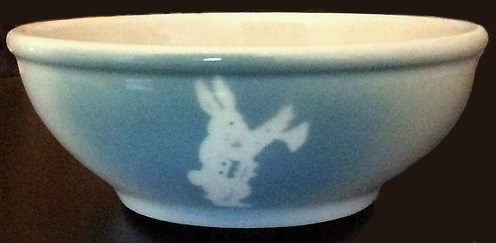
A few years ago I received a nice surprise when a stranger sent me this bowl by Syracuse china used in the tea room.

© Jan Whitaker, 2019

13 Comments

Filed under food, menus, popular restaurants, roadside restaurants, tea shops

Christmas dinner in the desert

A red-and-white-striped restaurant named the Christmas Tree Inn located on a desolate stretch of road in the Arizona desert makes a little bit more sense when you learn that its creators were Los Angeles real estate developers.

The Christmas theme was, of course, a publicity gimmick, and one that worked rather well, at least at the beginning.

Ninon Rivé Talbott, a well known “subdivider” in L.A., opened the restaurant in 1939 with her husband Edward. It was intended to kick off an associated project, a housing development called Santa Claus Acres on the road leading to the newly completed Boulder Dam (renamed Hoover Dam in 1947).

The Talbotts had moved from Los Angeles to Kingman AZ in the early 1930s with an interest in developing tourist facilities. In 1929 they formed a corporation to build hotels along The Old Trails Highway (U.S. Highway 66), which went through Kingman. The road’s creation had been promoted by the Automobile Club of Southern California since the mid-teens, was officially designated in 1926, with paving beginning in 1931. The corporation’s first hotel was to be in Kingman, with others in Nevada, Utah, and California. (I could not determine whether any were built.)

The housing development scheme was undoubtedly spurred not only by the budding Route 66 but also the concurrent U.S. government plan to build Boulder Dam. After checking out a number of locations the government auctioned off some of the properties in the vicinity, including a 80-acre parcel acquired by the Talbotts.

However, although Santa Claus Acres building lots were sold, the housing development was foiled when it proved impossible to drill deep enough to access water.

Needless to say, the absence of water was quite a hindrance to the restaurant complex as well. Water had to be trucked in from Kingman, 14 miles away. However, the absence of water did not entirely defeat the Christmas Tree Inn, with its associated gas station and playhouses for children.

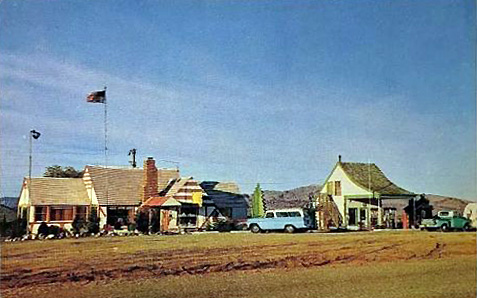
The Christmas Tree Inn complex, which comprised the entirety of “Santa Claus, Arizona,” was a classic do-it-yourself mid-century roadside attraction. Characteristically, it occupied an isolated spot in the wilderness, was garishly eye-catching, and somewhat makeshift. Still, the sight of it was so striking in the vast and empty desert that vacationing families with bored children were almost certain to stop there.

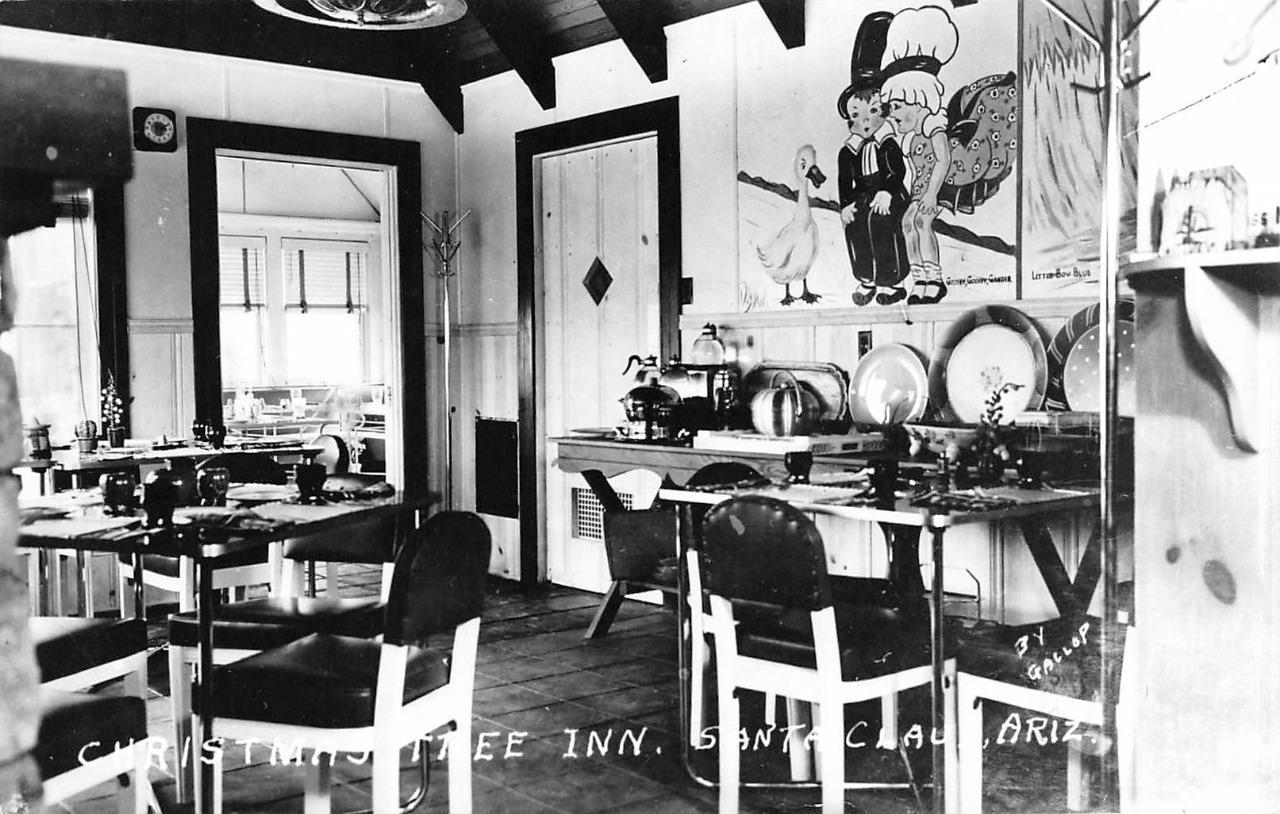
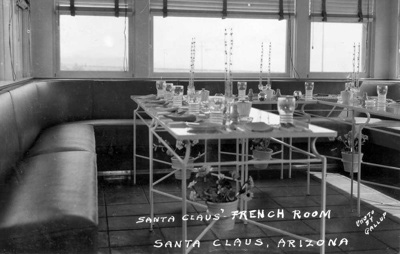
Despite the red and white stripes and the Christmas name, the complex had more of an overall story-book feel, with its Cinderella playhouse, Three Little Pigs hut, and indoor murals with goose girls and other characters. A second dining area, devoid of any theme decor, was inexplicably called the French Room.

Any early success was due primarily to Ninons’ initial efforts and those of the couple who acquired it next. Ninon dubbed herself “Mrs. Santa Claus,” claiming in 1939 that this was a character who seemed “to have been neglected up to this time.” Presumably it is a be-wigged Ninon depicted on the 1940 postcard above.

She was evidently quite a high-powered personality capable of motivating others and making deals. Married four times and mother of five children, she somehow managed to build a career as a realtor in the 1920s and 1930s. Additionally, she was said to be a fine cook who produced surprisingly delicious food for a small roadside eatery. A listing in Duncan Hines’ 1941 edition of Adventures in Good Eating recommended the Inn, saying “Perhaps the best rum pie you ever ate, chicken a la North Pole and lots of other unusual things.”

The war years had to be tough ones. Traffic must have been light due to gasoline rationing and elimination of public access to Boulder Dam from 1941 to September, 1945.

By 1946, the Inn seemed to be doing somewhat poorly judging from the listing in Hines’ guide, which tersely stated: “Serve cold sandwiches.” In 1947 and 1948 want ads appeared in Phoenix and Salt Lake City papers offering the restaurant complex for sale at $35,000, citing the seller’s ill health and that it had cost $60,000 to build. Ninon was 50 years old at that time. According to a 2008 article in The Journal of Arizona History by Douglas C. Towne, Ninon weighed 300 pounds and had a gambling addiction.

The second owners, Erma and “Doc” Bromaghim, carried on some of Ninon’s traditions such as answering children’s letters to Santa. The Bromaghins revealed in 1954 that December was a poor month for business, so they would close then, as well as January and February. Soon they gave up running the business completely, defeated in part by their renewed failure to find water.

Although the Christmas Tree Inn survived until about 1994, its later history was rocky, involving at least 10 owners and or lessees and managers. It was advertised for sale almost continuously.

Today, what is left of the complex is boarded up and covered with graffiti. As a quick internet search will demonstrate, it is an ever-popular subject for photographers fascinated by roadside ruins.

© Jan Whitaker, 2018

5 Comments

Filed under alternative restaurants, family restaurants, odd buildings, Offbeat places, roadside restaurants, women

Green Book restaurants

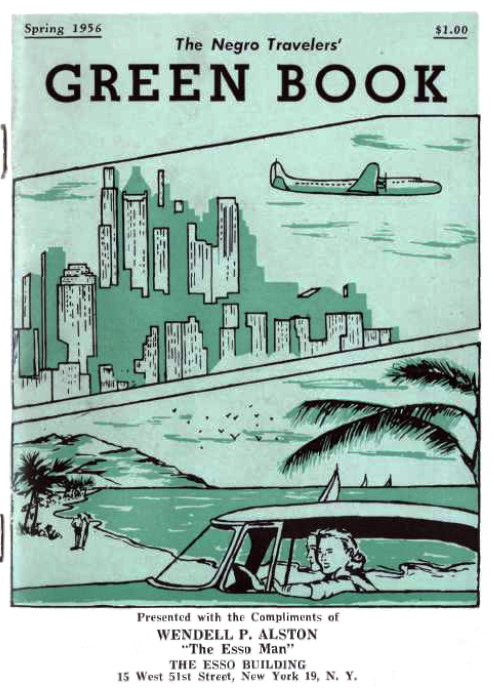
Interest in historical Green Book guides for Black travelers has been growing in the past decade and the new movie of this title will surely increase it.

The Green Books’ slogan, “Covering the United States like a blanket,” nicely sums up its goal of making travel more comfortable (maybe even enjoyable) for Black travelers living in a country that typically greeted them with hostility whenever they moved outside their restricted neighborhoods and social roles.

Prior to the arrival of the Green Book, Black Americans relied on the kindness of strangers – also Black – when traveling. Until the 1960s, Jim Crow laws in Southern states barred them from access to white hotels, resorts, and restaurants. Outside the South conditions were not much better, despite civil rights laws barring discrimination in many states. To deal with this, middle-class Black travelers relied on other Blacks who invited them into their homes, even providing meals despite not usually knowing them personally. According to Willis Duke Weatherford’s Race Relations (1934), “The institution of ‘dining out’ is not established among careful [Black] families – it is a reflection on the home to eat in a restaurant; it simply is not done.”

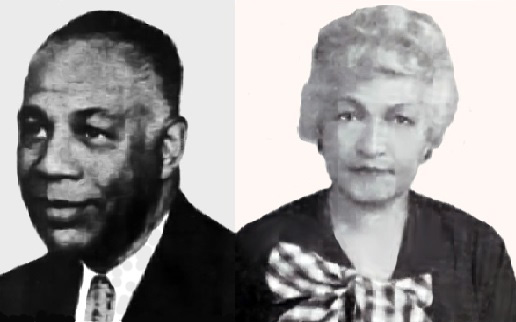
As travel increased among Black business people, entertainers, and tourists, accommodations in private homes were no longer adequate, especially for longer trips. A number of guides were published, among them the annual Negro Motorist Green Book published by Victor Hugo Green, a mail carrier in New Jersey. The guide was renamed the Negro Travelers Green Book in 1952. At some point in the 1950s, Victor became ill and his wife Alma took over as editor and publisher. The last two editions were by new owners.

The Green Books were first published in 1937, then every year after that except for four WWII years, ending with a 1966-1967 edition. With the exception of 1946 and 1958, all of the editions are available digitally in the New York Public Library. A 1946 edition sold for over $4,500 on eBay in 2016 and a copy is owned by Virginia Union University Library. As far as I can tell the 1958 edition is not publicly available. Several editions have been republished.

Green Books were sold directly to consumers and also distributed by Esso after Standard Oil of New Jersey hired a prominent Black businessman to promote Esso to Black motorists. Thirty-eight percent of Esso gas stations were operated by Black proprietors, according to a 1939 essay. Conoco also ran a Negro Travel Service which prepared custom “Touraides” free on request. Quite a few issues of guides devoted pages to new model cars of the major, and a few minor, automobile manufacturers. In the Black community cars were regarded as liberators, as well as providers of good jobs in the manufacturing and service sectors. An essay to this effect, “The Automobile and What It Has Done for the Negro,” appeared in the 1938 edition.

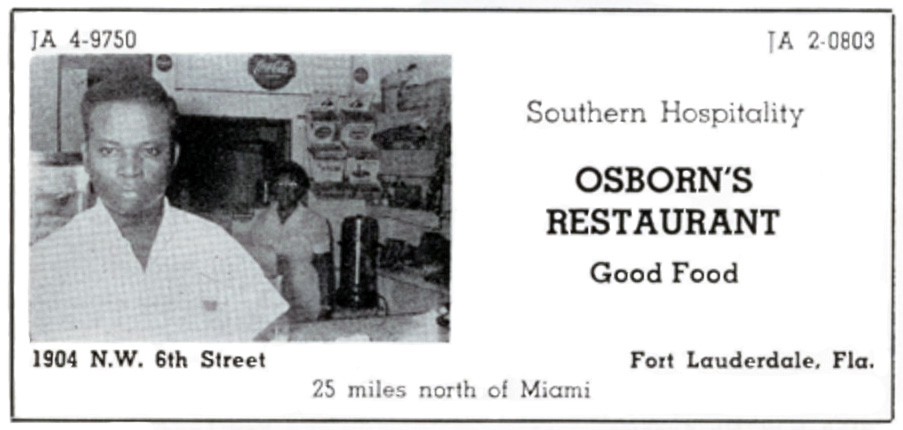
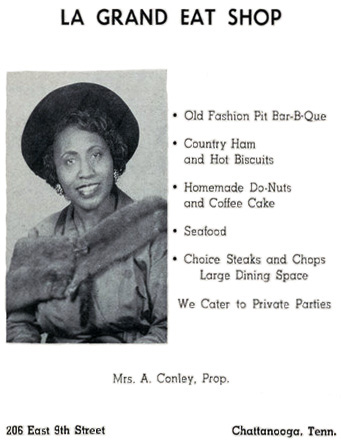
The books provided lists of hotels and tourist homes that were welcoming, most of them located in Black business areas of cities and towns. It also listed restaurants, roadhouses, taverns, nightclubs, beauty and barber shops, service stations, and other businesses. In later years it tended to focus primarily on places to stay. [Osborn’s, 1962]

I’ve looked at all the Green Books in the NYPL collection, paying special attention to restaurants in them. Overall there are not a huge number of restaurants. In 1939, for instance, only two restaurants are listed for the entire state of California.

Most of the restaurants seem to be in Black sections of towns, or are Chinese. Their numbers seem to have been dependent on Victor Green’s informants, who were said to be mail carriers like himself. Coverage was also spotty. Green lived in New Jersey and then New York City, and it’s noticeable that both states are more thoroughly covered than most others.

What seems to be lacking are restaurants in predominately white areas that welcomed Black customers. If Black tourists or business people were visiting Los Angeles, for instance, how would they know which restaurants in the main shopping or business districts would serve them without problems?

Comparing the Duncan Hines’ popular Adventures in Good Eating guide book of the late 1940s with a Green Book of roughly the same time reveals that there is no overlap whatsoever in their listings of Los Angeles restaurants. Not one of the 37 LA restaurants recommended by Hines is to be found in the Green Book or vice versa.

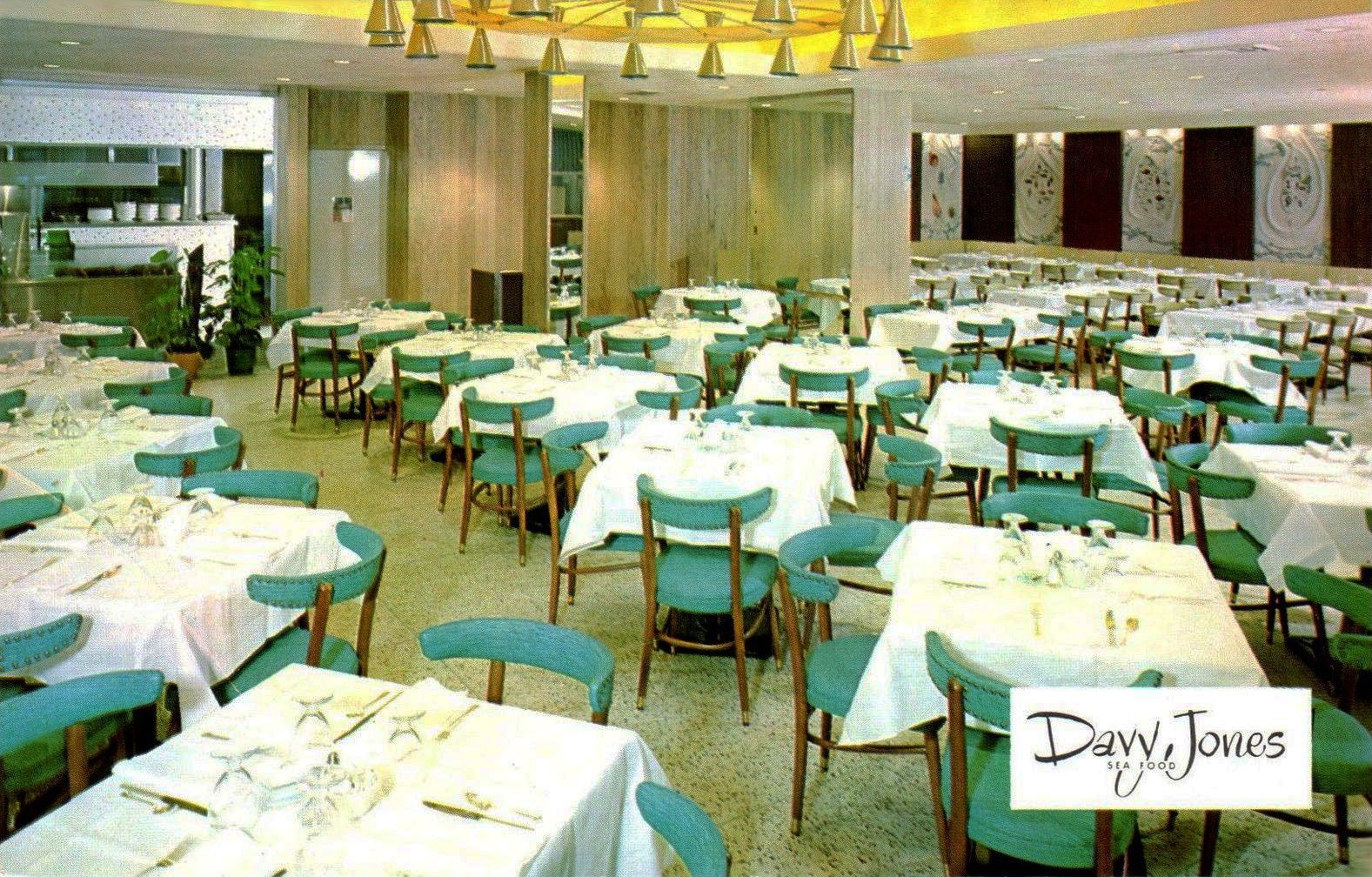
Things had changed somewhat by the 1962 edition. It is striking how many more white-owned and patronized restaurants are listed for New York City that year. Previously the only New York restaurants in the guides were located in Harlem, but now they are all over town. Among them are the Brass Rail chain, Davy Jones Seafood House, and Jack Dempsey’s. It’s hard to know whether the change was due to the policy of the restaurants or the Green Book.

Trying to learn more about restaurants listed in Green Books is difficult. Many I’ve looked for do not show up in city directories, nor in newspaper archives. Judging from feature advertisements for restaurants in later issues, many of the restaurants listed were small neighborhood places that served unpretentious home-cooked meals, quite similar to the majority of white-owned restaurants in the 1930s, 1940s, and 1950s.

I recognized a few names of well-known Black restaurants such as Paschal’s in Atlanta (est. 1947 as a small sandwich shop), Little Gray Shops #2 and #3 (considered Harlem’s better eating places in the 1930s), and Dooky Chase in New Orleans (like Paschal’s, still going strong today).

There was also a listing for Bagley’s, operated by Black socialite Caroline Bagley in Sheepshead Bay NY, as a kind of tea room with garden dining. A number of other tea rooms are listed, among them the Black Beauty Tea Room in Mount Olive NC, which had the distinction of being raided in 1950 for serving bootleg whiskey.

Probably quite a few restaurants in the Green Book were community institutions in their time, such as Hammond Café in Abilene TX, specializing in spicy chili. Certainly that was true of Harlem’s Aunt Dinah’s Kitchen, run by Broadway actor Richard Huey. Aunt Dinah’s hosted one-act plays and discussion forums in the 1930s and 1940s, and served as an informal support center for actors who needed a place to gather and have a free meal now and then.

Researching restaurants, hotels, etc. listed in the Green Books would be an interesting way to construct a picture of 20th-century Black life before the Civil Rights Act. It would make a good group project.

© Jan Whitaker, 2018

17 Comments

Filed under guides & reviews, patrons, racism

Gossip feeds restaurants

gossip1927gossipHeddaHopper3

O. O. McIntyre, a popular columnist who authored “New York Day by Day,” advised his readers in 1925 that anyone wishing to open a “swank” New York restaurant and establish a smart reputation from the start should get prominent people and theater stars to patronize it. “The rest,” he wrote, “is up to the cafe’s press agent.” He might have added, “and gossip columnists.”

By revealing glimpses into the lives of the rich and famous, gossip columnists like McIntyre, working with restaurants’ press agents, played a crucial role in the publicity system that made New York’s restaurants and nightclubs household names across the nation. The same was true of Hollywood’s night spots, particularly in the 1930s and 1940s. Columnist Leonard Hall wrote in 1937, “As restaurants, Hollywood’s famed eating houses are little more than golden shambles, which exist that stars may see and be seen.”

gossipBrownDerbybettyHuttonDorothyLamour1949

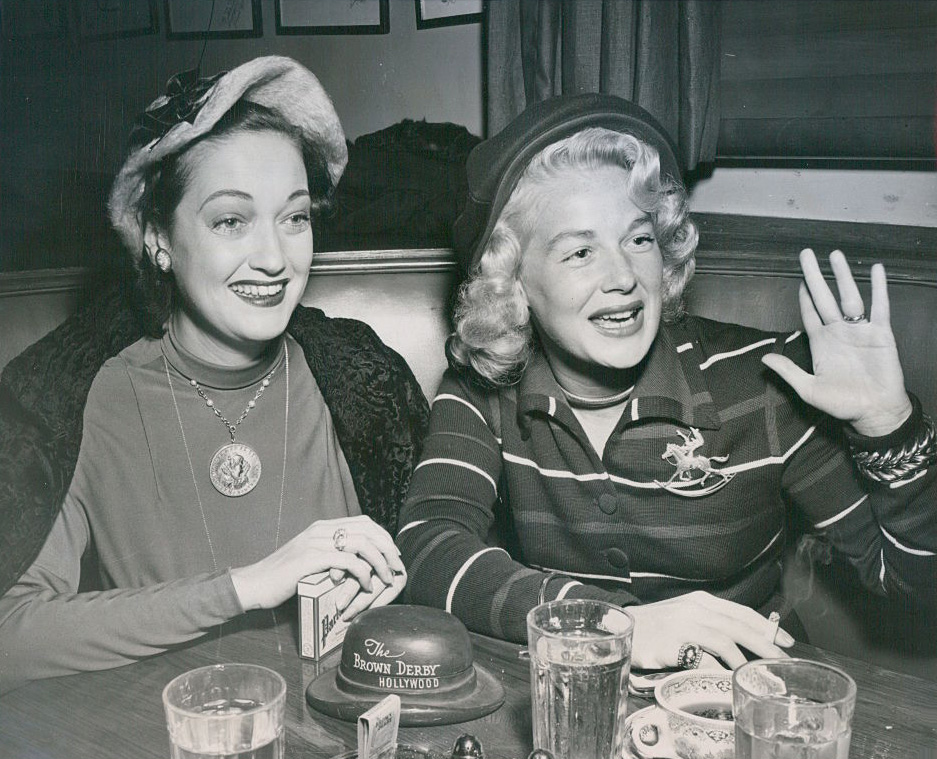
Columnists might sometimes focus on a restaurant’s food, decor, or proprietor, but their main subjects were clearly its celebrity customers. Who was s/he with? What was she wearing? Romances brewing? Was anyone getting the cold shoulder, a divorce? Were their stars rising or falling? [Above Dorothy Lamour and Betty Hutton smile wanly for the camera at the Brown Derby]

The main thing, though, was just to get the names before the readers’ eyes. Typically the columns delivered short bursts of mundane info, each bit separated from the next by an ellipsis (. . .). A sample from Lucius Beebe’s “Faces Around Town,” 1938: “Burgess Meredith having early dinner with Frank Shields at Jack and Charlie’s before going to the theater . . . Henry Luce and Claire Luce, ditto, but indicating marital individualism by commanding different entrees – she pompano meuniere, he chateaubriand and German fried potatoes . . .”

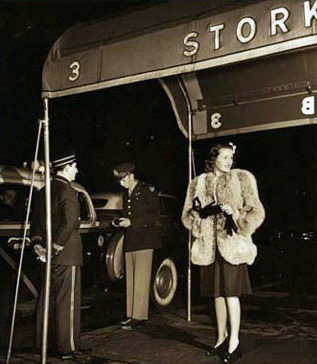
Mid-century spots such as the Stork Club, El Morocco, the Colony, and Jack and Charlie’s ‘21′ in NYC; Hollywood’s Brown Derby, Trocadero, and Ciro’s; and Chicago’s Pump Room were a few of the top restaurants and clubs that played the gossip game. Parlaying gossip was standard practice at the glamour palaces, so much so that the elegant and expensive Voisin on Park Avenue, which also refused to advertise, was noted for having NO gossip columnists holding court at its tables.

gossipStorkClubColumnists were influential. Sherman Billingsley, proprietor of the Stork Club, credited Walter Winchell with making his club successful. Winchell, who operated out of the Stork from his own table, enjoyed a privileged position in the gossip business and at the club whose upstairs barber shop was at his disposal. In the 1960s a short blurb by Dorothy Kilgallen put Elaine’s on the map, according to its proprietor, the late Elaine Kaufman.

Restaurants, celebrities, and columnists profited mutually from gossip. In New York the featured subjects were people with power, café society, theater actors, and literary figures; in Hollywood they were film stars needing to propel their careers. Restaurants living up to the boast, “A gossip columnist guaranteed under every table,” were appreciated by show biz figures. Newspapers and fan magazines regularly ran photographs of stars arriving at a posh restaurant or of couples smiling from their tables. When a new restaurant or nightclub opened the owner hired a press agent to round them up. They dropped by, posed with the owner, and circulated, in a constant routine that kept their faces and names before the public and added glitz to the restaurant. El Morocco found the publicity generated by an opening night so valuable that they held one every year.

gossipErnestMarthaHemingway

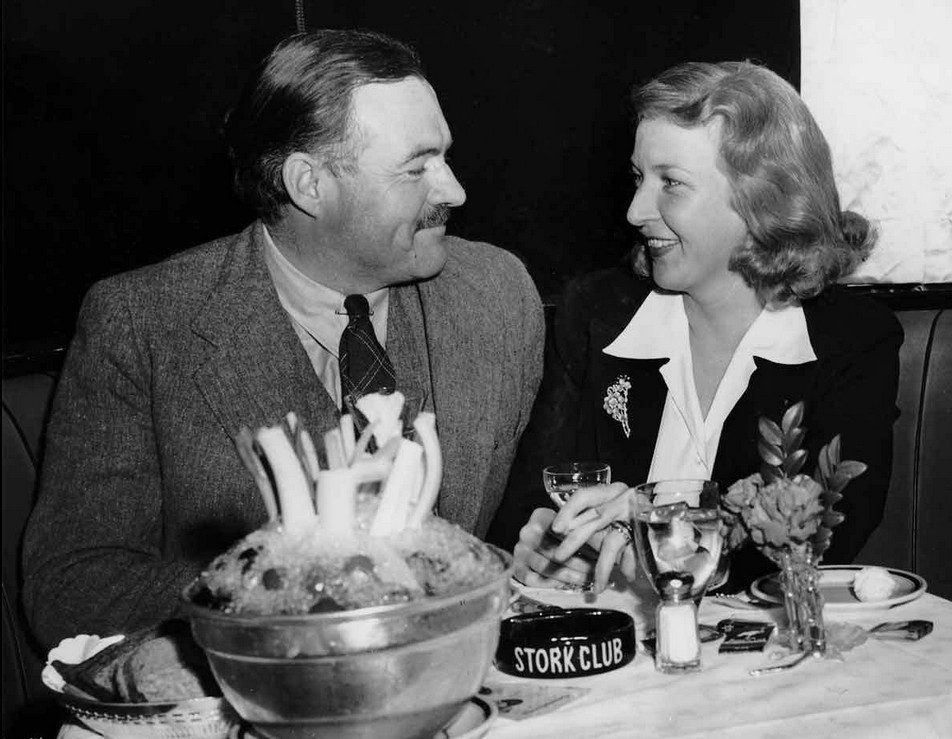
Sometimes restaurant owners would even subsidize patrons from film and stage. At Sardi’s, where as late as the 1960s “one well-timed exposure . . . [was] worth more to a burgeoning career than a whole picture series in a fan magazine,” actor Jose Ferrer dined for months on account before attaining success in his role as Cyrano de Bergerac. “Prince” Mike Romanoff, whose own restaurant would one day become a den of celebrity gossip, had enjoyed free meals at Chasen’s in his early days in Hollywood. [Above Ernest Hemingway and his wife Martha]

All the roles were fluid. Hedda Hopper acted before she took up the pen. But perhaps the best role optimization occurred when columnists became celebrities and used their own activities as subject matter. Journalist Christopher Morley wrote about the doings of his lunch clubs while putting the spotlight on NYC restaurants such as Christ Cella’s.

Gossip columnists still operate but their work became less valuable to restaurants and celebrities with the arrival decades ago of newspaper restaurant reviews and television talk shows and, more recently, social media.

© Jan Whitaker, 2015

1 Comment

Filed under guides & reviews