Tag Archives: 1930s

Restaurant-ing in movieland

In 1916 a newly arrived New Yorker named Adolph “Eddie” Brandstatter and a partner opened a café in Los Angeles. Modeling it on an unnamed New York City restaurant, they named it Victor Hugo and designed it to introduce fine French cuisine and continental service to the cafeteria-loving city.

Four years after opening the Victor Hugo, Brandstatter turned his attention to a Santa Monica project, the Sunset Inn, buying it with a new partner and selling his share in the Victor Hugo. His short tenure at the Victor Hugo was an early sign of his seeming “love it and leave it” relationship to most of the restaurants he created. Despite that, he rapidly became a well-known and well-liked public figure.

Trying to track all his restaurant ventures is a dizzying job.

By June of 1920 the Sunset Inn, which had served as a Red Cross center during WWI, had been remodeled and outfitted with a jazz band. Wednesdays were devoted to performances by Hollywood actors. But in 1922, less than two years after its opening, and despite the Inn’s apparent success, Eddie sold his share and moved on.

That same year, only a few months after departing from the Sunset Inn, he bought a new restaurant, the Maison Marcell, remodeling and reopening it. A little more than a year later he remodeled it again, renaming it the Crillon Café. Meanwhile, shortly after opening the Marcell, he had advertised the sale of his home’s furnishings, including suites from the living room, dining room, and two bedrooms, along with curtains, draperies, oriental rugs, flatware, and tableware.

Presumably the sale was meant to raise funds for his next project, the Café Montmartre which he opened in January of 1923 on Hollywood Boulevard, with a coffee shop below it on street level. At the luxurious Café Montmartre he continued the method of luring customers that had been adopted at the Sunset Inn: linking the café to the movies, attracting stars and a gaping public. Reputedly this often involved subsidizing meals for actors short on funds. [photo: Los Angeles Public Library]

The Montmartre would become the restaurant most closely identified with him, and the longest lasting of his cafes, staying in business for nine years. He took an active role in it, greeting and mingling with guests from the film industry, as well as overall management. Yet that workload barely slowed him down. In May of 1923, the Los Angeles Examiner announced that Eddie, “Little Napoleon of the Cafes,” was planning to open “the exclusive Piccadilly Coffee House on West Seventh street between Hill and Broadway.”

1925 was a busy year of ups and downs. The Crillon closed, as did his newly opened cafeteria called Dreamland, not even open for a full year. It was the only cafeteria I’ve ever come across that had dancing!

He also began a catering company that furnished food to movie casts and crews. In the next few years, the catering company took on some big projects. In one case it provided meals for 2,500 in Yuma AZ when the Famous Players-Lasky studio was filming Beau Geste. [above photo] To do that it was necessary to build a plank road atop the sand and to drill wells. The company also catered to studios when they filmed in Hollywood at night, as was the custom. That could mean serving as many as 25 studios on some nights.

The Depression – and probably the end of silent film — took a toll. When Montmartre began to sag, he opened a swanky club next door for film people called the Embassy. It opened in 1929, closing three years later when his decision to open to the public failed to rescue it. [above: the public waits to get in] Also, in 1932 he was caught removing art objects and furnishings from the then-closed Montmartre, planning to use them in his next venture. At his trial it came out that the actual owner of the Montmartre was the realtor who had built the Montmartre and backed him by putting up capital, loaning him personal funds, and paying him a salary of $100 a week. He was found guilty and put on probation for two years.

In 1933 he opened a restaurant he called Sardi’s but in no way connected to New York’s Sardi’s. With booths, tables, and fountain service, and featuring his popular set-price buffet luncheon, it quickly became a success. Its success did not stop him, however, from launching another restaurant, a chop house called Lindy’s that he seemed to have no further link to. In 1936 Sardi’s was destroyed by fire. When it was rebuilt two years later he sold his share to a partner. [rebuilt Sardi’s shown above]

In 1939 he opened his final eating place, the Bohemia Grill, with prices as low as 35c for Pot Roast and Potato Pancakes. The following year he took his own life, apparently troubled by money worries. Among the honorary pall bearers at his funeral were Charlie Chaplin, Tom Mix, Bing Crosby, and studio head Jack Warner.

© Jan Whitaker, 2024

8 Comments

Filed under patrons, popular restaurants, proprietors & careers, restaurant catering

Neon restaurant signs

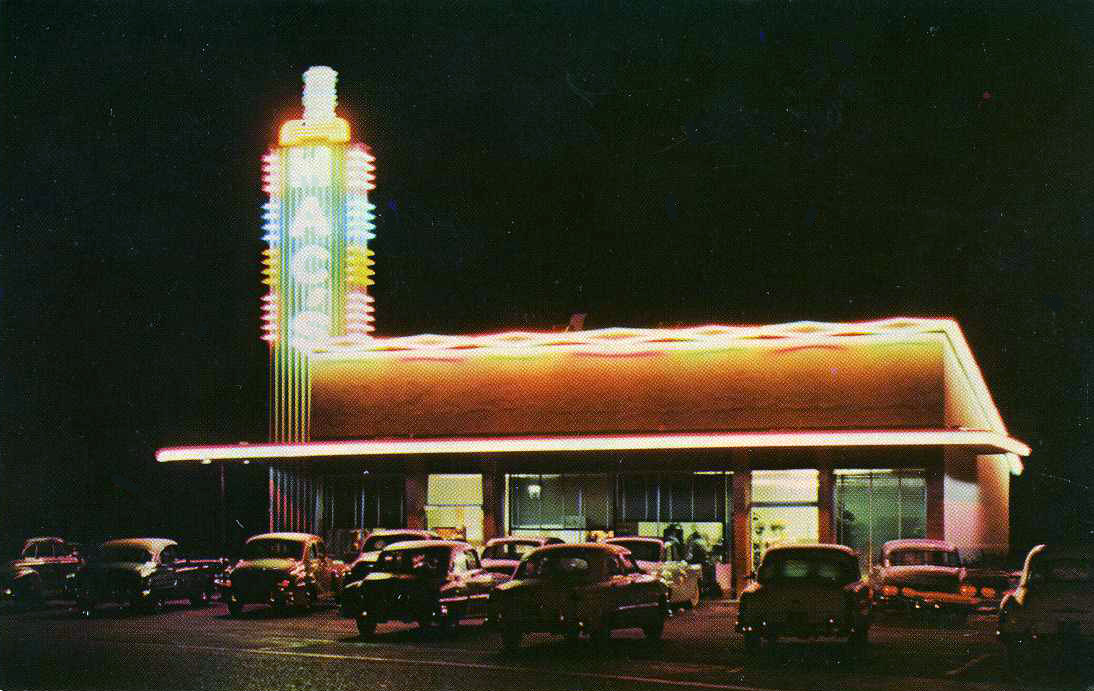
The four gases used initially by neon signs – neon, argon, krypton, xenon – were discovered by English scientists in the 1890s and adapted for use in signs by Frenchman Georges Claude a short time later. Though not the first, an early neon sign was used in Paris in 1913 to advertise Cinzano vermouth. [shown above: Mac’s, Corpus Christi TX]

But it wasn’t until the late 1920s that the signs became popular with restaurants in America. Particularly in the West where car culture was developing, the eye-catching signs helped attract the attention of drivers.

In the early days neon signs in a town’s business district could also be taken as a sign of progressiveness. A 1929 advertisement for an electrical display company in Great Falls MT advised businesses that their adoption of a neon sign would impress people, encourage progress, and “beautify Great Falls.”

Their use became well established in the 1930s. In the 1934 book Curious California Customs, the author commented, “To the casual visitor, Wilshire Boulevard, after dark, is a flashing cavern of Neon signs, most of which are calling attention to eating places.” A later postcard of Hollywood Boulevard at night in the 1950s demonstrates the effect of a street full of neon signs [shown above].

In the late 1920s the signs began moving across the country. Among early adopters were eight Benish Restaurants in St. Louis, four White Way Hamburger outlets in Colorado, the Horn & Hardart Automats in Philadelphia, and four Janssen’s Hofbraus in New York City. Salt Lake City outfitted multiple New York Coney Island Sandwich Shops with the signs.

Bright neon signs and images remained quite popular throughout the country into the 1940s. But if they were meant to make a business stand out from the crowd, that became more and more difficult as the numbers grew.

Neon signs were undoubtedly most effective for roadside restaurants on dark roads that stayed open at night [above: [Bratten’s Grotto, Salt Lake City, 1956]. Or for eating places in somewhat obscure locations that required signs that could be seen from afar. Unfortunately, they didn’t look as impressive during the daylight hours [below: Bratten’s Grotto, daytime].

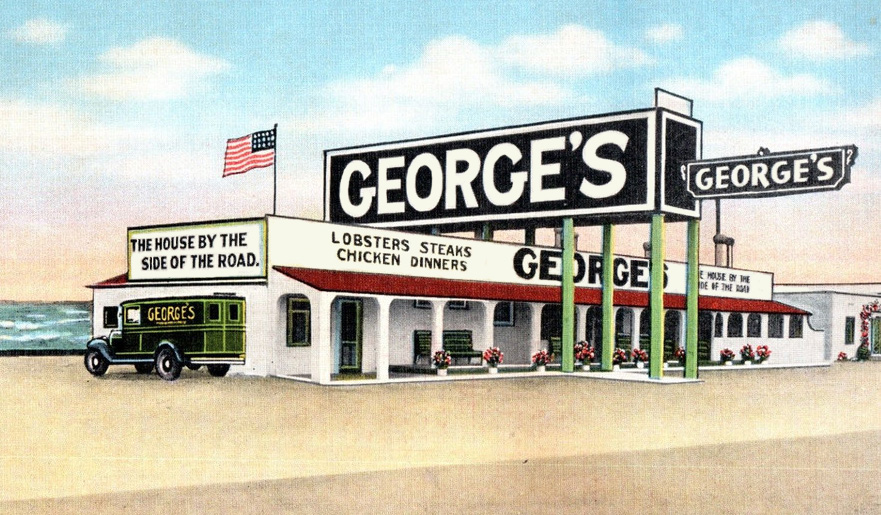
Before neon, efforts to craft signs that could attract distant or speeding traffic were undoubtedly less successful, less visible in the dark. George’s grotesquely large sign shown below, for example, was neither attractive nor sufficiently visible at night. As a slightly later version of this postcard revealed, the restaurant soon found it necessary to add spotlights atop the sign.

Neon wasn’t for every eating place. To critics it lacked artistic pedigree and dignity. Elite restaurants wanted nothing to do with it. It might announce the presence of the Green Frog or the Zig Zag Sandwich Shop, but certainly not New York’s La Chaumiere.

A 1960 book on restaurant decor pronounced neon in bad taste, saying, “Incandescent lighting is more expensive but has a kindlier glow and, thanks to the bad association arising from the tasteless use of neon, is generally considered ‘classier.’” As cities declined with the growth of suburbs, such attitudes toward neon grew more negative.

Nor was neon welcome in classy towns and communities such as Palm Springs, Carmel-by-the-Sea, and Sonoma in California; Santa Fe, New Mexico; the Hamptons on Long Island; and Cohasset, Massachusetts, to name but a few that banned it.

Rejection of neon grew in the 1960s and 1970s. In 1965, food critic and editor Craig Claiborne was uneasy about eating in the one (barely) acceptable restaurant he could find in Roswell NM, which he said had “the air of something once removed from Las Vegas or Miami Beach with its neon-silhouetted champagne glass and flashing neon bubbles.” His unease increased upon stepping inside and seeing a lighted goldfish tank, male customers not wearing coats, and bartenders with “narrow, abbreviated ties.”

Antipathy to neon in the 1970s, as before, was associated with urban decay and seedy neighborhoods characterized by run-down buildings and businesses such as bars and strip clubs. More cities and towns banned it.

Soon there were few “tube benders” left who could create or repair neon signs, which were increasingly being replaced with lighted plastic signs that were easier and cheaper to make and less prone to damage outdoors. Yesterday’s real neon signs that had survived soon showed up as quaint wall decor in warehouse-style theme restaurants.

A few commentators, such as a reporter for the Fort Wayne News-Sentinel, began to wonder about the return of neon. She speculated in 1975 that “that much-maligned symbol of everything that’s bad about American commercial districts” might “someday be recognized as art.”

Sure enough, in 1976 the Smithsonian put on an exhibit that included neon signs, among them examples from a Kosher restaurant, a foot-long hotdog place in Cleveland, and from a Spanish-American restaurant in Greenwich Village, a many-colored creation that combined a lobster, pig, fish, chicken, crab, and a steaming coffee cup.

Nowadays, vaguely quaint-looking plastic “neon” signs might show up as interior wall decor in the sort of restaurants that want to suggest they are fun places.

© Jan Whitaker, 2024

12 Comments

Filed under restaurant issues, roadside restaurants

Anatomy of a restaurateur: Clifford Clinton

Rarely is the word fantastical used to modify the word cafeteria. Nor are restaurant proprietors usually thought of as powerful vice crusaders. [cover, 1940s booklet; below Pacific Seas]

A major exception of the latter was Clifford Clinton, creator of two of Los Angeles’ most memorable cafeterias. Both Clifton’s Pacific Seas and Clifton’s Brookdale were indeed fantastical, exotic, and composed of an odd blend of entertainment and salvation. In appearance they anticipated elements of Disneyland as well as Polynesian restaurant decor.

One of their strangest aspects was that they represented Clinton’s missionary work. After a few years of operating his father’s Puritan restaurant chain in San Francisco – previously owned by moralist Alfred W. Dennett — he came to Los Angeles in 1931 and re-opened a former Boos Brothers cafeteria at 618 S. Olive.

By the following year he was running that “Clifton’s” cafeteria plus another one on W. Third, one on Hollywood Blvd, a hotel probably housing his employees, “A miniature Cafeteria of the Tropics” in Whittier, and a “Penny Caveteria” in a basement on S. Hill street that offered dishes for 1 cent each.

In October 1932, perhaps the worst year of the Depression, a newspaper featured a smiling woman in the Caveteria with her 5¢ meal of soup, veal loaf, macaroni, sliced tomatoes, and buttered bread. According to another story, she was but one of an average of 4,500 customers fed each day (except Sundays, when all Clifton’s closed). Lines typically stretched down the street. For Christmas that year 7,000 guests enjoyed a Christmas turkey dinner priced at 1¢.

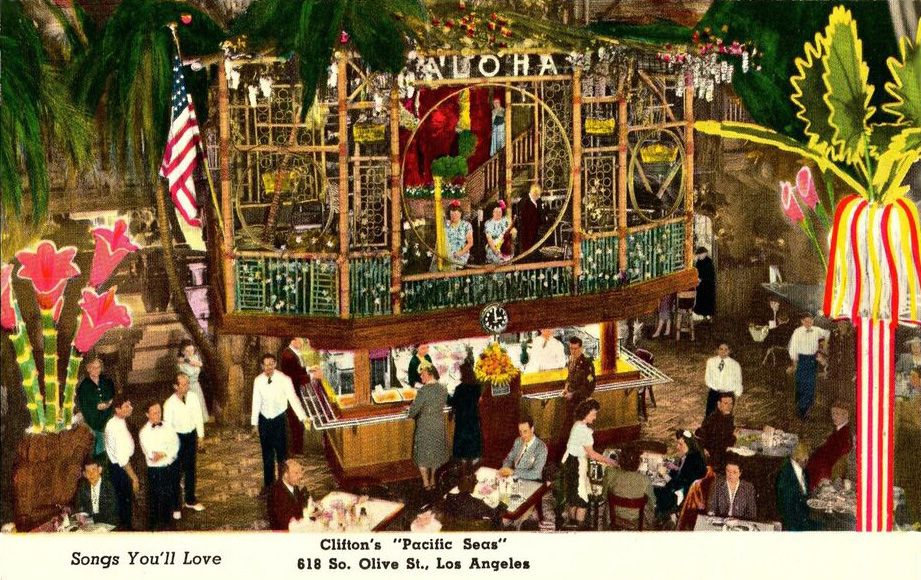
In 1939 Clinton remodeled the redwood-forest-themed Clifton’s Brookdale that had opened in 1935 as well as the original place on S. Olive, Clifton’s Pacific Seas, with a dazzling Polynesian look, neon palm trees, and many, many waterfalls. [Brookdale interior shown above; below more waterfalls, Pacific Seas exterior]

Along with meals, the restaurants acted as social centers and spiritual retreats for the thousands of uprooted mid-westerners who had relocated to Los Angeles. And they served as a kind of political base for Clinton’s reform campaigns. His cafeterias and his political activities were entirely consistent with the tenor of Los Angeles culture of the time. As George Creel summarized it in a 1939 Colliers article, the city throbbed with “two thousand religious cults . . ., each claiming daily and direct communication with Jehovah, and an equal number of social, economic and political movements: Epic, Social Credit, Utopia, the Townsend Plan and Thirty Dollars Every Thursday, etc., all guaranteed to promote the immediate salvation of mankind.”

Religiosity permeated the Clifton’s Cafeterias, as it had Dennett’s and would in a number of restaurants later in the century. If guests left the main dining room of Pacific Seas and entered the basement they would find a life-sized figure of Jesus praying in The Garden of Meditation [shown above]. Brookdale featured a Little Chapel set amidst the redwoods.

During World War II, Pacific Seas diners could also post their “feelings and wants” on a bulletin board or consult with a “Mrs. Von” in her bamboo hut for advice on personal problems.

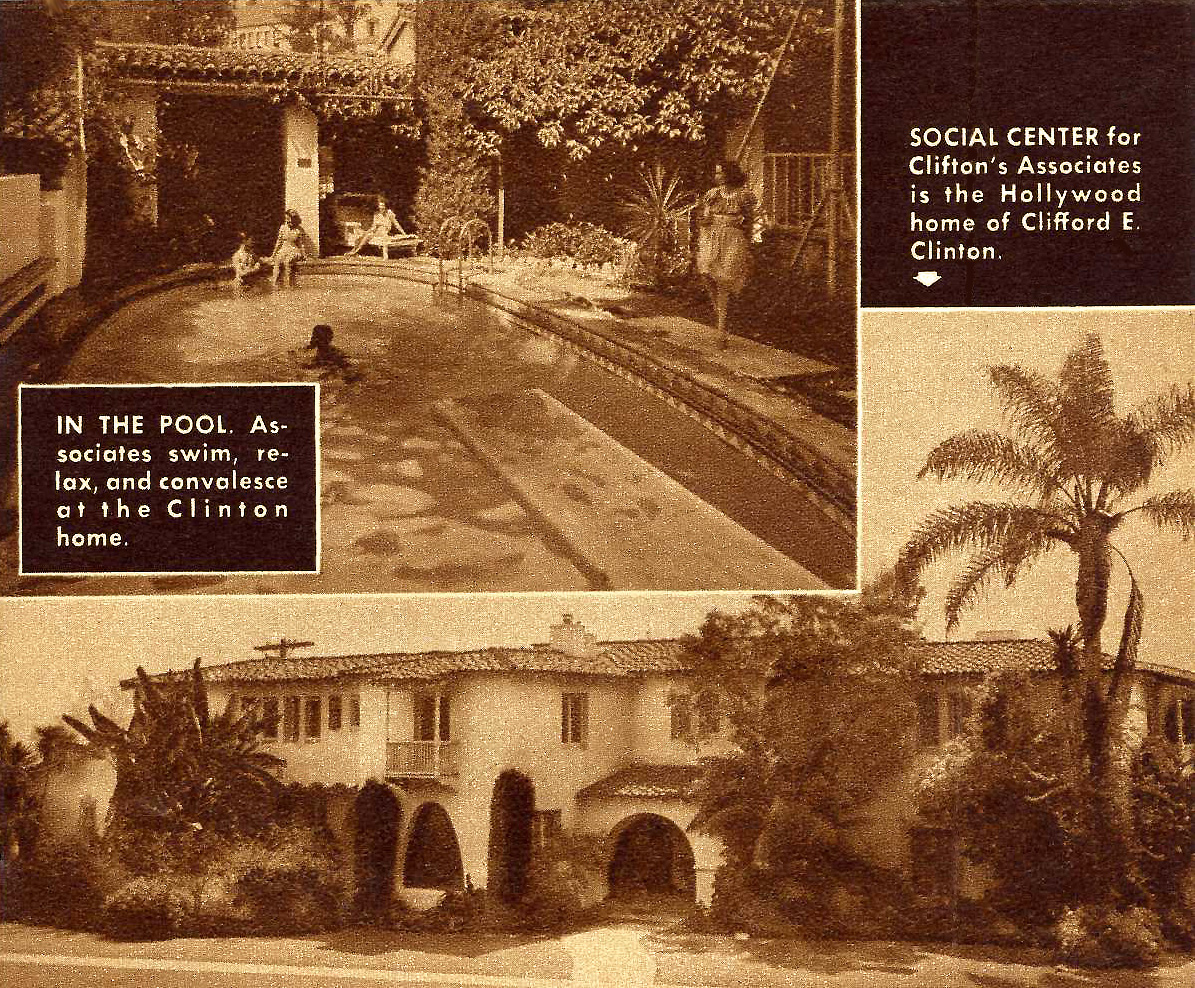
Clifford Clinton’s mission to offer affordable meals continued throughout his career. The policy was that no one would be turned away because of a lack of funds. Although the practice undoubtedly ate into revenue, and was probably taken advantage of by some, Clinton managed to amass enough profits to live in a sprawling mansion on Los Feliz Blvd. and Western Ave in which he hosted convalescing employees [shown above]. (The house sold last year for close to $5M.)

Clifford Clinton was as colorful as his restaurants, despite his appearance as a conventional religious and civic-minded family man. He had spent much of his childhood in China with his missionary parents, an experience that he said made him ultra-sensitive to human hunger. That is unusual but it was just a prelude to his role as one of Los Angeles’ prominent crusaders of the 1930s dedicated to cleaning up the city’s vice and political corruption.

He succeeded in getting Mayor Frank Shaw recalled and replaced by the candidate of his choice, who he promoted on his radio show. In addition, the city’s police chief was indicted and found guilty of plotting the car bombing that severely injured the private detective working for Clinton’s lawyer.

Clinton’s success as a crusader has been partly attributed to his alliances. He worked with Protestant ministers under the banner of an organization he created known as C.I.V.I.C (Citizens’ Independent Vice Investigating Committee). And he also allied with the Communist Party during its popular front phase. As a result of these efforts, gambling, prostitution — and the city’s anti-Communist Red Squad — were eliminated, or at least removed from sight.

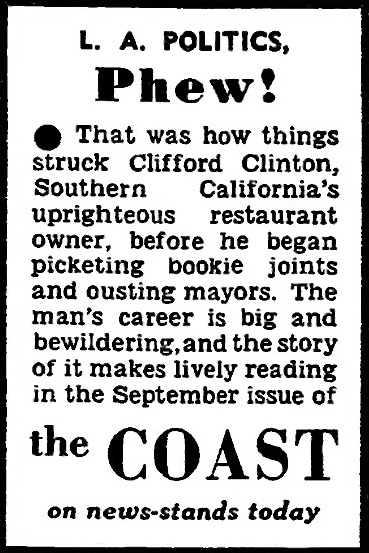
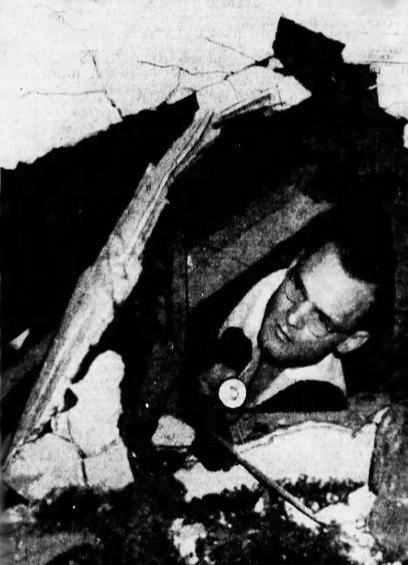
Through these years Clinton experienced endless phone threats, a bombing at his home, false reports of food poisoning at his restaurants, and an endless array of dirty tricks such as an invasion of one of his public forums by 300 hungry people who had been given tickets for a (non-existent) free meal of chicken and beer. [above: 1939 advertisement for magazine article; below: Clinton examines bomb damage]

Having turned the cafeterias over to his children in 1946, Clinton and his business partner, Ransom Callicott, focused on world hunger. They found a scientist who developed what would be known as Meals for Millions, a soy-based one-dish meal that could be prepared as soup or, with a little flour or corn meal added, bread.

Clinton died in 1969 but his restaurants, including a number of conventional ones in shopping centers, endured well into the 2000s.

© Jan Whitaker, 2024

11 Comments

Filed under cafeterias, Offbeat places, popular restaurants, proprietors & careers, restaurant decor, restaurants, theme restaurants

Dinner in Miami, Dec. 25, 1936

Judging from the number of restaurants and hotel dining rooms advertising Christmas or Xmas dinner that year, there must have been quite a few prospective diners around. It was still the Depression but prohibition had ended several years earlier, tourism was well underway, and Art Deco buildings were going up all over.

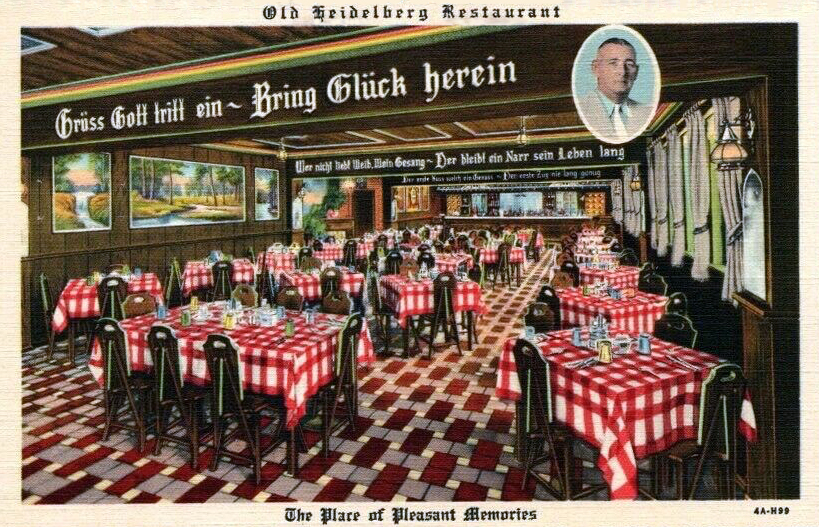
The not-at-all modernistic Old Heidelberg shown above – which had opened in the unfortunate year of 1929 — gave no details about its offerings that day, other than to characterize it as an “Old-Fashioned Dinner.” That’s a fairly meaningless description if you ask me. Given that Germany had withdrawn citizenship from Jews in 1935, this probably was not a restaurant popular with Miami’s Jewish community.

Most of the advertisements mentioned price, not surprising since most people had to watch their spending. They ranged from a low of 50¢ per person to a high of $2.00 at a place called the Rose Bowl, a restaurant specializing in Southern dishes, with a woman serving bread dressed as a “mammy.” Like the Heidelberg, the Rose Bowl made no effort in its Christmas advertisements to tout its dinner or whatever other attractions it might have possessed.

Others went to great length to attract diners. The Big And Little Grill had no end of attractions, including music, “gifts to all,” free parking, a chef who had formerly worked at a New Hampshire resort hotel, and a Santa Claus who once appeared in Charlie Chaplin’s movie “Circus.” All dinners were 75¢. The list of comestibles filled ten wide lines of text. It contained 35 separate items, among them a “Big and Little Salad,” Boiled Lobster Stuffed with Oysters, Supreme of Sole Florentine, Sizzling Steak with Wine, and numerous vegetables and desserts.

The Big and Little offered an equally good deal for its New Year’s celebration, with a return performance of Charlie Little, now in the role of clown. As for its advertisement, as a New Englander I’m obligated to point out that there is no Dixieville in New Hampshire – it’s Dixville.

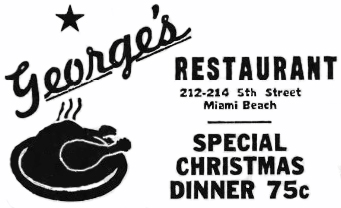
Attraction-wise, the Big and Little was hard to top. But George’s Restaurant tried hard, with even more inches of advertising, not to mention wine and bottled beer. Its 75¢ dinner comprised six courses: Cocktail (tomato juice, half grapefruit, etc.); a soup accompanied by olives and hearts of celery; a choice of five entrees that included Whole Broiled Lobster, Maitre d’Hotel (chances are these were clawless Florida lobsters, considered inferior to Maine’s); a salad; eight vegetables; choice of many desserts (six kinds of pie, a cake, a sundae, ice creams, jello, or stewed prunes). For those who didn’t have big appetites there was George’s Special 50¢ Dinner, which of course offered fewer choices and only half a lobster, but still looked like a bargain.

The Studio Grill’s turkey dinner included wine, which may have accounted for the $1.00 charge. Shortly after it opened a few years earlier, the suburban Miami curb service eatery had advertised for “Girls with Blonde Hair” who were 5’6″ tall, weighed 118 lbs., and had “striking” personalities. Undoubtedly reflecting Depression conditions, 800 showed up. The grill was owned by a magazine cover illustrator and was filled with his paintings of nude women.

The Laura Jacobsen Café, a high-class Chicago transplant, was located in a residential apartment hotel. Her Christmas dinner in the ritzy-looking Colonial Towers accommodating snowbirds from the North was $1.25.

Wherever and whatever you may eat, I hope you will enjoy your holiday dinner.

© Jan Whitaker, 2022

13 Comments

Filed under food, restaurant prices

Fish & chips & alligator steaks

The menu shown here caught my eye as I was browsing the internet. Of course, I wanted to know more about it. The first thing I discovered was that it is available as a reproduction.

Evidently the Trebor Dinner was a specialty menu for complete dinners of multiple courses. Three dollars was a steep price for the Depression when this menu was introduced, at least double what a comparable meal would have cost in a moderately-priced good restaurant then.

The illustrated menu shows 14 entrees. But the restaurant almost certainly did not have all the exotic items available at all times. Another fish & chips, inc. menu from 1937, for example, offered one appetizer, one soup, and only four entrees.

The menu could date any time from the opening of the restaurant in 1936 into the 1940s. Its clever design may have been due to owner Bob Winter’s background in advertising. Why the menu is named “Trebor Dinner” is a mystery. It’s possible that Trebor is a play on the owner’s name Robert.

Fish & chips, inc. was conveniently located in the Loop, across the street from the central Chicago library, now the Chicago Cultural Center. It was a handy location for a 1943 dinner of the literary members of the Boswell club, admirers of Doctor Samuel Johnson. In their honor the restaurant posted one of Johnson’s quotations over their table in which he criticized French menus, requesting “thy knaves to bring me a dish of hog’s pudding, a slice or two from the upper cut of a well roasted sirloin, and two apple dumplings.”

It was a popular restaurant, said to be especially well liked by male patrons. In 1944, during World War II, lines formed at the door. The following year it was enlarged to seat 300. [1949 advertisement shown]

With no meat on the menu, the restaurant would have had the advantage of escaping wartime food restrictions and shortages.

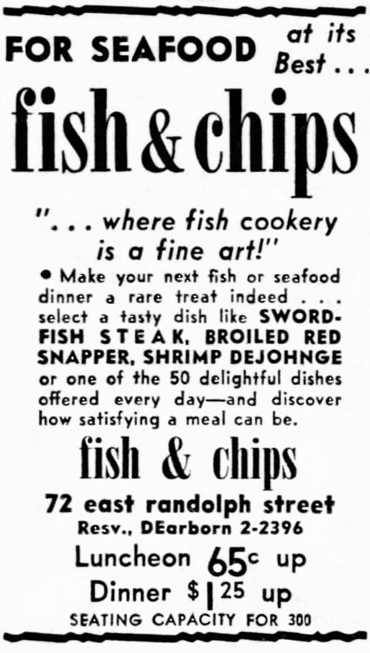
Advertising that it had 50 varieties of fish on hand daily, a lunch or dinner could include sunfish, crappies, smelts, cod, brook trout, sea bass, shrimp, and lobster among many others. The restaurant advertised heavily during the Lenten season.

Bob Winter died in 1953 and the entire contents of the restaurant were auctioned, including groceries.

© Jan Whitaker, 2021

16 Comments

Filed under alternative restaurants, food, menus, Offbeat places, patrons, popular restaurants

Lobster stew at the White Rabbit

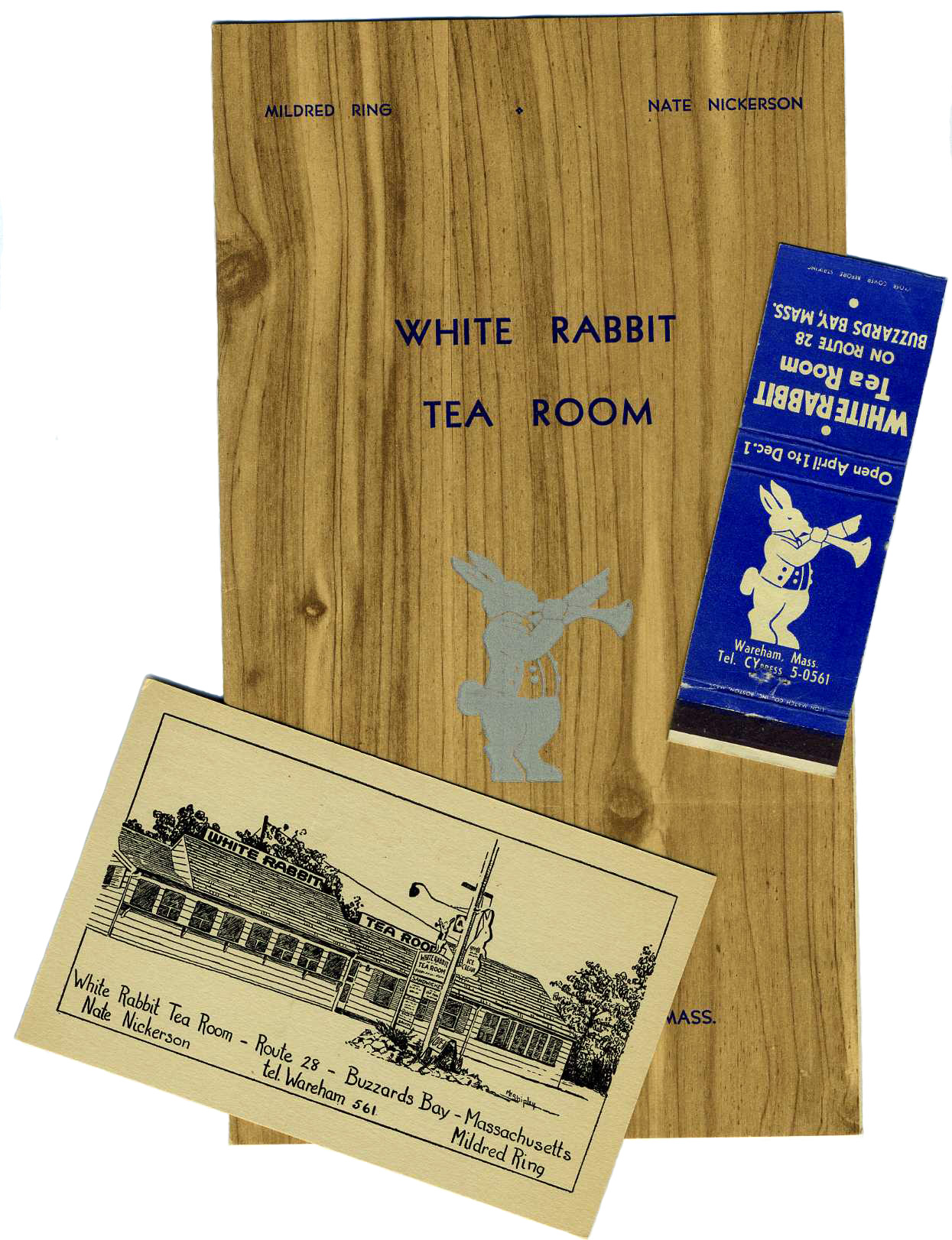
On the menu shown here a bowl of lobster stew cost 70 cents and came with crackers, pickles, and chips. Oyster stew was 50 cents, while fried clams with french fries, cole slaw, and coffee cost 60 cents.

The menu is undated but is probably from the 1940s. Fried lobster was one of the White Rabbit’s most popular dishes, according to Duncan Hines’ 1947 guide book, Adventures in Good Eating. With a fruit cup, tomato, pineapple, french fries, rolls, dessert, and tea or coffee, it came to $1.35. And, of course, they threw in pickles and chips.

In addition to lobster fried, sautéed, or stewed, it was also available as a salad.

Admiring patrons quoted in the 1948 edition of Gourmet’s Guide to Good Eating explained that the reason the Rabbit was always mobbed with people on their way to and from Cape Cod was due to its high standards, excellent food, and, specifically, “plates of hot buttered rolls.”

On Saturday nights the White Rabbit offered a traditional Massachusetts dinner of baked beans for 50 cents. Other interesting dishes on the menu include a vegetable salad sandwich (35¢), a sardine and horseradish sandwich (25¢), and a side order of tomato and cucumbers (15¢).

The tea room got its start in 1931, in West Chatham on the Cape, about 37 miles from the Buzzards Bay location which became its long-term home. Prior to its beginning, owner Nate Nickerson was a taxi driver in Brockton MA, where co-owner Mildred Ring may have worked as a waitress.

Nickerson’s two sons were waiters at the restaurant which was open only from April through November.

In 1966, the final year in which I found advertisements for it, the White Rabbit had evidently abandoned the tea room theme. It then featured liquor and steaks. Nickerson had died in 1950 and it’s likely that it was under different management.

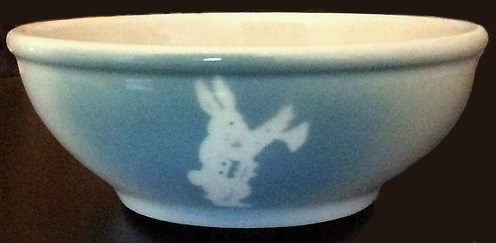
A few years ago I received a nice surprise when a stranger sent me this bowl by Syracuse china used in the tea room.

© Jan Whitaker, 2019

13 Comments

Filed under food, menus, popular restaurants, roadside restaurants, tea shops

Christmas dinner in the desert

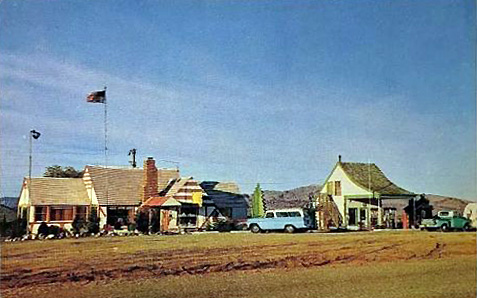
A red-and-white-striped restaurant named the Christmas Tree Inn located on a desolate stretch of road in the Arizona desert makes a little bit more sense when you learn that its creators were Los Angeles real estate developers.

The Christmas theme was, of course, a publicity gimmick, and one that worked rather well, at least at the beginning.

Ninon Rivé Talbott, a well known “subdivider” in L.A., opened the restaurant in 1939 with her husband Edward. It was intended to kick off an associated project, a housing development called Santa Claus Acres on the road leading to the newly completed Boulder Dam (renamed Hoover Dam in 1947).

The Talbotts had moved from Los Angeles to Kingman AZ in the early 1930s with an interest in developing tourist facilities. In 1929 they formed a corporation to build hotels along The Old Trails Highway (U.S. Highway 66), which went through Kingman. The road’s creation had been promoted by the Automobile Club of Southern California since the mid-teens, was officially designated in 1926, with paving beginning in 1931. The corporation’s first hotel was to be in Kingman, with others in Nevada, Utah, and California. (I could not determine whether any were built.)

The housing development scheme was undoubtedly spurred not only by the budding Route 66 but also the concurrent U.S. government plan to build Boulder Dam. After checking out a number of locations the government auctioned off some of the properties in the vicinity, including a 80-acre parcel acquired by the Talbotts.

However, although Santa Claus Acres building lots were sold, the housing development was foiled when it proved impossible to drill deep enough to access water.

Needless to say, the absence of water was quite a hindrance to the restaurant complex as well. Water had to be trucked in from Kingman, 14 miles away. However, the absence of water did not entirely defeat the Christmas Tree Inn, with its associated gas station and playhouses for children.

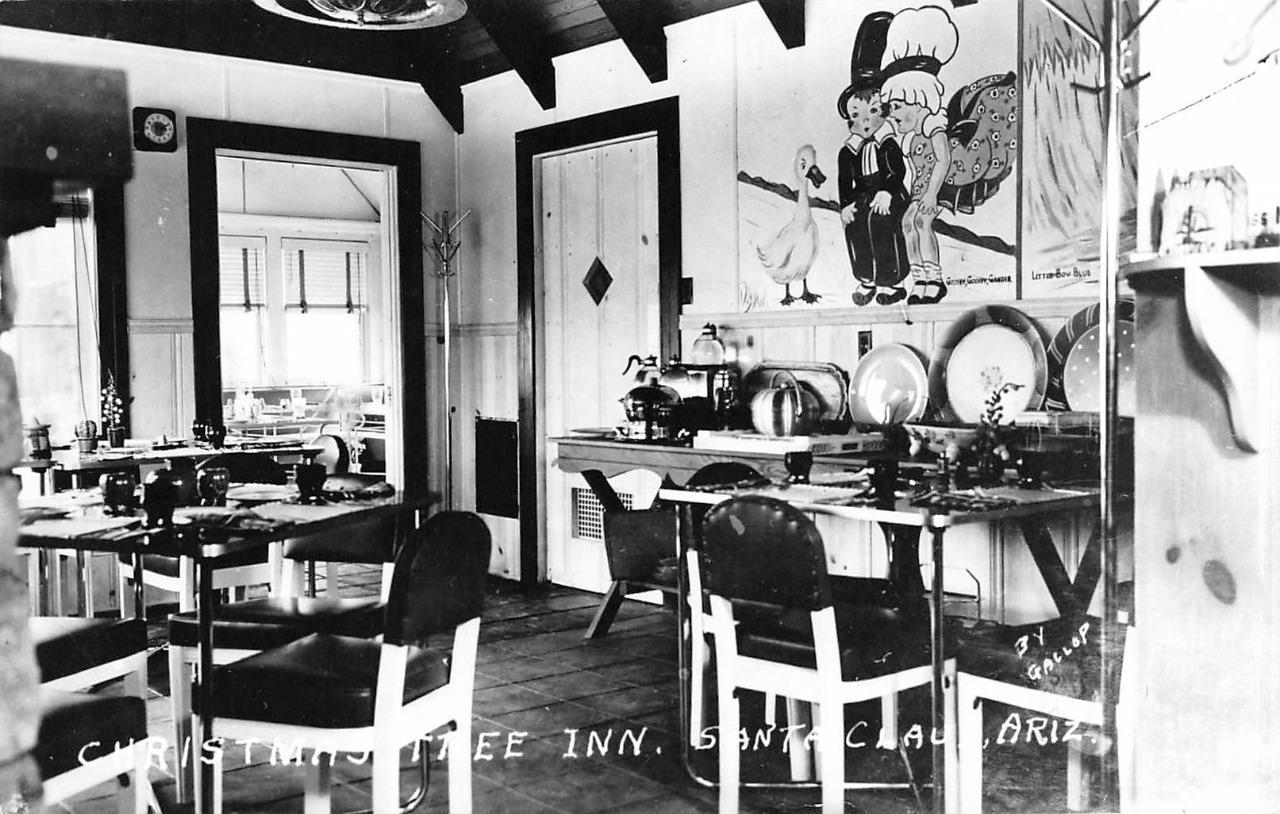
The Christmas Tree Inn complex, which comprised the entirety of “Santa Claus, Arizona,” was a classic do-it-yourself mid-century roadside attraction. Characteristically, it occupied an isolated spot in the wilderness, was garishly eye-catching, and somewhat makeshift. Still, the sight of it was so striking in the vast and empty desert that vacationing families with bored children were almost certain to stop there.

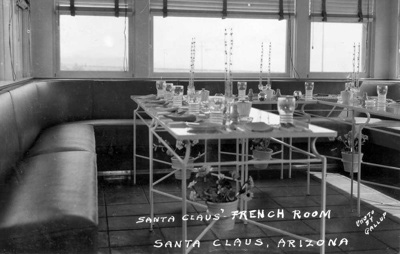
Despite the red and white stripes and the Christmas name, the complex had more of an overall story-book feel, with its Cinderella playhouse, Three Little Pigs hut, and indoor murals with goose girls and other characters. A second dining area, devoid of any theme decor, was inexplicably called the French Room.

Any early success was due primarily to Ninons’ initial efforts and those of the couple who acquired it next. Ninon dubbed herself “Mrs. Santa Claus,” claiming in 1939 that this was a character who seemed “to have been neglected up to this time.” Presumably it is a be-wigged Ninon depicted on the 1940 postcard above.

She was evidently quite a high-powered personality capable of motivating others and making deals. Married four times and mother of five children, she somehow managed to build a career as a realtor in the 1920s and 1930s. Additionally, she was said to be a fine cook who produced surprisingly delicious food for a small roadside eatery. A listing in Duncan Hines’ 1941 edition of Adventures in Good Eating recommended the Inn, saying “Perhaps the best rum pie you ever ate, chicken a la North Pole and lots of other unusual things.”

The war years had to be tough ones. Traffic must have been light due to gasoline rationing and elimination of public access to Boulder Dam from 1941 to September, 1945.

By 1946, the Inn seemed to be doing somewhat poorly judging from the listing in Hines’ guide, which tersely stated: “Serve cold sandwiches.” In 1947 and 1948 want ads appeared in Phoenix and Salt Lake City papers offering the restaurant complex for sale at $35,000, citing the seller’s ill health and that it had cost $60,000 to build. Ninon was 50 years old at that time. According to a 2008 article in The Journal of Arizona History by Douglas C. Towne, Ninon weighed 300 pounds and had a gambling addiction.

The second owners, Erma and “Doc” Bromaghim, carried on some of Ninon’s traditions such as answering children’s letters to Santa. The Bromaghins revealed in 1954 that December was a poor month for business, so they would close then, as well as January and February. Soon they gave up running the business completely, defeated in part by their renewed failure to find water.

Although the Christmas Tree Inn survived until about 1994, its later history was rocky, involving at least 10 owners and or lessees and managers. It was advertised for sale almost continuously.

Today, what is left of the complex is boarded up and covered with graffiti. As a quick internet search will demonstrate, it is an ever-popular subject for photographers fascinated by roadside ruins.

© Jan Whitaker, 2018

5 Comments

Filed under alternative restaurants, family restaurants, odd buildings, Offbeat places, roadside restaurants, women

Green Book restaurants

Interest in historical Green Book guides for Black travelers has been growing in the past decade and the new movie of this title will surely increase it.

The Green Books’ slogan, “Covering the United States like a blanket,” nicely sums up its goal of making travel more comfortable (maybe even enjoyable) for Black travelers living in a country that typically greeted them with hostility whenever they moved outside their restricted neighborhoods and social roles.

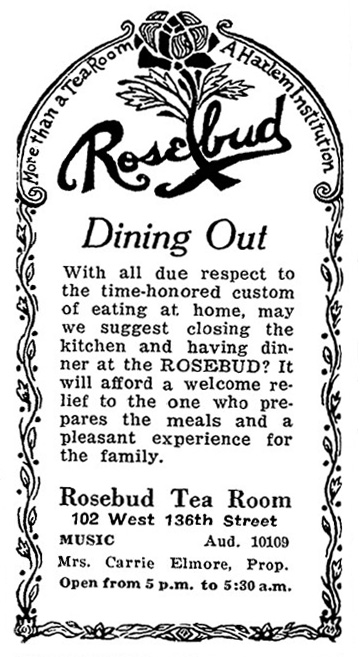
Prior to the arrival of the Green Book, Black Americans relied on the kindness of strangers – also Black – when traveling. Until the 1960s, Jim Crow laws in Southern states barred them from access to white hotels, resorts, and restaurants. Outside the South conditions were not much better, despite civil rights laws barring discrimination in many states. To deal with this, middle-class Black travelers relied on other Blacks who invited them into their homes, even providing meals despite not usually knowing them personally. According to Willis Duke Weatherford’s Race Relations (1934), “The institution of ‘dining out’ is not established among careful [Black] families – it is a reflection on the home to eat in a restaurant; it simply is not done.”

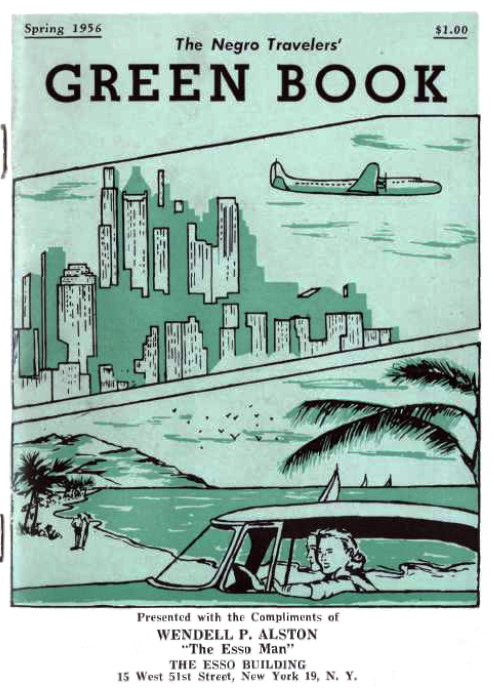
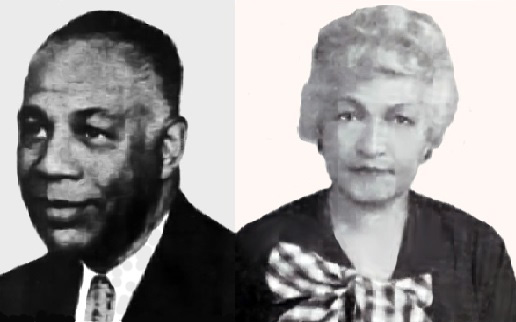
As travel increased among Black business people, entertainers, and tourists, accommodations in private homes were no longer adequate, especially for longer trips. A number of guides were published, among them the annual Negro Motorist Green Book published by Victor Hugo Green, a mail carrier in New Jersey. The guide was renamed the Negro Travelers Green Book in 1952. At some point in the 1950s, Victor became ill and his wife Alma took over as editor and publisher. The last two editions were by new owners.

The Green Books were first published in 1937, then every year after that except for four WWII years, ending with a 1966-1967 edition. With the exception of 1946 and 1958, all of the editions are available digitally in the New York Public Library. A 1946 edition sold for over $4,500 on eBay in 2016 and a copy is owned by Virginia Union University Library. As far as I can tell the 1958 edition is not publicly available. Several editions have been republished.

Green Books were sold directly to consumers and also distributed by Esso after Standard Oil of New Jersey hired a prominent Black businessman to promote Esso to Black motorists. Thirty-eight percent of Esso gas stations were operated by Black proprietors, according to a 1939 essay. Conoco also ran a Negro Travel Service which prepared custom “Touraides” free on request. Quite a few issues of guides devoted pages to new model cars of the major, and a few minor, automobile manufacturers. In the Black community cars were regarded as liberators, as well as providers of good jobs in the manufacturing and service sectors. An essay to this effect, “The Automobile and What It Has Done for the Negro,” appeared in the 1938 edition.

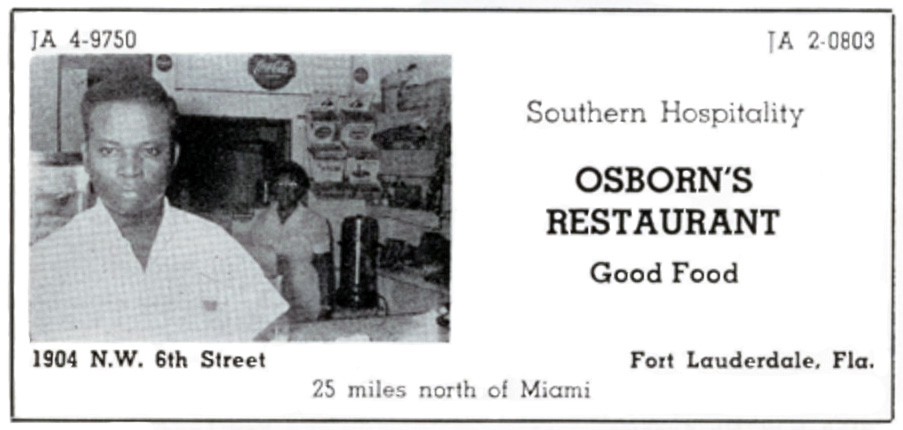
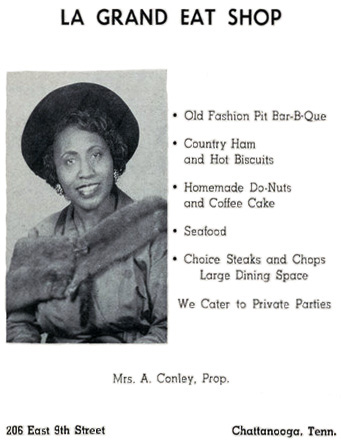
The books provided lists of hotels and tourist homes that were welcoming, most of them located in Black business areas of cities and towns. It also listed restaurants, roadhouses, taverns, nightclubs, beauty and barber shops, service stations, and other businesses. In later years it tended to focus primarily on places to stay. [Osborn’s, 1962]

I’ve looked at all the Green Books in the NYPL collection, paying special attention to restaurants in them. Overall there are not a huge number of restaurants. In 1939, for instance, only two restaurants are listed for the entire state of California.

Most of the restaurants seem to be in Black sections of towns, or are Chinese. Their numbers seem to have been dependent on Victor Green’s informants, who were said to be mail carriers like himself. Coverage was also spotty. Green lived in New Jersey and then New York City, and it’s noticeable that both states are more thoroughly covered than most others.

What seems to be lacking are restaurants in predominately white areas that welcomed Black customers. If Black tourists or business people were visiting Los Angeles, for instance, how would they know which restaurants in the main shopping or business districts would serve them without problems?

Comparing the Duncan Hines’ popular Adventures in Good Eating guide book of the late 1940s with a Green Book of roughly the same time reveals that there is no overlap whatsoever in their listings of Los Angeles restaurants. Not one of the 37 LA restaurants recommended by Hines is to be found in the Green Book or vice versa.

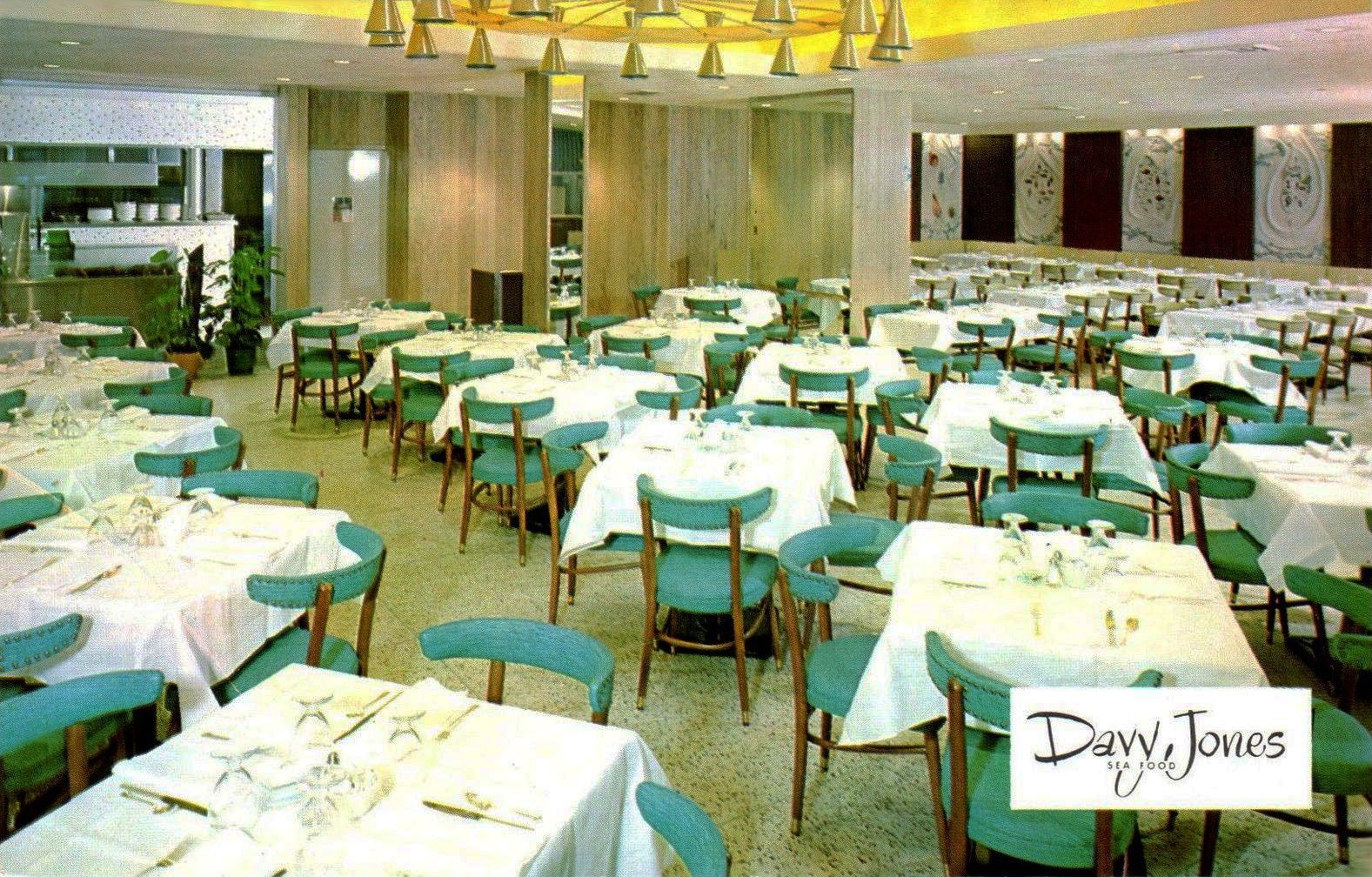
Things had changed somewhat by the 1962 edition. It is striking how many more white-owned and patronized restaurants are listed for New York City that year. Previously the only New York restaurants in the guides were located in Harlem, but now they are all over town. Among them are the Brass Rail chain, Davy Jones Seafood House, and Jack Dempsey’s. It’s hard to know whether the change was due to the policy of the restaurants or the Green Book.

Trying to learn more about restaurants listed in Green Books is difficult. Many I’ve looked for do not show up in city directories, nor in newspaper archives. Judging from feature advertisements for restaurants in later issues, many of the restaurants listed were small neighborhood places that served unpretentious home-cooked meals, quite similar to the majority of white-owned restaurants in the 1930s, 1940s, and 1950s.

I recognized a few names of well-known Black restaurants such as Paschal’s in Atlanta (est. 1947 as a small sandwich shop), Little Gray Shops #2 and #3 (considered Harlem’s better eating places in the 1930s), and Dooky Chase in New Orleans (like Paschal’s, still going strong today).

There was also a listing for Bagley’s, operated by Black socialite Caroline Bagley in Sheepshead Bay NY, as a kind of tea room with garden dining. A number of other tea rooms are listed, among them the Black Beauty Tea Room in Mount Olive NC, which had the distinction of being raided in 1950 for serving bootleg whiskey.

Probably quite a few restaurants in the Green Book were community institutions in their time, such as Hammond Café in Abilene TX, specializing in spicy chili. Certainly that was true of Harlem’s Aunt Dinah’s Kitchen, run by Broadway actor Richard Huey. Aunt Dinah’s hosted one-act plays and discussion forums in the 1930s and 1940s, and served as an informal support center for actors who needed a place to gather and have a free meal now and then.

Researching restaurants, hotels, etc. listed in the Green Books would be an interesting way to construct a picture of 20th-century Black life before the Civil Rights Act. It would make a good group project.

© Jan Whitaker, 2018

17 Comments

Filed under guides & reviews, patrons, racism

Famous in its day: the Blue Parrot Tea Room

blueparrot1920sjpg“Hoity toity” was how a resident of Gettysburg PA in the 1980s remembered The Blue Parrot Tea Room in its heyday.

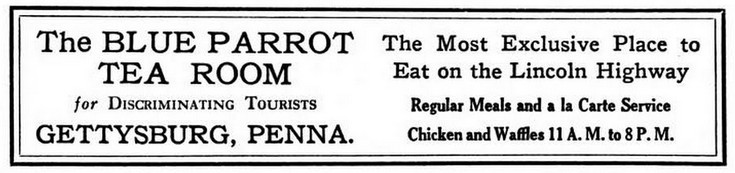
The tea room opened in 1920 on the Lincoln Highway (aka Chambersburg street) through Gettysburg [pictured above, before 1928]. Known initially as the Blue Parrot Tea Garden (rendered on its large lighted sign in pseudo-“Oriental” lettering), it was a soda fountain, candy store, and lunch spot at first. It quickly earned a reputation as an eating place for “discriminating” diners, according to its advertisement in the 1922 Automobile Blue Book [shown below]. Later advertising described the restaurant as modern, sanitary, and perfect for people who ran an “efficient table” at home.

blueparrotautobluebook1922

Its creator was Charles T. Ziegler, who spent years on the road as a salesman for a Chicago firm, returning to his hometown to open a gift shop in 1916 with the then-trendy name of Gifts Unusual. His shop featured imported articles such as Japanese household items and kimonos. In 1917 he bought the building his shop was in, turning it into a tea room a few years later.

blueparrotfoyer

blueparrotdiningroom

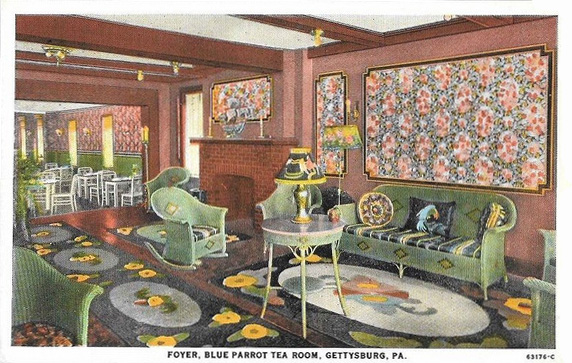
The tea room’s artistic decor, elements of which had reportedly come from England and Belgium, was of great interest to Gettysburgers. The sign on the front of the building was illuminated with 275 small lights (this was before neon). Thirty feet in length and topped with a blue parrot, the Gettysburg Times declared it “one of the most pretentious between Philadelphia and Pittsburgh.”

In 1927 a visitor noted fine aspects of the Blue Parrot that he observed, many vouched for by their brand names, such as Shenango China and Community Silver. He was pleased to note that the kitchen was shiny and spotless and even the potato peeler was “cleaned to perfection.” He was also gratified by the back yard area where “every fowl is killed, cleaned and dressed by the kitchen staff.”

blueparrotadvjuly1921The Blue Parrot remained the place to go for decades. Local colleges held dinners there, as did fraternal organizations and women’s clubs. Guests included bishops, Washington dignitaries, Harrisburg business men, and traveling celebrities. A high point came in 1926 when Douglas Fairbanks, Mary Pickford, and Gloria Swanson and her husband, the Marquis de la Falause, stopped for dinner on a chauffeured road trip following the New York funeral of Rudolph Valentino.

The Blue Parrot could be counted on to furnish special holiday meals for Thanksgiving, New Year’s Day, and Easter. In 1924 it published the following menu for Thanksgiving Dinner, served from 11 am to 9 pm.

Grape Fruit
Oyster Cocktail
Bisque of Tomato
Celery              Olives
Salted Nuts
Roast Vermont Turkey English Filling
Giblet Gravy            Cranberry Jelly
Orange Sherbert [sic]
Mashed Potatoes             Green Spinach au Egg
Waldorf Salad
Hot Mince Pie                            Lemon Meringue
Pineapple Parfait                   Chocolate Ice Cream
Mixed Fruit Ice Cream
Mints
Café Noir

Dinners at the Blue Parrot in the 1920s ran from $1.25 to $1.50, while lunches were often 75 cents. The tea room advertised its prices as moderate, yet probably they would have been out of reach for many of Gettysburg’s working class residents. In the 1930s Depression the Blue Parrot, like so many other restaurants, was forced to lower its prices considerably. In the mid-1930s it offered lunch platters at 30 cents and New Year’s and Thanksgiving dinners for as little as 50 cents.

No doubt the end of Prohibition was a life saver for the Blue Parrot. As soon as beer became legal in 1933, Ziegler opened a Blue Parrot Tap Room and Grill on the second floor, with extended hours, Pabst Blue Ribbon on tap, and 10-cent crab cakes and sandwiches. He was at the head of the line for a full liquor license when they became available a few months later. The bar and grill had a western slant with rustic log cabin decor, knotty pine paneling, and a wagon wheel light fixture, all likely meant to appeal to a wide range of male customers.

blueparrotnowIn 1944 Ziegler sold the business to Gettysburg’s fire chief, James Aumen, who ran it for the next ten years, after which it had a succession of owners. Even in recent times, the original name has continued as the Blue Parrot Bistro, and now the Parrot.

© Jan Whitaker, 2016

4 Comments

Filed under food, menus, proprietors & careers, restaurant decor, signs, tea shops

The “mysterious” Singing Kettle

singingkettlepcA veil of ominous mystery has spread over the remains of a California roadside tea room once known by the homey name Singing Kettle.

It was located near the summit of Turnbull Canyon, high above the San Gabriel Valley, on a winding road running through the Puente Hills in North Whittier. The road was completed in 1915, opening up a route filled with what many regarded as the most impressive views on the entire Pacific Coast.

singingkettle3781tcrstreetview

Today young people drive into the “haunted” canyon at night determined to be frightened to death. Gazing out car windows they eagerly tell each other tales they’ve heard of satanic rituals, murders, and human sacrifice, hoping that behind that fence are unspeakable horrors they might be lucky enough to witness. Even the Singing Kettle tea room, perhaps because remnants of its entrance are visible from the road, has become enmeshed in dark fantasies.

Why am I laughing?

Because it strikes me as funny that a tea room from the 1920s and 1930s could be associated with horror and paranormal events. Or even that people would find its existence mysterious, wondering why it was ever there or what it really was.

I suppose that given enough time and imagination mysterious auras can envelop any mundane place, even a deserted mall or a parking garage. But still, finding a tea room scary is like being frightened by a club sandwich.

I have experienced a somewhat similar attitude before. I gave a talk on tea rooms of New York City when my book Tea at the Blue Lantern Inn came out in 2002. Afterwards a man in the audience came up and asked me why I didn’t mention the darker aspects of tea rooms. He was fixated on the idea that a lot of them had been speakeasies and houses of prostitution.

Really? If that had indeed been the case, why would I not have mentioned it? It would be a good story. I’ve found little evidence of prostitution in tea rooms. It’s true that some, a minority, of tea room proprietors were found selling liquor during Prohibition. A few places in Greenwich Village were raided in the early 1920s, and here and there the mob would open a joint and call it a tea room, though that was purely a ruse. They were totally fake. I feel certain it was impossible to order a diet plate or a Waldorf salad in a mob tea room.

singingkettleentireproperty

The dining area of the Singing Kettle tea room was up the hill from the pergola entrance shown on the black and white postcard above. As can be seen from a bird’s-eye view of the property, terraced stairs with fountains and shrubbery led up to the main tea room which today appears to be a residence. The view while dining would have been spectacular.

The tea room was frequented by students and staff from Whittier College, the Whittier Chamber of Commerce, and women’s clubs. It was a popular place for business meetings, card parties, wedding receptions, and bridal showers. Weddings were held in the inner courtyard of its entrance pergola.

singingkettlehartwhittierheights1927I have not been able to discover exactly who ran the Singing Kettle. It was said to be owned and operated by a major Southern California agricultural land developer, Edwin G. Hart, but I can’t establish if he was headquartered on the property or was directly involved in the business. He did promote the tea room in a 1927 advertisement for his new residential development, Whittier Heights.

The Singing Kettle was in business from 1926 until at least 1939, but probably not much longer. It surely would not have survived gasoline rationing during WWII.

© Jan Whitaker, 2016

With many thanks to the reader who told me about the Singing Kettle.

21 Comments

Filed under atmosphere, odd buildings, Offbeat places, roadside restaurants, tea shops