Category Archives: tea shops

Reading the tea leaves

Although “gypsy” tea rooms could be found in the 1920s, and occasionally even now, their heyday was in the 1930s Depression.

They represented a degree of degeneration of the tea room concept in that they built their allure on tea leaf reading as much as – or more than — food. The menus in some of them consisted simply of a sandwich, piece of cake, and cup of tea, typically costing 50 cents. A drug store in New Orleans reduced the menu to a toasted sandwich and tea for the low price of 15 cents.

Gypsy tea rooms were often located on the second or third floor of a building, reducing the rent burden. Downtown shopping districts were popular places to attract customers, with about twenty near NYC stores located in the 30s between 6th and 7th Avenues. Los Angeles had a Gypsy Tea Room across the street from Bullock’s department store, while Omaha’s Gypsy Tea Shop, affiliated with another one in Council Bluffs IA, was across from the Brandeis store.

Times were hard, and Gypsy, Mystic, or Egyptian tea rooms, as they were known, offered a diversion from the concerns of the day and a way to prop up tottering businesses.

Usually it was all in fun. Gypsy tea rooms dressed waitresses in peasant costumes with bandana headdresses and adopted brilliant color schemes such as orange and black with yellow candles, and red tables and chairs. Such decor was a formula worked out by a New York City woman who by 1930 had opened 25 such places all over the country. Evidently after opening each one she sold it to a new owner.

Most customers, almost always women, saw the readings as light entertainment suitable for clubs and parties. Sometimes, though, an advertisement suggested that patrons’ reasons for having their tea leaves read were not so happy. A 1930 advertisement for the Mystic Tea Room, in Kansas City MO, asked “Have You Worries? Financial, domestic or otherwise? Our gifted readers will help you solve your problems.”

Many tea leaf readers had names suggesting they were “real gypsies” but that is unlikely, despite the Madame Zitas, Estellas, and Levestas. In fact, the reason that tea rooms advertised free readings was because many states and cities had laws prohibiting payment for fortune telling so as to keep genuine gypsies from settling there. A Texas law of 1909 declared “all companies of Gypsies” who supported themselves by telling fortunes would be punished as vagrants.

New York state passed a law in 1917 that made fortune telling in New York City illegal. In the 1930s police conducted raids of tea rooms advertising tea leaf readings. The raids did little to reduce their ranks and tea rooms continued to announce readings. A “gypsy princess” on site was an undeniable attraction — “Something New, Something Different,” according to an advertisement for Harlem’s Flamingo Grill and Tea Room on 7th Avenue.

In 1936 an attempt was made to organize tea leaf readers but it didn’t seem to amount to much. Members of the National Association of Fortune Tellers were required to be “scientific predictors,” just as good at forecasting as Wall Street brokers. The group’s organizer said she wanted to professionalize fortune telling. Because 32 states had laws against it, she said, tea room readers were forced to work for tips only, to the benefit of tea room owners.

Tea leaf readers seemed to move around quite a bit, perhaps because tea room proprietors wanted to keep things interesting. It was supposed to generate excitement when a “seer” from abroad or a larger city visited a small town tea room. A male clairvoyant such as Pandit Acharjya of Benares, India, was bound to enliven the atmosphere at the Gypsy Tea Room in New Orleans in 1930. And to the River Lane Gardens in Jefferson City MO, even the week-long appearance of “Miss Ann Brim of St. Louis, Famous Reader of Cards and Tea Leaves” was worth billing as a major attraction.

In Boston, the Tremont Tea Room has been doing business in sandwiches and tea leaf readings since 1936. Proving, as if proof is needed, that no “restaurant” concept ever totally dies away.

© Jan Whitaker, 2017

8 Comments

Filed under alternative restaurants, atmosphere, decor, Offbeat places, restaurant controversies, tea shops, uniforms & costumes, women

Tea-less tea rooms

Tearooms thrived during national Prohibition when they didn’t have to compete with eating places serving more spirited beverages. With their delicate china, tiny portions, female clientele – and tea — they had a reputation for being too genteel, too precious, and too proper.

Since the Victorian era, it had been well established that respectable women didn’t drink alcohol, except maybe a little wine at dinner parties in the home. Never in public.

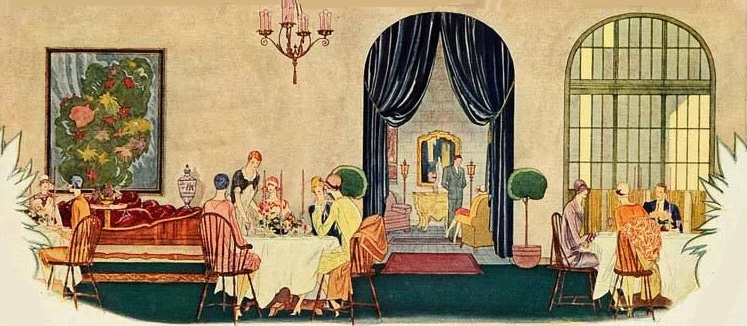
As with anything that is ever so proper, of course, skeptical watchdogs took their posts to keep a close eye on tea rooms from the beginning, not entirely trusting women out on their own. In 1912 the New York Times ran a story in which it was alleged that society women could and did enjoy whiskey, gin, and vodka in six out of eighteen Manhattan tea rooms visited. Though liquor selling was not illegal at this time, the tea rooms were not licensed to sell it. [Pergola Tea Room shown above]

I wonder: Could it be possible that places such as Vanity Fair and Mary Elizabeth’s, both in business in 1912, slipped forbidden drinks to their elite patrons? Perhaps “The Scotch Tea Room” implied a different meaning than I thought.

Some years later, with liquor now illegal, New York City’s law-breaking tea rooms spread across town. To all appearances, though, police were harder on avant-garde “bohemian” tea rooms than they had been on bourgeois society’s unlicensed haunts. In the 1920s, Greenwich Village places such as the Black Parrot, the Blue Bird, and the Witch Cat were easy targets.

New York City was scarcely the only city with liquored-up tea rooms. The Moulin Rouge in Baltimore, the Welcome Tea Room in Long Branch NJ, even the Lady Ann Cavendish Tea Room in the upscale Wilshire District of Los Angeles where society women sipped, were all found serving cocktails.

In 1923 the trade magazine Tea Room and Gift Shop felt compelled to state that although a New Jersey tea room proprietor had recently been fined $1,000 for selling liquor, “the percentage [of tea rooms] doing this is very small – in fact we feel certain that none of the better class are violating the law.” Mostly, but not entirely, true.

Pictured here is former star of the musical theater, May Yohe, in 1926, two years after liquor was found in her Marlow NH tea room, The Blue Diamond. How her fortunes had declined. The tea room was named after the Hope diamond, which she had once possessed (by virtue of marriage).

As the 1920s wore on, many of the tea rooms that were found violating the law seemed to be tea rooms in name only. It certainly sounds suspicious that The Chimney Corner, in Scotch Plains NJ, was destroyed by fire only a few days after its two proprietors – both men – were arrested in a raid. Based on an advertisement in 1921, it may have originally been a legitimate tea room.

Other places, often run and patronized by men, that offered drugs and prostitutes in addition to liquor, were not genuine tea rooms, no matter what they pretended. When the Raritan Township NJ police chief raided the Triangle Tea Room in unincorporated Potters NJ, he found seven male patrons, none drinking tea. When he happened to touch what he thought was a light switch a wall swung open revealing two nude young women who rather unconvincingly claimed to be the proprietors.

At the same time the police chief of Raritan Township was raiding criminally inclined tea rooms, his counterpart in Union Township NJ was investing in one. He was arrested in 1929 and charged with being a partner with two other men in a disorderly house. Called The Blue Lantern (a name which, coincidentally, is in the title of my book), it also provided patrons with liquor and a slot machine.

All in all, it’s not clear that running a tea room actually provided that much cover for illicit activity. Nor did the illegal booze and the raids do much to dent the reputation of tea rooms as feminine spaces where women gathered, played bridge, and ate fancy desserts. Once Prohibition ended in the early 1930s, a tamer form of tea room entertainment, fortune-telling, soared in popularity.

© Jan Whitaker, 2017

7 Comments

Filed under Offbeat places, patrons, tea shops, women

Finds of the day: two taverns

Steuben Taverns

Two small finds on a cold, rainy day at the Brimfield flea market. Both are from the 1930s, both are taverns, and both conjure up bygone days. But beyond that, the two – one representing a chain of German-themed restaurants and the other a small-town tea room – have little in common.

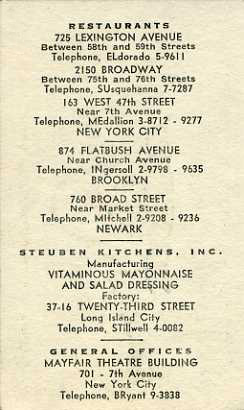
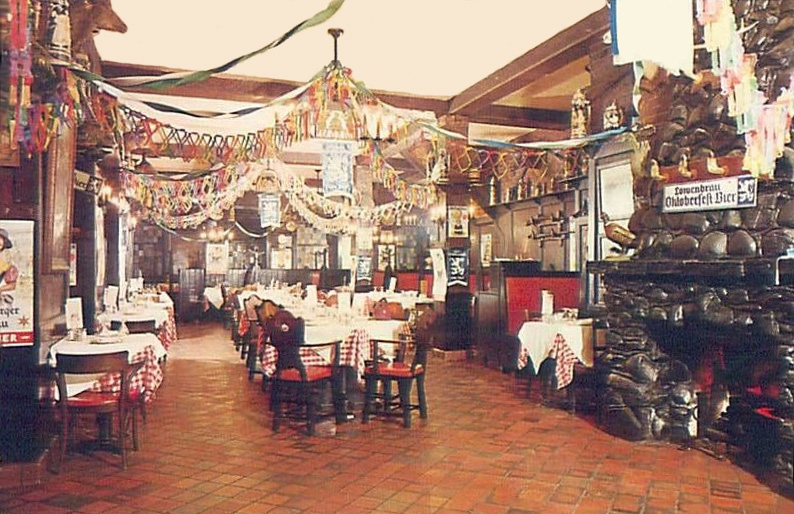
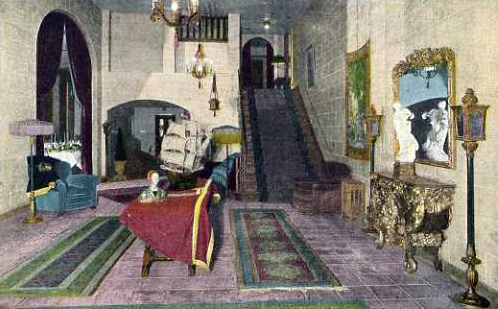
Steuben Taverns was a chain of pseudo-Bavarian restaurants located in big cities. The first, on 47th Street, was opened in New York City in 1930 and was the longest survivor of the moderate-priced chain, staying in business until 1971 [the postcard of the interior below is probably of the 47th Street place]. At its peak the chain had about a dozen restaurants, mainly in NYC but also in Newark, Baltimore, and Philadelphia.

The business encountered a few bumps along the road. Opening a huge, block-long unit in Times Square in 1934 proved difficult, dragging out to 14 months, because the restaurant was located over the Times Square subway station, which had to be redesigned. Despite selling a lot of beer (Prohibition had just ended) and seating 800 customers, the Times Square Steuben Tavern failed just five years later.

Meanwhile the chain suffered more grief in 1936 during a mobster shakedown that affected a number of high-profile NYC restaurants. As a chain the Taverns allegedly paid a particularly high sum – $17,000 – to ensure that the racket leaders did not carry out their threats to send “union” picketers or set off stench bombs.

Strangely, given its German theme, the Steuben Tavern in Newark evidently entertained many Jewish patrons in the 1930s. On September 14, 1934, with the Nazis in power in Germany, the restaurant took out an advertisement in Newark’s Jewish Chronicle wishing its patrons the best for the Jewish holidays.

White Gate Tavern

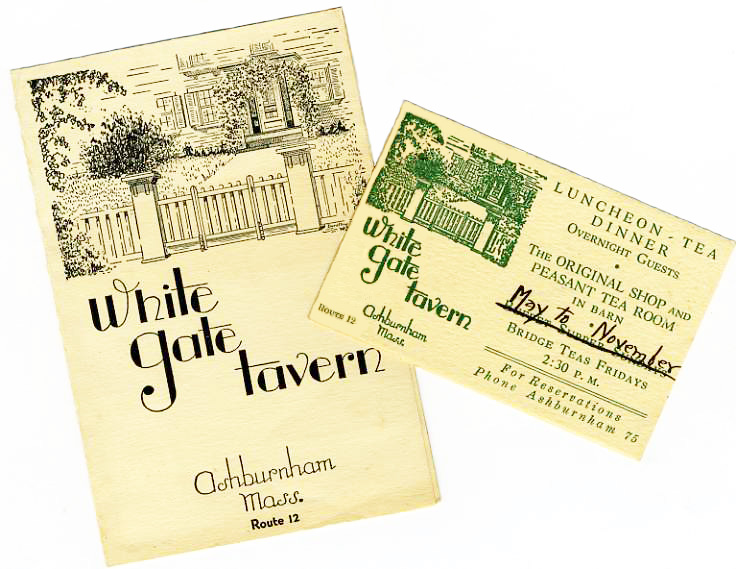
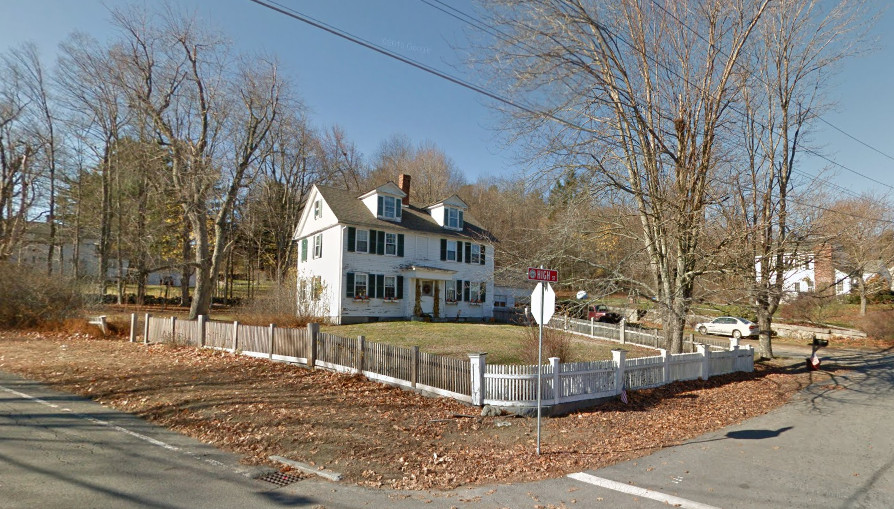
It was almost as though the White Gate Tavern was in another country altogether, one without beer, racketeers, or subway stations. It began in business in August of 1932 in the town of Ashburnham, Massachusetts, in a 100-year-old house formerly occupied by a Latin teacher at the town’s private school, Cushing Academy.

Its proprietors were two unmarried middle-aged women, both of whom had worked for the Y.W.C.A. at one point. Ida J. Lyon was from Connecticut and, as a member of the Daughters of the American Revolution, a bona-fide Yankee. Her partner, Helen G. Cowell, was the daughter of the late but long-time principal of Cushing Academy.

The two women set about having the house remodeled for use as a guest house and tea room. They installed a modern kitchen with electric refrigeration, a convenience undoubtedly not enjoyed by many of the townspeople at that time. They emphasized the house’s old-fashioned Colonial features as they were considered “homey” by their prospective patrons. The dining rooms were decorated in a green and yellow color scheme that was carried over to the dishes and glassware. In 1932 – in the depths of the Depression – they offered special Sunday dinners for $1.00 and $1.50. (By comparison the Steuben Taverns advertised their “famous” 55-cent dinners on the business card from about the same time.)

In the next few years, further improvements were made to the White Gate Tavern. A yarn shop where knitting lessons were given was opened in a finished room in a barn adjoining the house. In 1935 the interior of the house was renovated and the kitchen was enlarged. A so-called Peasant Tea Room was opened in the barn, along with a “Sunbeam Shop,” a gift shop with crafts made by villagers.

The White Gate Tavern probably closed in the late 1930s. I could find no trace of it after 1937 — the local newspaper carried no further notices of its annual opening for the season or the usual lists of guests who stayed there.

The house is still standing and from the outside likely looks much like it did in the 1930s.

© Jan Whitaker, 2017

2 Comments

Filed under chain restaurants, proprietors & careers, tea shops, women

Training department store waitresses

It is said that department stores of the 20th century offered “luxury for the masses.” This was nowhere as evident as in the stores’ tea rooms.

A shining example was the tea room at Younkers Department Store in Des Moines, Iowa. Although residents of large coastal cities might imagine that their stores were the most luxurious and elegant, this was not strictly true. Department stores in smaller cities often had much higher status and influence in the eyes of their customers. In the case of Younkers, the flagship store was located near the middle of the state, making the store accessible to the entire population of Iowa. It is hardly surprising that it adopted the motto “Iowa’s Foremost Mercantile Establishment.”

And so the store’s tea room absolutely had to be a superior eating place, one that drew countless individuals, clubs, families, sororities, and professional organizations from every point in the state.

Although a tea room was first opened in 1913 in the original Younkers building, the one familiar to Iowans living today was opened in the mid-1920s after Younkers acquired the neighboring Wilkins Department store and built a narrow 4-story bridge between the two buildings in 1924. The new tea room on the 6th floor of the Wilkins building had ceilings over 18 feet tall, chandeliers, grand columns, and large arched windows. Patrons sat on federal-style urn-back chairs at tables with white tablecloths and stemmed water glasses. In addition to the main tea room seating 350 persons, there were several party and meeting rooms. A lounge outside the main tea room was decorated in Spanish revival style.

Recently I found a Tea Room Waitress Service Manual for Younkers, probably dating from the 1930s. [part of page 1 shown] It reveals the high standard of service expected from the staff, despite the fact that prices were moderate. Though undoubtedly predominantly white and culturally homogeneous, Younkers patrons represented a cross-section of ordinary Iowans. Yet in many ways the tea room aspired to the quality of appointments and service only found in certain expensive restaurants today.

The manual instructs waitresses that they must wear plain black shoes without “fancy stitching” or buckles. Uniforms were colored and came with a white apron, white collar, cuffs, and headband. Perfect alignment was required in all things. When dressing, for example, the “collar must fit in exact V in front, black bow straight at point of V.” The servers were to stand straight, “never . . . with hands on hips.” Light makeup was permitted but no jewelry other than a wedding ring.

Alignment in setting the tables was equally critical. The two creases of a tablecloth had to “come together in center of table.” Knives were to be placed to the right of the plate with the sharp edge facing inward, “one inch from edge of table.” Salt and pepper shakers were to be “placed straight with lines of table.” When doilies were used for parties, servers were to “Be careful to place linen straight, if round doilies, thread of linen should run parallel to edge of table.” The tip of a slice of pie had to point “directly to customer.”

Of course great care was demanded in all things. Finger bowls were to be presented on a saucer. Dishes were to be served holding a folded towel underneath. After filling water glasses before guests arrived for a party, the waitress was instructed to “Check the chairseats for any drops of water.” And of course, “Make as little noise as possible in handling silverware, dishes, and trays at all times.” To insure silence, trays were to be set down upon pads, particularly in the evening.

It is easy to see why so many Iowans were sad to see Younkers flagship store close in 2005.

© Jan Whitaker, 2017

12 Comments

Filed under atmosphere, decor, department stores, popular restaurants, tea shops, uniforms & costumes

Famous in its day: the Blue Parrot Tea Room

blueparrot1920sjpg“Hoity toity” was how a resident of Gettysburg PA in the 1980s remembered The Blue Parrot Tea Room in its heyday.

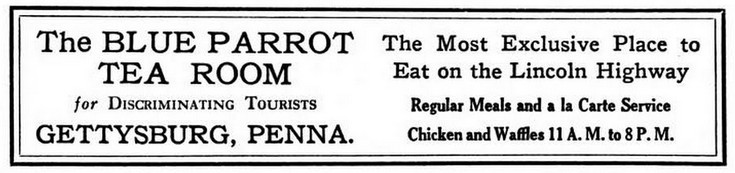
The tea room opened in 1920 on the Lincoln Highway (aka Chambersburg street) through Gettysburg [pictured above, before 1928]. Known initially as the Blue Parrot Tea Garden (rendered on its large lighted sign in pseudo-“Oriental” lettering), it was a soda fountain, candy store, and lunch spot at first. It quickly earned a reputation as an eating place for “discriminating” diners, according to its advertisement in the 1922 Automobile Blue Book [shown below]. Later advertising described the restaurant as modern, sanitary, and perfect for people who ran an “efficient table” at home.

blueparrotautobluebook1922

Its creator was Charles T. Ziegler, who spent years on the road as a salesman for a Chicago firm, returning to his hometown to open a gift shop in 1916 with the then-trendy name of Gifts Unusual. His shop featured imported articles such as Japanese household items and kimonos. In 1917 he bought the building his shop was in, turning it into a tea room a few years later.
blueparrotfoyer

blueparrotdiningroom

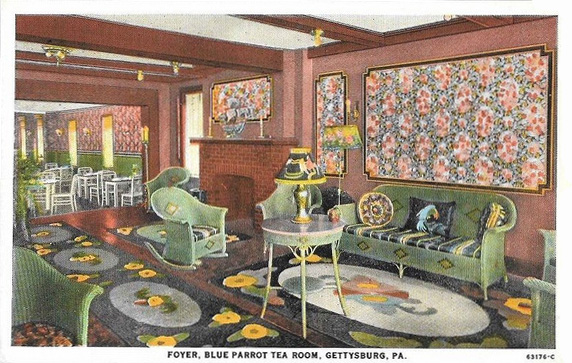
The tea room’s artistic decor, elements of which had reportedly come from England and Belgium, was of great interest to Gettysburgers. The sign on the front of the building was illuminated with 275 small lights (this was before neon). Thirty feet in length and topped with a blue parrot, the Gettysburg Times declared it “one of the most pretentious between Philadelphia and Pittsburgh.”

In 1927 a visitor noted fine aspects of the Blue Parrot that he observed, many vouched for by their brand names, such as Shenango China and Community Silver. He was pleased to note that the kitchen was shiny and spotless and even the potato peeler was “cleaned to perfection.” He was also gratified by the back yard area where “every fowl is killed, cleaned and dressed by the kitchen staff.”
blueparrotadvjuly1921The Blue Parrot remained the place to go for decades. Local colleges held dinners there, as did fraternal organizations and women’s clubs. Guests included bishops, Washington dignitaries, Harrisburg business men, and traveling celebrities. A high point came in 1926 when Douglas Fairbanks, Mary Pickford, and Gloria Swanson and her husband, the Marquis de la Falause, stopped for dinner on a chauffeured road trip following the New York funeral of Rudolph Valentino.

The Blue Parrot could be counted on to furnish special holiday meals for Thanksgiving, New Year’s Day, and Easter. In 1924 it published the following menu for Thanksgiving Dinner, served from 11 am to 9 pm.

Grape Fruit
Oyster Cocktail
Bisque of Tomato
Celery              Olives
Salted Nuts
Roast Vermont Turkey English Filling
Giblet Gravy            Cranberry Jelly
Orange Sherbert [sic]
Mashed Potatoes             Green Spinach au Egg
Waldorf Salad
Hot Mince Pie                            Lemon Meringue
Pineapple Parfait                   Chocolate Ice Cream
Mixed Fruit Ice Cream
Mints
Café Noir

Dinners at the Blue Parrot in the 1920s ran from $1.25 to $1.50, while lunches were often 75 cents. The tea room advertised its prices as moderate, yet probably they would have been out of reach for many of Gettysburg’s working class residents. In the 1930s Depression the Blue Parrot, like so many other restaurants, was forced to lower its prices considerably. In the mid-1930s it offered lunch platters at 30 cents and New Year’s and Thanksgiving dinners for as little as 50 cents.

No doubt the end of Prohibition was a life saver for the Blue Parrot. As soon as beer became legal in 1933, Ziegler opened a Blue Parrot Tap Room and Grill on the second floor, with extended hours, Pabst Blue Ribbon on tap, and 10-cent crab cakes and sandwiches. He was at the head of the line for a full liquor license when they became available a few months later. The bar and grill had a western slant with rustic log cabin decor, knotty pine paneling, and a wagon wheel light fixture, all likely meant to appeal to a wide range of male customers.

blueparrotnowIn 1944 Ziegler sold the business to Gettysburg’s fire chief, James Aumen, who ran it for the next ten years, after which it had a succession of owners. Even in recent times, the original name has continued as the Blue Parrot Bistro, and now the Parrot.

© Jan Whitaker, 2016

4 Comments

Filed under food, menus, proprietors & careers, restaurant decor, signs, tea shops

The “mysterious” Singing Kettle

singingkettlepcA veil of ominous mystery has spread over the remains of a California roadside tea room once known by the homey name Singing Kettle.

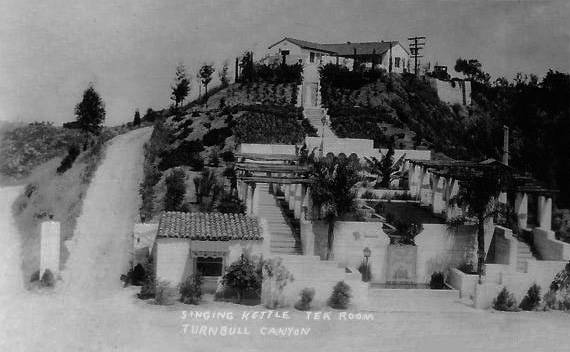
It was located near the summit of Turnbull Canyon, high above the San Gabriel Valley, on a winding road running through the Puente Hills in North Whittier. The road was completed in 1915, opening up a route filled with what many regarded as the most impressive views on the entire Pacific Coast.

singingkettle3781tcrstreetview

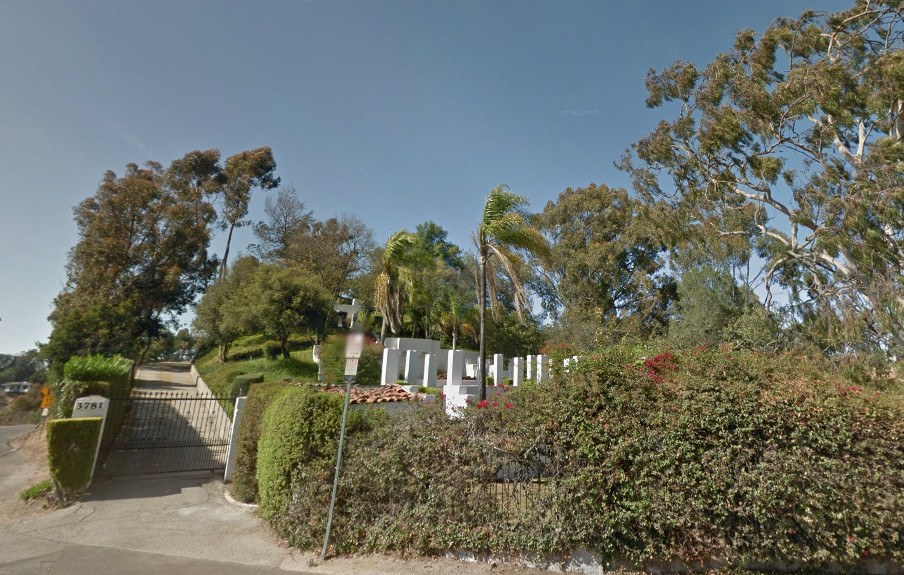
Today young people drive into the “haunted” canyon at night determined to be frightened to death. Gazing out car windows they eagerly tell each other tales they’ve heard of satanic rituals, murders, and human sacrifice, hoping that behind that fence are unspeakable horrors they might be lucky enough to witness. Even the Singing Kettle tea room, perhaps because remnants of its entrance are visible from the road, has become enmeshed in dark fantasies.

Why am I laughing?

Because it strikes me as funny that a tea room from the 1920s and 1930s could be associated with horror and paranormal events. Or even that people would find its existence mysterious, wondering why it was ever there or what it really was.

I suppose that given enough time and imagination mysterious auras can envelop any mundane place, even a deserted mall or a parking garage. But still, finding a tea room scary is like being frightened by a club sandwich.

I have experienced a somewhat similar attitude before. I gave a talk on tea rooms of New York City when my book Tea at the Blue Lantern Inn came out in 2002. Afterwards a man in the audience came up and asked me why I didn’t mention the darker aspects of tea rooms. He was fixated on the idea that a lot of them had been speakeasies and houses of prostitution.

Really? If that had indeed been the case, why would I not have mentioned it? It would be a good story. I’ve found little evidence of prostitution in tea rooms. It’s true that some, a minority, of tea room proprietors were found selling liquor during Prohibition. A few places in Greenwich Village were raided in the early 1920s, and here and there the mob would open a joint and call it a tea room, though that was purely a ruse. They were totally fake. I feel certain it was impossible to order a diet plate or a Waldorf salad in a mob tea room.

singingkettleentireproperty

The dining area of the Singing Kettle tea room was up the hill from the pergola entrance shown on the black and white postcard above. As can be seen from a bird’s-eye view of the property, terraced stairs with fountains and shrubbery led up to the main tea room which today appears to be a residence. The view while dining would have been spectacular.

The tea room was frequented by students and staff from Whittier College, the Whittier Chamber of Commerce, and women’s clubs. It was a popular place for business meetings, card parties, wedding receptions, and bridal showers. Weddings were held in the inner courtyard of its entrance pergola.

singingkettlehartwhittierheights1927I have not been able to discover exactly who ran the Singing Kettle. It was said to be owned and operated by a major Southern California agricultural land developer, Edwin G. Hart, but I can’t establish if he was headquartered on the property or was directly involved in the business. He did promote the tea room in a 1927 advertisement for his new residential development, Whittier Heights.

The Singing Kettle was in business from 1926 until at least 1939, but probably not much longer. It surely would not have survived gasoline rationing during WWII.

© Jan Whitaker, 2016

With many thanks to the reader who told me about the Singing Kettle.

21 Comments

Filed under atmosphere, odd buildings, Offbeat places, roadside restaurants, tea shops

Tea at the Mary Louise

MaryLouiseTR1928BestFoodsADV2200W7th

In 1914 the J. W. Robinson department store arrived on West Seventh and Grand, launching a shift in Los Angeles’ shopping district from Broadway. The following year the Brack Shops began leasing specialty shops in an empty loft building nearby. Construction activity boomed as Seventh Street turned into a shopping mecca.

Will and Dolla Harris staked the future of the Mary Louise Tea Room on the prosperity of West Seventh. In 1918 they opened their first tea room on the 12th floor of the Brack Shops. With wide hallways allowing shops to open their doors and let goods spill outside, it resembled a modern-day shopping mall. Shoppers could easily spend the day having their hair done, browsing the latest styles, or enjoying lunch, tea, or a Thursday night chicken dinner at the Mary Louise.

MaryLouiseBarkerBros790Through the 1920s the Mary Louise expanded, opening additional tea rooms on West Seventh — on the mezzanine of the fashionable New York Cloak & Suit House, and on the top floor of the gigantic Barker Brothers home furnishings store [shown here]. In 1922 construction began on what would be the largest of the Mary Louise tea rooms [shown below], a two-story building across from Westlake Park (renamed MacArthur Park in 1942). It opened in 1923 and was soon followed by a Mary Louise in Fullerton, next door to the new Alician Court movie theater owned by Dolla’s brother Charles S. Chapman. The last Mary Louise, whose servers were young Asian-American women dressed in Chinese costumes, opened in 1931 on North Cahuenga in Hollywood.

MaryLouiseEXT792

Shortly after its debut, the park-side Mary Louise advertised it was “the Center of the City’s Social Life.” Wedding parties and meetings of professional groups were booked regularly. Elaborately decorated on a lavish budget equal to more than half the cost of construction, the capacious building held a large entry hall [shown below] and dining room [shown at top] on the first floor plus an afternoon tea room, a banquet hall, and four smaller dining rooms for private parties on the second. In sync with the fashion of the day, the rooms had themes such as Mah Jong and Italian tea garden.

MaryLouiselobby789As can be seen on postcards from the Mary Louises in Barker Brothers and opposite Westlake Park, the tea rooms were decorated in glamourous movie-set style markedly different than minimalist Eastern tea rooms. Gilded pieces, Oriental rugs, wall tapestries, heavy draperies, and paired ornamental trees abounded.

MaryLouisebizcardINT791

The Mary Louise mini-empire was dealt a severe blow just a few months after the Hollywood location opened when Will Harris died suddenly. Three of the tea rooms, including the main one opposite Westlake Park, were quickly sold to the Elite Catering Company owned by the expanding Pig’n Whistle chain. When I acquired the business card shown here opened up, it had Xs penciled over all but the section reading “2 Smart Downtown Tea Rooms,” evidently reflecting the changeover.

Dolla Harris continued to operate the two downtown tea rooms: in Barker Brothers and in the Security Bank Building opposite the Robinson’s store. In 1932, in the depths of the Depression, she was forced to reduce prices for lunch and to attract customers with palmists and numerologists. How long she stayed in business is uncertain but I’ve found evidence that there was still a Mary Louise tea room in Barker Brothers in 1952.

© Jan Whitaker, 2014

9 Comments

Filed under proprietors & careers, restaurant decor, tea shops

Hot chocolate at Barr’s

e.c.Barrtearoomca1906

Even in a good-sized, prosperous city as Springfield MA was in the late 19th century, a chance to sit down and be served a cup of hot chocolate or other light, non-alcoholic refreshments was hard to come by. Other than hotel dining rooms, usually open only during mealtimes, there was just about nothing.

Except for the city’s leading confectioner. As was true in other cities, a confectionery restaurant assumed a prominent role in feeding and entertaining the public.

E. C. Barr & Co. was Springfield’s leading restaurant, caterer, candy and ice cream maker, and baker of fine pastries and wedding cakes. In an advertisement in December 1889 it advised, “Ladies while on your Holiday shopping tour try a cup of that hot Chocolate, Cocoa or Bouillon at BARR’S Restaurant.” For most of its long existence it did business on Main Street, for 20 years occupying a corner just across from the city’s foremost retailer, the Forbes & Wallace department store.

e.c.barr1884Barr’s reach went beyond Springfield. With a branch in Northampton, its fame was known throughout Western Massachusetts. The restaurant ran advertisements in Amherst to lure students from the Massachusetts Agricultural College to come out for a “spread” or a class dinner. This 1884 example ran in the M.A.C.’s yearbook.

Barr’s stayed in the public eye as a prime banquet venue and with elaborate show window displays of confectionery. In 1909 the company commemorated the exploration of the North Pole with representations of Cook and Peary and their exploring party, all made of sugar fashioned by owner Edwin Barr’s son Walter.

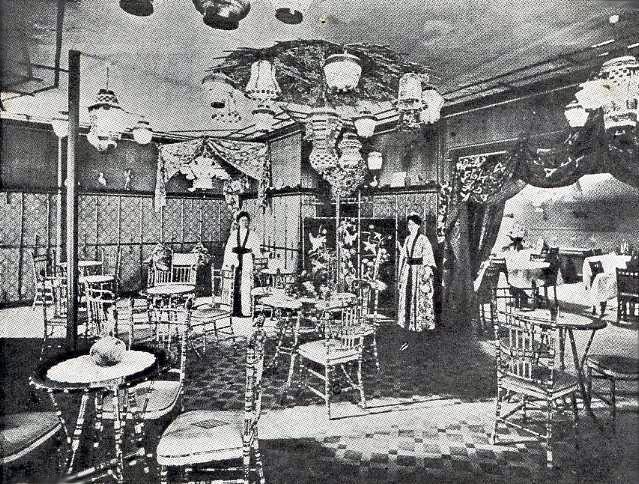
Recently I was lucky to find the postcard image of the Japanese Tea Room in the Barr restaurant shown above. It dates from about 1906, when a dessert called the Priscilla College Ice, an ice cream soda with a “totally different flavor,” was a popular order. Edwin Barr’s second wife, Minerva, worked with him and it’s likely she supervised the tea room and may have chosen the Japanese theme which was in vogue then.

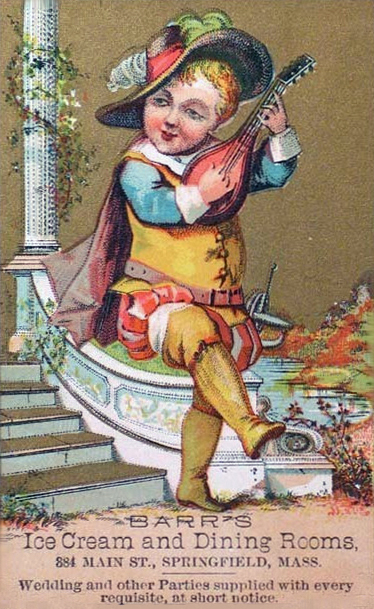
Barr’s was begun in 1865 or 1866 when founder Edwin Barr finally decided to give up prospecting for gold in California and Montana and returned to Springfield to settle down. It wasn’t until around 1891 that Edwin acquired the Main and Vernon corner (384 Main), one of the most valuable corners in the city’s shopping district. (It’s likely that the 884 Main address on the trade card shown here is misprinted.)e.c.barrtradecard

In 1870 an article in the Springfield Republican claimed that Barr’s decor was more “tasteful” than that of Delmonico’s in New York. Keep in mind that the New England taste of that time leaned toward plainness. The story also praised the appearance of the restaurant’s menu which was printed on cream paper with a thin magenta border – “neat, but not gaudy.”

Sadly the Barr family’s lives were not so neat. In 1891 Edwin’s eldest son, George, who managed the family’s Hotel Warwick in Springfield, shot and killed his wife and himself in a fit of jealousy. Edwin’s third son, Jesse, manager of the Northampton restaurant, died of syphilis in 1900.

Fortunately Edwin’s son Edgar lived a long life and carried on his father’s business for a time after Edwin’s death in 1911. In 1912 the restaurant moved to East Bridge Street and later was recreated on State Street. I have not been able to discover how long it remained in business.

Clearly Barr’s glory days were at Main and Vernon. That site underwent many demolitions, the latest being construction of the Monarch Place hotel and office complex.

© Jan Whitaker, 2013

12 Comments

Filed under confectionery restaurants, restaurant decor, tea shops

An annotated menu

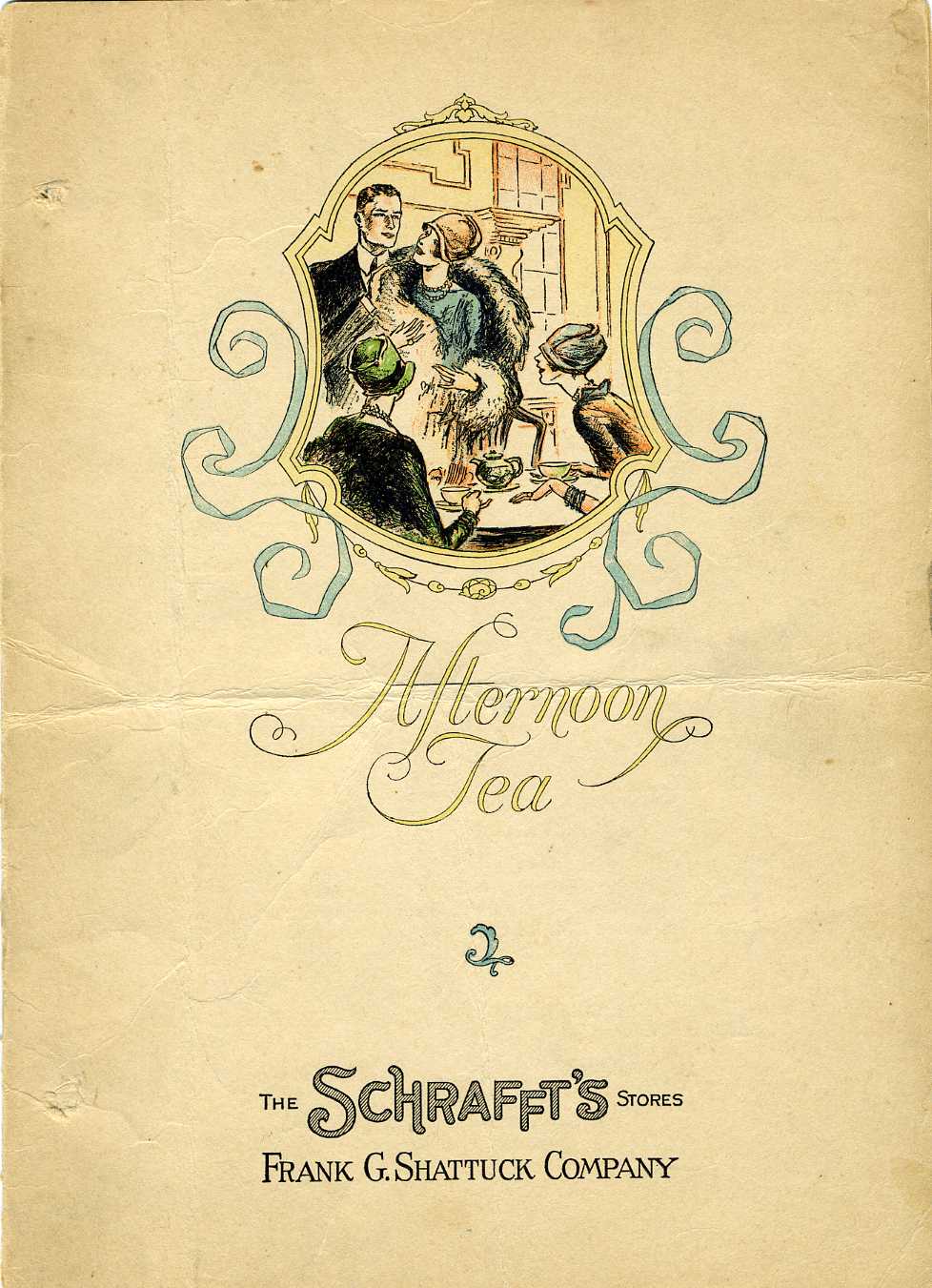
One of my most-treasured menus is a grubby, dog-earned Afternoon Tea menu from Schrafft’s at 181 Broadway in NYC dated September 3, 1929. What makes it so great is that it was carried off from the restaurant by someone who took detailed notes concerning a number of dishes. Apparently (judging from the notation “Monday & Wednesday”) the “spy” made two visits to the restaurant. The menu has holes along the side as though it was kept in a binder for reference.

I have always imagined that the spy, who must have been accompanied by a few friends, was a rival tea room operator hoping to learn a lesson or two from a successful competitor. The notes really bring the menu to life, and also give a feel for just how scanty tea room dishes could be. I had read that tea rooms were often criticized for their high-priced “bird-like” portions. I see from this menu that there was some truth in the charge.

The prices are indeed high. It is difficult to be confident about today’s equivalents to the prices below, but keep in mind that in 1929 a full dinner could be had at a decent restaurant for 50 cents. So, clearly, the sense in which Schrafft’s was a middle-class restaurant essentially means that it was easily affordable only to the upper middle class and above, though lower-income patrons may have enjoyed an occasional splurge there.

Here are a few of my transcriptions of the difficult-to-read notations, with my punctuation and explanations added:

Cold Fresh Shrimp with Tomato Mayonnaise in Puff Shell – 55 cents
Cut top off a tea [?] puff; put a 40 sc. [presumably refers to scoop size] of tomato mayonnaise inside; put 5 large or 6 small shrimp in the puff; place 3 or 4 nice sprigs of watercress around puff; serve on T. P. [tea plate]; make Bread & Butter sandwich cut in [fourths]

Toasted Mushroom Sandwich, Stuffed Celery, Ice Cream and Cocoanut Crisps, Pot of Tea – 60 cents
Cut crusts off 2 sl. toast and ½ inch off remaining 2 sides; butter and cover with mushrooms, a nice piece of lettuce; cover with another sl. toast same size; spread with mayonnaise; cut in 3 oblong pieces; serve on a doily on a T. P. with 1 stalk of stuffed celery

Egg and Tomato Salad – 50 cents
4 pcs. crisp lett. laid on a salad pl.; 3 ½ slices of tomato, cut crosswise; in center ½ stuffed egg; between each slice of tomato, place a nice spray of watercress

Fruit Salad with Orange Cream Dressing – 65 cents
A small sl. pineapple on 2 sm. lettuce leaves; on 1 side 1 section orange, half on pineapple and half on plate; on other side between orange & grapefruit on a l. l. [lettuce leaf] put 30 sco[o]p of dressing

Cocoanut Crisps – 25 cents
2 ea. on the Tea [see Toasted Mushroom Sandwich above], 4 ea. ala carte

Chicken Salad Club (Sandwich) – 60 cents
Tea plates. 1 sl. toast; 30 scoop of Ch. salad, may[be?] 8 lettuce leaf. Another slice of toast, cut diag. on ea. half; place ½ sl. of bacon, ½ sl. tomato, sweet pickle & toast cover

Fresh Fruit and Pecan Salad – 55 cents
Tea plate. 1 sl. pine[apple]; 2 sec. orange; 2 sec. grapefruit, 8 pecans

Fresh Bartlett Pear and Roquefort Cheese with Special Dressing – 65 cents
Tea plate. 2 halves of pear, 50 sc. of cheese in ea.; sp. dressing, capers, pimiento

Creamed Potatoes with New Lima Beans (Plate) – 45 cents
Tea plate. 1 sp. cr. pot[ato]; 1 sp. of limas; sprig of parsley

© Jan Whitaker, 2012

3 Comments

Filed under menus, tea shops

Celebrity restaurants: Evelyn Nesbit’s tea room

Hundreds, maybe thousands, of celebrities have gone into the restaurant business when their careers waned. Their level of direct involvement may be high or low but all these ventures bank on the idea that a famous name will attract customers.

When Evelyn Nesbit opened her NYC tea room in May of 1921 she made sure that her name was prominently displayed. Located on West 52nd street just off Broadway, the sign saying “Evelyn Nesbit’s Specialty Shop” was visible from the theater district’s Great White Way.

She was then in her mid-30s, years away from her peak as a teenage artist’s model [above, age 16], “Gibson Girl,” Floradora showgirl, and millionaire’s wife. Her fame derived not only from her former good looks – from the years her image was displayed everywhere – but also from her involvement in a romantic triangle with prominent architect Stanford White and her insanely jealous husband Harry Thaw. After Thaw shot and killed White in 1906, she became notorious as a witness during the sensational “trial of the century.”

By 1921 she had divorced Thaw, had a son, returned sporadically to the stage, taken up sculpture, published a memoir, and married a second husband from whom she was estranged. Characteristically, she was in debt, owing the equivalent of a year’s income to a dress shop.

Her tea room enjoyed such a short, unsuccessful run that it is hard to learn much about it. Presumably she raised funds from friends to furnish it and pay the $300 monthly rent. She lived in two rooms upstairs. One account described the 100-seat tea room as “super-beautiful” and furnished with rich carpets, Oriental tapestries, and exotic plants, a description at odds with the homey scene in a 1922 photograph shown here.

In several interviews Evelyn made what sound like preposterous claims that she served food available nowhere else. “I am revolutionizing the restaurant business in New York,” she boasted. Her specialties included deep dish apple pie and ice cream which she said she made herself. “I amazed the chef, let me tell you, with what I know about cooking,” she said.

I found it surprising that she claimed to be a good cook; however I did discover that when she left the US for Paris in 1910, surely pregnant with her son, she told friends that she planned to rent a modest apartment on the outskirts of Paris, study sculpture, and do her own cooking.  Although she evidently hired someone else to cook for the tea room she said she furnished the recipes and did all the buying.

Things went wrong fast. During the first six months she (barely) survived three robberies, one kidnap attempt, one suicide attempt, and eviction for nonpayment of rent. On a second try in January of 1922 she was successfully evicted, after which she returned to cabaret dancing. In 1926, while performing at Chicago’s Moulin Rouge, she tried to kill herself again by swallowing Lysol. Her troubled brother took his own life two years later.

But Evelyn achieved happiness in later life and lived on to age 81. She moved to Southern California near her three grandchildren and their father, a pilot for Douglas Aircraft. She returned to her lifelong interest in art, teaching sculpture and ceramics at a community center. Easing her constant need for money, she received a $10,000 bequest when Thaw died in 1947 and was paid more than $50,000 for use of her life story in the 1955 movie “The Girl in the Red Velvet Swing.”

After many years away, she visited New York in 1955, reflecting on the great meals she had eaten during her heyday. Passing the former location of Sherry’s, she recalled “the wonderful terrapin they served.” She expressed surprise that she had managed to stay slim in her youth. “I ate so much in the old days I still wonder why I didn’t get fat,” she said referring to another performer’s, Lillian Russell’s, “upholstered” appearance. Heading off to a restaurant dinner, the ever-unsentimental Evelyn confessed, “You know what I really want to see most in New York? A nice big broiled Maine lobster.”

© Jan Whitaker, 2012

10 Comments

Filed under proprietors & careers, tea shops, women