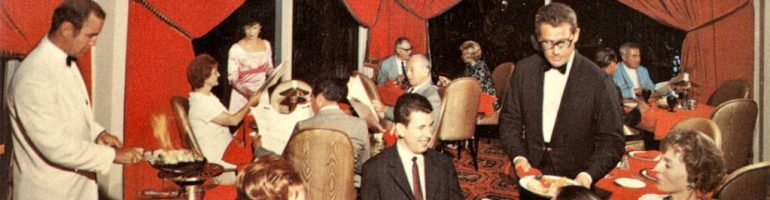
Beginning in the 1950s going out for brunch or dinner began to be a popular way to treat mothers on their annual holiday. But it seems to have lost its appeal somewhat in recent years. Has the idea of doing that waned with the public or is it because fewer restaurants are open on Sundays? Maybe restaurant staffs would like to celebrate the day themselves. But it is more likely that going out to eat on Sundays, once very popular, has become less so and restaurants don’t find it worthwhile to stay open. And, could it be that brunch has lost its appeal as well? [Above: Allgauer’s ad, Chicago, 1956]

Category Archives: restaurant customs
Free birthday cake!
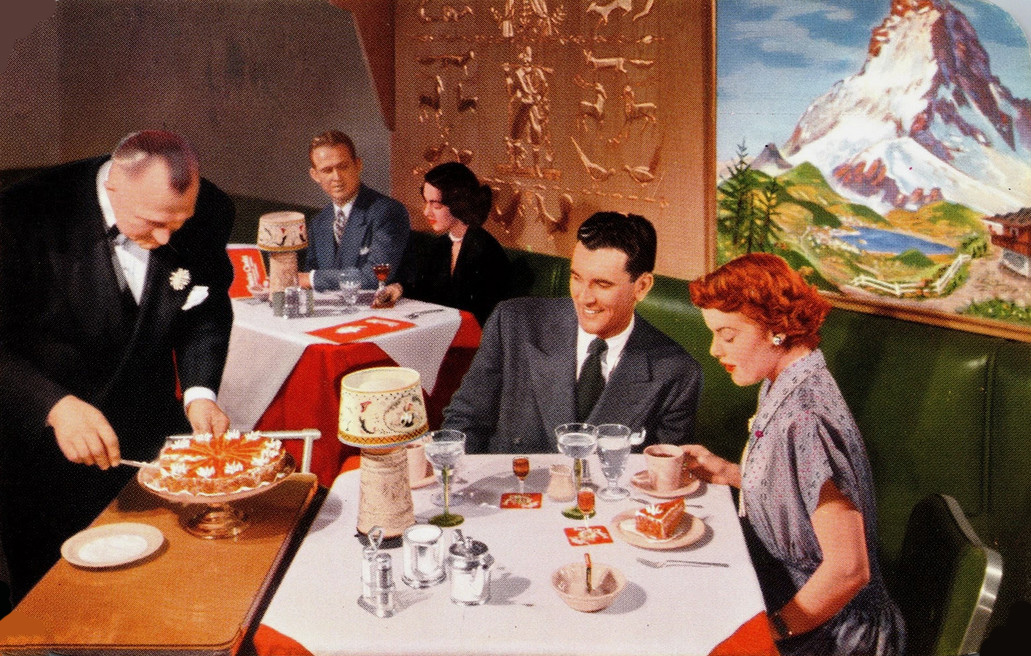
A trip to Maine to celebrate two birthdays (not mine) got me thinking about how restaurants observe these events with customers. [above: at Wolfie’s, Miami, 1986]
The custom of restaurants recognizing birthdays with songs, cakes, fancy drinks, free dinners, and serenades took hold in the 1960s. It’s unclear whether it had anything to do with an IRS decision ca. 1959 not to charge a cabaret tax in eating places where servers sang birthday greetings.
But there was a notable earlier cake bestower: cafeteria king Clifford Clinton of Clifton’s fame. By 1945 he claimed to have given away over 110,000 birthday cakes to patrons. Of course since his restaurant was a cafeteria, it’s likely that there were no singing waiters involved.
Apart from the IRS, another barrier to growth of the custom was the royalties levied by a copyright holder who claimed rights to the Happy Birthday song until 2015. It led many restaurants to write their own birthday songs, particularly if they were large chains that would have been most likely to be caught. Otherwise, it seems that in independent restaurants waiters and waitresses sang the familiar, homey version pretty much fearlessly.
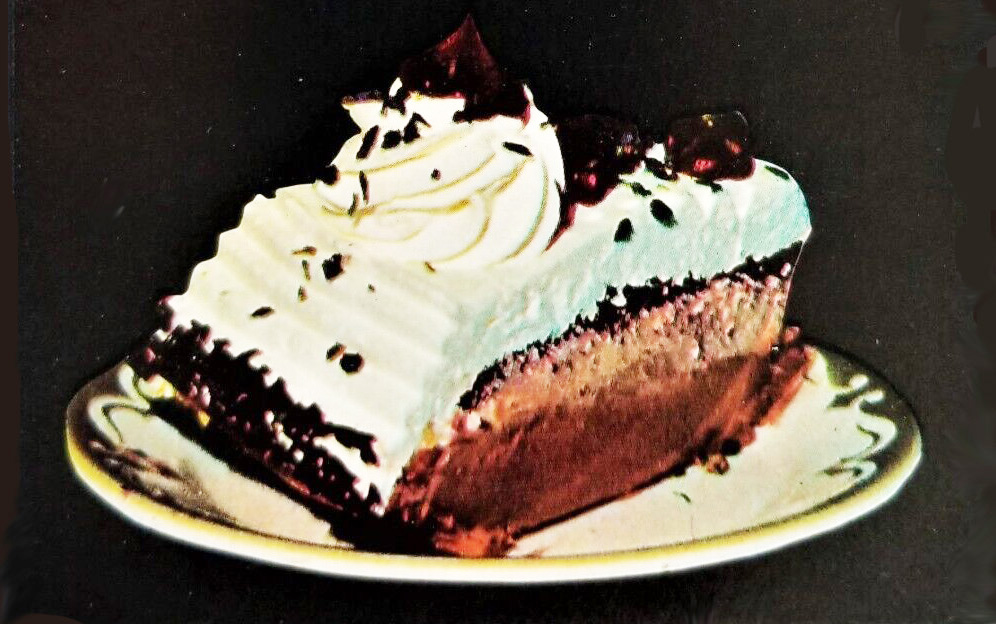
Songs aside, the special attraction that actually brought celebrants to a restaurant for their birthday was probably the freebies. There were numbers of people who wanted a free meal, dessert, or drink but didn’t really like being in the spotlight.
Despite all the deals, generous or skimpy, some diners rejected the whole idea of a public celebration of birthdays in restaurants. In his Chicago Sun-Times column, Roger Simon advised, “Never eat in a restaurant where the waiters sing ‘Happy Birthday.’” He echoed the spirit of the author of the “Lonely Man’s Doggy Bag Diary” who wrote in the Oakland Tribune that along with lobster bibs, wooden menus, flames, mushrooms, anchovies, patés, and so much more, he disliked “waitresses singing Happy Birthday to everyone.” The T.G.I. Friday’s chain eventually dropped the custom, sensing that many customers found it embarrassing.
Of course many restaurant owners found birthday (and anniversary) celebrations attractive as a way to draw customers. But it seems that deluxe restaurants were less likely to observe this custom, possibly judging that their guests weren’t looking for reduced prices or free desserts, preferred privacy, and didn’t find the drama of singing waiters appealing.
Restaurant chains, on the other hand, tended to make a big deal of their generosity toward birthday celebrants. As the growing popularity of television kept families home and reduced restaurant visits in the 1950s and later, a restaurant management advisor suggested “. . . one possible way to help offset the decline in business might be to get more people to celebrate birthdays by going out to dinner.” Many restaurants created birthday clubs.
Often customers seeking birthday specials were required to fill out forms prior to their birthdays, and to notify the restaurant when they were planning a visit. And, quite a few restaurants required that would-be celebrants bring along their birth certificates, suggesting there were customers who lied about their birthday.
Some customers evidently had a much harder time convincing restaurants that it was really their birthday. As late as 1991, a 13-year old Black girl in Vallejo CA was refused her free birthday meal at a Denny’s restaurant even though she brought her baptismal certificate. She told a reporter that “They just said that wasn’t enough and made a big scene. I felt embarrassed. It was humiliating because other families in there were looking at us, and I guess they thought we were some kind of bad criminals.” Her case became part of a successful class action suit brought against Denny’s in California.
There were some restaurants that developed more elaborate rules concerning the precise kind of “deals” they were offering and who was eligible. The Bill Knapp’s restaurants offered free birthday cake, not just for the guest celebrating their birthday, but for the entire party. The main guest also benefited from a 1% reduction in the price of their meal for each year of age over 11. Another Michigan restaurant, Dennison’s in Farmington Hills, offered cake plus a discount on the celebrant’s meal based on the size of the party. Benihana in New Orleans served a free dinner valued at upwards of $14 to the birthday guest in the early 1980s, but only if there were four in the party.
Cake wasn’t the only kind of birthday food offering. Brennan’s in New Orleans presented French bread decorated with cherries, olives and lemon slices. The bread was not meant to be eaten, just to hold a candle. Accompanying it was a character made of fruit and vegetables, followed by an Irish coffee. Cocktails took the place of dessert in some restaurants. At the Asian restaurant Jade East in New Orleans a celebrating guest received a flaming pousse-café with layers of blue Curaçao, grenadine, and rum or gin.
I’m not expecting any free cake or singing waiters/waitresses in restaurants we’ll visit this weekend — but if I’m wrong I’ll report back.
© Jan Whitaker, 2024
Filed under chain restaurants, family restaurants, food, restaurant customs
Advice to diners, 1815
What follows are “Useful Directions to Epicures,” published in the (New York) Weekly Museum. The publication’s motto was: “Here Justice with her balance sits, and weighs impartially the deeds of men.” (The word “Museum” was sometimes used to mean a publication. Another example was the Farmers’ Museum, a New Hampshire newspaper of the early 1800s.)
At the time of publication New York city had a population of about 100,000. The war of 1812 had just ended. Most residents of the city were merchants, grocers, or tradesmen such as shoemakers, cabinetmakers, or carpenters. Eating places included boarding houses, small hotels, victualling houses, and taverns.
– Make it a rule to be early in your attendance: every epicure will allow that it is better to wait a little for dinner, than to have the dinner spoiled waiting for him.
– Carefully inspect the bill of fare that you may know what is coming, and be able to place yourself accordingly.
– Seat yourself directly opposite your favourite dish; in that case you will be able to help yourself to the nice cuts.
– Help yourself plentifully at first, as it is a thousand to one whether you have a chance of a second plateful, and there may be some present who understand the joint as well as yourself.
– Watch the eye of him who wishes to hob or nob, and ask him to drink a glass of wine with you. You may get drunk otherwise, but not so expeditiously and politely.
– If you wish to be very witty at the expence of any of the company, attack him after the second bottle, ten to one but he forgets it all before morning, or if not, you can plead that you had too much wine in your head.
My interpretation
The advice, clearly critical of common practices, is addressed to men, some of whom may have been renting bedrooms in the same building. This explains why the writer might see a dinner companion again the next morning.
The word “epicure” is probably meant to be humorous.
The “bill of fare” was likely a single sheet of paper on which the day’s or week’s meals were hand written.
At this time in history, everyone sat at communal tables for meals and helped themselves from shared platters and bowls. They would heap their plates high and the last person might not get the best pieces, or much at all.
It’s clear that meat dishes, referred to as “nice cuts” and “the joint,” were the most highly prized foods. The narrator – along with the others — would almost certainly try to sit as close to them as possible, even if that meant arriving early and waiting for the food to arrive.
The reference to the difficulty of getting a second helping reflects the customary greediness of patrons — and that would include the advice giver.
There was quite a drinking problem in early America, and getting drunk was a frequent occurrence.
© Jan Whitaker, 2024
Filed under restaurant customs
Dining . . . and wining?
Americans have not been big wine drinkers historically, so sommeliers (aka wine stewards) have not been commonplace. There were French sommeliers in New York in the 1870s and later, but it’s likely they were wine merchants and specialists in maintaining wine cellars rather than part of restaurant staffs.
Nevertheless the fine restaurants of the 19th century, such as Delmonico’s and some hotels, made a point to offer wine and almost certainly had someone on their staff capable of ordering, storing, and recommending wines to diners.
But, however many or few wine experts worked in American restaurants, they were put out of business by the advance of Prohibition. Their numbers gradually grew after Prohibition ended in December, 1933. By that time the restaurant industry was hanging by a thread and eager to get back into profitable business with the sale of wine and spirituous liquors.
Articles from the 1930s reveal just how unfamiliar the American dining public was with wine. A columnist mentioned that the Fred Harvey company was busily creating a wine list for its deluxe restaurant in Chicago’s Straus building in the months leading up to Repeal. The story ran through a few basic pairing suggestions such as whites with fish and reds with beef, adding, “One never drinks beer at a swank dinner.”
Restaurants that planned to serve wine, such as Karl Eitel’s in Chicago, were furiously stocking their cellars then. Two days after Repeal, Eitel’s waiters scrambled to catch up with customers who ordered wines that were out of stock. They were instructed to offer orange juice as a substitute for the missing vermouth. Eitel himself expressed annoyance at the waiters’ lack of knowledge about how to chill wine properly (ice has to melt a little before it will cool a bottle).
At Repeal, French wine shippers had hopes that the U.S. would expand their market, but according to one insider, the ambassadors they sent to this country came back full of pessimism, convinced that Americans much preferred liquor and soft drinks.
The relatively few restaurants wanting sommeliers usually had to hire Europeans, as they were the ones with the finest training, or any training at all. The Vendome in Los Angeles, for instance, brought a sommelier from Monte Carlo’s Hotel de Paris in 1934. But even a couple of years later there were said to be fewer than a dozen professional sommeliers in this country.
And it was already evident that the popular attitude toward them was less than worshipful. For a start the word sommelier was a barrier which, in the words of one wit, “can’t be correctly pronounced unless you’re either drunk or French.” [See Word of the Day cartoon below for a guide] And the chain worn around the neck suspending an oversize key and tasting cup was often ridiculed – except as jewelry for women, who were said to make off with them. Their attractiveness inspired the jewelry maker Monet to produce a simplified sommelier-style necklace and matching bracelet in the 1930s, which remained popular into the 1950s.
The happy sommelier in this country was one who managed to get a dedicated tip from guests who truly appreciated his (rarely her) recommendations. Few newspaper columnists showed respect for them, excepting O. O. McIntosh. In 1938 he explained that he loved the rituals associated with the sommelier’s work, such as twirling bottles in an ice bucket, displaying labels, wrapping bottles with napkins, and extracting and sniffing corks. He declared it “a magnificent ritual and one the gallop of American life should not trample.”
It was more typical for commentators to make fun of it all. One made suggestions on how to respond to a sommelier’s proud display of a bottle: “. . . it is good to respond by fitting a monocle to the eye, studying the label and issuing appropriate clucks and ‘hmmms.’ This has become an obligatory art form in certain restaurants . . .”
The sommelier’s primary role in the view of the restaurant industry was to get people to buy wine by the bottle. Behind the scenes, in industry journals and books, the depiction of wine sales could be crudely oriented toward profits, with the sommelier’s skill directed toward an estimation of the diner’s insecurity or wish to celebrate. A 1968 book on wine merchandising in restaurants saw a skilled sommelier as “merchandising in motion” and useful for “giv[ing] class to your restaurant.” And a trade magazine article on how to merchandise wine in restaurants carried the tagline, “A Meal Without Wine is a Meal With Less Profit.” As was demonstrated by comparing two checks (shown above), wine drinkers were said to be fond of pre-dinner cocktails also.
One of the strongest motives for restaurant guests to value advice about wine was, and undoubtedly still is, not to look foolish in the eyes of others. A Napa Valley winery owner reported that an experimental wine tasting he held for his Harvard Business School classmates in the 1960s revealed that “They weren’t particularly interested in learning anything about wine, except for how to order it without being embarrassed.”
In 1940s NYC, sommeliers were still rare and could mostly be found at luxury restaurants such as Jack & Charlie’s 21 Club, The Colony, Chambord, Pierre’s, and El Morocco.
Their numbers likely increased in the 1950s, but were there really any golden years for sommeliers? Not if you asked NYT food critic Craig Claiborne. He declared in 1961 that sommeliers had lost their status, and were no longer involved in buying wine and supervising restaurant wine cellars. “The number of old school sommeliers in New York can be counted on the fingers of one hand,” he declared.
Some sommeliers, perhaps in reaction to ridicule, tried to avoid being showy. The French sommelier at Maxim’s in Paris (in Chicago), despite the honors he had won, stayed in the background and rejected wearing the long chain with a key because he found the custom pretentious. Judging from her 1972 advertisement, Georgette of Baton Rouge LA also departed from the traditional sommelier costume.
In the 1970s waitstaff captains at New York’s Four Seasons took over the role of sommelier. They were trained by one of the restaurant’s knowledgeable owners and given wine at their meals so they would be familiar with it. This would have satisfied critics who complained that many sommeliers had never tasted the wines they recommended.
Today, Las Vegas may have the most sommeliers in this country, however I’d guess that most restaurants elsewhere have done away with the costuming and ritual, relying instead on trained servers to make wine recommendations.
© Jan Whitaker, 2023
True confessions
Through the years a number of writers have described deceptive practices and foul scenes in restaurant kitchens where they have worked. Probably the best known authors are George Orwell (Down and Out in London and Paris, 1933) and Anthony Bourdain (Kitchen Confidential, 2000).
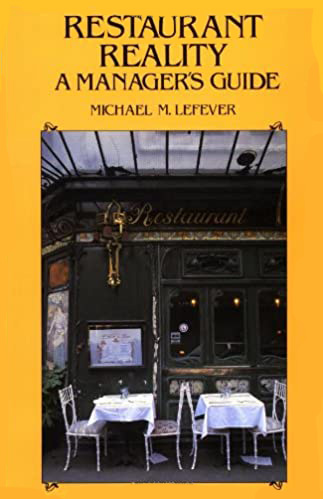
In those books, and in periodicals, I’ve read many reports of bad restaurant food, along with dishes misrepresented on menus. But I’m still a bit stunned after reading Restaurant Reality: A Manager’s Guide by Michael M. Lefever (1989). One of the biggest surprises is that he reveals his own willing involvement in kitchen tricks and horrors inflicted on guests — even in restaurants he and his wife owned and operated.
The book has a puzzling disclaimer on the copyright page: “This book is a composite of the author’s own experiences. Names, characters, places, and incidents are the product of the author’s imagination or are used fictitiously and any resemblance to actual persons, living or dead, or locales is purely coincidental.” But, whether absolutely factual or not, and despite being aimed at college students interested in restaurant management, the book seems to sanction questionable activities.
In his preface to Restaurant Reality the author makes several statements that seem to undermine the disclaimer somewhat. He says that he tried to present “an authentic overview” that was “a real eye-opener for anyone who has ever eaten in a restaurant.” He adds that while the content may be shocking, “that’s how things really are.”
Starting at age 14, Lefever had at least a 23-year career in a number of restaurant roles, including dishwasher, server, cook, and bartender for an Italian restaurant, followed by unit manager and district manager for a fast-food chain, and regional manager for a dinner-house chain. Plus, in between the chains, he and his wife were owner-operators of three independent restaurants. Following his restaurant career, he held academic positions both as Associate Dean of the Conrad Hilton College of Hotel and Restaurant Management at the University of Houston and as head of the Department of Hotel, Restaurant and Travel Administration at UMass Amherst.
Although no names of individuals, places, or restaurants are given in the book, I have discovered that the third restaurant the Lefevers owned briefly was The Balcony in Folsom, CA. According to a 1983 story in the town’s paper, their two previous restaurants were in Bend OR and Salt Lake City, probably in that order.
How things really were
At age 16 Lefever became head cook at an Italian restaurant. It was before microwave ovens were common so hot water was used for parboiling and defrosting items such as lobster tails. The same water might be used for multiple items, such as pasta, chicken, and fish, as well as frozen steaks before they went on the broiler. He remarks, “This may be of some interest to readers who are strict vegetarians.”
No matter what the customer ordered at the Italian restaurant, all steaks were delivered to guests rare and cooked further only if they complained. If the customer insisted on a well-done steak the kitchen took revenge by putting it in a deep-fat fryer, followed by treatment with a blowtorch which caused it to burst into flames. Just before it burned to a crisp they would throw it on the floor and smother it in salt, then shake off the salt, put it on a platter and brush it lavishly with butter. He claims – and maybe it was true – that customers loved these steaks and some started asking for theirs charred.
As a fast-food unit manager, he oversaw (or witnessed? or heard about?) some truly disgusting practices. For instance, afternoon employees hired mainly to clean toilets and dispose of trash often did some off-hour cooking as well — but they weren’t always terribly sanitary. If no fresh lettuce was available, he writes, “the afternoon employee might fish out of the garbage can some discarded outer leaves.” They were oversized with tough spines, so the worker would “simply place his palm on the assembled sandwich and smash it downward.” When condiments squished out, he would “take a dirty cleaning rag” and wipe off the bun.
Since Lefever’s monthly bonus was based on keeping costs down, he recycled sandwiches that had officially expired as often as he could, even though this subverted the chain’s system. Eventually they began to look inedible. Then the workers would replace limp lettuce, spray the dry bun with water, and make other repairs. If that didn’t work they would disassemble the sandwiches and salvage the valuable parts for remakes during the off-hours, and so much the better if the customers were nighttime drive-thrus who had spent their evenings in a bar.
At the Lefevers’ own restaurant, The Balcony, servers were instructed to tell customers that all dishes — Veal Piccata, Beef Wellington, and so on — were prepared on site though they actually came from a supplier of frozen entrees. The cooks were highschool students who defrosted them in a microwave while doing their homework.
He declares that customers who found eggshells in their omelets should have been grateful since this meant the restaurant used fresh eggs rather than processed omelet mixes. But it could also mean that they came from the bottom of containers they used to store hundreds of cracked eggs in water. And, he reveals, “The bottom also collected the heavier eggs, which result when hens are sick, given a strange diet, or frightened.” Customers requesting decaffeinated coffee didn’t necessarily get it, since servers randomly grabbed the handiest pot, switching the red or green plastic bands that indicated type of coffee.
In discussing food spilled on the floor, he writes, “I have served . . . entrees spilled and then salvaged such as lasagne, beef stew, chili, pasta, and scrambled eggs. Steaks and chops are no problem at all. Simply put them back on the grill or in the pan to freshen them, after washing them under the faucet.” But he advises cooks to inspect the entree “looking for hairs and foreign pieces of food that do not complement the dish.”
Lately I’ve found myself eager to eat at home.
© Jan Whitaker, 2022
Black waiters in white restaurants
In the 19th century Black waiters staffed most Northern restaurants and hotel dining rooms, particularly as hotels grew larger and better appointed beginning in the 1840s. Earlier, Black waiters in the North were mostly employed in private residences or for catered events.
Before the Civil War, the hotels were run on the American plan where meals were included with lodging and served family style. Mealtime was often a mad scramble, putting waiters under great pressure to bring out the dishes. They were often ridiculed, or seen as having no other virtue than being imposing-looking in uniforms.
After the Civil War, when the tipping custom spread, they were suspected of being interested solely in tips. Nevertheless, jobs as waiters were sought after and those who held them were highly respected in Black communities. Headwaiters, occupying a role similar to that of maitre d’, enjoyed the highest status.
A number of Black waiters rose in their profession and took the role of advisor and trainer of their fellow servers. An early example was Tunis Campbell who published The Hotel Keepers, Head Waiters, and Housekeepers’ Guide in 1848. He presented the headwaiter’s role as similar to an officer whose troops need a lot of drilling lest they became undisciplined and boisterous when facing a mob of impatient guests. His advice was put into practice, judging from an English traveler’s description of a remarkably choreographed scene in the 1850s. He reported that, “At a given signal, each [waiter] reaches over his arm and takes hold of a dish . . . at another signal, they all at the same moment lift the cover, all as if flying off at one whoop, and with as great exactness as soldiers expected to ‘shoulder arms.’”
Some patrons preferred Black servers to white ones, and it was said that the better restaurants and dining rooms of the post Civil War period preferred them to whites, particularly the Irish. But praise was often blended with condescension. A prominent Chicago hotelier noted that Black waiters were the “best.” But he added, “They are waiters by nature, and are peculiarly adapted to servitude.” Another admirer of Black waiters commented in a similar way: “White waiters always have an idea that they are doing a man a great favor if they serve him promptly and are polite and respectful. Colored waiters know their place and keep it, give themselves no airs, and take no liberties.”
Never did it seem to occur to white commenters that the best Black waiters had actually chosen to dedicate themselves to their profession and constantly improve their skills. Nor that they were performing a role rather than conforming to their nature.
Unsurprisingly, given the lack of a wide range of job opportunities, many Black men were known for their long tenure as waiters. Still, it is interesting that a Chicago restaurateur noted with surprise in 1899 how many Black waiters “find their way to the variety stage.” Perhaps they had been drilled in the Campbell method. [Blaney Quartette poster, 1898]
The position of headwaiter was especially coveted, particularly if a Black man was tall and impressive looking in a uniform, often a tuxedo in the 20th century. However, although some remained, by then the position of Black headwaiter was being replaced by restaurant owners and hostesses taking over the job of greeting and seating guests.
In the late 19th and early 20th centuries a white backlash against Black Americans generally reduced work opportunities even further, threatening Black predominance as waiters. Immigrant men arriving in this country proved willing to accept jobs as waiters. However, there was a notable reason to favor Black men, one that hindered them at the same time. As a Black waiter explained in 1903, for Black men being a waiter was “usually the zenith of his industrial possibilities” and because of this there was strong competition among them for these positions. This allowed hotels and restaurants to pay them less than white waiters.
By the 20th century, white women also took jobs serving in restaurants, often replacing Black men. Actually, though, the Fred Harvey organization may have pioneered the shift from Black men to white women. In 1883 the men – considered troublesome – were replaced at one of the eating houses on the Santa Fe Railroad line, launching the phenomenon of the “Harvey girls.” Unlike white women, Black women were not often found waiting in white restaurants, but were more likely to be working in the kitchens. When they did occupy waitress roles, white patrons seemed to enjoy seeing them dressed in mammy costumes.
Black waiters organized mutual aid societies and employment bureaus as early as the 1820s, but many were skeptical of labor unions. When strikes failed, their distrust was intensified and they felt they had been betrayed by the white unions, particularly after losing their jobs and being replaced by white men and women. A failed strike at a lunchroom chain in Chicago in 1903 was long remembered with bitterness. Leading Black waiters supported advancement for Black waiters, but not of joining unions. John B. Goins wrote in his book (The American Waiter, 1908) that “unions will never be of any benefit to a colored waiter.” In an even stronger vein, he advised, “Keep out of strikes. If you are asked to join in a strike for better wages refuse point blank. And I would advise you to offer to quit; but first explain why you do so, stating your reason for quitting is to keep out of strikes.” His ally, Forrest Cozart (author of The Waiters’ Manual), was another strong proponent of improvement, urging Black waiters in American plan hotels to learn to read and write because such hotels were disappearing. [Forrest Cozart shown below]
Though there were still an appreciable number of Black waiters through the 1920s, competition with whites increased during the Depression of the 1930s. Then, even native-born whites who had long objected to taking service jobs began to compete successfully, significantly reducing the number of Black waiters.
After World War II, when the economy had improved, dining out for pleasure increased substantially in this country. Black waiters discovered that they were often shut out of waiting jobs in fine restaurants where there was a chance to make good tips. Possibly, though, Black waiters were favored in Southern restaurants such as the elegant Justine’s in Memphis, which hired a strictly Black waitstaff from its beginnings in 1948 until closing in 1995. The restaurant made much of the fact that many of its waiters stayed on the job for many years, yet there were signs of dissatisfaction on their part such as walkouts and complaints about low wages. Many had full-time day jobs.
A 1985 case study found that, unlike immigrants, Black men were not eager to be waiters in low-priced restaurants and that they were not often hired in the better eating places. How much this was due to racist attitudes on the part of managers and/or patrons was not clear. But the study noted that even “when the supply of European waiters fell during the sixties, New York City’s full-service sector did not hire blacks into these relatively high paying jobs, but used artists and actors instead.”
By 1970 Black servers, either male or female, made up only 16% of all waitstaff according to research by Dorothy Sue Cobble (Dishing It Out, 1991).
© Jan Whitaker, 2022
Filed under racism, restaurant customs, waiters/waitresses/servers
Pausing to reflect
I prepared a new post for today, but with the grotesque events happening in Ukraine, the invasion worsening by the hour as Russia attacks daycare centers and residential housing, it seems so wrong to post it.
For that matter, I feel that over the past couple of years I haven’t seriously acknowledged the effects of Covid on restaurants. When it all began – which now seems long ago – I wrote a post on the effects of the 1918 influenza pandemic on restaurants, noting a number of responses similar to what has happened recently. But since then I haven’t really dealt with the difficulties contemporary restaurants have been having, with staff miseries and shrinkage, shifts to carry out, disappearance of printed menus, mass closings, etc. I hope to come up with some new themes that touch upon historical precedents. For example, there was terrific difficulty in hiring restaurant kitchen and dining room staff during WWII. I could look at how restaurants dealt with that problem.
If you want to read something new today, I recommend some of my “old” posts that still seem to hold up. Since I’ve been doing this since 2008, there are many to choose from. Some have few likes which is because when I started blogging there was no “like” button!
Here are some of my personal favorites:
The (partial) triumph of the doggie bag
Once upon a time it was embarrassing to ask for a doggie bag.
That glass of water
Visitors from other countries are always surprised at getting a glass of water without asking.
No smoking!
Ending smoking in restaurants was a long struggle.
Deep fried
Where would restaurants be without deep frying?
You want cheese with that?
Everything’s better with cheese, right?
Chocolate on the menu
It all started with cups of hot chocolate.
Basic fare: club sandwiches
How a mere sandwich became a classic.
Take care,

Filed under blogging, food, restaurant customs


It's great to hear from readers and I take time to answer queries. I can't always find what you are looking for, but I do appreciate getting thank yous no matter what the outcome.