Category Archives: patrons

Sugar on the table

Probably most patrons never give sugar a thought when they are visiting cafes and restaurants, but it is a subject that has been somewhat vexing for proprietors and guests over time.

Sugar in restaurants has figured as a health concern, an aesthetic concern, a monetary concern – and just a plain old nuisance.

For decades in the 19th and early 20th centuries, when tables were shared by strangers, a bowl of sugar was put on the table to be used by all. In the average eatery of 1830s Boston, as elsewhere, a table would typically hold a sugar bowl along with salt, butter, and other condiments.

By the late 19th century, the new-style help-yourself lunchrooms had a novel way of grouping condiments together. These were three-tier revolving trays placed in the center of round tables and holding napkins, silverware, sugar and salt, etc. They looked prim and neat – at least before the “quick lunchers” arrived.

But whether the sugar bowl resided on an 1830 oak table or a “modern” nickel-plated “Waldorf” revolving tray in a 1910s lunch room, it posed a sanitation problem.

It doesn’t take much imagination to see how shared sugar bowls could go wrong. The salty journalist who wrote under the name Fanny Fern expressed her disgust vividly in the 1850s when she described a scene at New York’s popular and well-known Taylor’s Saloon. “J-u-l-i-u-s C-ae-s-a-r! look at that white-aproned waiter pulling out his snuff-box and taking a pinch of snuff right over that bowl of white sugar, that will be handed to me in five minutes to sweeten my tea!” she exclaimed.

Along the same lines, complaints about sugar bowls that had signs of careless use were common. The cheaper the restaurant, the better the odds that the ugly cracked bowl of sugar would have coffee stains or fly specks. In the 19th and early 20th centuries, sugar bowls usually had no lids and often customers used their own spoons to dip into them. When lump sugar was used, as was often the case, diners would take pieces out of the bowl with their fingers.

Concerns about public health brought changes in the 20th century. In 1912 the U.S. Surgeon General suggested that if people would not use tongs to remove lump sugar from bowls then restaurants should switch to loose sugar, which required a spoon.

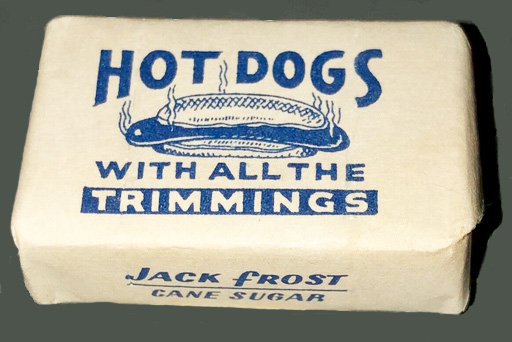
During World War I, many restaurants removed sugar bowls from their tables. Not for sanitary reasons but because they were severely restricted in the amount of sugar they were allotted. Some restaurants served no sugar while others served it only if asked, limiting the amount to one teaspoon per customer. In others, the staff put the sugar in diners’ coffee or served it in small paper packets.

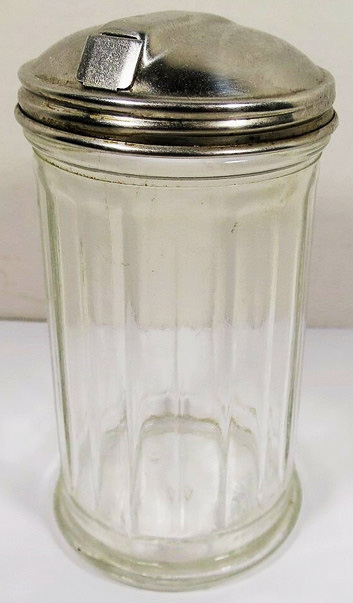
By the end of the war municipal health departments around the country began to order restaurants to use covered sugar bowls, a move probably made more urgent by the nation’s deadly flu epidemic. The postwar years marked several other changes in restaurants’ ways of handling sugar, partly because prices were higher than before. Some introduced wrapped sugar cubes that were often smaller than the lumps of old, while others set out shakers rather than bowls, another method meant to discourage overuse.

Meanwhile, though, tea rooms – and fine restaurants — continued to use sugar bowls, often matching their china patterns, suggesting this was considered more refined and attractive than shakers. During the Depression a tea room consultant advised proprietors who wanted to attract male customers not to use wrapped sugar cubes because “somehow they do not know what to do with that bit of paper.” Likewise, a columnist in 1941 pitied the tired businessman seeking a restaurant meal who couldn’t “dip his spoon into a good old sugar bowl.” Instead he had to fumble with unwrapping a cube and waiting for it to dissolve in his coffee, wasting time and fraying his nerves. Poor guy, who knew?

Another age-old issue with sugar was that when its price went up, customers stole it. No doubt this occurred in the 19th century but it became a focus in news reporting beginning in World War II when sugar was rationed. Waitresses began to notice diners dumping bowls of sugar cubes into their pockets and purses. Some came prepared to steal sugar, bringing along paper bags. It didn’t take long before managers decided not to use lump sugar or discontinued placing any sugar on tables. Some began to furnish saccharin.

Stealing occurred again in 1963 and in the fall of 1974 when sugar prices tripled. The fact that many restaurants were using sugar packets by then actually made stealing easier. This time, many restaurants returned to using loose sugar. A few began to have servers provide sugar only when asked, occasionally going so far as to add a charge on the customers’ checks. [cartoon, 1975]

Things have changed since then. Sugar shakers continue to be associated with diners and lunch counters. But cubes have come up in the world. In the late 1980s a restaurant critic expressed dismay when he went to Justine’s, a restaurant that had long been regarded as one of the finest in Memphis. Among the disappointing details he noticed was the restaurant’s sugar delivery system. “Do people spending hundreds on food and wine really want to use sugar from a paper packet rather than sugar cubes?” he asked.

Today I suspect that the reduced custom of drinking coffee with meals means that restaurants provide far less sugar to customers than they used to.

© Jan Whitaker, 2022
Wishing you a sweet Valentine’s Day!

9 Comments

Filed under food, patrons, restaurant customs, sanitation

Famous in its day: Le Pavillon

Alternative headings for this post could be Former Busboy Becomes Famous Restaurateur, Best Mid-Century French Restaurant in the U.S., or The Restaurant that Set the Standard for Fine Dining.

In other words, everyone who has known or researched Le Pavillon agrees that it produced this country’s finest French cuisine for most of its 22 years under Henri Soulé. It’s also significant that throughout that time numerous employees of the restaurant left to found some of New York’s other top French restaurants.

Not that the city was devoid of fine French restaurants when Le Pavillon arrived on the scene. French restaurants were well established and plentiful, both as independents and in hotels. Among those competing for the most discriminating and well-heeled diners were Voisin, Café Chambord, and La Belle Meunière. But they were soon outdone.

Because its story has been written about so often and so well, it is challenging to approach Le Pavillon as a topic. For a thorough history that gives a good appreciation of its cuisine, I recommend Ten Restaurants That Changed America by Paul Freedman.

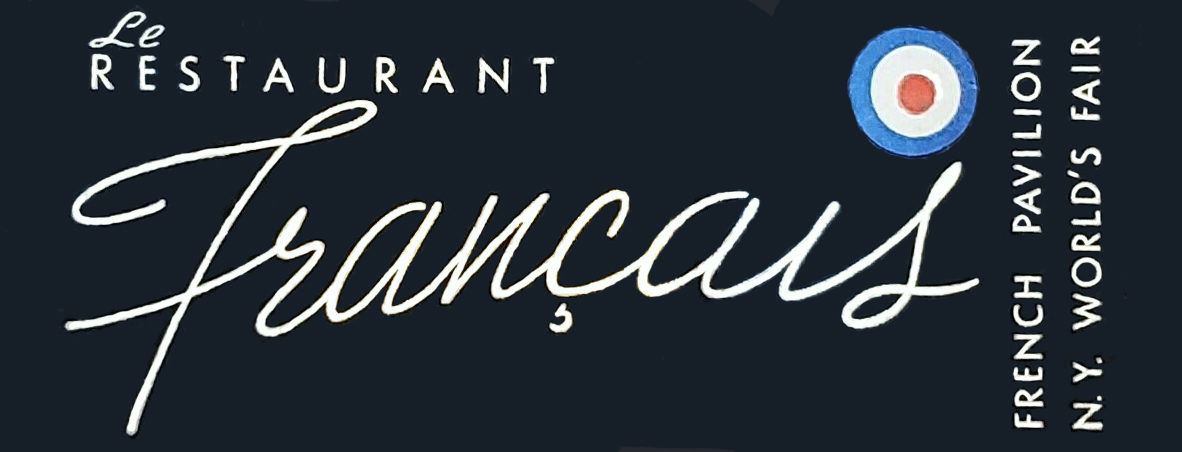
Le Pavillon opened in New York City in 1941, after a spectacular two-year run at the 1939-1940 New York World’s Fair. Located near the top of the Fair’s French Pavilion, it had a dramatic spot overlooking the Lagoon of Nations where a light and fireworks show took place each night at 9 p.m. Despite being the Fair’s most expensive eating place, it was wildly popular and booked for weeks in advance. Because the Fair was difficult to get to by car, New Yorkers had to want to go there badly enough to take public transportation. Yet many returned again and again to dine at the Restaurant Français.

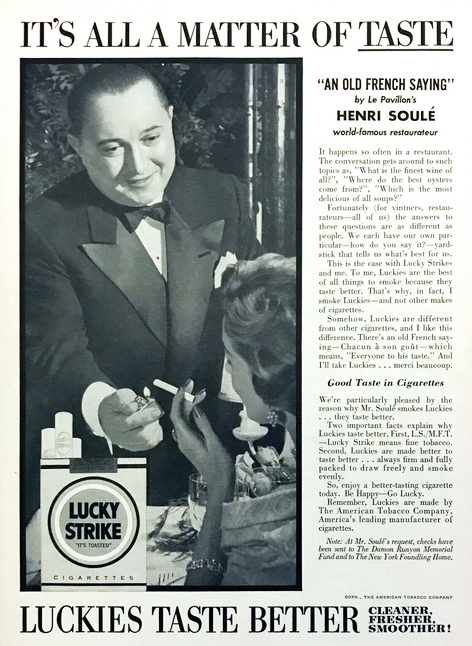
The French Pavilion’s restaurant was provisioned with food and wines brought from France and was staffed by French cooks, maitre d’s, and waiters. It was backed by the French Line and a number of prominent Paris restaurants owned by the Drouant family. Jean Drouant ran the show, hiring Soulé [pictured here], a maitre d’ at one of his Paris restaurants, to manage the dining room.

During the Fair’s tenure, Germany advanced on France, occupying Paris. When the Fair ended, Soulé decided to stay in New York. It has been said that he did not want to return to France under enemy occupation, but it’s likely he was also swayed by the stunning success of the Restaurant Français.

Since many of the restaurant’s French waiters had decided to return to France, Soulé had to hire a good number of French waiters already living in New York. He would soon become known for disputes with his staff, some resulting in resignations of chefs and temporary closure of the restaurant. His authoritarian attitudes may have been shaped by his history with Drouant, who occupied a powerful position in the French restaurant industry. He was president of the Syndicate of French Restaurants as well as the General Owners Union and was not sympathetic to waiters’ rights. He had fully supported military force used to stop a 1938 workers’ strike in response to elimination of the 40-hour week in France. He was critical of French waiters working in America, describing them as “contaminated.”

Soulé’s negative attitudes also included dislike of smoking at the table, women drinking, and the widespread American habit of eating quickly rather than slowly savoring the meal. Perhaps because of his general air of disapproval, regular patrons sought signs of his favor, which he gave sparingly. His was a notable ability to confer status on people who were as hungry for that as they were for Chateaubriand with sauce Béarnaise. One of his ways of winning the loyalty of valued patrons was to offer them special dishes not on the menu. [Note that his dislike of smoking in his restaurant did not keep him from appearing in a Luckies’ advertisement in 1954.]

In a 1962 review of a book about Le Pavillon, a clever journalist summed up how to become approved by Soulé. She wrote: “When you go to Le Pavillon you should be famous, if you can manage it, if not, you should at least be rich, elegant, chic and witty. Beautiful, if a woman, dintingué, if a man. If you can’t manage that, then maintain a balance between hauteur and quiet rapture and for heaven’s sake be careful of your manners and careless of your money.”

Yes, the restaurant was exceedingly expensive, beginning at the Fair. According to Craig Claiborne, in 1960 it was possible to spend as little as $6 there for a meal without drinks, equivalent to about $52 today. But with drinks it could cost ten times that. However, in the era of expense accounts, it was standard that a power lunch would be written off as a business expense.

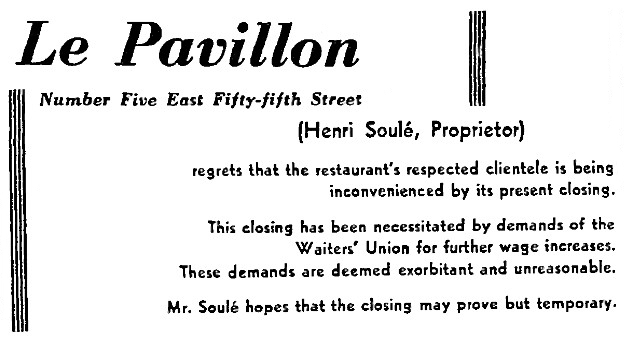
1960 was the year that a dispute between chef Pierre Franey and Soulé over working hours resulted in Franey’s resignation, followed by that of seven of the kitchen staff and leading to a temporary closure of the restaurant. It was not the first time the restaurant closed in response to a dispute. [1955 notice above]

Soulé died in 1966, at age 62. I find it interesting that he willed his watch to frequent patron and “dear friend” J. Edgar Hoover, director of the FBI, whose favorite dishes included Filet of Beef Periogourdine accompanied by a bottle of vintage Romanée Conti.

After Soulé’s death, attempts were made to keep Le Pavillon going but it closed for good in 1971.

© Jan Whitaker, 2022

6 Comments

Filed under elite restaurants, patrons, proprietors & careers, restaurant issues

An early French restaurant chain

Sometimes you need to leave your own country in order to get some perspective on it. Along with going back in time, that is what I’ve done. I’ve gone to France — though only through texts and pictures — to explore a restaurant chain begun in the 19th century known as Bouillon Duval.

I tend to think of the United States as the home of restaurant chains, and that they are quintessentially American. There is some truth to this, but it is also full of blind spots as the existence of the Duvals shows. They came before American chains, and showed that a highly rationalized, business-like approach to running restaurants is not solely American. [pictured, rue Poissonniere, 1882]

Looking at Bouillon Duval, which began as a soup restaurant, also dispels a bit of romanticism about French restaurants. As much as Duvals emphasized quality, they were eating places for the frugal masses, not temples of haute cuisine. In the beginning they were meant for poor workmen, but soon they became popular with the middle class. To put it in the language of the day, the “black coats drove out the blouses” who were embarrassed to be in the presence of the better dressed.

The Bouillons were the idea of Baptiste Adolphe Duval. He had a butcher shop in Paris and came from a family that ran a brasserie in the north of France. According to legend, around 1857 he opened a small soup restaurant near his shop using the unsalable meat scraps, and went on from there to become fabulously successful and wealthy. By 1867 he had eight Bouillons Duval in the city as well as at least one at that year’s world’s fair.

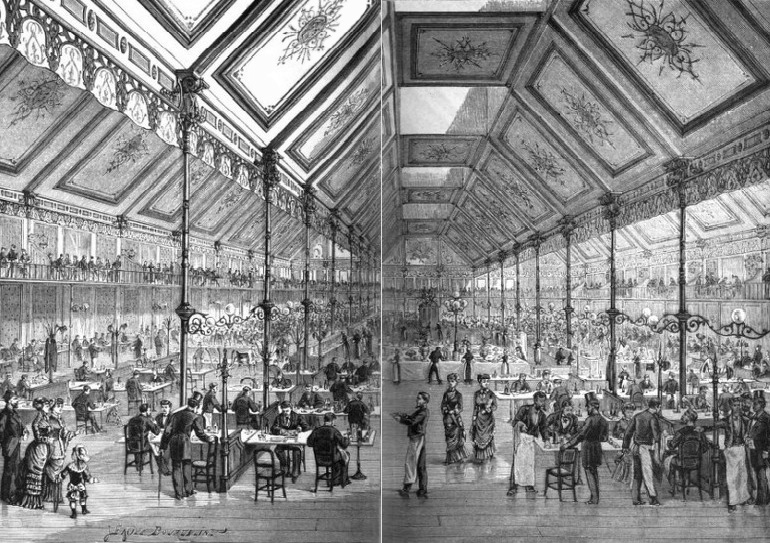
Of course it wasn’t quite that simple, and he might have failed if it hadn’t been for his wife’s assistance. According to the most thorough account of the chain’s development, the business was headed for failure as soon as it expanded beyond the small shop. With an enlarged menu and a lot of ideas, M. Duval had moved to a location in a former ballroom on the rue Montesquieu [shown at top of page in 1882, when it had reinstated male waiters]. There he installed a steam-heat system of cooking, along with elaborate piping that served every table with seltzer water. Both innovations were disastrous failures that cost a fortune to tear out. Add to this the lack of an accounting system that made it hard to calculate sales and permitted chiseling on the part of employees and the business was soon drowning in debt.

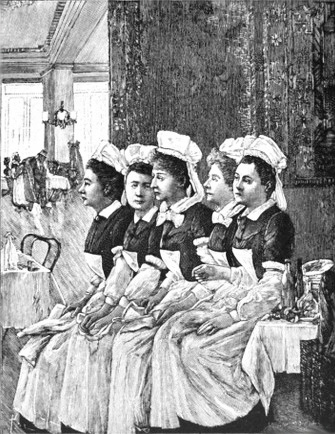
His wife Ernestine helped set up an accounting system and suggested replacing the questionable male servers with married women of irreproachable character who she dressed in uniforms resembling nuns’ habits [pictured, 1902]. The business began to show a profit and soon expansion was underway. Not surprisingly, when M. Duval died in 1870 shareholders chose Ernestine to take over the corporation and expand it further.

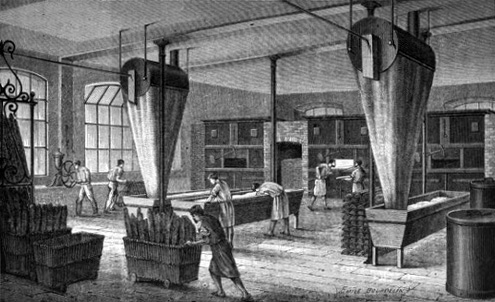
The Duval company had incorporated in 1868, by then consisting not only of eating places but also its own butcher shops, slaughter houses, bakery [pictured, 1882], large laundry, and caves that stored wine.

The company achieved heroic status in 1870 when it somehow managed to stay open during the “Siege of Paris” when German forces surrounding the city cut off food supplies. Their continuing in operation was significant not only for providing meals but also in boosting morale. In 1900 the French government awarded the Duvals’ son Alexandre, then manager, with the medal of the Legion of Honor. By then the company ran 32 restaurants.

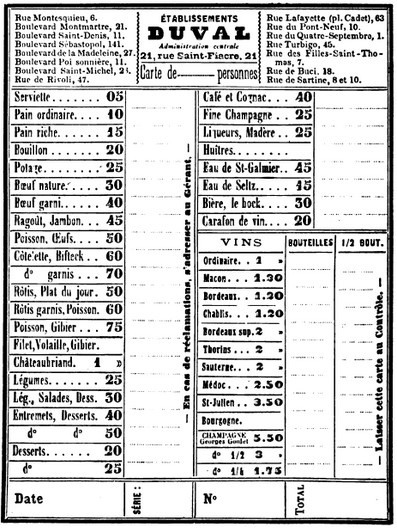
The Duval system was based on keeping prices low while serving a large volume of customers quickly and efficiently. It was thoroughly a la carte right down to an extra charge for a tablecloth if wanted. During the Siege a London man recorded what he ordered at one of the 14 Duvals. He and his companion ordered bread for 1 cent, potato soup for 2 cents, as well as roast mutton, puréed potatoes, green beans in white sauce, and a pint of Mâcon wine. The total bill – with tablecloth – came to 18 cents. [Above, a menu that was to be filled out by the customer, ca. 1882; See The American Menu blog for several Duval menus.]

Needless to say, the fact that wine and other alcoholic beverages appeared on menus set the Bouillons Duval apart from most early chains that later developed in the U.S., such as Childs.

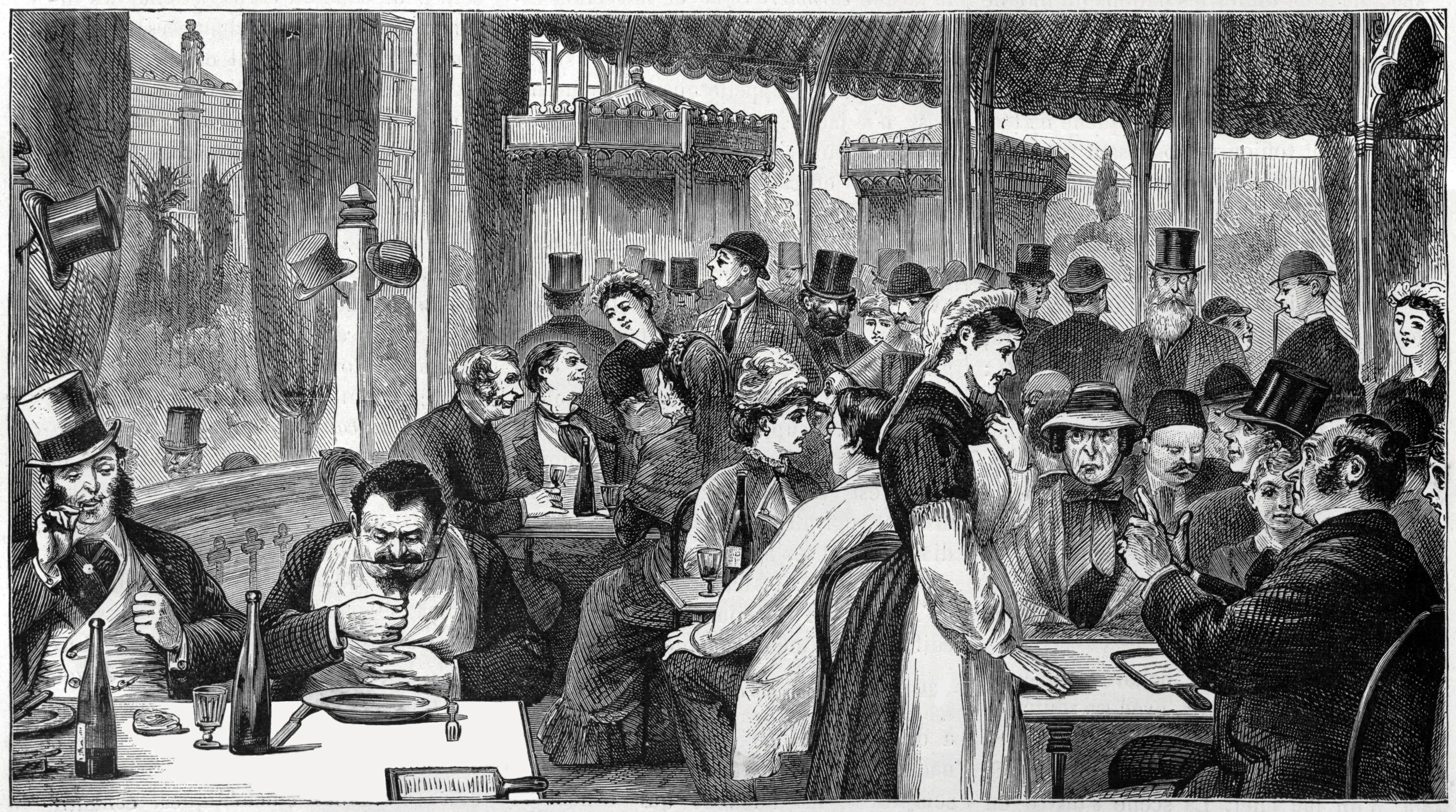
Numerous Americans as well as English citizens frequented the Bouillons when visiting Paris [above, diners at the 1878 Paris International Exposition; the objects with handles on the tables are menus], and expressed a wish to have something like them in their own countries. In addition to serving quality food and decent wine at low prices they were known to be spotlessly clean, quite unlike most of the cheap fixed-price cafes that working people had frequented before the Bouillons came along. The major criticism against them was that portions were small. Some critics said that if a hungry diner ordered all they wanted they would find that their bill was as expensive as in a finer restaurant. Other guests complained about the crowds and the “deafening din of knives and forks clinking against plates and dishes.”

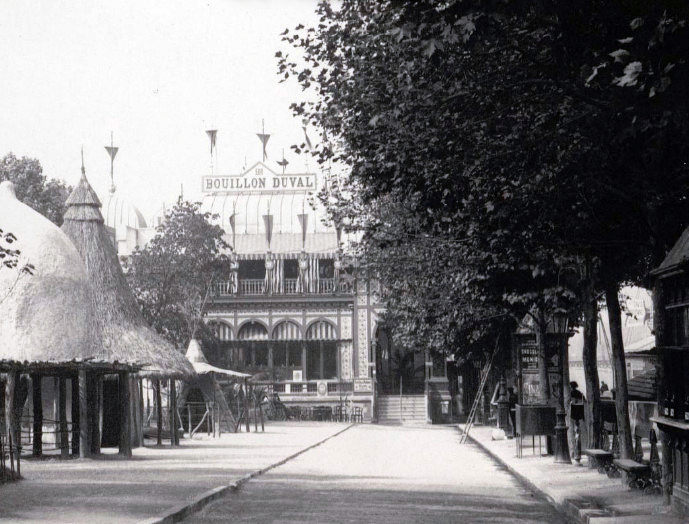
Nonetheless the Bouillons Duval were invariably recommended in guide books for visitors to the international fairs held in Paris in 1867, 1878, 1889, and 1900. In 1878 the Duval restaurants were said to have served 5M meals that year. Pictured above is one of several Duval locations at the 1889 Exposition.

At some point a Bouillon Duval was opened in London, and in the 1880s there was one advertised in Los Angeles that offered “hot soup and schooner lager beer, five cents.” I couldn’t determine whether it was connected to the Paris restaurants or not.

The last mention of the Paris Bouillons Duval I found was in 1924, when the chain was still said to be all over the city.

© Jan Whitaker, 2021

1 Comment

Filed under chain restaurants, patrons, proprietors & careers, restaurant prices, waiters/waitresses/servers, women

Restaurant-ing in 1966

Every month in 1966 – 55 years ago — the Gallup organization surveyed about 1,600 Americans to find out what they thought about restaurants. The surveys were conducted for and published in Food Service Magazine.

Then, as now, dining out took place at a time of upheaval. It was a year of turmoil, with the U.S. bombing Hanoi as the Vietnam war raged on and protestors spilling into the streets. Black Americans pushed civil rights to the forefront, often meeting resistance from whites.

Gas cost 32 cents a gallon. The minimum wage was stuck at $1.25 despite attempts to raise it. Gallup divided the population into five income categories, with yearly family income under $3,000 at the bottom, and $10,000 and over at the top.

The restaurant industry was growing rapidly, led by lower-priced chains such as Denny’s, McDonald’s, and Jack in the Box. According to the National Restaurant Association, by 1966 annual restaurant volume had grown to $20 billion, compared to about $3 billion in 1940.

That year a steak dinner at a Bonanza Steak House came to $1.39. Very much at the opposite pole was Voisin in New York City where a dinner of Foie Gras, Consommé, English Sole, Squab Chicken, Fresh Peas and Asparagus, finished with Almond Soufflé, accompanied by wine, would come to $25 plus tip. Of course most restaurant meals were priced much closer to Bonanza’s then.

What did Americans want in a restaurant? The loudest and clearest message received by Gallup’s pollsters was that restaurant goers valued cleanliness more than atmosphere or appearance and almost as much as good food. “If there is anything Americans want, it is a restaurant that is clean, clean, clean!” the January report exclaimed. Diners had an eagle eye for sticky menus, flatware with water marks, waitresses with grimy fingernails, and dirty rags for wiping tables.

The most common answer to why eat out? was to have a change in routine, an attraction in itself far more appealing than getting a special kind of food, such as “Italian, Chinese, seafood, etc.” At a time when (white) married women were supposed to shun employment, it was hardly surprising that many commented that they wanted relief from cooking or just to get out of the house.

It is especially interesting that it seemed as if not all Americans had been won over to frequent restaurant meals. Pollsters were surprised to learn that many respondents actually preferred home cooking to restaurant food. The report noted that “many patrons really look down their noses at restaurant-prepared hamburger, roast beef, fish, chicken, baked potato and soup.” Grasping for an explanation, it asked: “Is the apparent preference for home cooking really a protest against the drab presentation of food in so many restaurants . . .?”

I find it somewhat surprising that the 1966 Gallup reports as published by Food Service Magazine candidly expressed criticisms of American restaurants. Another area they identified as in need of improvement was the lack of atmosphere. They noted: “Too many American restaurants have no personality – offer nothing that will give patrons a sense of participating in the exciting adventure that eating out really ought to be.”

But looking at the twelve monthly survey reports of 1966, I wonder just how much excitement in dining Americans actually wanted. According to the survey focused on atmosphere, the characteristic liked best about respondents’ favorite restaurant was “pleasant atmosphere,” (42%) followed by cleanliness (40%). Unsolicited comments referred to positive attributes such as “good-looking waitress,” “not too dark [lighting],” and “they leave me alone once I have been served.”

Clearly patrons weren’t looking for adventures in dining or in food. When asked “If you were going out to dinner tonight, which two of the foods on this list would you most likely select to go with your favorite meat dish?” most preferred baked potatoes and green beans. As for appetizers, 55% of respondents chose tomato juice as their favorite, although those with incomes over $10,000 preferred shrimp cocktail.

A short article prepared as part of a 12-page newspaper insert on the occasion of the 1966 opening of a new Forum Cafeteria in Miami remarked about the restaurant’s music: “Music by Muzak was designed to be unobtrusive and require no active listening. It avoids distracting musical devices and has a uniquely distinctive character which never forces itself on the conscious minds of its audience.”

I wonder whether the average American restaurant of 1966 achieved the same effect in dining.

© Jan Whitaker, 2021

12 Comments

Filed under atmosphere, chain restaurants, family restaurants, patrons, restaurant industry, restaurant issues

Fish & chips & alligator steaks

The menu shown here caught my eye as I was browsing the internet. Of course, I wanted to know more about it. The first thing I discovered was that it is available as a reproduction.

Evidently the Trebor Dinner was a specialty menu for complete dinners of multiple courses. Three dollars was a steep price for the Depression when this menu was introduced, at least double what a comparable meal would have cost in a moderately-priced good restaurant then.

The illustrated menu shows 14 entrees. But the restaurant almost certainly did not have all the exotic items available at all times. Another fish & chips, inc. menu from 1937, for example, offered one appetizer, one soup, and only four entrees.

The menu could date any time from the opening of the restaurant in 1936 into the 1940s. Its clever design may have been due to owner Bob Winter’s background in advertising. Why the menu is named “Trebor Dinner” is a mystery. It’s possible that Trebor is a play on the owner’s name Robert.

Fish & chips, inc. was conveniently located in the Loop, across the street from the central Chicago library, now the Chicago Cultural Center. It was a handy location for a 1943 dinner of the literary members of the Boswell club, admirers of Doctor Samuel Johnson. In their honor the restaurant posted one of Johnson’s quotations over their table in which he criticized French menus, requesting “thy knaves to bring me a dish of hog’s pudding, a slice or two from the upper cut of a well roasted sirloin, and two apple dumplings.”

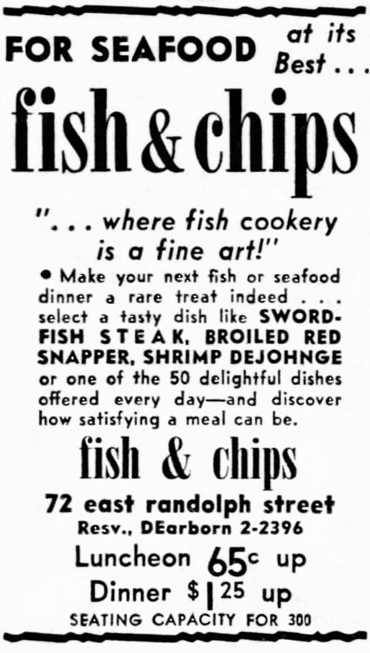
It was a popular restaurant, said to be especially well liked by male patrons. In 1944, during World War II, lines formed at the door. The following year it was enlarged to seat 300. [1949 advertisement shown]

With no meat on the menu, the restaurant would have had the advantage of escaping wartime food restrictions and shortages.

Advertising that it had 50 varieties of fish on hand daily, a lunch or dinner could include sunfish, crappies, smelts, cod, brook trout, sea bass, shrimp, and lobster among many others. The restaurant advertised heavily during the Lenten season.

Bob Winter died in 1953 and the entire contents of the restaurant were auctioned, including groceries.

© Jan Whitaker, 2021

16 Comments

Filed under alternative restaurants, food, menus, Offbeat places, patrons, popular restaurants

Hash house lingo

Odd – often humorous – names for simple restaurant orders were long associated with cheap eating places such as hash houses, beaneries, and lunch wagons. In addition to inexpensive food, patrons got free entertainment, while newspaper reporters never ran out of light copy.

In cheap restaurants it was customary through much of the 19th century and early in the 20th for servers to convey orders to the kitchen by shouting them out from the dining area. It’s highly likely that many, maybe most, of the servers as well as the cooks, were unable to read and write.

The colorful stories began to fill papers’ pages in the 1880s. In 1881 U.S. President Chester Arthur was reported to have visited a “coffee and cake saloon” in lower Manhattan – probably Hitchcock’s — where waiters shouted out his order of coffee and rare corned beef to the kitchen in slang.

Judging by how often it was repeated in the press, the public was endlessly amused by the tale of the clever Bowery hash house waiter who bested the patron who tried to confuse him by asking for two poached eggs on toast by adding that he wanted the yolks broken. Without a pause, the waiter shouted out “Adam and Eve on a raft. Wreck ‘em.”

Eggs merited the most jargon of all foods, probably because there are so many ways of preparing them. Two terms remain in almost universal use today and are so commonly used that probably no one suspects they were once regarded as unfamiliar waiter slang. I’m sure you will spot them easily in the list of egg orders.

Many of these terms make no sense at all, and some have more than one reference. Why were they used? Clearly they are not necessarily shorter or easier to yell than if they were straightforward. According to the 1945 article Soda Fountain Lingo, “An exclusive language – racy, picturesque, humorous – understood only by the initiate, adds zest to the monotony. Further, it lends pride to the job and provides an esprit de corps. It gives incentive to the new waiter, mystifies the general public, and furnishes satisfaction to the enlightened professional hasher.”

Eggs
Ham and eggs – Kansas City chicken and Adam and Eve
Scrambled eggs — Adam and Eve shipwrecked; Agitated eggs; Storm tossed eggs; Eggs around the curve; Wreck Noah
Scrambled eggs with chili sauce – Ship wreck in the Red sea
Scrambled eggs on toast – Wreck on a raft
Fried eggs unturned — With eyes open; Sunny side up; Straight up; Two white wings turned down
Fried eggs turned over – In the dark; With a black eye; Over easy; Eyes closed
Fried eggs scalded in hot grease — Blindfold two
Poached eggs – Sleeve buttons
Poached eggs on toast – Two ladies on horseback; Adam and Eve on a raft
Soft boiled eggs – A light on the ocean wave; In the sea/ocean
Hard boiled eggs – A light under the waves; Two in the water like a brick

Meat/fish/main dishes
Dozen oysters stewed plain — Drown a dozen
Dozen oysters in the loaf — One in the coffin
Oyster stew – Two in a bowl; Stew-o-o-oo
Chicken stew — Springer in the mud
Corned beef hash – Brownstone front (can also refer to pancakes); Mystery
Wienerwurst and sauerkraut — A Dutchman’s paradise
Ham and beans – Ham an’
Beef and beans – Beef an’
Beans – Plate of Bostons; Thousand on a plate
Baked beans without the pork — Brass band without the leader
Beefsteak – Patent leather; One sole without a shoe
Mutton chops – Whiskers
Codfish ball – Sinker (also refers to doughnuts and to pancakes)
Spring chicken on toast and boiled potatoes — Foul tip and a hot grounder
Fried catfish (quickly) — Railroad a hot swimmer

Other
Macaroni — A son of Italy; Put up the flag
Buttered toast — Butter the gash
Pancakes — Brownstone front; Brown the wheats; String o’ flats; Stack ‘em up
Pancakes and coffee – Bootleg and sinkers
Buckwheat cakes – Brown the buck
Hot biscuit — Order of the boat heels
Doughnuts – Sinkers; Life preservers; Fried holes
Shredded wheat biscuits and a glass of milk – Couple o’ bales of hay & squeeze the cow
Milk toast – Cemetery stew
Chicken soup – Hen in the bowl
Slice of watermelon — The Red Man
Mince pie with powdered sugar on top — Indigestion in a snowstorm
Pie a la mode – Freeze out; Snow on the open face
No gravy – Make it dry
Keep it hot – In a hot box

Beverages
Hot tea — Cup of China; On the Chinaman
Tea without milk – Hong Kong on crutches
Iced tea — One in the mountains
Cup of coffee — One in the dark; Draw one
Glass of milk — One in the light; Squeeze the cow
Ice water – One Arctic

Customers often contributed to the lingo by inventing their own, both for ordering and asking someone to pass something.
Pass the sugar – Give the sand box a kick down this way
Request for butter – Pass the dope
Milk – Drive the cow down this way
Beans and molasses – Short and sweet
Fried pigs’ feet – A Trilby foot [Trilby was a popular 1894 novel about an artist’s model with beautiful feet]
Coffee and doughnuts – Slop and sinkers
Sandwich with a liberal allowance of ham – One boxing glove with plenty of lining

Hash house lingo died a slow death in the 20th century with the arrival of automated eating places, cafeterias, and other serve-yourself places, and was pretty much gone by the 1930s. It has been artificially revived here and there as a novelty attraction, the former Ed Debevics diners being a prime example.

© Jan Whitaker, 2021

13 Comments

Filed under atmosphere, food, patrons, restaurant customs, waiters/waitresses/servers

Bicycling to lunch and dinner

In the 1890s old wayside inns and roadhouses removed the horse troughs and replaced them with bicycle stands. A new day was dawning!

For years, ever since railroads had reduced horse-and-carriage traffic on the old colonial turnpikes, roadside eating and drinking places outside cities had been in serious decline. After the Civil War they were visited mostly by farmers and marketmen taking their produce to the city by horse and wagon. But, due to the popularity of bicycling beginning in the late-1880s, city people became the favored customers, both because they came in larger numbers and because they spent more.

Bicycling was fast becoming the favorite leisure-time activity of the American public. They couldn’t wait to take a spin in their free time, often on a route with wayside inns and roadhouses. The oldest inns were in the East, mostly found in states such as Massachusetts and Pennsylvania. The Red Lion inn at Torresdale PA, for example, was built in 1730.

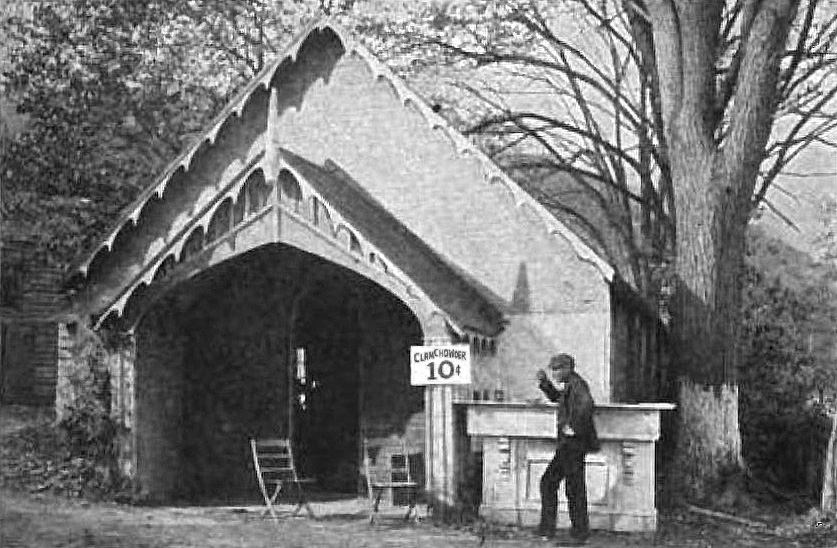
For those preferring shorter rides, city parks were attractive, perhaps none so much as Philadelphia’s Fairmount Park. It was well supplied with places to stop for a bite [such as The Dairy, shown here]. New Yorkers liked to tour the good roads on Staten Island or pedal out to Long Island and Coney Island, often making a stop at the beach. Bicyclists in Oregon were drawn to a rose farm outside Portland, site of the Ah Ben roadhouse where chicken dinners were served.

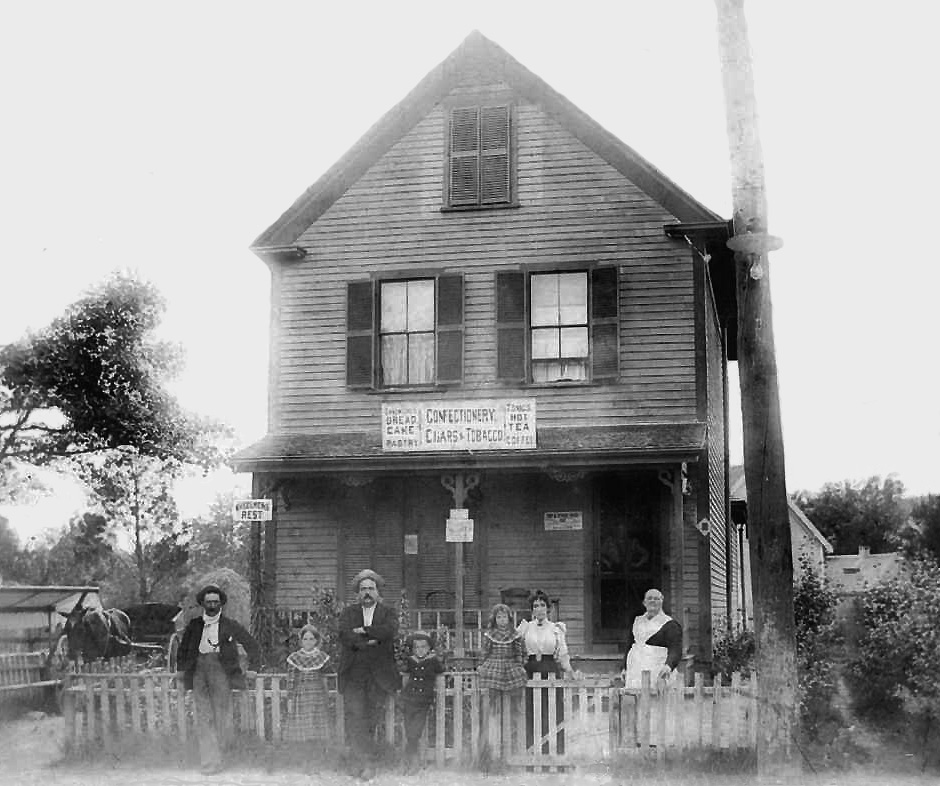
There were also eating places set up in homes along the wayside, and homemade refreshment stands in fields. Often these eating and drinking places were dubbed “Wheelman’s Rest.” One in Malden MA was offering light snacks in 1896, but apparently no beer or liquor, an activity that landed many proprietors who had no liquor licenses in jail.

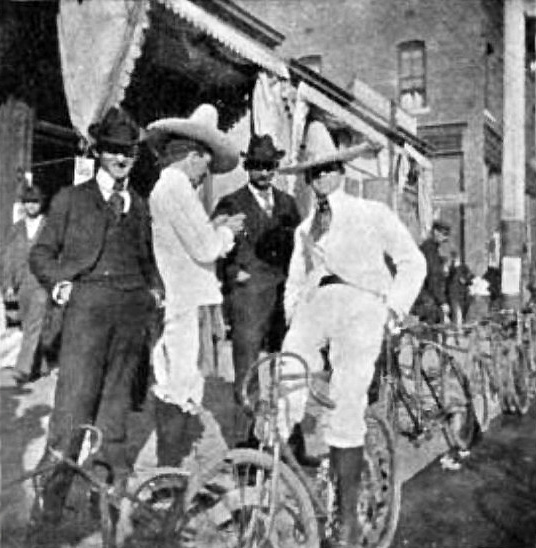
Californians boasted that bicycling was possible year round in “the land of sunshine.” Country trips might be planned around visits to old missions. Pictured above are members of San Diego’s Crown City club, wearing white suits and sombreros on a tour in 1896.

Bicycling was popular across the country with men and women, both white and Black. Black cyclists, however, were banned from some local clubs and, after 1894, from membership in the national League of American Wheelmen. That did not stop them from cycling, but I can’t help but wonder whether they were welcome at most inns and roadhouses.

White women, however, were welcome, despite those who criticized them for showing their ankles or adopting non-ladylike postures. For years feminists had tried and failed to reform constricting women’s clothing. Almost overnight, opposition faded as bicycling women began wearing split skirts and bloomers. Beyond clothing, it seemed as though the new past time had a freeing effect. A journalist visiting a Bronx beer garden one evening wrote: “The bicycle has made ‘new women’ of them. They lean their elbows on the table and call for beer, or, leaning back, cross their legs man fashion and sip from the foaming mug.”

More conventional “wheelwomen” might prefer tea-roomy places serving nothing alcoholic where menus included milk, root beer, and lemonade, along with sandwiches, cheese and crackers, and cakes. Servers there were women who, according to one account, were ready to repair a sagging hem, brush dirt off a costume, or attend to a minor wound. The short-lived Greenwich Tea Room in Connecticut, operated by two young society women, offered dainty sandwiches of tongue, ham, chicken, or lettuce, plus home-made cake and ice cream. Drinks included café frappe and café mousse, both 10 cents.

Bike paths were crowded from April through October, especially on Sundays, the most popular day of the week for cycling. Christian ministers were horrified, particularly if stopping at roadhouses was involved. As one wrote in 1897, this inevitably led to “blunting the moral sense, dulling the moral perceptions, and tainting the purity of the moral character . . .”

Shore dinners also attracted bicyclists. In 1899 a cyclist traveling along the shore from New York City to Boston stopped at Hammonasset Point in Madison CT for a dinner that included clam chowder, bluefish, steamed clams, boiled lobster, potatoes, corn, tomatoes, cucumbers, pudding, ice cream, coffee, and milk – all for 50 cents. And an abandoned church turned restaurant and bowling alley in Undercliff NJ [pictured] did a brisk summer business in clam chowder with cyclists traveling along the Hudson River cliffs.

In the early years of the 1900s, the fad began to slow somewhat. Bicycling on roads became more dangerous as the number of cars multiplied. Through the years bicycling organizations had lobbied ceaselessly for improvement of the nation’s roads, most of which were unpaved. But they did not reap full benefit. As roads were improved, cars soon took over and bicycling accidents, often fatal, increased. However, automobile drivers continued the Sunday habit of heading out to country inns, tea rooms, and roadhouses that bicyclists had begun.

© Jan Whitaker, 2021

6 Comments

Filed under Offbeat places, patrons, roadside restaurants, tea shops

Speed eating

Since the early 19th century, observers have commented on how fast Americans eat. Visitors from other countries were especially apt to notice the speed with which people, particularly men, gulped down their food and hurried away from the table as quickly as possible.

In the 1843 book Men and Manners in America, the author observed that “all was hurry, bustle, clamor, and voracity, and the business of repletion went forward with a rapidity altogether unexampled.” He described how at breakfast he had barely arrived at the communal table as others were rushing off, leaving behind a terrific mess of chicken bones, an upset mustard pot, and a tablecloth with egg, coffee, and gravy stains. Dinner was no better: “the same scene of gulping and swallowing, as if for a wager.” Many of his fellow diners left the dining room before the second course and few waited for dessert.

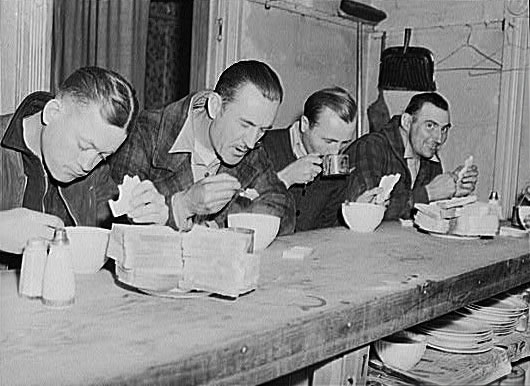
His observations were ratified by many others, continuing throughout the 19th century and into the 20th. New York’s inexpensive “slam-bang” places with counters were especially noted for their customers’ speed of eating. Viewed from the back, wrote an essayist in 1865, a row of 30 men with heads bent down and elbows moving rapidly looked as though they were weaving or fiddling. They finished in about 8 minutes.

A Scribner’s story in 1874 described the typical American restaurant as a place where men “do not eat – they feed,” without even removing their hats. It reported that the average mid-day “dinner” time lasted 6 minutes and 45 seconds. At New York’s Astor House of the 1880s – scarcely a low-class eatery – many of the male customers ate standing up at a counter, a practice that was by no means rare. A visiting French economist attributed the popularity of 5-minute counter lunches in saloons to the wish not to interfere with business — a convenience “that does not cut the day in two.” Or, as another writer put it in 1895, “The ammunition is put in, with a wad of dessert on top, and in ten minutes the man who is going to be a millionaire in less than ten years is back at his desk, loaded and pointed at his work . . .”

By the late 1890s, women had also become speed eaters, “stopping in restaurants when shopping and being in such a hurry that they don’t care what they eat and do not even remove hats and coats.” The so-called “new woman” was ready to sit at lunch counters “like a man and eat her pie and drink her coffee in a hurly-burly.”

The late 19th century also witnessed the development and spread of new restaurant types organized around speed – the cafeteria, the automatic restaurant, and the quick lunch, all of which were based on the abolition of table service. They also did away with the much-hated custom of tipping that was widely viewed as a foreign importation from old and dying Europe.

Through the 20th century speediness was made into a science, increasingly applying not only to how fast customers ate, but how quickly food could be prepared, how quickly customers could be presented with food, and how they could be induced to leave as soon as possible. The hot noontime “dinner” gave way to the sandwich lunch. The number of menu choices was reduced. Chains developed that produced food in central commissaries, doing away with the need for full-scale restaurant kitchens. Cafeterias discovered they could speed up the serving line by wrapping silverware in a napkin. Uncomfortable seating could be designed to stop patrons from lingering.

After the second World War, in which the military had developed rapid methods of feeding troops, speed-up technology advanced in restaurants. A California drive-in had machines that could mold 800 hamburger patties per hour and slice 1,000 buns in the same time. In 1956 an automatic broiler was advertised to drive-ins that broiled approximately 300 burgers an hour. The franchise system began to spread quickly to drive-in eateries across the country, but now without curb service because it was much too slow even if carhops wore roller skates. Even table-service restaurants, catering to the relatively leisurely dinner crowd which was on the increase in the 1960s, improved their speed with frozen foods, boiling bags, and microwave ovens.

By 1965, more than 70% of the more than 378,000 commercial eating places in this country were quick-service restaurants, according to a marketing research study.

No one comments about Americans eating fast anymore. It has become normal.

© Jan Whitaker, 2021

6 Comments

Filed under cafeterias, chain restaurants, patrons

The Automat goes country

What happened when Horn & Hardart went outside the densely populated city and into the countryside?

“The Automat in the Forest” was located in Sterling Forest Gardens, a 125-acre private park filled with attractions such as huge floral displays, children’s playgrounds, fountains, and a meditation garden. The enterprise, created by a NYC investment company, was a one-hour drive outside New York City.

The Gardens presented a highly-engineered version of nature achieved with imports such as 1.5M tulip bulbs and 300 robins for the grand opening in spring of 1960. (The robins arrived by plane.) There were swans, peacocks, cranes, and flamingos, while native wildlife was strongly “discouraged” from participating. There were even special “picture-taking spots” where a sample photograph was displayed along with precise instructions on how to get the same results.

At the time of the 1960 opening a wire-service story disclosed a jarring fact: “The setting is so romantic that few visitors would guess that the Union Carbide Corporation’s laboratory is constructing an atomic reactor over the nearest hill.” That did not seem to deter visitors.

Into this surreal wonderland came the Automat in 1962. That summer a promotional photo showed children feeding a deer in front of a wall of vending cubicles – which was odd since deer were forbidden in the gardens. The photo’s caption explained that the Automat was the first to be located outside a city, and described it as having redwood planks and pastel panels rather than the usual marble facing “in keeping with its surroundings.” In the postcard above, the vending wall looks oddly out of place in the high-ceilinged building and has little feel of an urban Horn & Hardart.

At the same time that the Automat moved into the Sterling Forest Gardens, Horn & Hardart’s Food Service and Management Division was advertising that it could furnish In-Plant ‘Automats for Industry’. I suspect the factory installations were very similar to the array in the Gardens.

The Automat was not the first eating place in the Garden’s International Pavilion. A 1961 postcard described the original eating place, a buffet, as “tastefully decorated in international motifs.” Nor was it the last restaurant in the Pavilion. It was there only two years, continuing in business through the 1964 season. By the 1965 Spring Festival the Automat in the Forest had been replaced by the Sterling Farms Restaurant. Later, in 1968, there was a Schrafft’s occupying the Pavilion.

Horn & Hardart also operated a second eating place in the Gardens, Peacock Patio, that had a cafeteria and barbecue. Not far from the park, it ran a Country Store where, ironically, H&H frozen prepared dishes were sold. It’s not clear how long either remained in business under Horn & Hardart’s ownership.

As might be imagined, Sterling Forest Gardens was popular with garden clubs, groups of older adults, and bus tours generally. Without doubt its most unusual guests were Marshall Tito of Yugoslavia and his wife who visited in summer 1963, one day after Tito enemies had infiltrated the Waldorf Towers where the Titos were staying in NYC. Distrustful of the city’s ability to protect him, Marshall Tito cancelled plans to attend a 1,100-person dinner at the United Nations, asking instead to visit a farm. He was taken to Sterling Forest Gardens, where he and his wife lunched at the Automat. Walking through the Automat’s cafeteria line, he chose a hamburger steak, french fries, and macaroni while she accompanied her ground meat with fries, carrots, and spinach.

After several years of slumping attendance, the Gardens closed in 1976. Later, it became a site for medieval jousting.

© Jan Whitaker, 2020

7 Comments

Filed under alternative restaurants, chain restaurants, Offbeat places, patrons

Suffrage tea & lunch rooms

In roughly the ten years preceding passage of the 19th amendment giving women the vote in 1920, suffragists ran tea rooms and lunch rooms to raise funds for the cause and to publicize their arguments for why women should have the right to vote.

Most major cities – New York, Boston, Baltimore, Hartford, Charleston, Atlanta, D.C. [see above illustration], etc. – had a suffrage tea or lunch room, many located in the local suffrage headquarters. In smaller towns they might be temporary, running only for a week or so in order to get money for something such as sending a delegate to a meeting out of town. There were other related ways to make money: in San Francisco suffragists sold a specially packaged Equality Tea, with a booth in the Emporium department store.

Some groups served only tea but in larger cities tea and lunch rooms also provided food. When a suffrage tea room opened in Chicago in 1914, it offered a variety of salads and sandwiches with a beverage for 35 cents. Desserts could be added for another 15 cents, but evidently pie a la mode was reserved for male guests. Men were warmly invited to patronize suffrage tea and lunch rooms, and treated very well, since they would be the ones deciding whether women would get the vote. Lifelong peace activist Mildred Scott Olmsted [shown here at age 29], interviewed at age 97, said she had been a volunteer waitress at Philadelphia’s suffrage tea room, where they “lured men in for a good cheap business lunch.” “Then,” she said, “you could hand them literature and talk.” No doubt she did a lot of talking. Over and over she heard the argument that women should rely on husbands, fathers, and brothers to vote for them.

At Boston’s suffrage lunch room on Tremont Street [shown below] substantial meals were available, such as corned beef hash with beets and a muffin or boiled salmon with egg sauce and potatoes, both for about 30 cents. The back of the menu was used to inform diners that if the lunch room succeeded in adding another 40 daily patrons to its usual 160, it would make enough profit to cover its office rent. Yellow was the color most often associated with the suffrage cause, explaining the Sunflower name adopted by the Boston suffragists.

Undoubtedly, the most eye-catching of the pro-suffrage tea and food dispensaries was the yellow and black lunch wagon that showed up in the Bronx near Fordham College in the summer of 1911. Suffrage volunteers worked in it, selling lemonade and sandwiches. The plan was to have one wagon in each of the five boroughs; one showed up in Brooklyn in 1915, though I couldn’t determine if there were others.

The lunch wagon was only one of New York’s suffrage eating places. At 70 Wall Street was the Votes for Women lunch room run by the Empire State Suffrage Campaign Committee, in a space donated by the husband of one of the suffragists. When a promise of homemade food was made on September 16, 1915, the place was mobbed, with men crowding the tables and “against the walls.” A menu published later promised “Real Home Cooking,” featuring Chicken Salad, Corn Bread, Waffles with Real Maple Syrup, and Home-made Ice Cream.

The offer of “homemade” food was politically strategic in that it reinforced the idea that suffragists were feminine women, not pseudo men as argued by the anti-suffragists. Using the same logic a suffrage group in Washington state put out a cookbook with 700 recipes. [1917 ad for Philadelphia’s lunch room show here]

Multi-millionaire Alva Belmont financed another New York City suffrage lunch room on East 41st street, at the headquarters of her Political Equality League. There middle-class women who could afford to spend 50 cents for lunch ate in one room, while working-class women ate inexpensive sandwiches in a second room.

Along with suffrage groups, probably every city also had an organization of women opposed to equal suffrage. They also tried to gain support through teas and lunches, though these tended to be occasional events held at the antis’ headquarters or in someone’s home. In February 1917, the District of Columbia Association Opposed to Woman Suffrage, for instance, created a pink tea room – pink being the antis’ color — at their Pennsylvania Avenue offices for visitors attending the inauguration of Woodrow Wilson. In Des Moines IA, the local anti-suffrage association held a tea reception at Younker’s Department Store to host a prominent anti-suffragist from Pennsylvania.

Just how helpful suffrage eating places were in boosting the cause is impossible to assess, but they surely must have helped build bonds among feminist activists such as Mildred Olmsted.

© Jan Whitaker, 2020

3 Comments

Filed under alternative restaurants, lunch rooms, patrons, tea shops, women