Category Archives: odd buildings

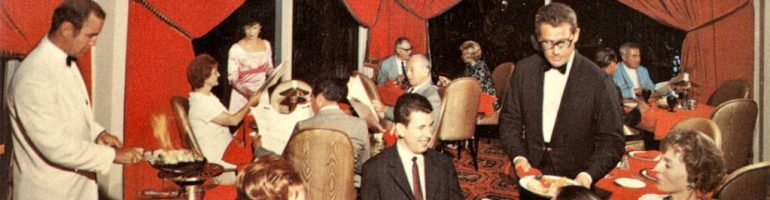
Famous in its day: The Pyramid

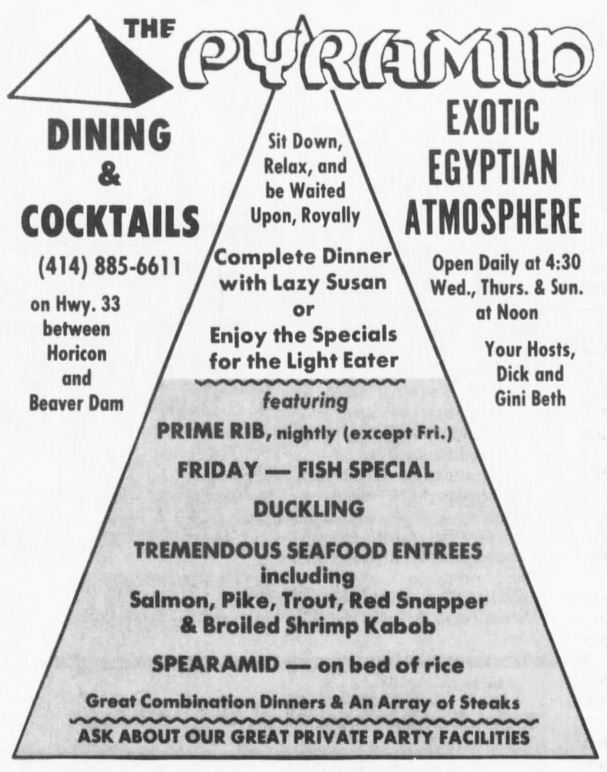
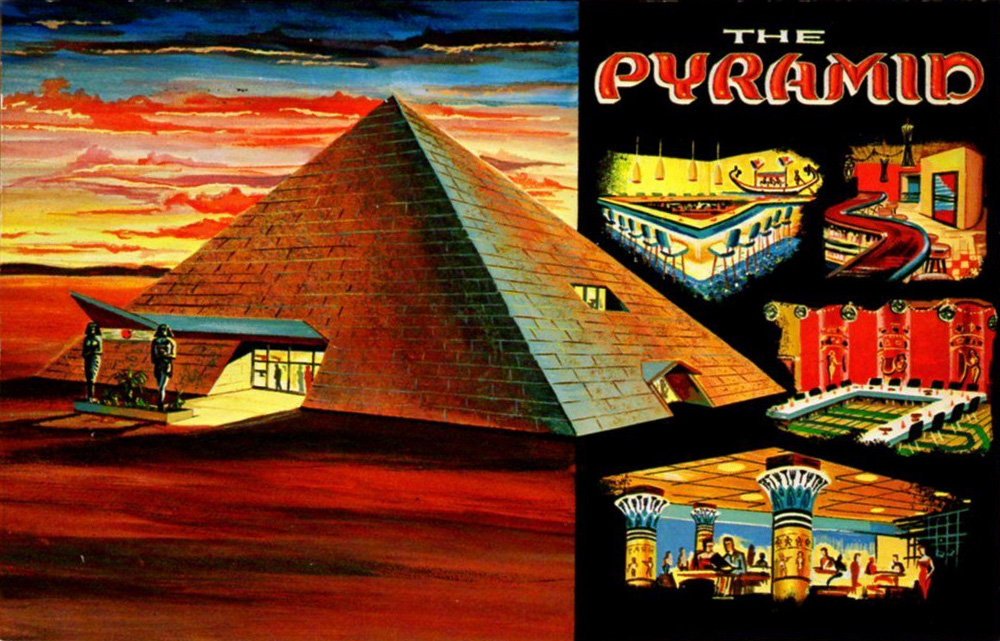
I was initially attracted to The Pyramid Supper Club because of its kooky architecture and its surprising location on a rural Wisconsin road next to a cornfield. I admit I thought it was a joke.

As a 1991 advertorial noted, “The Pyramid Supper Club on Highway 33 east of Beaver Dam is surrounded by a bare, flat-land setting much like the original pyramids depicted in the interior wall paintings.”

Flat it is, I thought, but Wisconsin is a long way from ancient Egypt. Like Wild West-theme restaurants in New England and Polynesian restaurants in Arizona, it struck me as absurd.

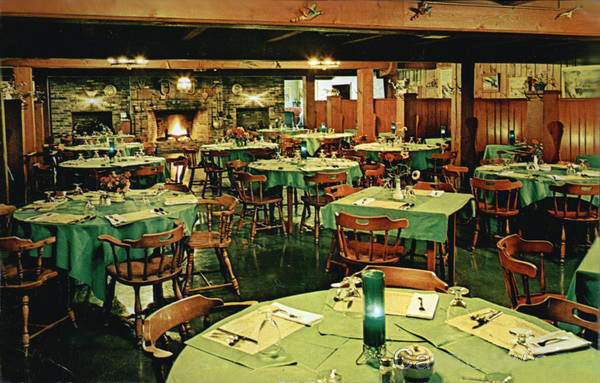
Not only its location, but dining in a replica of a tomb? With murals depicting slaves at work? “Dine amidst the splendors of The Pharaohs – Have Cocktails in fabulous Egyptian lounges,” read the copy on the back of a postcard. I pictured the wives of Lutheran pastors, 4-H officials, fertilizer dealers, and goose hunters – all of whom gathered there at various times – clinking glasses of Yummy Mummies.

Why did the owners, who helped design the building, want their restaurant to resemble a pyramid? It opened in 1961 as the Tutankhamun Treasures exhibition toured the United States, so that’s one obvious source of inspiration. But I was surprised by the explanation that owners Gini and Dick Beth gave to a reporter, that in addition to “visual appeal” the building style had “no association with any particular food.”

Doesn’t that apply to most buildings that house restaurants? It takes no special architecture to lure lovers of steak and prime rib, the all-American cuisine the restaurant was based on.

I counted at least 27 main dishes on a 1984 Pyramid menu, suggesting that the restaurant must have had a mighty big freezer. Along with beef, chicken, and seafood specials was the puzzler, “Spearamid – on bed of rice.” Slowly it dawned on me that the word rhymed with pyramid, and was their coining. I then discovered it was beef, onion, peppers, and tomatoes grilled on a skewer.

To be fair, not all the Pyramid’s meat was frozen. The restaurant bought locally raised animals that won prizes at fairs. In 1991, for instance, they bought a lamb that won grand champion honors, paying $1,050 for it.

The Pyramid was a popular place, with a staff that was renowned for their friendliness and long tenure. It was heavily patronized by surrounding townspeople and community organizations of all sorts. Counting party rooms, the restaurant seated 500. On Sundays they served up to 300 meals, a number that jumped up as high as 800 during goose hunting season.

As I continued to learn about the Pyramid I realized a restaurant that at first I took as a joke wasn’t that at all. It was a true community institution.

Its originators, the Beths, sold it in 1994, and it subsequently had a couple of owners who ran it under different names. It closed in 2009, looking rather forlorn as shown here on Google Earth.

© Jan Whitaker, 2018

15 Comments

Filed under food, odd buildings, popular restaurants, restaurant decor, theme restaurants

Famous in its day: the Public Natatorium

Sometimes a brilliant idea hits you, but then you wake up the next day and see why it won’t work. But other times you don’t see why it won’t work until much, much later – after you’ve lost a lot of money.

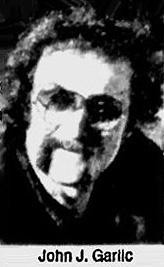
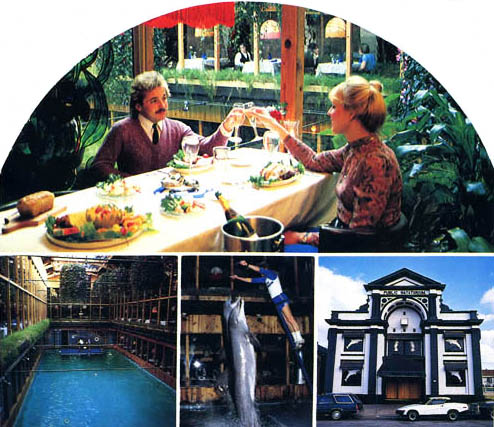
That’s what seems to have happened with John and Margaret Garlic’s plan to turn a 19th-century public bathhouse in Milwaukee into a restaurant with dolphin shows. The future looked bright when they bought the building from the city for a mere $4,000, but then things became more complicated.

They hoped to open the restaurant one year after their January 1978 purchase, but the actual opening date was delayed by a year by city regulations, trade unions, and late equipment deliveries. Gutting the building and reconstructing the interior purportedly cost upwards of $800,000. And then there were unexpectedly high costs of leasing dolphins and providing for their care and feeding, as well as for federal inspections and trainers’ salaries.

It was not the Garlic’s first foray into the food and restaurant business. Around 1976 they had opened J. J. Garlic’s, a casual restaurant that soon gained popularity in Milwaukee for its cheese fondue, soups, burgers, and jumbo shrimp. Around 1973 the Garlics had pioneered the industrial production of the now-ubiquitous gyro cone, beef and lamb scraps blended and pressed into a Spam-like substance supplied to concessionaires, roadside carts, and restaurant operators.

But then in 1978 J. J. Garlic’s received a devastating review by none other than the celebrated writer Herbert Kubly who wrote restaurant reviews for The Milwaukee Journal from 1970 to 1984. According to G&G Enterprises, Ltd., the official owner of Garlic’s, the review caused a 25% drop in business, amounting to a loss of half a million dollars.

As it happened, the menu at the Public Natatorium – as the new 1979 restaurant was named — borrowed heavily from J. J. Garlic’s. This was especially the case on the Natatorium’s “gourmet” second level where prices ran considerably higher than on the lower level.

While the lower-level menu had sandwiches in the $4 to $5 range, the upper level was meant to provide an elegant dining experience, with chilled golden salad forks, marble-topped tables, and a parchment-like menu. Yet even the lower level was deemed too expensive by some Milwaukeeans. A review that appeared shortly after the opening pointed to skimpy servings such as the Peel & Dip Shrimp at $7.50 which a reviewer described as “five small shrimp . . . with cocktail sauce, a slice of lemon and a lot of ice.” The writer also grumbled about a $1 entrance fee assessed on all customers.

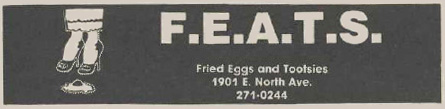
Nonetheless, the Public Natatorium became a must for tourists attracted by the dolphin shows and as far as I can tell did reasonably well overall. At some point after its opening, G&G Enterprises opened a third place with the characteristically jocular 1970s name Fried Eggs & Tootsies, aka F.E.A.T.S. Located near the Milwaukee campus of the state university, F.E.A.T.S. was mostly a drinking spot with bands.

Still, the fine dining concept at the Public Natatorium showed signs of consumer resistance. A 1980 review in a Racine WI paper titled “Taking a bath at the Natatorium” was extremely negative. It described in great detail how, despite high prices, the wine glasses were dirty as were some raw appetizer mushrooms, while several main dishes were submerged in thick, tasteless sauces. The reviewer also cited a shrimp dish that “reeked of the freezer.” He found a small loaf of warm bread the best food served to his table. A 1982 Los Angeles Times story about places to visit in Milwaukee advised visitors to take the children there for the dolphin show but “certainly don’t go for the food, which is mediocre.”

It’s likely that the Natatorium was not doing too well by 1983, the year in which G&G Enterprises filed a $1.1 million lawsuit against The Milwaukee Journal for the 1978 Kubly review of J. J. Garlic’s and to forestall a forthcoming review of the Natatorium by Kubly which they believed would be negative. The suit, which went nowhere, claimed that the paper, an editor, and Kubly were “engaged in a conspiracy to put plaintiff out of business with yet another defamatory article.”

Kubly’s review came out anyway and was indeed negative, detailing slow service, cold food, and a high degree of inept pretentiousness. He included inauspicious quotations from the menu such as “Wild Boar Chasseur, cousin of the domestic sow” and “Hippopotamus Bordelaise, chewier than beef.” What was appealing about Lion le Blanc, Buffalo Navajo, or Veal Chop Andrea Doria (“once served on the famous ship that had the unfortunate collision”)? Kubly must have recognized some of the same dishes he had been served at J. J. Garlic’s, namely the cold fondue (“incorrigible, starch-laden, over salted”), cold consomme (“contained tough bits of meat, a few peas and carrot lumps”), and baked potatoes (“cold and had an unappetizing scorched taste”). A lengthy two and a half hours after arriving, he and his companions made their way out of the then-empty restaurant as the staff brought out a cake – which they took home in its Pepperidge Farm box supplied by the waitress.

The following year John Garlic announced he would sell J. J. Garlic’s and F.E.A.T.S. and move to Florida, while The Public Natatorium would remain open under a manager. But that didn’t last long. By January 1985 the remaining dolphin, Soda, was in peril due to a heating breakdown. A bankruptcy judge ordered that he and two sea lions be sold immediately as part of the restaurant’s liquidation proceedings.

© Jan Whitaker, 2017

23 Comments

Filed under atmosphere, food, guides & reviews, menus, odd buildings, Offbeat places

The history of the restaurant of the future

Starting in the early 20th century, most futuristic thinking about restaurants involved technological inventions. Many envisioned replacing waiters with mechanical devices that would send orders straight to the kitchen, then deliver the food to customers. Others foresaw the day that electricity could be used in restaurant kitchens to power every kind of tool for peeling, slicing, heating, etc.

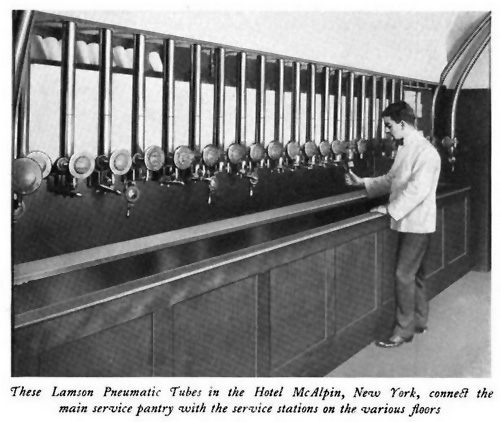
In the teens, in fact, major hotels installed pneumatic tube systems that swooshed restaurant orders from guests in bedrooms and dining rooms to hotel service pantries. [1916 image]

The arrival of electronics with the end of World War II inspired dreams of near-instant cooking, and led to imagined scenarios in which waitresses shouted directions to the kitchen meant to produce a soft-boiled egg and crisp bacon: “One egg, hundred and thirty megacycles, six seconds – bacon, two hundred and forty megs, eleven seconds.”

The late 1950s, perhaps a wackier decade than it is usually portrayed, brought forth two curious predictions. Don Roth of Chicago’s Blackhawk Restaurant probably gave his prediction as a publicity stunt when he suggested that in the future gourmet meals by famous chefs would arrive by rocket ship from all over the world. Arrive, that is, after diners ordered via 3-D television on which they watched a chef prepare it. A columnist writing “Astro-Guide” under the name “Ceean” predicted that restaurants patronized by advertising and television executives would soon be equipped with table jacks permitting portable TVs and earphones to be used to monitor programs during lunch.

Watching a little screen at your restaurant table while eating? What a silly idea.

Still, in one way or another, most of the predictions eventually came true. Of course it helped if a prediction was made when the trend was already well underway. It wasn’t too daring in 1969 to predict that chains and franchising would grow. On the other hand, the same analysts considered the possibility that as people ate out more, future restaurants might offer special pricing for anyone who planned to eat five or more dinners a month at the same place. They did not seem to know that as far back as the 1870s it had been commonplace for restaurants to sell discounted weekly meal tickets.

Also in the 1960s, food scientists and industry gurus dreamed of frozen pre-prepared meals that needed only to be heated and served. That happened too.

The 1960s also produced a semblance of futuristic dining at the 1964 New York World’s Fair, at the gas industry’s Pavilion Restaurant [shown above], and at Disney’s Tomorrowland [shown here, 1967]. It was heralded as “Tomorrowland Terrace – A restaurant of the future where excellent food and entertainment are served daily. Presented by COCA-COLA.” The Pavilion Restaurant had walls of blown air, while the futuristic aspects of Tomorrowland Terrace escape me. Later TT was remodeled and renamed Club Buzz, and then in 2006 was semi-restored and once again became Tomorrowland Terrace.

A hospitality management professor once told me that the restaurant industry is not interested in the past, only the future. That attitude can produce some strange predictions, such as those of a professor of hotel management in 1976. He anticipated push button ordering with pneumatic tube delivery (turn of the century ideas, partly realized in the teens), boiling bag entrees (see 1964 image), pictorial menus (already in use by then), and scratch ‘n’ sniff menus (which, thankfully, never materialized).

In the mid-1970s, some thought that restaurants that implemented energy-conservation measures were models of restaurants of the future. In 1976 a new Jolly Tiger restaurant opened outside Albany NY, designed as a test site for energy reclamation and conservation, and monitored by the State University of New York, with funding from the U.S. Energy Research and Development Administration (later the Department of Energy). Given that restaurants are huge energy users, energy conservation has been recommended by the National Restaurant Association and implemented to varying degrees in some restaurants. However, as of 2013 only 38 U.S. restaurants out of a total of over 600,000 had been granted LEED certification, signifying that they had made a serious commitment to reducing energy consumption.

That future has yet to arrive.

© Jan Whitaker, 2017

3 Comments

Filed under chain restaurants, odd buildings, restaurant industry, technology

Multitasking eateries

restaurantand

For centuries people have grabbed something to eat wherever they happened to be. Maybe they bought a baked potato from a roving street peddler, got tamales from a lunch cart, or stopped at a stand for a hot dog.

The places they got their food were usually not full-scale restaurants with waiters, complete meals, and sit-down service. The food and surroundings were often rudimentary. In the 20th century, and now, many catch-as-catch-can eateries were combined with other types of businesses.

restaurantandservicestationint

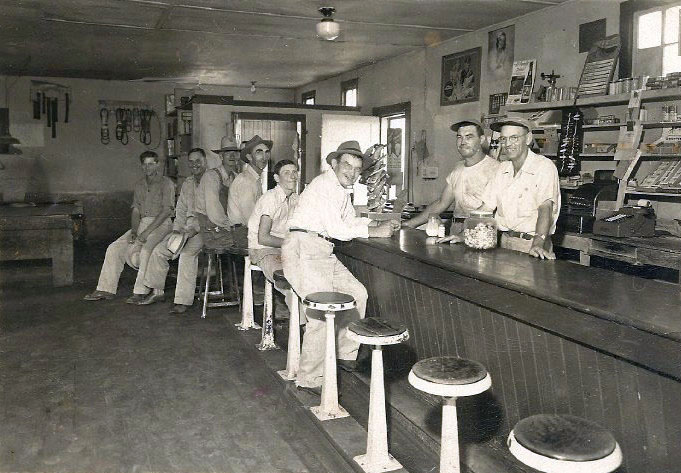
Gas stations are a prime example. But only once have I come across a lunchcounter installed inside the garage itself as shown here. Along with coffee and grub, it looks like customers could just grab a fanbelt off the wall at this homespun Arkansas café.

As was true of gas stations, eateries were often provided to serve people who stopped to take care of other chores, whether filling up their gas tank – or getting a haircut. Combining a quick lunch stand with a barber shop was outlawed in Duluth MN in the 1920s, perhaps because customers were finding hairs in their soup?

But I have to admit it was handy that the W-Bar-W Steak Ranch in Kennesaw GA was combined with a pawn shop in the 1960s. If hungry diners’ appetites exceeded their funds, they could pawn their watches.

restaurantandshoeshineherefordtx1920

And certainly it was convenient to have your shoes shined while you ate.

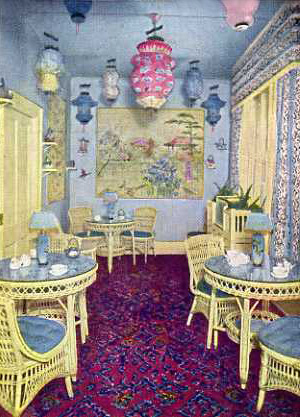
restaurantanddentistofficeHow about some tea or bouillon while you wait for the dentist to work on your teeth? Unlike most other providers of refreshments, Dr. Arthur Cobb of Buffalo NY did not try to make money from his color-coordinated Japanese Tea Room.

Of course it has always been common to combine places of amusement with opportunities to eat a bite. In the 1850s men looking for an evening of entertainment might go the Washington Hall Restaurant and Pistol Gallery. After consuming “Beverages and Edibles” guests could enjoy rifle and pistol practice upstairs. Given the “beverages,” it sounds like a recipe for disaster to me.

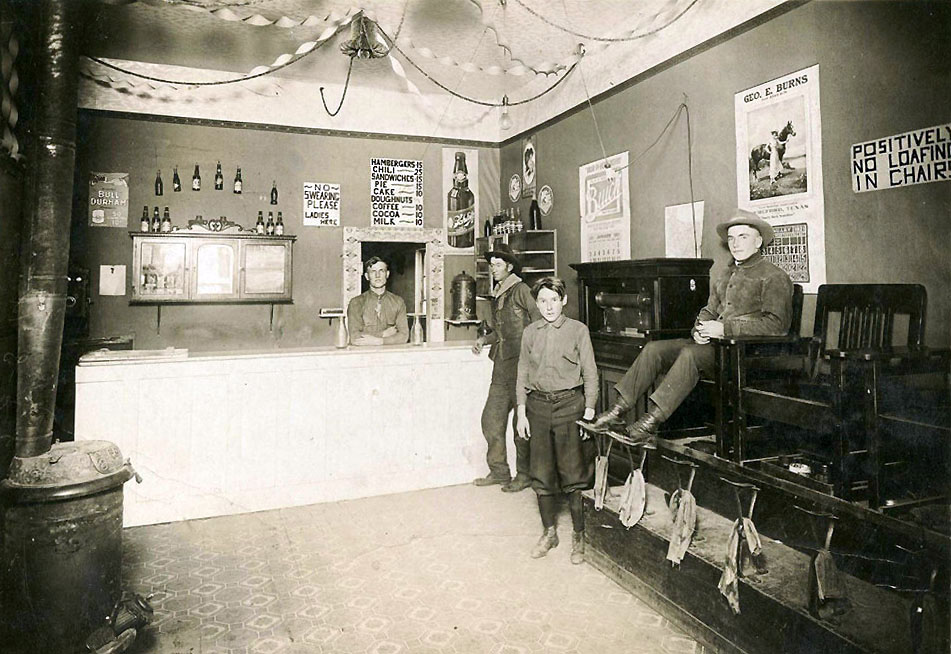
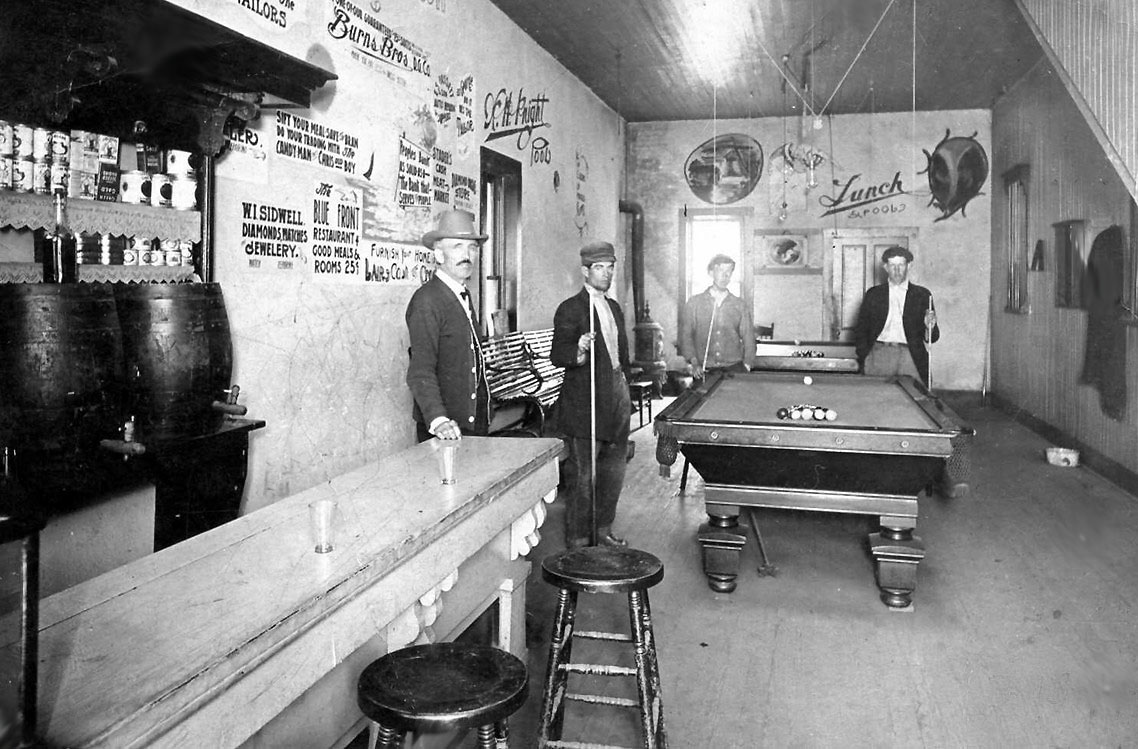
Bowling, pinball, and billiards were also frequently accompanied by eats as the following images show.

restaurantand-pool1914

restaurantandpinballmaybetx

© Jan Whitaker, 2016

Leave a comment

Filed under lunch rooms, odd buildings, Offbeat places

The “mysterious” Singing Kettle

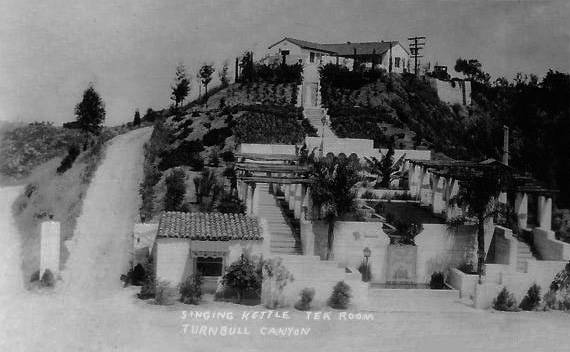
singingkettlepcA veil of ominous mystery has spread over the remains of a California roadside tea room once known by the homey name Singing Kettle.

It was located near the summit of Turnbull Canyon, high above the San Gabriel Valley, on a winding road running through the Puente Hills in North Whittier. The road was completed in 1915, opening up a route filled with what many regarded as the most impressive views on the entire Pacific Coast.

singingkettle3781tcrstreetview

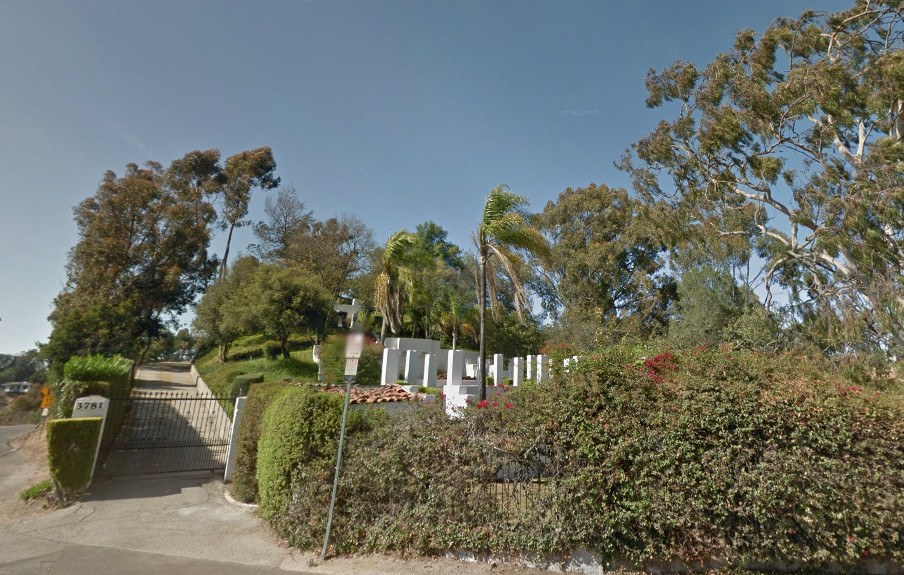
Today young people drive into the “haunted” canyon at night determined to be frightened to death. Gazing out car windows they eagerly tell each other tales they’ve heard of satanic rituals, murders, and human sacrifice, hoping that behind that fence are unspeakable horrors they might be lucky enough to witness. Even the Singing Kettle tea room, perhaps because remnants of its entrance are visible from the road, has become enmeshed in dark fantasies.

Why am I laughing?

Because it strikes me as funny that a tea room from the 1920s and 1930s could be associated with horror and paranormal events. Or even that people would find its existence mysterious, wondering why it was ever there or what it really was.

I suppose that given enough time and imagination mysterious auras can envelop any mundane place, even a deserted mall or a parking garage. But still, finding a tea room scary is like being frightened by a club sandwich.

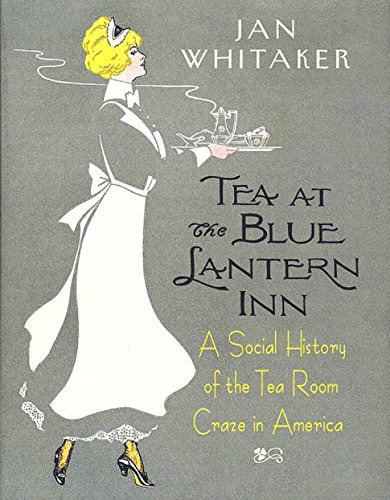
I have experienced a somewhat similar attitude before. I gave a talk on tea rooms of New York City when my book Tea at the Blue Lantern Inn came out in 2002. Afterwards a man in the audience came up and asked me why I didn’t mention the darker aspects of tea rooms. He was fixated on the idea that a lot of them had been speakeasies and houses of prostitution.

Really? If that had indeed been the case, why would I not have mentioned it? It would be a good story. I’ve found little evidence of prostitution in tea rooms. It’s true that some, a minority, of tea room proprietors were found selling liquor during Prohibition. A few places in Greenwich Village were raided in the early 1920s, and here and there the mob would open a joint and call it a tea room, though that was purely a ruse. They were totally fake. I feel certain it was impossible to order a diet plate or a Waldorf salad in a mob tea room.

singingkettleentireproperty

The dining area of the Singing Kettle tea room was up the hill from the pergola entrance shown on the black and white postcard above. As can be seen from a bird’s-eye view of the property, terraced stairs with fountains and shrubbery led up to the main tea room which today appears to be a residence. The view while dining would have been spectacular.

The tea room was frequented by students and staff from Whittier College, the Whittier Chamber of Commerce, and women’s clubs. It was a popular place for business meetings, card parties, wedding receptions, and bridal showers. Weddings were held in the inner courtyard of its entrance pergola.

singingkettlehartwhittierheights1927I have not been able to discover exactly who ran the Singing Kettle. It was said to be owned and operated by a major Southern California agricultural land developer, Edwin G. Hart, but I can’t establish if he was headquartered on the property or was directly involved in the business. He did promote the tea room in a 1927 advertisement for his new residential development, Whittier Heights.

The Singing Kettle was in business from 1926 until at least 1939, but probably not much longer. It surely would not have survived gasoline rationing during WWII.

© Jan Whitaker, 2016

With many thanks to the reader who told me about the Singing Kettle.

21 Comments

Filed under atmosphere, odd buildings, Offbeat places, roadside restaurants, tea shops

Famous in its day: Aunt Fanny’s Cabin

auntfannyscabinouthouse

Famous, but also infamous in its day because of how it portrayed the South before the Civil War and Emancipation as a world of smiling slaves who loved serving the kindly white people who held them captive.

Beyond its costumed mammy servers and the Black children who boisterously recited the menu, sang, danced, and proclaimed the South would rise again, the proprietors of Aunt Fanny’s Cabin restaurant in Smyrna GA created a legend regarding its name and building which appropriated and falsified the life story of a living woman.

According to an oft-told tale, the restaurant’s core building was a relic of the Civil War era and the home of a former slave, Fanny Williams, who spent her last years sitting on the restaurant’s front porch telling of the war and its aftermath. At her death in 1949 legend had it that she was very old, her age ranging from somewhere in the 90s to much older. She was “about 112 years old” when she died, restaurant owner George Poole told a reporter in 1982.

Indeed there was a real Afro-American woman named Fanny Williams. However it was revealed after the restaurant closed in the 1990s that she was born after the Civil War and had never lived in the cabin, which itself dated from the 1890s. Poole’s estimate of her 112 years had been preposterous – only a few dozen people worldwide were known to have attained that age — but newspapers had been much inclined to lax reporting when it came to Aunt Fanny’s Cabin. Far from an ancient rural yokel, she was about 81 when she died, a city dweller in Atlanta, and active in raising funds for her church there. How willingly or why she adopted the ex-slave persona is unknown.

auntfannyscabin1953jpg

Fanny Williams was a servant to a wealthy Atlanta family named Campbell. She was in service to socialite Isoline Campbell McKenna in 1941 when McKenna opened a tea room-style eating place on family property near their summer home. She named it Aunt Fanny’s Cabin, hosting ladies’ luncheons, bridge clubs, and bridal showers. She leased the business in 1947, selling it to lessees Harvey Hester [pictured above instructing his employees] and Marjorie Bowman in 1954. They elaborated the Aunt Fanny legend, enacted in what are known as “Blacks in Blackface” scenes where cheerful servers sang, danced, and even joined patrons in singing “Dixie,” the anthem of the ante-bellum South. According to a newspaper report in 1977 the restaurant’s decor included framed advertisements for slaves.

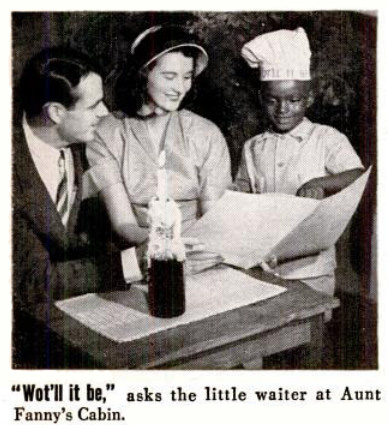
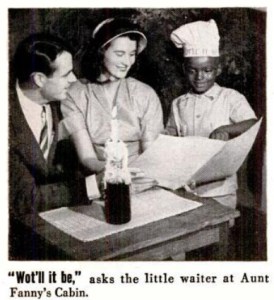
The restaurant’s third owner, George “Pongo” Poole, continued the song and dance tradition into the 1980s, although when a cabaret tax was demanded, dancing by the Black boys stopped. However, they continued to carry yoke-style wooden menu boards around their necks while they shouted out the menu offerings [child waiter shown below in 1949 before the menu boards were used].

The restaurant drew Georgians from Smyrna and Atlanta, as well as visitors from all over the country and the world. It was a tour bus stop, and a favorite of President Jimmy Carter and conventioneers such as members of the American Bar Association. Those who complained about the roles played by Black servers and the implicit celebration of slavery were characterized by proprietors as “Northern liberals,” though there is evidence that some Southerners and Westerners were also critical.
auntfannyscabin1949lifewoodburysoapadvIt became standard procedure when reporting on the restaurant to quote Poole about how his staff loved working there and was part of a big happy family. When interviewed, Black women servers would invariably attest to their love of the job and how they never felt insulted. To what extent this was a genuine expression on their parts is unknown.

What is known is that many of the elements that characterized the restaurant had been subjects of contention for a long time. A 1964 survey by Wayne State University researchers showed that most Black respondents found terms such as Sambo, Aunt Jemima, auntie, mammy, spook, and darkie offensive. Many white people, especially in the South, did not understand this, and thought that calling an elderly Black man or woman Uncle or Aunt/ie was a mark of respect. As for “mammy,” despite the affection many Southerners felt for the Black women who had cared for them when they were children, it had been rejected by many Americans long before the 1960s. In the 1920s the National Organization of Colored Women’s Clubs mobilized massive opposition to a Washington, D.C. memorial to mammies proposed by the United Daughters of the Confederacy. “One generation held the black mammy in abject slavery; the next would erect a monument to her fidelity,” said the club women’s official statement in 1923.

Georgia Senator Julian Bond said in the 1980s that he had little attraction to Aunt Fanny’s Cabin but could imagine that younger Blacks might find it “cute.” A journalist with the Atlanta Constitution who visited the restaurant in 1984 reported that he saw numerous Black patrons.

So, what’s the story? Did the degree of tolerance or even liking that some Black people expressed for Aunt Fanny’s Cabin mean that it held no offense to people of color? Did it mean that those who complained were thin-skinned trouble makers with an elevated sense of their own dignity who couldn’t take a joke? Did it mean, as a 1982 Washington Post story argued, that the years after the Civil Rights Act of 1964 were part of a post-racial age in which slavery, forced segregation, and lynching had largely ended and any remaining blatant prejudice was due simply to a few “obnoxious rednecks”?
mammy1959milwaukeeI think not.

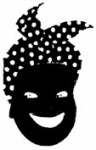
I cannot be absolutely certain that there has never been a Black-owned restaurant that celebrated plantations, “pickaninnies,” and “mammies” of the Old South, but all the mammy restaurants I know of, mostly in business from the 1930s to the Civil Rights era of the 1960s, were white-owned. And dressing Black women servers in mammy get-ups was so commonplace back then that at times I’ve wondered if wearing that costume was a waitressing job requirement for dark-skinned women.

auntfannyscabin1954jpg

After the death of owner George Poole, Aunt Fanny’s Cabin struggled and subsequent owners could not revive it. It closed for the last time in 1994, sometimes recalled as partly a victim of “political correctness.” Based on the understanding that the original portion of the restaurant’s building had been a slave cabin, the city of Smyrna proposed to move it downtown to be used as a visitors’ center. After a historic structures report revealed it dated from the 1890s, the city decided to go ahead with the project on the grounds that the restaurant had itself been a significant part of the city’s history.

© Jan Whitaker, 2016

Update regarding comments: From now on I will approve only thoughtful comments that address the theme of this blog post which is the restaurant’s portrayal of history and how that shaped the roles available to Black staff. I will not approve comments that assert that everyone loved working there or that rave about the fried chicken. I have already held some back for these reasons — along with some hate comments — but now it is my policy. March 5, 2021

December 16, 2021 update: The remaining Aunt Fanny’s Cabin is going to be torn down! Thanks to “MadamC” for sending this link to the Atlanta Journal-Constitution story.
103 Comments

Filed under odd buildings, Offbeat places, popular restaurants, racism, restaurant decor, uniforms & costumes

Dining for a cause

SanitaryFairKnickerbockerHall

During the Civil War, fairs were held in over twenty Northern cities to raise funds for the United States Sanitary Commission, a private organization that supplemented the Union Army Medical Corps’ efforts to care for wounded soldiers.

New York state held five fairs, in Albany, Poughkeepsie, Rochester, Brooklyn, and New York City. The Brooklyn and New York City “Sanitary Fairs” were massive endeavors resulting in donations of enormous amounts — $300,000 and $1,000,000, respectively — to the Sanitary Commission.

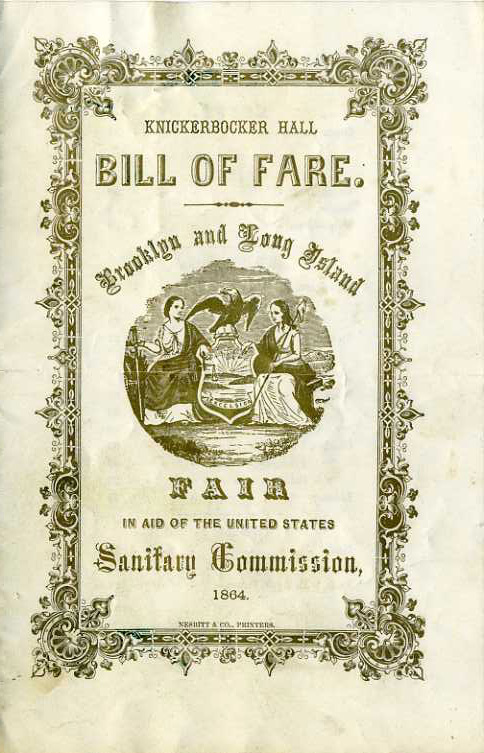
SanitaryFair1The fairs featured music, displays of art and curiosities, tableaux vivants, and other entertainments. Restaurants were an especially popular attraction. This week, a friend whose ancestors were involved with the Brooklyn fair gave me a wonderful printed-in-gold bill of fare from that fair’s Knickerbocker Hall Restaurant.

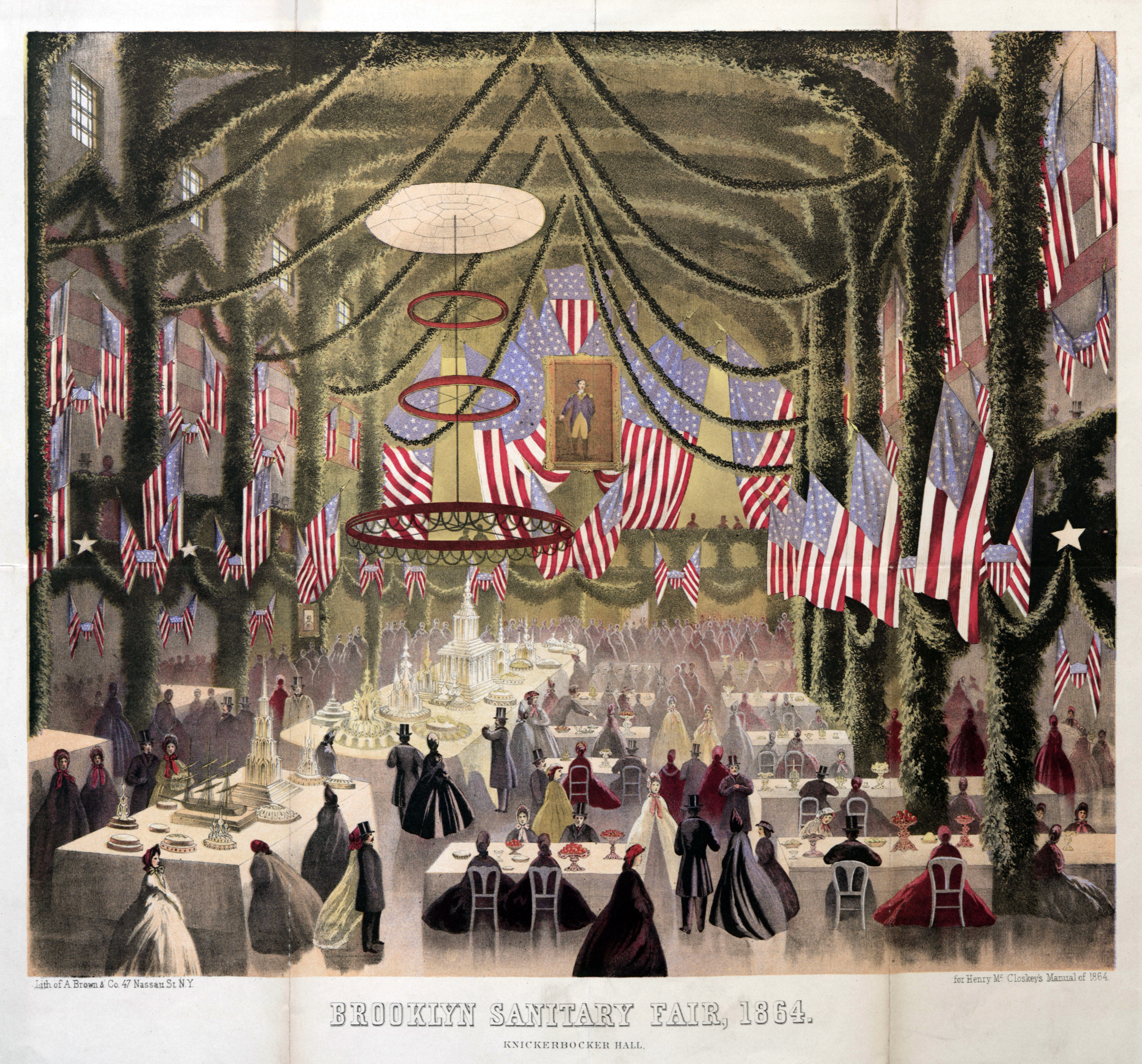
There were two main eating places at the two-week-long Brooklyn & Long Island fair, the larger one located in the temporary, specially built two-story Knickerbocker Hall located next to the Brooklyn Academy of Music [shown above]. The other restaurant, The New England Kitchen, occupied another temporary building across the street [shown below].

SanitaryFair2The Refreshment Committee in charge of the two restaurants was quite successful in getting donations of food supplies, including almost $20,000 worth of wine. But public opinion nixed serving wine, along with holding raffles, as improper for a fair in the “City of Churches.” So the wine was given instead to the New York Metropolitan Sanitary Fair which was held about a month after Brooklyn’s, in April of 1864.

Despite the absence of wine, the Brooklyn fair outdid the Metropolitan NYC fair in how much money its SanitaryFair3eating places cleared. Compared to the Metropolitan NYC fair, the Brooklyn menu was simplified, with no relishes or fruit, and few soups, cold dishes, or pastries. Brooklyn netted $24,000 for the cause, while the Metropolitan fair cleared only a little over $7,000 because, unlike Brooklyn, they received little donated food (uh, what happened to the wine?). Brooklyn’s New England Kitchen added perhaps as much as another $10,000 for the Sanitary Commission.

SanitaryFair4Brooklyn’s Knickerbocker Hall Restaurant, which could seat 500 at a time and took in about $2,000 a day, was under the direction of the men’s refreshment committee, while the New England Kitchen was run by a committee of women. The Kitchen was tremendously popular, serving 800 to 1,000 persons daily. But it occupied too small a space and, as the commemorative volume issued by the fair noted, would have made a greater profit had it been able to accommodate larger crowds.

sanitaryfairfrankleslie'sillustnewspaper

Unlike the Knickerbocker, the Kitchen’s bill of fare did not replicate that of a fine restaurant. Nor did the Kitchen follow the prevailing custom of hiring Afro-American men as waiters. The Kitchen used (white) women volunteers who served meals dressed in mid-18th-century costumes that visitors found ugly yet fascinating. For a set price of 50 cents, considerably less than a typical dinner composed from the Knickerbocker Hall’s a la carte menu, they served a down-home meal of such things as pork & beans, brown bread, applesauce, baked potatoes in their jackets, hasty pudding, and cider. Food was eaten from old china with a two-tined fork. The Kitchen also hosted events such as spinning wheel demos, apple paring bees, and an actual wedding.
Though it’s hard to draw a straight line from The New England Kitchen to women’s tea rooms of the early 20th century, it is notable how many tea rooms adopted a similar theme, right down to the old-style cooking fireplace and spinning wheel. It was also significant that so many women assumed executive and managerial positions on fair committees, especially in the New England Kitchen, and it’s probable that many of them remained active in public life after it ended.

© Jan Whitaker, 2016

8 Comments

Filed under alternative restaurants, menus, odd buildings, Offbeat places, proprietors & careers, uniforms & costumes, women

The Gables

gablesMC

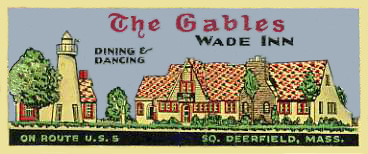
I have a weak spot for corny roadside attractions, such as the scaled down lighthouse in front of The Gables restaurant in South Deerfield, Massachusetts, pictured here on a matchbook cover. The first time I saw it a while ago I wondered why it was there, and what the story was about the little commercial complex that appeared to be a bit down and out at that time.

And now I know – sort of. The lighthouse and its connected cottage were a gas station, while the main building was run as a roadside lunch spot when it began in business. Combination gas station/lunch rooms became commonplace in the 1920s and 1930s when more and more people began taking recreational drives through the countryside.

Exactly when the twin businesses were launched remains a question. My guess is the late 1920s, definitely by 1930, at which time they were operated by Charles M. Savage. He had long been a co-owner/manager of the Hotel Lathrop in South Deerfield, which was sold in 1928.

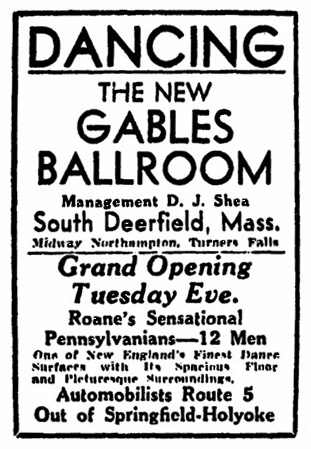
gablesADVMay31931In 1931 a local builder completed a large building next door, south of The Gables. Oddly enough, it was intended as an indoor golf course, but instead was run as a dance hall by Dennis Shea, owner of the Shea Theater in Turners Falls, and later by a succession of others. Rudy Vallee and other nationally known acts performed there. In the 1950s it became a roller rink and then, in the 1970s, an auction house [pictured below as it looks now]. During its tenure as a dance hall and roller rink it was also known as The Gables, just like the restaurant (to confuse future researchers I’m sure!).

gablesballroomrollerrink

At the time the matchbook shown above was produced, The Gables restaurant was conducted by William Wade who also ran the Wade Inn on State Street in Northampton MA.

gables1939ADV

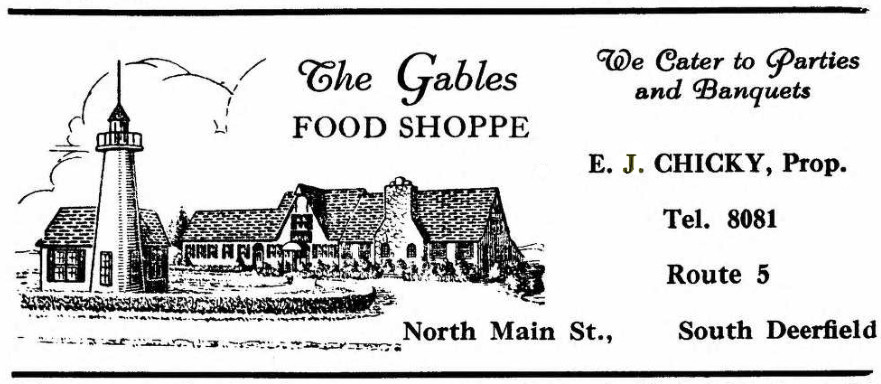
By 1936, The Gables restaurant had passed into the hands of Edward J. Chicky, also of Northampton. If the illustration in the advertisement from 1939 is accurate, the building had been extended on the left by then. It was now known as The Gables Food Shop, “food shop” being a popular name for a restaurant at the time.

Gables1940s

After Chicky, it was owned by others, including Guido “Guy” Zanone, previously proprietor of the Bernardston Inn, who bought it in 1941 [see above], then Frank and Veronica Shlosser in 1946. The Shlossers built a new, larger restaurant across the street in 1955, advertising in 1956 that it had colonial atmosphere and facilities for 350. It was a popular place for wedding receptions, club lunches, and business organization meetings.

The Gables South Deerfield, MA

The Shlossers continued to run the new place shown above until the early 1970s, when it was sold. It stayed in business as a restaurant and banquet house through most of the 1980s, serving beef, seafood, and chicken parmesan, among other dishes. Today it serves as housing for faculty and staff at Deerfield Academy.

gablesNOW2

Recently the original Gables has gone on the market once again. I wish someone would reopen it as a 1940s film-noirish roadhouse.

Thanks to Historic Deerfield librarian David Bosse for helping to clear up an area of confusion in my research.

© Jan Whitaker, 2016

15 Comments

Filed under night clubs, odd buildings, proprietors & careers, roadside restaurants

Find of the day: Hancock Tavern menu

hancocktaverndoublemenu

When I found this menu from Boston’s Hancock Tavern [shown front & back] at a flea market my first question was how old it was. As soon as I began researching I learned that proprietor Wadsworth & Co. had taken over in 1897 and that the building pictured was torn down in the spring of 1903. That narrowed things down.

At that point I thought I knew enough to consider the question of the tavern’s history, starting with “Built 1634″ as noted on the menu.

Then, everything began to unravel, including the menu’s date.

hancocktavern1867corncourtI discovered that Edward & Lucina Wadsworth had reopened the Hancock Tavern in 1904 at “the identical site of the original historic structure.” Which had been razed. It took a while to figure that one out but I eventually determined that the reborn Hancock Tavern was located in the rear, Corn Court side, of a new office building facing on State Street. [sketch of map fragment shows Corn Court and Hancock Tavern in 1867]

Then I found a story about a menu like mine found in a collection of items related to the Hancock Tavern — similar except that it said “Visit the Historic Tea Room Up Stairs. In this room the ‘Boston Tea Party’ made their plans, and dressed as Mohawk Indians to destroy the tea in Boston harbor, Dec. 16, 1773.” Since mine simply says “Private Supper Rooms Up Stairs for Ladies and Gentlemen,” I decided that it probably dates from the reincarnated Hancock Tavern, which would put it between 1904 and approximately 1910.

Much bigger mysteries surrounded the history of Hancock Tavern. By the late 19th century legends about the tavern abounded, beginning with the notion that it dated from 1634 as the continuation of a tavern begun by Samuel Coles. It was also said to have hosted John Hancock, exiled French king Louis Philippe, George Washington, Benjamin Franklin, and French foreign minister Talleyrand. But the grandest legend concerned the conspirators in the “Boston tea party.” Beginning in the 1880s, the various proprietors of the Hancock Tavern spun historic tales about this.

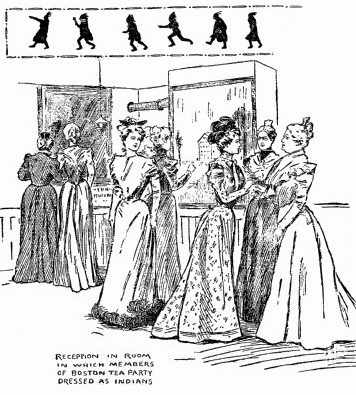
hancocktaverndec1898In December of 1898, the Daughters of the American Revolution, dressed as Colonial maids, met at the Hancock Tavern to celebrate the 125th anniversary of the tea party. On the wall was a somewhat more detailed inscription, likely put there by the Wadsworths: “In this room the Boston tea party made their plans and dressed as Mohawk Indians, and went to Griffin’s (now Liverpool) wharf, where the ships Beaver and Eleanor and Dartmouth lay, and threw overboard 342 chests of tea, Dec. 16, 1773.” Later, the Wadsworths produced a souvenir booklet of historic lore.

But the link between the tavern and the Revolution, as well as its ancient status, were thrown into doubt in 1903 when City Registrar Edward W. McGlenen announced that the just-razed building that had housed the Hancock Tavern had been erected between 1807 and 1812. Furthermore, he said, its predecessor on the same site, a two-story house, had not been granted a tavern license until 1790, ruling out any associations with the Revolution. He also showed that Samuel Coles’ Inn, reputedly built in 1634, was an entirely separate property, thereby demolishing the Hancock Tavern’s claim to be Boston’s oldest tavern. The legends, he said, had developed from a number of fanciful books and articles from the 19th century that were in conflict with town records.

And so my menu, though still more than 100 years old, lost some of its charm.

On the bright side, though, I learned a few things about the operation of 19th-century taverns. I learned that Mary Duggan, widow of the first licensee, ran the tavern for a number of years after her second husband died. In addition to supplying the finest liquors, she advertised in 1825 that she had engaged a “professed COOK” who would have soup ready from 10 to 12 o’clock (then the standard time to eat soup), and would prepare supper parties “at the shortest notice.”

I also realized how much turnover there was in the tavern business. During most of the 19th century the Hancock Tavern was leased out to a succession of proprietors who either handled its alcohol and food service or the entire operation, which included lodging.

It fell on hard days sometime before the Wadsworths took over in 1897. Their energetic attempts to raise its historic value may have sprung in part from the fact that it had spent some years as a gambling den. In a city with many old buildings, most Bostonians did not care about it.

Having the bad luck to be located in what was fast becoming Boston’s financial district, the building was doomed, but the legend of Hancock Tavern’s link to the tea party lived on. The Arkansas Gazette reported in 1976:

hancocktavern1976© Jan Whitaker, 2016

6 Comments

Filed under atmosphere, history, menus, odd buildings, Offbeat places, proprietors & careers

Odd restaurant buildings: “ducks”

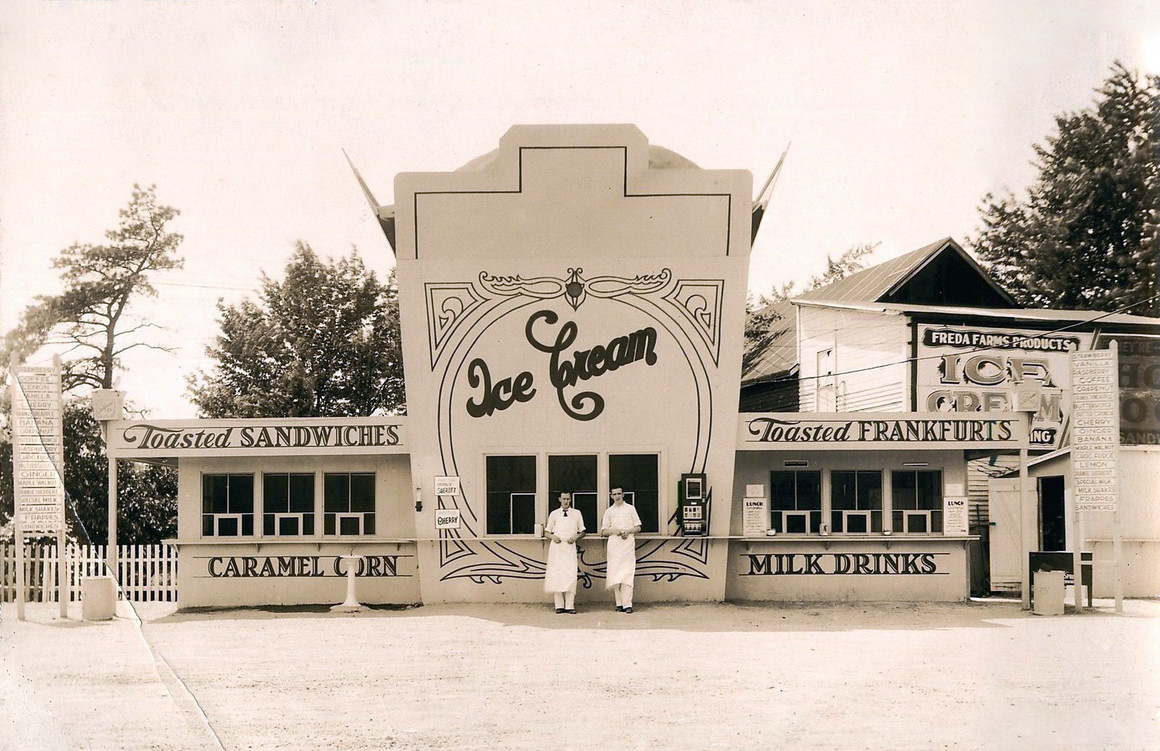
ducksfredafarmsBerlinCT

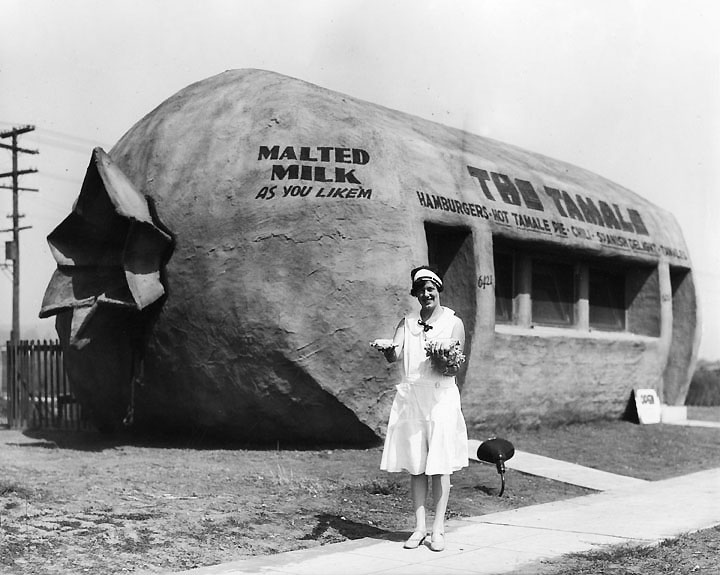
Ducks are commercial buildings that look like what they sell, as illustrated by the Freda Farms ice cream stand in Berlin CT. The term was actually inspired by a Long Island store that sold ducks (to eat). It has been generalized to apply to any buildings that looks like some familiar object or animal, etc, whether or not their merchandise is related. These types of buildings are also known as programmatic or mimetic architecture.

duckstamaleThough they reached a peak of popularity in the late 1920s and early 1930s, ducks trace back much further in history. An introduction to Jim Heimann’s book California Crazy by David Gebhard links the mimetic architecture of the last century to garden buildings of the 18th century and even earlier. One of the first examples in the United States was the 65-foot elephant of Margate NJ built in1881 to attract attention to a real estate development.

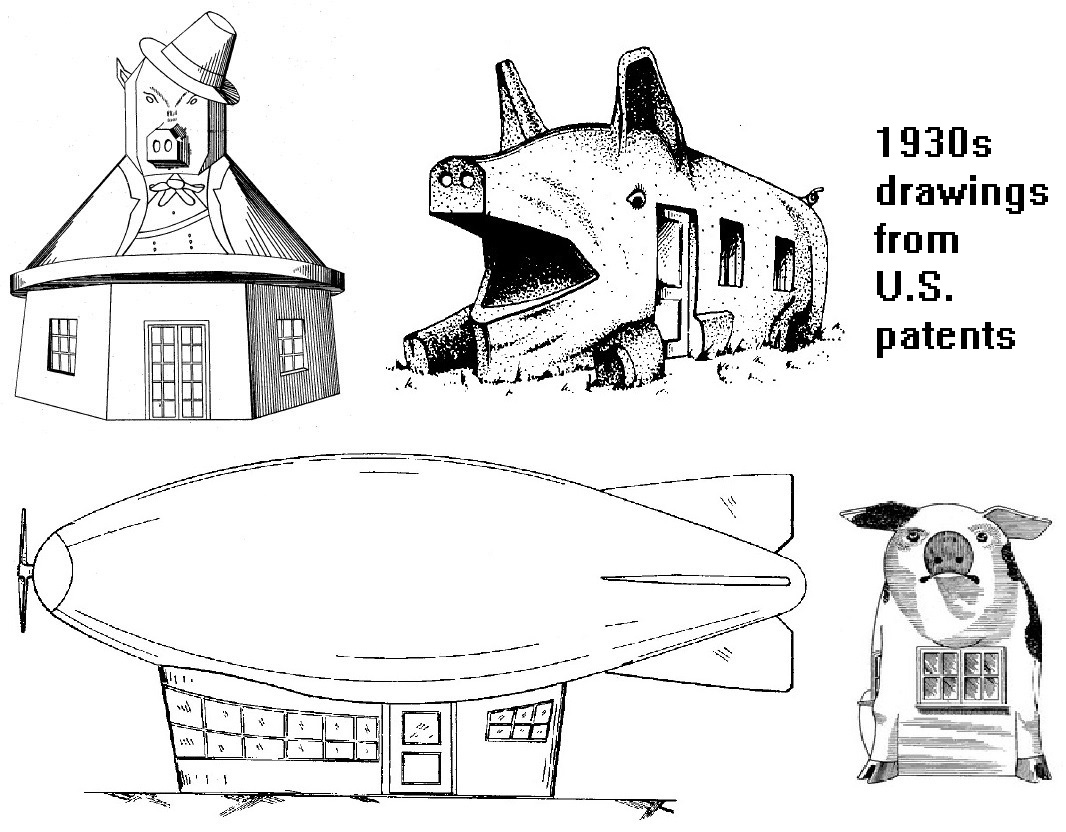
In addition to housing stores and offices, many ducks have featured restaurants over the decades. They have taken the shape of all kinds of animals, kegs, barrels, ships, castles, cups, coffee pots, bowls, hats, chuck wagons, dirigibles, items of food, shoes, and windmills.

DucksbulldogLA

The earliest restaurant duck I have found was a café planned for Cincinnati in the shape of a huge beer cask in 1902. Unlike later examples, though, it was meant to occupy a location in a row of Main Street storefronts. Most later ducks, arriving with the spread of car ownership in the late 1920s and early 1930s, occupied empty lots in developing areas of cities. Not too surprisingly, southern California’s car culture provided a nurturing environment. In addition the climate was favorable to the somewhat makeshift carnival-type structures, while the city’s movie industry supplied inspiration. As Los Angeles grew, giant dogs, toads, ice cream freezers, shoes, and other bizarre apparitions sprang up along the roadside, vying for the business of passing motorists.

Ducks4patentdrawingsDucksVandeKamp'sDutchbakers

The link between the movie industry and roadside fantasy was straightforward in the case of Harry Oliver, a leading designer who brought magic to sets for movies such as Scarface, The Good Earth, and Mark of the Vampire. Oliver designed windmill-shaped buildings for the Van de Kamp bakeries and drive-ins as well as a storybook building occupied by the Tam o’ Shanter Inn.

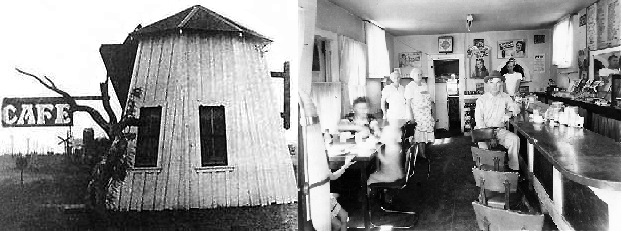
If architecture is about the enclosure of space, ducks are architecture only secondarily. In most cases mimetic architecture describes a building that serves more as advertising sign than as an innovative enclosure of space. Once a customer stepped inside a giant pig or coffee pot, all whimsy faded away as the interior revealed itself to be a standard rectangle as shown here in one of the many coffee-pot ducks that could be found across the U.S.

DucksTXCoffeePotExt&INT

If ducks say anything about American restaurants, it is that they are only partially about food.

© Jan Whitaker, 2016

5 Comments

Filed under odd buildings, roadside restaurants