Category Archives: night clubs

A grandiose failure?

It’s difficult to assign a definite cause to the short life of Raphael’s, a Chicago restaurant that opened in October 1928 and seemed to have closed by the following July. It would make perfect sense if it had failed after the Wall Street crash at the end of October 1929, but it seems to have closed while the boom was still in progress. [Above: Detail of a platter from Raphael’s shown below, with a fanciful depiction of the building.]

Then again, Prohibition was in effect and that almost undoubtedly contributed to failure. But whatever the cause, Raphael’s on Chicago’s south side didn’t even make it to its first birthday as far as I can tell.

Judging from its exotic design, the restaurant clearly had grand aspirations. Its financial backing totaling $300,000 amounted to a small fortune at that time, equal to nearly $5,700,000 today. At least two thirds of the capital came from a major Chicago investment banker. The remaining $100,000 presumably was furnished by the restaurant’s nominal owner, Edwin Raphael.

In June of 1928, as construction began, the Chicago Tribune ran a snarky story that managed to insult the design as well as Chicagoans’ taste in general. It said that the building “should make one think he’s in Persia, provided he doesn’t know too much about Persian Architecture,” and that it was aimed at “Chicago’s epicureans – if we have any.” [Above: Raphael’s main dining room in 1929]

The layout of the building accommodated a small tea garden inside the front door that was outfitted with trees and fountains. Next came a two-story dining room accommodating hundreds, with a ceiling imitating a blue sky with twinkling stars and surrounded on all sides by a balcony that also held tables for guests. Two ends of the building provided people entering from the street access to two interior lunch counters with soda fountains. [Above: one of the lunch counters, but looking strangely like a bar.]

With its minaret, the building reached 60 feet in height and was visible for miles along all three major streets that crossed there. The minaret was used for advertising with neon lighting and a crescent on top. The illustrations used for this building, whether on the restaurant’s dinnerware [shown above] or in advertising, took great liberty in portraying it. [Below: April 1929 advertisement that imagines the building with two domes, four minarets, and palm trees!]

The main dining room featured a band named Raphael’s Persians. Their performances could be heard on the radio at night.

The March 1929 issue of The American Restaurant Magazine hailed Raphael’s for its ability to merchandise meals by “stealing the thunder” of night clubs and offering them stiff competition while putting food “foremost.” When the radio audience listened to the Raphael’s orchestra, the story said, they would feel that the restaurant had “an air of mystery about it” and want to visit “Chicago’s most exclusive restaurant.” But did they?

The combination of three types of eating places in one business was an odd one, something that would be more understandable in a hotel than a restaurant. It would seem as though the tea room and the snack bars would keep earlier and shorter hours than the restaurant/nightclub which stayed open until 3 a.m. and that this would cause staffing problems. By June of 1929 Raphael’s had figured out more ways of making money, as is shown on the advertisement below, such as afternoon dancing, an additional cover charge, and higher cover charges on weekends, but it’s likely that it wasn’t enough.

The trade journal also hailed Raphael’s for its modern kitchen facilities that were filled with the latest mixing machines, ranges, refrigerators, warmers, etc., proving “that the kitchen methods of this modern restaurant are a far cry from the methods employed when the members of Persian tribes would prepare feasts for their shahs.”

A reader of The American Restaurant would be left with the idea that Raphael’s was an elegant place catering to a clientele with sophisticated tastes. But that idea was dashed in a story written by a young reporter who spent a night there playing the part of a “shy cigaret girl.” Over the course of the evening male patrons hit on her nine times. She also observed people drinking alcoholic drinks, probably enhanced by their own whisky flasks. The crowd included teenagers. By June of 1929, the restaurant was reduced to featuring a “crystal gazer” on the balcony named Allah Mahalla. So much for elegance!

Despite serious searching I could find no advertising, nor any mention of the Raphael restaurant at all after July, 1929. In 1940 the address was mentioned as the location of a bunco party (a dice game) hosted by a political group. In 1947 the building, then occupied by a beauty supply warehouse, was auctioned for taxes. It sold for a mere $14,027 plus payment of back taxes of $11,259. The second floor was offered for rent in 1948, and it may have been then that the American Legion moved in. [Above: Could the Hippodrome have occupied the building when this advertisement ran in 1938?]

However, according to a recent Chicago Sun Times story by architectural critic Lee Bey, Raphael’s continued in business until WWII, and “later converted into the American Legion South Shore Post 388.” I haven’t been able to find out why he thought Raphael’s stayed in business that long.

Another eating place that might have once occupied the building (in addition to the Hippodrome) was the Kickapooo Inn. Its address was given as 7901 Stony Island in a 1957 obituary notice for its owner.

The building was acquired by The Haven of Rest Missionary Baptist Church in 1966 and used for church services until 1977 when they built a new church. Now the church is seeking a grant to restore the building, hoping it can be reopened in a few years as a community center. [Above: the building as it appeared recently.]

If any reader has information about this building and its uses over time, I’d love to hear from you. It could assist the church in applying for grants.

© Jan Whitaker, 2025

4 Comments

Filed under atmosphere, night clubs, odd buildings, Offbeat places, restaurant decor

Colosimo’s charm

Many restaurants through the decades have built their popularity on a genial host. That was true of Colosimo’s in Chicago and its owner and host Jim Colosimo.

To a large degree the restaurant’s reputation was built around “Big Jim.” Before 1920 that was because of his pleasant manner. And, maybe, the spaghetti at Colosimo’s really was exceptionally good.

But the genial host was also a big-time gangster.

The restaurant was located in a part of Chicago known as the levee, an area specializing in prostitution. Colosimo had opened his restaurant in 1910, having previously run two “single-hour” hotels.

He expanded his operations to become a crime boss who not only provided illegal services but also had procurers recruiting naive young women as prostitutes in and outside of Chicago. And he handled the police, seeing to it that they didn’t interfere with these activities. His lieutenants collected payoffs from other illegal operators — and killed people as necessary — leaving Big Jim’s hands clean. (Of course, the police knew very well what he directed his minions to do.)

Many of Colosimo’s patrons also must have known about his other activities. In 1914 a letter appeared in the Chicago Tribune from a woman who feared for the fate of young women that might venture into the place:
I have been reading The Tribune about this vice upheaval and notice what is said about Colosimo’s. This recalls that when I first came to Chicago last winter I saw, I believe, [full] page ads in the leading Chicago theater programs which advertised what a fine place was to be found at Colosimo’s. I didn’t know what kind of a place it was and didn’t go there to find out, but I’ll warrant any number of younger girls went there, led by the page advertisement in the Chicago theater program, and undoubtedly a great many of them can now trace their downfall to Colosimo’s. [above: 1914 advertisement]

Its reputation evidently didn’t bother many of its patrons. The theatrical profession was said to flock there. And a publication reported that “The café . . . is crowded nightly after the show with a merry making throng which makes it one of the brightest spots on the city’s map.” It served as an ongoing attraction for the city’s “society slummers.” And in 1916 an advertisement for Colosimo’s appeared in the Official Program of the Republican National Convention to be held in the city.

His execution helped perpetuate the restaurant’s appeal after Colosimo was gunned down on the premises in 1920. It also helped that Al Capone was associated with the restaurant. He had been hired as Big Jim’s bodyguard, replacing him as the city’s crime boss after he was killed.

In subsequent years the name of the restaurant remained Colosimo’s, despite his absence and a new owner. It was remodeled to look elegant, and operated as a nightclub. Its past, presumably firmly behind it, did not deter the crowds in the 1920s. Drinks were available, although the restaurant was shut down repeatedly for violating Prohibition. Apparently that was okay with the alumni of a Vermont military college which planned a dinner there in 1925, including their “wives and sweethearts.” Their invitation noted “At this place we can be entertained by dancing, eating and looking . . .” [my emphasis]

The new owner, who had bought a half share in the restaurant shortly before Colosimo’s murder, operated it until its end in 1948, by which time it had suffered the bizarre fate of being converted into a cafeteria. [Above: the restaurant in the 1940s]

Colosimo’s murder was never solved.

© Jan Whitaker, 2025
10 Comments

Filed under night clubs, Offbeat places, popular restaurants, proprietors & careers

Music & food at Café Society

Café Society was the satirical name of a New York jazz club in the late 1930s and 1940s. The name was meant to make fun of people who wanted to be seen as sophisticated rather than merely rich. However, it’s likely that Café Society nevertheless proved to be an attraction to many of those same people.

By the second year there were two locations of Café Society, Downtown and Uptown. The clubs and their owner Barney Josephson have become well known for the number of jazz greats they introduced and nurtured, among them Lena Horne, Billie Holiday, and Teddy Wilson. And also for their full acceptance of Black customers.

Unlike other “café society” club owners such as the Stork Club’s, Josephson refused to accept the racial codes of that time. He was determined not to follow policies that featured Black performers but would not allow them to mingle with the patrons, and excluded Black guests. Even when these policies began to soften, it was common for Black patrons to be seated inconspicuously in the least desirable spots. [Above: 1939 sign at the Downtown club ridiculing prominent society figures]

When he opened the Downtown Greenwich Village club in late December 1938, Barney recruited three musicians who had been part of a Carnegie Hall Christmas Eve program called From Spirituals to Swing. Albert Ammons, Meade Lux Lewis, and Pete Johnson performed at the club a few days later. The club advertised that it featured “boogie-woogie,” which was largely unknown in New York City at the time. [Above: Downtown in 1939; William Gropper mural]

But what about the food? In general, jazz clubs’ culinary output has not been regarded as the finest. Barney claimed that when he started out, most jazz clubs were run by mobsters who didn’t even try to prepare good meals. He tried to do better, but it’s hard to judge how well he succeeded since I’ve found little commentary. Club cuisine wasn’t usually written about.

In a book based on recordings of his memories, published by his fourth wife after his death, Barney commented that in most nightclubs waiters were urged to push drinks not food. For the Uptown Café Society (on East 58th), opened about a year later than Downtown, he made an effort to provide good food by hiring a chef who had managed the Claremont Inn and had been head waiter at Sherry’s. Robert Dana, nightclub editor of the Herald Tribune, was of the opinion that “On its food alone, Café Society ranked with many fine restaurants,” singling out squab chicken casserole and cream of mushroom soup. [Above: Uptown, 1943; Below: Advertisement with the musical lineup on Uptown’s first anniversary, 1940]

By the end of 1947 Uptown was out of business, and Downtown closed in early March of 1949. The problem was that Barney’s brother Leon, an admitted Communist Party member, was part owner of the clubs, having advanced start-up money. In 1947 Leon was called before the House Un-American Activities Committee, refused to testify, and spent a year in prison. Barney was seen as guilty by association, attendance at his clubs plummeted, and he lost all his money. It seemed his career as a jazz club owner was over.

After that he concentrated on the restaurant business. He opened three restaurants, all called The Cookery, with one on Lexington across from Bloomingdale’s, one on 52nd Street in the CBS building, and then in 1955 a third one in Greenwich Village on University Place and 8th Street. The first two did not stay open long, but the Greenwich Village site was successful. [Above: The Cookery on Lexington; wall art by Anton Refregier]

While the two Café Societies had featured jazz with food, his third Cookery was to become a purveyor of food with jazz.

The Village’s Cookery was far from glamorous, generally described as “a hamburger, ham-and-egg type restaurant.” For the first 15 years there was no music. And then one day Barney had a visit from pianist Mary Lou Williams — who had played at Café Society Downtown – looking for work. As he described it:

“. . . this lady, one of the greatest musicians of all times, composer, arranger, not working? It was all this wild, crazy rock. . . . I investigated and found out I didn’t need a cabaret license in my place if I only had three string instruments.” [Above: Mary Lou Williams, at the Cookery in the Village, 1970]

So he told her to go rent a piano and, presto!, he was back in the jazz club business as of 1970. She was a draw. As he put it, “Mary returned to The Cookery each year through 1976 for three-month gigs, always to critical acclaim and crowds.” Other musicians who played there included Teddy Wilson, Marian McPartland, and the elderly singer Alberta Hunter, who had been working as a nurse.

The Cookery stayed in business until 1984.

For those interested in reading more about Barney’s clubs, see the book based on his recorded memoir published by Terry Trilling-Josephson in 2009 (Café Society: The wrong place for the Right people).

© Jan Whitaker, 2025
Leave a comment

Filed under alternative restaurants, night clubs, Offbeat places, patrons, proprietors & careers, restaurant decor

Romanian restaurants

Historically, the Romanian* restaurants that received the greatest attention from the press have been those in New York City. In 1901 the population of Romanians in New York City as a whole was estimated to be 24,000, with about 15,000 of those in the Romanian quarter on the Lower East Side. There were said to be 150 restaurants, 200 wine cellars, and 30 coffee houses kept by Romanian Jews. Favorite foods included broiled meats, goose pastrami, cabbage rolls, polenta, and spicy skinless sausage. Seltzer and red wine figured largely as drinks.

Not all Jewish-operated Romanian restaurants followed kosher law, but they were unlikely to have pork on the menu, the principal meat of Romanian cuisine and used in cabbage rolls (sarmale).

Immigration to this country began in the 1880s. It’s likely that the earliest Romanian restaurant in New York was one that began as a wine cellar in 1884 on Hester Street, and soon evolved into an eating place. Romanian immigrants were disproportionately male, working during the day and renting crowded floor space to sleep at night. Restaurants and coffee houses were not only places for meals and refreshment, but also community centers for these men, who were essentially homeless.

In his memoir An American in the Making (1917), Marcus Ravage explained that when he arrived in New York City in 1901, as soon as he made a few cents peddling on the streets he headed for a Romanian restaurant on Allen Street, where he ordered a ten-cent dinner of “chopped eggplant with olive-oil, and a bit of pot-roast with mashed potato and gravy.” Ravage expressed the difficulty he had in accepting American food and eating habits. When he went to college in Missouri in 1905, he reported that everything tasted “flat” to him, and that he “missed the pickles and the fragrant soups and the highly seasoned fried things and the rich pastries made with sweet cheese” he grew up with.

A Romanian dish from an East Side restaurant described in 1905 was a “hot and very piquant” round steak with peppers. The steak was cut into 3-inch-wide strips, slashed with a knife and marinaded in lemon juice and oil before being pan fried. Small red peppers were fried with it. Each diner took a pepper, opened it, and sprinkled the seeds on the meat.

According to author Konrad Bercovici in Around the World in New York (1924), many of New York City’s Romanian restaurants were run by Jews, but often the proprietors were Greeks, Hungarians, or Germans, as was the case in Romania’s capital, Bucharest. Over time, it seems as though the fare served in these restaurants merged with what was becoming known as Jewish cuisine rather than remaining strictly Romanian. (Of course Romanian cuisine itself strongly reflected a blend of traditions.)

Some of New York’s Romanian restaurants developed into night clubs, with a grab-bag of acts bordering on vaudeville. Joseph Moskowitz was a world-famous cymbalom player, who began his restaurant career in 1913 with a wine cellar on Rivington street. Later he had restaurants with music and dancing on Houston, and then on 2nd Avenue in 1938 at Moskowitz & Lupowitz where dinners began at 85 cents. He sold his share in that restaurant a short time later and moved to Akron OH, where he often played at Gruhler’s Romany Restaurant.

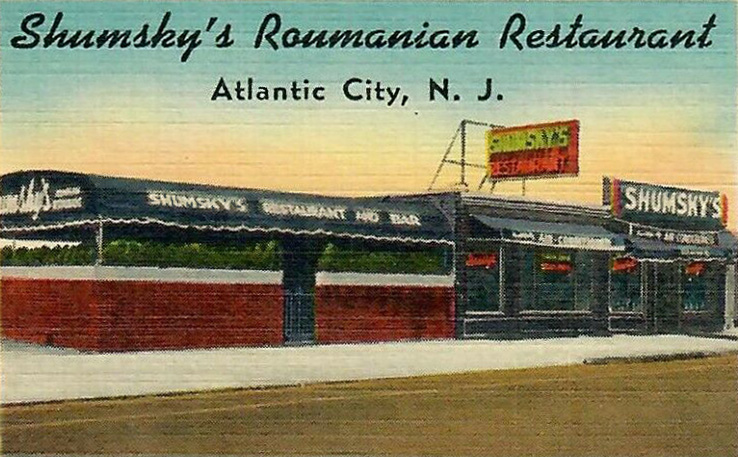
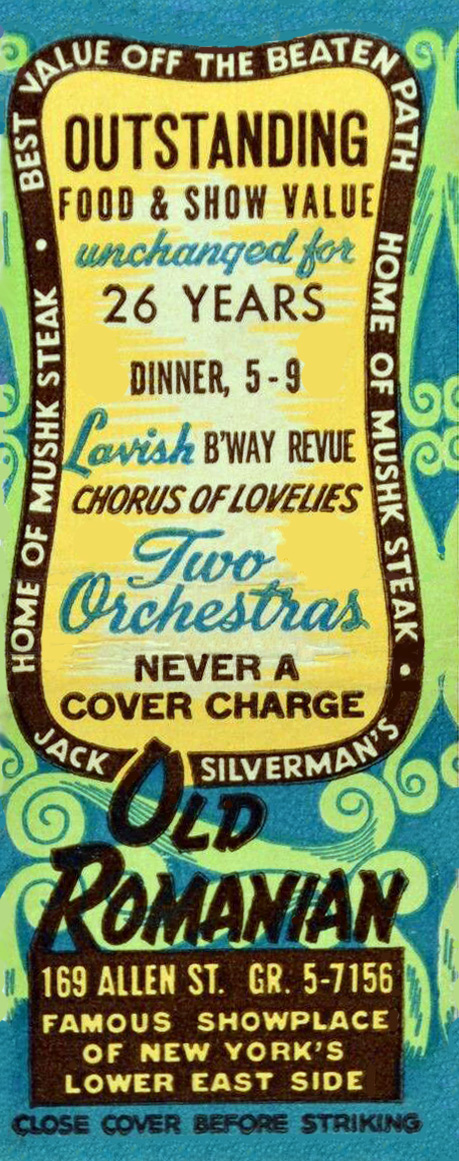
Other popular East coast night spots included Old Roumanian on Allen Street in New York and Shumsky’s Roumanian Restaurant and Bar in Atlantic City, established 1925, which advertised “New Kishka (sausage) Room” and “Dinner ‘Muscat’ Music” in 1952. At Sammy’s, on NY’s Chrystie street, which opened in 1975 and closed quite recently, entertainment was mainly in the form of extras placed on the table. They included a pitcher of chicken fat, fizz-your-own-seltzer, and for dessert a bottle of Fox’s U-Bet chocolate syrup, milk and two glasses for making an egg cream.

A bohemian version of a Romanian Restaurant was operated by Romany Marie in Greenwich Village. Sculptor Isamu Noguchi characterized it as “a sort of a transfer of the Paris café life to New York.” It’s likely this was true to some degree of many Romanian eating places which tended to exude a sense of good cheer and camaraderie all their own. [above: 1924 advertisement]

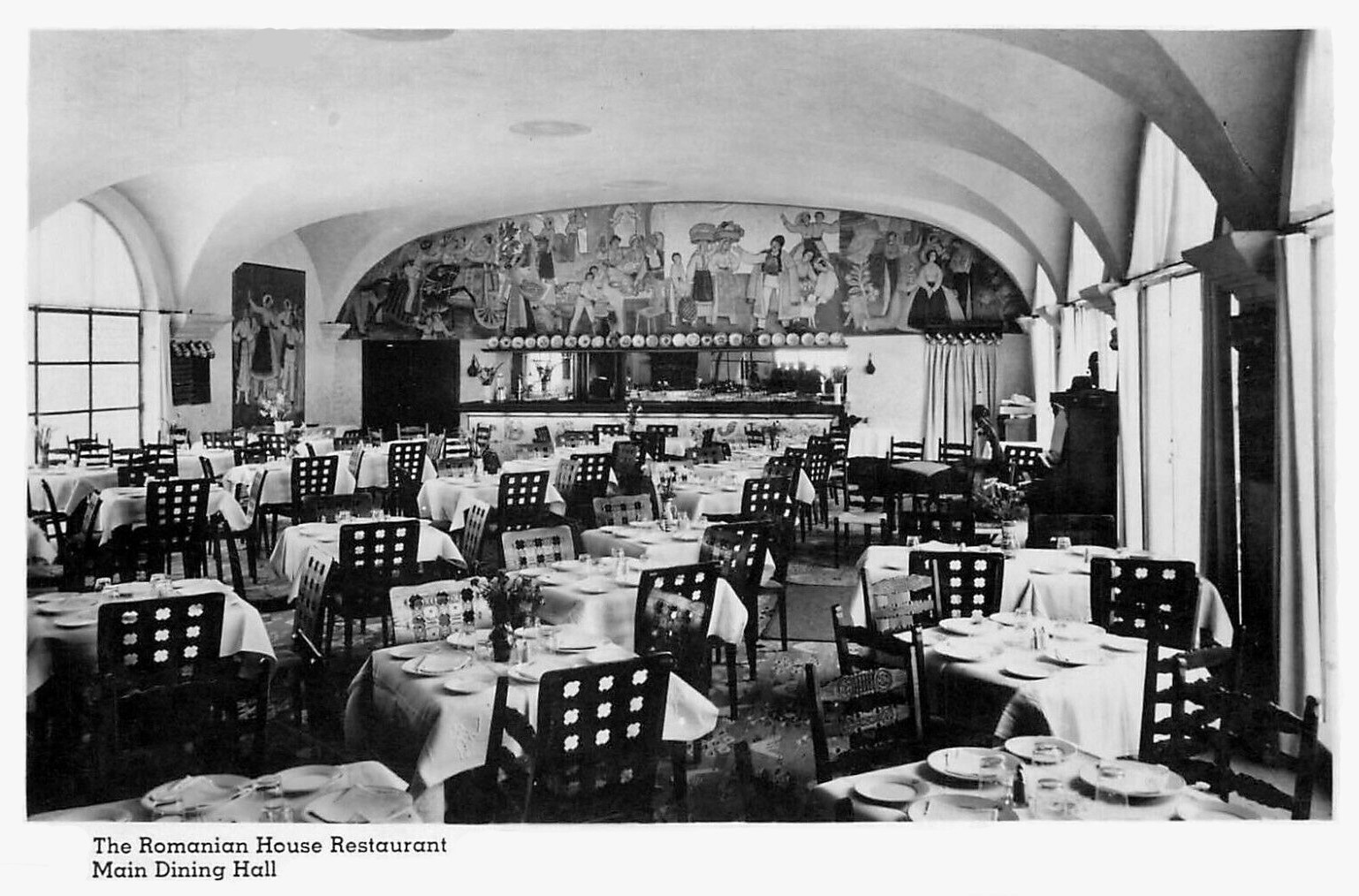
Many Romanian restaurants had prices in the reasonable range, with full dinners running from $1.00 to $1.25, but that was far from the case for the elegant restaurant in the Romanian House at the 1939 NY World’s Fair [shown above]. There the menu was in French, fresh caviar was $2.50, and a dinner was priced at $3.50, minus wine.

Outside of New York – in the late 19th and early 20th centuries before many Romanians dispersed into the larger population – there were Romanian colonies in other cities, both in the East and in the upper Midwest. Some were composed of Romanian Jews, but others, perhaps most, were communities whose members belonged to Catholic and Orthodox religions. Immigration to the U.S., almost nil from 1920 until the 1940s, resumed after World War II when the Soviets took over and continued through the 20th century and into the present.

It becomes harder to track Romanian restaurants in the later 20th century since they became less inclined to use Romanian as part of their names. But they certainly existed in Trenton, Chicago, Detroit, Cleveland, Miami, Los Angeles, and many other cities. One reason they might not have been clearly identified as Romanian was expressed in 1990 by Felicia Zanescu, proprietor of Mignon European Restaurant in Los Angeles. When asked why she called it European rather than Romanian, she replied, “Who ever heard of Romania?” Nonetheless the menu was convincingly Romanian with its carp roe dip, eggplant paté, dill-accented white bean broth, fried cheese, sausages, cabbage rolls, etc.

© Jan Whitaker, 2021

* Before 1975 Romania was usually spelled Roumania or Rumania.

13 Comments

Filed under atmosphere, ethnic restaurants, food, kosher, menus, night clubs

Added attractions: cocktail lounges

Neither cocktail lounges nor cocktails were new in the 1930s when both became quite popular. Far back into the 19th century, men enjoyed lounging at bars and tables in hotels and other places while they imbibed cocktails, along with cobblers, fixes, fizzes, flips, juleps, punches, slings, smashes, sours, and toddies. Cocktails became popular after the Civil War and a regular pre-dinner habit in the 1890s.

In those times drinking in public was a male enterprise. Later, during Prohibition in the 1920s when it became illegal to sell alcoholic beverages, drinking in the home, formerly rare, became common. Women who had generally shunned drinking in public began to indulge. Since bootleggers made more money from concentrated alcohol than wine or beer, cocktails rose in favor with both sexes.

Upon repeal of Prohibition in the early 1930s, hotels and restaurants made plans to capitalize on cocktail drinking, ushering in the era of luxurious cocktail lounges that could attract women as well as men. According to one report in 1934 the new spaces attained a level of respectability by avoiding the old term “bar room,” preferring instead to be called cocktail bars, cocktail lounges, Persian rooms, palm rooms, and tap rooms. Cocktail “hours,” often accompanied by a tinkling piano, were instituted to encourage patronage.

In some senses, though, Prohibition hung around for years, even decades. Some states and towns did not permit cocktail lounges, while others only allowed men to be served at bars. The latter rules favored having a lounge with tables.

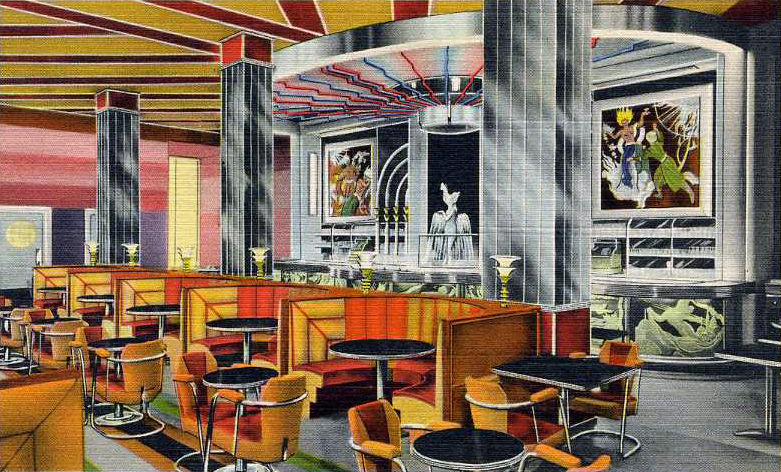
Hotels were prominent among the places where cocktail lounges were installed, and they still remain in many today, providing meeting places for socializing with friends or doing business with associates. Some, such as the new lounge at the Hotel Jermyn in Scranton PA in 1935, were quite glamorous with their bright colors, shiny surfaces, and over-the-top interpretations of art deco motifs.

It isn’t too far fetched to say that in the 1930s New York cocktail lounges were swankier than the restaurants they accompanied. Creative uses of materials such as metals, glass and leather, modern furniture, murals, and clever lighting set a tone quite unlike earlier decades. Color choices were striking, especially on surfaces not usually painted brightly such as tabletops and ceilings.

But women didn’t really love the hard, smooth yet cold, ultra-modern look. According to a 1934 article in Restaurant Management titled “The Ladies Must Be Pleased,” they actually preferred Colonial themes, something that designers would have realized if they had paid attention to the tea rooms of the 1920s.

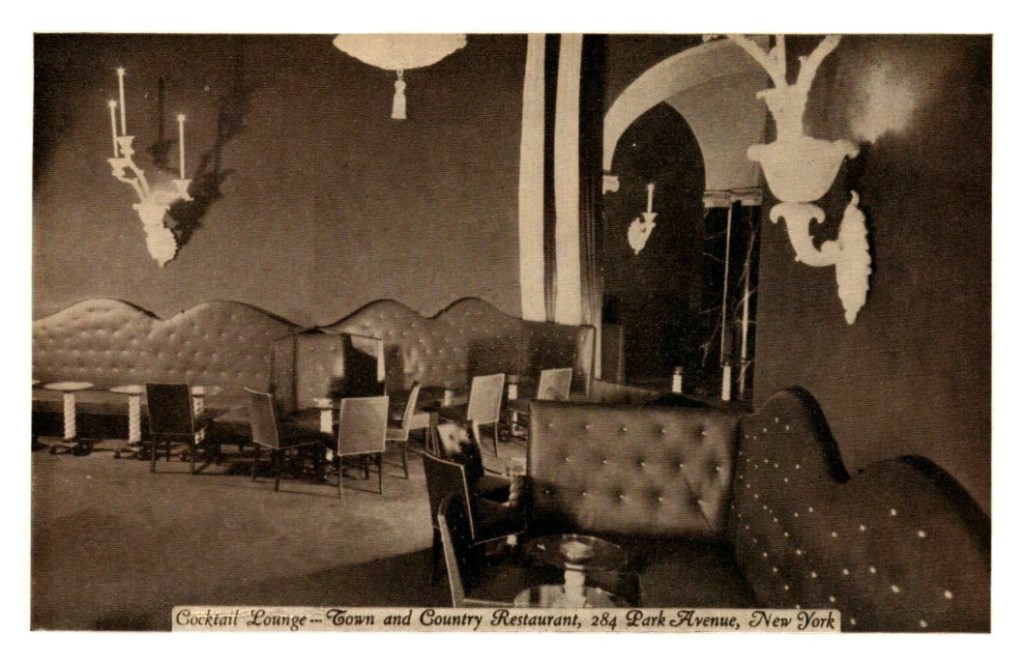
The bold styling of the Jermyn was passé by the 1940s, when the oh-so-glamorous and romantic cocktail lounge at the Town and Country Restaurant in NYC opened on Park Avenue. It seemed to epitomize the very concept of lounging with its high-back tufted banquettes.

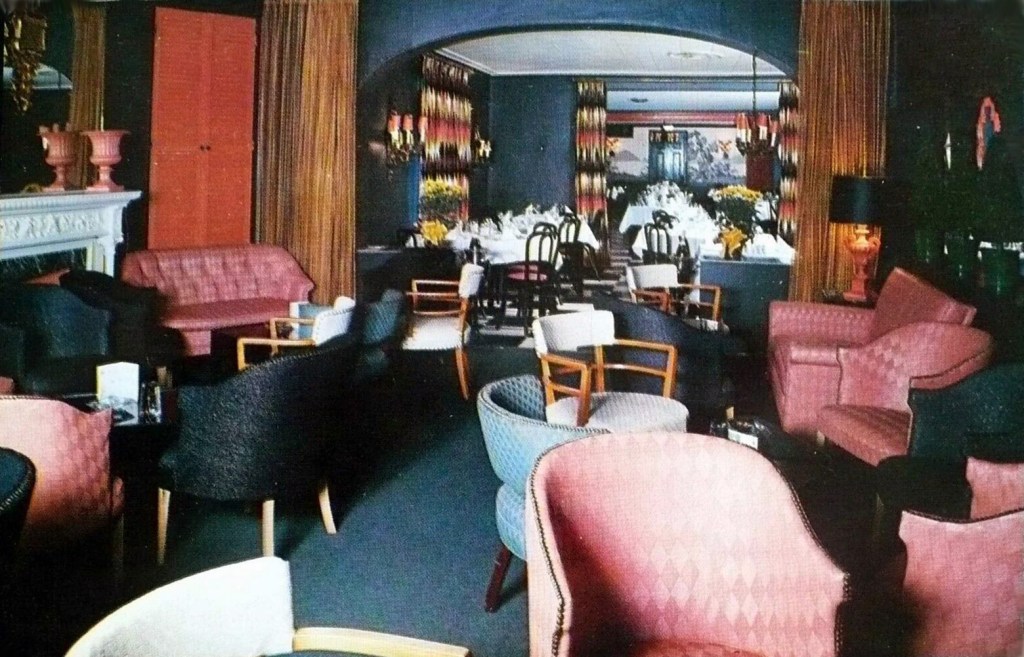
The Keys restaurant, in Indianapolis, had the informal look of a living room in the 1950s.

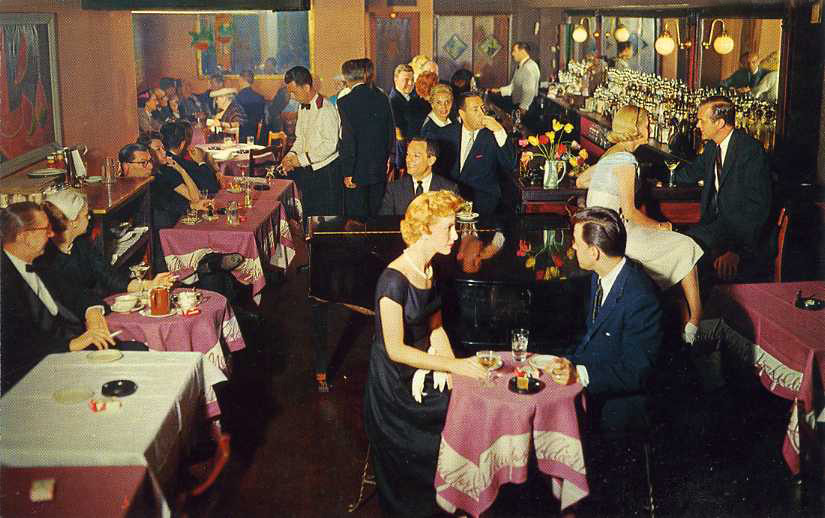
The advantages of setting off a space for a cocktail lounge made good sense for restaurants because it drew people in. And there was always a good chance that some who came in for a drink would decide to stay for dinner. Plus the lounge served as a waiting place for diners. Liquor offered higher profits than food, and having an attractive lounge extended the flow of traffic both before and after the dinner hours. Of course space was at a premium, with high rents in some cities, New York in particular. Anyone attending Goldie’s supper club in New York in 1955 [shown at top] was going to be crammed into a tight space with the club’s owner, pianist Goldie Hawkins. How servers maneuvered around his piano without spilling drinks on the well-dressed patrons is a mystery.

Cocktail lounges were rarely found in small cafes, and pretty much never in commonplace lunch rooms. But they were found in a number of Chinese restaurants that adopted a nightclub style, as well as some California drive-ins, a restaurant type quite different than the standard drive-in, and often referred to as the California coffee shop. The Tiny’s drive-in chain in the San Francisco area had it all: carhops, a dining room, and a cocktail lounge.

Yet, clearly, America was never totally comfortable with cocktail lounges, or bars, and regulated their numbers. Even as the Chicago suburb of Glen Ellyn eased its liquor law, allowing restaurants to serve mixed drinks, it capped cocktail lounge seating to 25% of seating in a restaurant’s dining areas. The 1980s saw the cocktail lounge recede somewhat as a restaurant feature when movements to reduce drunk driving took hold and the cost of liability insurance rose. Consumption of cocktails and hard liquor generally shrank as wine grew in popularity. These trends continued into the 1990s as cities restricted the number of liquor licenses granted.

In recent years cocktails have become popular once again. Many restaurants have bars, but I really haven’t noticed that cocktail lounges have reappeared.

© Jan Whitaker, 2020

2 Comments

Filed under atmosphere, decor, night clubs, women

Dining during an epidemic: San Francisco

After spending time isolated or constrained in any way people tend to become impatient and want to break loose. That’s what happened in San Francisco during the “Spanish” flu of 1918, especially as the number of cases began to decline.

It was understandable, especially when World War I ended. Everyone wanted to celebrate. Unlike most U.S. cities, San Francisco – with about 500,000 residents — was a city with a flourishing nightlife. Restaurants remained open throughout, even in October when flu ravaged the city, but the music and dancing that was often featured was banned when the number of cases rose sharply in the middle of October. Solely for the week ending October 26, reported cases had reached 8,682.

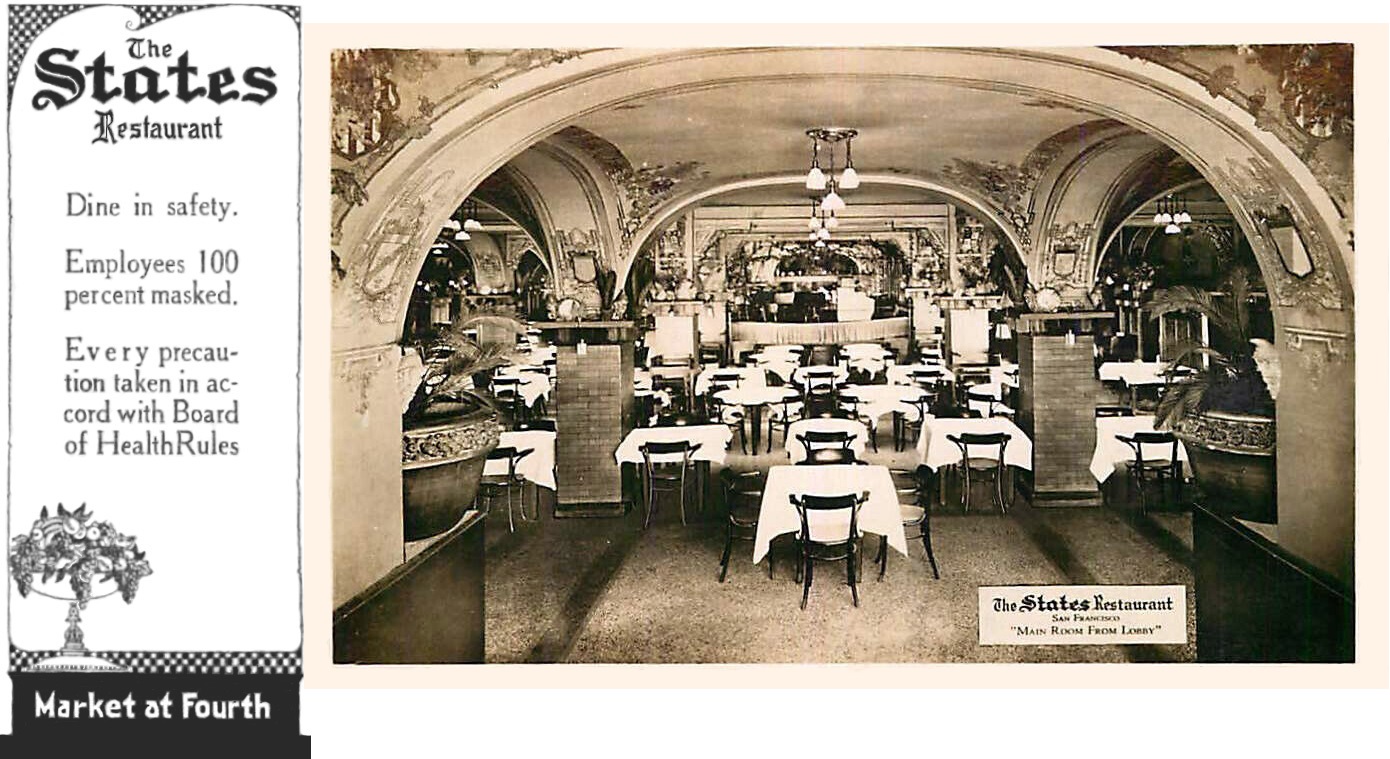
Because of the increase in cases, the city ordered all waiters and bartenders to wear masks [see above October 27 advertisement], shortly thereafter urging everyone to wear them. But then the number of cases began to decline. For the week ending November 9 they were down to 2,200. Although that seems like quite a lot, San Franciscans were beginning to relax.

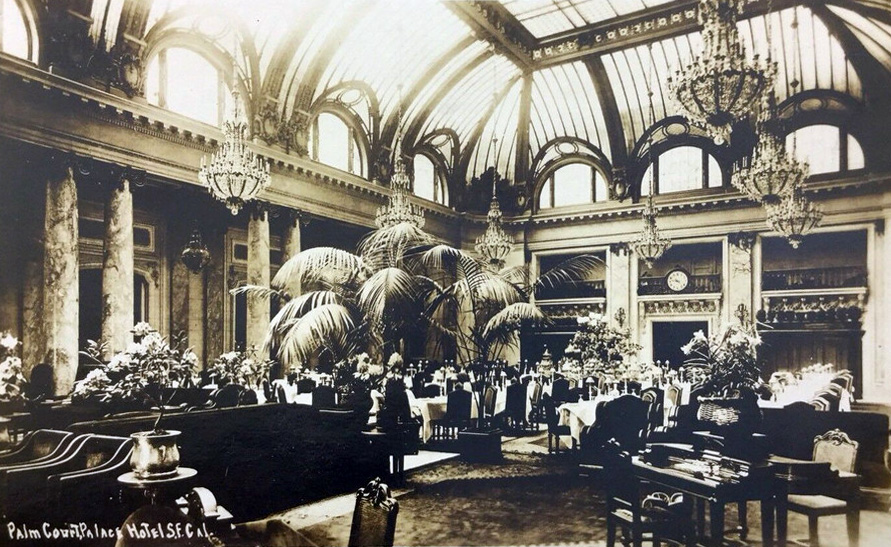
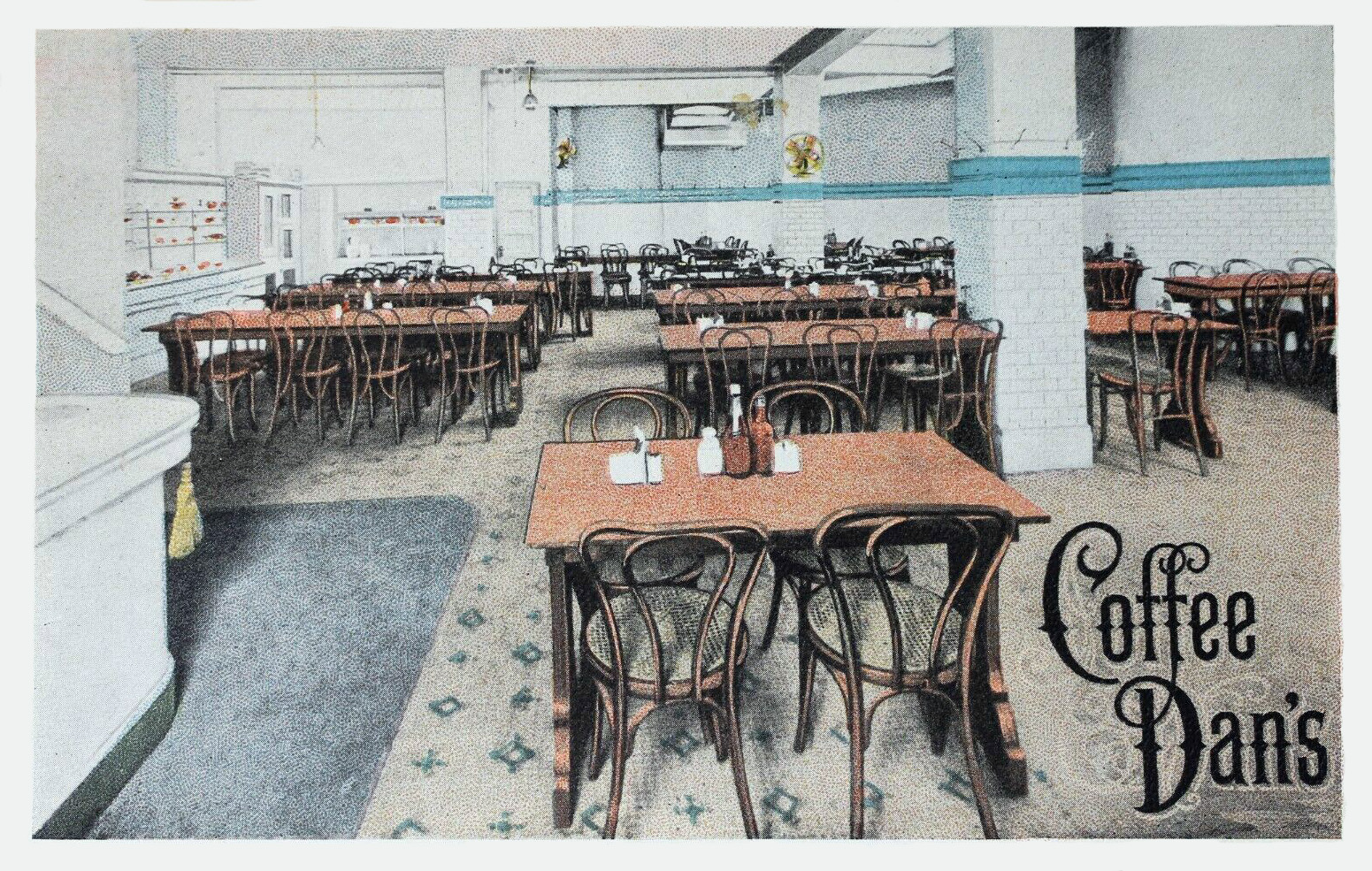
On Armistice Day, November 11, the city went wild. In a story headlined “San Francisco Romps Through Greatest Joyfest World Has Ever Known,” the Chronicle reported that hundreds of thousands had poured into the streets parading with noise makers, spontaneous singing, even improvised costumes. The city lifted the flu ordinance that had canceled music and dancing. But whether they had music or not, restaurants and bars were packed. Glamour spots such as Tait’s, the St. Francis Hotel, and the Palace Hotel [shown above] overflowed as did the non-glamourous eatery Coffee Dan’s.

Oddly enough, it appears that despite the overflow crowds in the streets, bars, and restaurants, a surge in flu cases did not occur. On November 21 the Board of Health authorized the removal of masks with a whistle blast at noon. People drank toasts in hotels and restaurants, while others crowded into ice cream shops. On November 25 the city declared the epidemic officially ended. People planned for Thanksgiving as usual and looked forward to the Christmas season.
But it wasn’t over. With war’s end, troop ships began returning to the city. Among the troops were enough new cases that on December 7 the mayor reinstituted the wearing of masks. This time most people ignored the order. Merchants hoping for a strong shopping season wanted the threat downplayed. The masking order was lifted 11 days later, even as cases continued to rise. On a single day, December 30, 540 new flu cases and 31 related deaths were reported. Then came . . . New Year’s Eve.

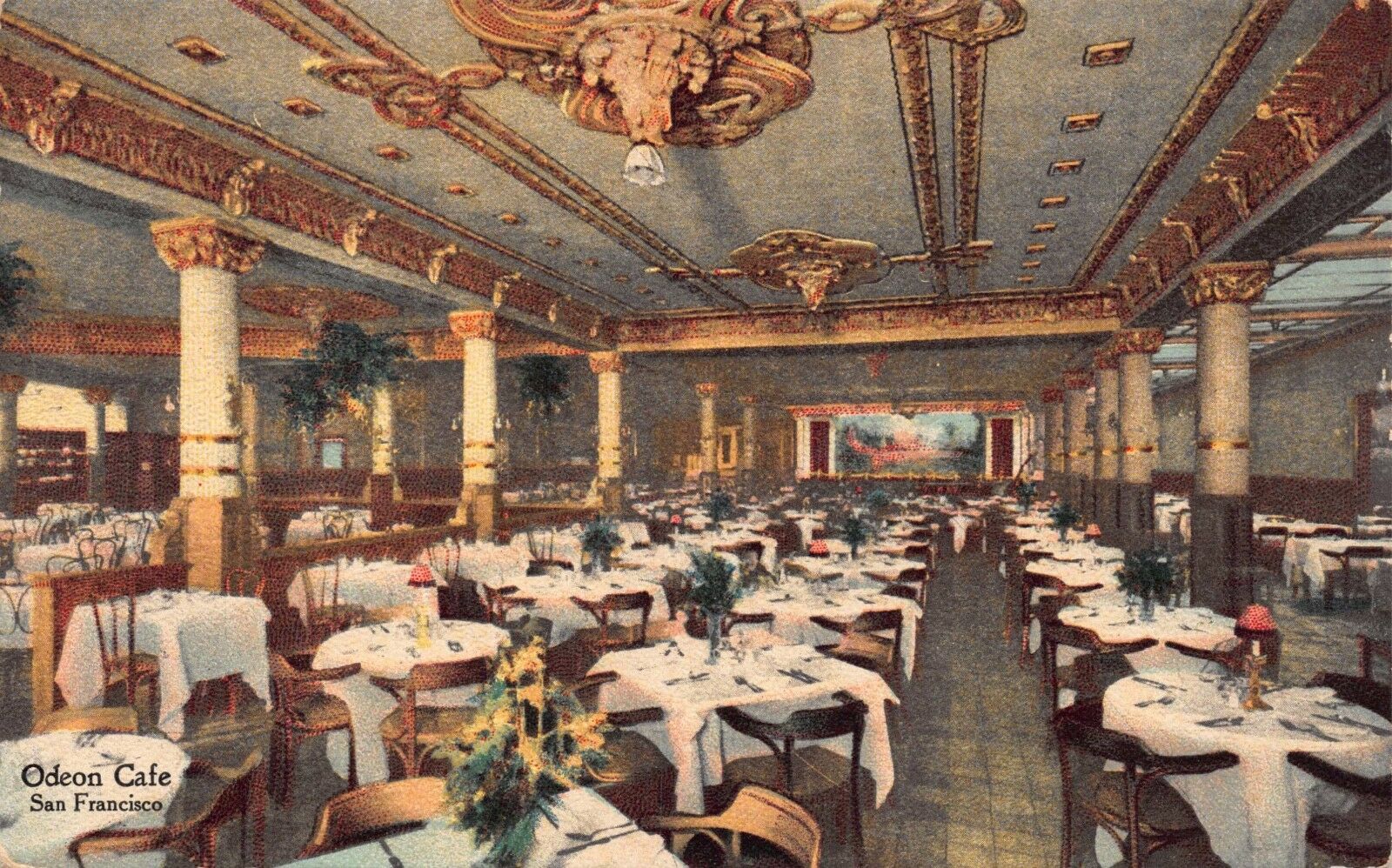
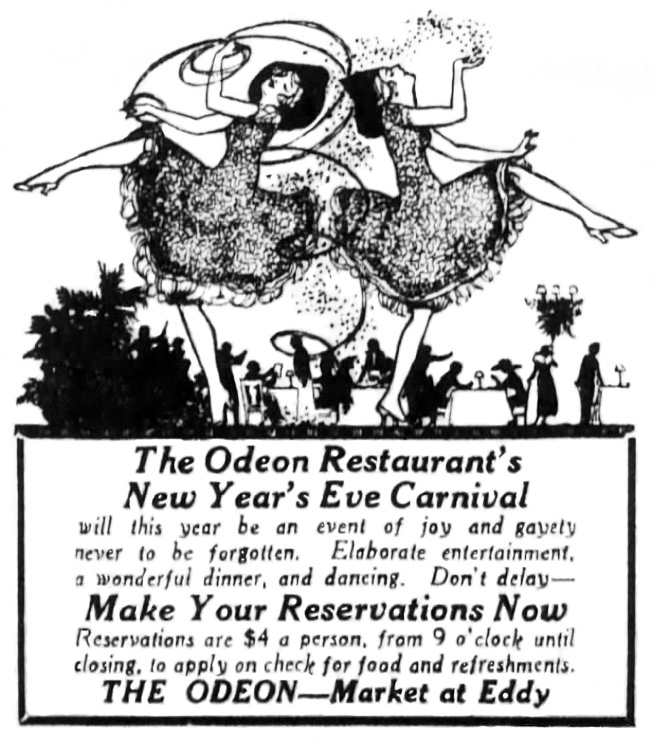
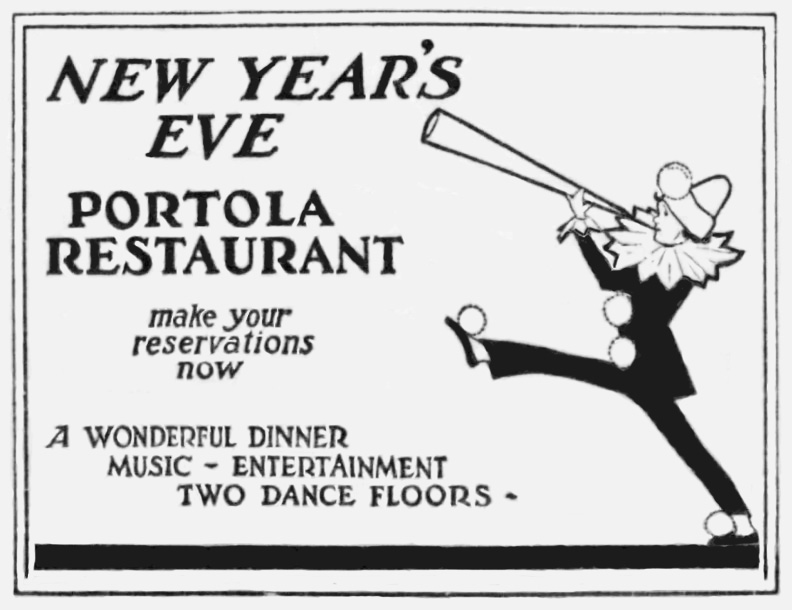
As was true on November 11, there was no stopping the celebrations. Packed trains brought revelers from neighboring towns and states where wartime alcohol bans were still in effect. San Francisco’s hotels were booked, its restaurants fully reserved. The next day the Examiner reported that the celebration was the “Greatest in History of Bay Region,” calling it a “Victory New Year’s Eve” with thousands from out of town. It was almost as if “the whole Pacific Coast and interior neighboring states sent their quotas,” said the Examiner. Among the crowds were many thousands of soldiers and sailors. Hotel dining rooms were full. The Palace had three orchestras, as did Tait’s and Techau Tavern, each of which took 1,500 reservations. The States, Portola [1918 advertisement], Solari’s, and the Odeon [1918 advertisement] were also packed and the same was true in the Latin quarter and other neighborhoods. Dancing continued until 5 a.m.
By January 8, 2,969 new cases had been reported just since the start of the new year. Two days later a new masking order was issued by the mayor who told the newspapers, “After San Francisco had successfully stamped it out the infection was brought to us once more by persons coming here from other cities.” It wasn’t until March 1919 that the city’s death rate returned to its usual level.

© Jan Whitaker, 2020

9 Comments

Filed under night clubs, patrons, waiters/waitresses/servers

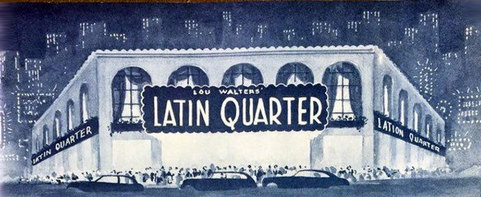
New Year’s Eve at the Latin Quarter

Anyone who wanted to celebrate New Year’s Eve at New York City’s nightclub The Latin Quarter in the 1940s and 1950s had to plan ahead. Way ahead, as in July or August.

The club – its name suggestive of Paris — seated 600 patrons. It took a lot of effort to fill it Like New York’s other nightclubs of that era, it was highly dependent upon out-of-towners.

Packing the house for two or three shows nightly meant that every travel agency in America had the LQ on its list, as did every convention planner. In 1956 it was said that there was scarcely an insurance company anywhere that didn’t include a night at the Latin Quarter among its prizes for top-selling agents.

The most ordered dinners were favorites of the time. Nightclubs weren’t known for the best food in town. Obviously, patrons were not there for the food, but for the show with lightly clad women. In the mid-1950s roast beef was tops. Then, somewhat surprisingly, came turkey, then steak.

The Latin Quarter opened in 1942, with Lou Walters as manager-owner and E. M. Loew’s of Boston’s Loew’s theaters as a financial backer. Walters (father of Barbara Walters) also had interests in LQ clubs in Boston, Miami, and Detroit, along with other nightclubs in New York and Florida.

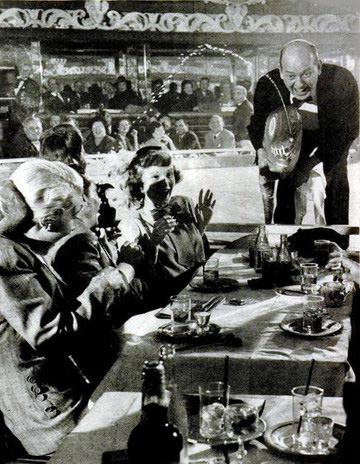
In addition to the nearly nude performers and big name bands and comedy acts, the LQ threw in some trick performances such as a waiter who unexpectedly squirted guests with water and a drunk photographer who would stumble onto the stage taking pictures of performers and creating a noisy ruckus. He was so convincing that guests (and sometimes even waiters) would try to shush him or have him arrested.

The Latin Quarter closed just before New Year’s Eve in 1968, marking the end of New York’s nightclub era. The building went through various identities after that, as a porn theater, a disco, and a hip-hop club.

Best wishes to everyone for happiness in 2020. Have fun, plan ahead, and don’t be fooled!

Leave a comment

Filed under alternative restaurants, night clubs, patrons

Early bird specials

Recently I read a story that originated on Eater.com about the decline of early bird specials in parts of Florida populated by retirees. It said that fewer and fewer restaurants were offering these deals. Partly this was because the retirees who had once patronized early bird dinners were passing away, but also because baby boomer retirees rejected the custom which they associated with an antiquated idea of old age.

Early bird restaurant-going is popularly associated with Florida, but by no means has been confined to that state. A 1973 story about restaurants in Palm Springs CA commented that “early dining is almost a city ordinance in Palm Springs,” with 6:00 p.m. being the popular dinner hour and restaurants deserted by 9:30.

Jaya Saxena, who wrote the Eater story, talked with historian Andrew Haley, author of the book Turning the Tables. He said he knew of restaurants that had offered early bird specials as early as the 1920s and 1930s, but that the custom had really become popular in the 1970s.

I found scarcely any trace of early bird restaurant specials before the 1950s, but agree that the 1970s was when the custom became popular. It increased in the 1980s but may have declined somewhat after that, possibly because of the ever-growing competition of cheap meals in chain eateries.

The term early bird special itself was in use in the early 1900s if not before, almost always referring to morning clothing sales in stores. Of course the concept could be – and was – extended to almost anything including sparkplugs at Western Auto or family portraits at discounted prices if made before the Christmas rush.

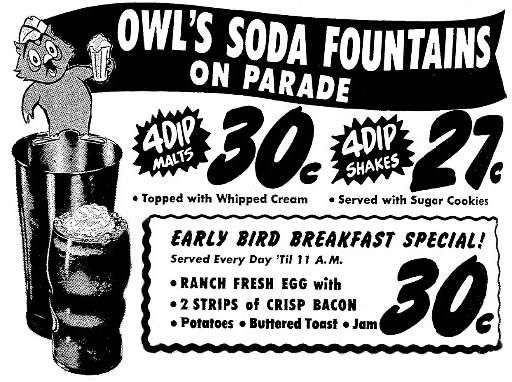
Stores, especially drug chains, were probably the first to offer early bird meals, usually breakfasts or pre-noon lunches. This was clearly a tactic to draw customers into the store at times when it was least busy. The Owl Drug store in Riverside CA offered Early Bird Breakfast Specials at its soda fountain in 1951. About the same time Walgreen’s in Lexington KY had a similar before-11:00 a.m. deal on two pancakes and an egg for 29 cents.

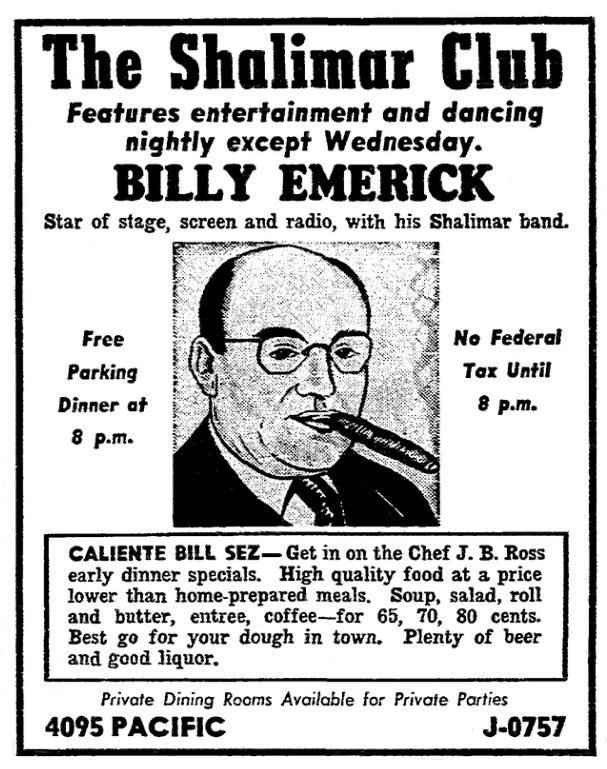
Nightclubs were some of the first to use early bird specials to attract patrons for dinner. Their business seemed to need a lot of boosting, especially in the 1960s and 1970s when night clubs were not doing well. Often part of the bargain was that early diners who came before showtime were allowed to stay on for the night’s entertainment without paying an additional charge. In the case of San Diego’s Shalimar Club, the time for early diners is not specified but evidently was before 8:00. [shown below]


Discounting meals for early customers might seem mainly to be a way for restaurants to spread out dinner business rather than turning away customers at rush times. In 1967 Wolferman’s Biftec Room in Kansas City found that daylight savings time inclined customers to eat later, when it became dark, but that by offering discounts for earlier dinners, they could correct this tendency. Although it makes good sense to try to spread the arrival of customers, it is notable that it is rarely, if ever, fashionable restaurants that offer early bird specials. There is at least a hint that some restaurants adopting this tactic were simply trying to improve a generally lagging business.

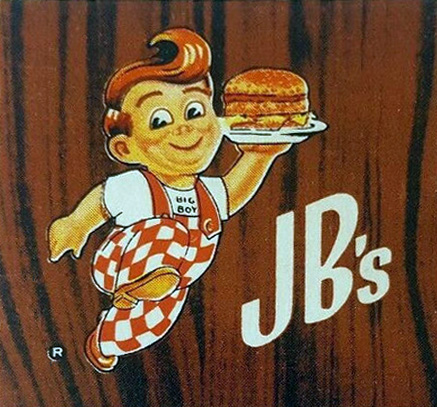
It’s interesting to note what times have been considered early for dinner. Usually it meant before 6:00 or 7:00 p.m. The understanding was/is that fashionable dining began at 8:00, an hour generally considered late by older diners – as well as by families, who have also made up a portion of the early bird flock. Early bird dining often began as early as 4:00 p.m. and I’ve found one restaurant chain, JB’s Big Boy restaurants in Nebraska, where it started at 2:00 p.m.

I can’t help but reflect on 19th-century dining hours, when dinner was a midday meal. Then 2:00 p.m. was when dinner time in restaurants and eating houses typically ended. The fashionable hour for dining out for the few who had the luxury of arising late in the morning was 5:00 or 6:00 p.m., though they might have a lighter repast, supper, later in the evening.

© Jan Whitaker, 2019

6 Comments

Filed under night clubs, patrons, restaurant customs

Anatomy of a restaurateur: Ruby Foo

Is any proof needed that restaurants are show business to a high degree – given that they are enveloped in mystique made up of names, signs, logos, lighting, decor, artistically arranged food, and costumed and scripted personnel?

And sometimes restaurateurs themselves are not the people they appear to be but are creations as carefully crafted as the stars of the entertainment world.

After extensive research I’ve begun to wonder if the public persona of Ruby Foo was largely fictitious.

She is often seen as a rare example of a Chinese woman who defied convention by creating a chain of stylish, nightclub-style Chinese restaurants that appealed to non-Chinese customers. It seems to me that however wealthy she became from the Ruby Foo restaurants, she had a turbulent and difficult life with three marriages and legal troubles that belied her vaunted glamorous life of jewels and furs, shopping in Paris, and flying her own plane.

To begin, note that she was indeed of Chinese ancestry but was born in California as were both her parents, who gave Ruby and her three siblings American first names. This casts doubt upon lore cranked out by gossip columnists who made much of her exotic identity. Their Ruby Foo seemed to have been born in China and had a mother who could not speak a word of English.

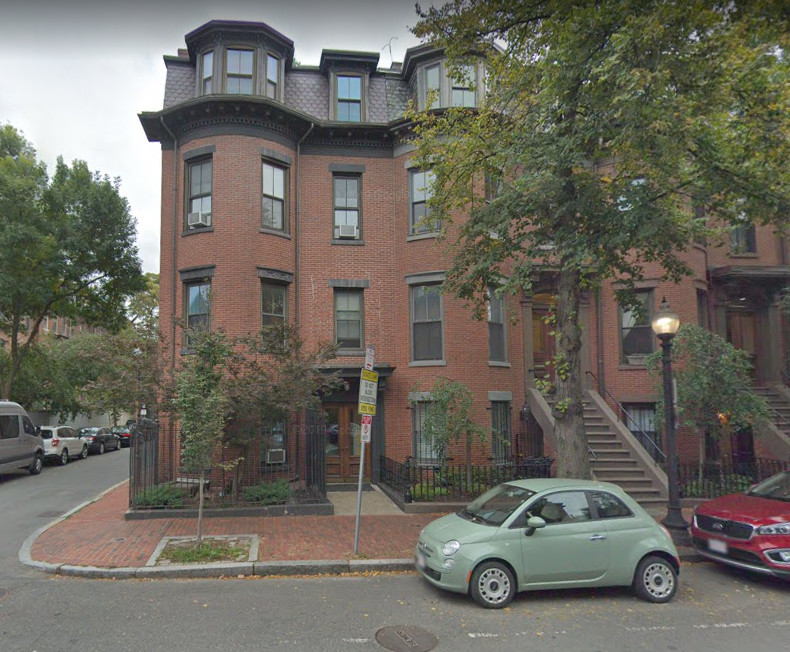
Some accounts say she opened her first restaurant in 1923. But she was married to an herbalist and living in Boston’s Back Bay in a house valued at $11,000 [pictured 2018], which was quite a lot at that time. She had a one-year-old and gave birth to her second child that year. Hard to believe that under those circumstances a woman would open a small lunch room for manual workers, as it has been described. I have been unable to find any trace of it.

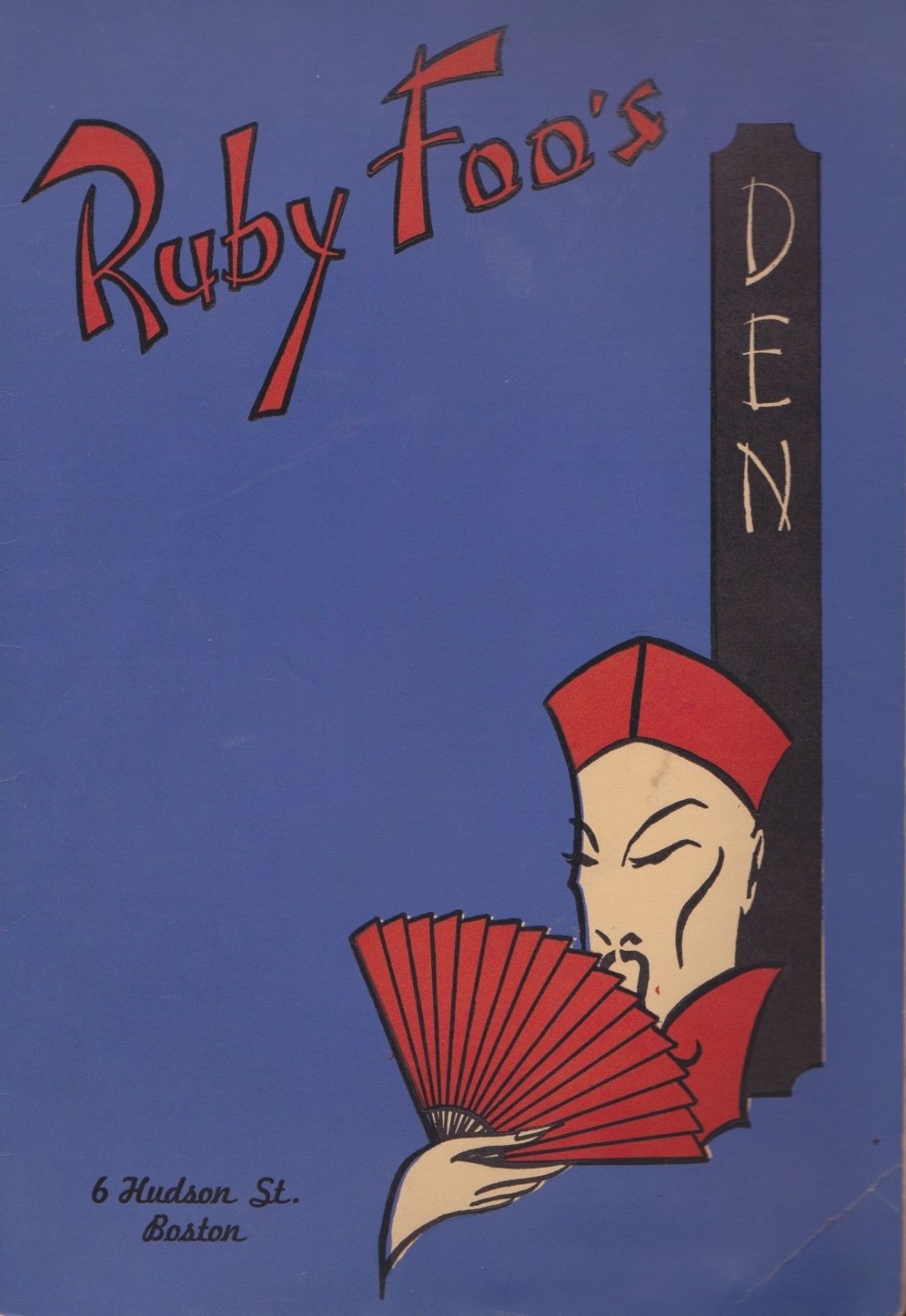
According to other tales, she opened her first restaurant in 1929, which is more believable, though I think it might have been a bit later. In publicity she is always represented as the sole proprietor, but when her brother George died in the 1960s, the Boston Globe reported that he had opened the “original” Den with Ruby. It could not have been called Ruby Foo’s Den then, because she had not yet divorced her first husband, Dr. Shong, and married Mr. Foo. A story in a New York City paper said that Ruby opened a restaurant in 1930 upon the death of Dr. Shong; actually, he died in 1933, by which time she had remarried. [Ruby Foo’s Den, Boston, ca. 1950]

Her second husband, Tam/Tom Foo, who she married sometime between 1930 and 1932, was a bookkeeper when they married and soon fell into big trouble when he embezzled $20,000 from his employer in 1932. Stories in the Boston Herald said the Chinese community regarded him as a scrupulously honest man who became money hungry when he married Ruby and adopted a more expensive lifestyle. Remarkably, by the time he died at age 47 in 1940 he had redeemed himself in the eyes of the community and was, indeed, an importer.

Around 1941 Ruby married William Wong. Wong sued for divorce in 1948, after being shot in the neck the previous year by Ruby’s son Earl/Earle Shong. Earl’s defense was that he was defending his mother from Wong’s attack on her with a hammer. Earl was acquitted, but later had several run-ins with the police. Wong claimed in his divorce proceedings that Ruby drank heavily and had assaulted him on three occasions, one resulting in a hospital stay. He was granted an uncontested divorce on the grounds of cruel and abusive treatment.

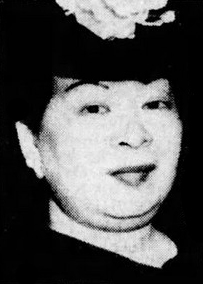
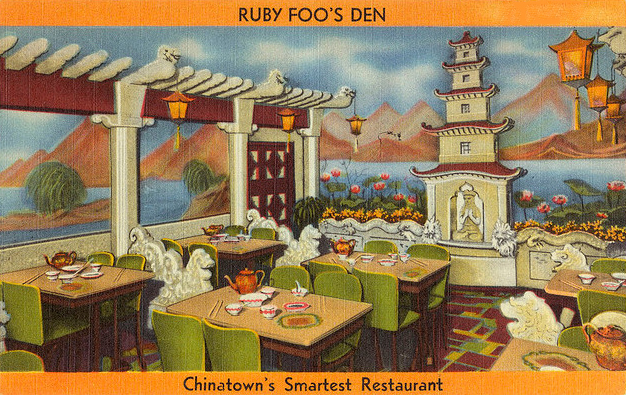
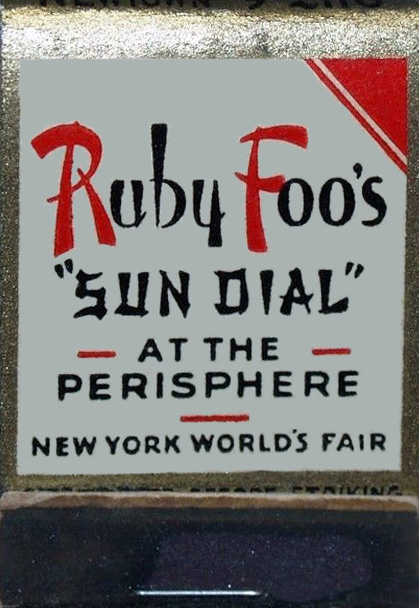
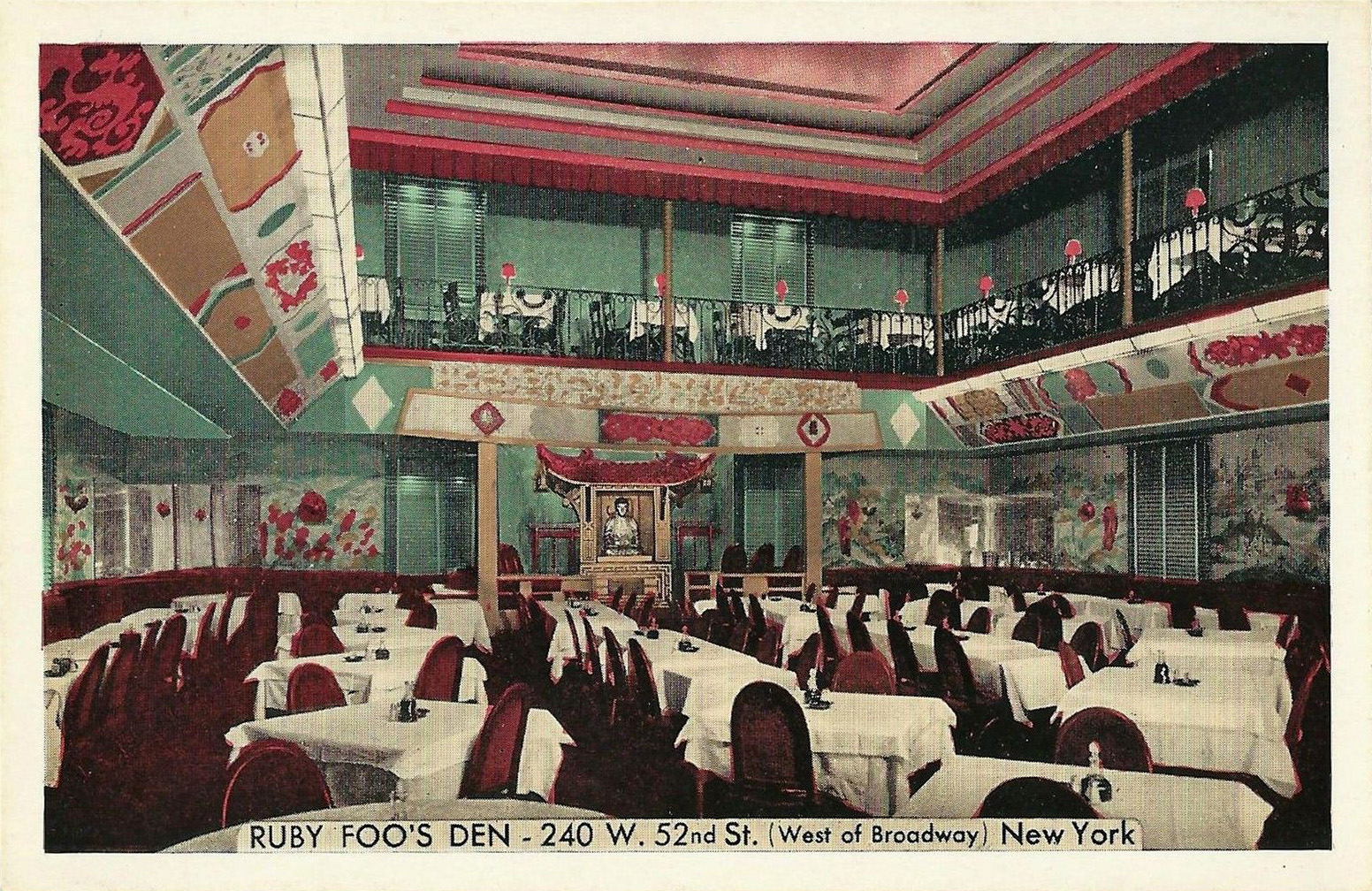
During the 1930s, with the end of Prohibition, Ruby Foo’s Den grew into a popular nightclub and expanded into New York and Miami, each with two locations, plus another at the 1939 New York World’s Fair. But it isn’t at all clear to what degree Ruby owned and operated the 11 Ruby Foo’s that existed at one time or another (not only in Boston, New York, and Miami, but also in Providence, Philadelphia, Montreal, and London). She was in poor health in the 1940s, when William Wong managed the Boston restaurant. It’s likely that by the time of her death in 1950 she held a financial stake in four of them and the others were licensed to use the copyrighted name “Ruby Foo’s Den.” A woman named Florence Pike partnered with Ruby to create and run the New York Ruby’s at 240 W. 52nd street near the theaters that was often featured in 1930s gossip columns. [pictured at top, ca. 1940] According to an obituary for Foo, Pike became owner of the restaurants after Ruby’s death.

One role that Ruby did honor as a restaurateur was to visit her restaurants regularly and to give interviews to columnists.

A Ruby-Foo’s Den was recreated in New York’s Times Square in 2000 and closed a few years ago.

© Jan Whitaker, 2019

7 Comments

Filed under night clubs, proprietors & careers, women

Check your hat

The topic of hat checking in restaurants, nightclubs, and hotels, a popular subject in early 20th-century journalism, is so full of lore that it’s hard to know what to believe. Here’s what seems to be the story as best I can determine.

Hat checking in restaurants started as an independent money-making enterprise around 1900, beginning in New York City and gradually spreading westward. Before that, men took their hats into dining rooms, placing them under their chairs. (In cheap restaurants they kept them on while eating.)

It was considered perfectly fine for women to wear their hats at the table.

But hat checking for men wasn’t really new. It was common at fancy-dress balls in the 1800s. Many regarded it as a scam. An organization or group would throw a ball in a large venue such as Madison Square Garden. Tickets were advertised at the high price of $5. However, hardly anyone bought a ticket, getting them free instead from saloon keepers. When guests arrived at the ball they were required to check their hats, for which they were charged $2, the true price of admission. Those in the know referred to these balls as “hat check affairs.”

Around 1900 restaurants began granting concessions to entrepreneurs who offered to pay them substantial sums to run a hat checking service. At first many were staffed with immigrant boys who were rudely persistent in demanding that male guests surrender their hats before entering the dining area. Gradually, the boys were replaced with attractive young women who used honey rather than vinegar to induce men to give up their hats. Upon exiting the restaurant patrons were expected to leave a tip of at least 10 cents, up to 25 cents by the 1930s.

Concession owners paid thousands of dollars a year for the privilege of running a hat check service and, often, of supplying washroom attendants as well. In nightclubs they provided women to sell cigarettes and flowers. In the early years the amounts paid for these concessions allegedly figured as important contributors to nightclub profits.

All the tips collected by hat checkers went to concession owners, while the attendants received a low hourly wage. Newspaper stories revealing this set-up were perennials from 1910 into the 1950s, suggesting that there were always plenty of people for whom it was news that hat check “girls” didn’t keep the tips.

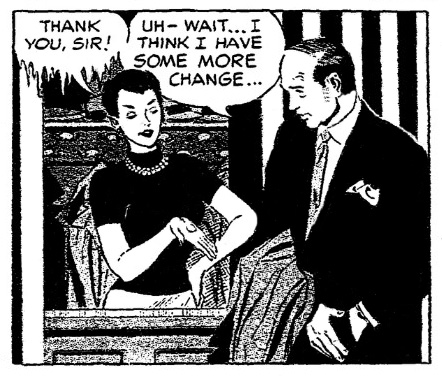
The menial job of hat checker was infused with glamour by gossip columnists and a number of Hollywood movies [top photo: Hat Check Girl, 1932]. This no doubt helped attract fresh recruits – including aspiring actresses who hoped to be “discovered” — in what was a high turnover, dead-end occupation. Want ads sought “attractive girls with pleasing personalities.” Meeting daily tip quotas through appearance and demeanor was a key to survival in what today is recognized as a “pink collar” job, i.e., one supposedly requiring no special abilities but demanding strenuous emotional labor. Acting talent came in handy. Occupants of the job became quite adept in shading the meaning of “Sir!” and “Thank you.”

Among the stresses of the job was the necessity to be gracious with patrons who flirted, pinched, left poor tips, and sometimes grew angry and slung insults. Hearing over and over how men had paid more in tips than their hats were worth became tiresome. So did laughing at jokes. Cartoonist W. E. Hill perfectly captured the facial expression of a woman preparing to respond hilariously to a bad joke.

Some hat checkers went to court to claim tips as theirs, but did they ever win? I doubt it. Many hotels and restaurants avoided the stigma associated with hat checking by running their own services while making it clear that tips were unnecessary. The Exchange Buffet chain advertised in 1914, “No hat-boy to hold you up.” Schraffts’ deposited tips in an employee sick benefit fund. Legislation was offered in some cities and states requiring that hat check stations either post a notice stating that tips went to a concession owner or turn them over to the attendants.

Overall, hat checking thrived best in big-city nightclubs visited mainly by tourists.

One of the rare hat checkers who beat the system was Renee Carroll, who ran her own concession at Sardi’s. The daughter of a New York City rabbi, she changed her name from Rebecca Shapiro and became part of the entertainment world, a Broadway personality known for witty quips. She appeared in movies, published a book about her experiences with celebrity customers, authored a gossip column, and backed theatrical productions.

By the mid-1920s, with many people going to restaurants and nightclubs by car, hat checking declined as hats were left in the car. By the mid-1930s fewer men wore hats, especially the young. Hat checking in restaurants can still be found but no one is forced to use it and the glamourous hat check girl is no longer a figure of popular culture.

© Jan Whitaker, 2018

9 Comments

Filed under night clubs, patrons, restaurant controversies, restaurant customs, restaurant etiquette, women