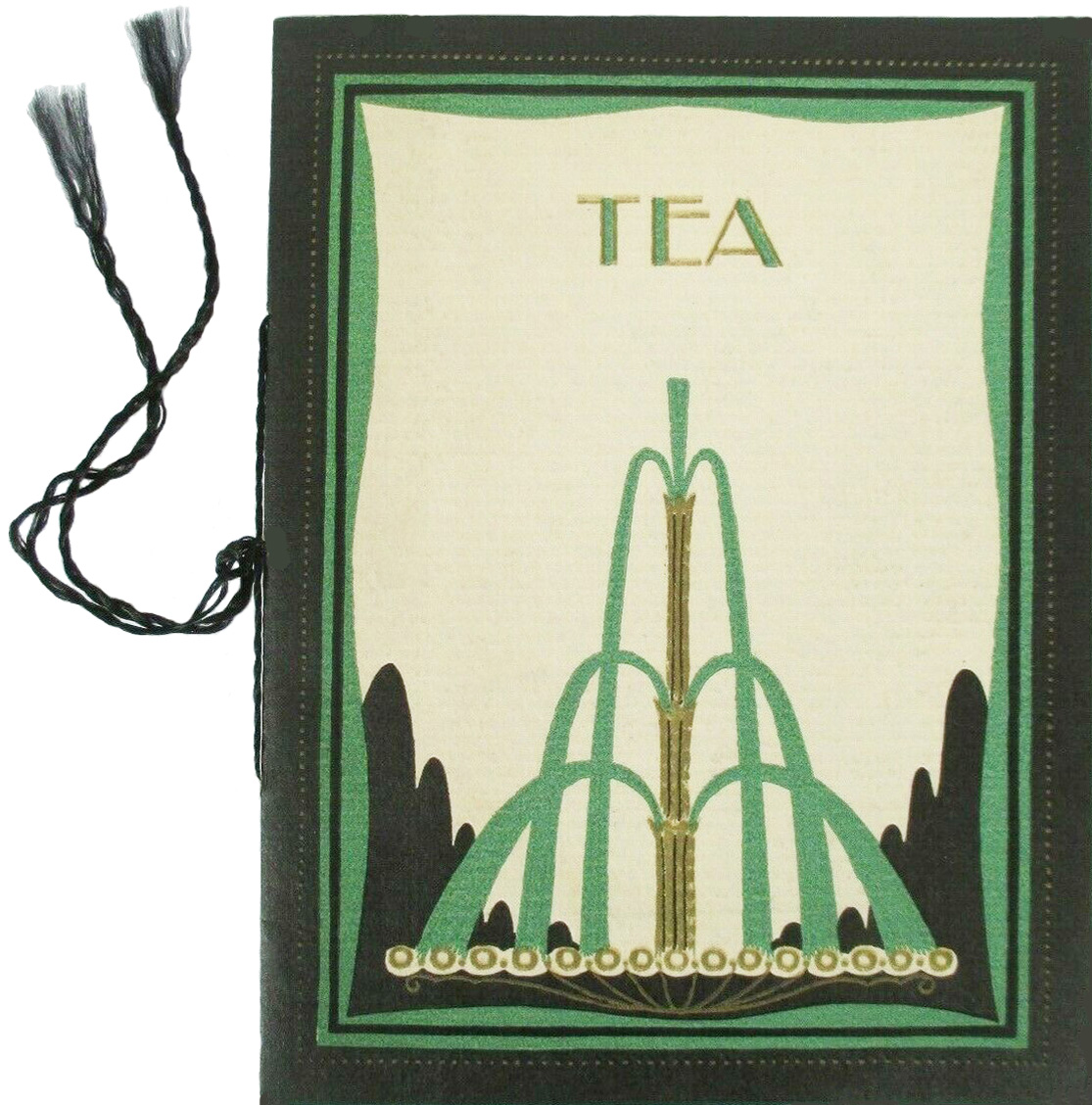
This past weekend at the giant Brimfield flea market I found the charming small menu shown above and below.
The menu is for a tea house that operated seasonally from 1928 through 1940. I’m guessing it may date from the mid-1930s since the prices match those in an advertisement from 1937 [shown below].
I couldn’t determine if the Providence Airport owned the tea house, renting it to the two women who ran it, or if the women were the owners. Despite the airport’s name, both it and the tea house were actually located in Seekonk MA, 7 miles from Providence RI.
The air field was private, offering flying lessons, short touring flights, and airplane storage. Its owners also sold the newly developed Aeronca monoplane.
The two women who ran the tea house for most of its years, Mildred Burrell and Lyle Lincoln, were from Fall River MA. They seemed to enjoy the status of socialites, being free to pursue that lifestyle in the months they were not running the tea house. They were able to make a success of the business for at least 10 years, which was greater than the lifespan of most eating places. It was offered for sale in 1939, but its new operator only kept it open for a year.
According to a 1932 feature story about women and aviation, women had no place in the early days of aviation, and were not expected to ever become passengers. However, that had changed by the time of the story when they had begun to learn to fly, and made up an increasing percentage of passengers and in-flight hostesses. According to the story, the operators of the tea house had made “occasional flights, [but] neither has a license or even any interest in obtaining one.”
Various newspaper stories of groups patronizing the tea house suggest that most came from Providence. Patrons could watch the airfield’s activities, but how many of the field’s plane owners, tour takers, or students taking flying lessons patronized the tea house is uncertain. Yet this 1929 advertisement suggests that there may have been some interest in an air tour followed by dinner on weekends.
By the time the tea house closed after the 1940 season, public airports were well established, and many featured full-scale restaurants that drew the public to dine while watching planes take off and land.
A short time ago I had a chance to visit the fascinating second floor of the Fishs Eddy store in New York. It is piled high with not-for-sale dishware of all kinds, collected by the store’s owner Julie Gaines. The collection includes restaurant ware from the golden past when this country still produced such things. (Tours of the collection, hosted by Julie, are given periodically and booked by the New York Adventure Club.)
The Fishs Eddy collection also includes records from china producers that show pattern designs. A page from Shenango China in Newcastle PA — closed in the 1970s — depicted the design for a plate made for use at the Well of the Sea restaurant in the former Hotel Sherman in Chicago. (A ca. 1950 painting of the restaurant by Cal Dunn is shown at the top of this page. Below is a plate using the above Shenango design.)
The restaurant opened late in 1948 in the hotel’s basement, which no doubt suggested an underwater theme to the hotel’s owner, the colorful and theatrical Ernie Byfield. He had also originated the over-the-top glamour restaurant, the Pump Room in the Ambassador Hotel.
A number of abstract murals of underwater scenes by Richard Koppe, Chicago painter and student of the German Bauhaus, decorated the walls of the restaurant. One of them was used for the menu’s cover shown below. The room was further enhanced by darkness and other-worldly ultraviolet lighting.
In addition to the murals, Koppe also contributed wire fish and light sculptures somewhat visible in the black and white advertisement of unknown date. The color menu depicted one of the murals.
Needless to say, the restaurant specialized in fish, with frequent shipments coming in by air. It was especially known for what was called Black Clam Chowder made with Madeira wine, clams, and many herbs and spices. A portion of a menu is shown above.
Another unusual feature of the Well of the Sea was the attached art gallery in which the work of Koppe and other Chicago artists was displayed. The exhibit of Richard Koppe’s work took place in December, 1949, one year after the restaurant’s opening.
In 1968 the Sherman’s general manager explained that the ultraviolet light used in Well of the Sea was glamorous when it illuminated jewelry and white shirts but not when it lighted false teeth. But the customers liked it anyway despite the room being so dark that waiters had to assist them with flashlights in order to read menus. In 1968 a glow-in-the-dark menu was introduced to make reading easier.
Exactly when the dishware inspired by Koppe’s murals and designed by Shenango Potteries’ Paul Cook came into use in the restaurant is not known with certainty. According to Margaret Carney, whose International Museum of Dinnerware Design in Kingston NY features many pieces of dinnerware from the Well of the Sea, the design shown on the Shenango file page above was probably not used until 1954. What preceded it is unknown.
The Well of the Sea was popular from the start and stayed in business until 1972, a year before the Sherman itself closed.
It’s rare to find business documents from long-gone restaurants, but last weekend I stumbled upon two letters to investors from the Physical Culture Restaurant Company headed by fitness and health food advocate Bernarr Macfadden [shown above, age 42].
Macfadden was a body-builder, natural food proponent, and entrepreneur who decided to spread the gospel by opening inexpensive, largely plant-based restaurants at the turn of the last century. He attributed his strength and energy to this special diet.
The 1904 end-of-year letter reported that four new restaurants had been added to the ten already in business, and that they had done business totaling over $243,000, with a net gain of $2,637. Five restaurants had been judged failures and closed, four of them in NYC and one in Jersey City. He and his board of directors believed in rapidly shutting down locations that did not draw crowds. The letter blamed a “business depression” and the normally slow start of new locations for the smaller-than-hoped-for profits.
Although he wanted the restaurants to succeed, his personal income was not dependent upon them. Macfadden’s primary business was publishing periodicals, beginning in 1899 with Physical Culture, which discussed diet and health, followed by True Story, Liberty and then, increasingly, a large number of detective and romance magazines with titles such as Dream World, True Ghost Stories, and Photoplay. In addition he authored scores of books on fitness, sex, and health, and established a tabloid newspaper, The New York Evening Graphic. His publications earned him a fortune.
The total number of Macfadden restaurants open at the same time never seemed to exceed sixteen or so. The first ones were in New York City, of which there were nine at one point. Others were spread across the East and Midwest, including Boston, Newark, Jersey City, Philadelphia, Pittsburgh, Detroit, Cleveland, Cincinnati, Chicago, and St. Louis. There was also one in Toronto. [above: 1906 advertisement and 1906 restaurant at 106 E. 23rd, NYC]
In the 1907 letter to stockholders shown above he floated the idea that the restaurant holdings might grow to 40 or 50 units if stockholders invested in more stock. This never happened.
Despite the growing popularity of the restaurants, it seems that for Macfadden they served primarily as a way to spread the gospel of a healthful diet. He could not be described as a restaurateur. No doubt he helped to conceptualize the restaurants and make up the early menus, but he did not manage them except in his role as corporate executive.
Prices were low in his early restaurants. A bowl of thick pea soup was 1c, as was a bowl of steamed hominy or oats or barley. Whole wheat bread and butter, however, cost 5c as did creamed beans or whole wheat date pudding. He sold loaves of whole wheat bread for 10c. [shown above]
A Macfadden menu shown in a 1919 British book reveals a wealth of choices then but also higher prices that reflect post WWI inflation. Five cents now bought less. Mushrooms on Toast cost 20c, as did meat substitutes Nuttose and Protose. A Macaroni Cutlet or Lentil Croquettes cost 25c, while omelets such as Mushroom, Walnut and Pecan, Orange, or Protose and Jelly were 30c.
In 1931, at which point only three Physical Culture restaurants remained, Macfadden gave up his fortune, said to be $5,000,000, and created the Bernarr Macfadden Foundation. In a radio broadcast he said: “It is a source of indescribable relief to feel like a free man again. Too much money unwisely used makes people greedy and ungrateful, destroys the home, steals your happiness, enslaves, enthralls you, lowers your vitality, and enfeebles your will.”
Yet his personal life continued to be full of numerous wives, affairs, and lawsuits. And, despite being “freed” of his fortune in 1931, he continued to spend money lavishly, taking it from the treasury of the Physical Culture Publishing Company after he turned that into a public corporation. Stockholders accused him of using nearly a million dollars for his own private interests, which included failed attempts to become a presidential candidate, governor of Florida, or mayor of New York.
In 1931 the Foundation opened the first of several Depression-era penny restaurants, no doubt modeled on Macfadden’s first restaurant at the beginning of the century where most dishes cost only one or a few cents. The initial Depression “pennyteria,” run by the Foundation, was located in midtown NYC. Drawing a crowd of about 6,000 a day, it quickly became self-supporting.
At a penny restaurant run by the Foundation, one cent would buy any of the following: coffee, split pea soup, navy bean soup, lentil soup, green pea soup, creamed cod fish on toast, raisin coffee, honey milk tea, cabbage and carrot salad, steamed cracked wheat, hominy grits, raisins and prunes, bread pudding, whole wheat doughnuts, whole wheat bread, or whole wheat raisin bread.
As the operator of the 1930s restaurants, the Foundation proved more flexible than Macfadden about dietary standards, but evidently he still had some say over what was served. According to one account he agreed to let meat appear on the menu as well as dairy products. Meat took the form of beef cakes, beef stew, and chicken fricassee. But he stood firm about bread, insisting only whole wheat be served.
I found no trace of the Macfadden restaurants nor the Foundation’s penny restaurants in the 1940s. Macfadden largely faded from the headlines, dying in 1955 and leaving an estate valued at only $5,000.
There is nothing as interesting (to me) as a memoir about a restaurant from an insider who reveals its workings not usually known to customers. Papa’s Table d’Hôte by Maria Sermolino is such a memoir, published in 1952, decades after her father’s ownership of the New York City restaurant, Gonfarone’s.
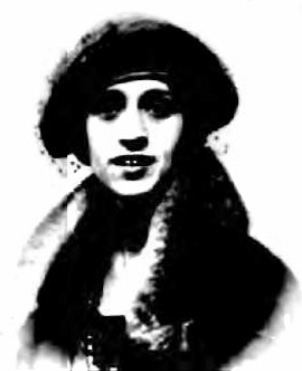
Maria’s career as an editor and writer was extensive. After graduating from the Columbia School of Journalism and spending a couple of years writing about post-WWI conditions in France, she interviewed Italian Fascist leader Benito Mussolini. Later she worked for Time, was the editor of The Delineator and for 11 years an associate editor for Life magazine. She attributed her lifelong unmarried status to overhearing conversations about women among waiters and from male guests invited by her father to join him at his table. [above, Maria at age 25, in 1920, the year she interviewed Mussolini]
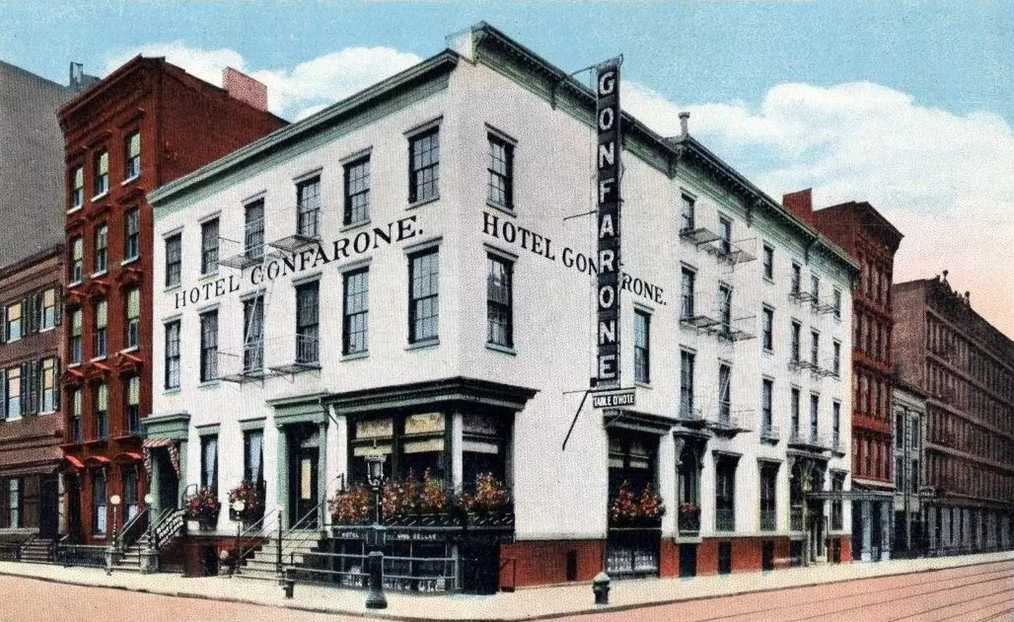
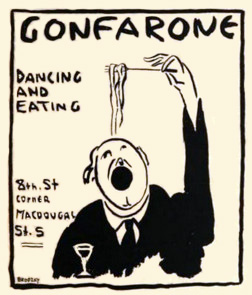
Gonfarone’s began in business around the turn of the last century as an Italian pension-type eating place, transitioning into a bohemian resort for Greenwich Villagers. It was run initially by Caterina Gonfarone who operated it in a basement on the corner of Eighth and McDougall streets. She soon partnered with Maria Sermolino’s father, Anacleto, who saw to it that the dining room was moved upstairs. Then, as neighboring residences were acquired by the partners, the popular Latin Quarter table d’hôte expanded to eventually accommodate 500 diners at a time. Sermolino soon acquired the restaurant from Madama Gonfarone, but kept her name.
After the Sermolino family moved into the complex of buildings (which also included a small hotel), Maria spent much of her childhood in the restaurant. Chapter 6 of her book is entitled “The Barroom Was My Playground.” She assisted her mother, the restaurant’s cashier, by spotting waiters who failed to pay her mother for drinks they ordered for customers at the bar. (They would have been reimbursed later, but without paying first they were able to keep the customers’ payments for themselves.)
But that is not the only way in which the staff tried to make extra money on the side. Dishwashers sold food scraps and fat to a company that made soap, with higher prices paid for barrels with more fat. On occasion Madama Gonfarone would catch a dishwasher pouring a large tin of unused lard into a barrel for a higher payoff. It was also common for the staff to smuggle out bottles of wine, chickens, lobsters, and other choice food items when they left at night. Her father refused to institute routine searches because he thought it would be bad for morale.
Because the restaurant was connected to a hotel, the bartender also acted as the room clerk. He took advantage of his position by renting rooms to prostitutes, even on occasion — when she was away — renting Madama’s room for more than double his usual charge.
Not all the restaurant’s customers were treated equally. Waiters would see to it that their favored regulars got larger portions, choicer cuts of meat, and less melted ice in their drinks. A standard menu, 50 cents on weeknights and 10 cents more on Saturdays and Sundays, featured Antipasto, Minestrone, Spaghetti, Salmon with Caper Sauce, a Sweetbread, Broiled Chicken or Roast Beef, Vegetables, Potatoes, Green Salad, Biscuit Tortoni or Spumoni, Fresh Fruit, Assorted Cheeses, and a Demi-tasse. In all likelihood the portions would have usually been on the small size.
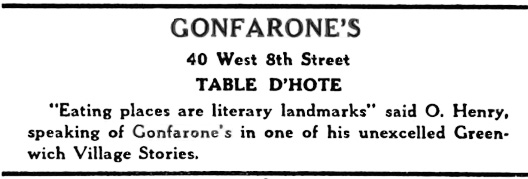
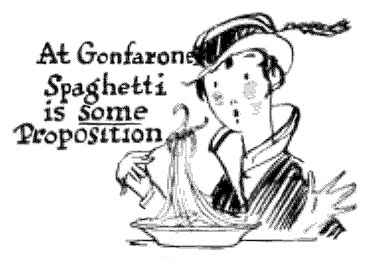
“By the simple act of ordering spaghetti an American was plunged into a foreign experience,” observes Sermolino. [above, 1916 advertisement from The Greenwich Village Quill; below, 1919 Quill]
All meals came with a glass of California claret, which the restaurant bought 40 or 50 barrels at a time, reducing their cost to ten cents a gallon. Apart from that free glass, which impressed many American patrons who were unfamiliar with wine and considered it exotic, the bar was a money maker. Maria called it “a gold mine.” A Manhattan cocktail — with cherry — cost 3 cents but sold for 15 cents, she explained.
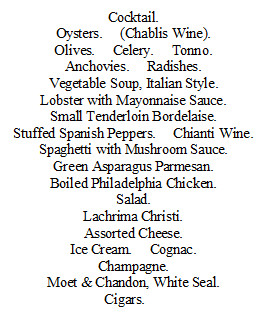
Banquet menus were grander and supplied more alcoholic beverages, as is shown in a 1904 menu above for a dinner given to honor a supporter of Democrats in the Tammany-controlled area occupied by the restaurant.
The restaurant’s best years were before World War I, when it was not unusual to serve four to five thousand dinners on an average weekday and double that on a good Saturday or Sunday, with waiting patrons spilling down the hall and into Macdougal Street. When food ran low the cooks would water the soup and waiters would offer patrons omelets.
With the onset of Prohibition, Maria’s father decided to get out of the business and concentrate on his other interest, real estate. Under new ownership, Gonfarone’s remained open for another 10 years, until 1930. The buildings were razed in 1937.
Slim pickings for a restaurant ephemera collector at the giant Brimfield flea market recently, but at least I turned up a few finds. Among them were two small menus and a business card, all from eating places run mainly by women. The size of the two menus makes me wonder if male-owned restaurants ever employed any this tiny.
The Henniker Tea Room
The oldest of the three finds was a menu from The Henniker Tea Room in 1932. It took me a while to realize that its location “Midway between Westfield and Brocton” put it in New York state.
I discovered that it is a relic of hard times in a double sense. The front of the menu says “Tenth Season,” so it was begun in 1922. That was the year that the owner’s husband, a superintendent of schools, died of tuberculosis, which probably meant that she had to earn a living for herself and her two daughters.
The second hardship associated with this menu is that it dated from the depths of the Depression. I suspect that is the reason she stopped charging an extra 15 cents for salad with Sunday dinner specials, and reduced the price of potato salad from 30 to 25 cents.
Possibly the tea room failed in the Depression because by 1940 Frances Swain was living in a lodging house and working as a secretary for the YMCA. But her fortunes must have improved after that because in 1950, at age 66, she had become director of the YMCA and headed her own household with additional income from three roomers.
The Salmagundi
The Salmagundi was a seasonal tea room that probably opened in the late 1920s. It was located on Beacon Street in Boston, in a rooming house that the married couple who operated it lived in. I’m guessing the menu shown here is from the early 1950s, an era when tomato juice appetizers were still popular.
The word salmagundi was an old-fashioned but rather artsy word. It could apply to many kinds of mixtures, whether art, collections of short stories or poems, or a multi-ingredient salad.
The Salmagundi was a frequent meeting place for women’s clubs, bridal showers, business and professional groups, and gatherings of college alums.
Duncan Hines, in the 1946 edition of Adventures in Good Eating, declared The Salmagundi “One of the most popular places in Boston,” and praised its “unusual food combinations, delicious hot breads, and good desserts.”
A student at the Massachusetts Institute of Technology took his girlfriend to dinner there in 1950. He said it was a quiet place with three small dining rooms and a limited menu but one he approved of since it included lobster, steak, and chicken. They ordered duck and found it delicious, and liked the “fancy rolls.” But the check totaled a bit over five dollars, so he had to borrow some money from his “chick.”
Around 1960 it passed into new hands, and the owner tried to get a license to serve wines and malt beverages. I found no trace of it after 1962.
Mary Hartigan Restaurant
Although Mary Hartigan’s business card is the smallest of the day’s finds, I discovered that hers was the most successful business of the three. She established it in 1933 in what was formerly a Dutchland Farms that she had run. [above, front and back of business card]
The Dutchland Farms chain in New England, beginning as dairy stores, developed into restaurants quite similar to Howard Johnson’s shortly before the chain failed in the Depression. Some were converted to Howard Johnson’s, but Mary Hartigan, who also ran one in Harwich Port MA, decided to run her Dedham place independently under her own name.
Nevertheless Mary Hartigan’s and Howard Johnson’s shared a similar appearance as well as a similar menu. A Hartigan menu from 1952 shows that she kept the strong link to dairy products in her new restaurant, dedicating an entire page to ice cream concoctions such as sodas, sundaes, freezes, frappes, floats, and malted milk. In addition to the standard steak and chicken entrees, the menu also presented a variety of seafood, including seafood plates, baked lobster, Cape scallops, broiled swordfish, and fried clams. Tomato, grapefruit, and pineapple juice served as appetizers.
1952 was also the year that the restaurant acquired a liquor license. In 1959 the building was enlarged and remodeled. [above, business card interior]
When Mary Hartigan died suddenly in 1961 her obituary in the Boston Globe observed that the restaurant was “one of the best known in the state.” She left it to a niece who ran the business until 1970 when it was sold to a new owner who said he planned to keep the staff, some of whom had worked there for three decades.
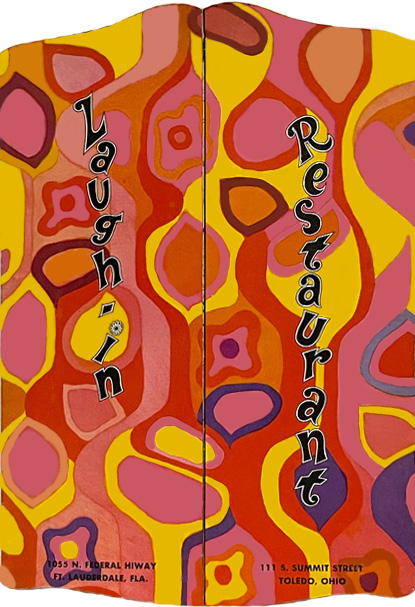
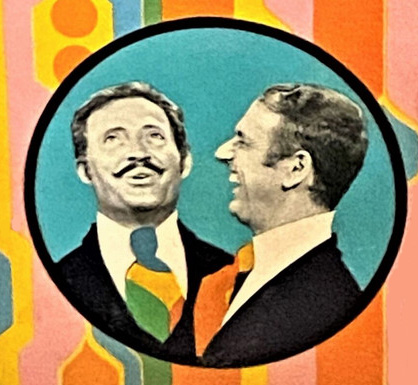
The restaurants called “Laugh-In,” based on the hit Dan Rowan and Dick Martin TV show, formed a teensy blip in an enterprise that culminated with big-time gambling casinos. [1969 menu cover]
Perhaps because the TV show was such an instant hit, it inspired the idea that the same enthusiasm would transfer over to the restaurant. It didn’t.
The chain was created in 1969, under the Lum’s restaurants umbrella, by brothers Clifford and Stuart Perlman who had built the successful Lum’s chain from a small Florida hot dog stand thirteen years earlier. The brothers adopted the Laugh-In concept and franchise system not long after they had begun another chain called Abners Beef House in 1968.
At that time the parent company, Lum’s Inc., had 300 locations. The brothers decided to list it on the New York Stock Exchange. In addition to the three restaurant chains, they also owned a chain of Army-Navy stores, meat packing plants, honeymoon resorts in the Poconos, and a large country club in Miami, the city where the corporation was located.
Selling stock in Lum’s, Inc. was a way to amass money to fulfill the brothers’ ambition of buying Caesar’s Palace, the Las Vegas hotel and casino that had opened in 1966.
When they created Laugh-In, financial analysts warned investors that counting on the continuing popularity of a TV show was risky. What if it went off the air? Perhaps that did worry buyers. Forty franchises were expected to be sold in 1969, but the actual total for that year was probably lower and the overall total number of units ever opened is unknown. [above left, Rowan, right, Martin]
Laugh-In relied heavily on the goofiness of its namesake TV show for the design of its units, fronting its flat-roofed concrete-block-style buildings with wild patterns and colors. Table tops were manufactured with imitation graffiti reflecting phrases from the show. [Below, table-top graffiti as shown on the back of menu above]
Everything was meant to appeal to youthful customers. According to an early advertisement for franchisees, Laugh-In was “a fun restaurant, designed for today’s vast young-minded, leisure-rich market.”
Additionally it advertised that it used a “proven food format” as employed by Lum’s. Lum’s had a signature dish, hot dogs cooked in beer, and it also sold beer. Laugh-In did not. But judging from their menus, neither Abners nor Laugh-In offered anything special in the way of food. Despite the “funny” names, Laugh-In selections were the same as those found in many other casual restaurants. Then there’s the fundamental question of whether customers choose what to order according to how funny the name is.
Judging from a 1969 advertisement for Abner’s franchisees, the Lum’s corporation was not especially good at presenting desirable-sounding food. The ad exclaimed over its menu’s “hunks of steak in a long fun bun” and “good things to drink, too, a malt, milk, a soda, coffee and tea.” As for Laugh-In, despite the funny names (Bippy Burgers, Fickle Fingers, Here Comes The Judge), its menu boiled down to the usual assortment of sandwiches, deep fried fish, onion rings, and a few oddities such as “tomato and egg slices” and “cheese on a bed of lettuce.”
The first Laugh-In restaurant opened in Hollywood FL in December, 1969. A few months later 25 more franchises were said to have been sold around the country. But #1 did not do at all well. It closed just short of a year later, replaced with an “Adult Art Theatre.” [above, partial advertisement for the grand opening]
Overall, the brothers fared better with another big venture, Caesar’s Palace, acquired a couple of months before the first Laugh-In opened. Caesar’s Palace had a rough time at the beginning of their ownership, and the stock of Lum’s, Inc., its corporate owner, fell sharply. The brothers raised $4 million by selling off most of their restaurants, including Laugh-Ins, in 1971. But they ran into trouble attempting to open another casino in Atlantic City. New Jersey’s Casino Control Commission insisted that because the Perlmans had had financial dealings with reputed organized crime figures, they had to resign if a permanent permit was to be issued. Stockholders voted to buy them out, paying almost $100 million for their stock.
A few Laugh-In restaurants probably continued on for a while, though it had to be a blow when the show went off the air in 1973. The longest survivor may have been Jeff’s Laugh-In in Chicago, lasting until 1988.
Not only have American’s favorite desserts changed over the course of history, but so has the meaning of the word dessert as used on menus.
In a series of articles in 1879, Lorenzo Delmonico explained the meaning of courses as presented in a proper French dinner. For a start, he explained, “when people believe that each dish served separately is a course in itself they have got the whole matter dreadfully mixed up.” There were only three courses, he stated. The first two comprised the “whole dinner” and the third, he wrote, “contains only the dessert.” Just how many dishes were presented in each course was entirely up to the host.
Sounds simple, but here’s where it gets confusing: the second course is accompanied by “Entremets” that are “the smaller dishes of the second course, including such puddings and pastries as may be served . . .” The third course – Dessert — comes last and “consists of ices, fruits, nuts, coffee, etc.” Today, we would consider the Entremets as Dessert.
Under Charles Ranhofer, Delmonico’s chef for most of the years from 1862 to 1896, Sweet Entremets continued to be presented with the Roast course, followed by Desserts as laid out by Lorenzo. At Delmonico’s Beaver Street location in 1899, for instance, an a la carte menu listed Entremets consisting of such things as Charlotte Russe, Peach Pie, and puddings, while Desserts included the subheadings Fancy Creams, Creams, Water Ices, Sorbets, Fresh Fruit, and Cheese.
Not surprisingly, cheap eating places had completely done away with courses decades earlier. For instance, at Milliken’s Beefsteak & Coffee Room in New York in 1849, there were only two categories: Dinner (i.e., meat) and Dessert. Dessert consisted of a choice of one custard and seven pies — Cocoa Nut, Plum, Mince, Peach, Apple, Indian, and Rice.
But even in far-off San Francisco end-of-meal choices reflected something like a formal menu, but with a different organization. In 1887, the ever-busy Royal Dining Saloon presented five categories of sweets in this order: Fruit, Puddings, Pies, Cakes – and then Desserts! Desserts included Peaches and Cream, Cranberry Sauce, Apple Sauce, New Comb Honey, Hot Mince Pie, various stewed and baked fruits, and Ice Cream. So, Mince Pie was a Dessert but other Pies were not?
Across the land there were other logic-defying variations. But probably no one really cared about logic. They saw what they wanted, ordered it, and that was that.
Overall, it would be cheap eateries such as Milliken’s that prefigured a 20th-century in which all the end-of-meal categories would be boiled down into one: Desserts. Not only that – the offerings in that category at popular eateries, as at Milliken’s, would remain primarily Pie and Pudding for decades.
But it seems that women preferred cake. As more unescorted women patronized restaurants in the 20th century, and tea rooms catering especially to them opened, this difference in their dessert preferences made itself known. Tea rooms began to specialize in cakes, selling them whole to take away as well as portioned for meals. For example, a pop-up Suffrage kitchen opened in Chicago’s Loop in 1914 offered a 35-cent lunch of salad, sandwich, and beverage, plus a dessert of cake and ice cream for an extra 15 cents. A notice read, “if the luncheon is served to men pie a la mode.”
Of course tea rooms did serve pie, and other desserts too, but it is striking that many lunchroom menus did not include cake. Perhaps for the average eating place layer cake was too difficult to frost, slice, or keep moist when portioned in advance. My sense is that it was also considered a more refined dessert suited to female tastes, whereas pie was an older, heartier, basic food.
Tea room proprietors were well aware of women’s attraction to cake. As Fanny Evans of Mary Elizabeth’s in New York said in 1923, her tea room knew how to cater to American women’s love of unusual salads, creamed chicken, croquettes, and “delicious home-made cakes.” In 1933 the proprietor of the Ipswich Tea House in Massachusetts, a graduate of Miss [Fannie] Farmer’s School of Cooking, prepared special menus titled “A Meal for Men” and “A Ladies Luncheon.” The men’s meal ended with Ice Cream Pie and the women’s finished with Meringue Cake.
In the Depression Americans turned to desserts to cheer themselves up. According to a 1932 NYT story “the American’s Real Desire Is More Dessert,” driven by a wish for glamor, romance, and “the desire for escape from the standardization of the machine age.” Plus desserts yielded high profits. Schrafft’s was way ahead of the game. As early as 1929, the 181 Broadway location in New York offered 34 different desserts!
After WWII, returning soldiers as well as civilians were hungrier than ever for desserts. A 1946 manual advised restaurateurs that a winning menu formula was to have as many desserts as entrees, 7 to 9, but no more than 4 green vegetables.
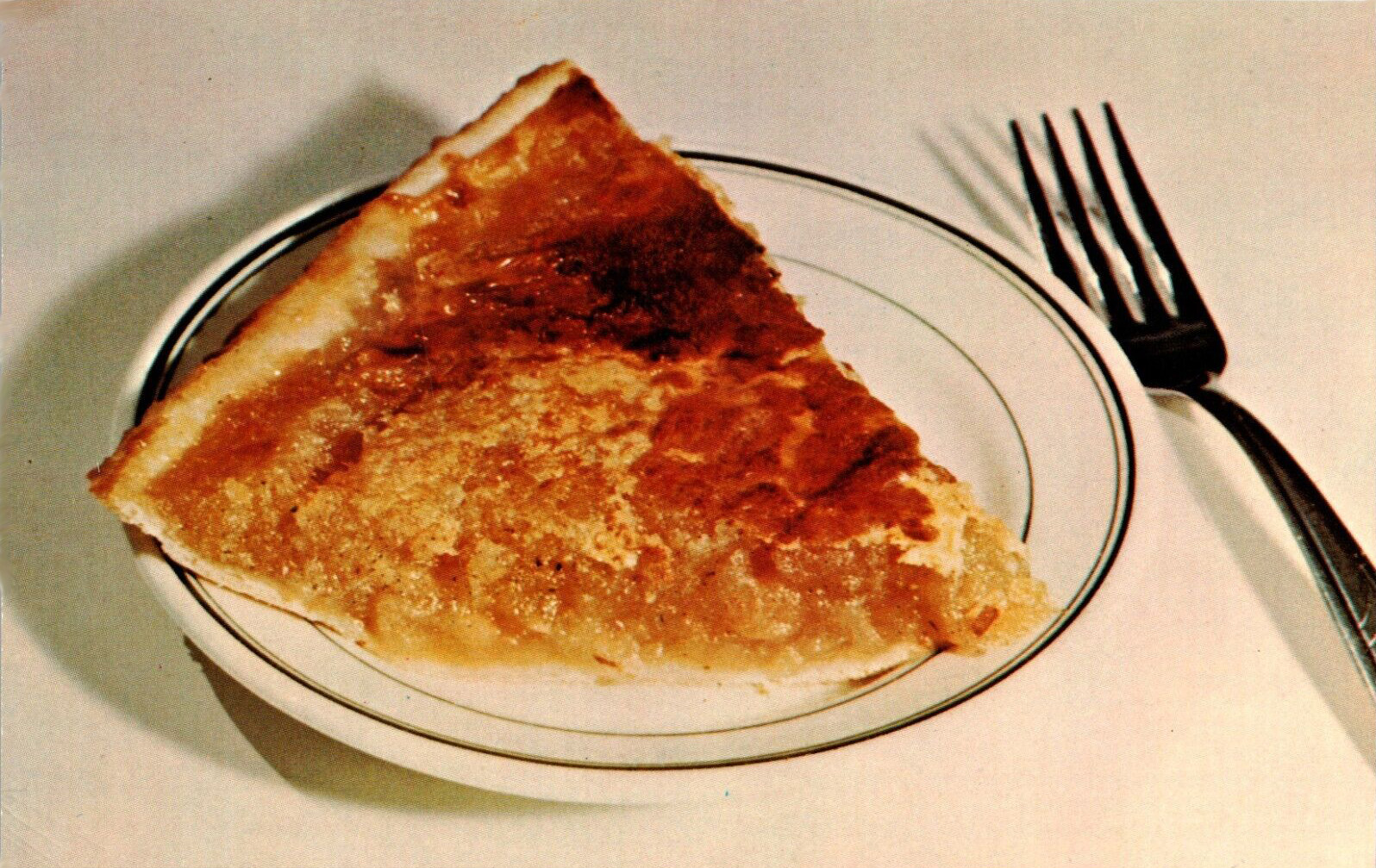
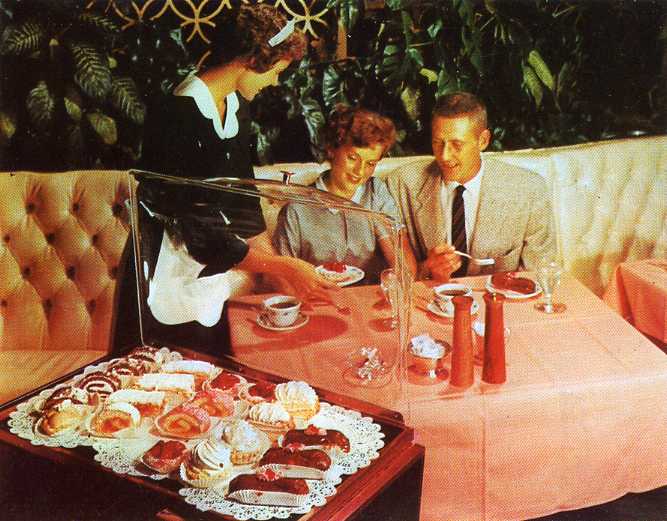
In the average eating places, apple pie was crowned the favorite American dessert until the 1970s, while layer cakes tended to vanish from the restaurant scene. But pie would not do for luxury diners. As demonstrated on a 1951 menu from Ciro’s in Hollywood, expensive restaurants gravitated to less common, fancier desserts such as Parfaits, Crepes Suzettes, and Baked Alaska. Dessert trays and carts bearing French pastries also came into use, while a flaming dessert was always a possibility worth considering.
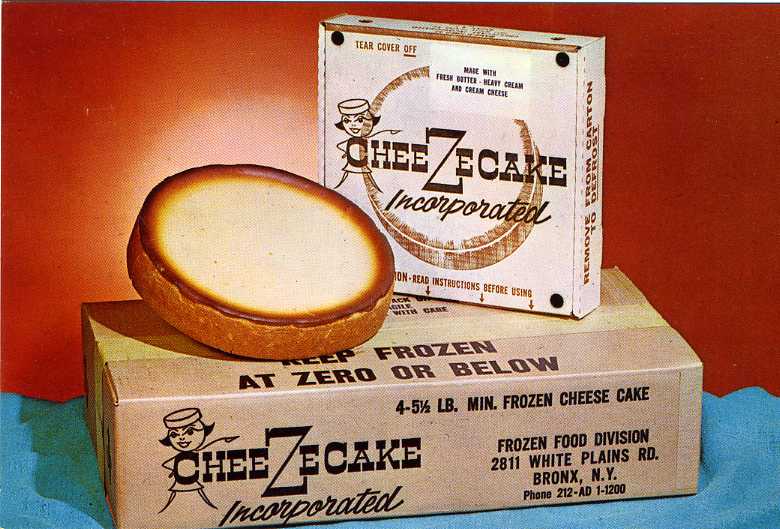
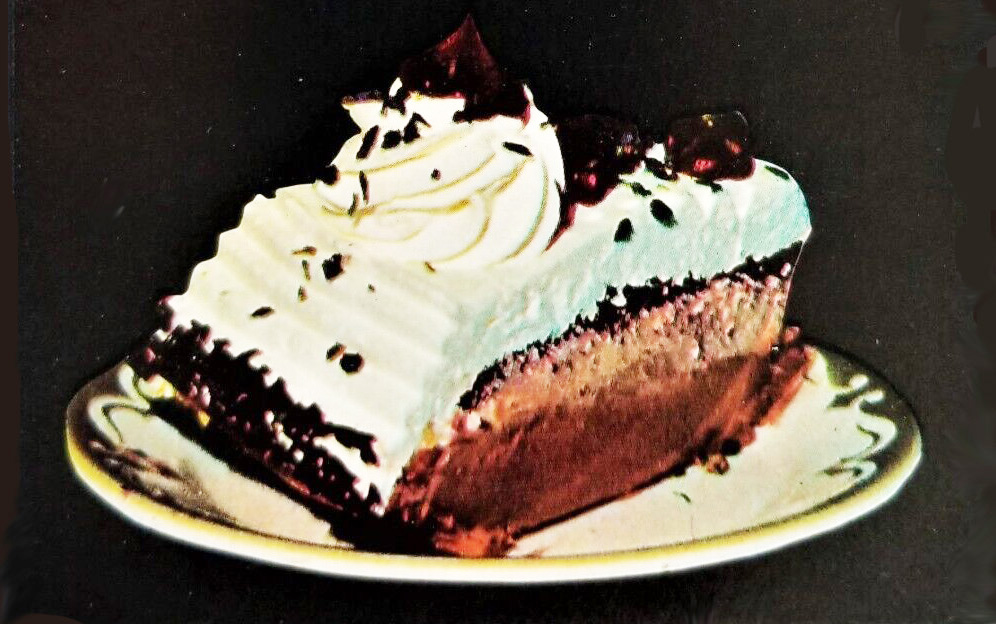
In 1996 a National Restaurant Association survey of restaurants found that the most popular desserts were cheesecake and pie. That is, cheesecake of the sort most commonly served today, made with cream cheese rather than cottage cheese. The latter was a very old sweet dish dating back to the early 1800s or earlier. Unlike some other factory-made desserts, cheesecake has the advantage of being regarded as genuine even when it comes frozen in a box. I am somewhat skeptical about this survey, though. How could it be possible that chocolate desserts weren’t mentioned when they had been advancing rapidly in popularity since the 1970s?
Later this month, beginning on April 26 and through July 29, the Grolier Club in New York will host an exhibition of menus from the collection of Henry Voigt entitled A Century of Dining Out: The American Story in Menus, 1841-1941. Admission is free, and there is a 124-page illustrated catalog for $35. [above: back of catalog]
Henry Voigt is also the author of a well-researched blog entitled The American Menu in which he provides background for the banquets, dinners, hotels, and restaurants associated with a variety of menus from his collection.
Selections from his collection to be exhibited at the Grolier Club include rare menus from the 19th century, such as one from Parker’s Restorant in Boston dated June 29, 1842. In the catalog Henry notes that Harvey Parker’s restaurant occupied a basement, and preceded the opening of his better-known Parker House in 1855. Most of the main dishes offered that day in June, such as Chicken with Oyster Sauce, cost 37½ cents. Half of the Restorant’s Bill of Fare is devoted to a wide range of wines, with Congress Water for the probably rare non-drinkers.
The majority of the menus to be shown are from the 19th century and cover a range of types of eating places and occasions. As is the case of menus for banquets held in honor of distinguished guests, many are from hotels which, after all, generally provided the finest facilities throughout the early period. But visitors will also appreciate seeing Bills of Fare from less grand “Eating Houses,” such as that operated in New York by Sandy Welsh.
Also of particular interest to me are two early 1860s menus from Taylor’s Saloon in New York, a place frequented by women patrons where it was fashionable to see and be seen. It was grand-iose in its decor and pretensions. In the catalog Henry quotes an 1859 travel book which describes its marble tile floor, ornamental bronze ceilings, profuse gilding, giant mirrors, and richly upholstered seating. Not surprisingly it was sometimes ridiculed, notably by the witty culture-critic who wrote under the pen-name Fanny Fern.
It’s hard to stop listing all the gems in the exhibit, but in the 20th century there are specimens from a quick lunch, a vegetarian restaurant, Delmonico’s in its fading years, Bernarr Macfadden’s One-Cent Restaurant of the Depression, and Smalls’ Paradise Cabaret in Harlem. These are only a small sampling.
Ask someone to name a designer of menu covers and it’s likely you will get a blank look. Although many stylish and eye-catching menus have been produced over time, their designers and illustrators mostly worked in anonymity.
In the early 20th century many of the menu cover artists were probably women. In 1900 the Kalo Shop in Chicago, for instance, employed six women graduates of the Art Institute who were trained in the esthetics of the arts-and-crafts movement. They created menu and magazine covers and other items. It’s likely that most of their menu work was for private banquets, while their biggest clients would have been steamships and railroads.
Individually produced menus such those from the Kalo Shop were rapidly being made obsolete by chromo-lithographers who could achieve quality effects at a lower cost. Unsurprisingly, the next chapter of menu production was taken over by printing companies with designers on their staffs. Some of the printing companies, such as Denver’s Standard Menu Co., were specialists in menu production as early as 1920. Like the women artists of earlier times, the names of designers in printers’ art departments are unknown. In more recent years, menu covers for well-capitalized restaurants have been designed by independent design firms. They created striking logos to be used on signs and menus and in advertising, giving individual restaurants and chains a thoroughly integrated visual signature.
In his book on menu design, “May I take Your Order?,” Jim Heimann says that well known illustrators such as Maxfield Parrish and Norman Rockwell rarely, or never, designed menus or created art specifically for menu covers. That is mostly true, with a few exceptions, such as Al Hirschfeld, who contributed caricatures to New York’s Stage Deli menu and Charles Bragg, who painted a crowd of Hollywood celebrities for Chasen’s in Los Angeles [shown at top].
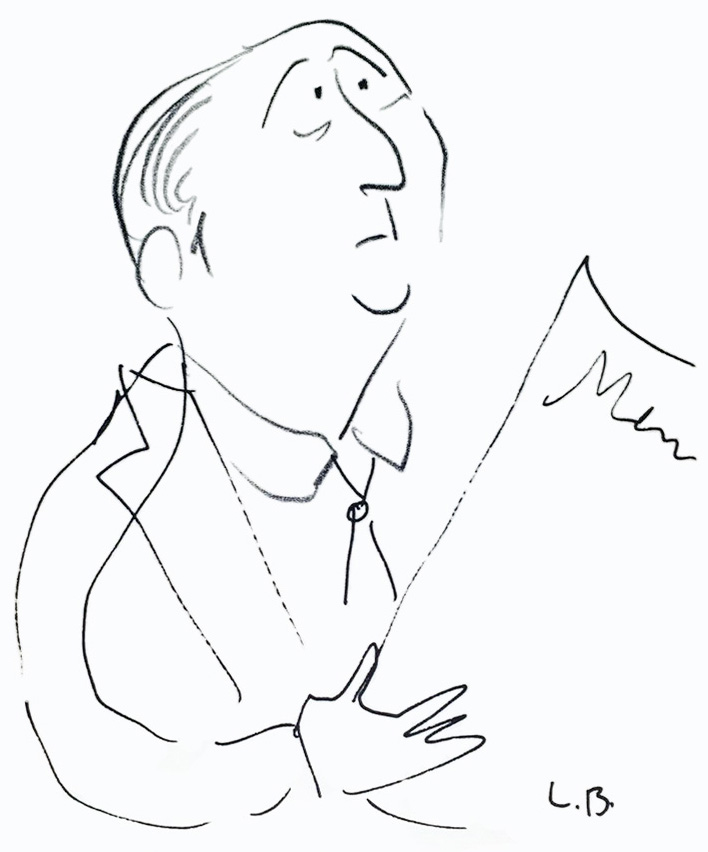
Chicago’s Blackhawk Restaurant used 8 drawings by Ludwig Bemelmans in the 1960s. They were not originally created for the restaurant, though owner Don Roth bought the originals, obtained Bemelmans’ permission to use them on menus, and gave them to customers as souvenirs.
Here are a few menus with designs that I particularly like.
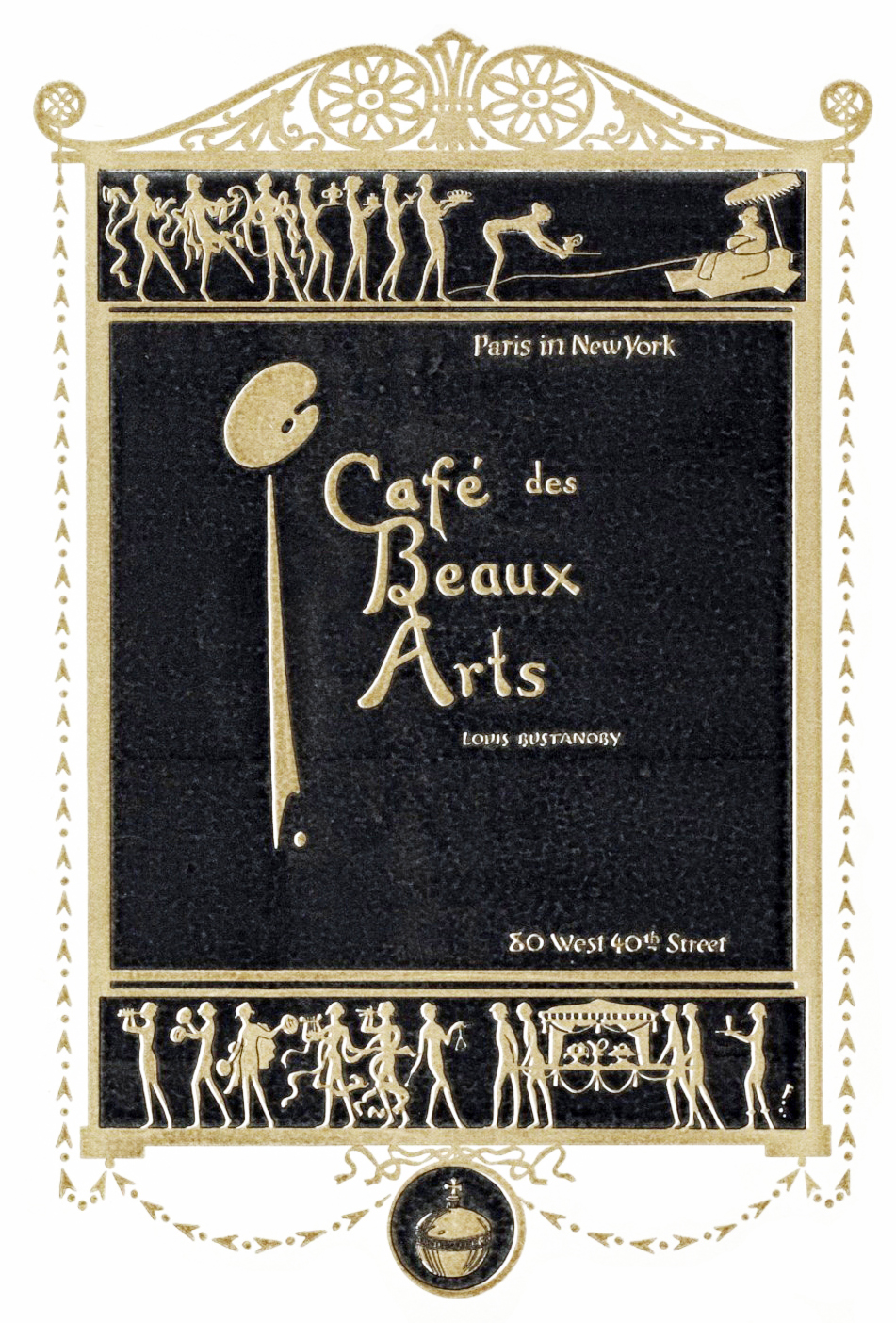
Café des Beaux Arts, New York City, ca. 1910 A fashionable café of the early 20th century created by brothers Louis Andre and Jacques Bustanoby. Said to be a hangout of the artistic crowd, on Sunday nights it was so crowded no one could enter. Unlike other so-called “lobster palaces,” it reputedly served good food. It closed in 1920, a victim of Prohibition.
Carson Pirie Scott Tea Room, Chicago, early 20th century In 1904 the old dry goods store named Carson Pirie Scott bought a building on Chicago’s State Street built by famed architect Louis Sullivan. The 8th-floor tea room soon became a city-wide attraction. This menu of uncertain date has the subdued but assured look of a pedigreed eating place meant to appeal to “ladies” who seek to be correct as well as stylish.
Café Society, New York City, 1938, 1940 In this case a known artist, Anton Refregier, not only contributed his artwork but did so in a full cover design when Barney Josephson, owner of New York’s Café Society music club restaurants, hired him to create menu covers for his two locations, first downtown at Sheridan Square in 1938, and then uptown at East 58th street in 1940. [Both covers are probably on beige-ish, not white, paper]
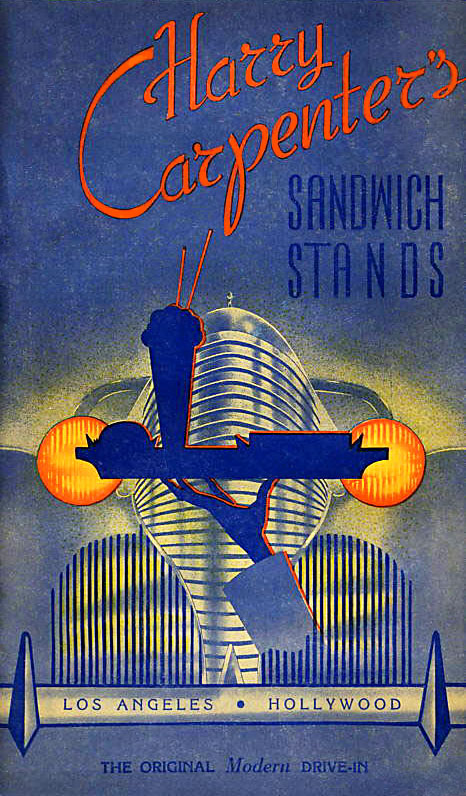
Harry Carpenter’s drive-in, Los Angeles, early 1940s Harry Carpenter opened his first drive-in, an octagonal building, on the corner of Wilshire Blvd. and Western Ave. It was so popular he soon opened two more. In addition to hamburgers and hot dogs, Carpenter’s served corned beef on rye and chicken a la king on toast. This menu, though somehow foreboding, is dramatic.
The Hungry I, San Francisco, ca. 1955 The Hungry I, a comedy and music club, was founded around 1950, then sold and relocated to 599 Jackson street in 1954 where this menu was in use. Among those appearing there were Mort Sahl and The Kingston Trio. This menu offers entrees such as steak, lamb chops, chicken, and shish kabob. In ways that are hard to pinpoint, the cover design captures the spirit of the 1950s beatnik counterculture.
Huddle Restaurants, Southern California, 1956 The Huddle’s menu borrows the lettering of the chain’s exterior signage as well as the style of its architecture by Louis Armét and Eldon Davis. Probably their firm also handled the design of this menu, either in-house or by commission. Not all the restaurants in the chain featured futuristic “googie” design, but you can view images of many of those that did.
According to Heimann, the golden age of menu cover design in America ran from the 1920s through the 1950s. The 1960s in his judgement was mostly “a monotonous era” for menu design. Sadly, to me, in recent years printed menus with covers have almost completely vanished, along with postcards, matchbooks, and business cards. Digital photographs, if preserved, may become the sole visual record of most restaurants.
Note: Fans of menu cover art would enjoy Menu Design in America (2011) and May I Take Your Order (1998). Reproductions of menus suitable for framing are available from Cool Culinaria, which also provides links to samples from the collections of Lou Greenstein, Henry Voigt, and the Culinary Institute of America. Also, beginning April 25, over 200 menus from the 19th and 20th centuries selected from Henry Voigt’s collection will be on display at New York’s Grolier Club. More about that later.
Historically, the Romanian* restaurants that received the greatest attention from the press have been those in New York City. In 1901 the population of Romanians in New York City as a whole was estimated to be 24,000, with about 15,000 of those in the Romanian quarter on the Lower East Side. There were said to be 150 restaurants, 200 wine cellars, and 30 coffee houses kept by Romanian Jews. Favorite foods included broiled meats, goose pastrami, cabbage rolls, polenta, and spicy skinless sausage. Seltzer and red wine figured largely as drinks.
Not all Jewish-operated Romanian restaurants followed kosher law, but they were unlikely to have pork on the menu, the principal meat of Romanian cuisine and used in cabbage rolls (sarmale).
Immigration to this country began in the 1880s. It’s likely that the earliest Romanian restaurant in New York was one that began as a wine cellar in 1884 on Hester Street, and soon evolved into an eating place. Romanian immigrants were disproportionately male, working during the day and renting crowded floor space to sleep at night. Restaurants and coffee houses were not only places for meals and refreshment, but also community centers for these men, who were essentially homeless.
In his memoir An American in the Making (1917), Marcus Ravage explained that when he arrived in New York City in 1901, as soon as he made a few cents peddling on the streets he headed for a Romanian restaurant on Allen Street, where he ordered a ten-cent dinner of “chopped eggplant with olive-oil, and a bit of pot-roast with mashed potato and gravy.” Ravage expressed the difficulty he had in accepting American food and eating habits. When he went to college in Missouri in 1905, he reported that everything tasted “flat” to him, and that he “missed the pickles and the fragrant soups and the highly seasoned fried things and the rich pastries made with sweet cheese” he grew up with.
A Romanian dish from an East Side restaurant described in 1905 was a “hot and very piquant” round steak with peppers. The steak was cut into 3-inch-wide strips, slashed with a knife and marinaded in lemon juice and oil before being pan fried. Small red peppers were fried with it. Each diner took a pepper, opened it, and sprinkled the seeds on the meat.
According to author Konrad Bercovici in Around the World in New York (1924), many of New York City’s Romanian restaurants were run by Jews, but often the proprietors were Greeks, Hungarians, or Germans, as was the case in Romania’s capital, Bucharest. Over time, it seems as though the fare served in these restaurants merged with what was becoming known as Jewish cuisine rather than remaining strictly Romanian. (Of course Romanian cuisine itself strongly reflected a blend of traditions.)
Some of New York’s Romanian restaurants developed into night clubs, with a grab-bag of acts bordering on vaudeville. Joseph Moskowitz was a world-famous cymbalom player, who began his restaurant career in 1913 with a wine cellar on Rivington street. Later he had restaurants with music and dancing on Houston, and then on 2nd Avenue in 1938 at Moskowitz & Lupowitz where dinners began at 85 cents. He sold his share in that restaurant a short time later and moved to Akron OH, where he often played at Gruhler’s Romany Restaurant.
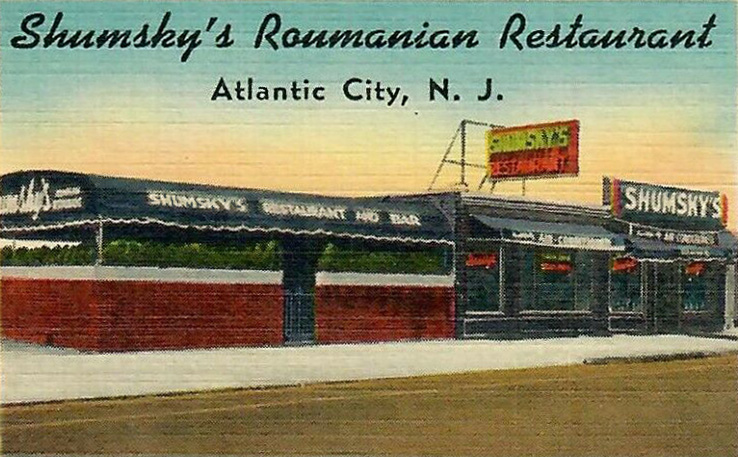
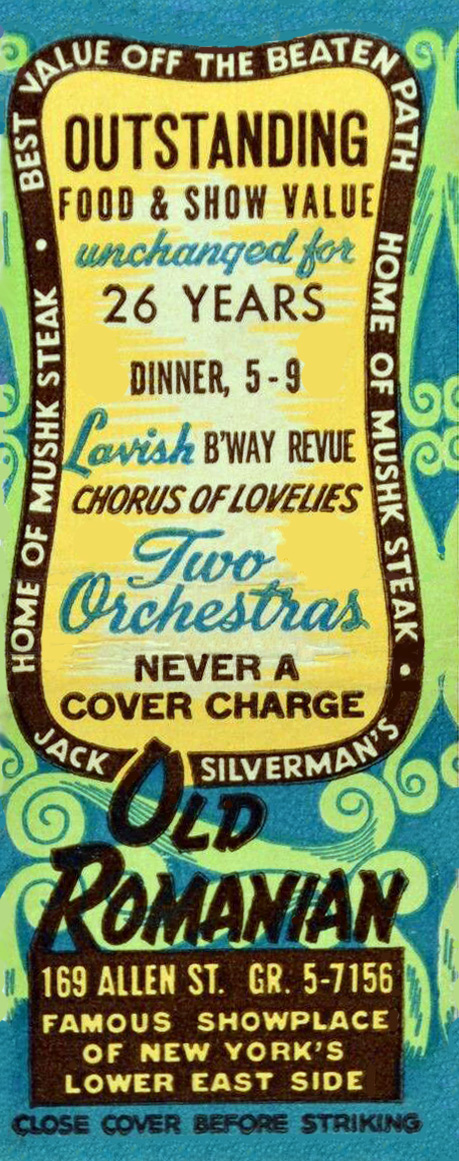
Other popular East coast night spots included Old Roumanian on Allen Street in New York and Shumsky’s Roumanian Restaurant and Bar in Atlantic City, established 1925, which advertised “New Kishka (sausage) Room” and “Dinner ‘Muscat’ Music” in 1952. At Sammy’s, on NY’s Chrystie street, which opened in 1975 and closed quite recently, entertainment was mainly in the form of extras placed on the table. They included a pitcher of chicken fat, fizz-your-own-seltzer, and for dessert a bottle of Fox’s U-Bet chocolate syrup, milk and two glasses for making an egg cream.
A bohemian version of a Romanian Restaurant was operated by Romany Marie in Greenwich Village. Sculptor Isamu Noguchi characterized it as “a sort of a transfer of the Paris café life to New York.” It’s likely this was true to some degree of many Romanian eating places which tended to exude a sense of good cheer and camaraderie all their own. [above: 1924 advertisement]
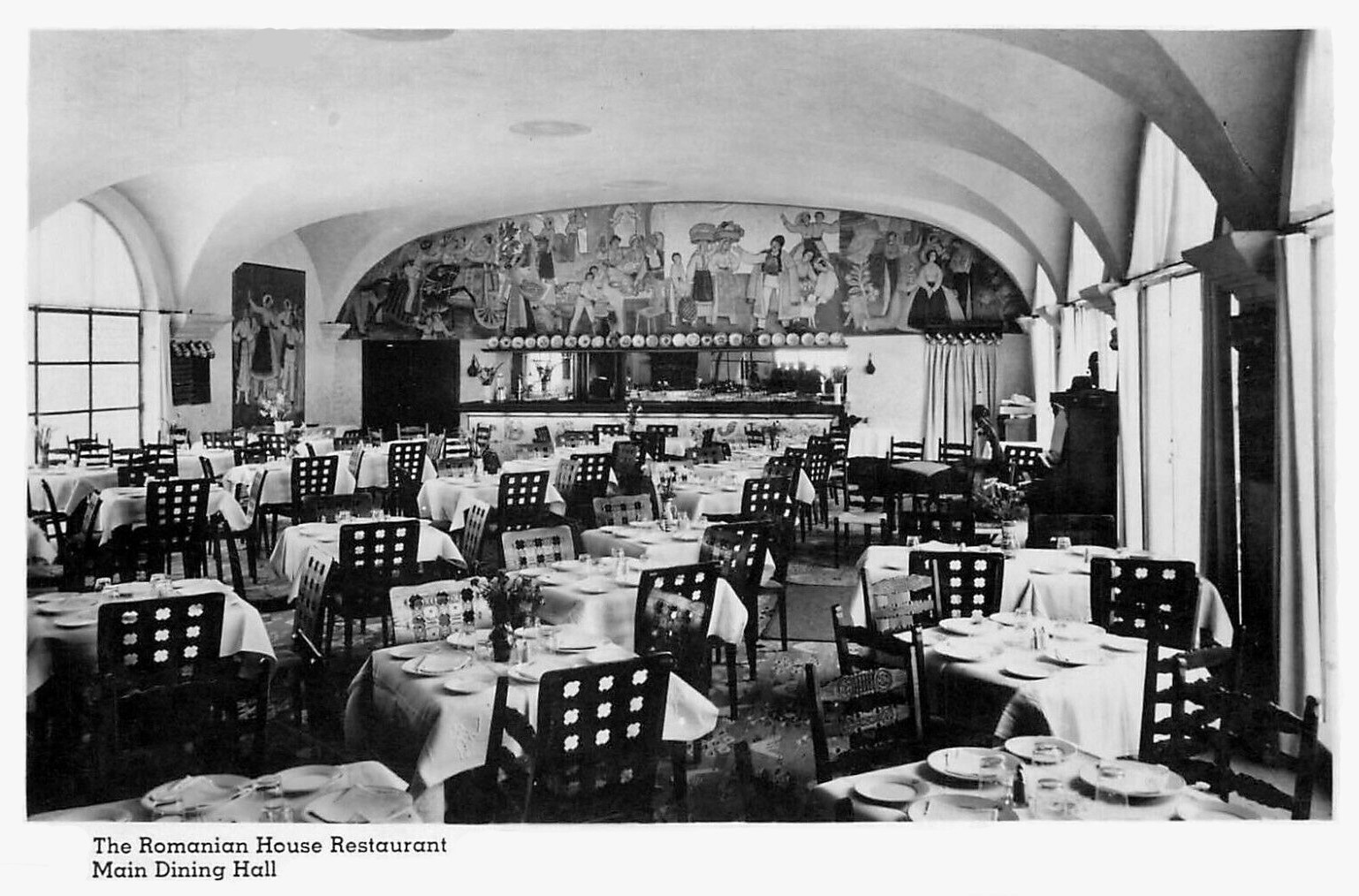
Many Romanian restaurants had prices in the reasonable range, with full dinners running from $1.00 to $1.25, but that was far from the case for the elegant restaurant in the Romanian House at the 1939 NY World’s Fair [shown above]. There the menu was in French, fresh caviar was $2.50, and a dinner was priced at $3.50, minus wine.
Outside of New York – in the late 19th and early 20th centuries before many Romanians dispersed into the larger population – there were Romanian colonies in other cities, both in the East and in the upper Midwest. Some were composed of Romanian Jews, but others, perhaps most, were communities whose members belonged to Catholic and Orthodox religions. Immigration to the U.S., almost nil from 1920 until the 1940s, resumed after World War II when the Soviets took over and continued through the 20th century and into the present.
It becomes harder to track Romanian restaurants in the later 20th century since they became less inclined to use Romanian as part of their names. But they certainly existed in Trenton, Chicago, Detroit, Cleveland, Miami, Los Angeles, and many other cities. One reason they might not have been clearly identified as Romanian was expressed in 1990 by Felicia Zanescu, proprietor of Mignon European Restaurant in Los Angeles. When asked why she called it European rather than Romanian, she replied, “Who ever heard of Romania?” Nonetheless the menu was convincingly Romanian with its carp roe dip, eggplant paté, dill-accented white bean broth, fried cheese, sausages, cabbage rolls, etc.
It's great to hear from readers and I take time to answer queries. I can't always find what you are looking for, but I do appreciate getting thank yous no matter what the outcome.
So, e-mail me!
















 It's great to hear from readers and I take time to answer queries. I can't always find what you are looking for, but I do appreciate getting thank yous no matter what the outcome.
 Restaurant-ing through history