2012, a recap

NewYearswithHats166

I had a pleasant surprise when I looked over my numbers for the past year and discovered that my page views had increased by 78%. As a “niche blogger” my biggest question is whether anyone is reading what I write and I am happy to report you are. Thank you!

My “Tastes of a decade” posts are so popular that I decided to make them easier to find by gathering them together on a special page. Now my mission is to fill in missing decades, starting with 1910-1920 and 1970-1980.

Just like last year, readers continue to be attracted to the well-loved restaurants of the past, the London Chop House, Schrafft’s, and Maxwell’s Plum. But even they were outdone. A new TV show set in Miami Beach in 1959 called “Magic City” propelled my 2011 post on Wolfie’s into the rank of second most visited post of 2012! Taste of a decade: 1920s restaurants, written way back in 2008, continued as no. 1.

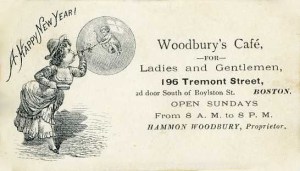
NewYearsWoodbury's167Holding its own quite nicely is one of my favorites — “You want cheese with that?” – written over three years ago.

Two posts I wrote in 2012 made it into this year’s Top 20. One of them surprised me: Miss Hulling’s cafeteria in St. Louis. Maybe the traffic it attracted is accounted for by someone linking to it but so far I haven’t detected any evidence of that. Ice cream parlors, published in August, was the other top new post. The popularity of this one is easy to explain: it was chosen as a featured post by WordPress.

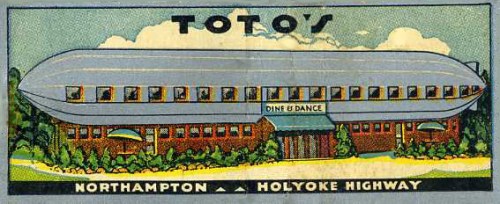
I am constantly adding to my list of ideas for future posts, so much so that it never seems to get any shorter. Some topics in the pipeline are: Greek-American restaurants, Nick’s Nest (a hotdog stand in Holyoke MA), sawdust floors, frozen entrées, menu design, chains of theme restaurants, and lunch wagons. If I can find enough material I’d love to write about the Kahiki in Columbus OH, which was perhaps the most exuberant example of a Polynesian restaurant in this country. A reader has suggested writing about Bookbinder’s in Philadelphia. So, as usual I expect to be working on many topics simultaneously.

Best wishes to everyone for a happy new year!

signature168

5 Comments

Filed under miscellaneous

Christmas dinner in a restaurant, again?

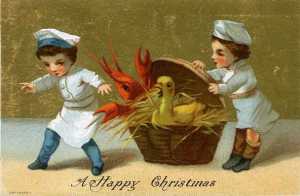
xmasgoose&lobster164I suspect that a lot of people living in the Wild West in the 1880s and 1890s had little choice but to eat their holiday dinners in restaurants. The majority of the residents of western mining and ranching towns were males living in “hotels” which were nothing but crude rooming houses with a saloon, pool hall, and none-too-fine restaurant attached.

John W. Conway ran such a place in Santa Fe NM, but judging from the spread he laid out for Christmas in 1891, he was making a generous effort to please his guests with a delicious meal. On this particular day he served a genuine feast for only 25 cents, the price of an everyday dinner.

Conway'sBonTonMenu1891

Just down San Francisco street, Will Burton offered a more refined, pared-down dinner. Judging from the menu, the 50-cent meal might well have equaled one served in more sophisticated big city restaurants. Unlike John Conway’s, his dinner began with oysters and featured fish and game courses. And there was no Pork and Beans or Cornstarch Pudding on Will’s menu.

Billy'sNewRestaurantMenu1891

Will, aka Billy, had lived for a time in San Francisco where he may have acquired elite tastes. He hosted game dinners, kept vintage French wines in his cellar, and poured expensive Scotch whisky. He opened this restaurant in Santa Fe on Thanksgiving of 1891 but, alas, by the next spring he was ruined and reduced to running the short order department at Conway’s Bon Ton.

Regarding the first menu, I am left wondering what Nellie Bly pudding might be. Under Relishes on the same menu, German pickles were, I think, pickled green tomatoes with onions and green peppers. Chow Chow was a mixture of pickled vegetables. On Billy’s menu, Velouté Sauce, of meat stock, and creamed flour and butter, is incorrectly spelled. “A. D. Coffee” is short for after dinner coffee. Both menus use the French meaning of entree, a side dish usually of smaller cuts or chopped meat or fowl.

I find it interesting that Christmas dinner menus in most of the restaurants I looked at from the second half of the 20th century were far less elaborate than these.

© Jan Whitaker, 2012

3 Comments

Filed under menus

Fortune’s cookies

fortunecookiecolorThey’ve been used in political campaigns, as a method of publicizing new movies, and as a clever way to announce engagements, but most people have encountered fortune cookies in Chinese restaurants.

Searching for their origins in old Chinese customs is pointless because the fortune cookie was almost certainly “invented” in America, in California to be more specific. And probably by Japanese confectioners as a variety of senbei wafers.

Yet, even with their probable Japanese origins, there is nothing particularly Asian about them. The idea of embedding charms or slips of paper with fortunes on them in pastries and candies is an old idea in Western culture. The Victorians loved such things. Halloween was a popular time for fortune cakes and cookies and even fortune popcorn balls. A 1903 book suggested fortunes such as “You are going to marry and live abroad.” and “Thy flour barrel shall never be empty.”

fortunecookiesConfuciusRestOaklandCAPrecisely why they were adopted by Asian restaurants remains a mystery. Could it have been that restaurant proprietors knew finding fortunes was popular with their non-Asian customers? Or was it the need to supply some kind of dessert to Western customers with a sweet tooth? A 1939 menu from San Diego’s Chinese Village restaurant shows Mixed Candy and Oolong Tea as finales to $1.00 and 75-cent meals but tea and Fortune Cookies with a 50-cent dinner.

As to when fortune cookies made their debut, there is general agreement that it was in the early 20th century, before World War I. Certainly they are never mentioned in stories about Chinese restaurants in the 19th century. Many have claimed to be the cookie’s inventor, but Jennifer 8. Lee, author of The Fortune Cookie Chronicles, thinks it likely that around 1910-1914 Makoto Hagiwara introduced them as accompaniments to tea at the Japanese Tea Garden in Golden Gate Park in San Francisco where he was the concessionaire.

fortunecookieArchieThe cookies came into widespread restaurant use across the United States after WWII. For some inscrutable reason they also became frequent topics of gags in comic strips, newspaper gossip columns, and comedians’ routines. The fictive message “Help, I’m a prisoner in a Chinese cookie factory,” is one that falls flat with Asian-American cookie producers. But if you ask me most of the jokes are remarkably unfunny including the one from Archie comics.

Writing fortunes was a part-time job for somebody’s cousin or a freelance writer, Asian or not, who would come up with a fresh batch of several hundred at a time. Supposedly beginning with translations from much-abused Confucius, eventually anything – anything at all – provided inspiration. Occasionally they are offensive to patrons, as exemplified by the 1942 lulu, “Every woman like to be taken with a grain of assault.”

By the 1970s production of cookies was fully mechanized and they were turned out in huge batches by Japanese and Chinese makers who supplied restaurants all over the country. Today they are an unquestionable part of American restaurant history, one that has spread around the world.

© Jan Whitaker, 2012

Leave a comment

Filed under restaurant customs

Famous in its day: Dutchland Farms

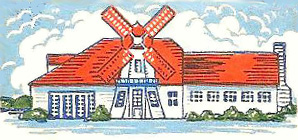
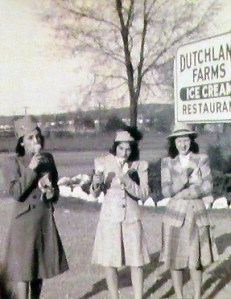
dutchlandHackensackThe Dutchland Farms story parallels that of Howard Johnson’s, its competitor and eventual conqueror. Both were chains of ice cream and lunch shops that began on Massachusetts roadways in the 1920s. But they experienced the Depression very differently. Howard Johnson’s expanded while Dutchland Farms shrank. Though Howard Johnson triumphed over its competitor, there is no doubt that Dutchland Farms strongly influenced HoJo’s development.

Unlike Howard Johnson’s, the Dutchland Farms chain grew out of a real dairy farm, established in 1897 by shoe manufacturer Fred F. Field. Years before the first Dutchland Farm dairy store – not yet a restaurant – opened in 1928, the dairy farm of the same name in Brockton MA had become nationally famous for its prize-winning herd of Holsteins. The ice cream produced by the farm in “28 flavors,” sometimes 30, was advertised as the only Grade A ice cream made in Massachusetts. (Most ice cream then was made from Grade B milk which has a higher bacterial count; now Grade B milk is mostly used for making cheese.)

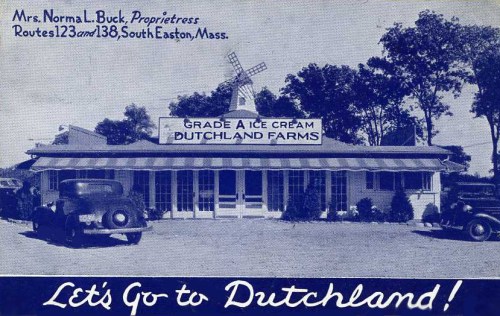
By 1933 the newly incorporated company had 50 roadside stores that sold milk, butter, and eggs, and also served toasted sandwiches, frankfurters, and fountain treats, as well as “Chinese Chop Suey” supplied by Hung’s Food Products Co. of Boston. Soon the menu expanded to include complete dinners. Menus displayed Dutchland Farms “registered” colors, orange, blue, and white, which also formed the color scheme for buildings. The canvas awnings on the white building depicted on the South Easton MA postcard below would have been in eye-catching orange and blue stripes.

DutchlandSouthEastonFifty was probably the greatest number of Dutchland Farms units in operation at any given time. In addition to eastern Massachusetts where most units were located, the company did business in  New Hampshire, Rhode Island, Connecticut, and New Jersey. Some restaurants were operated by the company itself but most were franchised, as was true of  Howard Johnson’s. Women formed 10 to 15% of Dutchland Farms proprietors, a large percentage for a restaurant chain.

In addition to colorful awnings, Dutchland Farms buildings had two outstanding visual characteristics: orange roofs and decorative windmills which sat atop the roof or formed part of the building front. The roadside restaurants were situated on busy thoroughfares and both features were intended to attract motorists’ attention. Additional evidence of positioning for mobile customers were Dutchland Farms’ ample parking lots.

dutchlandfarmsIceCreamThe Depression was rough on Dutchland Farm operators. A dozen or more of the restaurants went out of business. Some proprietors shifted their allegiance to Howard Johnson. A Fairfield CT operator who opened a Dutchland Farms in 1935 switched to Howard Johnson’s after only a few months. Another, Louise Prout, co-proprietor of a Dutchland Farms in Lakeland NH and another in Pocasset MA, decided to go with Howard Johnson’s when she opened a restaurant in Cambridge in 1936.

Still other Dutchland Farms restaurants became independents. A proprietor near Newport RI rechristened his The Mile Post, while a Dedham MA Dutchland adopted the name of its proprietor, Mary Hartigan. The same fate would one day befall Howard Johnson’s. Louise Prout turned her Cambridge HoJos into The Clipper Ship, disguising the cupola, sheathing the front with dark paneling, and decorating the entry with wrought iron.

Dutchland Farms tried to reorganize its debts in 1939 but was sold to Howard Johnson’s in 1940. Johnson kept the orange, blue, and white colors but was barred from using the Dutchland Farms windmills on restaurants operating as Howard Johnson’s, and chose cupolas instead. However, some of the restaurants he acquired continued to do business as Dutchland Farms and, presumably, kept their windmills. The last Dutchland Farms restaurant I could find evidence of was in Quincy MA in 1951.

It is not obvious why Howard Johnson succeeded and Dutchland Farms failed. Was it because after Repeal Howard Johnson restaurants served alcoholic beverages whereas Dutchland Farms did not? Or was it due to how well the businesses were conducted? Or just luck?

© Jan Whitaker, 2012

20 Comments

Filed under roadside restaurants

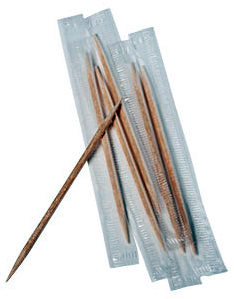
Toothpicks

Although toothpicks have many uses in the home, their career as a tool for picking teeth is mostly associated with restaurants. And, like so many aspects of restaurant history, their story says a lot about social class. The short version is that when using toothpicks was viewed as a custom of European elites it was approved in the U.S., but when American working class men adopted it, it became taboo. Today the use of toothpicks after a meal is infrequent compared to what it was roughly 100 years ago when it was at its peak.

In the Quick Lunch era of the early 20th century, toothpicks became more than a means to loosen bits of food stuck in tooth crevices. They were assertions of masculinity, essential accessories for the male lunchroom crowd. A dangling toothpick sent a macho signal as speedily as a cigarette between the lips of 1960s filmstar Jean Paul Belmondo.

In the 1890s lunchroom patrons felt entitled to toothpicks just as much as to a paper napkin and a glass of water. When a distinguished Afro-American man was told by a Kansas City restaurateur in 1890 that he would be charged an exorbitant $1 for pie and coffee, he seemed to consent but later walked out saying “Sue me for the rest” as he tossed a dime on the counter. And he grabbed a handful of toothpicks on the way, staking a claim to equality in an unmistakable fashion.

Arbiters of etiquette deplored toothpicks. Starting in the late 19th century when the picks came into fairly common use in the United States, and for the next 100 years at least, a string of advice columnists from Mrs. John Sherwood to Ann Landers railed against them. All declared using toothpicks in public vulgar and disgusting. “Dear Abby” echoed her forebears when she roundly condemned public toothpick use in 1986, calling it “crude, inconsiderate, and a show of bad manners.”

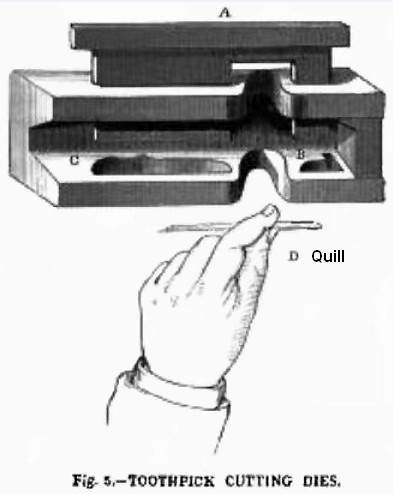
Goose quill toothpicks had been acceptable in the early republic, furnished even at such elite places as Delmonico’s. But as mass-produced wooden picks made of birch and poplar became available in the 1870s, prices fell drastically until even the cheapest eatery could afford to dispense them. Their social status plummeted.

Toothpick haters frequently pointed out that providing toothpicks in restaurants was as ridiculous as handing out toothbrushes. It’s interesting that in the early 20th century another form of tabletop hygiene, the finger bowl, was also about to go under attack. Strangely, since toothpicks and finger bowls were intended for cleanups, they were criticized as germ spreaders. Because toothpicks were provided loose in a bowl or cup, restaurant patrons often grabbed them helter skelter, fingering many they left behind. Trains eliminated them in their dining cars and Minneapolis health authorities banned open containers of toothpicks in 1917.

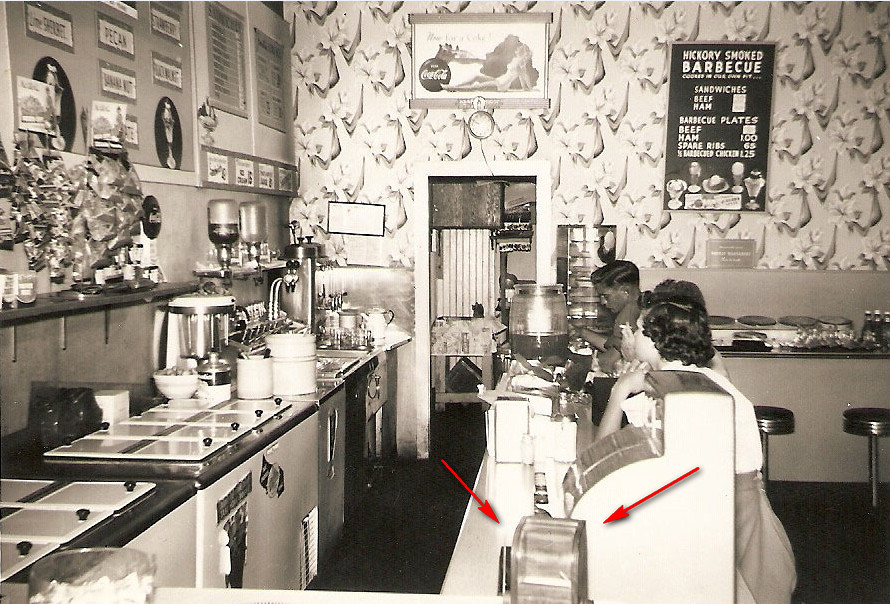
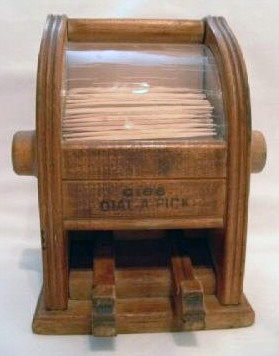
Another solution to the germy toothpick bowl and the habit of grabbing handfuls was bound to occur to America’s legion of gadget inventors. Presto! One-at-a-time toothpick dispensers. [shown here and in restaurant above, the Dial-A-Pic]

Restaurant owners would have been just as happy to see toothpicks disappear altogether. A NYC restaurant owner confessed in 1904 that he disliked the sight of men picking their teeth at his tables as much as that of others sticking knives in their mouths. But he took a pragmatic stance, admitting that “we cannot conduct examinations in table manners before we admit persons to our dining-rooms.”

Today toothpick usage is reportedly unpopular with younger diners and has been dropping off since World War II. So I was surprised to see a little cup of wrapped toothpicks in an upscale restaurant in Kansas City this weekend. Now I’ll be on the lookout everywhere I go.

© Jan Whitaker, 2012

14 Comments

Filed under lunch rooms, patrons, restaurant customs

An annotated menu

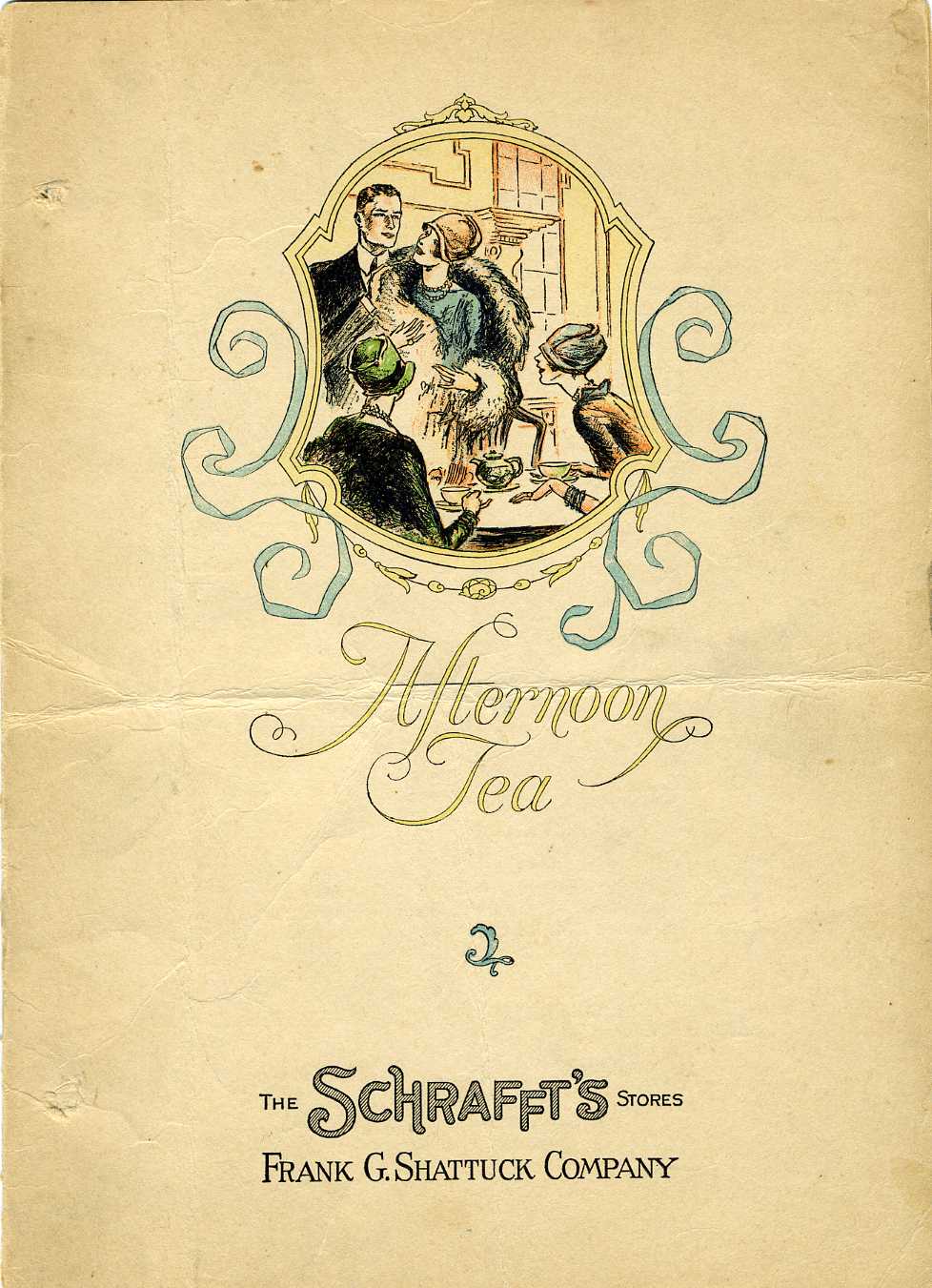
One of my most-treasured menus is a grubby, dog-earned Afternoon Tea menu from Schrafft’s at 181 Broadway in NYC dated September 3, 1929. What makes it so great is that it was carried off from the restaurant by someone who took detailed notes concerning a number of dishes. Apparently (judging from the notation “Monday & Wednesday”) the “spy” made two visits to the restaurant. The menu has holes along the side as though it was kept in a binder for reference.

I have always imagined that the spy, who must have been accompanied by a few friends, was a rival tea room operator hoping to learn a lesson or two from a successful competitor. The notes really bring the menu to life, and also give a feel for just how scanty tea room dishes could be. I had read that tea rooms were often criticized for their high-priced “bird-like” portions. I see from this menu that there was some truth in the charge.

The prices are indeed high. It is difficult to be confident about today’s equivalents to the prices below, but keep in mind that in 1929 a full dinner could be had at a decent restaurant for 50 cents. So, clearly, the sense in which Schrafft’s was a middle-class restaurant essentially means that it was easily affordable only to the upper middle class and above, though lower-income patrons may have enjoyed an occasional splurge there.

Here are a few of my transcriptions of the difficult-to-read notations, with my punctuation and explanations added:

Cold Fresh Shrimp with Tomato Mayonnaise in Puff Shell – 55 cents
Cut top off a tea [?] puff; put a 40 sc. [presumably refers to scoop size] of tomato mayonnaise inside; put 5 large or 6 small shrimp in the puff; place 3 or 4 nice sprigs of watercress around puff; serve on T. P. [tea plate]; make Bread & Butter sandwich cut in [fourths]

Toasted Mushroom Sandwich, Stuffed Celery, Ice Cream and Cocoanut Crisps, Pot of Tea – 60 cents
Cut crusts off 2 sl. toast and ½ inch off remaining 2 sides; butter and cover with mushrooms, a nice piece of lettuce; cover with another sl. toast same size; spread with mayonnaise; cut in 3 oblong pieces; serve on a doily on a T. P. with 1 stalk of stuffed celery

Egg and Tomato Salad – 50 cents
4 pcs. crisp lett. laid on a salad pl.; 3 ½ slices of tomato, cut crosswise; in center ½ stuffed egg; between each slice of tomato, place a nice spray of watercress

Fruit Salad with Orange Cream Dressing – 65 cents
A small sl. pineapple on 2 sm. lettuce leaves; on 1 side 1 section orange, half on pineapple and half on plate; on other side between orange & grapefruit on a l. l. [lettuce leaf] put 30 sco[o]p of dressing

Cocoanut Crisps – 25 cents
2 ea. on the Tea [see Toasted Mushroom Sandwich above], 4 ea. ala carte

Chicken Salad Club (Sandwich) – 60 cents
Tea plates. 1 sl. toast; 30 scoop of Ch. salad, may[be?] 8 lettuce leaf. Another slice of toast, cut diag. on ea. half; place ½ sl. of bacon, ½ sl. tomato, sweet pickle & toast cover

Fresh Fruit and Pecan Salad – 55 cents
Tea plate. 1 sl. pine[apple]; 2 sec. orange; 2 sec. grapefruit, 8 pecans

Fresh Bartlett Pear and Roquefort Cheese with Special Dressing – 65 cents
Tea plate. 2 halves of pear, 50 sc. of cheese in ea.; sp. dressing, capers, pimiento

Creamed Potatoes with New Lima Beans (Plate) – 45 cents
Tea plate. 1 sp. cr. pot[ato]; 1 sp. of limas; sprig of parsley

© Jan Whitaker, 2012

3 Comments

Filed under menus, tea shops

Anatomy of a restaurateur: Kate Munra

With her Early-American-style ringlets and silk gowns, already outdated by 1900 when this portrait was taken, white-haired Katherine Sterrett Munra scarcely looks like a highly skilled hospitality professional. And yet she was.

She was a pinch hitter for the Oregon Rail & Navigation Company whose trains ran across Oregon through the rugged Blue Mountains. She worked at many of their establishments, plus oversaw food facilities at Oregon’s hotels and resorts as well as at a university and a department store.

In the 1870s, at the then-advanced age of 44, she moved to southern California from her hometown of Erie PA where she ran a boarding house and raised three children single-handedly. Her marriage had ended, probably through desertion or divorce. In the seven years she lived in California she married twice and ran two boarding houses. After her second husband’s death she married an accountant, Selkirk Munra, and they took a steamer to Oregon, assuming management of a hotel in Eugene.

Next they managed the O. R. & N.’s dining facility at Bonneville. When the railroad closed it down, they returned to Eugene as managers of another hotel there. We then find Kate running the student dining halls at the University of Oregon, Eugene. Next, in December of 1894 she went back to work for the railroad, choosing furnishings for the new log hotel and restaurant in Meacham. She managed it from its inauguration in January 1895 until it was destroyed by fire in 1902.

A publicity agent for the O. R. & N. may have been responsible for dubbing Kate “Grandma,” a dubious title commonly bestowed on women past 60. He heaped praise upon the Log Cabin, calling it a “frontier Delmonico’s” and a “mountain-gulch Waldorf ” where the rugged West melded with the “refined luxury of the metropolis.” “Cabin, tables, linen, china, silver, glass and waiter-girls are all the perfection of neatness and cleanliness, and the cookery is as dainty as that of the daintiest old-time private family,” he wrote. Although Kate learned to cook as a child and could have prepared the meals, her role was to supervise the kitchen and dining room staffs.

After the Log Cabin burned Kate managed the railroad’s hotel at Huntington OR, and then a private resort at Hood River called the Country Club Inn. In the winter of 1904, when the inn was closed for the season, she presided over the opening of a tea room at Portland’s Olds-Wortman department store. She might well have retired at this point, but in 1905 came an announcement that she would act as housekeeper for the Hotel Sommer in La Grande OR. She was 75.

Eventually she did retire, joining her daughter’s household in Portland and living until age 92. She was a suffragist and friend of Oregon suffrage leader Agnes Lane. In recognition of her pioneering role in Oregon’s development a peak in the Blue Mountains was named for her in 1915.

© Jan Whitaker, 2012

Other posts on restaurant women:
Richards Treat cafeteria
Miss Hulling’s cafeteria
Anna de Naucaze
Harriet Moody
Romany Marie
Mary Alletta Crump
Afro-American women
The Maramor
Mary Elizabeth’s
Women culinary professionals
Alice Foote MacDougall

2 Comments

Filed under proprietors & careers, women

Putting patrons at ease

How many readers have thought about how very cleverly table-service chain restaurants engineer their establishments so that patrons feel no unease while eating out? They have relieved patrons of the embarrassment so many have felt historically – and which can still occur in formal restaurants today.

It doesn’t take much for restaurant patrons to become tense or self-conscious. They may feel that other guests are staring at them and judging their appearance or table manners. Or that their server is sizing them up. The menu can be mysterious, especially if it contains foreign or unfamiliar culinary terms. They fear they will mispronounce something and be sneered at for their lack of sophistication. Or order a dish they don’t like the looks of (does that explain why I once encountered a South Dakota menu that described salads as made up of “non-intimidating greens”?). If patrons have brought their children, they may worry they will misbehave and earn the wrath of all the tables around them.

Their fears are not entirely unfounded. I have a vivid memory of extreme discomfort I experienced in a restaurant considered among the top in the 1980s. Although the small dining room was fully occupied, it was almost totally silent. There were expensive arrangements of flowers everywhere. They, along with the preternatural quiet, conspired to create the ambiance of a funeral parlor. The waiter never smiled. I felt as though I was dressed for a barbecue. The melon ball-sized food was hard to identify and oddly assorted. I longed to flee to another room where I heard people laughing and imagined them eating real food.

Intimidation has a long history in restaurants. In 1859 a patron complained about his discomfort in the class of elite restaurants represented by Delmonico’s, admitting “we are made nervous by the sneerful smirk of the waiter, if we order the wrong wine . . .”

Snobbery was assessed as being greater in the East than the West. It’s certainly true that Eastern eateries did not run advertisements like the one in Portland OR in 1873 that greeted potential customers with “Hi You Muck-A-Muck and Here’s Your Bill of Fare. Now’s the time to get the wrinkles taken out of your bellies . . .”

Of course there were always casual eating places, but as some Americans grew wealthier in the late 19th century more foreign terms appeared on menus, leading to great puzzlement by diners. Even Easterners had to admit “a feeling of trepidation when confronted with an elaborate menu composed in the artistic and intricate terms of culinary French.” Jokes circulated about the bumpkin who randomly pointed to things on the menu and was dismayed when the waiter returned with two bowls of soup and some toothpicks.

Women were afraid to eat spaghetti in public lest they look foolish. No such worries at The Old Spaghetti Factory in the historic section of _____  [fill in the blank]!

Most sources of intimidation have been eliminated by chain restaurants (See 1973 Jacks Or Better advertisement). A circus-like sense of fun, raucous decor, and auditory buzz distracts everyone from other guests and blanks out children’s tantrums. The ethos is “come as you are.” Service is by relentlessly cheerful teenagers who reply to every request with a “No problem.” There are no pristine white tablecloths or carpets to ruin with spills. No foreign terms appear on menus. In the unlikely event that a menu contains unfamiliar items they will be carefully explained or illustrated. Even today a chain of Mexican theme restaurants in the South supplies a guide letting patrons know how to say the names of dishes, including Nachos (Nah-choz) and Chile Con Carne (Che-lee con Car-nay).

It is interesting to reflect on the deep message conveyed by mass market restaurants. Is it that the American public is juvenile in their tastes and easily manipulated? Or is it the more democratic thesis that Americans will accept being talked down to as the price that must be paid so that no one feels excluded?

© Jan Whitaker, 2012

2 Comments

Filed under atmosphere, patrons

Anatomy of a chef: Joseph E. Gancel

At an antiquarian book show last weekend I picked up a copy of Gancel’s Encyclopedia of Modern Cooking originally published in French in 1918, with an English version in 1920. Gancel’s Encyclopedia was an enlarged and enhanced version of his 1909 Ready Reference of Menu Terms which he compiled to assist waiters in explaining to diners the bewildering number of dishes, mostly in French, found on menus of the best restaurants of that time.

Joseph E. Gancel was a Frenchman who had a long career working in hotels and restaurants in the United States, France, and Belgium, as well as clubs and organizations such as the Brazilian Embassy in Brussels and the Press Club in Paris.

In 1874, at age 12, Joseph began his culinary apprenticeship in Rennes, France. In the 1880s he worked in the kitchens of European hotels such as Paris’s Grand Hotel and restaurants such as the Café de la Paix and the Moulin Rouge in Paris and the Antwerp branch of the Paris oyster house Rocher de Cancale.

In 1892 he immigrated to the United States with his wife and five children, finding work at the Waldorf-Astoria [pictured], the Plaza, Sherry’s, and others. He worked at many places; I’ve counted 21 and I’m sure the total is greater. When he published his 1920 edition of the Encyclopedia, he was about 58 years old and living in San Francisco where he was a member of Cooks’ Union Local 44. The self-published book, mailed from the author’s lodging house, cost $2.50. I hope he made some money from the book – evidently he had not become rich as a chef.

Just how confusing menus could be is indicated by the number of egg dishes included in his 1920 book: 477! To keep the book pocket-size he had to do a lot of abbreviation, leading H. L. Mencken to say, rather wryly, “His terse, epigrammatic style touches the heart.” Readers trying to make sense of the above sample page might like to know that . . .
art. = artichokes
can. = canapé
dec. = decorated
foi-g. = foie gras
gar. = garnished
po. = poached
pu. = puree
sa. = sauce
sal. = salpicon (a filling of chopped meat, fish, or vegetables)

There are some curiosities in Gancel’s Encyclopedia. Only a handful of Asian menu items are described. He pretty much dismisses Asian cuisine with the sentence, “Culinary art is very poor in China and Japan.” Yet there is room in the book for esoteric dishes such as Sauterelles Rôties, which I must remember never to order. At least I now know how to eat Roast Locusts (“When cold, take off head, wings and tail, eat same as shrimps.”) and how to store them (“Salted locusts can be conserved in a jar, covered with mutton grease.”)

The Encyclopedia also reveals that Gancel was an advocate for kitchen workers. He was quite unhappy with conditions found in most hotel and restaurant kitchens. Noting the stark contrast between magnificent dining rooms and the squalid subterranean areas where meals are prepared, he wrote, “When you see the cooks come out of the basement kitchens, pale and very often rheumatic, it is no wonder that they are so, considering that they have been shut up in such an atmosphere, forced to inhale the gas from the range and the fumes generating in the cooking utensils. . . . Give to these men sanitary, hygienic, well lighted, and ventilated kitchens. Such would be an act of humanity as well as a public necessity.”

I agree.

© Jan Whitaker, 2012

5 Comments

Filed under proprietors & careers

Taking the din out of dining

In the modern world nothing is more expensive than quiet. This certainly holds true for restaurants. The difference between a quiet and a noisy restaurant rests mainly on good padding, both of the room and the patron’s wallet.

But there is also such a thing as too much quiet, such as in a failing restaurant with few patrons. Nobody wants that kind of quiet. Which brings up the point that since the proliferation of theme restaurants in the 1970s, fun has become one of the biggest attractions for restaurant goers. And in most people’s minds fun = noise and crowds.

It seems as though since the 1970s noise has crept up the restaurant ladder, beyond the raucousness of TGI Friday and its kin, so that today even many fairly expensive, white-tablecloth restaurants are so noisy that conversation is difficult. This issue was called to my attention by a friend who asked where she could find a list of restaurants that are free of din. If anyone knows of such a thing, please let me know. With an aging population – older diners, particularly in the 55 to 65 year-old range, make up a sizable market – the noise problem becomes more pressing.

Although the popularity of restaurant-going is comparatively new, complaints about restaurant din are not. In 1848 a satirical essay in that fascinating periodical The Spirit of the Times (“A Chronicle of the Turf, Agriculture, Field Sports, Literature” – and almost everything else) said:

It has been ascertained that a gentleman never enjoys his dinner more than when it is served up in the midst of confusion, excitement, and noise. For this reason, the denizens of New York, observing and sagacious, delight to dine in cellars, and wisely select those which the most boisterous people frequent.

In 1869 another writer observed that at noon in downtown NYC “eating houses are in one continuous roar. The clatter of plates, the slamming of doors, the talking and giving of orders by the customers, the bellowing of waiters, are mingled in a wild chaos.” It would get worse. Restaurants became even noisier when music made its dining room debut, and again during World War II when they were packed to bursting capacity (see image). Cafeterias could be especially deafening.

However, there were some exceptions along the way. The upstanding Craftsman Restaurant in NYC eschewed artificial gaiety. A diner in 1914 wrote (revealing the genteel racism of the period): “About me people were lunching quietly, without haste and without boisterousness. Soft-treading little men of Nippon brought delectable viands on dainty dishes. A stringed orchestra was playing softly . . .”

Tea rooms were also singled out in the teens and 1920s for their peacefulness. Very likely the absence of alcoholic beverages in them played a big role. NYC’s Colonia had “a quiet atmosphere that appeals to the woman of culture,” while in Greenwich Village the women proprietors of The Candlestick provided a luncheon setting “without the annoyance of shrieks, laughter, loud talking and noises that seem to be the necessary accessories of every other similar place in our Village, perhaps in order to create ‘bohemian atmosphere.’” Yet drinking did not inevitably lead to din. Rather surprisingly, the speakeasy restaurant was seen by some as a quiet, relaxing haven where attentive waiters served well-behaved patrons united in a “civilized conspiracy.”

Quiet has also been seen as a necessary condition for a romantic dinner. But let’s note that on such an occasion diners are usually willing to fork out a bit more cash than usual for privacy and a chance to hear the cork pop and the harp being plucked. The question remains: can a restaurant that is thriving be quiet without being expensive?

© Jan Whitaker, 2012

2 Comments

Filed under atmosphere