Category Archives: proprietors & careers

An early health food empire

It’s rare to find business documents from long-gone restaurants, but last weekend I stumbled upon two letters to investors from the Physical Culture Restaurant Company headed by fitness and health food advocate Bernarr Macfadden [shown above, age 42].

Macfadden was a body-builder, natural food proponent, and entrepreneur who decided to spread the gospel by opening inexpensive, largely plant-based restaurants at the turn of the last century. He attributed his strength and energy to this special diet.

The 1904 end-of-year letter reported that four new restaurants had been added to the ten already in business, and that they had done business totaling over $243,000, with a net gain of $2,637. Five restaurants had been judged failures and closed, four of them in NYC and one in Jersey City. He and his board of directors believed in rapidly shutting down locations that did not draw crowds. The letter blamed a “business depression” and the normally slow start of new locations for the smaller-than-hoped-for profits.

Although he wanted the restaurants to succeed, his personal income was not dependent upon them. Macfadden’s primary business was publishing periodicals, beginning in 1899 with Physical Culture, which discussed diet and health, followed by True Story, Liberty and then, increasingly, a large number of detective and romance magazines with titles such as Dream World, True Ghost Stories, and Photoplay. In addition he authored scores of books on fitness, sex, and health, and established a tabloid newspaper, The New York Evening Graphic. His publications earned him a fortune.

The total number of Macfadden restaurants open at the same time never seemed to exceed sixteen or so. The first ones were in New York City, of which there were nine at one point. Others were spread across the East and Midwest, including Boston, Newark, Jersey City, Philadelphia, Pittsburgh, Detroit, Cleveland, Cincinnati, Chicago, and St. Louis. There was also one in Toronto. [above: 1906 advertisement and 1906 restaurant at 106 E. 23rd, NYC]

In the 1907 letter to stockholders shown above he floated the idea that the restaurant holdings might grow to 40 or 50 units if stockholders invested in more stock. This never happened.

Despite the growing popularity of the restaurants, it seems that for Macfadden they served primarily as a way to spread the gospel of a healthful diet. He could not be described as a restaurateur. No doubt he helped to conceptualize the restaurants and make up the early menus, but he did not manage them except in his role as corporate executive.

Prices were low in his early restaurants. A bowl of thick pea soup was 1c, as was a bowl of steamed hominy or oats or barley. Whole wheat bread and butter, however, cost 5c as did creamed beans or whole wheat date pudding. He sold loaves of whole wheat bread for 10c. [shown above]

A Macfadden menu shown in a 1919 British book reveals a wealth of choices then but also higher prices that reflect post WWI inflation. Five cents now bought less. Mushrooms on Toast cost 20c, as did meat substitutes Nuttose and Protose. A Macaroni Cutlet or Lentil Croquettes cost 25c, while omelets such as Mushroom, Walnut and Pecan, Orange, or Protose and Jelly were 30c.

In 1931, at which point only three Physical Culture restaurants remained, Macfadden gave up his fortune, said to be $5,000,000, and created the Bernarr Macfadden Foundation. In a radio broadcast he said: “It is a source of indescribable relief to feel like a free man again. Too much money unwisely used makes people greedy and ungrateful, destroys the home, steals your happiness, enslaves, enthralls you, lowers your vitality, and enfeebles your will.”

Yet his personal life continued to be full of numerous wives, affairs, and lawsuits. And, despite being “freed” of his fortune in 1931, he continued to spend money lavishly, taking it from the treasury of the Physical Culture Publishing Company after he turned that into a public corporation. Stockholders accused him of using nearly a million dollars for his own private interests, which included failed attempts to become a presidential candidate, governor of Florida, or mayor of New York.

In 1931 the Foundation opened the first of several Depression-era penny restaurants, no doubt modeled on Macfadden’s first restaurant at the beginning of the century where most dishes cost only one or a few cents. The initial Depression “pennyteria,” run by the Foundation, was located in midtown NYC. Drawing a crowd of about 6,000 a day, it quickly became self-supporting.

At a penny restaurant run by the Foundation, one cent would buy any of the following: coffee, split pea soup, navy bean soup, lentil soup, green pea soup, creamed cod fish on toast, raisin coffee, honey milk tea, cabbage and carrot salad, steamed cracked wheat, hominy grits, raisins and prunes, bread pudding, whole wheat doughnuts, whole wheat bread, or whole wheat raisin bread.

As the operator of the 1930s restaurants, the Foundation proved more flexible than Macfadden about dietary standards, but evidently he still had some say over what was served. According to one account he agreed to let meat appear on the menu as well as dairy products. Meat took the form of beef cakes, beef stew, and chicken fricassee. But he stood firm about bread, insisting only whole wheat be served.

I found no trace of the Macfadden restaurants nor the Foundation’s penny restaurants in the 1940s. Macfadden largely faded from the headlines, dying in 1955 and leaving an estate valued at only $5,000.

© Jan Whitaker, 2024

6 Comments

Filed under alternative restaurants, chain restaurants, menus, popular restaurants, proprietors & careers, restaurant prices

Postscript: Don the Beachcomber

A new book has come out about Don ‘s wife, Sunny Sund, who took over the Beachcomber chain and made it a success. Its author is Sunny’s daughter Karen, working with Cindi Neisinger. It is largely a personal account filled with anecdotes, a view of a mother/daughter relationship, celebrity mentions, and some of the harsh realities that shaped Sunny’s life. A drink recipe ends each chapter.

7 Comments

Filed under Polynesian restaurants, popular restaurants, proprietors & careers, women

The Boos brothers of cafeterialand

It was an orphaned family that had gone through some difficult times that developed one of the early, very successful chains of cafeterias in California.

The chain of Boos Brothers cafeterias was one of the first in Los Angeles, contributing to the flood of cafeterias that soon appeared in that city and elsewhere in Southern California. Californians to the north ridiculed the trend, referring to Los Angeles and southern California as the “State of Cafeteria.” It’s true, of course, that cafeterias have never been seen as fashionable and sophisticated.

The Boos [probably pronounced Boes] family story reads like a fictional tale. The Moscow, Ohio, family of nine children were orphaned when both parents died in the late 1880s, followed by the eldest son’s demise two years later. That left Horace, about 19, as caretaker of his three brothers and four sisters. In his will, their father had expressed a wish that they all stay together, live in the family home, and be self supporting. They followed his wishes except for staying in their small hometown. At some point Horace moved the family to Cincinnati where he got a job as a typesetter for the Cincinnati Enquirer. He and his brothers, and at least one sister, also operated a grocery story, then a hotel and restaurant in Cincinnati.

Before the brothers, and some of the sisters, moved to California in 1906 they had also lived briefly in Rochester, New York City, and St. Louis, operating restaurants in all of them, including a lunchroom at the 1904 St. Louis World’s Fair.

Once in California they acquired a ranch in San Gabriel, offering eggs for sale in a 1906 advertisement. By August of that year they had opened their first cafeteria in Los Angeles. They also continued to operate the ranch, supplying their restaurants with eggs into the 1920s.

By 1909 they had expanded to three cafeterias. Judging from postcards like the one here, the early cafeterias may have been exceptionally sanitary and well outfitted but had a somewhat functional appearance. Gradually their cafeterias became more decorative, particularly when they moved into buildings they had built.

In 1922 they opened a newly built cafeteria at 618 S. Olive decorated in what they described as Spanish and Moorish style. An advertisement celebrated its interior: “Accentuating the impressive spaciousness of the place, are three arched windows of great height in the north wall. In corresponding positions in the south wall, equivalent in number and size, are mural paintings of exquisite technique, depicting with historical exactness, Cortez before Montezuma.”

The newest, and last, cafeteria, built at 530 S. Hill in 1926 — a location previously occupied by a failed B&M Cafeteria — was custom-built and featured the largest orchestra, one of 9 pieces. It also was fitted with rest rooms filled with upholstered arm chairs and settees. A row of water fountains referred to as a “Persian fountain” was backed by a large and impressive scene painted on tiles [shown here].

In 1927 the cafeteria company celebrated its 20th anniversary, publishing a booklet called “Glancing Back Along the Cafeteria Trail.” At that point the business operated six cafeterias in Los Angeles and one on the island of Catalina opened in 1918.

The booklet celebrated their success and gave some idea of what it took, such as purchasing 870,000 pounds of beef per year and 40,800 chickens. An estimate of how many acres it would take to grow the fruits and vegetables used by the chain came to 20,000. The Boos used only fresh vegetables, nothing canned. All but one of their locations had live orchestral music.

Surprisingly, the year after the celebratory booklet was published, the brothers sold the chain to the Childs corporation, including all six cafeterias in Los Angeles and the one on Catalina Island. At that point the six L.A. cafeterias were reputedly serving 10M meals a year. The sale to Childs, which kept the Boos name, was said to net $8M for the three remaining brothers. Horace Boos had died the previous year and it’s possible that might have motivated the sale.

In the Depression, Childs sold their Boos holdings, two going to Clifford Clinton of Clifton’s Cafeterias fame, and two returning to the Boos brothers, according to some accounts. Other reports, confusingly, had the brothers buying back all the cafeterias. Whichever was the case, the only one that seemed to reopen under the control of the Boos brothers was the cafeteria at 530 S. Hill. During the Depression it met the needs of people with little money, offering low-priced dishes such as soup and spaghetti for 8 cents and most vegetables for 7 cents.

The S. Hill Boos Brothers cafeteria was still in business as late as 1955, advertising in the Los Angeles Times as “The Original.” But at some point it acquired a new owner doing business as Green’s Cafeteria. In 1960 Green’s was out of business and the equipment was auctioned.

© Jan Whitaker, 2024

12 Comments

Filed under cafeterias, popular restaurants, proprietors & careers

Behind the scenes at Gonfarone’s

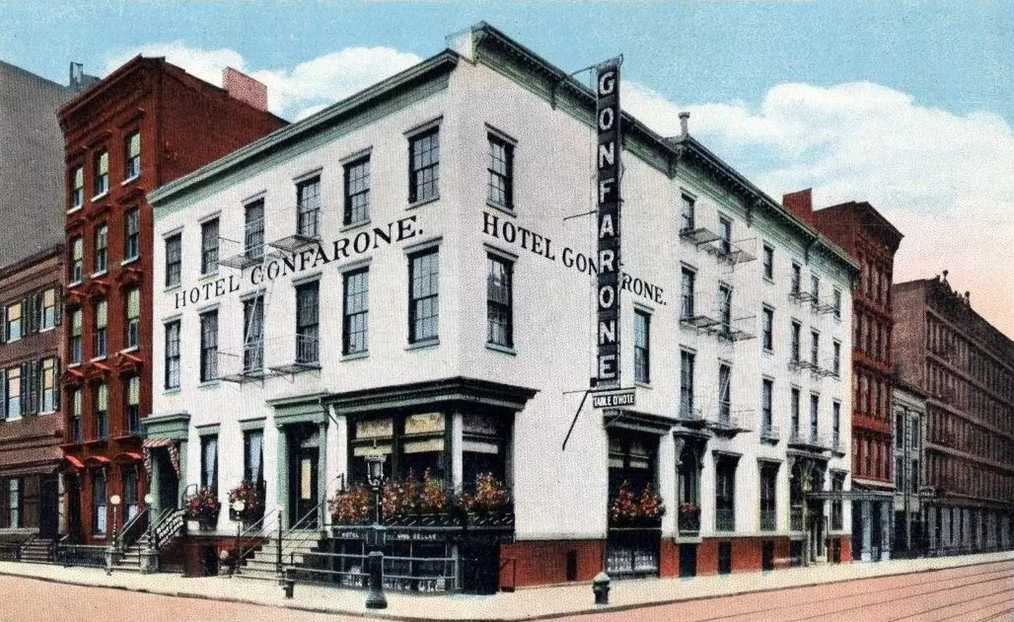
There is nothing as interesting (to me) as a memoir about a restaurant from an insider who reveals its workings not usually known to customers. Papa’s Table d’Hôte by Maria Sermolino is such a memoir, published in 1952, decades after her father’s ownership of the New York City restaurant, Gonfarone’s.

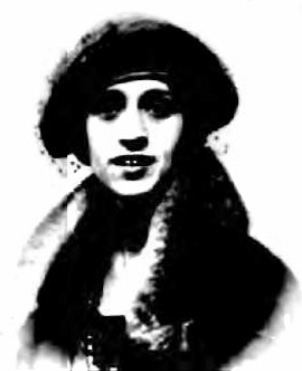
Maria’s career as an editor and writer was extensive. After graduating from the Columbia School of Journalism and spending a couple of years writing about post-WWI conditions in France, she interviewed Italian Fascist leader Benito Mussolini. Later she worked for Time, was the editor of The Delineator and for 11 years an associate editor for Life magazine. She attributed her lifelong unmarried status to overhearing conversations about women among waiters and from male guests invited by her father to join him at his table. [above, Maria at age 25, in 1920, the year she interviewed Mussolini]

Gonfarone’s began in business around the turn of the last century as an Italian pension-type eating place, transitioning into a bohemian resort for Greenwich Villagers. It was run initially by Caterina Gonfarone who operated it in a basement on the corner of Eighth and McDougall streets. She soon partnered with Maria Sermolino’s father, Anacleto, who saw to it that the dining room was moved upstairs. Then, as neighboring residences were acquired by the partners, the popular Latin Quarter table d’hôte expanded to eventually accommodate 500 diners at a time. Sermolino soon acquired the restaurant from Madama Gonfarone, but kept her name.

After the Sermolino family moved into the complex of buildings (which also included a small hotel), Maria spent much of her childhood in the restaurant. Chapter 6 of her book is entitled “The Barroom Was My Playground.” She assisted her mother, the restaurant’s cashier, by spotting waiters who failed to pay her mother for drinks they ordered for customers at the bar. (They would have been reimbursed later, but without paying first they were able to keep the customers’ payments for themselves.)

But that is not the only way in which the staff tried to make extra money on the side. Dishwashers sold food scraps and fat to a company that made soap, with higher prices paid for barrels with more fat. On occasion Madama Gonfarone would catch a dishwasher pouring a large tin of unused lard into a barrel for a higher payoff. It was also common for the staff to smuggle out bottles of wine, chickens, lobsters, and other choice food items when they left at night. Her father refused to institute routine searches because he thought it would be bad for morale.

Because the restaurant was connected to a hotel, the bartender also acted as the room clerk. He took advantage of his position by renting rooms to prostitutes, even on occasion — when she was away — renting Madama’s room for more than double his usual charge.

Not all the restaurant’s customers were treated equally. Waiters would see to it that their favored regulars got larger portions, choicer cuts of meat, and less melted ice in their drinks. A standard menu, 50 cents on weeknights and 10 cents more on Saturdays and Sundays, featured Antipasto, Minestrone, Spaghetti, Salmon with Caper Sauce, a Sweetbread, Broiled Chicken or Roast Beef, Vegetables, Potatoes, Green Salad, Biscuit Tortoni or Spumoni, Fresh Fruit, Assorted Cheeses, and a Demi-tasse. In all likelihood the portions would have usually been on the small size.

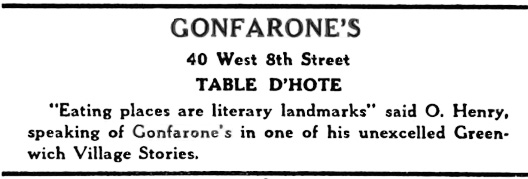
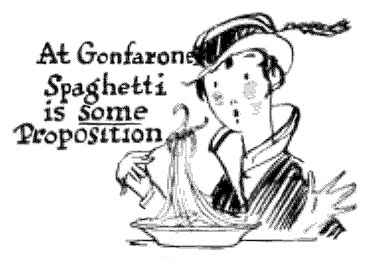
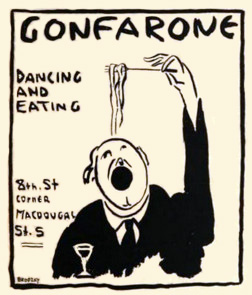
“By the simple act of ordering spaghetti an American was plunged into a foreign experience,” observes Sermolino. [above, 1916 advertisement from The Greenwich Village Quill; below, 1919 Quill]

All meals came with a glass of California claret, which the restaurant bought 40 or 50 barrels at a time, reducing their cost to ten cents a gallon. Apart from that free glass, which impressed many American patrons who were unfamiliar with wine and considered it exotic, the bar was a money maker. Maria called it “a gold mine.” A Manhattan cocktail — with cherry — cost 3 cents but sold for 15 cents, she explained.

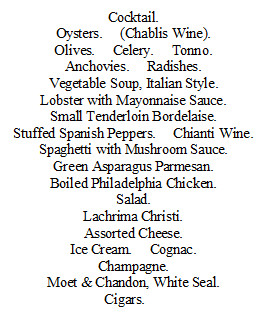
Banquet menus were grander and supplied more alcoholic beverages, as is shown in a 1904 menu above for a dinner given to honor a supporter of Democrats in the Tammany-controlled area occupied by the restaurant.

The restaurant’s best years were before World War I, when it was not unusual to serve four to five thousand dinners on an average weekday and double that on a good Saturday or Sunday, with waiting patrons spilling down the hall and into Macdougal Street. When food ran low the cooks would water the soup and waiters would offer patrons omelets.

With the onset of Prohibition, Maria’s father decided to get out of the business and concentrate on his other interest, real estate. Under new ownership, Gonfarone’s remained open for another 10 years, until 1930. The buildings were razed in 1937.

© Jan Whitaker, 2024

8 Comments

Filed under atmosphere, ethnic restaurants, menus, popular restaurants, proprietors & careers, restaurant customs, restaurant prices, waiters/waitresses/servers

Finds of the day

Slim pickings for a restaurant ephemera collector at the giant Brimfield flea market recently, but at least I turned up a few finds. Among them were two small menus and a business card, all from eating places run mainly by women. The size of the two menus makes me wonder if male-owned restaurants ever employed any this tiny.

The Henniker Tea Room

The oldest of the three finds was a menu from The Henniker Tea Room in 1932. It took me a while to realize that its location “Midway between Westfield and Brocton” put it in New York state.

I discovered that it is a relic of hard times in a double sense. The front of the menu says “Tenth Season,” so it was begun in 1922. That was the year that the owner’s husband, a superintendent of schools, died of tuberculosis, which probably meant that she had to earn a living for herself and her two daughters.

The second hardship associated with this menu is that it dated from the depths of the Depression. I suspect that is the reason she stopped charging an extra 15 cents for salad with Sunday dinner specials, and reduced the price of potato salad from 30 to 25 cents.

Possibly the tea room failed in the Depression because by 1940 Frances Swain was living in a lodging house and working as a secretary for the YMCA. But her fortunes must have improved after that because in 1950, at age 66, she had become director of the YMCA and headed her own household with additional income from three roomers.

The Salmagundi

The Salmagundi was a seasonal tea room that probably opened in the late 1920s. It was located on Beacon Street in Boston, in a rooming house that the married couple who operated it lived in. I’m guessing the menu shown here is from the early 1950s, an era when tomato juice appetizers were still popular.

The word salmagundi was an old-fashioned but rather artsy word. It could apply to many kinds of mixtures, whether art, collections of short stories or poems, or a multi-ingredient salad.

The Salmagundi was a frequent meeting place for women’s clubs, bridal showers, business and professional groups, and gatherings of college alums.

Duncan Hines, in the 1946 edition of Adventures in Good Eating, declared The Salmagundi “One of the most popular places in Boston,” and praised its “unusual food combinations, delicious hot breads, and good desserts.”

A student at the Massachusetts Institute of Technology took his girlfriend to dinner there in 1950. He said it was a quiet place with three small dining rooms and a limited menu but one he approved of since it included lobster, steak, and chicken. They ordered duck and found it delicious, and liked the “fancy rolls.” But the check totaled a bit over five dollars, so he had to borrow some money from his “chick.”

Around 1960 it passed into new hands, and the owner tried to get a license to serve wines and malt beverages. I found no trace of it after 1962.

Mary Hartigan Restaurant

Although Mary Hartigan’s business card is the smallest of the day’s finds, I discovered that hers was the most successful business of the three. She established it in 1933 in what was formerly a Dutchland Farms that she had run. [above, front and back of business card]

The Dutchland Farms chain in New England, beginning as dairy stores, developed into restaurants quite similar to Howard Johnson’s shortly before the chain failed in the Depression. Some were converted to Howard Johnson’s, but Mary Hartigan, who also ran one in Harwich Port MA, decided to run her Dedham place independently under her own name.

Nevertheless Mary Hartigan’s and Howard Johnson’s shared a similar appearance as well as a similar menu. A Hartigan menu from 1952 shows that she kept the strong link to dairy products in her new restaurant, dedicating an entire page to ice cream concoctions such as sodas, sundaes, freezes, frappes, floats, and malted milk. In addition to the standard steak and chicken entrees, the menu also presented a variety of seafood, including seafood plates, baked lobster, Cape scallops, broiled swordfish, and fried clams. Tomato, grapefruit, and pineapple juice served as appetizers.

1952 was also the year that the restaurant acquired a liquor license. In 1959 the building was enlarged and remodeled. [above, business card interior]

When Mary Hartigan died suddenly in 1961 her obituary in the Boston Globe observed that the restaurant was “one of the best known in the state.” She left it to a niece who ran the business until 1970 when it was sold to a new owner who said he planned to keep the staff, some of whom had worked there for three decades.

© Jan Whitaker, 2024

6 Comments

Filed under food, menus, proprietors & careers, restaurant prices, tea shops, women

Anatomy of a restaurateur: Clifford Clinton

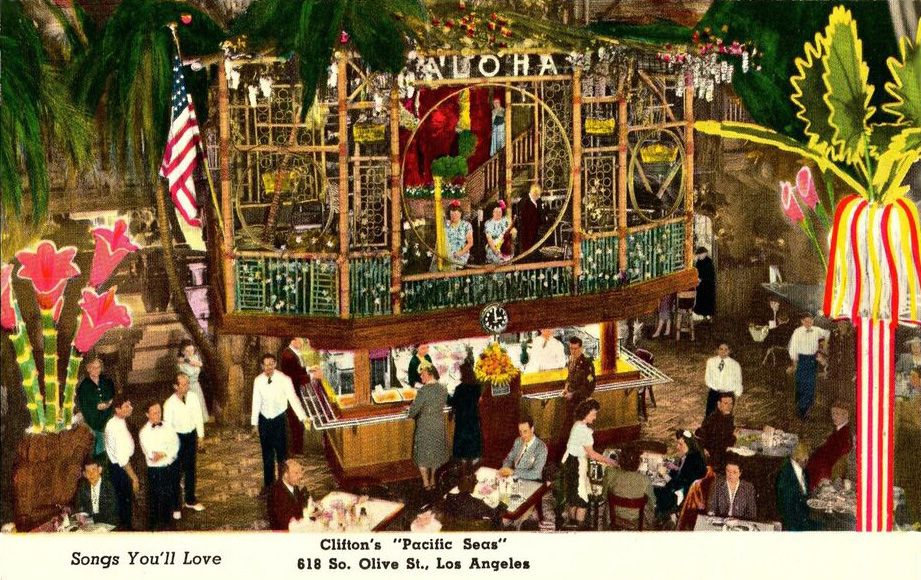
Rarely is the word fantastical used to modify the word cafeteria. Nor are restaurant proprietors usually thought of as powerful vice crusaders. [cover, 1940s booklet; below Pacific Seas]

A major exception of the latter was Clifford Clinton, creator of two of Los Angeles’ most memorable cafeterias. Both Clifton’s Pacific Seas and Clifton’s Brookdale were indeed fantastical, exotic, and composed of an odd blend of entertainment and salvation. In appearance they anticipated elements of Disneyland as well as Polynesian restaurant decor.

One of their strangest aspects was that they represented Clinton’s missionary work. After a few years of operating his father’s Puritan restaurant chain in San Francisco – previously owned by moralist Alfred W. Dennett — he came to Los Angeles in 1931 and re-opened a former Boos Brothers cafeteria at 618 S. Olive.

By the following year he was running that “Clifton’s” cafeteria plus another one on W. Third, one on Hollywood Blvd, a hotel probably housing his employees, “A miniature Cafeteria of the Tropics” in Whittier, and a “Penny Caveteria” in a basement on S. Hill street that offered dishes for 1 cent each.

In October 1932, perhaps the worst year of the Depression, a newspaper featured a smiling woman in the Caveteria with her 5¢ meal of soup, veal loaf, macaroni, sliced tomatoes, and buttered bread. According to another story, she was but one of an average of 4,500 customers fed each day (except Sundays, when all Clifton’s closed). Lines typically stretched down the street. For Christmas that year 7,000 guests enjoyed a Christmas turkey dinner priced at 1¢.

In 1939 Clinton remodeled the redwood-forest-themed Clifton’s Brookdale that had opened in 1935 as well as the original place on S. Olive, Clifton’s Pacific Seas, with a dazzling Polynesian look, neon palm trees, and many, many waterfalls. [Brookdale interior shown above; below more waterfalls, Pacific Seas exterior]

Along with meals, the restaurants acted as social centers and spiritual retreats for the thousands of uprooted mid-westerners who had relocated to Los Angeles. And they served as a kind of political base for Clinton’s reform campaigns. His cafeterias and his political activities were entirely consistent with the tenor of Los Angeles culture of the time. As George Creel summarized it in a 1939 Colliers article, the city throbbed with “two thousand religious cults . . ., each claiming daily and direct communication with Jehovah, and an equal number of social, economic and political movements: Epic, Social Credit, Utopia, the Townsend Plan and Thirty Dollars Every Thursday, etc., all guaranteed to promote the immediate salvation of mankind.”

Religiosity permeated the Clifton’s Cafeterias, as it had Dennett’s and would in a number of restaurants later in the century. If guests left the main dining room of Pacific Seas and entered the basement they would find a life-sized figure of Jesus praying in The Garden of Meditation [shown above]. Brookdale featured a Little Chapel set amidst the redwoods.

During World War II, Pacific Seas diners could also post their “feelings and wants” on a bulletin board or consult with a “Mrs. Von” in her bamboo hut for advice on personal problems.

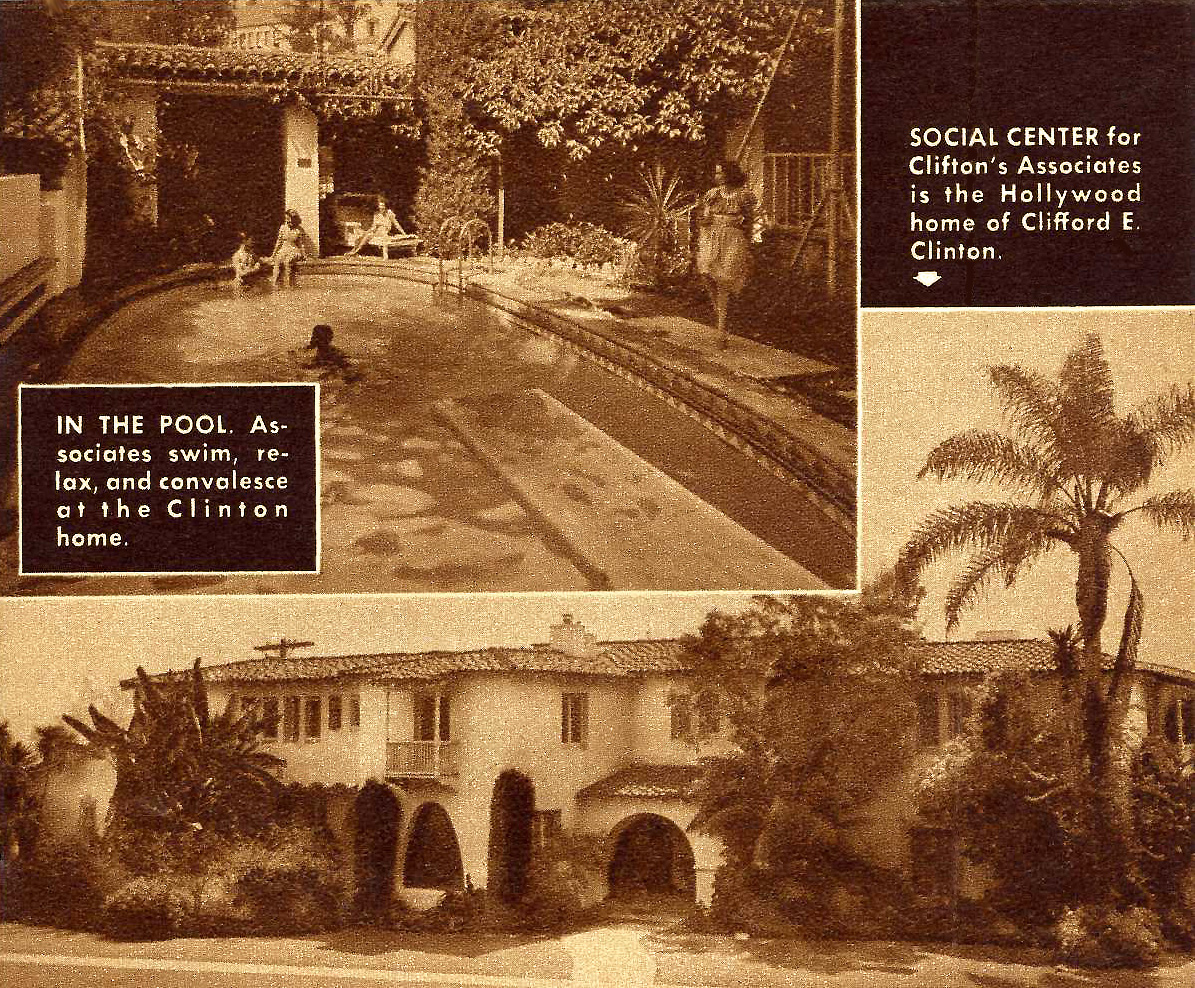
Clifford Clinton’s mission to offer affordable meals continued throughout his career. The policy was that no one would be turned away because of a lack of funds. Although the practice undoubtedly ate into revenue, and was probably taken advantage of by some, Clinton managed to amass enough profits to live in a sprawling mansion on Los Feliz Blvd. and Western Ave in which he hosted convalescing employees [shown above]. (The house sold last year for close to $5M.)

Clifford Clinton was as colorful as his restaurants, despite his appearance as a conventional religious and civic-minded family man. He had spent much of his childhood in China with his missionary parents, an experience that he said made him ultra-sensitive to human hunger. That is unusual but it was just a prelude to his role as one of Los Angeles’ prominent crusaders of the 1930s dedicated to cleaning up the city’s vice and political corruption.

He succeeded in getting Mayor Frank Shaw recalled and replaced by the candidate of his choice, who he promoted on his radio show. In addition, the city’s police chief was indicted and found guilty of plotting the car bombing that severely injured the private detective working for Clinton’s lawyer.

Clinton’s success as a crusader has been partly attributed to his alliances. He worked with Protestant ministers under the banner of an organization he created known as C.I.V.I.C (Citizens’ Independent Vice Investigating Committee). And he also allied with the Communist Party during its popular front phase. As a result of these efforts, gambling, prostitution — and the city’s anti-Communist Red Squad — were eliminated, or at least removed from sight.

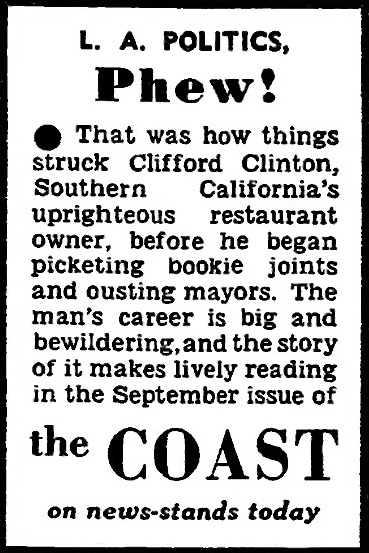
Through these years Clinton experienced endless phone threats, a bombing at his home, false reports of food poisoning at his restaurants, and an endless array of dirty tricks such as an invasion of one of his public forums by 300 hungry people who had been given tickets for a (non-existent) free meal of chicken and beer. [above: 1939 advertisement for magazine article; below: Clinton examines bomb damage]

Having turned the cafeterias over to his children in 1946, Clinton and his business partner, Ransom Callicott, focused on world hunger. They found a scientist who developed what would be known as Meals for Millions, a soy-based one-dish meal that could be prepared as soup or, with a little flour or corn meal added, bread.

Clinton died in 1969 but his restaurants, including a number of conventional ones in shopping centers, endured well into the 2000s.

© Jan Whitaker, 2024
11 Comments

Filed under cafeterias, Offbeat places, popular restaurants, proprietors & careers, restaurant decor, restaurants, theme restaurants

A tough business in a tough town

Most people realize that the expense and hassle of opening a restaurant in New York City is daunting, but a 1980 New York Magazine story by Paul Tharp laid it out in excruciating detail.

Generally new restaurants have a short run, but the piece underscored this observation by noting that the city’s Restaurant Association claimed that three of every four places shut down or had new owners within five years. Tharp added that a real estate broker said that one out of ten operating restaurants was for sale “at any given time.”

New York was a particularly tough city for restaurant operators. Higher food costs there meant that the consumer was going to pay four times the cost of a meal’s raw materials rather than three times, then the national norm.

Expenses involved in opening a new restaurant were staggering. Although the total estimate for a 40-seat restaurant of $162,018 given in the article seems quite low by today’s standards, it wasn’t then. The biggest chunks of money were for payroll, kitchen equipment, rent, and remodeling costs.

But that was just the monetary total. Tharp also outlined a time factor, noting that the amount of time spent getting set up was often not anticipated by those lacking previous experience.

The article observed that few new owners expected to be putting in 14-hour days the first year working in the kitchen or waiting on tables, virtually abandoning their personal life. Nor did they realize how much time and patience would be required to obtain licenses and satisfy city regulations, such as taking and passing a 15-hour Health Department course in sanitation and food handling.

And then there were the exasperating bureaucratic hurdles. For some it was a surprise that stove vents were required to extend to the top of buildings. If the Buildings Department found that the restaurant had not obtained a permit and met city standards for remodeling, an owner might need to tear out all the work that had already been done and start over.

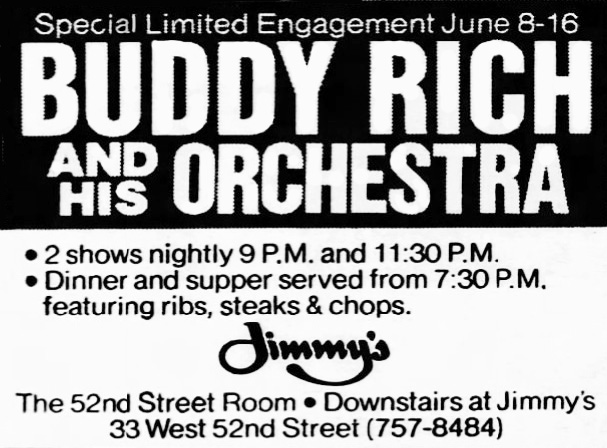
Taking over an existing restaurant may have avoided the hassles of remodeling, but its costs were likely much higher and brought their own hazards. Tharp relates a horror story involving two inexperienced men, elsewhere termed “babes in the gastronomic woods,” who wanted to take over a former Toots Shor restaurant for a bargain price if the new owners also assumed the restaurant’s debt. They teamed with major investors who pulled out and left them at sea. They renamed it Jimmy’s after soon-to-vanish partner Jimmy Breslin. Although at first it was quite popular, business then fell off with the recession and they realized they couldn’t handle the large staff or deal with unexpected costs such as credit card service charges, electricity rate hikes, and a temporary loss of their liquor license. Even adding an upstairs cabaret and a downstairs jazz club and hiring Jack Lemmon as Monday night bartender failed to attract the disappearing crowds. After about 34 months capped by a flooded basement, Jimmy’s shut down.

If Tharp’s report didn’t contain enough warnings, a published letter from a Manhattan realtor added another note of caution. He pointed out that owners of “quality buildings,” fearful of restaurant failure rates, tacked on security deposits equal to as much as five months rent, plus additional payments to make up for premiums required by insurers who assessed a higher fire risk for a restaurant tenant. Altogether, he estimated the operating budget should be 30% to 40% higher than Tharp’s.

Perhaps to offset all the bad news, the story included five thumbnail sketches of restaurateurs who overcame obstacles. I took a closer look at their subsequent careers, which raised some questions about just how well they all did. Three seemed to be well-connected pros who, despite disappointments with some ventures, did well overall. One of those briefly profiled was Peter Aschkenasy who had a number of successes including Charley O’s and U.S. Steakhouse, but who hit a snag trying to revive the classic New York restaurant Lüchow’s [pictured at top].

One restaurateur had a place I could find absolutely no trace of anywhere, and another had a single tiny restaurant with a short life. It was operated by the only woman mentioned in the story, chef Leslie Revsin, whose professional biographies unfailingly cited that she was the first woman chef to be hired by the Waldorf-Astoria. She opened Restaurant Leslie in Greenwich Village in 1979. With only nine tables and no liquor or wine license, it lasted only a few years despite critical praise. Following that she cycled through about nine New York restaurant kitchens including Argenteuil, One Fifth Avenue, and The Inn at Pound Ridge, often as executive chef. Eventually she turned to writing cook books.

© Jan Whitaker, 2024

Leave a comment

Filed under proprietors & careers, restaurant issues, restaurants

Building a myth: Bookbinder’s

As a Philadelphia Inquirer story observed when the legendary Bookbinder’s on Walnut Street closed for the first time, in 2002, its popular appeal had been based not only on seafood and steaks but also on the restaurant’s ability to play on its history.

Eventually, in the 1940s, the myth led to a claim that it was founded in 1865. Not everyone took the claim seriously, but that still leaves the question of why the restaurant invented it. The motivation was somewhat mysterious considering that Bookbinder’s was in fact very long-lived compared to most restaurants in the U.S., which do well to last five years. It’s curious to me that the actual founding date in the 1890s wasn’t good enough, but it may have been that its actual beginnings didn’t seem like much compared to the long patriotic history of Philadelphia.

An 1895 newspaper story reported that Cecilia Bookbinder, wife of Samuel, had bought the building on 125 Walnut Street for $5,000. Since 1884, it had been operated as an oyster and chop house by a man named Attila Beyer. It appears, however, that the devious Beyer may not have actually owned the building when he sold it to Cecilia, having already used it as collateral for a loan on which he was about to default as he left for California.

Perhaps due to monetary claims by Beyer’s creditors, the Bookbinders evidently lost ownership of the building and didn’t regain it until 1906, nevertheless operating the restaurant all the while, possibly at first under the simple name Merchant Restaurant. The restaurant was in Philadelphia’s long-established insurance district where business people flooded the local eating places at noon.

Somewhat before the myth of an 1865 founding was adopted, 1875 was advertised as the restaurant’s start date. For instance that was the date given in a 1940 Life Magazine advertisement for Hines ketchup shown here; it is also indicated by the poster on the wall.

A family rift may partially explain the adoption of an exaggerated founding date. Bookbinder’s on Walnut street adopted the name “Old Original Bookbinder’s” about 1935 or 1936 after Samuel C. Bookbinder, son of the founders, opened a rival Bookbinder’s on South 15th Street [shown above, 1935]. He had been in line to inherit the Walnut Street restaurant but was disinherited upon his conversion from Judaism to Catholicism in order to marry a Catholic woman. The false founding date and the name “Old Original” were likely ways to distance the Walnut Street restaurant from its new competitor. [Note that the 1936 advertisement below had not yet revised the fictitious founding date.]

As a result of the family split, Harriet Bookbinder took over the Old Original, operating it with her husband Harmon Blackburn. He was a successful corporate lawyer, and a collector of Americana, including the Lincoln memorabilia, old theater playbills, and Carrier & Ives prints that adorned the restaurant’s walls.

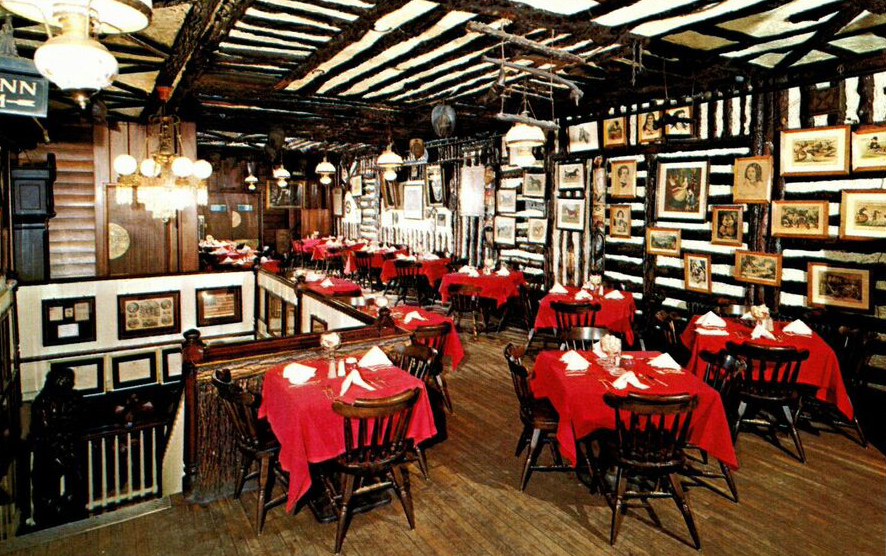
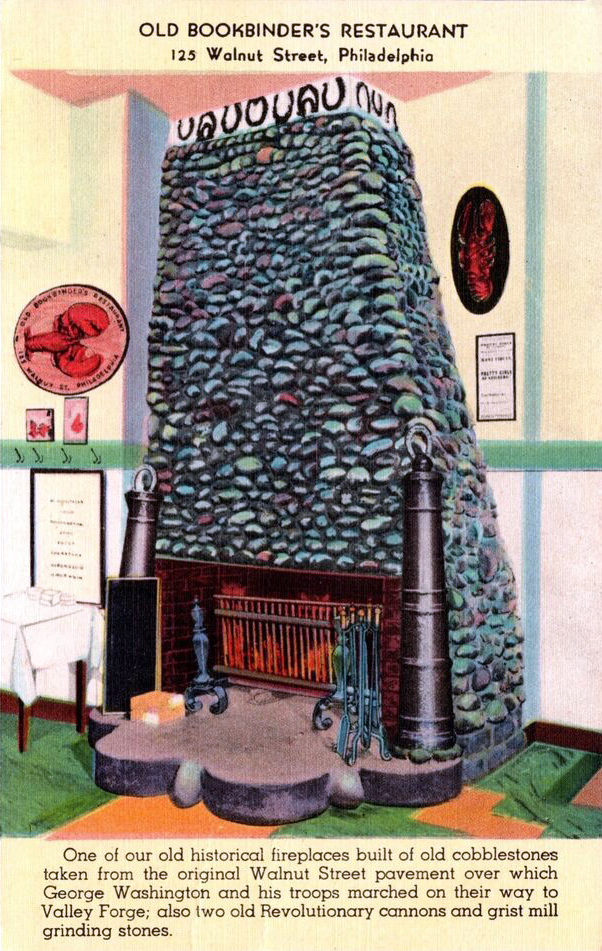
Obviously the building occupied by Old Original Bookbinder’s itself looked aged, and the memorabilia contributed to a sense of age. Other historical attractions were the fireplaces made of old cobblestones taken from Walnut Street. The fireplaces probably dated back to 1915 or 1916 when the city was removing cobblestones from streets. A 1916 advertisement promised “A Beefsteak Dinner in the ‘Maine Woods’” cooked at that room’s fireplace, with steaks and chops grilled in the fireplace and served with oysters, radishes, celery, and hot biscuits baked on the hearth.

When Harriet died in 1944, her husband ran the restaurant for a year and then donated the business to the Federation of Jewish Charities. Along with the building, the furnishings and equipment, the donation included “all food and liquors on hand, the good will and everything in the till.” John and Charles Taxin bought it, with John running it until its final bankruptcy and closure.

In the 1940s and 1950s Old Original Bookbinder’s was regularly recommended in books featuring the country’s favorite restaurants, such as Duncan Hines Adventures in Good Eating. In 1947 “The Dartnell Directory for America’s Most Popular Restaurants named it the country’s most popular eating place of the 2,300 restaurants it recommended.

In 1965 the restaurant celebrated its 100th anniversary as Bookbinder’s — a mere 30 years prematurely.

By the 1970s, the cobblestone fireplaces remained, but some rooms had been redecorated and modernized. Time was catching up with Bookbinder’s then, as new kinds of restaurants with inventive cuisine such as Le Bec-Fin came on the scene. Citing an estimated 300 new restaurants opening in Philadelphia in the early 1970s, a 1978 issue of trade magazine Restaurant Hospitality observed that traditionally conservative Philadelphia was now “vying with New York and San Francisco as the Eating Capital of the United States.”

Nevertheless, in 1986 Restaurant Hospitality rated Old Bookbinders the nation’s 7th highest-grossing restaurant, with annual sales totaling $10.6M and an average dinner check of $33. It was well-known nationwide and particularly popular with tourists, all the more so since it was near historical points of interest.

But nothing lasts forever. Both Bookbinder’s closed in the first decade of the 21st century.

© Jan Whitaker, 2024

12 Comments

Filed under popular restaurants, proprietors & careers, restaurant advertising, restaurant decor

Chicken in the Rough

Frequently when I write about the demise of a restaurant chain I can almost be certain to hear from at least one person who lets me know there is a survivor of that long-gone chain.

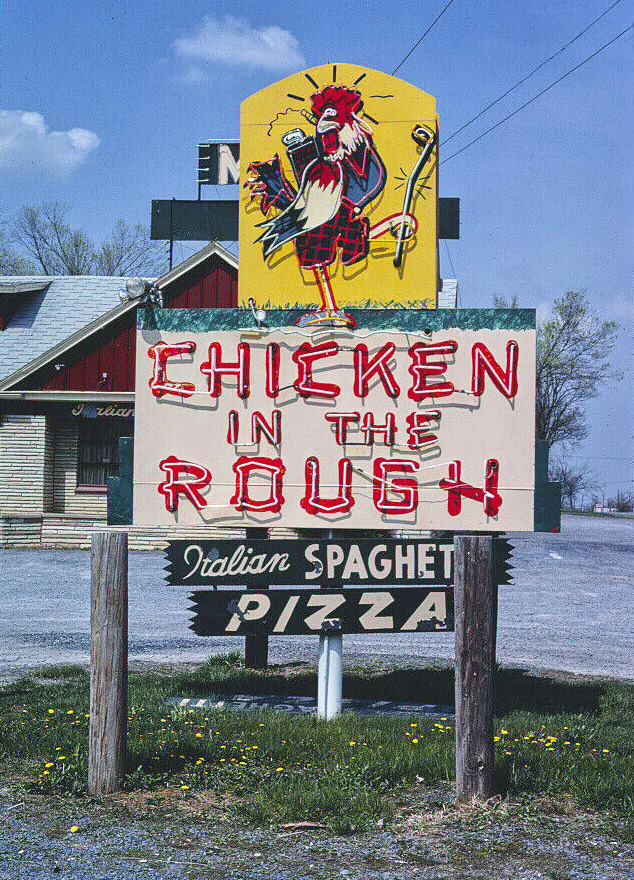
And, yes, that is also true of Chicken in the Rough, a franchised process for preparing fried chicken. As recently as now, Palms Krystal Bar & Restaurant in Port Huron MI offers “The World’s Most Famous Chicken Dish,” as it has for decades. In 2000 a Palms order consisted of an unjointed half fried chicken, with shoestring potatoes, hot bun, and jug of honey. Two orders cost $9.99 and they even threw in free coleslaw. In the 1930s an order usually was priced at 50 cents. [above, 1940s menu from an Arkansas restaurant]

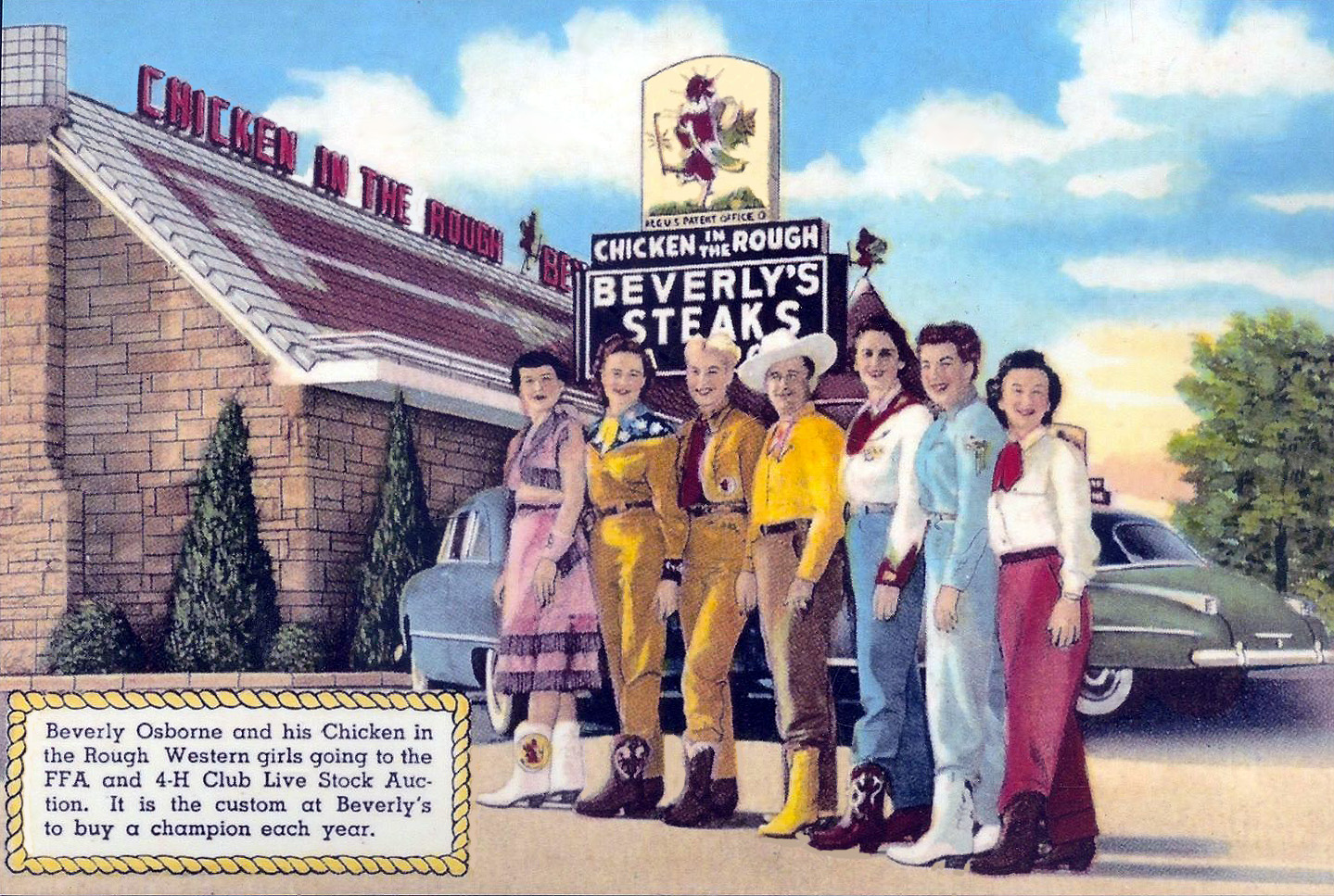
The developers of the Chicken in the Rough formula were a husband and wife team, Beverly and Ruby Osborne. They ran roughly nine cafes and waffle shops in Oklahoma City and even the 1930s Depression could not halt their enterprising spirit. [above: Beverly Osborne pictured in yellow boots]

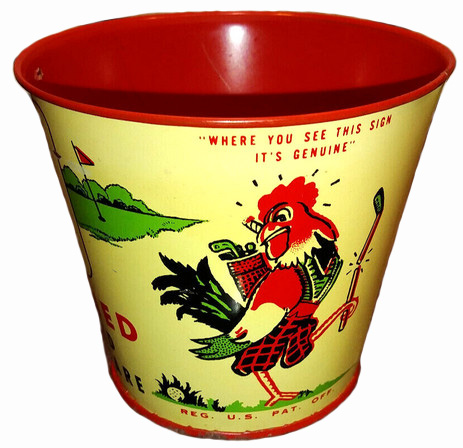
Their operations employed the magic word in modern management of that time – “system” – to streamline their operations and reduce costs. In 1936 they opened a drive-in in Oklahoma City which introduced customers to their method of preparing chicken. They soon began franchising the process and the trademark. In 1942, they patented their imprinted dishware and glasses, and the image of a chicken with a broken golf club, all of which had been in use for several years.

“In the Rough” was a perplexing phrase that often needed an explanation. It meant no silverware was provided despite the half chicken being unjointed. Evidently customers proved willing to adapt to “roughness,” although I’ve run across some evidence that over time some franchisees served the chicken in pieces. Another alternative was to serve the meal with a small metal pail filled with water for cleaning hands.

When the Osbornes opened the Ranch Room at their Oklahoma City drive-in in 1937 a large advertisement appeared in The Daily Oklahoman. Just in case anyone reading it didn’t realize the name Chicken in the Rough had been copyrighted, they were informed of this six times in the text: Yes Sir, “Chicken in the Rough.” (Copyrighted) – In one year we are known from coast to coast for “Chicken in the Rough.” (Copyrighted) – Served without silverware. In one year we have sold over 50,000 chickens or 100,000 orders of “Chicken in the Rough.” (Copyrighted) – We are now able to offer for sale franchises on “Chicken in the Rough.” (Copyrighted) . . . We took the town by storm – “Chicken in the Rough.” (Copyrighted) 50c. [Above: Madison WI franchisee]

The Osbornes were very particular about the meal’s composition, preparation, and presentation. Franchisees were required to use a freshly killed chicken, weighing 2 pounds and graded A, meaning it had been raised in an incubator and had sustained no injuries. No batter could be added to falsely make it look bigger and it had to be cooked in vegetable oil that had not been used for any other purpose. Inspectors came by regularly to make sure franchisees were following the rules.

World champion runner Jesse Owens, winner of four gold medals in the 1936 Olympics, was slated to open a restaurant featuring Chicken in the Rough in Chicago in 1953, for which he planned to use delivery wagons decorated with large images of himself racing. I could not determine the fate of that plan, but I don’t think it ever materialized.

The Osbornes sold the rights to their franchised process in 1969 and ten years later ownership changed hands once again. At the time of the first sale of the business there were only 68 franchises in 20 states left, compared to possibly 379 in 38 states at the peak, which I am guessing was in the late 1940s. Judging from a 1946 postcard that claimed to list all the U.S. restaurants with franchises then, most of the populous states without franchisees were in the Northeast. By contrast, Michigan had the most, followed by Indiana and California.

Unlike that of Harlan Sanders, who also began by selling a chicken recipe across the U.S. some years after the Osbornes, their venture remained a franchised cooking process and did not develop into a chain of restaurants.

© Jan Whitaker, 2023

18 Comments

Filed under popular restaurants, proprietors & careers, signs

The celebrity connection

Celebrities – and their names and faces – have had multiple connections with restaurants, generally adding to the glamour or appeal of the restaurants involved. One of the most obvious and probably the oldest attraction is the chance that customers will spot celebrities in a restaurant.

Restaurateurs and silver screen celebrities capitalized on that attraction in the 1930s and 1940s by encouraging gossip columns to publish sightings of dining celebrities. Despite their lack of real significance or accomplishments, the Duke and Duchess of Windsor were one of the celebrity couples most often attracting columnists’ attention in restaurants.

About the same time, there were also eating places, especially delicatessens, that named sandwiches for stars of stage and screen. Reuben’s was the best known, but in 1931 there was also Dave’s Blue Room, another NYC deli. As late as 1960 a Hollywood deli menu was full of humorous names such as Lox Hudson, Lucille Matzo Ball, and Judy Garlic.

Other eating places such as The Brown Derby and Sardi’s displayed portraits of celebrities who were past or present patrons of that restaurant.

But the BIG bump in celebrity links to restaurants came in the late 1960s and 1970s with the franchising boom. Many restaurant chain franchisers believed that by linking a chain to the name of a well-known athlete, singer, or actor, they would sell more fried chicken or hamburgers. Usually the celebrity was paid a fee and possibly a percentage of profits for their participation, which could involve taking the role of chairman of the board or as little as lending their name or likeness or making an occasional appearance at openings.

Much of the time the deal turned into a losing proposition for those celebrities who put their own money into the venture, as well as for stock market investors and franchisees. Joe Namath dismayed investors when he announced in 1969 that he was retiring from football to become chairman of Broadway Joe’s. The following year he pulled out when the chain’s stock plummeted downward. Within two years of becoming chairman of the soon-defunct Mickey Mantle’s Country Cookin’, the former New York Yankee resigned.

Some other sports figures who lent their names to restaurants included Dizzy Dean, Rocky Graziano, Fran Tarkenton, and Brady Keys.

Among Black celebrities failure took on a sadder note, given that some of them had hoped to bring business opportunities to Black communities. Other Black entertainers with restaurant connections were Fats Domino, Mahalia Jackson, and Sammy Davis, Jr. Black athletes included Jackie Robinson, Muhammad Ali, and Brady Keys, who created and headed All-Pro Chicken. In 1969 he had 10 outlets in San Diego, where he began the chain, as well as in Pittsburgh, Rochester, and New York City. Like Muhammad Ali, Keys hoped to spur Black business, and enjoyed much better luck than Ali, who lost a lot of money fast with his short-lived Champburger chain.

Among singers and musicians who joined restaurant ventures in the 1960s and 1970s were Trini Lopez, Tony Bennett, Julius LaRosa, Eddie Arnold, Tennessee Ernie Ford, Hank Williams, Pat Boone, and Al Hirt. Most of them took a bruising. Some other entertainers were Minnie Pearl, Dean Martin & Jerry Lewis, Jackie Gleason, Arthur Treacher, Johnny Carson, and Rodney Dangerfield. [Tony Bennett display above]

Observers were quick to point out that the celebrities who did well with a restaurant or chain were those whose places had good food and management. Of themselves, celebrity connections counted for little or nothing. A frequently cited example of a success story was the Gino’s Pizza chain [not to be confused with Papa Gino’s]. Its good fortune was attributed to food quality and good management, rather than a name. In fact, most customers had no idea that Gino was Gino Marchetti, formerly of the Baltimore Colts.

But while a celebrity name could not guarantee restaurant success, it could be helpful. As Steve Chrisman, manager of two Sam’s Cafes in NYC (the name was the nickname of his wife Mariel Hemingway), would observe in the 1980s, “You need to get customers in to become visible. Mariel’s notoriety was important.”

The new wave of celebrity involvement in restaurants came in the late 1980s when it became popular to invest in restaurants, particularly for film stars. The restaurants were nearly all located either in NYC or the Los Angeles area. Involvement was largely financial and rarely meant day-to-day management. In some cases stars grouped together as was true of Malibu Adobe that came into being in 1987 through a venture by Dustin Hoffman, Tony Danza, Bob Newhart, Stacy Keach, Alan Ladd Jr., and Randy Quaid, with Ali McGraw [shown above] in the role of decorator.

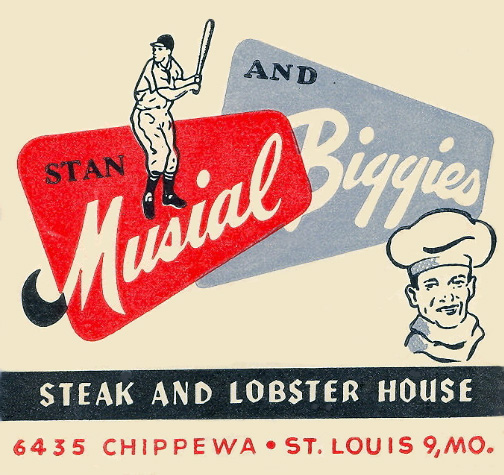
The 1980s wave was not about franchised chains, but mostly single restaurants. And that probably tended to give them a somewhat higher survival rate – as it had earlier for Joe DiMaggio, Joe Lewis [above, ca. 1940], Jack Dempsey [shown at top], and Stan Musial. Some of the new restaurants bore celebrity names, for example Charo’s Cantina, Tommy Lasorda’s Ribs and Pasta, and Bono, owned by Sonny Bono. Most did not, e.g., Dolly Parton’s Dockside Plantation, Tom Selleck’s Black Orchid, Clint Eastwood’s Hog’s Breath Inn, or Midwestern exception Oprah Winfrey’s The Eccentric. But their connections were widely known by patrons and they could sometimes be spotted dining in “their” restaurant.

The next wave of celebrity restaurants would feature famed chefs. But that’s another chapter in restaurant history.

© Jan Whitaker, 2023

11 Comments

Filed under chain restaurants, proprietors & careers