I am republishing this post that I originally presented ten years ago, because of the September 4 death of Joseph McNeil, age 83. The Greensboro lunch counter has been on exhibit at the Smithsonian’s National Museum of American History in Washington, D.C. since the 1990s when it was acquired from Woolworth’s. It will be one of 250 items featured in a show of “revolutionary objects” at the museum in 2026.
Actually there was no lunch. But there was plenty of heroism when four college students sat at a Greensboro NC lunch counter in February 1960. [Above photo: Joseph McNeil is seated on the left.]
The students were told to go to the segregated snack bar in the back of the Woolworth 5 & 10 cent store, but they refused. And although the Woolworth staff would not serve them, the students also refused to leave until closing time and pledged to come back every day until they won the right to eat there.
It was an honor to hear one of the organizers of the protest at the 9th Annual Northeast Regional Fair Housing and Civil Rights conference in Springfield MA. Joseph McNeil [shown above at the conference] told a room of 500 attendees how much had hung in the balance for him at the time. A first-year student at the North Carolina Agricultural and Technical State University, he feared that he could end up in jail and disastrously interrupt his college career. (Fortunately, his fears were not realized and he went on to graduate and eventually become a major general in the U.S. Air Force.)
McNeil related how the Greensboro protest grew as students from area schools joined with the initial four, then more student protests erupted at Woolworth stores around the South. In July 1960 Woolworth reversed its policy, which had been to let local managers decide whether or not to serve Black customers based on local customs.
He explained that the sit-down protests served as “a down payment on our manhood and womanhood” for him and his fellow students. The action, he said, was driven by their belief in the “dignity of men” and “the moral order of the universe.”
In the Q & A after his talk, a woman in the audience asked what his mother had thought about his decision to join a sit-in at the lunch counter. He said she had been uneasy about it but had to agree that it was the right thing to do based on the values she and his father had taught him.
McNeil received repeated standing ovations from conference goers. Everyone laughed when he said that he had always wanted to order coffee and apple pie at a Woolworth lunch counter but when he did, “The apple pie wasn’t very good.”
Many restaurants through the decades have built their popularity on a genial host. That was true of Colosimo’s in Chicago and its owner and host Jim Colosimo.
To a large degree the restaurant’s reputation was built around “Big Jim.” Before 1920 that was because of his pleasant manner. And, maybe, the spaghetti at Colosimo’s really was exceptionally good.
But the genial host was also a big-time gangster.
The restaurant was located in a part of Chicago known as the levee, an area specializing in prostitution. Colosimo had opened his restaurant in 1910, having previously run two “single-hour” hotels.
He expanded his operations to become a crime boss who not only provided illegal services but also had procurers recruiting naive young women as prostitutes in and outside of Chicago. And he handled the police, seeing to it that they didn’t interfere with these activities. His lieutenants collected payoffs from other illegal operators — and killed people as necessary — leaving Big Jim’s hands clean. (Of course, the police knew very well what he directed his minions to do.)
Many of Colosimo’s patrons also must have known about his other activities. In 1914 a letter appeared in the Chicago Tribune from a woman who feared for the fate of young women that might venture into the place: I have been reading The Tribune about this vice upheaval and notice what is said about Colosimo’s. This recalls that when I first came to Chicago last winter I saw, I believe, [full] page ads in the leading Chicago theater programs which advertised what a fine place was to be found at Colosimo’s. I didn’t know what kind of a place it was and didn’t go there to find out, but I’ll warrant any number of younger girls went there, led by the page advertisement in the Chicago theater program, and undoubtedly a great many of them can now trace their downfall to Colosimo’s. [above: 1914 advertisement]
Its reputation evidently didn’t bother many of its patrons. The theatrical profession was said to flock there. And a publication reported that “The café . . . is crowded nightly after the show with a merry making throng which makes it one of the brightest spots on the city’s map.” It served as an ongoing attraction for the city’s “society slummers.” And in 1916 an advertisement for Colosimo’s appeared in the Official Program of the Republican National Convention to be held in the city.
His execution helped perpetuate the restaurant’s appeal after Colosimo was gunned down on the premises in 1920. It also helped that Al Capone was associated with the restaurant. He had been hired as Big Jim’s bodyguard, replacing him as the city’s crime boss after he was killed.
In subsequent years the name of the restaurant remained Colosimo’s, despite his absence and a new owner. It was remodeled to look elegant, and operated as a nightclub. Its past, presumably firmly behind it, did not deter the crowds in the 1920s. Drinks were available, although the restaurant was shut down repeatedly for violating Prohibition. Apparently that was okay with the alumni of a Vermont military college which planned a dinner there in 1925, including their “wives and sweethearts.” Their invitation noted “At this place we can be entertained by dancing, eating and looking . . .” [my emphasis]
The new owner, who had bought a half share in the restaurant shortly before Colosimo’s murder, operated it until its end in 1948, by which time it had suffered the bizarre fate of being converted into a cafeteria. [Above: the restaurant in the 1940s]
In 1916 a newly arrived New Yorker named Adolph “Eddie” Brandstatter and a partner opened a café in Los Angeles. Modeling it on an unnamed New York City restaurant, they named it Victor Hugo and designed it to introduce fine French cuisine and continental service to the cafeteria-loving city.
Four years after opening the Victor Hugo, Brandstatter turned his attention to a Santa Monica project, the Sunset Inn, buying it with a new partner and selling his share in the Victor Hugo. His short tenure at the Victor Hugo was an early sign of his seeming “love it and leave it” relationship to most of the restaurants he created. Despite that, he rapidly became a well-known and well-liked public figure.
Trying to track all his restaurant ventures is a dizzying job.
By June of 1920 the Sunset Inn, which had served as a Red Cross center during WWI, had been remodeled and outfitted with a jazz band. Wednesdays were devoted to performances by Hollywood actors. But in 1922, less than two years after its opening, and despite the Inn’s apparent success, Eddie sold his share and moved on.
That same year, only a few months after departing from the Sunset Inn, he bought a new restaurant, the Maison Marcell, remodeling and reopening it. A little more than a year later he remodeled it again, renaming it the Crillon Café. Meanwhile, shortly after opening the Marcell, he had advertised the sale of his home’s furnishings, including suites from the living room, dining room, and two bedrooms, along with curtains, draperies, oriental rugs, flatware, and tableware.
Presumably the sale was meant to raise funds for his next project, the Café Montmartre which he opened in January of 1923 on Hollywood Boulevard, with a coffee shop below it on street level. At the luxurious Café Montmartre he continued the method of luring customers that had been adopted at the Sunset Inn: linking the café to the movies, attracting stars and a gaping public. Reputedly this often involved subsidizing meals for actors short on funds. [photo: Los Angeles Public Library]
The Montmartre would become the restaurant most closely identified with him, and the longest lasting of his cafes, staying in business for nine years. He took an active role in it, greeting and mingling with guests from the film industry, as well as overall management. Yet that workload barely slowed him down. In May of 1923, the Los Angeles Examiner announced that Eddie, “Little Napoleon of the Cafes,” was planning to open “the exclusive Piccadilly Coffee House on West Seventh street between Hill and Broadway.”
1925 was a busy year of ups and downs. The Crillon closed, as did his newly opened cafeteria called Dreamland, not even open for a full year. It was the only cafeteria I’ve ever come across that had dancing!
He also began a catering company that furnished food to movie casts and crews. In the next few years, the catering company took on some big projects. In one case it provided meals for 2,500 in Yuma AZ when the Famous Players-Lasky studio was filming Beau Geste. [above photo] To do that it was necessary to build a plank road atop the sand and to drill wells. The company also catered to studios when they filmed in Hollywood at night, as was the custom. That could mean serving as many as 25 studios on some nights.
The Depression – and probably the end of silent film — took a toll. When Montmartre began to sag, he opened a swanky club next door for film people called the Embassy. It opened in 1929, closing three years later when his decision to open to the public failed to rescue it. [above: the public waits to get in] Also, in 1932 he was caught removing art objects and furnishings from the then-closed Montmartre, planning to use them in his next venture. At his trial it came out that the actual owner of the Montmartre was the realtor who had built the Montmartre and backed him by putting up capital, loaning him personal funds, and paying him a salary of $100 a week. He was found guilty and put on probation for two years.
In 1933 he opened a restaurant he called Sardi’s but in no way connected to New York’s Sardi’s. With booths, tables, and fountain service, and featuring his popular set-price buffet luncheon, it quickly became a success. Its success did not stop him, however, from launching another restaurant, a chop house called Lindy’s that he seemed to have no further link to. In 1936 Sardi’s was destroyed by fire. When it was rebuilt two years later he sold his share to a partner. [rebuilt Sardi’s shown above]
In 1939 he opened his final eating place, the Bohemia Grill, with prices as low as 35c for Pot Roast and Potato Pancakes. The following year he took his own life, apparently troubled by money worries. Among the honorary pall bearers at his funeral were Charlie Chaplin, Tom Mix, Bing Crosby, and studio head Jack Warner.
It’s rare to find business documents from long-gone restaurants, but last weekend I stumbled upon two letters to investors from the Physical Culture Restaurant Company headed by fitness and health food advocate Bernarr Macfadden [shown above, age 42].
Macfadden was a body-builder, natural food proponent, and entrepreneur who decided to spread the gospel by opening inexpensive, largely plant-based restaurants at the turn of the last century. He attributed his strength and energy to this special diet.
The 1904 end-of-year letter reported that four new restaurants had been added to the ten already in business, and that they had done business totaling over $243,000, with a net gain of $2,637. Five restaurants had been judged failures and closed, four of them in NYC and one in Jersey City. He and his board of directors believed in rapidly shutting down locations that did not draw crowds. The letter blamed a “business depression” and the normally slow start of new locations for the smaller-than-hoped-for profits.
Although he wanted the restaurants to succeed, his personal income was not dependent upon them. Macfadden’s primary business was publishing periodicals, beginning in 1899 with Physical Culture, which discussed diet and health, followed by True Story, Liberty and then, increasingly, a large number of detective and romance magazines with titles such as Dream World, True Ghost Stories, and Photoplay. In addition he authored scores of books on fitness, sex, and health, and established a tabloid newspaper, The New York Evening Graphic. His publications earned him a fortune.
The total number of Macfadden restaurants open at the same time never seemed to exceed sixteen or so. The first ones were in New York City, of which there were nine at one point. Others were spread across the East and Midwest, including Boston, Newark, Jersey City, Philadelphia, Pittsburgh, Detroit, Cleveland, Cincinnati, Chicago, and St. Louis. There was also one in Toronto. [above: 1906 advertisement and 1906 restaurant at 106 E. 23rd, NYC]
In the 1907 letter to stockholders shown above he floated the idea that the restaurant holdings might grow to 40 or 50 units if stockholders invested in more stock. This never happened.
Despite the growing popularity of the restaurants, it seems that for Macfadden they served primarily as a way to spread the gospel of a healthful diet. He could not be described as a restaurateur. No doubt he helped to conceptualize the restaurants and make up the early menus, but he did not manage them except in his role as corporate executive.
Prices were low in his early restaurants. A bowl of thick pea soup was 1c, as was a bowl of steamed hominy or oats or barley. Whole wheat bread and butter, however, cost 5c as did creamed beans or whole wheat date pudding. He sold loaves of whole wheat bread for 10c. [shown above]
A Macfadden menu shown in a 1919 British book reveals a wealth of choices then but also higher prices that reflect post WWI inflation. Five cents now bought less. Mushrooms on Toast cost 20c, as did meat substitutes Nuttose and Protose. A Macaroni Cutlet or Lentil Croquettes cost 25c, while omelets such as Mushroom, Walnut and Pecan, Orange, or Protose and Jelly were 30c.
In 1931, at which point only three Physical Culture restaurants remained, Macfadden gave up his fortune, said to be $5,000,000, and created the Bernarr Macfadden Foundation. In a radio broadcast he said: “It is a source of indescribable relief to feel like a free man again. Too much money unwisely used makes people greedy and ungrateful, destroys the home, steals your happiness, enslaves, enthralls you, lowers your vitality, and enfeebles your will.”
Yet his personal life continued to be full of numerous wives, affairs, and lawsuits. And, despite being “freed” of his fortune in 1931, he continued to spend money lavishly, taking it from the treasury of the Physical Culture Publishing Company after he turned that into a public corporation. Stockholders accused him of using nearly a million dollars for his own private interests, which included failed attempts to become a presidential candidate, governor of Florida, or mayor of New York.
In 1931 the Foundation opened the first of several Depression-era penny restaurants, no doubt modeled on Macfadden’s first restaurant at the beginning of the century where most dishes cost only one or a few cents. The initial Depression “pennyteria,” run by the Foundation, was located in midtown NYC. Drawing a crowd of about 6,000 a day, it quickly became self-supporting.
At a penny restaurant run by the Foundation, one cent would buy any of the following: coffee, split pea soup, navy bean soup, lentil soup, green pea soup, creamed cod fish on toast, raisin coffee, honey milk tea, cabbage and carrot salad, steamed cracked wheat, hominy grits, raisins and prunes, bread pudding, whole wheat doughnuts, whole wheat bread, or whole wheat raisin bread.
As the operator of the 1930s restaurants, the Foundation proved more flexible than Macfadden about dietary standards, but evidently he still had some say over what was served. According to one account he agreed to let meat appear on the menu as well as dairy products. Meat took the form of beef cakes, beef stew, and chicken fricassee. But he stood firm about bread, insisting only whole wheat be served.
I found no trace of the Macfadden restaurants nor the Foundation’s penny restaurants in the 1940s. Macfadden largely faded from the headlines, dying in 1955 and leaving an estate valued at only $5,000.
A new book has come out about Don ‘s wife, Sunny Sund, who took over the Beachcomber chain and made it a success. Its author is Sunny’s daughter Karen, working with Cindi Neisinger. It is largely a personal account filled with anecdotes, a view of a mother/daughter relationship, celebrity mentions, and some of the harsh realities that shaped Sunny’s life. A drink recipe ends each chapter.
It was an orphaned family that had gone through some difficult times that developed one of the early, very successful chains of cafeterias in California.
The chain of Boos Brothers cafeterias was one of the first in Los Angeles, contributing to the flood of cafeterias that soon appeared in that city and elsewhere in Southern California. Californians to the north ridiculed the trend, referring to Los Angeles and southern California as the “State of Cafeteria.” It’s true, of course, that cafeterias have never been seen as fashionable and sophisticated.
The Boos [probably pronounced Boes] family story reads like a fictional tale. The Moscow, Ohio, family of nine children were orphaned when both parents died in the late 1880s, followed by the eldest son’s demise two years later. That left Horace, about 19, as caretaker of his three brothers and four sisters. In his will, their father had expressed a wish that they all stay together, live in the family home, and be self supporting. They followed his wishes except for staying in their small hometown. At some point Horace moved the family to Cincinnati where he got a job as a typesetter for the Cincinnati Enquirer. He and his brothers, and at least one sister, also operated a grocery story, then a hotel and restaurant in Cincinnati.
Before the brothers, and some of the sisters, moved to California in 1906 they had also lived briefly in Rochester, New York City, and St. Louis, operating restaurants in all of them, including a lunchroom at the 1904 St. Louis World’s Fair.
Once in California they acquired a ranch in San Gabriel, offering eggs for sale in a 1906 advertisement. By August of that year they had opened their first cafeteria in Los Angeles. They also continued to operate the ranch, supplying their restaurants with eggs into the 1920s.
By 1909 they had expanded to three cafeterias. Judging from postcards like the one here, the early cafeterias may have been exceptionally sanitary and well outfitted but had a somewhat functional appearance. Gradually their cafeterias became more decorative, particularly when they moved into buildings they had built.
In 1922 they opened a newly built cafeteria at 618 S. Olive decorated in what they described as Spanish and Moorish style. An advertisement celebrated its interior: “Accentuating the impressive spaciousness of the place, are three arched windows of great height in the north wall. In corresponding positions in the south wall, equivalent in number and size, are mural paintings of exquisite technique, depicting with historical exactness, Cortez before Montezuma.”
The newest, and last, cafeteria, built at 530 S. Hill in 1926 — a location previously occupied by a failed B&M Cafeteria — was custom-built and featured the largest orchestra, one of 9 pieces. It also was fitted with rest rooms filled with upholstered arm chairs and settees. A row of water fountains referred to as a “Persian fountain” was backed by a large and impressive scene painted on tiles [shown here].
In 1927 the cafeteria company celebrated its 20th anniversary, publishing a booklet called “Glancing Back Along the Cafeteria Trail.” At that point the business operated six cafeterias in Los Angeles and one on the island of Catalina opened in 1918.
The booklet celebrated their success and gave some idea of what it took, such as purchasing 870,000 pounds of beef per year and 40,800 chickens. An estimate of how many acres it would take to grow the fruits and vegetables used by the chain came to 20,000. The Boos used only fresh vegetables, nothing canned. All but one of their locations had live orchestral music.
Surprisingly, the year after the celebratory booklet was published, the brothers sold the chain to the Childs corporation, including all six cafeterias in Los Angeles and the one on Catalina Island. At that point the six L.A. cafeterias were reputedly serving 10M meals a year. The sale to Childs, which kept the Boos name, was said to net $8M for the three remaining brothers. Horace Boos had died the previous year and it’s possible that might have motivated the sale.
In the Depression, Childs sold their Boos holdings, two going to Clifford Clinton of Clifton’s Cafeterias fame, and two returning to the Boos brothers, according to some accounts. Other reports, confusingly, had the brothers buying back all the cafeterias. Whichever was the case, the only one that seemed to reopen under the control of the Boos brothers was the cafeteria at 530 S. Hill. During the Depression it met the needs of people with little money, offering low-priced dishes such as soup and spaghetti for 8 cents and most vegetables for 7 cents.
The S. Hill Boos Brothers cafeteria was still in business as late as 1955, advertising in the Los Angeles Times as “The Original.” But at some point it acquired a new owner doing business as Green’s Cafeteria. In 1960 Green’s was out of business and the equipment was auctioned.
To gather recipes for the Sardi’s cookbook Curtain Up at Sardi’s [1957], co-author Helen Bryson spent two and half weeks, six days each week, in Sardi’s restaurant kitchen. She asked a lot of questions about the food preparation. It was the only way to put together a cookbook, something that she said had never been done before in the restaurant’s long history that dated back to the 1920s. [The restaurant pictured above in the 1950s; below is a 1924 advertisement — “Your Restaurant” is aimed at theater people]
The recipes were intended for use by the public. Whether the restaurant’s chefs ever looked at them is another question. Of course the book’s recipes were adapted for smaller amounts than were normal for the restaurant, and they were no doubt simplified for home cooks too.
And yet the book also includes 26 sauces and dressings, some of them classic French sauces that are far from simple. “Sardi Sauce,” for instance, is made with Sherry wine, light cream, and whipped cream, but also includes Velouté Sauce and Hollandaise Sauce. Velouté Sauce is made with chicken stock and roux (chicken fat and flour). The book also includes a much simpler version, perhaps designed for the homemaker, called Emergency Velouté Sauce (butter, flour, canned broth, and bay leaf).
Later, in contrast to the intricacies of sauce making, comes an amazingly simple recipe for Spaghetti with Tomato Sauce en Chafing Dish which calls for spaghetti, boiling water, salt, tomato sauce (can be canned!) and grated Parmesan. The cook could instead choose to make the book’s Tomato Sauce, but that, by contrast, calls for 11 ingredients including a ham bone. Using that sauce the spaghetti might qualify for a chafing dish but otherwise, I think not.
Mid-century dishes at Sardi’s covered a wide range of cuisines. Italian and French were in the lead, as were favorites of indeterminate origin such as Supreme of Chicken à la Sardi ($1.50 in 1939). But the book also includes hot tamales with chili con carne and turkey chow mein, and even makes room for a few “low-calorie plates,” which were becoming popular in the 1950s.
The recipe for Supreme of Chicken à la Sardi is as follows — minus recipes for the accompanying Duchesse Potatoes and Sardi Sauce. Together, those two components add a major amount of cream to this mid-century “specialty of the house.” 1 cup Duchesse Potatoes 6 slices cooked breast of chicken, heated in sherry wine 12 stalks green-tipped asparagus, canned or cooked 1 cup Sardi Sauce 2 teaspoons grated Parmesan cheese After being assembled on a serving dish, with the chicken resting on the asparagus, surrounded by piped potatoes and all covered with Sardi Sauce and Parmesan, the dish was to be browned lightly under the broiler.
Though Sardi’s food was considered good, the restaurant was not among those that won awards for their cuisine. It is rarely mentioned in “best food” books and articles. Rather, the restaurant’s fame derived from its role as a haven for theatrical people of every kind – actors, agents, producers, publicists, and devoted patrons of live theater. In the early days, Vincent and Eugenia Sardi won over theater people by extending credit to those down on their luck. To the wider public it was most attractive as a site for celebrity spotting and autograph collecting. The restaurant was also well known for years for its canny hat check “girl.”
In the 1963 movie Critic’s Choice Bob Hope plays a critic whose wife, played by Lucille Ball, writes a play which he will need to review. Since it isn’t very good, an honest review would threaten his marriage. [Lucille Ball does not appear in the Sardi’s scene shown above.]
Like the Brown Derby in Los Angeles and the London Chop House in Detroit, Sardi’s decorated its walls with portraits of its celebrity guests – and still does. Some of the older drawings, from the 1920s through the 1950s, have been saved and can be seen by appointment at the NY Public Library.
Until 1947, when Vincent and Eugenia (“Jenny”) Sardi retired and sold the restaurant to their son, Vincent Jr., they divided duties, with Vincent in the dining room greeting guests and Jenny looking over the kitchen and doing the buying. According to one account she was the beloved member of the couple, attracting theatrical guests to the kitchen to visit with her, while Vincent did his duty greeting guests wearing his “guest smile.” A profile in 1939 referred to him as a “chilly individual.” He did, however, give his wife credit for her role in the restaurant’s success. “She does it all,” he said in one interview. [above: the Sardi’s in 1939]
Despite some rocky years and changes in ownership, Sardi’s restaurant, still decorated with celeb faces, continues in business today on W. 44th Street.
A final note: in case anyone was wondering, Sardi’s in New York had no connection with the restaurant of the same name in Los Angeles that opened in the 1930s clearly modeled on the original – a situation that vexed the Sardis.
And thanks to the kind reader who sent me a copy of Curtain Up.
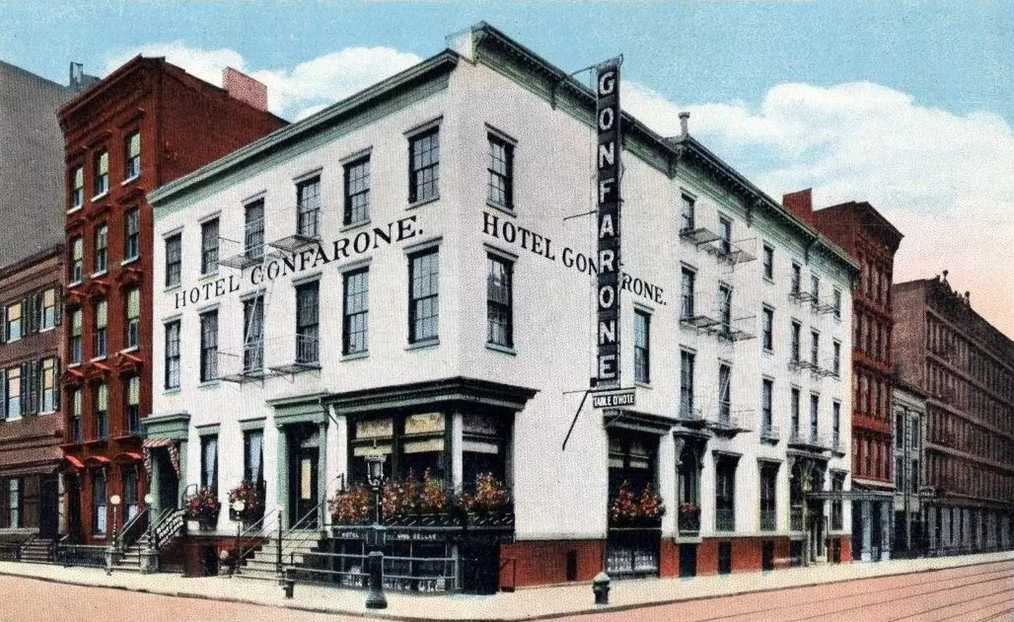
There is nothing as interesting (to me) as a memoir about a restaurant from an insider who reveals its workings not usually known to customers. Papa’s Table d’Hôte by Maria Sermolino is such a memoir, published in 1952, decades after her father’s ownership of the New York City restaurant, Gonfarone’s.
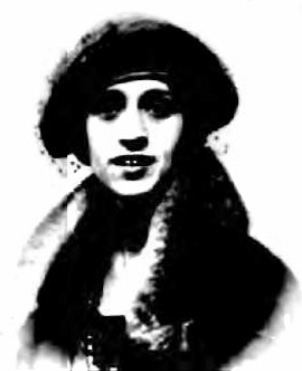
Maria’s career as an editor and writer was extensive. After graduating from the Columbia School of Journalism and spending a couple of years writing about post-WWI conditions in France, she interviewed Italian Fascist leader Benito Mussolini. Later she worked for Time, was the editor of The Delineator and for 11 years an associate editor for Life magazine. She attributed her lifelong unmarried status to overhearing conversations about women among waiters and from male guests invited by her father to join him at his table. [above, Maria at age 25, in 1920, the year she interviewed Mussolini]
Gonfarone’s began in business around the turn of the last century as an Italian pension-type eating place, transitioning into a bohemian resort for Greenwich Villagers. It was run initially by Caterina Gonfarone who operated it in a basement on the corner of Eighth and McDougall streets. She soon partnered with Maria Sermolino’s father, Anacleto, who saw to it that the dining room was moved upstairs. Then, as neighboring residences were acquired by the partners, the popular Latin Quarter table d’hôte expanded to eventually accommodate 500 diners at a time. Sermolino soon acquired the restaurant from Madama Gonfarone, but kept her name.
After the Sermolino family moved into the complex of buildings (which also included a small hotel), Maria spent much of her childhood in the restaurant. Chapter 6 of her book is entitled “The Barroom Was My Playground.” She assisted her mother, the restaurant’s cashier, by spotting waiters who failed to pay her mother for drinks they ordered for customers at the bar. (They would have been reimbursed later, but without paying first they were able to keep the customers’ payments for themselves.)
But that is not the only way in which the staff tried to make extra money on the side. Dishwashers sold food scraps and fat to a company that made soap, with higher prices paid for barrels with more fat. On occasion Madama Gonfarone would catch a dishwasher pouring a large tin of unused lard into a barrel for a higher payoff. It was also common for the staff to smuggle out bottles of wine, chickens, lobsters, and other choice food items when they left at night. Her father refused to institute routine searches because he thought it would be bad for morale.
Because the restaurant was connected to a hotel, the bartender also acted as the room clerk. He took advantage of his position by renting rooms to prostitutes, even on occasion — when she was away — renting Madama’s room for more than double his usual charge.
Not all the restaurant’s customers were treated equally. Waiters would see to it that their favored regulars got larger portions, choicer cuts of meat, and less melted ice in their drinks. A standard menu, 50 cents on weeknights and 10 cents more on Saturdays and Sundays, featured Antipasto, Minestrone, Spaghetti, Salmon with Caper Sauce, a Sweetbread, Broiled Chicken or Roast Beef, Vegetables, Potatoes, Green Salad, Biscuit Tortoni or Spumoni, Fresh Fruit, Assorted Cheeses, and a Demi-tasse. In all likelihood the portions would have usually been on the small size.
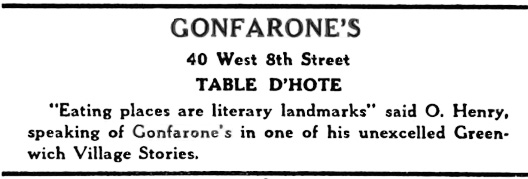
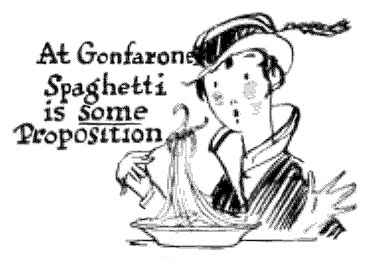
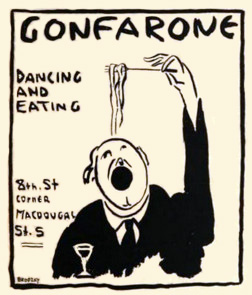
“By the simple act of ordering spaghetti an American was plunged into a foreign experience,” observes Sermolino. [above, 1916 advertisement from The Greenwich Village Quill; below, 1919 Quill]
All meals came with a glass of California claret, which the restaurant bought 40 or 50 barrels at a time, reducing their cost to ten cents a gallon. Apart from that free glass, which impressed many American patrons who were unfamiliar with wine and considered it exotic, the bar was a money maker. Maria called it “a gold mine.” A Manhattan cocktail — with cherry — cost 3 cents but sold for 15 cents, she explained.
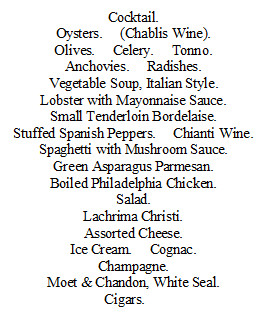
Banquet menus were grander and supplied more alcoholic beverages, as is shown in a 1904 menu above for a dinner given to honor a supporter of Democrats in the Tammany-controlled area occupied by the restaurant.
The restaurant’s best years were before World War I, when it was not unusual to serve four to five thousand dinners on an average weekday and double that on a good Saturday or Sunday, with waiting patrons spilling down the hall and into Macdougal Street. When food ran low the cooks would water the soup and waiters would offer patrons omelets.
With the onset of Prohibition, Maria’s father decided to get out of the business and concentrate on his other interest, real estate. Under new ownership, Gonfarone’s remained open for another 10 years, until 1930. The buildings were razed in 1937.
With the end of World War II, the United States became the undisputed world power as well as the leading economy, producing the largest share of the world’s goods.
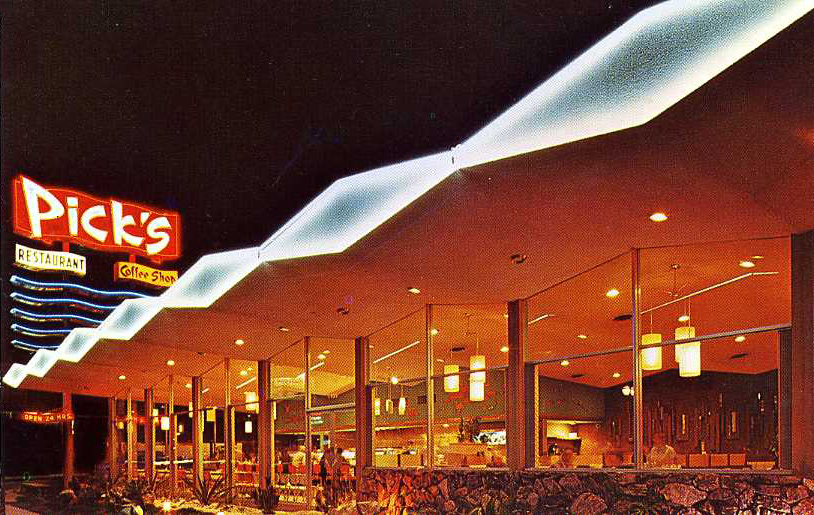
Many changes took place in American society as the soldiers returned. Suburbs sprang up with housing for growing families, shopping centers appeared, and many workers enjoyed prosperity. And a new type of eating place came into being, known as the “California coffee shop.” There had been coffee shops before that, but Southern California introduced new features, particularly in terms of design.
Triumph at the war’s end was celebrated with ticker-tape parades, but also in the design of cars and buildings, including the exuberant design of coffee shops in Southern California. The style of restaurant buildings that has also come to be known as “Googie” was modern, but without the severity of International Style. It used a wide range of materials developed in wartime, and forms inspired by the angles of fighter planes, the energy of the atom, and the bursts of bombs.
The inspiration for the striking designs of California coffee shops – known as Coffee Shop Modern – is frequently attributed to the space age, but over time the realization has grown that it was equally inspired by U.S. world ascendancy rooted in warfare. It may seem strange to attribute inspiration for a sprightly and bright type of architecture and interior design to something as ominous and deadly as the bomb, but a number of writers have made this connection.
In the words of Michael Sorkin’s essay “War is Swell” [in World War II and The American Dream, 1995]: “That the atom so readily became a chipper symbol of American modernity in the immediate aftermath of its use as the greatest instrument of mass death in human history speaks volumes about the relationship of the accomplishments of war to the formal culture of peace. The decor of the fifties is all bursts and orbits, nuclei and energetic spheres. The atom was fully relegated to the class of things, isolated from life.” [See also Elizabeth Yuko’s “Why Atomic Age Design Still Looks Futuristic 75 Years Later”]
Elements of coffee shop design can be seen in the look of automobiles of the same time. Some of the striking elements of California coffee shop design were echoed in the fins of Cadillacs inspired by the P-38 fighter plane. In Googie Redux, author Alan Hess, who has been largely responsible for recognition and appreciation of the creativity of Coffee Shop Modern, notes that Time Magazine called the 1959 Cadillac design the “ICBM [Intercontinental Ballistic Missile] look,” and also that “The Olds Rocket, the Olds Cutlass, and the Buick LeSabre were all names borrowed from aeronautics.”
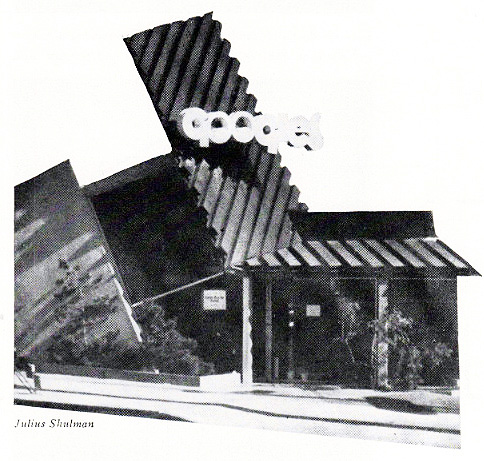
The design of coffee shops was nicknamed “Googie” after architect John Lautner’s 1949 unique Los Angeles creation bearing that name. It featured expansive glass window walls, unusual angles and roof lines, prominent signs, and bright colors. [partial view shown above — it extended farther to the right]
The vocabulary of Coffee Shop Modern signals its inventiveness. Terms in a glossary by Alan Hess in his book Googie Redux include: amoeboid, boomerang, cantilevered canopy, diagonals, dingbat, flagcrete, folded plate roof, free form, hyperbolic paraboloid, starburst, steel web lightener, structural truss, and tapering pylon.
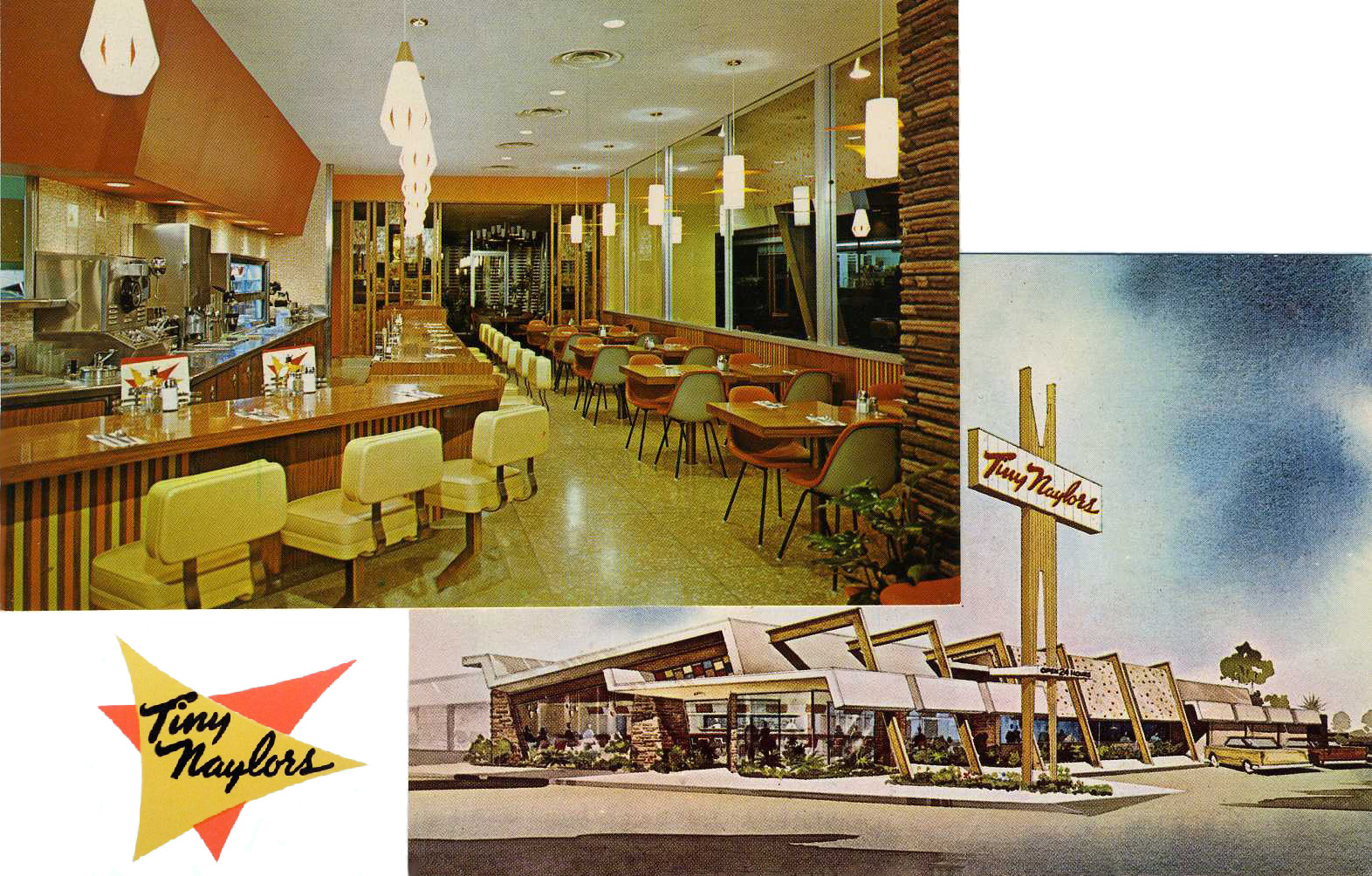
California coffee shops, often bearing nicknames of their owners (Norm’s, Biff’s, Ship’s, Hody’s, Sherm’s, etc.), were casual, unpretentious, comfortable, moderately priced, and open 24 hours. Compared to the inexpensive eating places of the Depression, they offered a cheerful example of luxury for the masses, or what has been termed “populuxe” (See Thomas Hines’ book of the same name). Contrary to the usual negative public reaction to modern architecture, the upstart designs of the coffee shops were well accepted.
Counter seats were usually spaced generously and built with cantilevered supports allowing for unobstructed floor cleaning. [see above] Many had walls of decorative stone. A 1955 news story about the newly built Carolina Pines Jr. at LaBrea and Sunset noted its imported Italian mosaic tile columns, Palos Verde stone walls, and custom-designed wall plaques, among other features. It also had a carpeted dining room and an outdoor patio eating area in a garden protected from road noise and dirt with decorative fencing. [see below]
The coffee shops also introduced exhibition cooking. Although Eastern diner-style eateries had long done their cooking in sight of patrons, coffee shops introduced stylish designs and materials to the cooking areas and kept them sparkingly clean.
And, oddly enough, considering that the coffee shops were open all night, many of them had cocktail lounges.
Coffee shops designed along the lines of Southern California’s soon spread across the country. In St. Louis there was the Parkmoor, Cleveland had Manners, and Denny’s, with its beginnings in California, flourished everywhere.
Of course, as was true with neon signs, there were critics, notably Peter Blake in his 1964 book God’s Own Junkyard. He lumped Googie-style designs with neon, billboards, subdivisions, and a general decline in the built environment.
Starting in the mid 1960s but gaining in the 1970s Googie style was rejected, and what has been dubbed the “browning of America” by Philip Langdon had begun. Now chain restaurants of the coffee shop type began featuring earth tones, mansard roofs, exposed wooden beams, hanging plants, and subdued lighting. The coffee shop type of suburban restaurant continued in chains such as Denny’s despite competition by fast food establishments. McDonald’s, which had itself begun with Googie styling, toned down its buildings.
The change was due in part to the Vietnam War, but I can’t help but wonder if Americans hadn’t already become disenchanted with power and wealth based on military might.
Rarely is the word fantastical used to modify the word cafeteria. Nor are restaurant proprietors usually thought of as powerful vice crusaders. [cover, 1940s booklet; below Pacific Seas]
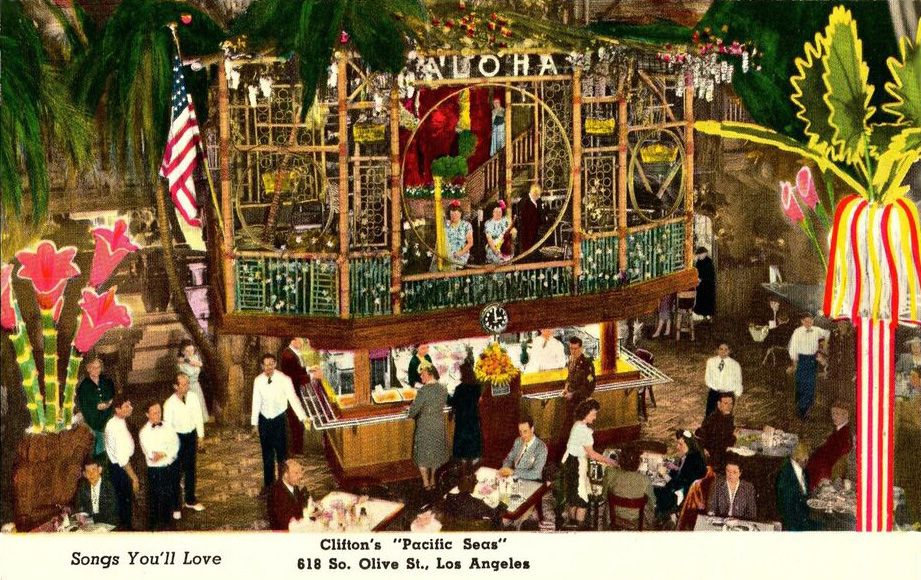
A major exception of the latter was Clifford Clinton, creator of two of Los Angeles’ most memorable cafeterias. Both Clifton’s Pacific Seas and Clifton’s Brookdale were indeed fantastical, exotic, and composed of an odd blend of entertainment and salvation. In appearance they anticipated elements of Disneyland as well as Polynesian restaurant decor.
One of their strangest aspects was that they represented Clinton’s missionary work. After a few years of operating his father’s Puritan restaurant chain in San Francisco – previously owned by moralist Alfred W. Dennett — he came to Los Angeles in 1931 and re-opened a former Boos Brothers cafeteria at 618 S. Olive.
By the following year he was running that “Clifton’s” cafeteria plus another one on W. Third, one on Hollywood Blvd, a hotel probably housing his employees, “A miniature Cafeteria of the Tropics” in Whittier, and a “Penny Caveteria” in a basement on S. Hill street that offered dishes for 1 cent each.
In October 1932, perhaps the worst year of the Depression, a newspaper featured a smiling woman in the Caveteria with her 5¢ meal of soup, veal loaf, macaroni, sliced tomatoes, and buttered bread. According to another story, she was but one of an average of 4,500 customers fed each day (except Sundays, when all Clifton’s closed). Lines typically stretched down the street. For Christmas that year 7,000 guests enjoyed a Christmas turkey dinner priced at 1¢.
In 1939 Clinton remodeled the redwood-forest-themed Clifton’s Brookdale that had opened in 1935 as well as the original place on S. Olive, Clifton’s Pacific Seas, with a dazzling Polynesian look, neon palm trees, and many, many waterfalls. [Brookdale interior shown above; below more waterfalls, Pacific Seas exterior]
Along with meals, the restaurants acted as social centers and spiritual retreats for the thousands of uprooted mid-westerners who had relocated to Los Angeles. And they served as a kind of political base for Clinton’s reform campaigns. His cafeterias and his political activities were entirely consistent with the tenor of Los Angeles culture of the time. As George Creel summarized it in a 1939 Colliers article, the city throbbed with “two thousand religious cults . . ., each claiming daily and direct communication with Jehovah, and an equal number of social, economic and political movements: Epic, Social Credit, Utopia, the Townsend Plan and Thirty Dollars Every Thursday, etc., all guaranteed to promote the immediate salvation of mankind.”
Religiosity permeated the Clifton’s Cafeterias, as it had Dennett’s and would in a number of restaurants later in the century. If guests left the main dining room of Pacific Seas and entered the basement they would find a life-sized figure of Jesus praying in The Garden of Meditation [shown above]. Brookdale featured a Little Chapel set amidst the redwoods.
During World War II, Pacific Seas diners could also post their “feelings and wants” on a bulletin board or consult with a “Mrs. Von” in her bamboo hut for advice on personal problems.
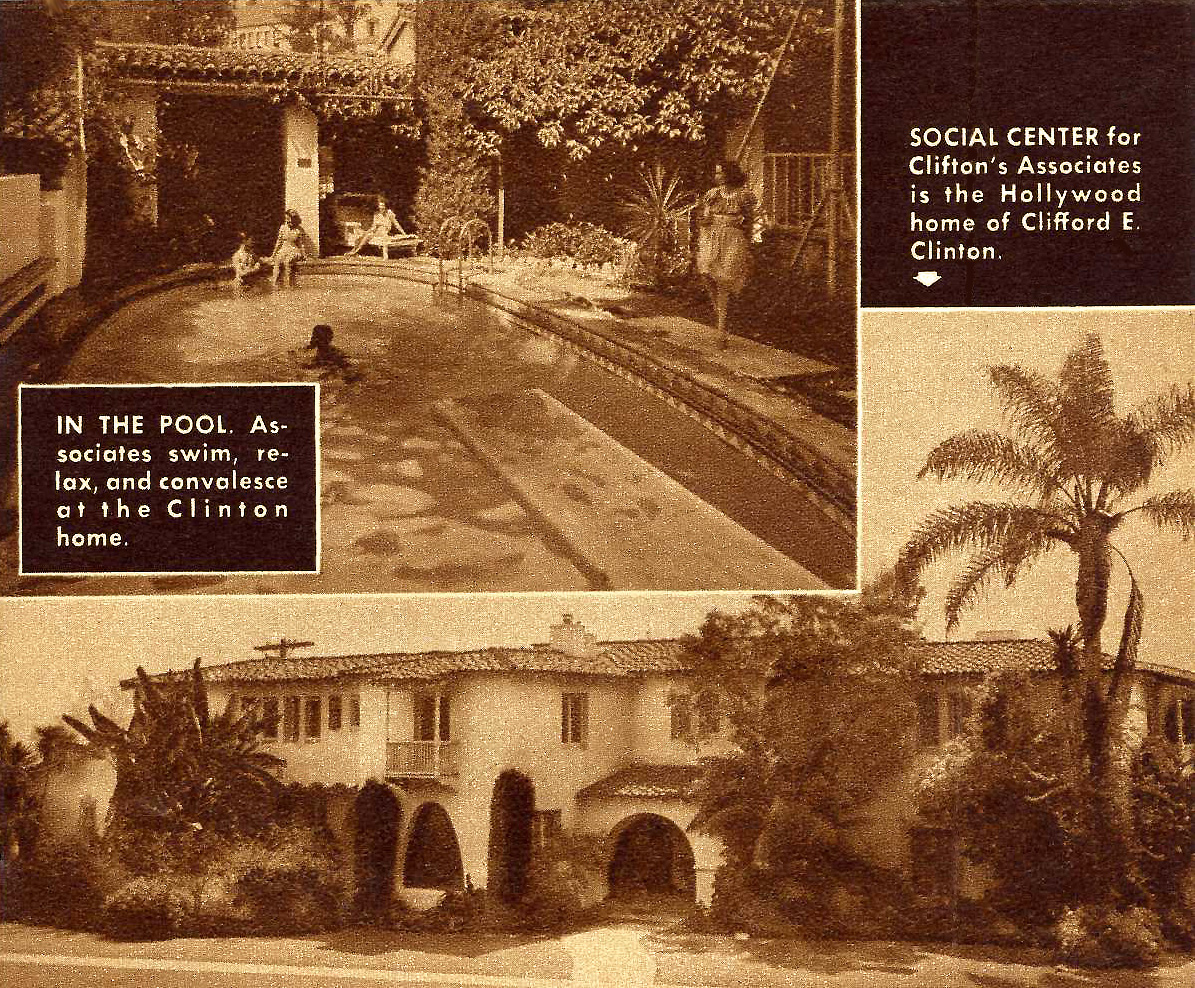
Clifford Clinton’s mission to offer affordable meals continued throughout his career. The policy was that no one would be turned away because of a lack of funds. Although the practice undoubtedly ate into revenue, and was probably taken advantage of by some, Clinton managed to amass enough profits to live in a sprawling mansion on Los Feliz Blvd. and Western Ave in which he hosted convalescing employees [shown above]. (The house sold last year for close to $5M.)
Clifford Clinton was as colorful as his restaurants, despite his appearance as a conventional religious and civic-minded family man. He had spent much of his childhood in China with his missionary parents, an experience that he said made him ultra-sensitive to human hunger. That is unusual but it was just a prelude to his role as one of Los Angeles’ prominent crusaders of the 1930s dedicated to cleaning up the city’s vice and political corruption.
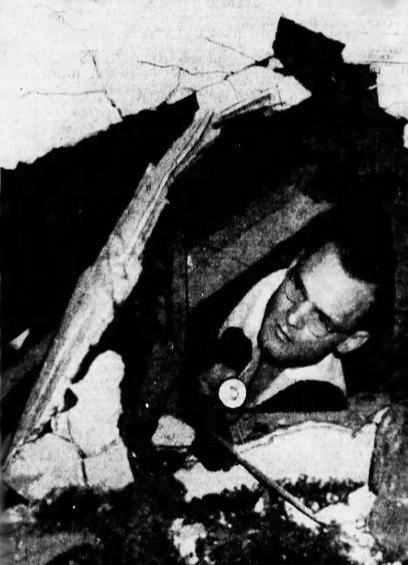
He succeeded in getting Mayor Frank Shaw recalled and replaced by the candidate of his choice, who he promoted on his radio show. In addition, the city’s police chief was indicted and found guilty of plotting the car bombing that severely injured the private detective working for Clinton’s lawyer.
Clinton’s success as a crusader has been partly attributed to his alliances. He worked with Protestant ministers under the banner of an organization he created known as C.I.V.I.C (Citizens’ Independent Vice Investigating Committee). And he also allied with the Communist Party during its popular front phase. As a result of these efforts, gambling, prostitution — and the city’s anti-Communist Red Squad — were eliminated, or at least removed from sight.
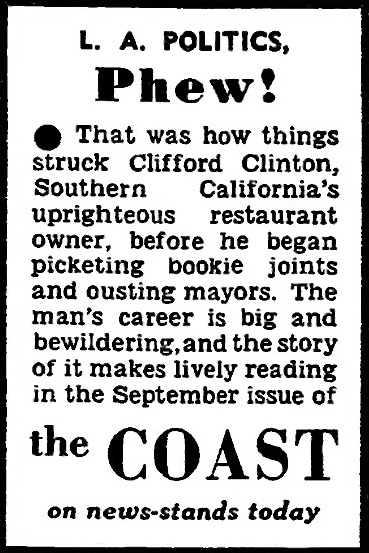
Through these years Clinton experienced endless phone threats, a bombing at his home, false reports of food poisoning at his restaurants, and an endless array of dirty tricks such as an invasion of one of his public forums by 300 hungry people who had been given tickets for a (non-existent) free meal of chicken and beer. [above: 1939 advertisement for magazine article; below: Clinton examines bomb damage]
Having turned the cafeterias over to his children in 1946, Clinton and his business partner, Ransom Callicott, focused on world hunger. They found a scientist who developed what would be known as Meals for Millions, a soy-based one-dish meal that could be prepared as soup or, with a little flour or corn meal added, bread.
Clinton died in 1969 but his restaurants, including a number of conventional ones in shopping centers, endured well into the 2000s.
It's great to hear from readers and I take time to answer queries. I can't always find what you are looking for, but I do appreciate getting thank yous no matter what the outcome.
So, e-mail me!










 It's great to hear from readers and I take time to answer queries. I can't always find what you are looking for, but I do appreciate getting thank yous no matter what the outcome.
 Restaurant-ing through history