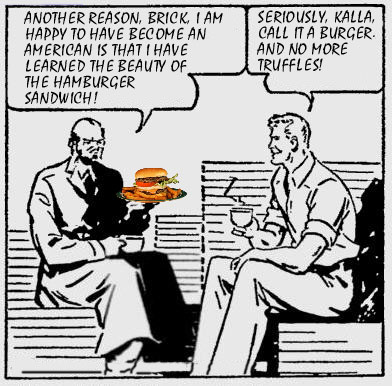
Brick counsels the elitist alien Kalla about his Americanization issues around food. Increase your own cultural capital by reading about the hamburger’s restaurant career.
Brick counsels the elitist alien Kalla about his Americanization issues around food. Increase your own cultural capital by reading about the hamburger’s restaurant career.
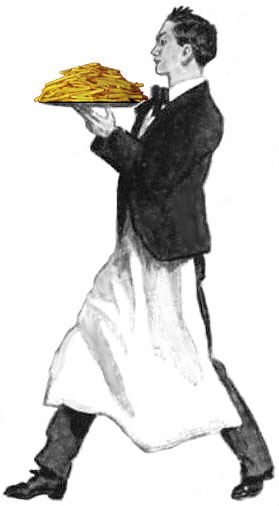 I suspect that in the 19th century more Americans ate French fried potatoes at home than in restaurants. Boiled, baked, and mashed potatoes were more common on restaurant menus than fried potatoes of any sort.
However there were probably a few restaurants that served French fries. Maria Parloa, whose New Cook Book of 1880 included a recipe for preparing French fried potatoes in a frying basket lowered into boiling fat, traveled around giving cooking lessons, and I know of at least one restaurant manager who attended them. The course of lessons she delivered in Trenton NJ in 1884 included how to make French fries, perhaps extending to the sweet potato fries that appeared in her cookbook. I have discovered at least one 19th-century restaurant menu with French fries, in Grand Forks, North Dakota, in 1894.
The reason why few restaurants served fries then was not that they weren’t popular but that they used too much cooking fat. According to Jessup Whitehead, a culinary advisor to restaurant cooks in the 1880s and 1890s, raw potatoes cooked in hot lard were the most expensive potato dish for an eating place to prepare, while baked potatoes were the most economical.
 Perhaps things were starting to change in the 20th century. I’ve found a 1902 advertisement for a potato slicer for hotels and restaurants that cut “perfect French fries.” In 1911 another company produced a heavy duty model (pictured). Around this time there was a movement afoot among restaurants to charge separately for French fries rather than provide them “free” with meat or fish orders. This change could have made it possible to make a profit despite the high cost of cooking oil.
In France at this time – and probably much earlier – street vendors outfitted pushcarts with coke-fired kettles and prepared fries (“pomme frites”) on the spot for customers who ate them from paper cones. Many American soldiers in France during World War I developed the French fry habit, probably increasing demand for them in this country upon their return. In the 1920s and 1930s they began to appear on more and more menus. During World War II potatoes were scarce but after the war returning GIs, sick of mashed potatoes because of the dehydrated ones they had eaten in mess halls, hungered for French fries. Through much of the 20th century restaurant operators believed that men loved fries more than women did.
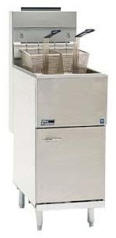 French fries were prominent on menus of postwar drive-ins. By then they were available frozen or formed from moistened dried potatoes forced through an extruder (little did the vets know they were eating dehydrated potatoes in a new guise). By 1968 the restaurant industry considered it “archaic” to make French fries from fresh raw potatoes. It was so much easier to shake frozen fries out of a bag straight into the fryer, no muss, no waste. According to Jakle & Sculle in their book Fast Food, the consumption of frozen potatoes went from 6.6 pounds a year per person in 1960 to 36.8 pounds in 1976. In this same period French fries made the short hop from drive-ins to their successors, hamburger chains such as McDonald’s.
Perhaps because of their mid-century popularity as side dish to sandwiches, French fries were shoved aside in the white tablecloth restaurants of the 1960s and 1970s by the old-fashioned baked potato which returned to favor as the prestigious accompaniment to steak and prime rib, especially when served with sour cream and fresh, er, frozen, chives.
© Jan Whitaker, 2010
Filed under food
 I question whether there are huge gender differences in food preferences but I’ve seen plenty of evidence that many restaurants have marketed menus on this basis, especially by playing to the idea that men have manly tastes. This idea seems to have grown stronger in the 20th century when more women patronized restaurants on an equal basis with men.
Many people believe that men like heartier food than women do. In the 19th century, of course, men dominated restaurants and women were often viewed as special guests. Since eating places were accustomed to catering to men then, menu staples such as oysters, beef, and pie came to be seen as men’s favorite dishes. Perhaps they were, but then again they may have been regarded as “masculine” simply because men were the ones who usually ate them out in public.
In the early 1900s articles began to appear in newspapers that offered ideas of what food men liked best. Restaurants designed menus to appeal largely to male diners. Pollution of oyster beds brought growing distrust and beef came to top the list. “Quick lunch” spots noticed that men ordered more meat dishes than women. Louis Sherry said that women guests in his deluxe Fifth Avenue restaurant did not like to draw blood so they avoided red meat and game.
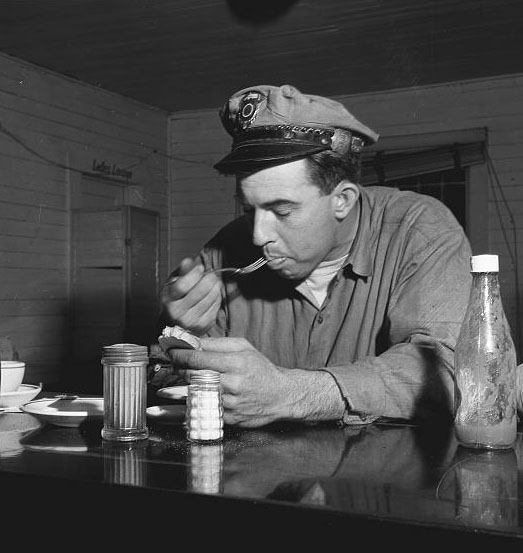 In the many places that served “business men’s lunch,” the favorite meal was meat and potatoes, pie, and coffee. If the lunch was served in a tavern setting, the pie and coffee might be replaced by a glass of beer. But men had other favorites as well, such as griddle cakes, corned beef and cabbage, beef stew, chili con carne, bean soup, fried potatoes, and ham and eggs.
With the advent of national Prohibition in the 1920s, observers noticed that men were eating lighter meals, more sandwiches, and even the occasional salad. While nutritionists hailed the change as healthier, some restaurant owners longed for the return of the heavy eater. When beer became legal again in 1933 the executive chef of Chicago’s Palmer House said, “With the stein on the table, masculine foodstuffs are bound to come into their own.” In 1934 a New York guide book tipped off men about where they could enjoy “man-sized” food “served without fancy gegaws.”
 After Prohibition men who preferred no women in the dining room could go to bar & grill restaurants in hotels such as the Esquire Restaurant in the Penn-Harris Hotel in Harrisburg PA or the men’s bar at the Waldorf Astoria where they could enjoy their Martinis and Mutton Chops minus female company. In the men’s bar at the Mayflower Hotel in Washington, D.C., the dining room captain personally prepared Cannibal Sandwiches of raw beef, onion, egg yolk, and Worcestershire sauce at guests’ tables.
Known as the Rib Room, the men-only Mayflower bar was also host to FBI chief J. Edgar Hoover, who lunched there daily in the 1960s, always at the same table facing the door. His favorite meal, consumed with only the slightest variation, was cream of chicken soup, coffee, and Jello. While he was President, in 1970, Richard Nixon and four of his staff dropped in at the Rib Room for breakfast after Nixon’s early morning visit to Vietnam War protesters at the Washington Monument. Nixon ordered corned beef hash with an egg on top which, according to his press secretary, marked the first time he had eaten this dish in five years.
© Jan Whitaker, 2010
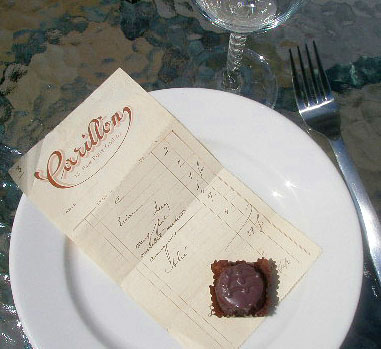 In his 1904 Culinary Handbook, Charles Fellows pledged: One of my first thoughts in writing this handbook was to abstain from French terms. I said to myself, I WILL WRITE AN AMERICAN CULINARY HANDBOOK FOR AMERICANS. I have heard it frequently stated that the terms for the bill of fare could not be properly represented in the American language. I SAY IT CAN, and as proof positive you have it here. There are no French terms used for the receipts [recipes] of this book, and the headings as given are what should in my opinion be placed on the bill of fare, as perfectly adequate in describing the dish.
He was unable to keep his pledge. There are French terms throughout the handbook. On one typical page appear not only the fairly commonplace French words purée and sauté, but also béchamel, epigramme, haricot, matelote, saûtoir, and vélouté. He duly translates Chicken Chasseur as “Broiled chicken, Hunter’s Style,” but then instructs the cook to serve it with “sauce chasseur.”
Fellows felt that many dishes on restaurant menus went unordered simply because diners didn’t know what they were. This may have been true, especially since the dining public was broadening in the early 20th century, bringing unsophisticated but monied newcomers into high-class restaurants.
French terms began to appear on American menus in the 1850s. By the 1890s their use was considered essential for luxury restaurants. But the tide began to turn around the 1920s when people started eating lighter, faster meals and menus were greatly scaled down, simplified, and rendered in English. The 1918 menu of the Tuxedo Rotisserie and Grill actually listed “Frog Legs in Paper Bags” rather than the dreaded en papillote. But, there are terms that remain today and still puzzle diners. Many of the menu terms below were not well known by most Americans in the 1890s, nor even 40 years later.
compote – a dish of fruit stewed in sweetened liquid, sometimes a dessert as was the case with Compote of Apricots and Rice which appeared on an 1893 menu at San Francisco’s Delmonico’s Restaurant. But I have also seen “Pigeons en compote” on an 1841 menu.
fricandeau – sliced meat or fish fried or braised and sauced, similar to a fricasée. In 1839 Fricandeau of Veal appeared in the French section of a menu of the Astor House, a first-class NYC hotel. This term is antiquated today.
glacé – according to Restaurant Menu Planning (1954), this word is an excellent one for menus, right up there with oven-baked and crisp. It properly refers to reduced meat stock that can be used to give flavor and sheen to dishes. Sweet Breads Glace was on the menu for a special dinner at the Rankin House, Columbus GA, in 1887.
jardiniere – Le Jardinier de Macaroni à la Italienne appeared on an 1843 Tremont House menu under Hors D’Oeuvres. In 1915 the Budweiser Café in Indianapolis IN offered “Fricandeaux (perhaps indicating by the “x” that there is more than one slice) of Veal, Jardiniere” for a mere 30c. Jardiniere indicates a dish served with a garnish of cut up mixed vegetables, perhaps in gravy. In 1965 the Armour Company advertised a new product which provided restaurants with flexible film pouches containing eight servings of braised oxtails jardiniere.
la financiere – Sweetbread patties a la Financiere as served at Fleischmann’s in NYC in 1906 undoubtedly were patties made from the thymus glands of veal or young lambs with a garnish or sauce of button mushrooms, bits of truffle, and possibly some cockscombs (yes, the red things atop roosters’ heads) with Sherry or Madeira wine.
maitre d’hotel – The Broiled Halibut, maitre d’hotel on the menu of New York’s Café des Ambassadeurs in 1905 was fish with a melted butter sauce to which was added lemon juice, chopped parsley, and a little grated nutmeg. The popular and expensive Jack’s in San Francisco dared in 1947 to offer Broiled Spring Salmon Steak à la Maitre d’Hôtel, giving the words their full accented treatment. (The menu also featured Tripe à la Mode de Caen.)
ragout – this word, now antique, was almost synonymous with French cooking in the early 19th century and critics always referred to it when criticizing French food for its overseasoned character which was believed to be unhealthy and induce drinking. In short it means spicy stewed meat and vegetables. When given a French name, western restaurants could sell stew at high prices to miners who felt they were living large. Ragout of Mutton appeared on a 1903 menu of the Occidental Hotel, Breckenridge CO.
rissole – According to Delmonico’s long-time chef Charles Ranhofer, in the 1890s rissoles were one of many items that could be served for the hors d’oeuvres course which followed soup. They were made of chopped meat, or possibly fish, vegetables, or even fruit, which was held together with egg, formed into a rounded shape, encased in crumbs or pastry, and fried.
quenelles – meat or fish forced through a small mesh and formed into balls, such as the marrow balls in the Green Turtle Soup aux Quennells a la Moelle served at the Central Hotel in Charlotte NC in 1896 or Quenelle of Calves Liver, German Style, served at Kentucky’s Louisville Hotel in 1857. Not long ago I attended a forum in NYC which declared quenelles, and the fancy cuisine they represent, totally decrepit.
vol au vent – a pastry basket from which a “lid” is cut and replaced after inserting a filling of delicately sauced meat, fish, vegetables, or fruit. The case is then baked. Sometimes found grossly misspelled on menus as in “voloven garnie de clams a la poulette,” which presumably is pastry with a chicken filling garnished with clams.
© Jan Whitaker, 2010
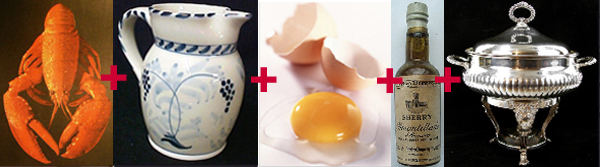
The tale has often been told of Benjamin Wenberg who created a fabulous new dish at Delmonico’s restaurant in NYC sometime in the 1870s. The punch line revolves around how Charles Delmonico changed the name to Lobster Newberg to spite Wenberg after the two men had an argument. Do you believe the story? I am suspicious of it.
As a historian I run across many legends of this type. There is always a delightful little detail that makes the story click and lures journalists into repeating it so often that it becomes undisputed truth. Less catchy, and thus less repeated versions of the Lobster Newberg story, suggested that Wenberg did not want his name used so the name of the dish was altered slightly – or that the Delmonicos named the dish Newberg right from the start out of respect for Wenberg’s privacy.
It’s doubtful that Wenberg invented the dish. A sauce made of cream, egg yolks, butter, and sherry wine – the à la Newberg part of Lobster Newberg – was known as terrapin sauce and was in use before the 1870s.
Did Wenberg have anything to do with Lobster Newburg? Some stories imply he was the first to use the sauce with lobster. To me it seems doubtful that he would be more likely than top chefs to see its wider potential. In fact at least one Delmonico chef claimed to have developed the dish. In yet another version of the story, Delmonico’s named it for him because he ordered it so often.
Maybe. Whatever. As far as I can tell, no one has ever found the name Lobster Wenberg on a Delmonico’s menu. Nor has Lobster Newberg been found on menus from the 1870s or 1880s.
Although Benjamin Wenberg may be altogether irrelevant to the story of Lobster Newberg, he was an actual person, a well-known figure in New York City in the 1850s and until his death in 1885. He was in the shipping business, buying, selling, and chartering sea-faring vessels. At least one of his ships, Panchita, was suspected of engaging in the slave trade in 1856 and 1857.
The dish attributed to him became popular in the 1890s and the legend of its naming was oft repeated in this decade. It was a favorite chafing dish recipe for home entertaining and any restaurant with the least pretensions was bound to have it on the menu. Restaurants occasionally prepared it tableside in a chafing dish. Shrimp, crab, scallops, and sometimes frog legs were also offered à la Newburg.
These dishes were usually spelled with a U on restaurant menus. Which is another oddity since Wenberg’s name was usually spelled with an E.
© Jan Whitaker, 2010
 Last year, thanks to a travel screw-up, we found ourselves eating Christmas dinner at a San Francisco hotel. It was new and chic, with a highly rated chef, so we could have fared much worse … and yet we were dissatisfied. There was something pompous about how dramatically the waiters poured soup from pitchers into bowls which had been daubed artistically with creme fraiche. Not to mention all the other absurd ceremony that surrounded the meal yet failed to prevent orders from being mixed up and food from arriving burnt or cold.
Anyway, this got me wondering about eating Christmas dinner in hotels roughly100 years ago, around the turn of the last century when lengthy formal dinners were still in vogue. Even though hotels were the best places other than home to have a holiday dinner then, I’m not sure we would have liked that experience any better.
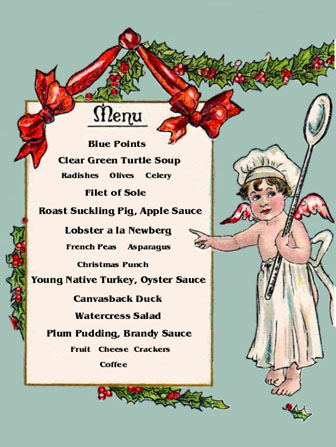 For one thing, who could eat all the food hotels piled on? The menu shown here represents my distillation of the most typical dishes from about 20 Christmas dinner menus of American hotels from 1898 to 1906. I’ve selected only one dish for each course, whereas the actual menus often had three or more and diners could choose as many as they wanted! Though the number and sequence of the courses varied somewhat from hotel to hotel, the most common arrangement was as shown here. The meal began with Oysters (a course all their own in the U.S.), then Soups, Relishes, Fish, Relevé (featuring a roast despite a later Roasts course – I don’t get it), Entrées, Vegetables, Roasts, Game, Salads, Desserts (which could be subdivided, with hot desserts coming first, under Entremets), Cheese, and ending with Coffee. Strictly speaking the Relishes, Vegetables, and Salads are not separate courses as they would be served with other dishes. So I believe the sample shown here would be an 8-course dinner. Each course would have been accompanied with wine and brandy may have been served with the coffee.
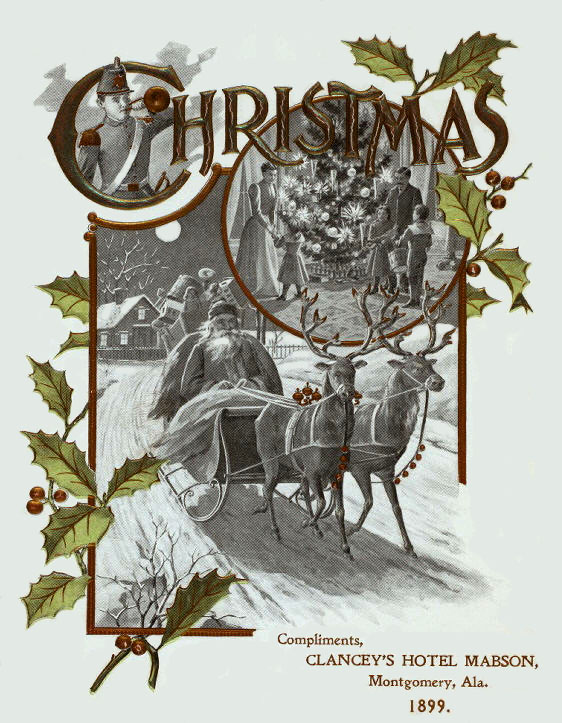 There were some interesting regional dishes on the menus I looked at. The Hotel Metropole in Fargo ND offered Saddle of Antelope; the New Century Hotel in Union SC had Pompano and Carolina Quail; while the Tulane Hotel in Nashville had Stuffed Mangoes*, Fried Hominy, and Dew Drop Corn. The Hollenbeck Hotel in Los Angeles mentioned that its Turkey was “Pomona Farm Fed” and featured a salad of Monk’s Beard greens. Two hotels, in Alabama and Michigan, presented Suckling Pig that had been barbecued. Without doubt the most unusual menu was that of Jack H. Clancey’s Hotel Mabson, primarily accommodating traveling salesmen in Montgomery, Alabama. In addition to Pompano and Barbecued Suckling Pig, its Christmas menu – the only one entirely devoid of French – introduced dishes seen nowhere else such as Stuffed Tomatoes, Scrambled Calf’s Brains, and Grandma’s Fruit Cake.
Whatever kind of dinner you eat on Christmas Day, enjoy it!
* Thanks to food historian Gary Allen for decoding stuffed mangoes as stuffed bell peppers.
© Jan Whitaker, 2009
Filed under food, restaurant customs
 It seems as though almost all of history’s food forces have cooperated to give cheese top billing in restaurant meals today. Only one cheesy custom failed to catch on, that of finishing a meal with cheese and fruit as was done in small French and Italian restaurants in the later 19th century. Craig Claiborne argued in 1965 that even the best New York restaurants didn’t know how to handle the cheese course. They had poor selections which tended to be old, overripe, or served too cold. One restaurant admitted their chef was in the habit of popping cheese straight from the fridge into the oven to soften it. Restaurateurs that Claiborne interviewed insisted that Americans didn’t like cheese after a meal. I’d agree that most prefer their after-dinner cheese in the form of cheesecake.
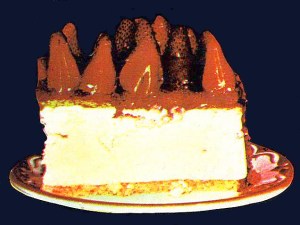 Cheese has been a staple food in American eating places probably since the first tavern opened. Regular meals were served only at stated hours but hungry customers could get cheese and crackers at the bar whatever the hour. For “Gentlemen en’passant,” the Union Coffee House in Boston promised in 1785 that it could always furnish the basics of life: oysters, English cheese, and London Porter. Across the river in Cambridge, the renowned Othello Pollard, aka “the Prince of Creams,” specialized in epicurean cheesecakes in 1805. By the 1850s, English chop houses in the East were famous for their Welsh rarebits, while pie came with a wedge of cheese just about everywhere.
When Germans immigrated to America in the 1850s and 1860s they brought their fondness for Limburger, often ridiculed in the press. The Italians introduced grated Parmesan for pasta dishes, as well as risotto, macaroni and cheese, and cheese-filled ravioli. In the late 19th century cheese became a standard item at “free lunch” counters in saloons, and many allegedly exhibited a solitary dried-up cheese sandwich as proof of their status as genuine restaurants during anti-saloon crackdowns in the early 20th century. In the 1920s toasted cheese sandwiches of all varieties became luncheonette favorites.
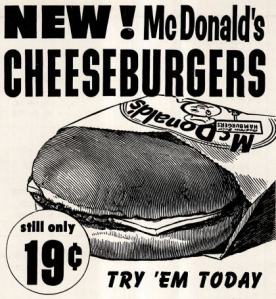 Cheeseburgers were a product of the fast food industry of the 1920s, claimed as inventions by both the Rite Spot of Southern California and the Little Tavern of Louisville. Strange there aren’t thousands of other contenders because what was there to invent, really? Cheeseburgers were strongly associated with Southern California before WWII — Bob’s Big Boy of LA introduced cheeseburgers in 1937. Another step forward came in the 1930s when a bill was introduced in the Wisconsin legislature requiring restaurants and cafes to serve 2/3 oz. of Wisconsin cheese with every meal costing 25 cents or more. In the same decade Kraft Cheese was among major food producers providing restaurants with standardized recipe cards.
 It was after WWII that cheese spread its melted gooeyness everywhere — on pizza, hamburgers, Mexican dishes, and pasta, until today, well … just picture TV advertisements for TGI Friday and Olive Garden. Mass-produced cheesecake made its restaurant debut around 1950. McDonald’s introduced cheeseburgers in 1960. In the 1970s vegetarian and health food restaurants fell in love with dishes such as 7-cheese meatless lasagna, cheese-stuffed cauliflower, and cheese-smothered veggies on brown rice. From 1960 to 1978 annual cheese consumption doubled from 8.3 to 17.4 pounds per capita. Now we each eat close to 34 pounds of cheese a year, mainly on pizza and hamburgers.
© Jan Whitaker, 2009
Filed under food
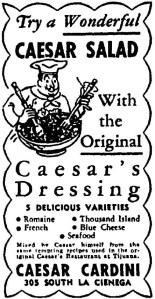 When we get into questions of the origins of certain dishes we have left history behind and entered into the murky depths of lore and legend.
Take ye olde Caesar salad. Look this up on the internet you will most likely find out that it was created by Caesar Cardini at his restaurant in Tijuana on a holiday weekend in which he made the devastating discovery that he was out of all supplies except for romaine lettuce, eggs, lemons, garlic, olive oil, a wedge of Romano cheese, and some stale white bread. I call this the “loaves & fishes” story, despite the absence of anchovies which was not an ingredient he approved of.
Who else has claimed inventorship? According to Caesar, his competition consisted of several Hollywood restaurants including Paul’s Duck Press and The House of Murphy (where it was known as a Di Cicco salad), and maybe the Brown Derby and Chasen’s. Then there were also all the busboys and waiters he trained to make the salad tableside on that fateful day, in 1924 (or, by other accounts, in 1913, 1919, 1921, 1926, or 1927) who lodged claims as the inventors.
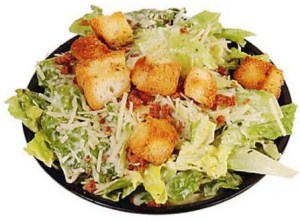 A strong inventorship claim was presented by Caesar’s brother, Alexander, in the 1960s. Caesar died in 1956, while running a grocery store in Los Angeles where he produced and bottled Caesar salad dressing. According to Alexander’s son, who ran Cardini’s in Mexico City, the two brothers had developed the salad together in a Tijuana restaurant in their younger days, improvising on a recipe their mother used when they were boys in Italy. In this “Mother’s recipe” account, the salad was initially called “Aviator’s salad” in honor of their customers who were soldiers, sailors, and airmen.
One of the busboys at the old Tijuana place invoked a combination of the “Mother’s recipe” origin myth with “loaves & fishes” (times 2!) in his inventorship claim. His mother was an Italian living in Austria during WWI. Facing food shortages she found herself with eggs, romaine, Parmesan cheese, wine vinegar and olive oil from which she improvised a salad. Her son, Livio Santini, emigrated to Mexico where he got a job working in Caesar Cardini’s restaurant kitchen. Feeling hungry one day, he mixed himself his mother’s salad whereupon a customer came into the kitchen, coveted it, and from there the salad landed on Caesar’s menu and began its upward ascent.
When confused about origins it is always wise to cherchez l’agent de PR, in this case Chet L. Switell. He was the most active public defender of Caesar’s claim as salad creator. Chet also fabricated a legend about the invention of popsicles (orange soda in a paper cup with a spoon in it forgotten outdoors overnight during a sudden freeze). Chet sent out letters to newspaper editors and columnists and succeeded in getting movie stars such as Cary Grant and Irene Dunne to prepare Caesar salads on screen. He claimed that the salad was named and popularized by Wallace Simpson, who frequented the Tijuana restaurant before she became the Duchess of Windsor. However, in a 1952 interview Caesar Cardini said that the salad did not become well-known until 1937 when a Hollywood screenwriter named Manny Wolfe provided the recipe to various restaurants. Or, perhaps it became popular after New York food editors were introduced to it at a special Waldorf-Astoria promotion around 1947.
Next mystery: who added the anchovies?
© Jan Whitaker, 2009
Filed under food, proprietors & careers
 In the 1850s the great landscape architect Frederick Law Olmsted, designer of New York’s Central Park, traveled through the South to investigate the institution of slavery. His observations were published in three volumes which were influential in turning readers against slavery. Around 1857 he traveled to Memphis, Tennessee, where he stayed at the Commercial Hotel. Although it was considered a first-class establishment, things did not go well for Frederick in the dining room as his journal entry for March 20, below, reveals. Among the dishes appearing on the not-too-elegant menu were “Beef heart egg sauce,” “Calf feet mushroom sauce,” “Bear sausages,” “Fried cabbage,” and, for dessert, “Sliced potatoe pie.” Better than whole potato pie, I guess.
He wrote:
Being in a distant quarter of the establishment when a crash of the gong announced dinner, I did not get to the table as early as some others. The meal was served in a large, dreary room exactly like a hospital ward; and it is a striking illustration of the celerity with which everything is accomplished in our young country, that beginning with the soup, and going on by the fish to the roasts, the first five dishes I inquired for … were “all gone;” and as the waiter had to go to the head of the dining room, or to the kitchen, to ascertain this fact upon each demand, the majority of the company had left the table before I started at all. At length I said I would take anything that was still to be had, and thereupon was provided immediately with some grimy bacon, and greasy cabbage. This I commenced eating, but I no sooner paused for a moment, than it was suddenly and surreptitiously removed, and its place supplied, without the expression of any desire on my part, with some other Memphitic chef d’oeuvre, a close investigation of which left me in doubt whether it was the denominated “sliced potatoe pie,” or “Irish pudding.”
© Jan Whitaker, 2009
Filed under food, miscellaneous
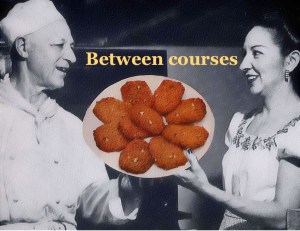
 People have strong feelings about their favorite dishes from restaurant chains. I am thankful to all those who poured their hearts out on the subject on Jane & Michael Stern’s ever-fascinating Roadfood forums. I have excerpted the following wistful memories from “Long-gone regional franchises” which took on a life of its own and ran for years. After each snippet is the pertinent chain restaurant.
— The burgers were awesome, the onion rings superb and the soda cold. [Charco’s]
— Oh, those hot dogs steamed in beer. [Lums]
— Loved those frosty mugs of root beer and Big Boy hamburgers! [A&W]
— I went for the Ollie Burger. They bought the sauce from “Ollie’s Trolley.” [Lums]
— Shrimp salad. Chili spaghetti size. Navy bean soup. [Bob’s Big Boy]
— Frothy orange drinks and orange chili dogs. [Orange Julius]
— Tuesday night 10-cent “Coney Island Dogs.” [A&W]
— Orange colored cheese on their cheeseburgers, not the pale yellow stuff of today. [Wetson’s]
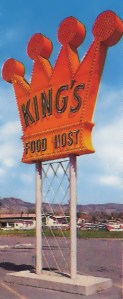 — The Cheese Frenchies were unique. [King’s Food Host]
— They also had a Tuna Frenchie, a Hot Dog Frenchie. [King’s Food Host]
— Greasy fish and plank-style chips. [Arthur Treacher’s]
— Orange drink with pulp in it. Tuna sandwiches. What fast food chain would have a tuna sandwich today? [Chock Full O’Nuts]
— How exotic it was to have a sandwich on a bagel. [Bagel Nosh]
— Good hot dogs. Never touched, cooks used plastic gloves. [Chock Full O’Nuts]
— My first straight cut fry. [Wetson’s]
— I remember eating and loving my first Apple Fritter there! [Hamburg Heaven]
— Coffee and Apple Fritters (hush-puppy shaped apples in dough, deep-fried and powdered sugar coated). [Dutch Pantry]
 — Pickles, diced onion, relish, mustard, ketchup and mayo were all available. [25 Cent Hamburger]
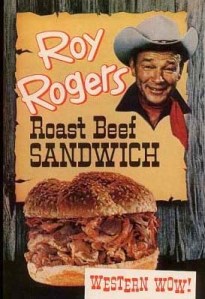
— Yummmm. A cheeseburger with ham and barbecue sauce. [Roy Rogers]
— Broasted chicken and french fries with a sweet sauce to die for. [Arctic Circle]
— I can remember stopping in for a soft drink and a basket of crumbs. [Squire Jacks]
— Ketchup was free. The fries weren’t like the “wavy,” half-fried or quick fried potatoes of today’s ilk. [Toot ‘n Tell]
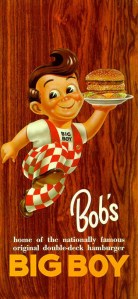
— I haven’t had the heart to stop in and see if they still had Strawberry Pie. [Big Boy]
Filed under chain restaurants, food

 It's great to hear from readers and I take time to answer queries. I can't always find what you are looking for, but I do appreciate getting thank yous no matter what the outcome.
So, e-mail me!
It's great to hear from readers and I take time to answer queries. I can't always find what you are looking for, but I do appreciate getting thank yous no matter what the outcome.
So, e-mail me!