Tag Archives: bohemian restaurants

The ‘bohemian’ restaurant in fiction

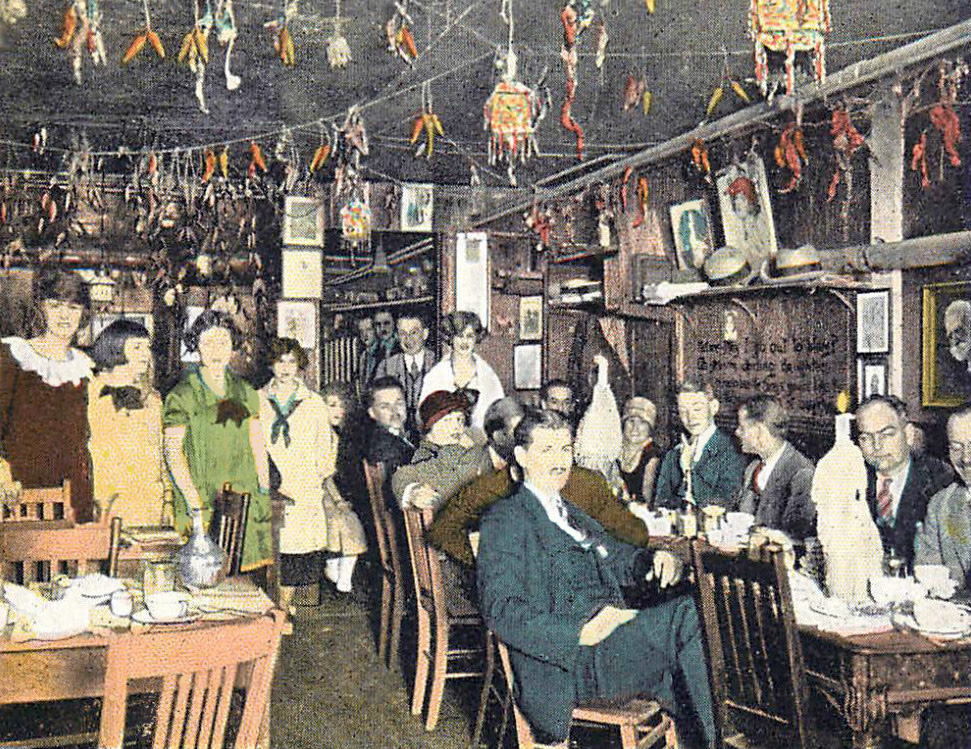
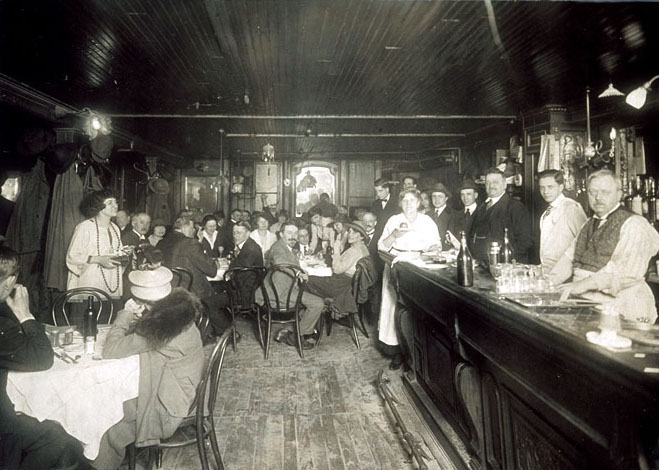
There was a time when many Americans considered inexpensive French or Italian restaurants naturally bohemian – wild and crazy, not too clean, filled with oddball characters, and offering menus of unfamiliar and dubious dishes. But nonetheless fascinating. Novelists liked to use them as settings, so they turned up in fiction of the late 19th and early 20th centuries as the excerpts below illustrate.

In the final sample presented here we meet up with a restaurant keeper who wishes his place was more bohemian because that would make it a better draw.

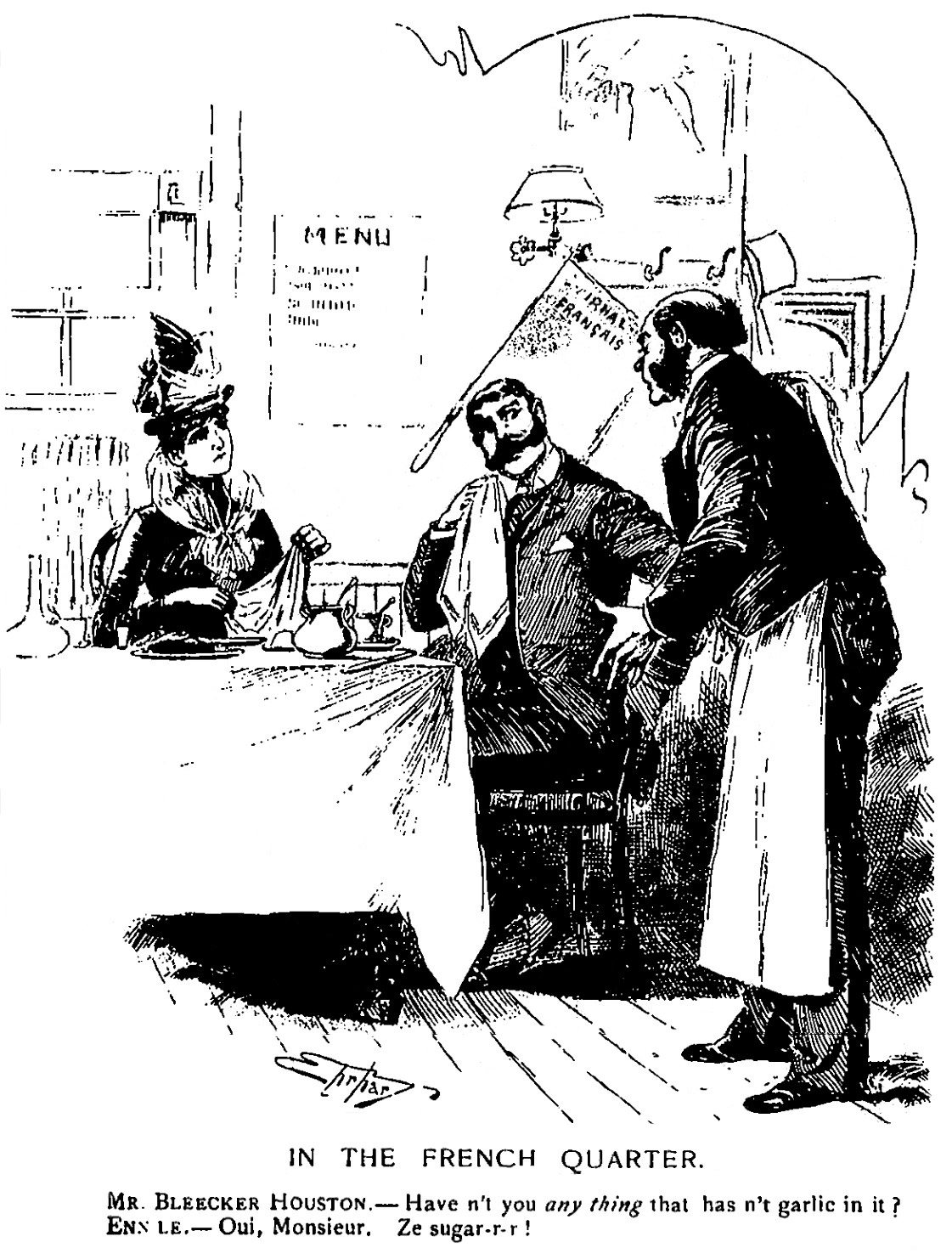
1886 The Midge, Henry C. Bunner – To celebrate the Midge’s 16th birthday, her guardian, a doctor, takes her out to dinner at a table d’hote in New York City’s French quarter.

It was a modest feast, only a plain table-d’hôte dinner, eaten in the heart of the quarter, at a cost of half-a-dollar apiece. They had tried more elaborate dinners, at the great hotels up-town; but they preferred the simpler joys of Charlemagne’s restaurant. They both possessed that element of Bohemianism which belongs to all good fellows; the Midge was a good fellow, as well as the Doctor.

Charlemagne’s is a thing of the past; but he was a jolly king of cheap eating-house keepers while he lasted. He gave a grand and wholesome dinner for fifty cents. The first items were the pot-au-feu and bouilli. If the pot-au-feu was thin, the bouilli was so much the richer. And if the bouilli was something woodeny, why, you had had all the better pot-au-feu before it. Then came an entrée, calves’ brains, perhaps, or the like; a rôti, a vegetable or so coming with it; a good salad, chicory or lettuce or plantain, a dessert of timely fruits, a choice of excellent cheese, and a cup of honest black coffee. And with all this you got bread ad libitum and a half bottle of drinkable wine, that had never paid duty, for it came from California, though it called itself Bordeaux.

1896 Some Modern Heretics: A Novel, Cora Maynard – About two women who adventurously move to Boston to live in a flat and do their own housework. But they don’t know how to cook.

And the alternative of tramping out to restaurants at all hours was a Bohemianism which, in spite of her late advancement, she could not contemplate serenely. It appeared positively disreputable. If her father knew of the actual circumstances of her situation a prompt withdrawal of his original consent would have cut short Vida’s visit on the spot; but she left him in tranquil ignorance . . .

By seven o’clock the girls realized that it was time to have dinner, and then came Vida’s great trial. It was too late to think of cooking anything themselves, so there was nothing to do but face the restaurant.
“Isn’t it a very – a very queer thing to do?” Vida ventured feebly. She would much rather have bought some crackers and eaten them at home in their unpalatable dryness.

“Why, no. It’s a little quiet place we’re going to. I’ve often been. You know we girls don’t believe in being restricted by senseless prejudices. Good gracious, one can’t be so dreadfully hampered in these days of rationality!”

Before long Vida got used to the restaurant, and even enjoyed it when they felt too tired or too lazy to struggle with the cookbook. She enjoyed the whole queer situation and got a taste of such freedom as she had never before dreamed of.
1910 Predestined, Stephen French Whitman – Featuring Benedetto’s, a favorite with artists in New York City.

On the north side of Eighth Street, close to Washington Square, an old, white dwelling-house had been converted into an Italian restaurant, called “Benedetto’s,” where a table d’hôte dinner was served for sixty cents. Some brown-stone steps, flanked by a pair of iron lanterns, gave entrance to a narrow corridor. There, to the right, immediately appeared the dining-room, extending through the house — linoleum underfoot, hat-racks and buffets of oak aligned against the brownish walls, and, everywhere, little tables, each covered with a scanty cloth, set close together.

Felix, at the most inconspicuous table, consumed a soup redeemed from tastelessness by grated parmesan, a sliver of fish and four slices of cucumber, spaghetti, a chicken leg, two cubic inches of ice cream, a fragment of roquefort cheese, and coffee in a small, evidently indestructible cup. Then, through tobacco smoke, he watched the patrons round him, their feet twisted behind chair-legs, their elbows on the table, all arguing with gesticulations. Sometimes, there floated to him such phrases as: “bad color scheme!” “sophomoric treatment!” “miserable drawing!” “no atmosphere!” Benedetto’s was a Bohemian resort.

1912 The Soul of a Tenor, W. J. Henderson – According to a review, “The reader is taken behind the scenes at performances and rehearsals and into the dressing rooms and boudoirs of the artistes; into the café, where foreign singers congregate.”

As for those women who figure in all animated chronicles of the present kind, some of them may have had husbands, but they have tried to forget them, and usually with success. Little Italian restaurants, with hot and opaque atmospheres, are in accord with their temperaments, for their part of the opera world is hot and opaque at all seasons of the year.

It was not a pretty place, that particular Italian restaurant. All the men in it seemed to require cigarette smoke as a condiment for food, and they chewed and puffed alternately. The room was filled with a wreathing blue fog, through which strange head-dresses and still stranger gowns could be seen, for the denizens of this world always garb themselves in streamers of splendor and look not unlike perambulating lamp shades.

They were not only singers. Some were impecunious painters and some were patrons of the arts, who were wont to shout “bravo” from the highest seats in the temple. It gave them a fine satisfaction to eat within reach of real singers. And they were not all Italians, for one feast of spaghetti makes the whole world of Bohemia kin.

1914 Our Mr. Wrenn; The Romantic Adventures of a Gentle Man, Sinclair Lewis – Mr. Wrenn is a lonely lodger who timidly invites a neighbor, Theresa Zapp, to dinner at a restaurant run by Papa Gouroff. She is described as “forward” and “gold-digging.” Although she is not interested in Mr. Wrenn, she accepts his invitation, but fails to be impressed by the restaurant.

The Armenian restaurant is peculiar, for it has foreign food at low prices, and is below Thirtieth Street, yet it has not become Bohemian. Consequently it has no bad music and no crowd of persons from Missouri whose women risk salvation for an evening by smoking cigarettes. Here prosperous Oriental merchants, of mild natures and bandit faces, drink semi-liquid Turkish coffee and discuss rugs and revolutions.

In fact, the place seemed so unartificial that Theresa . . . was bored. And the menu was foreign without being Society viands. It suggested rats’ tails and birds’ nests, she was quite sure. She would gladly have experimented with pate de foie gras or alligator-pears, but what social prestige was there to be gained at the factory by remarking that she “always did like pahklava”?

Papa Gouroff was a Russian Jew who had been a police spy in Poland and a hotel proprietor in Mogador, where he called himself Turkish and married a renegade Armenian. . . . He hoped that the place would degenerate into a Bohemian restaurant where liberal clergymen would think they were slumming, and barbers would think they were entering society, so he always wore a fez and talked bad Arabic. He was local color, atmosphere, Bohemian flavor.

© Jan Whitaker, 2024

6 Comments

Filed under alternative restaurants, ethnic restaurants, food, Offbeat places, patrons

Coppa’s famous walls

coppa'sBlackCat2

The San Francisco restaurant Coppa’s became legendary in the early 20th century as a gathering spot for bohemian artists and writers, especially after they decorated its walls with curious and intriguing murals. Though the murals remained in existence for scarcely a year, because of the devastating fires that followed the earthquake of April 1906, they have been forever tied to the restaurant’s mystique.

coppaincoppa'sBlackCatOver the course of months in 1905 the murals were drawn in chalk crayon by artists who frequented the restaurant on Montgomery Street. Legend has it that proprietor Giuseppe “Joseph” Coppa papered (or painted) his walls a hideous red that offended their esthetic sensibilities, impelling them to mask it with their humorous, nonsensical drawings. An alternative explanation is that Coppa asked the artists to draw on the walls and that he chose red as a good backdrop. I find this more convincing since Coppa himself was a painter.

A row of stenciled black cats at the original location, by Xavier Martinez, was inspired by Le Chat Noir in Paris, the city where Martinez had studied painting. They gave the restaurant its nickname, The Black Cat, which was also used at its new post-fire location.

While I was at the Library of Congress a few weeks ago I had a chance to look at the hard-to-find book The Coppa Murals, by Warren Unna (1952). He interviewed some of the artists involved and also Felix Piantanida, Coppa’s early partner who was responsible for preserving the photographs shown in the book. It’s likely the photos were taken for use in an article by Mabel Croft Deering not published until June 1906 in The Critic, but written before April’s destruction caused Coppa’s closure. The murals themselves were at some point scrubbed off or painted over by the landlord.

coppa'sphoto1906

Though the restaurant was looted by vandals, the building Coppa’s restaurant was in actually somehow escaped destruction [shown above]. With few buildings intact, its value rose and Coppa’s landlord raised the rent, leading Coppa to vacate and open another Black Cat on Pine Street in November. He and Piantanida split up, and for a short time Piantanida conducted a restaurant called La Boheme in the space formerly occupied by Coppa’s.

The artists and illustrators who contributed drawings included some who would become prominent, such as Maynard Dixon, Xavier Martinez, and Gelett Burgess. The artists, along with poets and writers, contributed puzzling sayings and quotations that adorned the walls, fascinating – and insulting – customers (“Philistines”) who came to gawk at the bohemians.

coppa'sbook

The cover of Unna’s book shows a crude rendering of a mural by Xavier Martinez depicting the restaurant’s core group of regulars. Martinez is seated at the far right. Standing behind him is poet Bertha Brubaker, wife of Perry Newberry, smoking a cigarette. Her nickname “Buttsky,” which referred to her habit of saving cigarette butts, appears in the “hall of fame” of names that run beneath the black cats. The names of Coppa’s regulars are interspersed with those of famous writers such as [Johann Wolfgang] Goethe, [François] Villon, and [Guillaume] Apollinaire. The few women named are hard to identify since their last names do not appear, but Maisie was freelance writer Mary Edith Griswold and Isabell was allegedly a newspaper writer.

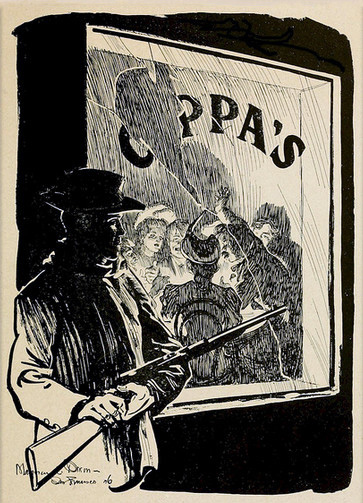
coppa'sMaynardDixonSimpleLifeinBohemiaWhen Coppa moved to Pine Street, a new row of cats appeared, but now marching in the opposite direction. Maynard Dixon also contributed several new images. One of his shows Coppa unfurling a scrolled menu to a crowd that includes regulars who were violinists, writers, poets, and artists. On another wall Dixon commemorated Coppa’s “Last Supper” at his old location, celebrated soon after the fire and necessitating official approval and protection from a marshal who stood guard outside. Another notable feature of the Pine Street murals were two works by a woman, painter and jewelry designer May Mott-Smith.

coppa'sredpaint

Coppa’s second Black Cat closed in 1913, after which Joseph and his son Victor launched Neptune Palace, a more commercial cabaret restaurant. In 1916 Joseph returned to a bohemian theme with The Red Paint, a short-lived restaurant on Washington Street that went out of business at the start of Prohibition, stopping the flow of “red paint,” i.e., wine. It too had murals, never completely finished and lacking the inspiration of those at the earlier Black Cats, despite Maynard Dixon’s participation once again. Many in the old gang had moved to Carmel by the Sea and things were not the same.

coppasaug231933In 1922 Coppa opened yet another restaurant, at 120 Spring Street, offering “old-time dinners,” possibly so-called because they were paired with illicit wine. Joseph was often arrested in raids by prohibition agents, and Victor once escaped by running out the back door. It’s possible the restaurant was officially padlocked for a time because in 1933 it “re-opened,” with the unveiling of a painting by the ever-faithful Maynard Dixon of a nude woman dressed only in shoes, stockings, and a large-brimmed hat with her legs crossed atop the table, toasting an obese man opposite her [see 1933 advertisement]. The same image was used on the cover of the restaurant’s menu at its final location, 241 Pine. That closed in December 1939, marking the end of Joe Coppa’s long culinary career.

Joseph’s wife, Elizabeth, who had been the dining room manager and cashier, died in 1938. After his retirement he took up painting, focusing on portraits of men such as business magnates, Italian dictator Benito Mussolini, and poet George Sterling.

© Jan Whitaker, 2015

12 Comments

Filed under atmosphere, Offbeat places, restaurant decor

“Atmosphere”

atmosphereschaber1941I put the word in quotation marks to acknowledge that what atmosphere in restaurants means is as elusive as air itself — which the word also refers to. It was often used to describe eating places in the 19th century, but not in a flattering way. A typical usage is that from 1868 where someone remarked that in a certain restaurant “the atmosphere is heavy with cooking vapors.”

The term atmosphere (or ambience, which came into use in the 1970s) became used in a more general way to describe the character of a restaurant – that intangible spirit of a place. The broader meaning could encompass an air that was sophisticated or homey, rowdy or relaxing, masculine or feminine, formal or casual, etc. I discovered a 1950s restaurant that claimed to have “Christian atmosphere” with home cooking by a Mrs. and “No Beer, Liquor or Smoking.”

In the 1890s the more general meaning almost always referred to the kinds of people associated with a restaurant, both owners and patrons. For example sawdust on the floor, pictures of athletes on the wall and the presence of prostitutes signaled a thoroughly masculine atmosphere while the presence of artists and writers in French, German, or Italian table d’hotes shouted “bohemian!”. A jolly host could also impart atmosphere, which might be altogether missing if he weren’t on hand, or if his most colorful patrons failed to show.

AtmosphereRomanyMarieSummer1921It didn’t take long before restaurant owners realized they could appeal to new patrons by bragging about their “atmosphere,” especially if it was bohemian. A San Francisco restaurant announced that it attracted “artists, writers, musicians, poets, painters, singers, draftsmen, balladists, literati and newspaper writers.” In 1903 NYC’s Elite Rathskeller Restaurant ran an advertisement claiming to have “Refined Bohemian atmosphere,” which sounds like a contradiction in terms since bohemians were supposed to be carefree souls who violated everyday norms of propriety.

The next step for restaurateurs was to merchandise atmosphere by generating it themselves. Since it seemed that so many people wanted to gawk at bohemians, why wait for them to show up if you could entice them with free dinners? Allegedly some restaurants did just that.

atmosphereVentureTeaRoomPhila

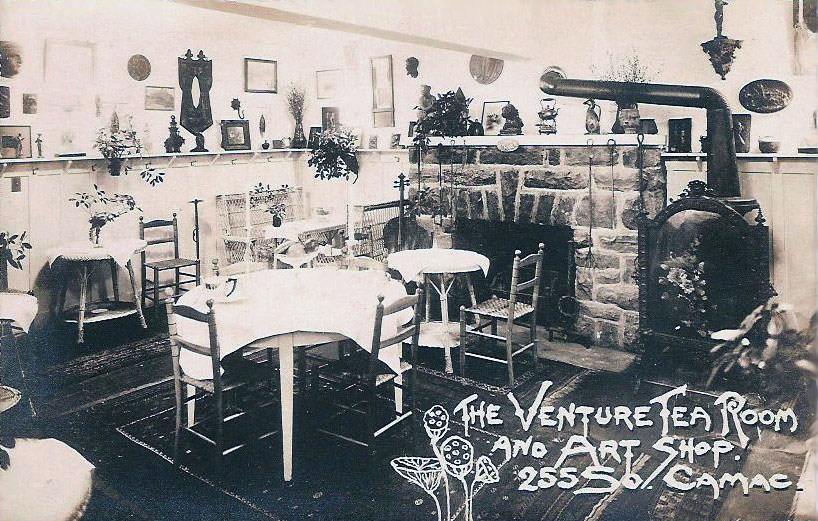
After World War I, following the reign of bohemian restaurants, came a new type of atmospheric eating place, the tea room of the 1920s. The tea room’s special atmosphere was  quaint and homey with artistic touches. In 1922 the Journal of Home Economics pronounced that “The very name of Tea Room has grown to mean a place with ‘atmosphere’ and with furnishings that are unique.” Ranging from the fashionable to the playful, tea rooms proved that women – their primary patrons – were in love with atmosphere.

atmosphere1918FlintMIBucking the trend toward atmospheric decor were a handful of holdouts. Anything like a “restaurant atmosphere” was anathema to a Y.M.C.A. cafeteria in Flint Michigan (1918). The Old Colony Coffee House in Richmond VA renounced “ordinary restaurant atmosphere” in 1924 and vowed it would have instead “simplicity in decorations” and “plainness in food.” Patrons of traditionally masculine restaurants feared that when Chicago’s J. R. Thompson’s tore out its white tiles for a more feminine look it had destroyed its no-nonsense atmosphere and gone “girly girly.” Likewise, design critic Lewis Mumford shuddered when the Childs’ chain replaced the “antiseptic elegance” of its “hospital ward atmosphere” for “fake fifteenth century English,” betraying the honest utilitarianism of the Machine Age. No doubt Mumford chuckled when Alice Foote MacDougall, queen of scenographic Spanish villas and French chateaux in NYC, went bankrupt in 1932. [see The Cortile below]

atmosphereCortile

In the 1950s there was still a tendency in the restaurant industry to see women as the constituency for atmosphere while men supposedly judged a restaurant first by its food quality. But by the 1960s this was no longer true, as indisputably demonstrated by the success of Polynesian restaurants. An executive of the National Restaurant Association (NRA) said that Americans’ demand for atmosphere had raised the cost of opening a restaurant to $4,000 a seat in 1962.

One of the early chains built around atmospheric theme restaurants was David Tallichet’s Specialty Restaurant Corporation in California. In 1965 the firm opened Gate of Spain, capturing the “atmosphere of old Castile” atop a tall building in Santa Monica. Restaurant industry consultant George Wenzel recommended the following year that restaurateurs “give your guests something to do or something to see, or something to make conversations about.” He suggested creating a Gay Nineties or a river boat atmosphere.

In the 1970s theme restaurants came into their own, classified by the NRA as one of three of the basic types of restaurant in 1976, and the one that drew the most affluent guests.

© Jan Whitaker, 2015

5 Comments

Filed under atmosphere, restaurant decor, theme restaurants, women

Picky eaters: Helen and Warren

helenwarren1928

Helen and Warren liked eating in restaurants in the early 20th century when it was a rare experience for most Americans. They kept up with the trends and they tried restaurants of every format. They were affluent New Yorkers, somewhat jaded and always seeking the new thing.

Helen wanted to avoid expense and ostentation but was uncomfortable in offbeat places. Warren was cynical and alternately a cheapskate or big-spender. Both were distrustful. They feared they’d be taken advantage of, and sometimes were.

In the 1920s Helen and Warren were the best known couple in the U.S.A.

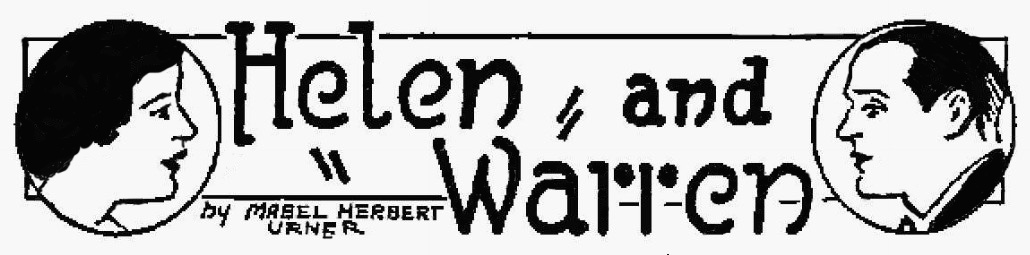
But they were fictional. They were the creation of Mabel Herbert Urner who wrote a column about the pair for over thirty years, from 1910 until the early 1940s.  The column was widely syndicated in newspapers from Boston to Los Angeles as well as in Canada and England. Though fiction, the column presents a fascinating subjective view of dining out, particularly in the 1910s and 1920s.

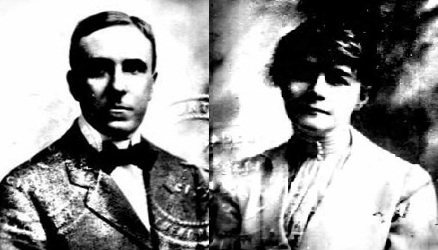
HelenandWarrenLathropandMabelHelen’s and Warren’s experiences likely had some resemblance to Mabel’s own life, particularly when the couple visited restaurants in Paris, London, and other European capitals. After marrying rare book dealer and collector Lathrop Colgate Harper in 1912, Mabel traveled with him around the world. In New York they lived in an apartment at 1 Lexington Avenue across from Gramercy Park from which they surely forayed into restaurants regularly.

Did Mabel and Lathrop, like her famous pair, have a preference for out-of-the-way restaurants such as the French and Italian tables d’hôtes in NYC? One starlit summer night in 1913 Helen dragged Warren to a backyard café run by three sisters. Helen exclaimed “Why, it’s a bit of Paris!” when she stepped into the garden. They were surrounded by writers, artists, and illustrators, including a “queerly dressed” literary woman. (Mabel’s inside joke?) Warren, a successful businessman, scoffed at the artists but even he had to admit afterward, “That [was] the best dinner in New York for the money.” They paid 65 cents each for soup, beef tongue with piquant sauce, squab, and salad, finished with fresh pears, Camembert, and coffee – wine included. The café was clearly modeled on that run by the Petitpas sisters on W. 29th in conjunction with a boarding house where artist John Butler Yeats lived. A dinner with Yeats and friends about this time was memorialized in a painting by John Sloan.

pepperpot

The Petitpas dinner was one of the couple’s few positive experiences. As much as Helen was drawn to offbeat restaurants, she was often squeamish about unsanitary conditions. She refused to eat ground meat. Usually she wiped her silverware with her napkin. She had problems in a Chinese restaurant, an Italian place, an “anarchist restaurant,” probably Maria’s, as well as at the Pink Parrot in Greenwich Village (probably the Pepper Pot, shown here). When she pushed away her plate there, Warren reprimanded her, saying, “You’re a bum bohemian.”

Helen and Warren visited cafeterias, tea rooms, pre-war cabarets, hotel dining rooms, roadhouses, and shoreline resorts in the NYC metro area. Helen was often embarrassed by Warren’s behavior when he showed off or spent too much money. They bickered. He declared a tea room she liked “a sucker joint.” She was critical of the decor and pomp of expensive restaurants, but her attempts to put a brake on Warren’s spending often backfired.

In 1913 they went to a restaurant in the throes of a waiters’ strike. Somewhat surprisingly, considering the bourgeois lifestyles of both Mabel and Helen, the story presents a case for the strikers. Helen questions their server about the goals of the strike, and he says, “They want decent food, m’am; clean food and a clean place to eat it. They want to be treated like men – not dogs! And they want a living wage.” Warren asks about tips and the waiter replies, “Why does he have to depend on tips thrown at him?”

In many ways Helen’s and Warren’s restaurant adventures and complaints seem relevant today. Has it happened to you that a server tries to remove your meal in progress? Have you been charged extra for bread? Welcome to the 1910s.

© Jan Whitaker, 2013

10 Comments

Filed under miscellaneous, patrons

The artist dines out

Before World War I artists in NYC were attracted to cheap, unpretentious little ethnic restaurants in the basements of brownstones that dotted unfashionable side streets. Called table d’hôtes, they harked back to the early days of European restaurants when paying guests sat down with the host family at their dining table. With the meal, which typically consisted of spaghetti, salad, and a small portion of meat or fish, came a complimentary carafe of red wine, not always of the best vintage.

Evidently when Charles Green Shaw, the author of the haiku-like poem below, attended such a dinner in Greenwich Village he wasn’t exactly swept off his feet. Rather he displays a comical tongue-in-cheek attitude about the experience. I would guess he wrote the poem about 1915.

Shaw [1892-1974] was an abstract modern artist whose work is in the collections of major museums such as MOMA and the Art Institute of Chicago. He also was a children’s book illustrator, a poet, and an author of essays and novels. He collected theatrical ephemera and was an authority on Lewis Carroll. His papers, which include some of his drawings, are held in the Archives of American Art, Smithsonian Institution.

The Bohemian Dinner

The ride downtown.
The Washington Square district.
The “bohemian” restaurant.
The descending steps.
The narrow hall-way.
The semi darkness.
The checking the hat.
The head waiter.
The effusive greeting.
The corner table.
The candle light.
The brick walls.
The “artistic atmosphere”.
The man who plays the piano.
The wailing sounds.
The boy fiddler.
The doleful discords.
The other diners.
The curious types.
The long hair.
The low collar.
The flowing tie.
The loose clothes.
The appearance of food.
The groan.
The messy waiter.
The thumb in the soup.
The grated cheese.
The twisted bread.
The veal paté.
The minced macaroni.
The cayenne pepper.
The coughing fit.
The chemical wine.
The garlic salad.
The rum omlette.
The black coffee.
The bénédictine.
The Russian cigarette.
The “boatman’s song”.
The mock applause.
The “temper[a]mental” selection.”
The drowsy feeling.
The snooze.
The sudden awakening.
The appearance of the check.
The dropped jaw.
The emptied pockets.
The last penny.
The bolt for the door.
The hat.
The street.
The lack of car fare.
The long walk up town.
The limping home.
The Bed.

5 Comments

Filed under miscellaneous