Tag Archives: 1930s

Roadside attractions: Toto’s Zeppelin

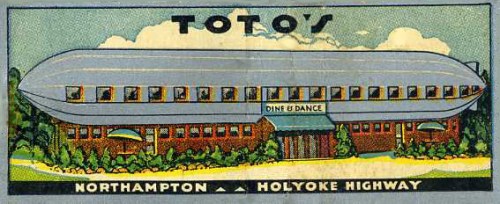
toto'sAs alcoholic beverages made their return in the early 1930s, supper clubs and roadhouses offering meals, entertainment, and good cheer sprang up on highways and byways across the nation. Eager to attract customers, some adopted unusual designs that, on the surface at least, promised something out of the ordinary.

Toto'smenuOne of them was Salvatore “Toto” Lobello’s place on the main road leading from Holyoke to Northampton MA. It looked like the German Graf Zeppelin that was always in the news with tales of travelers gliding through the sky while enjoying its deluxe dining and sleeping accommodations.

The fantastic building was a type of roadside architecture of the late 1920s and 1930s commonly associated with California where sandwich shops and refreshment stands resembled oversized animals and objects ranging from toads to beer kegs. The zeppelin-shaped building was constructed in 1933 by Martin Bros., a well-known Holyoke contractor experiencing serious financial distress at that time. The nightclub apparently failed to open and, in 1934, suffered fire damage (for the first, but not the last, time).

In December of 1935, after months of trying to obtain a liquor license, Toto Lobello announced the grand opening of the Zeppelin. He solved the licensing problem by teaming up with Lillian and Adelmar Grandchamp who were able to transfer the license from their recently closed downtown Holyoke restaurant, the Peacock Club.

toto's1936The advertisement for the opening of “New England’s Smartest Supper Club” announced that drinks would be available in the Modernistic Cocktail Lounge, which was on the ground floor below the dirigible-shaped dance hall. With Web Maxon and his orchestra providing dance music, and a promise of “Never a Cover Charge, Always a Good Time,” the Zeppelin soon became a popular place for nightlife generally and for dinner parties of organizations such as the Elks and the Knights of Columbus.

Toto's1936ADVToto Lobello also had a confectionery business in Northampton located on Green Street across from the campus of the all-women Smith College. Like the confectionery, the Zeppelin became one of the students’ favorite haunts for the 3-Ds (dining, dancing, and drinking). According to an informal survey in 1937 the majority of Smith students liked to drink, preferring Scotch and soda, champagne, and beer. Toto’s ranked as a top date destination.

Toto’s Zeppelin served lunch and dinner and a special Sunday dinner for $1.00. On Saturday nights Charcoal Broiled Steak was featured.

One year after Toto’s grand opening the restaurant/nightclub faced a licensing renewal challenge requiring it to withdraw its application until unspecified “improvements” were made to the facility. But a more serious problem was about to emerge when dirigibles suddenly lost their appeal following the May 1937 Hindenburg disaster in which 36 people perished. Not too much later, in November of 1938, fire would also completely destroy Holyoke’s Zeppelin. In rebuilding, Toto chose a moderne style with a pylon over the entrance.

In the mid-1950s Salvatore Lobello, owing the state a considerable sum for unpaid unemployment taxes, filed for bankruptcy. He closed his Northampton restaurant, auctioning off all the fixtures in 1957. The building, at the address now belonging to a pizza shop, was razed. The Holyoke restaurant continued in business until 1960 when it was seized by the federal government for nonpayment of taxes. It briefly did business as the Oaks Steak & Rib House, a branch of the Oaks Inn of Springfield, before its destruction by fire in 1961. [above, facing pages from the drinks menu, ca. 1950s, courtesy of “a lover of the 1930s, cocktails, and zeppelins.”]

© Jan Whitaker, 2013
3 Comments

Filed under odd buildings, roadside restaurants

Famous in its day: Dutchland Farms

dutchlandHackensackThe Dutchland Farms story parallels that of Howard Johnson’s, its competitor and eventual conqueror. Both were chains of ice cream and lunch shops that began on Massachusetts roadways in the 1920s. But they experienced the Depression very differently. Howard Johnson’s expanded while Dutchland Farms shrank. Though Howard Johnson triumphed over its competitor, there is no doubt that Dutchland Farms strongly influenced HoJo’s development.

Unlike Howard Johnson’s, the Dutchland Farms chain grew out of a real dairy farm, established in 1897 by shoe manufacturer Fred F. Field. Years before the first Dutchland Farm dairy store – not yet a restaurant – opened in 1928, the dairy farm of the same name in Brockton MA had become nationally famous for its prize-winning herd of Holsteins. The ice cream produced by the farm in “28 flavors,” sometimes 30, was advertised as the only Grade A ice cream made in Massachusetts. (Most ice cream then was made from Grade B milk which has a higher bacterial count; now Grade B milk is mostly used for making cheese.)

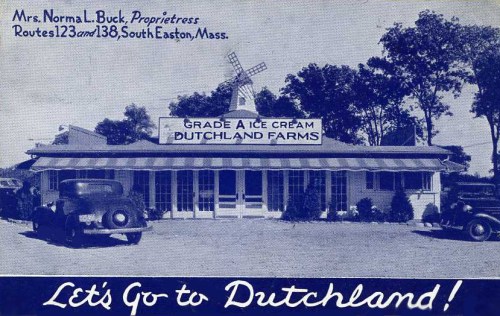
By 1933 the newly incorporated company had 50 roadside stores that sold milk, butter, and eggs, and also served toasted sandwiches, frankfurters, and fountain treats, as well as “Chinese Chop Suey” supplied by Hung’s Food Products Co. of Boston. Soon the menu expanded to include complete dinners. Menus displayed Dutchland Farms “registered” colors, orange, blue, and white, which also formed the color scheme for buildings. The canvas awnings on the white building depicted on the South Easton MA postcard below would have been in eye-catching orange and blue stripes.

DutchlandSouthEastonFifty was probably the greatest number of Dutchland Farms units in operation at any given time. In addition to eastern Massachusetts where most units were located, the company did business in  New Hampshire, Rhode Island, Connecticut, and New Jersey. Some restaurants were operated by the company itself but most were franchised, as was true of  Howard Johnson’s. Women formed 10 to 15% of Dutchland Farms proprietors, a large percentage for a restaurant chain.

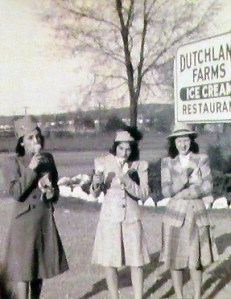
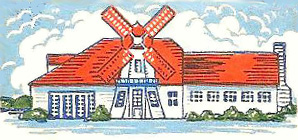
In addition to colorful awnings, Dutchland Farms buildings had two outstanding visual characteristics: orange roofs and decorative windmills which sat atop the roof or formed part of the building front. The roadside restaurants were situated on busy thoroughfares and both features were intended to attract motorists’ attention. Additional evidence of positioning for mobile customers were Dutchland Farms’ ample parking lots.

dutchlandfarmsIceCreamThe Depression was rough on Dutchland Farm operators. A dozen or more of the restaurants went out of business. Some proprietors shifted their allegiance to Howard Johnson. A Fairfield CT operator who opened a Dutchland Farms in 1935 switched to Howard Johnson’s after only a few months. Another, Louise Prout, co-proprietor of a Dutchland Farms in Lakeland NH and another in Pocasset MA, decided to go with Howard Johnson’s when she opened a restaurant in Cambridge in 1936.

Still other Dutchland Farms restaurants became independents. A proprietor near Newport RI rechristened his The Mile Post, while a Dedham MA Dutchland adopted the name of its proprietor, Mary Hartigan. The same fate would one day befall Howard Johnson’s. Louise Prout turned her Cambridge HoJos into The Clipper Ship, disguising the cupola, sheathing the front with dark paneling, and decorating the entry with wrought iron.

Dutchland Farms tried to reorganize its debts in 1939 but was sold to Howard Johnson’s in 1940. Johnson kept the orange, blue, and white colors but was barred from using the Dutchland Farms windmills on restaurants operating as Howard Johnson’s, and chose cupolas instead. However, some of the restaurants he acquired continued to do business as Dutchland Farms and, presumably, kept their windmills. The last Dutchland Farms restaurant I could find evidence of was in Quincy MA in 1951.

It is not obvious why Howard Johnson succeeded and Dutchland Farms failed. Was it because after Repeal Howard Johnson restaurants served alcoholic beverages whereas Dutchland Farms did not? Or was it due to how well the businesses were conducted? Or just luck?

© Jan Whitaker, 2012

20 Comments

Filed under roadside restaurants

Modernizing Main Street restaurants

In the late 1920s the spreading influence of the 1925 “Art Deco” exposition in Paris inspired restaurants in the United States to remodel their exteriors and interiors in the bold new modern style. A leading trade journal, The American Restaurant, proclaimed in its July 1929 issue that modernism had become a notable trend in the industry.

Modernizing restaurants usually went further than skin-deep decorations and included new ventilation systems, dropped ceilings, concealed lighting, sound proofing, and air-conditioning. Many restaurants badly wanted to renovate their facilities, but by 1932 the Great Depression seriously curtailed funding for building and remodeling.

It didn’t take long for central business districts to decline, looking dowdy and down on their luck. Many towns felt if they could improve the appearance of stores in shopping areas it would have a positive effect on consumer spending. When President Franklin Roosevelt signed the National Housing Act into law in 1934, there was rejoicing on Main Streets across the country. Through government-backed, low-interest private loans, the NHA was meant not only to shore up the housing market but to stimulate improvements to commercial properties.

Towns responded wholeheartedly. In Mansfield, Louisiana (population 3,357), every merchant on the main business street signed up for that town’s 1935 improvement campaign and the local bank approved four loans the very first day. In 1936 sixty-nine New Jersey cities and towns were chosen to participate in Main Street modernization programs, with committees of prominent merchants, bankers, realtors, and building contractors presiding.

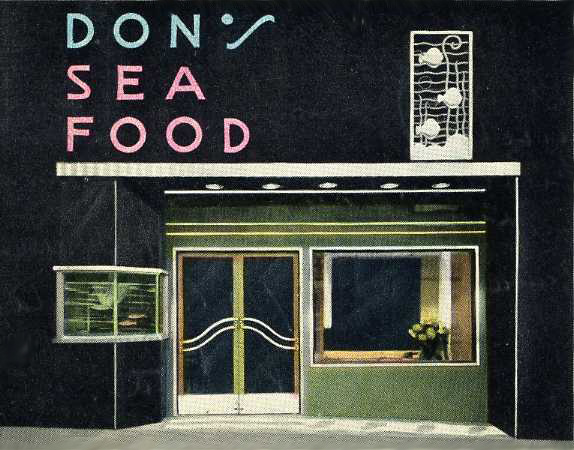
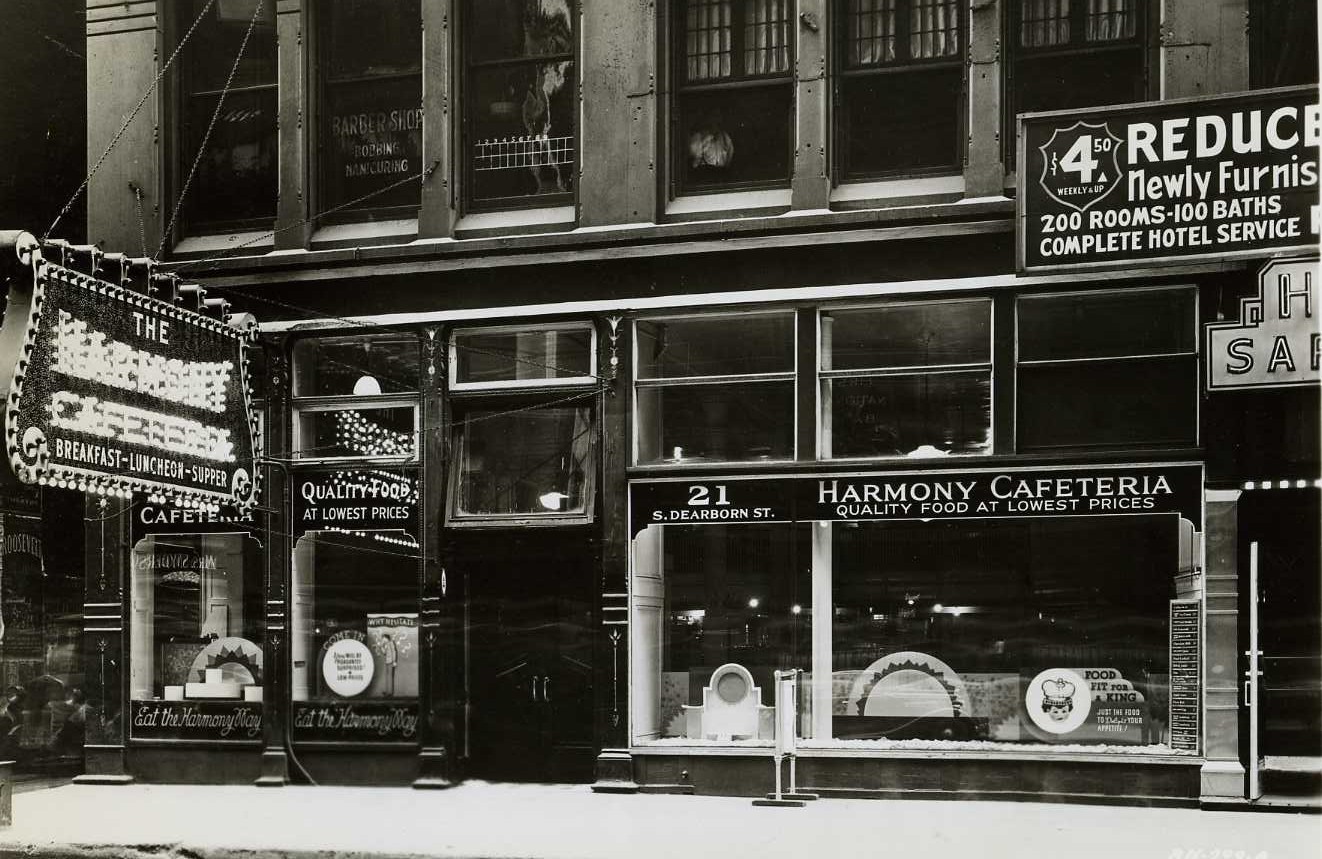
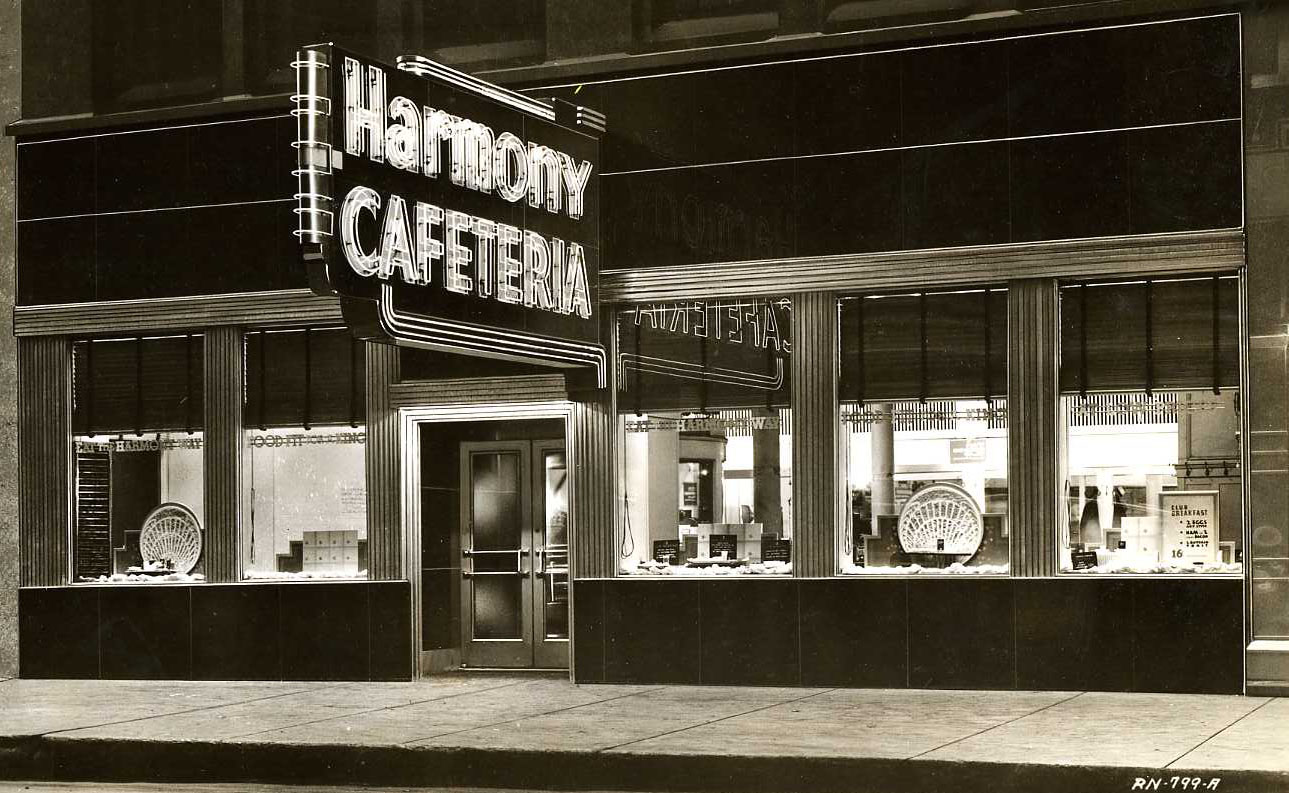
Retailers of all types took advantage of the program under the banner “Modernize Main Street.” Through architecture contests and programs sponsored by manufacturers of structural glass and other materials, a style soon developed known retrospectively as Depression Modern. Although it can be traced back to luxurious Art Deco styles, it was simplified and streamlined, and used industrial building materials such as glass and aluminum rather than marble and rare woods. As shown in before and after shots of the Harmony Cafeteria the new style was less cluttered than what had preceded it.

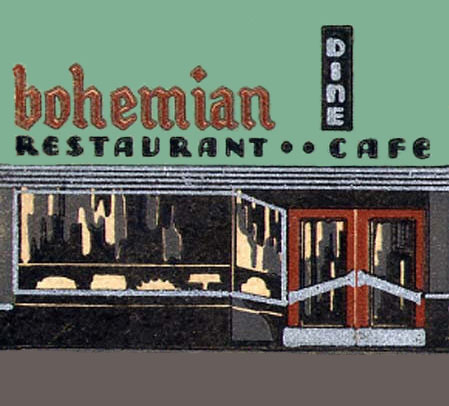
A new facade could be acquired for as little as $1,000 but some restaurants invested far more. For instance, in 1937 Joe Yium, owner of the Shanghai Cafe at 1004 Main in Dallas, sunk $15,000 into a structural glass front of cream trimmed with black, as well as an interior with new furniture and lunch counter all done in cream and deep “mandarin” red. Like the Shanghai, the Bohemian Restaurant in Portland OR [shown above] closed for a month while it was renovated to the tune of $25,000 with a front of black glass and aluminum, increased floor space, new ranges and steam tables, and a pastry department.

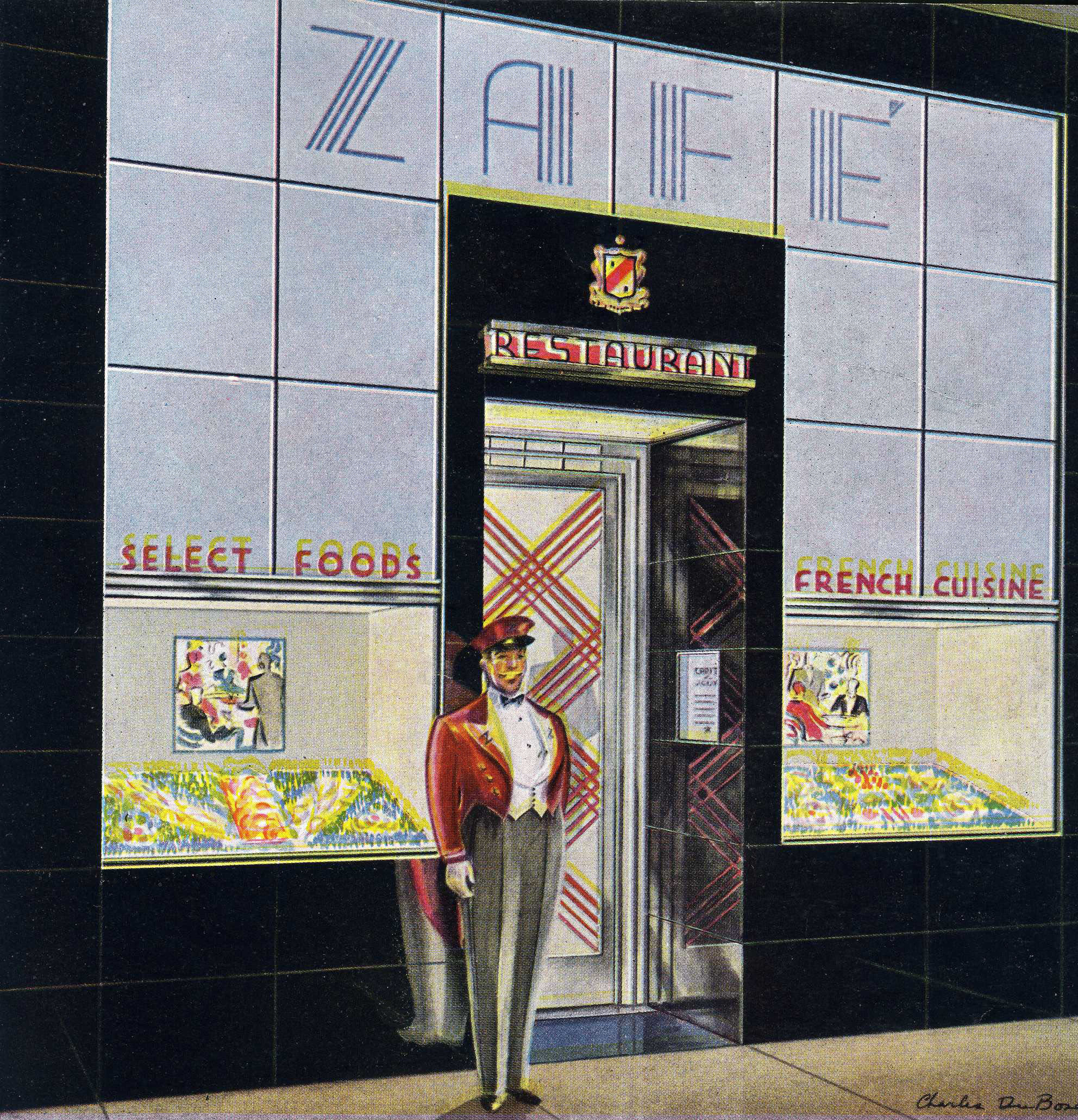
Improvements eligible under the program could include interior decor, air conditioning, and other functional modifications, but nothing symbolized hope for the future nor represented modernization more visibly than gleaming new fronts of shiny glass. Colored glass veneers were provided mostly by two companies, Pittsburgh Plate Glass Co. which made Carrara Glass, and Libbey-Owens-Ford, maker of Vitrolite [advertisement pictured].

Both companies offered complete storefront packages which furnished all materials needed, whether colored glass, clear plate glass, glass blocks, metal framing, signage, or even services of design consultants. Many of PPG’s model storefronts were designed by Walter Dorwin Teague, one of America’s foremost industrial designers. For luncheonettes, a PPG booklet recommended a design (possibly by Teague) using glass blocks and Carrara glass in orange, beige, and Rembrandt blue whose overall effect was “carefree and attractive” and — as you might imagine — had “high visibility.”

Coinciding as it did with the end of national prohibition, modernization paid off in increased business for restaurants, many of which took full advantage of the program. It confirmed the status of Main Street as the symbol of economic health for cities and towns in the popular imagination. However, as Gabrielle Esperdy points out in Modernizing Main Street: Architecture and Consumer Culture in the New Deal, decentralization of downtown shopping districts was well underway by the 1930s. But the modern transformation of Main Street maintained considerable significance to consumer psychology. The styles remained popular until the start of World War II when they were shunned as obsolete.

Today, in American cities and towns vestiges of Depression Modern storefronts, such as black glass panels above or beneath a show window, can still occasionally be spotted.

© Jan Whitaker, 2012

5 Comments

Filed under restaurant decor

Find of the day: the Stork Club

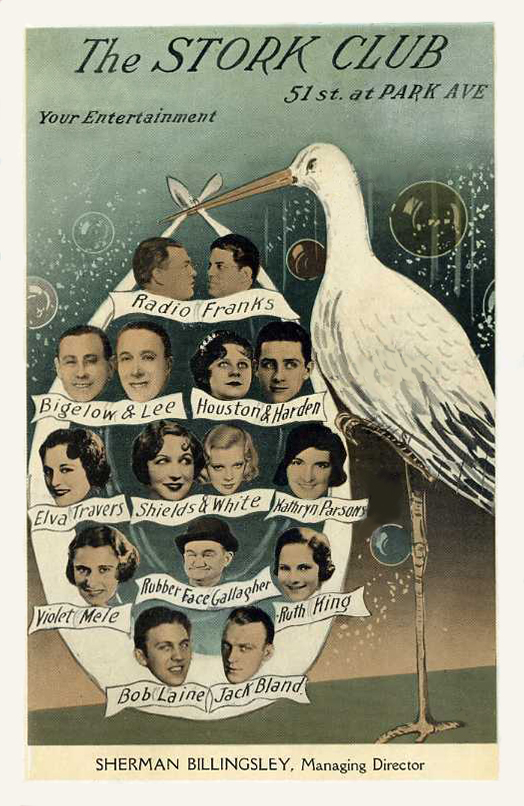
It seems harder all the time to find interesting things at flea markets and vintage paper shows, but I got lucky at Brimfield last week and turned up an unfamiliar Stork Club postcard. What is special is that it dates from before the nightclub/restaurant’s 1934 move to its well known address just off Fifth Avenue on East 53rd Street in NYC.

The postcard shows some of the “Stork’s” entertainers just before the era when its patrons became bigger attractions than its performers. When debutante Brenda Frazier, featured on the cover of Life magazine in 1938, started coming, attention shifted to who was seated at the tables. The early dinner crowd was followed by a late-night set of glamorous publicity seekers, many of them movie stars. Proprietor Sherman Billingsley installed a telephone at the entrance so that the orchestra could strike up an appropriate tune as celebrities were escorted to their tables. [William Boyd, aka Hopalong Cassidy, pictured]

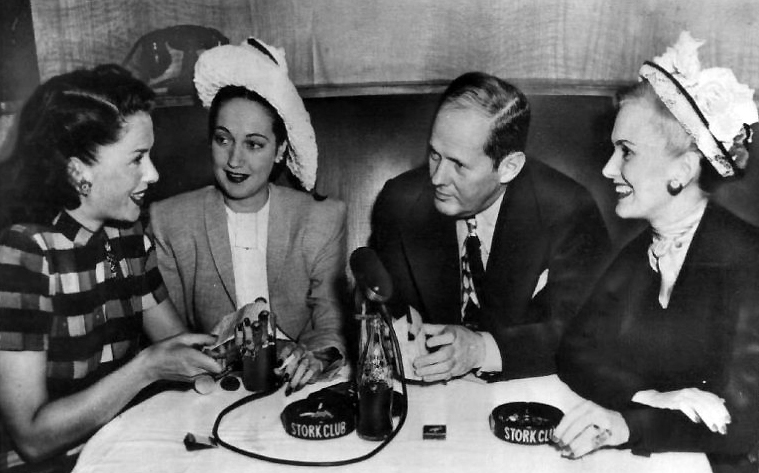
To feed the celebrity mill, newspaper columnist Walter Winchell, always at table no. 50, informed all America of the evening’s highlights the next day. Billingsley had his own radio and TV shows for many years [a 1946 photo shows him interviewing some of the club’s stars]. During its prime in the 1930s and 1940s the Stork Club was the country’s best known nightclub. It’s closest rival was El Morocco. There could never be any doubt about the location of photos taken at the Stork Club thanks to the club’s black and white ashtrays and oversized matchbooks which always appeared prominently.

Nightclubs are a special type of restaurant in which food does not always figure too importantly. But the Stork Club was said to take its menu seriously, for example, flying in fresh crab and pompano from Florida in the 1930s. Unlike others, it opened for lunch. It had a staff of a couple hundred, about 30 of whom worked in the kitchen under longtime French chef Gustave Reynaud. In its best years it reportedly served 1,000 to 3,000 meals a day.

But I am not completely convinced that it was a diner’s mecca. Clearly tastes have changed, yet even by the standards of the day a 1948 menu looks like a real hodgepodge. Some selections are in quasi-French (Calf’s Sweetbreads Under Bell, Eugenie), others are standard American fare (Cold Cuts and Potato Salad). There are a few uninteresting specials stapled to the top (Minute Steak with Baked Potato and Green Salad) and a strange section labeled Chinese Specialties. And, 22 desserts?

Sherman Billingsley, whose background was in Oklahoma bootlegging and Bronx real estate development, began his club career in 1928 or 1929 when he took over management of several NYC speakeasies, one of them named The Stork. He bought out his mob partners, and when prohibition ended went legit. Sherman also ran The Streets of Paris at Coney Island and had interests in other places, while his brother Logan at one point owned a NY restaurant called Madeira House. He and Logan (the latter officially banned from Oklahoma in 1919 as a condition of parole) lived lives of contentiousness and court appearances – perhaps inescapable experiences for bootleggers, developers, and nightclub owners.

The Stork Club fell out of favor in the 1950s, a decade in which Sherman poured hundreds of thousands into defeating unions at his club. His lawyer, the infamous Reds-hunter Roy M. Cohn, told a NY state labor relations committee in 1957 that the Stork Club had been losing money for years. Nevertheless it ranked high as an attraction for out-of-town visitors for some years before its closure in 1965, in dismal condition. One sign it is still remembered is Ralph Blumenthal’s well-researched book, The Stork Club: America’s Most Famous Nightspot and the Lost World of Café Society (2000).

© Jan Whitaker, 2012

17 Comments

Filed under night clubs

Banquet-ing menus

As those of us who collect menus know, people are more likely to preserve menus from restaurants related to memorable occasions than those from ordinary, everyday eating places. As a result, there are more menus in the ephemera market that come from famous restaurants, voyages on ships, and banquets than from humble eateries. I tend to concentrate on the latter group, but once in a while I will buy a banquet menu that interests me.

I particularly like ones that are from professional and business trade groups, unions, and organizations such as the three shown here. Even better if they have a humorous slant, as is surprisingly often the case.

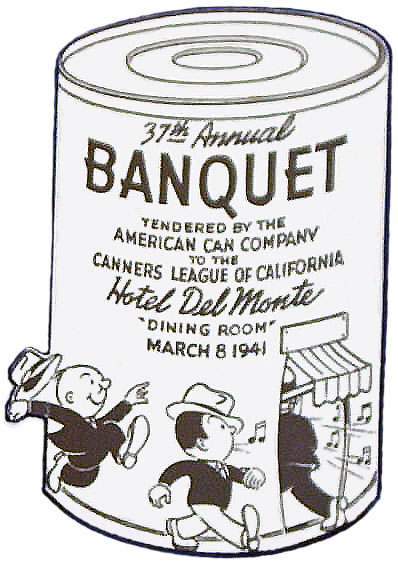
The 1941 menu at the top, from a dinner presented by the American Can Company to a California trade group at the Hotel Del Monte, shares something in common with the dinner given for the Golden Jubilee of the Oakland Typographical Union in 1936. The site of the canners’ banquet, the Hotel Del Monte in Monterey CA, like the union’s locale, the Oak Knoll Country Club in Oakland CA, was soon to become a property of the U.S. Navy. The canners may have enjoyed one of the last banquets held at the historic hotel, originally opened in 1880, but rebuilt in the 1920s after a disastrous fire.

The Oakland “Typos’” menu is one of my favorites because of its design as a proof adorned with proofreader’s corrections. It is not only clever but reminds me of a job I once had back in the days of linotype when I marked up proofs using the very same marks indicating lines to be deleted and transferred, as well as misspelled words, broken type, etc.

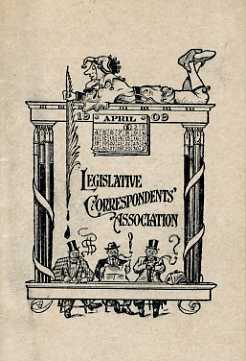
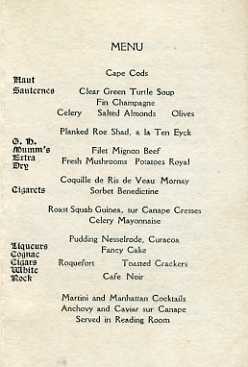
The Legislative Correspondents’ Association, which still exists, held its first dinner in 1900, so this menu is from its tenth, held in Albany at the Hotel Ten Eyck – on April Fools Day, 1909. Throughout it is filled with wry commentary and comical rules for the banquet governing issues around table companions and drinking. Judging from the menu, I’d think everyone got plenty to drink. Not only is the dinner accompanied by wine, champagne, liqueur, and cognac, it’s topped off with cocktails. Whoa.

I don’t know if the canners were served canned food at their banquet, but I’d say that the journalists undoubtedly enjoyed the finest cuisine of the three groups.

© Jan Whitaker, 2012

5 Comments

Filed under menus

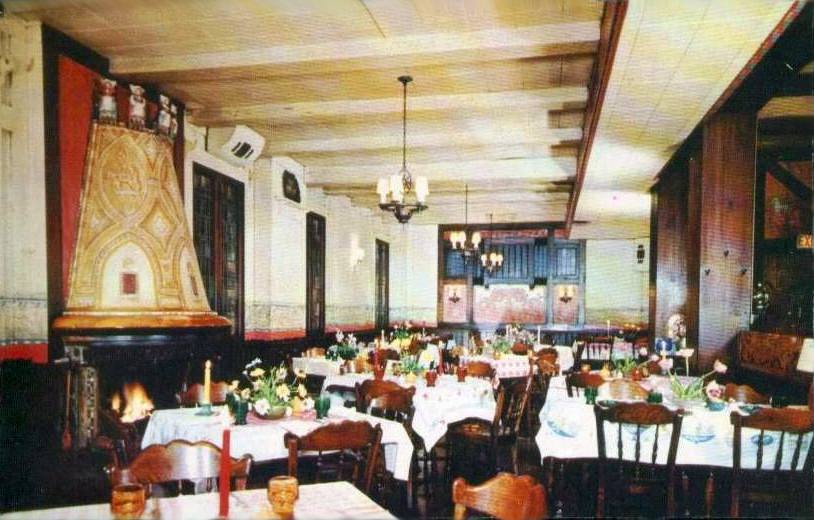
Restaurants and artists: Normandy House

With the recent publication of the book Edgar Miller and the Handmade Home has come renewed appreciation of Miller’s talents and of the central role he played in the birth of Chicago’s Old Town arts colony in the 1920s and 1930s. Often seen as “Chicago’s forgotten Renaissance man,” Miller is mainly admired for his imaginative renovation of apartments and studios, with Sol Kogen, employing materials from demolished buildings.

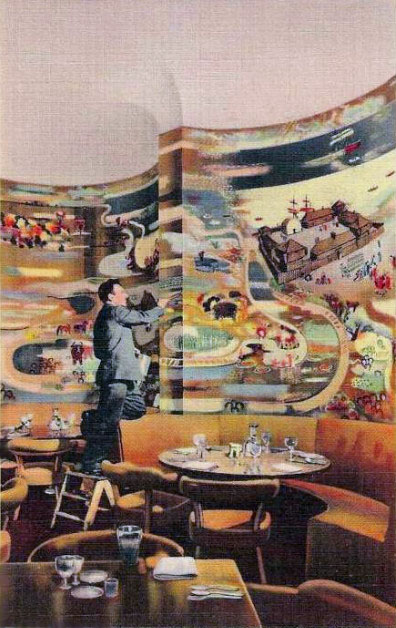
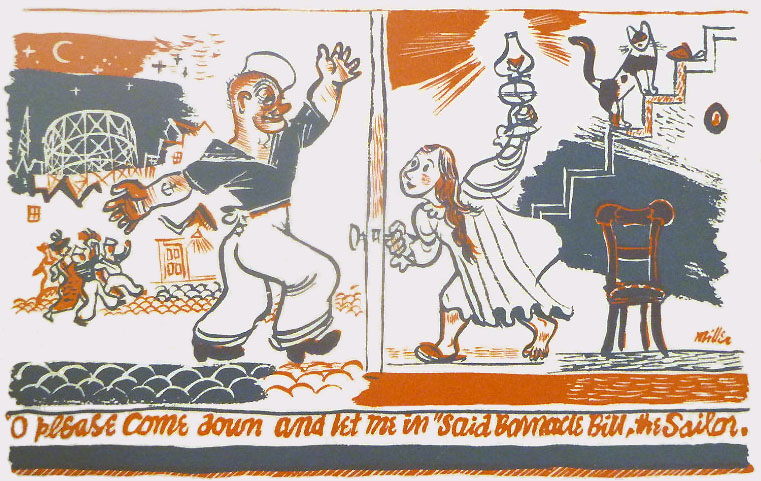
His work encompassed mural paintings [portion of Black Sheep mural below], stained glass windows, wood and stone carvings, ceramics, wallpaper, and fabrics. In addition to dwellings, his playful virtuosity in the decorative arts was bestowed upon a number of Chicago’s eating and drinking places, including Harry’s New York Bar and the several outdoor cafes at the Streets of Paris complex in the 1933-34 Century of Progress Exposition. Following Repeal, when money poured into updating bars and restaurants, he worked with architects such as Andrew Rebori, painting murals for bars in the Northern Lights hotel, the 885 Club, and a Fred Harvey restaurant in Dearborn Station [pictured below]. At the Tavern Club, where Miller was a member and his precocious young son Skippy would later hold “one-man” shows, he created a renowned mural called Love Through the Ages.

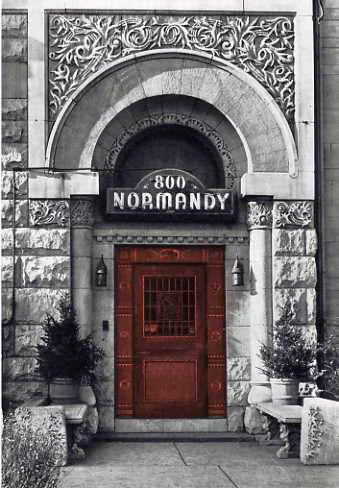
Normandy House on Chicago’s near north side became his ongoing project in the late 1930s and through the 1940s. The restaurant occupied the corner structure in a row of five apartment buildings, each four stories in height, at the southern end of Tower Court (aka Tower Place and North Michigan Ave.) opposite the historic water tower. Once the home of the city’s blue-bloods, by the 1920s the entire row had become a commercial property. A restaurant called the Charm House occupied the corner site until about 1937 when Grace Holverscheid bought the business, renaming it Normandy House.

Grace, a widow, operated it with her friend Helen Wing, also widowed. Grace would soon marry a third partner, Richard Tallman. All three were involved with music, Richard as a composer, Grace as a concert vocalist, and Helen as her arranger and accompanist. While running Normandy House, Helen also wrote books and composed operettas for children.

Edgar Miller lived upstairs over the restaurant, perhaps trading his artistic work in exchange for rent. During its incarnation as Charm House, the restaurant had been renovated in quaint style with beamed ceilings, etc., to resemble a sister restaurant in Cleveland OH. An Old English taproom and grill installed in the basement in 1934 – named the Black Sheep Bar by its new proprietors — became the focus of Miller’s decorative elaborations. Over the years when he, and later his family, lived on the third floor, he carved a front door, painted murals, and made stained glass windows, wood sculptures, ceramic plaques, and wall paper for the restaurant. He was assisted by his brother Frank who became the Black Sheep’s bartender.

The Millers’ quarters, up the stairs past the restaurant’s cashier, also served as studio space for Edgar and his wife, the former Dale Holcomb, who translated many of Edgar’s designs into fabrics. At any given moment the whole family, including the two young sons, might be painting portraits, squeegeeing silk screens, or engaging in any number of artistic endeavors. Other artists, musicians, and classes of art students from the Art Institute frequently paid visits.

The Normandy House, like Chicago’s Le Petit Gourmet, attracted a clientele that included club women and professional groups of architects and academics. Its menu featured favorites such as the Pink Squirrel (broiled beef tenderloin with Roquefort sauce) and Eggnog Pie, as well as 1950s innovations such as salad in wooden bowls and individual loaves of bread served on cutting boards.

Helen Wing and the Tallmans closed Normandy House and retired in the summer of 1956. Then, under the management of a long-time employee and with backing from a Florida hotel mogul, it was reopened. In 1960 it moved to Rush Street, reinstalling at least some of Miller’s pieces.

The Tower Court building housing Normandy House along with the other four buildings in the row were razed to make room for a multi-story hotel. In the 1960s Miller and his wife moved to Florida where they ran a motel until her death. Edgar lived in Taos NM, Australia, and San Francisco, then returning to Chicago where he died in 1993 at age 94.

© Jan Whitaker, 2012

Read more about Edgar Miller’s life and work.

1 Comment

Filed under restaurant decor

Reuben’s: celebrities and sandwiches

Once upon a time there was a famous NYC restaurant called Reuben’s. Today there is a famous grilled sandwich of corned beef, Swiss cheese, sauerkraut, and Russian dressing on pumpernickel called a Reuben. Wouldn’t it make a nice story if the sandwich came from the restaurant?

The connection has been well researched yet it remains unresolved. For anyone who wants to examine the matter in detail, I recommend Jim Rader’s excellent account. He has the last word, inasmuch as there is one.

Two important points. 1) No one has come up with an early menu from Reuben’s that lists the Reuben sandwich as it is known today. It does appear under the name “Reuben’s Pioneer” on a 1971 menu but by then the sandwich could be found everywhere. 2) Despite being a publicity hound – and despite an Omaha woman winning a national contest for creating the sandwich in 1959 — founder Arnold Reuben never laid claim to it as his restaurant’s creation.

What is certain is that the fame of Reuben’s restaurant and delicatessen was built upon sandwiches — and the celebrity patrons who ate them.

I have seen a menu from Reuben’s said to be from 1922. Under the top heading “Reuben’s Famous Sandwiches” are listed 42 sandwiches. Nine are named after celebrities of stage and screen of that time. What is striking about the named sandwiches is that they cost more than the others. At the low end are ordinary sandwiches priced at 35 cents such as Salami, Corned Beef, and Liver Wurst. The special celebrity sandwiches range from 75 cents to a dollar, amounts that would then buy a whole dinner in many restaurants. The specially named sandwiches probably had more ingredients and may have been larger, but the aura of celebrity around them must have added a few cents too.

Naming sandwiches for celebrities was a publicity gimmick probably thought up by a press agent. The columnist Westbook Pegler claimed that Reuben’s initially acquired fame because of publicity generated by the audacious Harry Reichenbach who encouraged Arnold to sue a well-known New Yorker over the price of a ham in 1920. Thereafter, like Lindy’s and the Stork Club, Reuben’s was constantly in the nationally syndicated gossip columns of the 1920s, 30s, and 40s.

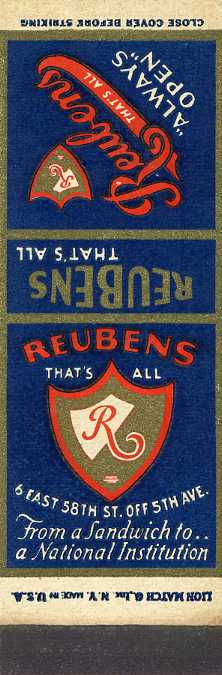
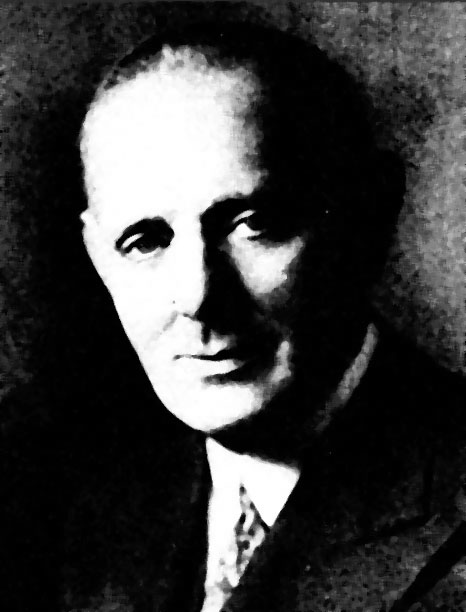
Arnold Reuben was a German Jew who, with his family, immigrated to the US as a young child around 1886. He helped out by peddling produce, then worked at a delicatessen. In 1908 he opened his own deli, which he later referred to as a “shtoonky little store.” By the end of the teens, he was thriving; he had incorporated his Pure Food Shop at 2102 Broadway and opened an eating place at 622 Madison Avenue which was popular with Broadway performers and stars from Hollywood. (Transitions from food store to restaurant are not uncommon and, as was also the case with Texas butcher shops-to-barbecues, often begins with sandwiches.) In 1928 he had a third restaurant in Philadelphia and was said to be “enormously rich.” Adopting the slogan “From a Sandwich to a National Institution,” he often told a story about the first celebrity sandwich he created – ham, cheese, turkey, cole slaw, and dressing — for a struggling young actress.

He experienced some financial difficulties in 1933 and filed for bankruptcy but only two years later was back on course with a bigger and better restaurant [pictured] to replace the one on Madison Avenue. Of critical importance to his comeback was the end of Prohibition. His opening announcement in the New York Times attested to this with a prominent display of the names of Reuben’s “friends,” seven liquor manufacturers and distributors.

In 1946 he opened a restaurant on West 57th near Carnegie Hall, with a front nearly identical to East 58th Street. Like his others it was open 24 hours. No doubt it, too, had a doorman who greeted patrons with the bywords “Reuben’s, that’s all.” Larger than the East 58th place, it was billed “A City in Itself,” and contained shops for delicatessen, flowers, chocolates, cigars, and theater tickets, as well as a perfume bar and a barber shop. Despite all, it silently disappeared a couple years later.

Arnold retired to Florida in the mid-1960s and sold the business, which he had turned over to his son to manage years earlier. Reuben’s in NYC continued under new ownership at various locations until 2001. A Reuben’s was also opened in Miami in the 1940s but I have not been able to determine its subsequent fate.

© Jan Whitaker, 2012

4 Comments

Filed under food, popular restaurants, proprietors & careers

Wayne McAllister’s drive-ins in the round

Architects who design restaurants often have labored in anonymity, and that goes ten-fold for those whose work involved drive-in restaurants. In the beginning drive-ins were simple shacks plastered with signs, as were other buildings of the early automobile age. Like the chicken coups converted to motor courts and the farmers’ fields rigged out for overnight camping, they served as temporary fixes for seat-of-the-pants entrepreneurs looking to make a quick buck from the passing traffic.

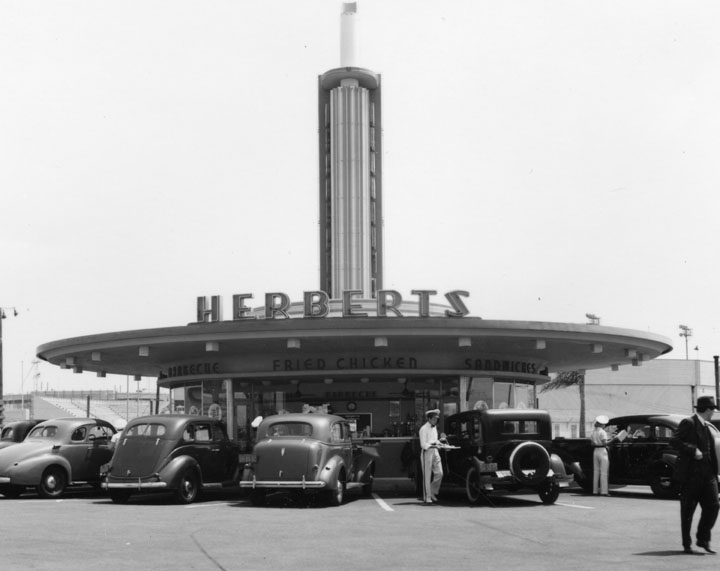
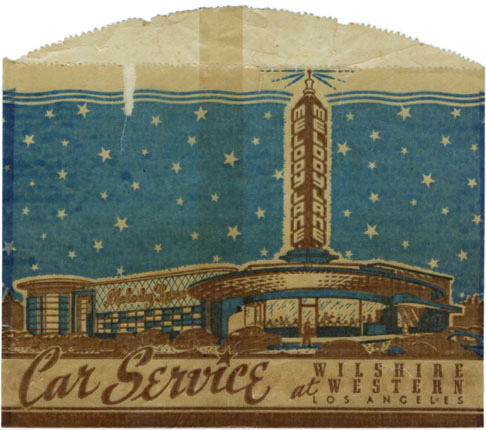
The couple of dozen Los Angeles drive-ins Wayne McAllister designed in the 1930s – the Wich Stand, Simon’s, Robert’s, Herbert’s, Melody Lane — were likewise ephemeral, tumbling into ruins with rising real estate values. Yet, despite the ephemerality of the form, he was one of the few designers who managed to develop a functional and aesthetically satisfying style for an inexpensive roadside building type.

This post is based mostly upon Chris Nichols’ The Leisure Architecture of Wayne McAllister, a book that traces McAllister’s career and conveys his genius at transforming crude vernacular building forms into sophisticated expressions of car culture.

Born in San Diego, Wayne McAllister and his wife Corinne, then both 20, took on a major project in 1927 with the Moorish Moderne design of Agua Caliente, a Prohibition-era Tijuana gambling mecca. Wayne was a self-taught high school dropout whose first job was designing houses, a task he was able to execute handily. According to his own account, he regularly completed a new design each day. In the course of a roughly 30-year architectural career, his work focused on the design and remodeling of hotels and restaurants in Los Angeles and Las Vegas. Among his Las Vegas hotel projects were El Rancho Vegas, the Desert Inn, and the Sands Hotel, while a partial list of his LA restaurants includes Café Caliente, Mike Lyman’s, Richlor’s, Lawry’s, Clifton’s, and Bob’s Big Boy. From 1956 to 1961 he was an architect for the Marriott Corporation.

Although he is best known for the Sands, his circular drive-ins are considered significant in architectural history. Alan Hess, author of Googie, noted that thanks to Wayne McAllister, “Commercial vernacular design developed a respectable architecture that stands on its own right, not simply as a second-rate version of high art design.” It is interesting that even a lofty modern architect like Ludwig Mies van der Rohe developed a drive-in restaurant design, in 1945 (it was never built).

Wayne’s circular drive-ins typically had 20-foot pylons on the roof on which the drive-in’s name was spelled out, with horizontal louvers partially concealing neon tubes that made the signs glow. While his early designs had no doors – the businesses stayed open 24/7 and evidently had no need of heating or air-conditioning – this element was eventually modified. For a time his styles were influential, but after World War II when drive-ins expanded throughout the country, round buildings with overspread roofs were scrapped for rectangular structures from which long canopies stretched outward.

Noir crime novelist Raymond Chandler referred to Los Angeles’ drive-ins “gay as circuses” in The Little Sister (1949), leading Alan Hess to remark: “In almost anyone’s mental map of Los Angeles, the drive-ins of the thirties had become indelible landmarks.” Their images remain no less powerful today.

© Jan Whitaker, 2011

5 Comments

Filed under drive-ins, odd buildings

Duncan’s beefs

Duncan Hines celebrated simple, home-style American food. But as a printing salesman whose territory covered the entire country he ate in enough restaurants that by his 60s he had accumulated quite a few dissatisfactions with cuisine and service. “Every day on the road adds to my list of pet peeves,” he told an interviewer in 1947. In retrospect it’s clear that the decades in which he rated restaurants for the Adventures in Good Eating directories, the 1930s and 1940s, were not the country’s finest for restauranting. Some of his complaints are dated but others still ring true today.

● Chef’s specials: “Most Chef’s Specials are ground-up leftovers.”

● Chicken a la king: “I always dodge chicken a la king, if it is offered at bargain prices.”

● Cover-ups: “Foods doused with gravies or sauces.”

● Warmed-up baked potatoes.

● French fries kept warm under a heat lamp: “The grease soaks through.”

● Restaurants that steer patrons into the bar while they wait for their table.

● Being seated at a table that hasn’t been cleared of the previous patrons’ dirty dishes

● Restaurants that crowd patrons “like sardines.”

● Certain small towns: “The states between the Mississippi River and the Pacific Coast are pretty much the Gobi Desert as far as good cooking in the small towns goes.”

● “Maryland fried chicken” which is widely advertised but often turns out to be “old chickens covered with thick batter.”

● Long menus that contain nothing outstanding.

● Roadside stands: “Never eat at hot dog or hamburger stands.”

● Drug store counters: “How in God’s name can anyone who regularly eats drugstore snacks ever be expected to recognize a good meal when it’s served?

● Restaurants that ignore local specialties, such as those on the Gulf that feature chicken and steak rather than red snapper. Why no fiddleheads on menus in Maine? he asked.

Leave a comment

Filed under guides & reviews

Theme restaurants: Russian!

Restaurants and coffee houses run by Russian immigrants appeared in the late 19th century. Their proprietors were Jews living on NYC’s lower East Side as well as others in California and Chicago who were pro-revolution enemies of the Czar. But not until after World War I (and the Russian Revolution), when a very different wave of anti-revolution, pro-Czar Russian immigrants arrived, did explicitly and self-consciously Russian-themed restaurants come into being. They flourished in the 1920s and 1930s.

For many readers New York’s Russian Tea Room will immediately spring to mind. It was established on West 57th Street in 1927 by Jakob Zysman, a Polish immigrant who operated a chocolate factory at the little tea room where ballerinas hung out. The business soon moved across the street where it changed hands and was expanded into a full-fledged restaurant. Over its long history it had many owners, notably including Faith Stewart-Gordon who ran it from 1967 until the end of 1995. After extensive renovations by restaurant impresario Warner LeRoy, it reopened in the fall of 1999. LeRoy died in 2001 and the RTR closed the following year.

But it should be noted that, unlike other Russian restaurants of the interwar period, the RTR was not started by a White Russian nor did it have a specifically Russian emigré clientele for most of its tenure. Reportedly, at one point the Russians who haunted the barroom were discouraged from patronizing the place because of their propensity to linger while they eulogized the olden days. The RTR was mainly famous as a flamboyant celebrity restaurant.

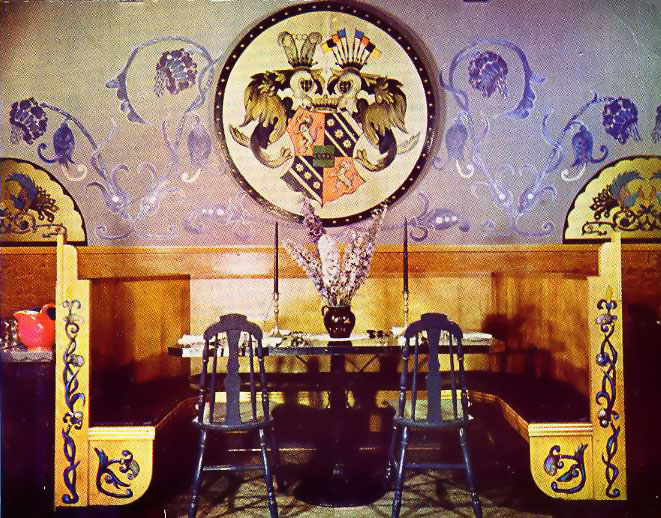
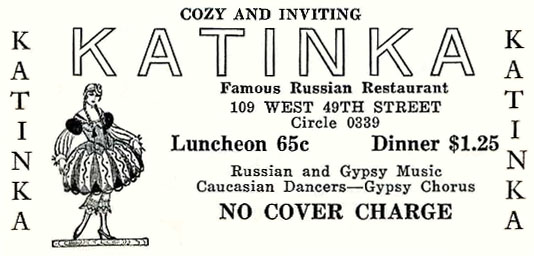
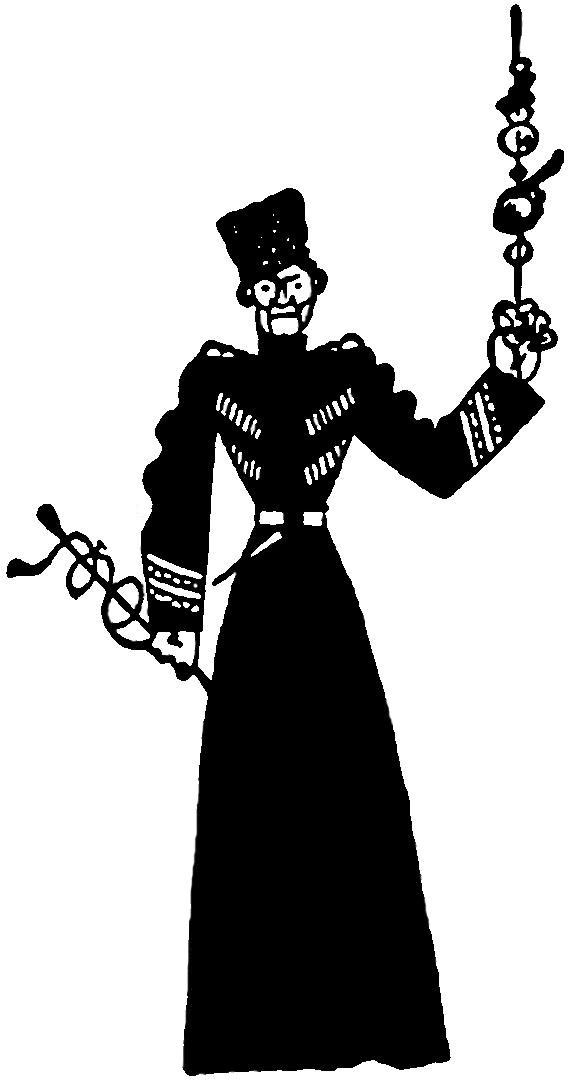
In the 1920s NYC gained a population of White Russians numbering about 6,000, most of them well-educated former members of the intelligentsia or the Imperial Russian Army. Numerous Russian eating places soon cropped up, with names such as The Russian Inn, The Eagle (E 57th), Katinka (W 49th), The Russian Swan, Kavkaz (Bdwy & 53rd), Casino Russe (W 56th), The Russian Sadko (W 57th), The Maisonette Russe (W 52nd), and The Russian Bear (W 57th). On the lower East Side were The Russian Kretchma and the (original) Russian Bear. Striking modernistic wall murals by emigré artists such as Boris Artzybashev, balalaika music, and entertainment by Cossack performers often contributed to the atmosphere of these eating places. As far as I can tell they served both as gathering spots for Russians and as tourist attractions.

Los Angeles also had a White Russian settlement of up to 2,000, with an Orthodox church, art shops, tea rooms, and restaurants. Lured by Hollywood, some Russians from this period acted as extras in movies and a few became studio consultants with expertise on the former glories of the fallen Russian aristocracy. When Theodore Lodijensky, proprietor of NYC’s Russian Eagle, moved westward he consulted on Sternberg’s “Last Command” (1928) — and he opened a West Coast version of The Eagle.

When the RTR began there were also other Russian tea rooms in NYC and around the US, some going by that exact name, some with names such as The Samovar. An importer of artistic wares named Polakoff, a Czarist who used a royal crest in his advertising, ran a Russian Tea Room filled with Russian arts and crafts on Chicago’s South Michigan Blvd. A specialty there was the Petrograd Supreme, a tall sandwich which the eater approached from the appetizer layer on top, working down to the dessert layer at bottom. In the 1930s Valentina Alekseevna Vernon ran a Russian Tea Room in San Francisco. A woman of strong opinions, she found Americans as resistant to some Russian dishes as she was to theirs.“I wouldn’t touch either an ice cream soda or a fruit salad,” she proudly proclaimed. Also in San Francisco was the Moscow Café which opened in 1932 and featured flaming Beef Stroganoff and Cossacks balancing flaming swords. A few Russian restaurants could also be found in Philadelphia, Boston, New Haven CT, and Miami in the 1930s.

The dishes introduced by White Russian restaurants included not only Beef Stroganoff, but also Blini with Caviar and Nesselrode Pudding. Although their menus might list Borscht, Darra Goldstein points out in The Oxford Companion to American Food and Drink that this humble Ukrainian beet soup was brought by Russian Jews who had immigrated earlier.

© Jan Whitaker, 2011

4 Comments

Filed under proprietors & careers, theme restaurants