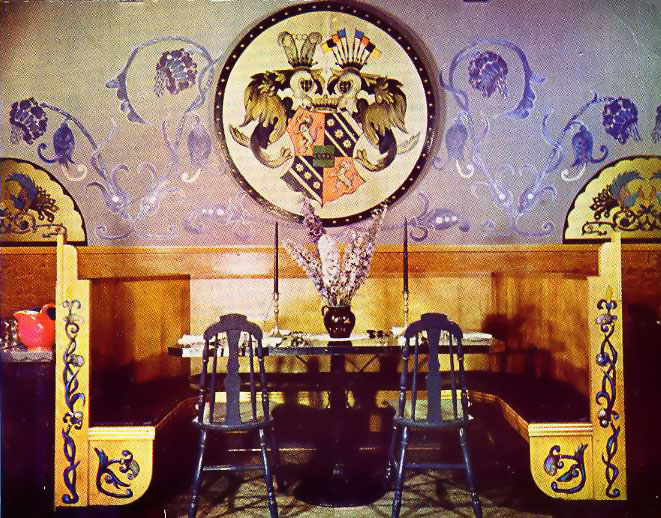
 Restaurants and coffee houses run by Russian immigrants appeared in the late 19th century. Their proprietors were Jews living on NYC’s lower East Side as well as others in California and Chicago who were pro-revolution enemies of the Czar. But not until after World War I (and the Russian Revolution), when a very different wave of anti-revolution, pro-Czar Russian immigrants arrived, did explicitly and self-consciously Russian-themed restaurants come into being. They flourished in the 1920s and 1930s.
For many readers New York’s Russian Tea Room will immediately spring to mind. It was established on West 57th Street in 1927 by Jakob Zysman, a Polish immigrant who operated a chocolate factory at the little tea room where ballerinas hung out. The business soon moved across the street where it changed hands and was expanded into a full-fledged restaurant. Over its long history it had many owners, notably including Faith Stewart-Gordon who ran it from 1967 until the end of 1995. After extensive renovations by restaurant impresario Warner LeRoy, it reopened in the fall of 1999. LeRoy died in 2001 and the RTR closed the following year.
But it should be noted that, unlike other Russian restaurants of the interwar period, the RTR was not started by a White Russian nor did it have a specifically Russian emigré clientele for most of its tenure. Reportedly, at one point the Russians who haunted the barroom were discouraged from patronizing the place because of their propensity to linger while they eulogized the olden days. The RTR was mainly famous as a flamboyant celebrity restaurant.
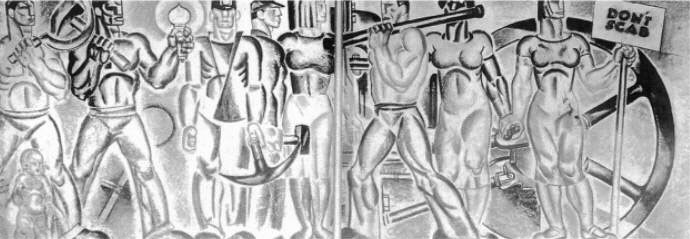
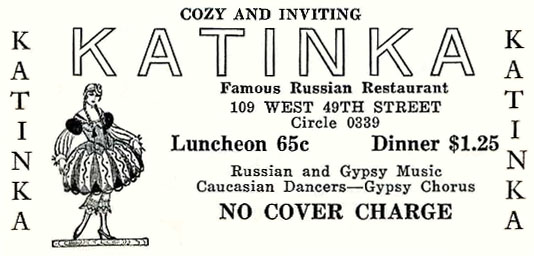 In the 1920s NYC gained a population of White Russians numbering about 6,000, most of them well-educated former members of the intelligentsia or the Imperial Russian Army. Numerous Russian eating places soon cropped up, with names such as The Russian Inn, The Eagle (E 57th), Katinka (W 49th), The Russian Swan, Kavkaz (Bdwy & 53rd), Casino Russe (W 56th), The Russian Sadko (W 57th), The Maisonette Russe (W 52nd), and The Russian Bear (W 57th). On the lower East Side were The Russian Kretchma and the (original) Russian Bear. Striking modernistic wall murals by emigré artists such as Boris Artzybashev, balalaika music, and entertainment by Cossack performers often contributed to the atmosphere of these eating places. As far as I can tell they served both as gathering spots for Russians and as tourist attractions.
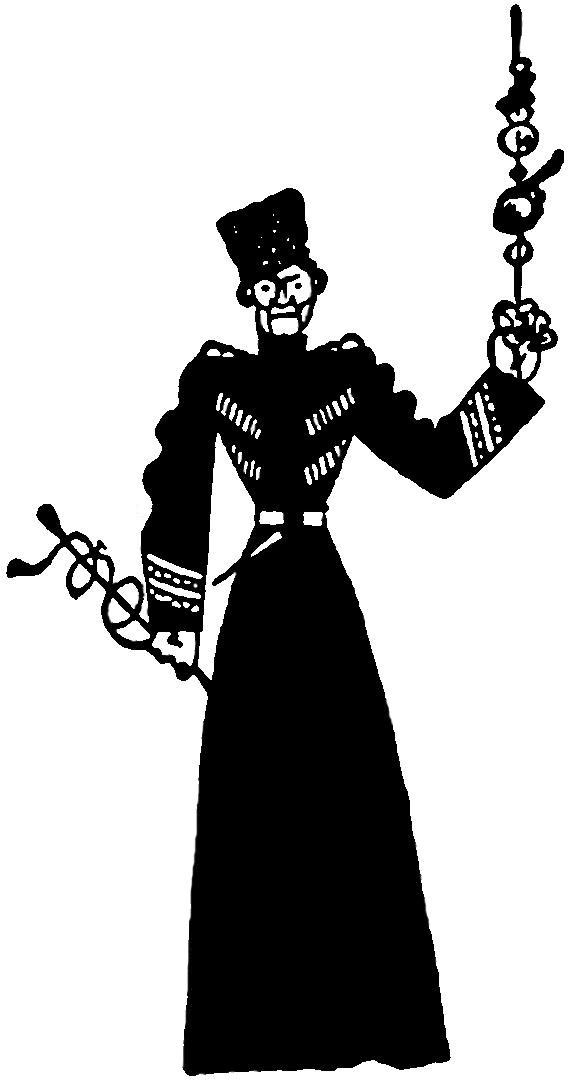 Los Angeles also had a White Russian settlement of up to 2,000, with an Orthodox church, art shops, tea rooms, and restaurants. Lured by Hollywood, some Russians from this period acted as extras in movies and a few became studio consultants with expertise on the former glories of the fallen Russian aristocracy. When Theodore Lodijensky, proprietor of NYC’s Russian Eagle, moved westward he consulted on Sternberg’s “Last Command” (1928) — and he opened a West Coast version of The Eagle.
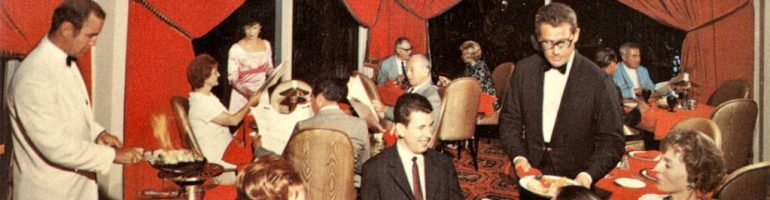
When the RTR began there were also other Russian tea rooms in NYC and around the US, some going by that exact name, some with names such as The Samovar. An importer of artistic wares named Polakoff, a Czarist who used a royal crest in his advertising, ran a Russian Tea Room filled with Russian arts and crafts on Chicago’s South Michigan Blvd. A specialty there was the Petrograd Supreme, a tall sandwich which the eater approached from the appetizer layer on top, working down to the dessert layer at bottom. In the 1930s Valentina Alekseevna Vernon ran a Russian Tea Room in San Francisco. A woman of strong opinions, she found Americans as resistant to some Russian dishes as she was to theirs.“I wouldn’t touch either an ice cream soda or a fruit salad,” she proudly proclaimed. Also in San Francisco was the Moscow Café which opened in 1932 and featured flaming Beef Stroganoff and Cossacks balancing flaming swords. A few Russian restaurants could also be found in Philadelphia, Boston, New Haven CT, and Miami in the 1930s.
The dishes introduced by White Russian restaurants included not only Beef Stroganoff, but also Blini with Caviar and Nesselrode Pudding. Although their menus might list Borscht, Darra Goldstein points out in The Oxford Companion to American Food and Drink that this humble Ukrainian beet soup was brought by Russian Jews who had immigrated earlier.
© Jan Whitaker, 2011



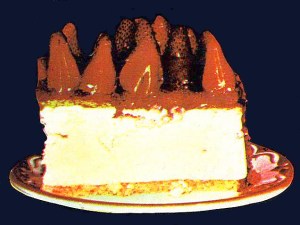
 It seems as though almost all of history’s food forces have cooperated to give cheese top billing in restaurant meals today. Only one cheesy custom failed to catch on, that of finishing a meal with cheese and fruit as was done in small French and Italian restaurants in the later 19th century. Craig Claiborne argued in 1965 that even the best New York restaurants didn’t know how to handle the cheese course. They had poor selections which tended to be old, overripe, or served too cold. One restaurant admitted their chef was in the habit of popping cheese straight from the fridge into the oven to soften it. Restaurateurs that Claiborne interviewed insisted that Americans didn’t like cheese after a meal. I’d agree that most prefer their after-dinner cheese in the form of cheesecake.
 Cheese has been a staple food in American eating places probably since the first tavern opened. Regular meals were served only at stated hours but hungry customers could get cheese and crackers at the bar whatever the hour. For “Gentlemen en’passant,” the Union Coffee House in Boston promised in 1785 that it could always furnish the basics of life: oysters, English cheese, and London Porter. Across the river in Cambridge, the renowned
 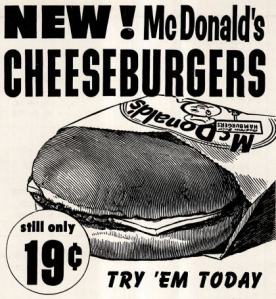 Cheeseburgers were a product of the fast food industry of the 1920s, claimed as inventions by both the Rite Spot of Southern California and the Little Tavern of Louisville. Strange there aren’t thousands of other contenders because what was there to invent, really? Cheeseburgers were strongly associated with Southern California before WWII — Bob’s Big Boy of LA introduced cheeseburgers in 1937. Another step forward came in the 1930s when a bill was introduced in the Wisconsin legislature requiring restaurants and cafes to serve 2/3 oz. of Wisconsin cheese with every meal costing 25 cents or more. In the same decade Kraft Cheese was among major food producers providing restaurants with standardized recipe cards.
 It was after WWII that cheese spread its melted gooeyness everywhere — on
 It's great to hear from readers and I take time to answer queries. I can't always find what you are looking for, but I do appreciate getting thank yous no matter what the outcome.