Lunching in the Bird Cage

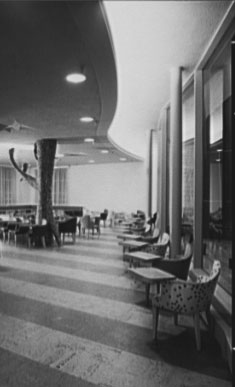
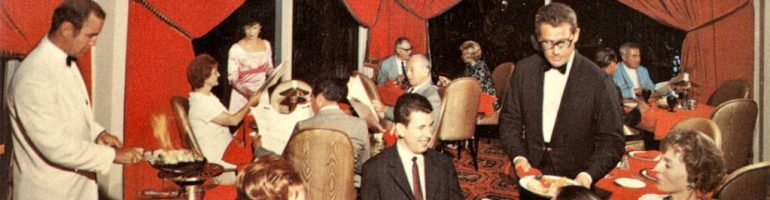
Lord & Taylor’s Bird Cage restaurant and tea room was opened in the late 1930s. It continued on the fifth floor of the Fifth Avenue New York City store until the 1980s when it was updated and renamed Café American Style. Accommodating only about one hundred persons, the Bird Cage was considerably smaller than the main restaurant in Altman’s which held over two hundred, as well as Abraham & Straus’s in Brooklyn which held over four hundred. Until the mid-1970s the Bird Cage was outfitted with armchairs with trays connected to them. In the early years each tray was supplied with a complimentary cigarette. Diners selected sandwiches, salads, and desserts from rolling carts modeled on Italian racing cars. As Lord & Taylor branches were opened after World War II in locations such as Westchester (shown here, 1948), Millburn NJ, Hartford CT, and Washington DC, they too were furnished with their own Bird Cages.

For many years the Bird Cage staff at the Fifth Avenue store provided refreshments to shoppers who arrived before the store opened each morning. Lord & Taylor president Dorothy Shaver initiated the custom and insisted that the coffee, juice (in summer), or bouillon (when temperatures were frigid) be served in china, not paper, cups.

birdcagemilkbarny1950Other well-loved eateries in the Manhattan store were the men’s Soup Bar on the tenth floor and the children’s Milk Bar (shown, 1950). Scotch broth and deep-dish apple cobbler with rum sauce were specialties at the Soup Bar.

© Jan Whitaker, 2008

50 Comments

Filed under department stores, tea shops

Cabarets and lobster palaces

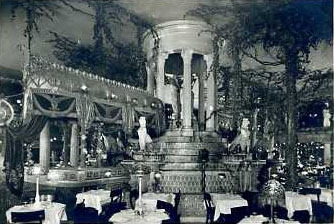
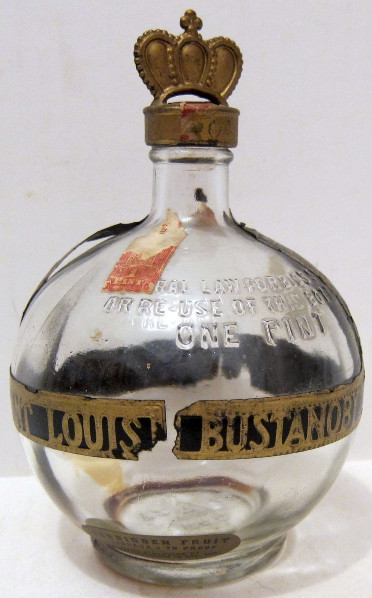
Around 1908 Murray’s Roman Gardens in Times Square, pictured here, was just the place to sample the “high life” after seeing the popular operetta The Merry Widow. Murray’s, which has been called “New York’s first theme restaurant,” demonstrated a kind of decadent Roman-Pompeian-Egyptian-Babylonian grandeur that appealed to tourists. It was one of the so-called lobster palaces that sprang up around the turn of the last century. Other cities had them, but New York led the trend with Murray’s, Bustanoby’s (known for its Forbidden Fruit liqueur), Churchill’s, Faust’s, Martin’s, Maxim’s, Rector’s, Reisenweber’s, Shanley’s and others. After surviving the depression of the 1890s, Americans were ready to drink champagne and order the most expensive dish on the menu, preferably lobster. Restaurants, department stores, and soon movie theaters all styled themselves as palaces outfitted with marble fountains, chandeliers, and velvet draperies. The era’s “luxury for the masses” set a precedent later followed by Las Vegas.

New York’s lobster palaces were in possession of a valuable asset, the all-night liquor license which enabled them to sell drinks round the clock. Anti-liquor forces were determined to clamp down on the partying. One by one cabarets saw their licenses revoked, forcing them to close by 1 a.m. In 1913 the early closing rule was applied across the board — and rightly so, according to New York’s mayor. He asserted, “The people who patronize such places after the regular closing hour of 1 o’clock are not, as a rule, decent people. They are vulgar, roystering, and often openly immodest. They get intoxicated, behave boisterously, and indulge in lascivious dancing in rooms devoted to that use.”

Critics insisted that sophisticates wouldn’t be seen in a warehouse-style palace. Despite their high prices, the food they served was prepared assembly-line fashion hours before the rush. Waiters made a grand table-side show of shaking and pouring drinks which had been premixed before the crowds arrived. Patrons dressed to the nines vied for a table. Critic Julian Street sneered at the whole scene of what he regarded as social pretenders. He commented in 1910, “About the wide doorway of this room stood a knot of twenty or thirty men and women, all in evening dress and eager to get in – a comic sort of bread-line, held back by a plush rope and a young head waiter, who, St. Peter-like, examined the candidates with a critical eye.”

Although they instituted cover charges when national Prohibition began in 1919, lobster palaces could not carry on without the liquor sales which had made up as much as two-thirds of their gross. By 1923 most had closed.

© Jan Whitaker, 2008

1 Comment

Filed under night clubs

Fried chicken blues

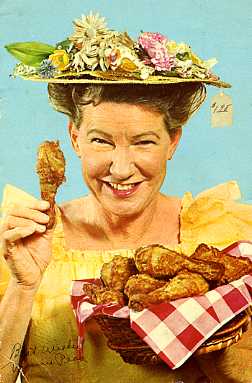
The 1960s were a boom decade for marrying fast food to franchise businesses christened with celebrity names. Chicken seemed like the up-and-coming successor to hamburgers in a business more about marketing concepts and stock quotations than food or hospitality. Following the success of Harlan Sanders, whose 500-unit Kentucky Fried Chicken chain mushroomed to 1,700 when he sold to a corporate buyer, entrepreneurs looked around for other celebrities to hitch their schemes to. Performers Minnie Pearl, Mahalia Jackson, James Brown, and Eddy Arnold, along with many sports figures, were persuaded to lend their names, rarely assuming any further involvement.

Minnie Pearl’s Chicken System, Inc., was the creation of Tennessean John Jay Hooker whose political ambitions included becoming governor, then president. Minnie Pearl, a Grand Ole Opry comedien whose frumpy stage persona suggested down-home eating, covered the white market, while gospel singer Mahalia Jackson lent her name to the black-owned side of the enterprise aimed at black inner-city consumers. Around the same time, ca. 1969, “king of soul” James Brown figureheaded the Gold Platter soul food chain which failed to get beyond the pilot stage in Macon, Georgia. Minnie’s and Mahalia’s ventures, too, lasted only a few years. Hooker, chicken systems mastermind, did not make it into office, but Benjamin Hooks, co-owner of Mahalia Jackson’s Gloree-Fried chicken (carryout only), went on to become executive director of the NAACP.

Though hailed as a restaurateur, Jackson received royalties for the use of her name but did not choose to invest in the Mahalia Jackson Chicken System, Inc. Perhaps she did not approve of its slogan: “It’s Gloree-Fried, and that’s the gospel truth.” The Minnie Pearl system totaled several hundred locations at its peak but it’s not clear how many outlets the Jackson chain comprised, probably many fewer. Chicago had only two units, paired with gas stations. The chain also operated in Memphis, Cleveland, Jacksonville, and Detroit. In addition to chicken, menus included fish sandwiches, sweet potatoes, fried pies, and a ‘Soul Bowl’ of chicken giblets in gravy on rice.

Minnie Pearl’s chicken — and later roast beef sandwiches — business went bankrupt in 1970.

© Jan Whitaker, 2008

Leave a comment

Filed under chain restaurants, food

Rats and other unwanted guests

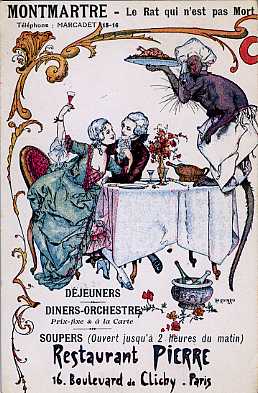
It would be unusual to find an advertising card from an American restaurant with such a humorous attitude toward rats as shown on this French postcard. Here we see the “rat who is not dead,” a play on The Dead Rat, a famous bohemian café in 1920s Paris. In this country, restaurants would rather their customers never think about rats or other vermin. Their customers also prefer to put the subject out of mind.

As a consequence, researching this topic is not so easy – BUT it is possible. Even the impeccable Delmonico’s, at its peak in the 1850s, used the historic version of Roach Doom, also lethal to rats. Cheap restaurants of the 1870s were known familiarly as “cockroach dens” and one New York place was dubbed Cockroach Hall, all very funny until rumors circulated that cockroaches were regularly seen floating in the minestrone. Bohemian joints in San Francisco were renowned for keeping monkeys and parrots and winking at the roaches swarming the walls. Over time patrons became less tolerant of these conditions. Really, who could disagree with the journalist of the 1890s who wrote, “A dining room that smells of grease or mold or stale cookery, or that has cockroaches in the wainscot that peep out at the customer as he sits at dinner … is not a desirable place to go”?

The real crackdown came in the early 20th century after exposés described unhygienic kitchens to a public already queasy from revelations about Chicago stockyards. Cities enacted tougher sanitary laws and sent out inspectors with the power to shut down filthy eateries. Still, I recall the large rat that glanced at me as it went about its business a few years ago in New York lunchroom late at night. The truth is they will never totally go away.

© Jan Whitaker, 2008

1 Comment

Filed under sanitation

Dining with Duncan

In 1935 a Kentuckian named Duncan Hines compiled a list of his 167 favorite places to eat and slipped it inside his Christmas cards. It made quite a hit. The next year his list had grown to 475 and he put it in book form, calling it Adventures in Good Eating. By 1946 the book had gone through 30 printings and had become the restaurant bible of the white American traveling public. “Our family swears by Duncan Hines,” attested a typical reader. His well-off professional and middle-class readers undoubtedly felt they needed a guide when traveling, agreeing with Hines’s comment in a 1947 interview: “I’ve run more risk eating my way across the country than in all my driving.” Distrust of the general run of restaurants reflected the times. Under the economic constraints of the depression and the labor shortages of World War II, standards of cleanliness and cooking in many restaurants slipped badly.

Adventures in Good Eating revealed sharply defined dining preferences. Hines and his legion of volunteer reviewers favored places with women cooks that specialized in home-like meals and made their own rolls, desserts, and salad dressings. WASPy country inns, tea rooms, and cafeterias predominated while relatively few restaurants serving ethnic foods made the list – subtly undermining the promise of adventure. Sprinkled throughout the book were Hines’s reflections regarding sanitation (clean catchup bottle tops, no smears on sugar bowls), essential ingredients (“good butter, fresh eggs, rich milk and a loving touch”), and favorite dishes (cornbread, fried potatoes, codfish cakes, baked beans, and eggs). He freely dispensed advice to restaurant operators, urging them to burnish their silverware, provide sharp knives and comfortable chairs, and use locally available foods.

In interviews through the years he minced no words in expressing his dislikes. Among his memorable quotes are these:
• “After many years of eating my way around the country, I have concluded that the principal reason for looking at the average menu is to see what to avoid.”
• “Baby beef, baby lamb, baby lobster, baby chicken. Who wants to eat babies?”
• “I never order baked potato without inquiring when it was baked, because a warmed-over baked potato is about as edible as a gum eraser.”
• “I would like to be food dictator of the U.S.A. just long enough to padlock two thirds of the places that call themselves cafes or restaurants.”

© Jan Whitaker, 2008

6 Comments

Filed under guides & reviews

Basic fare: toast

Toast wasn’t really new on restaurant menus around 1914 but it was beginning to enjoy a bigger vogue. The soda fountain, often located in drug or department stores, was expanding into a lunch counter and as it did it added electric toasters to its battery of equipment. Most Americans still lacked electricity in their homes at this time so toast was something of a treat to them. By 1923 a new type of sandwich place, the luncheonette, had caught on. At the Tasty Toasty Luncheonette in New Haven a diner could almost certainly order a toasted cheese sandwich, an item once found only in English-style chop houses way before the Civil War.

Considering that restaurants in the early 19th century laboriously toasted bread by turning it slowly over an open fire, it is surprising that it was offered at all in those days. And yet Mrs. Poppleton, a versatile New York restaurateur, pastry cook, and confectioner, advertised in 1815 that she would provide refreshments such as savory patties, mock turtle soup, and anchovy toasts between 11 a.m. and 3 p.m. each day. Beyond being an accompaniment to eggs, toast also did service in many an eating place as an edible prop for such foods as quail, creamed chicken, or asparagus. Buttered toast floated in oyster stews and bowls of milk (“milk toast”). World War I put a temporary end to its sidekick role when the Food Administration ordered restaurants to conserve wheat by not using bread as a garniture.

After the war toasters stayed perpetually busy in luncheonettes. An Omaha chain of lunchrooms advertised “National Toast Week” in 1923. The R and C Sandwich Shops boasted in 1925 that “Our big double-deck special toast sandwiches are the talk of Chicago.” The following year there was a special demonstration on how to make toasted sandwiches at the National Restaurant Association convention.

The novelty of toast wore off over time until the cheap steakhouses that sprang up in the early 1960s revived it. Their dinners of sirloin steak, tossed salad, and baked potato came with garlic toast (called Texas toast when made of double thick bread), all for the magic price of $1.19.

Today toast can still be found filling all its historical restaurant roles, with the exception of milk toast which has been replaced with milk and cereal. But its leading role is perhaps in the club sandwich. As a 1960 restaurant trade magazine observed: “The dry, crispy consistency of toasted breads improves flavor and appearance, and also makes the customer feel he is getting a more exclusive product.” This, the article noted, allows toasted sandwiches to be priced a bit higher than plain ones.

© Jan Whitaker, 2008

3 Comments

Filed under food, lunch rooms, menus

Department store restaurants

In small cities – and some large ones too – restaurants in department stores were frequently the best places to eat. Often they did their own baking and made desserts from scratch. It was not unusual for them to whip up mayonnaise and produce their own potato chips. Their kitchens were often directed and entirely staffed by women professionally trained in restaurant management.

They invariably favored home-style methods of cooking. Dishes popular through the decades included chicken pot pies, tomatoes stuffed with chicken salad, club sandwiches, and frozen fruit salads. The dessert sections of their menus were lengthy — layer cakes, eclairs, and chiffon pies were always to be had. [see 1925 menu, Abraham & Straus, Brooklyn NY] If the diner wanted more sweets at meal’s end, she could always pick up a box of bon bons or chocolate pralines made in the store’s candy kitchen. In the 1950s and 1960s menus cropped up with diet specials such as vegetable plates and cottage cheese salads.

To list the most famous department store restaurants and tea rooms (as they were often called) would be an impossible task, but among those that leap to mind are: Marshall Field in Chicago (which ran 11 restaurants simultaneously at one point and might serve as many as 10,000 meals on an especially busy Saturday before Christmas); Wanamaker’s Grand Crystal Tea Room; Lord & Taylor’s Bird Cage in New York City (liverwurst and lettuce on rye); Altman’s Charleston Garden (“no tipping please”); Rich’s Magnolia Room; Higbee’s Silver Grille; and G. Fox’s Connecticut Room (which served Guernsey milk fresh from the store’s Auerfarm dairy).

By the late 1960s, modernity made department store restaurants obsolete. The times had changed and so had the pace of life. Women no longer had time to linger. Men who had once enjoyed eating in department store “grill” rooms reserved especially for them also moved on to quicker venues. Stores closed or revamped their large, elegant tea rooms, switching to speedier Bite Bars and Cafeterias. An era had ended.

© Jan Whitaker, 2008

4 Comments

Filed under department stores, menus

Roadside restaurants: tea shops

Tea shops were among the earliest restaurants that built their business around customers arriving by car. In the densely populated Northeast in particular, roadways were thick with the small eating places which specialized in lunches and afternoon teas for vacationers. They also made up box lunches for automobile parties and rented out rooms to overnight guests. In hot weather many offered an amenity now vanished, sleeping porches. People who traveled by car in those days tended to be well-off. City tea rooms had already established an upscale cachet and this association no doubt served the roadside places well.

One of the first roadside tea shops was the Tiffin Shop in White Plains, New York, which was in business by 1906. A story in Town and Country magazine titled “A Tiffin Shop for Motorists” noted it featured “cool green tints and Japanese prints, mission furniture, nasturtiums on the tables, a tinkly wind-harp,” as well as sandwiches, salads and “cake served on an embroidered doily.”

MAAuntTempy's3 (2)Most of the tea rooms and shops in outlying areas were run by women in their own homes. Letters to advice columns such as the following from “Flora” in 1909 show how eager many were to earn money using their housewifely skills: “I am thinking of starting a wayside inn or tearoom for ‘autoists’ this summer, and would ask you to give me some ideas if you will. I have thought it best to serve some ‘specialties.’ We have a grand empty front room and a beautiful, wide, grassy front yard for resting. Any suggestions as to furnishing room, menu, and way of serving would be a great help.” Included in the column’s advice was to use the finest ingredients and hang a sign featuring a teakettle.

© Jan Whitaker, 2008

3 Comments

Filed under tea shops

Tipping in restaurants

Until I found this card I was convinced that the custom of waiters disclosing their first name started in the 1970s. The Village Barn was a Greenwich Village restaurant and night club. I’d guess this card dates from the 1950s. Many people dislike having servers tell them their names because they feel it’s a smarmy way to wangle a bigger tip.

The first mention of tips (originally known as fees or douceurs) I’ve found was in 1840: “The renumeration [sic] of the eating-house waiter, though based on the voluntary system, is yet a fixed one, like a physician’s fee. His honorarium is the moderate sum of one penny.” Keep in mind that an average dinner at this time usually cost 25 to 50 cents.

Today we pretty much accept tipping as an inevitable part of eating out but that wasn’t always so. One hundred years ago there were many people who wanted to eradicate tipping, which had only become commonplace around 1890. They were convinced the custom was a foreign one that didn’t belong in a democratic society. They felt it created an unhealthy master-servant relationship in which the server either groveled or tried to manipulate the customer.

One of the things critics hated most were snooty waiters in upscale restaurants who made guests anxious by subtly hinting they were low-class pretenders who didn’t belong in a fine restaurant. This worked like a charm with insecure folks who compensated by leaving a generous tip to prove they were legit.

More recently, other waiters revealed that the snooty method produces better tips than the friendly approach. Maybe servers should say, “Hello, my name is . . . none of your business.”

© Jan Whitaker, 2008

2 Comments

Filed under restaurant customs

Rewriting restaurant history

In this 1965 guide to places to eat in Colorado, the following notice appeared for the tiny town of Fairplay, north of Denver: “Fairplay Hotel Miner’s Grub Shack. Serve yourself at the Miner’s Grub Shack in the dining area of historic Fairplay Hotel. Fifteen feet of delicious food. Eat as much as you want. Fixin’s for young’uns.”

Well, sure, that’s where old-timey miners ate, right? In a grub shack. After all they were unsophisticated fellers who just wanted chow and lots of it. Actually that idea might better apply to 1965, when restaurants in outlying areas such as the Fairplay Hotel’s loaded up their all-you-can-eat buffets with warmed-up trays of frozen prepared foods which were good enough for vacationers mainly interested in getting the children fed without too much fuss.

The diners of 1965 were no doubt flattered to think they lived in the most progressive of times, at a much higher standard than in mining days. But could the Fairplay Hotel of 1965 have competed with the Christmas feast the same hotel presented to miners in 1888? Included in the array of dishes served that day were blue points, salmon with parsley sauce, curried duck, quail smothered in claret sauce, plum pudding, and imported sherry. I’d call that quite an upgrade from chicken legs and gelatin salad!

© Jan Whitaker, 2008

Leave a comment

Filed under miscellaneous