Theme restaurants: Russian!

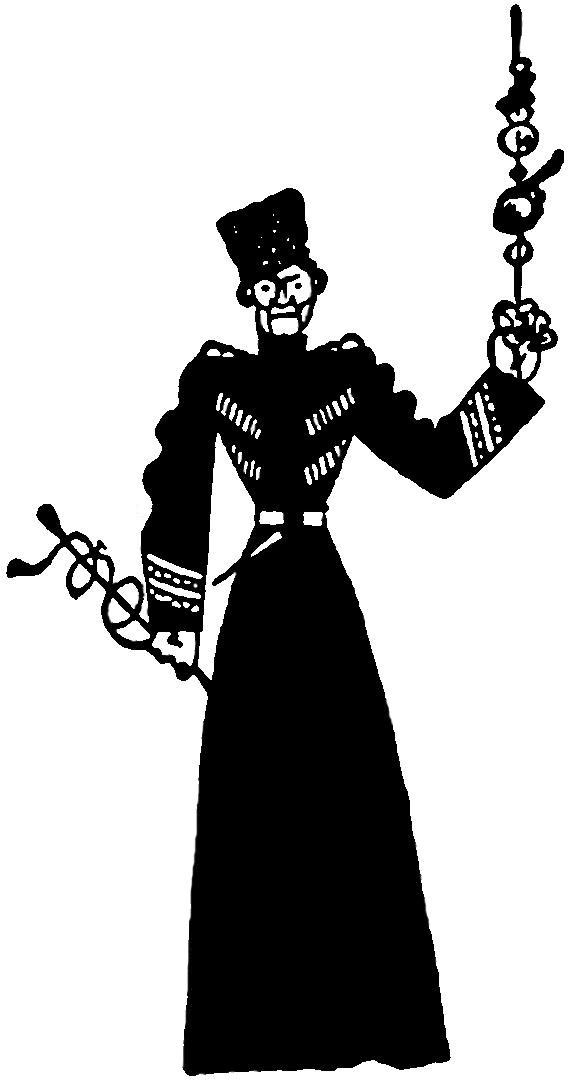
Restaurants and coffee houses run by Russian immigrants appeared in the late 19th century. Their proprietors were Jews living on NYC’s lower East Side as well as others in California and Chicago who were pro-revolution enemies of the Czar. But not until after World War I (and the Russian Revolution), when a very different wave of anti-revolution, pro-Czar Russian immigrants arrived, did explicitly and self-consciously Russian-themed restaurants come into being. They flourished in the 1920s and 1930s.

For many readers New York’s Russian Tea Room will immediately spring to mind. It was established on West 57th Street in 1927 by Jakob Zysman, a Polish immigrant who operated a chocolate factory at the little tea room where ballerinas hung out. The business soon moved across the street where it changed hands and was expanded into a full-fledged restaurant. Over its long history it had many owners, notably including Faith Stewart-Gordon who ran it from 1967 until the end of 1995. After extensive renovations by restaurant impresario Warner LeRoy, it reopened in the fall of 1999. LeRoy died in 2001 and the RTR closed the following year.

But it should be noted that, unlike other Russian restaurants of the interwar period, the RTR was not started by a White Russian nor did it have a specifically Russian emigré clientele for most of its tenure. Reportedly, at one point the Russians who haunted the barroom were discouraged from patronizing the place because of their propensity to linger while they eulogized the olden days. The RTR was mainly famous as a flamboyant celebrity restaurant.

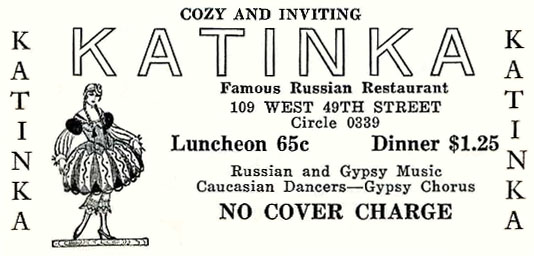
In the 1920s NYC gained a population of White Russians numbering about 6,000, most of them well-educated former members of the intelligentsia or the Imperial Russian Army. Numerous Russian eating places soon cropped up, with names such as The Russian Inn, The Eagle (E 57th), Katinka (W 49th), The Russian Swan, Kavkaz (Bdwy & 53rd), Casino Russe (W 56th), The Russian Sadko (W 57th), The Maisonette Russe (W 52nd), and The Russian Bear (W 57th). On the lower East Side were The Russian Kretchma and the (original) Russian Bear. Striking modernistic wall murals by emigré artists such as Boris Artzybashev, balalaika music, and entertainment by Cossack performers often contributed to the atmosphere of these eating places. As far as I can tell they served both as gathering spots for Russians and as tourist attractions.

Los Angeles also had a White Russian settlement of up to 2,000, with an Orthodox church, art shops, tea rooms, and restaurants. Lured by Hollywood, some Russians from this period acted as extras in movies and a few became studio consultants with expertise on the former glories of the fallen Russian aristocracy. When Theodore Lodijensky, proprietor of NYC’s Russian Eagle, moved westward he consulted on Sternberg’s “Last Command” (1928) — and he opened a West Coast version of The Eagle.

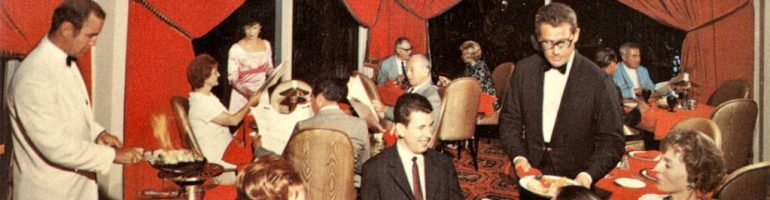
When the RTR began there were also other Russian tea rooms in NYC and around the US, some going by that exact name, some with names such as The Samovar. An importer of artistic wares named Polakoff, a Czarist who used a royal crest in his advertising, ran a Russian Tea Room filled with Russian arts and crafts on Chicago’s South Michigan Blvd. A specialty there was the Petrograd Supreme, a tall sandwich which the eater approached from the appetizer layer on top, working down to the dessert layer at bottom. In the 1930s Valentina Alekseevna Vernon ran a Russian Tea Room in San Francisco. A woman of strong opinions, she found Americans as resistant to some Russian dishes as she was to theirs.“I wouldn’t touch either an ice cream soda or a fruit salad,” she proudly proclaimed. Also in San Francisco was the Moscow Café which opened in 1932 and featured flaming Beef Stroganoff and Cossacks balancing flaming swords. A few Russian restaurants could also be found in Philadelphia, Boston, New Haven CT, and Miami in the 1930s.

The dishes introduced by White Russian restaurants included not only Beef Stroganoff, but also Blini with Caviar and Nesselrode Pudding. Although their menus might list Borscht, Darra Goldstein points out in The Oxford Companion to American Food and Drink that this humble Ukrainian beet soup was brought by Russian Jews who had immigrated earlier.

© Jan Whitaker, 2011
4 Comments

Filed under proprietors & careers, theme restaurants

African-American tea rooms

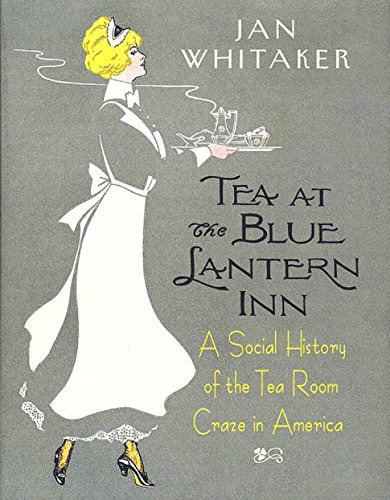
When I wrote my book about the history of tea rooms, Tea at the Blue Lantern Inn, I knew very little about tea rooms run by and for African-Americans. There were few historical sources available on the internet then and even a research trip to Chicago turned up nothing. Since then I’ve discovered that there were many of these tea rooms and that they shared numerous characteristics with tea rooms run by and for whites, yet were also different in significant ways.

It’s easy to see why black women, and men, wanted to create their own tea rooms. For one thing, even in states where Jim Crow policies were not enacted into law it was common for white-run tea rooms and restaurants to engage in racial discrimination. Secondly, starting a business represented the fulfillment of the idea of self-help for blacks as advanced by leaders. Perhaps that was what inspired Mittie Burgess, a Georgia-born caterer in her late 30s, to name her newly opened 1916 place in Lexington KY the Booker T. Washington Tea Room. Although Mittie’s tea room was in the South, quite a few of the proprietors I’ve been able to trace were part of the 20th-century’s Great Migration of Southern blacks to Northern cities.

Like white tea room proprietors, blacks who took up this business tended overall to be of higher social status than the average restaurant owner, white or black. Proprietors I’ve come across included a woman who was a former pharmacist and a man who had been a college professor. Some of the more elite women who operated tea rooms were married to life insurance executives, ministers, doctors, and successful business men. Others were wives of porters, cabbies, and chauffeurs but still seemed to have achieved standing in their communities.

The advertisement for the 1922 opening of Mayme Clinkscale’s Ideal Tea Room [shown above] in Chicago said it was designed for club, society, and lodge banquets, and furnished with “the latest and best in silverware, linen, and glassware.”

A number of tea rooms were clearly meant for the black upper crust. Common phrases in advertisements and news stories include “exclusive,” “the elite of the city are found [here],” or “where the wealthier class of colored people dine.” Mentions of table appointments and decor often include silver bud vases, exotic themes, and carefully coordinated color schemes. Menus offered fried chicken and corn sticks as well as steaks and salads, but were less likely to list rural Southern favorites such as pigs’ feet or greens.

Tea rooms in African-American communities in the teens, 20s, and 30s, frequently hosted important social events. Community leaders hailed them as badly needed establishments. Groups such as the NAACP Women’s Auxiliary, black sports writers, and the Negro Business League held luncheons and dinners at tea rooms. Red Caps from Grand Central and Penn Station hosted their peers at the Gilt Edge Tea Room during a national convention in NYC. Newspaper people from the black newspaper The Amsterdam News celebrated a colleague’s college graduation at Harlem’s Jack and Jill Tea Room in 1928. They certainly received a warmer welcome than had Charlotte Bass, black publisher of the California Eagle, when she and several of her guests were refused service at the white-run Old Adobe in Ventura CA.

Since they were small and did not make money from alcoholic beverages (not legally anyway, during Prohibition) all tea rooms were hard to operate profitably. Yet I sense that owners of Afro-American tea rooms had to work even harder than whites to succeed. They seem to have been open much longer hours, covering meals that ran from breakfast until late into the night. They were also more likely than white tea rooms to offer entertainment such as music and dancing. Many took in table boarders, regular patrons who contracted to eat their meals there for a week or month at a time.

© Jan Whitaker, 2011
55 Comments

Filed under proprietors & careers, racism, tea shops

Romantic dinners

No respectable person in the 19th century would have dreamed of even mentioning such a thing as a romantic dinner in a restaurant. The whole topic of “romance” and restaurants was scandalous. Basically it implied a man having sex – and maybe dinner – with a disreputable woman, probably a prostitute, in a private room in the basement or on an upper floor of a restaurant. For decades the term “French restaurant” was widely taken as a euphemism for a brothel, especially in San Francisco. There, at the start of the 20th century, the mayor and his legal counsel made thousands of dollars by shaking down restaurant owners engaged in this trade by having their liquor licenses withheld until they paid for “protection.”

The idea of private dining rooms was an explosive one. An expensive new French restaurant in New York City that wished to be patronized by best society in 1861 felt it necessary to run a special notice explaining its policy: “The Proprietor … fearing that the public has misunderstood that announcement in the papers of the opening of his house, begs leave to notify those who have already favored him with their patronage, and the public generally, that the PRIVATE ROOMS in his house are exclusively for families or dinner parties to order.” Meanwhile, to insure its reputation with society elites, particularly women, Delmonico’s banned even married couples from dining in its private rooms unless they were accompanied by others.

It seems that for a very long time in America’s history there was only one type of food purveyor that might be deemed acceptable for a romantic twosome, and that was not really a restaurant but a place that specialized in ice cream. In late-18th-century NYC this would be a pleasure garden, such as Vauxhall or Contoit’s, dotted with little vine-covered bowers with individual tables inside. There were also some bright and glittery mirrored cafes modeled on those in Paris that attracted young couples and were considered somewhat acceptable.

As late as the World War I era, when restaurants were becoming more respectable, a typical scene in today’s popular media featuring a man proposing to a woman in a restaurant would have been seen as improper. For one thing, it wasn’t really considered totally ok for an unmarried couple to have dinner unchaperoned in a restaurant until the later 1920s. In 1913 a waitress confessed that she was shocked to witness a man proposing marriage. She felt a strong negative reaction to the spectacle:“That was too much for me, and I made up my mind then that if any man ever asked me at the dinner table to marry him I would refuse him on the spot.”

Of course there were plenty of people who defied convention and went to restaurants two by two anyway, and there were restaurants that had romantic attractions such as strolling musicians in the early 20th century. Yet, it wasn’t until fairly recently that restaurants began to specifically and proudly advertise that they were the perfect spot for a romantic dinner. This began to occur in the 1960s, a decade in which more and more Americans went to restaurants in the evening for entertainment.

A popular restaurant in the college town of Columbia, Missouri, exemplified the new trend in the 1960s and the characteristics that would become regarded as romantic. Called the Mill O’Rock, it was in an old grist mill and had a circular stone fireplace in the center of the room with wooden ceiling beams radiating out from it. Young couples flocked there and the owner said it was well known as the perfect place for marriage proposals.

© Jan Whitaker, 2011
6 Comments

Filed under patrons, restaurant etiquette, women

Flaming swords

When I was researching my last post on knights-and-castles restaurant themes I discovered that this kind of theatrical decor was often complemented by flamboyant food presentation, especially the kind that mixes weaponry and meat. Specifically sticking meat on a sword, setting it aflame, and rushing it toward your guests.

If you like that and had been looking for a fun night out in the vicinity of Reno, Nevada, in 1960, you might have turned up at The Lancer, “home of the flaming sword” and Glen Relfson at the organ. The Lancer’s advertisement showed a knight charging forward on his horse with lance in hand — yet, disappointingly, the food came on an everyday sword. Why not a lance?

I’ve searched U.S. patents and the reason why meat was not served on a lance is because no one thought to invent a lance — or a gun, why not? — that could go on the grill loaded up with shish kebab. But they did invent several very practical-minded swords, either with detachable handles (permitting the handle to stay cool while the skewered meat cooks on the grill), or with the hand protector turned upward to catch dripping grease when the sword is held upright (pictured). As the patentees methodically argued, these features are important to restaurant managers.

Many municipalities have enacted fire regulations that do not permit restaurant employees to carry flaming objects across a room. This has cut down the number of restaurants that offer this service today as compared to the peak in the mid-20th century and through the 1970s.

It’s possible the custom began in restaurants with Russian themes. In the 1930s there was a place in San Francisco called the Moscow Café which had Cossack dancing, entertainment with flaming swords, and a specialty of flaming Beef Stroganoff. (Presumably the sour cream was added after the flames subsided.) Los Angeles’ Bublichki Russian Café also offered beef on flaming swords in the 1950s. And a patent was granted in 1965 for an item called a “shashlik sword.”

How does the flame work? I always wondered. As a patent applicant explained, “this is usually accomplished through igniting, immediately before serving, a piece of cotton which, first dipped in alcohol, is wrapped around the base of the sword near the hilt thereof.” However if you adopted another design you could have a wick holder built into the grease drip cup “so that when the skewer is carried in an upright position with cooked meats or other food articles impaled thereon, the wick, previously soaked with rum or brandy, may be ignited, providing a dramatic torch-like effect as the skewer is carried from the kitchen to the table.” Quite frankly, that would be my preferred sword because I like the way it catches grease and eliminates cotton wads thereon.

You may be thinking that only corny restaurants in mini-malls featured food on swords but you’d be wrong. For instance, the menu at NYC’s Forum of the Twelve Caesars in the early 1960s included, perhaps for lighter appetites, Wild Boar Marinated and Served on the Flaming Short Sword. And, starting in the 1940s, flaming swords were practically synonymous with the fabulously funky Pump Room in Chicago’s Ambassador East Hotel. The Pump Room’s manager Ernie Byfield laughingly referred to the action there, consisting of costumed waiters weaving through crowds of guests with “flaming gobbets of lamb,” as being “like Halloween in Hell.” I don’t believe anyone was immolated.

© Jan Whitaker, 2011
5 Comments

Filed under restaurant customs, technology

Theme restaurants: castles

So often restaurant reviewers seem to struggle to say something positive about a restaurant. Is it my imagination or did they try twice as hard when reviewing restaurants with medieval castles and King-Arthur-and-his-knights themes? No doubt there were a handful of restaurants of this sort that really cared about food but, mainly, I think not. Of course most were actually steak houses in disguise — but what wasn’t a steak house around 1967, the year that the movie Camelot came out, almost certainly boosting this restaurant-ing trend?

In America Eats Out, John Mariani comments that during the 1960s many “strained and mawkish” restaurant themes prevailed. For example, he writes, “‘Old English pubs’ proliferated in places with names like Ye Olde Bull & Bush in Atlanta, The Golden Bee in Denver, and His Lordship’s in St. Louis. At Atlanta’s Abbey restaurant, waiters came to the table dressed as monks (a sartorial gimmick also featured at New York’s Monk’s Inn).”

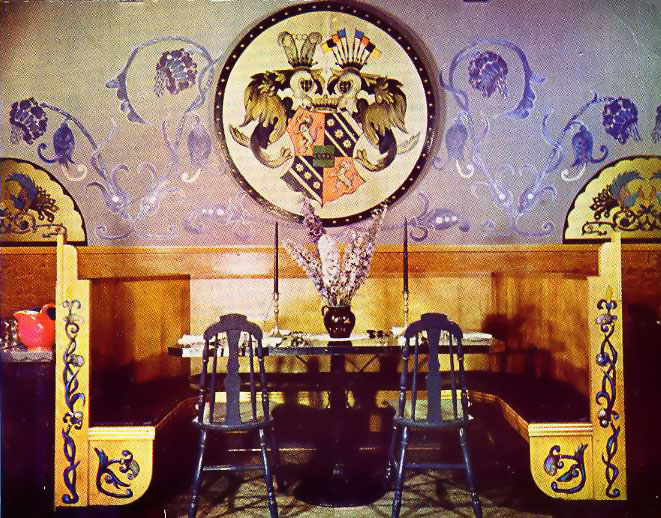
The popular movie Camelot explains some but not all instances of medieval English resorts in this country. There were none in the 19th century that I’ve discovered, but a few can be found before the 1960s. I do not include White Castle hamburger stands. Despite their name and laughably minimal crenellated exteriors, they were so clearly not castles that they may be excused from consideration. They didn’t print menus on parchment scrolls, didn’t decorate with suits of armor, and didn’t dress countermen in monks’ robes or velveteen rompers with tights. As others have commented, White Castle interiors looked more like morgues than baronial halls. And while White Castles were sited near bus stops and factory gates, only a novelist like Vladimir Nabokov could have created the existential contexts for English castles: The Coat of Arms on Oracle Blvd. in the Casa Adobes Plaza; the Camelot Castle, a smorgasbord in Azusa CA; King Arthur steaks in Long Beach.

knightCrownRoomSheratonMotorHotelNYC

Back in the 1920s entrepreneurs in Los Angeles were knocking together roadside castles – and windmills, Irish shanties, French Bastilles, giant igloos, anything that would catch the eye of a speeding motorist. It may have been a similar motive that led to the ca. 1920s erection of a castle in Westhampton, Long Island, once the home of the Gray Lion Tea House (another medieval castle would spring up in a Valley Stream shopping center in the mid 1960s housing a unit of the Steak Pub chain). The 1939 Chicago World’s Fair occasioned many theme restaurants including The Hunting Lodge, an English castle whose guests were attended by young women dressed as Robin Hoods.

Quite unlike White Castles’s tiny beef patties, Olde English castles encouraged “royal” self-indulgence, designed principally for male guests. Stiff drinks in front of the roaring fire, the color red, chunky chairs, cheese crocks, T-bone steaks, jumbo shrimp, and oversize desserts were typical of these castles.

The proliferation of restaurants of this type in the 1960s makes me think that it took a lot of coaxing to get men to go out to dinner in that decade.

© Jan Whitaker, 2011
2 Comments

Filed under restaurant decor, theme restaurants

Know thy customer

In the early days of American eating places, in the late 18th and early 19th centuries, most customers other than travelers were personally known to proprietors. Some, especially single men, were regular customers eating in the same place every day for weeks, months, even years. They may have rented a sleeping room there as well. Others worked nearby. The typical newspaper advertisement of that time always began by saying that the proprietor wanted to thank his friends, old customers, and the public, in that order, which I believe descends in importance. Many of the familiar customers at better eating places no doubt kept a tab and paid monthly or less often.

From what I have been able to gather, anyone wanting to eat their dinner at a tavern, ordinary, coffee house, or whatever the establishment was called, would let the proprietor know in advance. For those who did not eat there every day, some (most? a few?) proprietors prepared a list of dishes being served that could be examined in the morning. As Mrs. Treville of New York announced in 1777, “The bill of fare [is] to be seen in the coffee room every forenoon.” After inspecting the day’s bill of fare, the prospective diner might leave his name or buy a ticket if he intended to return for dinner, which was served at noon or in the early afternoon.

Although there was sometimes a bill of fare, diners did not usually order individual dishes from it as we do today (though sometimes they did – subject of a later post). Instead, the meal would be served family style, with all the dishes being passed around a common table and each person paying a flat price. Anyone wishing an evening meal had to place their order in advance, probably so that the proprietor could buy the necessary supplies.

Although I am guessing about some of this – to a degree – I think this is how it usually worked. But what I don’t know is whether a person ordering an evening meal for themselves or a group of friends had to pay something up front or if being known was enough to underwrite the deal.

A few months ago a man walked into Antonio’s Pizza parlor in Amherst, Massachusetts, and placed a very large order for 178 pizzas which he said he would pick up later. He never did. The staff worked far into the night to prepare them and the bill totaled nearly $4,000. Almost all of the pizzas ended up being thrown away. The man, whose identity was never publicly revealed, was caught on the store’s security camera [center] and located later living in New Jersey. Through a lawyer he made settlement for an undisclosed amount, with no public explanation of his motive for what appears to have been an intentional prank.

He paid nothing in advance, nor did he leave his credit card or phone number.

Because he was wearing a lanyard around his neck filled with backstage passes and said he was ordering the pizzas for the crew of a Bob Dylan concert at the University of Massachusetts, Antonio’s failed to insist upon a deposit or … anything.

Did the early proprietors of eating places ever get stiffed? Apparently they did, despite the closer personal relations between them and their customers. A law was upheld in 1831 which said that each person in a dining party is a member of a partnership and as such is individually responsible for the entire bill if the others abscond or fail to pay.

Othello Pollard, who served a college crowd, announced in 1802 that he expected immediate payment and would extend credit only for “as long as a man can hold his breath.”

I don’t think Othello would have let the prankster out the door so easily.

© Jan Whitaker, 2011
1 Comment

Filed under patrons

Menue [sic] mistakes

The names of dishes, particularly if they are in an unfamiliar language, can be daunting to spell. Depending upon your perspective, discovering spelling errors on menus can be trivial, annoying, or amusing. Jane Black’s Washington Post column on mistakes she has spotted was funny to me, and got me thinking about errors I’ve seen while researching restaurants of the past.

Often menus were reproduced or reprinted in newspaper advertisements, in which case it’s hard to know who was to blame for garbled words, the restaurant or the newspaper. But given that newspaper typesetters were often more literate than the general public, I would think they corrected more mistakes than they made. In either case, plenty made it into print.

For instance:

Horne’s Restaurant in Macon GA prepared a special celebration dinner in May of 1859 which featured MAJONAISE of Lobster and, for dessert, SUFFLE (Soufflé). For a long time mayonnaise was an unfamiliar word that caused a lot of confusion.

Overall French culinary terms, intended to impress restaurant guests, posed the greatest spelling challenges but that did not seem to limit their use. Menus were littered with semi-recognizable dishes such as Giblets VOLIVEN (Vol au Vent — in puff pastry cases), BLAUMAGE or BLAMONGE (Blancmange — a vanilla pudding), Chicken COQUETS (Croquets), and Peach MERANGUE (Meringue).

Sauces and methods of cooking received rough treatment, as in the following: Croquets of Chicken FINNENCIER (Financière), Breaded Frog Saddles MAITRA (Maitre) d’Hotel, and Regon of Veal JULIEANN (probably Rognon of Veal [veal kidneys], Julienne). The last appeared on an 1893 menu from Delmonico’s Restaurant in Woodland CA which also featured Scallops of Mutton a la PROVENSIAL (Provençale), and Queen Pudding au RUM (Rhum).

Although foreign language terms were the most perplexing to Americans, mistakes were also made with relatively more common words such as TERREPIN, RABIT, PARSNEP, ASPECT (Aspic), BRASED or BRAIZED (braised), SHELLOT (Shallot), and BANNANA (Banana).

My favorite misspelling occurred on a banquet menu from 1883 which featured a sorbet course consisting of a gelatin shell resembling a glass ball filled with wine punch, referred to as a Fifth Avenue BOMB (Bombe). What a difference one letter can make.

Obviously menu spelling errors did not cease in the 20th century, though I found fewer on chain restaurant menus than on those of independent restaurants. The examples illustrated above are from about 1950 to 1980, from restaurants in San Francisco and Los Angeles. Corrected, the misspelled words would read: Parmesan, Du Jour, and Wienerschnitzel.

© Jan Whitaker, 2011
Leave a comment

Filed under menus

“Waiter, telephone please!”

As one year ends and another begins, it’s a good time to think about what’s old and what’s new. For example, talking on a phone at the table in a restaurant seems a new-ish kind of activity. Of course you realize that I’m going to tell you it isn’t.

Even though the telephone was invented in the 1870s, it took a while for it to become an everyday necessity. So it was still newsworthy when restaurants began to provide telephone service at patrons’ tables in the early 1900s. The customer had only to say to the waiter, “Bring me a telephone,” and it would be placed on the table and plugged into a jack.

In the first few years of the 20th century tabletop telephone service was available in Chicago, New York, Cleveland, Boston, and probably all big cities. Chicago restaurants such as Kinsley’s, the Bismarck, and Boston Oyster House (pictured), as well as the tea room at Mandel Brothers department store were outfitted with table telephones. Boston’s R. H. White department store also had phone service in its restaurant. In both these stores the telephones were undoubtedly in the men’s, not the women’s, sections.

Fans of old movies might remember scenes where waiters rush telephones to male VIPs enjoying the evening out dressed in tuxedos and accompanied by mink-clad companions. But, actually, early restaurant phoning was apparently more like today’s: business transactions, usually conducted at lunch. Stock brokers in New York City — who paid a monthly telephone rental fee and might take as many as 30 calls while lunching at a restaurant — were at least liberated from their earlier practice of gulping sandwiches at their desks.

Social commentators worried about the effect on health, how working during times meant for rest would cause “brain fag” and indigestion. The invasion of the restaurant by telephones inspired one journalist in 1902 to imagine how one day “some brilliant genius will invent a telephone that can be carried in the vest pocket and then the hustling American can wire messages to his wife, telling how busy he is while he is crossing the street or going up in the elevator.”

© Jan Whitaker, 2010

5 Comments

Filed under restaurant customs, technology

Conference-ing

Admittedly the “-ing” gimmick doesn’t work so well with that word, but it’s for a good cause. I want to let readers know about a fantastic event taking place in NYC February 18 and 19 that I will be participating in. It is the regional conference of the International Association of Culinary Professionals (IACP), sponsored by The Culinary Trust.

The two days have a lot packed into them: Two plenary addresses to choose from, two receptions, restaurant dinners and lunches (additional charges), and multiple panels organized by thematic track. The four tracks are:

Food Writing (with me on one of the panels)

The Food of New York (me again, talking about NYC’s restaurant history)

School Food

Farm to Table

Read more about the IACP conference. To get more details about each panel, click on the “Register here” button. (You will not be required to register immediately, but I hope you will.)

1 Comment

Filed under miscellaneous

Top posts in 2010

Leave a comment

Filed under miscellaneous