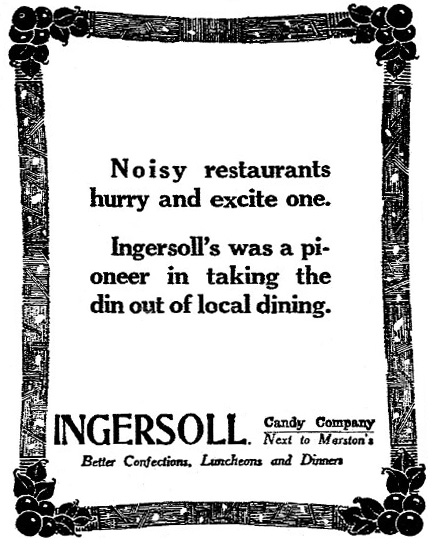
Taking the din out of dining

In the modern world nothing is more expensive than quiet. This certainly holds true for restaurants. The difference between a quiet and a noisy restaurant rests mainly on good padding, both of the room and the patron’s wallet.

But there is also such a thing as too much quiet, such as in a failing restaurant with few patrons. Nobody wants that kind of quiet. Which brings up the point that since the proliferation of theme restaurants in the 1970s, fun has become one of the biggest attractions for restaurant goers. And in most people’s minds fun = noise and crowds.

It seems as though since the 1970s noise has crept up the restaurant ladder, beyond the raucousness of TGI Friday and its kin, so that today even many fairly expensive, white-tablecloth restaurants are so noisy that conversation is difficult. This issue was called to my attention by a friend who asked where she could find a list of restaurants that are free of din. If anyone knows of such a thing, please let me know. With an aging population – older diners, particularly in the 55 to 65 year-old range, make up a sizable market – the noise problem becomes more pressing.

Although the popularity of restaurant-going is comparatively new, complaints about restaurant din are not. In 1848 a satirical essay in that fascinating periodical The Spirit of the Times (“A Chronicle of the Turf, Agriculture, Field Sports, Literature” – and almost everything else) said:

It has been ascertained that a gentleman never enjoys his dinner more than when it is served up in the midst of confusion, excitement, and noise. For this reason, the denizens of New York, observing and sagacious, delight to dine in cellars, and wisely select those which the most boisterous people frequent.

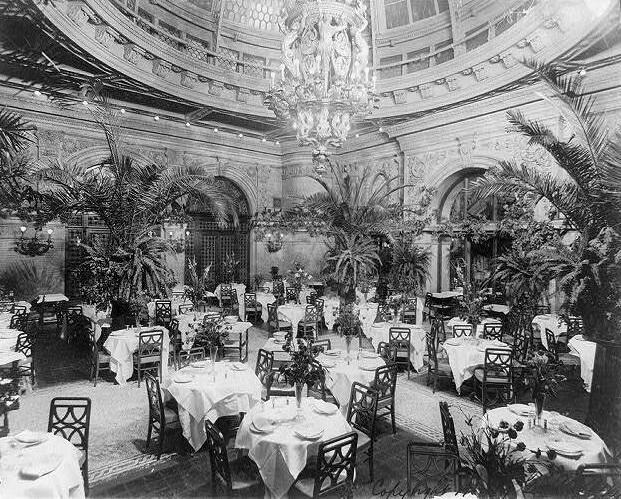
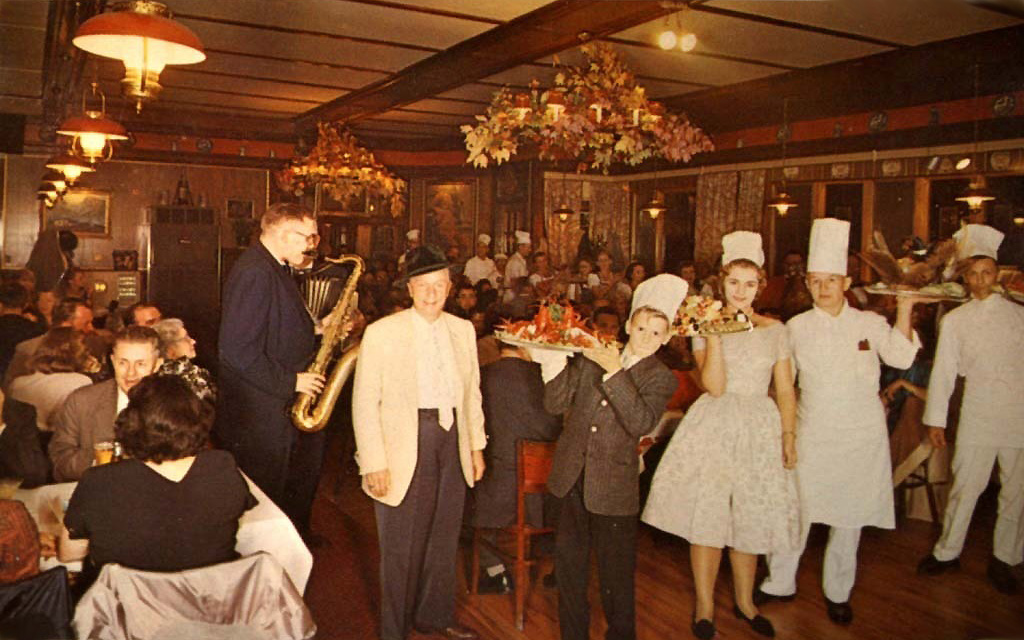
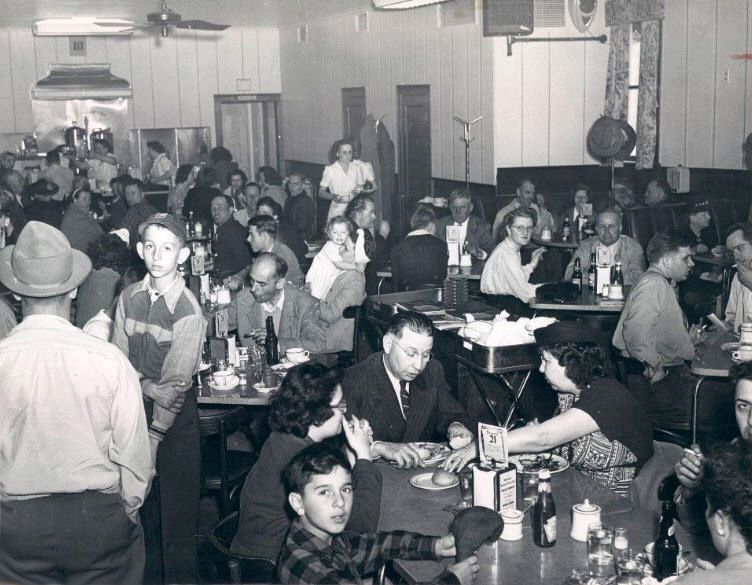
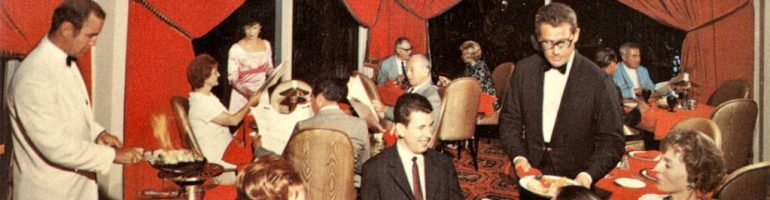
In 1869 another writer observed that at noon in downtown NYC “eating houses are in one continuous roar. The clatter of plates, the slamming of doors, the talking and giving of orders by the customers, the bellowing of waiters, are mingled in a wild chaos.” It would get worse. Restaurants became even noisier when music made its dining room debut, and again during World War II when they were packed to bursting capacity (see image). Cafeterias could be especially deafening.

However, there were some exceptions along the way. The upstanding Craftsman Restaurant in NYC eschewed artificial gaiety. A diner in 1914 wrote (revealing the genteel racism of the period): “About me people were lunching quietly, without haste and without boisterousness. Soft-treading little men of Nippon brought delectable viands on dainty dishes. A stringed orchestra was playing softly . . .”

Tea rooms were also singled out in the teens and 1920s for their peacefulness. Very likely the absence of alcoholic beverages in them played a big role. NYC’s Colonia had “a quiet atmosphere that appeals to the woman of culture,” while in Greenwich Village the women proprietors of The Candlestick provided a luncheon setting “without the annoyance of shrieks, laughter, loud talking and noises that seem to be the necessary accessories of every other similar place in our Village, perhaps in order to create ‘bohemian atmosphere.’” Yet drinking did not inevitably lead to din. Rather surprisingly, the speakeasy restaurant was seen by some as a quiet, relaxing haven where attentive waiters served well-behaved patrons united in a “civilized conspiracy.”

Quiet has also been seen as a necessary condition for a romantic dinner. But let’s note that on such an occasion diners are usually willing to fork out a bit more cash than usual for privacy and a chance to hear the cork pop and the harp being plucked. The question remains: can a restaurant that is thriving be quiet without being expensive?

© Jan Whitaker, 2012

2 Comments

Filed under atmosphere

The power of publicity: Mader’s

Compared to cities of comparable size in 1910 — such as Los Angeles, Minneapolis, or New Orleans — Milwaukee at first appears to be a town where people rarely ate outside the home. But statistics can be deceiving. In the city made famous by its breweries, most eating places were primarily saloons before Prohibition, usually set up in business by one or another brewery.

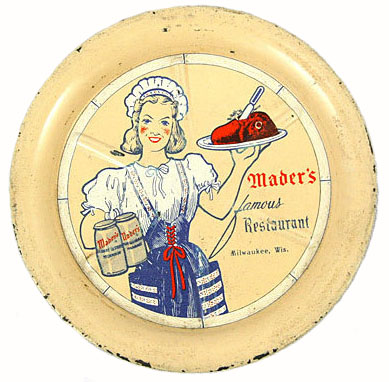
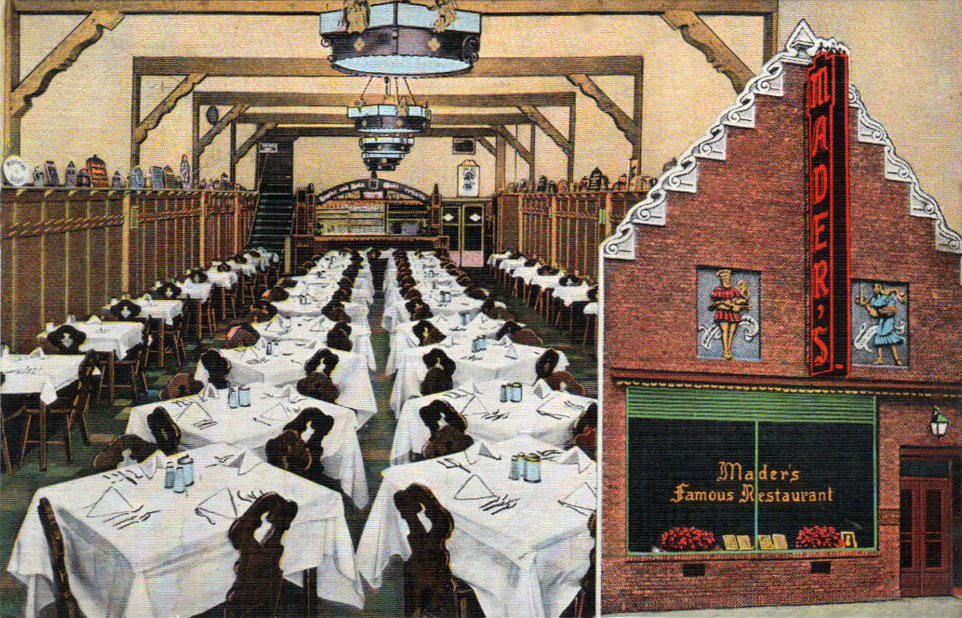
This is how Charles Mader got his start, as a saloonkeeper who also served meals of the homely sort. Although 1902 is commonly given as the year in which he began, I suspect it was a few years later that he opened his own place. Throughout most of his early career he worked with a partner. He and Gustav Trimmel joined up in 1915, the year the saloon moved to the present-day restaurant’s address. In 1921 Mader had a new partner, Charles Ruge, with whom he remained in business until 1928. Thereafter his partners were his sons George and Gus who assumed ownership when Charles died in 1937. [pictured above, 1950s]

Although many restaurants get a good share of patronage from out-of-towners, relatively few located in America’s midsection make a determined bid for nation-wide recognition. Mader’s was one of those that did so successfully. A late 1920s photograph in the historic photo collection of the Milwaukee Public Library shows the restaurant with a prominent “Tourists’ Headquarters” sign in its front window. In 1929, a newspaper item suspiciously resembling an advertorial (publications didn’t identify them as such then) claimed that Mader’s had won a reputation for hospitality extending “the length and breadth of this land and to distant lands as well.”

Charles Mader was known for his belief in advertising, often remarking, “If your business is not worth advertising, advertise it for sale.” Beginning afer Prohibition, Mader’s would intensify its advertising program and accentuate its Germanness, following a kind of reverse assimilation common to other German-themed restaurants in the US. Very likely this reflected a proportionate shift in patronage from German-American Milwaukeans to a wider clientele of conventioneers, traveling businessmen, and tourists of all stripes looking for an identifiably ethnic experience. The trend would continue: a 1968 newspaper story reported that at Mader’s and Karl Ratzsch’s, mostly patronized by tourists, German dishes were popular, while at restaurants patronized exclusively by Milwaukeans such as the Fox and Hounds, filet mignon and lobster tail were favorites.

In 1935 the Maders remodeled the 3rd Street building to look more typically German in a style suggestive of medieval architecture with a high stepped gable and two bas relief panels depicting quaintly costumed servers. By contrast, only a couple years earlier Mader’s had a typical plate glass storefront with a centered, recessed entryway and a moderne sign with its name spelled out in bold aluminum lettering. In subsequent decades, the Mader’s compound has been further extended and embellished, given a vaulted ceiling and decorated with heraldic swords and shields. It has taken on a castle-like appearance.

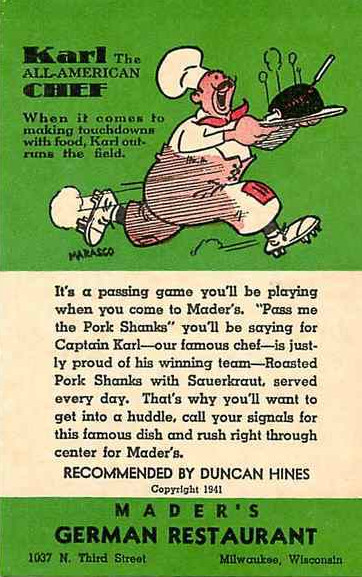
Along with arch competitor Karl Ratzsch’s, a Viennese-inflected restaurant pursuing much the same strategy, Mader’s began to win awards and listings in national magazines and restaurant guides, such as Duncan Hine’s Adventures in Good Eating and those of the Automobile Club of America and Ford Motor Company. It began attracting visiting Hollywood stars in the 1930s, hanging their autographed photos on its walls. In 1937 and again in 1949 and 1952 a poll of traveling business men voted it America’s favorite German restaurant and one of their ten favorite restaurants overall. Accolades continued coming in up to the present day.

Mader’s is a survivor, having outlasted most of Milwaukee’s venerable German restaurants, some of which, Forst-Keller and the Old Heidelberg for example, were associated with the city’s breweries. Cafes originating with Fritz Gust, Joe Deutsch, and John Ernst have all passed from the scene, the last as recently as 2001.

Long considered “heavy” eating, German cuisine has perhaps sunk in popularity somewhat from the middle of the 20th century, although Pork Shanks – ever popular at Mader’s – remain on the restaurant’s menu to this day. Notably, though, this once-humble dish has become an expensive entree.

© Jan Whitaker, 2012

1 Comment

Filed under theme restaurants

Modernizing Main Street restaurants

In the late 1920s the spreading influence of the 1925 “Art Deco” exposition in Paris inspired restaurants in the United States to remodel their exteriors and interiors in the bold new modern style. A leading trade journal, The American Restaurant, proclaimed in its July 1929 issue that modernism had become a notable trend in the industry.

Modernizing restaurants usually went further than skin-deep decorations and included new ventilation systems, dropped ceilings, concealed lighting, sound proofing, and air-conditioning. Many restaurants badly wanted to renovate their facilities, but by 1932 the Great Depression seriously curtailed funding for building and remodeling.

It didn’t take long for central business districts to decline, looking dowdy and down on their luck. Many towns felt if they could improve the appearance of stores in shopping areas it would have a positive effect on consumer spending. When President Franklin Roosevelt signed the National Housing Act into law in 1934, there was rejoicing on Main Streets across the country. Through government-backed, low-interest private loans, the NHA was meant not only to shore up the housing market but to stimulate improvements to commercial properties.

Towns responded wholeheartedly. In Mansfield, Louisiana (population 3,357), every merchant on the main business street signed up for that town’s 1935 improvement campaign and the local bank approved four loans the very first day. In 1936 sixty-nine New Jersey cities and towns were chosen to participate in Main Street modernization programs, with committees of prominent merchants, bankers, realtors, and building contractors presiding.

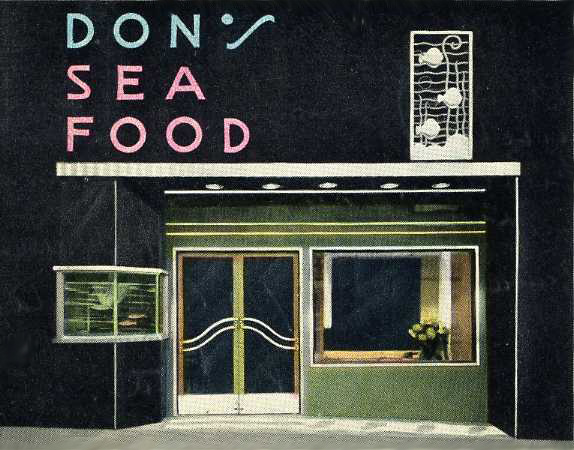
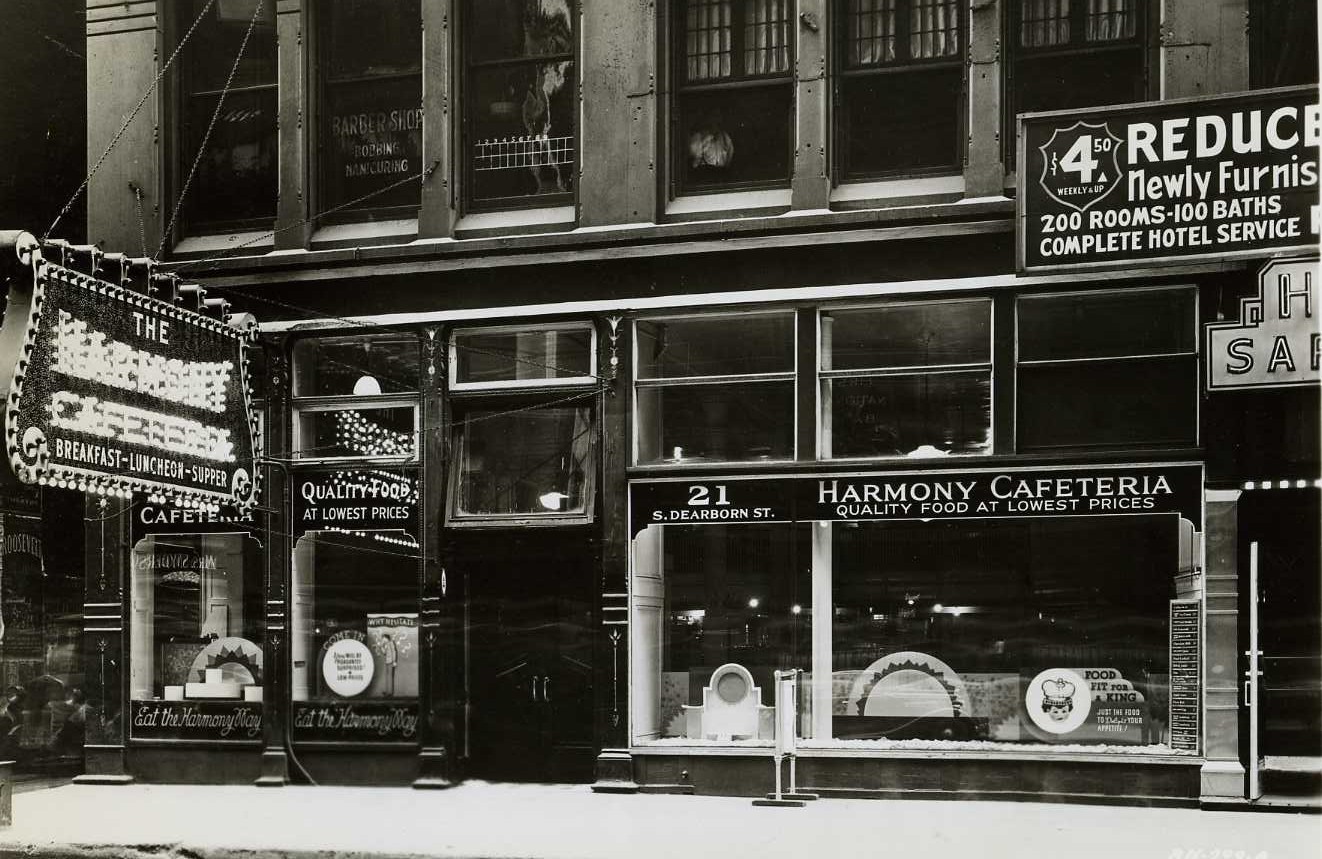
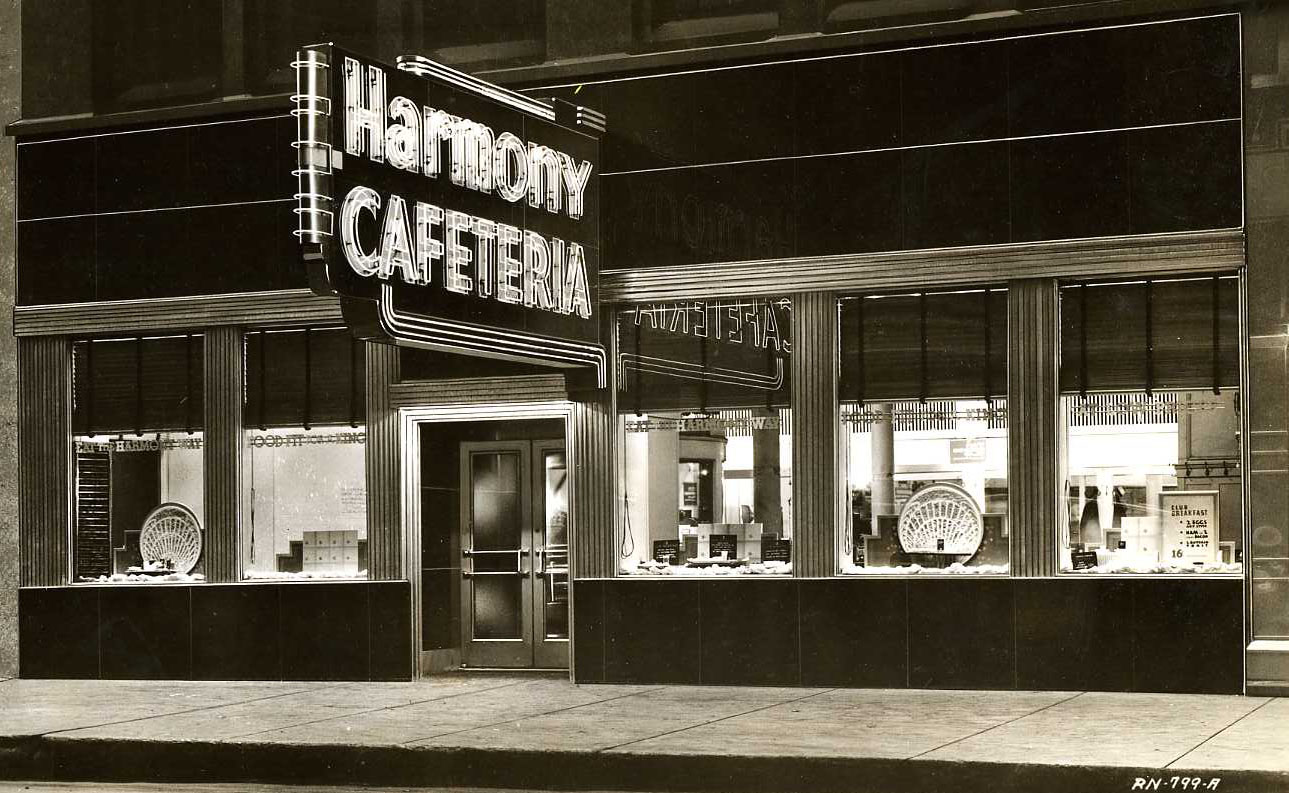
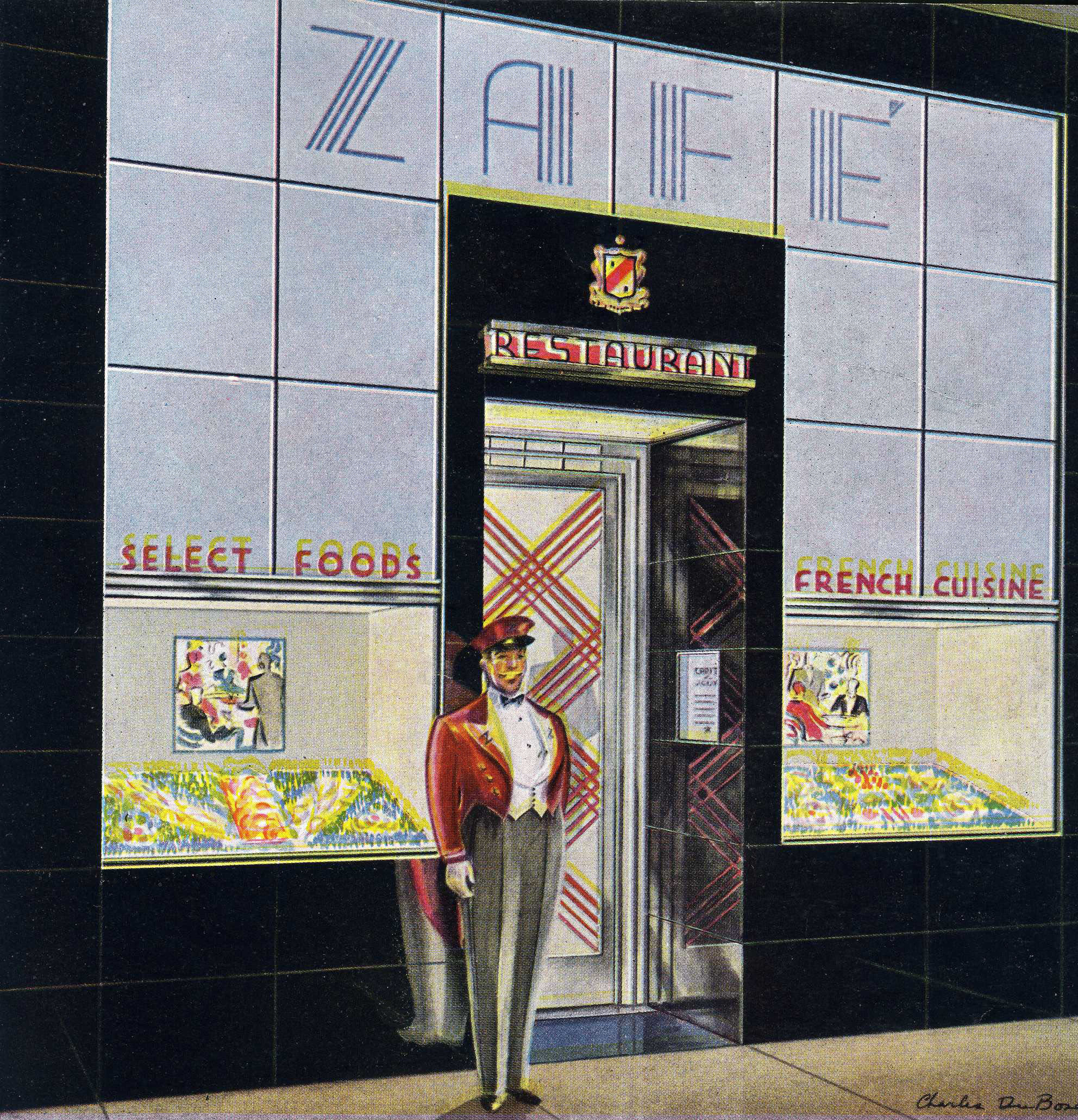
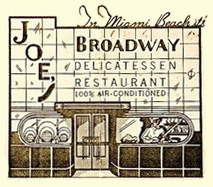
Retailers of all types took advantage of the program under the banner “Modernize Main Street.” Through architecture contests and programs sponsored by manufacturers of structural glass and other materials, a style soon developed known retrospectively as Depression Modern. Although it can be traced back to luxurious Art Deco styles, it was simplified and streamlined, and used industrial building materials such as glass and aluminum rather than marble and rare woods. As shown in before and after shots of the Harmony Cafeteria the new style was less cluttered than what had preceded it.

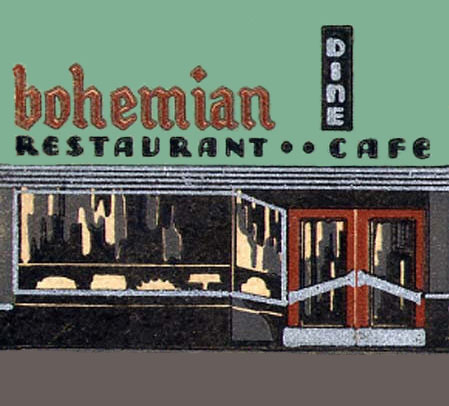
A new facade could be acquired for as little as $1,000 but some restaurants invested far more. For instance, in 1937 Joe Yium, owner of the Shanghai Cafe at 1004 Main in Dallas, sunk $15,000 into a structural glass front of cream trimmed with black, as well as an interior with new furniture and lunch counter all done in cream and deep “mandarin” red. Like the Shanghai, the Bohemian Restaurant in Portland OR [shown above] closed for a month while it was renovated to the tune of $25,000 with a front of black glass and aluminum, increased floor space, new ranges and steam tables, and a pastry department.

Improvements eligible under the program could include interior decor, air conditioning, and other functional modifications, but nothing symbolized hope for the future nor represented modernization more visibly than gleaming new fronts of shiny glass. Colored glass veneers were provided mostly by two companies, Pittsburgh Plate Glass Co. which made Carrara Glass, and Libbey-Owens-Ford, maker of Vitrolite [advertisement pictured].

Both companies offered complete storefront packages which furnished all materials needed, whether colored glass, clear plate glass, glass blocks, metal framing, signage, or even services of design consultants. Many of PPG’s model storefronts were designed by Walter Dorwin Teague, one of America’s foremost industrial designers. For luncheonettes, a PPG booklet recommended a design (possibly by Teague) using glass blocks and Carrara glass in orange, beige, and Rembrandt blue whose overall effect was “carefree and attractive” and — as you might imagine — had “high visibility.”

Coinciding as it did with the end of national prohibition, modernization paid off in increased business for restaurants, many of which took full advantage of the program. It confirmed the status of Main Street as the symbol of economic health for cities and towns in the popular imagination. However, as Gabrielle Esperdy points out in Modernizing Main Street: Architecture and Consumer Culture in the New Deal, decentralization of downtown shopping districts was well underway by the 1930s. But the modern transformation of Main Street maintained considerable significance to consumer psychology. The styles remained popular until the start of World War II when they were shunned as obsolete.

Today, in American cities and towns vestiges of Depression Modern storefronts, such as black glass panels above or beneath a show window, can still occasionally be spotted.

© Jan Whitaker, 2012

5 Comments

Filed under restaurant decor

“Adult” restaurants

Anyone who knows American culture realizes immediately that the term “adult restaurant” would not even remotely imply an eating place that caters to mature or developed culinary tastes. Instead it would mean one deemed inappropriate for children because of some kind of sexually tinged goings on.

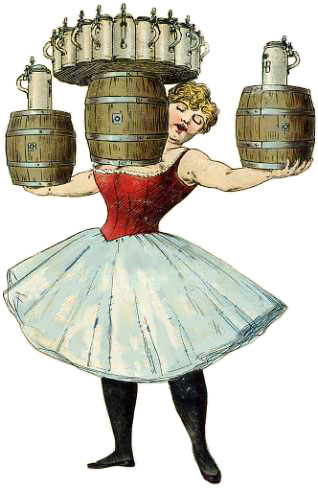
Historically the attractions in adult restaurants have not been what’s on the plate but are part of the female servers’ anatomy.

An unfamiliar restaurant concept to me is the “adult fast food restaurant.” This is how a Florida drive-in owner referred to his business in 1976. It didn’t serve adult fast food – what would that be? Crêpes? It served hot dogs, hamburgers, beer, and, oddly, wine. The manager called it “our answer to MacDonald’s,” reflecting the fierce competition drive-ins faced from big chains in the 1970s.

The “adult” aspect: servers at the “Jugs ‘n’ Suds” drive-in were costumed only in hot pants and tassles.

However, Jugs ‘n’ Suds waitresses got very little chance to “wear” their intended costume. The drive-in met with vehement disapproval from citizens and officials of New Port Richey who insisted that the waitresses cover up. One of the restaurant’s promoters admitted that business fell off once apron-like halter tops were adopted, saying “People aren’t as interested in seeing a topless waitress with fringe on.” [pictured] In very short order the drive-in closed. A second one – without carhops — then opened in an old A&W. I don’t think it lasted long. A fantasized  nationwide chain never materialized.

Jugs ‘n’ Suds was unusual in that it was a drive-in. Most topless restaurants have been positioned at the “nightclub” end of the restaurant spectrum. Typically they’ve been dark, bar-like spaces where business men congregate at noon and after work.

California was the birthplace of the topless restaurant with the pioneers opening in 1965 not long after the creation of Rudi Gernrich’s topless bathing suit. Many offered a business man’s lunch special accompanied by models strolling from table to table. In California, at Long Beach’s Kozy Kitten, kittens ambled while patrons downed 98c luncheons of Turkey, Ham, or Beef served with Potato Salad and Beans. (I didn’t say topless restaurants were glamorous.)

The topless restaurant fad, which combined gawking, drinking, AND eating, died out, but using women’s anatomy to attract restaurant patrons did not. Maybe it’s eternal. Even as the last Playboy bunny club closed in the 1988, a new crop of “breastaurants” (as they are mockingly known by critics) appeared, most of them flaunting scantily dressed servers. Following the success of Hooters, a slew of knock-offs opened in Florida, among them the so preciously named Melons, Knockers, and Mugs & Jugs.

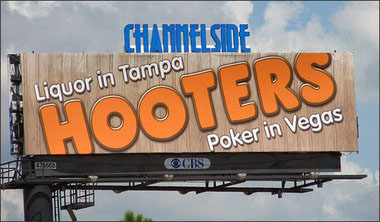
Controversy is also eternal. Hooters’ aggressively suggestive advertising campaign has offended many and the chain was forced to remove billboards that hinted servers were prostitutes, an idea that, depressingly, has plagued female servers since the 19th century.

Legal challenges to topless restaurants and breastaurants have mostly not held up. But communities protest them anyway, occasionally successfully. Recently the Quincy MA Licensing Board denied permission to a unit of the Tilted Kilt chain because it was too close to a church that objected.

© Jan Whitaker, 2012

7 Comments

Filed under drive-ins, food, women

Taste of a decade: 1820s restaurants

Aside from roadside inns, most eating places are found in cities in this decade. With a population slightly over 150,000 New York is more than twice as big as its nearest rivals, Philadelphia and Baltimore, but most cities are considerably smaller. In 1820 only 12 have populations over 10,000, all of them along the East Coast with the exceptions of Albany NY and New Orleans LA.

Yet industrial development is underway. After a financial panic at the decade’s beginning, textile mills in Massachusetts begin large-scale production. The Erie Canal goes into operation with its completion in 1825, spurring commercial development in NYC. With the city’s expansion there is greater distance between work in lower Manhattan and places of residence, bringing more customers to oyster cellars and taverns. But New York still lags behind Boston in its supply of refined French restaurants.

Big hotels begin to be established, most notably Baltimore’s City Hotel (1826), Philadelphia’s United States Hotel (1827), Washington’s National Hotel (1827), and Boston’s Tremont Hotel (1829). In most hotel dining rooms it is still the custom to put all the food – soup, meat, vegetables, puddings — on the table at once. Except for the occasional banquet, menus are not printed. A list of available dishes is chanted by waiters or chalked on a board behind the bar.

Apart from eating in hotels while traveling, “respectable” women stay home. They avoid  public dining spots, especially oyster houses or cellars which are associated with heavy drinking and the burgeoning male “sporting life” of gambling and frequenting prostitutes.

The temperance movement begins. Since there is little separation between eating and drinking places, restaurants are targeted as sites of temptation and moral downfall. Religious publications warn readers that it’s a slippery slope from sipping “innocent soda water” in a pleasure garden to getting drunk in the oyster house or “the common grog shop.”

Highlights

1820 Aiming for well-off gentlemen, Dudley Bradstreet advertises fine venison, “a warm room and the best of wine” at his Phoenix Restorator in Boston.

1821 In summer wealthy New Yorkers vacation in Saratoga Springs and environs where they enjoy Wild Pigeons, Pike, and Bass “taken daily at the foot of the much celebrated Cohoes Falls” at S. Demarest’s Mansion House.

1823 A visiting Frenchman complains he cannot get French cooking in New York’s typical English-style chop houses. He pleads, “Will any body be kind enough to point out a veritable French coffee house or restaurateur in New-York, where ‘haricot mutton,’ ‘coutulettes a la maintenon,’ and sundry other dishes may be procured?”

1824 France’s marquis de Lafayette, friend of the American revolution, pays a return visit to the US and is feted with a dinner at Boston’s Exchange Coffee House which features an astonishing selection of American and French dishes.

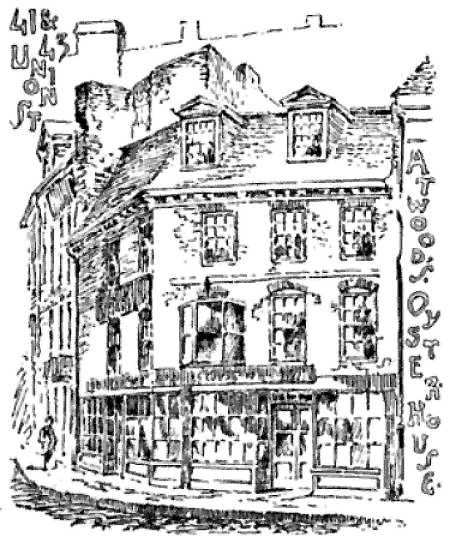
1826 A teenager named Hawes Atwood opens an oyster saloon on Boston’s Union Lane which he will operate into the 1890s. (Still in business and now known as Ye Olde Union Oyster House, it is the nation’s oldest restaurant in continuous operation, looking very much the same as in its 1889 illustration above.)

1826 To the delight of a passerby who copies it in his notebook exactly as it appears, a sign at a Philadelphia oyster cellar captures the speed and energy of the spoken bill of fare: “OystersOPENED,ORINSHELLFriedorstuedBEER,PORtE,ALE”

1827 Swiss immigrants Giovanni and Pietro Del Monico arrive in New York and establish a small European-style confectioner’s shop serving pastries, coffee, wine, and liquor at 23 Williams Street.

1828 Black caterer Edward Haines opens a summertime Mead Garden on the corner of Front and Jay streets in Brooklyn NY.

1828 The editor of the Trumpet & Universalist Magazine applauds a Providence RI restaurant keeper who has “substituted at his Restorateur hot coffee in lieu of intoxicating alcohol.” “If a man must drink at 11 o’clock, he writes, “let him drink Hot Coffee.” (By the way, he is referring to 11 A.M.)

1829 Downtown in NYC patrons of the dark and dreary, but cheap, Plate House crowd into box-like seating and wolf down plates of beef and potatoes. Child waiters shout orders to the kitchen followed by the guests’ box numbers (Half plate beef, 4!). [Philadelphia oyster cellar pictured; note curtained booths]

© Jan Whitaker, 2012

Read about other decades: 1810 to 1820; 1860 to 1870; 1890 to 1900; 1900 to 1910; 1920 to 1930; 1930 to 1940; 1940 to 1950; 1950 to 1960; 1960 to 1970; 1970 to 1980

4 Comments

Filed under miscellaneous

Find of the day: the Stork Club

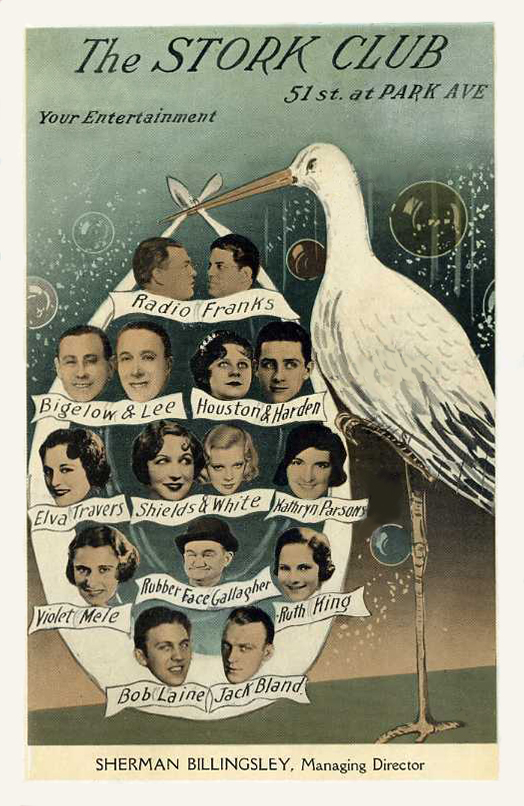
It seems harder all the time to find interesting things at flea markets and vintage paper shows, but I got lucky at Brimfield last week and turned up an unfamiliar Stork Club postcard. What is special is that it dates from before the nightclub/restaurant’s 1934 move to its well known address just off Fifth Avenue on East 53rd Street in NYC.

The postcard shows some of the “Stork’s” entertainers just before the era when its patrons became bigger attractions than its performers. When debutante Brenda Frazier, featured on the cover of Life magazine in 1938, started coming, attention shifted to who was seated at the tables. The early dinner crowd was followed by a late-night set of glamorous publicity seekers, many of them movie stars. Proprietor Sherman Billingsley installed a telephone at the entrance so that the orchestra could strike up an appropriate tune as celebrities were escorted to their tables. [William Boyd, aka Hopalong Cassidy, pictured]

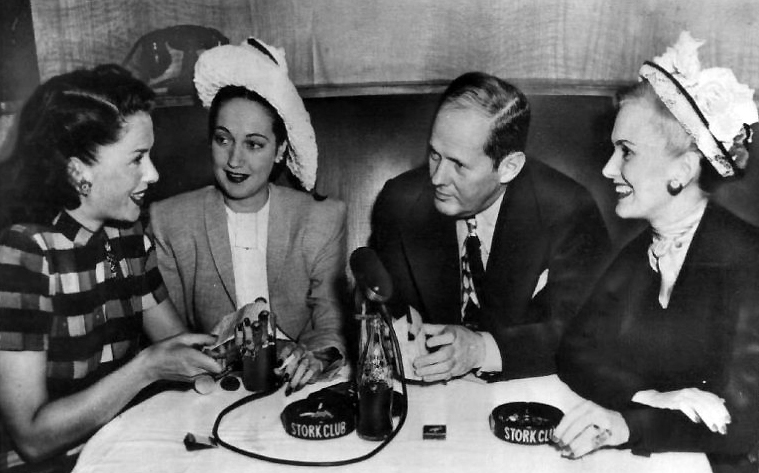
To feed the celebrity mill, newspaper columnist Walter Winchell, always at table no. 50, informed all America of the evening’s highlights the next day. Billingsley had his own radio and TV shows for many years [a 1946 photo shows him interviewing some of the club’s stars]. During its prime in the 1930s and 1940s the Stork Club was the country’s best known nightclub. It’s closest rival was El Morocco. There could never be any doubt about the location of photos taken at the Stork Club thanks to the club’s black and white ashtrays and oversized matchbooks which always appeared prominently.

Nightclubs are a special type of restaurant in which food does not always figure too importantly. But the Stork Club was said to take its menu seriously, for example, flying in fresh crab and pompano from Florida in the 1930s. Unlike others, it opened for lunch. It had a staff of a couple hundred, about 30 of whom worked in the kitchen under longtime French chef Gustave Reynaud. In its best years it reportedly served 1,000 to 3,000 meals a day.

But I am not completely convinced that it was a diner’s mecca. Clearly tastes have changed, yet even by the standards of the day a 1948 menu looks like a real hodgepodge. Some selections are in quasi-French (Calf’s Sweetbreads Under Bell, Eugenie), others are standard American fare (Cold Cuts and Potato Salad). There are a few uninteresting specials stapled to the top (Minute Steak with Baked Potato and Green Salad) and a strange section labeled Chinese Specialties. And, 22 desserts?

Sherman Billingsley, whose background was in Oklahoma bootlegging and Bronx real estate development, began his club career in 1928 or 1929 when he took over management of several NYC speakeasies, one of them named The Stork. He bought out his mob partners, and when prohibition ended went legit. Sherman also ran The Streets of Paris at Coney Island and had interests in other places, while his brother Logan at one point owned a NY restaurant called Madeira House. He and Logan (the latter officially banned from Oklahoma in 1919 as a condition of parole) lived lives of contentiousness and court appearances – perhaps inescapable experiences for bootleggers, developers, and nightclub owners.

The Stork Club fell out of favor in the 1950s, a decade in which Sherman poured hundreds of thousands into defeating unions at his club. His lawyer, the infamous Reds-hunter Roy M. Cohn, told a NY state labor relations committee in 1957 that the Stork Club had been losing money for years. Nevertheless it ranked high as an attraction for out-of-town visitors for some years before its closure in 1965, in dismal condition. One sign it is still remembered is Ralph Blumenthal’s well-researched book, The Stork Club: America’s Most Famous Nightspot and the Lost World of Café Society (2000).

© Jan Whitaker, 2012

17 Comments

Filed under night clubs

Cool culinaria is hot

Since I’m an incorrigible collector of restaurant ephemera of all kinds – menus, postcards, photos, business cards, Victorian trade cards, brochures, etc. – you can well imagine that I’ve adorned my kitchen walls with framed vintage menus. (Not too many, very tasteful!) I never tire of looking at them and guests always seem to find them interesting.

Searching out attractive and appealing menus to decorate with isn’t as easy as you might think. Personally I love “the hunt” but, hard as it is for me to realize, not everybody enjoys digging through musty boxes at flea markets or scrolling through pages and pages of e-Bay where you frequently find only the same mediocre items. Solution: Cool Culinaria’s offerings of digital prints of menus on premium paper ready to frame, or already framed if you prefer.

Cool Culinaria’s Charles Baum (formerly general manager and partner of The Rainbow Room and partner of Windows on the World) and writer/researcher/storyteller Barbara McMahon have done the hard work for you. I don’t allow advertisements on my blog and I hesitate to promote commercial enterprises or products, but I am convinced that Cool Culinaria is a quality operation.

For neatniks like me, it is also nice that CC’s menus are not folded, torn, or splattered with gravy as are so many old menus in the vintage paper marketplace.

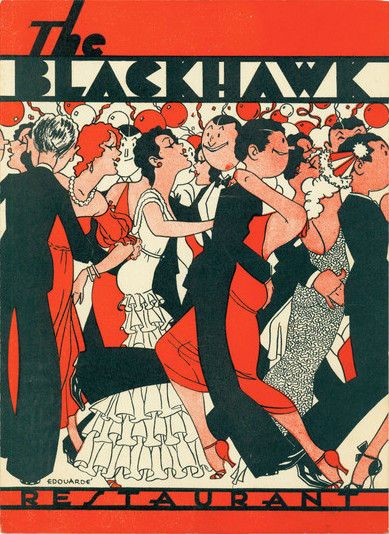
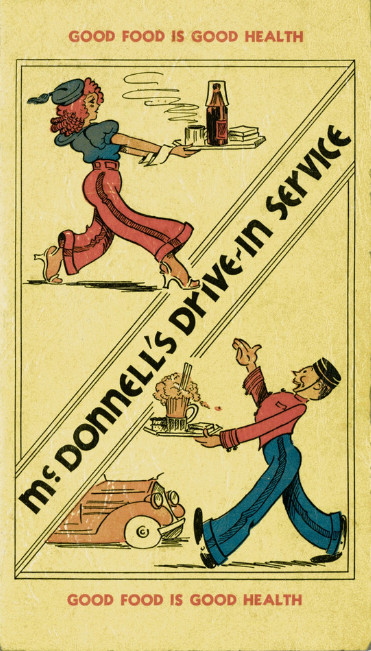
I notice that since the business was launched, quite recently, new menus have been added regularly. Fans of all kinds of menus, ranging from drive-ins to swanky turn-of-the-century restaurants, will find something to like. Two of my favorites are a 1930s menu from the Blackhawk, decorated with dancers from the smart set (above), and, of course, drive-ins such as McDonnell’s.

Cool Culinaria also reprints diner signs (“We serve fresh eggs”), and imprints tee shirts, aprons, and throw pillows with restaurant logos and humorous phrases.

2 Comments

Filed under menus, miscellaneous

Restaurant booth controversies

Public eating places have historically presented an array of dining arrangements, from sharing tables with strangers to occupying highly private dining rooms and many gradations in between. In fact, the development of individual tables – as opposed to sharing the host’s own dining table with his family and other customers – marks the emergence of the “restaurant” in late 18th-century France.

Booths are a dining option that give a measure of privacy within a public room that is often furnished with tables in the open as well. Private dining rooms were found in taverns and coffee houses of the Revolutionary era in America, but there were no booths then. There were, however, boxes. The English, who ran most early eating places in this country, were fond of creating boxes in churches and opera houses that gave their occupants some separateness from others. Boxes, as shown here in a latter-day chop house, were the forerunners of booths.

Boston’s New Porter Cellar advertised in 1796 that it had been renovated and could now accommodate customers with a “range of boxes, of convenient magnitude, into which any party may retire, and detach themselves from the company, as agreeably as in a private apartment.” Sometimes, boxes were ranged around the side of a room, allowing them to be closed off with curtains, as was true at Boston’s Exchange Coffee House in 1809 which was outfitted with “handsome boxes, each containing a mahogany table, seats, and a bell rope; each box … is faced with mahogany, and decorated with scarlet curtains, which screen visitors from observation.”

To critics the curtains went one step too far in providing privacy. What were people doing behind those curtains? Moralists wanted diners, and drinkers, to be in full view of all.

Opposition to curtained booths, booths with high backs, and tables partitioned off with high walls crystallized in the early 20th century when municipal ordinances outlawing them were drafted. In 1904 a judge struck down an ordinance in a Utah town which made it unlawful “to permit, construct or place any screen, door, blind, booth, stall, portiere, curtain or other obstruction to the public view, in any restaurant,” in part because it was aimed prejudicially at Chinese restaurant keepers. But in other cities such as Portland OR and Duluth MN ordinances took effect in the years before WWI.

Boston’s White Slave Commission, dedicated to the eradication of prostitution, recommended an ordinance for that city in 1914 which outlawed any kind of space resembling a private room or area not open to public view anywhere food or liquor was served. Exceptions were made only for spaces holding fewer than two or more than six persons. About the same time Olympia WA restricted the use of curtains in booths, declaring them “unhealthful.” Meanwhile a chief of police in Aberdeen, South Dakota, tried to persuade the city council that booths were the greatest menace to the morals of the town’s youth he knew of.

Other ordinances tried to limit the height of booths, 42 inches being the highest booth tolerable to most reformers. Sometimes restaurants were required to provide lights for each booth and make sure they were turned on when guests were seated.

In places where no liquor was served booths seemed to win easy acceptance. Tea rooms often advertised them and New York’s Tally-Ho boasted that it had rehabilitated stalls in the “Famous Astor Stables” as dining alcoves. The whole issue of booth height seemed to die down while national prohibition was in effect, but with repeal it surfaced once again. In 1933 Lewiston, Maine, decreed (rather generously, actually) that booths could not exceed 54 inches in height.

But the truth was that many restaurant patrons preferred booths over ordinary tables and chairs and they had become so popular during the 1920s that it was impossible to turn back. Michigan had to rescind its 1934 order that booths not exceed 42 inches because restaurant owners claimed it was simply too expensive for them to cut down their existing installations.

Soon restaurants were boldly advertising that they had booths that were “cozy and intimate,” the latter a word that would have once been too daring to proclaim. By the late 1930s restaurant supply catalogs were full of modern-styled booths of chrome and colorful leatherette.

Although there was a 1950s case in which a court upheld an ordinance making booths over 42 inches illegal, the issue disappeared for the most part. But history always has a joker up its sleeve. In 1983 a lesbian couple sued the Papa Choux restaurant in Los Angeles for refusing to seat them in its special curtained booths designed for “romantic evenings.” Although the couple lost their suit initially [see below] they eventually prevailed in the California Supreme Court.

© Jan Whitaker, 2012

7 Comments

Filed under lunch rooms, restaurant customs

Ice cream parlors

Ice cream is an affordable, intergenerational family-friendly treat with a mild sedative effect. Historically it’s been associated with the temperance movement, innocent youthful courtship, and after-theater refreshment.

For ages ice cream has been primarily a commercial product. As was largely true of soda and beer, it was usually consumed outside the home until after World War II. Only then did supermarkets and homes acquire extensive freezer capacity. In 1925, according to Jakle and Sculle’s Fast Food, 19% of all ice cream was sold in grocery stores, the bulk of it being marketed through confectioners, drug store soda fountains, wayside stands, restaurants, and lunch counters.

Those who could afford it in the late 18th century often obtained ice cream from confectioners and caterers of European origin who made it each day in summer and served it in outdoor gardens or delivered it to homes for immediate consumption.

Late 18th- and early 19th-century residents of Philadelphia and New York City enjoyed eating ice cream in private parks such as NYC’s Vauxhall, Washington, and Columbian gardens which opened yearly on June 1. An elderly writer recalled in the 1860s that in the 1790s at Contoit’s on Broadway in NYC, “Little alcoves, well shaded, on each side of the gravelled walk, had each its table, where friends or lovers, in undisturbed quiet, could enjoy their cream and cake.”

Ice cream saloons (the term merely indicating a spacious room) and parlors, as they were called later in the 19th century, were described as gaudy mirrored palaces, lit brightly by gaslight. In 1869 M. F. Brigham & Son opened a Ladies’ and Gentlemen’s Coffee, Lunch and Ice Cream Saloon on Washington Street in Boston, in connection with a confectionery at which they sold candy, pastry, ice cream, frozen puddings, sherbets, jelly whips, charlotte Russe, Roman punch, and other confections.

In Chicago, a number of these “ladies’ cafes,” as they were usually known, sprang up on State Street at the time of the 1893 World’s Fair, among them Gunther’s [pictured] and Plow’s. They featured special attractions – positively non-temperance drinks such as Yum Yum and a special version of Roman punch, the former 13% and the latter 20% alcohol!

It is strange, and a little jarring, to see so many advertisements of 19th-century eating places  specializing in ice cream AND oysters – until you realize the two were not usually consumed together. Featuring both as specialties makes perfect sense, though, since for decades oysters were not eaten during the summer months and ice cream was eaten only then.

Frequently, places that started out with just ice cream and simple refreshments eventually branched into restaurants selling lunches and other meals. When Schrafft’s established its first NYC store at Broadway and 36th Street in 1898, for instance, it served nothing beyond candy and ice cream.

With the increase in automobile ownership in the 1920s, and into the 1930s and 1940s, chains of roadside ice cream stands and eateries featuring ice cream began to form, among them Dutchland Farms, Howard Johnson’s, Prince Castle, Henry’s, and Friendly’s. “Soft serve” – a product whose name reflects that it does not meet the official definition of ice cream – caught on in the 1940s, a decade which commenced with the first Dairy Queen, located in Joliet IL.

In Southern California, people still fondly remember the Currie’s chain and its “mile-high cone” whose replica was often displayed billboard-style on roofs. The chain was started in 1927 by three brothers named Kuhns. After WWII they sold it to the Good Humor company who later sold it to Lipton in the 1960s. In 1964 the chain opened its 87th store, in North Hollywood. Although Currie’s anticipated launching units in every community in Southern California, only three outlets were listed in the 1967 Los Angeles phone book and the chain had disappeared by the 1980s.

© Jan Whitaker, 2012

59 Comments

Filed under food

Banquet-ing menus

As those of us who collect menus know, people are more likely to preserve menus from restaurants related to memorable occasions than those from ordinary, everyday eating places. As a result, there are more menus in the ephemera market that come from famous restaurants, voyages on ships, and banquets than from humble eateries. I tend to concentrate on the latter group, but once in a while I will buy a banquet menu that interests me.

I particularly like ones that are from professional and business trade groups, unions, and organizations such as the three shown here. Even better if they have a humorous slant, as is surprisingly often the case.

The 1941 menu at the top, from a dinner presented by the American Can Company to a California trade group at the Hotel Del Monte, shares something in common with the dinner given for the Golden Jubilee of the Oakland Typographical Union in 1936. The site of the canners’ banquet, the Hotel Del Monte in Monterey CA, like the union’s locale, the Oak Knoll Country Club in Oakland CA, was soon to become a property of the U.S. Navy. The canners may have enjoyed one of the last banquets held at the historic hotel, originally opened in 1880, but rebuilt in the 1920s after a disastrous fire.

The Oakland “Typos’” menu is one of my favorites because of its design as a proof adorned with proofreader’s corrections. It is not only clever but reminds me of a job I once had back in the days of linotype when I marked up proofs using the very same marks indicating lines to be deleted and transferred, as well as misspelled words, broken type, etc.

The Legislative Correspondents’ Association, which still exists, held its first dinner in 1900, so this menu is from its tenth, held in Albany at the Hotel Ten Eyck – on April Fools Day, 1909. Throughout it is filled with wry commentary and comical rules for the banquet governing issues around table companions and drinking. Judging from the menu, I’d think everyone got plenty to drink. Not only is the dinner accompanied by wine, champagne, liqueur, and cognac, it’s topped off with cocktails. Whoa.

I don’t know if the canners were served canned food at their banquet, but I’d say that the journalists undoubtedly enjoyed the finest cuisine of the three groups.

© Jan Whitaker, 2012

5 Comments

Filed under menus