Category Archives: waiters/waitresses/servers

Behind the scenes at Gonfarone’s

There is nothing as interesting (to me) as a memoir about a restaurant from an insider who reveals its workings not usually known to customers. Papa’s Table d’Hôte by Maria Sermolino is such a memoir, published in 1952, decades after her father’s ownership of the New York City restaurant, Gonfarone’s.
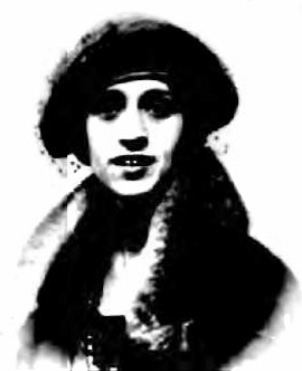
Maria’s career as an editor and writer was extensive. After graduating from the Columbia School of Journalism and spending a couple of years writing about post-WWI conditions in France, she interviewed Italian Fascist leader Benito Mussolini. Later she worked for Time, was the editor of The Delineator and for 11 years an associate editor for Life magazine. She attributed her lifelong unmarried status to overhearing conversations about women among waiters and from male guests invited by her father to join him at his table. [above, Maria at age 25, in 1920, the year she interviewed Mussolini]
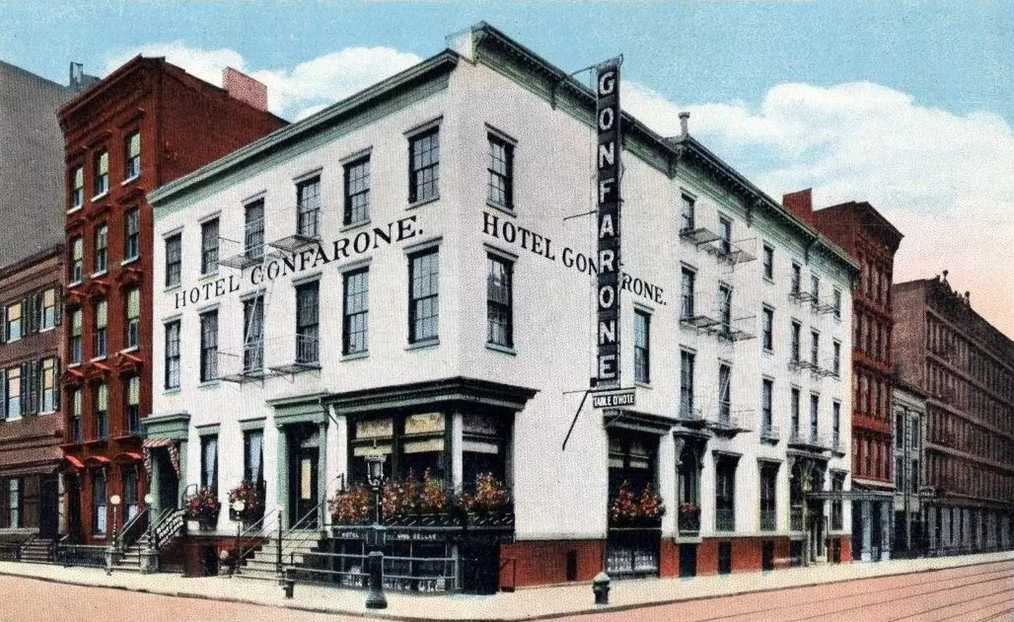
Gonfarone’s began in business around the turn of the last century as an Italian pension-type eating place, transitioning into a bohemian resort for Greenwich Villagers. It was run initially by Caterina Gonfarone who operated it in a basement on the corner of Eighth and McDougall streets. She soon partnered with Maria Sermolino’s father, Anacleto, who saw to it that the dining room was moved upstairs. Then, as neighboring residences were acquired by the partners, the popular Latin Quarter table d’hôte expanded to eventually accommodate 500 diners at a time. Sermolino soon acquired the restaurant from Madama Gonfarone, but kept her name.

After the Sermolino family moved into the complex of buildings (which also included a small hotel), Maria spent much of her childhood in the restaurant. Chapter 6 of her book is entitled “The Barroom Was My Playground.” She assisted her mother, the restaurant’s cashier, by spotting waiters who failed to pay her mother for drinks they ordered for customers at the bar. (They would have been reimbursed later, but without paying first they were able to keep the customers’ payments for themselves.)

But that is not the only way in which the staff tried to make extra money on the side. Dishwashers sold food scraps and fat to a company that made soap, with higher prices paid for barrels with more fat. On occasion Madama Gonfarone would catch a dishwasher pouring a large tin of unused lard into a barrel for a higher payoff. It was also common for the staff to smuggle out bottles of wine, chickens, lobsters, and other choice food items when they left at night. Her father refused to institute routine searches because he thought it would be bad for morale.

Because the restaurant was connected to a hotel, the bartender also acted as the room clerk. He took advantage of his position by renting rooms to prostitutes, even on occasion — when she was away — renting Madama’s room for more than double his usual charge.

Not all the restaurant’s customers were treated equally. Waiters would see to it that their favored regulars got larger portions, choicer cuts of meat, and less melted ice in their drinks. A standard menu, 50 cents on weeknights and 10 cents more on Saturdays and Sundays, featured Antipasto, Minestrone, Spaghetti, Salmon with Caper Sauce, a Sweetbread, Broiled Chicken or Roast Beef, Vegetables, Potatoes, Green Salad, Biscuit Tortoni or Spumoni, Fresh Fruit, Assorted Cheeses, and a Demi-tasse. In all likelihood the portions would have usually been on the small size.
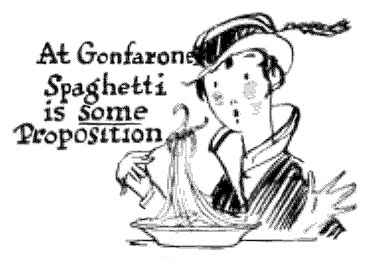
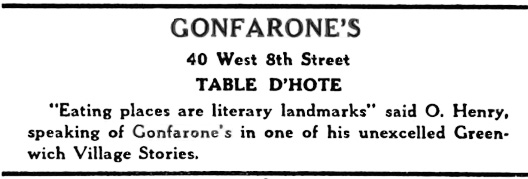
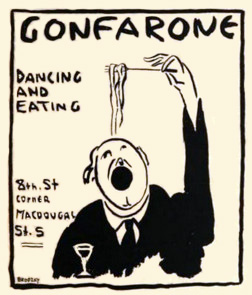
“By the simple act of ordering spaghetti an American was plunged into a foreign experience,” observes Sermolino. [above, 1916 advertisement from The Greenwich Village Quill; below, 1919 Quill]
All meals came with a glass of California claret, which the restaurant bought 40 or 50 barrels at a time, reducing their cost to ten cents a gallon. Apart from that free glass, which impressed many American patrons who were unfamiliar with wine and considered it exotic, the bar was a money maker. Maria called it “a gold mine.” A Manhattan cocktail — with cherry — cost 3 cents but sold for 15 cents, she explained.
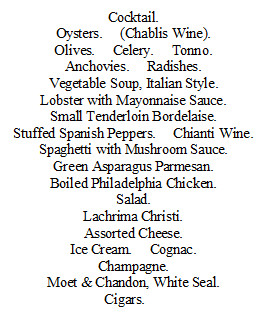
Banquet menus were grander and supplied more alcoholic beverages, as is shown in a 1904 menu above for a dinner given to honor a supporter of Democrats in the Tammany-controlled area occupied by the restaurant.

The restaurant’s best years were before World War I, when it was not unusual to serve four to five thousand dinners on an average weekday and double that on a good Saturday or Sunday, with waiting patrons spilling down the hall and into Macdougal Street. When food ran low the cooks would water the soup and waiters would offer patrons omelets.

With the onset of Prohibition, Maria’s father decided to get out of the business and concentrate on his other interest, real estate. Under new ownership, Gonfarone’s remained open for another 10 years, until 1930. The buildings were razed in 1937.

© Jan Whitaker, 2024

8 Comments

Filed under atmosphere, ethnic restaurants, menus, popular restaurants, proprietors & careers, restaurant customs, restaurant prices, waiters/waitresses/servers

Glamming in Booth One

Before non-stop coast-to-coast air travel became common, actors and performers relied on the railroad to cover long distances. Usually this involved changing trains in Chicago. Arriving there, weary celebrities were more than happy to be scooped up and whooshed off for lunch or dinner at the Pump Room.

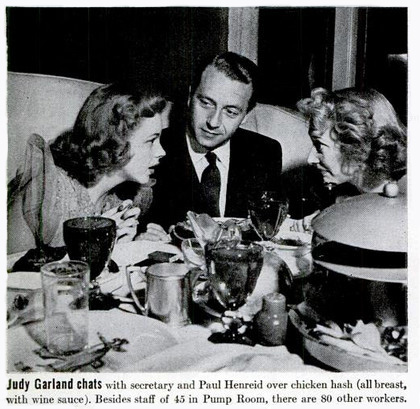
Top celebrities were escorted to Booth One, a cushy white leather nest where their job was to field calls from gossip columnists and smile as the flashbulbs went off. Their lunch may have been on the house, but they earned it. [It’s likely Judy Garland is talking with a columnist in the above Life magazine photo, 1943] Of course both the stars and the restaurant got publicity out of the deal.

The Pump Room stood out as a notable publicity mill in part because it was in the middle of the country. On the coasts there were plenty of such venues – the Stork Club and El Morocco in New York, and Chasen’s and Romanoff’s in Los Angeles to name but a few.

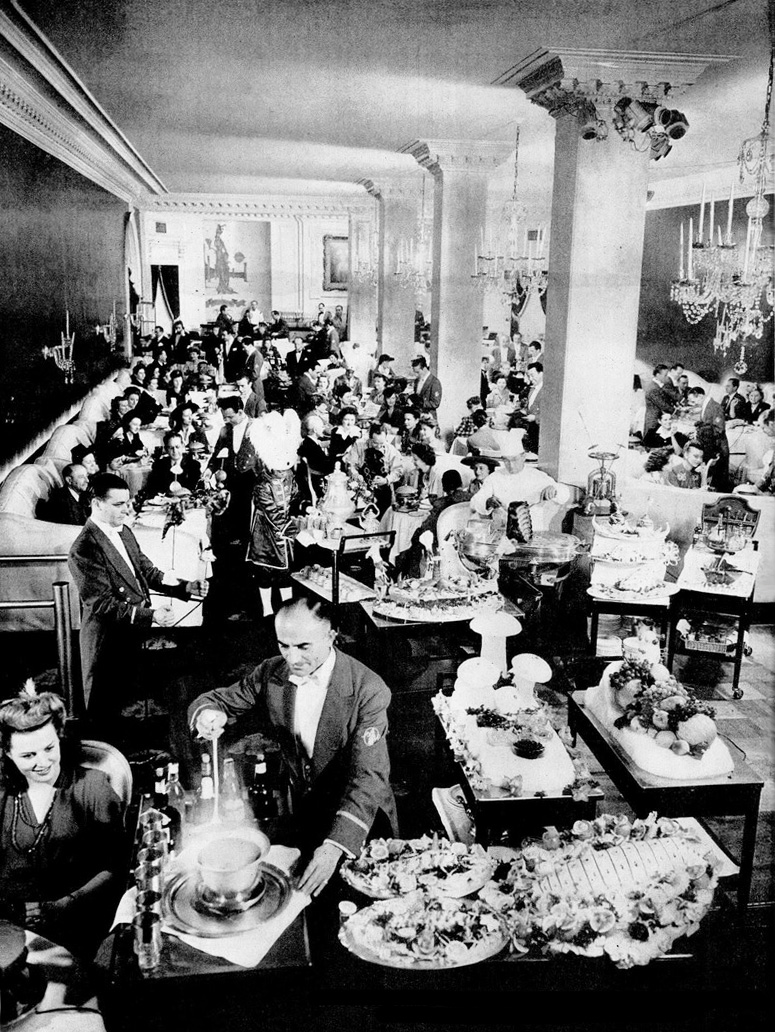
But the Pump Room had a vibe all its own. [Life magazine photo showing a very crowded room, 1943]

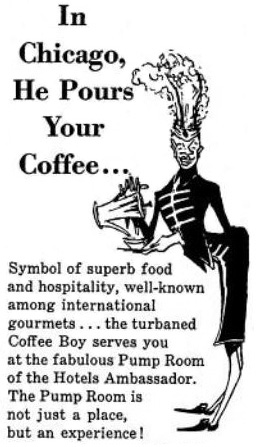
In addition to being swanky — with dark blue walls, white leather upholstery and crystal chandeliers — and well connected to the gossip pipeline, the Pump Room drew attention for its culinary burlesque shows featuring costumed staff, flames, and choreography. Waiters – all white men – wore scarlet jackets and black satin knee pants, while the “coffee boys” – all young black men – wore emerald green or white uniforms with giant ostrich plumes seeming to spring from their foreheads. [see grotesque caricature shown below, 1957] There were also “curry boys” dressed in gold. Food was served from wagons except for that skewered on flaming swords.

The coffee servers took it upon themselves to compete in the art of coffee pouring. Competition involved seeing how far they could hold the pot and still manage to pour the coffee neatly into the cups. Management did not approve and stopped the contest, but not before the winner set a record of 5 feet. He said customers asked him to do it. Not unbelievable since it was, after all, in keeping with the spirit of the place. According to one observer, customers watching servers with flaming swords make their entrance secretly hoped “the adroit waiter will slip and ignite one of the highly combustible hats being worn this season.” This never happened.

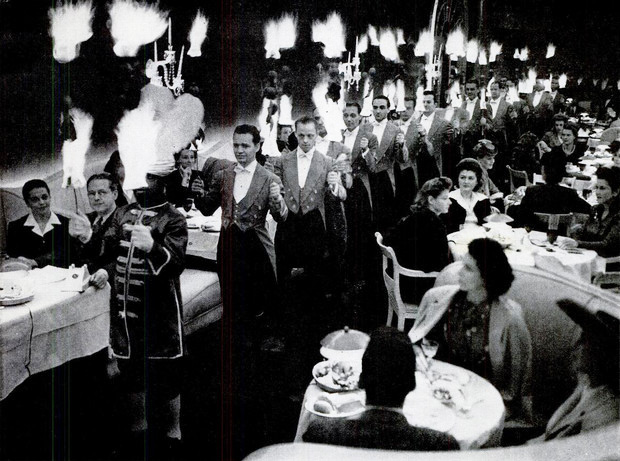
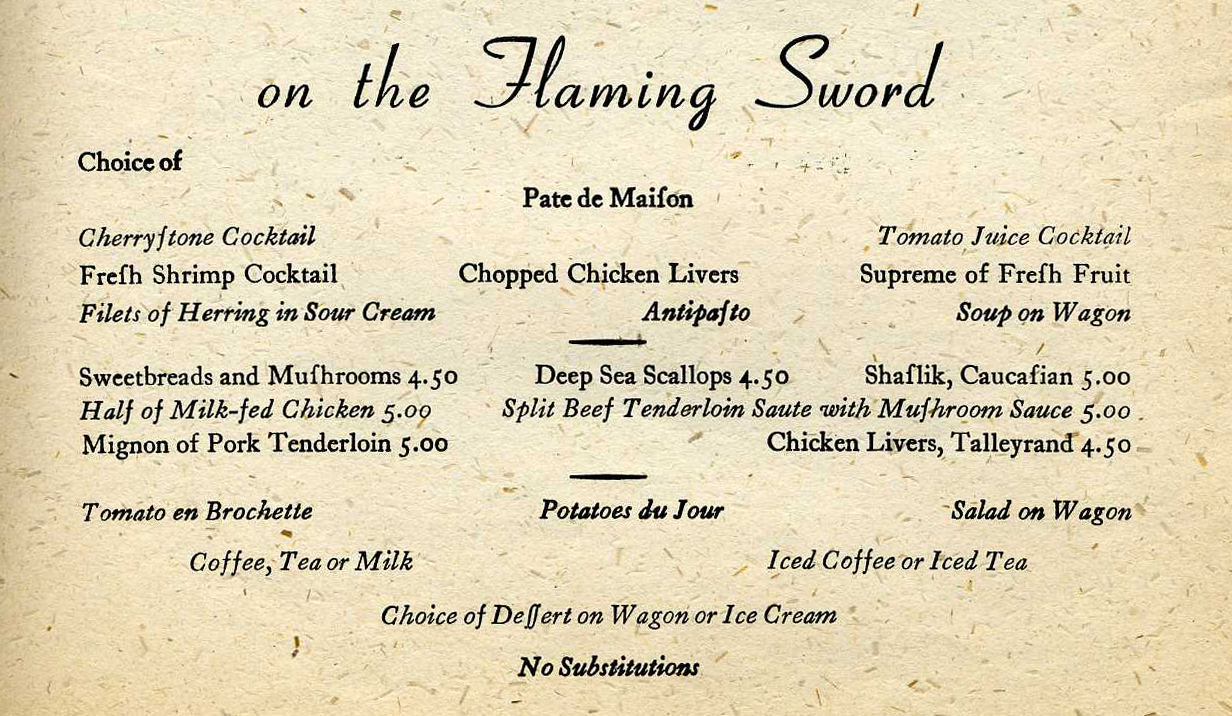
In 1943, Life magazine visited the Pump Room, photographing a number of spectacular scenes, some of which were undoubtedly contrived for the sake of the story. The crowning photo was certainly that of the procession of waiters holding flaming swords. A flaming-sword dinner cost $3.50 at the time of the story, going up to $4.50 or $5.00 by 1949 according to the menu shown below.

The Pump Room emblemized the sardonic humor of its creator, Ernie Byfield, who also owned its home, the Ambassador East Hotel. Its 1938 creation may have been a desperation attempt to survive during the Depression, but Byfield had long been in the habit of befriending show business stars back when he headed the Sherman Hotel. In the Sherman’s night clubby College Inn, he had entertained actors, musicians, and others on “theatrical nights.” Through the years Byfield made friends with an extensive roster of Hollywood stars that included James Cagney, Bette Davis, and William Powell in the 1930s and Douglas Fairbanks, Mary Pickford and a long list of others in earlier times.

Ernie Byfield’s death in 1950 seemed to mark the beginning of a long decline. The Ambassador East and the two other hotels Byfield owned changed hands repeatedly while the Pump Room sagged. A few months after Byfield died, columnist Lucius Beebe noted in a Holiday magazine story that Ernie had always said, “I don’t want grim gourmets around my place. I want laughing eaters.” Beebe’s story made it clear that the Pump Room was meant to be amusing, even moderately ridiculous. Without its creator at the helm, it became difficult to set the tone while maintaining quality.

In 1962 a reviewer for the Michelin Guide visited the Pump Room and, according to a devastating Life magazine account, had a miserable dinner described as deviled turkey breast accompanied by “canned peas and what looked exactly like potato chips.” Equally horrid, Life reported, was the incompetent waiter who recommended a red wine that “not only foamed but tasted as though it were composed of a second-grade detergent.” Learning of the story, an Ambassador Hotel executive dug through that day’s food checks and found, according to a rapidly produced account in a Chicago newspaper, that the reviewer and his Life magazine companion (the story’s author) had each consumed a cocktail and then shared two bottles of wine. He also insisted that the turkey steak on the menu was never served with anything but grilled sweet potatoes and wild rice.

But the damage was done and the restaurant’s reputation continued to crumble. Not much after the Michelin bomb dropped, Irv “Kup” Kupcinet, its number one gossip columnist, who had created a version of the Pump Room in his own dining room, admitted that it wasn’t what it used to be. Cross-country airplane flights were becoming commonplace, eliminating Chicago stopovers and reducing the flow of celebrities into town. Even though the room was remodeled in the mid-sixties by new managers, it was unable to recapture the past glory.

Although loyal Chicagoans continued to support it, the Pump Room closed in 1976, after some years of low ratings and, it was said, grease-spotted menus and chipped glassware. Everything was auctioned, included Booth One. Then came a new owner, Rich Melman, of the Lettuce Entertain You restaurant group which included Jonathan Livingston Seafood, Lawrence of Oregano, and others. He remodeled it in glamorous fashion and ran it for 22 years. After that it had various owners, including Melman once more who ran it as Booth One.

© Jan Whitaker, 2023

3 Comments

Filed under atmosphere, decor, elite restaurants, Offbeat places, uniforms & costumes, waiters/waitresses/servers

Dining . . . and wining?

Americans have not been big wine drinkers historically, so sommeliers (aka wine stewards) have not been commonplace. There were French sommeliers in New York in the 1870s and later, but it’s likely they were wine merchants and specialists in maintaining wine cellars rather than part of restaurant staffs.

Nevertheless the fine restaurants of the 19th century, such as Delmonico’s and some hotels, made a point to offer wine and almost certainly had someone on their staff capable of ordering, storing, and recommending wines to diners.

But, however many or few wine experts worked in American restaurants, they were put out of business by the advance of Prohibition. Their numbers gradually grew after Prohibition ended in December, 1933. By that time the restaurant industry was hanging by a thread and eager to get back into profitable business with the sale of wine and spirituous liquors.

Articles from the 1930s reveal just how unfamiliar the American dining public was with wine. A columnist mentioned that the Fred Harvey company was busily creating a wine list for its deluxe restaurant in Chicago’s Straus building in the months leading up to Repeal. The story ran through a few basic pairing suggestions such as whites with fish and reds with beef, adding, “One never drinks beer at a swank dinner.”

Restaurants that planned to serve wine, such as Karl Eitel’s in Chicago, were furiously stocking their cellars then. Two days after Repeal, Eitel’s waiters scrambled to catch up with customers who ordered wines that were out of stock. They were instructed to offer orange juice as a substitute for the missing vermouth. Eitel himself expressed annoyance at the waiters’ lack of knowledge about how to chill wine properly (ice has to melt a little before it will cool a bottle).

At Repeal, French wine shippers had hopes that the U.S. would expand their market, but according to one insider, the ambassadors they sent to this country came back full of pessimism, convinced that Americans much preferred liquor and soft drinks.

The relatively few restaurants wanting sommeliers usually had to hire Europeans, as they were the ones with the finest training, or any training at all. The Vendome in Los Angeles, for instance, brought a sommelier from Monte Carlo’s Hotel de Paris in 1934. But even a couple of years later there were said to be fewer than a dozen professional sommeliers in this country.

And it was already evident that the popular attitude toward them was less than worshipful. For a start the word sommelier was a barrier which, in the words of one wit, “can’t be correctly pronounced unless you’re either drunk or French.” [See Word of the Day cartoon below for a guide] And the chain worn around the neck suspending an oversize key and tasting cup was often ridiculed – except as jewelry for women, who were said to make off with them. Their attractiveness inspired the jewelry maker Monet to produce a simplified sommelier-style necklace and matching bracelet in the 1930s, which remained popular into the 1950s.

The happy sommelier in this country was one who managed to get a dedicated tip from guests who truly appreciated his (rarely her) recommendations. Few newspaper columnists showed respect for them, excepting O. O. McIntosh. In 1938 he explained that he loved the rituals associated with the sommelier’s work, such as twirling bottles in an ice bucket, displaying labels, wrapping bottles with napkins, and extracting and sniffing corks. He declared it “a magnificent ritual and one the gallop of American life should not trample.”

It was more typical for commentators to make fun of it all. One made suggestions on how to respond to a sommelier’s proud display of a bottle: “. . . it is good to respond by fitting a monocle to the eye, studying the label and issuing appropriate clucks and ‘hmmms.’ This has become an obligatory art form in certain restaurants . . .”

The sommelier’s primary role in the view of the restaurant industry was to get people to buy wine by the bottle. Behind the scenes, in industry journals and books, the depiction of wine sales could be crudely oriented toward profits, with the sommelier’s skill directed toward an estimation of the diner’s insecurity or wish to celebrate. A 1968 book on wine merchandising in restaurants saw a skilled sommelier as “merchandising in motion” and useful for “giv[ing] class to your restaurant.” And a trade magazine article on how to merchandise wine in restaurants carried the tagline, “A Meal Without Wine is a Meal With Less Profit.” As was demonstrated by comparing two checks (shown above), wine drinkers were said to be fond of pre-dinner cocktails also.

One of the strongest motives for restaurant guests to value advice about wine was, and undoubtedly still is, not to look foolish in the eyes of others. A Napa Valley winery owner reported that an experimental wine tasting he held for his Harvard Business School classmates in the 1960s revealed that “They weren’t particularly interested in learning anything about wine, except for how to order it without being embarrassed.”

In 1940s NYC, sommeliers were still rare and could mostly be found at luxury restaurants such as Jack & Charlie’s 21 Club, The Colony, Chambord, Pierre’s, and El Morocco.

Their numbers likely increased in the 1950s, but were there really any golden years for sommeliers? Not if you asked NYT food critic Craig Claiborne. He declared in 1961 that sommeliers had lost their status, and were no longer involved in buying wine and supervising restaurant wine cellars. “The number of old school sommeliers in New York can be counted on the fingers of one hand,” he declared.

Some sommeliers, perhaps in reaction to ridicule, tried to avoid being showy. The French sommelier at Maxim’s in Paris (in Chicago), despite the honors he had won, stayed in the background and rejected wearing the long chain with a key because he found the custom pretentious. Judging from her 1972 advertisement, Georgette of Baton Rouge LA also departed from the traditional sommelier costume.

In the 1970s waitstaff captains at New York’s Four Seasons took over the role of sommelier. They were trained by one of the restaurant’s knowledgeable owners and given wine at their meals so they would be familiar with it. This would have satisfied critics who complained that many sommeliers had never tasted the wines they recommended.

Today, Las Vegas may have the most sommeliers in this country, however I’d guess that most restaurants elsewhere have done away with the costuming and ritual, relying instead on trained servers to make wine recommendations.

© Jan Whitaker, 2023

8 Comments

Filed under elite restaurants, restaurant customs, restaurant fads, uniforms & costumes, waiters/waitresses/servers

Black waiters in white restaurants

In the 19th century Black waiters staffed most Northern restaurants and hotel dining rooms, particularly as hotels grew larger and better appointed beginning in the 1840s. Earlier, Black waiters in the North were mostly employed in private residences or for catered events.

Before the Civil War, the hotels were run on the American plan where meals were included with lodging and served family style. Mealtime was often a mad scramble, putting waiters under great pressure to bring out the dishes. They were often ridiculed, or seen as having no other virtue than being imposing-looking in uniforms.

After the Civil War, when the tipping custom spread, they were suspected of being interested solely in tips. Nevertheless, jobs as waiters were sought after and those who held them were highly respected in Black communities. Headwaiters, occupying a role similar to that of maitre d’, enjoyed the highest status.

A number of Black waiters rose in their profession and took the role of advisor and trainer of their fellow servers. An early example was Tunis Campbell who published The Hotel Keepers, Head Waiters, and Housekeepers’ Guide in 1848. He presented the headwaiter’s role as similar to an officer whose troops need a lot of drilling lest they became undisciplined and boisterous when facing a mob of impatient guests. His advice was put into practice, judging from an English traveler’s description of a remarkably choreographed scene in the 1850s. He reported that, “At a given signal, each [waiter] reaches over his arm and takes hold of a dish . . . at another signal, they all at the same moment lift the cover, all as if flying off at one whoop, and with as great exactness as soldiers expected to ‘shoulder arms.’”

Some patrons preferred Black servers to white ones, and it was said that the better restaurants and dining rooms of the post Civil War period preferred them to whites, particularly the Irish. But praise was often blended with condescension. A prominent Chicago hotelier noted that Black waiters were the “best.” But he added, “They are waiters by nature, and are peculiarly adapted to servitude.” Another admirer of Black waiters commented in a similar way: “White waiters always have an idea that they are doing a man a great favor if they serve him promptly and are polite and respectful. Colored waiters know their place and keep it, give themselves no airs, and take no liberties.”

Never did it seem to occur to white commenters that the best Black waiters had actually chosen to dedicate themselves to their profession and constantly improve their skills. Nor that they were performing a role rather than conforming to their nature.

Unsurprisingly, given the lack of a wide range of job opportunities, many Black men were known for their long tenure as waiters. Still, it is interesting that a Chicago restaurateur noted with surprise in 1899 how many Black waiters “find their way to the variety stage.” Perhaps they had been drilled in the Campbell method. [Blaney Quartette poster, 1898]

The position of headwaiter was especially coveted, particularly if a Black man was tall and impressive looking in a uniform, often a tuxedo in the 20th century. However, although some remained, by then the position of Black headwaiter was being replaced by restaurant owners and hostesses taking over the job of greeting and seating guests.

In the late 19th and early 20th centuries a white backlash against Black Americans generally reduced work opportunities even further, threatening Black predominance as waiters. Immigrant men arriving in this country proved willing to accept jobs as waiters. However, there was a notable reason to favor Black men, one that hindered them at the same time. As a Black waiter explained in 1903, for Black men being a waiter was “usually the zenith of his industrial possibilities” and because of this there was strong competition among them for these positions. This allowed hotels and restaurants to pay them less than white waiters.

By the 20th century, white women also took jobs serving in restaurants, often replacing Black men. Actually, though, the Fred Harvey organization may have pioneered the shift from Black men to white women. In 1883 the men – considered troublesome – were replaced at one of the eating houses on the Santa Fe Railroad line, launching the phenomenon of the “Harvey girls.” Unlike white women, Black women were not often found waiting in white restaurants, but were more likely to be working in the kitchens. When they did occupy waitress roles, white patrons seemed to enjoy seeing them dressed in mammy costumes.

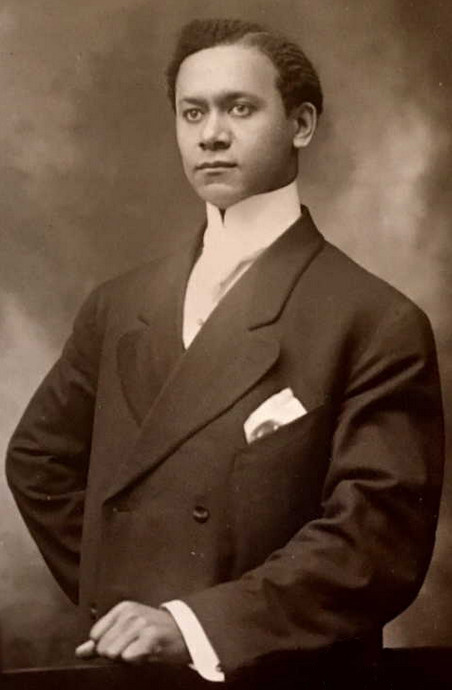
Black waiters organized mutual aid societies and employment bureaus as early as the 1820s, but many were skeptical of labor unions. When strikes failed, their distrust was intensified and they felt they had been betrayed by the white unions, particularly after losing their jobs and being replaced by white men and women. A failed strike at a lunchroom chain in Chicago in 1903 was long remembered with bitterness. Leading Black waiters supported advancement for Black waiters, but not of joining unions. John B. Goins wrote in his book (The American Waiter, 1908) that “unions will never be of any benefit to a colored waiter.” In an even stronger vein, he advised, “Keep out of strikes. If you are asked to join in a strike for better wages refuse point blank. And I would advise you to offer to quit; but first explain why you do so, stating your reason for quitting is to keep out of strikes.” His ally, Forrest Cozart (author of The Waiters’ Manual), was another strong proponent of improvement, urging Black waiters in American plan hotels to learn to read and write because such hotels were disappearing. [Forrest Cozart shown below]

Though there were still an appreciable number of Black waiters through the 1920s, competition with whites increased during the Depression of the 1930s. Then, even native-born whites who had long objected to taking service jobs began to compete successfully, significantly reducing the number of Black waiters.

After World War II, when the economy had improved, dining out for pleasure increased substantially in this country. Black waiters discovered that they were often shut out of waiting jobs in fine restaurants where there was a chance to make good tips. Possibly, though, Black waiters were favored in Southern restaurants such as the elegant Justine’s in Memphis, which hired a strictly Black waitstaff from its beginnings in 1948 until closing in 1995. The restaurant made much of the fact that many of its waiters stayed on the job for many years, yet there were signs of dissatisfaction on their part such as walkouts and complaints about low wages. Many had full-time day jobs.

A 1985 case study found that, unlike immigrants, Black men were not eager to be waiters in low-priced restaurants and that they were not often hired in the better eating places. How much this was due to racist attitudes on the part of managers and/or patrons was not clear. But the study noted that even “when the supply of European waiters fell during the sixties, New York City’s full-service sector did not hire blacks into these relatively high paying jobs, but used artists and actors instead.”

By 1970 Black servers, either male or female, made up only 16% of all waitstaff according to research by Dorothy Sue Cobble (Dishing It Out, 1991).

© Jan Whitaker, 2022

9 Comments

Filed under racism, restaurant customs, waiters/waitresses/servers

An early French restaurant chain

Sometimes you need to leave your own country in order to get some perspective on it. Along with going back in time, that is what I’ve done. I’ve gone to France — though only through texts and pictures — to explore a restaurant chain begun in the 19th century known as Bouillon Duval.

I tend to think of the United States as the home of restaurant chains, and that they are quintessentially American. There is some truth to this, but it is also full of blind spots as the existence of the Duvals shows. They came before American chains, and showed that a highly rationalized, business-like approach to running restaurants is not solely American. [pictured, rue Poissonniere, 1882]

Looking at Bouillon Duval, which began as a soup restaurant, also dispels a bit of romanticism about French restaurants. As much as Duvals emphasized quality, they were eating places for the frugal masses, not temples of haute cuisine. In the beginning they were meant for poor workmen, but soon they became popular with the middle class. To put it in the language of the day, the “black coats drove out the blouses” who were embarrassed to be in the presence of the better dressed.

The Bouillons were the idea of Baptiste Adolphe Duval. He had a butcher shop in Paris and came from a family that ran a brasserie in the north of France. According to legend, around 1857 he opened a small soup restaurant near his shop using the unsalable meat scraps, and went on from there to become fabulously successful and wealthy. By 1867 he had eight Bouillons Duval in the city as well as at least one at that year’s world’s fair.

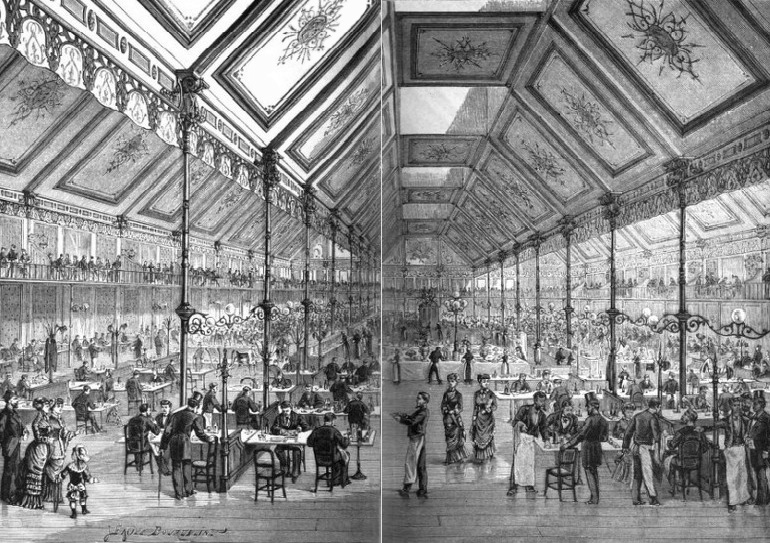
Of course it wasn’t quite that simple, and he might have failed if it hadn’t been for his wife’s assistance. According to the most thorough account of the chain’s development, the business was headed for failure as soon as it expanded beyond the small shop. With an enlarged menu and a lot of ideas, M. Duval had moved to a location in a former ballroom on the rue Montesquieu [shown at top of page in 1882, when it had reinstated male waiters]. There he installed a steam-heat system of cooking, along with elaborate piping that served every table with seltzer water. Both innovations were disastrous failures that cost a fortune to tear out. Add to this the lack of an accounting system that made it hard to calculate sales and permitted chiseling on the part of employees and the business was soon drowning in debt.

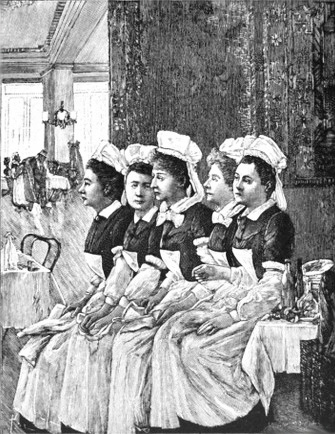
His wife Ernestine helped set up an accounting system and suggested replacing the questionable male servers with married women of irreproachable character who she dressed in uniforms resembling nuns’ habits [pictured, 1902]. The business began to show a profit and soon expansion was underway. Not surprisingly, when M. Duval died in 1870 shareholders chose Ernestine to take over the corporation and expand it further.

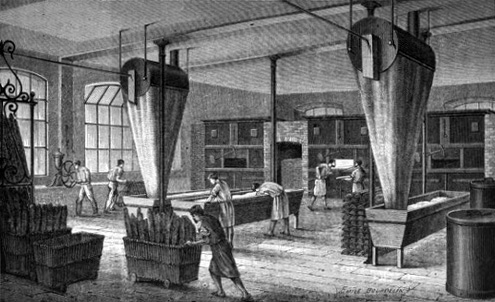
The Duval company had incorporated in 1868, by then consisting not only of eating places but also its own butcher shops, slaughter houses, bakery [pictured, 1882], large laundry, and caves that stored wine.

The company achieved heroic status in 1870 when it somehow managed to stay open during the “Siege of Paris” when German forces surrounding the city cut off food supplies. Their continuing in operation was significant not only for providing meals but also in boosting morale. In 1900 the French government awarded the Duvals’ son Alexandre, then manager, with the medal of the Legion of Honor. By then the company ran 32 restaurants.

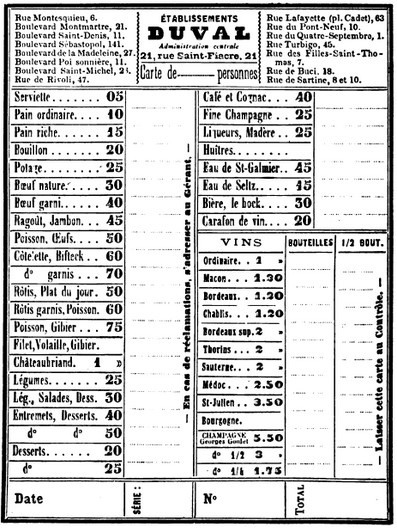
The Duval system was based on keeping prices low while serving a large volume of customers quickly and efficiently. It was thoroughly a la carte right down to an extra charge for a tablecloth if wanted. During the Siege a London man recorded what he ordered at one of the 14 Duvals. He and his companion ordered bread for 1 cent, potato soup for 2 cents, as well as roast mutton, puréed potatoes, green beans in white sauce, and a pint of Mâcon wine. The total bill – with tablecloth – came to 18 cents. [Above, a menu that was to be filled out by the customer, ca. 1882; See The American Menu blog for several Duval menus.]

Needless to say, the fact that wine and other alcoholic beverages appeared on menus set the Bouillons Duval apart from most early chains that later developed in the U.S., such as Childs.

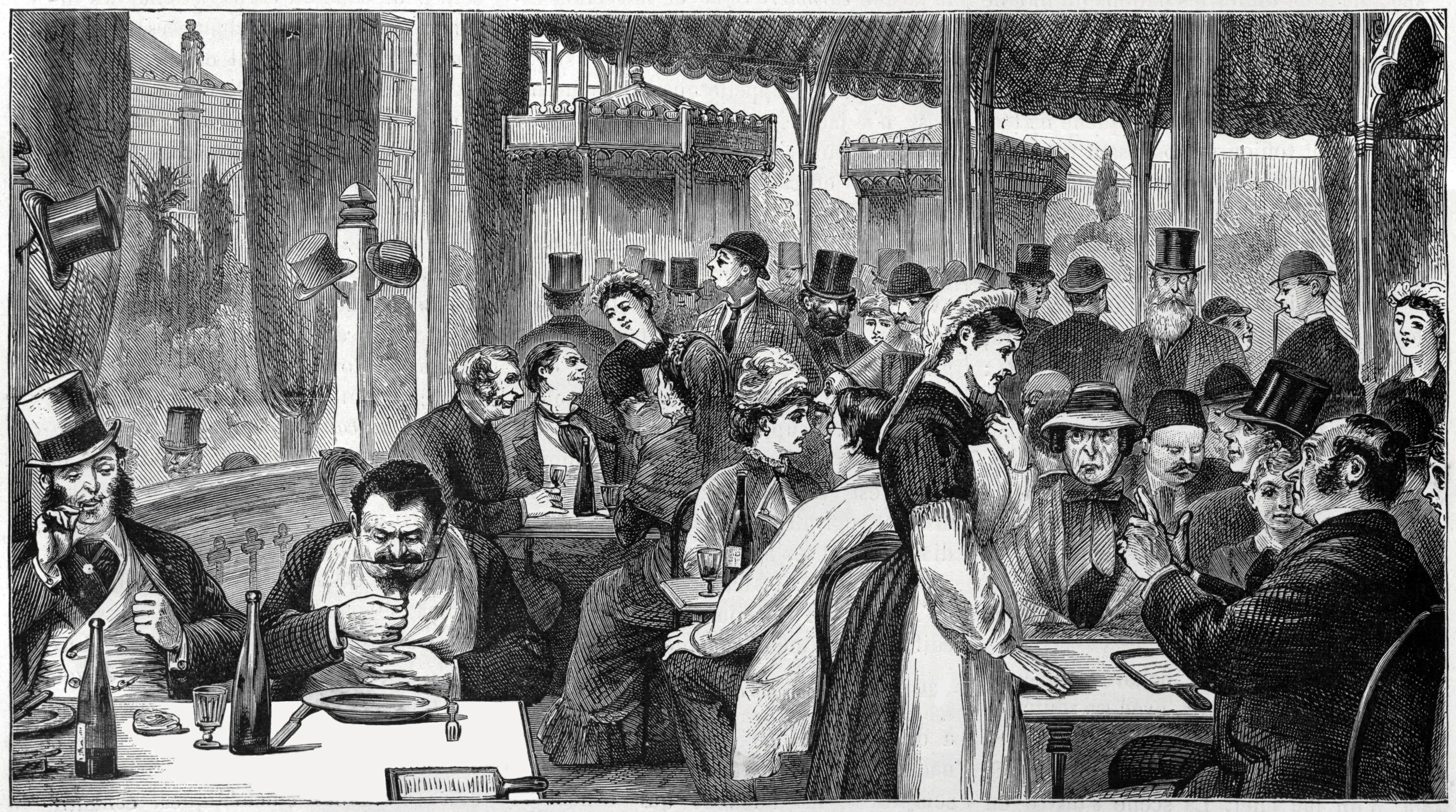
Numerous Americans as well as English citizens frequented the Bouillons when visiting Paris [above, diners at the 1878 Paris International Exposition; the objects with handles on the tables are menus], and expressed a wish to have something like them in their own countries. In addition to serving quality food and decent wine at low prices they were known to be spotlessly clean, quite unlike most of the cheap fixed-price cafes that working people had frequented before the Bouillons came along. The major criticism against them was that portions were small. Some critics said that if a hungry diner ordered all they wanted they would find that their bill was as expensive as in a finer restaurant. Other guests complained about the crowds and the “deafening din of knives and forks clinking against plates and dishes.”

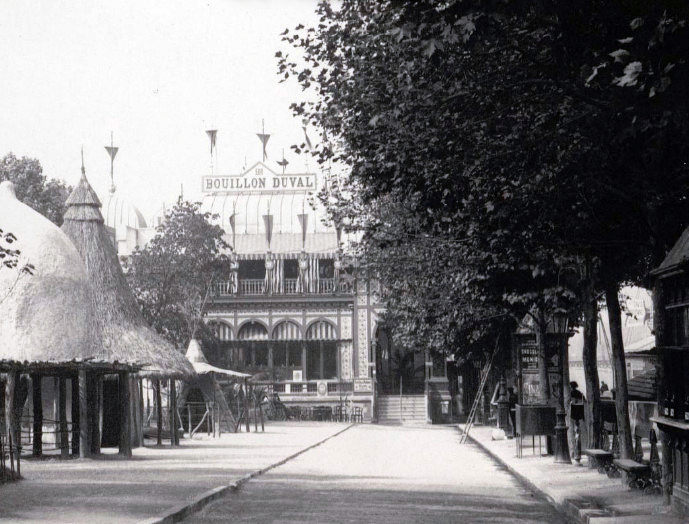
Nonetheless the Bouillons Duval were invariably recommended in guide books for visitors to the international fairs held in Paris in 1867, 1878, 1889, and 1900. In 1878 the Duval restaurants were said to have served 5M meals that year. Pictured above is one of several Duval locations at the 1889 Exposition.

At some point a Bouillon Duval was opened in London, and in the 1880s there was one advertised in Los Angeles that offered “hot soup and schooner lager beer, five cents.” I couldn’t determine whether it was connected to the Paris restaurants or not.

The last mention of the Paris Bouillons Duval I found was in 1924, when the chain was still said to be all over the city.

© Jan Whitaker, 2021

1 Comment

Filed under chain restaurants, patrons, proprietors & careers, restaurant prices, waiters/waitresses/servers, women

Dining at the Centennial

In 1876, one hundred years after independence, Philadelphia held America’s first world’s fair to celebrate the country’s growing importance in industry, trade, and the arts, and perhaps implicitly to recognize of the end of the Civil War.

It is notable, though, that no Southern states elected to participate. According to a historian who studied the South’s attitudes toward the Centennial, it’s likely that relatively few visitors from the South attended [“Everybody is Centennializing”: White Southerners and the 1876 Centennial, Jack Noe, 2016]. This was due both to inability to afford it and a widespread opinion reflected in Southern newspapers that the whole thing was another Yankee scam meant to benefit the North.

Another problem was that the entire country was moored in a severe six-year-long depression. Despite the drawbacks, however, the Centennial Exhibition was judged a big success, based on its efficient organization, the participation of many other countries, the range of exhibits, and the attendance over its six-month span which was reported as nearly 10 million.

When I began to think about exploring the topic of eating places at the Centennial I imagined that its restaurants and cafes would have been a novelty to many visitors who would have been delighted to experience them, with many having their first restaurant meal.

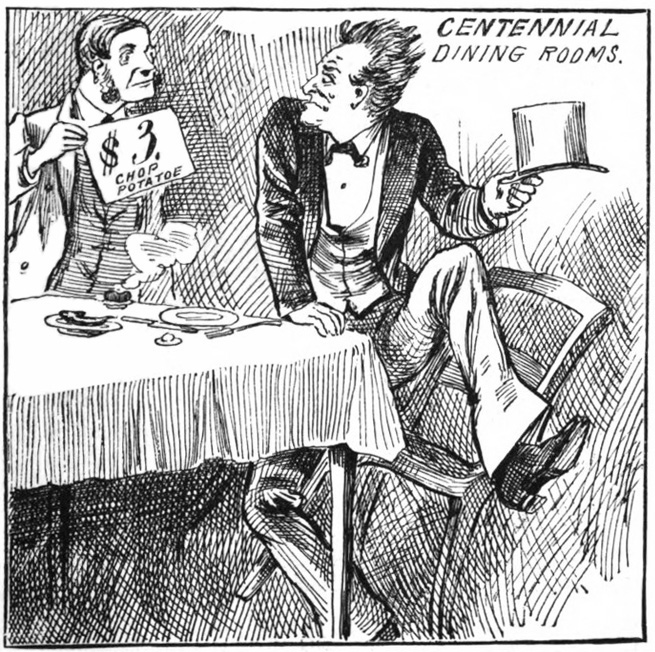
I was not prepared for the large number of criticisms, ranging from offense at snooty European waiters to complaints about menu prices and tacked on service charges. They began to pour out as soon at the Centennial began. High prices were the main target. A widely circulated Chicago Tribune story claimed that a meal could easily cost $4, with $1 charged for asparagus, and 50¢ for mashed potatoes. These were prices that rivaled fine restaurants in New York City such as Delmonico’s.

There were at least 20 restaurants and cafés on the grounds. Several seated thousands. George’s Hill Restaurant, a Kosher eating place, was capable of serving an astounding 5,000 patrons at a time. Of course most fair goers could not begin to afford these grand restaurants, each of which occupied its own massive building. Many probably found it difficult to pay even the 50¢ admission fee.

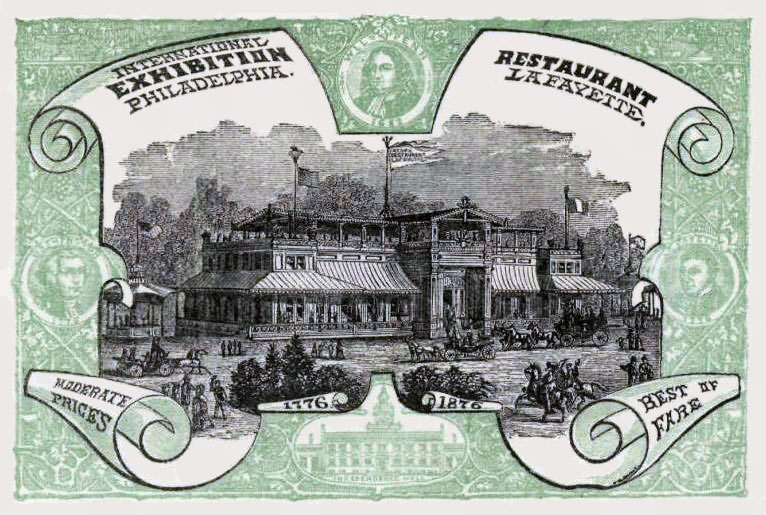
The complaints about restaurant prices leveled off a bit over time, and it may be that the Centennial Commission forced managers to lower them. Or, perhaps there was a compromise leading the big restaurants to devote part of their space to lower-priced cafes, as seems to be reflected on the menu from the La Fayette Lunch Garden shown above, part of the La Fayette Restaurant complex. There a sandwich was a mere 10¢.

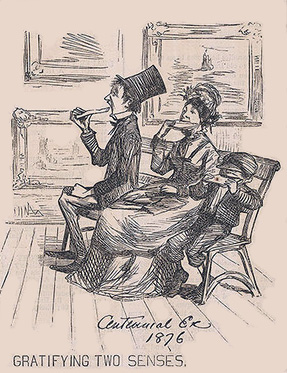
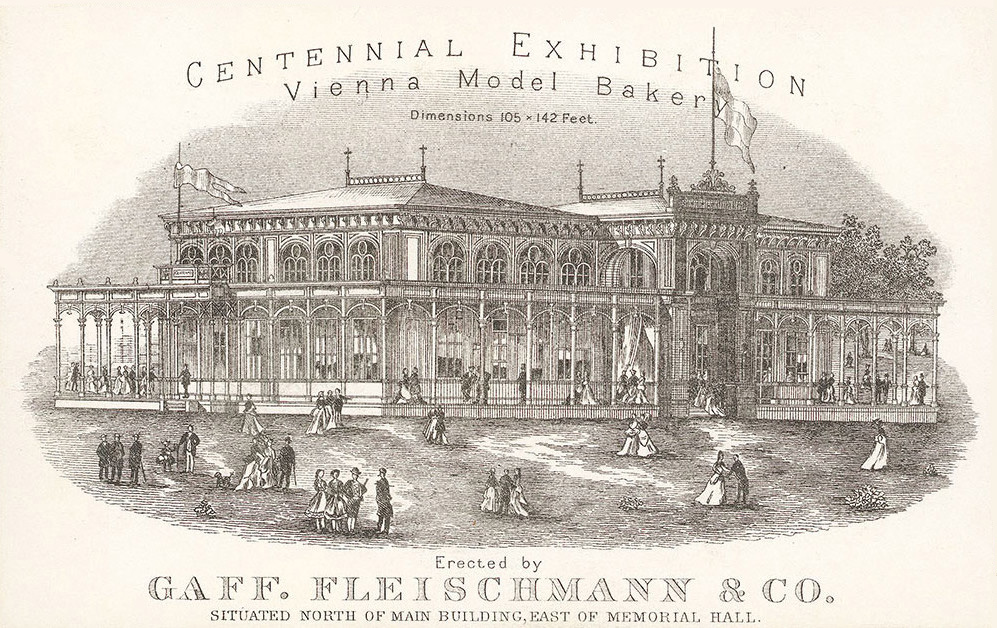
Regardless, one effect of all the publicity about high prices was that many fair goers brought their own picnic lunches [see cartoon above]. Soda and popcorn stands also proved to be very popular, as did the Vienna Model Bakery which furnished no meals but served coffee and freshly baked bread, both of a quality Americans had not experienced before. Another popular eating place was a moderately priced rustic café called The Dairy [shown below] where milk, fruit, biscuits, and pies were available.

Actually, the entire organization of the Centennial discouraged working people from attending. From the start the Commissioners decided against Sunday openings and half-price Saturdays, both of which had been operative at recent world’s fairs in Paris and Vienna. Only after disappointing attendance in the unusually hot summer months did they relent and declare a handful of Saturdays eligible for discounted fares. When the weather cooled off and attendance increased, they eliminated the discounts.

The dominance of elite restaurants at the Centennial may have been part of the same plan of discouraging, or simply ignoring, working class patrons. Perhaps the restaurant that was most resented was the “Parisian” restaurant, Aux Trois Frères Provencaux [shown here and at top]. It had a famed past dating back to the 18th century, though, unbeknownst to most Americans (if they even vaguely knew of it), it had changed hands many times, lost much of its splendor, and closed several years before the Centennial.

The Trois Frères Provencaux and the five other big restaurants at the Centennial were set up much like first-class restaurants and hotels of that time. They had large main dining rooms, a big banquet hall, a number of smaller private dining rooms, and a café. It’s likely that some of the buildings also included living quarters for the staff.

Most of the big six restaurants came in for some degree of criticism, with only George’s Hill and Lauber’s being largely exempt. George’s Hill Restaurant, on a breezy hill with a beautiful view, may have offered relief from the heat, and perhaps its customers appreciated having a kosher restaurant on the grounds. Lauber’s was already a popular Philadelphia German restaurant and it promised that its prices at the fairgrounds were identical to downtown’s.

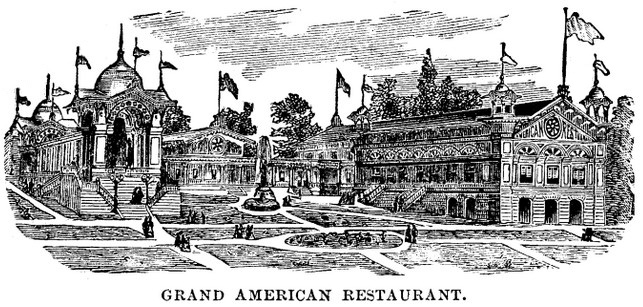
Faring less well in public opinion were The Grand American Restaurant (disliked for its employment of foreign waiters) and The La Fayette [shown here]. The latter was perceived as a French import despite the fact that the proprietor had a restaurant in New York City. Its building was considered unattractive and its waiters were alleged to cheat customers. As was also said of the Trois Frères Provencaux, a critic claimed that its French management was unable to “comprehend America.”

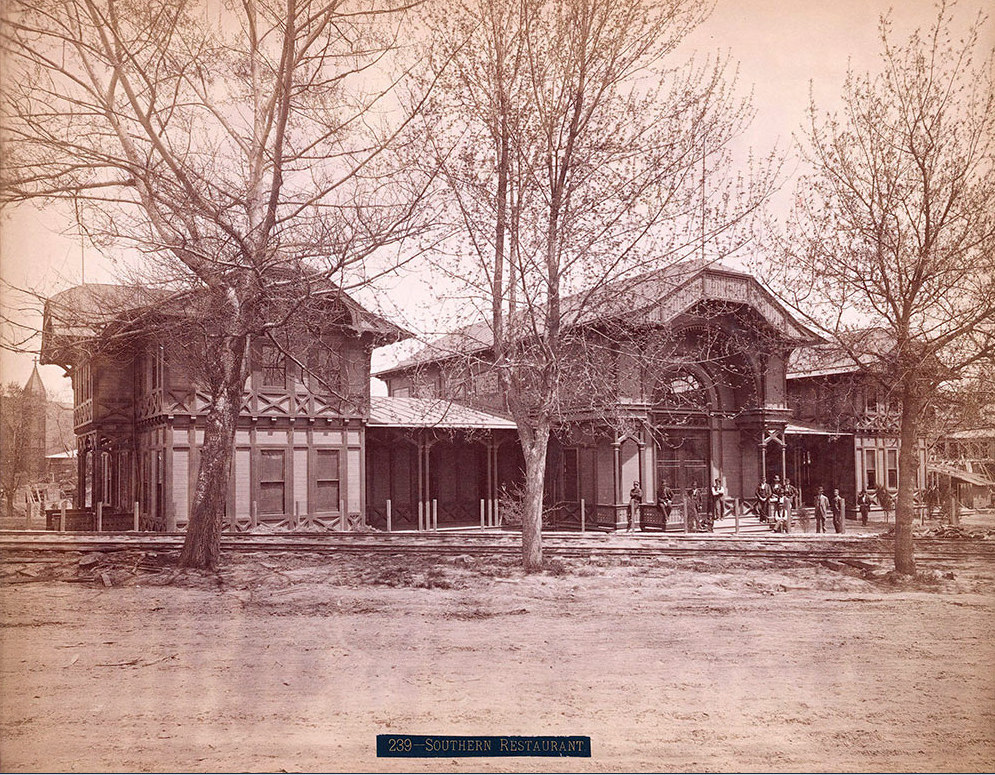
The other large eating place, the Restaurant of the South [shown here], seemed to be predicated on a fascination that Northerners would have with Southern culture (including an “Old Plantation Darkey Band”), along with the belief that Southern visitors to the Centennial would want to group together in their own place. But if it was the case that few Southerners visited the fair [Noe, cited above], this would probably have taken a quite a toll on the Restaurant of the South.

In addition to meals, most restaurants and cafés also served beer and wine, despite the attempt by temperance organizations to prevent this. A California winemaker brought his wine to the Centennial to introduce it to Easterners. For $1 he also offered a “copious luncheon” with a half pint of his “California Golden Wine,” which was considered quite a bargain by the standards of the fair. Although it seems that all the cafés and restaurants had beer and wine, it’s probable that beer sales far outstripped wine sales, judging from the final report of the Centennial Commission which reported no royalties on wine.

Which was the most American restaurant? Not the Grand American, which Scribner’s magazine declared had “nothing especially American about it,” but the American Lunch Counter. Associated with railroads – where lunch counters were the norm in stations – it was ridiculed by elite critics such as one in The Nation who pointed out “the excessive liberality of the bill-of-fare as compared with the actual resources of the kitchen, the negro or nondescript waiters, the unlimited pickles,” etc. The Nation’s account included the other two restaurants advertised as American — The Grand American Restaurant and The Restaurant of the South — in its complaint.

I’m left with questions about the restaurants at the fair and the fair itself. How many people actually attended? Each person had to pass through a turnstile that counted them, but since many people made multiple visits, it leaves the question whether there were 10M visitors, or 10M visits. Given that the Commissioners’ detailed final report did not show any royalties from restaurants or cafés, I can’t help but wonder if the restaurants lost money.

But surely, since many thousands ate at the fair’s restaurants, there must have been some who had good experiences.

© Jan Whitaker, 2021

For more images of the Centennial buildings and exhibits, visit the collection at the Free Library of Philadelphia.

9 Comments

Filed under elite restaurants, guides & reviews, restaurant controversies, restaurant prices, waiters/waitresses/servers

Hash house lingo

Odd – often humorous – names for simple restaurant orders were long associated with cheap eating places such as hash houses, beaneries, and lunch wagons. In addition to inexpensive food, patrons got free entertainment, while newspaper reporters never ran out of light copy.

In cheap restaurants it was customary through much of the 19th century and early in the 20th for servers to convey orders to the kitchen by shouting them out from the dining area. It’s highly likely that many, maybe most, of the servers as well as the cooks, were unable to read and write.

The colorful stories began to fill papers’ pages in the 1880s. In 1881 U.S. President Chester Arthur was reported to have visited a “coffee and cake saloon” in lower Manhattan – probably Hitchcock’s — where waiters shouted out his order of coffee and rare corned beef to the kitchen in slang.

Judging by how often it was repeated in the press, the public was endlessly amused by the tale of the clever Bowery hash house waiter who bested the patron who tried to confuse him by asking for two poached eggs on toast by adding that he wanted the yolks broken. Without a pause, the waiter shouted out “Adam and Eve on a raft. Wreck ‘em.”

Eggs merited the most jargon of all foods, probably because there are so many ways of preparing them. Two terms remain in almost universal use today and are so commonly used that probably no one suspects they were once regarded as unfamiliar waiter slang. I’m sure you will spot them easily in the list of egg orders.

Many of these terms make no sense at all, and some have more than one reference. Why were they used? Clearly they are not necessarily shorter or easier to yell than if they were straightforward. According to the 1945 article Soda Fountain Lingo, “An exclusive language – racy, picturesque, humorous – understood only by the initiate, adds zest to the monotony. Further, it lends pride to the job and provides an esprit de corps. It gives incentive to the new waiter, mystifies the general public, and furnishes satisfaction to the enlightened professional hasher.”

Eggs
Ham and eggs – Kansas City chicken and Adam and Eve
Scrambled eggs — Adam and Eve shipwrecked; Agitated eggs; Storm tossed eggs; Eggs around the curve; Wreck Noah
Scrambled eggs with chili sauce – Ship wreck in the Red sea
Scrambled eggs on toast – Wreck on a raft
Fried eggs unturned — With eyes open; Sunny side up; Straight up; Two white wings turned down
Fried eggs turned over – In the dark; With a black eye; Over easy; Eyes closed
Fried eggs scalded in hot grease — Blindfold two
Poached eggs – Sleeve buttons
Poached eggs on toast – Two ladies on horseback; Adam and Eve on a raft
Soft boiled eggs – A light on the ocean wave; In the sea/ocean
Hard boiled eggs – A light under the waves; Two in the water like a brick

Meat/fish/main dishes
Dozen oysters stewed plain — Drown a dozen
Dozen oysters in the loaf — One in the coffin
Oyster stew – Two in a bowl; Stew-o-o-oo
Chicken stew — Springer in the mud
Corned beef hash – Brownstone front (can also refer to pancakes); Mystery
Wienerwurst and sauerkraut — A Dutchman’s paradise
Ham and beans – Ham an’
Beef and beans – Beef an’
Beans – Plate of Bostons; Thousand on a plate
Baked beans without the pork — Brass band without the leader
Beefsteak – Patent leather; One sole without a shoe
Mutton chops – Whiskers
Codfish ball – Sinker (also refers to doughnuts and to pancakes)
Spring chicken on toast and boiled potatoes — Foul tip and a hot grounder
Fried catfish (quickly) — Railroad a hot swimmer

Other
Macaroni — A son of Italy; Put up the flag
Buttered toast — Butter the gash
Pancakes — Brownstone front; Brown the wheats; String o’ flats; Stack ‘em up
Pancakes and coffee – Bootleg and sinkers
Buckwheat cakes – Brown the buck
Hot biscuit — Order of the boat heels
Doughnuts – Sinkers; Life preservers; Fried holes
Shredded wheat biscuits and a glass of milk – Couple o’ bales of hay & squeeze the cow
Milk toast – Cemetery stew
Chicken soup – Hen in the bowl
Slice of watermelon — The Red Man
Mince pie with powdered sugar on top — Indigestion in a snowstorm
Pie a la mode – Freeze out; Snow on the open face
No gravy – Make it dry
Keep it hot – In a hot box

Beverages
Hot tea — Cup of China; On the Chinaman
Tea without milk – Hong Kong on crutches
Iced tea — One in the mountains
Cup of coffee — One in the dark; Draw one
Glass of milk — One in the light; Squeeze the cow
Ice water – One Arctic

Customers often contributed to the lingo by inventing their own, both for ordering and asking someone to pass something.
Pass the sugar – Give the sand box a kick down this way
Request for butter – Pass the dope
Milk – Drive the cow down this way
Beans and molasses – Short and sweet
Fried pigs’ feet – A Trilby foot [Trilby was a popular 1894 novel about an artist’s model with beautiful feet]
Coffee and doughnuts – Slop and sinkers
Sandwich with a liberal allowance of ham – One boxing glove with plenty of lining

Hash house lingo died a slow death in the 20th century with the arrival of automated eating places, cafeterias, and other serve-yourself places, and was pretty much gone by the 1930s. It has been artificially revived here and there as a novelty attraction, the former Ed Debevics diners being a prime example.

© Jan Whitaker, 2021

13 Comments

Filed under atmosphere, food, patrons, restaurant customs, waiters/waitresses/servers

Tableside theater

Is tableside service the kind of glamour that doesn’t stand up to scrutiny? It may be a noble tradition in French restaurants, but in the United States it’s another story. Depending upon how you look at it, it can be fun — or it can be understood as a way to charge more for lower quality food.

I haven’t been able to determine how common tableside service was in 19th-century America. But clearly chafing dishes were employed long ago, especially where oysters were served. A widely circulated story from 1843 described a man staying at a fine hotel in New Orleans who was outraged that he should “cook his own victuals” when he ordered a venison steak and the waiter brought a chafing dish for him to prepare it in.

How times change! By the mid-20th century, restaurant guests were delighted to prepare food themselves with a hibachi or fondue pot.

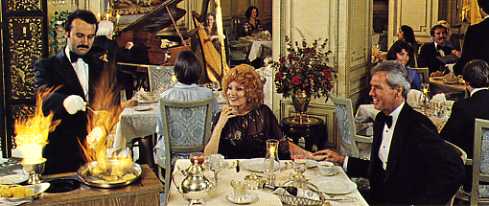
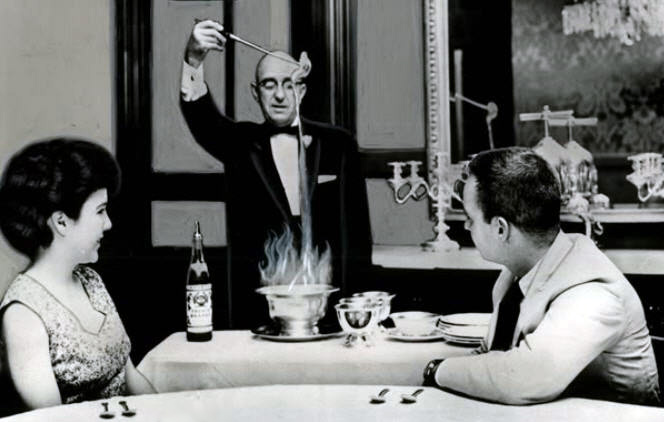
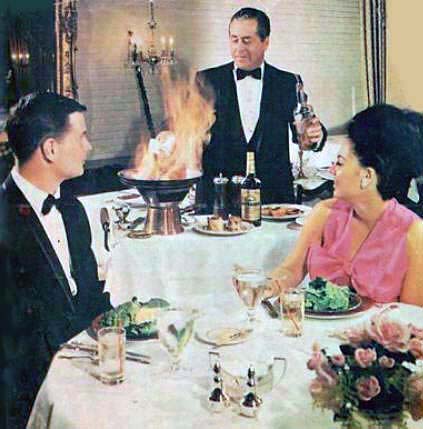
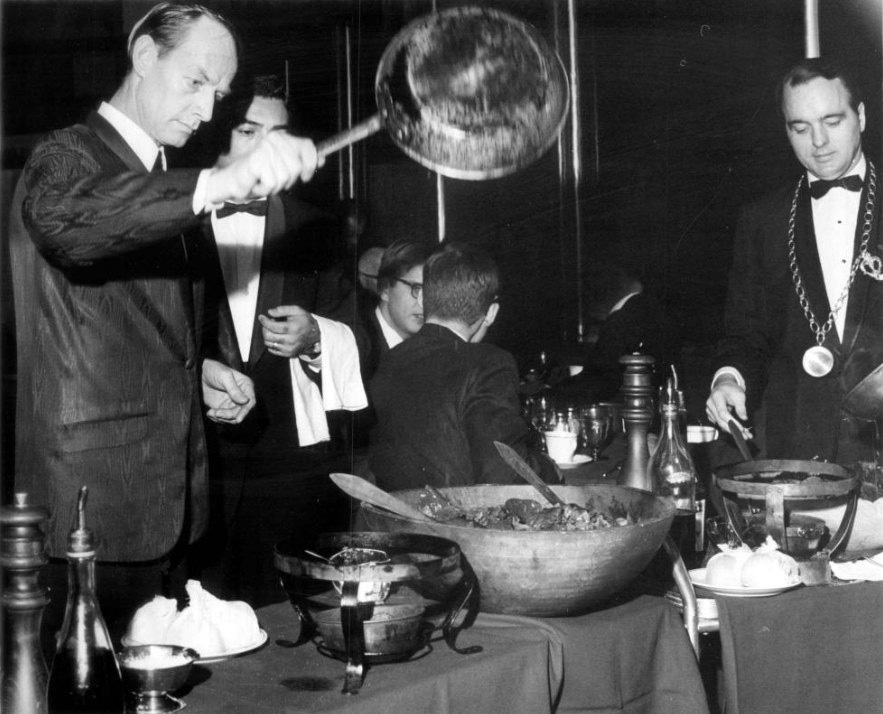
One of the most flamboyant sorts of tableside service is the presentation of food on flaming swords. It represented the consummate display of tableside theatrics, particularly at Chicago’s Pump Room of the late 1930s and 1940s. Master of ceremonies Ernie Byfield asserted that he preferred to host “laughing eaters” rather than “grim gourmets.” He was quite frank about the degree of pretense involved with tableside service at the Pump Room, implicitly acknowledging that formal French service was out of step with mainstream American culture. [Pump Room flaming swords, 1943]

Tableside service as entertaining floorshow got a foothold in American restaurants in the 1930s. By then, according to an essay by A. J. Liebling, Prohibition speakeasies had introduced middle-class New Yorkers to “a pancake that burned with a wan flame,” a reference to Crepes Suzette.

The popularity of flames at the table and other forms of tableside food preparation grew in the 1950s, 1960s, and 1970s. The full show was described by the proprietor of the Bubble Bar in Akron OH in 1952: “Just as your Flaming Sword Dinner is about to be served, the Rajah (that’s my assistant) and I dim the house lights and approach your table, sword in hand aflame with choice morsels of lamb, beef tenderloin or chicken. . . . And of course, following such an adventure in dining, you wouldn’t think or dare to order any dessert but our Flaming Cherry Jubilee or Flaming Crepes Suzette.”

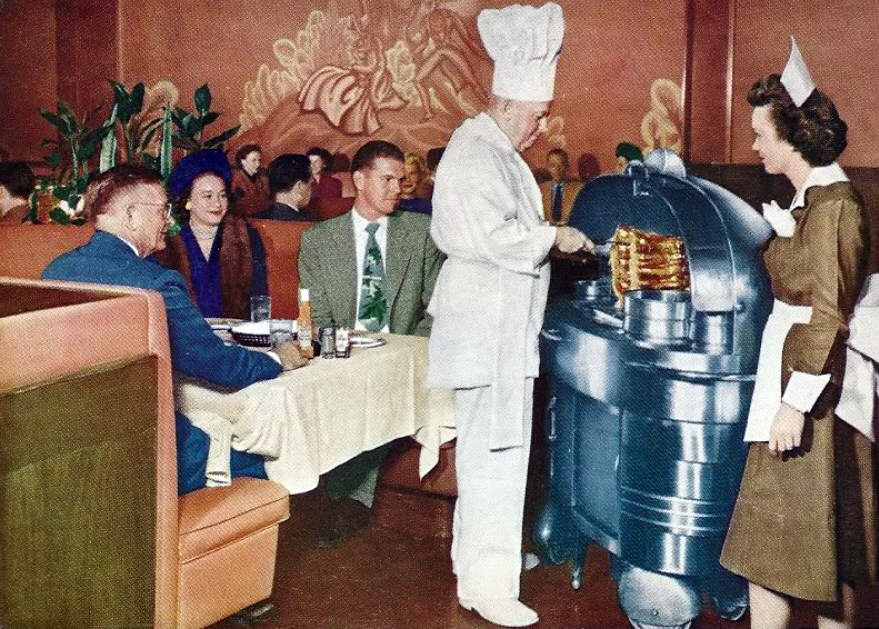
Alas, a look behind the scenes quickly dissolves whatever magic adheres to tableside drama. The 1974 how-to book Showmanship in the Dining Room leaves little doubt that tableside service in all its forms — whipping up sauces, tossing Caesar salads, serving beef from shiny rolling carts, flaming things — is all about money. The book builds upon the wisdom articulated in a July 1966 issue of Cooking for Profit that asserts that, for “the table-cloth operation,” service is the prime merchandiser. Tableside service, goes the thinking, makes customers feel important and willing to pay more for what is often food of lesser quality or quantity.

Here are some of the magic-dissolving points made in the Showmanship book:
– The rolling cart has a virtually unique benefit. It allows the restaurateur to sell items he could not otherwise sell.
– Wines on a cart allow the waiter to push particular bottles. Few people can resist when a bottle is held before them with the waiter’s recommendation.
– Coffee can be served by a specialist. For some inexplicable reason customers accept an individual dressed like an Indian maharajah much more readily than a native of a coffee-producing country.
– A casserole item with a low food cost, such as curry made from turkey thighs, which could not be readily sold otherwise, can be merchandised from a self-service chafing dish on the table.
– As a general rule, carving in the dining room gives the operation a better yield; The carver becomes proficient at making less meat look like more; the waiter can divide a piece of meat that is less than the sum of two individual orders.
– If flambéing is done properly, the customers enjoy it and willingly pay for it. In most instances, it does not harm the food very much at all.
– Any waiter who can light a match can flambé a dish.
– Nothing about the perennial flambé favorites, crepes Suzette and cherries Jubilee, is exciting except the showmanship.
– But people like sweet tastes, and people like flames. The combination is seemingly irresistible, as it sells at menu prices so exceeding the cost that they would make a desert water vendor blush.
– The matronly waitress might be able to flambé successfully . . . but she may look domestic making a steak tartare and resemble a washerwoman when tossing a Caesar salad.

Let the patron beware!

© Jan Whitaker, 2021

11 Comments

Filed under food, restaurant customs, restaurant fads, theme restaurants, waiters/waitresses/servers

Fred Harvey revisited

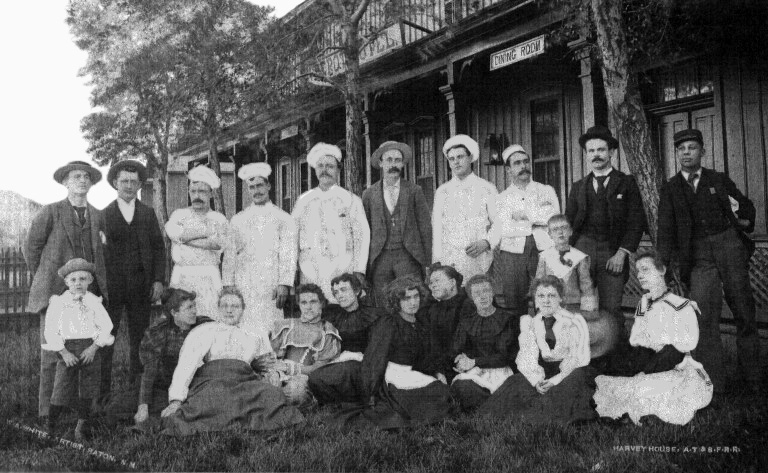
As many readers probably already know, particularly if they’ve seen the Harvey Girls movie with Judy Garland, Fred Harvey was the prime architect of a company begun in 1875. Harvey ran what were once called eating houses serving passengers and workers along the route of the Atchison, Topeka and Santa Fe railroad. [above: staff of the Raton NM eating house, ca. 1900]

Largely due to the movie, Fred Harvey — the man and the company — has been turned into a myth about providing the first good meals for train passengers and, in the process, civilizing the West. The myth was crafted mainly in the 20th century, and has rarely been challenged. As such, the Harvey enterprise has also been hailed as an example of the first restaurant chain.

I have looked carefully at the company’s first 25 to 30 years and have found many ways in which the actual history challenges the myth. Almost certainly the meals provided by Harvey’s eating houses were superior to much of what was available in the West. Yet, this is an exaggeration in that it leaves out how often eating houses on other railroad lines were praised. [menu, Las Vegas NM, 1900]

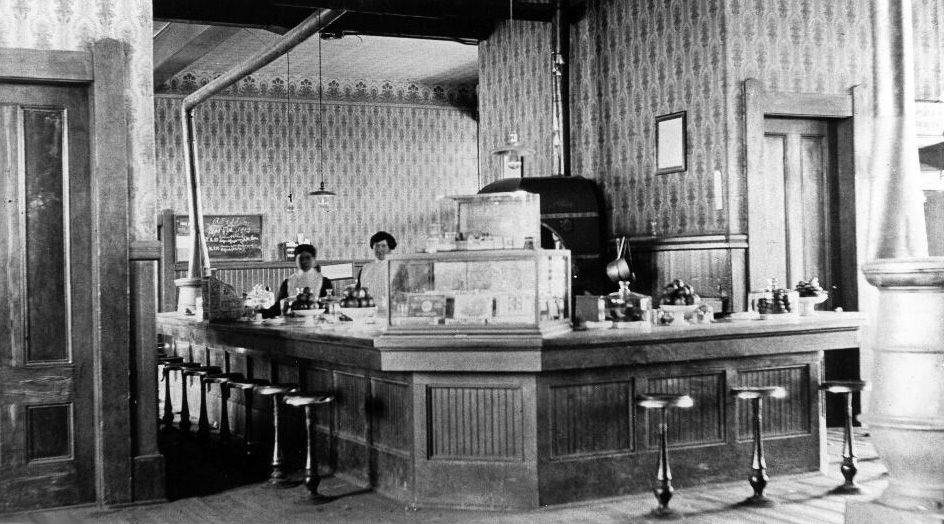
And, although Harvey’s meals were better than average in the 19th century, “the Harvey system . . . represented a utilitarian approach to meeting the needs of travelers and railroad company employees” (History of the Atchison, Topeka and Santa Fe Railway; Bryant, 1974). Some of the early dining spaces were far from elegant, located in simple frame buildings, or even fashioned out of train cars. [Deming NM lunch room, ca. 1900]

Viewed as a model of a successful modern restaurant chain, the Harvey case demands a closer look. Harvey had a close relationship with the vice-president, later president of the Santa Fe line, W. B. Strong, and enjoyed a sweetheart deal with the railroad. Essentially he could not fail, even in the early years when the number of patrons of his eating houses was small. Railroad passengers going West in the early years were of two classes. One was tourists who could afford to travel for enjoyment. The second, people moving West, were classed as “emigrants.” They were of lesser means and carried food with them because they could not afford to buy the meals, which were high priced.

The railroad’s primary business was freight; passenger traffic was light. The 44 Harvey houses then in business each fed an average of only 114 per day in 1891. It is striking to compare this figure to that of an admittedly very busy restaurant in NYC, which often fed 8,000 patrons a day in 1880.

In a number of ways the railroad operated like today’s cruise ships in terms of its relation to the surroundings, stopping briefly to refuel, get water, and let passengers off for meals. Using the railroad to transport food, supplies, and workers from afar by train – all at no cost – was what sustained the Harvey eating house business. Additionally, the beef used by Harvey eating houses was supplied from Harvey’s own ranch, and shipped for free (a practice known as deadheading) to slaughterhouses in Leavenworth KS and Kansas City MO and back to his kitchens. This drew the ire of local butchers and ranchers who had to pay high rates to ship their cattle. As Stephen Fried reported in his thoroughly researched Appetite for America, Harvey co-owned a ranch of 10K cattle with Strong and another railroad executive.

Newspaper editorials in several of the towns where Harvey did business railed against his practices. A paper in Newton KS called him “one of the worst monopolists in the State” because he brought supplies from Kansas City rather than buying from local merchants. Conflict about the same issues in Las Vegas NM was ongoing as the town struggled to prevent Harvey from supplying his own meat. Bitter complaints were made from people in Albuquerque as well, especially when two box cars were delivered and painted yellow to serve as a make-do restaurant. High prices for meals were widely criticized by local patrons.

Employees in the Harvey system included very few local people. Many were immigrants from Europe, especially the cooks, though the waitresses tended to be U.S.-born, and were selected by employment agencies in cities. Myths have celebrated how the “Harvey girls” married ranchers and helped populate the West (indigenous Indians and Mexicans aside). But in fact the servers were semi-indentured, with half their pay held back for 6 months to keep them from leaving the job. Not only was this meant to discourage resignations due to marriage but also to discourage the practice of working for a short time and then requesting a transfer farther west, all in the effort to finance travel through the West. [Photo of dining room server, ca. 1890s]

In terms of pleasing patrons, Harvey’s food was widely praised. But Santa Fe passengers were not really satisfied. What they disliked about the eating houses was basically that they existed at all. As an article in Scribner’s inquired, “Why . . . should a train stop at a station for meals any more than a steamboat should tie up to a wharf for the same purpose?” Passengers would have much preferred to eat on the train rather than to rush through their meal in 20 minutes – or, worse, to have mealtime delayed for hours when trains ran late. But the three largest railroads, including the Santa Fe, had made a pact not to introduce dining cars because they were huge money losers.

The pact began to break down in the late 1880s, but when the Santa Fe decided it wanted to run dining cars on through trains, Harvey got a court injunction preventing it, claiming it would violate his contract. After several years, the injunction was lifted when Harvey was awarded the contract to run the dining cars. [California Limited advertisement, early 20th century]

Despite many of the myth-challenging realities of the favorable circumstances Harvey enjoyed, he did introduce some practices common to modern chain restaurants. His was a top-down organization based upon standardization and strict centralized control. Each eating house was run like every other, with goods, employees, and services selected according to the same methods. In the early years, Fred Harvey personally visited and inspected all restaurants. Later supervision was taken over by managers, accountants, and a chef, who operated from the central office in Kansas City. By contrast, other railroads contracted with individual operators to run their eating houses as they saw fit and sourcing food locally, which produced excellent results in some cases, but limited menus and unappealing food in others.

It’s not surprising that the Harvey myth persists like so much of Western lore. Alas, it is extremely difficult to correct legends. When facts depart from a legend, John Ford, director of The Man Who Shot Liberty Valance, concluded with resignation, “. . . print the legend.”

© Jan Whitaker, 2021

26 Comments

Filed under chain restaurants, lunch rooms, proprietors & careers, waiters/waitresses/servers

Maitre d’s

As the name suggests, “maitre d’hotel” (hotel master) tended to be used most often in hotels. In a large enterprise a maitre d’hotel would supervise multiple headwaiters, each of whom had charge of service in one of its multiple dining spaces. Those could include a formal dining room, a supper-room, a grill room, banquet rooms, and/or a café lounge. Over time, the positions of maitre d’hotel and headwaiter were collapsed into one, yet both terms remained in use.

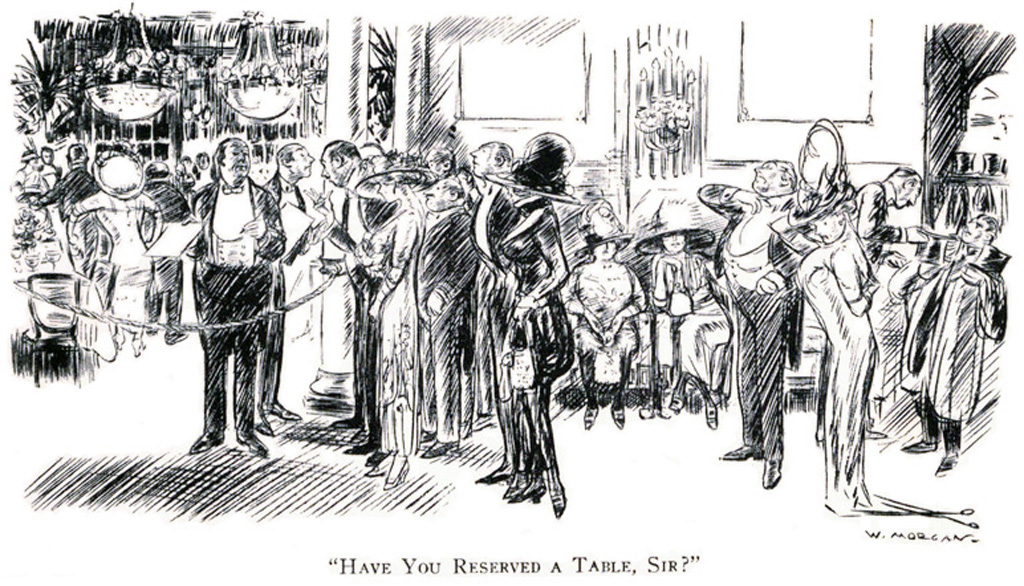
The man (99.9% of the time) playing that role became the public face of a restaurant or hotel dining room. Like celebrities, he was often known by one name only. A counterpart of the chef who ruled the kitchen, he ruled the front of the house. In addition to being completely in charge of the dining room and its service, he might hire, train, and supervise the entire waitstaff as well as plan private dinners and banquets, take reservations, admit and seat guests, make recommendations and take orders, and prepare special dishes at the table.

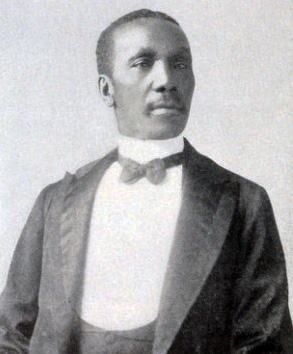
Whether called maitre d’hotel or headwaiter, historically the person filling this role was an imposing physical figure, large, tall, and very well dressed. In this country during the 19th century the role was most often filled by a Black man, usually working in an American-plan hotel where meals were included in the cost of lodging. [L. D. Houston, shown here in 1904, worked in New York and for a time in Hong Kong where he went to escape U. S. racism.] Dressing the part was essential. During the 1930s Depression a nightclub performer in Paris entertained his audience by describing a headwaiter as “The only man in the place whose clothes fit.”

The maitre d’hotel (shortened to maitre d’ over time) or headwaiter could have a wide variety of duties depending upon the size of the dining facilities. An expensive, full-service restaurant that was French or international might have captains, waiters, wine stewards, and busboys in addition to a maitre d’. In the 20th century, a popular maitre d’, having reached the pinnacle of the waiting profession while working for someone else, might look for partners or backers and become the host of his own restaurant.

A prominent example of someone who worked his way up from waiter to owner/maitre d’ was the late Sirio Maccioni of New York’s famed Le Cirque. Other well known maitre d’s — who stayed at their posts for about 50 years each — were “Oscar” and “Hoxter.” Oscar Tschirky of the Waldorf was said to be the first to rope off a doorway, while Stansbury Hoxter of Boston’s Parker House was known for his smile and his infallible memory. [Portrait of Stansbury Hoxter courtesy of his great, great, great nephew James Bell.]

Although some maitre d’s who had immigrated from Europe arrived with hotel school training, usually the headwaiter/maitre d’ reached his position after considerable time working his way up the dining room hierarchy. He may have begun as a busboy or waiter, then advanced to captain of a group of waiters, and finally to headwaiter. Along the way he would have proved his ability to judge a guest’s social status, underwritten by his astute understanding of human behavior. It was expected that he not only remembered regular guests’ names and faces, but also knew their favorite dishes.

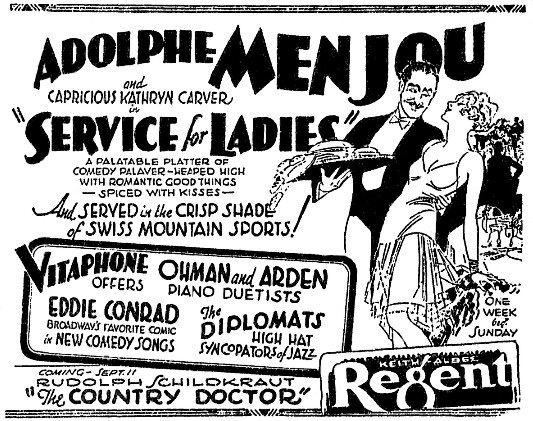
Although many Americans probably never encountered a maitre d’, he became a figure in popular culture. In 1927 the debonair Adolphe Mange played one in a silent-era rom-com.

While it’s true that favored guests at luxury restaurants appreciate the services of a maitre d’ who saves them “their” table, treats them with great care, and knows their likes and dislikes, many Americans have not reacted well to what they regard as haughty judges of their social rank who may treat them poorly or even turn them away. Despite the geniality of well-liked headwaiters, to many people the overall impression created by this personage is a feeling of cold formality. According to a 1940 opinion piece in a restaurant industry journal, diners did not like bowing nor “that type of waiter service that constantly rearranges your bread-and-butter-plate and water glass . . . and then frequently walks by your table to see if you are eating properly.”

That may be why in more recent times even an upscale, expensive restaurant probably does not have a formally dressed maitre d’ greeting guests. That role is more likely to be filled by a younger person, frequently a woman, who probably does not run the entire dining room nor hire the staff. She may nod her head as she hands guests a menu but does not bow.

© Jan Whitaker, 2020


5 Comments

Filed under elite restaurants, proprietors & careers, restaurant customs, Uncategorized, uniforms & costumes, waiters/waitresses/servers