Category Archives: patrons

Eating Chinese

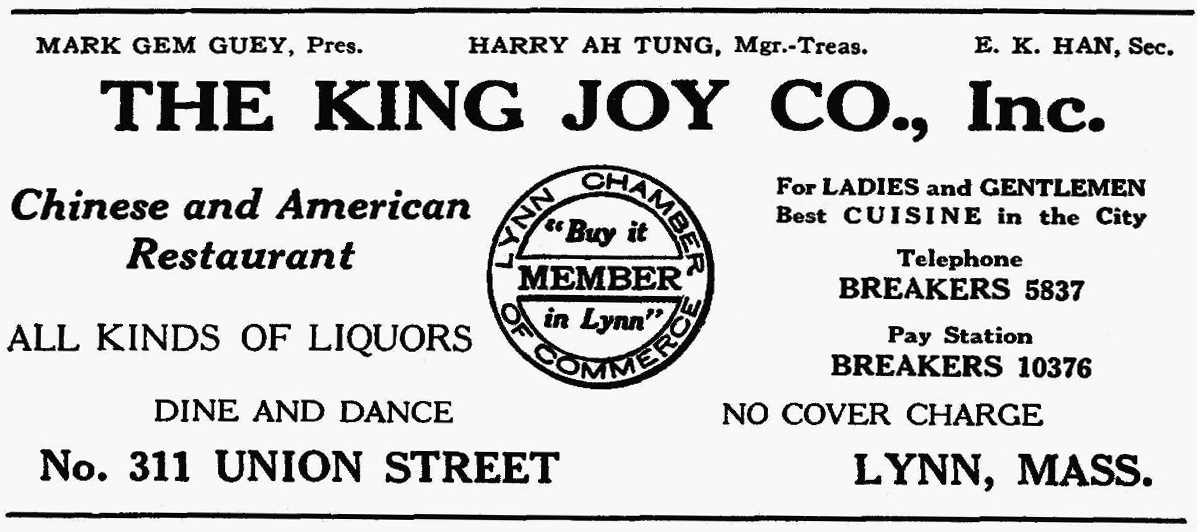
lynn1937KingJoy

While paging through a 1922 Massachusetts business directory I was struck at first by how many Chinese restaurants there were in various towns. But when I went back to the directory to take a closer look I realized there weren’t really so many except, perhaps, in manufacturing towns such as Fall River and Lowell.

I wondered who patronized Chinese restaurants in Massachusetts in the early 20th century – and then I remembered recently buying a diary that mentioned a place called King Joy.

After I managed to identify the family whose doings were chronicled in the diary (not easy!), I discovered a surprising and intriguing little story.

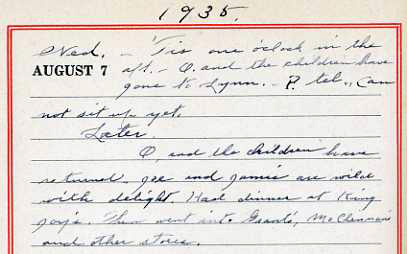
The diary, mostly written in 1935, was about three generations of a family living on the North Shore of Massachusetts. It was kept by the grandmother of the family who I will call Gertrude, age 76. Her husband Arthur was a retired dentist a few years older. They headed a socially prominent family with two homes, one in the affluent community of Hamilton and the other in the nearby resort town of Nahant.

Living with Arthur and Gertrude were their daughter Opal, age 49, and her son Jamie, age 5. Opal’s brother Perry, a 40-year old engineer, and his wife Ellen, also lived in Hamilton.

hotelvendomeThe overwhelming focus of the diary is the health of family members, who seem to be under the weather for much of 1935. There are large stretches of blank pages where nothing is recorded, but restaurants are mentioned six times, all but one of them Chinese. The exception was the time that Gertrude, Opal, and Jamie went to Boston and stayed overnight in the Hotel Vendome, a Back Bay hotel for the gentry that dated to 1871. While grandmother and grandson retired early, Opal had a late-night supper in the hotel’s Nippon Room. Gertrude, a woman of few words who loved to abbreviate, hints in the diary that the purpose of the trip was for Jamie to visit his estranged father.

WsEatChinese

Twice that year Gertrude records that someone, usually Opal and Jamie, went to King Joy in nearby Lynn MA. Another time Opal went to Lynn to bring back chow mein for her father, Arthur, who had fallen down the stairs at home. Once the family went to the Far East Restaurant in Lynn and once they went to the Canton Restaurant in Worcester, riding in Perry’s car.

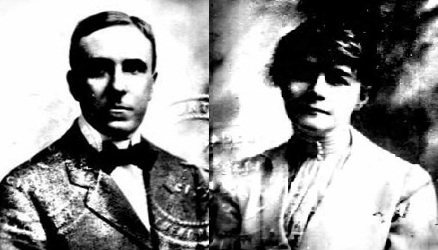
OWP1904Opal’s liking for what must have been a fairly exotic cuisine to a Massachusetts native in the 1930s might be explained by her world travel as a young woman. In 1904, at age 19 [pictured], she was adopted by a wealthy retired Boston lawyer with real estate holdings. Divorced and thirty years her senior, he was a renowned animal rights advocate, free thinker, and globe-trotter. (Amazingly enough, Opal’s parents reportedly approved of the arrangement.) Shortly after the adoption, Opal and her new father set off for a visit to the World’s Fair in St. Louis followed by a trip to Brazil and winter in Egypt. It was the first of many trips she would take with him.

Opal married around 1921, at age 36, giving birth to Jamie nine years later. Her adopted father gave her his house in the Boston area as a wedding present and some time later moved to Los Angeles.

PGP1934By the time Opal’s paternalistic benefactor died in 1934 at age 77 [pictured], he had crossed the Atlantic 145 times, visited Russia 16 times, Egypt 13 times, and the Arctic 13 times. In his will he left all his money to animal protection and free-thinking societies and just $1 to Opal. She contested the will, probably without success.

© Jan Whitaker, 2014

3 Comments

Filed under patrons

Habenstein of Hartford

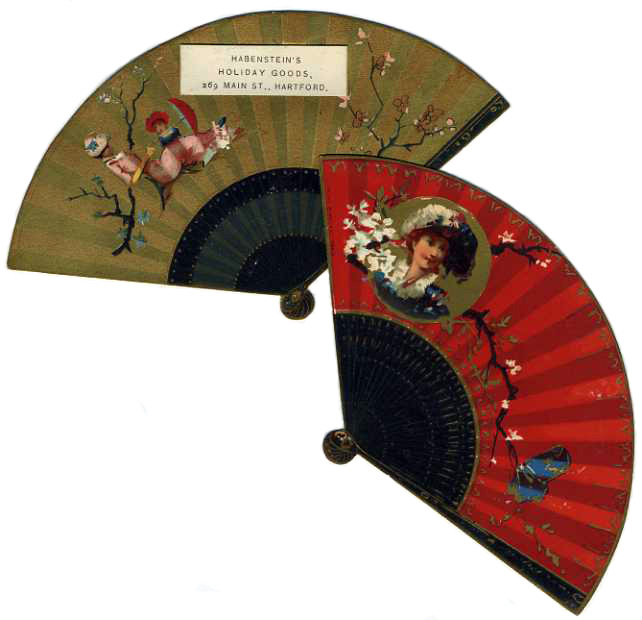
habrenstein's1880stradecardsIn the late 19th century having your party catered by Edward Habenstein was proof that you had arrived socially. The newspapers of Hartford CT and Springfield MA were filled with descriptions of lavish social events that carried the phrase “catered by Habenstein of Hartford.” That said it all.

Edward Habenstein was born in Saxony, Germany, around 1844 and came to the US with his parents when he was young. They settled in Utica NY where, at age 15, he joined a catering business. When he was 18 he went to New York City, moving to Hartford in 1865 and starting his business in 1868.

habenstein's1891Wesleyanpub

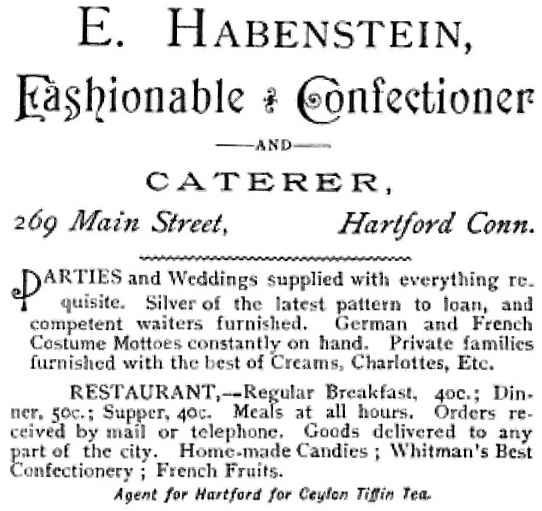
Although his was a retail confectionery and bakery selling its own products as well as Whitman’s candies, French candied fruits, and holiday favors, Edward and his wife Adelia specialized in weddings and large affairs given in private homes. By 1880 they also ran a restaurant but, judging from advertisements, catering remained a prominent part of their business. In Massachusetts the company was known simply as “Habenstein, the Connecticut caterer” while in Connecticut newspapers it claimed the title “The State Caterer” as reflected in an 1890 advertisement consisting solely of that line and a Main Street address in Hartford.

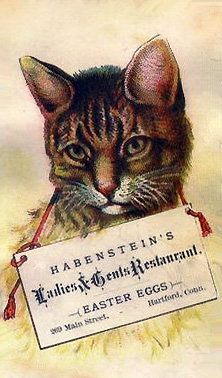
habenstein'sEasterEggsIn addition to providing edible refreshments and dinners, Habenstein supplied receptions and parties with “silver of the latest pattern,” decorated French china, awnings, camp chairs, cloth to cover valuable carpets, orchestras, and “first-class” cooks and waiters.

In June of 1886, a Springfield MA alderman opened his house to the city’s elites who danced, spilled out into an enclosed piazza, and enjoyed Habenstein’s refreshments “of all conceivable forms and kinds.” In summer 1895 an even splashier affair was hosted by the Skinner family who owned one of the nation’s largest silk mills in Holyoke MA. Youngest daughter Katherine entertained about 300 guests at a lawn party at their palatial home “Wistariahurst,” whose grounds were lit with clusters of Chinese paper lanterns hung from trees. The younger set danced for hours outdoors on a specially constructed platform illuminated by arc lights while Habenstein served “lunch” in the mansion’s dining room.

habenstein'sdinner

Students at Wesleyan College in Middletown CT also enjoyed Habenstein’s hospitality. In June 1890 the all-male sophomore class boarded a boat on the Connecticut River to travel to the Hartford restaurant. The boat got hung up on a sandbar and, despite its departure at 11 P.M., did not arrive until 2 A.M. Edward was a bit cross, according to an illustrated account in a student magazine, but served the Class of 1892 a delicious “midnight” supper nonetheless. I’m struck how unlike the menu is compared to what 19-year-old students might order today. They might agree with Milton’s epigram but would they quote it atop their menu?

MENU.
“What hath night to do with sleep.
Welcome joy and feast, midnight
Shout and revelry.” – Milton’s Comus.

Little Neck Clams,
Olives               Celery           Radishes
Vermicelli Soup
Salmon, with wine sauce
Currant Jelly
Brown Mashed Potatoes                           Broiled Chicken on Toast
Saratoga Potatoes                  French Peas
Roman Punch
Lobster de Newburg               Chicken Salad
Fruit                         Assorted Cakes
Ice Cream                  Neapolitan Ice
Coffee
Cigars        Cigarettes

Over its more than 50 years in business in Hartford and up and down the Connecticut River valley, Habenstein’s moved about half a dozen times. In 1902, when it was at 805 Main Street, it advertised that it was the best restaurant in Connecticut. Edward died around 1920. Adelia carried on the business for a short time.

© Jan Whitaker, 2014

10 Comments

Filed under confectionery restaurants, patrons

Don’t play with the candles

nightingalepartialfrontmenu

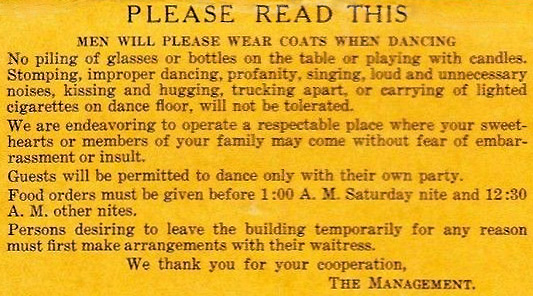
It’s not often that you run across a menu that tells patrons how to behave, right on the front. It seems to project the message Welcome! . . . or maybe not.

In case you were wondering what “trucking apart” means, I think it refers to flirting with someone other than who you came with.

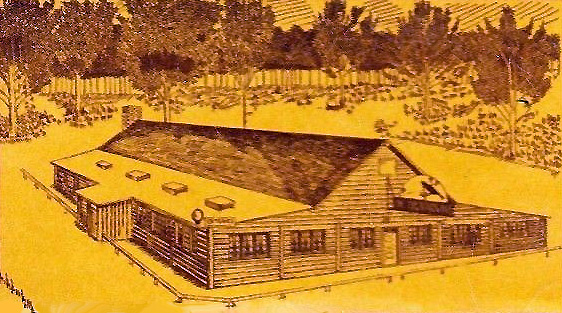
nightingaleMenufrontdrawingThe menu, which probably dates from the 1950s, is entertaining inside too: Pop Corn as an appetizer, Toast (under Specials, .20), Pickled Egg Salad with Crackers (.50), and Blackberry Wine from Ohio (.30 per glass).

The Nightingale’s finest and most elaborate offering is clearly its Chicken Dinner ($1.25). The potatoes, tomatoes, and biscuits get glowing modifiers while the chicken has none.

Tomato Soup or Tomato Cocktail
French Fried, Golden Brown Potatoes
Sliced Field Ripe Tomatoes
Peas or Beans
Piping Hot Biscuits
Coffee or Tea
Ice Cream

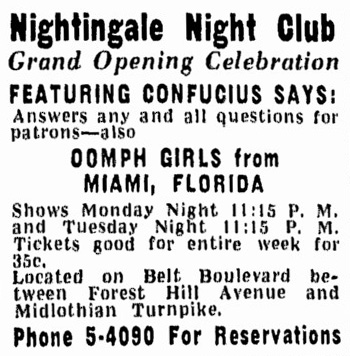
nightingaleclubMarch251940In 1940 Luther L. Dixon, an enterprising factory worker at American Tobacco Co. who made money in real estate, opened a restaurant/club called the Nightingale on the outskirts of Richmond, Virginia. He had left the business by the mid 1950s, so the owner of the Nightingale with the menu advice, located south of Alexandria, may have been someone else.

© Jan Whitaker, 2014

12 Comments

Filed under night clubs, patrons, roadside restaurants

Girls’ night out

GirlsNightOut

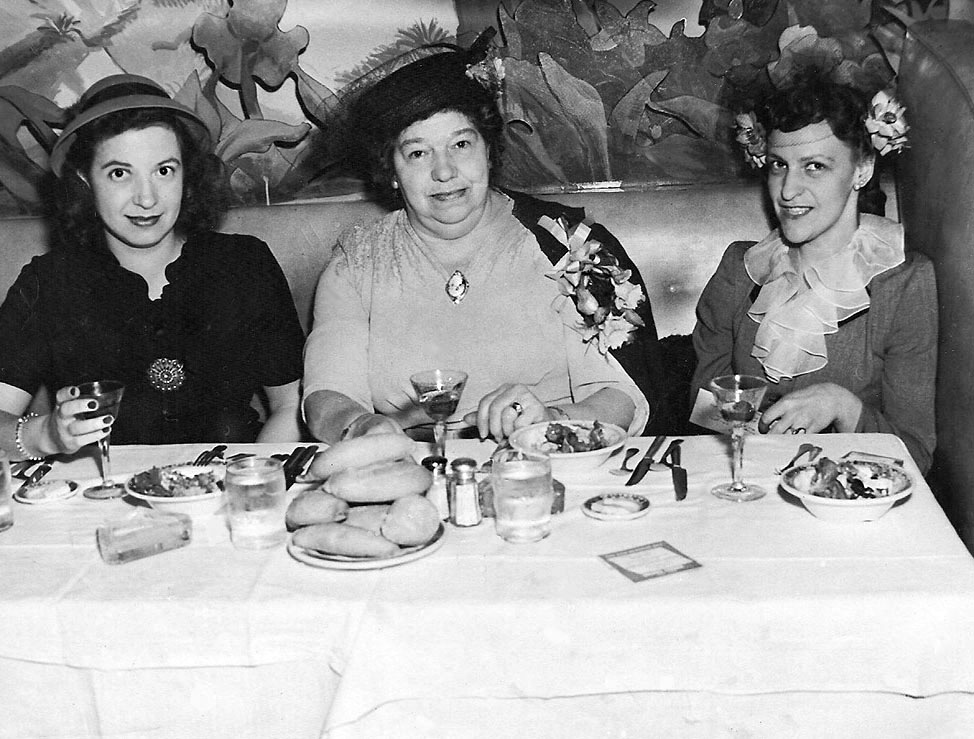
This is one of my favorite photographs, the kind I tend to hoard until the perfect moment. I put it in the same league with the wonderfully evocative photograph in That night at Maxim’s. It seems just right for the first post of a new year.

Once again, I invite readers to imagine what is going on. I know little other than that they are in a restaurant in New York City. Because they are seated  at a banquette, and because the photo was almost certainly taken by a professional photographer, I would guess it is a nightclub restaurant, or certainly a special occasion type of place. Judging from their outfits and the style of the mural behind them, I think it is the late 1940s or early 1950s.

I love how directly they look at the photographer and how contented they are. I think the woman in the middle is the mother of the woman on the left. Perhaps it is her birthday. Could the other be a cousin? She seems to have been interrupted just as she is about to present what looks like a check to the older woman.

They are drinking manhattans or martinis, not paying too much attention to their salads, and totally ignoring the mound of dinner rolls piled so unceremoniously on a too-small plate. The awkward way the rolls are served and the ordinary serviceable restaurant ware (water tumblers, dishes, and salt and pepper shakers) makes me think it is not an elite restaurant. Still, love those butter pats on the tiny plates!

The only objects in the photograph that I cannot identify are two small squares of paper on the table, one in the foreground right and the other just beyond the salad of the woman on the right. Forms to fill out for the photographer?

Thoughts?

© Jan Whitaker, 2014

10 Comments

Filed under patrons

Restaurant-ing in Metropolis

Metropolis544

In the depths of the Depression, in 1934, Harper & Bros. published a book of 304 photographs called Metropolis. Most of the photos were by Edward M. Weyer, Jr., an anthropologist who wanted to show how people in greater NYC lived. Captions were supplied by the popular writer Frederick Lewis Allen.

In a 2010 NY Times story the book was described as a “romantic masterpiece of street photography” composed of “moody black-and-white coverage of day-to-day life in New York in the ’30s. Beggars, snow-shoveling squads, schooner crews, railroad commuters, subway crowds, tenement life, tugboats, a sidewalk craps game. . .”

I find it particularly interesting that a major focus of the book was to contrast how different social classes lived, illustrated in part by where they ate lunch.

The central narrative follows employees of a company headed by a Mr. Roberts. He lives in a house on a 4-acre plot in Connecticut, commutes to New York, and employs a house maid whose duties include fixing his wife’s lunch each day. On the day he is being profiled Mr. Roberts eats a $1.00 table d’hôte lunch at his club (equal to $17 today). So frugal, Mr. R.

Metropolis540

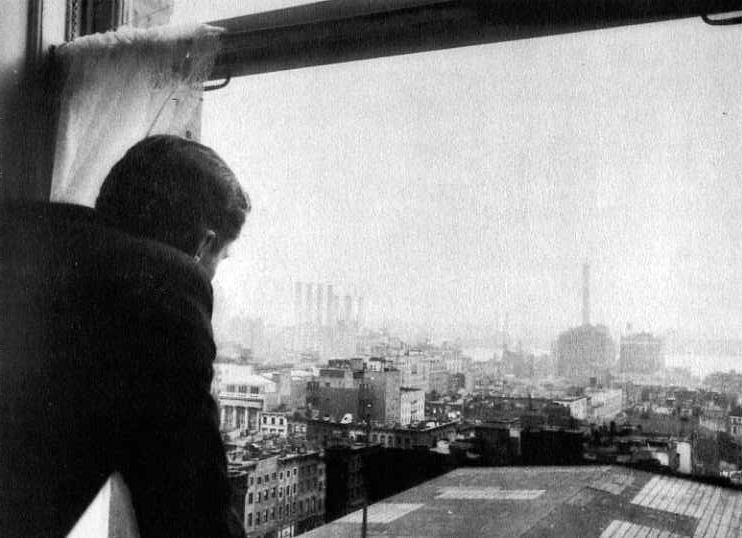
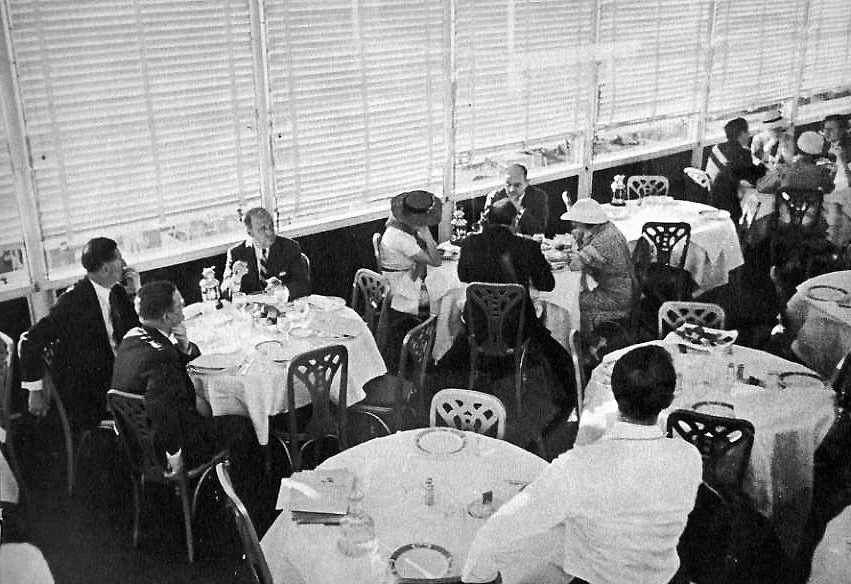
Mr. Roberts is visited by a Mr. Smith from out of town (shown above looking out hotel window). Mr. Smith “stands for all those who come to the city from a distance,” whether Los Angeles, Boston, or elsewhere. He is “reasonably well off.” Mr. Smith eats a $1.25 table d’hôte lunch – er, luncheon — in a dining room on a hotel roof (pictured). Prices are high there, making his meal a relative bargain. Had he wanted to splurge he could have ordered a Cocktail (.40), Lobster Thermidor ($1.25), and Cucumber Salad (.45) – total $2.10. I would guess that many visitors to New York tend to spend more on restaurants than natives.

Metropolis539

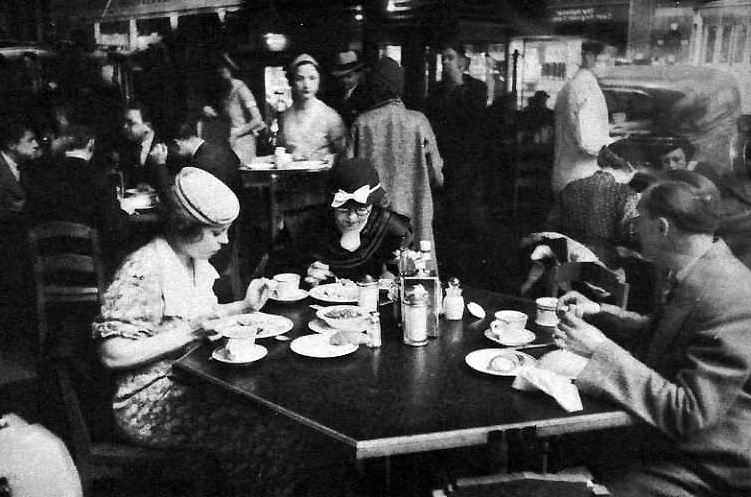
Mr. Roberts’ secretary, Miss Jordan, lives with her mother and brother in an apartment just off Riverside Drive. With a combined family income of less than $4,000 the three can barely afford their $125/month rent. She goes to lunch at a café (pictured) and orders To-Day’s Luncheon Special which consists of Tomato Juice, Corned Beef Hash with Poached Egg, Ice Cream, and Coffee, all for 40 cents. Frankly, I don’t see how she can afford to do this every day.

Metropolis538

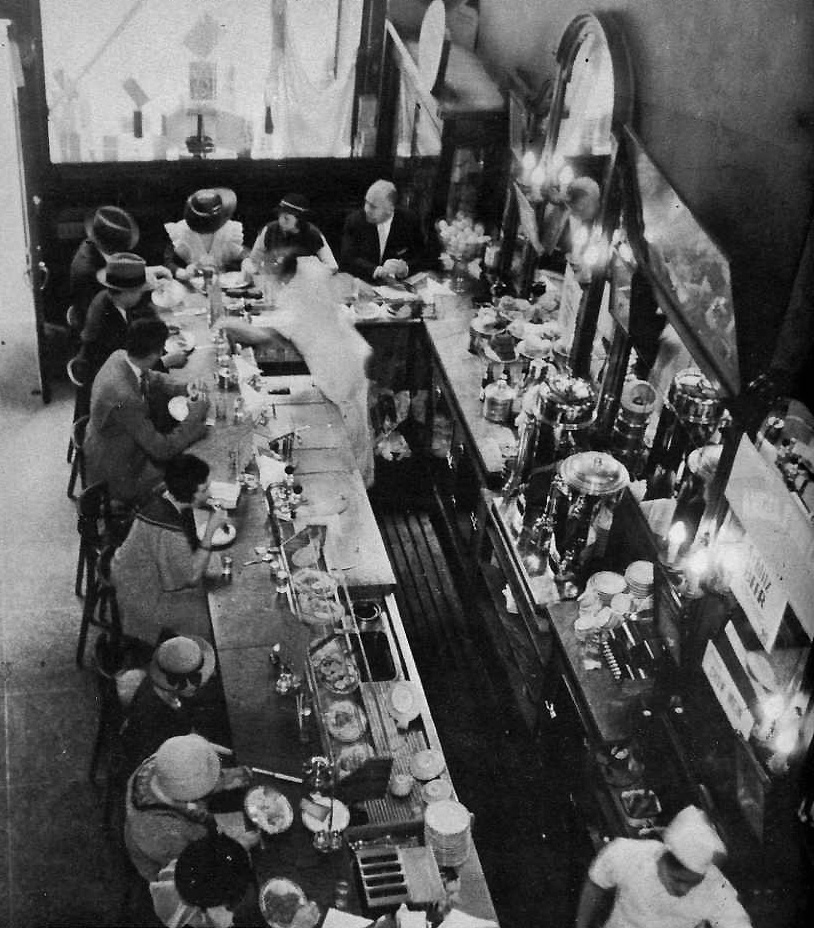
Miss O’Hara and Miss Kalisch transcribe dictation from other executives in the firm and each makes about $22.50 a week. Miss Kalisch lives in Astoria, Queens, and is married. Evidently she is pretending to be single in order to hold her job (her name is really Mrs. Rosenbloom). Miss O’Hara lives with her father in a somewhat decrepit apartment costing almost half her wages. Her father has been out of work for three years. The two women eat lunch at a drugstore counter (pictured) where they order Ham on Rye Sandwiches, Chocolate Cake, and Coffee (.30). I fear Miss O’Hara is living beyond her means if she does this often.

Miss Heilman, a young clerk, makes about $16.50 a week and is subject to occasional layoffs. She lives with her brother, his wife, and their two children in a 3-room apartment in Hoboken NJ, for which they pay $15/month. Like the other “girls” at the bottom of the totem pole she brings a sandwich and eats it in the office.

Metropolis542

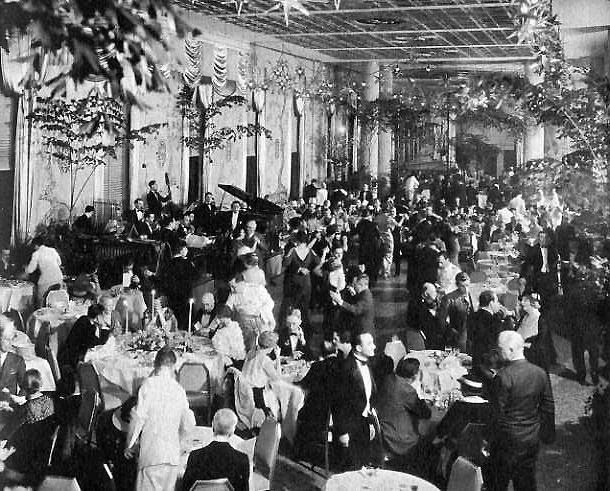
Mr. Smith, being on his own, must go out for dinner. Once again he chooses a hotel roof garden (pictured), where about half the guests are also out-of-towners. With a live orchestra and dancing, it is undoubtedly expensive. I’m guessing he went for the Cocktail and Lobster Thermidor this time.

© Jan Whitaker, 2013

8 Comments

Filed under patrons

Taste of a decade: 1970s restaurants

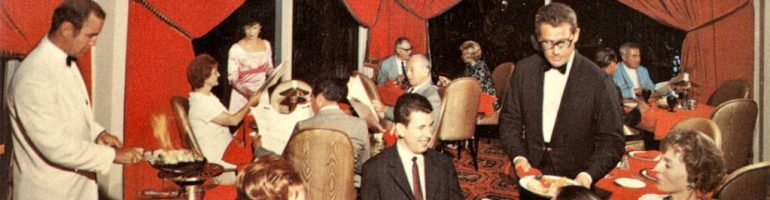
1979restaurantIn the 1970s the restaurant industry and the custom of eating in restaurants grew rapidly. The decade was the gateway to the present in many ways. Despite economic woes (recession and inflation), the energy crisis, urban decline, crime, and escalating restaurant prices, restaurant-going continued to rise.

The president of the National Restaurant Association proclaimed “Dining out is a significant part of the lifestyle of this great country,” noting in 1976 that one out of three meals was being consumed outside the home.

Restaurant patronage was encouraged by all kinds of things, including relaxed liquor laws in formerly dry states and counties, which brought more restaurants into the suburbs, the spread of credit cards, more working wives and mothers, youth culture, and a me-generation quest for diversion.

New York exemplified the problems faced by restaurants in troubled inner cities. Fear of crime kept people from going out to dinner. Restaurants closed, few new ones opened, and cash-strapped survivors began to trade vouchers for heavily discounted meals for advertising. But as New York struggled, California experienced a culinary renaissance as did other parts of the country. Still, much of the U.S. wanted only steak and potatoes, and hamburger was the most often ordered menu item nationwide.

A number of restaurant formats and concepts faced senescence, but new ones came on the scene at a rapid pace. Going, going, or gone were automats, coffee shops, continental cuisine, diners, drive-ins, formal dining, Jewish dairy restaurants, and Polynesian restaurants, not to mention the rule of elite French cuisine.

Fast-food chains continued to grow, with the number of companies increasing by about two-thirds. Growth was especially strong in the Midwest which was targeted as a region susceptible to their appeal. Toledo was bestowed with Hardee’s, Perkins Pancakes, a Mexican chain, and, in 1972, the arrival of two Bob Evans eateries. Another Ohio city, Columbus, was christened a test market for new fast-fooderies while Junction City KS, bordering Fort Riley, looked like a franchiser’s fast food heaven. By contrast, greater Boston had only one Burger King and one McDonald’s in 1970.

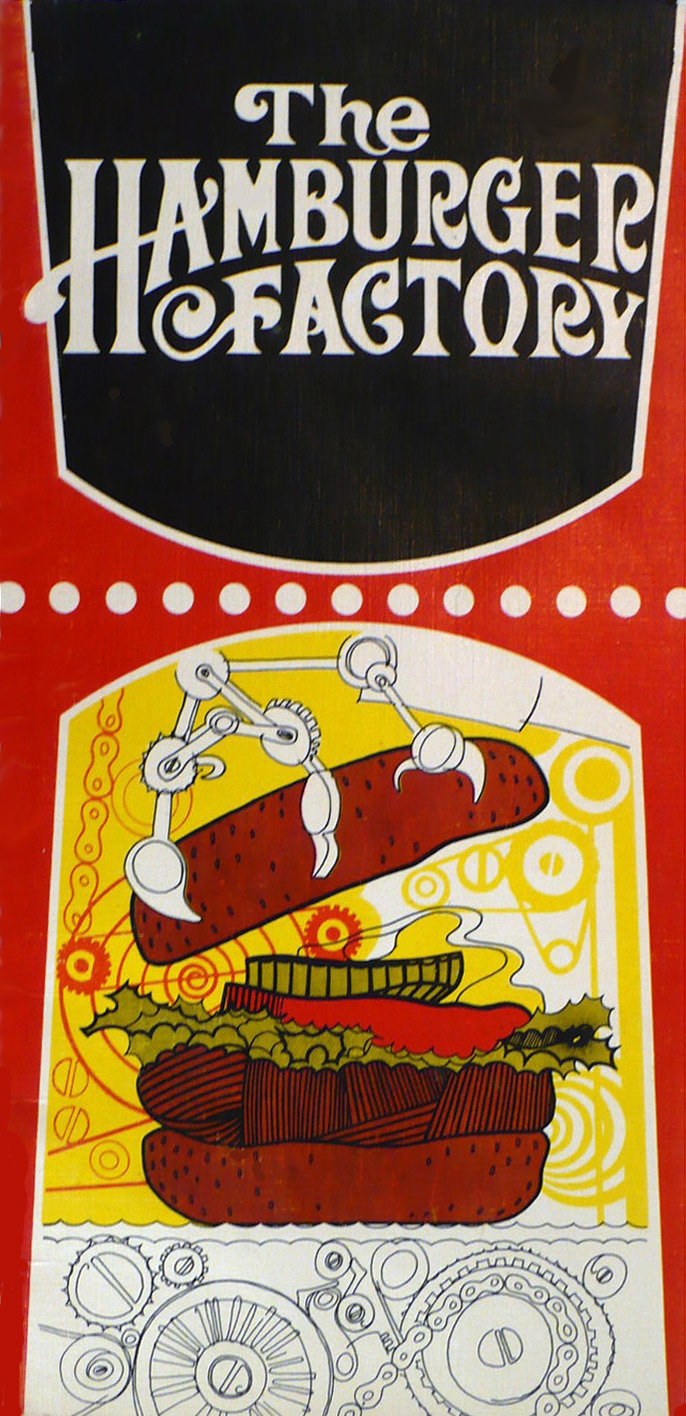
HamburgerFactoryAlong with the chains and a shortage of (cheap) kitchen help, came an upsurge in restaurants’ use of convenience foods and microwaves. In response, municipalities across the country enacted ordinances to protect consumers against false claims on menus, many of them centering on misuse of the words “fresh” and “home-made.”

Yet as the country was swamped with fast food, it experienced the flowering of restaurants specializing in ethnic, artisanal, and natural foods. Hippie and feminist restaurants stressed honest, peasant-style meals. Burgeoning interest in nutrition made salad bars popular. Bean sprouts, zucchini, and more fish showed up on menus. Diners learned that Chinese food was not limited to Cantonese, but might also be Mandarin, Szechuan, or Hunan. Once languishing behind luxurious decor, impeccable service, and famous patrons, food took center stage in deluxe restaurants as they purged Beef Wellington from their repertoire and took up the call for culinary creativity and authenticity.

Though not unknown in earlier decades, the restaurant-as-entertainment-venue came into full flourish with the proliferation of theme restaurants with unbearably cute names such as Orville Bean’s Flying Machine & Fixit Shop. To supplement a shrinking supply of old stained glass windows, telephone booths, and barber chairs, restaurant fixture companies began to manufacture reproduction antiques.

However crazy and mixed up the foodscape, America had become the land of restaurants for every taste and pocketbook.

Highlights
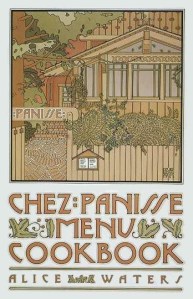
ChezPanissecookbook1971 – In Berkeley CA Alice Waters and friends found Chez Panisse, marking the movement of college and graduate students into the restaurant field, a career choice which is beginning to have cachet.

1972 – NYC’s Le Pavillon, considered the finest French restaurant in the U.S., closes. In Kansas City MO the first Houlihan’s Old Place, adorned with nostalgia-inducing decorative touches, opens, as does Mollie Katzen’s natural-food Moosewood Restaurant in Ithaca NY.

1972 –Dry since 1855, Evanston IL, home of the Women’s Christian Temperance Union, grants liquor licenses to two hotels and six restaurants. Their business doubles in a few months.

1973 – Los Angeles County becomes the first jurisdiction in the country to enact a “truth in menu” ordinance. During the pilot program, the scenic Sea Lion Restaurant in Malibu is caught selling the same fish under five different names with five different prices.

1974 – A Chicago food writer throws cold water on arguments about which restaurant has the best lasagne, asserting that the debaters “might have found that same lasagne in restaurants all over the country” courtesy of Invisible Chef, Armour, or Campbell’s.

1974 – Restaurateur Vincent Sardi spearheads a campaign to get New Yorkers to eat out, claiming that the city’s major restaurants have lost up to 20% of their business in the past two years, thus precipitating the closure of 20 leading restaurants.

1976 – The CEO of restaurant supplier Rykoff says whereas his company once supplied whole tomatoes it now provides diced tomatoes “because the operator just can’t afford to pay someone to cut them up.”

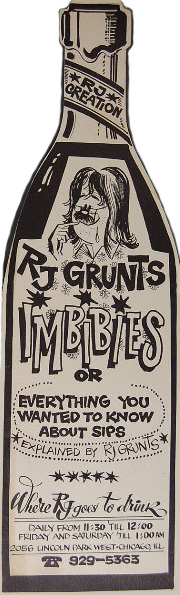
RjGrunts1970s1976 – Richard Melman’s Chicago restaurant company, Lettuce Entertain You Enterprises, operator of RJ Grunts, Great Gritzbe’s Flying Food Show, and Jonathan Livingston Seafood, opens Lawrence of Oregano and prepares to take over the flamboyant Pump Room.

1977 –Industry journal Restaurant Business publishes survey results showing that, on average, husband & wife pairs eat out twice a month, spend $14.75 plus tip, prefer casual restaurants, and tend to order before-dinner cocktails and dishes they don’t get at home. Measured by sales, Lincoln NE is one of the country’s leading cities for eating out.

1977 – Once characterized by blandness, San Diego now has restaurants specializing in cuisines from around the globe, an improvement one observer attributes in part to the new aerospace industry there.

1978 – A reviewer in Columbia MO complains, “A brick floor and pillars, old photos, Tiffany lamps, stained-glass windows and trim on the tops of the booths as well as revolving single-bladed, old-fashioned fans [is] a familiar type of decoration these days and I’m getting a little weary of the sameness of so many restaurants.”

1979 – As the year ends restaurant reviewer Phyllis Richman observes that more people are eating out than ever before, transforming once-lackluster Washington D.C. into “what is known as a Restaurant Town.”

Read about other decades: 1800 to 1810; 1810 to 1820; 1820 to 1830; 1860 to 1870; 1890 to 1900; 1900 to 1910; 1920 to 1930; 1930 to 1940; 1940 to 1950; 1950 to 1960; 1960 to 1970; 1980 to 1990

© Jan Whitaker, 2013
29 Comments

Filed under alternative restaurants, chain restaurants, food, patrons

Picky eaters: Helen and Warren

helenwarren1928

Helen and Warren liked eating in restaurants in the early 20th century when it was a rare experience for most Americans. They kept up with the trends and they tried restaurants of every format. They were affluent New Yorkers, somewhat jaded and always seeking the new thing.

Helen wanted to avoid expense and ostentation but was uncomfortable in offbeat places. Warren was cynical and alternately a cheapskate or big-spender. Both were distrustful. They feared they’d be taken advantage of, and sometimes were.

In the 1920s Helen and Warren were the best known couple in the U.S.A.

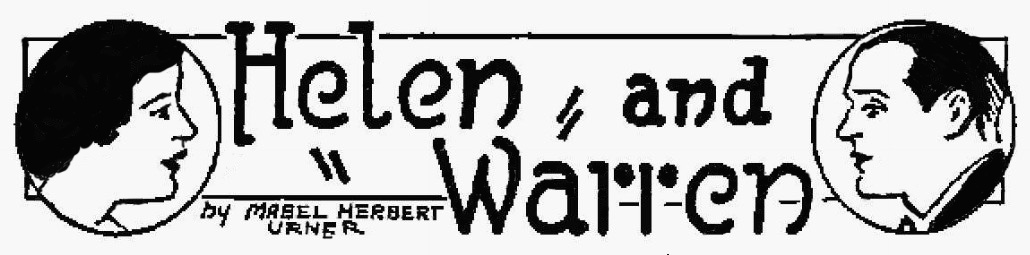
But they were fictional. They were the creation of Mabel Herbert Urner who wrote a column about the pair for over thirty years, from 1910 until the early 1940s.  The column was widely syndicated in newspapers from Boston to Los Angeles as well as in Canada and England. Though fiction, the column presents a fascinating subjective view of dining out, particularly in the 1910s and 1920s.

HelenandWarrenLathropandMabelHelen’s and Warren’s experiences likely had some resemblance to Mabel’s own life, particularly when the couple visited restaurants in Paris, London, and other European capitals. After marrying rare book dealer and collector Lathrop Colgate Harper in 1912, Mabel traveled with him around the world. In New York they lived in an apartment at 1 Lexington Avenue across from Gramercy Park from which they surely forayed into restaurants regularly.

Did Mabel and Lathrop, like her famous pair, have a preference for out-of-the-way restaurants such as the French and Italian tables d’hôtes in NYC? One starlit summer night in 1913 Helen dragged Warren to a backyard café run by three sisters. Helen exclaimed “Why, it’s a bit of Paris!” when she stepped into the garden. They were surrounded by writers, artists, and illustrators, including a “queerly dressed” literary woman. (Mabel’s inside joke?) Warren, a successful businessman, scoffed at the artists but even he had to admit afterward, “That [was] the best dinner in New York for the money.” They paid 65 cents each for soup, beef tongue with piquant sauce, squab, and salad, finished with fresh pears, Camembert, and coffee – wine included. The café was clearly modeled on that run by the Petitpas sisters on W. 29th in conjunction with a boarding house where artist John Butler Yeats lived. A dinner with Yeats and friends about this time was memorialized in a painting by John Sloan.

pepperpot

The Petitpas dinner was one of the couple’s few positive experiences. As much as Helen was drawn to offbeat restaurants, she was often squeamish about unsanitary conditions. She refused to eat ground meat. Usually she wiped her silverware with her napkin. She had problems in a Chinese restaurant, an Italian place, an “anarchist restaurant,” probably Maria’s, as well as at the Pink Parrot in Greenwich Village (probably the Pepper Pot, shown here). When she pushed away her plate there, Warren reprimanded her, saying, “You’re a bum bohemian.”

Helen and Warren visited cafeterias, tea rooms, pre-war cabarets, hotel dining rooms, roadhouses, and shoreline resorts in the NYC metro area. Helen was often embarrassed by Warren’s behavior when he showed off or spent too much money. They bickered. He declared a tea room she liked “a sucker joint.” She was critical of the decor and pomp of expensive restaurants, but her attempts to put a brake on Warren’s spending often backfired.

In 1913 they went to a restaurant in the throes of a waiters’ strike. Somewhat surprisingly, considering the bourgeois lifestyles of both Mabel and Helen, the story presents a case for the strikers. Helen questions their server about the goals of the strike, and he says, “They want decent food, m’am; clean food and a clean place to eat it. They want to be treated like men – not dogs! And they want a living wage.” Warren asks about tips and the waiter replies, “Why does he have to depend on tips thrown at him?”

In many ways Helen’s and Warren’s restaurant adventures and complaints seem relevant today. Has it happened to you that a server tries to remove your meal in progress? Have you been charged extra for bread? Welcome to the 1910s.

© Jan Whitaker, 2013

10 Comments

Filed under miscellaneous, patrons

The fifteen minutes of Rabelais

Watch me wipe that smile off his face.

Watch me wipe that smile off his face.

François Rabelais was a French writer, an eccentric, and a joker who lived centuries ago. Based on a prank he pulled to get out of paying a dinner bill, the phrase “quarter hour of Rabelais” has come down through history to refer to the unhappy time when diners are confronted with the bill for their restaurant meal.

Personally, I am someone who always has a rough estimate of what I’ll have to pay at the end, so I am scarcely in the same boat as Rabelais. All the more so because I definitely would not go into a restaurant (in his case, an inn) and order a meal knowing I had no money.

But, it is a well known fact that some people order freely – and drink freely – to the point that they have no idea what their total bill will come to. And, in the olden days, there was no written menu so it wasn’t always clear what everything cost.

According to lore, Rabelais was penniless yet ate and drank as though there would be no reckoning. When the bill came, he held up a flask and announced he planned to poison the king with its contents. He was arrested and carried off to the palace. The king took the whole incident as a big joke. An unlikely story if I ever heard one.

Nevertheless the phrase survived and is, or was, well known in France as a moment of letdown when you realize you’ve got to pay the bill. Maybe in modern times credit cards have distanced us from that feeling. Or, is it simply that not that many people sit around restaurant tables drinking all night anymore?

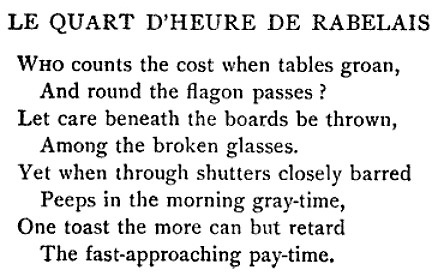
Obviously misery about paying the bill is worsened if the diner is short of money. Or if his or her companions have departed without leaving enough money for their shares – something that can still be counted on to happen from time to time. Perhaps that is a modern example of the “quart d’heure de Rabelais” as it was memorialized in the following bad poetry from 1887.

LeQuartd'heureGeorgeR.Sims1887

The question of who pays is an associated issue. Though it isn’t well known, the law considers everyone at the table responsible for the check. If there are four and three leave, and all the orders are on one check, the last person remaining must pay the total bill.

© Jan Whitaker, 2013

1 Comment

Filed under miscellaneous, patrons

Mob restaurants

mobstersGalante&CoppolakilledGangster stories run like a red thread through the 20th-century history of American restaurants, from the speakeasies of the 1920s, to the shakedowns and union infiltration of the 1930s, the rackets of the 1940s and 1950s, and the later years of money laundering and loudly proclaimed legitimate business.

But what seems to interest Americans the most are restaurants mobsters are alleged to patronize, and all the more so if there has been a legendary shootout there.

As portrayed in the film Dinner Rush, even rumors that a restaurant is a gangland favorite can boost its popularity immensely. The film was made by Bob Giraldi who’s been inside the restaurant business.

mobsterscolosimo'sOn July 28 a series called Inside the American Mob will begin on the National Geographic channel. My friend and neighbor John Marks, supervising producer, inspired this post when he mentioned the popularity of restaurants where mobsters have been gunned down.

Violence is abundant in restaurant history. Two of the worst mass murders in the United States took place in restaurants, the killing of 23 people at Luby’s Cafeteria in Killeen TX in 1991 and 21 at a McDonald’s in San Ysidro CA in 1984. Those tragic events did not bring about an influx of patrons wanting to soak up evil ambiance. Quite the contrary. Luby’s remodeled and reopened but never regained the business it once had, closing the Killeen site for good in 2000. McDonald’s razed the blighted unit in San Ysidro, rebuilding nearby.

MobsterVillaVeniceGlenviewIL1932

On the other hand, when gangsters are shooting victims people are unmoved, evidently figuring they got what was coming to them. The absence of bullet holes and bloodstains disappoints.

Restaurants that are linked to mobsters, such as NYC’s Sparks Steak House, where Paul Castellano was killed as he stepped out of his car, do not always appreciate being included in guide books such as A Goodfellas Guide to New York just because a mobster sometimes ate there. I can’t blame them. Who would want tourists dressed in shorts and tee shirts turning up at your high priced restaurant? The mob is not what it used to be. Yet I have to wonder, is there an American restaurant that can be absolutely certain it has never hosted mobsters?

I’ll also point out that not all mob-connected restaurants are or have been Italian. Also, probably every ethnic group has had its own version of the Mafia at some point.

MobstersCaponeTorioheadquartersCiceroca1939Most major cities in the U.S. have had restaurants that served as gangster hangouts. [pictured: the Cicero IL headquarters of Al Capone, ca. 1939] Chicago’s Colosimo’s was already in the books by 1930, ten years after its owner “Big Jim” Colosimo became one of the first victims of a gangland shooting in a restaurant. As late as 1958 when a new owner of the property announced he would raze the building, the site was overrun with an estimated 1,000 souvenir hunters. In the 1920s and 1930s even “nice” St. Paul MN could boast of four or five nightclub eateries with underworld associations, according to the authors of Minnesota Eats Out. Other mob-connected eating places illustrated in this post are Louigi’s in Las Vegas and Villa Venice outside Wheeling IL.

MobstersLouigi'sNew York City and environs takes the prize for gangland restaurants, among which are restaurants where mobsters, their henchmen, and associates have met a messy end. Few still exist or remain in their original locations. To name some, both present and past: Nuova Villa Tammaro, Coney Island (Giuseppe “Joe the Boss” Masseria,1931); Palace Chop House, Newark (Dutch Schultz, 1935); Umberto’s Clam House, Little Italy (Joey Gallo, 1972); Joe & Mary, Brooklyn (pictured at top, Carmine Galante, 1979); Broadway Pub, Manhattan; La Stella, Queens; King Wah, Chinatown; Villa Capri, Long Island; Sparks, Manhattan (Paul Castellano, 1985); Bravo Sergio, Manhattan (Irwin Schiff, 1987).

© Jan Whitaker, 2013

10 Comments

Filed under patrons