Category Archives: patrons

Dressing for dinner

FarmersinCafe

In the vast majority of eating places customers never had to be told to “come as you are.” That’s how they were going to come – or else they weren’t coming at all. Farmers wearing overalls were likely to show up in small town cafes, while white collar workers in shirtsleeves grabbed seats in city lunchrooms.

Nevertheless, there was a segment of society that “dressed” for dinner. People of high society were accustomed to donning formal wear for dinner parties given in private homes. Then, as New York society began to expand beyond “the 400″ in the late 1890s, growing ranks of wealthy newcomers adopted formal dress for dinners in hotel dining rooms and swanky restaurants.

Rector's1913Geo.HectorInc

In the late 1890s men began to wear tuxedos for such outings. Women wore long gowns, cut lower than their daytime dresses. [Rector’s, 1913, illustrated] But the era of luxury dressiness was brief. After WWI, with prohibition forcing the closure of many fine restaurants and “lobster palaces,” more informal clothing became acceptable in most restaurants. What was known as afternoon wear – coats and neckties for men and daytime dresses and hats for women – became the new standard. But even that dress standard tended to erode.

It isn’t as easy to enforce a dress code as it might seem. As long as a restaurant isn’t using a dress code as a foil for illegal discrimination, it can set the dress bar as high as it wants. But will customers constantly challenge it? Even worse, will they shun the restaurant entirely?

Rejection of the Café de l’Opera’s formal wear requirement was cited as one reason for its sudden demise in NYC in 1910. And the 1930s Depression encouraged a lower standard. After World War II some predicted a return to elegance, but that proved shaky. Many well-established fine restaurants struggled with turtleneck-wearing male guests in the 1960s and 1970s. At New York’s “21″ the maitre d’ developed a practice of requiring necktie-less men to put on a hideously garish tie that he provided. This had the effect of either making them (a) leave, or (b) feel so embarrassed they never dared come without a tie again. Other places relented and admitted guests in “dressy casual” wear.

Pittari's1963NewOrleansA new restaurant wishing to enter the esoteric fine dining ranks, underwritten by a dining room of well-dressed guests,  has to ask itself if it can pull it off. If it does not draw the “top-drawer” clientele it aims for it may find its dress code impossible to enforce. For instance, resorting to posting a “Dress Code for Ladies” notice near the front door, as a San Diego reviewer said of a restaurant there in 1981, is “simply tacky.” It is scarcely better than a sign reading “No shirt, no shoes, no service.”

Likewise, a restaurant may portray itself as elegant, on a postcard, publicity photo, or website, but rarely will the actual guests look quite so sophisticated as those pictured. And, needless to say, fancy dress does not in itself project elegance.

SultansTableRestDunesHotel

Today there is a small top tier of restaurants whose guests would not dare to wear shorts, t-shirts, baseball caps, or overlarge rubber-soled shoes. But, most restaurants are far more informal. Overall, “come as you are” – a phrase first used by churches — has remained in effect.

The phrase itself attained widespread use by restaurants in the 1960s when it appeared in advertisements for suburban establishments wishing to attract families. A new segment of chain restaurants came into being, a few notches less casual than fast food establishments, but entirely non-intimidating in their standardized cuisine, friendly service, and “fun” decor. Philip Langdon, in his book Orange Roofs and Golden Arches, sees the “chain dinnerhouses” as coming from the West (where restaurant dress rules were always more relaxed). Examples included Victoria Station, originating in San Francisco, and Steak & Ale, from Dallas.

At the present moment, at least, it is difficult to imagine a return to turn-of-the-century formality. I’d guess that even the 1% don’t like to dress up.

© Jan Whitaker, 2013
10 Comments

Filed under patrons, restaurant customs

Postscript: beefsteak dinners

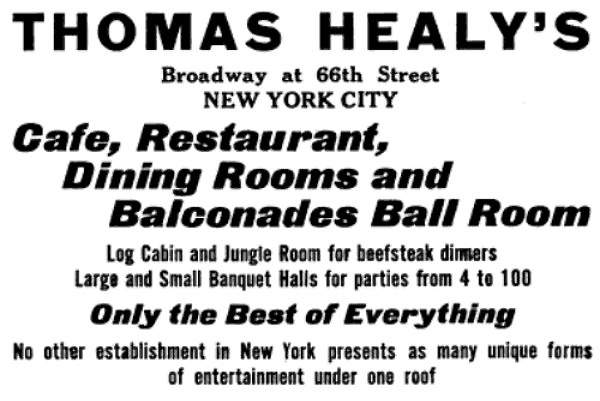
healysphotoThis year marks the 100th anniversary of the Armory Show, an art exhibit that introduced Americans to modern art, most notably to Marcel Duchamp’s Nude Descending a Staircase [No. 1]. Last week I received a copy of the Smithsonian’s Archives of American Art Journal which commemorates the show. To my surprise, the journal contains an article (Meat and Beer, by Darcy Tell) about a beefsteak dinner given by the artists who organized the Armory Show in gratitude to the press whose extensive coverage helped make the show a popular success.

The Armory Show was largely organized by American artists Walt Kuhn, Arthur Davies, and Walter Pach. (Kuhn’s and Pach’s papers are preserved in the Archives of American Art, Smithsonian Institution.)

In an earlier post I wrote about beefsteak dens, dungeons, and caves where men put on butchers’ aprons and threw aside the trappings of civilization. Sitting uncomfortably on boxes in dingy cellars, they drank beer and ate steaks without silverware or napkins.

BeefsteakHealy'sADV1916The 1913 Armory Show dinner was held at Healy’s restaurant, on 66th Street in NYC, a popular place for these feasts. It had three rooms dedicated to them: the Dungeon, the Jungle Room, and the Log Cabin Room. The artists and their “friends and enemies from the press,” as they were designated on the menu, gathered in the Log Cabin Room, probably the most civilized space of the three, furnished with long tables and chairs and complete with tablecloths and napkins. While the guests ate, someone read aloud humorous, insiderish (fake) telegrams, even one purporting to be from Gertrude Stein [see link below].

I have to admit I was a tiny bit disappointed to learn that such a (presumably) sophisticated group of men as was represented at this dinner would choose to attend a beefsteak at Healy’s. By 1913, if not long before, beefsteaks were recognized as evenings of orthodox jollity for business men and conventioneers. Yet, the Association of American Painters and Sculptors paid out $234 [at least $5,500 today] for a dinner much like that enjoyed by the Paper Box Makers Association and the League of Associated Hat Men.

And, just like the hat men and box makers, they took away a regulation group photo to show for it.

© Jan Whitaker, 2013
5 Comments

Filed under atmosphere, patrons

Three hours for lunch

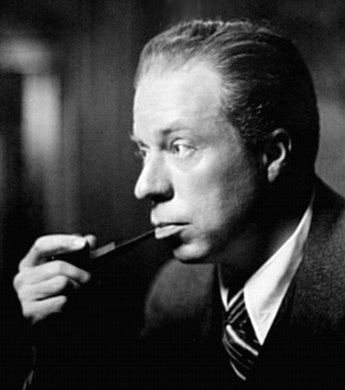
ChristopherMorley1930For every devoted restaurant-goer who likes to keep up with the latest restaurant trend there are probably two others who would prefer an eating place from the past. Despite my fascination with the history of restaurants, it might surprise some readers to learn that as a diner I am not attracted to historic restaurants; I study the past but eat in the present. Journalist and author Christopher Morley, however, might have been the patron saint of those who would gladly flip back the calendar when dining out.

Through the 1920s he gathered together friends who loved to explore the corners, alleys, and waterfronts of Manhattan and environs, especially Hoboken which he christened the “seacoast of Bohemia.” Their whimsical jaunts centered on a leisurely lunch.

The group, whose personnel was always changing, was made up of men who had enough time to join Morley’s Three Hours for Lunch Club. He initiated it in 1920 when he began writing a column for The New York Evening Post called “The Bowling Green” that chronicled his explorations of New York and the escapades of the club. Later the column appeared in the Saturday Review of Literature.

The club was less about food than about male camaraderie, conversation, and humorous one-upmanship. In earlier times, before Prohibition, it might have been a drinking club. The loss of masculine drinking culture and the alleged feminization of restaurants underwrote a lament for a present era supposedly ruined by women lunching on sandwiches and soft drinks at soda fountains. By contrast, Morley & Co. searched out old-fashioned taverns and chop houses.

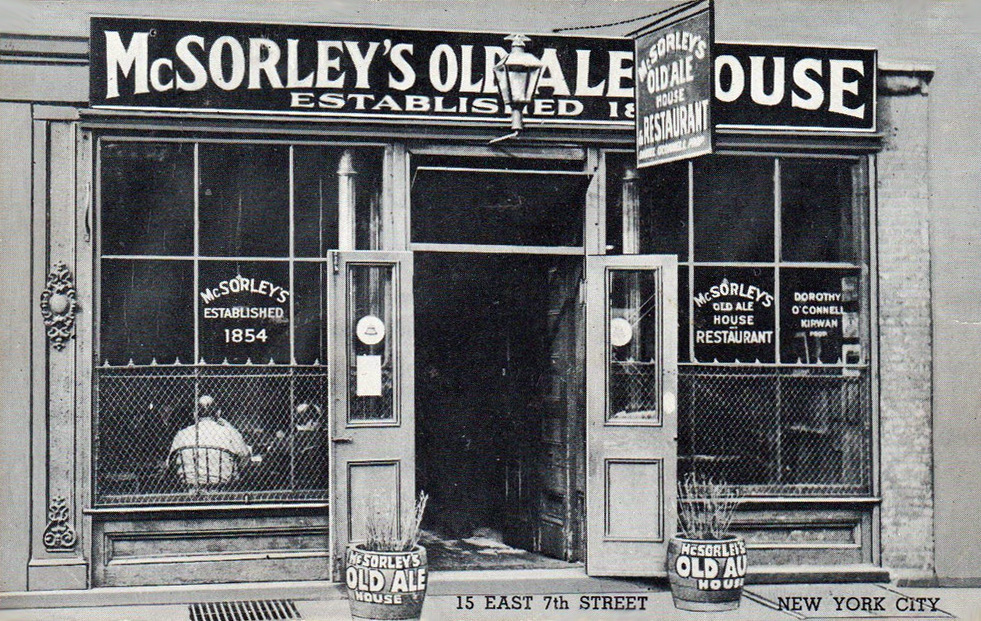
mcSorley'sHe wrote in a tribute to McSorley’s Ale House (which did not admit women until 1970), “Atrocious cleanliness and glitter and raw naked marble make the soda fountain a disheartening place to the average male. He likes a dark, low-ceilinged, and not too obtrusively sanitary place to take his ease. At McSorley’s is everything that the innocent fugitive from the world requires.”

Without his male buddies, Morley might have been limited to the company of his wife Helen, whom he called Titania in his columns. Although the pair enjoyed frequent Saturday lunches in the basement of Moretti’s table d’hôte on East 14th Street, he complained publicly, “Anyplace that I think is peculiarly amusing, or quaint, or picturesque, Titania thinks is unhealthy. Sometimes I can see it coming. We are on our way to Mulberry Bend, or the Bowery, or Farrish’s Chop House. I see her brow begin to pucker . . .”

The club, which included Don Marquis, sea captain/writer David William Bone, Sinclair Lewis, and other editors and writers, flourished about the same time as the Round Table whose literary stars met at the Algonquin Hotel. For a time before he founded his own club Morley was part of a group of Vanity Fair writers who congregated at the Café Noir, but he felt edged out because he lacked the Vanity Fair style. “Even Thackeray would have been grayballed,” he wrote later.

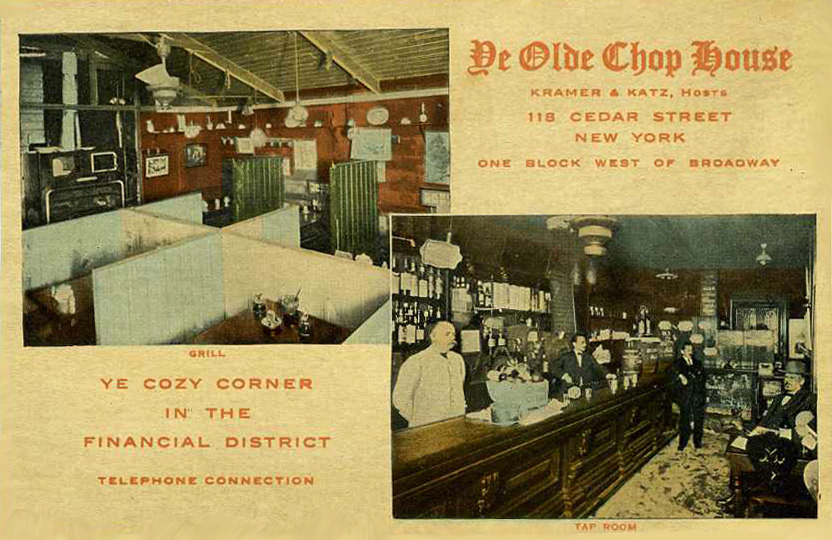
YeOldeChopHouse423

A favorite THFL place in lower Manhattan was Ye Olde Chop House on Cedar Street (pictured pre-Prohibition with sawdust floors beloved by CM) where the club named a waitress “the Venus of Mealo.” The cuisine of chop houses, as might be expected, featured grilled meat and homey dishes such as pickled beets, corned beef hash, tapioca pudding, and rhubarb pie. Far from seeking adventure in the culinary department, Morley once ordered swordfish steak, but declared it “too reptilian.”

Other than the musty hangouts of lower Manhattan, Hoboken’s Hofbrau, Meyer’s Restaurant, and the American Hotel were popular with the club. In 1929 Morley and others bought a bankrupt ironworks on River Street in Hoboken to become club headquarters. But it seems the club was waning around this time and it’s not clear how long that experiment continued. Three-Hours-for-Lunch was succeeded by another club, the Baker Street Irregulars, which Morley – a Sherlock Holmes fan –  formed at Prohibition’s end.

© Jan Whitaker, 2013
2 Comments

Filed under patrons

Light-fingered diners

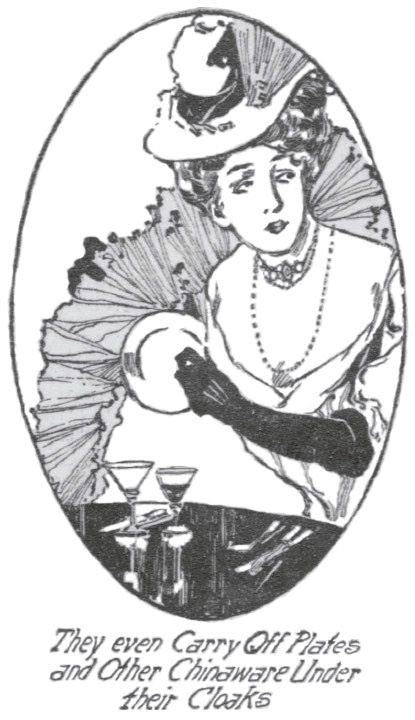
1920sPilferingIf the number of newspaper stories is a reliable index to a trend, then a fad for stealing small items from restaurant tables began in the 1890s. Its continuing incidence is perhaps one reason why table appointments gradually became far less elegant and costly.

A flurry of stories appeared in the late 19th and early 20th centuries about affluent society people who “collected” cordial glasses, demitasse cups, salt cellars, silver spoons, oyster forks, and nut picks as “souvenirs” of first-class hotel dining rooms and restaurants. Anything small that bore an insignia from an elite establishment sent out an irresistible message: “Take me home with you.” Or, as a NYC restaurant owner would confirm decades later, “Put a spoon on a table with a fancy crest on it and kiss it goodbye.” 1906pilfering

The “thieves” – a term pointedly avoided by all – were usually identified as young women from the best families, though men were also known to freely pocket alluring items. It was especially attractive to pick things up while traveling. Women would display their booty in cabinets with little ribbons and tags that gave the date and occasion that each bibelot commemorated.

How cute! A little less cute, though, were college student pranks following athletic competitions. A gang of Amherst College students met with suspension after they raided three railroad restaurants on the return train trip from a Dartmouth football game in 1893. During their “wilding” episode they descended en masse on three successive Vermont depot restaurants, making off with everything they could grab from sandwiches and ginger ale to dishes and spoons to remind them later of their escapades.

Typically souvenir hunters were portrayed as feeling not the least bit guilty about their some-would-say-larcenous activities. “I must steal one of those lovely things,” said a woman at a fashionable restaurant. Her friends merely laughed. Another received encouragement from her luncheon companions when she declared she wanted to snag a silver match case for her husband. “So she tucked it in her muff and went out with the glee of a smuggler,” the story relayed.

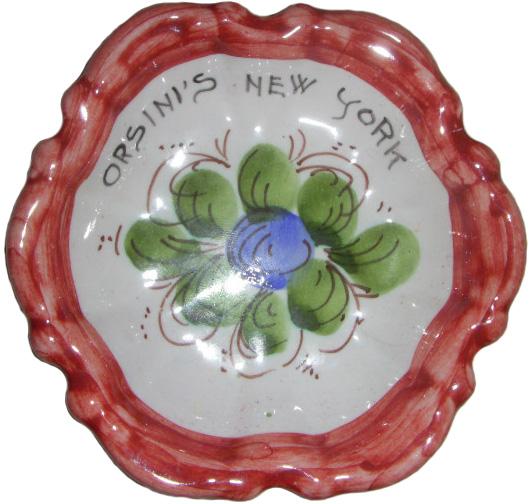
Often these activities brought forth a degree of censure among reporters and readers. Was it not true, for instance, that these same people would probably condemn a poor man for stealing food? Was it really a victimless crime? Didn’t waiters have their small wages docked for missing silver? orsini'sDish

The moral code, such as it was, decreed that stealing from need was a crime, but stealing something you didn’t need or could easily afford to pay for was not a crime. Plus, as much as restaurateurs hated it, who wanted to accuse wealthy guests of stealing? Prosecution, or even confrontation, was rare though sometimes additional charges – curiously hard to read – were levied on a check. Over time menu prices crept up to cover shrinkage, tableware became ordinary, and pepper mills grew monstrous.

We’d probably hear more on this subject, particularly on the diverse range of things taken from restaurants, but restaurant managers prefer to keep silent. As one confessed in 1976, “We don’t like to talk about this sort of thing. It only gives the public more ideas.”

© Jan Whitaker, 2013

7 Comments

Filed under patrons, restaurant customs

Toothpicks

Although toothpicks have many uses in the home, their career as a tool for picking teeth is mostly associated with restaurants. And, like so many aspects of restaurant history, their story says a lot about social class. The short version is that when using toothpicks was viewed as a custom of European elites it was approved in the U.S., but when American working class men adopted it, it became taboo. Today the use of toothpicks after a meal is infrequent compared to what it was roughly 100 years ago when it was at its peak.

In the Quick Lunch era of the early 20th century, toothpicks became more than a means to loosen bits of food stuck in tooth crevices. They were assertions of masculinity, essential accessories for the male lunchroom crowd. A dangling toothpick sent a macho signal as speedily as a cigarette between the lips of 1960s filmstar Jean Paul Belmondo.

In the 1890s lunchroom patrons felt entitled to toothpicks just as much as to a paper napkin and a glass of water. When a distinguished Afro-American man was told by a Kansas City restaurateur in 1890 that he would be charged an exorbitant $1 for pie and coffee, he seemed to consent but later walked out saying “Sue me for the rest” as he tossed a dime on the counter. And he grabbed a handful of toothpicks on the way, staking a claim to equality in an unmistakable fashion.

Arbiters of etiquette deplored toothpicks. Starting in the late 19th century when the picks came into fairly common use in the United States, and for the next 100 years at least, a string of advice columnists from Mrs. John Sherwood to Ann Landers railed against them. All declared using toothpicks in public vulgar and disgusting. “Dear Abby” echoed her forebears when she roundly condemned public toothpick use in 1986, calling it “crude, inconsiderate, and a show of bad manners.”

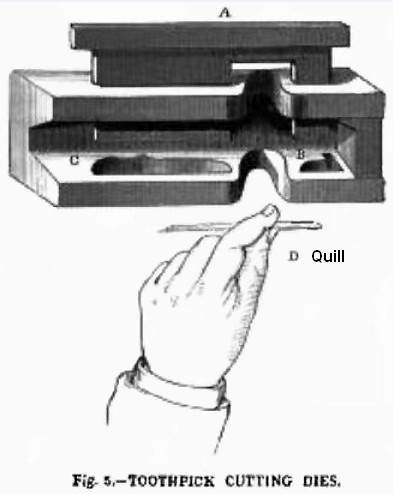
Goose quill toothpicks had been acceptable in the early republic, furnished even at such elite places as Delmonico’s. But as mass-produced wooden picks made of birch and poplar became available in the 1870s, prices fell drastically until even the cheapest eatery could afford to dispense them. Their social status plummeted.

Toothpick haters frequently pointed out that providing toothpicks in restaurants was as ridiculous as handing out toothbrushes. It’s interesting that in the early 20th century another form of tabletop hygiene, the finger bowl, was also about to go under attack. Strangely, since toothpicks and finger bowls were intended for cleanups, they were criticized as germ spreaders. Because toothpicks were provided loose in a bowl or cup, restaurant patrons often grabbed them helter skelter, fingering many they left behind. Trains eliminated them in their dining cars and Minneapolis health authorities banned open containers of toothpicks in 1917.

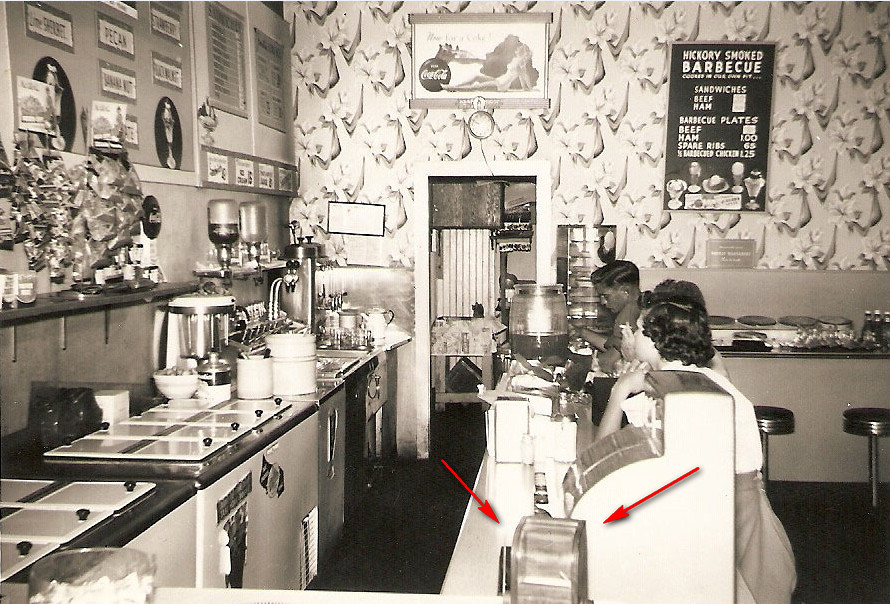
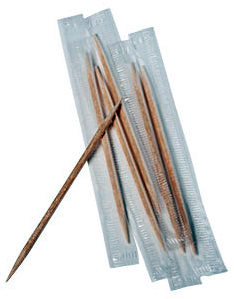
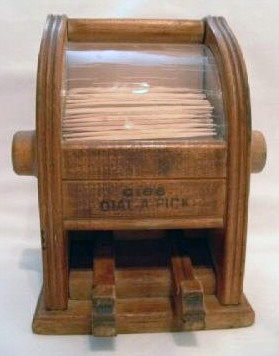
Another solution to the germy toothpick bowl and the habit of grabbing handfuls was bound to occur to America’s legion of gadget inventors. Presto! One-at-a-time toothpick dispensers. [shown here and in restaurant above, the Dial-A-Pic]

Restaurant owners would have been just as happy to see toothpicks disappear altogether. A NYC restaurant owner confessed in 1904 that he disliked the sight of men picking their teeth at his tables as much as that of others sticking knives in their mouths. But he took a pragmatic stance, admitting that “we cannot conduct examinations in table manners before we admit persons to our dining-rooms.”

Today toothpick usage is reportedly unpopular with younger diners and has been dropping off since World War II. So I was surprised to see a little cup of wrapped toothpicks in an upscale restaurant in Kansas City this weekend. Now I’ll be on the lookout everywhere I go.

© Jan Whitaker, 2012

14 Comments

Filed under lunch rooms, patrons, restaurant customs

Putting patrons at ease

How many readers have thought about how very cleverly table-service chain restaurants engineer their establishments so that patrons feel no unease while eating out? They have relieved patrons of the embarrassment so many have felt historically – and which can still occur in formal restaurants today.

It doesn’t take much for restaurant patrons to become tense or self-conscious. They may feel that other guests are staring at them and judging their appearance or table manners. Or that their server is sizing them up. The menu can be mysterious, especially if it contains foreign or unfamiliar culinary terms. They fear they will mispronounce something and be sneered at for their lack of sophistication. Or order a dish they don’t like the looks of (does that explain why I once encountered a South Dakota menu that described salads as made up of “non-intimidating greens”?). If patrons have brought their children, they may worry they will misbehave and earn the wrath of all the tables around them.

Their fears are not entirely unfounded. I have a vivid memory of extreme discomfort I experienced in a restaurant considered among the top in the 1980s. Although the small dining room was fully occupied, it was almost totally silent. There were expensive arrangements of flowers everywhere. They, along with the preternatural quiet, conspired to create the ambiance of a funeral parlor. The waiter never smiled. I felt as though I was dressed for a barbecue. The melon ball-sized food was hard to identify and oddly assorted. I longed to flee to another room where I heard people laughing and imagined them eating real food.

Intimidation has a long history in restaurants. In 1859 a patron complained about his discomfort in the class of elite restaurants represented by Delmonico’s, admitting “we are made nervous by the sneerful smirk of the waiter, if we order the wrong wine . . .”

Snobbery was assessed as being greater in the East than the West. It’s certainly true that Eastern eateries did not run advertisements like the one in Portland OR in 1873 that greeted potential customers with “Hi You Muck-A-Muck and Here’s Your Bill of Fare. Now’s the time to get the wrinkles taken out of your bellies . . .”

Of course there were always casual eating places, but as some Americans grew wealthier in the late 19th century more foreign terms appeared on menus, leading to great puzzlement by diners. Even Easterners had to admit “a feeling of trepidation when confronted with an elaborate menu composed in the artistic and intricate terms of culinary French.” Jokes circulated about the bumpkin who randomly pointed to things on the menu and was dismayed when the waiter returned with two bowls of soup and some toothpicks.

Women were afraid to eat spaghetti in public lest they look foolish. No such worries at The Old Spaghetti Factory in the historic section of _____  [fill in the blank]!

Most sources of intimidation have been eliminated by chain restaurants (See 1973 Jacks Or Better advertisement). A circus-like sense of fun, raucous decor, and auditory buzz distracts everyone from other guests and blanks out children’s tantrums. The ethos is “come as you are.” Service is by relentlessly cheerful teenagers who reply to every request with a “No problem.” There are no pristine white tablecloths or carpets to ruin with spills. No foreign terms appear on menus. In the unlikely event that a menu contains unfamiliar items they will be carefully explained or illustrated. Even today a chain of Mexican theme restaurants in the South supplies a guide letting patrons know how to say the names of dishes, including Nachos (Nah-choz) and Chile Con Carne (Che-lee con Car-nay).

It is interesting to reflect on the deep message conveyed by mass market restaurants. Is it that the American public is juvenile in their tastes and easily manipulated? Or is it the more democratic thesis that Americans will accept being talked down to as the price that must be paid so that no one feels excluded?

© Jan Whitaker, 2012

2 Comments

Filed under atmosphere, patrons

That night at Maxim’s

A restaurant is an expression of its time and place. Except for fast food franchises which are based on an industrial mode of mass production detached from local particularity. So when a replica of an art nouveau turn-of-the-century culinary haunt of demimonde Paris shows up in the basement of a hotel on Lake Michigan’s gold coast in the mid-20th century – well, it’s a little strange.

In short, was the Paris-based Maxim’s franchise that arrived in Chicago in 1963, with its undulating woodwork, fleur-de-lis lights, red velvet banquettes, Soles Albert, and Poires Helene, the real thing?

I’ve been pondering this question as I’ve pored over the fascinating photograph above, which was taken by prize-winning photographer Gary Settle, probably for The Chicago Daily News.

What was the occasion? It’s not a casual shot. At least two floodlights are in evidence and there is something stagey about the scene. I suspect the couples were asked to leave their coffee and smokes and get up and dance. Unfortunately, in the process two napkins were flung aside in an unsightly manner. Elegance is so hard to achieve.

The Brylcreemed man leaning over the table must be Chef Pierre Orsi who had very recently arrived from Paris to take command of the kitchen. The man seated to the right of him looks as though he could be French, but the other men in the picture, apart from the musicians, appear to be of German ancestry. I wonder if they might be two sets of twins.

Which of the women owns the sable coat and elbow-length black gloves? I believe it is the blissful dancer on the left. She will carry home leftovers in a foil purse-shaped doggie bag — perhaps she is dieting or didn’t love her Calves Liver with Raisin and Grape Sauce so much.

The table has a center lamp with pink silk shades and coffee cups bearing Maxim’s curlicue M logo. A cigarillo rests in one of the souvenir ashtrays, while others have been used by the table’s two Winston smokers who prefer a fliptop box to a soft pack. Did these eight people really polish off four bottles of champagne? Did anyone use the replica antique telephone to check in with their babysitter?

I invite readers to create a scenario. Who are these people and what were they thinking at this moment in September, 1967?

© Jan Whitaker, 2012

19 Comments

Filed under elite restaurants, miscellaneous, patrons

Good eaters: students

As far back as the early 19th century students have made up a notable segment of restaurant clientele. They have played a significant historical role both in supporting the growth of restaurants and in shaping the eating habits of Americans.

In the 1800s some restaurants located near colleges specifically catered to students, alumni, and college faculty and staff. As incomparable caterer Othello Pollard of Cambridge MA noted in an 1802 advertisement, “Harvard flourishes and Othello lives.” In NYC in the 1840s poor divinity students could be found at the “sixpenny” eating house called Sweeny’s downing slices of roast beef, clam soup, pickles, and bread and cheese.

One of the penny-pinching patrons at Sweeny’s was Lyman Abbot, an NYU student who later became a noted theologian. Each month when he got his allowance he splurged on dinner at Delmonico’s, but as his money ran low at the end of the month he subsisted on Sweeny’s wheat cakes.

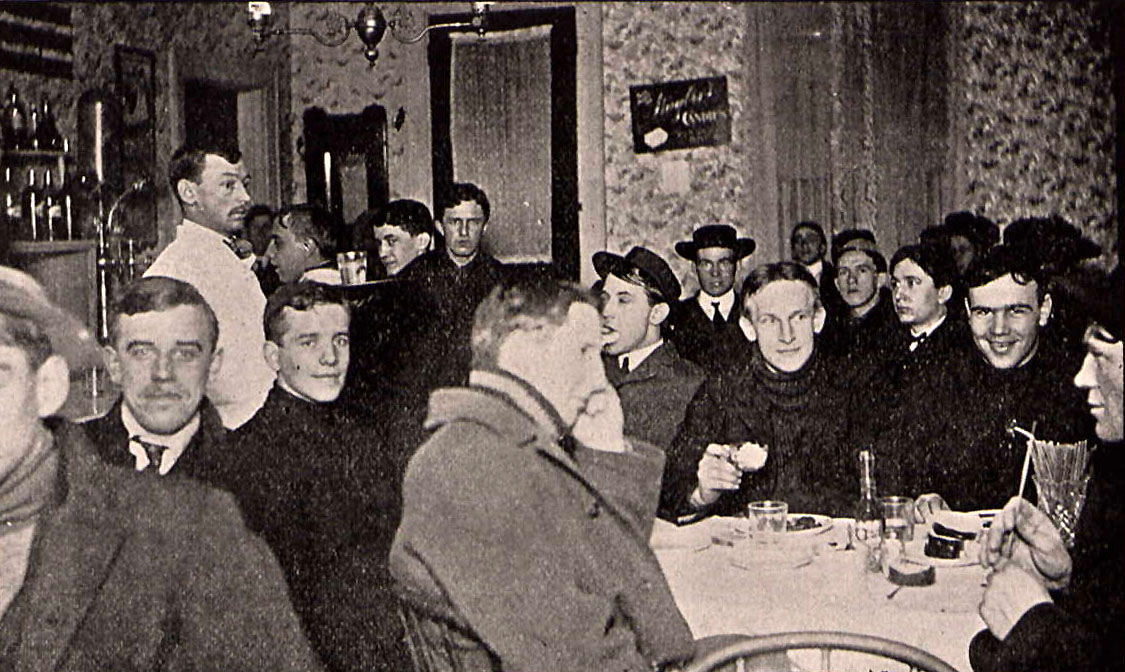
Restaurants clustered around colleges often billed themselves as “student headquarters” and supplied not only food, but entertainment in the form of billiards and supplies such as books and stationery. Hoadley’s, “Hoad’s” to Harvard students, also rented velocipedes in the 1860s. Restaurants around Yale sold weekly meal tickets, hosted private parties, and delivered midnight snacks – “spreads” – to students’ rooms [pictured: midnight “lunch” near Penn State College, 1905]. Billy Park’s chop house in Boston was a hot spot for Harvard students following athletic events. Big-spending students could enjoy the luxurious “sports bar” eateries of their day at places such as Newman’s College Inn in Oakland CA. When it opened ca. 1910 it was decorated with college pendants and tapestries depicting scenes in a man’s life from college to middle age. Murals pictured various college sports while chandeliers were fashioned out of copper and glass footballs.

Alums regularly gravitated back to their college haunts to relive their youth. “Papa” confessed to his daughter on a 1906 postcard of the “Famous Dutch Kitchen, one of the most noted student resorts in the country” near Cornell University, that he planned to eat there before returning home. “I am going to be a college sport for just two days. Big crowd in town. Slept at Fraternity house last night,” he wrote.

Many 19th-century eating places were restricted to male guests, but students at women’s colleges were supplied with tea rooms in the early 20th century [pictured: Brown Betty tea room near Shorter College]. Near the University of Michigan in Ann Arbor, Almira Lovell’s University Tea Room offered teas along with dressmakers’ supplies and college souvenirs in 1903. Around the same time Smith students could often be found curled up on window seats eating popcorn at the Copper Kettle in Northampton. Well into the 1920s being stricken from a college’s approved list was the kiss of death for tea rooms and other eating places that depended upon patronage of women students. Such was the fate of the Rose Tree Inn in Northampton as well as a tea room near Connecticut College.

Students dearly appreciated places to “hang out” because well into the 20th century colleges and universities provided few dormitories and many students lived in rented rooms off campus. Plus, as recent research into Depression-era student life at the State Teachers College in Normal IL has shown, living off campus permitted poor students to economize on food expenses.

College students were prominent among the artsy, “bohemian” restaurant-going crowd. In the late 19th century, when lower Manhattan was filled with schools, students congregated around Washington Square. San Francisco’s art students loved Italian dinners at Sanguinetti’s. In Chicago in the 1920s students met at the Wind Blew Inn. In later decades student beatniks would flock to coffee houses, which in turn were succeeded by hippie hangouts. In 1960 the NYT reported that in one Greenwich Village student café an undercover government agent was asked blandly, “Do you want coffee or peyote?”

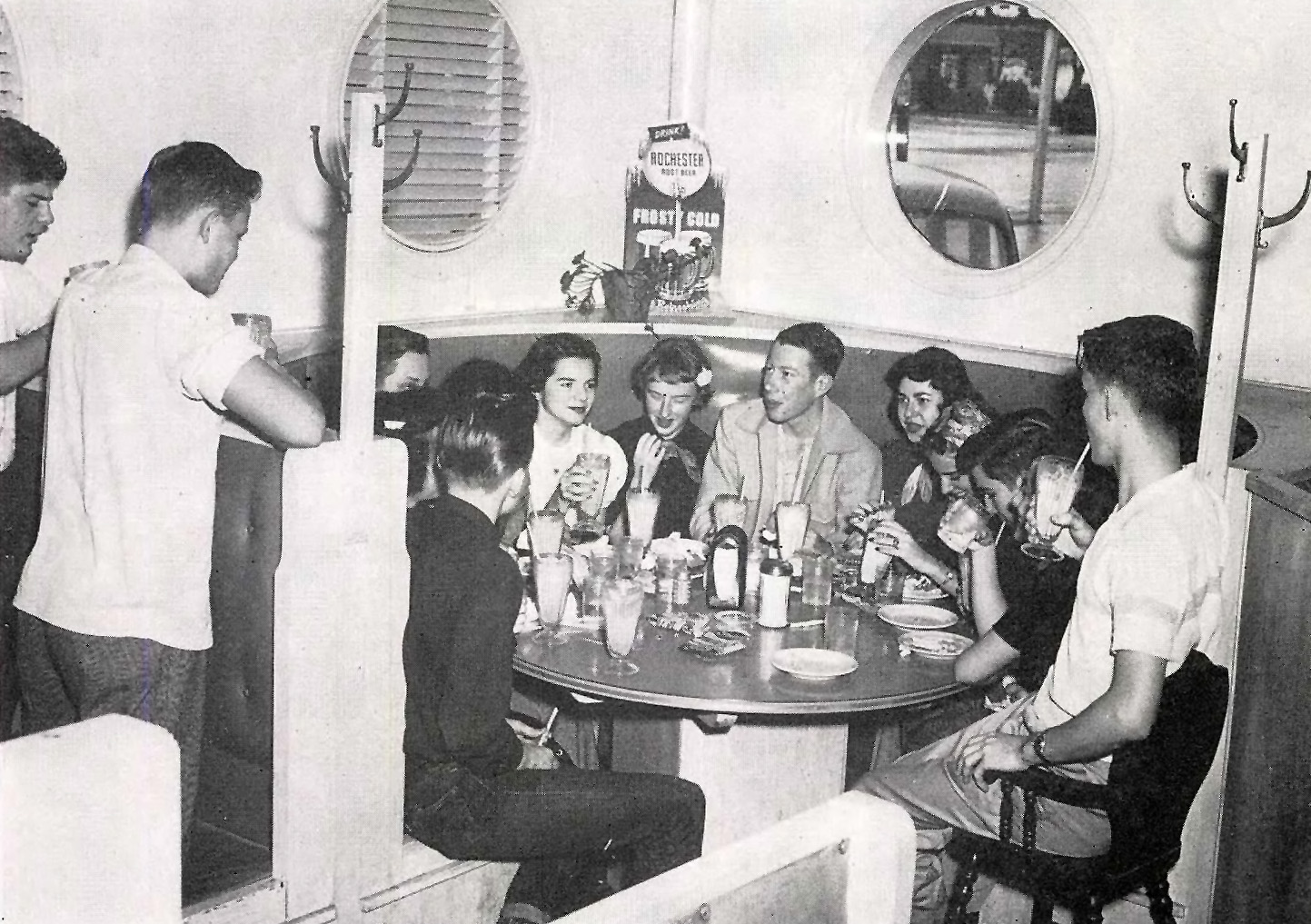
It’s harder to track high school students, at least until the 40s and 50s when their consumption of snack foods such as hamburgers, sodas, and pizzas became noticeable. Like college students before them they tended to favor informal meals eaten at odd hours of the day and night.

It would be interesting to calculate how many of the post-WWII fast food restaurant chains opened their early units near high schools and colleges. This was certainly true of King’s Food Host, Steak n Shake, and the Parkmoor drive-ins. I have no doubt there were many others.

© Jan Whitaker, 2012

4 Comments

Filed under patrons

Regulars

The modern idea of eating out revolves around choice. Where shall we go? What shall we order? We are looking for change, novelty. We want to vary our routine.

It hasn’t always been this way.

Choice in dining out did not become the norm to any great extent until the second half of the 19th century, and then slowly and incompletely. Before that patrons were divided into “regulars” and “transients,” with the first category making up the backbone of the fledgling restaurant business.

In early American taverns the regulars were male groups such as firemen, clubs, or religious societies who turned up on a scheduled basis and were served group meals for a prearranged price. To put it in other words, much of the business of a tavern or eating house was conducted on a catering basis. Male college students, in the decades before dormitories and dining halls, grouped together in dining clubs that operated similarly.

By the 1870s restaurants filled with the same old people eating the same old food day after day came to be regarded as somewhat archaic. A visitor to a chop house in lower Manhattan that served steaks and baked potatoes observed patrons who, curiously, “did not give any order.” He reasoned that they were habitues and learned that one, a dry goods merchant, “has dined there every day for the last seventeen years.”

The system of regular diners and regular meals worked effectively during an era when there was not a large dining public like today. But even by the time things had changed significantly, in the early 20th century, many small cafes tried to take the guesswork and risk out of their business by cultivating regular customers. They sold meal tickets for which patrons paid in advance for a number of meals in order to receive a discount.

Even today there are probably still some individuals who would rather eat at the same place on a frequent, even daily basis. There are those who order the same thing every time or are automatically served the day’s special without even glancing at the menu. Is there an invisible straight line in NYC connecting the 1859 eatery where “regular patrons at the sandwich counter merely sit down and their sandwich is placed before them” and The Colony, where in the 1950s a woman was enjoying her 28th year lunching on lamb chops, salad, and grapefruit? Likewise in that same decade regulars at a Mississippi City restaurant were fond of sitting down and telling the proprietor, “Joe, fix us up.”

Another vestige of the old system that lingered on for decades was that of men’s professional groups who ate together regularly at the same restaurant – and the same table – for years on end.  Around the turn of the century insurance adjustors — members of the Firebug Club (whose name commemorated the olden days when adjusters colluded with policyholders to commit arson for profit) – used to meet at Mike Lyons’ in NYC’s Bowery. About the same time St. Louis’s Lippe’s was set up with alcoves for trade groups. There was a “Hoo-Hoo” decorated with a painting of a black cat that was designated for lumbermen, and another called “The Roost” decorated with a goose and other birds, meant for tailors. Might “The Chapel” have been intended for ministers? The tradition continued into the 1940s at the century-old Speck’s in that city where there was a bankers’ table, a doctors’ table, etc.

Journalists were well-known for socializing together in restaurants. In Chicago, Ric Riccardo hosted correspondents for the major national magazines and newspapers in his restaurant’s imitation jail called the Padded Cell in the early 1950s. By the 1970s the room had become dedicated to the weekly luncheons of the St. Louis Browns fan club.

Restaurants highly esteemed their regular patrons, none more so than Maylie’s in New Orleans, which closed its doors in 1920. The all-male restaurant admitted patrons each day at 11:00 a.m. and 6:00 p.m., seating them at long communal tables. When a regular died, his chair was left empty for several days.

© Jan Whitaker, 2012

6 Comments

Filed under patrons

Romantic dinners

No respectable person in the 19th century would have dreamed of even mentioning such a thing as a romantic dinner in a restaurant. The whole topic of “romance” and restaurants was scandalous. Basically it implied a man having sex – and maybe dinner – with a disreputable woman, probably a prostitute, in a private room in the basement or on an upper floor of a restaurant. For decades the term “French restaurant” was widely taken as a euphemism for a brothel, especially in San Francisco. There, at the start of the 20th century, the mayor and his legal counsel made thousands of dollars by shaking down restaurant owners engaged in this trade by having their liquor licenses withheld until they paid for “protection.”

The idea of private dining rooms was an explosive one. An expensive new French restaurant in New York City that wished to be patronized by best society in 1861 felt it necessary to run a special notice explaining its policy: “The Proprietor … fearing that the public has misunderstood that announcement in the papers of the opening of his house, begs leave to notify those who have already favored him with their patronage, and the public generally, that the PRIVATE ROOMS in his house are exclusively for families or dinner parties to order.” Meanwhile, to insure its reputation with society elites, particularly women, Delmonico’s banned even married couples from dining in its private rooms unless they were accompanied by others.

It seems that for a very long time in America’s history there was only one type of food purveyor that might be deemed acceptable for a romantic twosome, and that was not really a restaurant but a place that specialized in ice cream. In late-18th-century NYC this would be a pleasure garden, such as Vauxhall or Contoit’s, dotted with little vine-covered bowers with individual tables inside. There were also some bright and glittery mirrored cafes modeled on those in Paris that attracted young couples and were considered somewhat acceptable.

As late as the World War I era, when restaurants were becoming more respectable, a typical scene in today’s popular media featuring a man proposing to a woman in a restaurant would have been seen as improper. For one thing, it wasn’t really considered totally ok for an unmarried couple to have dinner unchaperoned in a restaurant until the later 1920s. In 1913 a waitress confessed that she was shocked to witness a man proposing marriage. She felt a strong negative reaction to the spectacle:“That was too much for me, and I made up my mind then that if any man ever asked me at the dinner table to marry him I would refuse him on the spot.”

Of course there were plenty of people who defied convention and went to restaurants two by two anyway, and there were restaurants that had romantic attractions such as strolling musicians in the early 20th century. Yet, it wasn’t until fairly recently that restaurants began to specifically and proudly advertise that they were the perfect spot for a romantic dinner. This began to occur in the 1960s, a decade in which more and more Americans went to restaurants in the evening for entertainment.

A popular restaurant in the college town of Columbia, Missouri, exemplified the new trend in the 1960s and the characteristics that would become regarded as romantic. Called the Mill O’Rock, it was in an old grist mill and had a circular stone fireplace in the center of the room with wooden ceiling beams radiating out from it. Young couples flocked there and the owner said it was well known as the perfect place for marriage proposals.

© Jan Whitaker, 2011

6 Comments

Filed under patrons, restaurant etiquette, women