People who eat in restaurants and walk out without paying come in all varieties, though it would seem they are more likely to be men than women. They fit into a number of categories that I have begun to think of as the scammers, the larkers, the dissatisfied, the accidental, and some whose motives are unclear.
If you search on Google you will find that a study that claimed overall about 5% of contemporary restaurant patrons leave without paying, most often because they are dissatisfied in some way, including how long they wait to get the check.
If that is the most frequent motive now, then it differs from what seemed to be the reason in earlier decades. Then, judging from newspaper notices, it was more likely that the patron had no intention of paying from the moment they walked in.
Restaurants that experience true deadbeats also span high and low, but more often have been places with medium or low prices than those with high prices. Past midnight hours have historically been the most likely time for skipping payment, though that seems less often the case in more recent decades.
An early instance happened in 1866 when two American soldiers ate a “hearty meal” in a place run by an Negro woman in Richmond, Virginia. When they left without paying she followed them, asking for her payment. One of the soldiers slapped her and she fought back. She seemed to be winning the battle until his companion joined the fight. When the police came the proprietor was taken to the police station along with the soldiers, but then the account ends and it isn’t clear if all three were charged with a crime.
Did the soldiers think they could easily get away with cheating a woman proprietor? There is no way of knowing, but I have a similar question regarding Chinese and Japanese proprietors. They seem to have been likely to experience deadbeats, perhaps because non-Asian diners, typically being taller and heavier, felt they could easily fight them off if they pursued them for payment.
Like the Black woman in Richmond, restaurant owners and others who were determined to catch departing non-payers could find themselves in dangerous situations. In Chicago in 1893 a man who was kicked out of a restaurant for saying he couldn’t pay became enraged and returned to the restaurant saying he wanted to “kill somebody.” He targeted the waiter who ejected him, stabbing him in the neck and ear. Other examples include an owner in Chicago who pursued six men who skipped out and was shot and killed by one of them. As recently as 1981 a Seattle policeman was shot fatally by a deadbeat who had wrestled away his gun.
Some deadbeats practiced restaurant cons. A Kansas City man seemed to have perfected a con in 1897, but it wore out fairly quickly. While it was working he enjoyed expensive dishes such as porterhouse steak and quail on toast. When he finished eating he would proceed to the cashier carrying a napkin with him that he made sure the waiter could see. The waiter would accuse him of attempted theft, but then discover that the napkin was not the sort the restaurant used. The customer pretended to be gravely insulted, complained to the owner, and then simply walked out without being stopped. Of course eventually word got around and that ended it.
Along with the criminally inclined scammers, there were also destitute men who ordered meals they couldn’t pay for. One of them was Arthur Hamlin, the adopted son of former Vice President Hannibal Hamlin who had served in the Andrew Johnson administration and as Governor of Maine. Arthur had gone west to become a prospector but found himself destitute. The judge ordered him to find work, but there were no jobs due to a depression.
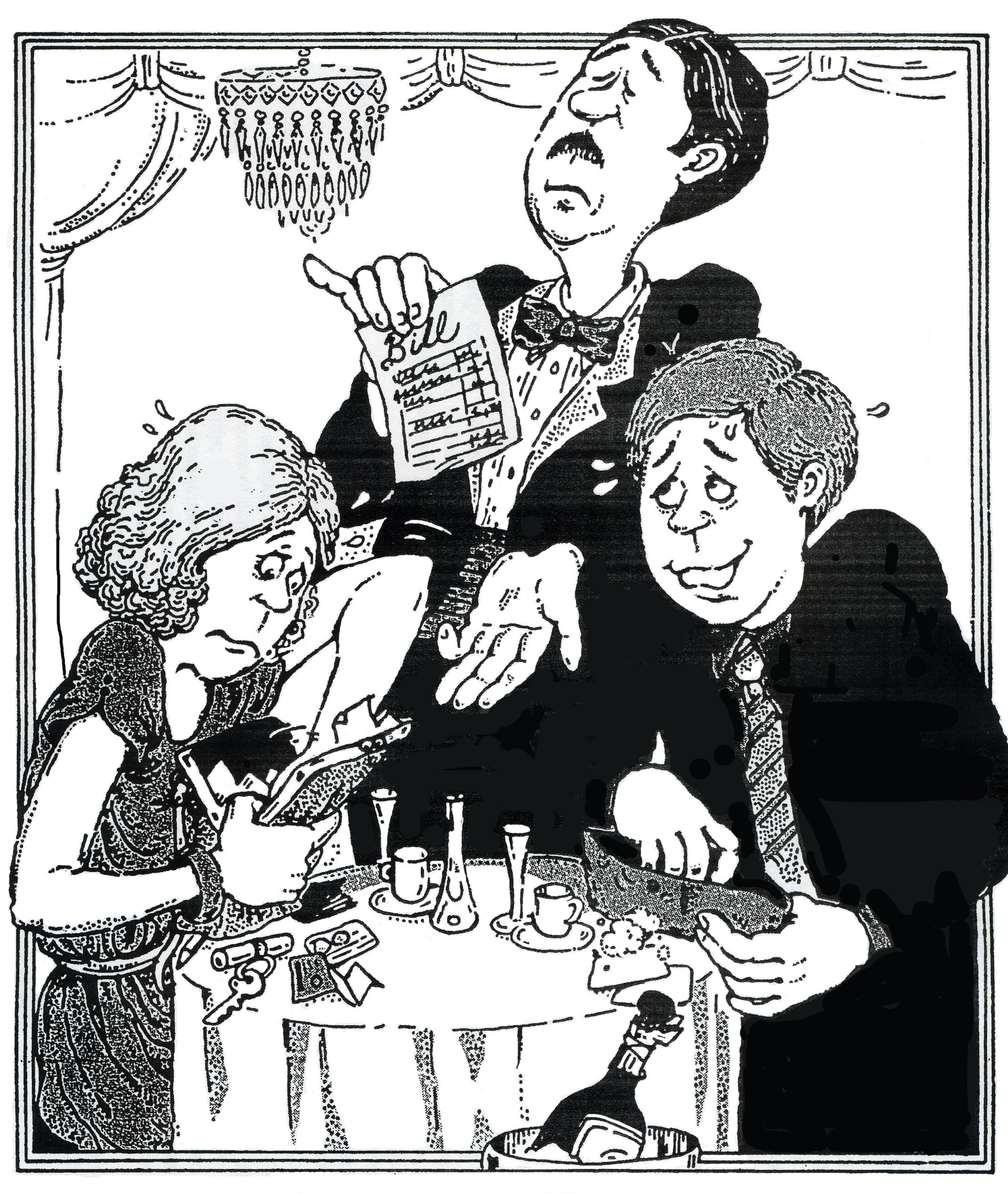
While some deadbeats were poverty stricken, there were others who appeared well off. In the 19th century, restaurant owners often complained that they could not spot the freeloaders in advance because they dressed well and seemed to be men — rarely women — of standing. This seems to have carried into the later decades of the 20th century and possibly into the present. Individuals and even groups who look just as respectable as any other patrons simply get up and leave and often get away with it. [The cartoon shown here seems to be a couple who overspent and can’t cover their check.]
It’s quite possible that it has become almost a game with some patrons and maybe always has been at times. A 1979 story that is more thorough than most notes that it is restaurants that are open 24 hours that are most likely to experience the “dine and dash” crime. The slippery patrons often get away with it, and the restaurant may not even report it to the police, which of course makes it difficult to know just how common it is. One manager observed it was usually groups of young people in their 20s who skipped payment for fun.
The other thing I learned researching this topic is that there is no way to pay for a meal by washing dishes. Except for special circumstances such as tours, modern health and safety requirements for restaurants do not permit guests to even enter restaurant kitchens.
One question that I don’t know the answer to is to what extent losses from deadbeats are treated as costs of doing business and figure into menu prices.
© Jan Whitaker, 2026
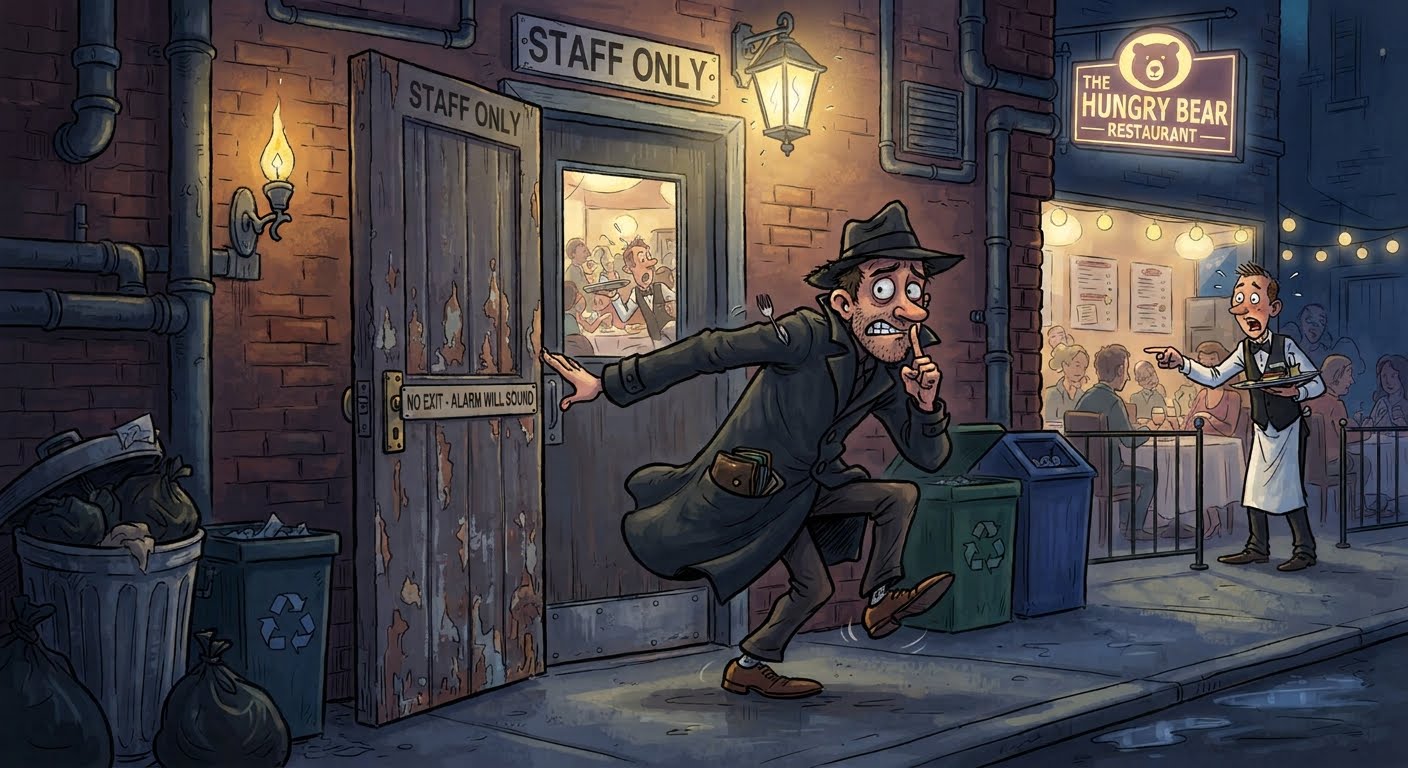
Apologies to graphic artists for using an AI-crafted image at the top. This post was unusually difficult to find images for.

 It's great to hear from readers and I take time to answer queries. I can't always find what you are looking for, but I do appreciate getting thank yous no matter what the outcome.