Category Archives: patrons

Toothpicks

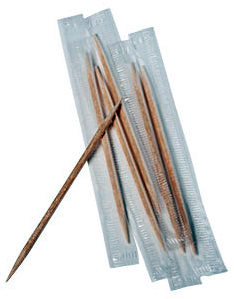
Although toothpicks have many uses in the home, their career as a tool for picking teeth is mostly associated with restaurants. And, like so many aspects of restaurant history, their story says a lot about social class. The short version is that when using toothpicks was viewed as a custom of European elites it was approved in the U.S., but when American working class men adopted it, it became taboo. Today the use of toothpicks after a meal is infrequent compared to what it was roughly 100 years ago when it was at its peak.

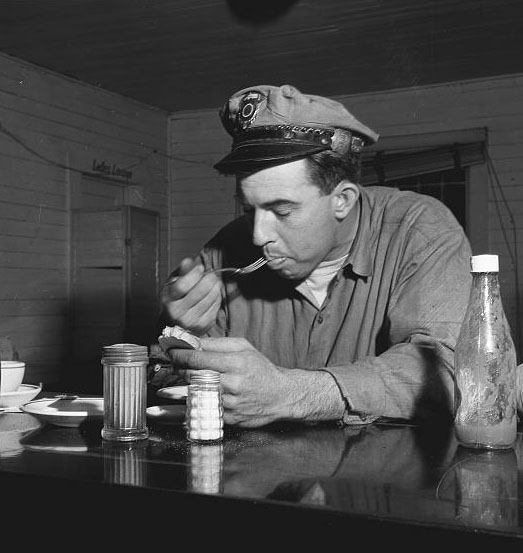
In the Quick Lunch era of the early 20th century, toothpicks became more than a means to loosen bits of food stuck in tooth crevices. They were assertions of masculinity, essential accessories for the male lunchroom crowd. A dangling toothpick sent a macho signal as speedily as a cigarette between the lips of 1960s filmstar Jean Paul Belmondo.

In the 1890s lunchroom patrons felt entitled to toothpicks just as much as to a paper napkin and a glass of water. When a distinguished Afro-American man was told by a Kansas City restaurateur in 1890 that he would be charged an exorbitant $1 for pie and coffee, he seemed to consent but later walked out saying “Sue me for the rest” as he tossed a dime on the counter. And he grabbed a handful of toothpicks on the way, staking a claim to equality in an unmistakable fashion.

Arbiters of etiquette deplored toothpicks. Starting in the late 19th century when the picks came into fairly common use in the United States, and for the next 100 years at least, a string of advice columnists from Mrs. John Sherwood to Ann Landers railed against them. All declared using toothpicks in public vulgar and disgusting. “Dear Abby” echoed her forebears when she roundly condemned public toothpick use in 1986, calling it “crude, inconsiderate, and a show of bad manners.”

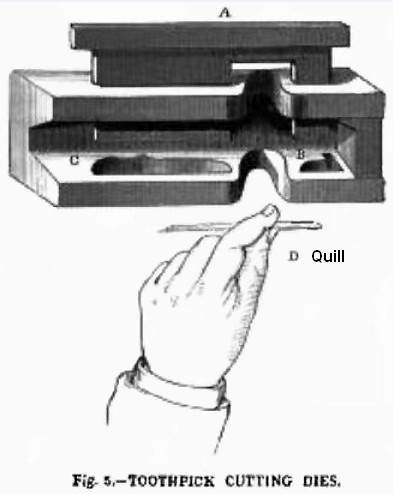
Goose quill toothpicks had been acceptable in the early republic, furnished even at such elite places as Delmonico’s. But as mass-produced wooden picks made of birch and poplar became available in the 1870s, prices fell drastically until even the cheapest eatery could afford to dispense them. Their social status plummeted.

Toothpick haters frequently pointed out that providing toothpicks in restaurants was as ridiculous as handing out toothbrushes. It’s interesting that in the early 20th century another form of tabletop hygiene, the finger bowl, was also about to go under attack. Strangely, since toothpicks and finger bowls were intended for cleanups, they were criticized as germ spreaders. Because toothpicks were provided loose in a bowl or cup, restaurant patrons often grabbed them helter skelter, fingering many they left behind. Trains eliminated them in their dining cars and Minneapolis health authorities banned open containers of toothpicks in 1917.

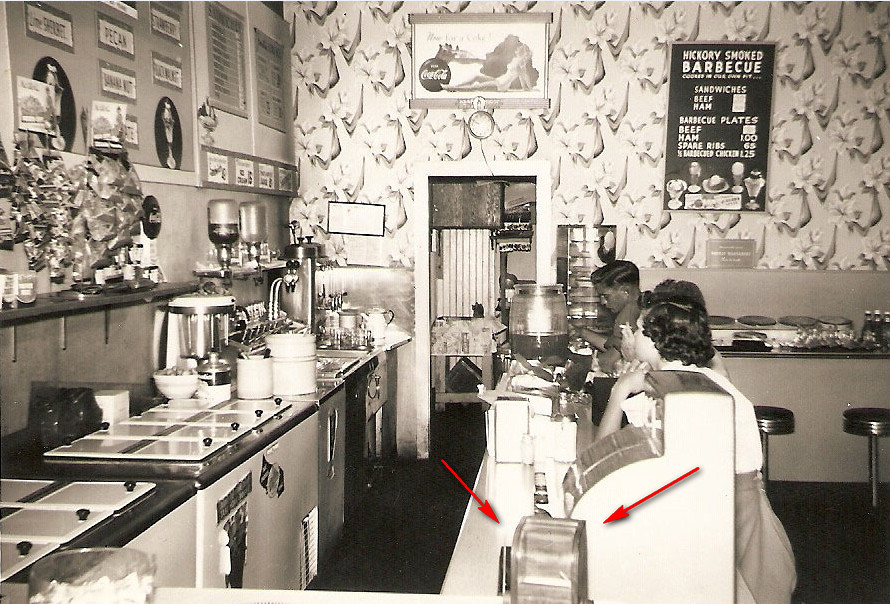
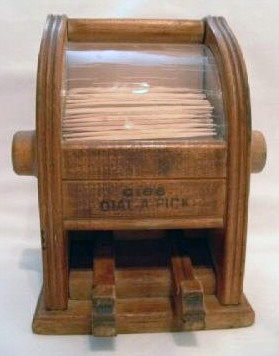
Another solution to the germy toothpick bowl and the habit of grabbing handfuls was bound to occur to America’s legion of gadget inventors. Presto! One-at-a-time toothpick dispensers. [shown here and in restaurant above, the Dial-A-Pic]

Restaurant owners would have been just as happy to see toothpicks disappear altogether. A NYC restaurant owner confessed in 1904 that he disliked the sight of men picking their teeth at his tables as much as that of others sticking knives in their mouths. But he took a pragmatic stance, admitting that “we cannot conduct examinations in table manners before we admit persons to our dining-rooms.”

Today toothpick usage is reportedly unpopular with younger diners and has been dropping off since World War II. So I was surprised to see a little cup of wrapped toothpicks in an upscale restaurant in Kansas City this weekend. Now I’ll be on the lookout everywhere I go.

© Jan Whitaker, 2012

14 Comments

Filed under lunch rooms, patrons, restaurant customs

Putting patrons at ease

How many readers have thought about how very cleverly table-service chain restaurants engineer their establishments so that patrons feel no unease while eating out? They have relieved patrons of the embarrassment so many have felt historically – and which can still occur in formal restaurants today.

It doesn’t take much for restaurant patrons to become tense or self-conscious. They may feel that other guests are staring at them and judging their appearance or table manners. Or that their server is sizing them up. The menu can be mysterious, especially if it contains foreign or unfamiliar culinary terms. They fear they will mispronounce something and be sneered at for their lack of sophistication. Or order a dish they don’t like the looks of (does that explain why I once encountered a South Dakota menu that described salads as made up of “non-intimidating greens”?). If patrons have brought their children, they may worry they will misbehave and earn the wrath of all the tables around them.

Their fears are not entirely unfounded. I have a vivid memory of extreme discomfort I experienced in a restaurant considered among the top in the 1980s. Although the small dining room was fully occupied, it was almost totally silent. There were expensive arrangements of flowers everywhere. They, along with the preternatural quiet, conspired to create the ambiance of a funeral parlor. The waiter never smiled. I felt as though I was dressed for a barbecue. The melon ball-sized food was hard to identify and oddly assorted. I longed to flee to another room where I heard people laughing and imagined them eating real food.

Intimidation has a long history in restaurants. In 1859 a patron complained about his discomfort in the class of elite restaurants represented by Delmonico’s, admitting “we are made nervous by the sneerful smirk of the waiter, if we order the wrong wine . . .”

Snobbery was assessed as being greater in the East than the West. It’s certainly true that Eastern eateries did not run advertisements like the one in Portland OR in 1873 that greeted potential customers with “Hi You Muck-A-Muck and Here’s Your Bill of Fare. Now’s the time to get the wrinkles taken out of your bellies . . .”

Of course there were always casual eating places, but as some Americans grew wealthier in the late 19th century more foreign terms appeared on menus, leading to great puzzlement by diners. Even Easterners had to admit “a feeling of trepidation when confronted with an elaborate menu composed in the artistic and intricate terms of culinary French.” Jokes circulated about the bumpkin who randomly pointed to things on the menu and was dismayed when the waiter returned with two bowls of soup and some toothpicks.

Women were afraid to eat spaghetti in public lest they look foolish. No such worries at The Old Spaghetti Factory in the historic section of _____  [fill in the blank]!

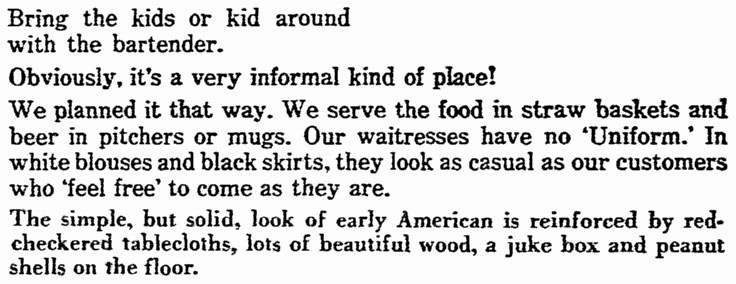
Most sources of intimidation have been eliminated by chain restaurants (See 1973 Jacks Or Better advertisement). A circus-like sense of fun, raucous decor, and auditory buzz distracts everyone from other guests and blanks out children’s tantrums. The ethos is “come as you are.” Service is by relentlessly cheerful teenagers who reply to every request with a “No problem.” There are no pristine white tablecloths or carpets to ruin with spills. No foreign terms appear on menus. In the unlikely event that a menu contains unfamiliar items they will be carefully explained or illustrated. Even today a chain of Mexican theme restaurants in the South supplies a guide letting patrons know how to say the names of dishes, including Nachos (Nah-choz) and Chile Con Carne (Che-lee con Car-nay).

It is interesting to reflect on the deep message conveyed by mass market restaurants. Is it that the American public is juvenile in their tastes and easily manipulated? Or is it the more democratic thesis that Americans will accept being talked down to as the price that must be paid so that no one feels excluded?

© Jan Whitaker, 2012

2 Comments

Filed under atmosphere, patrons

That night at Maxim’s

A restaurant is an expression of its time and place. Except for fast food franchises which are based on an industrial mode of mass production detached from local particularity. So when a replica of an art nouveau turn-of-the-century culinary haunt of demimonde Paris shows up in the basement of a hotel on Lake Michigan’s gold coast in the mid-20th century – well, it’s a little strange.

In short, was the Paris-based Maxim’s franchise that arrived in Chicago in 1963, with its undulating woodwork, fleur-de-lis lights, red velvet banquettes, Soles Albert, and Poires Helene, the real thing?

I’ve been pondering this question as I’ve pored over the fascinating photograph above, which was taken by prize-winning photographer Gary Settle, probably for The Chicago Daily News.

What was the occasion? It’s not a casual shot. At least two floodlights are in evidence and there is something stagey about the scene. I suspect the couples were asked to leave their coffee and smokes and get up and dance. Unfortunately, in the process two napkins were flung aside in an unsightly manner. Elegance is so hard to achieve.

The Brylcreemed man leaning over the table must be Chef Pierre Orsi who had very recently arrived from Paris to take command of the kitchen. The man seated to the right of him looks as though he could be French, but the other men in the picture, apart from the musicians, appear to be of German ancestry. I wonder if they might be two sets of twins.

Which of the women owns the sable coat and elbow-length black gloves? I believe it is the blissful dancer on the left. She will carry home leftovers in a foil purse-shaped doggie bag — perhaps she is dieting or didn’t love her Calves Liver with Raisin and Grape Sauce so much.

The table has a center lamp with pink silk shades and coffee cups bearing Maxim’s curlicue M logo. A cigarillo rests in one of the souvenir ashtrays, while others have been used by the table’s two Winston smokers who prefer a fliptop box to a soft pack. Did these eight people really polish off four bottles of champagne? Did anyone use the replica antique telephone to check in with their babysitter?

I invite readers to create a scenario. Who are these people and what were they thinking at this moment in September, 1967?

© Jan Whitaker, 2012

19 Comments

Filed under elite restaurants, miscellaneous, patrons

Good eaters: students

As far back as the early 19th century students have made up a notable segment of restaurant clientele. They have played a significant historical role both in supporting the growth of restaurants and in shaping the eating habits of Americans.

In the 1800s some restaurants located near colleges specifically catered to students, alumni, and college faculty and staff. As incomparable caterer Othello Pollard of Cambridge MA noted in an 1802 advertisement, “Harvard flourishes and Othello lives.” In NYC in the 1840s poor divinity students could be found at the “sixpenny” eating house called Sweeny’s downing slices of roast beef, clam soup, pickles, and bread and cheese.

One of the penny-pinching patrons at Sweeny’s was Lyman Abbot, an NYU student who later became a noted theologian. Each month when he got his allowance he splurged on dinner at Delmonico’s, but as his money ran low at the end of the month he subsisted on Sweeny’s wheat cakes.

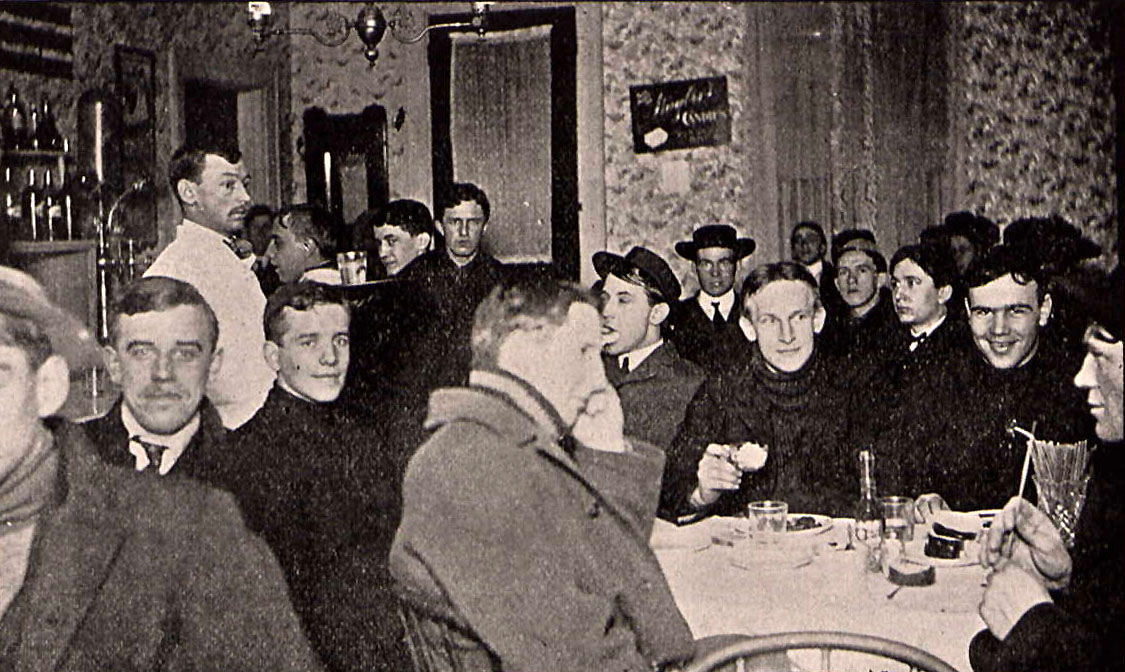
Restaurants clustered around colleges often billed themselves as “student headquarters” and supplied not only food, but entertainment in the form of billiards and supplies such as books and stationery. Hoadley’s, “Hoad’s” to Harvard students, also rented velocipedes in the 1860s. Restaurants around Yale sold weekly meal tickets, hosted private parties, and delivered midnight snacks – “spreads” – to students’ rooms [pictured: midnight “lunch” near Penn State College, 1905]. Billy Park’s chop house in Boston was a hot spot for Harvard students following athletic events. Big-spending students could enjoy the luxurious “sports bar” eateries of their day at places such as Newman’s College Inn in Oakland CA. When it opened ca. 1910 it was decorated with college pendants and tapestries depicting scenes in a man’s life from college to middle age. Murals pictured various college sports while chandeliers were fashioned out of copper and glass footballs.

Alums regularly gravitated back to their college haunts to relive their youth. “Papa” confessed to his daughter on a 1906 postcard of the “Famous Dutch Kitchen, one of the most noted student resorts in the country” near Cornell University, that he planned to eat there before returning home. “I am going to be a college sport for just two days. Big crowd in town. Slept at Fraternity house last night,” he wrote.

Many 19th-century eating places were restricted to male guests, but students at women’s colleges were supplied with tea rooms in the early 20th century [pictured: Brown Betty tea room near Shorter College]. Near the University of Michigan in Ann Arbor, Almira Lovell’s University Tea Room offered teas along with dressmakers’ supplies and college souvenirs in 1903. Around the same time Smith students could often be found curled up on window seats eating popcorn at the Copper Kettle in Northampton. Well into the 1920s being stricken from a college’s approved list was the kiss of death for tea rooms and other eating places that depended upon patronage of women students. Such was the fate of the Rose Tree Inn in Northampton as well as a tea room near Connecticut College.

Students dearly appreciated places to “hang out” because well into the 20th century colleges and universities provided few dormitories and many students lived in rented rooms off campus. Plus, as recent research into Depression-era student life at the State Teachers College in Normal IL has shown, living off campus permitted poor students to economize on food expenses.

College students were prominent among the artsy, “bohemian” restaurant-going crowd. In the late 19th century, when lower Manhattan was filled with schools, students congregated around Washington Square. San Francisco’s art students loved Italian dinners at Sanguinetti’s. In Chicago in the 1920s students met at the Wind Blew Inn. In later decades student beatniks would flock to coffee houses, which in turn were succeeded by hippie hangouts. In 1960 the NYT reported that in one Greenwich Village student café an undercover government agent was asked blandly, “Do you want coffee or peyote?”

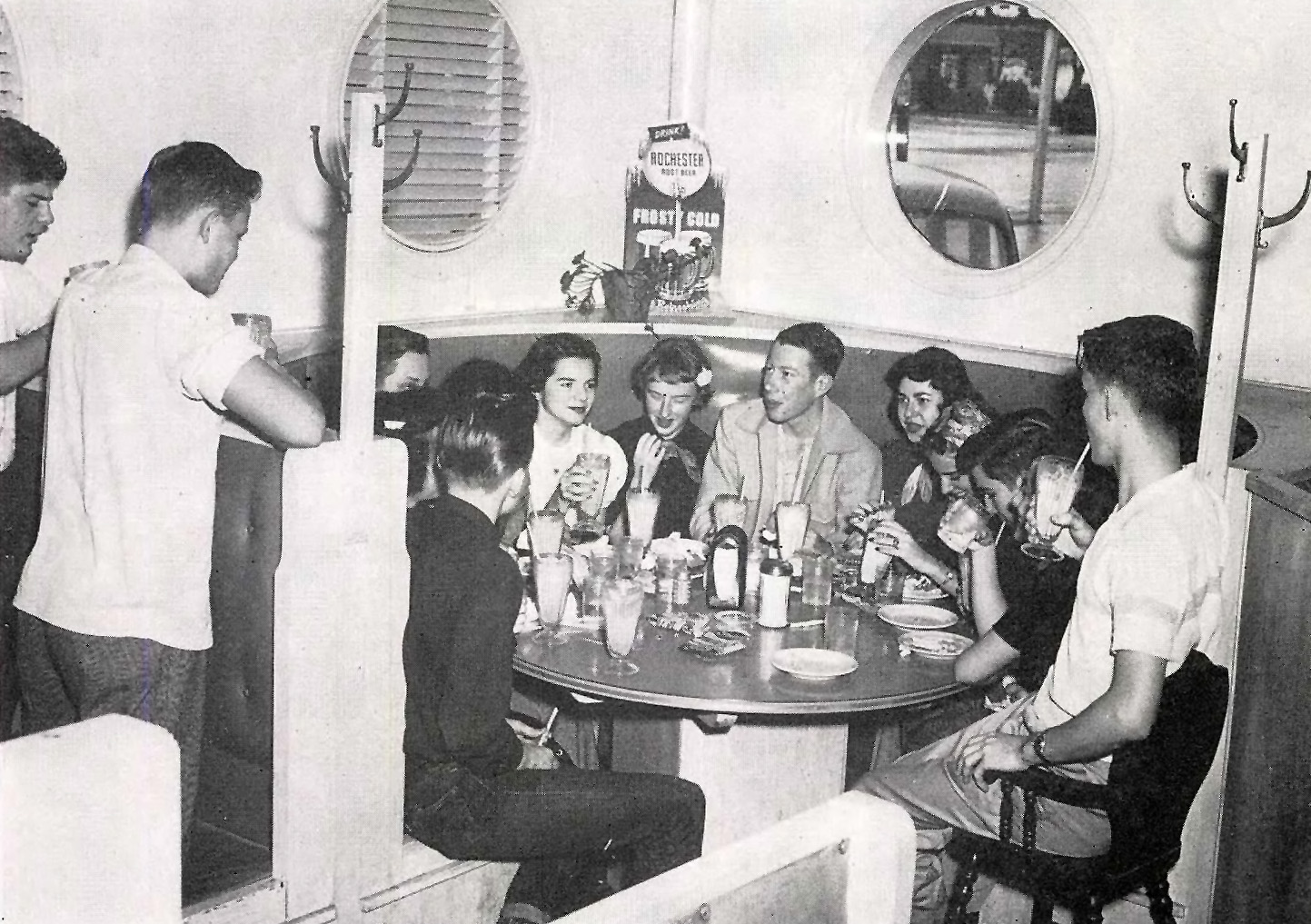
It’s harder to track high school students, at least until the 40s and 50s when their consumption of snack foods such as hamburgers, sodas, and pizzas became noticeable. Like college students before them they tended to favor informal meals eaten at odd hours of the day and night.

It would be interesting to calculate how many of the post-WWII fast food restaurant chains opened their early units near high schools and colleges. This was certainly true of King’s Food Host, Steak n Shake, and the Parkmoor drive-ins. I have no doubt there were many others.

© Jan Whitaker, 2012

4 Comments

Filed under patrons

Regulars

The modern idea of eating out revolves around choice. Where shall we go? What shall we order? We are looking for change, novelty. We want to vary our routine.

It hasn’t always been this way.

Choice in dining out did not become the norm to any great extent until the second half of the 19th century, and then slowly and incompletely. Before that patrons were divided into “regulars” and “transients,” with the first category making up the backbone of the fledgling restaurant business.

In early American taverns the regulars were male groups such as firemen, clubs, or religious societies who turned up on a scheduled basis and were served group meals for a prearranged price. To put it in other words, much of the business of a tavern or eating house was conducted on a catering basis. Male college students, in the decades before dormitories and dining halls, grouped together in dining clubs that operated similarly.

By the 1870s restaurants filled with the same old people eating the same old food day after day came to be regarded as somewhat archaic. A visitor to a chop house in lower Manhattan that served steaks and baked potatoes observed patrons who, curiously, “did not give any order.” He reasoned that they were habitues and learned that one, a dry goods merchant, “has dined there every day for the last seventeen years.”

The system of regular diners and regular meals worked effectively during an era when there was not a large dining public like today. But even by the time things had changed significantly, in the early 20th century, many small cafes tried to take the guesswork and risk out of their business by cultivating regular customers. They sold meal tickets for which patrons paid in advance for a number of meals in order to receive a discount.

Even today there are probably still some individuals who would rather eat at the same place on a frequent, even daily basis. There are those who order the same thing every time or are automatically served the day’s special without even glancing at the menu. Is there an invisible straight line in NYC connecting the 1859 eatery where “regular patrons at the sandwich counter merely sit down and their sandwich is placed before them” and The Colony, where in the 1950s a woman was enjoying her 28th year lunching on lamb chops, salad, and grapefruit? Likewise in that same decade regulars at a Mississippi City restaurant were fond of sitting down and telling the proprietor, “Joe, fix us up.”

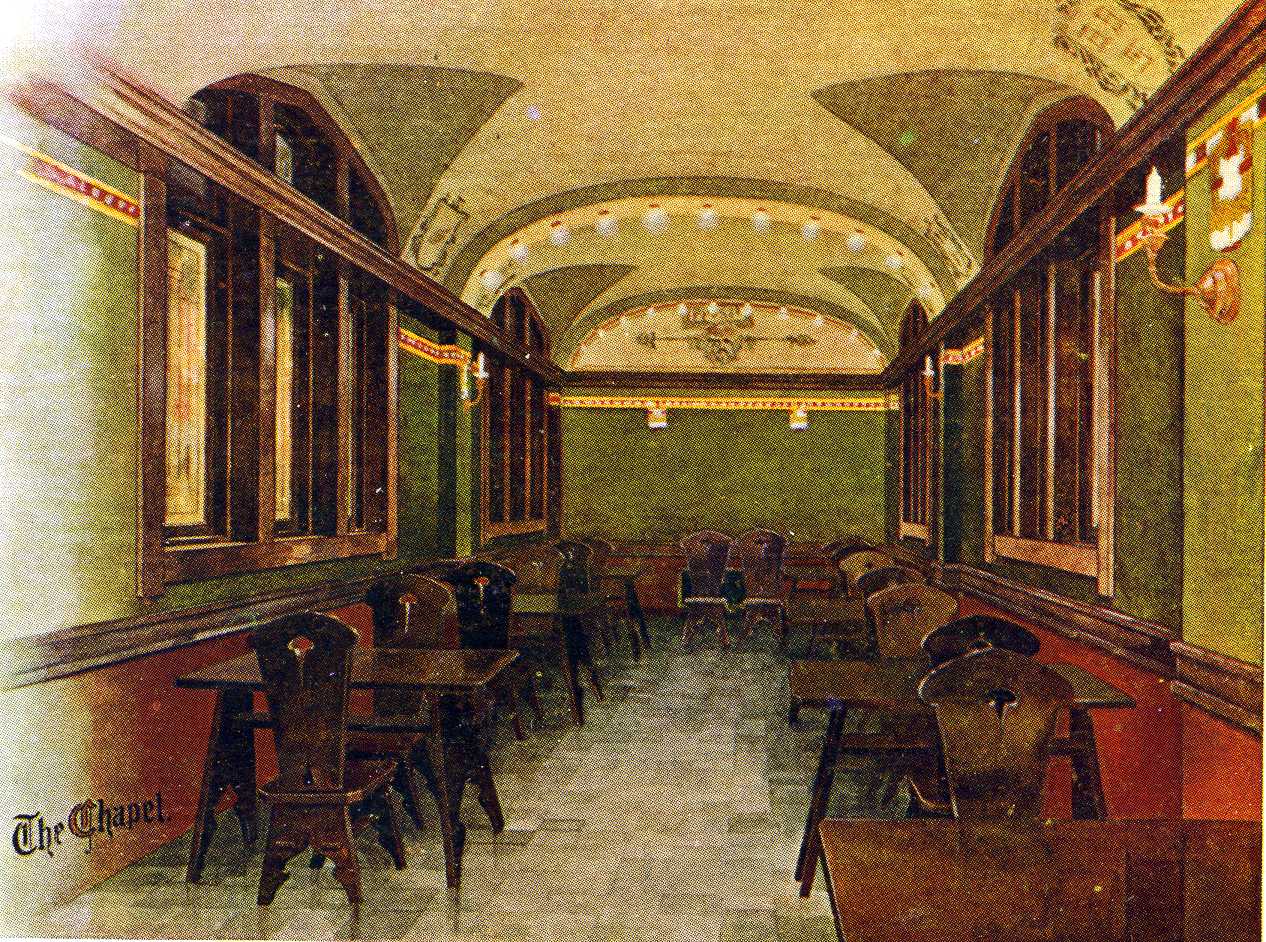
Another vestige of the old system that lingered on for decades was that of men’s professional groups who ate together regularly at the same restaurant – and the same table – for years on end.  Around the turn of the century insurance adjustors — members of the Firebug Club (whose name commemorated the olden days when adjusters colluded with policyholders to commit arson for profit) – used to meet at Mike Lyons’ in NYC’s Bowery. About the same time St. Louis’s Lippe’s was set up with alcoves for trade groups. There was a “Hoo-Hoo” decorated with a painting of a black cat that was designated for lumbermen, and another called “The Roost” decorated with a goose and other birds, meant for tailors. Might “The Chapel” have been intended for ministers? The tradition continued into the 1940s at the century-old Speck’s in that city where there was a bankers’ table, a doctors’ table, etc.

Journalists were well-known for socializing together in restaurants. In Chicago, Ric Riccardo hosted correspondents for the major national magazines and newspapers in his restaurant’s imitation jail called the Padded Cell in the early 1950s. By the 1970s the room had become dedicated to the weekly luncheons of the St. Louis Browns fan club.

Restaurants highly esteemed their regular patrons, none more so than Maylie’s in New Orleans, which closed its doors in 1920. The all-male restaurant admitted patrons each day at 11:00 a.m. and 6:00 p.m., seating them at long communal tables. When a regular died, his chair was left empty for several days.

© Jan Whitaker, 2012

6 Comments

Filed under patrons

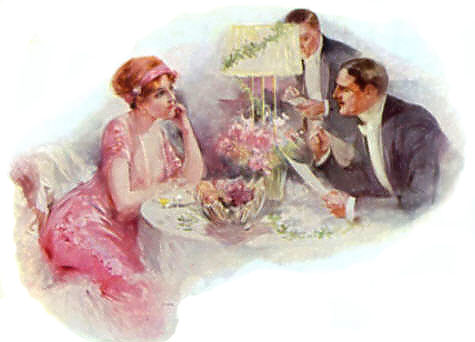
Romantic dinners

No respectable person in the 19th century would have dreamed of even mentioning such a thing as a romantic dinner in a restaurant. The whole topic of “romance” and restaurants was scandalous. Basically it implied a man having sex – and maybe dinner – with a disreputable woman, probably a prostitute, in a private room in the basement or on an upper floor of a restaurant. For decades the term “French restaurant” was widely taken as a euphemism for a brothel, especially in San Francisco. There, at the start of the 20th century, the mayor and his legal counsel made thousands of dollars by shaking down restaurant owners engaged in this trade by having their liquor licenses withheld until they paid for “protection.”

The idea of private dining rooms was an explosive one. An expensive new French restaurant in New York City that wished to be patronized by best society in 1861 felt it necessary to run a special notice explaining its policy: “The Proprietor … fearing that the public has misunderstood that announcement in the papers of the opening of his house, begs leave to notify those who have already favored him with their patronage, and the public generally, that the PRIVATE ROOMS in his house are exclusively for families or dinner parties to order.” Meanwhile, to insure its reputation with society elites, particularly women, Delmonico’s banned even married couples from dining in its private rooms unless they were accompanied by others.

It seems that for a very long time in America’s history there was only one type of food purveyor that might be deemed acceptable for a romantic twosome, and that was not really a restaurant but a place that specialized in ice cream. In late-18th-century NYC this would be a pleasure garden, such as Vauxhall or Contoit’s, dotted with little vine-covered bowers with individual tables inside. There were also some bright and glittery mirrored cafes modeled on those in Paris that attracted young couples and were considered somewhat acceptable.

As late as the World War I era, when restaurants were becoming more respectable, a typical scene in today’s popular media featuring a man proposing to a woman in a restaurant would have been seen as improper. For one thing, it wasn’t really considered totally ok for an unmarried couple to have dinner unchaperoned in a restaurant until the later 1920s. In 1913 a waitress confessed that she was shocked to witness a man proposing marriage. She felt a strong negative reaction to the spectacle:“That was too much for me, and I made up my mind then that if any man ever asked me at the dinner table to marry him I would refuse him on the spot.”

Of course there were plenty of people who defied convention and went to restaurants two by two anyway, and there were restaurants that had romantic attractions such as strolling musicians in the early 20th century. Yet, it wasn’t until fairly recently that restaurants began to specifically and proudly advertise that they were the perfect spot for a romantic dinner. This began to occur in the 1960s, a decade in which more and more Americans went to restaurants in the evening for entertainment.

A popular restaurant in the college town of Columbia, Missouri, exemplified the new trend in the 1960s and the characteristics that would become regarded as romantic. Called the Mill O’Rock, it was in an old grist mill and had a circular stone fireplace in the center of the room with wooden ceiling beams radiating out from it. Young couples flocked there and the owner said it was well known as the perfect place for marriage proposals.

© Jan Whitaker, 2011

6 Comments

Filed under patrons, restaurant etiquette, women

Know thy customer

In the early days of American eating places, in the late 18th and early 19th centuries, most customers other than travelers were personally known to proprietors. Some, especially single men, were regular customers eating in the same place every day for weeks, months, even years. They may have rented a sleeping room there as well. Others worked nearby. The typical newspaper advertisement of that time always began by saying that the proprietor wanted to thank his friends, old customers, and the public, in that order, which I believe descends in importance. Many of the familiar customers at better eating places no doubt kept a tab and paid monthly or less often.

From what I have been able to gather, anyone wanting to eat their dinner at a tavern, ordinary, coffee house, or whatever the establishment was called, would let the proprietor know in advance. For those who did not eat there every day, some (most? a few?) proprietors prepared a list of dishes being served that could be examined in the morning. As Mrs. Treville of New York announced in 1777, “The bill of fare [is] to be seen in the coffee room every forenoon.” After inspecting the day’s bill of fare, the prospective diner might leave his name or buy a ticket if he intended to return for dinner, which was served at noon or in the early afternoon.

Although there was sometimes a bill of fare, diners did not usually order individual dishes from it as we do today (though sometimes they did – subject of a later post). Instead, the meal would be served family style, with all the dishes being passed around a common table and each person paying a flat price. Anyone wishing an evening meal had to place their order in advance, probably so that the proprietor could buy the necessary supplies.

Although I am guessing about some of this – to a degree – I think this is how it usually worked. But what I don’t know is whether a person ordering an evening meal for themselves or a group of friends had to pay something up front or if being known was enough to underwrite the deal.

A few months ago a man walked into Antonio’s Pizza parlor in Amherst, Massachusetts, and placed a very large order for 178 pizzas which he said he would pick up later. He never did. The staff worked far into the night to prepare them and the bill totaled nearly $4,000. Almost all of the pizzas ended up being thrown away. The man, whose identity was never publicly revealed, was caught on the store’s security camera [center] and located later living in New Jersey. Through a lawyer he made settlement for an undisclosed amount, with no public explanation of his motive for what appears to have been an intentional prank.

He paid nothing in advance, nor did he leave his credit card or phone number.

Because he was wearing a lanyard around his neck filled with backstage passes and said he was ordering the pizzas for the crew of a Bob Dylan concert at the University of Massachusetts, Antonio’s failed to insist upon a deposit or … anything.

Did the early proprietors of eating places ever get stiffed? Apparently they did, despite the closer personal relations between them and their customers. A law was upheld in 1831 which said that each person in a dining party is a member of a partnership and as such is individually responsible for the entire bill if the others abscond or fail to pay.

Othello Pollard, who served a college crowd, announced in 1802 that he expected immediate payment and would extend credit only for “as long as a man can hold his breath.”

I don’t think Othello would have let the prankster out the door so easily.

© Jan Whitaker, 2011

1 Comment

Filed under patrons

He-man menus

I question whether there are huge gender differences in food preferences but I’ve seen plenty of evidence that many restaurants have marketed menus on this basis, especially by playing to the idea that men have manly tastes. This idea seems to have grown stronger in the 20th century when more women patronized restaurants on an equal basis with men.

Many people believe that men like heartier food than women do. In the 19th century, of course, men dominated restaurants and women were often viewed as special guests. Since eating places were accustomed to catering to men then, menu staples such as oysters, beef, and pie came to be seen as men’s favorite dishes. Perhaps they were, but then again they may have been regarded as “masculine” simply because men were the ones who usually ate them out in public.

In the early 1900s articles began to appear in newspapers that offered ideas of what food men liked best. Restaurants designed menus to appeal largely to male diners. Pollution of oyster beds brought growing distrust and beef came to top the list. “Quick lunch” spots noticed that men ordered more meat dishes than women. Louis Sherry said that women guests in his deluxe Fifth Avenue restaurant did not like to draw blood so they avoided red meat and game.

In the many places that served “business men’s lunch,” the favorite meal was meat and potatoes, pie, and coffee. If the lunch was served in a tavern setting, the pie and coffee might be replaced by a glass of beer. But men had other favorites as well, such as griddle cakes, corned beef and cabbage, beef stew, chili con carne, bean soup, fried potatoes, and ham and eggs.

With the advent of national Prohibition in the 1920s, observers noticed that men were eating lighter meals, more sandwiches, and even the occasional salad. While nutritionists hailed the change as healthier, some restaurant owners longed for the return of the heavy eater. When beer became legal again in 1933 the executive chef of Chicago’s Palmer House said, “With the stein on the table, masculine foodstuffs are bound to come into their own.” In 1934 a New York guide book tipped off men about where they could enjoy “man-sized” food “served without fancy gegaws.”

After Prohibition men who preferred no women in the dining room could go to bar & grill restaurants in hotels such as the Esquire Restaurant in the Penn-Harris Hotel in Harrisburg PA or the men’s bar at the Waldorf Astoria where they could enjoy their Martinis and Mutton Chops minus female company. In the men’s bar at the Mayflower Hotel in Washington, D.C.,  the dining room captain personally prepared Cannibal Sandwiches of raw beef, onion, egg yolk, and Worcestershire sauce at guests’ tables.

Known as the Rib Room, the men-only Mayflower bar was also host to FBI chief J. Edgar Hoover, who lunched there daily in the 1960s, always at the same table facing the door. His favorite meal, consumed with only the slightest variation, was cream of chicken soup, coffee, and Jello. While he was President, in 1970, Richard Nixon and four of his staff dropped in at the Rib Room for breakfast after Nixon’s early morning visit to Vietnam War protesters at the Washington Monument. Nixon ordered corned beef hash with an egg on top which, according to his press secretary, marked the first time he had eaten this dish in five years.

© Jan Whitaker, 2010

Leave a comment

Filed under food, patrons

Who invented … lobster Newberg?

The tale has often been told of Benjamin Wenberg who created a fabulous new dish at Delmonico’s restaurant in NYC sometime in the 1870s. The punch line revolves around how Charles Delmonico changed the name to Lobster Newberg to spite Wenberg after the two men had an argument. Do you believe the story? I am suspicious of it.

As a historian I run across many legends of this type. There is always a delightful little detail that makes the story click and lures journalists into repeating it so often that it becomes undisputed truth. Less catchy, and thus less repeated versions of the Lobster Newberg story, suggested that Wenberg did not want his name used so the name of the dish was altered slightly – or that the Delmonicos named the dish Newberg right from the start out of respect for Wenberg’s privacy.

It’s doubtful that Wenberg invented the dish. A sauce made of cream, egg yolks, butter, and sherry wine – the à la Newberg part of Lobster Newberg – was known as terrapin sauce and was in use before the 1870s.

Did Wenberg have anything to do with Lobster Newburg? Some stories imply he was the first to use the sauce with lobster. To me it seems doubtful that he would be more likely than top chefs to see its wider potential. In fact at least one Delmonico chef claimed to have developed the dish. In yet another version of the story, Delmonico’s named it for him because he ordered it so often.

Maybe. Whatever. As far as I can tell, no one has ever found the name Lobster Wenberg on a Delmonico’s menu. Nor has Lobster Newberg been found on menus from the 1870s or 1880s.

Although Benjamin Wenberg may be altogether irrelevant to the story of Lobster Newberg, he was an actual person, a well-known figure in New York City in the 1850s and until his death in 1885. He was in the shipping business, buying, selling, and chartering sea-faring vessels. At least one of his ships, Panchita, was suspected of engaging in the slave trade in 1856 and 1857.

The dish attributed to him became popular in the 1890s and the legend of its naming was oft repeated in this decade. It was a favorite chafing dish recipe for home entertaining and any restaurant with the least pretensions was bound to have it on the menu. Restaurants occasionally prepared it tableside in a chafing dish. Shrimp, crab, scallops, and sometimes frog legs were also offered à la Newburg.

These dishes were usually spelled with a U on restaurant menus. Which is another oddity since Wenberg’s name was usually spelled with an E.

© Jan Whitaker, 2010

8 Comments

Filed under food, patrons

Good eaters: Andy Warhol

He certainly wasn’t from the same category of eaters as James Beard, yet both Beard and Andy Warhol celebrated American cuisine, even in its more humble pancake/sandwich/barbecue forms. Warhol was a typical American eater in many regards. He was conservative about his food, preferred simple dishes, and was happy eating in front of the TV.

As for restaurants, he explained in his 1975 book The Philosophy of Andy Warhol that he stayed thin by ordering things he disliked in restaurants — even fashionable and expensive ones such as La Grenouille. While his companions ate, he picked at his plate and then had the food wrapped up so he could leave it somewhere for a homeless person to find. He called this the “Andy Warhol New York City Diet.”

He much preferred “good, plain American lunchroom[s] or even the good plain American lunchcounter” to chic eateries. His favorites, already vanished by 1975, were the “old-style” Chock Full O’ Nuts and Schrafft’s. “The days were carefree in the 1940s and 1950s when I could go into a Chocks for my cream cheese sandwich with nuts on date-nut bread and not worry about a thing,” he wrote. He felt that people could not handle many challenges to their food habits without becoming upset. As he put it, “Progress is very important and exciting in everything except food.”

He came close to becoming a restaurateur himself when he announced the coming of the “Andy-Mat,” an unpretentious neighborhood restaurant serving homely comfort food at reasonable prices which was slated to open in fall of 1977 on Madison Avenue at 74th Street in NYC, perhaps launching a chain. (See photo with Warhol and his partners, [standing L to R] architect Araldo Cossutta, developer Geoffrey Leeds, and financier C. Cheever Hardwick III.) Described as “a tinker toy for sophisticates,” Warhol’s concept included pneumatic tubes through which customers’ orders would be whooshed into the kitchen. The meals served in Andy-Mats, in keeping with the times, were to be frozen dinners requiring only reheating.

For some reason — poor location or failure to raise capital or maybe because the whole plan was cooked up over “twelve stingers at El Morocco” — the restaurant did not materialize.

© Jan Whitaker, 2010

6 Comments

Filed under patrons