Category Archives: Offbeat places

A grandiose failure?

It’s difficult to assign a definite cause to the short life of Raphael’s, a Chicago restaurant that opened in October 1928 and seemed to have closed by the following July. It would make perfect sense if it had failed after the Wall Street crash at the end of October 1929, but it seems to have closed while the boom was still in progress. [Above: Detail of a platter from Raphael’s shown below, with a fanciful depiction of the building.]

Then again, Prohibition was in effect and that almost undoubtedly contributed to failure. But whatever the cause, Raphael’s on Chicago’s south side didn’t even make it to its first birthday as far as I can tell.

Judging from its exotic design, the restaurant clearly had grand aspirations. Its financial backing totaling $300,000 amounted to a small fortune at that time, equal to nearly $5,700,000 today. At least two thirds of the capital came from a major Chicago investment banker. The remaining $100,000 presumably was furnished by the restaurant’s nominal owner, Edwin Raphael.

In June of 1928, as construction began, the Chicago Tribune ran a snarky story that managed to insult the design as well as Chicagoans’ taste in general. It said that the building “should make one think he’s in Persia, provided he doesn’t know too much about Persian Architecture,” and that it was aimed at “Chicago’s epicureans – if we have any.” [Above: Raphael’s main dining room in 1929]

The layout of the building accommodated a small tea garden inside the front door that was outfitted with trees and fountains. Next came a two-story dining room accommodating hundreds, with a ceiling imitating a blue sky with twinkling stars and surrounded on all sides by a balcony that also held tables for guests. Two ends of the building provided people entering from the street access to two interior lunch counters with soda fountains. [Above: one of the lunch counters, but looking strangely like a bar.]

With its minaret, the building reached 60 feet in height and was visible for miles along all three major streets that crossed there. The minaret was used for advertising with neon lighting and a crescent on top. The illustrations used for this building, whether on the restaurant’s dinnerware [shown above] or in advertising, took great liberty in portraying it. [Below: April 1929 advertisement that imagines the building with two domes, four minarets, and palm trees!]

The main dining room featured a band named Raphael’s Persians. Their performances could be heard on the radio at night.

The March 1929 issue of The American Restaurant Magazine hailed Raphael’s for its ability to merchandise meals by “stealing the thunder” of night clubs and offering them stiff competition while putting food “foremost.” When the radio audience listened to the Raphael’s orchestra, the story said, they would feel that the restaurant had “an air of mystery about it” and want to visit “Chicago’s most exclusive restaurant.” But did they?

The combination of three types of eating places in one business was an odd one, something that would be more understandable in a hotel than a restaurant. It would seem as though the tea room and the snack bars would keep earlier and shorter hours than the restaurant/nightclub which stayed open until 3 a.m. and that this would cause staffing problems. By June of 1929 Raphael’s had figured out more ways of making money, as is shown on the advertisement below, such as afternoon dancing, an additional cover charge, and higher cover charges on weekends, but it’s likely that it wasn’t enough.

The trade journal also hailed Raphael’s for its modern kitchen facilities that were filled with the latest mixing machines, ranges, refrigerators, warmers, etc., proving “that the kitchen methods of this modern restaurant are a far cry from the methods employed when the members of Persian tribes would prepare feasts for their shahs.”

A reader of The American Restaurant would be left with the idea that Raphael’s was an elegant place catering to a clientele with sophisticated tastes. But that idea was dashed in a story written by a young reporter who spent a night there playing the part of a “shy cigaret girl.” Over the course of the evening male patrons hit on her nine times. She also observed people drinking alcoholic drinks, probably enhanced by their own whisky flasks. The crowd included teenagers. By June of 1929, the restaurant was reduced to featuring a “crystal gazer” on the balcony named Allah Mahalla. So much for elegance!

Despite serious searching I could find no advertising, nor any mention of the Raphael restaurant at all after July, 1929. In 1940 the address was mentioned as the location of a bunco party (a dice game) hosted by a political group. In 1947 the building, then occupied by a beauty supply warehouse, was auctioned for taxes. It sold for a mere $14,027 plus payment of back taxes of $11,259. The second floor was offered for rent in 1948, and it may have been then that the American Legion moved in. [Above: Could the Hippodrome have occupied the building when this advertisement ran in 1938?]

However, according to a recent Chicago Sun Times story by architectural critic Lee Bey, Raphael’s continued in business until WWII, and “later converted into the American Legion South Shore Post 388.” I haven’t been able to find out why he thought Raphael’s stayed in business that long.

Another eating place that might have once occupied the building (in addition to the Hippodrome) was the Kickapooo Inn. Its address was given as 7901 Stony Island in a 1957 obituary notice for its owner.

The building was acquired by The Haven of Rest Missionary Baptist Church in 1966 and used for church services until 1977 when they built a new church. Now the church is seeking a grant to restore the building, hoping it can be reopened in a few years as a community center. [Above: the building as it appeared recently.]

If any reader has information about this building and its uses over time, I’d love to hear from you. It could assist the church in applying for grants.

© Jan Whitaker, 2025

4 Comments

Filed under atmosphere, night clubs, odd buildings, Offbeat places, restaurant decor

Colosimo’s charm

Many restaurants through the decades have built their popularity on a genial host. That was true of Colosimo’s in Chicago and its owner and host Jim Colosimo.

To a large degree the restaurant’s reputation was built around “Big Jim.” Before 1920 that was because of his pleasant manner. And, maybe, the spaghetti at Colosimo’s really was exceptionally good.

But the genial host was also a big-time gangster.

The restaurant was located in a part of Chicago known as the levee, an area specializing in prostitution. Colosimo had opened his restaurant in 1910, having previously run two “single-hour” hotels.

He expanded his operations to become a crime boss who not only provided illegal services but also had procurers recruiting naive young women as prostitutes in and outside of Chicago. And he handled the police, seeing to it that they didn’t interfere with these activities. His lieutenants collected payoffs from other illegal operators — and killed people as necessary — leaving Big Jim’s hands clean. (Of course, the police knew very well what he directed his minions to do.)

Many of Colosimo’s patrons also must have known about his other activities. In 1914 a letter appeared in the Chicago Tribune from a woman who feared for the fate of young women that might venture into the place:
I have been reading The Tribune about this vice upheaval and notice what is said about Colosimo’s. This recalls that when I first came to Chicago last winter I saw, I believe, [full] page ads in the leading Chicago theater programs which advertised what a fine place was to be found at Colosimo’s. I didn’t know what kind of a place it was and didn’t go there to find out, but I’ll warrant any number of younger girls went there, led by the page advertisement in the Chicago theater program, and undoubtedly a great many of them can now trace their downfall to Colosimo’s. [above: 1914 advertisement]

Its reputation evidently didn’t bother many of its patrons. The theatrical profession was said to flock there. And a publication reported that “The café . . . is crowded nightly after the show with a merry making throng which makes it one of the brightest spots on the city’s map.” It served as an ongoing attraction for the city’s “society slummers.” And in 1916 an advertisement for Colosimo’s appeared in the Official Program of the Republican National Convention to be held in the city.

His execution helped perpetuate the restaurant’s appeal after Colosimo was gunned down on the premises in 1920. It also helped that Al Capone was associated with the restaurant. He had been hired as Big Jim’s bodyguard, replacing him as the city’s crime boss after he was killed.

In subsequent years the name of the restaurant remained Colosimo’s, despite his absence and a new owner. It was remodeled to look elegant, and operated as a nightclub. Its past, presumably firmly behind it, did not deter the crowds in the 1920s. Drinks were available, although the restaurant was shut down repeatedly for violating Prohibition. Apparently that was okay with the alumni of a Vermont military college which planned a dinner there in 1925, including their “wives and sweethearts.” Their invitation noted “At this place we can be entertained by dancing, eating and looking . . .” [my emphasis]

The new owner, who had bought a half share in the restaurant shortly before Colosimo’s murder, operated it until its end in 1948, by which time it had suffered the bizarre fate of being converted into a cafeteria. [Above: the restaurant in the 1940s]

Colosimo’s murder was never solved.

© Jan Whitaker, 2025

10 Comments

Filed under night clubs, Offbeat places, popular restaurants, proprietors & careers

Music & food at Café Society

Café Society was the satirical name of a New York jazz club in the late 1930s and 1940s. The name was meant to make fun of people who wanted to be seen as sophisticated rather than merely rich. However, it’s likely that Café Society nevertheless proved to be an attraction to many of those same people.

By the second year there were two locations of Café Society, Downtown and Uptown. The clubs and their owner Barney Josephson have become well known for the number of jazz greats they introduced and nurtured, among them Lena Horne, Billie Holiday, and Teddy Wilson. And also for their full acceptance of Black customers.

Unlike other “café society” club owners such as the Stork Club’s, Josephson refused to accept the racial codes of that time. He was determined not to follow policies that featured Black performers but would not allow them to mingle with the patrons, and excluded Black guests. Even when these policies began to soften, it was common for Black patrons to be seated inconspicuously in the least desirable spots. [Above: 1939 sign at the Downtown club ridiculing prominent society figures]

When he opened the Downtown Greenwich Village club in late December 1938, Barney recruited three musicians who had been part of a Carnegie Hall Christmas Eve program called From Spirituals to Swing. Albert Ammons, Meade Lux Lewis, and Pete Johnson performed at the club a few days later. The club advertised that it featured “boogie-woogie,” which was largely unknown in New York City at the time. [Above: Downtown in 1939; William Gropper mural]

But what about the food? In general, jazz clubs’ culinary output has not been regarded as the finest. Barney claimed that when he started out, most jazz clubs were run by mobsters who didn’t even try to prepare good meals. He tried to do better, but it’s hard to judge how well he succeeded since I’ve found little commentary. Club cuisine wasn’t usually written about.

In a book based on recordings of his memories, published by his fourth wife after his death, Barney commented that in most nightclubs waiters were urged to push drinks not food. For the Uptown Café Society (on East 58th), opened about a year later than Downtown, he made an effort to provide good food by hiring a chef who had managed the Claremont Inn and had been head waiter at Sherry’s. Robert Dana, nightclub editor of the Herald Tribune, was of the opinion that “On its food alone, Café Society ranked with many fine restaurants,” singling out squab chicken casserole and cream of mushroom soup. [Above: Uptown, 1943; Below: Advertisement with the musical lineup on Uptown’s first anniversary, 1940]

By the end of 1947 Uptown was out of business, and Downtown closed in early March of 1949. The problem was that Barney’s brother Leon, an admitted Communist Party member, was part owner of the clubs, having advanced start-up money. In 1947 Leon was called before the House Un-American Activities Committee, refused to testify, and spent a year in prison. Barney was seen as guilty by association, attendance at his clubs plummeted, and he lost all his money. It seemed his career as a jazz club owner was over.

After that he concentrated on the restaurant business. He opened three restaurants, all called The Cookery, with one on Lexington across from Bloomingdale’s, one on 52nd Street in the CBS building, and then in 1955 a third one in Greenwich Village on University Place and 8th Street. The first two did not stay open long, but the Greenwich Village site was successful. [Above: The Cookery on Lexington; wall art by Anton Refregier]

While the two Café Societies had featured jazz with food, his third Cookery was to become a purveyor of food with jazz.

The Village’s Cookery was far from glamorous, generally described as “a hamburger, ham-and-egg type restaurant.” For the first 15 years there was no music. And then one day Barney had a visit from pianist Mary Lou Williams — who had played at Café Society Downtown – looking for work. As he described it:

“. . . this lady, one of the greatest musicians of all times, composer, arranger, not working? It was all this wild, crazy rock. . . . I investigated and found out I didn’t need a cabaret license in my place if I only had three string instruments.” [Above: Mary Lou Williams, at the Cookery in the Village, 1970]

So he told her to go rent a piano and, presto!, he was back in the jazz club business as of 1970. She was a draw. As he put it, “Mary returned to The Cookery each year through 1976 for three-month gigs, always to critical acclaim and crowds.” Other musicians who played there included Teddy Wilson, Marian McPartland, and the elderly singer Alberta Hunter, who had been working as a nurse.

The Cookery stayed in business until 1984.

For those interested in reading more about Barney’s clubs, see the book based on his recorded memoir published by Terry Trilling-Josephson in 2009 (Café Society: The wrong place for the Right people).

© Jan Whitaker, 2025

Leave a comment

Filed under alternative restaurants, night clubs, Offbeat places, patrons, proprietors & careers, restaurant decor

Ruth Stout, her life and tea rooms

A few days ago I read a fascinating article by Jill Lepore in the New Yorker. It was about Ruth Stout, author of How to Have a Green Thumb, Without an Aching Back, originally published in 1955. It has been reissued and is still quite popular.

There were many engaging aspects to Stout’s life, such as her affair with the radical Scott Nearing, her career as a writer, the fact that her brother was the mystery novelist Rex Stout who created Nero Wolfe, her involvement with ‘no-plow’ gardening, and the fact that lived to be 96. [Below: Ruth in 1923, age 39.]

But what especially interested me was that Stout had been briefly involved in owning and running two tea rooms in Greenwich Village around 1917. They didn’t last long, but that was true — almost typical — of many tea rooms.

The first was the Will o’ the Wisp which she opened with a family friend. It was appropriately named, being short-lived. It was ridiculed by the New-York Tribune in a 1917 story about an imaginary visitor from afar searching NYC for the “real Bohemia.” He and the writer go to “the Wisp” (as it was known), where the “young ladies” (actually about 32 and 50 years old) that operated it invite them to come back the next night and help wash dishes around 1 or 2 a.m. The sardonic piece ends with the trite observation that Bohemia is a fantasy.

If the Tribune writer had known that the two women running the Wisp were both from small towns in Kansas, that would have been another sign of how misplaced his dismissive attitude was. They actually represented the adventurousness and talent of many New York transplants. In this case they were writers, world travelers, and free spirits.

The Greenwich Village tearooms before World War I served mainly as hangouts for local residents, many of whom were artists and who liked to gather with friends in the evening. Alas, they didn’t spend much, so the advent of visitors from outside the Village was a financial boon. The Wisp tagged itself in advertising as a place for writers, “the poets’ favorite,” not a slogan likely to draw the masses.

As the photo at the top shows (by the Village’s photographer Jessie Tarbox Beals), tea rooms were plentiful, with three in the building in this photo. And the building itself is none too impressive, even looks somewhat structurally unsound. The Wisp is on the ground floor.

Not much later, or maybe simultaneously with the Will o’ the Wisp, Ruth opened a second Village tea room called The Klicket, this one with dancing. The Quill, the Village’s magazine, promoted it saying, “Ruth Stout’s ‘Klicket’ has a good floor, and say! Ruth CAN cook!” No doubt she was amused by that since she wasn’t much of a cook.

At the Klicket, Ruth found herself keeping even later hours, but there was little monetary reward.
As she indicated in her advertisement she mainly hoped her customers would end the evening by paying for their tea. It was not a financial success and she kept it going only for about a year.

In a 1917 book about the Village, author Anna Alice Chapin outlined the “phases” which the Village was going through, which included not only “the tea-shop epidemic,” but also psychoanalysis, arts and crafts, masquerade balls, and support for labor activism and anarchy. Ruth took up the call to radicalism. She and Rex were on the editorial board of a leading socialist-communist periodical The New Masses. She also visited Russia as a Quaker volunteer helping alleviate famine there in 1923 and became a helper and romantic partner of Scott Nearing for several years, living with him on his farm.

She published four books in the 1950s and 1960s, including her garden book and Company Coming: Six Decades of Hospitality, Do-it-yourself and Otherwise, in which she mentioned her tea rooms. Until her death in 1980 she spent her elder years in Connecticut where she and her husband Fred Rossiter had acreage.

© Jan Whitaker, 2025

11 Comments

Filed under Offbeat places, proprietors & careers, tea shops, women

The short life of the Roboshef

In 1940 the restaurant trade magazine Restaurant Management ran a story about a new San Francisco restaurant called Roboshef where one presumably unskilled cook could turn out 120 meals an hour. The feat was accomplished by using an automatic cooker that rapidly cooked steaks, fish, potatoes, and biscuits in hot oil. (Opening 1939 announcement below.)

The counter-sized cooker (shown above), the Roboshef, was patented by Walter Scharsch, a chef who had previously run his own restaurant.

The Roboshef menu also included juices, salads, vegetables, soup, and desserts, all prepared conventionally. On the menu, a half chicken with French fries and hot rolls was priced at 60c.

In 1935, prior to opening the San Francisco location, Scharsch had spent some time demonstrating his invention in Portland OR. A story that ran in the local paper described him demonstrating the invention in a local auditorium (shown above). Local production of the machine, said the story, had begun that same day. It said the plan was to open the machine to distribution in Oregon, Washington, and California before going national. I could find no evidence that Roboshef restaurants ever opened in Washington or Oregon.

The invention had appeared first in Tiny’s Waffle Shop in San Francisco in early 1938. Next came the Roboshef restaurant described in Restaurant Management, with its grand opening in July of 1939. According to the trade magazine’s story, the business planned to dedicate the upper two floors of the Van Ness location to a commissary and an office.

And then what happened after 1939?

Nothing, nothing at all. The Restaurant Management story was the last trace of Roboshef.

Except for this, which appeared months before Restaurant Management’s 1940 story – on Nov. 26, 1939:

It does not list any restaurant equipment, but seems to be referring to what would have been in the upstairs office. However the restaurant must have closed then or not much later, because by April, 1940, two months before the Restaurant Management story, a Persian rug store had moved into the space formerly occupied by the restaurant.

So it seems that Restaurant Management had presented a new restaurant – that had already failed!

Why did the San Francisco Roboshef go out of business so quickly? I could not find any explanation. My guess is that the invention did not work properly. That might explain why Scharsch submitted a new design for a similar yet different “Food Cooking Unit” to the U.S. patent office in 1941.

The new version of the Roboshef was acquired by Cogrisch Products which christened it the “Cogrisch Chicken Fryer.” Two advertisements from 1941 exclaimed about using it to cook chicken, one at the Nip & Tuck Chicken Inn in San Diego and the other at Earl’s Tavern & Chicken Shack in Tulare CA. There may have been others. Both the Nip & Tuck and an unknown place in Tracy CA advertised their used Cogrisch fryers for sale in 1950.

Meanwhile, Walter Scharsch had gone on to work for a shipbuilding corporation and to invent a Butter Slicing and Dispensing Machine around 1945.

© Jan Whitaker, 2025

Leave a comment

Filed under Offbeat places, proprietors & careers

Famous in its day: Well of the Sea

A short time ago I had a chance to visit the fascinating second floor of the Fishs Eddy store in New York. It is piled high with not-for-sale dishware of all kinds, collected by the store’s owner Julie Gaines. The collection includes restaurant ware from the golden past when this country still produced such things. (Tours of the collection, hosted by Julie, are given periodically and booked by the New York Adventure Club.)

The Fishs Eddy collection also includes records from china producers that show pattern designs. A page from Shenango China in Newcastle PA — closed in the 1970s — depicted the design for a plate made for use at the Well of the Sea restaurant in the former Hotel Sherman in Chicago. (A ca. 1950 painting of the restaurant by Cal Dunn is shown at the top of this page. Below is a plate using the above Shenango design.)

The restaurant opened late in 1948 in the hotel’s basement, which no doubt suggested an underwater theme to the hotel’s owner, the colorful and theatrical Ernie Byfield. He had also originated the over-the-top glamour restaurant, the Pump Room in the Ambassador Hotel.

A number of abstract murals of underwater scenes by Richard Koppe, Chicago painter and student of the German Bauhaus, decorated the walls of the restaurant. One of them was used for the menu’s cover shown below. The room was further enhanced by darkness and other-worldly ultraviolet lighting.

In addition to the murals, Koppe also contributed wire fish and light sculptures somewhat visible in the black and white advertisement of unknown date. The color menu depicted one of the murals.

Needless to say, the restaurant specialized in fish, with frequent shipments coming in by air. It was especially known for what was called Black Clam Chowder made with Madeira wine, clams, and many herbs and spices. A portion of a menu is shown above.

Another unusual feature of the Well of the Sea was the attached art gallery in which the work of Koppe and other Chicago artists was displayed. The exhibit of Richard Koppe’s work took place in December, 1949, one year after the restaurant’s opening.

In 1968 the Sherman’s general manager explained that the ultraviolet light used in Well of the Sea was glamorous when it illuminated jewelry and white shirts but not when it lighted false teeth. But the customers liked it anyway despite the room being so dark that waiters had to assist them with flashlights in order to read menus. In 1968 a glow-in-the-dark menu was introduced to make reading easier.

Exactly when the dishware inspired by Koppe’s murals and designed by Shenango Potteries’ Paul Cook came into use in the restaurant is not known with certainty. According to Margaret Carney, whose International Museum of Dinnerware Design in Kingston NY features many pieces of dinnerware from the Well of the Sea, the design shown on the Shenango file page above was probably not used until 1954. What preceded it is unknown.

The Well of the Sea was popular from the start and stayed in business until 1972, a year before the Sherman itself closed.

© Jan Whitaker, 2024

5 Comments

Filed under atmosphere, decor, menus, Offbeat places

Goodbye, Alice

Last week Alice Brock of Alice’s Restaurant made her exit from Earth. I wrote a post about her long ago, but thought I’d add a bit more about her life, including more of her colorful quotations. She didn’t find running restaurants easy and made that clear in interviews and in her 1975 book My Life As a Restaurant. [photos by Jane McWhorter, from Alice’s book]

In addition to opening and running three different restaurants in Western Massachusetts over a number of years, she worked with a franchise that was to create nationwide string of restaurants, not surprisingly named Alice’s Restaurant. In 1969 announcements were made that the first four would be located in Boston, New York, Nashville, and Los Angeles. The goal for the first three years was 500! Just how many of them materialized is difficult to determine, but it’s certain the total fell far short.

Alice derived some income from her association with the enterprise. She was paid to be a menu consultant, promoter, and for “just being Alice.” She fulfilled the third goal when she quit the job less than a year after the launch. Once she sampled the food at the New York pilot location she declared, “The food was no good. It wasn’t honest. It was like the movie – a lot of gravy but no meat.”

She spoke her mind, as her quotations make clear.

About her first restaurant in Stockbridge MA:
“. . . a year after I had opened the restaurant, I dragged my body in through the door and freaked out. I felt that instead of owning it, it owned me. . . . I had a terrible urge to smash everything. I telephoned Eastern Airlines and booked myself on the midnight flight to Puerto Rico. I emptied the cash box, gave away all the food.”

Working in a restaurant kitchen:
“. . . if you open the kitchen door, it’s like the door to Hell – everyone’s screaming and crying and cursing, and pots are being slammed around, sweat is pouring off everyone, and it’s a hundred and thirty degrees.”

Running a restaurant:
“Running a restaurant isn’t really satisfying. In fact, next to running a hospital emergency ward, I think this is the worst thing you can do.”

© Jan Whitaker, 2024

6 Comments

Filed under alternative restaurants, chain restaurants, Offbeat places, proprietors & careers, women

Beer & barbecue at the fair

The 19th century was the century of world’s fairs, but the United States did not have a fair to call its own until 1876 when Philadelphia celebrated the 100th anniversary of U.S. independence. After Philadelphia, Chicago’s, in 1893, was the largest in this country. [above, outdoor beer garden at the Tyrolean Alps]

So . . . for St. Louis organizers of the Louisiana Purchase Exposition in 1904, when St. Louis was the fourth largest American city, second-largest Chicago figured as the one to beat. St. Louis fair organizers hoped to surpass the Chicago fair in all ways, particularly attendance.

The St. Louis fairgrounds occupied an immense 1,200 acres, double the area of Chicago’s. Not only was the area very large but so were the buildings. A hotel on the fairgrounds, the Inside Inn, had 2,357 rooms and dining rooms accommodating 2,500 at a time. The Palace of Agriculture building alone covered 23 acres. Big money too: the entire outlay for the city, U.S. government, participating nations and states, exhibitors, and concessionaires came to over $500M in today’s dollars.

Planning the fair’s restaurants, with enough variety in fare and price to please fairgoers, was a formidable task. In St. Louis, those interested in being considered included owners of existing city restaurants, experienced professionals who made a career of running restaurants at fairs, various exhibitors who wanted to include a themed restaurant as an added attraction, some state and foreign nation buildings and exhibits, and food and drink companies and promoters.

The offerings ranged from about 50 stands selling sandwiches to 75 full-scale restaurants, some of them expensive. There were also oddities such as a proposed underground eating spot in the Anthracite Mining exhibit’s coal mine with waiters dressed as miners. Or, the restaurant in Hereafter — a tour through Dante’s Inferno — where diners ate off coffins in the Café of the Dead, probably an imitation of the Café of Death in Paris’ Montmartre.

Without a doubt the most lavish, expensive, huge, and overall outstanding restaurant was the Tyrolean Alps, organized by two prominent restaurateurs, New York’s August Luchow and St. Louis’ Tony Faust, plus three other experienced St. Louis caterers, and with many backers including St. Louis brewer Adolphus Busch. Like several others it could handle an estimated 2,500 diners at a time. Despite all the banquets it catered, the famous people who dined there, its extensive menu, its general popularity, and its gross receipts of nearly $1M, like so many concessions it managed to lose money by fair’s end. It carried on for a time post-fair, into the summer of 1905.

Even before the fair ended some restaurant concessions had failed. The two owners of the Japanese restaurants [shown above], overcome with debt, filed for bankruptcy. The German Wine restaurant that charged $2 for a lunch with wine, proved to be far too expensive for fairgoers. Also, beer, not wine, was the preferred beverage at the fair, costing a nickel for a glass or a dime for a stein. Beer pavilions, such as Falstaff’s and Blatz’s, competed with the almighty Budweiser, widely available and practically the official beer of at least 17 of the restaurants.

I haven’t found reports on how well the food stands did, but I’m guessing they fared better than many of the full-scale restaurants. The Barbecue, with six stands spread around the fairgrounds, was quite popular with the crowds. A reporter from Wichita KS let her readers know that it was a good deal, not requiring much money or time in being served, whether ordering hot beef, pork, mutton or sausage sandwiches. Plus, she reported, they supplied free paper cups and spoons (!).

Another winner was the enormous Inside Inn, the only hotel on the fairgrounds and the biggest financial success of the fair. A ham sandwich was 10 cents, while a complete dinner was 75 cents, and breakfast and lunch each cost 50 cents. At fair’s end, the Inn showed a sizable profit.

There were about a half dozen women operating restaurants. Prominent among them was well-known cookbook author Sarah Tyson Rorer who had also been at the Chicago fair. She ran a large restaurant seating 1,200 prominently located in the East Pavilion building [shown above], and she taught cooking classes. Harriet McMurphy, a food reformer and domestic science lecturer from Omaha, ran an eating place designed for people with digestive difficulties. She had very definite ideas of what was best to eat, rejecting pastry as something that should not be eaten more than once a year. Instead she offered baked apples with almonds and whipped cream. A local woman, Mrs. Reid, operated a breezy tea room called The Bungalow designed for women guests.

A few of the women restaurant operators also did the catering for some of the many banquets given during the fair, possibly including wedding ceremonies held in Ferris wheel gondolas [visible above] accommodating 60 persons.

The St. Louis fair has often been criticized for its disrespectful treatment of Philippine tribal people brought there to demonstrate the U.S.’s beneficial domination of developing nations considered inferior. Evidently they adjusted to modernity very quickly, soon tiring of the rice diet they were fed at the fair and demanding an American diet such as found at the restaurants. They were granted their wish.

A lesser known scandal was how Black fairgoers were treated. In June, a group of Black visitors observed notices posted by restaurants on the Pike that read “No colored people served in this restaurant.” Then complaints were received that white servers were refusing to sell glasses of water to Black visitors, claiming that if they did they would lose their white customers. The fair organizers expressed dismay and there was discussion about hiring a Black woman who would run a stand to greet visitors of color, but that did not materialize and the number of Black visitors declined. The water issue was supposed to be “solved” with separate tanks of water and distinctively marked glasses. Unsurprisingly, the Black press denounced the fair. The Cleveland Gazette, for instance, advised “Our people had better stay away from the St. Louis World’s fair. There is much discrimination on the grounds.”

In the end, the St. Louis World’s Fair drew about 8 million fewer visitors than had Chicago’s exposition. The sideshow amusements lost so much money that the chairman of the Pike Financing Co. reported, “So universal has been the losing on the Pike that not one of the St. Louis shows will be taken to Portland,” the site of the next big fair. Despite all the losses for private investors who naively expected to make money, the fair’s Exposition Company managed to break even after paying back government loans.

© Jan Whitaker, 2024

11 Comments

Filed under food, Offbeat places, racism, women

The ‘bohemian’ restaurant in fiction

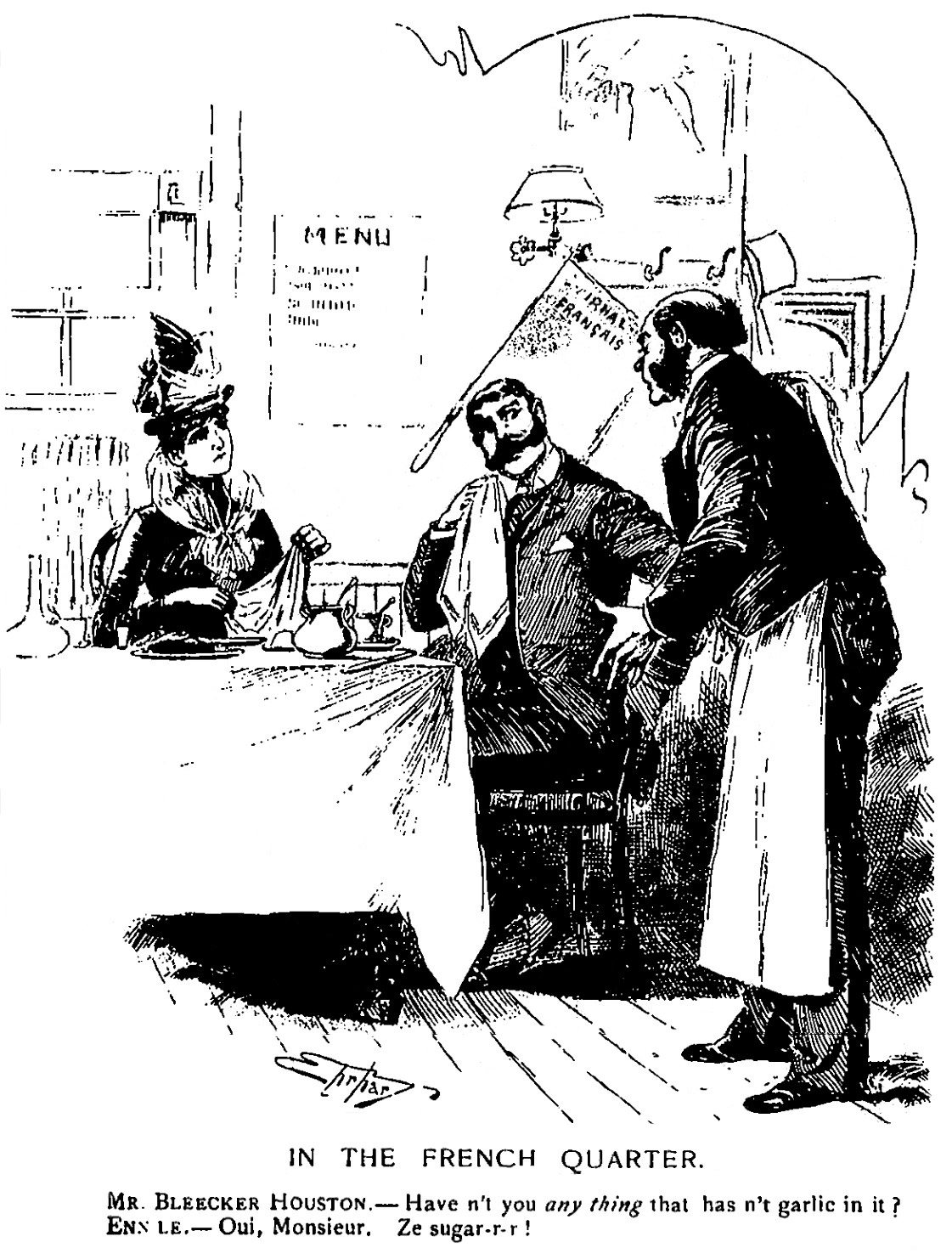
There was a time when many Americans considered inexpensive French or Italian restaurants naturally bohemian – wild and crazy, not too clean, filled with oddball characters, and offering menus of unfamiliar and dubious dishes. But nonetheless fascinating. Novelists liked to use them as settings, so they turned up in fiction of the late 19th and early 20th centuries as the excerpts below illustrate.

In the final sample presented here we meet up with a restaurant keeper who wishes his place was more bohemian because that would make it a better draw.

1886 The Midge, Henry C. Bunner – To celebrate the Midge’s 16th birthday, her guardian, a doctor, takes her out to dinner at a table d’hote in New York City’s French quarter.

It was a modest feast, only a plain table-d’hôte dinner, eaten in the heart of the quarter, at a cost of half-a-dollar apiece. They had tried more elaborate dinners, at the great hotels up-town; but they preferred the simpler joys of Charlemagne’s restaurant. They both possessed that element of Bohemianism which belongs to all good fellows; the Midge was a good fellow, as well as the Doctor.

Charlemagne’s is a thing of the past; but he was a jolly king of cheap eating-house keepers while he lasted. He gave a grand and wholesome dinner for fifty cents. The first items were the pot-au-feu and bouilli. If the pot-au-feu was thin, the bouilli was so much the richer. And if the bouilli was something woodeny, why, you had had all the better pot-au-feu before it. Then came an entrée, calves’ brains, perhaps, or the like; a rôti, a vegetable or so coming with it; a good salad, chicory or lettuce or plantain, a dessert of timely fruits, a choice of excellent cheese, and a cup of honest black coffee. And with all this you got bread ad libitum and a half bottle of drinkable wine, that had never paid duty, for it came from California, though it called itself Bordeaux.

1896 Some Modern Heretics: A Novel, Cora Maynard – About two women who adventurously move to Boston to live in a flat and do their own housework. But they don’t know how to cook.

And the alternative of tramping out to restaurants at all hours was a Bohemianism which, in spite of her late advancement, she could not contemplate serenely. It appeared positively disreputable. If her father knew of the actual circumstances of her situation a prompt withdrawal of his original consent would have cut short Vida’s visit on the spot; but she left him in tranquil ignorance . . .

By seven o’clock the girls realized that it was time to have dinner, and then came Vida’s great trial. It was too late to think of cooking anything themselves, so there was nothing to do but face the restaurant.
“Isn’t it a very – a very queer thing to do?” Vida ventured feebly. She would much rather have bought some crackers and eaten them at home in their unpalatable dryness.

“Why, no. It’s a little quiet place we’re going to. I’ve often been. You know we girls don’t believe in being restricted by senseless prejudices. Good gracious, one can’t be so dreadfully hampered in these days of rationality!”

Before long Vida got used to the restaurant, and even enjoyed it when they felt too tired or too lazy to struggle with the cookbook. She enjoyed the whole queer situation and got a taste of such freedom as she had never before dreamed of.

1910 Predestined, Stephen French Whitman – Featuring Benedetto’s, a favorite with artists in New York City.

On the north side of Eighth Street, close to Washington Square, an old, white dwelling-house had been converted into an Italian restaurant, called “Benedetto’s,” where a table d’hôte dinner was served for sixty cents. Some brown-stone steps, flanked by a pair of iron lanterns, gave entrance to a narrow corridor. There, to the right, immediately appeared the dining-room, extending through the house — linoleum underfoot, hat-racks and buffets of oak aligned against the brownish walls, and, everywhere, little tables, each covered with a scanty cloth, set close together.

Felix, at the most inconspicuous table, consumed a soup redeemed from tastelessness by grated parmesan, a sliver of fish and four slices of cucumber, spaghetti, a chicken leg, two cubic inches of ice cream, a fragment of roquefort cheese, and coffee in a small, evidently indestructible cup. Then, through tobacco smoke, he watched the patrons round him, their feet twisted behind chair-legs, their elbows on the table, all arguing with gesticulations. Sometimes, there floated to him such phrases as: “bad color scheme!” “sophomoric treatment!” “miserable drawing!” “no atmosphere!” Benedetto’s was a Bohemian resort.

1912 The Soul of a Tenor, W. J. Henderson – According to a review, “The reader is taken behind the scenes at performances and rehearsals and into the dressing rooms and boudoirs of the artistes; into the café, where foreign singers congregate.”

As for those women who figure in all animated chronicles of the present kind, some of them may have had husbands, but they have tried to forget them, and usually with success. Little Italian restaurants, with hot and opaque atmospheres, are in accord with their temperaments, for their part of the opera world is hot and opaque at all seasons of the year.

It was not a pretty place, that particular Italian restaurant. All the men in it seemed to require cigarette smoke as a condiment for food, and they chewed and puffed alternately. The room was filled with a wreathing blue fog, through which strange head-dresses and still stranger gowns could be seen, for the denizens of this world always garb themselves in streamers of splendor and look not unlike perambulating lamp shades.

They were not only singers. Some were impecunious painters and some were patrons of the arts, who were wont to shout “bravo” from the highest seats in the temple. It gave them a fine satisfaction to eat within reach of real singers. And they were not all Italians, for one feast of spaghetti makes the whole world of Bohemia kin.

1914 Our Mr. Wrenn; The Romantic Adventures of a Gentle Man, Sinclair Lewis – Mr. Wrenn is a lonely lodger who timidly invites a neighbor, Theresa Zapp, to dinner at a restaurant run by Papa Gouroff. She is described as “forward” and “gold-digging.” Although she is not interested in Mr. Wrenn, she accepts his invitation, but fails to be impressed by the restaurant.

The Armenian restaurant is peculiar, for it has foreign food at low prices, and is below Thirtieth Street, yet it has not become Bohemian. Consequently it has no bad music and no crowd of persons from Missouri whose women risk salvation for an evening by smoking cigarettes. Here prosperous Oriental merchants, of mild natures and bandit faces, drink semi-liquid Turkish coffee and discuss rugs and revolutions.

In fact, the place seemed so unartificial that Theresa . . . was bored. And the menu was foreign without being Society viands. It suggested rats’ tails and birds’ nests, she was quite sure. She would gladly have experimented with pate de foie gras or alligator-pears, but what social prestige was there to be gained at the factory by remarking that she “always did like pahklava”?

Papa Gouroff was a Russian Jew who had been a police spy in Poland and a hotel proprietor in Mogador, where he called himself Turkish and married a renegade Armenian. . . . He hoped that the place would degenerate into a Bohemian restaurant where liberal clergymen would think they were slumming, and barbers would think they were entering society, so he always wore a fez and talked bad Arabic. He was local color, atmosphere, Bohemian flavor.

© Jan Whitaker, 2024

6 Comments

Filed under alternative restaurants, ethnic restaurants, food, Offbeat places, patrons

Anatomy of a restaurateur: Clifford Clinton

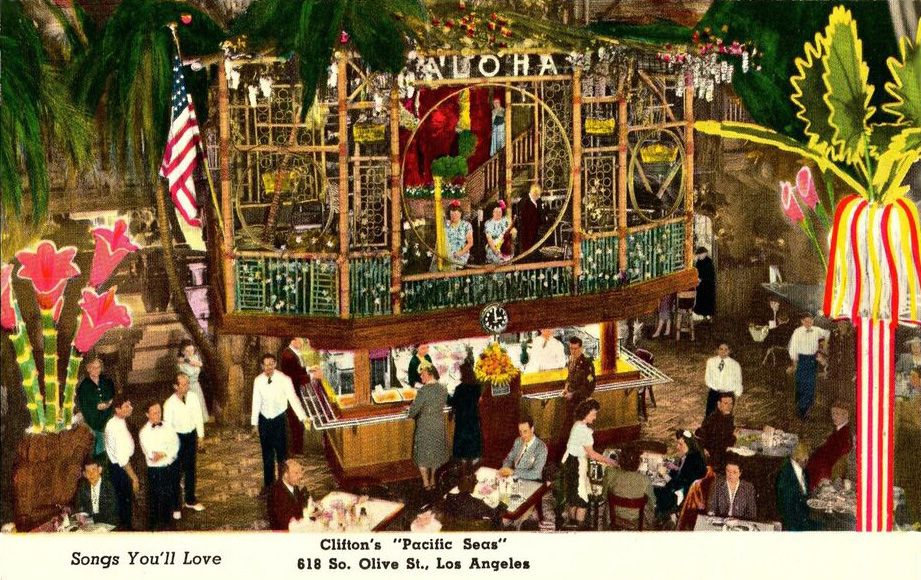
Rarely is the word fantastical used to modify the word cafeteria. Nor are restaurant proprietors usually thought of as powerful vice crusaders. [cover, 1940s booklet; below Pacific Seas]

A major exception of the latter was Clifford Clinton, creator of two of Los Angeles’ most memorable cafeterias. Both Clifton’s Pacific Seas and Clifton’s Brookdale were indeed fantastical, exotic, and composed of an odd blend of entertainment and salvation. In appearance they anticipated elements of Disneyland as well as Polynesian restaurant decor.

One of their strangest aspects was that they represented Clinton’s missionary work. After a few years of operating his father’s Puritan restaurant chain in San Francisco – previously owned by moralist Alfred W. Dennett — he came to Los Angeles in 1931 and re-opened a former Boos Brothers cafeteria at 618 S. Olive.

By the following year he was running that “Clifton’s” cafeteria plus another one on W. Third, one on Hollywood Blvd, a hotel probably housing his employees, “A miniature Cafeteria of the Tropics” in Whittier, and a “Penny Caveteria” in a basement on S. Hill street that offered dishes for 1 cent each.

In October 1932, perhaps the worst year of the Depression, a newspaper featured a smiling woman in the Caveteria with her 5¢ meal of soup, veal loaf, macaroni, sliced tomatoes, and buttered bread. According to another story, she was but one of an average of 4,500 customers fed each day (except Sundays, when all Clifton’s closed). Lines typically stretched down the street. For Christmas that year 7,000 guests enjoyed a Christmas turkey dinner priced at 1¢.

In 1939 Clinton remodeled the redwood-forest-themed Clifton’s Brookdale that had opened in 1935 as well as the original place on S. Olive, Clifton’s Pacific Seas, with a dazzling Polynesian look, neon palm trees, and many, many waterfalls. [Brookdale interior shown above; below more waterfalls, Pacific Seas exterior]

Along with meals, the restaurants acted as social centers and spiritual retreats for the thousands of uprooted mid-westerners who had relocated to Los Angeles. And they served as a kind of political base for Clinton’s reform campaigns. His cafeterias and his political activities were entirely consistent with the tenor of Los Angeles culture of the time. As George Creel summarized it in a 1939 Colliers article, the city throbbed with “two thousand religious cults . . ., each claiming daily and direct communication with Jehovah, and an equal number of social, economic and political movements: Epic, Social Credit, Utopia, the Townsend Plan and Thirty Dollars Every Thursday, etc., all guaranteed to promote the immediate salvation of mankind.”

Religiosity permeated the Clifton’s Cafeterias, as it had Dennett’s and would in a number of restaurants later in the century. If guests left the main dining room of Pacific Seas and entered the basement they would find a life-sized figure of Jesus praying in The Garden of Meditation [shown above]. Brookdale featured a Little Chapel set amidst the redwoods.

During World War II, Pacific Seas diners could also post their “feelings and wants” on a bulletin board or consult with a “Mrs. Von” in her bamboo hut for advice on personal problems.

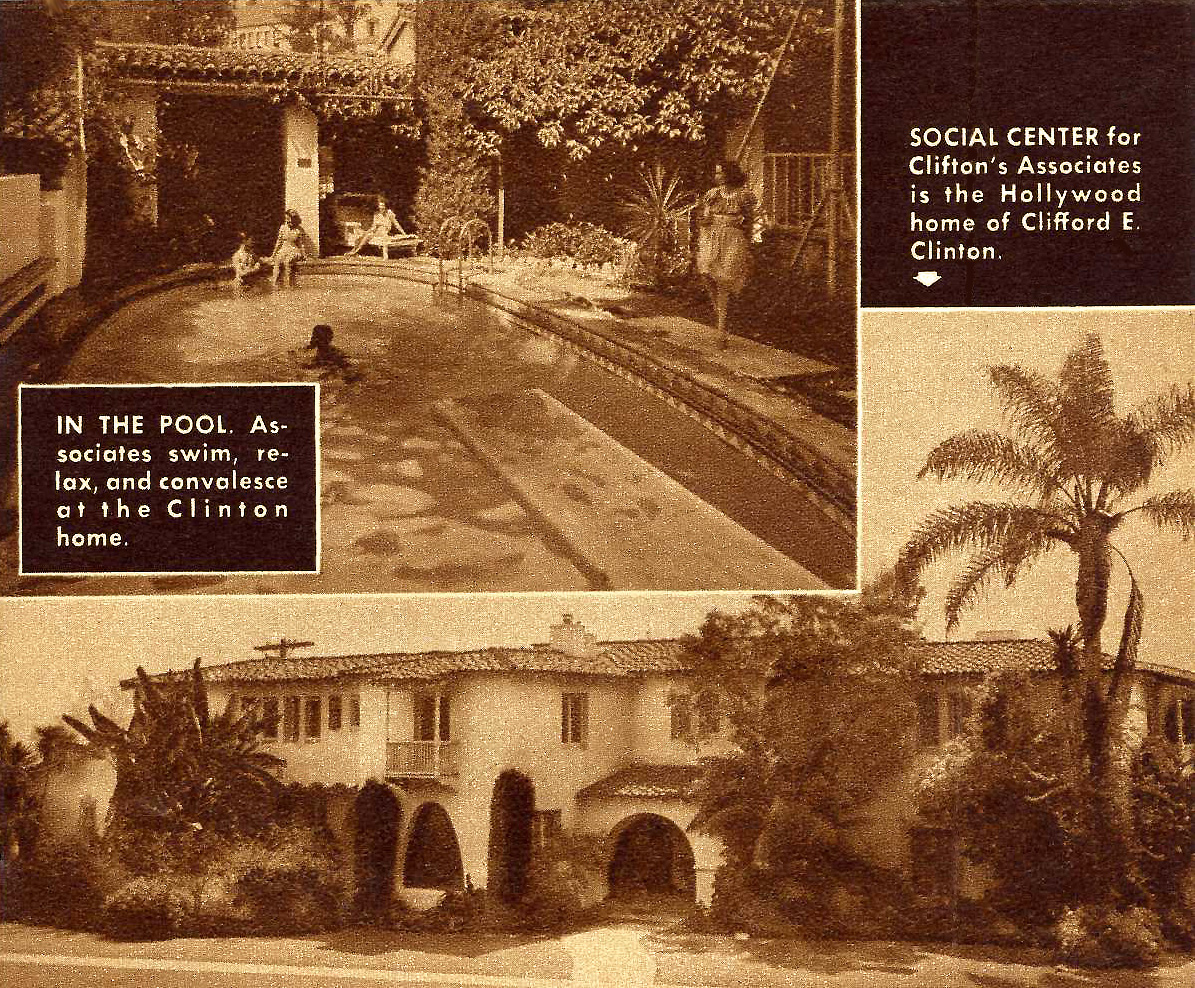
Clifford Clinton’s mission to offer affordable meals continued throughout his career. The policy was that no one would be turned away because of a lack of funds. Although the practice undoubtedly ate into revenue, and was probably taken advantage of by some, Clinton managed to amass enough profits to live in a sprawling mansion on Los Feliz Blvd. and Western Ave in which he hosted convalescing employees [shown above]. (The house sold last year for close to $5M.)

Clifford Clinton was as colorful as his restaurants, despite his appearance as a conventional religious and civic-minded family man. He had spent much of his childhood in China with his missionary parents, an experience that he said made him ultra-sensitive to human hunger. That is unusual but it was just a prelude to his role as one of Los Angeles’ prominent crusaders of the 1930s dedicated to cleaning up the city’s vice and political corruption.

He succeeded in getting Mayor Frank Shaw recalled and replaced by the candidate of his choice, who he promoted on his radio show. In addition, the city’s police chief was indicted and found guilty of plotting the car bombing that severely injured the private detective working for Clinton’s lawyer.

Clinton’s success as a crusader has been partly attributed to his alliances. He worked with Protestant ministers under the banner of an organization he created known as C.I.V.I.C (Citizens’ Independent Vice Investigating Committee). And he also allied with the Communist Party during its popular front phase. As a result of these efforts, gambling, prostitution — and the city’s anti-Communist Red Squad — were eliminated, or at least removed from sight.

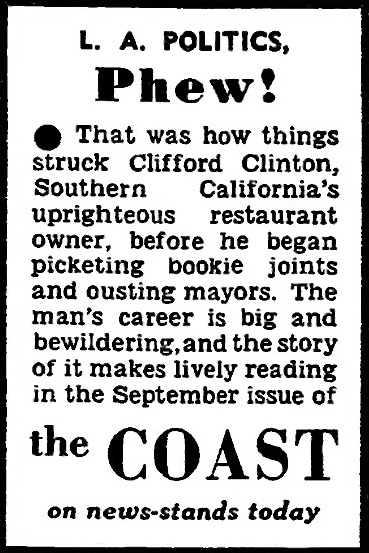
Through these years Clinton experienced endless phone threats, a bombing at his home, false reports of food poisoning at his restaurants, and an endless array of dirty tricks such as an invasion of one of his public forums by 300 hungry people who had been given tickets for a (non-existent) free meal of chicken and beer. [above: 1939 advertisement for magazine article; below: Clinton examines bomb damage]

Having turned the cafeterias over to his children in 1946, Clinton and his business partner, Ransom Callicott, focused on world hunger. They found a scientist who developed what would be known as Meals for Millions, a soy-based one-dish meal that could be prepared as soup or, with a little flour or corn meal added, bread.

Clinton died in 1969 but his restaurants, including a number of conventional ones in shopping centers, endured well into the 2000s.

© Jan Whitaker, 2024

11 Comments

Filed under cafeterias, Offbeat places, popular restaurants, proprietors & careers, restaurant decor, restaurants, theme restaurants