 In his 1904 Culinary Handbook, Charles Fellows pledged: One of my first thoughts in writing this handbook was to abstain from French terms. I said to myself, I WILL WRITE AN AMERICAN CULINARY HANDBOOK FOR AMERICANS. I have heard it frequently stated that the terms for the bill of fare could not be properly represented in the American language. I SAY IT CAN, and as proof positive you have it here. There are no French terms used for the receipts [recipes] of this book, and the headings as given are what should in my opinion be placed on the bill of fare, as perfectly adequate in describing the dish.
He was unable to keep his pledge. There are French terms throughout the handbook. On one typical page appear not only the fairly commonplace French words purée and sauté, but also béchamel, epigramme, haricot, matelote, saûtoir, and vélouté. He duly translates Chicken Chasseur as “Broiled chicken, Hunter’s Style,” but then instructs the cook to serve it with “sauce chasseur.”
Fellows felt that many dishes on restaurant menus went unordered simply because diners didn’t know what they were. This may have been true, especially since the dining public was broadening in the early 20th century, bringing unsophisticated but monied newcomers into high-class restaurants.
French terms began to appear on American menus in the 1850s. By the 1890s their use was considered essential for luxury restaurants. But the tide began to turn around the 1920s when people started eating lighter, faster meals and menus were greatly scaled down, simplified, and rendered in English. The 1918 menu of the Tuxedo Rotisserie and Grill actually listed “Frog Legs in Paper Bags” rather than the dreaded en papillote. But, there are terms that remain today and still puzzle diners. Many of the menu terms below were not well known by most Americans in the 1890s, nor even 40 years later.
compote – a dish of fruit stewed in sweetened liquid, sometimes a dessert as was the case with Compote of Apricots and Rice which appeared on an 1893 menu at San Francisco’s Delmonico’s Restaurant. But I have also seen “Pigeons en compote” on an 1841 menu.
fricandeau – sliced meat or fish fried or braised and sauced, similar to a fricasée. In 1839 Fricandeau of Veal appeared in the French section of a menu of the Astor House, a first-class NYC hotel. This term is antiquated today.
glacé – according to Restaurant Menu Planning (1954), this word is an excellent one for menus, right up there with oven-baked and crisp. It properly refers to reduced meat stock that can be used to give flavor and sheen to dishes. Sweet Breads Glace was on the menu for a special dinner at the Rankin House, Columbus GA, in 1887.
jardiniere – Le Jardinier de Macaroni à la Italienne appeared on an 1843 Tremont House menu under Hors D’Oeuvres. In 1915 the Budweiser Café in Indianapolis IN offered “Fricandeaux (perhaps indicating by the “x” that there is more than one slice) of Veal, Jardiniere” for a mere 30c. Jardiniere indicates a dish served with a garnish of cut up mixed vegetables, perhaps in gravy. In 1965 the Armour Company advertised a new product which provided restaurants with flexible film pouches containing eight servings of braised oxtails jardiniere.
la financiere – Sweetbread patties a la Financiere as served at Fleischmann’s in NYC in 1906 undoubtedly were patties made from the thymus glands of veal or young lambs with a garnish or sauce of button mushrooms, bits of truffle, and possibly some cockscombs (yes, the red things atop roosters’ heads) with Sherry or Madeira wine.
maitre d’hotel – The Broiled Halibut, maitre d’hotel on the menu of New York’s Café des Ambassadeurs in 1905 was fish with a melted butter sauce to which was added lemon juice, chopped parsley, and a little grated nutmeg. The popular and expensive Jack’s in San Francisco dared in 1947 to offer Broiled Spring Salmon Steak à la Maitre d’Hôtel, giving the words their full accented treatment. (The menu also featured Tripe à la Mode de Caen.)
ragout – this word, now antique, was almost synonymous with French cooking in the early 19th century and critics always referred to it when criticizing French food for its overseasoned character which was believed to be unhealthy and induce drinking. In short it means spicy stewed meat and vegetables. When given a French name, western restaurants could sell stew at high prices to miners who felt they were living large. Ragout of Mutton appeared on a 1903 menu of the Occidental Hotel, Breckenridge CO.
rissole – According to Delmonico’s long-time chef Charles Ranhofer, in the 1890s rissoles were one of many items that could be served for the hors d’oeuvres course which followed soup. They were made of chopped meat, or possibly fish, vegetables, or even fruit, which was held together with egg, formed into a rounded shape, encased in crumbs or pastry, and fried.
quenelles – meat or fish forced through a small mesh and formed into balls, such as the marrow balls in the Green Turtle Soup aux Quennells a la Moelle served at the Central Hotel in Charlotte NC in 1896 or Quenelle of Calves Liver, German Style, served at Kentucky’s Louisville Hotel in 1857. Not long ago I attended a forum in NYC which declared quenelles, and the fancy cuisine they represent, totally decrepit.
vol au vent – a pastry basket from which a “lid” is cut and replaced after inserting a filling of delicately sauced meat, fish, vegetables, or fruit. The case is then baked. Sometimes found grossly misspelled on menus as in “voloven garnie de clams a la poulette,” which presumably is pastry with a chicken filling garnished with clams.
© Jan Whitaker, 2010

 It seems as though almost all of history’s food forces have cooperated to give cheese top billing in restaurant meals today. Only one cheesy custom failed to catch on, that of finishing a meal with cheese and fruit as was done in small French and Italian restaurants in the later 19th century. Craig Claiborne argued in 1965 that even the best New York restaurants didn’t know how to handle the cheese course. They had poor selections which tended to be old, overripe, or served too cold. One restaurant admitted their chef was in the habit of popping cheese straight from the fridge into the oven to soften it. Restaurateurs that Claiborne interviewed insisted that Americans didn’t like cheese after a meal. I’d agree that most prefer their after-dinner cheese in the form of cheesecake.
 Cheese has been a staple food in American eating places probably since the first tavern opened. Regular meals were served only at stated hours but hungry customers could get cheese and crackers at the bar whatever the hour. For “Gentlemen en’passant,” the Union Coffee House in Boston promised in 1785 that it could always furnish the basics of life: oysters, English cheese, and London Porter. Across the river in Cambridge, the renowned
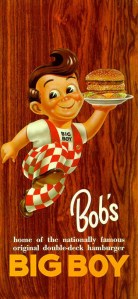
 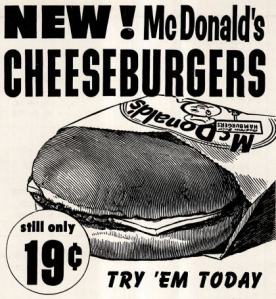 Cheeseburgers were a product of the fast food industry of the 1920s, claimed as inventions by both the Rite Spot of Southern California and the Little Tavern of Louisville. Strange there aren’t thousands of other contenders because what was there to invent, really? Cheeseburgers were strongly associated with Southern California before WWII — Bob’s Big Boy of LA introduced cheeseburgers in 1937. Another step forward came in the 1930s when a bill was introduced in the Wisconsin legislature requiring restaurants and cafes to serve 2/3 oz. of Wisconsin cheese with every meal costing 25 cents or more. In the same decade Kraft Cheese was among major food producers providing restaurants with standardized recipe cards.
 It was after WWII that cheese spread its melted gooeyness everywhere — on
  When we get into questions of the origins of certain dishes we have left history behind and entered into the murky depths of lore and legend.
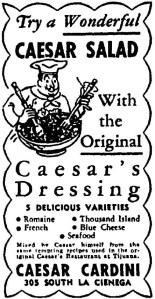
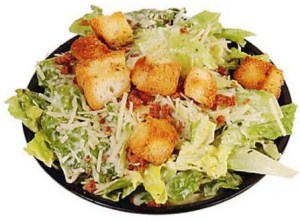 A strong inventorship claim was presented by Caesar’s brother, Alexander, in the 1960s. Caesar died in 1956, while running a grocery store in Los Angeles where he produced and bottled Caesar salad dressing. According to Alexander’s son, who ran Cardini’s in Mexico City, the two brothers had developed the salad together in a Tijuana restaurant in their younger days, improvising on a recipe their mother used when they were boys in Italy. In this “Mother’s recipe” account, the salad was initially called “Aviator’s salad” in honor of their customers who were soldiers, sailors, and airmen.
 In the 1850s the great landscape architect Frederick Law Olmsted, designer of New York’s Central Park, traveled through the South to investigate the institution of slavery. His observations were published in three volumes which were influential in turning readers against slavery. Around 1857 he traveled to Memphis, Tennessee, where he stayed at the Commercial Hotel. Although it was considered a first-class establishment, things did not go well for Frederick in the dining room as his journal entry for March 20, below, reveals. Among the dishes appearing on the not-too-elegant menu were “Beef heart egg sauce,” “Calf feet mushroom sauce,” “Bear sausages,” “Fried cabbage,” and, for dessert, “Sliced potatoe pie.” Better than whole potato pie, I guess.
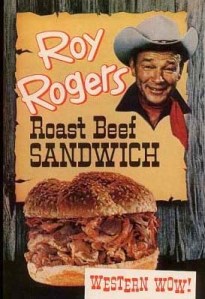 People have strong feelings about their favorite dishes from restaurant chains. I am thankful to all those who poured their hearts out on the subject on Jane & Michael Stern’s ever-fascinating Roadfood forums. I have excerpted the following wistful memories from “Long-gone regional franchises” which took on a life of its own and ran for years. After each snippet is the pertinent chain restaurant.
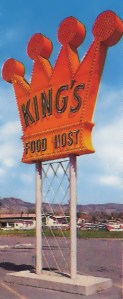 — The Cheese Frenchies were unique. [King’s Food Host]
 — Pickles, diced onion, relish, mustard, ketchup and mayo were all available. [25 Cent Hamburger]
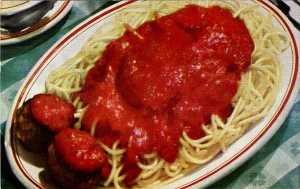 In the 1890s it was considered daring to go to an Italian restaurant and eat spaghetti. The restaurants were not in affluent neighborhoods and some middle-class people worried (largely needlessly) about how clean they were. Non-drinkers didn’t approve of the “red ink” (wine) that came with the spaghetti. Some women felt it was not ladylike to eat spaghetti in public. Then there was the garlic, which was considered seriously foreign by many Americans. But others, especially offbeat types – artists, musicians, and free spirits known as “bohemians” — loved the whole experience: spaghetti, wine, garlic, low prices, and the friendly atmosphere found in most Italian places. The future of spaghetti belonged to them.
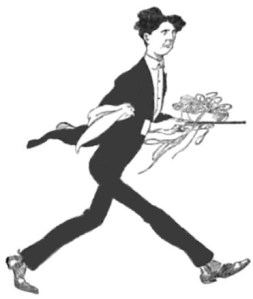 The bohemian fad for spaghetti grew stronger in the early 20th century, particularly in lower Manhattan and San Francisco. Diners flocked to Gonfarone’s in Greenwich Village. Despite its low prices, the restaurant made money because a 50-cent dinner with a complimentary glass of wine cost but pennies to put on the table – about 2 cents for the spaghetti and a few cents for a carafe of the red California claret bought by the barrel, 40 or 50 at a time.
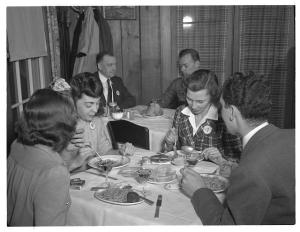 Spaghetti, Italian and non, continued as a staple restaurant dish during successive decades, in speakeasies of the 1920s, Depression dives and diners, and a variety of restaurants during the meatless months of World War II. Next came pre-cooked meatballs and prepared sauces in the 1960s and 1970s which meant even virtually kitchenless restaurants could serve spaghetti. Its cheapness and the fact that children like it also made spaghetti a favorite of family restaurants, and the basis of chains such as the Old Spaghetti Factory, the original of which was started in Portland OR by a Greek immigrant in 1969.
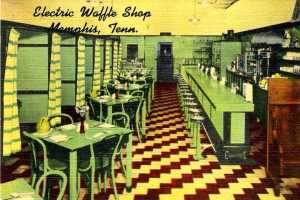 In the early 19th century Philadelphians enjoyed driving their carriages to the falls on the Schuykill River, the area now known as East Falls, then lined with hotels and restaurants. Eating places there specialized in a favorite dish associated with Philadelphia long before the advent of cheese steaks, namely catfish and waffles. (I’d like to believe that the dish did not include maple syrup.)
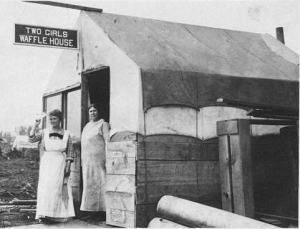 Well into the 20th century waffles were familiar fare in boom towns such as Anchorage, Alaska, and the oilfields of Oklahoma. Around 1915 two young women from Seattle decided to seek their fortune in Alaska with the Two Girls Waffle House (pictured). In what was not much more than a shack with a canvas roof they could handle only eight customers at the counter. But after a year they had made enough money from railroad construction workers to build a permanent structure. A similar success story could be told about the two young men who ran the Kansas City Waffle House in Drumright, Oklahoma, before graduating to a bigger enterprise in Tulsa.
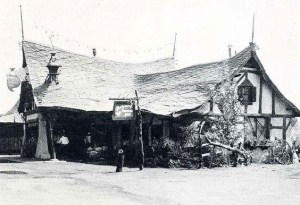 Waffles were also a staple of tea rooms in the early 20th century. In places as varied as big city afternoon tea haunts and humble eateries in old New England homesteads, waffles attracted patrons. In 1917 New Yorkers could choose among the
  For decades pizza was seen as a light snack rather than a meal, much as it had been on the streets of Naples for centuries. An English visitor to Naples in 1843 noticed small bakeshops where “a constant hissing and thick smoke indicated the preparation of pizze, (composed of flour, lard, eggs, and garlick) and muzzarella.” In 19th-century Italy, as now, there were a variety of toppings: grated Swiss cheese, olive oil, tomatoes, and anchovies or other fish. Southern Italians brought the dish to America, and in 1903 a New York newspaper took note of a dish known as “pomidore pizza” or “tomato pie” sometimes topped with salami.
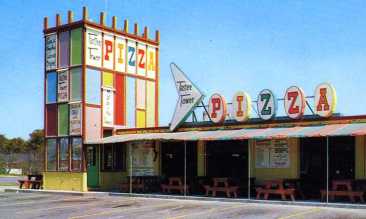 Boosted by prosperity, casual suburban lifestyles, and burgeoning youth culture after the Second World War, pizza leaped into popularity. But it was not known well everywhere. For instance, in 1948 a Corpus Christi TX restaurant review referred to the “unusual” item as “pietza pie.” It was much better known in Chicago. In 1953 there were already more than 100 pizza parlors there.
 It's great to hear from readers and I take time to answer queries. I can't always find what you are looking for, but I do appreciate getting thank yous no matter what the outcome.

 Restaurant-ing through history