Category Archives: chain restaurants

Eating, dining, and snacking at the fair

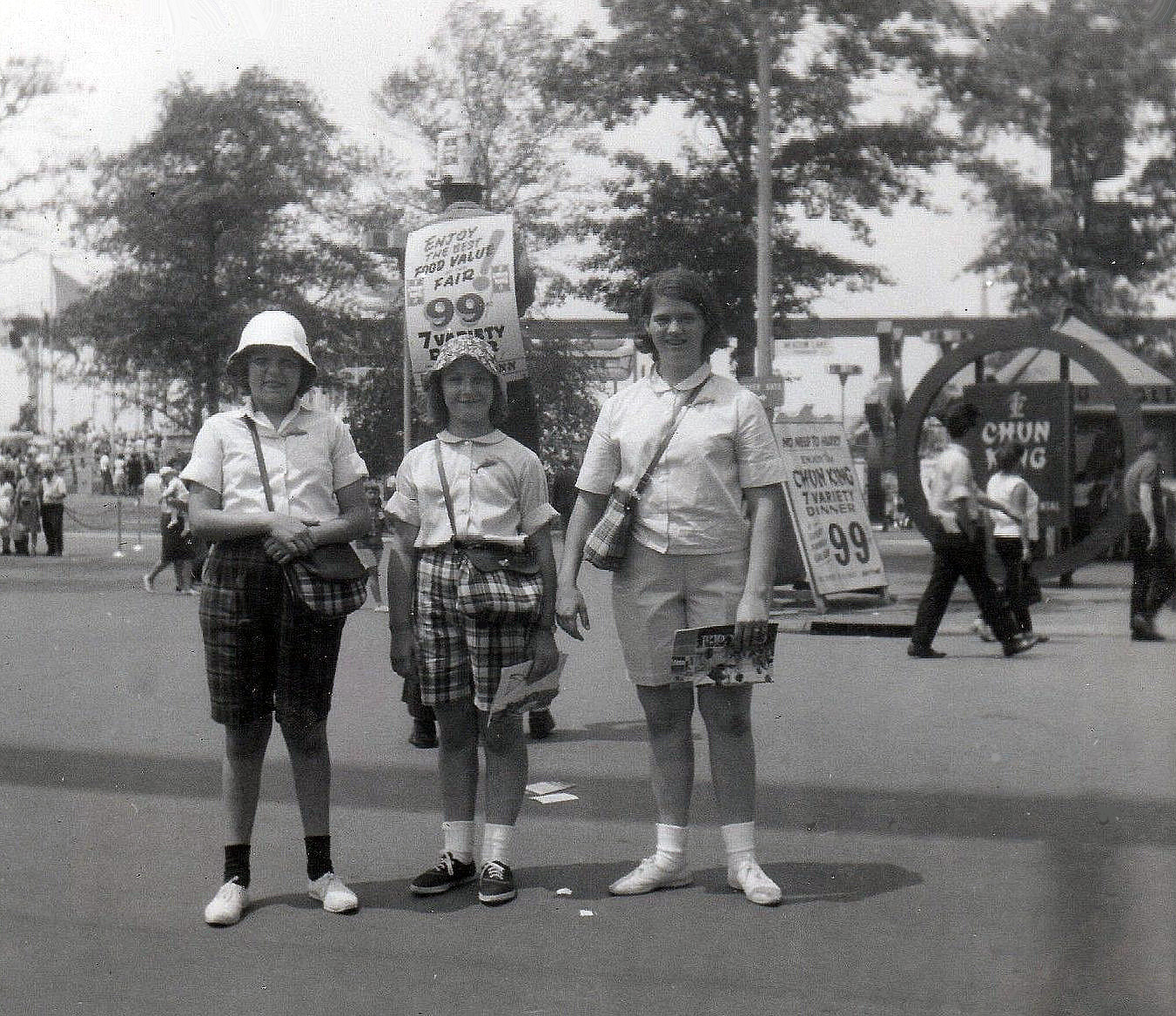
1964World'sFairChunKingphoto

Fifty years ago the 1964-65 New York World’s Fair was underway, with thousands going through the turnstiles. Sooner or later they had to eat. Some brought a picnic but others patronized the roughly 110 restaurants in operation the first season, up to nearly 200 in 1965.

The Fair was not officially sanctioned by the Bureau of International Expositions nor supported by governments (for the most part); it was a commercial enterprise filled with corporate pavilions such as Johnson’s Wax, General Motors, and Travelers Insurance. Most of the restaurants were run by private entrepreneurs who were not necessarily from the country represented by the pavilion. Restaurant Associates, which operated Mamma Leone’s, The Four Seasons, and others in NYC, ran the restaurant in the Indonesian Pavilion and five others. New York’s Sun Luck chain ran the Cathay Chinese Restaurant in the Hong Kong Pavilion.
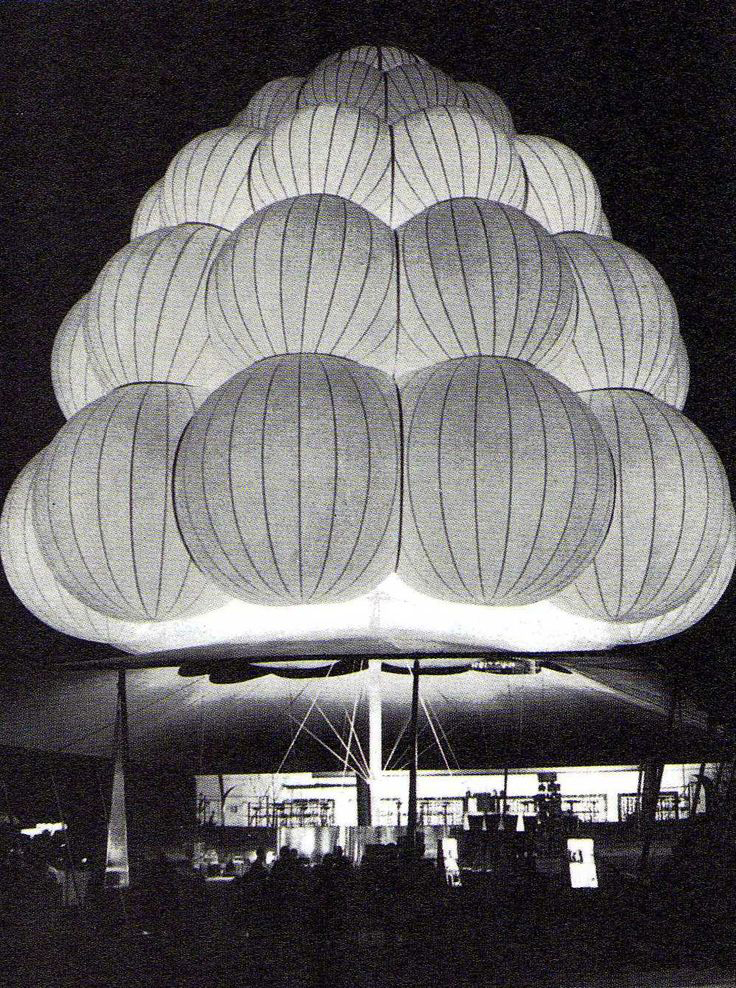
1964NYWorld'sFairBrassRailsnackbarBiggest of all, the Brass Rail operated six moderate-priced restaurants, each offering a single complete meal for $3. In the International Plaza they ran both a cold Danish buffet and the Garden restaurant offering Southern fried chicken dinners. The company, a subsidiary of Interstate Vending Co. in Chicago, also had 25 freestanding snack bars with balloon-shaped roofs that looked as though they could lift off and float away.

Most of the eating places at the Fair supplied casual food and snacks, whether strawberry and whipped cream filled Bel-gem waffles (the hit of the Fair), Wienerwald hot dogs, or Chicken Delight(s). Providing plentiful fast food was based on the belief that non-New Yorker Americans would accept nothing else. Keep in mind too that it was the mid-1960s before the culinary revolution came along with its hopes of replacing industrially produced convenience food.

There was also no shortage of exotic cocktails served at tiki bars and lounges, and American and imported beers flowing in beer gardens. During groundbreaking for the Schaefer Brewing Company Center, which contained Schaefer’s Restaurant of Tomorrow and a beer garden, Fair president Robert Moses advanced a surprising perspective on the Fair’s theme, Peace through Understanding, by declaring that beer was probably “the thing that holds the world together.”

International edibles ranged from the passably authentic to the thoroughly Americanized. Yet however tame the Fair’s version of world cuisine often was, those fairgoers daring enough to go beyond burgers and dogs found a wide selection of food unknown to most Americans then. Among the many unfamiliar dishes were smoked reindeer at the Swedish Pavilion, spicy Korean spareribs, and stewed meat with peanuts and couscous at the Tree House restaurant in the African Pavilion.
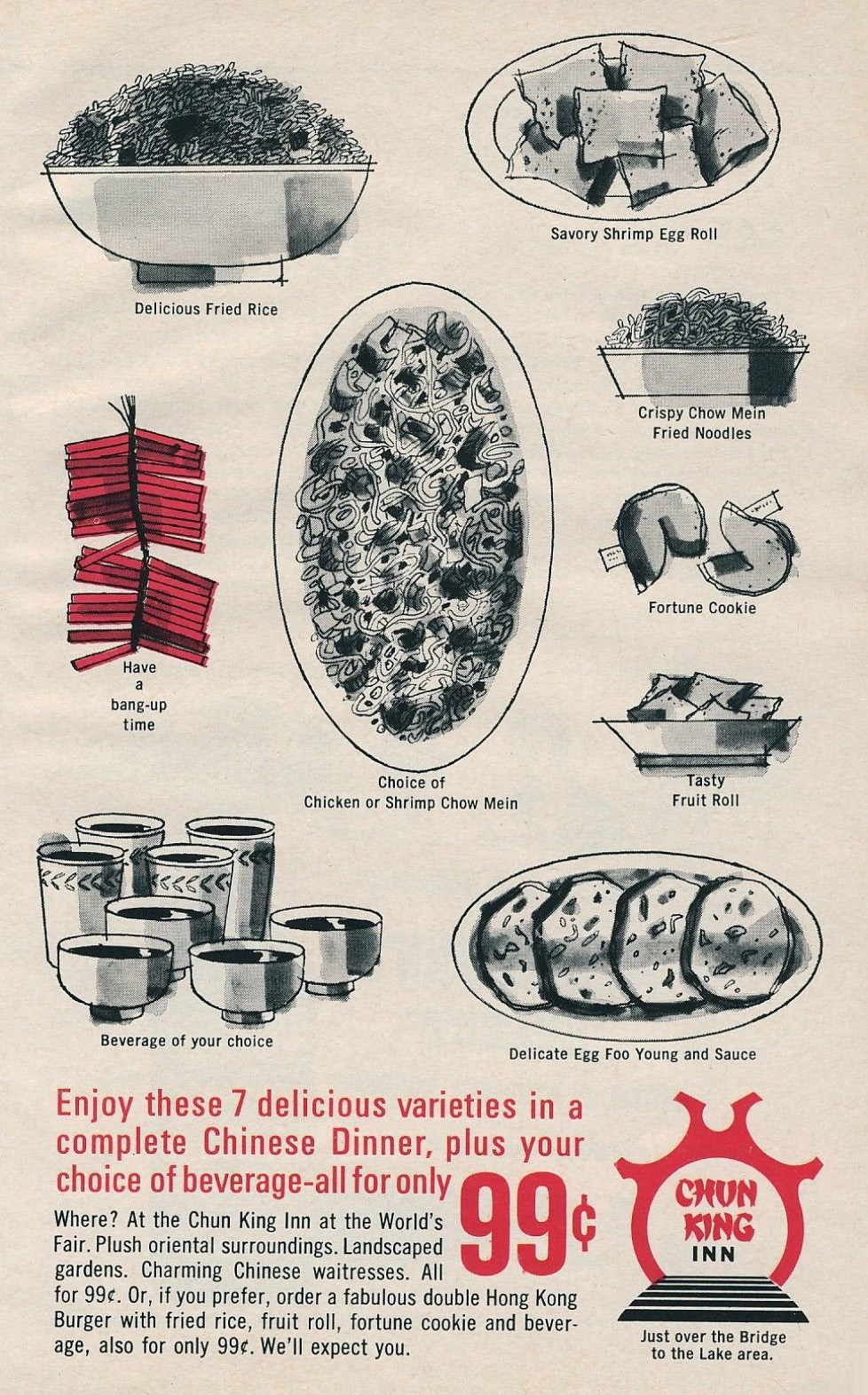
1964NYWorld'sFairChunKingRepresenting American-style Chinese food was the Chun King Inn, whose mission was not so much to run a profitable restaurant as to familarize people with Chun King products sold in supermarkets. It won over the public — who often complained about high restaurant prices at the Fair — by serving full meals consisting of seven items for only 99 cents. The Inn also featured a double-patty Hong Kong Burger with cheese, lettuce, special sauce – and bean sprouts for an Asian touch. Many restaurants did poorly at the Fair, but Chun King’s president reported that the Inn served 5 million customers the first year.

Probably the most successful restaurants were those directed by veterans of earlier Fairs, particularly Seattle’s in 1962 and New York’s in 1939. Repeaters from 1939 included the operator of the Century Grill who had run the Aviation Grill in 1939 and Schaefer Brewing Co.  Seattle businessmen subleased a restaurant in the Fine Arts Pavilion named the Bargreen Buffet to Roy Peterson, proprietor of Seattle restaurants including the Norselander. Another restaurateur from Seattle, William Moultray, did so well with his Polynesian restaurant in 1964 that Fair officials asked him to set up a restaurant complex in another pavilion.
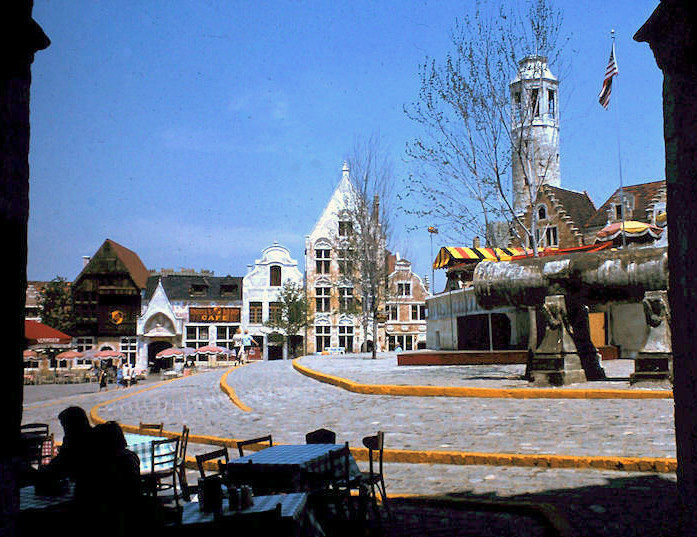
1965World'sFairBelgianVillage

The Belgian Village [shown above in part] consisted of 100 buildings and 20 eating places, some of them outdoor cafes, but was not completed until the end of 1964. A similar village with some of the same buildings had been at Chicago’s Century of Progress Exposition in 1933.

Although critics were disappointed that there was nothing to equal Henri Soulé’s 1939 French restaurant (origin of NYC’s Le Pavillon), everyone agreed that the restaurants in the Spanish Pavilion came closest. Unlike most, it was officially supported by Spain’s government, headed at that time by dictator Francisco Franco. Two restaurants in the pavilion, the moderately priced Granada and the expensive Toledo, were under the management of Madrid’s Jockey Club which imported its chef and 40 of his assistants. So popular was the pavilion’s outdoor seafood bar, the Marisqueria, that it was enlarged in 1965. It was under the direction of Alberto Heras who opened a Spanish Pavilion restaurant on Park Avenue in NYC in 1966.
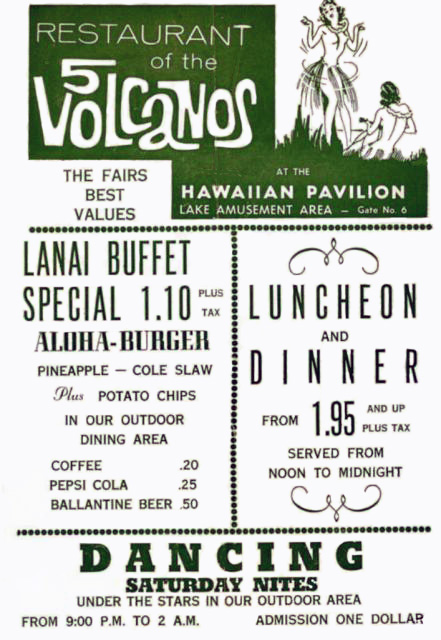
1964World'sFairFiveVolcanoesRestHeras was one of several restaurateurs who tried to extend their success beyond the Fair. The Spanish Pavilion building was removed to St. Louis by then-mayor Alfonso Cervantes, where it housed three restaurants that met a rapid demise. The maestro of Wienerwald, Friedrich Jahn, extended the Europe-based chain into this country. It had grown to 880 units by the early 1980s when it failed. The Petersons of the Bargreen Buffet took over management of New York’s venerable Janssen’s restaurant. The Wisconsin Pavilion’s Tad’s Steaks, with its popular $1.19 sirloin steak dinners, became a fixture with bargain-meal hunters in NYC.

Although the Fair fell short of meeting its attendance goal of 70 million, drawing only 52 million fairgoers, it’s likely that millions of them carried away lasting food memories.

© Jan Whitaker, 2014

16 Comments

Filed under chain restaurants, family restaurants, miscellaneous, odd buildings, outdoor restaurants, theme restaurants

Toddle House

toddlehouseca1940

The Toddle House chain occupied “cozy cottage” style buildings that were quite popular as restaurants, gas stations, and cabin camps in the Depression. On the outside Toddle Houses projected an exaggerated Colonial doll-house version of domesticity, with two oversized chimneys and a primly manicured lawn.

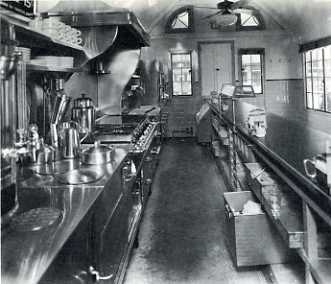
toddlehouseinteriorca1939Inside, though, a very functional, almost clinical interior greeted customers: A back wall of stainless steel kitchen equipment, a counter with a dozen comfortless, backless stools (“in and out in 12 minutes”), bare windows, bathroom-tile wainscoting, and NO fireplaces. Open 24 hours, their menus were limited and featured hamburgers and breakfast at all hours.

ToddleHouseStedmanpatentAdding another touch of no-nonsense modernity was the “cashier machine” invented by founder and co-owner J. C. Stedman. Designed to keep the countermen (later women) from handling money, a mechanical box near the door received meal checks and payments in coins. After a counterman observed, via a mirror inside the box, that the customer had deposited the correct amount, he lifted a treadle behind the counter and the money and checks fell through trap doors into locked bins below (nos. 14 and 15 in the patent diagram).

As awkward as the contraption was – not giving change, easily circumvented by cheating employees, etc. – it remained in use at least until the 1940s and customers liked it. In Evanston IL customers felt let down, their trustworthiness in doubt, when the cashier machine was replaced by a standard cash register in 1945. Today, the old drop box system — in my view mistakenly considered an honor system — has become an object of nostalgia.

toddlehouseca.1953

The first Toddle Houses were opened in Southern states, principally Texas and Tennessee, in the 1930s. The chain never made it farther west than Omaha. In 1945 the company expanded northward with the acquisition of 46 Hull-Dobbs Houses, which resembled Toddle Houses to a remarkable degree. Toddle Houses built later were larger and of a style referred to as “New South” shown here that was plainer and even more symmetrical. Some had dining rooms and the front entrances with copper-clad canopies were enclosed by glass vestibules.

In 1946 Toddle Houses created Harlem House, for Black customers who were not otherwise welcome. Eventually there were 12 such units in Memphis, the company’s headquarters. An Atlanta Toddle House was the site of a prominent civil rights sit-in demonstration in December of 1963, in which demonstrators including comedian Dick Gregory were taken to jail.

toddlehouse1938Memphis

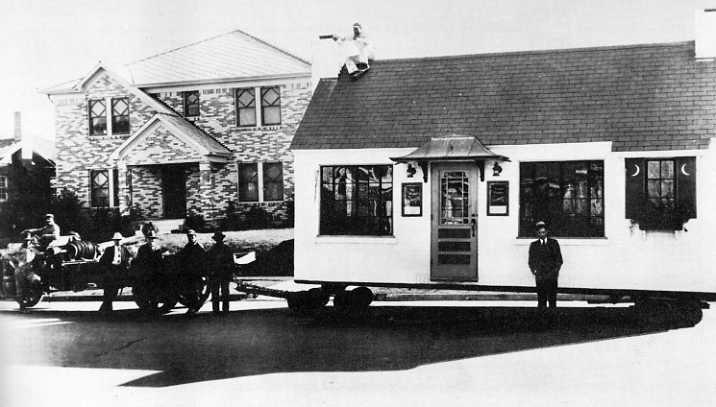
The original 24 × 12-ft Toddle Houses were prefabricated and shipped to their sites on flatbed trucks. It has been reported that their exteriors were of porcelain-coated steel for portability. Since this material is inappropriate for Colonial architecture and they do not appear to be shiny in pictures, I find the description given in Philip Langdon’s Orange Roofs and Golden Arches more convincing. He says that some Toddle Houses were “veneered with a cement coating scored to resemble brick.” Others were built of brick on site. Langdon also observes that because early Toddle Houses could be transported so easily, the possibility of moving them presented advantages when negotiating land leases. I discovered a number of them that were in fact moved.

In 1962 the Toddle House company was bought by Dobbs House which turned most of them into Steak N Egg Kitchens. In the 1980s, after another company, Carsons, bought out Dobbs, an attempt was made to revive the Toddle Houses, which by 1984 had dwindled to 11 units. Carsons built at least 45 new Toddle House units.

Though Toddle Houses no longer exist, many of the buildings continue as eating places or have been adapted for other uses, as shown in a blogpost by Dinerhunter.

© Jan Whitaker, 2014

103 Comments

Filed under chain restaurants, racism, technology

Early chains: Baltimore Dairy Lunch

baltimorelunchDetroitAPeople liked to say that the names of lunch room chains in the early 20th century offered a lesson in geography. There were Baltimore, Boston, Buffalo, Chicago, Denver, Detroit, Hartford, Iowa, Manhattan, Maryland, Milwaukee, New York, Pennsylvania, Pittsburg, St. Louis, and Utica Lunches, or Dairy Lunches as some were known. Los Angelenos patronized a New York Lunch in 1905, while customers in Duluth MN, Lexington KY, and San Francisco enjoyed their sandwiches in a Boston Lunch. Detroit had its Manhattan Lunch, while Manhattan had a Detroit Lunch. And so on.

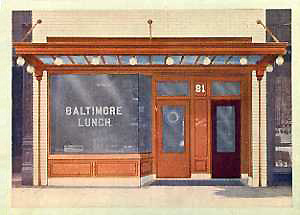
baltimorelunchDetroitBBut before the 1920s no lunchroom chain was as popular as the Baltimore Dairy Lunch which at that time outnumbered Childs. Founder James A. Whitcomb began the business in the late 1880s in Washington, D.C., where he was a federal postal clerk, then opening a lunch room in Baltimore. Along with four quasi-franchisers, he controlled about 140 units by 1920. The largest branch, under the ownership of Harry Bowles in Springfield MA, consisted of a couple dozen units. Few large cities were without a Baltimore Dairy Lunch, as Whitcomb’s were named, or a Baltimore Lunch, the name used by Bowles.

baltimorelunchDetroitCWhether they belonged to large or small chains or were independents, Baltimores or Buffalos,  all Lunches were similar. As someone put it, “It’s an age of standardization, and one restaurant is now much like every other, barring minor differences.” A humorous story in Everybody’s Magazine in 1914 featured a cranky elderly man who went around from lunch room to lunch room asking the local wits, “What is the difference between a Hartford Lunch and a Baltimore Lunch.” Their answer was always the same, “Search me.”

Regardless of their similarity, dairy lunches were regarded as characteristically and proudly American, so much so that during battle in World War I, after U.S. soldiers took control of an improvised clubhouse used by German troops, they tore down a sign the Germans had posted over the door that said “Hindenburg Rathskeller” and replaced it with “Baltimore Lunch.”

baltimorelunchDetroitBaltimore Lunches shared many features in common with the fast food chains that arrived in the 1960s. Their offerings were simple and inexpensive. No alcohol was served. Customers got their food at a counter and carried it to their seats. Seating – one-armed wooden chairs — was uncomfortable and did not encourage lingering. Patrons didn’t mind, though, because they were interested in expediting the entire getting and eating process so they could go about their business.

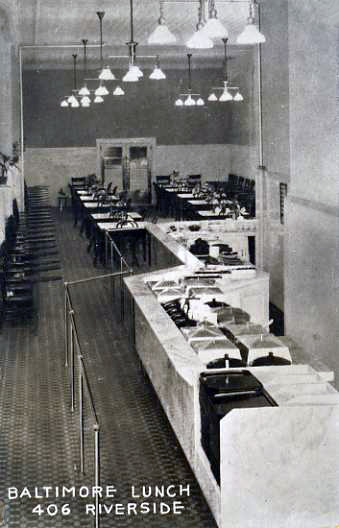
baltimorelunchDetroit710Unlike fast food architecture of the 1960s, though, Baltimore Lunches were built as solidly and luxuriously as Grecian temples. Interiors used marble lavishly for counters and fixtures. Was it because both Whitcomb and Bowles were natives of Vermont, the state where so much marble is quarried? Maybe, but I think that marble was an expression of cleanliness and investment in a growing economy’s ability to efficiently mass produce affordable, nutritious meals. A standard feature of the Baltimore Lunch – a large marble bowl filled with sugar set on a marble pedestal — can easily be seen as a representation of democratic abundance.

© Jan Whitaker, 2014

28 Comments

Filed under chain restaurants, lunch rooms

Roast beef frenzy

neba

According to Mike Davis, creator of the NEBA chain, the arrival of fast-food roast beef sandwiches in the early 1960s was a sign of an upward-bound middle class able to afford its beef sliced rather than ground to bits. His sandwiches cost 69 cents as against the 15 or 20 cents for a chain burger.

Indeed, sliced beef was big. Despite being first into the beef sandwich market, by 1967 NEBA faced competition from Arby’s, Beef Corral, RoBee’s (soon to become Roy Rogers), Heap Big Beef (with its odd Indian theme), and others. Burger King and McDonald’s were testing roast beef in some of their units and Minnie Pearl’s was poised to add roast beef to its chicken menu.

NEBAADVDavis began his fast food career with submarine sandwiches, branching into roast beef in 1960 because it was easier to produce in quantity and not commonly found in chain restaurants. There are various ideas about where the odd name NEBA came from. Almost certainly it was not an abbreviation for “Never eat burgers again.” As strange as it sounds, it’s likely that NEBA was chosen because it was the name of a dog once owned by Davis, as he said in a 1969 interview. Another possible explanation is that it was named after the New England Beef Association. “Nicest Eating Beef Around,” sometimes used as an advertising slogan, may have been a back formation.

The first sandwich shops in the NEBA chain were in the Albany NY area, the company’s headquarters before moving to Hollywood FL. In 1965 a Mike’s Submarine and NEBA Roast Beef unit opened in Pittsfield, the first in Davis’s home state of Massachusetts. Franchised units eventually opened in Florida and southern states but the chain never made it to the West.

NebadavisphotoDavis described himself as driven to make money ever since his miserable childhood in which he earned up to $100 a week by organizing a crew of boys to deliver newspapers. Reportedly he used the money to pay rent and buy food for his brothers and sisters in an attempt to make up for parental neglect. Dropping out of school after 8th grade, he was apprehended for breaking into houses and stealing money in his teens and spent time in a reformatory. Described as “tight-lipped” and “compulsive,” he confessed he felt inhuman and never laughed.

The NEBA chain reached its peak in 1969 when there were 70 units in the U.S. Having sold the Canadian branch, Davis, 35, was said to be worth $15 or 20 million at that time. In 1970 he resigned as chairman a month before the corporation declared bankruptcy. With 400 units by then, Arby’s had become the competition-busting roast beef leader.

As late as the mid-1980s a few of the original NEBA sandwich shops, in upstate New York and Miami FL, remained in business under new owners.

I don’t know what happened to Davis after he left the company. I’d like to think he found some degree of happiness.

© Jan Whitaker, 2013

64 Comments

Filed under chain restaurants, food, proprietors & careers

Taste of a decade: 1970s restaurants

1979restaurantIn the 1970s the restaurant industry and the custom of eating in restaurants grew rapidly. The decade was the gateway to the present in many ways. Despite economic woes (recession and inflation), the energy crisis, urban decline, crime, and escalating restaurant prices, restaurant-going continued to rise.

The president of the National Restaurant Association proclaimed “Dining out is a significant part of the lifestyle of this great country,” noting in 1976 that one out of three meals was being consumed outside the home.

Restaurant patronage was encouraged by all kinds of things, including relaxed liquor laws in formerly dry states and counties, which brought more restaurants into the suburbs, the spread of credit cards, more working wives and mothers, youth culture, and a me-generation quest for diversion.

New York exemplified the problems faced by restaurants in troubled inner cities. Fear of crime kept people from going out to dinner. Restaurants closed, few new ones opened, and cash-strapped survivors began to trade vouchers for heavily discounted meals for advertising. But as New York struggled, California experienced a culinary renaissance as did other parts of the country. Still, much of the U.S. wanted only steak and potatoes, and hamburger was the most often ordered menu item nationwide.

A number of restaurant formats and concepts faced senescence, but new ones came on the scene at a rapid pace. Going, going, or gone were automats, coffee shops, continental cuisine, diners, drive-ins, formal dining, Jewish dairy restaurants, and Polynesian restaurants, not to mention the rule of elite French cuisine.

Fast-food chains continued to grow, with the number of companies increasing by about two-thirds. Growth was especially strong in the Midwest which was targeted as a region susceptible to their appeal. Toledo was bestowed with Hardee’s, Perkins Pancakes, a Mexican chain, and, in 1972, the arrival of two Bob Evans eateries. Another Ohio city, Columbus, was christened a test market for new fast-fooderies while Junction City KS, bordering Fort Riley, looked like a franchiser’s fast food heaven. By contrast, greater Boston had only one Burger King and one McDonald’s in 1970.

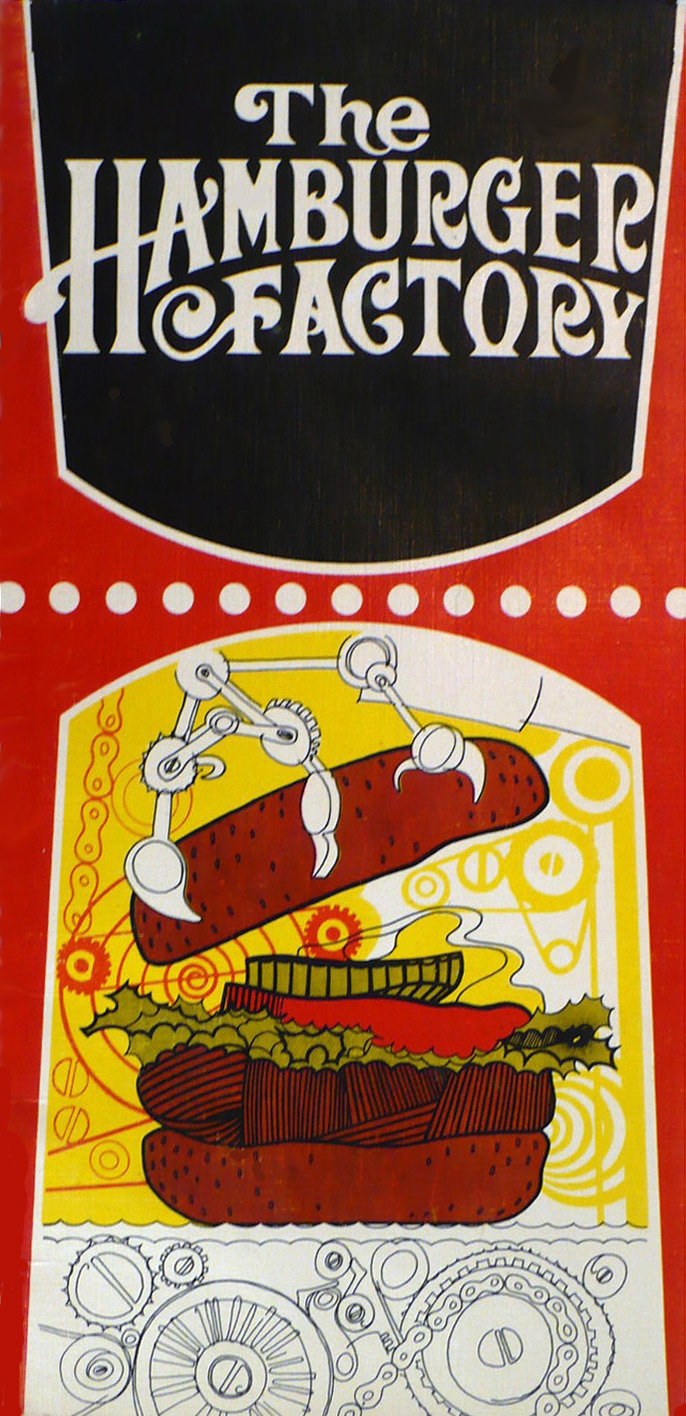
HamburgerFactoryAlong with the chains and a shortage of (cheap) kitchen help, came an upsurge in restaurants’ use of convenience foods and microwaves. In response, municipalities across the country enacted ordinances to protect consumers against false claims on menus, many of them centering on misuse of the words “fresh” and “home-made.”

Yet as the country was swamped with fast food, it experienced the flowering of restaurants specializing in ethnic, artisanal, and natural foods. Hippie and feminist restaurants stressed honest, peasant-style meals. Burgeoning interest in nutrition made salad bars popular. Bean sprouts, zucchini, and more fish showed up on menus. Diners learned that Chinese food was not limited to Cantonese, but might also be Mandarin, Szechuan, or Hunan. Once languishing behind luxurious decor, impeccable service, and famous patrons, food took center stage in deluxe restaurants as they purged Beef Wellington from their repertoire and took up the call for culinary creativity and authenticity.

Though not unknown in earlier decades, the restaurant-as-entertainment-venue came into full flourish with the proliferation of theme restaurants with unbearably cute names such as Orville Bean’s Flying Machine & Fixit Shop. To supplement a shrinking supply of old stained glass windows, telephone booths, and barber chairs, restaurant fixture companies began to manufacture reproduction antiques.

However crazy and mixed up the foodscape, America had become the land of restaurants for every taste and pocketbook.

Highlights

ChezPanissecookbook1971 – In Berkeley CA Alice Waters and friends found Chez Panisse, marking the movement of college and graduate students into the restaurant field, a career choice which is beginning to have cachet.

1972 – NYC’s Le Pavillon, considered the finest French restaurant in the U.S., closes. In Kansas City MO the first Houlihan’s Old Place, adorned with nostalgia-inducing decorative touches, opens, as does Mollie Katzen’s natural-food Moosewood Restaurant in Ithaca NY.

1972 –Dry since 1855, Evanston IL, home of the Women’s Christian Temperance Union, grants liquor licenses to two hotels and six restaurants. Their business doubles in a few months.

1973 – Los Angeles County becomes the first jurisdiction in the country to enact a “truth in menu” ordinance. During the pilot program, the scenic Sea Lion Restaurant in Malibu is caught selling the same fish under five different names with five different prices.

1974 – A Chicago food writer throws cold water on arguments about which restaurant has the best lasagne, asserting that the debaters “might have found that same lasagne in restaurants all over the country” courtesy of Invisible Chef, Armour, or Campbell’s.

1974 – Restaurateur Vincent Sardi spearheads a campaign to get New Yorkers to eat out, claiming that the city’s major restaurants have lost up to 20% of their business in the past two years, thus precipitating the closure of 20 leading restaurants.

1976 – The CEO of restaurant supplier Rykoff says whereas his company once supplied whole tomatoes it now provides diced tomatoes “because the operator just can’t afford to pay someone to cut them up.”

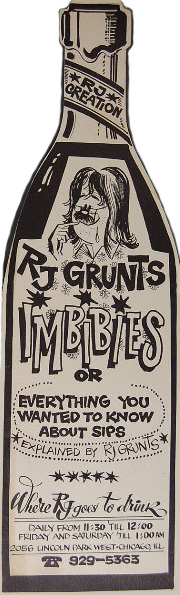
RjGrunts1970s1976 – Richard Melman’s Chicago restaurant company, Lettuce Entertain You Enterprises, operator of RJ Grunts, Great Gritzbe’s Flying Food Show, and Jonathan Livingston Seafood, opens Lawrence of Oregano and prepares to take over the flamboyant Pump Room.

1977 –Industry journal Restaurant Business publishes survey results showing that, on average, husband & wife pairs eat out twice a month, spend $14.75 plus tip, prefer casual restaurants, and tend to order before-dinner cocktails and dishes they don’t get at home. Measured by sales, Lincoln NE is one of the country’s leading cities for eating out.

1977 – Once characterized by blandness, San Diego now has restaurants specializing in cuisines from around the globe, an improvement one observer attributes in part to the new aerospace industry there.

1978 – A reviewer in Columbia MO complains, “A brick floor and pillars, old photos, Tiffany lamps, stained-glass windows and trim on the tops of the booths as well as revolving single-bladed, old-fashioned fans [is] a familiar type of decoration these days and I’m getting a little weary of the sameness of so many restaurants.”

1979 – As the year ends restaurant reviewer Phyllis Richman observes that more people are eating out than ever before, transforming once-lackluster Washington D.C. into “what is known as a Restaurant Town.”

Read about other decades: 1800 to 1810; 1810 to 1820; 1820 to 1830; 1860 to 1870; 1890 to 1900; 1900 to 1910; 1920 to 1930; 1930 to 1940; 1940 to 1950; 1950 to 1960; 1960 to 1970; 1980 to 1990

© Jan Whitaker, 2013

29 Comments

Filed under alternative restaurants, chain restaurants, food, patrons

Name trouble: Sambo’s

SambosGoletaCA

You might imagine that chain restaurants would spend vast amounts of time and money researching potential names in order to pick one that would convey exactly the desired associations and nuances. Certainly one that would not insult a portion of its intended customers.

I’m sure most do. Sambo’s was not among them.

Wouldn’t the founders of Sambo’s, in the late 1950s, dimly perceive that the name Sambo was not beloved by everyone, especially African-Americans?

Why would they decorate with images from the book “Little Black Sambo,” the American editions of which were filled with racist caricatures?

sambocollage

Evidently they had no idea that Sambo had been – and still was – a derogatory word for black males for over 100 years; that the name and ridiculous images of Sambo were used on many consumer products in the early 20th century; and that after WWII school libraries had complied with requests by African-Americans to remove the book from shelves.

Even if they didn’t know any of this, when protests erupted they might have realized they had made a terrible mistake. Regardless of whether “Sam-bo” originated from the first name of one of them combined with the nickname of the other.

Nope, nope, nope, and double nope.

Instead the founders, their successor, and the corporation that finally took over the chain all insisted right up to the bitter end that no harm was intended or implied. Even as they renamed some units in the East where there had been boycotts, the company insisted the change was purely in order to market their new menus.

sambo's216CabrilloHwy1960The first Sambo’s was opened in Santa Barbara in 1957. [pictured] By 1977, when the son of one of the founders was heading the company, the chain was the country’s largest full-service restaurant chain, with 1,117 units.

But trouble was looming. Protests during the West Coast chain’s expansion into the Northeast had already resulted in renaming units in the Albany NY area “Jolly Tiger.” Eventually there were 13 Jolly Tigers in various towns. Protest would spread to Reston VA, New York, and New England including at least 9 towns in Massachusetts. In 1981 the Rhode Island Commission on Human Rights ordered the company to change its name in that state because indirectly the name violated the 1964 Civil Rights Act by denying public accommodations to black persons.

SambosNoPlaceLikeSam'sLogo1981The company responded that it would rename 18 of its Northeastern units “No Place Like Sam’s”; in fact according to an advertisement a few months later they actually renamed 41 units.

Soon thereafter the company began to collapse. In November 1981 it filed for Chapter 11 bankruptcy protection, closing more than a third of its units. In Leominster and Stoughton MA, early morning customers had to pick up and get out immediately so the restaurants could be padlocked.

In 1982 all, or most, remaining Sambo’s were renamed Seasons. By 1984 most of the Seasons restaurants had been sold to Godfather’s Pizza and other buyers.

The successive name switches undoubtedly hurt business, but a more serious problem was that Sambo’s, like other chains using a coffee shop format with table service and extensive menus, had been steadily losing out to fast food chains. Unsurprisingly, it did not survive.

© Jan Whitaker, 2013

67 Comments

Filed under chain restaurants, racism

Celebrity restaurateurs: Pat Boone

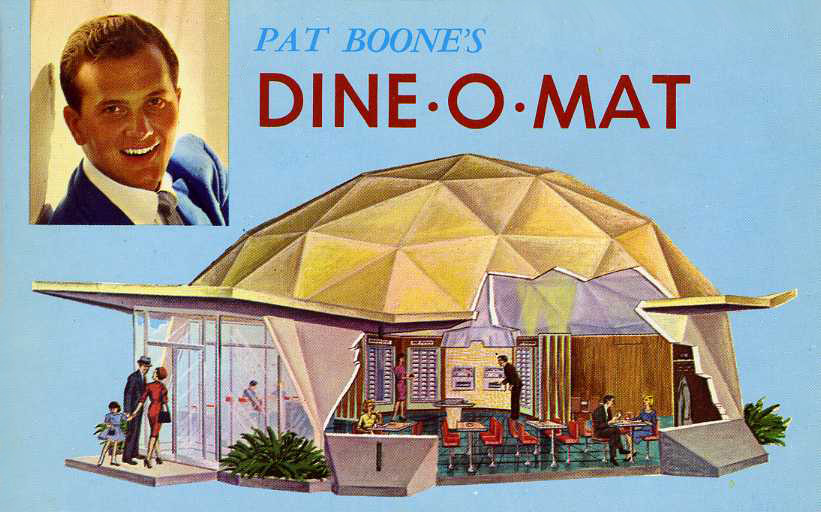
PatBooneDine-O-Mat

Few celebrities become deeply involved in the restaurants that bear their names. That was true of the singer Pat Boone, who was known to visit his namesake restaurants occasionally and to sing and sign autographs at openings. How much good his – or any celebrity’s – connection does for a restaurant is debatable. Neither Pat Boone’s success as a performer nor his pro-family, clean-cut, Christian image saved the ventures he lent his name and money to.

Pat Boone’s Dine-O-Mat appears to have barely gotten off the ground despite what publicity referred to as its “space age” design. “This . . . new type of fully automatic roadside restaurant is destined to be an important landmark on highways all over America,” boasted a 1963 advertisement aimed at investors. The initial plan was to build 100 of the restaurants by summer of 1964, but few seem to have been constructed.

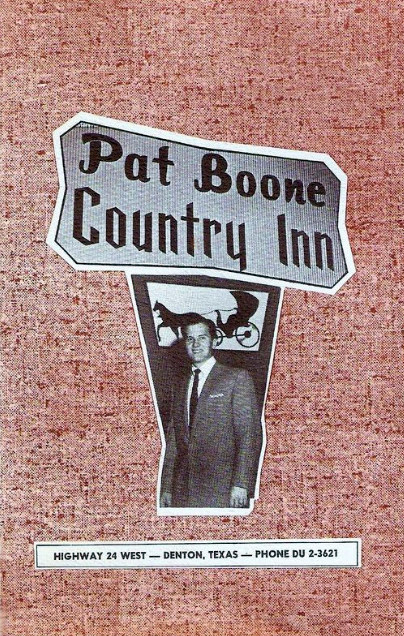
PatBooneCountryInn1959An earlier disappointing experiment in restauranting, Pat Boone’s Country Inn, in Denton TX, closed a mere four years after opening in 1958, even though Boone was connected to the town because of attending North Texas State College there.

While the Country Inn was a conventional restaurant, Dine-O-Mats were designed to be “revolutionary.” Perhaps the New Jersey entrepreneurs who cooked up the Dine-O-Mat concept were inspired by Stouffer’s 1961 foray into selling frozen food from vending machines to Ohio turnpike motorists who reheated it in microwave ovens.

Little could Pat Boone and company know when they launched Dine-O-Mats in 1962 that Stouffer’s would announce less than a year later their intention to phase out the roadside restaurants after realizing that travelers only wanted “speed and price.”

Both Stouffer’s highway restaurants and Dine-O-Mats might be called automats. But unlike Horn & Hardart automats, coins put in a slot did not call forth ready-to-eat selections. Dine-O-Mats had only one employee on the premises, an attendant whose job was to keep the machines loaded with frozen food. Rather comically, the postcard above shows customers (and Pat) dressed in their Sunday best, yet they are “dining” in a dismal geodesic-domed hut surrounded by vending machines and two microwaves sunk into an imitation hearth.

Similar to Stouffer’s restaurants, Dine-O-Mats were to be located near “motels, service stations, shopping centers, bowling alleys, country clubs, amusement parks, factories, air and bus terminals and along major highways,” according to a 1962 prospectus. How many were ever built, other than the prototype on Route 46 in Little Ferry NJ, is unclear. There may have been a few additional ones in New Jersey and Georgia.

Since kitchenless Dine-O-Mats relied on cooked food supplied by an offsite commissary, the scheme made sense only if deliveries could reach multiple outlets easily. In 1964 construction was to begin on a unit in Augusta, Georgia, but the project was delayed because of company “reorganization.” It was to be part of a group of Dine-O-Mats in Albany, Macon, and Savannah, but whether any of the Georgia restaurants opened I cannot determine.

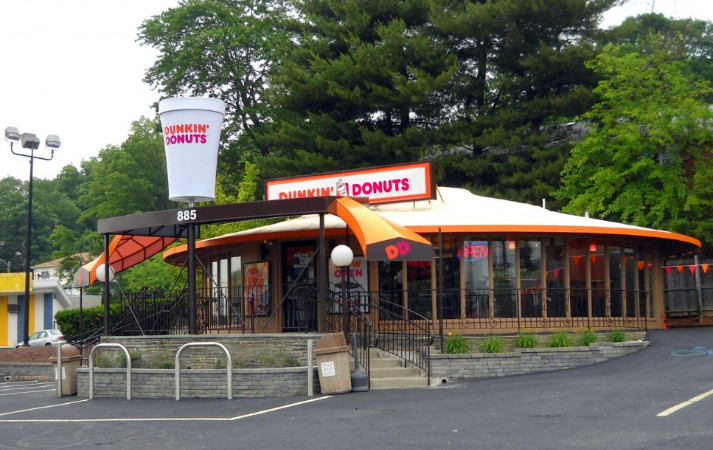
PatBooneDunkinDonutsNPlainfieldNJIn 1965, when the Augusta construction was slated to begin, a newspaper report announced, “The Pat Boone Restaurant Corp. has revised all plans and has just now completed reorganization with new, modernized plans for its restaurants.” Though it’s hard to imagine what could be more modern than “space age,” it’s possible the geodesic dome had been scrapped and that the North Plainfield NJ Dunkin Donuts pictured here was once a Dine-O-Mat as some people believe.

The company’s confusing advertisements for prospective investors required differing minimum investment amounts ranging from $2,500 to $10,000 for a “limited (inactive) partnership” in April of 1963, to $15,000 to become an “area controller” in October, then asking $10,000 for an “investment opportunity” in March of 1965. Did anyone ever get the 10% to 13% returns that were estimated?

© Jan Whitaker, 2013

15 Comments

Filed under chain restaurants, proprietors & careers, roadside restaurants, technology

Restaurant-ing on Sunday

The Chick-fil-A controversy has arrived at my blog. A few days ago I heard from a reporter looking for restaurant history background on the subject of religion and restaurants.

Was there, she asked, ever a commercial restaurant chain similar to Chick-fil-A that took a strong religious stand evidenced by decisions such as closing on Sundays?

Why, yes, there was. It was the Dennett’s chain of the late 19th century. Founded in New York City by the crusading moralist Alfred W. Dennett, it sported religious slogans on the walls, held a mandatory daily prayer session for employees – and was closed on Sundays. Dennett failed in the Northeast in the 1890s but his successors followed his policies. Later, he made another attempt to run a chain of lunchrooms on the West Coast.

Chick-fil-A boasts of its personnel practices, but Dennett’s was scarcely a model employer as a waitress at a San Francisco Dennett’s discovered. Employees were fined so frequently for missing prayers or other minor infractions that most never took home a full pay envelope. She reported that she saw a placard on the wall that quoted Jeremiah: “Thus saith the Lord, Let not the wise man glory in his wisdom, neither let the mighty man glory in his riches; but let him that glorieth glory in this, that he understandeth and knoweth me, that I am the Lord which exercises loving kindness, judgment, and righteousness, in the earth.” As she read, another waitress came up behind her and remarked wittily, “So now you know that four dollars a week is right, and kind, and just.”

From the patrons’ point of view Sunday closures were generally not pleasing. Sunday was a popular day to eat in a restaurant beginning in the late 19th century and continuing into the 1960s. Not only did thousands and thousands of people living in rented rooms absolutely need access to restaurants all week long, for decades Sunday was the only day off for most working people.

Back when drinking was the social issue of the day, some temperance reformers thought it was advisable to keep restaurants open on Sundays since eating a meal in a decent place was preferable to getting drunk in a saloon. Critics found it outrageous that in the 1870s New Hampshire law ordered all restaurants closed on Sundays unless they also rented rooms.

By the 20th century it was fashionable to eat Sunday dinner out and many patrons filled their Sunday afternoons with dining and dancing to a live orchestra. In the 1920s, when car ownership spread, it became a Sunday treat for families to drive to the “country” (i.e., the city outskirts) to go to a tea room for chicken dinner. Service often was “family style,” with all the food on platters or in bowls to pass around.

I recall as a child going to such a place outside St. Louis, in Valley Park, called Madame DeFoe’s. It was a cottage with many screened windows, in a wooded setting. I thought it was terribly quaint and that Madame was foreign and exotic. Only recently did I discover that her first name was Cora and that she was a farmer.

The reporter also asked me if I knew of any restaurants in the past that, after coming under criticism for a controversial stance such as rejecting homosexuality, had politicians rally the public to show support for it through mass patronage (as is intended to happen August 1 at Chick-fil-A locations).

That one had me stumped.

© Jan Whitaker 2012

5 Comments

Filed under chain restaurants, miscellaneous, restaurant customs

Famous in its day: Pig’n Whistle

One of the strange appropriations of the early 20th-century involved using old tavern signs and names for distinctly non-alcoholic eateries, often tea rooms or confectionery restaurants appealing primarily to middle-class women. One of these was the Pig’n Whistle chain which began in California in 1908.

The name originated with ancient British taverns. Many believe that “whistle” was a corruption of wassail, an alcoholic concoction drunk from a small bowl or cup called a “pig.” But an early advertisement for Pig’n Whistle (shown below) gives no suggestion that patrons could get anything stronger than a cup of tea.

Although there is some disagreement about whether Pig’n Whistle started in San Francisco or Los Angeles, it seems likely that the first one was opened in San Francisco by Frank L. Callebotta, in 1908, perhaps growing out of a candy store he established earlier. In 1912 there was one unit in downtown San Francisco and another in the H. C. Capwell department store in Oakland. [top of page: early view of a window at the Oakland Pig’n Whistle, from the collection of Albert E. Norman]

By December of 1908 there was a store in Los Angeles, the city that was destined to become the chain’s headquarters. In 1914 the third LA Pig’n Whistle opened on South Broadway with an ivory baked enamel front displaying the trademark fife-playing pig which also decorated interior walls. In 1916 Pig’n Whistle was known for hanging original artworks on the walls, a custom it would continue into the 1930s. Patrons liked the idea so much they asked to be seated in booths where their favorite paintings appeared.

In 1926 the chain made a public stock offering and began an expansion drive. It absorbed Melody Lane restaurants in Los Angeles and Ennor’s in Berkeley. By 1929 it had opened its 20th store and had restaurants in Seattle, San Francisco, Oakland, Pasadena, Hollywood, and Los Angeles, including one planned for Grauman’s Egyptian Theater. It acquired the Mary Louise Tea Rooms as part of its Elite Catering subsidiary. Operating three factories, it made its own baked goods, candy, and ice cream. In 1931 passengers traveling on Transcontinental-Western Air, Inc. out of LA and San Francisco had lunches furnished by Pig’n Whistle.

pigNwhistleInterior577

Pig’n Whistles made a specialty of appealing to children and created menus and booklets for them. Although the restaurants were casual, they were also considered refined and somewhat elegant. Menus were elaborate even though prices were moderate. In 1934 it was possible to order a “De Luxe” six-course dinner for $1.00 that included dishes such as “Braised Saddle of Rabbit, Chasseur” and “Grilled Boned Loin of Spring Lamb” with fresh mushrooms and mint jelly. The dinner came with additional courses and accompaniments such as seafood cocktail, soup, spaghetti, avocado salad, and asparagus Hollandaise. To finish, there were 23 desserts to select from.

Profits declined in the 1950s and the chain shrunk. In 1952 it was reduced to five locations in LA and Hollywood, and one each in Beverly Hills, Pasadena, Long Beach, and San Diego. When an Illinois corporation, King Kastle, bought the company in 1968 there were only three units remaining, all in Los Angeles. King Kastle planned renovations and expansion but I don’t think they materialized.

Coming full circle, the name Pig’n Whistle can now be found on several drinking places around the country, as well as one of the original units at 6714 Hollywood Blvd. (interior pictured above) which has been restored and is operated as a restaurant.

© Jan Whitaker, 2011

40 Comments

Filed under chain restaurants, confectionery restaurants

Frenchees, oui, oui

It’s remarkable how people still pine for Frenchees of days gone by. Recipes for the most cherished of these, the Cheese Frenchee, a battered, deep fried cheese sandwich with a crunchy exterior, are all over the internet. It may have been modeled on the somewhat similar Croque Monsieur sandwich of France, possibly explaining the name Frenchee.

Frenchees, sometimes spelled Frenchies, were the creation of King’s Food Host, a fast food chain catering to families and college students in the 1960s and 1970s. Most of the chain’s units were located in the middle of the country, with headquarters in Lincoln, Nebraska, where there were once nine units. The first – King’s Drive-In – was started by James King and Larry Price in 1955, on North Cotner in Lincoln. I wonder if the first one had telephones at each table that patrons used to send their orders to the kitchen?

King soon dropped out of the partnership but Price stayed with it until 1972 when he gave up control of the company for around $3 million. It had reached its peak size then, with about 100 company-owned stores and 35 franchised units. Reportedly it had units in Winnipeg, Canada, and 20 states, but I’ve only been able to identify 18: Arizona, Colorado, Florida, Idaho, Illinois, Indiana, Iowa, Kansas, Minnesota, Missouri, Montana, Nebraska, New Mexico, North Dakota, Oklahoma, South Dakota, Wisconsin, and Wyoming.

kingsfoodhostbrookingsSD1972785In King’s younger days around 1966 when it had only 35 locations in 10 states, it focused on building near universities. King’s were handy for students at state universities in Nebraska (Lincoln), Iowa (Ames), Wisconsin (Madison), and Colorado (Boulder), with new units under construction in Norman, Oklahoma, and Lawrence, Kansas. [pictured: King’s near South Dakota State University]

Larry Price, who graduated from Nebraska Wesleyan University, had been a football assistant there and served on the university’s board of trustees. His first food service foray was as a teenager in 1934 when he ran a hamburger stand at the 1934 Nebraska State Fair. He was very likely the motive force behind the chain’s advertised principles. The company would not sell cigarettes nor allow patrons to tip lest servers “compete with each other for the tip to the extent that they appear greedy.” Price was disgusted when King’s new corporate managers installed cigarette machines because he believed it would encourage minors to smoke.

The Frenchees may have disappeared from the chain at some point or maybe simply dropped out of favor. They were heavily promoted as part of a nostalgia campaign shortly after King’s went into Chapter 11 bankruptcy protection in 1974. Apart from Cheese Frenchees, King’s offered Tuna Frenchees [pictured], Hot Dog Frenchees, and Pizza Frenchees. Never having seen an actual Frenchee myself, I can’t picture what the last two varieties looked like. Apparently the Pizza Frenchee, which “joined the Frenchee family” in the dark days of 1974, was not a big hit. Nor were the 30% soymeal burgers which Larry Price, coming out of retirement to offer advice, persuaded the new owners to scuttle shortly after they were introduced to manage high beef costs.

None of these moves, nor others — the adoption of chicken in a box, frequent discounts, or red, white & blue decorating schemes — could save the company. The chain’s troubles started just after it went public in 1969 and began a rapid expansion drive. In debt for millions, it could not work out a satisfactory deal with creditors and never emerged from bankruptcy. Stock shares which sold for $14 each in 1969 dropped to a low of 50 cents after bankruptcy was declared. In 1978 a couple of business men from Minnesota and Wisconsin bought the remaining King’s outlets, which by then numbered only 17.

© Jan Whitaker, 2011

36 Comments

Filed under chain restaurants, food