Category Archives: alternative restaurants

Find of the day: Aviation Tea Room

This past weekend at the giant Brimfield flea market I found the charming small menu shown above and below.

The menu is for a tea house that operated seasonally from 1928 through 1940. I’m guessing it may date from the mid-1930s since the prices match those in an advertisement from 1937 [shown below].

I couldn’t determine if the Providence Airport owned the tea house, renting it to the two women who ran it, or if the women were the owners. Despite the airport’s name, both it and the tea house were actually located in Seekonk MA, 7 miles from Providence RI.

The air field was private, offering flying lessons, short touring flights, and airplane storage. Its owners also sold the newly developed Aeronca monoplane.

The two women who ran the tea house for most of its years, Mildred Burrell and Lyle Lincoln, were from Fall River MA. They seemed to enjoy the status of socialites, being free to pursue that lifestyle in the months they were not running the tea house. They were able to make a success of the business for at least 10 years, which was greater than the lifespan of most eating places. It was offered for sale in 1939, but its new operator only kept it open for a year.

According to a 1932 feature story about women and aviation, women had no place in the early days of aviation, and were not expected to ever become passengers. However, that had changed by the time of the story when they had begun to learn to fly, and made up an increasing percentage of passengers and in-flight hostesses. According to the story, the operators of the tea house had made “occasional flights, [but] neither has a license or even any interest in obtaining one.”

Various newspaper stories of groups patronizing the tea house suggest that most came from Providence. Patrons could watch the airfield’s activities, but how many of the field’s plane owners, tour takers, or students taking flying lessons patronized the tea house is uncertain. Yet this 1929 advertisement suggests that there may have been some interest in an air tour followed by dinner on weekends.

By the time the tea house closed after the 1940 season, public airports were well established, and many featured full-scale restaurants that drew the public to dine while watching planes take off and land.

© Jan Whitaker, 2025

7 Comments

Filed under alternative restaurants, menus, tea shops

Music & food at Café Society

Café Society was the satirical name of a New York jazz club in the late 1930s and 1940s. The name was meant to make fun of people who wanted to be seen as sophisticated rather than merely rich. However, it’s likely that Café Society nevertheless proved to be an attraction to many of those same people.

By the second year there were two locations of Café Society, Downtown and Uptown. The clubs and their owner Barney Josephson have become well known for the number of jazz greats they introduced and nurtured, among them Lena Horne, Billie Holiday, and Teddy Wilson. And also for their full acceptance of Black customers.

Unlike other “café society” club owners such as the Stork Club’s, Josephson refused to accept the racial codes of that time. He was determined not to follow policies that featured Black performers but would not allow them to mingle with the patrons, and excluded Black guests. Even when these policies began to soften, it was common for Black patrons to be seated inconspicuously in the least desirable spots. [Above: 1939 sign at the Downtown club ridiculing prominent society figures]

When he opened the Downtown Greenwich Village club in late December 1938, Barney recruited three musicians who had been part of a Carnegie Hall Christmas Eve program called From Spirituals to Swing. Albert Ammons, Meade Lux Lewis, and Pete Johnson performed at the club a few days later. The club advertised that it featured “boogie-woogie,” which was largely unknown in New York City at the time. [Above: Downtown in 1939; William Gropper mural]

But what about the food? In general, jazz clubs’ culinary output has not been regarded as the finest. Barney claimed that when he started out, most jazz clubs were run by mobsters who didn’t even try to prepare good meals. He tried to do better, but it’s hard to judge how well he succeeded since I’ve found little commentary. Club cuisine wasn’t usually written about.

In a book based on recordings of his memories, published by his fourth wife after his death, Barney commented that in most nightclubs waiters were urged to push drinks not food. For the Uptown Café Society (on East 58th), opened about a year later than Downtown, he made an effort to provide good food by hiring a chef who had managed the Claremont Inn and had been head waiter at Sherry’s. Robert Dana, nightclub editor of the Herald Tribune, was of the opinion that “On its food alone, Café Society ranked with many fine restaurants,” singling out squab chicken casserole and cream of mushroom soup. [Above: Uptown, 1943; Below: Advertisement with the musical lineup on Uptown’s first anniversary, 1940]

By the end of 1947 Uptown was out of business, and Downtown closed in early March of 1949. The problem was that Barney’s brother Leon, an admitted Communist Party member, was part owner of the clubs, having advanced start-up money. In 1947 Leon was called before the House Un-American Activities Committee, refused to testify, and spent a year in prison. Barney was seen as guilty by association, attendance at his clubs plummeted, and he lost all his money. It seemed his career as a jazz club owner was over.

After that he concentrated on the restaurant business. He opened three restaurants, all called The Cookery, with one on Lexington across from Bloomingdale’s, one on 52nd Street in the CBS building, and then in 1955 a third one in Greenwich Village on University Place and 8th Street. The first two did not stay open long, but the Greenwich Village site was successful. [Above: The Cookery on Lexington; wall art by Anton Refregier]

While the two Café Societies had featured jazz with food, his third Cookery was to become a purveyor of food with jazz.

The Village’s Cookery was far from glamorous, generally described as “a hamburger, ham-and-egg type restaurant.” For the first 15 years there was no music. And then one day Barney had a visit from pianist Mary Lou Williams — who had played at Café Society Downtown – looking for work. As he described it:

“. . . this lady, one of the greatest musicians of all times, composer, arranger, not working? It was all this wild, crazy rock. . . . I investigated and found out I didn’t need a cabaret license in my place if I only had three string instruments.” [Above: Mary Lou Williams, at the Cookery in the Village, 1970]

So he told her to go rent a piano and, presto!, he was back in the jazz club business as of 1970. She was a draw. As he put it, “Mary returned to The Cookery each year through 1976 for three-month gigs, always to critical acclaim and crowds.” Other musicians who played there included Teddy Wilson, Marian McPartland, and the elderly singer Alberta Hunter, who had been working as a nurse.

The Cookery stayed in business until 1984.

For those interested in reading more about Barney’s clubs, see the book based on his recorded memoir published by Terry Trilling-Josephson in 2009 (Café Society: The wrong place for the Right people).

© Jan Whitaker, 2025

Leave a comment

Filed under alternative restaurants, night clubs, Offbeat places, patrons, proprietors & careers, restaurant decor

Goodbye, Alice

Last week Alice Brock of Alice’s Restaurant made her exit from Earth. I wrote a post about her long ago, but thought I’d add a bit more about her life, including more of her colorful quotations. She didn’t find running restaurants easy and made that clear in interviews and in her 1975 book My Life As a Restaurant. [photos by Jane McWhorter, from Alice’s book]

In addition to opening and running three different restaurants in Western Massachusetts over a number of years, she worked with a franchise that was to create nationwide string of restaurants, not surprisingly named Alice’s Restaurant. In 1969 announcements were made that the first four would be located in Boston, New York, Nashville, and Los Angeles. The goal for the first three years was 500! Just how many of them materialized is difficult to determine, but it’s certain the total fell far short.

Alice derived some income from her association with the enterprise. She was paid to be a menu consultant, promoter, and for “just being Alice.” She fulfilled the third goal when she quit the job less than a year after the launch. Once she sampled the food at the New York pilot location she declared, “The food was no good. It wasn’t honest. It was like the movie – a lot of gravy but no meat.”

She spoke her mind, as her quotations make clear.

About her first restaurant in Stockbridge MA:
“. . . a year after I had opened the restaurant, I dragged my body in through the door and freaked out. I felt that instead of owning it, it owned me. . . . I had a terrible urge to smash everything. I telephoned Eastern Airlines and booked myself on the midnight flight to Puerto Rico. I emptied the cash box, gave away all the food.”

Working in a restaurant kitchen:
“. . . if you open the kitchen door, it’s like the door to Hell – everyone’s screaming and crying and cursing, and pots are being slammed around, sweat is pouring off everyone, and it’s a hundred and thirty degrees.”

Running a restaurant:
“Running a restaurant isn’t really satisfying. In fact, next to running a hospital emergency ward, I think this is the worst thing you can do.”

© Jan Whitaker, 2024

6 Comments

Filed under alternative restaurants, chain restaurants, Offbeat places, proprietors & careers, women

An early health food empire

It’s rare to find business documents from long-gone restaurants, but last weekend I stumbled upon two letters to investors from the Physical Culture Restaurant Company headed by fitness and health food advocate Bernarr Macfadden [shown above, age 42].

Macfadden was a body-builder, natural food proponent, and entrepreneur who decided to spread the gospel by opening inexpensive, largely plant-based restaurants at the turn of the last century. He attributed his strength and energy to this special diet.

The 1904 end-of-year letter reported that four new restaurants had been added to the ten already in business, and that they had done business totaling over $243,000, with a net gain of $2,637. Five restaurants had been judged failures and closed, four of them in NYC and one in Jersey City. He and his board of directors believed in rapidly shutting down locations that did not draw crowds. The letter blamed a “business depression” and the normally slow start of new locations for the smaller-than-hoped-for profits.

Although he wanted the restaurants to succeed, his personal income was not dependent upon them. Macfadden’s primary business was publishing periodicals, beginning in 1899 with Physical Culture, which discussed diet and health, followed by True Story, Liberty and then, increasingly, a large number of detective and romance magazines with titles such as Dream World, True Ghost Stories, and Photoplay. In addition he authored scores of books on fitness, sex, and health, and established a tabloid newspaper, The New York Evening Graphic. His publications earned him a fortune.

The total number of Macfadden restaurants open at the same time never seemed to exceed sixteen or so. The first ones were in New York City, of which there were nine at one point. Others were spread across the East and Midwest, including Boston, Newark, Jersey City, Philadelphia, Pittsburgh, Detroit, Cleveland, Cincinnati, Chicago, and St. Louis. There was also one in Toronto. [above: 1906 advertisement and 1906 restaurant at 106 E. 23rd, NYC]

In the 1907 letter to stockholders shown above he floated the idea that the restaurant holdings might grow to 40 or 50 units if stockholders invested in more stock. This never happened.

Despite the growing popularity of the restaurants, it seems that for Macfadden they served primarily as a way to spread the gospel of a healthful diet. He could not be described as a restaurateur. No doubt he helped to conceptualize the restaurants and make up the early menus, but he did not manage them except in his role as corporate executive.

Prices were low in his early restaurants. A bowl of thick pea soup was 1c, as was a bowl of steamed hominy or oats or barley. Whole wheat bread and butter, however, cost 5c as did creamed beans or whole wheat date pudding. He sold loaves of whole wheat bread for 10c. [shown above]

A Macfadden menu shown in a 1919 British book reveals a wealth of choices then but also higher prices that reflect post WWI inflation. Five cents now bought less. Mushrooms on Toast cost 20c, as did meat substitutes Nuttose and Protose. A Macaroni Cutlet or Lentil Croquettes cost 25c, while omelets such as Mushroom, Walnut and Pecan, Orange, or Protose and Jelly were 30c.

In 1931, at which point only three Physical Culture restaurants remained, Macfadden gave up his fortune, said to be $5,000,000, and created the Bernarr Macfadden Foundation. In a radio broadcast he said: “It is a source of indescribable relief to feel like a free man again. Too much money unwisely used makes people greedy and ungrateful, destroys the home, steals your happiness, enslaves, enthralls you, lowers your vitality, and enfeebles your will.”

Yet his personal life continued to be full of numerous wives, affairs, and lawsuits. And, despite being “freed” of his fortune in 1931, he continued to spend money lavishly, taking it from the treasury of the Physical Culture Publishing Company after he turned that into a public corporation. Stockholders accused him of using nearly a million dollars for his own private interests, which included failed attempts to become a presidential candidate, governor of Florida, or mayor of New York.

In 1931 the Foundation opened the first of several Depression-era penny restaurants, no doubt modeled on Macfadden’s first restaurant at the beginning of the century where most dishes cost only one or a few cents. The initial Depression “pennyteria,” run by the Foundation, was located in midtown NYC. Drawing a crowd of about 6,000 a day, it quickly became self-supporting.

At a penny restaurant run by the Foundation, one cent would buy any of the following: coffee, split pea soup, navy bean soup, lentil soup, green pea soup, creamed cod fish on toast, raisin coffee, honey milk tea, cabbage and carrot salad, steamed cracked wheat, hominy grits, raisins and prunes, bread pudding, whole wheat doughnuts, whole wheat bread, or whole wheat raisin bread.

As the operator of the 1930s restaurants, the Foundation proved more flexible than Macfadden about dietary standards, but evidently he still had some say over what was served. According to one account he agreed to let meat appear on the menu as well as dairy products. Meat took the form of beef cakes, beef stew, and chicken fricassee. But he stood firm about bread, insisting only whole wheat be served.

I found no trace of the Macfadden restaurants nor the Foundation’s penny restaurants in the 1940s. Macfadden largely faded from the headlines, dying in 1955 and leaving an estate valued at only $5,000.

© Jan Whitaker, 2024

6 Comments

Filed under alternative restaurants, chain restaurants, menus, popular restaurants, proprietors & careers, restaurant prices

The ‘bohemian’ restaurant in fiction

There was a time when many Americans considered inexpensive French or Italian restaurants naturally bohemian – wild and crazy, not too clean, filled with oddball characters, and offering menus of unfamiliar and dubious dishes. But nonetheless fascinating. Novelists liked to use them as settings, so they turned up in fiction of the late 19th and early 20th centuries as the excerpts below illustrate.

In the final sample presented here we meet up with a restaurant keeper who wishes his place was more bohemian because that would make it a better draw.

1886 The Midge, Henry C. Bunner – To celebrate the Midge’s 16th birthday, her guardian, a doctor, takes her out to dinner at a table d’hote in New York City’s French quarter.

It was a modest feast, only a plain table-d’hôte dinner, eaten in the heart of the quarter, at a cost of half-a-dollar apiece. They had tried more elaborate dinners, at the great hotels up-town; but they preferred the simpler joys of Charlemagne’s restaurant. They both possessed that element of Bohemianism which belongs to all good fellows; the Midge was a good fellow, as well as the Doctor.

Charlemagne’s is a thing of the past; but he was a jolly king of cheap eating-house keepers while he lasted. He gave a grand and wholesome dinner for fifty cents. The first items were the pot-au-feu and bouilli. If the pot-au-feu was thin, the bouilli was so much the richer. And if the bouilli was something woodeny, why, you had had all the better pot-au-feu before it. Then came an entrée, calves’ brains, perhaps, or the like; a rôti, a vegetable or so coming with it; a good salad, chicory or lettuce or plantain, a dessert of timely fruits, a choice of excellent cheese, and a cup of honest black coffee. And with all this you got bread ad libitum and a half bottle of drinkable wine, that had never paid duty, for it came from California, though it called itself Bordeaux.

1896 Some Modern Heretics: A Novel, Cora Maynard – About two women who adventurously move to Boston to live in a flat and do their own housework. But they don’t know how to cook.

And the alternative of tramping out to restaurants at all hours was a Bohemianism which, in spite of her late advancement, she could not contemplate serenely. It appeared positively disreputable. If her father knew of the actual circumstances of her situation a prompt withdrawal of his original consent would have cut short Vida’s visit on the spot; but she left him in tranquil ignorance . . .

By seven o’clock the girls realized that it was time to have dinner, and then came Vida’s great trial. It was too late to think of cooking anything themselves, so there was nothing to do but face the restaurant.
“Isn’t it a very – a very queer thing to do?” Vida ventured feebly. She would much rather have bought some crackers and eaten them at home in their unpalatable dryness.

“Why, no. It’s a little quiet place we’re going to. I’ve often been. You know we girls don’t believe in being restricted by senseless prejudices. Good gracious, one can’t be so dreadfully hampered in these days of rationality!”

Before long Vida got used to the restaurant, and even enjoyed it when they felt too tired or too lazy to struggle with the cookbook. She enjoyed the whole queer situation and got a taste of such freedom as she had never before dreamed of.

1910 Predestined, Stephen French Whitman – Featuring Benedetto’s, a favorite with artists in New York City.

On the north side of Eighth Street, close to Washington Square, an old, white dwelling-house had been converted into an Italian restaurant, called “Benedetto’s,” where a table d’hôte dinner was served for sixty cents. Some brown-stone steps, flanked by a pair of iron lanterns, gave entrance to a narrow corridor. There, to the right, immediately appeared the dining-room, extending through the house — linoleum underfoot, hat-racks and buffets of oak aligned against the brownish walls, and, everywhere, little tables, each covered with a scanty cloth, set close together.

Felix, at the most inconspicuous table, consumed a soup redeemed from tastelessness by grated parmesan, a sliver of fish and four slices of cucumber, spaghetti, a chicken leg, two cubic inches of ice cream, a fragment of roquefort cheese, and coffee in a small, evidently indestructible cup. Then, through tobacco smoke, he watched the patrons round him, their feet twisted behind chair-legs, their elbows on the table, all arguing with gesticulations. Sometimes, there floated to him such phrases as: “bad color scheme!” “sophomoric treatment!” “miserable drawing!” “no atmosphere!” Benedetto’s was a Bohemian resort.

1912 The Soul of a Tenor, W. J. Henderson – According to a review, “The reader is taken behind the scenes at performances and rehearsals and into the dressing rooms and boudoirs of the artistes; into the café, where foreign singers congregate.”

As for those women who figure in all animated chronicles of the present kind, some of them may have had husbands, but they have tried to forget them, and usually with success. Little Italian restaurants, with hot and opaque atmospheres, are in accord with their temperaments, for their part of the opera world is hot and opaque at all seasons of the year.

It was not a pretty place, that particular Italian restaurant. All the men in it seemed to require cigarette smoke as a condiment for food, and they chewed and puffed alternately. The room was filled with a wreathing blue fog, through which strange head-dresses and still stranger gowns could be seen, for the denizens of this world always garb themselves in streamers of splendor and look not unlike perambulating lamp shades.

They were not only singers. Some were impecunious painters and some were patrons of the arts, who were wont to shout “bravo” from the highest seats in the temple. It gave them a fine satisfaction to eat within reach of real singers. And they were not all Italians, for one feast of spaghetti makes the whole world of Bohemia kin.

1914 Our Mr. Wrenn; The Romantic Adventures of a Gentle Man, Sinclair Lewis – Mr. Wrenn is a lonely lodger who timidly invites a neighbor, Theresa Zapp, to dinner at a restaurant run by Papa Gouroff. She is described as “forward” and “gold-digging.” Although she is not interested in Mr. Wrenn, she accepts his invitation, but fails to be impressed by the restaurant.

The Armenian restaurant is peculiar, for it has foreign food at low prices, and is below Thirtieth Street, yet it has not become Bohemian. Consequently it has no bad music and no crowd of persons from Missouri whose women risk salvation for an evening by smoking cigarettes. Here prosperous Oriental merchants, of mild natures and bandit faces, drink semi-liquid Turkish coffee and discuss rugs and revolutions.

In fact, the place seemed so unartificial that Theresa . . . was bored. And the menu was foreign without being Society viands. It suggested rats’ tails and birds’ nests, she was quite sure. She would gladly have experimented with pate de foie gras or alligator-pears, but what social prestige was there to be gained at the factory by remarking that she “always did like pahklava”?

Papa Gouroff was a Russian Jew who had been a police spy in Poland and a hotel proprietor in Mogador, where he called himself Turkish and married a renegade Armenian. . . . He hoped that the place would degenerate into a Bohemian restaurant where liberal clergymen would think they were slumming, and barbers would think they were entering society, so he always wore a fez and talked bad Arabic. He was local color, atmosphere, Bohemian flavor.

© Jan Whitaker, 2024
6 Comments

Filed under alternative restaurants, ethnic restaurants, food, Offbeat places, patrons

Psychedelic restaurants

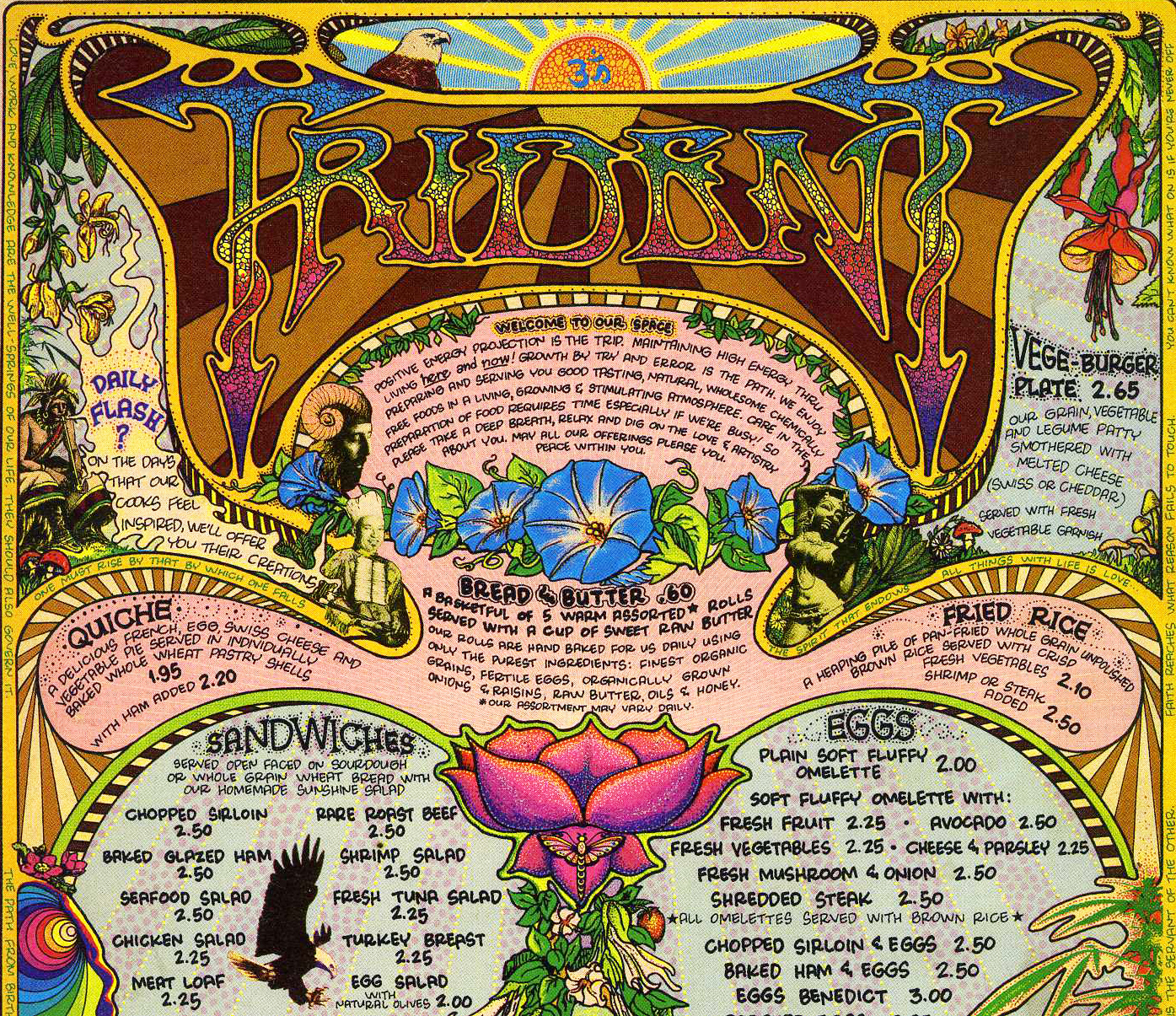
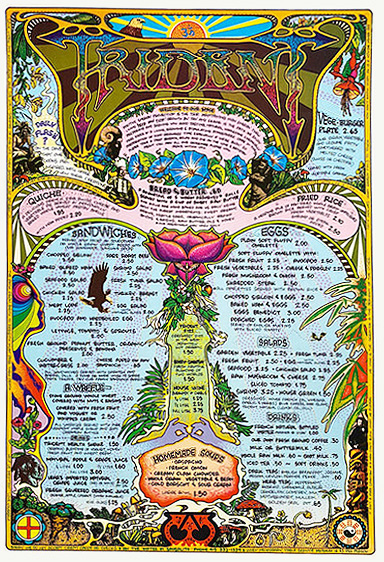
The short-lived psychedelic “theme” did not become popular in restaurants to the same degree that it did in the music world. But when you think about it, that’s not too surprising. [Trident menu, ca.1969]

As decor, a psychedelic interior made generous use of strobe lights and brightly colored paint. The decor was most likely to turn up in a teen club or a nightclub, such as Mother’s in San Francisco in 1969. Just reading a one-sentence description of Mother’s interior “with walls that modulate, colors that pulsate to music, hallucinatory lights . . .” is enough to make me queasy. Scarcely an environment for dining!

Interiors were meant to mimic the effects of LSD without the aid of drugs. This makes sense for music clubs, but it’s hard to see what it might lend to a café’s ambience.

Nevertheless there were a scattering of restaurants and cafes throughout the country in the late 1960s and early 1970s that were referred to in the press as being psychedelic in some sense. It was not always clear what that meant other than having psychedelic decor with bright colors or swirls.

The psychedelic Uptown Café in Madison WI, for instance, was decorated with fist-sized rocks “handpainted psychedelically [with] pop swirls.” But surely it took more than that to categorize the café as psychedelic. What that might have been is unknown.

Like the “Uptown Café,” some so-called psychedelic eating places had names that weren’t at all suggestive of grooviness, such as Dino’s in Tampa FL, the Great Society in Minneapolis, and the Feed Store in Chicago. In 1969 the Feed Store was firebombed, with police assuming that the perpetrator was someone in the neighborhood who disliked hippies and their psychedelic decor.

Although the natural food movement emerged at the same time as the interest in exploring consciousness via drugs, it would seem that not all psychedelic restaurants embraced it. Haight-Ashbury’s main gathering spot for the area’s hippies was The Drogstore, so named to avoid the obligation to fill prescriptions. Tabletops there may have featured “psychedelic linoleum” but the menu was centered on ordinary hamburgers, minestrone, and soft drinks.

Other eating places shown on a Haight-Ashbury tourist map of the late 1960s could have been just about anywhere judging from their commonplace designations, such as Mexican Restaurant, Pizza Joint, and Grinder Joint.

Outside of San Francisco, the 1969 Temptations’ hit pop song Psychedelic Shack inspired several places to adopt that name, one in Belle Glades FL and another in Salt Lake City. Like so many psychedelically inspired eating places and clubs, they were aimed at young people.

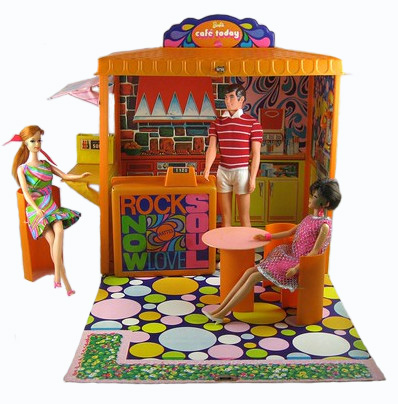
A bit later, after the Haight-Ashbury scene had dispersed, mainstream commerce discovered psychedelics – and it was odd. Burger King’s “Love” postcards and Mattel’s Barbie embraced a watered-down version evidently acceptable to the majority of Americans in a way that hippies were not. The “vibe” was detached from all meaning other than swirling color and made its appearance slightly after the movement had lost its center in San Francisco. Yet it was undoubtedly an attempt to appeal to teens. Burger King gave away its postcards for patrons to send on Valentines Day, 1972.

The best known psychedelic restaurant was Sausalito’s Trident, owned for a number of years by the Kingston Trio. It had a swirling ceiling and wild-looking menus. The early menu shown above listed natural foods but later ones featured many conventional items such as steak, plus alcoholic beverages said to be generally rejected by hippies. By 1970 it had become a favorite of tourists, and reportedly entertained “the hip and many society names trying to be hip.”

The Trident’s early menus were filled with cosmic advice in tiny type, dispensing such pseudo wisdom as “One must rise by that which one falls,” and “You can’t know what is in if you’re never off.” However, the messages at the menu’s bottom brought the patron back to earth with a thud, advising, “Sorry we do not accept checks,” and “When necessary, table service minimum of $3 per person.” [Click to see later Trident menus]

Nonetheless, another message from the Trident menu contains a wish for 2024: “May all our offerings please you. Peace within you.”

© Jan Whitaker, 2024

16 Comments

Filed under alternative restaurants, atmosphere, decor, Offbeat places

Caves, caverns, and grottos

I would have said that restaurants made to resemble caves represented a proprietor’s desperate attempt to rescue a windowless, underground space. Except . . . many restaurants of the early 20th century, when these sorts of restaurants became popular, had few or no windows yet they were not rigged up to resemble caves.

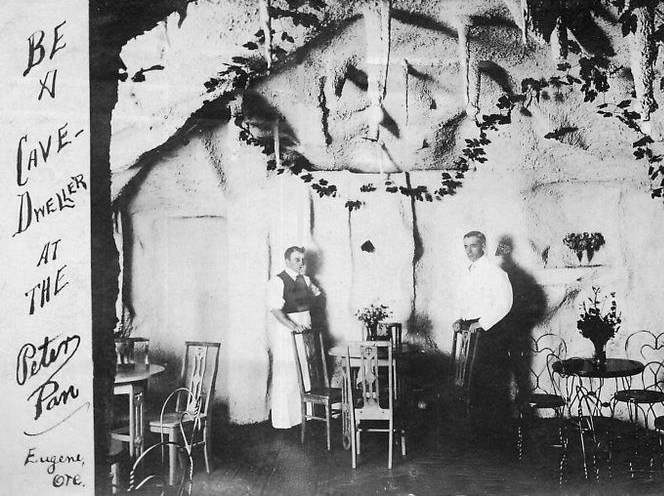
But it seems that the American public was discovering a fascination with caves and cave men in the early decades of the 20th century. In 1915 the Peter Pan, in the college town of Eugene OR, did seem to appeal to wannabe cave men, and possibly cave women too.

Perhaps the cave restaurants were spiritually related to beefsteak dungeons of a similar era where men sat on crates and ate steaks with their claws, er, hands.

I suspect another reason that cave-themed restaurants and clubs appeared in the teens was as a way to attract patrons during a time when drinking was becoming less popular. Prohibition of alcohol was not yet national law but many localities had banned it.

Or, if I wanted to get psychoanalytical about it, I might think that locating these night-clubby spots underground revealed a degree of shame in a culture once ruled by Puritanism.

Close to the turn of the century two hotels already had cave-like grottos built underground. In 1900 architect W. E. Loyer of Philadelphia designed a grotto for the Hotel Rudolph in Atlantic City. Five years later his grotto for a Boston hotel, the Revere House, opened. Like the Rudolph, it featured an all-women orchestra. According to Revere House advertising, light bulbs in the grotto sparkled “like jewels in an Aladin [sic] cave” where dining was “both weird and entrancing.” Even in August, cool breezes were said to “sweep across the room” where its “jagged sides” resembled “what might be found in some large underground cavern.”

Other hotels with caves and grottos for dining and entertainment in the teens and 1920s included the Ambassador in Atlantic City with its underground Neptune and Dolphin Grills, the latter filled with marble, cut glass, sea-green furniture, fish nets, life belts, shells, and more.

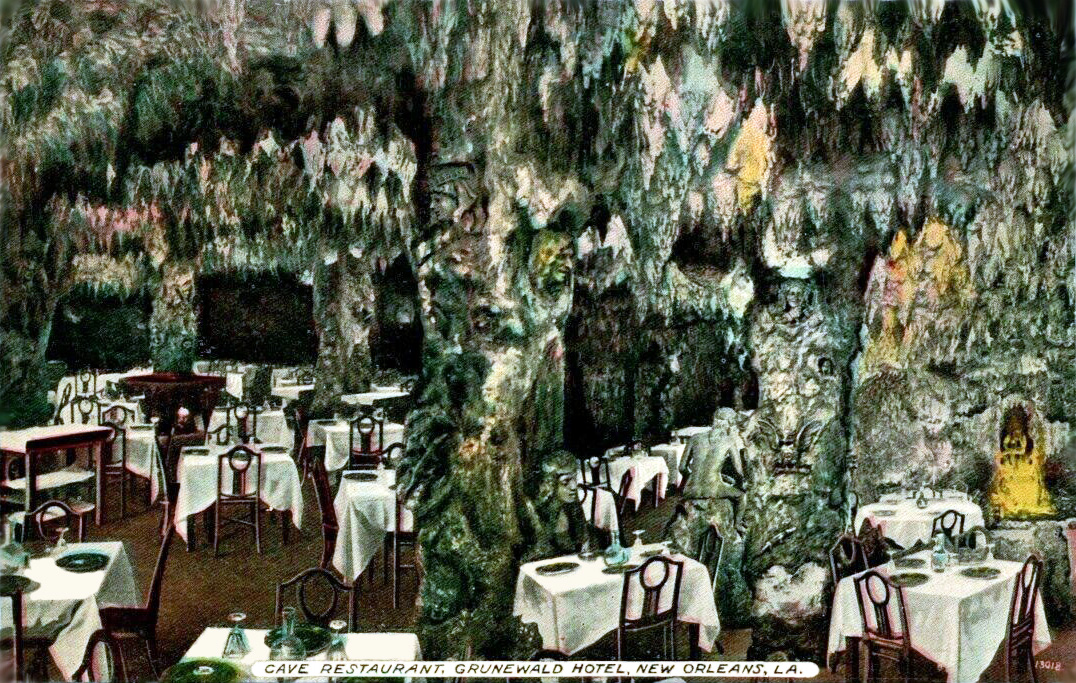
The Grunewald in New Orleans [shown here], the Mt. Washington Hotel in Bretton Woods NH, and the Redwoods Hotel in Grants Pass OR carried on the cave tradition.

New York City was a little short on cave/grotto restaurants but it did at least have one. According to The Grotto’s advertising it was a “romantic cave.”

Of course there were also eating stations in genuine caves designated as National Parks. I am hesitant to refer to some of their facilities as restaurants – particularly that of Carlsbad Caverns with its accommodations for 1,000 lunchers at a time, pictured here ca. 1962.

The whole idea of a cave-themed restaurant seems strange enough to me that I might have imagined they went out of fashion long ago. But of course they did not, and undoubtedly can be found today. In 1928 columnist O. O. McIntyre declared that Los Angeles was the foremost city for “stunt cafes and trick eating places . . . built in every fantastical and baroque shape imaginable.” However, since then cave-like eateries, though always sparse, showed up in a variety of cities and towns.

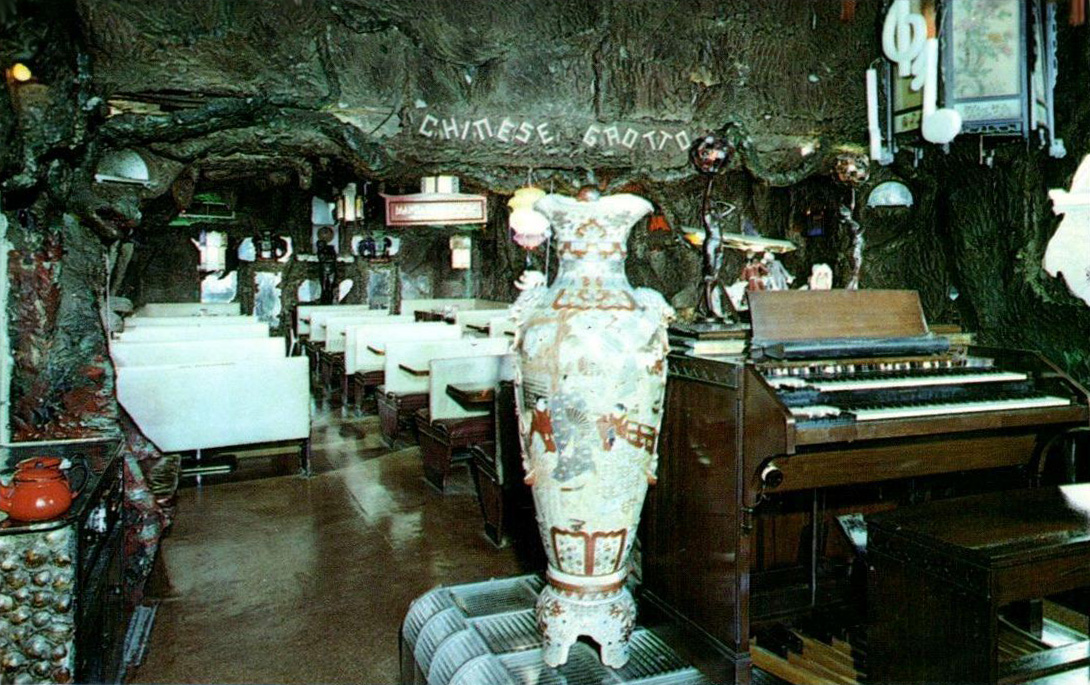
In the early 1930s, for instance, Binghamton NY had a restaurant called The Barn, which encompassed a Shell Room and a Chinese Grotto. The Grotto, whose special effects were the creation of its originator, David Stewart, offered the only Chinese food in Binghamton — accompanied by organ playing. I was surprised to discover that the restaurant’s cooking was applauded by a number of 1940s guidebooks.

The 1960s and 1970s saw restaurants such as The Cave in Cleveland which declared itself “a cave to end all caves.” An article revealed that its conversion from a pool hall involved the application of 16 tons of gray plaster accompanied by a poured Polyrock floor speckled with gold. The total effect, said the account, was “somewhat eerie and fascinating.”

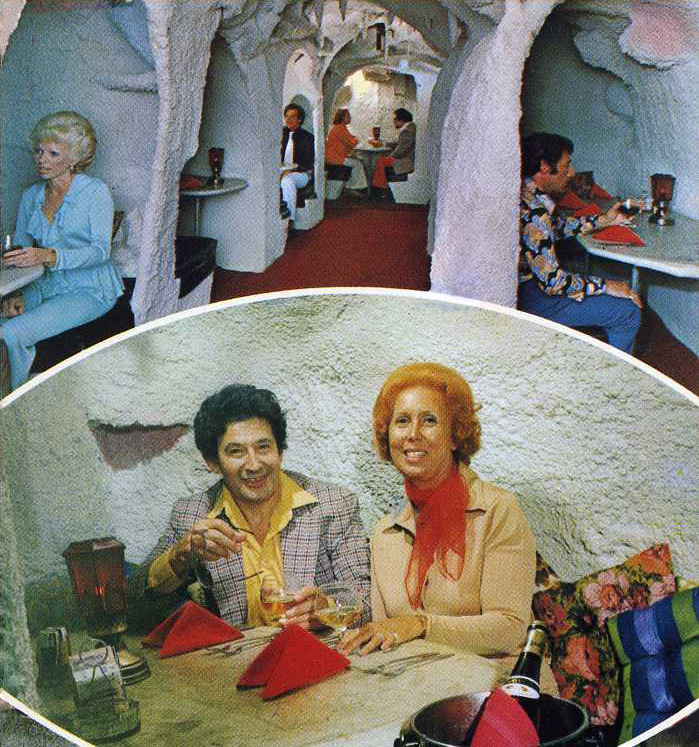
In Fort Lauderdale FL, The Caves restaurant was designed to encourage diners to “journey to prehistoric days via the stone-age decor and hearty feasting.” But, they were assured, they would be made comfortable with “luxurious pillows” and “soft lighting,” two things seriously lacking in nature’s version.

© Jan Whitaker, 2023

7 Comments

Filed under alternative restaurants, atmosphere, decor, Offbeat places, theme restaurants

Underground dining

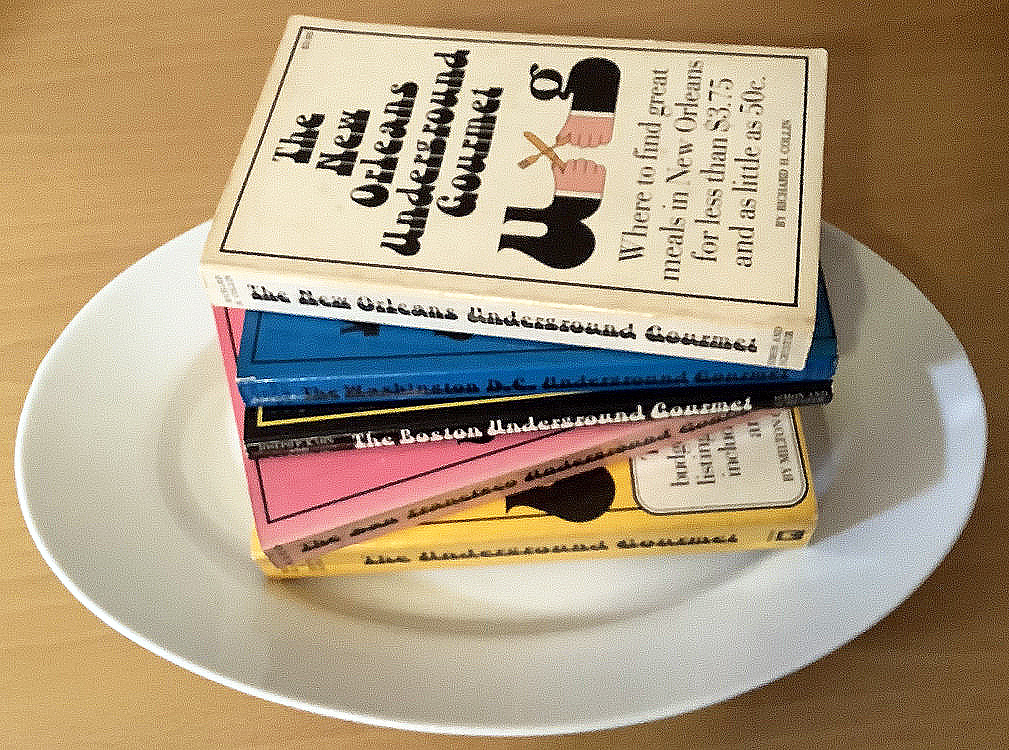
In the 1960s, with the rumble of social change came a flood of interest in low-priced eating places with character and good food. In this spirit, New Yorkers Milton Glaser and Jerome Snyder began a newspaper and magazine column titled The Underground Gourmet, followed by a guide book in 1966 with the same name.

Their book led to a series. It’s been a little difficult to nail down how many different UGs there were, but here is my list, with initial publication dates: New York (1966), San Francisco (1969), Los Angeles (1970), Washington D.C. (1970), New Orleans (1971), Boston (1972), Honolulu (1972), and Long Island (1973).

Several factors probably contributed to the new mood regarding restaurants. The economy was bad and the public was looking for bargains. Youth culture was blossoming as the baby boomers grew older, many becoming college students. And increased travel abroad was widening the public’s interest in unfamiliar foods and ways of cooking.

The public’s attraction to low-priced independent restaurants could also be seen as a reaction against the growth of fast food chains taking place, the greater use of frozen food in restaurants, and a rebellion against the blandness of much American food.

What was considered a low price for a meal during these years? The first New York edition specified in 1966, “Great meals . . . for less than $2 and as little as 50¢.” But the third edition (1977) explained that “unending inflation . . . has changed our perception of an inexpensive meal from one that cost $2.00 to one that costs $5.00 or $6.00.” For the New Orleans’ second edition in 1973, author Richard Collin promised meals “for less than $3.75 and as little as 50c.” This was still a lower price than featured by the others, which ran from $1.00 to $3.75 in San Francisco in 1969; $1.00 to $4.00 in D.C. in 1970; and “under $4.00″ in Boston in 1972. Dining in Honolulu remained a bargain, with the 1972 UG promising meals as inexpensive as in the first New York edition (50¢ to $2).

Low price was not really what set the best of the recommended restaurants apart from others. Rather it was the quality of the food for the price. Although Mr. Steak in 1970 offered its most expensive meal – Steak & Lobster with salad, toast and potatoes – for $3.99, it didn’t make the cut, though strangely enough a few other chain restaurants did win recommendations including a McDonald’s in D.C. and a Burger King in New Orleans.

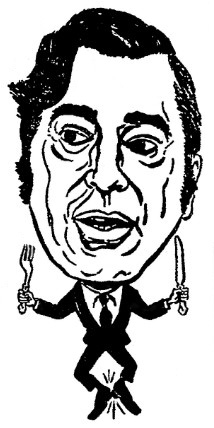
What were some of the most remarkable finds in these books? Richard Collin [above cartoon] discovered a number of dishes that he gave his highest praise, naming them “platonic dishes,” as perfect as that dish could possibly be. His New Orleans list of platonic dishes included Oysters Bienville and Fried Chicken at Chez Helene’s soul food restaurant — which he rated one of the city’s finest restaurants; Creole Gumbo at Dooky Chase; and Fried Potato Poor Boys at the dirt-cheap Martin’s Poor Boy.

The number of restaurants that met the criteria varied from city to city. Boston and D.C. are notably slim books. New York is the fattest volume. San Francisco and New Orleans have about 2/3 the heft of New York. However, with his shorter entries, Richard Collin packed over 250 restaurants into the 1973 revised New Orleans edition, rating everywhere he ate, including some very bad places. Needless to say, this makes for interesting reading.

In his 1969 UG, R. B. Read made a case that the San Francisco area had a unique set of restaurants from all over the world, such as at The Tortola, which preserved “hacienda cookery” from the days before gringos settled in the state. He also heaped praise on restaurants that were rare in the U.S. then — from Korea, the West Indies, and Afghanistan. The latter instance, Khyber Pass, offered a “fabled” ashak, which he described as “aboriginal ravioli.” In a different category of unusual was The Trident in Sausalito, with jazz and a “debonairly eclectic” menu with a psychedelic design.

Because my copy is the third edition of the New York UG (The All New Underground Gourmet, 1977), I did not get the flavor of the earlier versions, which is a shame. Sadly, Jerome Snyder died during the publication of the book. That and rising prices may have cast a pall over this edition, which strikes me as less interesting than the New Orleans and San Francisco UGs. The original NYC book contained 101 of the best low-cost eating places (out of 16,000!). The third edition has about 130. The three given the highest ratings for “excellent food” were the Italian Caffe da Alfredo, and two Greek restaurants, Alexander the Great and Syntagma Square. Mamma Leone’s showed up in the book even though it met the price criterion only for its Buffet Italiano Luncheon where for $4.25 it spread out 25 feet of salami, mortadella, meatballs, celery, olives, green bean salad, and more.

The UG authors for Boston were Joseph P. and E. J. Kahn, Jr.; Washington D.C.’s were Judith and Milton Viorst. Both books show a lower level of enthusiasm. The Viorsts admitted that Washington “has not been known for its restaurants” and that of the 100 restaurants they visited, “a substantial proportion were so awful that we were unable to include them.” Father and son Kahn began by telling of a long-time resident of Boston and Cambridge who couldn’t imagine that anyone could recommend inexpensive restaurants since the area’s expensive restaurants were “bad enough.” The Kahns then admitted, “It is probably true that the Boston area does not loom large in the world of cuisine.”

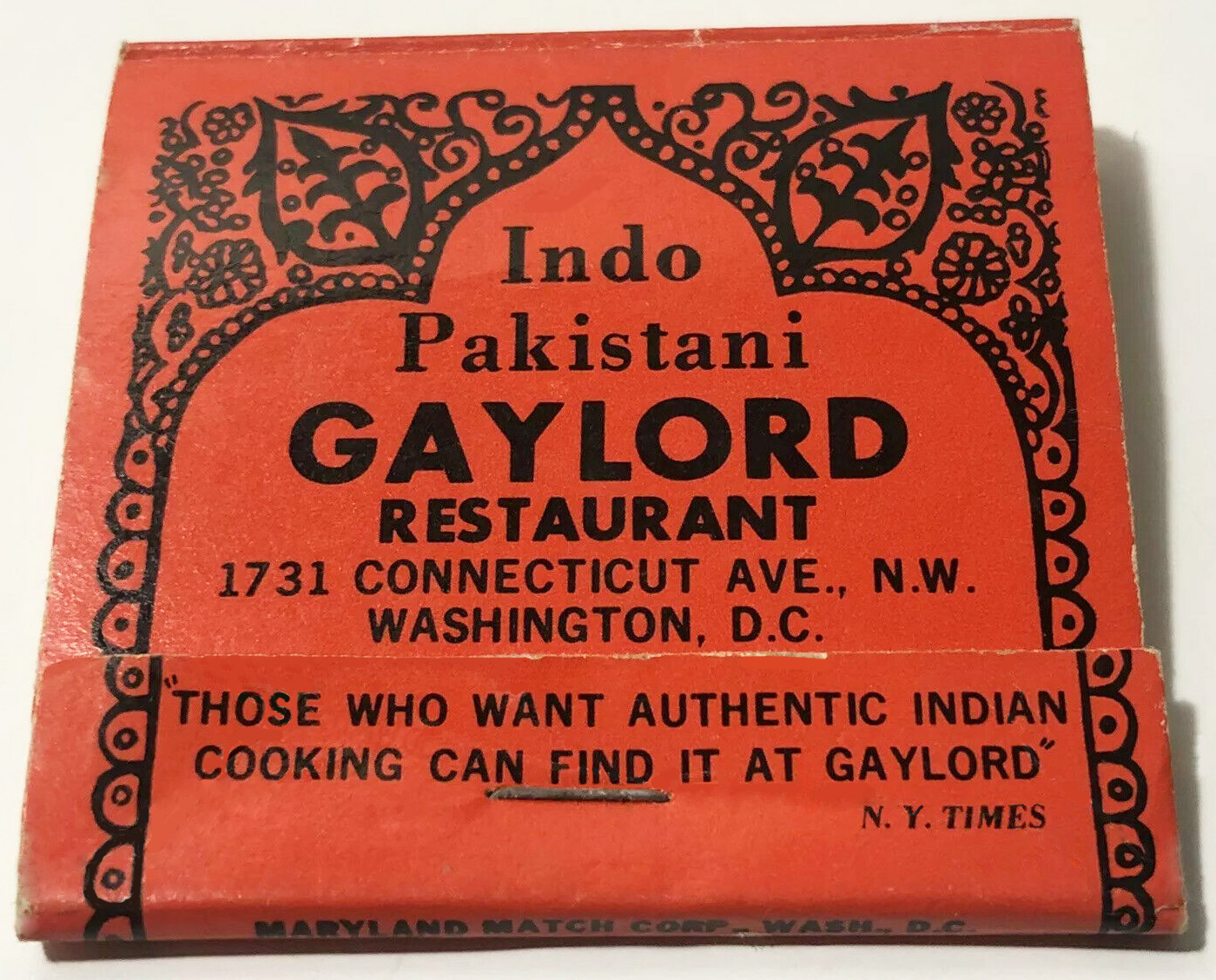
Despite their reservations, the authors of both books managed to find some places they liked. The Viorsts singled out five D.C. restaurants as “great finds.” They were: the Calvert Café, an Arabic place “worthy of shahs and empresses”; Don Pedro, Mexican, with a marvelous mushroom appetizer called hongos; the Cuban El Caribe, featuring raw Peruvian-style fish cubes in lemon-onion sauce (95¢); Gaylord, an Indo Pakistani restaurant with “delicious samosas”; and Warababa, a West-African place run by a Ghanaian couple with “exquisite” dishes such as peanut butter soup and Joloff rice flavored with bits of beef and vegetables.

The Kahns didn’t exactly rave about finds in Boston or Cambridge. But, after encountering “enough blandness while making our rounds to put us to sleep,” they enjoyed spicy lamb stew at Peasant Stock in Cambridge. They included the No Name restaurant on Fish Pier – no name, no sign, no lights, no decor — where a seafood chowder (50¢) served as the house special and was “so incredibly rich and so brimming with hunks of fresh fish that a cupful could be a meal in itself.” But the popular Jack and Marion’s in Brookline, known for its giant menu and huge portions, ranked merely as one of the area’s “better delicatessens.”

Alas, I couldn’t find the books from Honolulu, Los Angeles, or Long Island, but I saw a magazine piece that criticized the Los Angeles UG for its surprising inclusion of 25 restaurants in Palm Springs.

© Jan Whitaker, 2022

8 Comments

Filed under alternative restaurants, ethnic restaurants, restaurant prices

Restaurant as community center

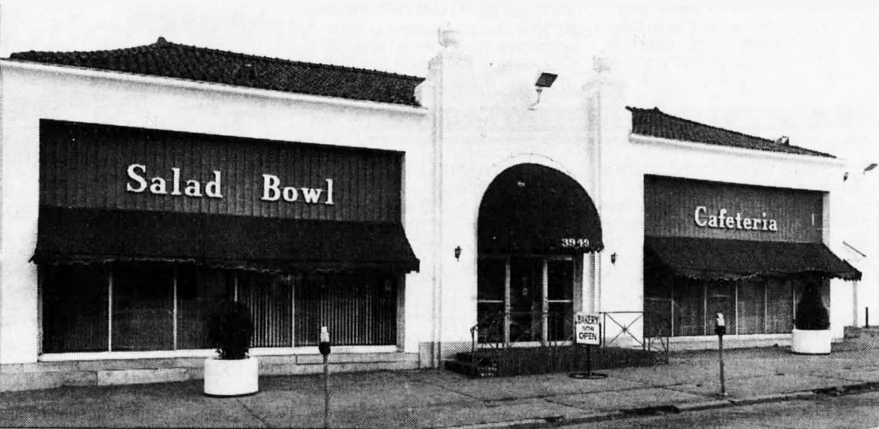
The first Salad Bowl restaurant, at 4100 Lindell in St. Louis, was established in 1948 by two former employees of Miss Hulling’s Cafeteria downtown. The husband and wife owners were mainly concerned with making a living for their family and had little idea that, like Miss Hulling’s, their venture was destined to become a celebrated local institution and landmark. [above: final and primary location, 1989]

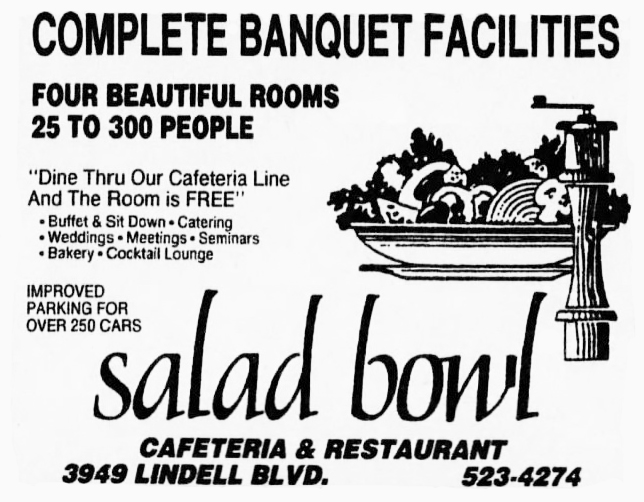
The Salad Bowl’s founders were Elmer and Anna Sewing, whose three sons would one day take over the cafeteria, having gained plenty of hands-on experience working there in their younger years. At its final location at 3949 Lindell Blvd. the sons, David and his twin brothers Norman and Norbert, took full charge after their father’s death in 1976. Knowing they had to expand the business, they encouraged greater use of the banquet rooms. To draw customers during the day the sons made the rooms available for free to clubs and organizations for meetings and talks if their members and attendees went through the cafeteria line. [Norbert and Norman Sewing at the bakery counter, 1989]

The cafeteria was located about halfway between two universities, making it possible for the cafeteria’s banquet rooms to become popular sites for talks and lecture series by professors. The Salad Bowl had the unique distinction of being the only eating place that I know of that advertised “seminars” among its attractions. [1988 advertisement] A few of the topics covered over time were homelessness, children’s mental health, the working poor, the global economy, and the Jewish sanctuary movement.

News conferences took place regularly at the Salad Bowl. In 1986 a speaker from Ralph Nader’s Public Citizen group discussed the rapidly rising rates of liability insurance, blaming it on greed in the insurance industry. The event was sponsored by the Missouri Public Interest Research Group and the Missouri Citizen-Labor Coalition.

Although, like many restaurant owners, Elmer Sewing had turned away Black diners at a time when he judged that white customers would not accept them, he often said that he was opposed to segregation. According to his grandson Stephen, who privately published a memoir-style history of the Salad Bowl* after its closure in December of 2005 [title page above], his grandfather was personally opposed to segregated eating facilities. He was said to be eager to welcome Black customers once the Civil Rights Act had passed, making it illegal to refuse service to patrons based on race. Stephen wrote that the cafeteria was one of the first in St. Louis to integrate.

Black organizations, clubs, and events by Black activists were included in the Salad Bowl mix, as were prayer breakfasts in honor of Martin Luther King. Another example was a news conference held by well known activist Ivory Perry who denounced President Ronald Reagan’s introduction of housing vouchers in 1982, calling it a step in federal abandonment of public housing and urging people to join a protest rally in Washington. A St. Louis section of the National Council of Negro Women held its 5th annual awards dinner there in 1986.

Both Black and white politicians gave talks at the cafeteria, and Jessie Jackson visited there. According to Stephen Sewing’s book, “Every state senator, state representative and governor has known the Salad Bowl because of all the political parties, press conferences, meetings and rallies held at the Salad Bowl over the years.” Organizations holding regular meetings included the Book Lovers Club, the League of Women Voters, the Press Club, Retail Druggists, Weight Watchers, the Worker’s Rights Board, the Women’s Coalition for the Democratic Party, and locals of the St. Louis Teachers Union and the Service Employees Union.

Scrolling through the notices of talks and public events held at the cafeteria made me realize how impossible it is to give more than a partial idea of how many and varied they were.

In the 1990s the cafeteria was also used as a site for flu shots, blood pressure tests, and school children’s immunizations.

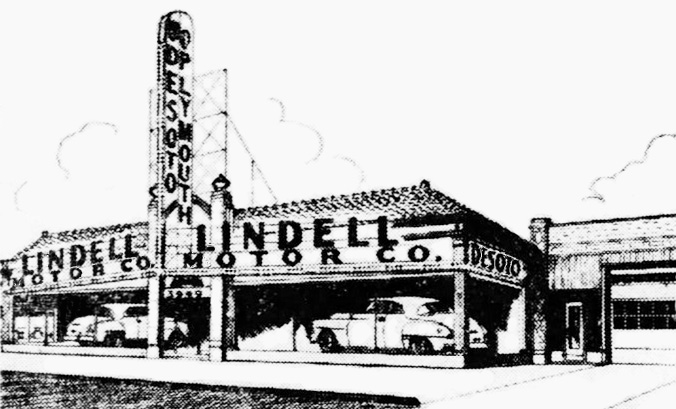
The Salad Bowl menu focused on standard cafeteria comfort food such as Kidney Bean Salad, Whiting, Beef Brisket, Banana Cream Pie, and the St. Louis specialties, German Potato Salad and Toasted Ravioli. Customers could also stop at the bakery counter to buy baked goods to take home. A tavern room called Bits and Saddles operated for ten years as part of the complex and there was an underground parking garage, a remnant of the car dealership that had occupied the site before the Salad Bowl took it over. [shown below, 1952]

The restaurant also served as a special gathering spot for the extended Sewing family who used banquet rooms for their own wedding dinners and receptions as well as major holiday feasts. With the three fathers working long days, sometimes six days a week, often the only way to see them was for their families to come to dinner at the cafeteria. Their wives and children also put in time as spare hands for serving banquets, helping with bookkeeping, and other chores.

Now, when restaurants tend to be ranked and rated mainly for the quality and novelty of their cuisine and interior appointments, I find it refreshing to review a restaurant from the past that was so deeply a part of city life, and valued for that by thousands of St. Louisans.

© Jan Whitaker, 2022

  • Two copies of the 90-page booklet are available at the main St. Louis Public Library.

4 Comments
Filed under alternative restaurants, cafeterias, popular restaurants, proprietors & careers

Native American restaurants

Although there has been growing interest in exploring native foodways in the past twenty or so years, it seems there’s been little research into the history of Native American restaurants, that is, those serving traditional Indian dishes and/or those run by Indians.

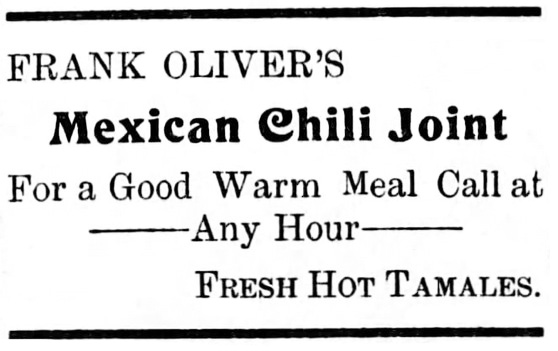
The earliest one with a Native American proprietor that I found was in Coweta, Oklahoma, around 1906. It was run by Frank Oliver, a member of the Muscogee Creek Nation. A very brief newspaper item reported, “There are few Indians in the restaurant business but Mr. Oliver likes to feed ‘em and is prosperous.” It was not unusual for Indian restaurants in the Southwest to serve Mexican dishes, especially in later decades.

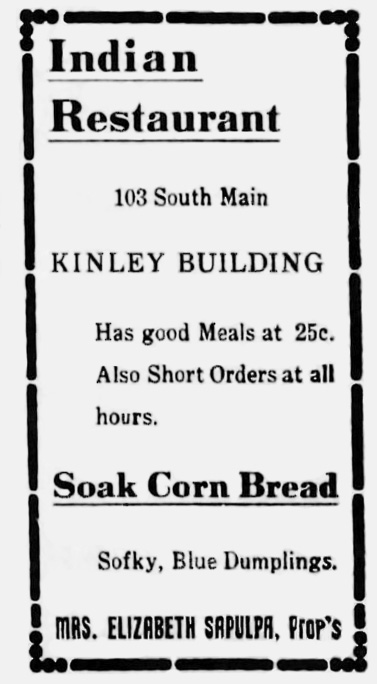
That same year another Indian proprietor was running a restaurant in Sapulpa, Oklahoma. His name was given simply as Antoine, born a Mohican in New York state but adopted into the Creek tribe. Sometime later a woman named Elizabeth Sapulpa, probably the wife of the tribe’s chief, also had a restaurant in Sapulpa where she served Sofky (corn soup made of hominy, bits of meat and blue corn dumplings) as well as cornbread made of cornmeal soaked overnight in buttermilk.

Many of the references to Indian restaurants I found did not lead anywhere. For instance, despite much searching, I could not determine if the Santa Fe movie studio, opened in Monrovia CA in 1927, ever established its planned Hopi Indian restaurant. And I’d love to know how the Hollywood actor Don Porter fared with his restaurant. It was to be built in Hollywood in 1951 with an open firepit vented through a hole in the roof. For years he had collected recipes from many tribes and planned to feature buffalo, bear, venison, wild greens, wild rice, and corn – along with cook-it-yourself fish wrapped in leaves and mud. Also, I wondered if the plans reported about a 1970s graduate of a culinary training program in Albuquerque had succeeded. She hoped to establish a restaurant on her reservation serving game such as quail, rabbit, and deer, along with blood pudding and her tribe’s oversized homemade tortillas.

Her endeavor would have been in contrast to many Indian-run restaurants on reservations that featured mainstream American fast food. As Ruben Silverbird would observe in the 1980s, “On the reservation we have restaurants run by Indians, but they sell hot dogs, hamburgers, ham and eggs.” Similarly, at the Tigua reservation’s cultural center in El Paso TX in 1986, a restaurant called Wyngs drew non-Indian tourists and served fajitas, seafood platters, and barbecued ribs.

It has been said that Native Americans don’t have a restaurant culture, but I have the sense that there were many native people who for decades wished there were more Indian restaurants. Especially among Indians living in cities there was a strong desire for gathering places and ways to stay connected to their culture, including foods. In 1968 a Queens resident, an Otoe-Pawnee from Oklahoma, observed, “There’s no place for Indians to gather in New York (City) – no Indian restaurants or anything like that.” Buoyed by the Black Power movement, she and other native women had recently joined together to promote their Indian identities.

In the mid-1960s, a food court representing many different cuisines in a Phoenix shopping mall included “The Hogan,” which was claimed – somewhat unconvincingly – to serve the only authentic Indian food in Arizona outside a reservation. It was run by a Scandinavian proprietor who served corn on the cob impaled on arrows. The second incarnation of an Indian restaurant there was named Tiny Teepee where posole, a hominy and pork stew, was prepared and served by Native Americans.

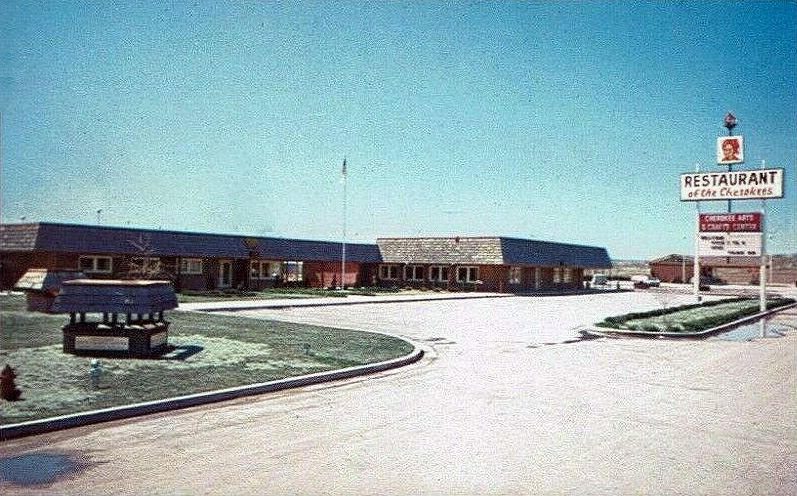
Also in the 1960s Native Americans began to urge the creation of cultural centers that would honor their heritage. By decade’s end a number of Indian restaurants began to open as part of complexes that included motels and cultural centers with museums and craft demonstrations. The Cherokee Heritage Center opened in Tahlequah, Oklahoma, in 1967 with an associated restaurant, the Restaurant of the Cherokees shown here. Although hamburgers and other common “American” dishes dominated the menu, the restaurant also served traditional Indian food such as shuck bean bread (corn and bean dough, steamed in cornhusks), sorrel, watercress from local streams, poke salad, fried huckleberries, crawdads, and “squaw” bread made with sour milk. In the spring, it hosted wild onion dinners.

Building Indian community took a hit in Baltimore when an Indian restaurant failed to open, despite being fully set up and ready to open its doors. The problem was that the U. S. Labor Department claimed it had been a mistake to permit the grantee to buy restaurant equipment with a 1974 job training grant for an American Indian Study Center. The government removed the equipment, sinking what would have been the only Native American restaurant in the Washington-Baltimore area.

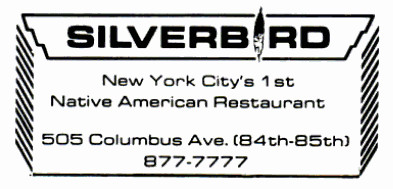
1986 marked the opening of what claimed to be New York City’s first Native American restaurant, Silverbird. Its proprietor, Ruben Silverbird Ortiz, a professional singer and entertainer of Indian/Mexican/white heritage, said it would serve New Mexico food, including “green and red chile, blue corn chips, salsa, all that good stuff.” As was true of most Indian restaurants, the menu accommodated non-Indian patrons with American dishes, but held weekly dinners serving rattlesnake stew. The restaurant employed a diverse crew, with servers and kitchen staff made up of Comanches, Navajos, Blackfeet, Italians, Irish, and Mexicans.

Some Indian restaurants were decorated with Southwestern art or murals of buffaloes and teepees. Silverbird was decorated with Kachina dolls and tables inlaid with sand paintings. However, some, such as Dovecrest [shown at top], gave little visual indication they were Indian.

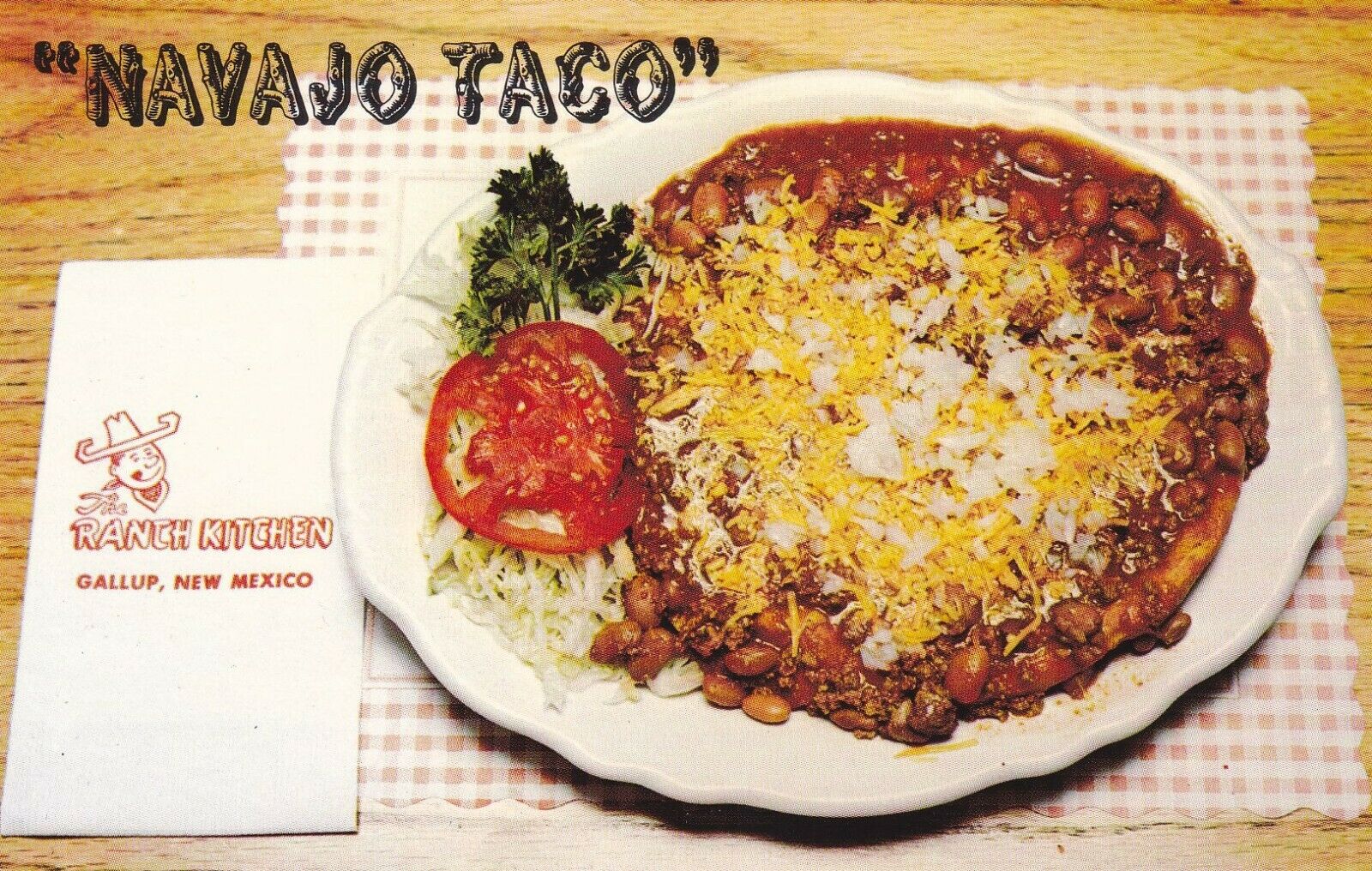
Probably the most celebrated Indian restaurant of the 20th century was Loretta Barrett Oden’s Corn Dance Café in Santa Fe, New Mexico, that ran from 1993 to 2001. Before opening her fine-dining restaurant, Oden, a member of the Citizen Patawatomi Nation, spent three years researching tribal recipes and cooking methods, which can vary considerably according to region. She is a proponent of healthier dishes such as bison, wild-caught salmon, trout, quail, venison, corn, beans, and squash. She has also been a vocal critic of deep-fried fry bread, a popular Indian item in itself as well as serving as the bottom layer of “Navajo tacos,” popular in eating places throughout the Southwest. She has tried to convince Indian-run casinos to offer native dishes, but has found that a hard sell considering the strong attachment of their patrons, both white and Indian, to steak, hamburger, pizza, etc.

The 2000s seem to have raised interest in indigenous chefs and restaurants, but they have continued to face a rocky road in terms of widespread acceptance.

© Jan Whitaker, 2022

16 Comments

January 16, 2022 · 12:47 pm