Author Archives: Jan Whitaker

Jan Whitaker's avatar

About Jan Whitaker

A frequent restaurant patron who knows a lot of fascinating things about the history of American restaurants based on years of research, and who is also interested in how people relate to food, what it means to them, and how they form memories about meals in the past. I started my blog in 2008 (!) and by now have a huge number of posts. The early ones are just as good as the new ones, so look around.

At the sign of the . . .

TavernsignsWalker'sTavernEarleTaverns and inns of the Colonial and Early American eras were ancestors to hotels, providing the all-important trio of beds, food, and alcoholic drinks. But they also supplied inspiration to eating places in later centuries, particularly tea rooms and, to a lesser extent, steak houses.

One of the most prominent features of taverns were their signboards. Borrowed from England and Europe, they depicted images of military heroes, courtly symbols, and local landmarks, with names to match. Animals of various colors were especially popular such as the White Swan, the Golden Horse, the Black Bear, or the Red Lion.

TavernsignsCTOldLion

Taverns actually had dual names, the proprietor’s and that of the image on the sign. Signs were linked to a place. Proprietors might move from tavern to tavern but signs stayed where they were. For example, a Boston tavern keeper of the 1760s named Francis Warden advertised that he kept a “public house of entertainment” at the sign of the Green Dragon. Earlier he had been at the Blue Anchor.

Tavern signs have often been admired for their originality, but even in the 18th century they were stereotyped. Artists who painted them often advertised that they had a stock of signs on hand and ready to go except for the lettering. This undoubtedly accounts for the many taverns called The White Horse, The Beehive [illustrated above], The Three Crowns, or The Bunch of Grapes.

tavernsigns1784NYCBy the start of the 19th century the reign of taverns was slowly coming to an end and being replaced by larger hotels. The decline of the tavern was hastened by the temperance movement in the 1830s and 1840s which saw them as dens of iniquity. A temperance advocate suggested tavern signs should bear truthful names such as “The Widow and Orphans Manufactory” or “The New England Rum Pit.” As towns outlawed the sale of liquor, many old tavern signs were pulled down and replaced with signs saying Temperance Hotel.

As taverns declined, nostalgia began to develop for their Days of Olde when jolly hosts greeted guests and ushered them inside to sip hot toddies at the fireplace. Books and newspaper stories appeared describing quaint tavern signs and names of yesteryear. Historical societies became interested in preserving the increasingly scarce old signs. A Boston lodge of the Masons fraternal organization which had been founded in The Bunch of Grapes acquired two of the four carved wooden bunches in 1883 and locked them away in a steel vault. A collector in Pennsylvania treasured a sign he discovered in the 1890s that had been painted in 1771 by famous English artist Benjamin West.
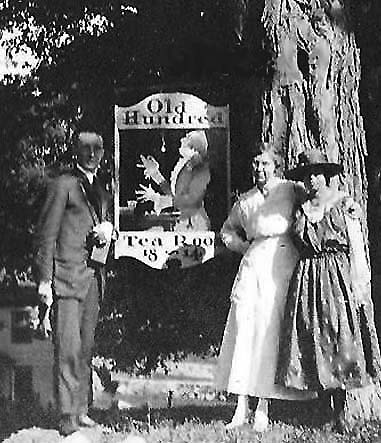
TavernSignsold100TeaRoomWomen, particularly those New Englanders who could trace their ancestry to Colonial times, became supporters of the preservation of American antiquities. Newly possible car travel encouraged them to explore former taverns in the countryside. Next they began to open tea rooms that celebrated Early America, many with names and signs from tavern days. It was as though taverns had returned, clean, ultra-respectable and without liquor and drunkenness. Tea, after all, was known as “the cup that cheers but does not inebriate.”
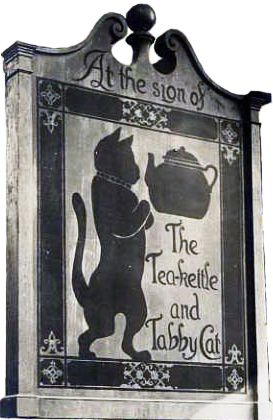
tavernsignstabbycatwenhamMAOne feature that did not survive was the political statement tavern signs had made back in the days when their keepers sided either with the British crown or the rebellious patriots. Another oddity was how many tea rooms adopted names that incorporated the words “At the Sign of” – preceding “the Green Kettle,” “the Golden Robin,” etc. Where a tavern of 1800 advertised it could be found “At the Sign of the Seven Stars,” a 20th-century tea room, had it used the same style of advertising, would have had to say it was “At the Sign of At the Sign of the Seven Stars.” The sign of At the sign of The Tea-Kettle and Tabby Cat adorned a tea room in Wenham MA.

tavernsignscornishNH858

The sign for the Tea Tray, a tea room in Cornish NH, was painted by Maxfield Parrish and shows much more detail than old tavern signs would have included.

In the 1960s and 1970s some steak houses also adopted a tavern theme, with names such as Steak & Ale, Bird & Bottle, or Cork & Cleaver, but only as a superficial concept that did not include revival of old-fashioned signboards.

© Jan Whitaker, 2015

3 Comments

Filed under signs

“Atmosphere”

atmosphereschaber1941I put the word in quotation marks to acknowledge that what atmosphere in restaurants means is as elusive as air itself — which the word also refers to. It was often used to describe eating places in the 19th century, but not in a flattering way. A typical usage is that from 1868 where someone remarked that in a certain restaurant “the atmosphere is heavy with cooking vapors.”

The term atmosphere (or ambience, which came into use in the 1970s) became used in a more general way to describe the character of a restaurant – that intangible spirit of a place. The broader meaning could encompass an air that was sophisticated or homey, rowdy or relaxing, masculine or feminine, formal or casual, etc. I discovered a 1950s restaurant that claimed to have “Christian atmosphere” with home cooking by a Mrs. and “No Beer, Liquor or Smoking.”

In the 1890s the more general meaning almost always referred to the kinds of people associated with a restaurant, both owners and patrons. For example sawdust on the floor, pictures of athletes on the wall and the presence of prostitutes signaled a thoroughly masculine atmosphere while the presence of artists and writers in French, German, or Italian table d’hotes shouted “bohemian!”. A jolly host could also impart atmosphere, which might be altogether missing if he weren’t on hand, or if his most colorful patrons failed to show.

AtmosphereRomanyMarieSummer1921It didn’t take long before restaurant owners realized they could appeal to new patrons by bragging about their “atmosphere,” especially if it was bohemian. A San Francisco restaurant announced that it attracted “artists, writers, musicians, poets, painters, singers, draftsmen, balladists, literati and newspaper writers.” In 1903 NYC’s Elite Rathskeller Restaurant ran an advertisement claiming to have “Refined Bohemian atmosphere,” which sounds like a contradiction in terms since bohemians were supposed to be carefree souls who violated everyday norms of propriety.

The next step for restaurateurs was to merchandise atmosphere by generating it themselves. Since it seemed that so many people wanted to gawk at bohemians, why wait for them to show up if you could entice them with free dinners? Allegedly some restaurants did just that.

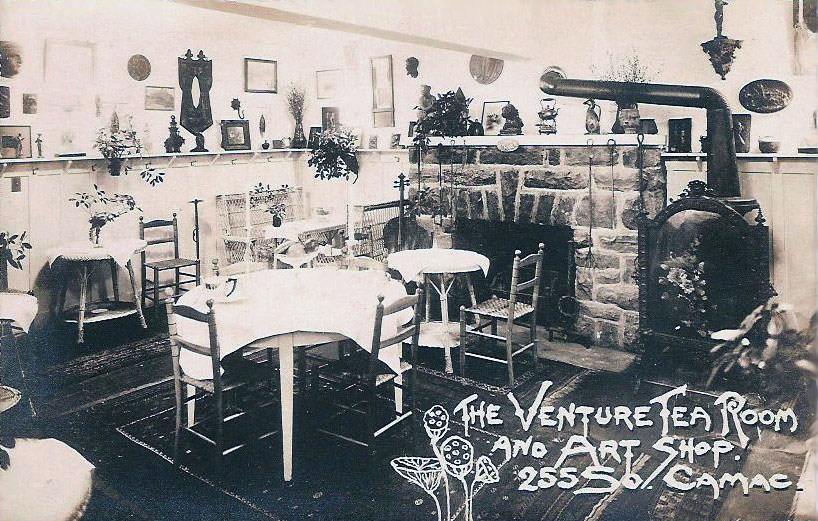
atmosphereVentureTeaRoomPhila

After World War I, following the reign of bohemian restaurants, came a new type of atmospheric eating place, the tea room of the 1920s. The tea room’s special atmosphere was  quaint and homey with artistic touches. In 1922 the Journal of Home Economics pronounced that “The very name of Tea Room has grown to mean a place with ‘atmosphere’ and with furnishings that are unique.” Ranging from the fashionable to the playful, tea rooms proved that women – their primary patrons – were in love with atmosphere.

atmosphere1918FlintMIBucking the trend toward atmospheric decor were a handful of holdouts. Anything like a “restaurant atmosphere” was anathema to a Y.M.C.A. cafeteria in Flint Michigan (1918). The Old Colony Coffee House in Richmond VA renounced “ordinary restaurant atmosphere” in 1924 and vowed it would have instead “simplicity in decorations” and “plainness in food.” Patrons of traditionally masculine restaurants feared that when Chicago’s J. R. Thompson’s tore out its white tiles for a more feminine look it had destroyed its no-nonsense atmosphere and gone “girly girly.” Likewise, design critic Lewis Mumford shuddered when the Childs’ chain replaced the “antiseptic elegance” of its “hospital ward atmosphere” for “fake fifteenth century English,” betraying the honest utilitarianism of the Machine Age. No doubt Mumford chuckled when Alice Foote MacDougall, queen of scenographic Spanish villas and French chateaux in NYC, went bankrupt in 1932. [see The Cortile below]

atmosphereCortile

In the 1950s there was still a tendency in the restaurant industry to see women as the constituency for atmosphere while men supposedly judged a restaurant first by its food quality. But by the 1960s this was no longer true, as indisputably demonstrated by the success of Polynesian restaurants. An executive of the National Restaurant Association (NRA) said that Americans’ demand for atmosphere had raised the cost of opening a restaurant to $4,000 a seat in 1962.

One of the early chains built around atmospheric theme restaurants was David Tallichet’s Specialty Restaurant Corporation in California. In 1965 the firm opened Gate of Spain, capturing the “atmosphere of old Castile” atop a tall building in Santa Monica. Restaurant industry consultant George Wenzel recommended the following year that restaurateurs “give your guests something to do or something to see, or something to make conversations about.” He suggested creating a Gay Nineties or a river boat atmosphere.

In the 1970s theme restaurants came into their own, classified by the NRA as one of three of the basic types of restaurant in 1976, and the one that drew the most affluent guests.

© Jan Whitaker, 2015
5 Comments

Filed under atmosphere, restaurant decor, theme restaurants, women

Taste of a decade: 1840s restaurants

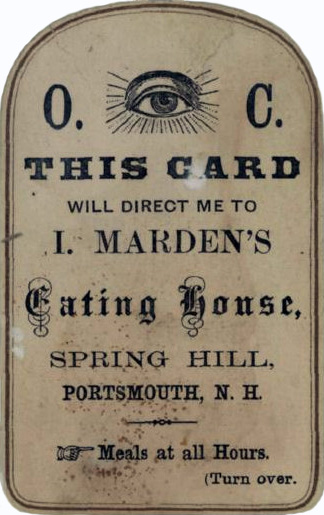
1849Marden'sEating places began to show a French influence as places called “restaurants” and “cafes” replaced “eating houses.” Many hotels adopted the European plan which allowed guests to choose where they would eat instead of including meals in the hotel in the room charge, a change that encouraged the growth of independent eating places. A “restaurant culture” had begun to develop, yet with stiff resistance from many who associated restaurants with vice and immorality.

Menus, particularly those of cheaper eating places, contained mostly meat, pastry, and ever-popular oysters. Meat production was still local; NYC had 200 slaughterhouses in operation. Out-of-season fresh produce was beginning to come North by steamboat from the South, but still not in large quantities. Harvey Parker’s well-known eating house in Boston was celebrated for acquiring peas from Virginia in 1841, but strawberries remained a seasonal delicacy in the Northeast later in the decade.

U.S. territory grew substantially when Texas became a state. Oregon territory was acquired, along with a big chunk of what had been Mexico (New Mexico, Colorado, Arizona, Utah, Nevada, and California). Gold was discovered in California and almost overnight San Francisco became a city of 25,000. San Francisco’s Tadich Grill, still around today, was one of the many restaurants that opened to serve the newcomers. The restaurant business was also doing well in New Orleans, home of generous “free lunch” buffets.

Among the middle classes in the Northeast the movement to discourage heavy drinking – or any at all — resulted in the establishment of “temperance restaurants” that served no alcoholic beverages.

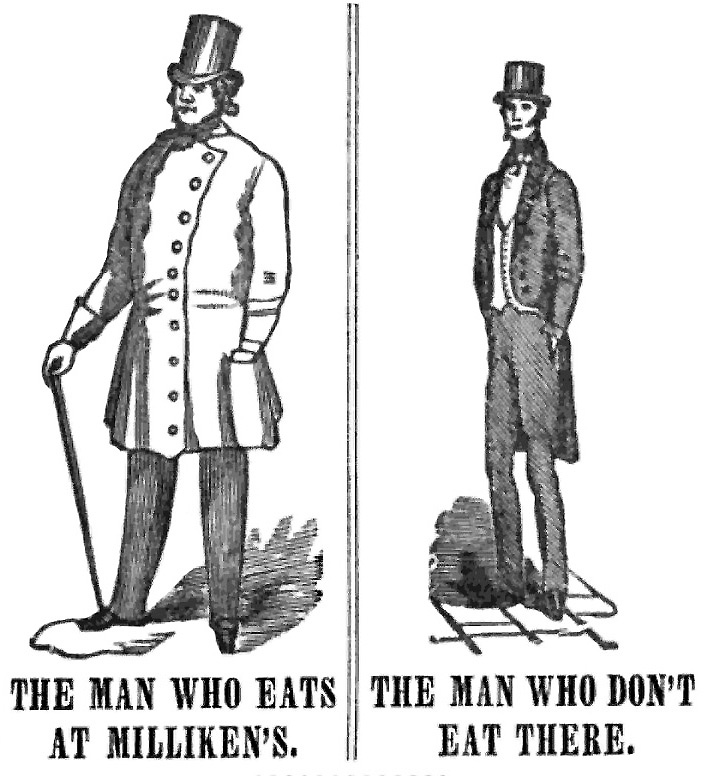
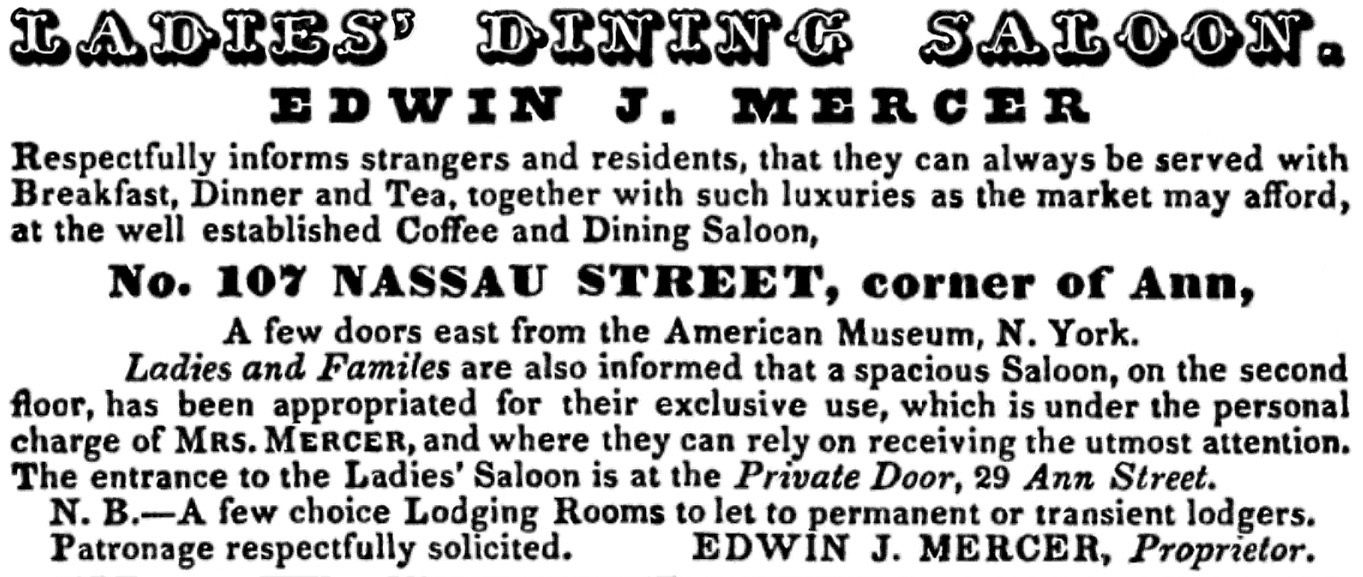
1848Milliken'sBostonEating away from home remained a male activity mostly, as was true at The Alhambra in Richmond VA and Taft’s near Boston, but women sometimes made an appearance. Although an advertisement for the popular and inexpensive Milliken’s in Boston pictured men, it also advised it had  “apartments [dining rooms] for ladies exclusively.” (As the illustration shows, a stout figure was admired then.)

Highlights

1840 If a diner wants to leave his waiter a tip in a cheap eating house, the standard amount is 1 cent, which usually amounts to about 5%.

1841 The Colored American, a weekly newspaper dedicated to elevating the moral and social stature of free Blacks, declares it will accept no advertising for restaurants because they mostly dispense not “wholesome food for the body” but “liquid death, both for body and mind.”

1842 The Franklin Café and Restaurant, located in Philadelphia’s elegant Franklin House (hotel) announces it is serving Ice Cream, Sherbets, and Roman Punch made by a graduate of the world-famous Café Tortoni in Paris.

1843 When a group of temperance advocates visits the Eagle Coffee House in Concord NH to convince the proprietor to give up the sale of intoxicating drinks, he tells them that he would feel “very mean” if he had to refuse a visitor from Boston a drink.

1844 P. B. Brigham announces he has hired the best French and Italian “Artistes” for his Restaurant, Ice Cream, and Oyster Saloon in Boston and has a Ladies’ Saloon newly “fitted up in the Parisian style.”

1845Harvard

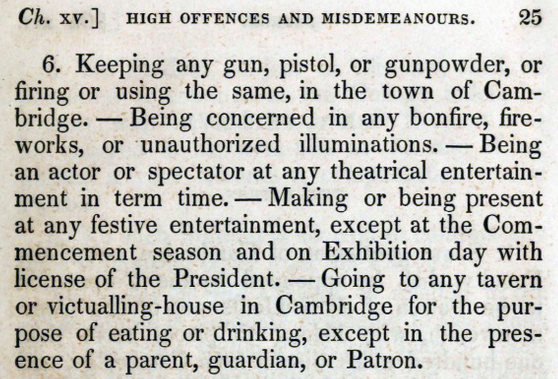
1845 Harvard forbids its students, all male then, from going to Cambridge eating and drinking places without a guardian.

1846 In an era when Black men occupy an important role in the catering business, NYC society caterer George T. Downing opens a summer branch of his business in Newport RI.

1846 A journalist travels somewhere “way out west” and eats at a small town tavern where the fare consists of ham and eggs fried in lard, hog jowl and greens (called corndoggers), and brains with greens, washed down with corn liquor or sassafras tea.

1849NYC

1847 Luxury comes to Baltimore with the opening of the Parisian Restaurant with a “French Cook.” As in Europe, Ladies (accompanied by Gentlemen) are to be honored in a private parlor “where it is hoped that they will be able to enjoy the luxuries of Oysters, Game, etc., from which they have been heretofore excluded.”

1848 In his vivid newspaper series New York in Slices, George G. Foster writes that about 30,000 persons who work in mercantile and financial occupations eat daily in the restaurants of lower Manhattan, and most of them “gorge . . . disgusting masses of stringy meat and tepid vegetables.”

1849 The Home Journal is convinced that the presence of restaurants, cafes, refectories, and oyster saloons, “on almost every corner of the streets” in cities is certain to lead young men to lives of “sensual excesses.”

© Jan Whitaker, 2014

4 Comments

Filed under miscellaneous

Eating Chinese

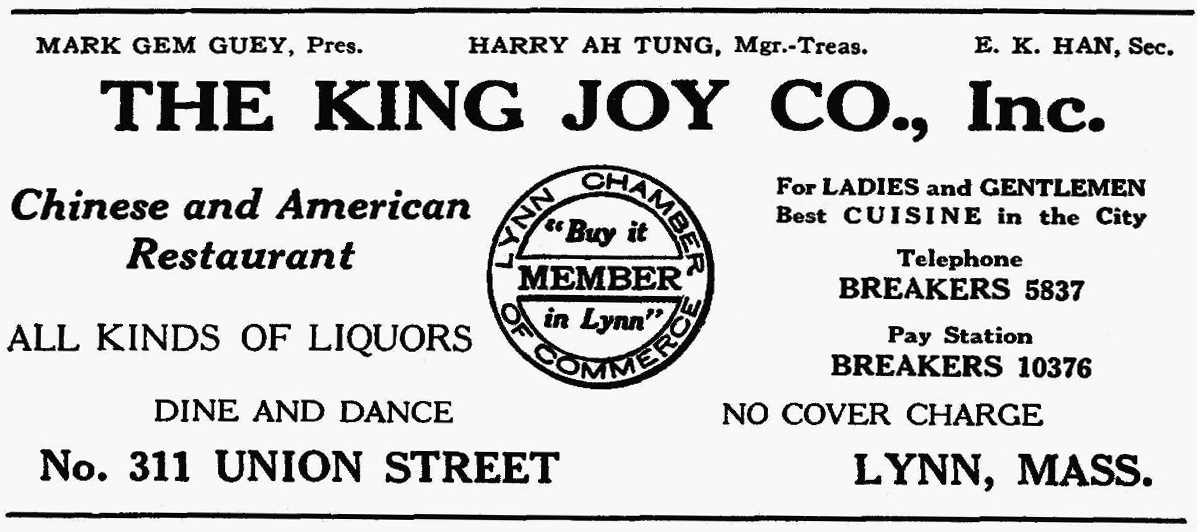
lynn1937KingJoy

While paging through a 1922 Massachusetts business directory I was struck at first by how many Chinese restaurants there were in various towns. But when I went back to the directory to take a closer look I realized there weren’t really so many except, perhaps, in manufacturing towns such as Fall River and Lowell.

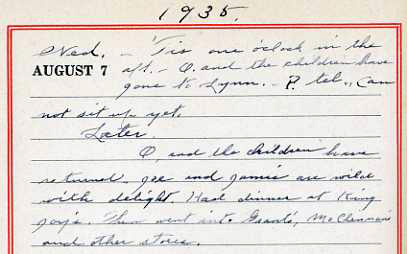
I wondered who patronized Chinese restaurants in Massachusetts in the early 20th century – and then I remembered recently buying a diary that mentioned a place called King Joy.

After I managed to identify the family whose doings were chronicled in the diary (not easy!), I discovered a surprising and intriguing little story.

The diary, mostly written in 1935, was about three generations of a family living on the North Shore of Massachusetts. It was kept by the grandmother of the family who I will call Gertrude, age 76. Her husband Arthur was a retired dentist a few years older. They headed a socially prominent family with two homes, one in the affluent community of Hamilton and the other in the nearby resort town of Nahant.

Living with Arthur and Gertrude were their daughter Opal, age 49, and her son Jamie, age 5. Opal’s brother Perry, a 40-year old engineer, and his wife Ellen, also lived in Hamilton.

hotelvendomeThe overwhelming focus of the diary is the health of family members, who seem to be under the weather for much of 1935. There are large stretches of blank pages where nothing is recorded, but restaurants are mentioned six times, all but one of them Chinese. The exception was the time that Gertrude, Opal, and Jamie went to Boston and stayed overnight in the Hotel Vendome, a Back Bay hotel for the gentry that dated to 1871. While grandmother and grandson retired early, Opal had a late-night supper in the hotel’s Nippon Room. Gertrude, a woman of few words who loved to abbreviate, hints in the diary that the purpose of the trip was for Jamie to visit his estranged father.

WsEatChinese

Twice that year Gertrude records that someone, usually Opal and Jamie, went to King Joy in nearby Lynn MA. Another time Opal went to Lynn to bring back chow mein for her father, Arthur, who had fallen down the stairs at home. Once the family went to the Far East Restaurant in Lynn and once they went to the Canton Restaurant in Worcester, riding in Perry’s car.

OWP1904Opal’s liking for what must have been a fairly exotic cuisine to a Massachusetts native in the 1930s might be explained by her world travel as a young woman. In 1904, at age 19 [pictured], she was adopted by a wealthy retired Boston lawyer with real estate holdings. Divorced and thirty years her senior, he was a renowned animal rights advocate, free thinker, and globe-trotter. (Amazingly enough, Opal’s parents reportedly approved of the arrangement.) Shortly after the adoption, Opal and her new father set off for a visit to the World’s Fair in St. Louis followed by a trip to Brazil and winter in Egypt. It was the first of many trips she would take with him.

Opal married around 1921, at age 36, giving birth to Jamie nine years later. Her adopted father gave her his house in the Boston area as a wedding present and some time later moved to Los Angeles.

PGP1934By the time Opal’s paternalistic benefactor died in 1934 at age 77 [pictured], he had crossed the Atlantic 145 times, visited Russia 16 times, Egypt 13 times, and the Arctic 13 times. In his will he left all his money to animal protection and free-thinking societies and just $1 to Opal. She contested the will, probably without success.

© Jan Whitaker, 2014

3 Comments

Filed under patrons

Park and eat

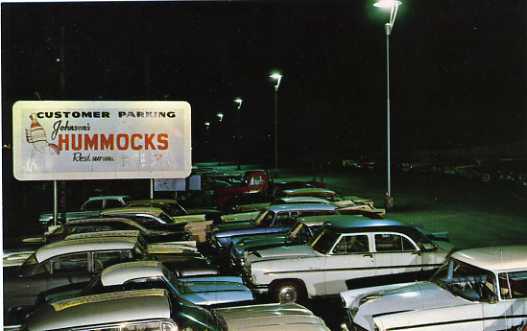
parkingJohnson'sHummocksProvidence

People who travel to restaurants by private transportation other than their feet have often had a little problem. They must do something with their horse, carriage, or car. As basic as this situation is, it has bedeviled eating places through the ages.

Into the mid-19th century, eating places which were also overnight accommodations were legally required to take care of their patrons’ means of transport, i.e., horses. In Haverhill MA, innholders, taverners, and common victualers had to follow rules that included hanging a sign, accepting all travelers, and providing feed for horses.

As urban downtowns grew after the Civil War, fed by trolleys powered by horses, steam, and electricity, restaurants developed independently of hotels and boarding houses with no need of facilities for horses. It must have been a relief, especially as land values rose.

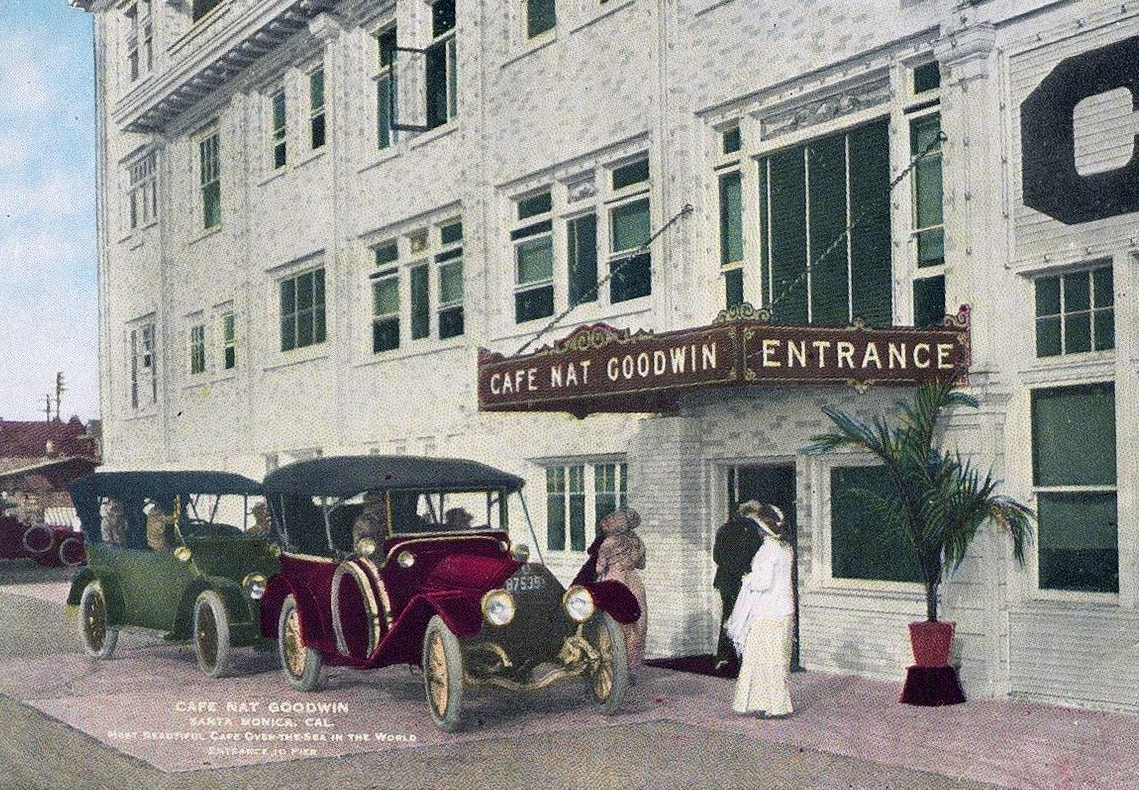
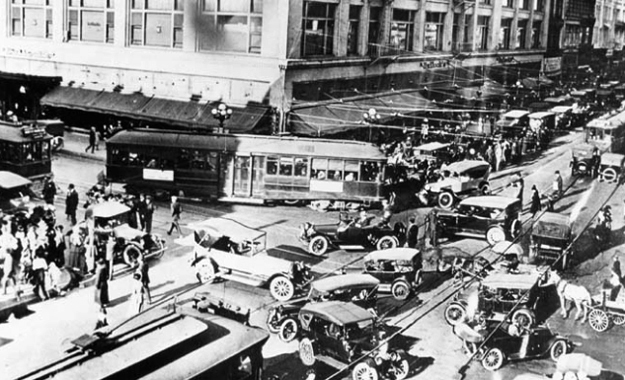
parkingNatGoodwinAt first the arrival of cars in the early 20th century might have seemed like a blessing, delivering patrons directly to the front doors of restaurants. But it soon turned into a curse as unprepared cities became gridlocked with traffic that included a mix of autos, streetcars on tracks, and horse-drawn wagons. Denver, for instance, scrambled to solve downtown congestion after the number of cars on its streets doubled from 1912 to 1915.

parkinggridlockLAmid1920s

A common solution — ordinances that prohibited curb parking on busy streets — caused restaurant owners to rise up in protest. Kansas City restaurateurs objected to a ban on parking before 6:30 p.m., saying it would harm their early dinner business. In Portland OR and Omaha NE restaurant owners complained they would lose their breakfast trade if morning parking was severely curtailed as proposed in those cities. The owner of an Omaha chain pointed out that downtown restaurants paid high rents and would desert the city center for less expensive areas if strict parking bans were enacted. Meanwhile, restaurants lucky enough to have parking lots advertised the fact loud and clear.

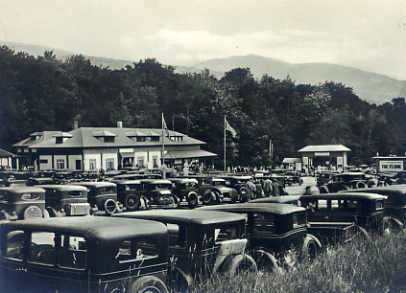
parkingFlumeTeaHouseNH1933

Restaurants and tea rooms (such as The Flume teahouse, shown here) in outlying areas with plenty of space for parking thrived. Warren’s Dining Car, located outside Worcester MA near the White City amusement park, advertised in 1927 that it had parking for 500 cars.

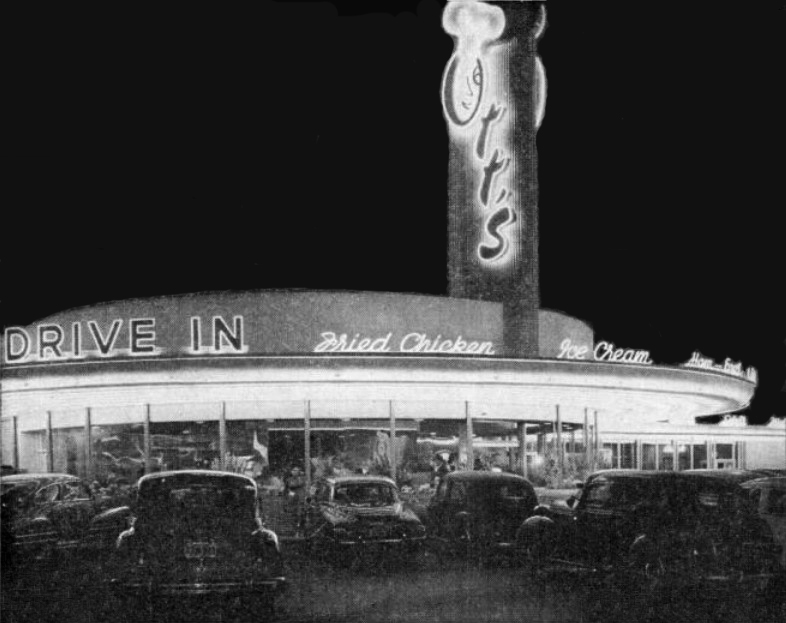
parkingOtt'sWith all the problems of downtown, it wasn’t long before restaurants began making good on their threats to relocate farther out, often in newer shopping areas on wider streets near residential areas. Anticipating the fast food chains of the 1960s, drive-ins chose to build on spacious lots surrounded by parking space. When Neff’s Drive-In opened in Corpus Christi TX in 1940 it boasted hickory-smoked barbecue served by “15 Beautiful Girls” on a full acre of parking space. Ott’s Drive-In in San Francisco employed four traffic police to direct parking in its 250-car lot.
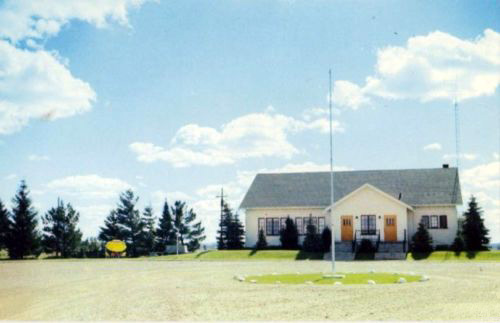
But it took a high volume of business to warrant such a large parking lot. The director of a restaurant design firm in Los Angeles observed in 1961 how difficult it was to find an affordable parcel of land big enough to accommodate a restaurant and parking for customers. Economically it was unfeasible for any place not open 24 hours, he said.

With 60 million cars on American roads in 1955, valet parking – which originated in venues with distant parking lots such as racetracks and sports stadiums – became common in urban restaurants with an affluent clientele who might otherwise avoid downtown. It brought its own set of problems, though, such as complaints about police taking payoffs in return for allowing attendants to park cars illegally.

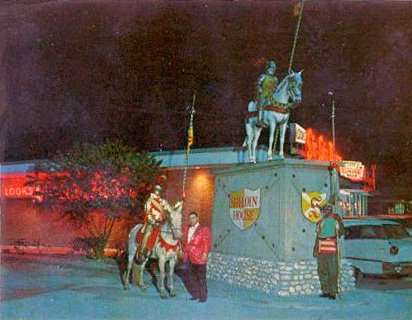
parkingthemeknightsir-loinHouseHoustonOne creative solution to the problem of a distant parking lot was demonstrated by the Sir-Loin House, a popular Houston TX steakhouse. Adopting a medieval knighthood theme, parking lot attendants dressed as Robin Hoods and guests were escorted to the restaurant by a knight on a white horse.

Although there are numerous parking garages in most urban areas today, parking still remains an issue for many restaurants and their patrons. The situation has almost certainly assisted the growth of fast food establishments with rapid turnover as well as the rise of premier restaurants in suburbs.

© Jan Whitaker, 2014

Leave a comment

Filed under restaurant customs

Thanksgiving quiz: dinner times four

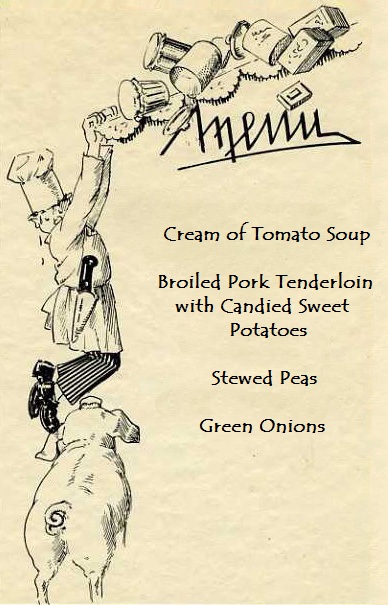
TDaymenuBeefIn 1921 a café in Kalamazoo, Michigan, advertised that it would offer a selection of Thanksgiving dinners at different prices. The most expensive was 85 cents, then came a 65-cent dinner, one at 60 cents, and a 50-cent dinner. In today’s dollars, they would range in price from a high of $11.10 to a low of $6.51.
TDaymenuChicken

All dinners began with tomato soup. They featured four types of roast meat: beef, pork, turkey, and chicken, with accompanying dishes that were not fancy. Strangely the menus made no mention of dessert. Perhaps it was not included in the price of the dinner. Since selling alcoholic beverages was illegal in 1921, it’s likely that Thanksgiving diners would have had coffee.

TDaymenuPorkThe name of the restaurant was the Bon Ton. Its proprietors were the Thenos brothers, Nicholas and George, of Greek heritage. The small restaurant advertised that it was “open all hours” and had moderate prices. It employed women as servers. I have not been able to find a photograph of it, but undoubtedly it followed the typical café configuration of its time with a counter running down one side of a narrow storefront space and tables on the other side, with the kitchen at the rear.

tdaymenuTurkey3


Can you identify the most expensive dinner? Study the four Thanksgiving menus (which I have re-created using menu blanks) and decide which you think was the 85-cent dinner, which the 65-cent dinner, etc.

Answers in the Comments, on Thanksgiving Day.

© Jan Whitaker, 2014

14 Comments

Filed under menus, miscellaneous

Dining sky-side

airportO'Hare

Although a number of superior restaurants have opened in airports in the past several years, their run-of-the-mill food purveyors are often just passable. Customer comments reveal praise for certain restaurants, but opinions overall sound a negative note, rising to weak compliments such as “actually somewhat good” or “standard innocuous restaurant/hotel fare.”

In the beginning, there was no food at all. In the 1920s airports had no restaurant facilities. There were scarcely any commercial flights, facilities consisted mainly of fields and a hangar or two, and the few commercial passengers were lucky if they could get a cup of coffee.

By the mid-1930s more commercial flights were offered and airport conditions improved. The number of passengers multiplied more than 100 times between 1926 and 1935. To win greater traffic, bigger cities vied to create terminal facilities that could match those of their transportation rival, trains. Restaurants figured prominently among the amenities offered.

Most passengers in the 1930s, 1940s, and 1950s were businessmen or wealthy travelers who were unwilling to settle for bad food. Even though all air travel was essentially first-class then, passengers frequently rejected what was served on the plane and tried for something better in the terminal. Their demands, combined with the need to put airports in the black financially, brought about efforts to create first-rate airport eating places.

airportburbankskyroom (2)

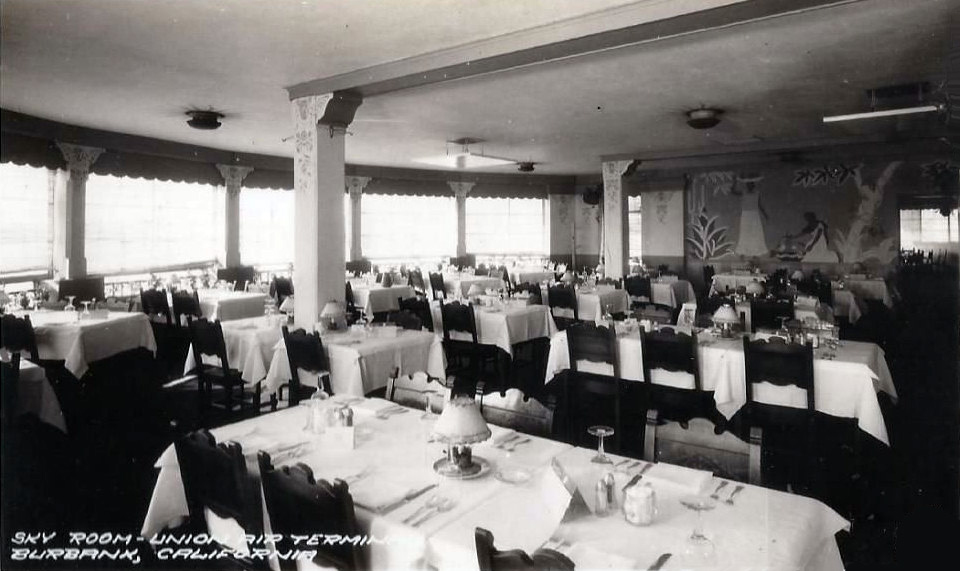
The earliest image of an airport restaurant I’ve found is that of the Sky Room in Burbank CA’s Union Air Terminal (now Bob Hope Airport), in 1940, showing tables with white linens, goblets, and boudoir-style table lamps.

Airports were costly for cities and towns to build and run so income from concessions was needed badly. Managers expected income from non-aviation concessions at New York’s Idlewild airport to make up one third of revenues in 1949. Restaurants and coffee shops were the biggest single contributors of concession revenue in most airports.

But restaurants found it hard to operate profitably when serving only “captive customers,” particularly when their numbers were still relatively small. Beyond pleasing airline passengers, the solution for many airports was to reach out to customers living nearby. In 1947 the airport restaurant in Albuquerque NM went so far as to hire a chef who had studied with Escoffier and cooked for US presidents and royal families in Europe. His mission was to make the terminal restaurant one of the nation’s best known restaurants.

The early 1950s saw the debut of what might have been America’s premier airport restaurant, The Newarker in the Newark NJ terminal. With Joe Baum as manager and Albert Stockli as chef, it soon became famous, launching Restaurant Associates which owned many of NYC’s top dining establishments. Duncan Hines lauded The Newarker for its “flaming sword specialties, authentic East Indian curries, [and] regional Swiss specialties.”

airportCleveland1965Seattle1941

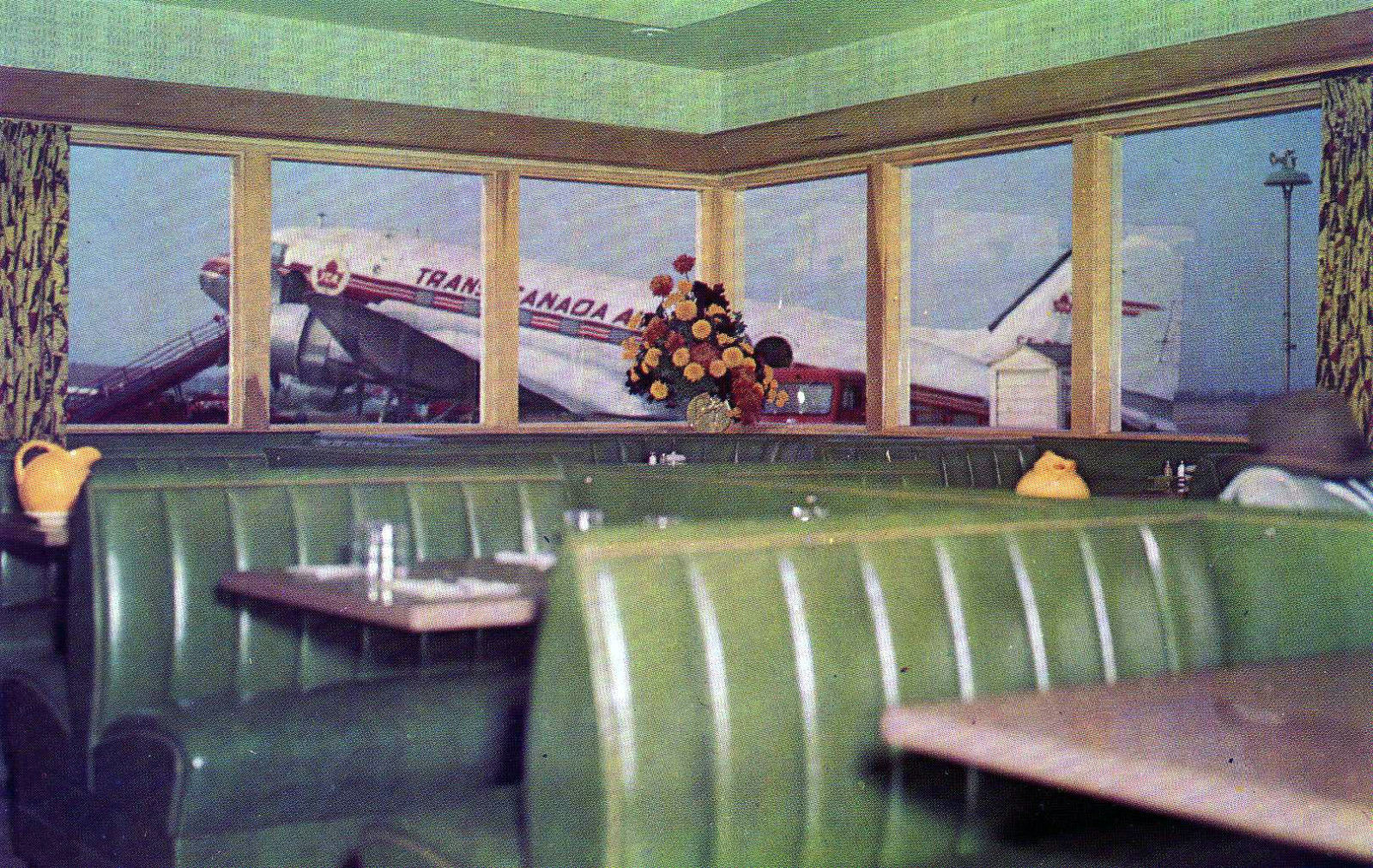
Evidently the tactic of pulling in locals worked, partly because even through the 1960s people were thrilled to see planes take off and land. Dining rooms typically overlooked the airfield. In 1953 Fort Worth’s new terminal at Amon Carter Field was touted as “a wonderful, quiet spot to have a leisurely evening meal and then sit on the observation deck and look at the bright lights of booming Dallas nineteen miles away.” Now it may seem an odd idea to go to an airport restaurant to celebrate a birthday or, even stranger, a holiday such as Thanksgiving or New Year’s Eve, yet these festivities did indeed take place [advertisements: Cleveland, 1965; Seattle, 1941].

airportClevelandshreiberrestaurantSome airport restaurants were operated by local restaurateurs. Among them was Marie Schreiber, who became a restaurant operator for Statler hotels after providing meals in Cleveland’s airport restaurant [pictured] as well as on-board meals for departing United Airlines flights. Food service operations of two Chicago departments stores, Marshall Field and Carson, Pirie & Scott, handled meals at O’Hare for years.

At the same time, chains that ran airport restaurants and prepared meals for service during flights developed rapidly. Some, such as Skychef restaurants, were operated by the airlines (in this case American Airlines), but existing chains such as Dobbs House and railroad caterers Fred Harvey and Interstate Hosts also migrated into airports. Dobbs House units in airports from Wichita to Miami also earned praise from Duncan Hines in 1959 for dishes such as pompano en papillote and Colorado mountain trout.

Southern airports were protest sites because of their discriminatory treatment of Black passengers. Until summer of 1961, Blacks were not served in Interstate Hosts’ main dining room or the coffee shop in New Orleans’ Moisant International airport, but only at the snack bar. After lawsuits, Black customers gained equal patronage at all airport restaurants in recognition that airports, like bus terminal facilities, were fundamental to interstate commerce.

In the 1980s theme restaurants – often flight-themed – began to locate in the vicinity of airports. But that’s a subject for a future post.

© Jan Whitaker, 2014

6 Comments

Filed under family restaurants, Offbeat places

Habenstein of Hartford

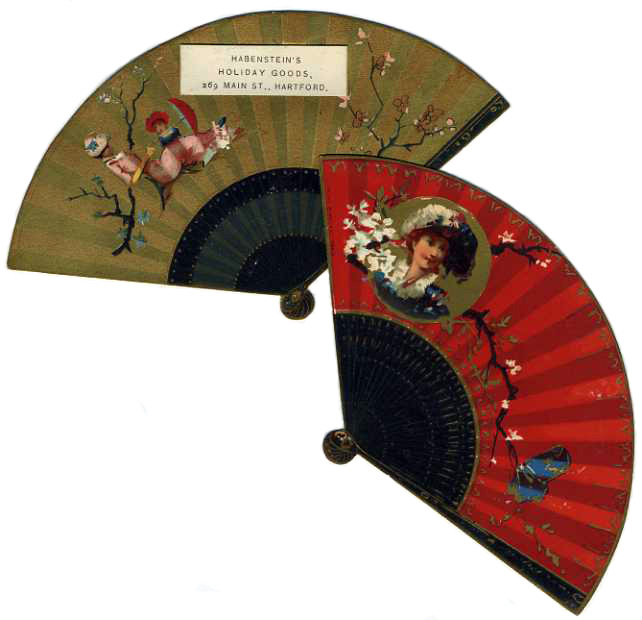
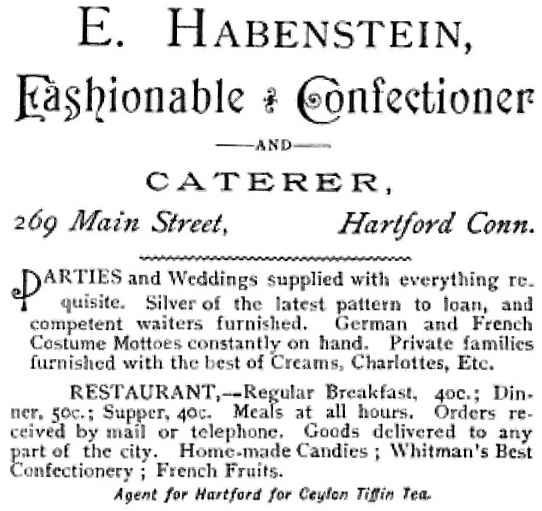
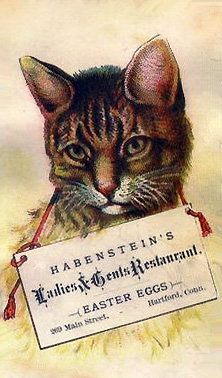
habrenstein's1880stradecardsIn the late 19th century having your party catered by Edward Habenstein was proof that you had arrived socially. The newspapers of Hartford CT and Springfield MA were filled with descriptions of lavish social events that carried the phrase “catered by Habenstein of Hartford.” That said it all.

Edward Habenstein was born in Saxony, Germany, around 1844 and came to the US with his parents when he was young. They settled in Utica NY where, at age 15, he joined a catering business. When he was 18 he went to New York City, moving to Hartford in 1865 and starting his business in 1868.

habenstein's1891Wesleyanpub

Although his was a retail confectionery and bakery selling its own products as well as Whitman’s candies, French candied fruits, and holiday favors, Edward and his wife Adelia specialized in weddings and large affairs given in private homes. By 1880 they also ran a restaurant but, judging from advertisements, catering remained a prominent part of their business. In Massachusetts the company was known simply as “Habenstein, the Connecticut caterer” while in Connecticut newspapers it claimed the title “The State Caterer” as reflected in an 1890 advertisement consisting solely of that line and a Main Street address in Hartford.

habenstein'sEasterEggsIn addition to providing edible refreshments and dinners, Habenstein supplied receptions and parties with “silver of the latest pattern,” decorated French china, awnings, camp chairs, cloth to cover valuable carpets, orchestras, and “first-class” cooks and waiters.

In June of 1886, a Springfield MA alderman opened his house to the city’s elites who danced, spilled out into an enclosed piazza, and enjoyed Habenstein’s refreshments “of all conceivable forms and kinds.” In summer 1895 an even splashier affair was hosted by the Skinner family who owned one of the nation’s largest silk mills in Holyoke MA. Youngest daughter Katherine entertained about 300 guests at a lawn party at their palatial home “Wistariahurst,” whose grounds were lit with clusters of Chinese paper lanterns hung from trees. The younger set danced for hours outdoors on a specially constructed platform illuminated by arc lights while Habenstein served “lunch” in the mansion’s dining room.

habenstein'sdinner

Students at Wesleyan College in Middletown CT also enjoyed Habenstein’s hospitality. In June 1890 the all-male sophomore class boarded a boat on the Connecticut River to travel to the Hartford restaurant. The boat got hung up on a sandbar and, despite its departure at 11 P.M., did not arrive until 2 A.M. Edward was a bit cross, according to an illustrated account in a student magazine, but served the Class of 1892 a delicious “midnight” supper nonetheless. I’m struck how unlike the menu is compared to what 19-year-old students might order today. They might agree with Milton’s epigram but would they quote it atop their menu?

MENU.
“What hath night to do with sleep.
Welcome joy and feast, midnight
Shout and revelry.” – Milton’s Comus.

Little Neck Clams,
Olives               Celery           Radishes
Vermicelli Soup
Salmon, with wine sauce
Currant Jelly
Brown Mashed Potatoes                           Broiled Chicken on Toast
Saratoga Potatoes                  French Peas
Roman Punch
Lobster de Newburg               Chicken Salad
Fruit                         Assorted Cakes
Ice Cream                  Neapolitan Ice
Coffee
Cigars        Cigarettes

Over its more than 50 years in business in Hartford and up and down the Connecticut River valley, Habenstein’s moved about half a dozen times. In 1902, when it was at 805 Main Street, it advertised that it was the best restaurant in Connecticut. Edward died around 1920. Adelia carried on the business for a short time.

© Jan Whitaker, 2014

10 Comments

Filed under confectionery restaurants, patrons

Back of the house: writing this blog

BackofhouseLemmonSDkitchen30s

I have a saying that I recite to myself often while I’m doing historical research. “The more you know, the less you know.” By that I mean the more you research a subject, the more you realize how little you knew before your latest discovery.

By the same logic you begin to doubt that you’ll ever know enough to write a reasonably well founded piece.

To deal with these doubts (and because I enjoy it), I tend to overdo the research stage of production. And the same is true of image gathering, which is almost an obsession with me and is what led me to restaurant history to begin with.

I’m now working on several posts, about a dozen probably, but two actively, alternating between them. The one likely to make it to the finish line first is about airport restaurants. I thought it would be easier than the other one, on the 1840s. It’s funny how I’ll switch from a post that is “too hard” to a topic that suddenly comes to me, miraculously promising to be “quick and easy.” Which rarely turns out to be true. So, airport restaurants (the easy one) has now taken several days. So far I have generated 10 pages of single-spaced notes, and have 23 images to choose from, way more than usual. I have yet to write it, so I have not embarked on the following:

Created with Nokia Smart Cam

The photo edit stage. Actually, along with more research this is something I do between bouts of writing to entertain myself. I rarely let my images go without some polishing. I adjust the tone of photographs to give them depth. I sharpen the focus. I remove blotches from black and white newspaper advertisements. I fix broken type. Sometimes I adjust color on postcards and menus.

The draft revision stage. Ideally I like to wait a day before I publish my post. The perspective gained by even 12 hours of distance lets me see ways I can rephrase sentences or restructure the whole essay.

The editor’s eye stage. Finally, just before I post on WordPress, I ask my editor to look it over.

My editor says things like:

“Doesn’t Glenn (Miller) have two Ns?” Yep.

“That sentence is too long. Break it into two.” Yep.

“1945? Don’t you mean 1845?” Yep.

The final mini-tweak stage. Inevitably, before I hit the Publish button, I discover some little thing that I need to change. An unfortunate word, a missing comma, a confusing sentence, or an actual error (the editor is good but not infallible).

I write all this not to brag, but to say that writing for a blog is no different than writing for any other form of publication. I can think of a number of quality blogs whose authors, I’m sure, go through the same stages I do. You can tell when you read them. There may be some writers who are so good they don’t need to work relentlessly to produce a decent piece of writing – but that is not true of most of us.

BackofHouse820How weird to discover, after writing all the above, that I left out the writing stage. Let’s just say it’s often filled with false starts, bloated sentences, and lots of intermissions for weed-pulling, taking walks, and staring out the window.

The finished stage. My favorite. I’m the kind of writer who enjoys having done it more than doing it.

© Jan Whitaker, 2014

12 Comments

Filed under miscellaneous

Image gallery: supper clubs

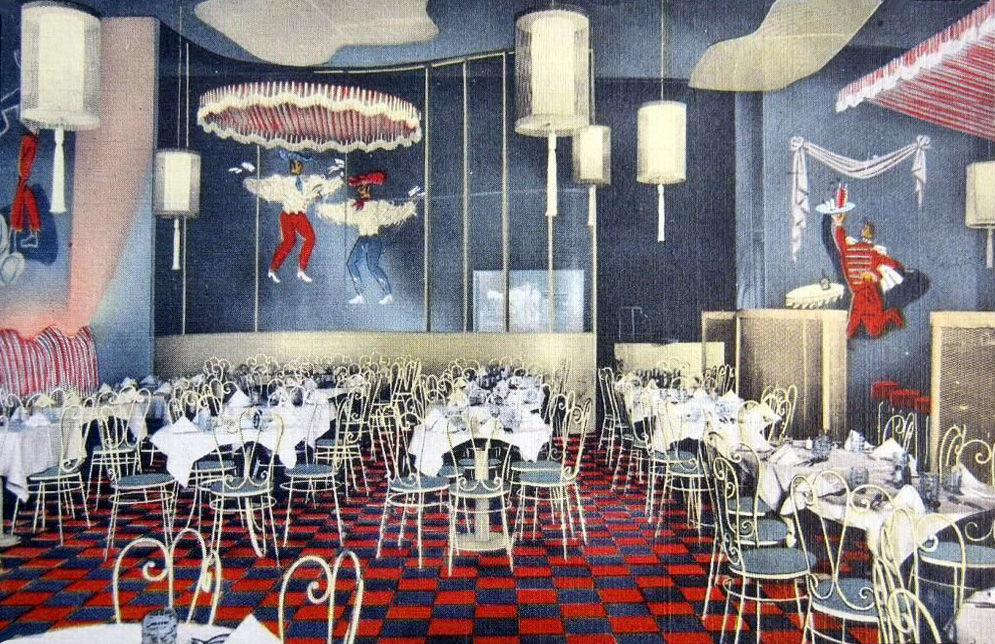
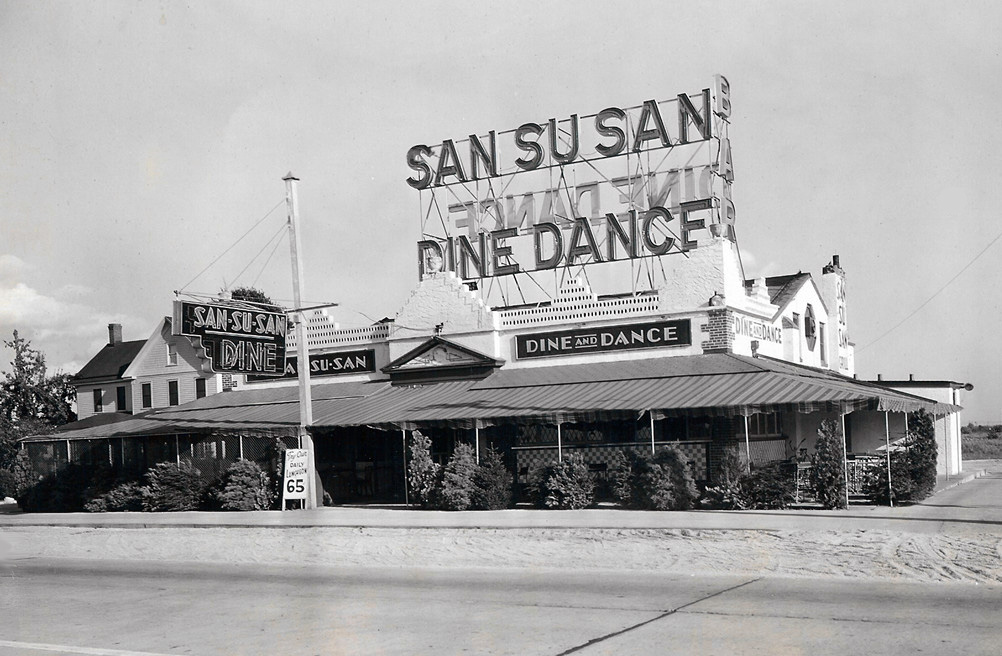
supperclubdine&dance813Supper clubs, night clubs where meals are accompanied by live music and (usually) dancing, began as private clubs rather than as businesses. Groups of people who knew each other, often socialites or theater performers, met regularly for late-night meals and entertainment, at either a single restaurant or at a succession of restaurants. The revelry might last until 2 or 3 A.M. if not later.

By the 1920s the habit had developed into a type of restaurant catering to fun seekers and open not to the select few but to the general public. Perhaps because supper clubs had once been associated in many people’s minds with capital-S Society, these restaurants enjoyed an aura of glamour.

Although a supper club is a night club that serves food, there are many variations. Some were urban, such as NYC’s well-known nightspots El Morocco, the Stork Club, and the Copacabana. But from the 1920s until the decline of supper clubs in the 1970s, many across the U.S. were located on roads outside settled areas. This is particularly true in the upper Midwest. In Wisconsin, where supper clubs have particularly flourished, they have ranged from rustic roadhouses serving barbecue to swanky resort-area clubs.

In movies of the 1930s and 1940s, supper clubs were portrayed as places where big stars and popular bands such as Glenn Miller’s played, but far more common were the sort that hosted local musicians. Still, patrons dressed up and enjoyed a night out, dining and dancing, perhaps even a forbidden cocktail or two during Prohibition, and maybe a floor show, without spending a fortune. Many a wedding and anniversary party was held at supper clubs across the country.

Despite the low point reached in the 1980s and 1990s, supper clubs showed an ability to incorporate trends such as the Tiki-mania of the 1960s and are reportedly making a comeback, now as retro-deco revivals with gourmet food. This has not always been true. According to menu-planner Lothar Kreck the wise supper club manager of the 1970s saw to it that the menu selections – whether stuffed lobster tails or capons — were prepared in advance of the arrival of guests.

The Gallery

supperclubThePyramid

The winner of the title “Dairy Princess of Dodge County” was announced at a dairy banquet at the Pyramid Supper Club in Beaver Dam WI in June, 1973. The illustration’s proportions would appear to be a tiny bit exaggerated.

SupperClubTesch'sSC,AntigoWI

At the other end of the glamour spectrum was the very modest looking Tesch’s Supper Club in Antigo WI, one of the many mom&pop operations.

supperclubTeaneckNJ

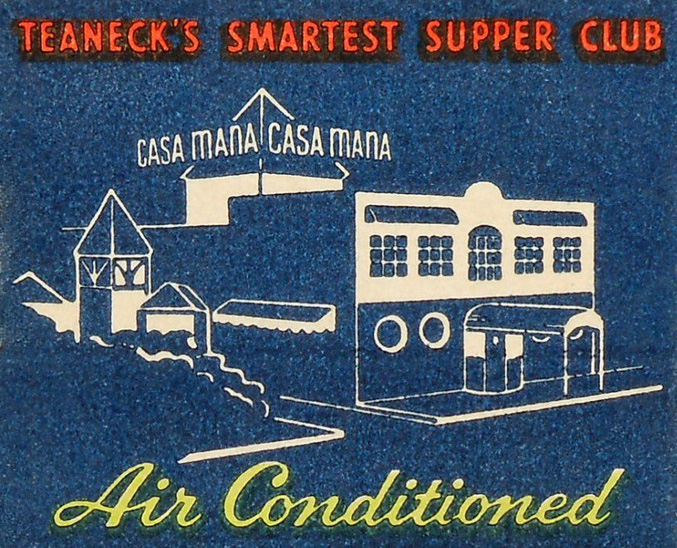
In the 1950s and 1960s The Casa Mana in Teaneck NJ  hosted the Lions Club, United Steel Workers, and Democratic Party functions.

SupperClubSilverDomeWI

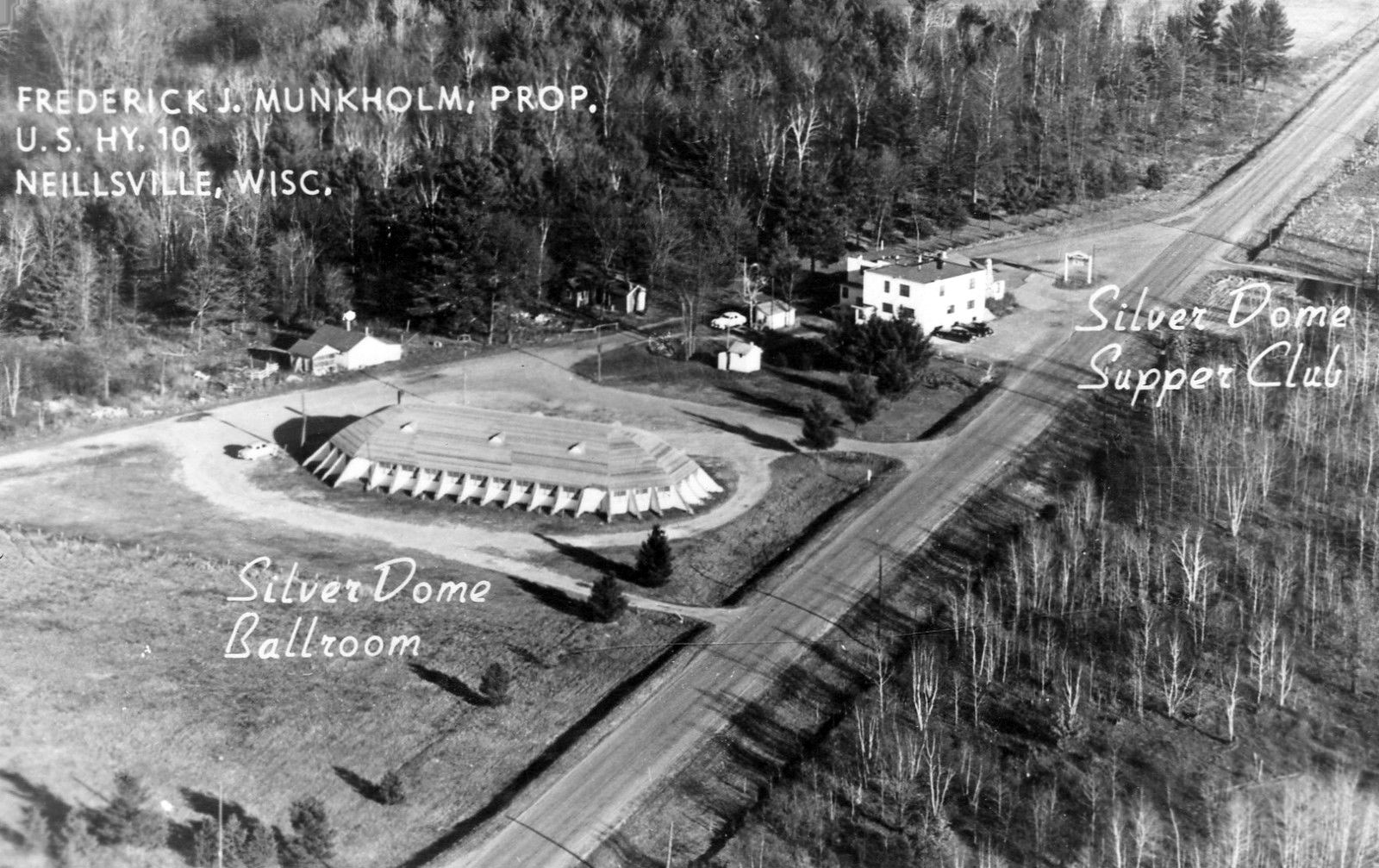
The Silver Dome Supper Club and Ballroom featured dining and dancing in two separate buildings.

SupperClubMardiGrasOaklandCA

In Oakland CA, the Mardi Gras Supper Club offered music in a raucous setting.

supperclubElMorocco

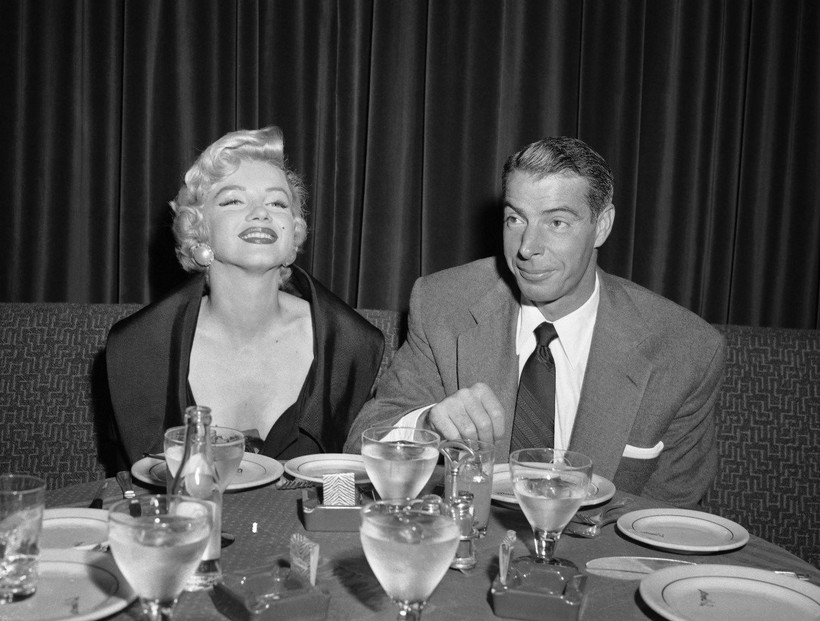
El Morocco in NYC was visited by celebrities such as Marilyn Monroe and then-husband Joe DiMaggio. Did they stay long enough to get some food on their plates?

SupperClubAmato'sPortlandORAn

Most supper clubs patrons were not celebrities. In an earlier incarnation Amato’s Supper Club had been the Roseland Ballroom owned by one of Portland Oregon’s leading restaurateurs, Larry Hilaire.

SupperClubDallas

Menu of the El Tivoli, established in 1929 on a former golf course west of Dallas on the Fort Worth Pike.

SupperClubMineolaNY1933An

Tiny Tim, famous for his falsetto rendition of “Tiptoe Through the Tulips,” played this Long Island supper club in 1970, a year before the Mineola NY property was put up for sale.

supperclubLotus814

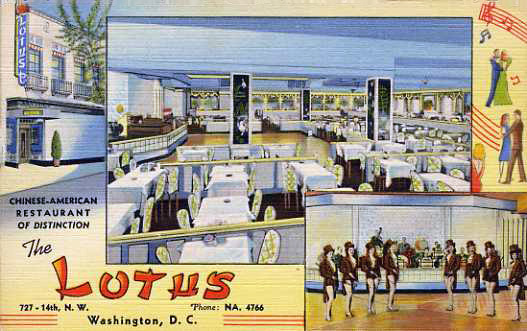
The Lotus, a Chinese supper club, was one of the many that did not use supper club in their name, preferring the term Cabaret Restaurant. Chinese and Afro-American supper clubs were numerous in big cities. In his book Historic Restaurants of Washington, D.C., John DeFerrari documents both. Club Bali, opened in 1943, featured Sarah Vaughn, Erroll Garner, Dinah Washington, and many other topnotch Black performers.

© Jan Whitaker, 2014

7 Comments

Filed under night clubs, roadside restaurants