Sometimes I feel the need to focus on ridiculousness in restaurants, maybe because I run across so many instances of it when I’m meandering through old sources. Lately I’ve been exploring franchising and have encountered numerous silly concepts expressed in the names of chains. Many businesses across the country adopted “Mister” or “Mr.” as part of their names, and this seems to have been particularly true of restaurant chains. [For now, I’m calling all of them Mister.]
There are also scores of restaurants with names such as Mister Mike’s or Mister T’s, but those are usually not part of franchise chains and the letter or nickname refers to an actual person, usually the owner, who may be known by that name in real life. I’m not including those here.
I’m more interested in the Misters that are not named for actual humans. At least I’m hoping that there is no real-life Mister Beef, Bun, Burger, Chicken, Drumstick, Fifteen, Hambone, Hamwich, Hofbrau, Pancake, Quick, Sandwich, Sirloin, Softee, Steak, Swiss, or Taco.

There were also Sir chains, such as Sir Beef, plus Kings and Senors. Were they in their own way an expression of multiculturalism? Being “continental,” Sir Beef was classier than most of the Misters.
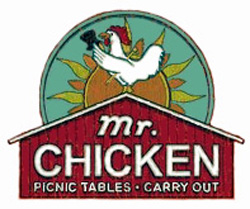
For quite a while I believed there could be no Mister Chicken. That seemed obvious to me – who wants to be called a chicken? But then it occurred to me that I should do a little more research. I was proven wrong. Maybe I shouldn’t be surprised. Surrounding the logo shown here were the words: Home of America’s Best Barbecue Chicken Since 1966!” Although there were restaurants by the same name in Rockford IL and Atlanta GA, I don’t know if they were related.
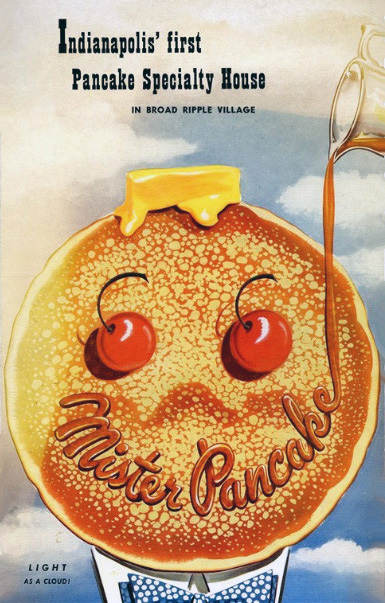
I find Mister Pancake’s face somehow threatening, but never mind that – he was a hit in his hometown of Indianapolis. He came into the world there in 1959, but I don’t know if he appeared anywhere else.
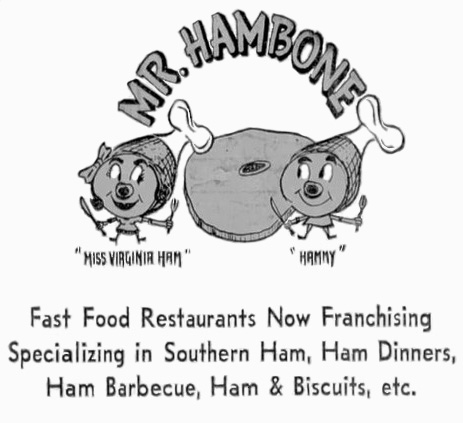
I especially like the logos that attempt to humanize food, particularly unlikely items such as hambones. Sadly for him and his girlfriend, Mister Hambone International – aka Hammy — really didn’t catch on. Starting out in Virginia in 1969, he opened at least one place in North Carolina, but nothing, I think, internationally.
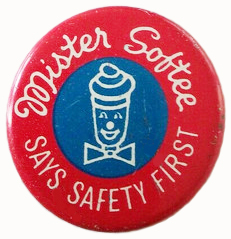
Mister Softee with his natty bow tie, born in New Jersey, was mainly peddled out of ice cream trucks, but there were also restaurants of the same name that served hamburgers, steaks, hot dogs, fish, etc., along with the creamy guy. In 1967 a mobile franchise cost $2,500 while a restaurant was ten times that, which may account for why there were then 1,600 trucks — even as far off as the French West Indies — but only 5 restaurants. Overall, Mister Softee, like Mister Steak, had a more successful life than most of the Misters.
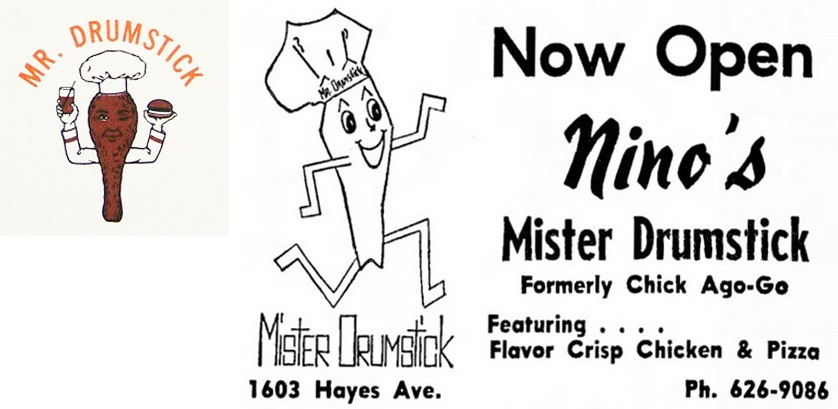
Mister Drumstick, born in Atlanta, offered the World’s Best Fried Chicken. I can’t help but wonder why he is holding a hamburger rather than a chicken leg. Maybe it was because his franchise was sold in connection with Mister Sirloin, a roast beefery, as well as Mister Hamwich, a ham sandwich purveyor. So far I’ve found four Mister Drumsticks in Atlanta and a few in Illinois, Ohio, and Missouri. Nino’s Mister Drumstick in Sandusky OH looks more athletic than Atlanta’s, but of course he has the advantage of legs. Was he a go-go dancer in an earlier phase of his career?
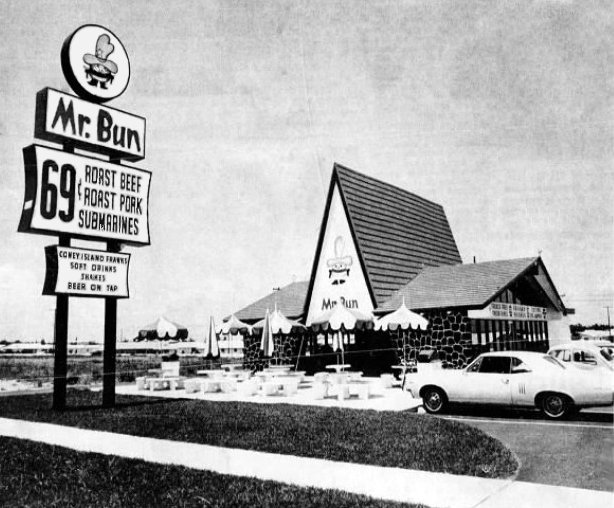
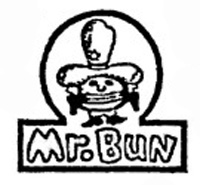
I like the Drumsticks, but my favorites are Mister Bun and Mister Sandwich (of New York City!). They are so versatile. They can handle anything that goes between two slices of bread. I don’t know what Mister Sandwich looked like but Mister Bun was a strange one, with his extremely short legs, his six-guns, and his 10-gallon hat. I can’t really figure him out. Is he trying to compensate for being nothing but bread?
The three Florida creators of Mister Bun had high hopes in 1968 when they opened their first location in Palm Beach, with plans to add more outlets in Florida as well as a number of other states where investors were interested. They advertised for franchisees by telling them that Mister Bun featured “the eight most popular food items in this nation.” It was true that Mister Bun could hold almost anything, so they settled on roast beef, cold cuts, roast pork, frankfurters and fish, accompanied by french fries and onion rings, and washed down with a range of beverages, including beer. Alas, Mister Bun had a rather unhappy life, experiencing little growth, abandonment by his primary creator, and time in court.
Females seemed to stay out of the game, so there are no Mrs. Buns, Mrs. Beefs, Mrs. Tacos . . . or Miss Steaks. Maybe theirs was the wiser course.
© Jan Whitaker, 2022




 People have strong feelings about their favorite dishes from restaurant chains. I am thankful to all those who poured their hearts out on the subject on Jane & Michael Stern’s ever-fascinating Roadfood forums. I have excerpted the following wistful memories from “Long-gone regional franchises” which took on a life of its own and ran for years. After each snippet is the pertinent chain restaurant.
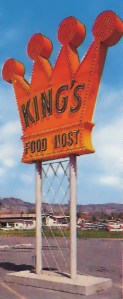 — The Cheese Frenchies were unique. [King’s Food Host]
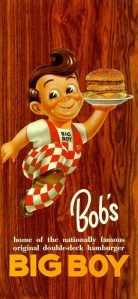 — Pickles, diced onion, relish, mustard, ketchup and mayo were all available. [25 Cent Hamburger]
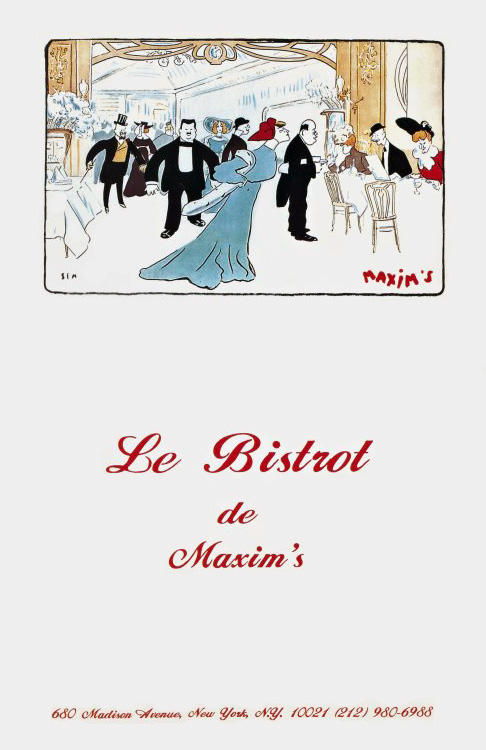
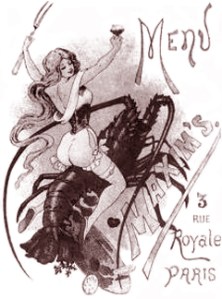
 The name has cast a spell over Americans since the 1890s and bits of its odd history have played out in the U.S. The fortunes of the “world’s most famous restaurant” have risen and fallen. It has won high ratings and lost them. It has been the subject and site of operettas, songs, and movies. It has been declared a French national treasure and an altar to haute cuisine, but also a fraud and a tourist trap. Maxim’s name has appeared on perfumes, airplane meals, and franchised outlets, yet even today it resonates.
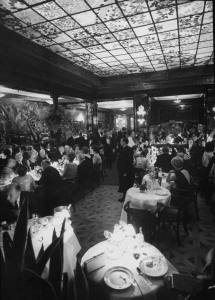 According to most accounts a waiter named Maxime Gaillard began Maxim’s in 1893. Yet another report calls him maitre d’hôtel Signor Maximo, while another stakes a claim for Georges Everard as founder in 1890. Everyone seems to agree, though, that the early Maxim’s was a late-night glamour magnet for American and English visitors to Paris, liberally supplied with friendly prostitutes. In 1899 it acquired a flamboyant Art Nouveau interior with enough murals, curves, and mirrors for a loopy carnival ride. Its prices were high, which may explain why many turn-of-the-century patrons, though dressed in silks and tuxedos, preferred to watch the action while munching pommes frites, an early specialty of the house.
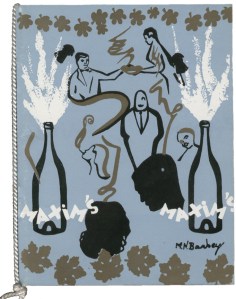 Detractors, such as H. L. Mencken, charged that Maxim’s “gypsy” orchestra was composed of Germans and that the toy balloons floating around were from “the Elite Novelty Co. of Jersey City, U.S.A.” In “Paris à la Carte” (1911), Julian Street, an authority on French food and wines, asserted “I abominate it,” and denounced it as “a brazen fake, over-advertised, ogling, odoriferous; a nightmare of smoke, champagne, and banality.” Debauched merrymakers aside, these were the golden years, before World War I, the era of wine, women, and song on which the Maxim’s legend would be built.
 By 1953 the restaurant had earned 3 stars in the Michelin Guide and was starting on a new course. It had developed a frozen food division which supplied airplane meals and was poised to sell frozen sauces and entrées in select American stores. In another twist, Maxim’s authorized a
 It's great to hear from readers and I take time to answer queries. I can't always find what you are looking for, but I do appreciate getting thank yous no matter what the outcome.
 Restaurant-ing through history