 When it came to cheap ready-to-eat food that was available around the clock, butter cakes sold in coffee and cake saloons were king. By the mid-19th century they had become food of urban lore. They were said to be favorites of people of the night such as newsboys, newspaper printers, policemen, volunteer firemen, and prostitutes.
Until the 1880s when they widened their menus, coffee and cake saloons served nothing but those two items. Although called saloons, they were not drinking places. Saloon then simply meant a room.
There was no hint of elegance in these places. Many were run by Irish proprietors, at a time when the Irish were pretty much at the bottom of the class order. Usually they were in basements, but those were the more established coffee and cake saloons. Other sellers occupied market stands or peddled butter cakes on the streets with trays strapped over their shoulders.
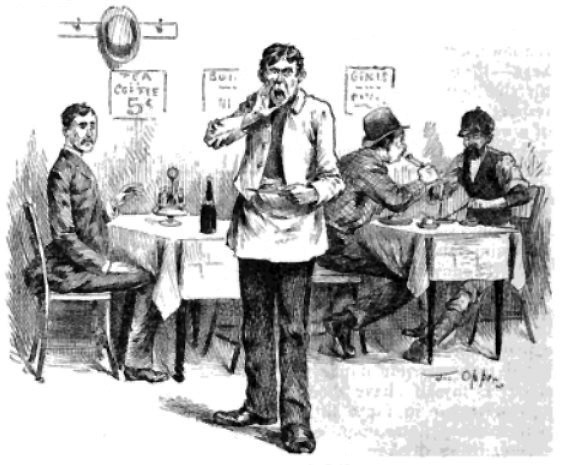 The lack of niceties in coffee and cake saloons was celebrated in a joke that described a waiter’s shock when asked for a napkin in one of these places. He had a quick comeback, inquiring whether the patron wanted his napkin fringed or unfringed. (Surely there were no tablecloths as in this 1889 illustration.)
Among the well-known proprietors of New York City were George Parker, who opened a place on John street in 1832 and “Butter-cake Dick,” whose full name was Dick Marshall. Oliver Hitchcock took over from Dick, who turned to a life of crime. Pat Dolan, starting business in the 1860s, reputedly invested in real estate and had amassed a quarter of a million by his death in 1889, while a couple of the Meschutt brothers later opened hotels.
Lore surrounding these establishments grew as they became rarer in the late 19th century. By the early 1900s the memory of coffee and cake saloons was tinted with nostalgia. It was often said that proprietors retired with fortunes — an unlikely story in the majority of cases. Another notion was that they were “peculiar to New York.” This, too, is inaccurate. I have found them in St. Louis, Sacramento, New Orleans, San Antonio, and San Francisco. Undoubtedly they could be found in most large cities.
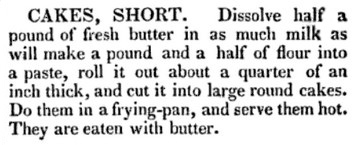 Just what was a butter cake? That isn’t totally clear. They are described differently, to the point where it’s anyone’s guess what they really were. Sometimes they sound like doughnuts, sometimes griddle cakes, sometimes like carnival-style fried dough – but without sugar. In St. Louis waiters referred to them as a “stack of whites.” Often they are referred to as biscuits. Sometimes they are called short cakes, as in the 1850s recipe shown here. I believe that initially they were made of little more than dough and were nearly indigestible, leading to the nickname “sinkers.” After bakers started adding yeast, they became lighter.
An 1890 story in the New York Sun explains that butter cakes could be either “wet” or “dry.” It said that the wet ones “were saturated with lard or grease of some sort, called butter for the purposes of trade.” But possibly some places really did use butter. A San Francisco restaurant advertised in 1856 that they used “none other than California Butter, fresh from the best Petaluma Ranches.” Their menu called them “New York Butter Cakes,” selling for the high price of 12 cents. In New York an order cost 3 cents. Butter-cake Dick was said to make his sinkers on the griddle and to store them in a kettle of melted butter until orders came in. The three Meschutt brothers sampled Dick’s but found a way to lighten them by adding yeast, splitting the cakes (biscuits?), and letting customers add the butter.
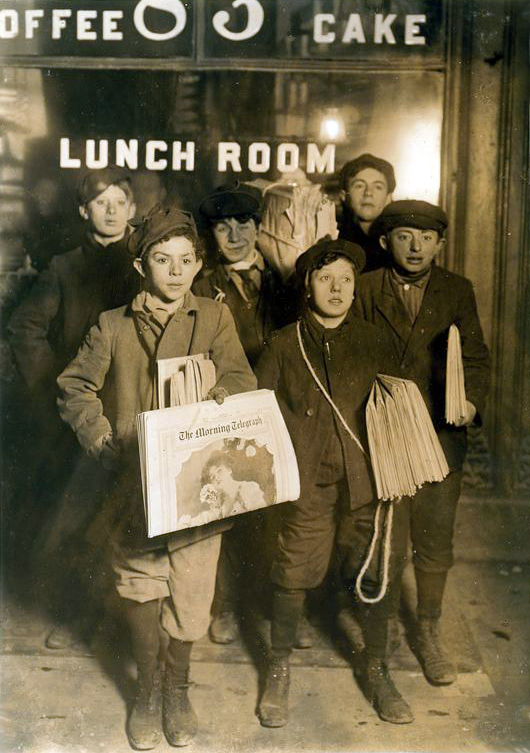
Although coffee and cake saloons were just about extinct by the 20th century, Lewis Hine managed to capture a view of newsboys exiting one in 1908. [shown at top]
© Jan Whitaker, 2019



 What could be more starkly different from the somber coffee shops of today with their earnest and wired denizens than the beatnik coffeehouses of the 1950s? Could Starbucks be anything but square to the beat generation?
 Although the word beatnik came into usage around 1958 (inspired partly by Sputnik), the phenomenon of dropping out of the “rat race” to lead an existentialist, non-consumerist life was part of the aftermath of World War II akin to the “Lost Generation” after World War I. The first coffeehouses sprang up in Greenwich Village in the late 1940s, but the beats weren’t averse to hanging out in cafeterias either — their “Paris sidewalk restaurant thing of the time.” When coffeehouses began levying cover charges for performances, beatniks tended to drop out of them too.
 The heyday of the coffeehouse was the late 1950s into the early 1960s. Few did much cooking so they weren’t restaurants in the true sense, but many of them offered light food such as salami sandwiches (on exotic Italian bread) and cheesecake, along with “Espresso Romano,” the most expensive coffee ever seen in the U.S. up til then. Of course the charge for coffee was more a rent payment than anything else since patrons sat around for hours while consuming very little. Other then-unfamiliar food offerings included cannolis at La Gabbia (The Birdcage) in Queens, Swiss cuisine at Alberto’s in Westwood CA, Irish stew at Coffee ’n’ Confusion in D.C., les fromages at Café Oblique in Chicago, “Suffering Bastard Sundaes” at The Bizarre in Greenwich Village, and snacks such as chocolate-covered ants and caterpillars at the Green Spider in Denver.

 It's great to hear from readers and I take time to answer queries. I can't always find what you are looking for, but I do appreciate getting thank yous no matter what the outcome.
 Restaurant-ing through history