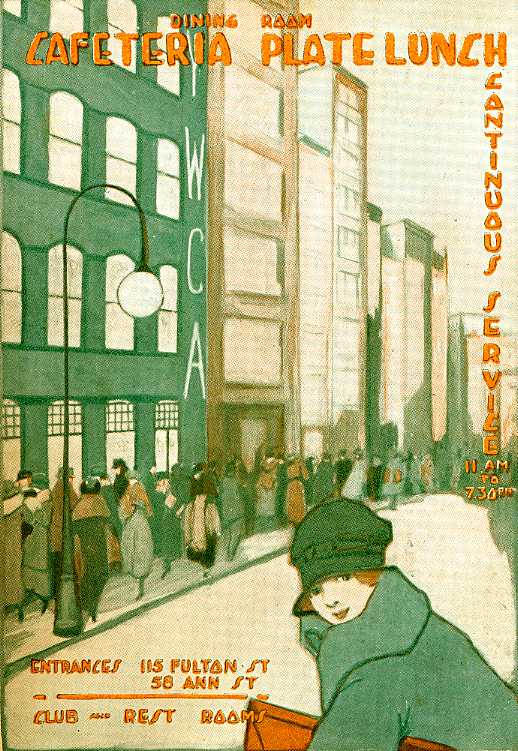
Women were the first to obtain professional training in the culinary trades from American institutions. However, because their training took place in college “domestic science” (home economics) programs it tends to be omitted in discussions of the development of culinary schools (most of which originated after World War II). Another important source of women’s formal training was the Y.W.C.A. So well respected was the “Y” for food service training that a large restaurant chain sent its managers to a New York branch in 1914 to study efficiency methods.
Throughout the last two centuries, most of the professionally trained people who owned, managed, cooked, and served in restaurants were born in Europe and learned their trades there. Native-born restaurant managers and workers, by contrast, tended to have no culinary backgrounds whatsoever unless they had cooked in their own homes or those of others. Exceptions included some women who had gained experience as housekeepers and many ex-slaves who had learned the culinary arts in the “employ” of rich Southern planters.
By the end of the 19th century, and especially in the early 20th, domestic science programs in colleges and universities began to train women in quantity cooking, nutrition, and the management of large-scale dining facilities, both commercial and institutional. Women were the first college-educated personnel to enter the restaurant and hospitality field, with degrees from Pratt Institute, the University of Chicago, Simmons College, Michigan State, the University of Wisconsin, and others.
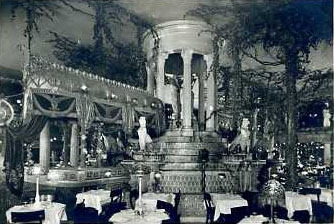
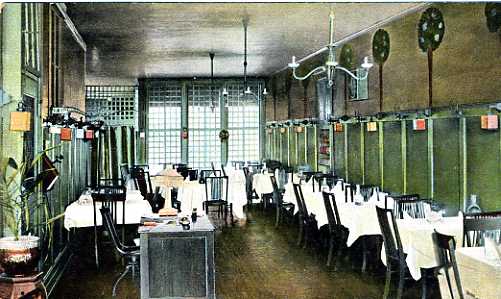 Although many graduates went on to head hospital and school food service operations, quite a number took over department store restaurants or opened their own places. An early, ca. 1896, graduate of a program at the Armour Institute in Chicago (later the Illinois Institute of Technology) was Ida Foster Cronk, catering director and manager of the Coffee House at Jane Addams’s Hull House. In 1900 Cronk left the settlement house to open her own Ristorante Roma in Chicago’s Loop, shown here ca. 1906.
© Jan Whitaker, 2008



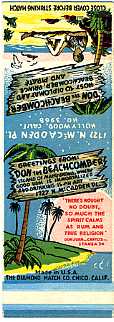
 Don ran into trouble with the postwar longshoremen’s strike and decided to limit his Honolulu Beachcomber to a drinking spot. By the early 1960s he was also in the restaurant business, operating a South Seas Cabaret Restaurant, a Colonel’s Plantation Steak House, a Colonel’s Coffee House, and at least one restaurant boat. Cora’s popular Chicago Don the Beachcomber was named one of the top 50 US restaurants in 1947. She soon opened another location in Palm Springs and by 1972, when it was acquired by Getty Financial, the chain had 6 or 7 units.


 It's great to hear from readers and I take time to answer queries. I can't always find what you are looking for, but I do appreciate getting thank yous no matter what the outcome.

 Restaurant-ing through history