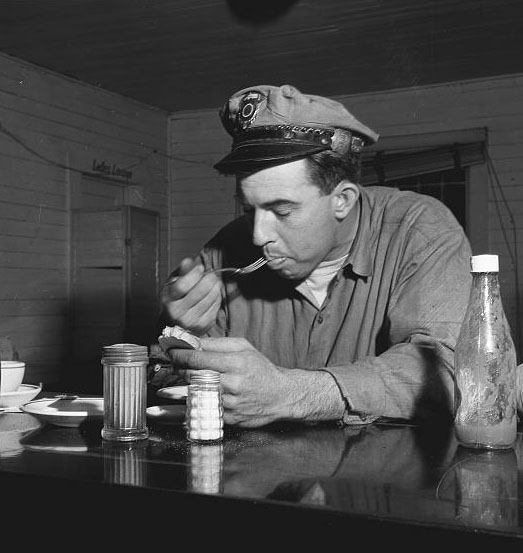
Between courses: only one?

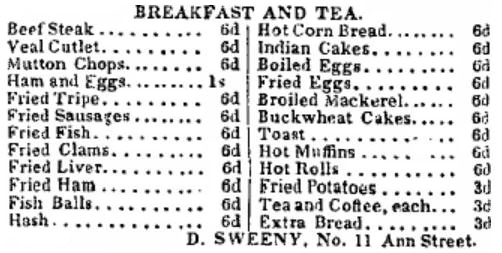
The gruff waiters and rowdy patrons found in cheap restaurants of the 19th century provided rich inspiration to story tellers. No story was more popular than the “Lone Fish Ball” which was published in newspapers before being turned into a favorite college song around 1854 (attributed to a Harvard professor of Latin), translated into Italian, and even performed in Tableaux Vivants.

The latter form of entertainment, where actors silently act out scenes, was a singularly odd one since the story is all about words uttered by a waiter and their mortifying effect upon a hapless patron.

In the 1840s, the decade in which the event allegedly took place, it was the custom of waiters in cheap eating houses to shout orders to cooks while standing at the tables. New patrons unfamiliar with this practice were invariably embarrassed when their orders were revealed to a roomful of none-too-polite patrons.

According to the tale, a young man who is short of money enters a cheap restaurant (sometimes identified as Daniel Sweeny’s Old Established Eating House in New York City) and realizes he has only enough money (6 cents) for a half order of fish balls – i.e., one fish ball – and a cup of tea. He timidly whispers his order to the waiter, hoping his oafish neighbors won’t overhear it, whereupon the waiter bellows it forth, emphasizing the word ONE. The oafs snicker.

He receives his order and again whispers to the waiter, “A piece of bread, sir, if you please.” Then, as the song goes:

The waiter roars it through the hall,
We don’t give bread with one fish-ball.

Now the entire house breaks out in laughter and the humiliated patron slips out.

© Jan Whitaker, 2010

3 Comments

Filed under miscellaneous

Restaurant-ing al fresco

Today there are many opportunities to eat outdoors, but for much of our history it was fairly uncommon. Partly explained by dust and dirt from unpaved roads, even in the 20th century when this had been overcome there were still few outdoor restaurants, particularly with the spread of air-conditioning after World War II. Though impossible to quantify, it’s possible that dining in open air was more in vogue in the late 18th century than in 1960.

“Pleasure gardens,” as they were called, were enjoyed in 18th-century American cities. Smaller ones were called tea gardens. Patrons, including whole families, were invited to lounge, stroll, and possibly spend the day. They offered a variety of food and drink, but by far the most popular order was ice cream. Many gardens were run by English tavern-keepers or French confectioners. New York’s Vauxhall Gardens, which contained a wax museum, was managed in the 1760s and 1770s by Sam Fraunces of the West Indies, later steward to George Washington. In 1798 a tea garden behind a Philadelphia tavern advertized it was “laid out in grass plats, provided with tables, benches, boxes, bowers, etc. and delightfully shaded by fruit trees.”

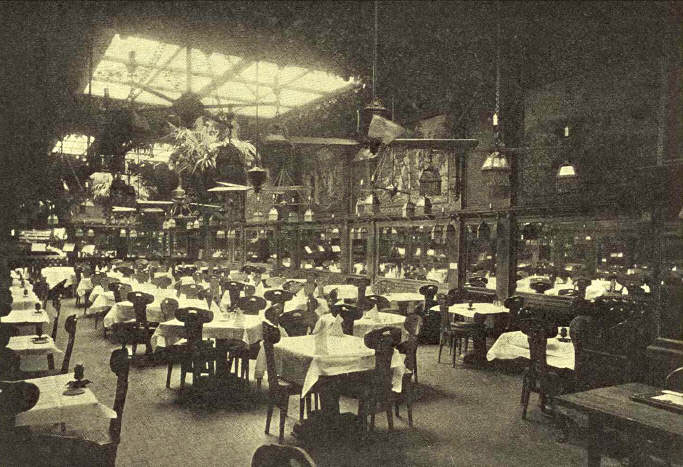
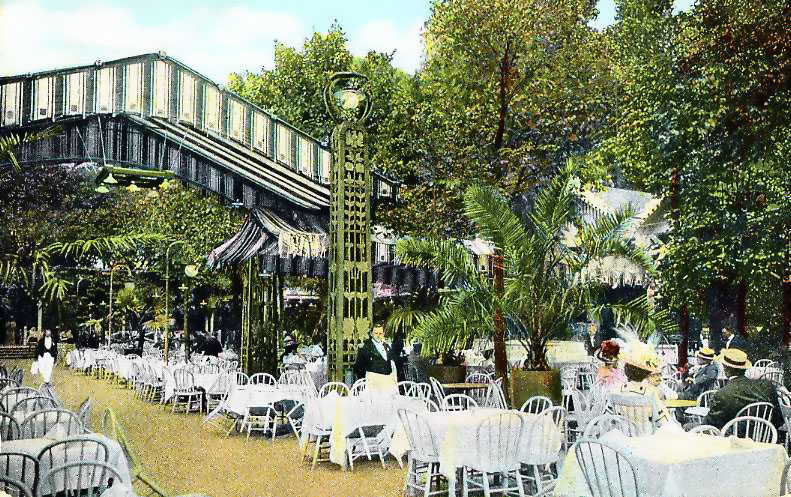
Outdoor gardens where patrons consumed mead, lemonade, and light snacks gave way around the Civil War to German beer gardens (Bismarck Gardens, Chicago, pictured) which, like tea gardens, were often situated on the outskirts of cities. They continued until the second decade of the 20th century when burgeoning suburbs wishing to eliminate alcohol purveyors succeeded in closing them down. Prohibition also defeated the dreams of American soldiers returning from WWI who had enjoyed sidewalk cafes in Paris and wanted to reproduce them in their homeland. But would they have caught on in a pragmatic country like America so dedicated to business and industry that sitting at a sidewalk café seemed like decadent loafing?

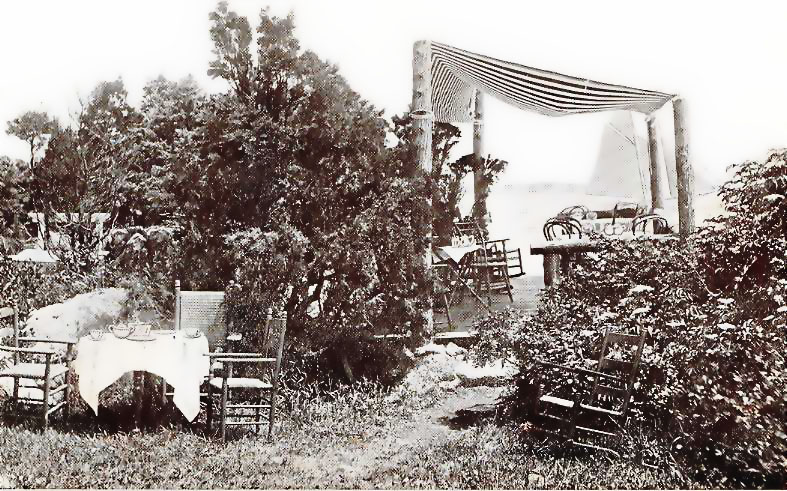
In truth dining outdoors was enjoyed by Americans mostly when they were in tourist mode, at the seashore or in Europe. Seasonal tea rooms delightfully situated in places such as Marblehead MA (pictured) commonly offered afternoon tea, lunch, and dinner on porches, lawns, and patios. World’s fairs were another place to enjoy Continental ways. Beginning with the 1876 Centennial in Philadelphia, fairs always included provisions for dining al fresco.

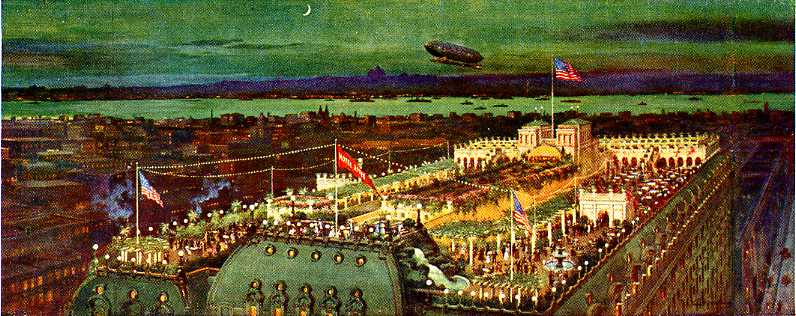
There were a few 20th-century exceptions to the general disinclination to dine outdoors. Rooftop restaurants, usually atop hotels such as the Astor (pictured here), attracted fashionable patrons around 1900 and persisted through the 1920s. New York had more than most cities, but they did flourish elsewhere, such as at San Antonio’s St. Anthony hotel. The title of “first” was claimed by St. Louis restaurateur Tony Faust who added rooftop dining in 1877.

And some odd artistic types — “bohemians” — enjoyed summertime dinners in the backyards of small Italian and French restaurants as early as the 1890s. By 1905, Town & Country magazine declared this habit had attained fad status among adventure seekers.

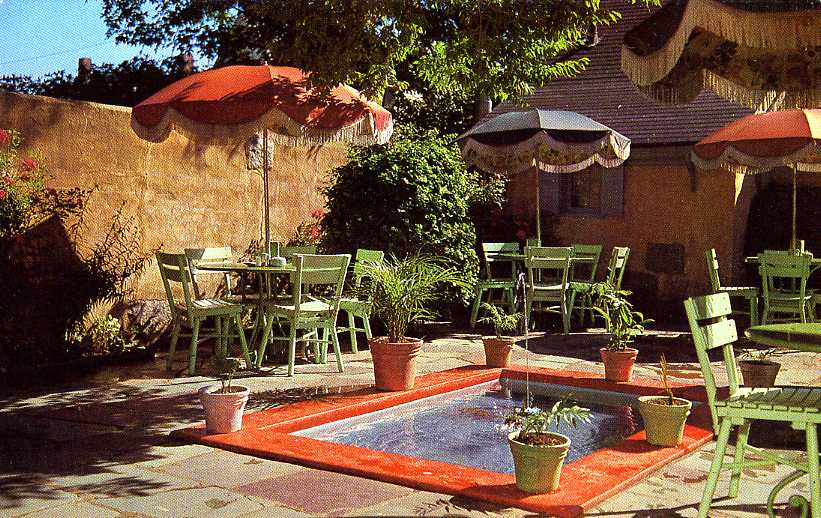
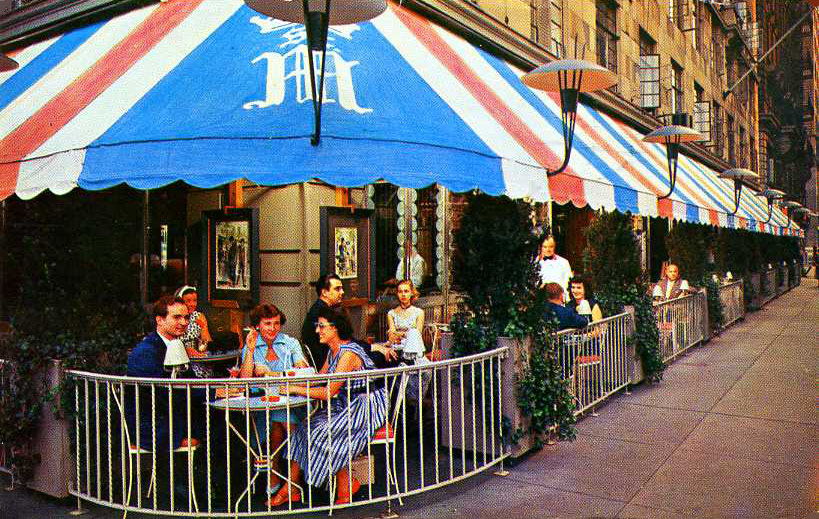
Louis Sherry claimed to have set up the first sidewalk café in this country, outside his Fifth Avenue restaurant in 1900. He wasn’t actually the first. In 1891 women out shopping in Manhattan liked to “eat al fresco under the vineclad, bush-shaded bower” in front of the Vienna Café. Not too surprisingly, the warmer climates of Florida and California proved most hospitable to sidewalk dining. The custom did not really catch on in a big way across the U.S., though. Those sidewalk cafes that were created in the mid-20th century, such as the St. Moritz Hotel’s Café de la Paix (NYC, pictured), usually advertised their Continental atmosphere, suggesting that eating on sidewalks had not yet earned true American status.

© Jan Whitaker, 2010
5 Comments

Filed under outdoor restaurants

A chef’s life: Charles Ranhöfer

Or, how Americans got dishes fit to set before a king.

In the middle of the 19th century highly trained European chefs began arriving in the United States. Many were lured to California by the inflated gold mining economy while others stopped on the East coast. Charles Ranhöfer (he soon dropped the umlaut) arrived in 1856, first working for a Russian diplomat in NYC, then for a Washington DC restaurant and a private family in New Orleans. After spending some time in his home country of France in 1860, he returned to New York and in 1862 accepted a position as chef at the “uptown” Delmonico’s on Fifth Avenue near Union Square.

At this time New York City was engorged with wealth from the Civil War. The rich bought up yachts, race horses, fancy carriages, and real estate. It was the perfect time to introduce them to fancy French cuisine. Despite his young age, 26, Ranhofer had extensive experience, having begun his career as a child and running Paris restaurants and the kitchens of European royalty.

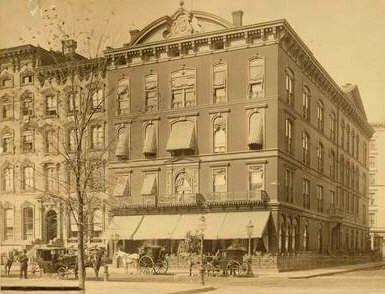
The reputation of Delmonico’s as the premier American restaurant, the one most nearly resembling the finest in London and Paris, was built largely during Ranhofer’s reign which lasted from 1862 to his death in 1899, with a brief interruption when he returned to Paris in 1876 around the time Delmonico’s moved from Union Square to Madison Square (shown).

The restaurant’s glory was founded less on regular patronage than on lavish banquets given to honor prominent men. Grand dinners of the 1860s included one given by British railway tycoon Sir Morton Peto and one for President Andrew Johnson and another for Charles Dickens. The Peto dinner, costing $30,000 in 1865 (over $400,000 now), spread Delmonico’s fame across the nation. Another celebrated dinner planned by Ranhofer featured a 30-foot pond set into the banquet table, banked with flowers to protect guests from splashing by four live swans.

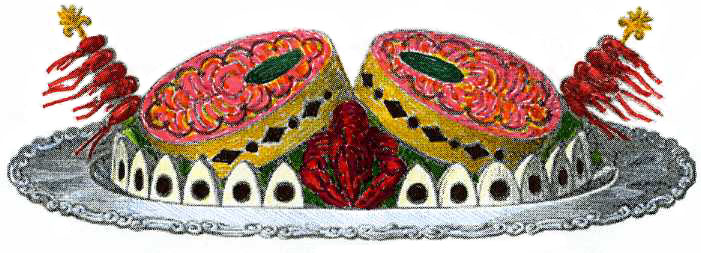
Ranhofer’s name became widely known after he published his vast cookbook, The Epicurean, in 1894, divulging how “haute” restaurant cuisine was produced. The cookbook reveals just how many props and quantities of plaster of paris and glue (jelly) are needed to turn out highly decorated French dishes. The illustration of salmon steaks from The Epicurean shown here exhibits salmon coated along the sides with butter paste onto which circles and diamonds cut from truffles have been attached. Truffles also cover the yolks in the boiled egg border. On either side of the salmon dish are decorative spears (hatelets/attelets) of prawns. Ranhofer is also known for inventing baked Alaska – in his recipe ice cream is stuffed inside a hollowed out cone-shaped cake before the meringue is added.

Although his early training was similar to other top chefs, he was atypical in holding one job for over 30 years. Perhaps his percentage share of profits explains his long tenure with Delmonico’s. His base pay was good for its time – $300 ($7,300 today) a month in 1890 – yet not the highest on record. William K. Vanderbilt’s top kitchen man reportedly earned $6,000 a year. However when his share was added, it’s likely Ranhofer’s income exceeded Vanderbilt’s chef’s as well as those of the top men at New York’s Savarin Café and Hoffman House.

© Jan Whitaker, 2010
2 Comments

Filed under proprietors & careers

The (partial) triumph of the doggie bag

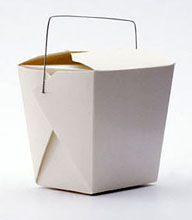
I can’t remember when restaurant servers began automatically asking if you wanted to take home food left on your plate but I know it’s a relatively recent phenomenon. It used to be that food was wrapped up only if patrons asked.

Probably some customers have always smuggled away food from restaurant tables, usually in napkins. Maybe to stop this, the custom of furnishing diners with bags in which to take home leftovers began after the second World War when upward mobility widened the dining public. Doggie bags went into production around the mid 1950s and their use increased tenfold in Chicago in the 1970s, according to a Chicago Tribune story.

But what is interesting is how many people were embarrassed by the practice. Well into the 1970s etiquette columns in newspapers got letters from restaurant patrons asking if it was ok to ask for a doggie bag if they didn’t have a dog. Usually the writer cited a spouse or friend who objected to the custom. A typical query is the one in 1964 from a wife whose husband “looked aghast” when she asked for a bag and told her it was in poor taste to take home table scraps. Nonetheless, with the exception of Elizabeth Post, Emily Post’s granddaughter by marriage, advice columnists invariably approved of doggie bags as sensible if not downright virtuous.

Doggie bags and other containers grew more acceptable in the 1970s – but not in all restaurants. The most expensive and elegant places, such as the Four Seasons and upscale French restaurants, showed a distinct dislike of the custom. Many would only provide a container if asked, and then often fashioned a swan of aluminum foil as if to say, “We don’t make a habit of this – this is just for you.”

There are a number of explanations why taking home leftovers has not always been universally accepted by restaurants or their guests. Some restaurants cite health concerns. French restaurateurs are offended by the idea of someone microwaving their cuisine; they believe food should be eaten just at the moment the chef sends it to the table. Diners who are the least bit intimidated by a restaurant or its servers are unlikely to ask to take food home. I was recently in a restaurant that does not permit guests to place jackets or coats on the back of their chairs. I am certain they would cringe at a request to take away uneaten food (and I’ve never seen it done there). In any event, the small portions served in this and other upscale restaurants do not allow any provision for future meals. Other restaurants handle the matter discreetly. In a power lunch spot in Los Angeles, diners must pick up their leftovers, packed in a tasteful tote bag, at the front desk as they leave. No styrofoam box sitting on tables through the dessert course there!

On a deep socio-psychological level the reasons doggie bags carry a degree of embarrassment and often are not accepted by elite restaurants are the same as why it’s considered poor manners to smack or gobble. Higher status accrues to those who disguise hunger by eating slowly, who appreciate small portions, and whose delicate appetite requires “appetizers” and little dainties with names such as “amuse bouche.” Leaving food on the plate communicates the absence of animal neediness. It is a version of Thorstein Veblen’s concept of “conspicuous consumption” in that it flaunts the diner’s ability to walk away from perfectly good food.

© Jan Whitaker, 2010
9 Comments

Filed under restaurant customs

Early chains: John R. Thompson

Although it is largely forgotten today, the Chicago-based John R. Thompson company was one of the largest “one arm” lunchroom chains of the early 20th century. We so strongly associate fast food chains with hamburgers that it may be surprising to learn that Thompson’s popular sandwiches included Cervelat, smoked boiled tongue, cold boiled ham, hot frankfurter, cold corned beef, cold salmon, and Herkimer County cheese, served on “Milwaukee Rye Bread” baked by the chain’s bakery. Thompson was proud that his meals were suited for sedentary office workers of the 1900s and 1910s. A 1911 advertisement claimed that lunch at Thompson’s “won’t leave you logy and lazy and dull this afternoon.”

Thompson, an Illinois farm boy, ran a rural general store as his first business. He sold it in 1891, moved to Chicago, and opened a restaurant on State Street. He proved to be a modernizer in the restaurant business as well as in politics.

He operated his restaurants on a “scientific” basis, stressing cleanliness, nutrition, and quality while keeping prices low. In 1912 he moved the chain’s commissary into a premier new building on North Clark Street (pictured, today). Thompson’s, then with 68 self-service lunchrooms plus a chain of grocery stores, became a public corporation in 1914, after which it expanded outside Chicago and into Canada. By 1921 there were 109 restaurants, 49 of which were in Chicago and 11 in New York (with a commissary in NYC). By the mid-1920s Thompson’s, Childs, and Waldorf Lunch were the big three U.S. chains, small by comparison to McDonald’s but significant nevertheless.

In politics Thompson served as a Republican committeeman and managed the campaign of a “good government” gubernatorial candidate in 1904. A few years later he failed in his own bid to run for mayor, promising he would bring efficiency to government while improving schools and roads. In the 1920s he financed a personal crusade against handguns.

Despite John R. Thompson’s progressive politics, his business would go down in history as one that refused to serve Afro-Americans. Or, as civil rights leader Marvin Caplan put it in 1985, “If the chain is remembered today, it is not for its food, but for its refusal to serve it.” J. R. died in 1927. Where he stood on the question of public accommodations is unclear but the chain faced numerous lawsuits by blacks in the 1930s. However the best known case occurred in 1950 when a group of integrationists led by Mary Church Terrell was refused service in a Washington D.C. Thompson’s. The group was looking for a case that would test the validity of the district’s 19th-century public accommodations laws. After three years in the courts the Thompson case (for which the Washington Restaurant Association raised defense funds) made its way to the Supreme Court which affirmed the so-called “lost” anti-discrimination laws of 1872 and 1873 as valid.

Over the years the Thompson chain absorbed others, including Henrici’s and Raklios. At some point, possibly in the 1950s, the original Thompson’s concept was dropped. By 1956 Thompson’s operated Holloway House and Ontra cafeterias. In 1971, as Green Giant prepared to buy Thompson’s, it had about 100 restaurants, including Red Balloon family restaurants, Henrici’s restaurants, and Little Red Hen Chicken outlets.

© Jan Whitaker, 2010
131 Comments

Filed under chain restaurants, lunch rooms, proprietors & careers

Anatomy of a restaurateur: Mary Alletta Crump

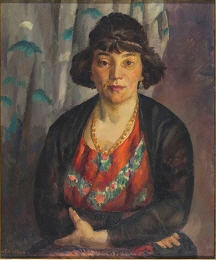
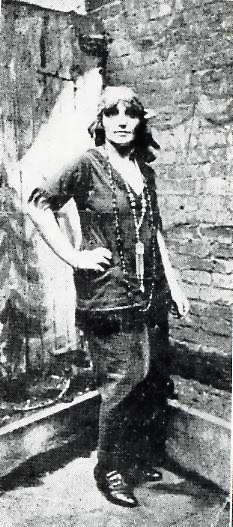
Because she ran a tea room, Mary Alletta “Crumpey” Crump (pictured, age 31) actually would not have called herself a restaurateur. She made a distinction between a tea room and a restaurant: the former served light food, mainly lunch and afternoon tea, while a restaurant served heavy food and was open for dinner. Not so The Crumperie. It served sandwiches, salads, soup, and desserts only. At 6 P.M. she and her partner, her mother “Bee,” shut down for the day. (M. Alletta, as she signed herself, advised prospective tea room operators in 1922 that “a mother or older person is a great asset to a young girl who is contemplating the opening of a tea room.”)

The two opened their first Greenwich Village Crumperie in 1917 (pictured), taking over the spot formerly occupied by photographer Jessie Tarbox Beals’ tea room and art gallery. Sharing the other half of the building at 6½ Sheridan Square with The Crumperie was a gift shop known as The Treasure Chest. By the time Crumpey’s mother passed away in 1926, The Crumperie had occupied five locations in the Village, first moving to Sheridan & Grove, then to the basement of 55 Christopher Street, then to 229 West 4th Street, and finally to 104 Washington Street. She would make one more — unsuccessful — attempt at running a Crumperie after her mother’s death, teaming up with Marie Saint Gaudens (niece of sculptor Augustus Saint Gaudens), at 13 West 51st Street in 1927. After this she abandoned the tea room business.

She and her mother opened the first Crumperie on a shoe string, spending only $100 for the first month’s rent plus all the furnishings and equipment. Start simple, that was their motto. Crumpey decorated with odds and ends: tables and chairs she painted herself, illustrations from magazines, a discarded old settle, family quilts, and table runners made from dime store toweling. Her mother did the cooking, specializing in crumpets of course, but also offering pea soup, “crumpled” eggs, and peanut butter sandwiches. Beverages included tea, coffee, and chocolate — nothing alcoholic!

The various Greenwich Village Crumperies were gathering places for New York City artists, musicians, literary figures, and actors with the Providence Players. The tea rooms were frequented by singer Enrico Caruso, artist Tony Sarg, and writers Theodore Dreiser, Eugene O’Neill, Sinclair Lewis, and Edna St. Vincent Millay. Writer and editor Christopher Morley steered his “Three Hours for Lunch” club to the Crumperie, though how they could have stretched out a meal there for that long I don’t know.

During and after her years in the food business, M. Alletta volunteered for war work, entertaining the troops in England with her ukulele playing during WWI (she also sang spirituals and folk songs in the tea room). After 1927 she apparently had a variety of jobs. She had studied at Smith College and trained to become a nurse before opening The Crumperie and may have returned to teaching or nursing. She taught a tea room management class in Brooklyn and worked for a time at the Grenfell Mission in Labrador. In 1958 she made five appearances on the TV quiz show “The $64,000 Question,” winning $16,000 which she used to fund a European trip.

© Jan Whitaker, 2010
7 Comments

Filed under Offbeat places, proprietors & careers, tea shops, women

L’addition: on discrimination

Perhaps as his defenders claim Kentucky’s senatorial candidate Rand Paul is not a racist, but … Even though he says he would have voted for it, it seems unlikely he would enforce the 1964 Civil Rights Act with any vigor. He believes that it should not apply to businesses such as luncheonettes. On the Rachel Maddow show, despite his slippery answers to her queries on this subject, he did reply “Yes” to Maddow’s question of whether a private business should have the right to refuse to serve black people. He seemed to be saying that restaurants that are privately owned (i.e., almost all of them) are not public accommodations. He believes that it is preferable that racist restaurant owners be sanctioned by consumers who would refuse to patronize them rather than by the state. Oh sure. Rather than see them all go out of business it’s more likely we’d soon be back to the days when Afro-Americans needed a guide to know where they could go for a meal without facing rejection and humiliation.

Paul’s position is somewhat reminiscent of Lester Maddox, who operated the Pickrick restaurant in Atlanta for 20 years and was dedicated to a policy of racial discrimination. After the passage of the Civil Rights Act, but before he surrendered the restaurant to his employees after being sanctioned by the court for non-compliance, he created a “shrine” in the corner of the restaurant, “in memory of free enterprise.”

8 Comments

Filed under racism

Between courses: dining with reds

In July of 1928 the Communist Party in the United States opened a public cafeteria on the ground floor of their headquarters in New York City, home also to The Daily Worker. The headquarters, known as the Workers’ Centre, was at 26-28 Union Square East and also contained a cooperative barber shop in which the barbers did not accept tips.

The restaurant was called Proletcos Cooperative Cafeteria. Proletcos was said to be a name created by a garment worker who combined the first two syllables of PROLETarian with the CO of cooperative, then added an S.

It’s not surprising that Communists would select a cafeteria as their preferred format for a restaurant. There is something socialistic about cafeterias, with their self-service and no-tipping customs. They were widely adopted in industrial plants and among working women’s organizations of the 1890s. Two home economists created a chain of cooperative cafeterias in NYC in 1920, called Our Cooperative Cafeterias, which dispersed an annual rebate to customers who were members. Evidently it was unrelated to the Communists’ project. Proletcos, whose prices were about average for a cafeteria, gave a 10% discount to its 600 shareholders. Its workers were guaranteed an 8-hour day and good working conditions.

Proletcos was enlarged in November of 1928 and was able to serve nearly 6,000 meals a day. Artist Hugo Gellert, a lifelong Marxist and co-founder of The New Masses magazine, created a mural for the expanded and refurbished restaurant in which sturdy workers and Communist heros such as Sacco and Vanzetti, John Reed, and Vladimir Lenin, all 10 feet tall, loomed over the dining room (pictured). According to a story in the New Yorker, the cafeteria was quite up to date, with tile floors, brass railings, and modern light fixtures.

The cafeteria had a short life lasting only a couple of years in which it served workers, many of them from the garment district, along with students who liked to hang out, drink coffee, and discuss the issues of the times. It evidently came to an end in 1930 when the CP moved its headquarters from Union Square to East 13th Street.

© Jan Whitaker, 2010
7 Comments

Filed under cafeterias, Offbeat places

Banqueting at $herry’s*

In 1898 Sherry’s and Delmonico’s faced off on two corners of Fifth Avenue and 44th Street. Which would win the favor of New York City’s high society whose core membership was known as the Four Hundred? Even before Sherry’s boldly moved onto Delmonico’s turf it had been successfully poaching “Del’s” clientele. For a time there seemed to be enough elite diners to go around, but the days were numbered for both of New York City’s grand restaurants. Before too long each would suffer from the negative impact of Prohibition and World War I on food and drink and social life. Nonetheless many spectacular balls and dinners were still in store at Sherry’s before its demise.

Louis Sherry began his professional life in restaurants in New Jersey and New York in the 1870s, working as a waiter, then steward and head waiter at establishments such as the Hotel Brunswick. In 1881 he started a confectionery and catering business at Sixth Avenue and 38th Street where he supplied ice cream, cakes, and deluxe dinner party staples such as lobster, salmon, deviled crab, chicken salad, and terrapin. He soon opened a restaurant at the casino at Narragansett Pier, Rhode Island. His businesses grew, and he moved to Fifth Avenue at 37th Street, and when that became too small he commissioned Stanford White to design a multi-story restaurant with ballrooms and residential suites opposite Delmonico’s.

Although he has been singled out as one of the few American-born proprietors of a fine NYC restaurant at the turn of the 20th century, it is likely that he was a native of Canada rather than Vermont as is frequently reported. On several passport applications he attests that he was born in Quebec, in 1855.

Sherry was known for getting every detail right, particularly table appointments and decorations which could include everything from asparagus served in a hollowed out block of ice to tabletop forests and lakes (1908 dinner pictured). But from time to time the expense and elaborateness of his dinners prompted critics to call them symptoms of a decadent society. This was especially true of the $250 per person dinner on horseback given by C. G. K. Billings to 36 members of his Equestrian Club in 1903 – and the 1905 dinner for 500 guests costumed as 18th-century French royalty given by James H. Hyde where even the waiters wore powdered wigs.

In 1912 Sherry’s was hit hard by a restaurant workers’ strike which targeted the city’s top eating places. He professed indifference but bitterly cited “Bolshevik waiters” as one of the reasons for closing the restaurant and hotel in 1919 and moving up to 58th Street to continue with catering and confectionery. In 1921 Sherry joined a corporation headed by Lucius Boomer that opened a Sherry’s restaurant and candy shop at 300 Park Avenue. A subsidiary of the corporation owned the Sherry-Netherland Hotel. Sherry, who did not seem to be actively involved in these enterprises, died in 1926. Later, under a succession of owners, there were Louis Sherry restaurants in the Metropolitan Opera and the Philharmonic, while ice cream is still (or was until fairly recently?) produced under the Louis Sherry name.

* In The Real New York (1902), Rupert Hughes suggested that because the restaurant was so expensive, its name should be written this way.

© Jan Whitaker, 2010
19 Comments

Filed under elite restaurants

Who invented … lobster Newberg?

The tale has often been told of Benjamin Wenberg who created a fabulous new dish at Delmonico’s restaurant in NYC sometime in the 1870s. The punch line revolves around how Charles Delmonico changed the name to Lobster Newberg to spite Wenberg after the two men had an argument. Do you believe the story? I am suspicious of it.

As a historian I run across many legends of this type. There is always a delightful little detail that makes the story click and lures journalists into repeating it so often that it becomes undisputed truth. Less catchy, and thus less repeated versions of the Lobster Newberg story, suggested that Wenberg did not want his name used so the name of the dish was altered slightly – or that the Delmonicos named the dish Newberg right from the start out of respect for Wenberg’s privacy.

It’s doubtful that Wenberg invented the dish. A sauce made of cream, egg yolks, butter, and sherry wine – the à la Newberg part of Lobster Newberg – was known as terrapin sauce and was in use before the 1870s.

Did Wenberg have anything to do with Lobster Newburg? Some stories imply he was the first to use the sauce with lobster. To me it seems doubtful that he would be more likely than top chefs to see its wider potential. In fact at least one Delmonico chef claimed to have developed the dish. In yet another version of the story, Delmonico’s named it for him because he ordered it so often.

Maybe. Whatever. As far as I can tell, no one has ever found the name Lobster Wenberg on a Delmonico’s menu. Nor has Lobster Newberg been found on menus from the 1870s or 1880s.

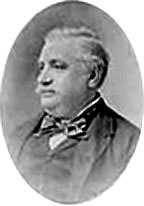
Although Benjamin Wenberg may be altogether irrelevant to the story of Lobster Newberg, he was an actual person, a well-known figure in New York City in the 1850s and until his death in 1885. He was in the shipping business, buying, selling, and chartering sea-faring vessels. At least one of his ships, Panchita, was suspected of engaging in the slave trade in 1856 and 1857.

The dish attributed to him became popular in the 1890s and the legend of its naming was oft repeated in this decade. It was a favorite chafing dish recipe for home entertaining and any restaurant with the least pretensions was bound to have it on the menu. Restaurants occasionally prepared it tableside in a chafing dish. Shrimp, crab, scallops, and sometimes frog legs were also offered à la Newburg.

These dishes were usually spelled with a U on restaurant menus. Which is another oddity since Wenberg’s name was usually spelled with an E.

© Jan Whitaker, 2010
8 Comments

Filed under food, patrons