Service with a smile . . . somehow

Recently I read a NYT story about a new documentary film “Booker’s Place,” about a Mississippi waiter named Booker Wright. While working at Lusco’s, then operating as a de facto all-white restaurant in Greenwood, Wright appeared in a 1966 documentary called “Mississippi: A Self Portrait” in which people were interviewed about the  status of race relations at that time.

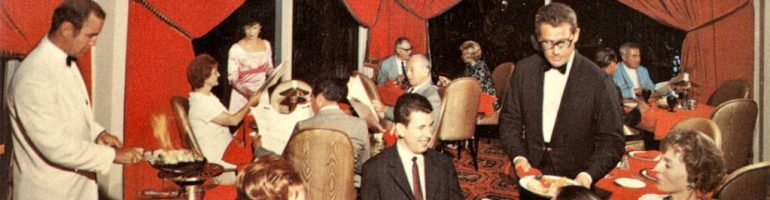
In the 1966 film Booker Wright gave viewers a glimpse of the indignities he experienced serving Lusco’s patrons who sometimes demeaned him or left him no tips. Following the airing of the show on television he lost his job at the restaurant where he had worked since he was a teenager. Patrons no longer wanted him to wait on them – he had broken the bubble by revealing his misery in playing the role of a happy-go-lucky black waiter.

No doubt he realized beforehand that his interview would put an end to the charade. After leaving Lusco’s he operated a restaurant of his own called Booker’s Place at which both whites and blacks were welcome.

As I read about the new documentary I immediately thought of a book called The American Colored Waiter, published initially in 1903 and revised several times. It is a manual written by John B. Goins, an African-American waiter in Chicago. Along with instructions on how to set tables properly, carve meat, and even restore rancid salad oil, Goins dispensed some poignant advice on how to “take it.”

No doubt all servers can relate to his words, but I believe they had special meaning to African-Americans, who were being eased out of the profession in Northern cities at that time.

With the eighteen years’ experience I have had I have found, from the beginning until this present time, that I have been getting the worst of it at all times …; and, my dear sir, if you expect to climb the ladder of success, expect always to get the worst of it while you are a waiter …

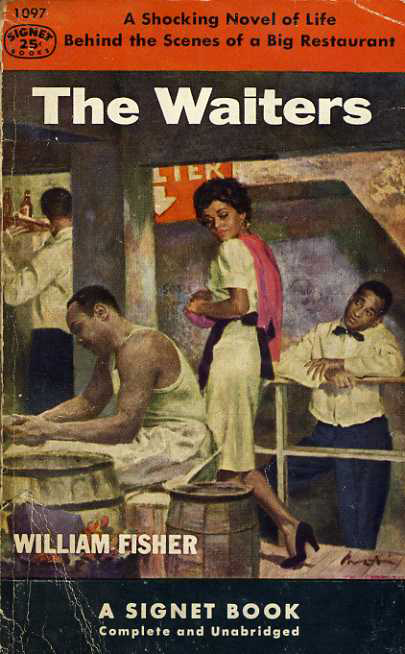
I also recalled a scene in the 1953 novel by William Fisher called The Waiters in which the book’s main character Asher Brown, a waiter at “the Fishbowl” on the seashore near Manhattan. Brown serves a party of inebriated white people and has the following exchange with one of them:

“Bring us some lobsters,” the man snapped.
“How’d you like them, sir?” Asher ventured timidly.
“Fat and ___” The man flashed a broad grin at his companions who scowled at Asher. “Listen, boy! Are you on the ball or not?”
Asher tried again. “Would you like them boiled or broiled, sir?”
“Bring us four large broiled lobsters,” the man commanded, in a morose growl. “And bring us some bread an’ butter right away, some of them biscuits.”
Asher had moved only a few feet away from the table, preparing to go to the kitchen, when the man called him back. “Hey, George,” he said importantly. Asher turned to face him with a tight-lipped expression. George, he repeated to himself. He oughta drop dead right here.

To read more about the making of “Booker’s Place: A Mississippi Story” see the blog written by his granddaughter Yvette Johnson.

© Jan Whitaker, 2012

3 Comments

Filed under miscellaneous, proprietors & careers, racism

Busy bees

A 1960 episode of The Twilight Zone, “The Nick of Time,” was set in a restaurant outfitted with a devilish fortune-telling device. The restaurant, supposedly in Ohio, was ordinary and undistinguished, with booths and laminated table tops.

The story’s writer chose a common name for it, one found in practically every city and small town across the entire United States: the Busy Bee.

I “collect” this name. To me it resonates with the typical 20th-century eating place. Judging from advertisements for eateries called The Busy Bee, they staked their reputations on being clean, economical, briskly efficient, and friendly.

I also find the name interesting because it is entirely divorced from place, proprietor’s ethnicity, and type of cuisine. Yet I’ve found that many restaurants of this name had proprietors who were of Polish, Italian, or Greek ethnic origins.

In the 19th century it was typical for restaurants to go by their proprietor’s surname. Over the 20th century, by contrast, many restaurants adopted “made up” names that were intended to suggest something positive, appealing, or at least memorable. I suspect that one of the factors propelling this change was the chance to background the ethnicity of the proprietor, particularly around World War I when much of the country became intolerant of those not native born. Busy Bee became one of the most common names around.

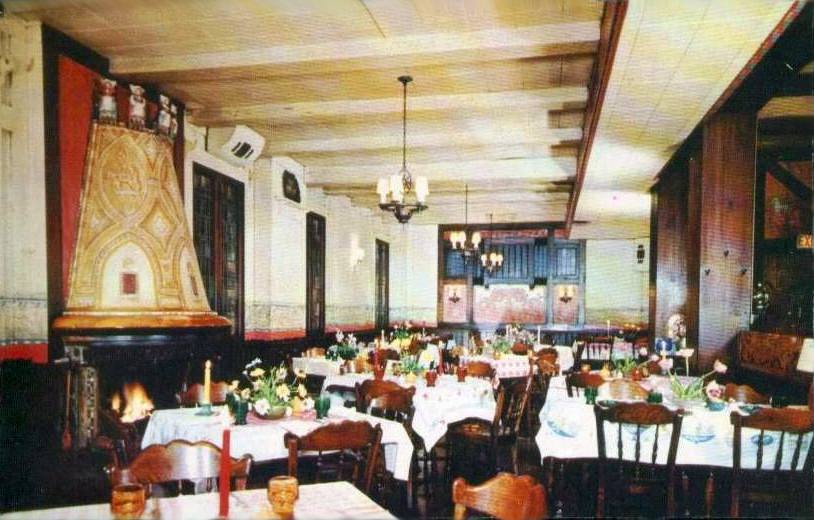
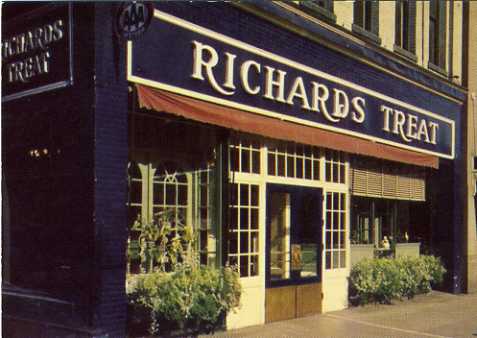
Also, restaurants owned by Greek-Americans, of which there were very many, were often run by multiple partners. It would be somewhat unwieldy if, for instance, the proprietors of the Busy Bee in Monessen PA in 1915 had decided to call their restaurant Chrysopoulos, Boulageris, Paradise, & Lycourinos. They might have taken the liberty of dubbing their establishment Four Brothers from Mykonos but they chose Busy Bee instead. [pictured: Busy Bee in Winchester VA — its proprietor, James Pappas, was born in Greece ca. 1889]

I have yet to find a Chinese restaurant called the Busy Bee but I’ll keep looking – I know there had to be a few.

Among many locations, I’ve found Busy Bees in Mobile AL as early as 1898, in Bisbee AZ in 1915, and in New York City’s Bowery, for decades presided over by Max Garfunkel. It was at Max’s Busy Bee, in 1917, that alumni of the Short Story Correspondence Schools of North America convened to greet the author of “Ten Thousand Snappy Synonyms for ‘Said He.’” Many Busy Bees became headquarters for meetings of business, civic, and social clubs.

Busy Bees were not known for any particular culinary specialties, offering instead home cooking favorites plus the inevitable chili and other Americanized foreign dishes such as spaghetti and chop suey. The four popular Busy Bees in Columbus OH, nonetheless, had an attractive array of warm weather choices on their June 29, 1909, menu which included Spring Vegetable Salad (10 cents), as well as Blackberries or Sliced Peaches in Cream (10 cents) and Fresh Peach Ice Cream (15 cents).

The Busy Bee name lives on even today, though perhaps less robustly. I was surprised there was not a single Busy Bee mentioned in Joanne Raetz Stuttgen’s books on contemporary “down home” cafes in Wisconsin and Indiana.

Is there a common restaurant name all around us today that will come to characterize the 21st century?

© Jan Whitaker, 2012
26 Comments

Filed under lunch rooms, miscellaneous

Eat and run, please!

I’ve always thought it odd that anyone would think of fast food eateries as friendly. The tersely scripted counter help and the characteristically uncomfortable, bolted-down tables and chairs seem anything but hospitable to me. Of course, most patrons know and accept the terms of doing business with fast food chains whose low prices are predicated on providing minimal on-site facilities at which customers gulp their food, crumple their bags, and depart.

The fast food formula was first developed by turn-of-the-century “quick lunch” establishments. Like later chains they provided few amenities that might have encouraged lingering. Patrons sat in chair & table combos resembling one-armed school desks. No coat racks were provided so diners usually left their coats on. Just as well, because the spaces were so tight that someone removing his coat stood a good chance of sweeping his neighbor’s food onto the floor.

The idea that patrons should not linger wasn’t really new even then. Mourning the passing of Brooklyn’s old-fashioned chop houses, a reporter noted in 1889 that chop houses had been replaced by restaurants “where all is hurry and bustle, and where he who lingers at the table after his bill has been paid is regarded as an incumbrance.”

It’s not clear whether quick lunch proprietors plotted their interiors with an eye to turnover, but certainly by the 1920s restaurant managers were well aware that turning tables faster could increase profits. Suddenly even restful tea rooms were under pressure as they were thrust into competition with chain restaurants that used economies of scale to reduce costs and prices. Writing in 1929, Madeleine F. Wolf observed that if they wanted to survive, “The Dew Drop Inn, the Bide-a-Wee Tea Room, the Cheer-Up Cabin, must go on pretending an interest in each individual guest whereas their true interest lies in numbers.”

Brisk modern style, in the form of cubist decor and streamlined furniture, provided assistance in the late 1920s and 1930s. Artist and industrial designer John Vassos, who illustrated the book Phobia, felt he understood psychology well and successfully applied it in his 1931 design of NYC’s Rismont Tea Room, where the tables were a bit too small and chair seats were triangular. “The chairs are comfortable – if one doesn’t sit too long on them,” he wrote. [see photo]

Uncomfortable chairs would become known in the restaurant industry as “15-minute chairs.” Charles Eames’ fiberglass scoop chair (shown above) might be an example, offering little possibility of posture realignment.

Bright lights, loud colors, and loud music also discourage coffee refills and relaxed conversation, often quite deliberately. In the Forum Cafeteria in Kansas City MO in the 1960s walls with stripes in mist, olive, turquoise, blue, and white were deemed perfect for that “friendly, but not too friendly” effect. Nooks decked out with red banquettes and red carpeting, likewise, whispered “goodbye,” as did armless turquoise chairs.

If all else failed to dislodge the diner, the server could always lean over and ask, “Can I get you anything else?” – or “All set?” as they so bluntly say in New England.

© Jan Whitaker, 2012

11 Comments

Filed under restaurant decor

Bumbling through the cafeteria line

In 1931 the American humor magazine Life (not to be confused with the later photojournalism magazine of the same name) published “The Cafeteria,” an essay that described an inexperienced patron’s befuddlement in composing a meal item by item while being propelled forward by an ever-moving line. (The illustration by W. E. Hill is also from 1931.)

The essay, from which I have selected sentences to shape into a “poem” similar to Charles Green Shaw’s The Bohemian Dinner, was written by John C. Emery. It’s likely that at the time he wrote about his cafeteria experience he was a 27-year old editor with Railway Age, a trade journal located in Chicago. Chicago, it happens, was a city with plenty of cafeterias. In its early stages cafeterias were identified with women while men were notoriously resistant to them.

Turns out Mr. Emery had an interesting biography. As a naval commander during World War II, he was in charge of expediting air cargo. Following the war he founded Emery Air Freight, which began as a freight forwarder that leased space on existing airlines and grew into a major corporation. Alas, I know nothing about his further adventures in eating out, but I doubt he continued to go to cafeterias.

The Cafeteria
The trays.
The cutlery.
The selection of a knife, a fork and two spoons.
The selection of two pieces of bread and a roll.
The after-thought selection of another roll.
The sudden realization that you have a lot of bread.
The hesitancy to put any of it back, under the eagle eye of a waitress.
The great variety of salads.
The quick selection of one kind.
The immediate regret that you did not take another kind instead.
The inclination to make a change.
The nudge of a tray in the hands of a woman in line behind you.
The decision to move along.
The bowl of soup.
The meat order.
The potatoes.
The string beans.
The beets.
The realization that your tray is getting pretty full …
The decision to forego dessert.
The tempting pies.
The urgent desire for a piece of pie.
The selection of a piece of pie.
The difficulty of finding space for it on your tray.
The check, amounting to $1.32.*
The vast surprise.
The realization for the first time that you have enough food for about three hungry men.
The search for a table.
The unloading of your tray.
The vast array of dishes.
The growing conviction that other patrons are laughing at you.
The discovery that you forgot to take a napkin.
The consumption of every bit of food before you.
The gorged feeling.
The sluggish return to the office.
The surreptitious nap.

© Jan Whitaker, 2012

* Equal to about $18.90 in 2010 dollars, probably about double what he usually paid for lunch.

3 Comments

Filed under cafeterias, miscellaneous

Celebrity restaurants: Evelyn Nesbit’s tea room

Hundreds, maybe thousands, of celebrities have gone into the restaurant business when their careers waned. Their level of direct involvement may be high or low but all these ventures bank on the idea that a famous name will attract customers.

When Evelyn Nesbit opened her NYC tea room in May of 1921 she made sure that her name was prominently displayed. Located on West 52nd street just off Broadway, the sign saying “Evelyn Nesbit’s Specialty Shop” was visible from the theater district’s Great White Way.

She was then in her mid-30s, years away from her peak as a teenage artist’s model [above, age 16], “Gibson Girl,” Floradora showgirl, and millionaire’s wife. Her fame derived not only from her former good looks – from the years her image was displayed everywhere – but also from her involvement in a romantic triangle with prominent architect Stanford White and her insanely jealous husband Harry Thaw. After Thaw shot and killed White in 1906, she became notorious as a witness during the sensational “trial of the century.”

By 1921 she had divorced Thaw, had a son, returned sporadically to the stage, taken up sculpture, published a memoir, and married a second husband from whom she was estranged. Characteristically, she was in debt, owing the equivalent of a year’s income to a dress shop.

Her tea room enjoyed such a short, unsuccessful run that it is hard to learn much about it. Presumably she raised funds from friends to furnish it and pay the $300 monthly rent. She lived in two rooms upstairs. One account described the 100-seat tea room as “super-beautiful” and furnished with rich carpets, Oriental tapestries, and exotic plants, a description at odds with the homey scene in a 1922 photograph shown here.

In several interviews Evelyn made what sound like preposterous claims that she served food available nowhere else. “I am revolutionizing the restaurant business in New York,” she boasted. Her specialties included deep dish apple pie and ice cream which she said she made herself. “I amazed the chef, let me tell you, with what I know about cooking,” she said.

I found it surprising that she claimed to be a good cook; however I did discover that when she left the US for Paris in 1910, surely pregnant with her son, she told friends that she planned to rent a modest apartment on the outskirts of Paris, study sculpture, and do her own cooking.  Although she evidently hired someone else to cook for the tea room she said she furnished the recipes and did all the buying.

Things went wrong fast. During the first six months she (barely) survived three robberies, one kidnap attempt, one suicide attempt, and eviction for nonpayment of rent. On a second try in January of 1922 she was successfully evicted, after which she returned to cabaret dancing. In 1926, while performing at Chicago’s Moulin Rouge, she tried to kill herself again by swallowing Lysol. Her troubled brother took his own life two years later.

But Evelyn achieved happiness in later life and lived on to age 81. She moved to Southern California near her three grandchildren and their father, a pilot for Douglas Aircraft. She returned to her lifelong interest in art, teaching sculpture and ceramics at a community center. Easing her constant need for money, she received a $10,000 bequest when Thaw died in 1947 and was paid more than $50,000 for use of her life story in the 1955 movie “The Girl in the Red Velvet Swing.”

After many years away, she visited New York in 1955, reflecting on the great meals she had eaten during her heyday. Passing the former location of Sherry’s, she recalled “the wonderful terrapin they served.” She expressed surprise that she had managed to stay slim in her youth. “I ate so much in the old days I still wonder why I didn’t get fat,” she said referring to another performer’s, Lillian Russell’s, “upholstered” appearance. Heading off to a restaurant dinner, the ever-unsentimental Evelyn confessed, “You know what I really want to see most in New York? A nice big broiled Maine lobster.”

© Jan Whitaker, 2012

10 Comments

Filed under proprietors & careers, tea shops, women

The artist dines out

Before World War I artists in NYC were attracted to cheap, unpretentious little ethnic restaurants in the basements of brownstones that dotted unfashionable side streets. Called table d’hôtes, they harked back to the early days of European restaurants when paying guests sat down with the host family at their dining table. With the meal, which typically consisted of spaghetti, salad, and a small portion of meat or fish, came a complimentary carafe of red wine, not always of the best vintage.

Evidently when Charles Green Shaw, the author of the haiku-like poem below, attended such a dinner in Greenwich Village he wasn’t exactly swept off his feet. Rather he displays a comical tongue-in-cheek attitude about the experience. I would guess he wrote the poem about 1915.

Shaw [1892-1974] was an abstract modern artist whose work is in the collections of major museums such as MOMA and the Art Institute of Chicago. He also was a children’s book illustrator, a poet, and an author of essays and novels. He collected theatrical ephemera and was an authority on Lewis Carroll. His papers, which include some of his drawings, are held in the Archives of American Art, Smithsonian Institution.

The Bohemian Dinner

The ride downtown.
The Washington Square district.
The “bohemian” restaurant.
The descending steps.
The narrow hall-way.
The semi darkness.
The checking the hat.
The head waiter.
The effusive greeting.
The corner table.
The candle light.
The brick walls.
The “artistic atmosphere”.
The man who plays the piano.
The wailing sounds.
The boy fiddler.
The doleful discords.
The other diners.
The curious types.
The long hair.
The low collar.
The flowing tie.
The loose clothes.
The appearance of food.
The groan.
The messy waiter.
The thumb in the soup.
The grated cheese.
The twisted bread.
The veal paté.
The minced macaroni.
The cayenne pepper.
The coughing fit.
The chemical wine.
The garlic salad.
The rum omlette.
The black coffee.
The bénédictine.
The Russian cigarette.
The “boatman’s song”.
The mock applause.
The “temper[a]mental” selection.”
The drowsy feeling.
The snooze.
The sudden awakening.
The appearance of the check.
The dropped jaw.
The emptied pockets.
The last penny.
The bolt for the door.
The hat.
The street.
The lack of car fare.
The long walk up town.
The limping home.
The Bed.

5 Comments

Filed under miscellaneous

Reuben’s: celebrities and sandwiches

Once upon a time there was a famous NYC restaurant called Reuben’s. Today there is a famous grilled sandwich of corned beef, Swiss cheese, sauerkraut, and Russian dressing on pumpernickel called a Reuben. Wouldn’t it make a nice story if the sandwich came from the restaurant?

The connection has been well researched yet it remains unresolved. For anyone who wants to examine the matter in detail, I recommend Jim Rader’s excellent account. He has the last word, inasmuch as there is one.

Two important points. 1) No one has come up with an early menu from Reuben’s that lists the Reuben sandwich as it is known today. It does appear under the name “Reuben’s Pioneer” on a 1971 menu but by then the sandwich could be found everywhere. 2) Despite being a publicity hound – and despite an Omaha woman winning a national contest for creating the sandwich in 1959 — founder Arnold Reuben never laid claim to it as his restaurant’s creation.

What is certain is that the fame of Reuben’s restaurant and delicatessen was built upon sandwiches — and the celebrity patrons who ate them.

I have seen a menu from Reuben’s said to be from 1922. Under the top heading “Reuben’s Famous Sandwiches” are listed 42 sandwiches. Nine are named after celebrities of stage and screen of that time. What is striking about the named sandwiches is that they cost more than the others. At the low end are ordinary sandwiches priced at 35 cents such as Salami, Corned Beef, and Liver Wurst. The special celebrity sandwiches range from 75 cents to a dollar, amounts that would then buy a whole dinner in many restaurants. The specially named sandwiches probably had more ingredients and may have been larger, but the aura of celebrity around them must have added a few cents too.

Naming sandwiches for celebrities was a publicity gimmick probably thought up by a press agent. The columnist Westbook Pegler claimed that Reuben’s initially acquired fame because of publicity generated by the audacious Harry Reichenbach who encouraged Arnold to sue a well-known New Yorker over the price of a ham in 1920. Thereafter, like Lindy’s and the Stork Club, Reuben’s was constantly in the nationally syndicated gossip columns of the 1920s, 30s, and 40s.

Arnold Reuben was a German Jew who, with his family, immigrated to the US as a young child around 1886. He helped out by peddling produce, then worked at a delicatessen. In 1908 he opened his own deli, which he later referred to as a “shtoonky little store.” By the end of the teens, he was thriving; he had incorporated his Pure Food Shop at 2102 Broadway and opened an eating place at 622 Madison Avenue which was popular with Broadway performers and stars from Hollywood. (Transitions from food store to restaurant are not uncommon and, as was also the case with Texas butcher shops-to-barbecues, often begins with sandwiches.) In 1928 he had a third restaurant in Philadelphia and was said to be “enormously rich.” Adopting the slogan “From a Sandwich to a National Institution,” he often told a story about the first celebrity sandwich he created – ham, cheese, turkey, cole slaw, and dressing — for a struggling young actress.

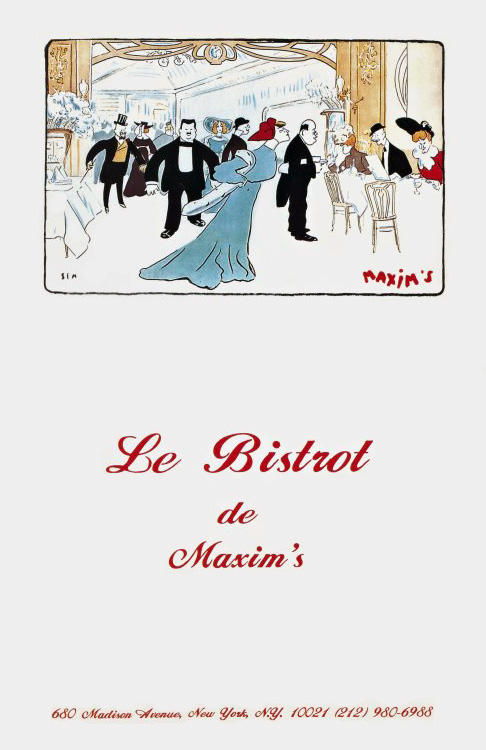
He experienced some financial difficulties in 1933 and filed for bankruptcy but only two years later was back on course with a bigger and better restaurant [pictured] to replace the one on Madison Avenue. Of critical importance to his comeback was the end of Prohibition. His opening announcement in the New York Times attested to this with a prominent display of the names of Reuben’s “friends,” seven liquor manufacturers and distributors.

In 1946 he opened a restaurant on West 57th near Carnegie Hall, with a front nearly identical to East 58th Street. Like his others it was open 24 hours. No doubt it, too, had a doorman who greeted patrons with the bywords “Reuben’s, that’s all.” Larger than the East 58th place, it was billed “A City in Itself,” and contained shops for delicatessen, flowers, chocolates, cigars, and theater tickets, as well as a perfume bar and a barber shop. Despite all, it silently disappeared a couple years later.

Arnold retired to Florida in the mid-1960s and sold the business, which he had turned over to his son to manage years earlier. Reuben’s in NYC continued under new ownership at various locations until 2001. A Reuben’s was also opened in Miami in the 1940s but I have not been able to determine its subsequent fate.

© Jan Whitaker, 2012
4 Comments

Filed under food, popular restaurants, proprietors & careers

Good eaters: students

As far back as the early 19th century students have made up a notable segment of restaurant clientele. They have played a significant historical role both in supporting the growth of restaurants and in shaping the eating habits of Americans.

In the 1800s some restaurants located near colleges specifically catered to students, alumni, and college faculty and staff. As incomparable caterer Othello Pollard of Cambridge MA noted in an 1802 advertisement, “Harvard flourishes and Othello lives.” In NYC in the 1840s poor divinity students could be found at the “sixpenny” eating house called Sweeny’s downing slices of roast beef, clam soup, pickles, and bread and cheese.

One of the penny-pinching patrons at Sweeny’s was Lyman Abbot, an NYU student who later became a noted theologian. Each month when he got his allowance he splurged on dinner at Delmonico’s, but as his money ran low at the end of the month he subsisted on Sweeny’s wheat cakes.

Restaurants clustered around colleges often billed themselves as “student headquarters” and supplied not only food, but entertainment in the form of billiards and supplies such as books and stationery. Hoadley’s, “Hoad’s” to Harvard students, also rented velocipedes in the 1860s. Restaurants around Yale sold weekly meal tickets, hosted private parties, and delivered midnight snacks – “spreads” – to students’ rooms [pictured: midnight “lunch” near Penn State College, 1905]. Billy Park’s chop house in Boston was a hot spot for Harvard students following athletic events. Big-spending students could enjoy the luxurious “sports bar” eateries of their day at places such as Newman’s College Inn in Oakland CA. When it opened ca. 1910 it was decorated with college pendants and tapestries depicting scenes in a man’s life from college to middle age. Murals pictured various college sports while chandeliers were fashioned out of copper and glass footballs.

Alums regularly gravitated back to their college haunts to relive their youth. “Papa” confessed to his daughter on a 1906 postcard of the “Famous Dutch Kitchen, one of the most noted student resorts in the country” near Cornell University, that he planned to eat there before returning home. “I am going to be a college sport for just two days. Big crowd in town. Slept at Fraternity house last night,” he wrote.

Many 19th-century eating places were restricted to male guests, but students at women’s colleges were supplied with tea rooms in the early 20th century [pictured: Brown Betty tea room near Shorter College]. Near the University of Michigan in Ann Arbor, Almira Lovell’s University Tea Room offered teas along with dressmakers’ supplies and college souvenirs in 1903. Around the same time Smith students could often be found curled up on window seats eating popcorn at the Copper Kettle in Northampton. Well into the 1920s being stricken from a college’s approved list was the kiss of death for tea rooms and other eating places that depended upon patronage of women students. Such was the fate of the Rose Tree Inn in Northampton as well as a tea room near Connecticut College.

Students dearly appreciated places to “hang out” because well into the 20th century colleges and universities provided few dormitories and many students lived in rented rooms off campus. Plus, as recent research into Depression-era student life at the State Teachers College in Normal IL has shown, living off campus permitted poor students to economize on food expenses.

College students were prominent among the artsy, “bohemian” restaurant-going crowd. In the late 19th century, when lower Manhattan was filled with schools, students congregated around Washington Square. San Francisco’s art students loved Italian dinners at Sanguinetti’s. In Chicago in the 1920s students met at the Wind Blew Inn. In later decades student beatniks would flock to coffee houses, which in turn were succeeded by hippie hangouts. In 1960 the NYT reported that in one Greenwich Village student café an undercover government agent was asked blandly, “Do you want coffee or peyote?”

It’s harder to track high school students, at least until the 40s and 50s when their consumption of snack foods such as hamburgers, sodas, and pizzas became noticeable. Like college students before them they tended to favor informal meals eaten at odd hours of the day and night.

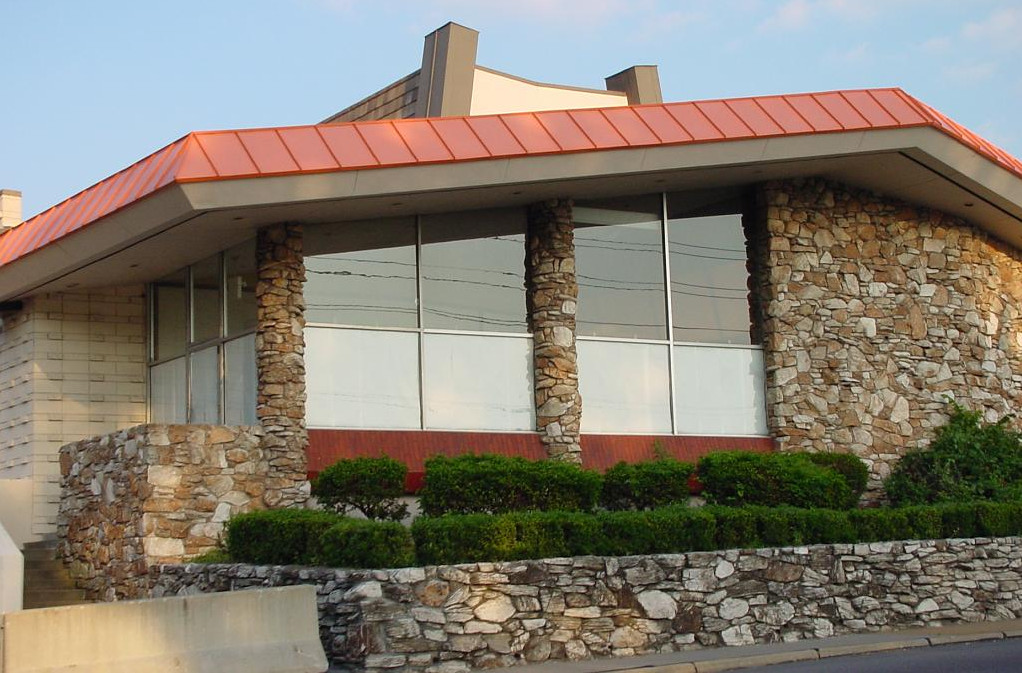
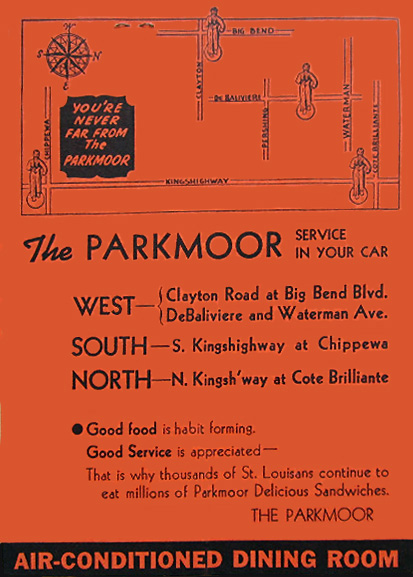
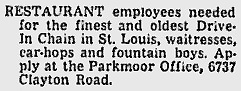
It would be interesting to calculate how many of the post-WWII fast food restaurant chains opened their early units near high schools and colleges. This was certainly true of King’s Food Host, Steak n Shake, and the Parkmoor drive-ins. I have no doubt there were many others.

© Jan Whitaker, 2012

4 Comments

Filed under patrons

From tap room to tea room

Cities in the United States were generously supplied with saloons before national Prohibition took effect. Saloons occupied some very choice sites, often on corners or other desirable spots. So it was quite a boon for other types of businesses such as drug stores and eating places when those locations became available en masse in 1919.

San Francisco’s Temple Bar was an English-style ale house established in the 19th century. Its name played upon London’s Temple Bar – which was a gatehouse, not a drinking place at all. One of its greatest assets was a magnificently carved rosewood and birch backbar said to have been made in Philadelphia in the 1840s. The saloon sat at the end of a quaint little cobblestone alley off Grant Avenue named Tillman Alley or Tillman Place. Just as Prohibition was set to begin, one of its best customers, on a whim perhaps fueled by too many drinks, declared he would buy it; William Davenport, a commercial illustrator who was used to capping off his afternoons there with colleagues from work, paid $300 for the place.

A few months later he and his young wife Hope opened it as the Temple Bar tea room and gift shop. It was also a circulating library which rented books for a small fee. Young Chinese women, dressed in Asian costumes, served lunch and afternoon tea.

William, who was known in artistic circles as “Davvy” and had designed posters for telephone companies up and down the West Coast, decorated the tea room in yellows, blues, and oranges, and fashioned an eye-catching orange sign. To liven up the outside he installed boxwoods in planters. However when they died, victims of the lack of sunlight, he replaced them with modernistic conical-shaped trees he constructed out of painted galvanized iron.

templebartearoomThe alley was inhabited by other interesting businesses and studios such as that of metal craftsman Harry Dixon whose work was exhibited and sold in the Temple Bar gift shop. Another alley denizen was Ye Old Book Shop where George Hargens rapidly gained fame as a seller of rare old books. Grant Avenue was the city’s most fashionable shopping venue in the 1920s, so the Temple Tea Room and its neighbors on Tillman Place were well positioned to catch the attention of affluent shoppers from businesses such as the White House department store just across from the alley.

Hope died in 1932. Davvy carried on the Temple Bar until at least the 1950s when a reporter found him behind the bar mixing dry martinis and old-fashioneds for lunching shoppers. Since his time the location has had many reincarnations as restaurant, bar, and place of entertainment. The backbar was removed to Berkeley in 1990.

© Jan Whitaker, 2012

6 Comments

Filed under tea shops

What’s in a name? Restaurants of 1936

To get a feel for restaurants in 1936, when drinking had recently been legalized and the Depression had eased up somewhat, I surveyed restaurants and lunch rooms entries in city directories for that year. I chose 25 cities that were among the US’s 100 largest according to the nearest census, 1940. The biggest city represented in the sample was Detroit (1,623,452) and the smallest was Shreveport LA (98,167).

I quickly discovered that people ate out frequently that year. Of the 25 cities, there were 7 that had a ratio of restaurants to population comparable to NYC today. I doubt that many readers can guess what they were. [See answer below.]

The ratio of restaurants to population is a rough guide to how often people eat out that is commonly used. But, judging from the names of eating place types – the Luncheonettes, Dinettes, Grillettes, Kitchenettes, Cabins, Cottages, Huts, Nooks, Stands, Shacks, and Shanties — it would seem that many of the eating places in 1936 were small, so there may have been less restaurant going than in NYC today. On the other hand many of the restaurant goers in NYC are not inhabitants, a situation that probably did not apply much to the cities in my survey.

The ethnicity of proprietors in each city is hard to compare. In some city directories restaurant and lunch room listings are almost entirely proper names while in others they are mostly business names. Nevertheless there are many ethnicities represented, including German, Greek, Armenian, Polish, Irish, Slavic, and Italian. Every city, except Scranton PA and Flint MI, has at least one or more Chinese restaurants. Long Beach CA has 9 Japanese names listed, and in San Antonio TX about 13% of the names are Mexican. Only 6 cities have the word Kosher in restaurant names, though of course that doesn’t necessarily mean there weren’t other kosher restaurants not so designated (obviously there are risks of reading too much into names).

Three cities, Shreveport LA, Charlotte NC, and Jacksonville FL, designate in proper Jim Crow fashion which restaurants are “colored.” After all, if everyone must stay in their place, they need to know where it is. One quarter of Jacksonville’s eating places are by and for African-Americans, including the Pink Tea Room.

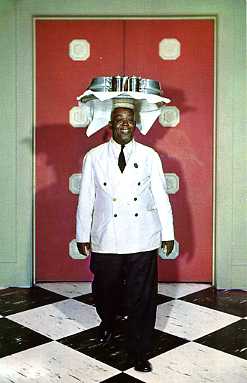
Restaurant types suggest not only smallness, but a degree of humbleness, as the types above indicate. Overall the word Restaurant is used far less often than is Café. Other dominant types are Shops (Coffee [Oklahoma City pictured above], Food, Sandwich, Snack, Soda, Tea, and Waffle) and  Lunches. Diners are found infrequently, with Newark the biggest exception, having 20 diners and 20 lunch wagons. Drive-ins are mostly in Salt Lake City and Houston.

Every city seems to have places offering hamburgers, chili, spaghetti, barbecue, and waffles, but not once did I find the words pizza or pizzeria. Cheerful and corny names abound. Busy Bees are common but so are Cozy Corners and Friendly Lunches. Every imaginable play on Inn can be found, such as Buzz, Dew Drop, Drag-on, Just Ramble, Step, Squeeze, and Swim. Popular culture and current events are conveyed by the Movieland Luncheonette, the Screenland Café, the Shirley Temple Sandwich Shop, and New Deal and Square Deal Lunches. The need to economize and forge ties as workers is evident in St. Paul’s Co-Operative Café, Newark’s Labor Lyceum Restaurant, Omaha’s Farmers Union Café and Tavern, and in Detroit’s Workingmen’s Co-operative Restaurant, International Co-Operative Restaurant, New System Profit Sharing Cafeteria, and People’s Profit Sharing Cafeteria.

There is considerable evidence of both regional and national chains. White Castle System Inc. is by far the most common, but there are numerous other “White Systems” such as White Tower [Scranton pictured above], White Hut, and White Spot. There are also Dixie Sandwich Systems [St. Louis pictured], Pig Stands, Toddle Houses, units of Childs, John R. Thompson, and the Waldorf System, as well as many other forerunners of today’s fast food chains.

Finally, a few of my favorite names of 1936: Omaha’s Boo Koo Café, Kansas City’s Yours & Mine Café, San Antonio’s Wampus Cat Café, Columbus’s Krome Dome System, Oklahoma’s Joy-Boy Café, Louisville’s Hy Skool Tavern, and Houston’s Robert’s Eatorium.

I am forced to conclude it was not a good year for upscale dining.

© Jan Whitaker, 2012
———–
Note: The cities with a ratio of about 1 restaurant for every 350 people were: Cincinnati OH, Kansas City MO, Houston TX, Columbus OH, San Antonio TX, Oklahoma City OK, and Long Beach CA. The complete list of cities in the sample were, in descending population size: Detroit, St. Louis, Cincinnati, Newark, Kansas City, Houston, Louisville, Columbus, St. Paul, San Antonio, Omaha, Oklahoma City, Jacksonville, Grand Rapids, Long Beach, Des Moines, Flint, Salt Lake City, Yonkers, Scranton, Fort Wayne, Erie, Tacoma, Charlotte, and Shreveport.

7 Comments

Filed under miscellaneous