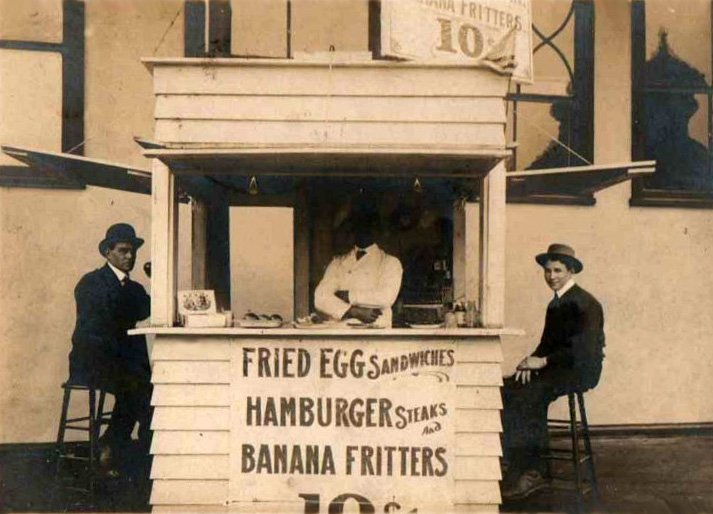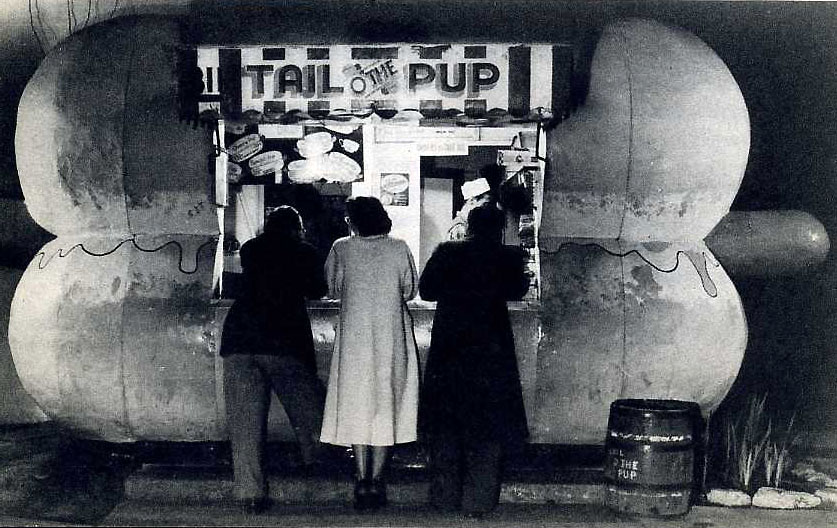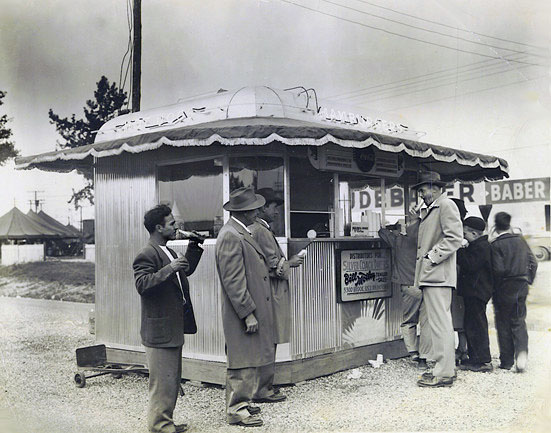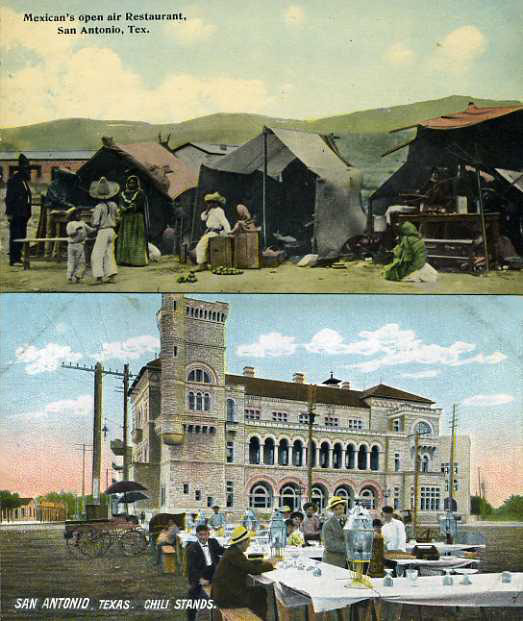
Odd restaurant food

Over the weekend I went to an antiques show in Fitzwilliam NH and bought some vintage menus. The seller had a cache of them from a printer in Manchester NH, all from 1956.

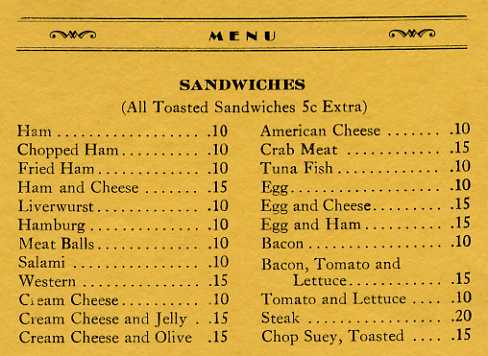
An unusual selection on one of the menus caught my eye, a Toasted Chop Suey sandwich. Odder still, the sandwich appeared on a menu from Angelo’s Spaghetti House.

It would seem slightly less strange to me if it had been a Chinese restaurant, such as the Chinese and American Red Rose Restaurant in New London CT, where around 1960 diners could order a Chow Mein sandwich.

But, upon reflection I have to ask myself why either of these sandwiches should seem odd. I used to enjoy a specialty of St. Louis Chinese restaurants called the St. Paul sandwich which consisted of something resembling Egg Foo Young served between two slices of spongy white sandwich bread slathered with mayonnaise. It was delicious.

I don’t mean to single out New England as the home of strange restaurant dishes, but it so happens that I’ve personally encountered two of the weirdest food combinations of my dining-out life in this part of the world.

Both involved potatoes.

One was in a New England inn with a quaint name and an old coach on the front lawn. It is against my better judgment to go to such places but a visitor from afar expressed interest in it. I have no idea what I ordered but let’s assume it was chicken or beef. Along with it, in a small saucer, came two whole boiled potatoes smothered in tomato sauce straight out of the can. I have to think that the cook was suddenly taken ill and the dishwasher, the only other person in the kitchen, had to take over.

At a restaurant in Springfield MA I experienced another culinary shock. I had taken my visiting parents there on the way to the train station because they liked Italian restaurants and it was handy. I have forgotten what we ate, but at tables all around us people joyfully celebrated carbo-loading with side dishes heaped with spaghetti AND french fries — in addition to their main dishes. I like spaghetti. I like french fries. But together?

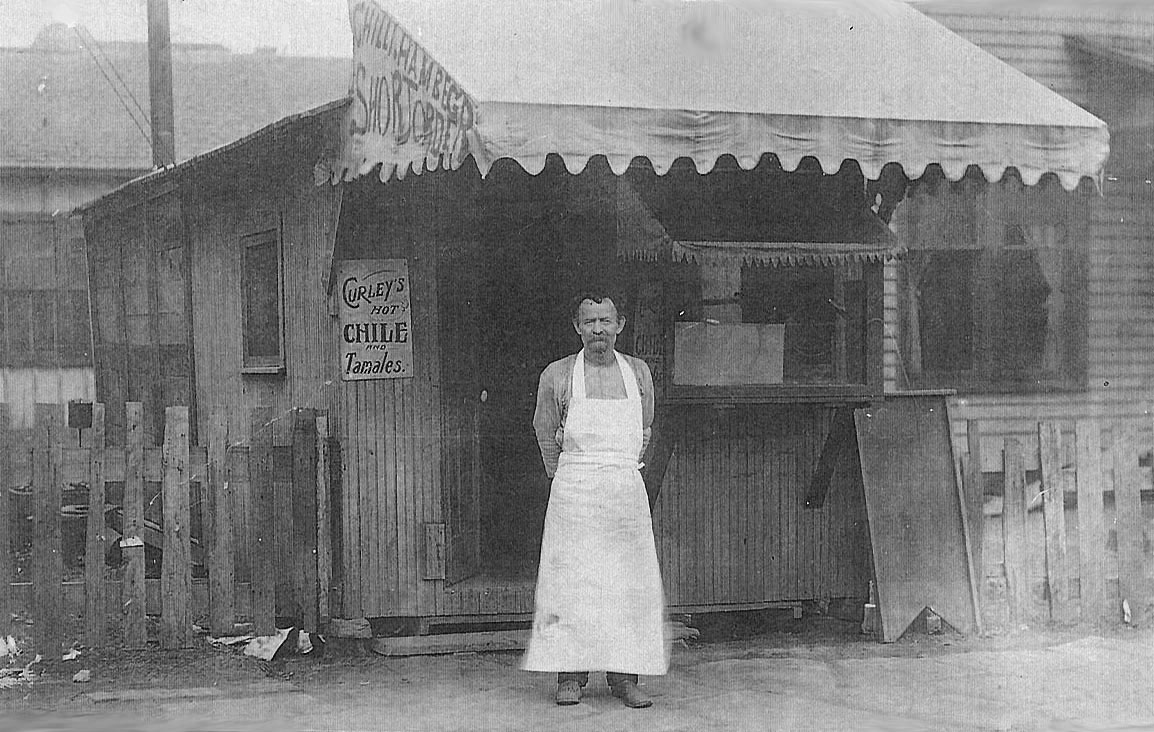
Changing the focus from New England to California, “Chili Size” might at first seem like an odd dish but upon closer inspection it is not so much the components that are peculiar – a hamburger patty covered with chili with beans, sometimes with cheese melted on top of it all – as it is the name.

On the other hand there may be people who don’t think any of these things are odd.

© Jan Whitaker, 2012

29 Comments

Filed under food

That night at Maxim’s

A restaurant is an expression of its time and place. Except for fast food franchises which are based on an industrial mode of mass production detached from local particularity. So when a replica of an art nouveau turn-of-the-century culinary haunt of demimonde Paris shows up in the basement of a hotel on Lake Michigan’s gold coast in the mid-20th century – well, it’s a little strange.

In short, was the Paris-based Maxim’s franchise that arrived in Chicago in 1963, with its undulating woodwork, fleur-de-lis lights, red velvet banquettes, Soles Albert, and Poires Helene, the real thing?

I’ve been pondering this question as I’ve pored over the fascinating photograph above, which was taken by prize-winning photographer Gary Settle, probably for The Chicago Daily News.

What was the occasion? It’s not a casual shot. At least two floodlights are in evidence and there is something stagey about the scene. I suspect the couples were asked to leave their coffee and smokes and get up and dance. Unfortunately, in the process two napkins were flung aside in an unsightly manner. Elegance is so hard to achieve.

The Brylcreemed man leaning over the table must be Chef Pierre Orsi who had very recently arrived from Paris to take command of the kitchen. The man seated to the right of him looks as though he could be French, but the other men in the picture, apart from the musicians, appear to be of German ancestry. I wonder if they might be two sets of twins.

Which of the women owns the sable coat and elbow-length black gloves? I believe it is the blissful dancer on the left. She will carry home leftovers in a foil purse-shaped doggie bag — perhaps she is dieting or didn’t love her Calves Liver with Raisin and Grape Sauce so much.

The table has a center lamp with pink silk shades and coffee cups bearing Maxim’s curlicue M logo. A cigarillo rests in one of the souvenir ashtrays, while others have been used by the table’s two Winston smokers who prefer a fliptop box to a soft pack. Did these eight people really polish off four bottles of champagne? Did anyone use the replica antique telephone to check in with their babysitter?

I invite readers to create a scenario. Who are these people and what were they thinking at this moment in September, 1967?

© Jan Whitaker, 2012

19 Comments

Filed under elite restaurants, miscellaneous, patrons

Famous in its day: the Parkmoor

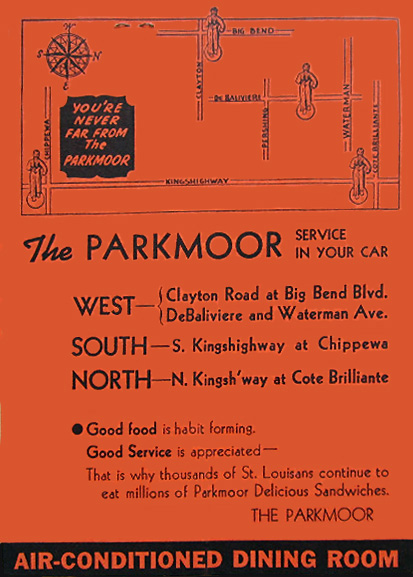
It’s been somewhat frustrating researching the Parkmoor chain of drive-ins that once did business in St. Louis, my home town. My main source has been a book written by Lou Ellen McGinley, daughter of the chain’s founder and manager of the Clayton Road Parkmoor from 1977 until its closing in 1999.

The book is called Honk for Service, yet throughout it are shown menus that say clearly at the top “Flash Your Lights for Service.” Alas, this is but one tipoff that somebody wasn’t totally on the job.

Nevertheless, the book enlightened me about a number of things, especially that there were once six Parkmoors in St. Louis. I had thought that the Parkmoor at Big Bend and Clayton was the one and only. In fact it was the sole survivor as well as the original, in 1930 the site of a Tudor-style drive-in. Three more Parkmoors opened in the 1930s and two in the 1950s, but all five of them were gone by 1971.

From 1940 to 1953 there was also a McGinley Parkmoor in Indianapolis. Parkmoor was a popular name for mid-century drive-ins. The Parkmoors in Amarillo TX, Knoxville TN (one O), Dayton OH, and Sarasota FL were not related.

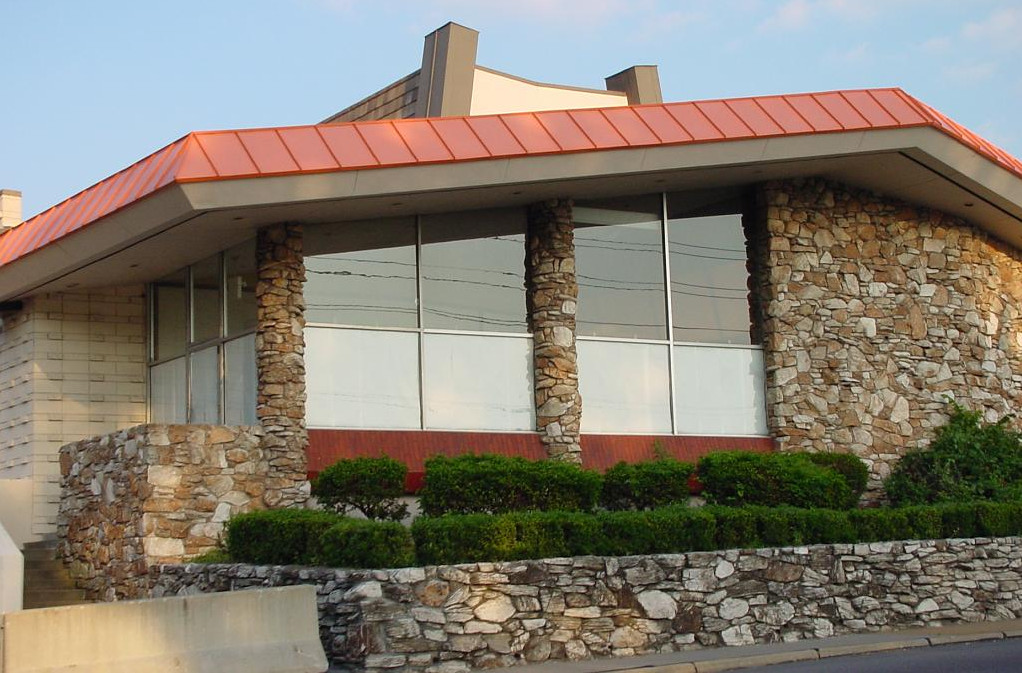
I enjoyed the book’s charming illustrations, but I was disappointed to find only a single blurred and partial image of the exterior of the modern orange-roofed Parkmoor building that most St. Louisans knew (pictured above after being closed; razed in 2004). And there was no mention of when it was constructed, who designed it, or why the McGinleys chose what was for architecturally conservative St. Louis such an exotic, California-style design.

As I remember it, the interior was impressively ugly. It had a tall peaked ceiling and a lava-stone back wall. All the seating was built-in and covered in orange leatherette. To the right of the entrance was an L-shaped counter with cantilevered seats that projected up diagonally from the base. Down the center of the room was a 3-foot high divider with plants growing from the top. On either side of the divider were rows of two-person mini-booths, while larger booths ran along the continuous windows to the left.

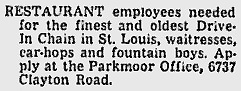
From what I’ve been able to discover poking around, the Googie-style Parkmoor was built in 1969. By that time the restaurant was no longer a drive-in. Honk for Service does not say when carhops were dispensed with, but according to a newspaper want ad they were still being hired in 1963 even though two locations had adopted speaker-based ordering systems by then.

Lou Ellen’s father, William Louis McGinley, began his business career in the 1920s as head of a Texas company that sold trays to drive-ins. According to Honk for Service he was inspired to open a drive-in in St. Louis as an “I’ll show them” response after he was informed by Dorr & Zeller, an old-line catering company, that St. Louis was not the kind of city that would accept drive-ins.

Was it a similar motive that led McGinley to open a Parkmoor very near Dorr & Zeller on DeBaliviere in the city’s west end? It turned out to be an ill-fated locale. A brawl there in which police shot and killed two men in 1965 may have contributed to the demise of that location a few years later.

Both generations of McGinleys were cattle ranchers who spent much of their time in Texas while overseeing the Parkmoor. As with most drive-ins, the menu featured hamburgers; the beef was ground in a two-story commissary building erected on a corner of the Clayton Road Parkmoor’s parking lot. The beef, however, did not come from the family’s Texas ranch.

A little taste of Texas appeared on a 1930 menu which offers a Top Sirloin Steak served with French fried potatoes, lettuce, tomato, bread and butter – plus a “Texas preserved fig” – all for 55c. Add a Dr. Pepper for an additional 5c.

© Jan Whitaker, 2012

75 Comments

Filed under drive-ins, restaurant decor

Frank E. Buttolph, menu collector extraordinaire

It was Monday, January 1, the start of a brand new week, year, and century. A patron at the Columbia Restaurant on 14th Street in NYC’s Union Square experienced a jolt when she looked at the menu. “The first time I saw the new date 1900 on a menu it thrilled me as if I had been suddenly transplanted to the planet Mars,” Miss Frank E. Buttolph would later say.

It occurred to her to save that menu. She gathered more and soon realized she had the makings of a collection. She donated 900 menus to the New York Public Library, with an offer of 1,000 more. By 1917 she claimed to have amassed about 28,000 menus for the NYPL, and had spent countless volunteer hours cataloging them and stamping them with the now-notorious blue stamp.

Although I suspect she actually started collecting menus in the 1890s, Miss Buttolph would repeat the engaging origin myth for years, using it in press releases and interviews to inspire menu donations from near and far, even from European royalty. Menu collecting was not unheard of, but had not yet become the fad it would be a few years later. It was said that when she began to collect menus, “no one thought of it as anything better than a rather tiresome freak, on which a vast amount of energy was being wasted that might have been better expended.” Poster and cookbook collecting were likewise viewed as trivial pursuits.

Born Frances Editha Buttles in Mansfield PA, Frank’s father was a wagonmaker and undertaker who filed at least a dozen patents for common tools. Frank became a teacher and taught in Rahway NJ, Minneapolis MN, Scranton PA (where she briefly ran her own girls’ school), Bolivar TN, and Saratoga Springs NY. I haven’t discovered exactly when she moved to NYC, but by 1900 Frank was a single 56-year-old whose family was deceased and who knew several languages and had traveled abroad at least three times. Her source of income in NY is unclear. She taught Sunday school and did some tutoring. She declared she was a magazine author but I’ve never found any of her publications. Perhaps she inherited money.

Evidently she had enough free time to spend long hours in her library office, first located in the old Astor Library and then, after the new Fifth Avenue public library building was completed in 1911, overlooking Bryant Park.

Her name “Frank” has caused much perplexity. Did it imply gender ambiguity? Although I can’t prove it didn’t, Frank was not a totally uncommon nickname for Frances which gained popularity in the 1870s and 1880s. She was known as Frank as early as 1866 when she finished teacher training [pictured]. It seems she was not especially fond of either Frances or Buttles. She researched her family’s genealogy and in 1900 changed her last name to the more dignified-sounding Buttolph, of which Buttles was a corruption.

Frank collected all sorts of menus, from restaurants, hotels, steamships, and trains. She insisted that they be clean and rejected those from businesses she sensed were simply trying to get publicity. Many she preserved were from club banquets or dinners celebrating famous individuals. Most were American, but she also collected menus commemorating the opening of the Suez Canal, menus from royal courts, and from other exotic occasions worldwide. It seems as though the public was most appreciative of rarity, but I am grateful that she saved menus from everyday restaurants such as the Columbia, all the more so since it went bankrupt about two years after her fateful visit.

More on Frank Buttolph and her collection.

© Jan Whitaker, 2012

3 Comments

Filed under menus, women

Lunch Hour NYC

I am happy that I had a chance to see this fine exhibit at the New York Public Library while I was in the city for a conference. It showcases menus, pamphlets, manuscripts, and other materials from the library’s collections, and also features actual hardware from the Automat, particularly a reconstructed wall of Automat cubicles. Alas, they have no food in them.

The exhibit is divided into four themes: eating places that furnished quick lunches, eating places where “power lunches” took place, home lunches, and charitable lunches, a theme which includes soup kitchens and early school lunch programs.

Of course I was primarily interested in the first two themes since both are about restaurants. Other than the Horn & Hardart Automat, places such as Childs’ restaurants, Sardi’s, the Forum of the Twelve Caesars, and Schrafft’s were profiled with displays of menus, drawings, photographs, and other memorabilia.

I was particularly fascinated by two large map sheets which presented mid-town Manhattan in great detail, showing the names of each of the businesses lining several streets. Published in the 1950s by Nirenstein’s Realty Map Company of Springfield MA, similar maps were made of many large cities in the U.S. I must see more of these!

It was delightful to see a photograph of Miss Frank E. Buttolph about the time she launched her menu collecting project whose results formed the basis for the library’s vast menu collection.

There are a few areas where I would have slanted things a bit differently or included additional material. As is often the case when the historical focus is on one city (or country), its uniqueness, greatness, or innovativeness tends to be overstated. For instance, New York was not alone in having early fast food lunch rooms – all big cities did. Nor was it a pioneer in the development of the cafeteria. Chicago and Los Angeles both played a greater role in the early days of the cafeteria.

I think too that I would have paid attention to the saloon lunch, since it was a very popular method of acquiring a quick lunch. Temperance advocates portrayed saloons as loathsome places but, as some anthropologically-minded reformers pointed out, saloons also functioned as welcoming community oases and cheap eating places for many low-income workers, men in particular.

But these are minor criticisms of a show that is well-researched and presented and will certainly delight hundreds of thousands of visitors as well as proving a valuable resource for teachers. The free show runs until mid-February 2013 at the main library. A promo for the exhibit is on youtube.

Leave a comment

Filed under miscellaneous

Restaurants and artists: Normandy House

With the recent publication of the book Edgar Miller and the Handmade Home has come renewed appreciation of Miller’s talents and of the central role he played in the birth of Chicago’s Old Town arts colony in the 1920s and 1930s. Often seen as “Chicago’s forgotten Renaissance man,” Miller is mainly admired for his imaginative renovation of apartments and studios, with Sol Kogen, employing materials from demolished buildings.

His work encompassed mural paintings [portion of Black Sheep mural below], stained glass windows, wood and stone carvings, ceramics, wallpaper, and fabrics. In addition to dwellings, his playful virtuosity in the decorative arts was bestowed upon a number of Chicago’s eating and drinking places, including Harry’s New York Bar and the several outdoor cafes at the Streets of Paris complex in the 1933-34 Century of Progress Exposition. Following Repeal, when money poured into updating bars and restaurants, he worked with architects such as Andrew Rebori, painting murals for bars in the Northern Lights hotel, the 885 Club, and a Fred Harvey restaurant in Dearborn Station [pictured below]. At the Tavern Club, where Miller was a member and his precocious young son Skippy would later hold “one-man” shows, he created a renowned mural called Love Through the Ages.

Normandy House on Chicago’s near north side became his ongoing project in the late 1930s and through the 1940s. The restaurant occupied the corner structure in a row of five apartment buildings, each four stories in height, at the southern end of Tower Court (aka Tower Place and North Michigan Ave.) opposite the historic water tower. Once the home of the city’s blue-bloods, by the 1920s the entire row had become a commercial property. A restaurant called the Charm House occupied the corner site until about 1937 when Grace Holverscheid bought the business, renaming it Normandy House.

Grace, a widow, operated it with her friend Helen Wing, also widowed. Grace would soon marry a third partner, Richard Tallman. All three were involved with music, Richard as a composer, Grace as a concert vocalist, and Helen as her arranger and accompanist. While running Normandy House, Helen also wrote books and composed operettas for children.

Edgar Miller lived upstairs over the restaurant, perhaps trading his artistic work in exchange for rent. During its incarnation as Charm House, the restaurant had been renovated in quaint style with beamed ceilings, etc., to resemble a sister restaurant in Cleveland OH. An Old English taproom and grill installed in the basement in 1934 – named the Black Sheep Bar by its new proprietors — became the focus of Miller’s decorative elaborations. Over the years when he, and later his family, lived on the third floor, he carved a front door, painted murals, and made stained glass windows, wood sculptures, ceramic plaques, and wall paper for the restaurant. He was assisted by his brother Frank who became the Black Sheep’s bartender.

The Millers’ quarters, up the stairs past the restaurant’s cashier, also served as studio space for Edgar and his wife, the former Dale Holcomb, who translated many of Edgar’s designs into fabrics. At any given moment the whole family, including the two young sons, might be painting portraits, squeegeeing silk screens, or engaging in any number of artistic endeavors. Other artists, musicians, and classes of art students from the Art Institute frequently paid visits.

The Normandy House, like Chicago’s Le Petit Gourmet, attracted a clientele that included club women and professional groups of architects and academics. Its menu featured favorites such as the Pink Squirrel (broiled beef tenderloin with Roquefort sauce) and Eggnog Pie, as well as 1950s innovations such as salad in wooden bowls and individual loaves of bread served on cutting boards.

Helen Wing and the Tallmans closed Normandy House and retired in the summer of 1956. Then, under the management of a long-time employee and with backing from a Florida hotel mogul, it was reopened. In 1960 it moved to Rush Street, reinstalling at least some of Miller’s pieces.

The Tower Court building housing Normandy House along with the other four buildings in the row were razed to make room for a multi-story hotel. In the 1960s Miller and his wife moved to Florida where they ran a motel until her death. Edgar lived in Taos NM, Australia, and San Francisco, then returning to Chicago where he died in 1993 at age 94.

© Jan Whitaker, 2012

Read more about Edgar Miller’s life and work.

1 Comment

Filed under restaurant decor

Conferencing: global gateways

I’m looking forward to being at the Global Gateways and Local Connections conference in New York later this month. The conference is for members of three organizations: the Agriculture, Food, and Human Values Society; the Society for Anthropology of Food and Nutrition; and the one I belong to which is the Association for the Study of Food and Society.

The conference hosts, New York University and the New School, have helped plan four days packed with fascinating panels as well as tours of markets, food producers, restaurants, and library collections. Not surprisingly given my interests, I’ll be joining a walking tour of the multi-faceted Eataly and another of library culinary collections at NYU and the New York Public Library.

I’m very eager to meet everyone on my panel and to hear their papers. I will talk about “How 20th-century Wars Shaped American Restaurants.” Andrew Haley (author of the James Beard prize winning book on the history of American restaurants, Turning the Tables) will present “From Prune Whip to Mac and Cheese: Children, Diet and the Restaurant in the Mid-20th Century. Nic Mink’s paper is “The Machine in the Culinary Garden: Technological Change and the Transformation of the Quick Service Restaurant Industry.” And Isil Celimli-Inaltong will talk about “The Increasing Significance of the Chef in the Culinary Field.”

Should be great!

3 Comments

Filed under miscellaneous

Peas on the menu

I read a story on dining-out trends a few days ago that said, “We’re ordering fewer peas …” Of course! I can’t remember when I last ordered peas in a restaurant. Never, I suspect. Plates often come adorned with little piles of grilled asparagus, or maybe julienned carrots and zucchini, but peas? No.

Admittedly, even at this moment, someone could be serving up peas in the pod in a trendy farm-to-table restaurant somewhere in Westchester County or in California wine country, but other than these outlier examples, I ask, how many peas have been served in restaurants in the last several decades? Very few, I’d bet.

Yet, strangely enough, once upon a time they were the darling vegetable of elite restaurants and hotel dining rooms. At Boston’s luxury hotel, Tremont House, an 1843 menu listed “Les Petits Pois à la Parisienne.” Small, tender, bright green peas imported from France were considered a delicacy, and were expensive. American canned green peas came on the market in the 1850s, but it took so many hands to pick and shell them that they too were expensive, yet not considered good enough to displace the popularity of the French imports.

French peas continued to reign even in lesser eating places, often appearing on holiday menus at hotel dining rooms across the land. For example the Rankin House in Columbus GA featured French Peas for Christmas dinner in 1887, along with choice dishes such as Oysters on the Half Shell, Green Turtle Soup, and Tenderloin of Beef with Mushrooms.

In that same year, though, an alarm was raised about the wisdom of eating imported French peas. Their bright green color was produced by adding copper sulfate, warned critics who said this was toxic, fatal if taken in big enough doses. Evidently the warnings did not impress many people because French peas continued to be served in fine restaurants. Loud cries to ban their importation were not heard until after the American invention of a machine that would both pick and shell peas in 1893, thus bringing down their cost to consumers.

In 1906 many states passed pure food laws that made it illegal to sell French peas colored with copper salts. In Idaho the state’s Pure Food Commissioner confiscated 72 cans of imported French peas found in a hotel and destroyed them by punching holes in the cans and pouring kerosene over the contents.

French peas appeared on menus after that, but it’s likely they were grown and canned in the US. “Petit pois” was the name adopted in this country for the smallest size pea, 9/32-inch in diameter. In the 1940s, 1950s, and 1960s, French Peas on a menu continued to suggest luxury or a special occasion such as Mother’s Day or Thanksgiving. Green Peas, Garden Peas, and June Peas, on the other hand, suggested freshness and nutrition, but not luxury or style. They were exactly what a diner expected to see filling in the blank spaces on a dinner plate at Howard Johnson’s.

In the last several decades I believe peas have vanished from menus. When was the last time you had peas in a restaurant?

© Jan Whitaker, 2012

11 Comments

Filed under food

Famous in its day: Richards Treat Cafeteria

With its ham loaf and chicken pot pie, the Richards Treat Cafeteria on South Sixth Street in downtown Minneapolis was akin to other cafeterias and restaurants run by women, such as The Maramor in Columbus, Miss Hulling’s in St. Louis, and the Anna-Maude in Oklahoma City. Like its sisters, the Richards Treat was not known for culinary innovation but for preparing home-like dishes from scratch using fresh ingredients cooked in small batches.

The Richards Treat was opened in 1924 by two home economics professors at the University of Minnesota, Lenore Richards and Nola Treat, who ran the successful enterprise until 1957. The two met in 1915 when they both taught at Kansas State Agricultural College in Manhattan KS. They became close and decided to arrange their lives so they could work and live together from then on. “I am not and never have been married,” each wrote in 1923 when applying for passports prior to a European tour.

Nola Treat [pictured, 1923] had some experience in running cafeterias before 1924. She had set up a high school cafeteria in Decatur IL in 1911 when many schools provided no meal service. Following that she inaugurated student cafeterias and institutional management programs at several Midwestern state colleges and universities. Apparently she was well aware that many people disliked cafeterias, publishing an article titled “Why Cafeterias Fail” just months before opening her own. In it she said that it was unusual to find the sort of cafeteria which was “so attractive in appearance, and which serves such good food, that the most fastidious people will go to it.”

Perhaps that was why Richards and Treat always paid such close attention to their restaurant’s decor, which had little in common with the typical cafeteria’s institutional appearance. Theirs more nearly resembled a tea room with its antique cupboard of curly maple, pewter objects from the couple’s collection, and other decorative pieces brought back from their travels. Each table in the main dining room, including the one where they ate their own dinner nightly, held glowing candles in candlestick holders or candelabra.

In their cafeteria they attempted to provide a home substitute for patrons who might be unable to get home for meals or who lived in efficiency apartments. “The atmosphere of the dining room – its quiet, order, cleanliness – contribute to a feeling of well-being and satisfaction in the food,” observed Lenore [pictured, 1923] in a 1941 address to the Home Economics Association.

Their menus featured American cooking as understood by the middle-class American-born mainstream in the mid-20th century. An April 1933 menu offered a special 50-cent dinner of Veal Loaf with Mushroom Sauce, Buttered New Asparagus and Carrots, and desserts such as Fresh Strawberry Shortcake or Devils Food Cake, accompanied by Coffee, Milk, or Buttermilk.

For 15 or more years the cafeteria supplied cakes for dining cars of the Great Northern Railroad. When they learned, quite by accident, that the cakes’ top layers had a habit of sliding off when trains went over mountains en route to Seattle, they substituted sheet cakes. Cakes, cookies, bread, and house-made candy were popular sellers at the cafeteria’s bake counter where, in the 1940s, they also sold Laguna Pottery from California.

The cafeteria became a place where lawyers, judges, professional men and women, and newspaper reporters gathered, leading restaurant guidebook publisher Duncan Hines to characterize it as “Educated Food for Educated People.” The slogan was adopted by the Richards Treat.

They expanded several times, seating 300 by 1944, and winning loyal patrons despite stiff competition from other cafeterias such as The Forum and Miller’s Cafeteria. They also ran a coffee shop in the Northwestern Bank Building. Throughout their career they received many accolades, served on the editorial board of Restaurant Management magazine, and held top positions in the National Restaurant Association. Their book Quantity Cooking, published in 1922, with three subsequent editions, became a basic text used by the US military in World War II and restaurants throughout the country into at least the 1970s.

© Jan Whitaker, 2012

3 Comments

Filed under cafeterias, proprietors & careers, restaurants, women

Maxim’s three of NYC

As some New Yorkers may recall, their city once boasted a certified branch of the famed Maxim’s de Paris. It opened in 1985 on two floors in the Carlton House on Madison and 61st. After seven years in which it went through many changes, it closed in 1992. It was grand and expensive, but despite its golden name never made it into the highest ranks of NYC restaurants.

The proprietor of an earlier, independent Maxim’s in New York, Julius Keller [pictured below], once wrote that “the American people reveled in anything that savored of a European atmosphere,” but perhaps that was truer in his day than the 1980s. His Maxim’s thrived from 1909 until 1920 when it fell victim to wartime austerity.

It was one of the “lobster palaces” on and near Broadway that appeared before the First World War to cater to fun-seeking after-theater crowds. Typically the palaces adopted French names, poured champagne like water, and featured some form of entertainment as well as premium-priced chicken sandwiches and broiled crustaceans.

Keller, who liked to be called Jules because it was classier, was a Swiss immigrant who landed in New York solo in 1880 at age 16. After working as a waiter in a number of restaurants and hotels, and eventually owning a few, he found a promising location on 38th street between Broadway and Sixth Avenue. Activity was moving in that direction and he thought he could make a go of it despite the hundreds of thousands of dollars lost by four failed predecessors which included the Café des Ambassadeurs and the Café de France.

At first he operated under the name Café de France. Nobody came. So, being resourceful, he dressed his waiters like servants to Louis XIV, hired an orchestra, and, most importantly, borrowed the name of the famous Paris house of good food and naughty gaiety, Maxim’s. Success followed quickly. Each year on New Years Eve he gave away souvenir plates displaying the words, “Let us go to Maxim’s, where fun & frolic beams,” possibly lyrics from the 1899 French play The Girl from Maxim’s.

His clientele was made up of society figures, financiers, celebrities, and those indispensable “others” with money to spend. Maxim’s courtly tone had a tendency to slip occasionally, as was often the case with lobster palaces. On one occasion in 1911, 250 people coming from the annual automobile show jammed the place, causing quite a fracas when the staff had to forcibly eject them in the wee hours. But Keller drew the line at known criminals. He deliberately discouraged the patronage of gangster friends from the old days – when he had ventured into gambling and, as part of the operation of his Old Heidelberg, prostitution. He wanted Maxim’s to be first-class.

During his years operating Maxim’s Jules was known as “the father of café society,” and for providing male dance partners for lone women patrons in the dance craze of 1914. Among these was his discovery, Rudolph Valentino. He was proud of his restaurant. As he wrote in his 1939 autobiography Inns and Outs, his visit to the original Maxim’s convinced him “that the replica we had put together . . . suffered nothing from comparison.”

Given restaurant-world Francophilia and the fame of the Maxim’s name, it’s to be expected that there were namesakes scattered across the U.S.A. (even in pre-WWI Salt Lake City, a city not generally known for kicking up its heels). And it’s hardly surprising that there was yet another Maxim’s in New York, this one sprouting in the Depression among other Greenwich Village hotspots such as The Black Cat, The Blue Horse, and El Chico. Other than that it acquired new banquettes around 1931, I know absolutely nothing about it.

© Jan Whitaker, 2012

7 Comments

Filed under proprietors & careers