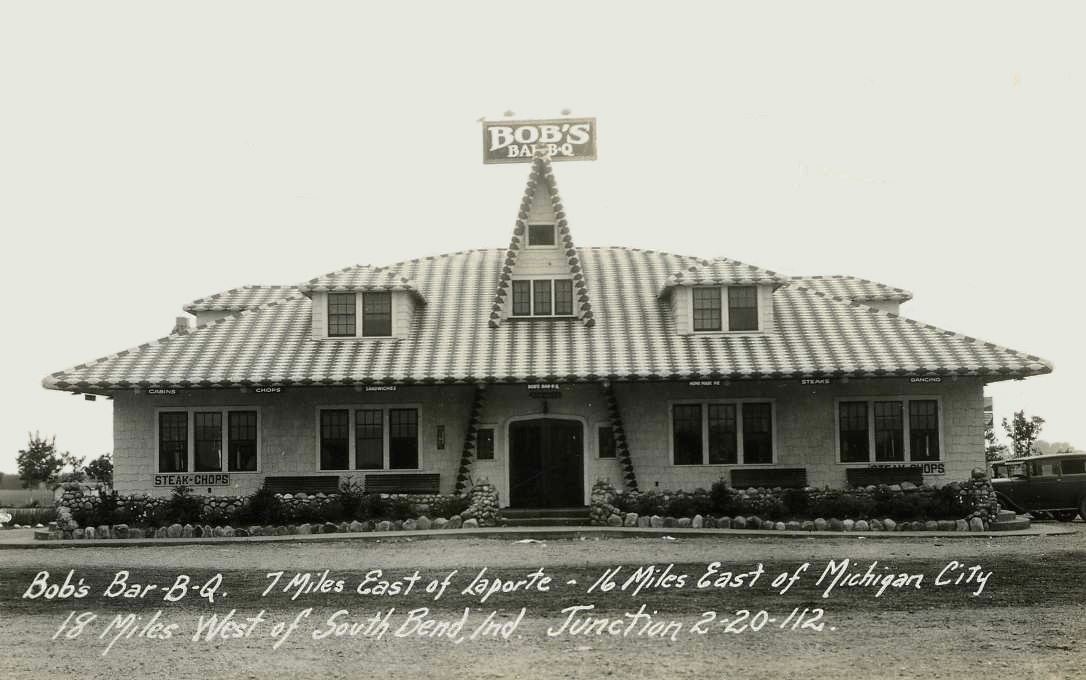
I’ve been exploring my postcard and ephemera collection and picking out favorites to see what I can find out about them. Judging from the geographical identification on this card – indicated by highway numbers and miles from towns, it clearly was a roadside enterprise catering to car and truck traffic on Route 20 in Indiana.
What I didn’t know is how very popular it was, not just with truckers and long distance drivers but with people living in the vicinity. Memories of it has inspired filmed interviews with former patrons who hung out there in their teens.
Bob’s initially opened in 1927, with a smaller building and was enlarged as shown above in 1932. In addition to getting business from traffic on Route 20, it also served as a stop for buses, with 10 to 15 stopping there daily. With the addition, the restaurant could host 150 patrons.
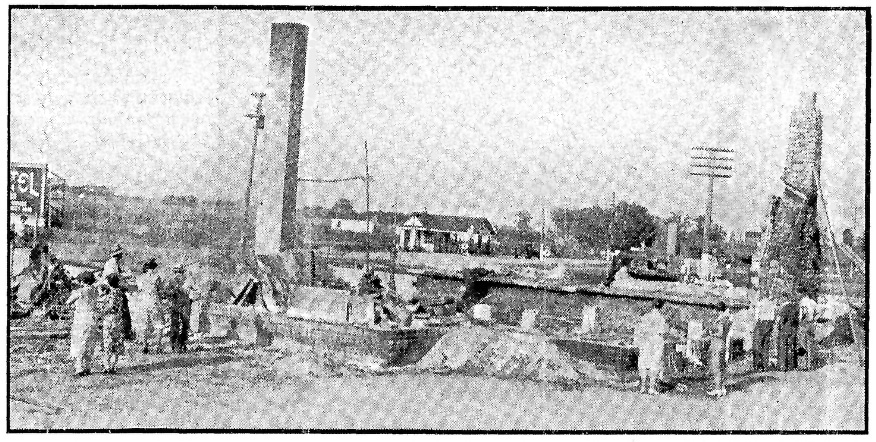
It belonged to by Robert Wiley and his wife Adah who worked there as a waitress. In 1933 it was totally destroyed by fire.
The Wileys and some relatives who lived with them were lucky to escape, although Adah was seriously injured. The Bob’s sign perched precariously on top of the central peak fell on Bob, but he was not badly hurt.
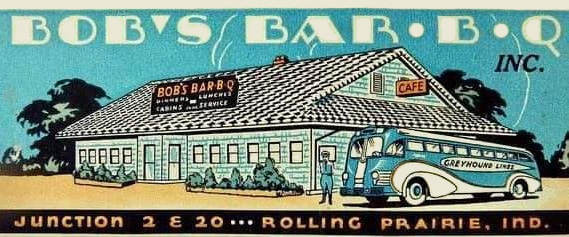
The Wileys were eager to replace the building quickly because it was on Route 20 where traffic was then headed toward Chicago’s World’s Fair. It soon reopened in a new building, shown above on a matchcover.
At some point tourist cabins were erected on land behind the restaurant. They were for travelers, but also housed restaurant waitresses.
With the new building in operation, the business continued to grow, But World War II presented new obstacles, namely difficulty in finding staff and a full range of food. At its busiest the restaurant had a staff of 40 but was down to 9 when it closed for the duration of the war. The South Bend newspaper declared it had been “one of the best-known highway restaurants and tourist camps in the middle west.”
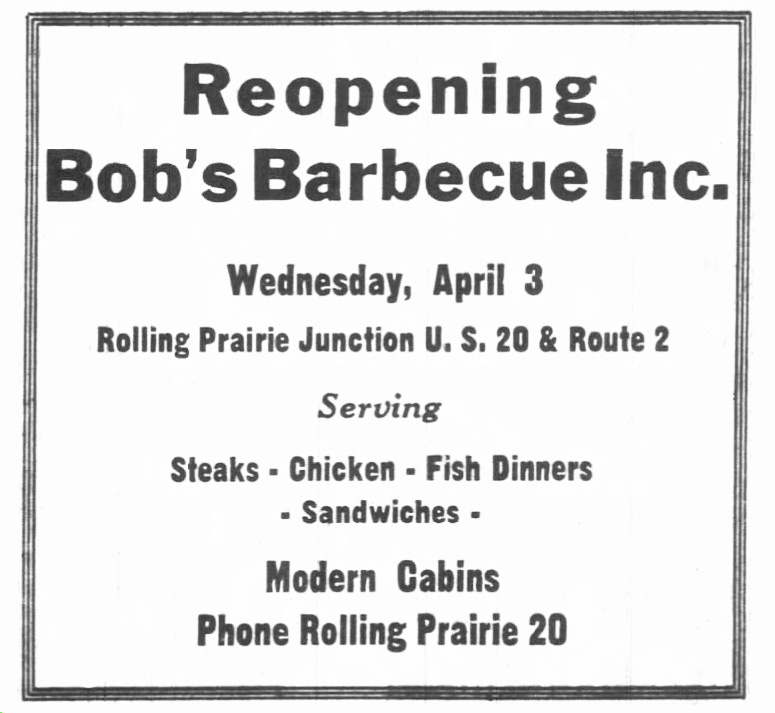
When the restaurant closed Robert Wiley became a La Porte county deputy sheriff. Adah died in 1946. He remarried and reopened the restaurant in April 1946.
The highway set the tone for the restaurant in a number of ways. Obviously it brought travelers of all kinds, including some criminals on the run, and a jewel thieves who pulled off a daring heist in the parking lot. But stranger still — to me at least — was putting venison on the menu after a deer was killed on the highway.
A few years back I published a post called “tableside theater” that looked at cooking performances at guests’ tables in restaurants. This sort of dining room drama occurred mainly in restaurants that wanted to give a sense of luxury that justified a higher price than the meal might otherwise command. [Above: Hotel Bismarck, Chicago]
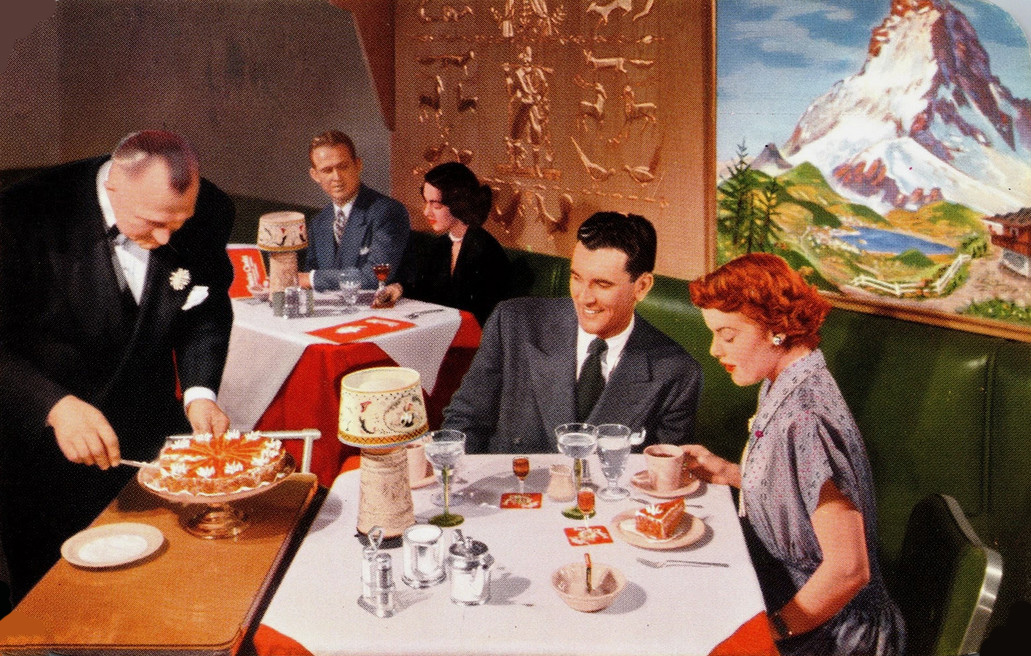
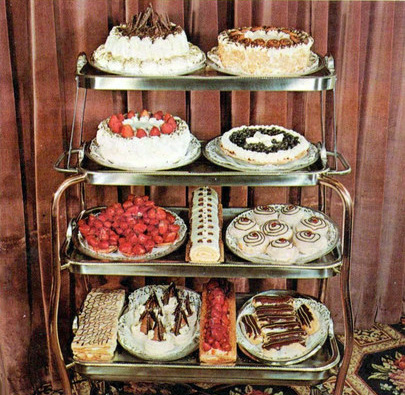
Another aspect of restaurant theater, usually less dramatic, but also certain to draw attention and oohs and aahs from patrons was the use of carts for ready-to-eat food, usually desserts.
The trend toward tableside food preparation and dessert carts came along mainly after World War II. It is not hard to imagine how restaurant goers then might have longed for normalcy and entertainment.
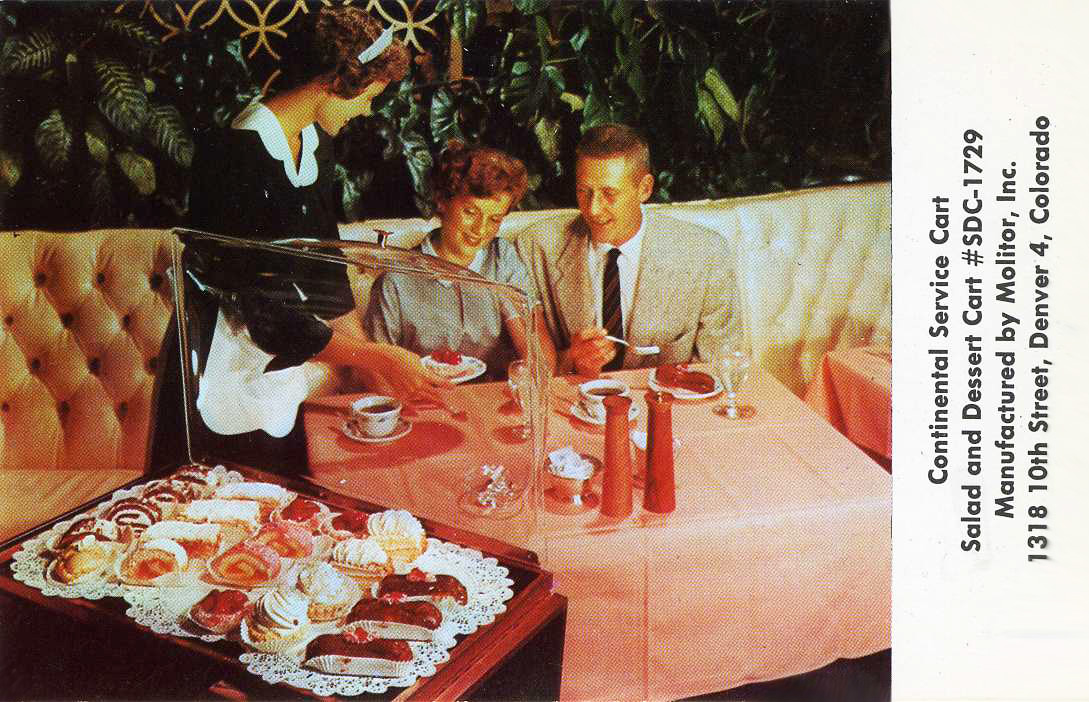
The 1950s is seen as the pinnacle decade of rolling carts of all kinds as well as tableside flambéing. Although carts with ready-to-eat desserts were likely to be found in a wider assortment of restaurants than those that provided tableside preparation, they too delighted guests. And the carts also enabled restaurants to boost demand for desserts. As the back of the postcard shown here notes, “Actual figures show customers buy more high profit desserts when Continental Carts are used to move them.” [The plastic cover of the cart shown above is not very elegant, but it was a practical way of keeping desserts from drying out.]
In Cleveland OH, the Taylor department store, inspired by New York and Europe, introduced rolling carts with salads, cold entrees, and desserts in 1950, in a space that had earlier been a cafeteria. Dessert carts were often used in department store restaurants. Chicago’s Marshall Field’s was not far behind, nor was the restaurant in Oakland CA’s airport. Pastry carts were also used at the Arnoldton, the restaurant in Trenton NJ’s Arnold Constable store.
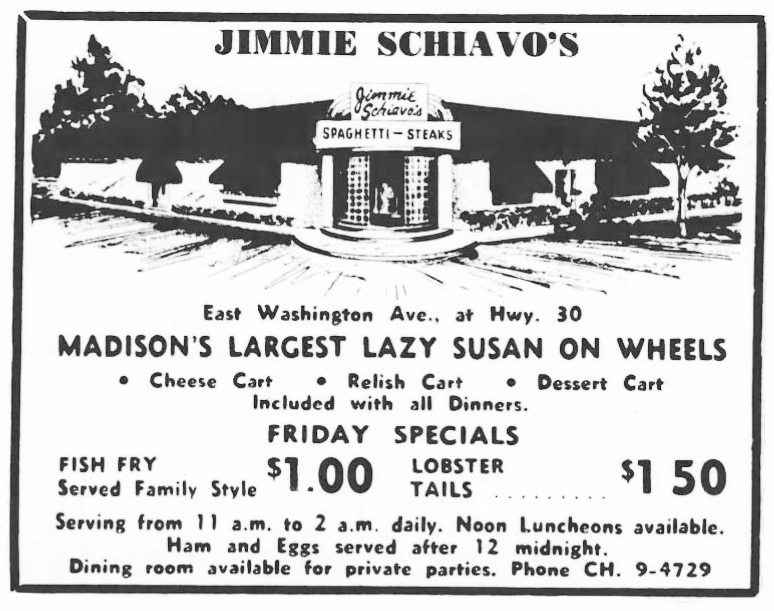
In some restaurants the dessert carts held a variety of after-dinner items including some that are unfamiliar to me. Jimmie Shiavo’s in Madison WI, which had cheese and relish carts in addition to dessert carts, offered desserts such as Italian cookies, a fresh fruit bowl, roasted pumpkin or sunflower seeds, mints, candied fruit, roasted ceci (chickpeas seasoned with spices) and “St. John’s bread” (carob bean pods). St. John’s bread turned up again at Club El Bianco in Chicago, where carts contained olives, St. John’s bread, cheese, peppers, fruits, and nuts, though whether they were all intended as desserts and grouped on the same cart is unclear.
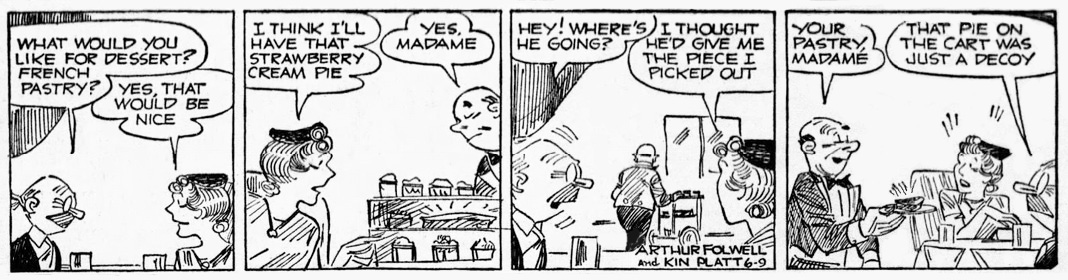
That dessert carts sell more desserts than would otherwise be the case seems to derive from their visual presentation, which is more powerful than a menu description. So it seems strange to me that carts would have items such as seeds, nuts, cheese, or other items such as those at Jimmie Shiavo’s since their appeal is not based on their looks. [The 1947 comic strip above suggests that sometimes carts were for display rather than serving.]
Tableside food presentation did not end in the 1950s, but continued through the 1960s and into the 1990s, though I have the impression it was fading by the late 1980s.
An example of a restaurant that eliminated tableside drama in the 1980s was The Buckingham Inn of Lima OH. Through the 1960s, 1970s, and much of the 1980s it specialized in luxury symbolism. Despite also operating an adjoining place called the Peanut Barrel that offered beer, pizza, and sing-alongs, it appeared to be an old English Inn adorned with knights’ armor and deadly weapons such as a truncheon and a lance. Steaks were the popular fare, but a pastry cart offered chocolate, lemon, and cocoanut cakes three inches high.
In 1986, as the Buckingham Inn’s owner made plans to replace the inn with a more casual family-style restaurant on the site, the pastry cart was auctioned along with the crystal chandeliers.
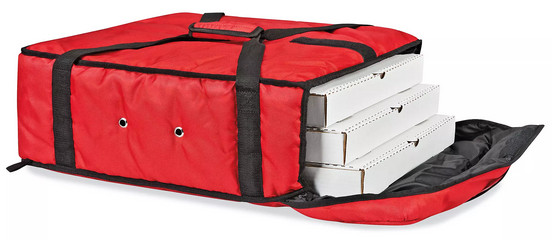
There are few Americans who wouldn’t recognize that the insulated carrying case shown here is for pizza delivery.
Of course, pizza is easier to deliver than an entire meal. Yet I just read a story in the New York Times that claimed currently, “Almost three of every four restaurant orders weren’t eaten in a restaurant . . .” And it reported that a National Restaurant Association survey from last year found that half of American adults ordered restaurant deliveries at least once a week.
The numbers of delivered meals may have grown, but the custom is far from new in this country.
Take a look at “They delivered,” a post I wrote a few years ago. You may be surprised.
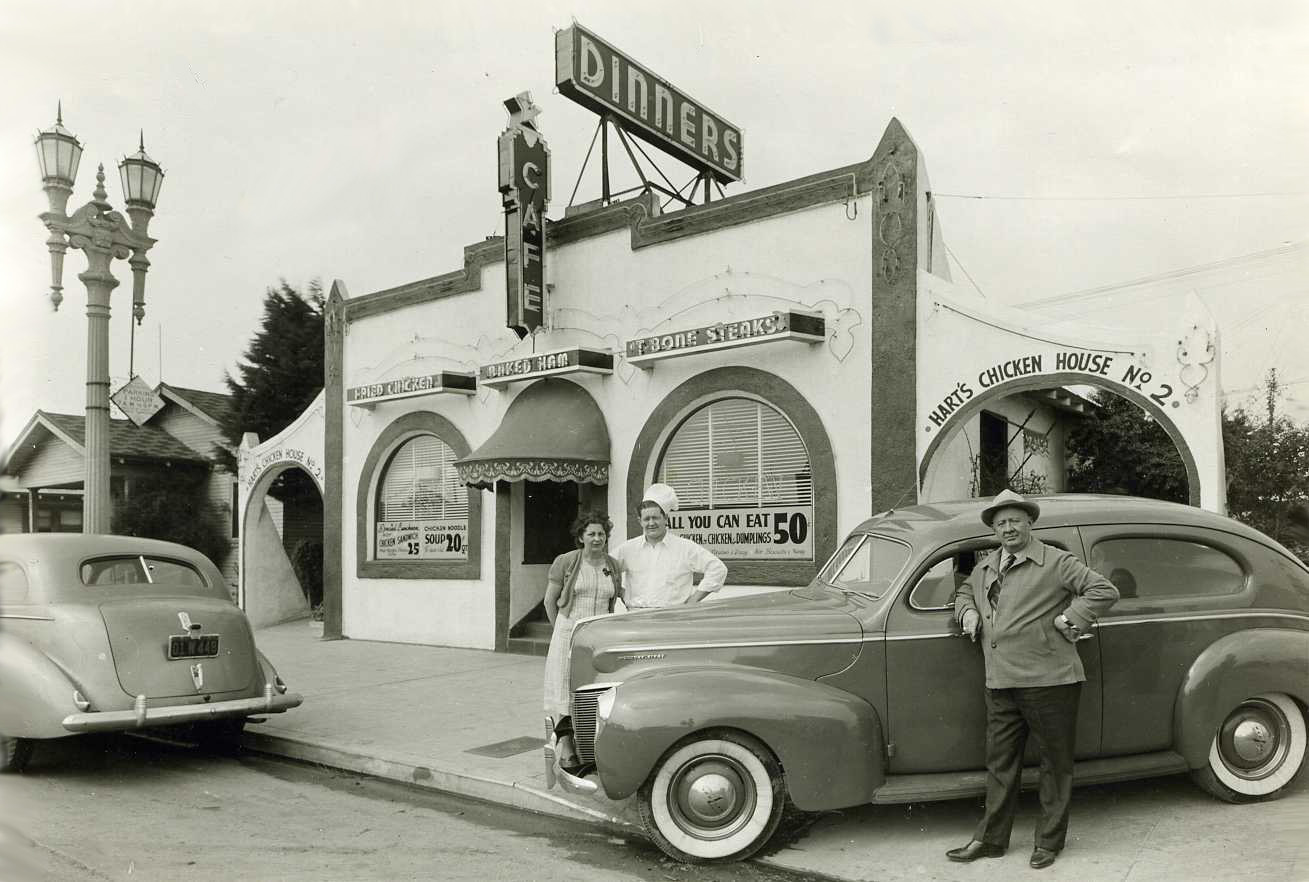
It’s snowing outside, a perfect day to look through my collection of restaurant images. This is one of my best photos and I’ve always wondered about the place’s history.
The man in the foreground is almost certainly Mr. Hart. He proudly stands next to his new car, a 1940 Hudson, while his employees — possibly his wife and son — smile in the background.
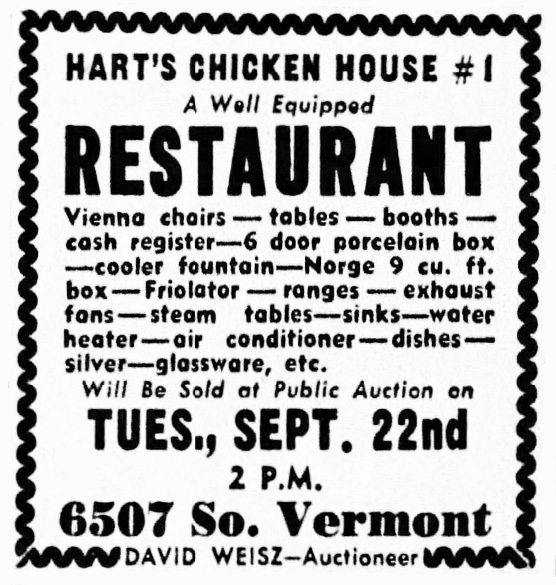
The restaurant’s history turned out to be difficult to research, but I did learn that both restaurants were in Los Angeles, and that No. 2 was at 203 W. Manchester Blvd. and No. 1 was on S. Vermont.
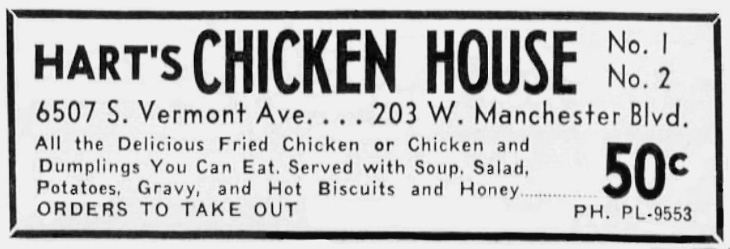
Neither location seemed to to be around for long. Already by January of 1941, Chicken House No. 1 was advertising for someone who would take a half interest in the business. Perhaps the entire restaurant sold quickly, because in May of 1941 it had a new address and was advertising “dancing & cocktails.” The October 1941 advertisement shown after the photo gives little hint that No. 1 had gone to auction already and that No. 2 had been offered for sale in April of 1941.
The for sale advertisement for No. 2 that was run in April claimed rather surprisingly that the restaurant seated 90 people and had a banquet room plus living quarters. The advertisement said it was being sold because the owner was ill.
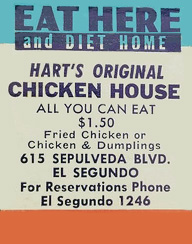
But I discovered — with the help of followers of the El Segundo Facebook group, in particular Mark Shoemaker — that the Hart father and son continued to operate a third Chicken House into the 1950s. it was located at 615 Sepulveda Blvd., where the family lived together. Note that by the time the matchbook shown here in part was produced the price had tripled.
It’s unclear how long the Sepulveda Blvd. restaurant continued in business.
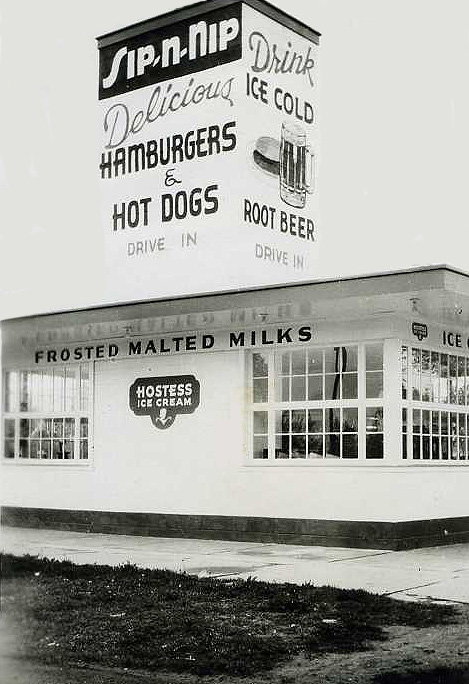
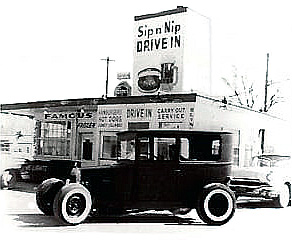
From time to time I become the lucky recipient of donated restaurant images. The most recent one is shown above, a charming small photo of a drive-in where the sign looks almost as large as the building.
The question was, where was it? It took quite a bit of sleuthing to find the answer, with searches of on-line resource by both the donor and me.
Luckily for me, the donor also became a researcher and helped nail down the location of the SIP-n-NIP in the photo.
Turns out that Sip-n-Nip was quite a popular name, sometimes with dashes, sometimes with apostrophes, or both. There was a SIP-‘N’-Nip in Tampa FL and a Sip-‘n-Nip in Baton Rouge LA, and St. Petersburg FL, not to mention similarly named drive-ins in Great Bend KS, Rayville LA, Delhi LA, Detroit MI, and Riverside CA. No doubt there were others. Plus, the name is still in use.
There were also Nip-n-Sips all over the country, but when Nip came first that usually meant it was a bar or liquor store.
Drive-in movies were popping up about the same time that the Sip-n-Nip eateries came along. The two went together, as families and teens with cars topped off movie nights with a hamburger and milkshake.
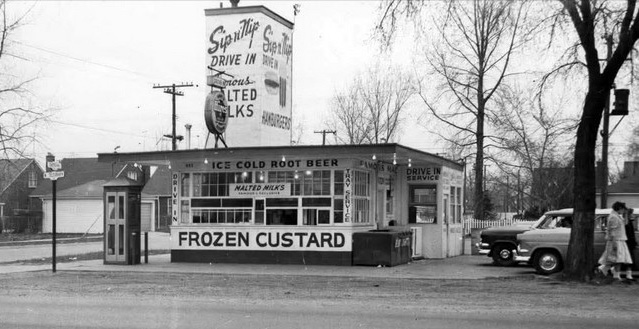
Eventually it became clear that the location shown in the small photo was Dearborn MI, on the corner of Telegraph and Sheridan roads. It was opened in the mid-1940s by brothers Stanley and Theodore Romanuk. [Above: another view of the drive-in, possibly later]
The Romanuk family also ran a cocktail lounge called the Blue Castle.
According to a presentation of the Dearborn Historical Museum, the Dearborn SIP-n-NIP was very popular with school children who stopped there on their way home from school. In the evening families came by for a casual dinner. As the evening wore on it became a gathering place for teens. [Above: Another view, possibly during a vintage car show?]
The Sip-n-Nip closed around 1960, with the widening of Telegraph Road.
That same year, in July, a waitress was accidentally killed at a Sip-n-Nip in Lincoln Park MI. The proprietor of the second Sip-n-Nip on 2031 Dix was Theordore Romanuk. I was not able to discover when that Sip-n-Nip opened or how long it stayed in business.
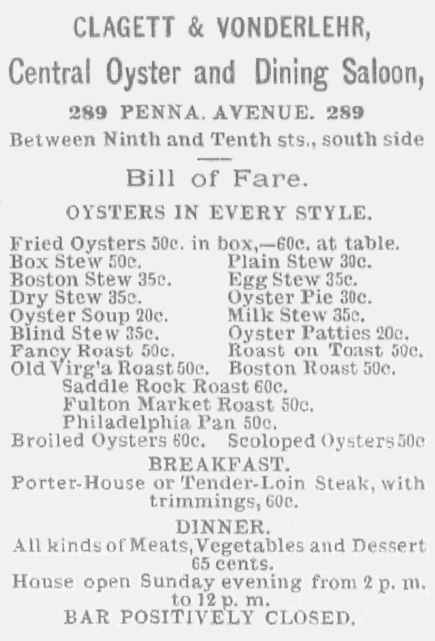
Today, going back at least to the 1950s, box stew has meant a slow-cooked beef stew. But in the 19th century and into the start of the 20th, it meant an oyster stew that featured what were referred to as box oysters. [Above: Bill of fare from a Washington, D.C. dining saloon in 1869]
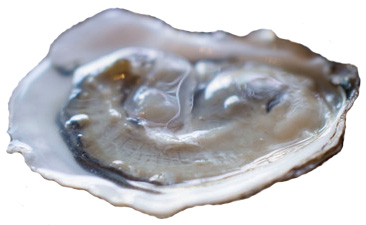
They were also referred to as “Fulton Market box oysters”, indicating that they were highly identified with New York city. “Box” oysters referred to the large saddle rock oysters found in the East River before it became hopelessly polluted. [Above: Saddle rock oyster]
Oysters were tremendously popular in Eastern cities in the 18th century, yet although there were oyster stews available in eating places so far I haven’t found mention of box stews until the 19th century. [Above: Bill of Fare from New Haven CT in 1873]
Box oyster stew was so well known in the 19th century that the term “box stew” was also used to refer to an uncomfortable state of mind. Today we might say an agitated person is “in a stew” but in 1864, in a Brooklyn Eagle news story, a committee of politicians was reported to be in “a ‘box stew’ for about an hour.”
But for those who ordered a box stew in an oyster cellar, it was a soothing dish. In an 1873 novel, the main character imagined himself having a “double box-stew of splendid East River, unlimited coolslaa (coleslaw?), and bread and butter, and a glass of creamy ale . . .”
Demonstrating the popularity of oyster, An advertisement in Port Jervis NY in 1870 from Kidd’s Oyster Bay, featured many oyster dishes in addition to Box Stew. They were Boston Stew, Dry Stew, Plain Stew, Cream Stew, Milk Stew, and Saddle Rock Stew. Having determined in other stories that Box Stew was made with Saddle Rock oysters, I am at a loss to explain how Kidd’s differentiated between box stew and saddle rock stew.
Chef and cookbook author Jessup Whitehead in 1883 noted that restaurants priced box stew at about 60 cents, describing it as “a stew of a dozen of the very largest oysters just taken out of the shells, with only a spoonful of milk and quite as much of the best butter. The oysters are dished upon a small square of buttered toast in a bowl and the rich milk and butter poured around.” He observed it was “uncommonly good eating.”
By 1905, according to a Washington, D.C. news story, box stew was then only to be found in “old-fashioned restaurants which can provide it in perfection.” [Above: Advertisement, Trenton NJ, 1901]
As sewage contaminated oyster beds along the East coast, one writer noted that it was reasonably safe to order a box stew because, unlike other oyster dishes, it was made from “oysters freshly opened for immediate cooking.”
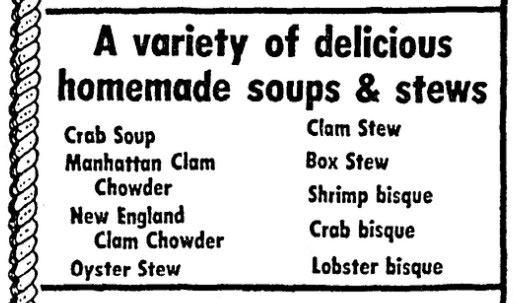
And then box stews disappeared. Or did they? Convinced that box stew was a dish of olden days I was quite surprised to discover a restaurant called the Atlantis Oyster House in Deptford NJ advertising it in 1984!
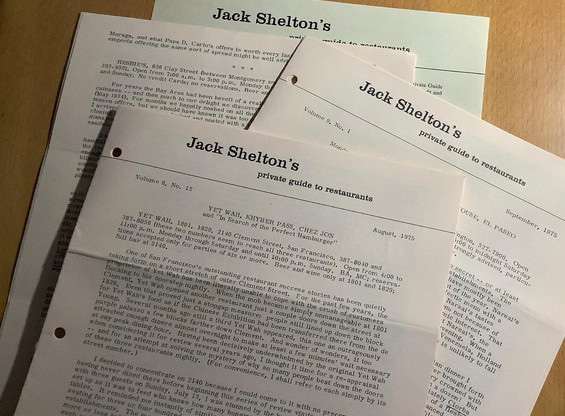
I recently bought the three newsletters by San Francisco restaurant reviewer Jack Shelton shown above. At least I thought they were written by Jack Shelton.
But I was wrong.
He began producing the newsletters in 1967, eleven years after he came to Sausalito, near San Francisco. His main occupation was producing direct mail advertising and fundraising appeals. But in 1959, before beginning his “private guide,” he had published a 94-page booklet called Jack Shelton’s Gracious Dining Guide to Outstanding Restaurants in San Francisco. Another venture was a popular book that he and his partner updated every few years called How to Enjoy 1 to 10 Perfect Days in San Francisco, which also included restaurants [shown above]. Both the guide book and the newsletter were co-authored by Jack Juhasz, but Shelton’s name was featured. Juhasz lived with Shelton and it’s likely they were life partners as well as business partners.
It did not take long for his newsletter to catch on with San Franciscans. Almost immediately he had 3,000 subscribers and the number continued to grow. Soon he was also being interviewed on radio programs and frequently mentioned in newspaper columns.
He had strong opinions about restaurants. An early citing of his newsletters noted that he was a tough critic who “finds the quenelles lacking in flavor, their sauce containing too much brandy, the escalope du veau in too thick a covering, and the salad dressing too sweet. The souffle ‘proved to be pudding-like in texture and a disappointing finale . . .’ The check, including an $8 bottle of Chateau Magdelaine (served in too small glasses), was $27.95 for two.”
He was also quite critical of waiters. On a radio show in 1968 he boldly declared, “Waiters are like dogs – they know when you’re afraid of them. Otherwise they lick your hand.”
He measured a restaurant’s quality by what customers got for their money. So he might give a more favorable review to a casual, inexpensive place such as Tommy’s Joynt or a Haight-Ashbury restaurant with a $3 wiener schnitzel.
As is almost certain to happen to any reviewer, he made some restaurant people angry. The chef of the Palace Hotel reacted badly when Shelton criticized his filets of sole in champagne sauce, saying they were “tasteless” with a “curdled” sauce. The furious chef declared that the sauce was impossible to curdle and that he disliked critics who wouldn’t identify themselves.
Shelton said he ate in restaurants six times a week, visiting those he was reviewing three times, and paying his own bill. And he tried to keep his identity secret. He sometimes wore a mask and wouldn’t allow his picture to appear in papers or magazines.
For instance, he appeared wearing a mask in 1974 when he testified in favor of then President of the Board of Supervisors Dianne Feinstein’s truth-in-menu law. It would have banned frozen dishes that were represented as fresh and other deceptions. In reply to an official’s comment that waiters might notify diners which dishes were frozen, he responded, “All waiters lie.” [Above: maskless Shelton in 1958]
Do reviewers lie too? In Shelton’s case the deception was that as of 1972 he was no longer the author of the restaurant newsletter.” He had sold his private guide to restaurants to wine critic Robert Finigan yet the name remained “Jack Shelton’s private guide to restaurants” as before.
When this became public news some reporters and columnists may have felt a little bit foolish. In May, 1976, columnist Stan Delaplane had referred to Shelton’s restaurant newsletter, calling him “the biggest hitter in San Francisco’s area.” He also reported that a restaurateur was worried that Shelton had been in his restaurant the night before. (Actually, he may have simply been there as a customer.)
It wasn’t until August, 1977, that the San Francisco Chonicle’s Herb Caen revealed that “a plug in Jack Shelton’s Private Guide to Restaurants is not a plug from Jack Shelton, since he no longer writes it” and “hasn’t . . . since 1972,” when he sold it to Finigan. Then he commented, “I thought all you people who say ‘I can’t STAND the way Jack Shelton writes!’ would want to know this.”
It isn’t clear exactly what Finigan renamed it, or exactly when, though it was during or after 1978. In 1982 I saw a mention of “Finigan’s Private Guides to Wine and Restaurants.” In 1981 Finigan had published a book about restaurants called “Robert Finigan’s Guide to Discriminating Dining in San Francisco.”
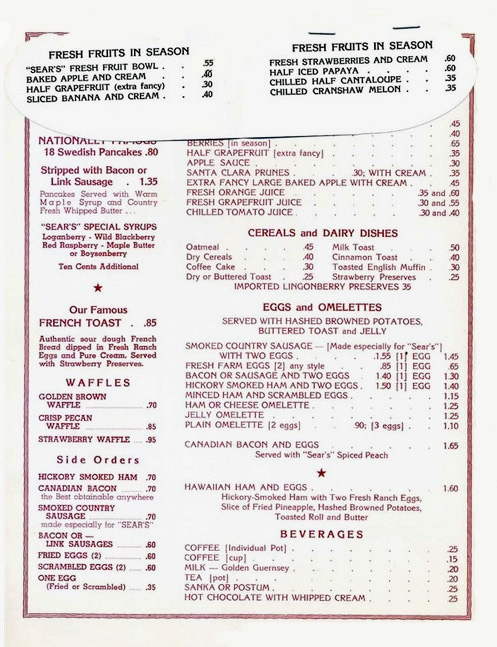
Despite not owning a true Shelton guide, I got a glimpse of a few pages from one in 1968 — when he truly did author it. In it he reviewed Rue Lepic, which he noted was a well-liked restaurant that all his readers wanted him to review, and Sear’s, which was famous for its breakfasts. [Note: the page from the Sear’s menu shown above is earlier than his review.]
Shelton remained a restaurant critic, with a radio show in 1981, but his direct mail business came first. Among the people and causes that he wrote newsletters for were Jesse Jackson and Common Cause.
Almost as soon as the Chinese began arriving in San Francisco in the 1850s their restaurant dishes became news of interest. A story appeared in major dailies in 1849 which observed that there were “two restaurants in the town, kept by Kong-sung and Whang-tong, where very palatable chow-chow, curry and tarts are served up by the Celestials.” [Above: early 20th century, San Francisco, when the dining area was usually on an upper floor; Below: elaborate interior of a San Francisco restaurant]
From the start, as this quotation reveals, there was a lot of guesswork in the identification of many of the unfamiliar dishes prepared by the newcomers. The same often applied to proper names.
But the level of interest was high, despite the fact that the Chinese themselves did not experience widespread acceptance, quite the opposite in fact. So the above 1849 report by poet, diplomat, and world traveler Bayard Taylor, which showed appreciative curiosity, stood in stark contrast to the many ugly slurs against the Chinese that would appear through the decades.
Despite the mixed attitudes toward Chinese immigration, their restaurants were popular with a wide range of patrons in early San Francisco. The most elaborate of them sometimes furnished formal banquets for visiting American dignitaries that featured exotic delicacies such as bird’s nest soup.
Although many Chinese kept their traditional grooming and clothing, they proved to be very adaptable in catering to America’s tastes and needs. Gradually moving from San Francisco to the western territory, they opened small eating places, sometimes in the back room of a saloon.
They quickly learned what their customers liked. A man named S. Ling Ning, who ran a restaurant in a mining area of Arizona, demonstrated adaptability in producing baked products, according to his 1873 advertisement.
Hateful sentiment toward Chinese had grown intense in the 1860s and 1870s, as is evidenced in a memoir by a woman who had moved to the silver mining boomtown of Virginia City, Nevada. She denounced the Chinese in the ugliest terms, calling them a “thieving, murderous, licentious, filthy, pestilential race of heathens” who should be banished from the land.
There is something ironic, if that is the right word, about ‘white’ Americans eating meals cooked by people they despised.
In 1882 the Chinese Exclusion Act prohibited the Chinese from immigrating or becoming citizens. The act was not reversed until 1943. Many left the U.S. because of the act, while others began to migrate in an eastern direction due to the level of hostility in the West where “No Chinese” was becoming common in want ads for restaurant help.
Despite the eastward migration, by 1885 there were said to be only six Chinese restaurants in New York City’s Chinese settlement area, according to a report by journalist Wong Chin Foo. Most New Yorkers were leery of patronizing them, he wrote. One of the six he described as grand, attracting “Hong Kong merchants, Mongolian visitors from ‘Frisco, and flush gamblers and wealthy laundrymen.” In other words, most customers were then limited to the Chinese. But it did not take long for the non-Chinese population of the city to “discover” Chinese restaurants. [Above: early 20th century, NYC]
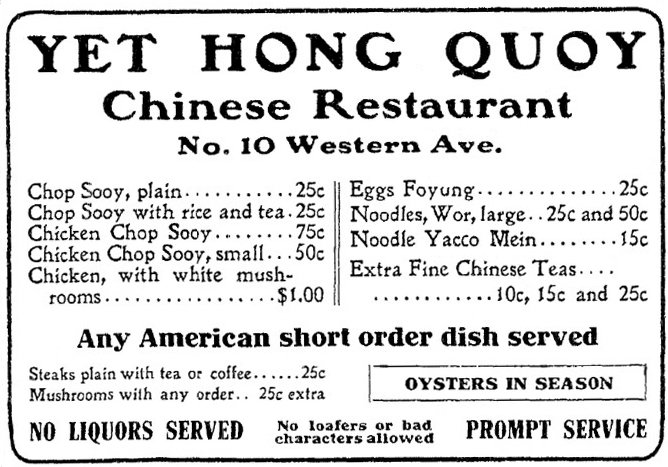
Chinese cooks continued to be highly adaptable to American tastes. Along with learning to turn out favorite American dishes such as stew, steak, and potatoes. [Above, Muskegon MI, 1906]
And there were some Chinese chefs who mastered cooking French dishes after training by French chefs. In his 1906 book A Requiem of Old San Francisco, Will Irwin notes that “most of the French chefs at the biggest restaurants were born in Canton, China.”
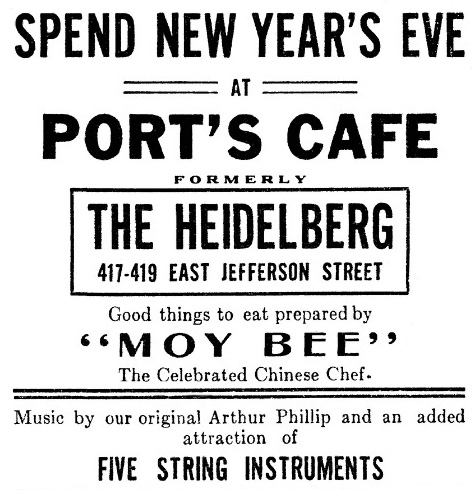
Chinese chefs also learned to prepare German dishes. James Beard and his mother were patrons of two Portland OR German restaurants, House’s and Huber’s, both of which were staffed by Chinese cooks. The venerable Huber’s was known for its turkey and cole slaw. Beard’s family meals were also prepared by a Chinese cook. [Above, Springfield IL, 1915]
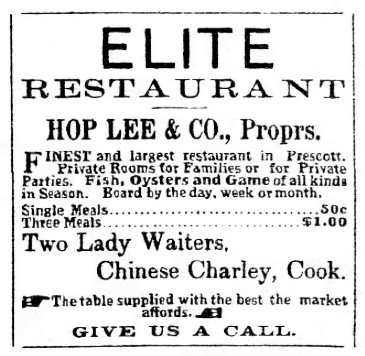
Chinese food, even when adapted to American tastes, did not qualify as a basic American “square meal” but it caught on with Americans anyway. In New York City, according to reports, among the non-Chinese population it was free-wheeling bohemians who were first to discover and enjoy Chinese restaurants. According to one observer, they were said to like the low prices that allowed them to escape from “the insipidity of cheap chop houses and the sameness of the dairy lunch counters.” [Elite Restaurant, Prescott AZ. 1892]
By 1903, according to the New York Times, there were “an estimated 100 chop suey places between 45th street and 14th and between the Bowery to 8th Ave.” However, the story continued, they were mainly patronized by Western visitors since many New Yorkers did not like Chinese servers. Chinese restaurants outside New York’s Chinatown were reportedly popular with Black Americans who hesitated to go into Chinatown but felt comfortable when many of those restaurants began to relocate.
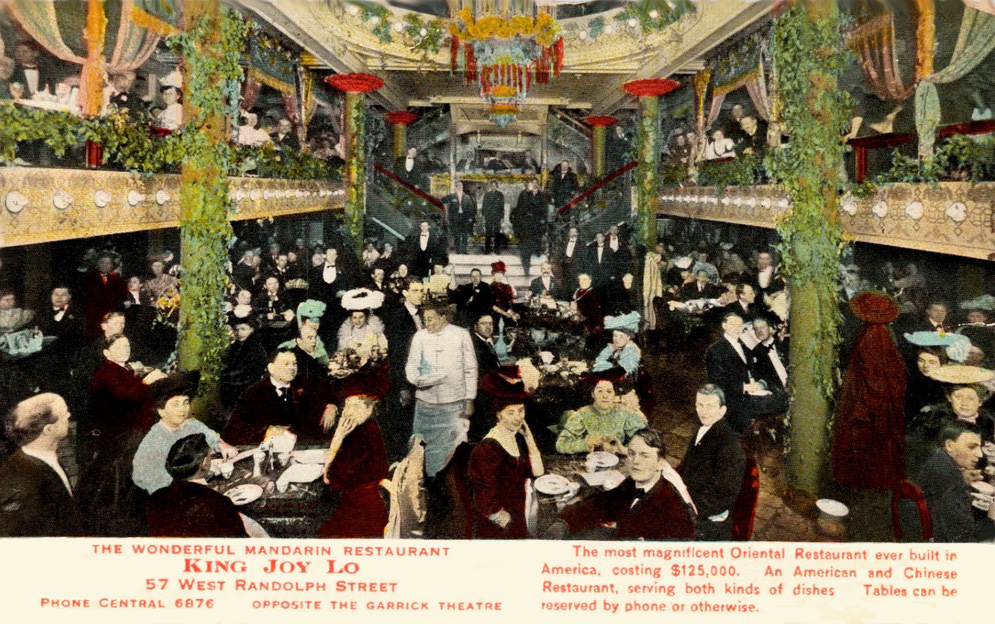
As is well known, the number of Chinese restaurants increased throughout the 20th century, eventually outnumbering McDonald’s. [Above, Chicago, 1913]
It’s difficult to assign a definite cause to the short life of Raphael’s, a Chicago restaurant that opened in October 1928 and seemed to have closed by the following July. It would make perfect sense if it had failed after the Wall Street crash at the end of October 1929, but it seems to have closed while the boom was still in progress. [Above: Detail of a platter from Raphael’s shown below, with a fanciful depiction of the building.]
Then again, Prohibition was in effect and that almost undoubtedly contributed to failure. But whatever the cause, Raphael’s on Chicago’s south side didn’t even make it to its first birthday as far as I can tell.
Judging from its exotic design, the restaurant clearly had grand aspirations. Its financial backing totaling $300,000 amounted to a small fortune at that time, equal to nearly $5,700,000 today. At least two thirds of the capital came from a major Chicago investment banker. The remaining $100,000 presumably was furnished by the restaurant’s nominal owner, Edwin Raphael.
In June of 1928, as construction began, the Chicago Tribune ran a snarky story that managed to insult the design as well as Chicagoans’ taste in general. It said that the building “should make one think he’s in Persia, provided he doesn’t know too much about Persian Architecture,” and that it was aimed at “Chicago’s epicureans – if we have any.” [Above: Raphael’s main dining room in 1929]
The layout of the building accommodated a small tea garden inside the front door that was outfitted with trees and fountains. Next came a two-story dining room accommodating hundreds, with a ceiling imitating a blue sky with twinkling stars and surrounded on all sides by a balcony that also held tables for guests. Two ends of the building provided people entering from the street access to two interior lunch counters with soda fountains. [Above: one of the lunch counters, but looking strangely like a bar.]
With its minaret, the building reached 60 feet in height and was visible for miles along all three major streets that crossed there. The minaret was used for advertising with neon lighting and a crescent on top. The illustrations used for this building, whether on the restaurant’s dinnerware [shown above] or in advertising, took great liberty in portraying it. [Below: April 1929 advertisement that imagines the building with two domes, four minarets, and palm trees!]
The main dining room featured a band named Raphael’s Persians. Their performances could be heard on the radio at night.
The March 1929 issue of The American Restaurant Magazine hailed Raphael’s for its ability to merchandise meals by “stealing the thunder” of night clubs and offering them stiff competition while putting food “foremost.” When the radio audience listened to the Raphael’s orchestra, the story said, they would feel that the restaurant had “an air of mystery about it” and want to visit “Chicago’s most exclusive restaurant.” But did they?
The combination of three types of eating places in one business was an odd one, something that would be more understandable in a hotel than a restaurant. It would seem as though the tea room and the snack bars would keep earlier and shorter hours than the restaurant/nightclub which stayed open until 3 a.m. and that this would cause staffing problems. By June of 1929 Raphael’s had figured out more ways of making money, as is shown on the advertisement below, such as afternoon dancing, an additional cover charge, and higher cover charges on weekends, but it’s likely that it wasn’t enough.
The trade journal also hailed Raphael’s for its modern kitchen facilities that were filled with the latest mixing machines, ranges, refrigerators, warmers, etc., proving “that the kitchen methods of this modern restaurant are a far cry from the methods employed when the members of Persian tribes would prepare feasts for their shahs.”
A reader of The American Restaurant would be left with the idea that Raphael’s was an elegant place catering to a clientele with sophisticated tastes. But that idea was dashed in a story written by a young reporter who spent a night there playing the part of a “shy cigaret girl.” Over the course of the evening male patrons hit on her nine times. She also observed people drinking alcoholic drinks, probably enhanced by their own whisky flasks. The crowd included teenagers. By June of 1929, the restaurant was reduced to featuring a “crystal gazer” on the balcony named Allah Mahalla. So much for elegance!
Despite serious searching I could find no advertising, nor any mention of the Raphael restaurant at all after July, 1929. In 1940 the address was mentioned as the location of a bunco party (a dice game) hosted by a political group. In 1947 the building, then occupied by a beauty supply warehouse, was auctioned for taxes. It sold for a mere $14,027 plus payment of back taxes of $11,259. The second floor was offered for rent in 1948, and it may have been then that the American Legion moved in. [Above: Could the Hippodrome have occupied the building when this advertisement ran in 1938?]
However, according to a recent Chicago Sun Times story by architectural critic Lee Bey, Raphael’s continued in business until WWII, and “later converted into the American Legion South Shore Post 388.” I haven’t been able to find out why he thought Raphael’s stayed in business that long.
Another eating place that might have once occupied the building (in addition to the Hippodrome) was the Kickapooo Inn. Its address was given as 7901 Stony Island in a 1957 obituary notice for its owner.
The building was acquired by The Haven of Rest Missionary Baptist Church in 1966 and used for church services until 1977 when they built a new church. Now the church is seeking a grant to restore the building, hoping it can be reopened in a few years as a community center. [Above: the building as it appeared recently.]
If any reader has information about this building and its uses over time, I’d love to hear from you. It could assist the church in applying for grants.
Newspaper workers, especially reporters and pressmen, made up a significant part of urban restaurant patrons in the 19th century and much of the 20th. Early on most of them were men, dropping in at all-night eateries of which there were many. Such eating places tended to choose locations close to the newspapers which were often grouped together in areas of a city referred to as “newspaper row.” [Above: advertisement for a Kansas City MO restaurant, 1940]
In his book Appetite City, about New York’s restaurant history, William Grimes notes the importance of newspapers in building nationwide interest in that city’s restaurants. He observes: “From the 1830s on, New York spawned so many papers and journals that their employees and writers constituted a sizable market, concentrated for the most part along Park Row. Moreover, journalists tended to regard oyster stands, saloons, food markets, and cafes as good copy. As the city grew and restaurants of every description proliferated, journalists turned out colorful slice-of-life stories for local and national consumption.” [Above: early 20th century postcards of newspaper rows in NY and San Francisco]
The restaurants that the newsmen patronized in the 19th century tended to be of two kinds. Either they were no frills, quick-eat places of the kinds newsboys favored, or they were places popular with artists, actors, and other free-wheeling sorts. For their evening meals, when newsmen were on their own time, they were said to enjoy the latter type of places where “there was no style, but plenty of ‘atmosphere’” such as the German “Kitty’s” on Park Place in New York with its Weiner Schnitzel and noodles.
One of New York’s best known hangouts was Bleeck’s [pronounced Blake’s] Artist and Writers, where reporters from the New York Herald were said to dominate. From its beginnings in 1925 until 1934, part of which time it was run as a so-called club in order to avoid the liquor ban, it barred women. Finally they were admitted, inspiring the unfunny comment from an old-time member, “There’ll be mayonnaise on the steak next week.” [Above: newspaper men play game to determine who will pay for drinks at Bleeck’s, 1945]
Another thriving New York restaurant with multiple locations, Crook & Duff, had a restaurant in the basement of the Times building for decades. Other magnets for newspaper folks included Jack’s, Hitchcock’s beanery, and Stewart’s in Sheridan Square. Childs’ in the Madison Square Garden building was a gathering spot for columnists, drama editors, critics, and press agents.
What might be called the Jewish newspaper row in New York was on the lower east side, which over time housed papers such as the Yiddish Daily Paper, Truth, The Day, Morning Journal, and The Forward. The Forward was located on East Broadway near the Garden Cafeteria, a gathering place for activists, intellectuals, and newspaper people, among others.
Of course New York was not the only city where newspapers, their employees, and restaurants were linked.
In Chicago, Schlogl’s, an old 19th-century restaurant, served as the newsmen’s club, watering hole, and dinner spot in the 20th century. Also known as Ye Olde Cheshire Cheese Tavern of America, it was located near the Chicago Daily News where its big round table hosted Carl Sandburg, Edgar Lee Masters, Ben Hecht, Thornton Wilder and other writers who worked for papers. But there were numbers of other places feeding reporters and printers, such as King’s, run by Mary King in the old Herald building. One of her daughters became a newspaper editor.
Boston had Thompson’s Spa. But as early as the 1870s, the editor of the newly founded Boston Globe established a lunch table at a nearby restaurant that endured for decades, hosting judges, lawyers, journalists, and business men. By the 1880s, Boston’s newspaper row was filled with dairy lunches and “temperance lunch rooms.” Other favorite day and night spots with the newspaper crowd were the various locations over time of Mrs. Atkinson’s, where baked beans and brown bread, corned beef hash, pies, and doughnuts were in demand for nearly 40 years. From the 1880s until 1919 Vogelsang’s was not only an eating place for newspaper men, but also for Democrats, making it a source for contacts and stories as well as for meals. [Above: Gridley’s in Boston’s newspaper row, early 20th century]
For decades in the teens and 1920s, and probably the late 19th century as well, Washington D.C. newspaper men enjoyed the French restaurant run by Count Jean Marie Perreard. He was known for his Bastille Day parties, where a tall Bastille made of boxes would be built in a corner to be attacked by guests at midnight.
St. Louis had Thony’s, where 19th century newsmen mingled with merchants and bankers while enjoying oysters brought from New Orleans on steamboats. Other newspaper men such as Eugene Field, an editorial writer in the 1870s, enjoyed the Old Beanery.
In the 1870s, Philadelphia newspaper workers almost certainly would have been found at the Model, which fed about 2,300 a day, joining a crowd that included the “sons of toil.” In the 1890s the quick lunch places grouped around the city’s big stores and newspaper offices would also have drawn them and it’s almost certain that later they would have flocked to the Horn & Hardart Automat opening in 1902. But the anti-alcohol emphasis of the city may have discouraged clubbiness.
Frequent employee patronage of eating places was only one way that newspapers influenced the restaurant world. Not only did the papers report on restaurants and carry their advertising, over time their role in promoting, evaluating, and rating them grew. Eventually there were formal reviews, and also gossip columns whose one-sentence quip about a well-known celebrity spotted in a restaurant was often enough to build the restaurant’s desirability and familiarity with readers across the U.S.
In the mid-20th century food columnists gained prominence. In 1962 Craig Claiborne began regular restaurant reviews for the New York Times. New Yorker James Beard [above] covered not just his city but the nation, running columns in many papers. When columns featured recipes, they almost always praised the restaurants that supplied them. And as has been observed by others, newspapers across the country were inclined toward favorable reviews for restaurants that were regular advertisers.
Restaurants began to turn to newspaper advertising in the 1920s, considering that the best way to attract customers. Almost certainly the most frequent advertiser nationwide in that decade was the low-priced Waldorf System with 94 units spread across 28 cities. Waldorfs were not fancy, but according to their ads they were extremely clean, with each unit undergoing inspection four times every 24 hours.
With the diminishment of newspapers, restaurant gatherings also ended by the later 20th century as did men’s clubs generally.
It's great to hear from readers and I take time to answer queries. I can't always find what you are looking for, but I do appreciate getting thank yous no matter what the outcome.
So, e-mail me!








 It's great to hear from readers and I take time to answer queries. I can't always find what you are looking for, but I do appreciate getting thank yous no matter what the outcome.